The blog for Mets fans
who like to read
ABOUT US
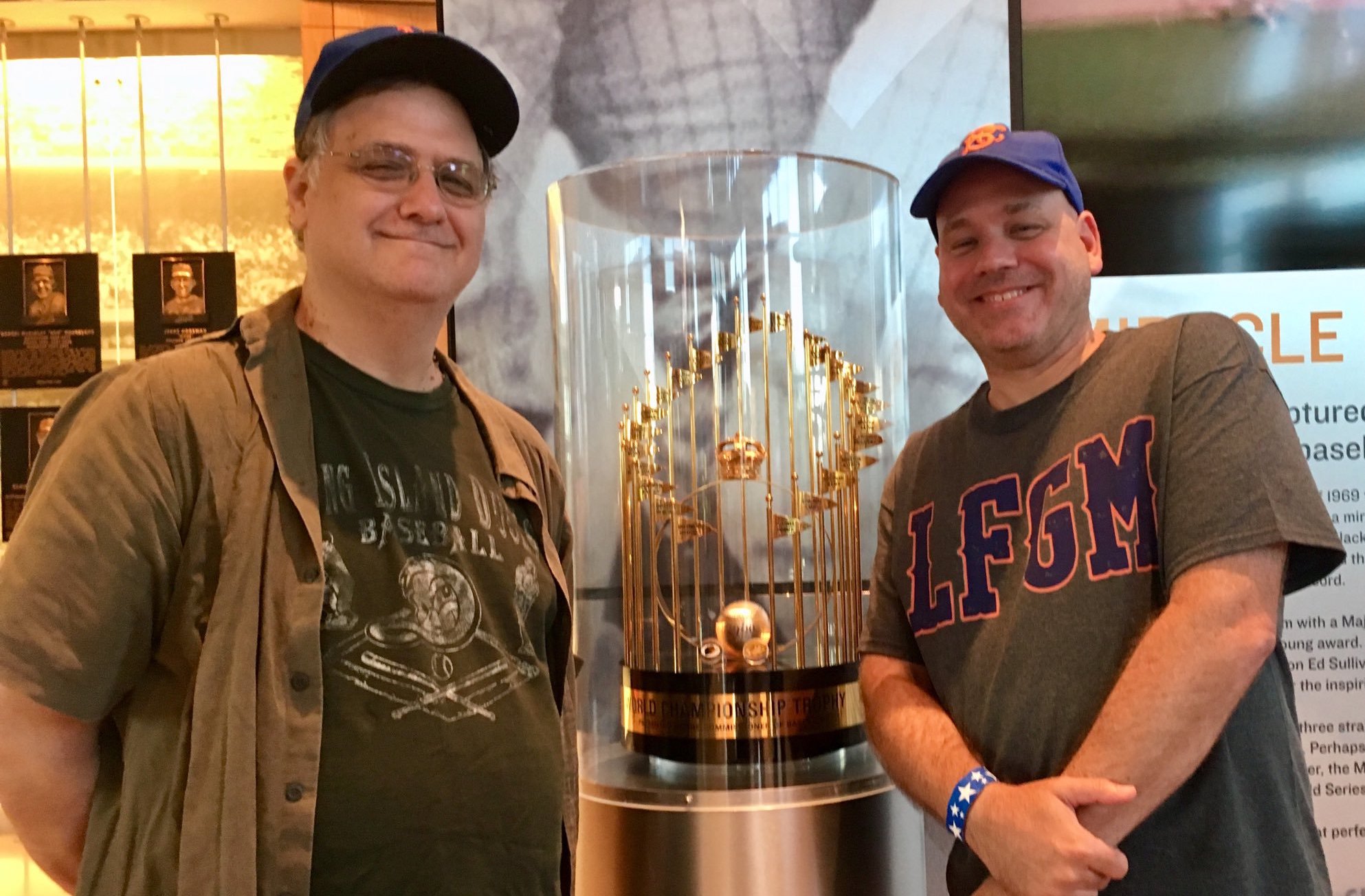
Faith and Fear in Flushing made its debut on Feb. 16, 2005, the brainchild of two longtime friends and lifelong Met fans.
Greg Prince discovered the Mets when he was 6, during the magical summer of 1969. He is a Long Island-based writer, editor and communications consultant. Contact him here.
Jason Fry is a Brooklyn writer whose first memories include his mom leaping up and down cheering for Rusty Staub. Check out his other writing here.
Got something to say? Leave a comment, or email us at faithandfear@gmail.com. (Sorry, but we have no interest in ads, sponsored content or guest posts.)
Need our RSS feed? It's here.
Visit our Facebook page, or drop by the personal pages for Greg and Jason.
Or follow us on Twitter: Here's Greg, and here's Jason.
|
by Greg Prince on 7 July 2013 9:06 pm Harvey and Hefner and…does anything rhyme with Hefner? Did you ever think we might need something that does?
The Mets have five starters in their rotation, four who are healthy, three who have proven themselves reasonably reliable and two who are extraordinarily effective. One of them is prospective National League All-Star starter Matt Harvey. He’s so hot that his clothes apparently melt right off his anatomy. The other is Jeremy Hefner. He’s the one nobody’s asked to pose nude in a national magazine — as far as we know.
Presumably no relation to the man who made a fortune making those sorts of proposals to buxom young women whose vital measurements aren’t nearly as attractive as Harvey’s have been in the first half of 2013, our Hef has been smoking like Hugh’s jacket since late May. An ERA that weighed in at five runs per nine innings has been reduced by approximately a third over his last nine starts. It’s now 3.39, or utterly presentable in mixed company. Jeremy’s going out there practically every turn, generally lasting six, seven innings and giving up no more than a couple of runs. Those are consistently quality starts, which we may mock as a metric, but when we’re talking about someone whose signature performance in 2012 encompassed seven batters, six hits, one walk and zero outs, consistent quality demands more than perfunctory admiration.
Shaun Marcum is going in for an MRI, so chances are we’ll never see him again. Zack Wheeler dares to be a work in progress. Dillon Gee is pretty close to being in a groove. Harvey and Hefner, however, are absolutely there already. Harvey was born in one. Hefner had to work to find his. As of Sunday in Milwaukee, where he struck out eight Brewers while allowing them merely two hits and one run, it can be confirmed the search is over. We are happy to learn Jeremy is packing talent to go with his heart and we are pleased to be reminded that Dan Warthen occasionally knows what he’s doing.
Which is all great when it adds up to a 2-1 win as it did at Miller Park, but it doesn’t help our Spahn/Sain cause. Harvey and Hefner and…and what? In April, Mets pitching projected as Harvey and Niese and Lord bring us peace. In our long-term dreams, we envision Harvey and Wheeler, each quite the dealer. If Dillon keeps up his end, it could be Harvey, Hefner and Gee, let’s group all three. But right now, it’s Harvey and Hefner and…and I’m still not sure what rhymes with Hefner.
Alternatively, as a Twitter pal suggested, we could just drop the whole Spahn and Sain legerdemain and dub our two top pitchers H&H Bagels in light of all the zeroes Harv & Hef are posting on a scoreboard near us. Think of the local sponsorship opportunities! Think of the Banner Day possibilities! Think of Jeremy Hefner trying to explain to the folks back in Oklahoma what the heck a bagel is! And, no, whatever it is that’s sitting in their grocer’s freezer doesn’t count.
In the meantime, Hef, just continue to schmear the batters like your teammate Harv and you’ll both be lox for the All-Star team next year.
by Greg Prince on 7 July 2013 7:56 am May my blood stop running orange and blue if I can’t deliver unto you an assessment of Shaun Marcum’s pitching, so here goes, albeit borrowed from John Adams as he critiqued a portrait intended to preserve Benjamin Franklin for posterity in 1776:
“It stinks.”
As ever, the soul of tact.
This blogger may be no Botticelli, but the subject of this blog is no Venus. I didn’t see every pitch Marcum threw Saturday night, but I got the gist early and often as he remained tethered to the Miller Park mound clear into the sixth despite his surrendering runs in most every inning possible. When the production he headlined was over and its predictable conclusion reached, it was revealed the righthander is prone to “numbness, tingling and coldness” in his right hand, sensations that grow worse the more he uses it to pitch. The decent human being in me thinks that’s probably a sign he shouldn’t be pitching. The Mets fan in me thinks 1-10 with a 5.29 ERA makes that case quite nicely, too. I’m not sure who would take his place at this point, but if you can’t dig up someone to replicate those numbers for a couple of turns in the rotation, you might want to reconsider your membership in Major League Baseball.
The Brewers cracked the shell of the egg that Marcum laid and I watched as little of it as bloggerly possible. The Mets, you see, had gotten in the way of the Princes’ proper Fourth of July observance, and we couldn’t wait any longer to get in our own makeup game.
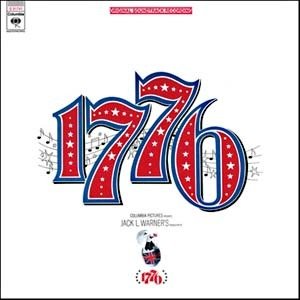 Not actually Shaun Marcum’s ERA. Every Independence Day, Stephanie and I devote a chunk of our holiday to an annual viewing of 1776, the story of how America decided to become America, set as all grand historical sagas should be: to song. I first saw 1776 upon its theatrical release in 1972, reveled in a junior high assembly showing of it prior to the Bicentennial and dropped whatever I was doing whenever it appeared on television thereafter. I introduced my then-fiancée to its considerable charms on July 4, 1991 (a double feature, actually; An Amazin’ Era opened our VHS twinbill). The Mets had a night game in another country, so our afternoon was devoted to the Continental Congress imploring John Adams to sit down and shut up…which of course John Adams was never going to do. From there, as measured by the director’s cut DVD released in 2002, it takes a hardy band of patriots not more than 2:46 and 13 musical numbers — one for every colony, come to think of it — to form a new nation.
A tradition was born. Once in a while on the Third, occasionally on the Fifth, but usually on the Fourth, it was William Daniels as Adams batting leadoff, Howard Da Silva as Franklin moving him along and Ken Howard as Jefferson driving them and the concept that all men are created equal and endowed by their creator with certain inalienable rights home. Through the commands of Generals B. Harrelson, J. Torborg, D. Green, B. Valentine, A. Howe, W. Randolph, J. Manuel and T. Collins, our viewing was inviolate. We would work around Mets game as needed/desired, but 1776 always got its due.
Then along came the Mets of 2013, who piddled, twiddled and resolved for five hours, forty-six minutes and fifteen innings this July 4. Their marathon loss to the Diamondbacks ran so long that it bumped 1776 from its projected late-afternoon/early-evening time slot. We just couldn’t get to it on Thursday. Then we couldn’t get to it on Friday. The Third, Fourth and Fifth of July had passed without confirming, per a proposal set forth by Virginia’s Richard Henry Lee, that these united colonies are (and of a right ought to be) free and independent states, that they are absolved from all allegiance to the British Crown, and that all political connection between them and the state of Great Britain is (and ought to be) totally dissolved.
Hence, our tradition got pushed back to the Sixth of July, which is to say the Princes chose freely to immerse themselves in the spirit of 1776 Saturday night and otherwise kept no more than light tabs on the spirit of 7 to 6 emanating from Milwaukee. I observed a little on Fox (what a great network for baseball!), mostly followed the bouncing diagrams on ESPN Gamecast and supplemented where necessary via Twitter. I’ve now seen 1776 23 summers in a row and paid mostly uninterrupted attention to the Mets for 45 consecutive seasons. I generally know how both are going to come out in the end. Our patriots round up enough votes for victory. Our ballplayers come up a run shy in defeat.
I could tell you all you want to know about the movie. As for further details on the game, Faith and Fear in Flushing abstains. Courteously.
by Jason Fry on 6 July 2013 12:53 am I’m sure there have been worse showcases for baseball. I’m sure I’ve even seen a few of them. But it’s hard to think of any at the moment.
My God, that was a horrible, horrible, horrible baseball game inflicted on blameless fans and viewers by the Mets and the Brewers. I gave up trying to keep track of the atrocities sometime around the third inning, throwing up my hands and letting the game degenerate into a blur of Brewers being thrown out by 10 feet, kicking balls into the outfield, flopping in the general vicinity of balls they should have had, and otherwise commencing to play stupid. The Mets had their own problems early on, but they seemed to right the ship, while the Brewers kept scooping up buckets of seawater and pouring them into the boat. It was like a “Benny Hill” sketch with all the roles played by Jar Jar Binks, a travesty so profound that eventually even Keith was overwhelmed — his metronomic sighs lapsed and then went silent, leaving him to stammer out a meek protest every so often about the decline of everything. When Carlos Gomez got himself thrown out at third with Milwaukee down four in the seventh, I just shook my head sadly. All that was missing was Dallas Green staring gape-mouthed at the field, so shocked that he momentarily couldn’t remember how to be outraged.
Amid the mess, some quick notes on Mets who managed to attract attention for positive reasons.
Ike Davis: Shalom y’all, he’s back. (Hey, Ike greeted everybody in the clubhouse with “shalom.” Just using the material I’m given.) My first glimpse of the prodigal son was disappointing — he still has that crazy hitch and 53 million other moving parts to his swing, making you wonder how he ever hit in the first place. But then I asked myself what, exactly, I thought I’d see — Ike was still going to look like Ike, not Pete Rose or Jerome Walton or Jeff Bagwell. Guys don’t retool a lifetime’s worth of batting over a couple of weeks wandering in the desert, no matter what commandments Wally Backman has to offer. He looks more patient, and that’s not nothing — his at-bats got better as the night went on. At his worst earlier this year, you felt like Ike was out before he stepped in for the first pitch. For a night at least, he wasn’t being baited into launching a long swing at junk he could only tap to an infielder, and it showed in the box score. Progress? Ask again in a day, and then in a week. But for a night? Sure. Progress.
Zack Wheeler: Reason 19,346 that it’s great to be a power pitcher is that you can survive on nights you don’t look particularly good. Wheeler was wild early, with his fastball leaping out of the strike zone in every conceivable direction, like a dog who’s been in the house all day straining at the leash. Fortunately for Wheeler, he was also throwing 96, meaning most of those misdirected fastballs went for balls or walks instead of shots up the gap. Like Ike, the most encouraging thing was that he got better, culminating in his 1-2 punchout of Juan Francisco as the tying run in the bottom of the fifth. The last pitch Wheeler threw all night was also the best pitch he threw all night. Can he build on that? I don’t know, particularly with the Mets braintrust giving him wildly contradictory advice nearly every day. (Don’t throw all fastballs! Throw more fastballs! You’re tipping your pitches! Quit worrying about tipping your pitches!) Tune in five days from now and we’ll begin to find out.
Kirk Nieuwenhuis: It’s probably just a hot streak, but the mulleted one has a pretty good thing going between his late-inning heroics against Arizona and his four-hit, two-walk, five-RBI performance tonight. Granted, massive hurler Johnny Hellweg and his successors were handing out walks to everybody who asked, but as with Ike, the most promising sign for Nieuwenhuis is that he’s doing fewer bad things — namely, getting himself out without making pitchers break much of a sweat.
But you know what? Enough. We won and they all count — even the ones where the entire other team plays like someone’s spazzy nephew mashing all the buttons on the controller at once.
And now that we’ve won, let us never speak of this one again.
by Jason Fry on 4 July 2013 8:41 pm A very long time ago, the Mets and Braves played 19 innings on the 4th of July in Atlanta. Keith Hernandez hit for the cycle, while Davey Johnson and Darryl Strawberry got ejected. There were rain delays, key blows by Ray Knight and Howard Johnson, pitching performances brave and determined and desperate by the likes of Doug Sisk and Roger McDowell and Tom Gorman and finally Ron Darling. There were fireworks that went off at 4 a.m., terrifying some residents of Georgia into thinking Sherman had returned.
And most indelibly, at least for me, there was utterly anonymous Braves middle reliever Rick Camp, who batted with the Braves down to their last out and behind 11-10 in the 18th. Earlier this week I met a fellow journalist for beers and it took us only a few minutes to go from checkpointing that we were both Mets fans to laughing incredulously at what Camp had done 28 years before. Facing Gorman, Camp swung and connected and the next sight was left fielder Danny Heep clasping his hands on his cap in a spasm of involuntary horror. The teams would play on, the Mets would score five in the top of the 19th, the Braves would claw back with two and damned if Camp didn’t come again as the tying run against an understandably disoriented-looking Darling.
Mercifully, the second time Camp struck out.
Greg, just out of college, watched and listened to it from a patchwork of Long Island locales. I, halfway through high school, watched in increasing disbelief from my parents’ couch in St. Petersburg, Fla., then wrote up a somewhat-crazed account of the game and sent it off to the local paper — the first time, now that I think of it, that I was ever moved to chronicle a Mets game and what it had been like to be simultaneously apart from it and trapped inside it.
The game has become legend, and deservedly so. But it’s a legend that still echoes through team history, perhaps never more oddly or eerily than today.
Today’s game was only 15 innings, was thankfully rain-delay-free (we’d had enough of those this week) and did not feature fireworks that will be mistaken for an enemy bombardment. And it wound up with the wrong team winning by a mere 5-4. But it had strangeness aplenty for all that — and lots of little brief-lived lessons in pluck and bad luck and inevitability.
First of all, can the Geneva Conventions be extended to ban Cody Ross from baseball? I’m sure fans of the cities where Ross has plied his trade like him just fine, but I’ve never been able to stand him — I haven’t loathed an opposing player this much since Michael Tucker. Wherein lies a terrible inevitability: Tucker, to my outrage, eventually became a Met. And Jim Leyritz also wore orange and blue, though mercifully only in spring training. I am grimly certain this means that Ross will arrive in a deadline deal one year, probably in conjunction with Greg Dobbs, the only guy I hate with vaguely comparable intensity. When that happens, it really might kill me, for I cannot abide Cody Ross’s smashed-up porcine features, his showboatery or (of course) his habit of beating us with apparent effortlessness. He’s an excrescence, an abomination, an ex-Marlin. In a couple of hours, when a chunk of blue ice falls out of the sky and smashes your car’s back window, you’ll know Arizona’s charter flight was overhead and Ross was using the lav.
Games like today’s leave you wondering if you’re watching a really taut duel or just gaping at crummy teams flailing spastically at each other, until you’re too tired to make up your mind. So both starters were good and then both bullpens were good, at least until the opposing managers found the unlucky relievers who didn’t have it. For them, it was Heath Bell and Chaz Roe; for us, it was David Aardsma, the currently dreadful [edit: and now pink-slipped] Brandon Lyon and finally Scott Rice.
But there was heroism too! Start with Anthony Recker, who walked to the plate in the 13th as the Mets’ apparent final out. Recker was 0 for 5 but had acquitted himself well in a couple of at-bats, lacking only the desired results. When he connected off Bell to keep the Mets alive, I flashed back to the game Recker lost against Florida with one of the worst innings I’ve ever seen for a catcher. If that had been Recker’s final appearance in a Mets uniform, suffice it to say there wouldn’t have been a rush to the barricades. Two months later, Recker’s not exactly lighting the NL East on fire, but he’s shown you enough to make you think he should get a chance to play more, or at least more than John Buck. Patience is a virtue!
Fairness then compels me to admit that the same gentle reminder should apply to Kirk Nieuwenhuis, whose strike-zone judgment has been pre-Vegas Ikean but who has shown a knack for pinch-hitting and late-inning homers — an inning after Recker kept the Mets alive, Nieuwenhuis hit a tracer that just topped the orange wall and somehow rattled through the bars of the fencing of the Party City deck. Amazing, though the amaze was brief-lived — Nieuwenhuis was the final out of the game, an anecdote that will give him something to discuss with Rick Camp should they ever wind up bending elbows together.
Plus there was a generous heaping of weirdness throughout: the misadventures of Arizona’s Tony Campana, whose speed is as startling as his ability to do dumb things on the bases; Gerardo Parra’s bunt double that just happened without being anyone’s fault; and Parra then short-circuiting the D-backs’ 13th by getting called out for running inside the line on his way to first. Even with six extra innings, that’s a whole lot of never-seen-that-before.
To say nothing of Keith Hernandez’s slow-motion meltdown as the game dragged on, punctuated by doleful sighs and Gary Cohen jabbing well-placed needle after well-placed needle into his broadcast partner. We were about an inning away from Keith collapsing into Dadaist poetry, which would have been entertaining provided he’d stayed away from thoughts on gender roles and kitchens, which is always a clear and present danger.
Oh, and then there were the kids who’d left the stadium in the eighth to run the bases, unaware that the game was in fact barely past the halfway mark. Presumably a good number of them were hauled off by exhausted parents before getting to run; I assume the rest grew up, went to college and started families, now and again stopping to wonder if anyone ever won that eternal and slightly interminable Mets game they attended once upon a time.
If so, those kids are luckier than we are. When Nieuwenhuis grounded out and the Mets had lost in a cool 1,776 346 minutes, I found myself surprisingly disappointed — and I realized something. It’s Independence Day, but being a Mets fan is a life sentence.
by Greg Prince on 4 July 2013 4:43 am Things that still suck, in case you thought there’d been a change:
• The Mets
• The MTA
• Cody Ross
• Fireworks Night
The Mets and their 5-3 loss in which Matt Harvey couldn’t rescue them and they couldn’t rescue Matt Harvey speaks for itself (and I believe the word it spoke was “feh”). Wednesday was yet another night of waiting, though unlike Monday and Tuesday, there was nothing worth waiting for.
Cody Ross…no further elaboration needed; I felt terrible watching Gerardo Parra bounce his head off the warning track Monday night but am not sure I wouldn’t treat Cody Ross in the same situation like a sizable plurality treated Jason Bay under similar circumstances, which is to say deplorably. So there goes my shot at the B’Nai Brith Humanitarian of the Year Award.
The MTA is on my The Out-of-Towners-style list of those people Jack Lemmon as George Kellerman planned to bring to justice. Their transgressions were…
a) not having a Super Express available after the game for those of us who preferred leaving Mets-Willets Point at 12:30 AM instead of sticking around for displays of colored lights;
b) having what appeared to be a local that would get me to Woodside in ample time for the 12:50 AM whoosh through the station without stopping;
c) the Long Island Rail Road not noticing a 7 pulling in upstairs at Woodside and holding the 12:50 to, oh, 12:52 when the next train where I, among many others, was going wasn’t coming until 2:04 AM. Nice coordination, fellas.
Oh, and Fireworks Night can blow itself. Or blow itself up. I have nothing against fireworks per se and if the Mets want to treat loyal Mets fans to fireworks after a Mets game — ideally after one that wasn’t delayed for nearly two hours at its start by omnipresent rain — that’s fine. My problem with Fireworks Night, in brief, is that it apparently attracts tens of thousands of people who wouldn’t ordinarily attend Mets games, people whose interest in the outcome of the Mets game is minimal, people who do a very aggressive wave in the third inning of Harvey Night, people who sit behind me who don’t shut up for a second and start vociferously rooting out of the blue for Cody Ross to hit one out “so we can have some action” and then Cody Ross hits one out. It was swell to have Citi Field full. It was lousy to have Citi Field full of what a dear friend aptly refers to as bananaheads.
How much did Fireworks Night 2013 suck? So much that I even briefly found myself regretting having attended Fireworks Night thirteen years earlier, for if the memory of Piazza capping off the ten-run inning didn’t burn so brightly, I might not have fallen for, “Well, they came back once before…” and made the 12:50.
And with that Metstivus litany of all the ways what should have been a splendid evening disappointed me, we reach the halfway point of this mostly miserable season on a pace for 70 wins, which sadly sounds much better than I would have expected. Besides the revelation of Matt Harvey and the plethora of weird-ass games, the big story of the first half to me is how replaceable almost everybody on this roster has been. I used to love Ruben Tejada. Now I all but forget about Ruben Tejada. My “WE LIKE IKE” t-shirt just makes me sad. If I could trade it in on a “WE DON’T NECESSARILY DISLIKE IKE, BUT, UH…” model, I would. And for all my fleeting fondness for the recent crop of retreads, I can already feel their magic wearing off. Sure, I’ll take Josh Satin (the Bronx and Staten Island) as well as EY and Brownie and whatever Omar Quintanilla’s cute nickname might be, but I can see throwing them overboard at the first sign of stagnation. If not for Harvey’s majesty and our sturdy standard-bearer Wright, I might not qualify for the fan loyalty program that would entitle me to those hypothetical earned fireworks nights.
Who am I kidding? They’ll stop blowing stuff up and Citi Field will revert back to being the province of me, Joe (who invited me Wednesday night when he lucked into primo seats and had no inkling of how much everything would suck), the dozen or so like-minded individuals I keep running into, some camp group in matching shirts, a cadre of overserved underage LIRR commuters who’ve been pounding Bud Lights since Massapequa and the occasional condescending Cardinals fan. Yeah, I’ll be back in the second half — the second half of this season and the second half of my first century. That is if my train’s on time and they start to play by nine.
by Greg Prince on 3 July 2013 10:47 am 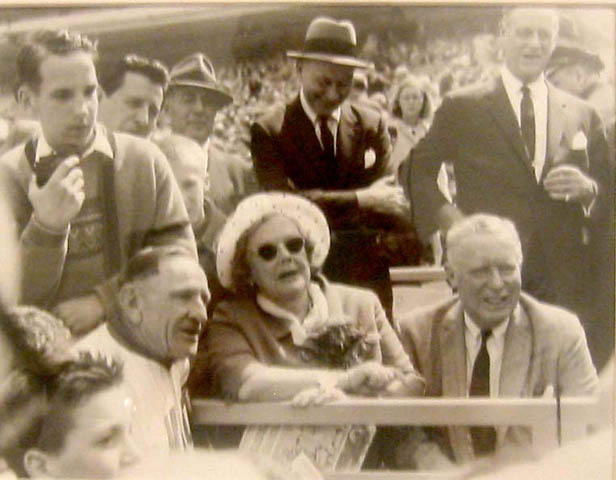 Casey and Joan get together again for a little Mets baseball. Mets fans wait. It’s what we do. We waited through four barren seasons to have National League baseball in the first place, only to wait seven seasons stuck in ninth or tenth place. The Jobian patience mandated by the minute progress of the earliest of those years may best be summed up by Jimmy Breslin’s story regarding No. 1 Mets fan Joan Whitney Payson. Mrs. Payson owned the club, sure, but that was merely a technicality of immense wealth and exquisite taste. OK, questionable taste, as it turned out once her investment showed more liabilities than assets, but she was never a boardroom kind of gal when it came to baseball. In 1966, she told the Associated Press that she was happy to be known as “just a fan”.
Just a fan who annually summered in Europe, but never a fan who could handle being completely disconnected from her team, ocean or not. Thus, in her Mets’ inaugural year of existence, pre-Internet 1962, she left instructions back in New York that she wished to be informed of how the Mets were coming along. The No. 1 fan got her wish, of course…and of course all the news wired her way was dreadful. It became a bit too much for so dedicated a Mets fan, so she wired back from the Greek isles new instructions:
PLEASE TELL US ONLY WHEN METS WIN
“That,” Mrs. Payson told Mr. Breslin, “was about the last word I heard from America.”
The waiting paid off for Joan Payson and the Mets fans who lined up behind her in 1969. “When we won first place,” she told the AP on the eve of the World Series, “I just sat there and cried. I’m still numb about the rest.”
The rest of the Mets story has encompassed plenty more waiting and not a little numbness from time to time. The franchise that famously gave us losses of 23, 24 and 25 innings in its first thirteen seasons won a West Coast contest at 4:47 AM Eastern Daylight in 1973, recorded a last out in Atlanta a dozen years later at 3:55 AM and has tried our stamina, never mind our patience, in a thousand little ways on our endless journey in their unpredictable company.
The Mets have ensnared us in waiting game after waiting game throughout 2013 in particular. The snow delays. The rain delays. The run delays. The innings upon innings when much happens but nothing occurs. The deluge of frustration. The drizzle of elation. And still more waiting. But at least it’s not surprising in that it’s not unprecedented.
One night after it took five hours and thirteen minutes to fall behind, stay within reach of, reluctantly tie, again fall behind and ultimately surpass the Arizona Diamondbacks, the New York Mets were at it again. You wouldn’t have thought so at first. Things were actually zooming right along Tuesday evening. Phenomenal Patrick Corbin and dogged Jeremy Hefner pitched quickly and effectively, which would indicate a brisk night’s work for all concerned, except for two considerations:
1) When a Met is immersed in a pitchers duel, usually the lack of scoring foretells the arrival of more zero-infested innings than the Citi Field scoreboard is capable of displaying at once;
2) If the Mets are involved, the game will probably stop for a spell in deference to inclement climate concerns.
There was hope for a breakthrough, however, on the first count. The Diamondbacks had pulled even at 1-1 in the top of the seventh, but the Mets were poised to make definitive things happen after Lou Monte roused Lazy Mary from her nightly nap. Josh Satin had driven home the go-ahead run and Andrew Brown walked to load the bases. Anthony Recker, who had homered earlier, was up. Nobody was out. It was all on the table for Hefner and the Mets to mar Corbin’s heretofore immaculate mark, cruise to a big inning and forge a situation as close to resolution as one could one hope for in this sodden season.
Ah, but the second count…the weather. It had been raining for quite a while. The umpires ignored it, the way umpires ignore baserunners sliding under fielders’ tags. Yet the skies at last demanded their attention. Here came the tarp. Here came an indeterminate pause in the action. Here came a flashback to a gloomy Sunday afternoon in July of 1987 — the Mets and Reds, tied at five in the bottom of the eleventh. Bill Almon is on second, Keith Hernandez is on first, Darryl Strawberry works Bill Scherrer to three-and-two…
And the umpires decided it was too rainy to play. Fifty-eight minutes went by before the heavy showers let up and the field could be groomed. Straw returned to the batter’s box and received ball four to put three Mets on. Pete Rose sent in a new pitcher, Bill Landrum, to face Kevin McReynolds with the bases loaded. Big Mac, never one who cared to wait around Shea Stadium or any ballpark, lined Landrum’s fourth pitch to center to create Almon joy at home plate. Mets won, 6-5, in what the box score says took 3:26 but what the rain pushed to 4:24.
“OMG I was there!!!”
Thus emanated a Tweet from a dry corner of Citi Field in response to my own Twittered communiqué of how this soggy interlude on July 2, 2013, was similar to that rain-soaked interlude of July 19, 1987. No surprise it came from @Coopz22. No surprise the Coop, as my friend Taryn likes to be known, was at a Mets game that required waiting. She was at this one. She was at the one 26 Julys before. She was at the one 22 or so hours before as well.
I knew about that last one. I was there with her. I’m often there with her, albeit for no more than maybe two innings at a time physically or 140 characters spiritually. Coop and I are always at games together. Monday night, however, was the only second time in seven seasons of knowing each other that we’d actually sat through an entire game in tandem. The last time was in July of 2009, when the Citi Field home run apple was so new and little-used that it couldn’t handle two Mets dingers in three at-bats and failed to rise punctually for the second of them.
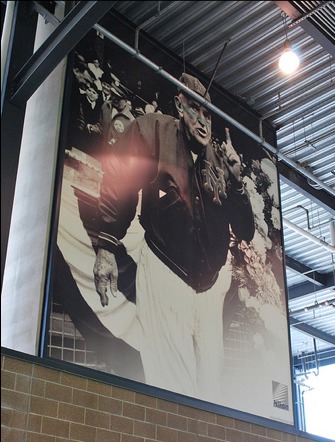
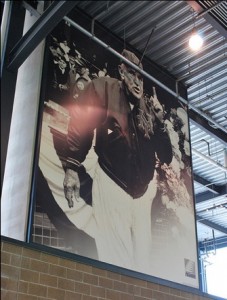 Casey, perhaps pleading for just one run. We didn’t have that problem Monday. The Mets did not test the home run apple, only our ability to endure. And that we could do. We’re Mets fans. If Mrs. Payson could do it in the days of Casey Stengel, Coop and I could surely honor that legacy. Fittingly, the seats Coop invited me to share are in the outfield section that slope down from a large Nikon-sponsored image of the Ol’ Perfesser. Every time I got up to use the restroom, Casey greeted me from the concourse wall, index finger in the air, prepared to make a salient point that the listener knew was eventually coming, albeit embedded in a torrent of Stengelese…or perhaps he was simply suggesting that it would sure be nice if his Metsies could score one run already yet.
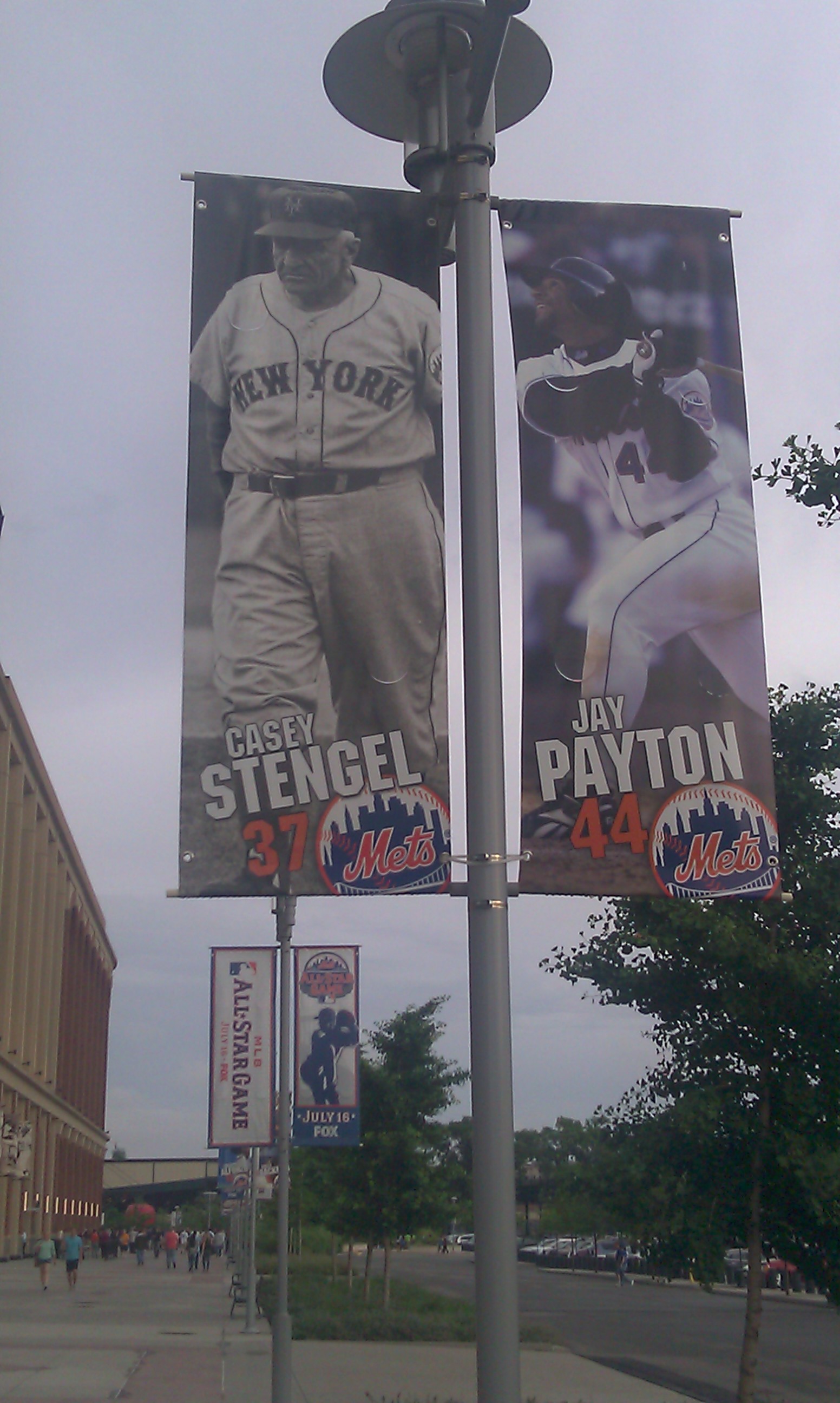
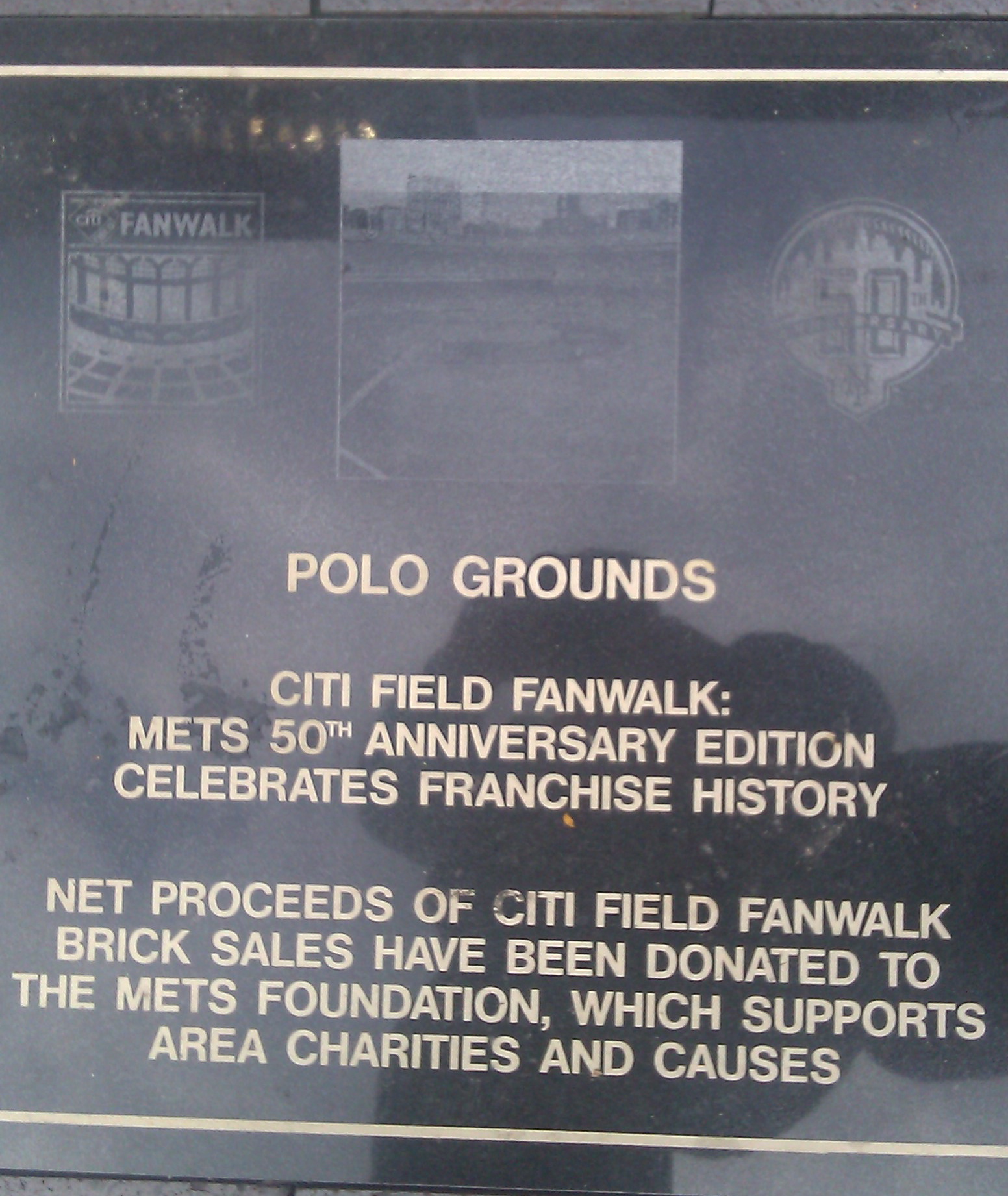
It wasn’t my first encounter with our first manager Monday. Coop asked me to meet her outside the Left Field gate, which felt as far from where I usually enter as Coogan’s Bluff is from Citi Field. Since I arrived early, I carefully inspected this surprisingly unfamiliar side of the ballpark’s exterior. I was shocked to discover a Polo Grounds plaque had been installed amid the Fanwalk bricks last year, a plaque I took it upon myself to polish a bit with a paper towel. I was delighted that the skipper had earned a lamppost banner alongside Jay Payton. I was puzzled as to why the man who invented the Mets as we know and love them was paired with — though I liked him fine — a relatively unremarkable outfielder who came along several decades later, until I decided “Payton” is pretty close to “Payson”. That’s probably not the real reason they hang together outside left field, but I’ll take it.
“If a nice lady like that calls and asks that you help her,” Casey Stengel reasoned upon his hiring in October of 1961, “what can you do?”
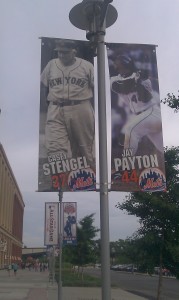 Stengel and Payson…almost. The Mets for most of Monday night were a team Joan and Casey would have recognized from when they first went into business with one another. I had the distinct feeling Coop and I were sitting in for them as nine innings proved not nearly enough. Shaun Marcum provided Arizona with an early lead and reportedly looked uncomfortable in the process. Mets runner upon Mets runner remained stubbornly on base. John Buck showed himself more Throneberry than Strawberry when he failed to take second on what should have been a passed ball that would have put Josh Satin on third except Buck needed to stay on first. If he had, maybe the Mets would have won in nine.
But then they wouldn’t have made us wait. And if they hadn’t made us wait, they wouldn’t be the Mets, would they?
So Joan and Casey, version 2.0, stuck it out. What else were we going to do? Not stick it out? If 650 people were going to stay in the stands as Monday became Tuesday — and I believe my attendance estimate to be generous — it was going to be 648 plus us, me barely managing to conjure the slightest optimism that I wasn’t about to extend my personal record onsite losing streak to ten, Coop owning her essential Coopness as only she could. Coop has authored a Merriam-Webster’s worth of essential Mets aphorisms, most of which she sprinkles casually into conversation, some of which are suitable for repeating in polite company. One of my favorites involves something or other being done with a rusty nail to those who would deprive the Mets of victory. The most on the nose addresses Post Traumatic Mets Disorder, an affliction with which we all deal. Oodles of innings and hours devoted to the Mets and Diamondbacks daring each other to win a game in which nobody deserves to prevail only contributes to this Coopyrighted condition.
Extended extra innings can bring out the punchiness in some, the irritability in others. Coop stays Coop, just more deeply. I learned a handful of biographical details between blunders and strandings. I learned Two Boots’ meatball sliders are well worth their $8.75 price tag. I learned you couldn’t pay Coop enough to become a Yankees fan for even a day, though she amended her stance that maybe you could, provided she could turn around and use her newfound wealth to buy a significant share of the Mets.
The rest of us should be so lucky.
When the real/first Mrs. Payson wasn’t on European holiday, she generally took her box seat at Shea wired to a transistor radio. “Only between innings,” the AP reported, “does the plug leave her ear. That’s when Mrs. Payson gives her attention to the fans around her and discusses the action on the field.” In that spirit, the Coop is never far from Twitter, which keeps her in touch with her thousand-plus acolytes, most notably her statistically nimble hubby Ed, who I suppose was part Charles Shipman Payson, part Arthur Friedman in our reincarnation scenario Monday night. It was via Ed via Coop that I learned I showed up a few times on SNY when its cameras followed a fly ball in our direction, which will happen when the seats well outnumber the fans. It was Ed who noted after the eleventh that Kirk Gibson and twelfth innings are a bad mix where all of us are concerned. Not that Ed suffers from PTMD, too.
It was via Citi Field acoustics (which is to say you can hear every conversation in an empty ballpark late at night) that I learned from one kid in the next section that Buck was traded here from Toronto for “R.A. Dickey, Josh Lewin and somebody else”. Also nearby: that young fellow who lives to grab foul balls, home runs and attention — he magically appeared a few rows behind where Cody Ross’s bat-flipping disgrace landed. Moments like that are what Coop’s rusty nail is for…and exactly the type of the episode that exacerbates PTMD. At least the guy who wore an Arizona Diamondbacks wrestler’s mask all night seemed happy. You’d think an Arizona Diamondbacks wrestler’s mask wearer would’ve been more demonstrative in celebrating the taking of a 4-3 lead in the top of the thirteenth, maybe furtively slipping a foreign object out of his trunks or bonking somebody with a chair when the umps weren’t looking, but no, he just politely applauded Cody Ross.
Which in itself is pretty offensive.
Well, as you know, the Mets flipped the figurative bat and any handy rusty nails right back up our old Marlin nemesis and whoever the hell is in first place with him in the National League West (where apparently they’re not too picky about such positioning). It took some more waiting in the bottom of the thirteenth: for Satin’s one-out double; for Gibson’s hilarious intentional walk of Buck, whose bat isn’t worth a dime; for 650 people — give or take the guy in the Arizona Diamondbacks wrestler’s mask — standing and applauding the pinch-hitting debut of Matt Harvey; for Terry Collins to sap the moment of its momentum let alone its optimal utility by ordering Harvey, who can hit, to bunt; for Harvey to bunt successfully, as there is nothing that man can’t do; for another intentional walk; and, finally, for Andrew Brown to turn out the lights on all of Gibson’s brilliant tactics.
Mets 5 Diamondbacks 4. My losing streak was over. I was no longer the Susan Lucci of Citi Field. Shed of the pain of channeling Erica Kane, Coop and I hugged and/or high-fived everyone in our section. It didn’t take long.
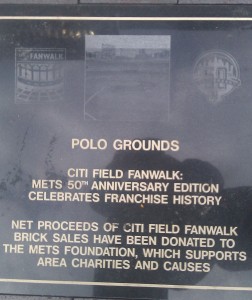 Harkness! Who goes deep there? Mets 5 Diamondbacks 4. Similar circumstances, Ed confirmed, as surrounded Tim Harkness overcoming the Cubs with a grand slam just over 50 years ago at the Polo Grounds. Chicago had taken a lead in the top of the fourteenth. Harkness took it back and then some, homering the Mets home, 8-6. The next regular-season occasion on which the Mets overcame a lead in thirteenth inning or later to win in walkoff fashion? Monday night. The Mets have been around long enough to have things happen 50 years apart. Maybe not the same thing, but close enough things. Collins had to resort to Harvey to pinch-hit in the thirteenth because he had used every position player? Stengel on June 26, 1963, explained why Harkness needed to be a hero when he did:
“We just about had to end it there because I’d run out of men.”
Mets 5 Diamondbacks 4. Same score, as Ed certainly immediately recognized, by which Gibson’s Dodgers beat our Mets 25 years ago on a night better known for what Mike Scioscia did to Doc Gooden and the rest of us sans rusty nail. In the course of what Josh Lewin (who, it turns out, was never traded with R.A. Dickey and somebody else to Toronto for John Buck) referred to as “five hours and thirteen mind-numbing minutes,” Coop and I revisited that playoff night at Shea from 1988. Coop traces much PTMD to Game Four. I countered that Scioscia didn’t beat the Mets in that series — the Mets beat the Mets in that series. Either way, October 9, 1988, was a very long game and Coop was there.
Of course she was. Or as Mrs. Payson said in 1969, “I’m with the Mets forever.”
The Coop was back Tuesday night, with she and Ed plowing through the rain delay, apprising their followers of what was going on inside Caesars Club. They found seats once the umpires decided another crowd of 650 strong had waited long enough. The grounds crew rolled up the tarp and revealed Recker still waiting to take advantage of the bases that had remained loaded through the raindrops. Brad Ziegler — who hit Justin Turner with the sacks full of Mets in my last thirteen-inning win, a shade over two years ago — was on for Corbin. Anthony singled. The Mets were up, 3-1, and if you’ll excuse the unfamiliar expression, the rout was on. Coop and Ed and their 648 companions would be released shortly thereafter on their own recognizance with a 9-1 triumph that took 2:24 in the box score and more than four hours in reality.
You wait, sometimes good things happen. More often the Mets happen. And they haven’t even visited the West Coast yet.
Follow the Coop @Coopz22 on Twitter and read her always entertaining take on the Mets and a couple of other teams at A Gal For All Seasons. Follow Ed @Studi_Metsimus and immerse yourself in his historical perspective on all things Amazin’ at Studious Metsimus. Boy, were these two Mets fans made for each other.
Photo of Casey Stengel from Citi Field concourse courtesy of Sharon Chapman.
by Jason Fry on 2 July 2013 1:15 am First reaction: We endured more than we won. And man were the other guys dopey.
If Miguel Montero doesn’t drop the ball at home plate on Josh Satin’s single with one out in the ninth, Marlon Byrd is out by seven or eight feet and we probably lose in regulation and mutter a lot. Up one in the 13th, after Satin’s leadoff double, why on earth did Kirk Gibson put the winning run on base, particularly when the winning run was John Buck, who’s been basically useless since the beginning of May and had just managed to get himself thrown out at second as the winning run +1, i.e. the run no one in the stadium cared about? Terry Collins, determined to beat Gibson to the bottom of the managerial ladder, then blithely discarded one of the Mets’ two remaining outs by having Matt Harvey bunt, but won anyway when Andrew Brown lined a high fastball up the gap. We’ll call this one Collins 0, Gibson -1, and agree that Brown spoke for all of baseball history when he told Kevin Burkhardt the game was “nerve-wracking and annoying” and he was just glad it’s over. I can’t possibly top that.
Second reaction: What the hell, we won. They all count. Oh, and pigface Cody Ross flipping your bat on your later-revealed-as-meaningless home run? YOU LOST SO HAHAHAHA.
P.S. Josh Satin is awesome. Go away, Ike. Oh, wait. Stay away, Ike.
by Greg Prince on 30 June 2013 8:58 pm Someday we’ll look back on this and it will all seem funny.
—Bruce Springsteen
Getting off my train after witnessing a 13-2 Mets loss in person — my personal-worst ninth consecutive loss at any of the ballparks the Mets have called home — I noticed a few people were arriving back on Long Island from New York’s annual Pride Parade.
Man, I thought, I’d love to someday return home from a parade full of pride for the Mets. That day is probably far off. It felt farther off than usual Sunday despite the focus on one of the leading indicators that better days are directly ahead.
Zack Wheeler couldn’t have been better in his first Citi Field inning had his name been Matt Harvey. Actually, Harvey was stomped on by the Braves in his first home inning of 2012: a walk, a fielder’s choice and a home run blasted by Jason Heyward. Harvey settled in thereafter for six unremarkably effective innings, but whatever glow was extant for the kid who had set the Diamondbacks on fire in Phoenix was briefly extinguished in Flushing. Of course it would go on to spark bigger and brighter than we could have imagined, and we all lived happily ever after every fifth day, but it was definitely on hold last August 10.
Wheeler drew a bigger crowd and set off more excitement as he paraded to the mound on the last day of June 2013, probably because the Harvey precedent has made us salivate our heads off at the idea that we could maybe get another one of those, whaddayacall, superstars practically out of the box. Zack received the same “Feels Like The First Time” introduction from the AV department that Matt did last summer and lived up to the novelty of so-called Wheeler Day immediately. Denard Span struck out. Anthony Rendon struck out. Ryan Zimmerman grounded out. Zack Wheeler, clad in the 45 made famous by McGraw and Franco and Martinez, was making it all look very easy.
But this pitching to big league hitters only looks that way, especially at the beginning of the trail. The Mets treated Wheeler like Harvey in the bottom of the first in that they put two runners on with one out and didn’t score. Then the paths of the phenoms diverged for now. The Nats beat up on Wheeler in the second and the third and the fifth, his last inning, the one he didn’t finish. By his performance, you’d never know there were special musical cues (I would’ve gone with “Heart Like A Wheel” by the Steve Miller Band over John Lennon’s “Watching the Wheels,” whose context is a bit too wistful for someone over whom we’re so hopeful), ticket deals and orange t-shirts devoted to him. You suddenly forgot Tug and Johnny and Pedro and were left to remember that 45 was also worn by Brent Gaff and Paul Gibson and Jerry DiPoto and that the one sight you’ll never see on a pitching mound is a sure thing.
Zack Wheeler wasn’t a budding ace Sunday. He was an unready rookie. That’ll happen when, perhaps, you’re an unready rookie.
We 33,366 who came out to celebrate the birth of a local idol chose instead to incubate him until he is ready. Zack was not hooted off the mound. We applauded warmly upon his removal with two on and two out in the fifth. We’re impatient by nature but we’re not idiots. We wish for Harvey II: Wheeler’s Revenge to open to rave reviews in Queens as it did on the road, but we realize boffo box office doesn’t necessarily lead to immediate critical acclaim.
Then we got back to being idiots, sitting through intermittent showers, invisible offense and Brandon Lyon. When your day’s highlight morphs from “I’m at Zack Wheeler’s first home start!” to “All right, Anthony Recker’s gonna pitch!” you should probably check and see if your health insurance covers stupidity.
What had hinted at a brighter future around 1:10 was, well before 4 o’clock, best left to the chronically dim, myself included. It became one of those days in which you and your companion debate which horrid game this is most like in your vast Met-going experience. I couldn’t decide if I was reliving the 10-1 debacle of September 2011 (a convenient precedent, as the Nationals were the opposition that gray Thursday afternoon) or the second game of the season-crushing doubleheader loss to the Diamondbacks in August 2002. That one — started by Wild Card insurance policy John Thomson — went so bad so much that my friend Joe agreed we should give up and get out, which is something Joe never does.
I was with Joe on Sunday and we stayed to the Recker end. He and I were giddy to be in on Citi Field’s first episode of Met position player pitching, but the misguided euphoria lasted all of two batters, or time enough for 11-0 to become 13-0. Once Ian Desmond landed Recker’s first strike (following six straight balls) square in the middle of the Acela Club’s Market Table, Joe capped his pen and shut his scorebook. If you know Joe as I do, that’s his version of Laurence Olivier ripping a piece of cloth from his suit jacket to signify that his rotten modern son Neil Diamond is dead to him in The Jazz Singer.
Yet we’re too stupid to stay mad at the Mets or leave them before they’re done losing more than once every decade or so. Thus, we stayed to watch Recker sew back a shred of our dignity by setting down his next three batters and John Buck hit his utterly unapplaudable home run to give us a final score of 13-2, a tally that was tangibly better than 13-0 only in that brought to mind another blowout the Mets absorbed — their first, actually. I wasn’t on hand for it, having made the mistake of not being born as of April 18, 1962, but I cherish it, thanks to Leonard Shecter’s account and description in Once Upon The Polo Grounds:
It was a cold and miserable day at the Polo Grounds and the Mets were down 15-5 with two out in the ninth. A fan stood in the aisle in right field, his shoulders hunched against the cold, his hands deep in his coat pockets. He jiggled up and down for warmth and all the time he was rooting. “C’mon,” he said, almost to himself. “C’mon, one more run, just one more run.”
“Why one more run?” he was asked.
“That would make it six,” he said. “Then you could say if they got any pitching they woulda won.”
The fan turned back toward Don Zimmer, who was at the plate. “C’mon,” he said. “Just one more.”
Zimmer popped up to the catcher.
The fan shrugged his shoulders. “Ah well,” he said. “I’ll be back tomorrow. No use giving up now.”
As a matter of fact, I will be back at Citi Field Monday night, with every possible chance that I’ll be racking up my tenth consecutive loss. But Shaun Marcum was 0-9 as of last week and he stopped his streak. And Shaun Marcum is pitching versus Arizona!
Like the man said, no use giving up now.
(P.S. Joe took the cap off his pen and reopened his scorebook for the bottom of the ninth. I knew he would.)
If you want more heartfelt Mets talk from a crazy person, listen to the interview and audience Q&A Jay Goldberg conducted with me last week at the Bergino Baseball Clubhouse when he graciously invited me over to discuss The Happiest Recap. Find the podcast here or on iTunes.
And when you see one, get yourself a 2013 All-Star Game program to read what I have to say about David Wright and John Franco as part of a wonderful article on Mets captains through the years, written by Jon Schwartz. The whole thing is a worthwhile $15 investment, actually (you can find my thoughts starting on page 269).
by Jason Fry on 30 June 2013 1:53 am On Friday night, after getting to be part of a conversation with Dwight Gooden, Greg and I were in the right-field stands, watching Matt Harvey finish up his domination of the Nationals.
“How is it this team isn’t in first place?” I asked him. “Doesn’t it feel like they should be?”
That’s what a 7-4 road trip that could easily have been a 9-2 road trip will do to you. That’s what happens when you feel uplifted by the subtraction of guys who hadn’t been getting it done and the addition of guys who have yet to disappoint you. That’s what happens when the rest of your division is a morass of meh — two underwhelming contenders by default, a rebuilding project that hasn’t figured out that’s what it is, and a cynical fraud perpetrated by a shameless huckster. That’s what happens when it’s the 40th anniversary of a little team that could despite most of a year in which it couldn’t — an anniversary that we hold dear even if the people who run the Mets aren’t interested in giving it its due.
Greg didn’t gently suggest that I’d had a few shandys too many, or point out any of the approximately 75,000 flaws with my argument, starting with the standings. We chatted happily about the resurrected Mets, as David Aardsma (“first in the Baseball Encyclopedia and in our hearts”) retired a pair of Nats.
We were still chatting dreamily about what might be when Terry Collins strolled to the mound and signaled for Josh Edgin.
* * *
150 years ago next week, two massive armies met at Gettysburg, a little town smack-dab in the middle of territories now claimed by the Pirates, the Phillies and the Orioles. The Confederate army was led by Robert E. Lee; the Union army by George Meade. They fought for three days. On the third, in the mid-afternoon heat, some 12,500 Confederates assembled to attack Union positions across a thousand yards of open field. Their charge ended with a few soldiers in gray reaching a jog in a stone fence called the Angle before being thrown back by Union reinforcements. That place is known now as the High-water Mark of the Confederacy — the closest Lee’s troops came to forcing an ending to the war different from what actually occurred, and different from the ending that became inevitable when the assault on the Angle was thrown back, with nearly half the troops who set out across the field never making it back to their lines.
I’ve stood at the Angle. It’s a sobering place. But looking across the field, you realize that no sane person would call the High-water Mark of the Confederacy the high-water mark of anything. Rather, it’s apparent that it was the horrible culmination of miscalculations, mistakes and the delusion that beating long odds was a character trait instead of a brief-lived pattern. The men who made that crossing didn’t have a chance, and their commanders shouldn’t have sent them. The disaster was foreordained.
* * *
I don’t know why I brought that up. Must just be that the anniversary’s near.
* * *
Anyway, the Mets lost on Friday night. They won today. Dillon Gee pitched well. Josh Satin looks good — amazing what young players can do when they actually get a chance to play. The Mets bullpen didn’t do anything that made you want to scream. Daniel Murphy had an adventurous, pratfall-rich trip from second to home that involved balls bouncing off infielders and caroming off Murph himself and rolling through the grass while umpires and coaches scattered. Until the play was finally over it was impossible to say with the slightest degree of certainty that Murphy would be out or safe; he was Schrodinger’s Baserunner.
It was fun. The Mets looked good. The Mets look better than they have in a while, in fact, and that’s a relief after the horrors of the spring.
They’re not going to be in first place or anywhere close to it at the end of the year, so let’s not throw anything valuable away on a lost cause. But it’s something.
by Jason Fry on 29 June 2013 12:38 am In the early 1980s the Mets were bad, baseball lost an entire summer to a labor war, and I was becoming a teenager, a transformation I navigated with the grace and self-confidence that have launched a thousand family sitcoms. Put those three things together and something not particularly surprising happened: I drifted away from the team I had loved as a child, watching less avidly, then less frequently, then not at all. I was around for the Mets of Ricky Sweet and Rusty Tillman, but they’re as theoretical to me as those of Choo Choo Coleman and Tim Harkness.
And it could easily have stayed that way. I could never have found my way back. Perhaps today I’d be your co-worker who sees your Mets gear and talks awkwardly about Rusty Staub and Lee Mazzilli, calls Citi Field Shea, then tries to segue into some vague point about the Madoffs or Ike Davis.
What brought me back was Dwight Gooden.
I can’t remember exactly when I heard about this young pitcher who’d appeared and who, I realized, wasn’t really so much older than I was. Things were different then — something caught my eye in the paper, or I heard about him at school, or caught some chirpy feature on the evening news. By May or June I was watching his starts, and starting to get excited about his teammates, who were winning games again. By July I was back in the fold — and nervous as a cat when 19-year-old Dwight Gooden, our Dwight Gooden — went to the mound in the All-Star Game at San Francisco. This was the chance for America to get a look at Dr. K outside of “This Week in Baseball” and see what we were so excited about back in New York. I was desperate for him to do well — full of jittery hope that he might and anxiety that he might not.
He struck out the side. I felt like we’d won the World Series.
Two years later, we did.
By then, of course, Gooden wasn’t anybody’s secret anymore. He’d put up one of the more astonishing seasons in baseball history in 1985, one recognizable by a single number. And, though we didn’t know it yet, seeing him in the pile after Orosco’s glove went skyward, his story was already changing. Over the years that followed I would cheer for Gooden and try to disdain him, pity him and write him off, glower at the sight of him in a Yankee uniform, applaud his moments of glory and mourn his setbacks. It got complicated, but it was always personal — because of the joy he’d brought me, and the sense of betrayal and despair he’d engendered, but underneath it all because he was the one who’d made me care again.
I say all this to explain why having Dwight Gooden walk over and sit down with us last night wasn’t just another moment in the Mets’ outreach to bloggers. I’ve been a journalist for a long time, and no longer get nervous if I’m near famous people, or talking with them. I’ve even seen Gooden up close before — as a teenager I lived a couple of blocks from him in St. Petersburg, Fla., and he shopped in the same Albertson’s that we did. But this was different. This was Doc, for goodness sake.
Gooden’s promoting his memoir, a frank look at his struggles with addiction and his efforts to overcome it. He talked with us about that, but also about Matt Harvey, and his own career, and pitching, and a lot besides.
On his memoir: He said he wrote it partially as therapy for himself, and to encourage himself to come clean with things in his past he wasn’t sure he wanted to talk about. But he said he also wrote it in hopes that it will help someone else draw lessons from the mistakes he made.
On learning to pitch: He said he was fortunate that his Dad knew a lot about pitching, teaching him the grip for the fastball and curve when he was 10, and was able to effectively serve as his coach until he went to high school and got drafted. He said that Mel Stottlemyre always challenged him, insisting there was still room for improvement — and added that it was very important to have Stottlemyre in that same role with the Yankees, even though Doc was a very different pitcher by then.
On Gary Carter: He “was like a security blanket for me and our other young pitchers,” Doc said, adding that he played with catchers who’d mope and “just put down whatever” signs when not hitting. He said Carter wouldn’t tolerate it if his focus wandered — say if the Mets were up by seven or eight runs and Doc wanted to fool around with his change-up, and would also buck him up if he didn’t have his good stuff. “He’d make me believe I had better stuff than I had,” Doc said.
On the crowds at Shea: He got adrenaline from the rising cheers when he had two strikes on a batter, and said with a smile that yes, he looked up at the Ks being hung to check how many he had.
On hitting: He acknowledged being a pretty good hitter despite never being allowed to hit left-handed, which was his natural side. Noting that he’d hit eight homers as a righty (with a .196 career average), he bet he could have hit twice that lefty. He said he’d told Davey that he hit lefty, but all thought of him doing so stopped after Rick Sutcliffe drilled him during a Mets-Cubs beanball war and he had to come out of the game.
On his 2000 start against the Mets: He was at his most relaxed and funny talking about this odd homecoming, saying he’d been working with Yankees pitching guru Billy Connors in Tampa after getting released by the Devil Rays. “I had nothing,” he said, and so when Connors called him into his office he figured he was getting released again — only to be told he was going to New York to start against the Mets. Warming up at Shea, he said, none of his pitches was working; it was so hopeless that Stottlemyre stopped offering suggestions about what to try, and Doc saw all the relievers heading down to the bullpen, which they never do that early. Then Joe Torre told him to give the Yankees whatever he had, whether it was one or two or three innings — something Doc noted managers never say. With everyone expecting him to get lit up, he said, he somehow found his pitches, scattering two runs on six hits over five innings.
On perspective: He acknowledged disappointment with himself, saying he used to beat himself up thinking how he might have won 300 games and gone to Cooperstown. But he said he’d come to think of things a little differently, remembering that as a kid his dream was to get to the majors and have a long career. He did that, won three World Series rings, and “every award a pitcher can win.” You know what? He’s right about that.
On returning to Shea for its final game: He was very nervous about returning, not knowing how he’d be received by Mets fans, and was cajoled into it by Gary Sheffield. When it rained that day, he admitted, “Part of me was like, ‘Wow, I hope they get rained out so I don’t have to go on the field.’ ” But he said he knew it would be OK before the ceremony when fans caught sight of him and some other Mets greats and started cheering — in response, he said, he got chills and teared up. He then extended an arm to us, noting that “I get goosebumps now just thinking about it.”
And after that? Well, Greg and I headed upstairs and spent a couple of innings in the press box (where he stifled a happy bleat and my fingertips came together in one abortive clap) before heading back downstairs and taking in the game from the stands. Matt Harvey, Gooden’s spiritual heir in the age of Twitter, was on the mound and he was 1985 Doc — striking out 11 over seven innings and taking a no-hitter into the fifth, which is an absurd thing to have gotten used to.
After seven it was Mets 4, Nationals 1 … and then my mind goes curiously blank. I must have hit my head or suffered some other trauma, and I have a vague worry that something awful may have happened. But how could that be true, after such a night?
|
|