The blog for Mets fans
who like to read
ABOUT US

Faith and Fear in Flushing made its debut on Feb. 16, 2005, the brainchild of two longtime friends and lifelong Met fans.
Greg Prince discovered the Mets when he was 6, during the magical summer of 1969. He is a Long Island-based writer, editor and communications consultant. Contact him here.
Jason Fry is a Brooklyn writer whose first memories include his mom leaping up and down cheering for Rusty Staub. Check out his other writing here.
Got something to say? Leave a comment, or email us at faithandfear@gmail.com. (Sorry, but we have no interest in ads, sponsored content or guest posts.)
Need our RSS feed? It's here.
Visit our Facebook page, or drop by the personal pages for Greg and Jason.
Or follow us on Twitter: Here's Greg, and here's Jason.
|
by Jason Fry on 7 June 2013 1:36 am The Mets didn’t lose! Coincidentally, they didn’t play — their game against the Nats was washed away by the advance guard of Tropical Storm Andrea, which will also wash away tomorrow night’s game here against the Marlins. We’ve been saying for some time that you should make other plans, but this time we really mean it.
As a franchise the Mets were busy, though — with their first-round pick they selected a 17-year-old kid from Los Angeles named Dominic Smith, who has scouts and front-office types gushing about his sweet left-handed swing and defense and fans ready for him to replace Ike Davis tomorrow. On Twitter, Greg noted that Smith was two days old when he and I attended our first Mets game together — Bill Pulsipher’s debut. Back then the Astros hung a first-inning five-spot on Pulse, who lost; despite being an incontinent newborn Smith probably didn’t misbehave to that extent.
In other news, both of your bloggers are now deplorably old.
I had preloaded a tweet that I thought was amusing in a low-level way: “TRAID [name of draftee here]. I WANTED THAT OTHER GUY I’VE NEVER HEARD OF.” It did pretty well, too, probably because lots of Mets fans and/or baseball bloggers were watching the MLB draft, partially because it was kind of a train wreck and partially because there was nothing else to do.
I really, really love baseball, but it’s a reach to say the draft makes for good television, even when narrowcast on the MLB Network. It was painful to watch Bud Selig squint uncertainly out at the room after the 12th, 21st or 31st intonation of the same announcement from the podium. It was ludicrous to watch swollen former players pretend to be on the phone at desks festooned with team motley. But the real problem is this isn’t the NFL draft, where draftees actually can remake their teams in relatively short order, leaving their fans to exult or despair for good reason. Dominic Smith is quite literally not done growing into his adult body, so predicting what he will mean for the Mets one day is beyond laughable. We won’t begin to have an idea for two or three years, at which point the vast majority of Mets fans will need to be reminded who he is.
Given all this, I wasn’t exactly surprised to find a surplus of ironic tweets about Smith. And I was reminded of a guy from generations ago, a guy who never got drafted and never played for the Mets.
I was reminded of Wilbur Huckle.
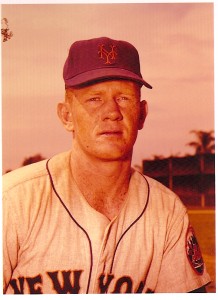 Who’s Wilbur Huckle? First the basics: He was a career minor-leaguer who logged nine seasons, all in the Mets organization, beginning with the Raleigh Mets in 1963 and lasting until his last hurrah with the Double-A Memphis Blues in 1971, when Huckle was 33. After that, he managed the Batavia Trojans of the New York-Penn League for three not particularly notable years; a fan on Ultimate Mets Database says he then became a middle-school teacher in San Antonio, adding that “I must admit that he is one of the finest people I have ever met.” Who’s Wilbur Huckle? First the basics: He was a career minor-leaguer who logged nine seasons, all in the Mets organization, beginning with the Raleigh Mets in 1963 and lasting until his last hurrah with the Double-A Memphis Blues in 1971, when Huckle was 33. After that, he managed the Batavia Trojans of the New York-Penn League for three not particularly notable years; a fan on Ultimate Mets Database says he then became a middle-school teacher in San Antonio, adding that “I must admit that he is one of the finest people I have ever met.”
Huckle has some other claims to fame of a low-level sort. He was Tom Seaver’s first minor-league roommate, and every now and then Seaver pops up on TV or in the pages of a memoir for a Huckle chuckle — he inevitably claims he only saw Wilbur when he was asleep, as the infielder was otherwise either out or taking a long early-morning walk. A few years ago, Keith Olbermann floated Huckle as a member of his Bill Sharman Society, made up of luckless players who appeared on a big-league club’s regular-season roster but never got into a game. Mets by the Numbers then disputed — convincingly, I thought — whether Huckle was actually added to the roster and so really deserved this unfortunate notoreity.
(If you’re curious — and let’s not kid ourselves, you’re long gone if you’re not — the Mets’ all-time ranks can be expanded to include nine “ghosts.” These spectral semi-Mets are Jim Bibby, Randy Bobb, Billy Cotton, Jerry Moses, Terrell Hansen, Mac Suzuki, Justin Speier, Anderson Garcia and Ruddy Lugo. Cotton and Hansen never got into a major-league game, making them the franchise’s ambassadors to the Bill Sharman Society.)
But I wasn’t thinking about any of that when Huckle came to mind. I was thinking about irony, and fandom.
Irony, believe it or not, wasn’t invented when Twitter became the darling of SXSW or our friends at Amazin’ Avenue started mocking WFAN callers with #BlameBeltran and TRAID. It dates back at least a few decades earlier — and it’s always been familiar territory for Mets fans. The so-called New Breed were masterful ironists, bringing their bedsheets and placards to the Polo Grounds, making Marv Throneberry into a cult hero, and merrily proclaiming that they didn’t want to set the world on fire, they just wanted to finish ninth.
Some of this Metsian irony was the Sixties starting to flower, and some of it was long-suffering Giants and Dodgers rooting reimagined as an allergic reaction to the boring, antiseptic Yankees’ occupation of New York City. But it proved catching, and it found a hero in the unassuming Wilbur Huckle. Sometime in late 1964, after Barry Goldwater borrowed Cicero’s line that extremism in the defense of liberty is no vice, oddball political buttons started popping up at brand-new Shea Stadium. Some proclaimed EXTREMISM IN DEFENSE OF THE METS IS NO VICE, while others pledged fealty to the Metropolitan Party. Both had the same rallying cry: HUCKLE FOR PRESIDENT.
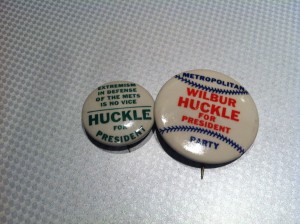 And why not? Huckle was the perfect candidate — he had that marvelous name, an unassuming blue-collar affect and red hair, making him more or less the Justin Turner of his day, except with an ocean of freckles instead of pies and “Call Me Maybe.” And because Huckle was never actually a Met except in spring-training or news briefs, he could be a vessel of hope and possibilities, with the disappointment of reality kept from intruding. And why not? Huckle was the perfect candidate — he had that marvelous name, an unassuming blue-collar affect and red hair, making him more or less the Justin Turner of his day, except with an ocean of freckles instead of pies and “Call Me Maybe.” And because Huckle was never actually a Met except in spring-training or news briefs, he could be a vessel of hope and possibilities, with the disappointment of reality kept from intruding.
Some say the Huckle buttons were the work of the Mets PR department, which I’d like to believe but doubt — if anything, the team was more square and risk-averse then than it is now. I suspect they were instead the work of some clever, bored fan in one of New York City’s many creative industries — the Darren Meenan of his day. Whatever the case, they’re wonderful — I bought a pair on eBay last year and split them up, one for Greg and one for me. They make me laugh, and they make me admire my Mets forebears, who had to work a lot harder amid similarly depressing standings. It’s easy to be ironic through game threads and tweets, but a lot harder when all you have is buttons and word of mouth and a wink aimed at a kindred spirit.
Irony, of course, can be toxic instead of gentle — it can harden into armor that deflects real feeling and commitment. But that’s not at work with the HUCKLE FOR PRESIDENT buttons — there’s a sunny optimism beneath the laugh line, just as tonight’s jibes about never having heard of Dominic Smith weren’t mean-spirited. Despite the Mets’ meek history and lowly prospects, the fans of September ’64 would have cheered rapturously for Wilbur Huckle if he’d ever made it to the starting lineup; despite the Mets’ fiscal black clouds, the fans of June ’13 happily dream of what Dominic Smith might become. Yes we mock the Mets and ourselves, but we have hope — we laugh through the tough times so we can exult in the better days that we’re sure await us.
Huckle’s still remembered, and that makes me happy. Candidates will come and go and the issue of the day will change, but that aw-shucks hope will always be a plank in the platform of the Metropolitan Party.
by Greg Prince on 6 June 2013 10:04 am As a former 35-year-old myself — I held the position for twelve months in the late 1990s — I am cheered by Marlon Byrd’s two home runs Wednesday night and the role they played in the Mets’ drubbing of the Nationals. Byrd is considered ancient, washed up, capable of playing for no better than a desperate dweller of the second division that was doing somebody a favor when they signed him. Plus he’s 35. Talk about a relic…the guy has been in the majors since September 2002! Why, that’s a whole 22 months before David Wright arrived!
It’s all a matter of perspective, I guess. Nobody was amending their “what outfield?” cracks when Byrd landed amid the Mets’ pasture of uncertainty in Port St. Lucie. There was no sense of we’re only dealing with two-thirds of a mess because this Marlon Byrd, he who had suffered beanings and bannings in the previous two years, was gonna clear everything up.
He hasn’t. Yet on a team in which Razzies could be awarded to many, Byrd’s not close to being in the bottom five, which is like being one of the best players on a good team. Or, put another way, Byrd has actually been one of the best players on this bad team.
You know who leads Mets qualifiers in slugging percentage? Marlon Byrd (.489).
You know who’s second among qualifying Mets in OPS? Marlon Byrd (.799).
You know who has as many homers (8) and doubles (7) as perennial All-Star backup David Wright and only four fewer RBIs (28 vs. 32) in eighty fewer plate appearances? Why, yes, that would be Marlon Byrd.
Your up-to-the-minute Mets WAR offense/defense (not counting pitching) leaders, according to Baseball Reference: Wright, 2.9; Murphy, 1.3; Byrd, 1.3. Then comes Omar Quintanilla at 0.3 — “Quintanilla,” if you’re not sure, is Spanish for “been here a week”. Then there are two guys at 0.2: Andrew Brown, about whom you’ve forgotten; and Jonathon Niese, and this is for hitting and fielding only, mind you.
These may be somewhat narrowly selected criteria and they may reflect as much on the company Byrd is keeping as anything (hey, we said it’s a bad team), but, y’know…it’s pretty decent in context. Marlon Byrd has risen ever so slightly above the morass and shown himself over the season’s first third — give or take a menacing fly ball here or there — as a shade beyond the prevailing sub-mediocrity that has defined our year thus far.
So, yeah, while I’m philosophically aligned with the argument against reflexively leaning on decrepit veterans when we could be learning just how, uh, crepit our youngsters are, not all dogma hunts all the time. Byrd, for example, is hitting .556 lifetime against Dan Haren after last night. Prior to Wednesday, in 16 at-bats, he was hitting .500. It would have been irresponsible to not deploy him last night of all nights.
Rick Ankiel’s extended audition suggests he can sit down, maybe even pack up. Marlon Byrd, however, isn’t the same guy, whatever temptation exists to clump every limited-future outfielder into one large Hefty Bag. I don’t grant him 30 straight starts based on last night, but I don’t dismiss him altogether based on 35 years of age. Plus, it’s the first week of June. It’s waaaay too early to commit to every flawed Triple-A outfielder on the basis of our not yet knowing just how flawed they are and what it will take to fix them. If Nieuwenhuis is sizzling, sure, bring him back. If Cowgill isn’t, then, no, don’t. There has to be some balance struck between “we’ve given up” and “we’re trying to compete nine innings at a time.” Ankiel doesn’t really help you compete. Byrd kind of does.
Of course it’s not too early for showcasing veterans. The best-case scenario for Byrd is he’s splashing around in the fountain of youth and leading the Mets, at 37 or 38, to grand things. The next-best? That he continues to hit occasionally competently for another six weeks and nets you something promising by July 31. Now that Shaun Marcum has regained major league credibility, I’d consider him in the same realm. Some contender might have a use for a “proven” right arm and you benefit accordingly. So let’s run Byrd out there semi-regularly and Marcum every fifth or so day. And then, come August 1, when the Mets’ season is only technically still going, you play every kid you have.
Until then, enjoy Marlon Byrd when he’s homering twice and succeeding intermittently. He’s more or less your third-best everyday player. If that’s what’s facing you every day, sometimes you have to relish what the day presents.
by Greg Prince on 5 June 2013 1:36 pm I have so much to tell you. I don’t know where to start.
—Masha to Jerry Langford, The King Of Comedy
He’s just some fan. What do you expect?
—Alison the surly fact checker, Almost Famous
So many games like Tuesday night’s. So many road trips like the one that has wound winless from Miami to Washington. So many seasons like 2013. Too many eras like the current epoch through which we persevere while grasping at distant straws from before and after the short straw of the present as proof that things have been better and that things will get better.
Why are we Mets fans again?
Oh right, because we’re Mets fans, which is my easy and self-evident answer, or as my blogging partner once countered, “What are we gonna do — become Phillies fans?” You pick your team, or your team picks you, and you’re off to the pennant races if you’re lucky, or a long-term rental of fourth place if you’re not.
But you’re in it for the long term. You’re in it for sweeps by the Marlins and blows to the Nationals even if that’s not what you were looking for. Which you weren’t, of course, though sometimes (ofttimes, really) that’s what you get when you fall in love. Your team is your team. You root for them as Chaka Khan might: through the fire, to the limit, to the wall.
And if you were one of the very first Mets fans when you were just eight and you had a predilection for speaking into inanimate objects and pretending you could be heard by people who couldn’t see you when you were only five, you broadcast them that way. If that’s your story, then you’re Howie Rose, who lays out his life and times relatably, navigably and refreshingly in the aptly titled, recently released Put It In The Book!
I love Howie Rose’s book because I have spent more than a quarter-century kvelling that Howie Rose is the Mets fan he is and channels it so professionally. No “we/us” on the air for someone whose formative years quite obviously dripped with first-person plural. That’s OK when you’re a kid whose attachment to a team is as emotional as it is anything. It’s OK for an overgrown kid like me to say “we,” I figure, because I’m sitting here wrapping myself in blue and orange, investing my time, money and soul in a team for whom I’m intermittently answering out on the hustings. “Hey Greg,” I’ve heard once, twice or a thousand times in my life, “what’s wrong with your Mets?”
I never stop to correct my inquisitor that they’re not my Mets. Because they are, give or take a 50.1-percent ownership stake. And they’re Howie’s Mets as much as anybody’s. He made that clear when he introduced himself to me through the radio late in Spring Training 1987 when he voiced promos over WHN promising that his new show, Mets Extra, with its 75 minutes of pre- and 75 minutes of post-game depth, would be a “dream come true” for Mets fans. I could tell by the way he delivered that line that he wasn’t reading from somebody else’s script. Only a lifelong Mets fan would think a cumulative two-and-a-half hours spent dwelling on the Mets before and after at least two-and-a-half hours of a Mets game itself would be nirvana.
 Where dreams came true. Twenty-five years of Mets baseball was in the books by then and another 25 or so have passed since. Howie’s been around for all of it, first as an eight-year-old who quite reasonably inferred in 1962 that they were “a team created just for me,” and for decades as someone charged with communicating that sense of proprietariness to millions infused with the same illusion. None of us is wrong. Your team is your team…your team. You might conjure a fancy reason for it based on your psychological self-profile or you might be the kind of guy Howie and I are, if I may narrowly lump us together: we really like sports and we take our teams within them very seriously.
Listening to Howie in his five-hour nightly slot in WFAN’s early years — a period Rose quite frankly doesn’t miss — I knew I was listening to someone who got it. He didn’t talk down to me or around me. He talked with me. There were no pretensions of experthood and nothing shticky about it. It was informed, it was lively, it was engaging. I never called Howie Rose at (718) 937 et al, but I maintained a running dialogue with him from 1987 to 1995. He’d talk and his thoughts crackled across 50,000 watts. I’d think he’d made an interesting point and come up with one of my own in my head. Maybe I’d say something to the radio. It was never contentious. It was usually in agreement.
That give-and-take returned with Howie’s book. A lot of “yeah, that’s right.” Some “you think so?” Now and then, “no, no way!” It’s as much interaction as I needed amid what’s part fan memoir, part broadcasting manual, part Mets narrative. I already knew the Mets parts, but not exactly where Howie was at crucial stages of the franchise’s development. I knew he had a career in broadcasting before Mets Extra but didn’t know the extent of the ins and outs (particularly fascinating to me was his noting he never left New York to garner out-of-town experience the way young broadcasters from around here are traditionally instructed). I guessed he probably had some intriguing interactions with characters who’ve come and gone from the Mets dugout, and indeed our lead radio announcer shares quite a few insightfully. It’s not that I needed to know more than Howie Rose was a helluva talk show host and the most comforting sound AM radio can beam this side of a warm and sunny five-day forecast, but what a treat to get all that.
And speaking of treats, I finally got to talk to Howie Rose because of this book. Not in my head, not in the car, but by phone — the way Emmis Broadcasting always intended.
This is the fringe benefit of blogging (another discipline Howie expresses some dismay over on page 203, but never mind that right now). A publicist asks if you’d like the opportunity to have a conversation with someone you’ve been listening to for more than half your life. You put on one of those cartoon bursts of speed that lands you in the next frame before the publicist has had time to place the question mark at the end of his inquiry. Hell yes, I’d like to talk to Howie Rose, I essentially said.
My first mission was not to guest-host The Chris Farley Show. You know: “You’re Howie Rose…remember that time you had Lindsey Nelson come on the line to congratulate Bob Murphy on being voted the Ford C. Frick Award in 1994? Yeah, that was awesome!” Believe me, I could’ve done that all day, but I don’t think that would’ve served any purpose amid what I had to approach as a professional media interaction. Give me a wide enough opening and I’d be Sandra Bernhard knitting Jerry Lewis oversized sweaters, though hopefully not as I held Howie hostage while Rupert Pupkin sat in alongside Josh Lewin.
Still, Howie Rose…on the phone…with me…and no microphone or producer between us. It wasn’t a dream come true for this Mets fan because who would have dared dream such a thing?
I behaved myself. I kept it as professional as I could. I did allow myself a little coda to tell him that as much as I enjoy his play-by-play — the thing he always wanted to do — what I really loved was his unfailingly classy talk show hosting — a job he saw primarily as an avenue to a ballpark or arena booth somewhere…and, oh yeah, the thing I really loved about him was something he hasn’t done except in cameos for eighteen years. Maybe tomorrow I can catch Will Smith coming out of a theater and swoon over “Parents Just Don’t Understand” while I’m at it.
Howie was quite gracious about it anyway. The entire exchange was cordial all around. No oversized sweaters in sight, all of my Farleyesque instincts properly tamped (“you remember how you called Steve Somers from your hotel room after the Mets lost Game Seven to the Dodgers in 1988 and sounded legitimately disgusted…that was awesome, too, albeit in an unfortunate context”). I don’t get paid to blog, but I conducted myself like at least a semi-pro.
We talked about Matt Harvey, who at that moment wasn’t far removed from his “HARVEY’S BETTER!” start against Stephen Strasburg. Howie said the scene at Citi Field that Friday night was so reminiscent of Doc Gooden riding high in the mid-1980s that “the only thing missing was Huey Lewis doing the national anthem.” We talked about Citi Field maybe not shaking like Shea Stadium but giving a hint that it can get excited by a big moment. We talked a little about the status of the Mets Hall of Fame, on whose selection committee Howie serves, but he didn’t offer any revelations about who might be considered next and if anything will happen soon.
We talked about a passage in the book involving Billy Wagner and Latin players, with Howie mostly reiterating what he wrote. We talked in what I hoped would be a non-snarky way (on my part) about Wayne Hagin — the challenges of working with a partner who isn’t steeped in Mets lore the way every current Mets announcer is — but I think it came out a little snarky when I invoked Lorn Brown never having heard of Banner Day. We talked about one of my favorite theories of Mets fandom, that we take our team more personally than most other kinds of fans and that Howie deciding at the age of eight that the Mets were invented just for him is emblematic of that phenomenon, but he kind of shot that down with (and I’m paraphrasing), nah, he was just being a dopey kid.
And we talked about the night the Mets went seven over, which is the kind of memory that makes Howie Rose one of us; makes Howie Rose’s broadcasts the aural equivalent of bumping into a favorite old acquaintance; and makes Howie Rose’s Put It In The Book! such a satisfying read.
Howie has repeatedly mentioned the Jimmy Qualls game over the years and he details his presence at Shea for it in the book. He should. It was the milestone of initial Mets contention and, as he put it, the “turning point” toward their miraculous coming of age. There’s been a Mets no-hitter at last, thankfully, but nothing could ever precisely supplant the Tom Seaver masterpiece of July 9, 1969, a game ever so slightly besmirched by an utterly unknown Cub entity (if Jimmy Qualls played in 2013, he’d surely be a Mets outfielder, probably sitting behind Rick Ankiel) yet incapable of being tangibly sullied. It’s a night that lives eternally in the Met bone marrow.
I didn’t want to ask Howie about Qualls. I wanted to ask Howie if there’s another game whose heart goes on for him. Not Seaver’s one-hitter, not Swoboda winning that game in 1966 off Bill Henry, even (another gem from his youth that Howie generously reminisces about in his book). Give me, if you can, a game nobody ever mentions in Happiest Recap form — give me a game that stays with Howie Rose, maybe only with Howie Rose.
So he did. He remembered a Friday night at Shea in 1969. It took place, he estimated, before Qualls, but after Clendenon came over at the June 15 trade deadline. As long as he was sitting by his computer, he checked Retrosheet to confirm. Yup, it was in the time frame he thought: June 20, the Mets playing the Cardinals.
Howie was there as part of a paid crowd of 54,083 to witness Nolan Ryan taking on Bob Gibson. This, he explained, was before Mets fan thoughts had turned to challenging for the division, let alone the pennant or World Series. The question on everybody’s minds was, “Can we actually have a winning record for the first time?” The Mets entered the night at 33-27 and, after Ryan bested Gibson (with two RBIs from Cleon Jones and three relief innings from Tug McGraw), they were exiting it at 34-27. Remember, the Mets had never been anywhere near .500 for the first seven years of their existence.
Remember? Who could forget? Who among Mets fans could have imagined this dream coming true? It was as silly in 1969 as me thinking that at any time since 1987 I could be chatting with Howie Rose. Yet here they/we were, winning record well in hand with a smidge more than a hundred games to go. Howie certainly couldn’t forget.
Why not? Because as Howie waited for the Bayside-bound Q27 at Flushing-Main Street, some kid with his head in the exact same space yelled over to the 15-year-old future voice of the New York Mets, “Seven over!”
“I’ll always remember that,” Howie added. And now so will I.
Because you’re a Mets fan, purchase Put It In The Book! by Howie Rose, available via Amazon and other fine retailers. Give it for Father’s Day. Give it for Graduation Day. Give it to yourself any day. You may sometimes be sorry you hooked up with this team, but as long you’re attached, you might as well enjoy all that Metsdom has to offer. It doesn’t get a whole lot more Metsian than this…in a good way, I mean.
by Jason Fry on 4 June 2013 11:28 pm Monday was one of the better days to be a Mets fan of late.
Monday was also an off-day.
It’s always bad when it gets to this point. It’s worse when this point arrives not in the second half of August, that cruel period that has a way of revealing your maybe-sorta-kinda-.500 club as a 72-win team, but in early June.
Yet that’s where we are, with plenty of season left to play.
It’s a shame, too. Jeremy Hefner was terrific tonight, and I like Hefner — he’s a hard worker and a smart pitcher and the kind of guy that’s easy to root for. Nothing that happened out there was his fault.
I like Bobby Parnell, too. He’s evolved into a solid closer, having entered the evening with just two blown saves, neither of which were his fault. He seems to have gotten over the hyperventilating, MUSTTHROUGHBALLEVENHARDERANDSTRAIGHTER mentality that made him so frustrating as a younger pitcher. More significantly, he’s learned a fiendish knuckle-curve from Jason Isringhausen. One imagines he also learned a few things about the volatile, frustrating life of a late-innings reliever. The story interests me, because it’s an example of something statistics can’t capture: Parnell pretty clearly learned something from his apprenticeship with Izzy (and I mean something beyond the Will to Win or some other lazy sportswriter’s Just So Story), something that’s valuable but defies measurability.
This time, though, what happened out there was definitely Parnell’s fault. He was terrible, and got beaten so quickly and efficiently that you’d have thought his name was Mariano Rivera. If you’ve been a baseball fan for any amount of time, you witness such games and learn your own guy-on-the-couch version of the closer mentality: It happens, there often isn’t any reason for it, so forget about it.
This dose of philosophy doesn’t make games like that suck any less, of course.
Since the word “suck” was trotted out, let’s talk about the larger sense in which Parnell’s failings weren’t his fault: The Mets’ offensive was substantially aided by the Nationals’ ineptitude, and still produced only two runs, leaving their pitchers with zero margin for error. This team has a good hitter who can’t do it alone, a couple of OK hitters who run hot and cold, some bad hitters who should be in the minors or bettering their duck-hunting skills, and various other misfit toys that should not be amassing hundreds of at bats a year.
The Mets are a terrible offensive club. That puts them in a guaranteed hole most nights, forcing their not-bad starters to tiptoe across the high wire and hope their shaky defensive avoids numerous land mines and their so-so bullpen doesn’t implode. Most of the time this difficult-to-execute plan goes less than perfectly, with results that are predictable and depressing. It’s an excellent blueprint for losing games by the bushelful, and that’s what the Mets are doing.
And it’s what they’ll continue to do unless something significant changes. That something has nothing to do with Zack Wheeler, who could fulfill his potential and join his rotation-mates by dropping 3-2 and 2-1 decisions. Do the Mets have the stomach to make those changes? Do the Wilpons have the money to make them matter? Ask me again in another five losses. Or 10. Or 20.
by Jason Fry on 3 June 2013 12:07 am The funny thing is I’m not sure I actually know what Greg Dobbs looks like.
Ask me to picture Chase Utley or Robinson Cano or Brian McCann or Ryan Zimmermann and I can instantly conjure a mental picture for you. Dobbs? I’ve got nothing except a general impression of squatness.
But maybe that’s appropriate. Just as a tornado or a tidal wave or an earthquake looks different depending on your vantage point, Dobbs looks different depending on what havoc he’s wreaking on the Mets. The constant is that he’s wreaking it.
LaTroy Hawkins’ pitch to Dobbs in the bottom of the eighth — the one he blasted down the right-field line for a three-run homer — was the final one I heard today. I snapped my earphones out of my phone, shut down AtBat and declared the finale of a thoroughly misbegotten Mets-Marlins series over a few minutes before it was actually so. The whole game had been a mess for me anyway — my battery was streaking towards empty and the radio feed kept cutting out, much like the Mets’ hitting, pitching and fielding. And when the Mets were at the plate in the middle innings, even a brief interruption could mean quite a few at-bats disappearing: Between the sixth and the seventh inning the Mets saw a grand total of 11 pitches. They then went down 1-2-3 on 10 pitches in the eighth. Way to make ’em work, fellas.
The rest? Matt Harvey was bad — incredibly and then resignedly. So was Scott Rice. And so was Hawkins. All three of those players have been somewhere between pretty useful and amazing this year, so it’s impossible to get too worked up about bad outings that happened to coincide. But that streak of frantic outmaking is harder to shrug off. And so are the galling misplays by Rick Ankiel and Lucas Duda.
Sigh. It feels like that four-game sweep of the Yankees happened around 140 B.C., doesn’t it?
by Greg Prince on 1 June 2013 8:37 pm Tomorrow we’ll start
Matt Harvey
Nothing could be better than Matt Harvey
He’s the one
Just thinkin’ about
Matt Harvey
Clears away the Collin and the feelin’
That we’re done
When were stuck with McHugh
And Super 2 excuses
I imagine an arm
That’s not so useless
Tomorrow we’ll start
Matt Harvey
Hotter than Cholula
Says the gun
Matt Harvey! Matt Harvey!
I love ya, Matt Harvey!
You’re only a day away!
We were squished by the Fish
And Kid Fernandez…
Couldn’t even be cheered
By Keith Hernandez…
Yet tomorrow we’ll start
Matt Harvey
Harvey Day is always marvy
Score a run!
Matt Harvey! Matt Harvey!
I love ya, Matt Harvey!
You’re only a day away!
Matt Harvey! Matt Harvey!
We love ya, Matt Harvey!
Why can’t you
Pitch every day?!
by Jason Fry on 1 June 2013 12:00 pm Howdy, Jupiter Pirates fans!
This is a page welcoming you to Faith and Fear in Flushing, which Jason writes with Greg Prince. It’s a mildly insane blog dedicated to the daily adventures and misadventures of the New York Mets. If that sounds good to you, glad to have you aboard — click here to go to the home page. But first, you should know that this blog sometimes contains bad language — Greg and I get cranky when the Mets lose, which happens way too often.
If this doesn’t sound like where you want to be, click here and you’ll return to the Jupiter Pirates page.
by Greg Prince on 1 June 2013 2:06 am A one-night pass was issued in advance. When the Mets sweep the Yankees, you cannot in all good faith complain about the next loss, even if it is to the frigging Marlins at their frigging boondoggle aquarium in front of a few dozen exotic fish and maybe a few dozen more curious onlookers. Shaun Marcum threw six fine innings but couldn’t quite make it seven. Jacob Turner, of course, turned into the second coming of Mordecai “Three Finger” Brown, except with a fully armed right hand. It made the five-game winning streak a vague memory and reminded us that the 2013 Mets are a precarious proposition on a night-to-night basis, no matter the opponent…but especially when the opponent is the homestanding Miami Marlins, who beat almost nobody ever, but us alarmingly frequently.
I’ll admit that after the Mets had blazed their way from desolation to the fringe of prospective mediocrity, I was kind of perusing the standings with a purpose, scoping out the schedule strategically and wondering about Wild Cards. I might put that project on indefinite hold for now. Too bad the dream of not being terrible has been doused again, but, hey, one-night pass, right? The Mets were going to suck sooner or later. Would you rather it have been Friday night in dim, dull and dreadful fashion against one of the few teams that are palpably worse than they are or have had it happen anytime between Monday and Thursday?
I do know this: We have however many games left this year and they will matter to me as Mets games do. They’ll matter to you within the parameters of your sanity and other plans. I mention this fact — the kind you’ll find on the nose of your face it’s so plain — because during what passes for Subway Series hype these days, I kept hearing and reading a common condescending refrain: this is the Mets’ last chance to be relevant in 2013.
Excuse me? Relevant to who? I’m a Mets fan. The Mets are relevant. Period. Their games may not wind up relevant to a pennant race, which is unfortunate. They may not wind up drawing many eyeballs to their network or fannies to their seats as the months wear on, but I’ll be watching and I’ll (likely) be going and they will be intrinsic to my pursuit of happiness. That’s what being a fan is about. Your team may not captivate you at every given moment, but they’re always relevant to you. I know they are to me.
To those media members who don’t or won’t try to understand how that works, I’m sorry you can’t figure out how to create a decent column or segment out of them. I’m also sorry you lean on the crutch of “this will be the highlight of the Mets’ season” when the Subway Series rolls around, and that’s before you know how it comes out. Listen, I enjoyed the hell — the hell — out of the Mets’ four-game sweep of the Yankees, but at the risk of taking your lazy nonsense too literally, use your heads, for crissake. You don’t know what the highlight of any season is going to be. And you don’t know how it’s going to be processed individually, let alone collectively.
One year ago tonight, you didn’t know that the Mets of 2012 were going to put up a highlight for the ages. I was pretty sure we got our highlight for the season when Johan Santana pitched the First No-Hitter in New York Mets History, but you know what? There were other highlights. There were lowlights, too. I probably haven’t gone a day without happily thinking about that no-hitter (regardless of Terry Collins’s endless buzzkill mea culpas) yet the season went on, y’know? There was R.A. Dickey knuckling his way to 20 wins and a Cy Young. There was Ike Davis occasionally blasting out of his doldrums. There was Scott Hairston doing things from time to time that suggested his might be a valuable bat to keep around. There were moments and innings and games and series that expanded the Mets fan experience for the better…and plenty that contracted it for the worse. The story didn’t just stop. When you’re paying attention, it never does.
The Mets play 162 games in a regulation season. Since we’ve been doing this blog, they’ve never won fewer than 70 games in any one of them. Do you have any idea how many times some above-average win has been referred to as “the best” or “the biggest” win of a given year? And do you have any idea how quickly they are brushed aside by the next one? Some stand the test of time and others need a nudge to nostalgize, but great wins do keep coming. Sometimes they don’t come in bunches, but they do arrive. They’re enchanting as they happen and they’re beautiful in hindsight, but none is ever the last win standing.
In 2004, the Mets swept the Yankees three games at Shea Stadium for the first time. It was such a welcome accomplishment that it felt like history stopped. It didn’t, though. We didn’t sit around dwelling on the heroics of Ty Wigginton and Richard Hidalgo for the next three months. The season continued. There were wins that, at the instant they went final, topped the victories over the Yankees from early July because the Subway Series had subtly receded into the past and this latest win, whatever win it was, was what just happened. And the win that just happened had the added value of obscuring the losses that had more recently mounted. (This was 2004; there were a lot of losses in the second half.)
This doesn’t go just for Subway Series and dismal seasons. Think back to September and October of 1999. Was there a more dramatic win down the stretch than the night the Mets singled Greg Maddux into a corner before John Olerud rocked his world via grand slam? No, nothing could top that…not for another couple of nights until Robin Ventura delivered the must-win run in the eleventh inning of the must-win game versus the Pirates…and not again for two more days when Melvin Mora scored on the wild pitch in the bottom of the ninth to force a one-game playoff. And nothing could top that. Except maybe for Al Leiter’s two-hitter in that one-game playoff. Or besting Randy Johnson in the opener of the actual playoffs. Or Todd Pratt winning that round of those playoffs. Or Olerud keeping the Mets alive in the next round. Or Ventura ending the fifteenth inning the night after that.
Baseball’s genius and generosity is that it’s always giving us more. In 1999, there was every reason for a Mets fan to pay attention to all of it. In 2004 and 2012 and (probably) 2013, your reason is that you are a Mets fan and you shouldn’t want to miss the irreplaceable good thing even if it takes some stoic sorting among the myriad bad things to find it and treasure it. In the end, listless losses in Miami notwithstanding, the effort tends to be worth it.
by Greg Prince on 31 May 2013 2:27 am After more than a year-and-a-half in dental denial that those random pains in my mouth were nothing that couldn’t be artfully ignored, I submitted to inevitable oral surgery this past Tuesday. Though I wouldn’t recommend it for a lark, I put myself in the hands of capable, caring professionals who made it nothing like the horror show I anticipated. They couldn’t tell from my instinctive clenching and whimpering, but I actually handled the procedure pretty well. Still, recovery has been a drag: soreness, ice packs, disgusting salt-water rinses, antibiotics, painkillers, a persistent sinus headache, very cautious chewing on one side and a bonus overnight bout of nausea for my trouble. As Keith Hernandez might suggest (albeit between licks of a Tootsie Pop), let this be a lesson to you kids out there: go find yourself a dentist you like and make regular visits — you can’t mollycoddle your choppers.
In my post-extraction fog, everything that smacks of routine has come to annoy me, including sitting down in front of the television at 7 PM to watch the same old Mets take on the same old opponent night after night after night for…what was it now? Four nights? “Are we playing the Yankees again?” I asked in exasperation.
Then I snapped out of my fog and smiled as much of a smile as 30 teeth hampered by one slightly puffy cheek could generate. Why, yes, we were playing the Yankees again. And because we put ourselves in the hands of capable, caring professionals, it was nothing like the horror show I anticipated. You couldn’t tell from my instinctive clenching and whimpering, but the Mets handled the procedure exceedingly well.
Thus, for those of you who might have thought trying to sweep an entire home-and-home Subway Series from the Yankees would be like pulling teeth, I can assure you it’s not.
It was a lark…a lark in our park and a lark in their park.
We took a bite out of the Yankees and it was delicious, however we managed to chomp down on them. The Mets’ preferred method was by nearly flawless starting pitching, which in 2013 tends to mean Matt Harvey and several days of dreaming about Matt Harvey, yet this week it has meant everybody, encompassing the most unlikely of characters. Like Shaun Marcum, who kicked off this five-game winning streak by mowing down our former rivals, the Braves. Like Jon Niese, who didn’t let his non-serious shoulder issue stop him from elbowing aside the Yankees on Ted Nugent Appreciation Night. Like Harvey, who only counts as unlikely here because he had company in pitching brilliantly. Like Jeremy Hefner, to whom Mets wins are no longer chronically allergic.
And, finally, like erstwhile bulldog Dillon Gee who used to stand and fight until Terry Collins had to drag him off the mound, but this season had this unnerving habit of chasing the bullpen cart into traffic by his third time through the opposition order. That Gee had gone so wayward that we were about to find himself lost from the rotation. Oh, but Thursday, as the Mets’ Subway Sweep that I ordered in 1997 was finally delivered into my waiting lap? This Gee pitched and pitched and pitched some more. This Gee could have gone the full nine and another nine on top of it. I knew it, you knew it, my periodontist knew it.
Except Terry Collins. He somehow knew that removing a starting pitcher who had thrown all of 88 pitches, retired his previous 15 batters and struck out the last five in defense of a 3-1 lead with five outs to go was the move that absolutely needed to be made. If Terry were a contestant on Beer Money, you suspect he’d answer the $10 question and walk away unwilling to risk greater success. His decision to lift Gee while Gee was as completely unhittable as he was suddenly hairless was undoubtedly a minority opinion, but given that Collins is the manager, his opinion was also the only one that counted.
So out went Dillon Gee from the game of his life — and the night we’d all been dreaming of ever since somebody decided forcing the Mets to play the Yankees annually would create an irresistible, platinum-priced treat — and in came Scott Rice. Rice has been used so much that if a teammate gives him a particularly effusive high five, Rice’s left arm will fall off. But the important thing is Rice has earned his slaps and claps this season and, though it was still a weird call to the bullpen, Scott did it again. He popped up Ichiro Suzuki and struck out Brett Gardner, and the Mets were one inning from a sweep.
A four-game sweep of the Yankees. The Yankees of Reid Brignac and David Adams and Chris Stewart, yes, but the recently first-place Yankees nonetheless. The same Yankees whose pinstripes, we’ve been repeatedly informed, transform scrubs into stars; pump youth serum through the veins of dried-out husks of has-beens; and generally demand genuflection based on reputation and presumed intimidation. The current Yankees still have plenty of players who have proven they can beat the Mets, but most of them watched this series in navy warmup jackets from their dugout or, perhaps, luxury condominiums in the Tampa Bay region. The Mets, on the other hand, entered this series mostly with guys who haven’t proven anything anywhere. All told, the only two things the Mets and Yankees of the moment had in common were a city and a talent level.
The neighborhood is still the neighborhood, replete with ill-mannered neighbors who don’t mind letting us know which way the wind usually blows, which is why any of this garners our extra attention. The neighborhood’s playing field, no matter what the respective records say, had been leveled. Ours was a crummy team. Theirs, according to my friend Pythagoras, had been indisputably crummier for three straight nights (because crummy team beaten by crummy team equals crummiest team cubed). Then, in the bottom of the ninth inning on the fourth straight night, Bobby Parnell — who is closing ballgames like he expects to be presented one of those sweet commemorative fire hoses in a dozen or so years — did what Mets closers haven’t done routinely since before there were Subway Series to save. He retired Robinson Cano and two guys who used to be Vernon Wells and Travis Hafner.
Subway Series sweep. For the Mets. Not of the Mets, but by the Mets. The Mets ran 27 rings around the Yankees. Three of the four games were close but all four Mets wins were decisive. It was Gee and Rice and Parnell. It was Byrd with a massive homer and Buck with a perfectly poked infield hit. It was Wright starting a nifty double play to pick up callup Quintanilla after an error and it was Quintanilla walking to set up the all-important insurance run.
It was all about “up” for our Mets of New York, New York, this helluva town. Queens is up. The Bronx…not so much. And Broom(e) Street was where all the action happened these past four nights when the routine of plopping down on the couch in the wake of having my teeth pulled couldn’t have been much more enjoyable unless it had happened in some distant October. Can’t do anything about the calendar, though. We play ’em when we play ’em and we play whoever they suit up in their precious pinstripes. Here at the end of May 2013, we played the hell out of ’em.
As this week ends, I feel I’ve traded two upper molars for four magnificent wins. I also feel I got a very good deal.
And you get yourself a very good deal on some other very great Mets wins right here.
by Jason Fry on 30 May 2013 1:34 am Go figure. After somehow overcoming their own lack of hitting and boneheadedness afield to take two from the Yankees at Citi Field, the Mets made the very short trip north to resume hostilities in the Bronx with the likable but generally luckless Jeremy Hefner on the mound. So of course they leaped on David Phelps like a psychotic jack-in-the-box, barraging him with hits and working walks and hitting balls at pinstriped infielders who booted them. Phelps got one out while surrendering five runs and slunk off to lie down in a dark room, wondering what the hell had just happened. On our couches and barstools and bits of enemy territory we were wondering the same thing, only we were happy and desperately wanted more.
I was still floating from the merry sucker punch Daniel Murphy, David Wright and Lucas Duda delivered to the immortal Mariano Rivera the night before. But this was equally fun — a five-spot to take the edge off immediately and leave Yankee fans practicing their October retreat to the Deegan. Why, even those Mets rumored for imminent visits to Vegas chipped in: Ruben Tejada began the night with a sharp single to left and Ike Davis worked a count and delivered two runs of his own. The infield wasn’t even drawn in.
The first two Subway Series crackled with tensions and subplots, even though the Mets’ happy double application of lipstick couldn’t hide the underlying pig and the current Yankees are a collection of understudies and temps. None of that matters, or ever will. The stadiums and uniforms are familiar and the fans and their dramas are the same: We hate them with the mostly impotent rage of little brothers pushed too far this time and they make a show of dismissing us as beneath their notice while constantly checking to make sure we’re registering their scorn. As long as these things are true, the Subway Series will be immune to fluctuations in attendance or either side’s protestations of being tired of it. The respite came, weirdly, from what actually happened on the field. With the Mets suddenly up 5-0 and then 6-0 and then 8-0 it was still a Subway Series game, but you could actually exhale a bit and just watch the thing instead of spending three hours clinging to the ceiling like an overly caffeinated Spider-Man or curled up in the fetal position.
It got scary of course — you knew it would. Hefner got scuffed up a bit, which is no crime given the Yankees’ assembly line of lefties and that ludicrously short porch in right. The Mets, apparently surprised by their own competence, returned to their normal catatonia with bats in hand for much of the game, allowing the Yankees to creep closer and closer, until you could hear the blue and orange muttering. Ike was striking out again and Tejada was doing lamebrained things and you could imagine all manner of awful hare-and-the-tortoise scenarios.
When I said something to this effect on Twitter, I wasn’t told I was insane despite the fact that the Yankees were mostly tired and wanted to get in their gigantic SUVs and sleep and come back and plot Dillon Gee’s demise, like sensible baseball teams do on the wrong side of a bad night.
No, my Mets tweeps promptly admitted that they too were worried. As a fanbase, we’re so out of practice when it comes to good fortune that we assume it’s a trick.
Scott Rice’s rather wonderful fort-holding pushed this paranoia back, as did Rick Ankiel’s RBI single. But even in a harmlessly weird ninth that saw Robinson Cano wander the bases unmolested and LaTroy Hawkins and John Buck both pursue a foul pop northwest of third base, I was trying to brew up my own little black cloud. When Tejada was mercifully removed before he could further injure himself or a teammate, I was briefly certain that Justin Turner would make 15 consecutive errors and the Mets would lose. Luis Castillo’s sins would be mostly forgotten, but it would be too late for me — I would forswear baseball and blogging, move to Mongolia and live in a yurt, defending its felty confines by hurling stones at anyone who dared approach.
This was of course ridiculous, even by melodramatic Mets standards. Hawkins tamped down a spot of Yankee bother and the Mets had won three straight against Them and four straight against Everybody. They’d won the Subway Series — done, put in books — and earned a chance to try for a four-game sweep.
They’ve done so despite ample evidence that their numerous problems are very far from fixed, but you know what? I’m not going to dwell on that. For the next 24 hours, let’s let that be fine. We can worry about demotions and regression by complementary players and lack of depth and hitting anemia and payrolls and all the rest on Friday. This has been fun, which is why we all started watching baseball in the first place, and more fun for being so totally unexpected. Let’s just enjoy it, whether it’s a sweep or merely a quite satisfying three of four. And let’s remember that sometimes the little black cloud is hovering over the other guys, not us — and if we’d just look up, we’d see a bit of sunshine.
|
|

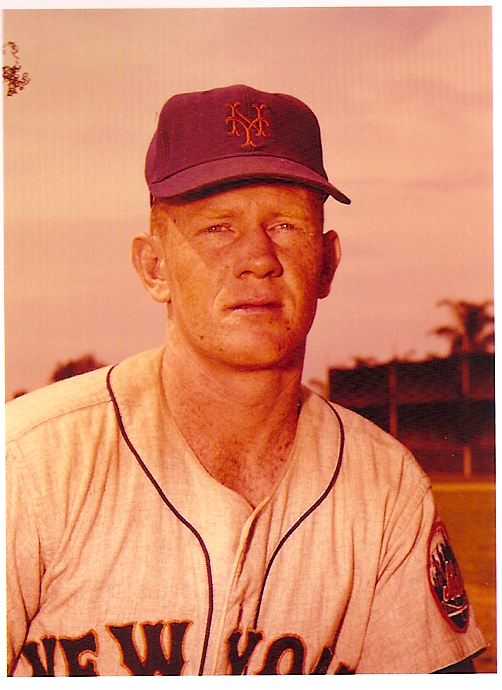 Who’s Wilbur Huckle? First the basics: He was a career minor-leaguer who logged nine seasons, all in the Mets organization, beginning with the Raleigh Mets in 1963 and lasting until his last hurrah with the Double-A Memphis Blues in 1971, when Huckle was 33. After that, he managed the Batavia Trojans of the New York-Penn League for three not particularly notable years; a fan on Ultimate Mets Database says he then became a middle-school teacher in San Antonio, adding that “I must admit that he is one of the finest people I have ever met.”
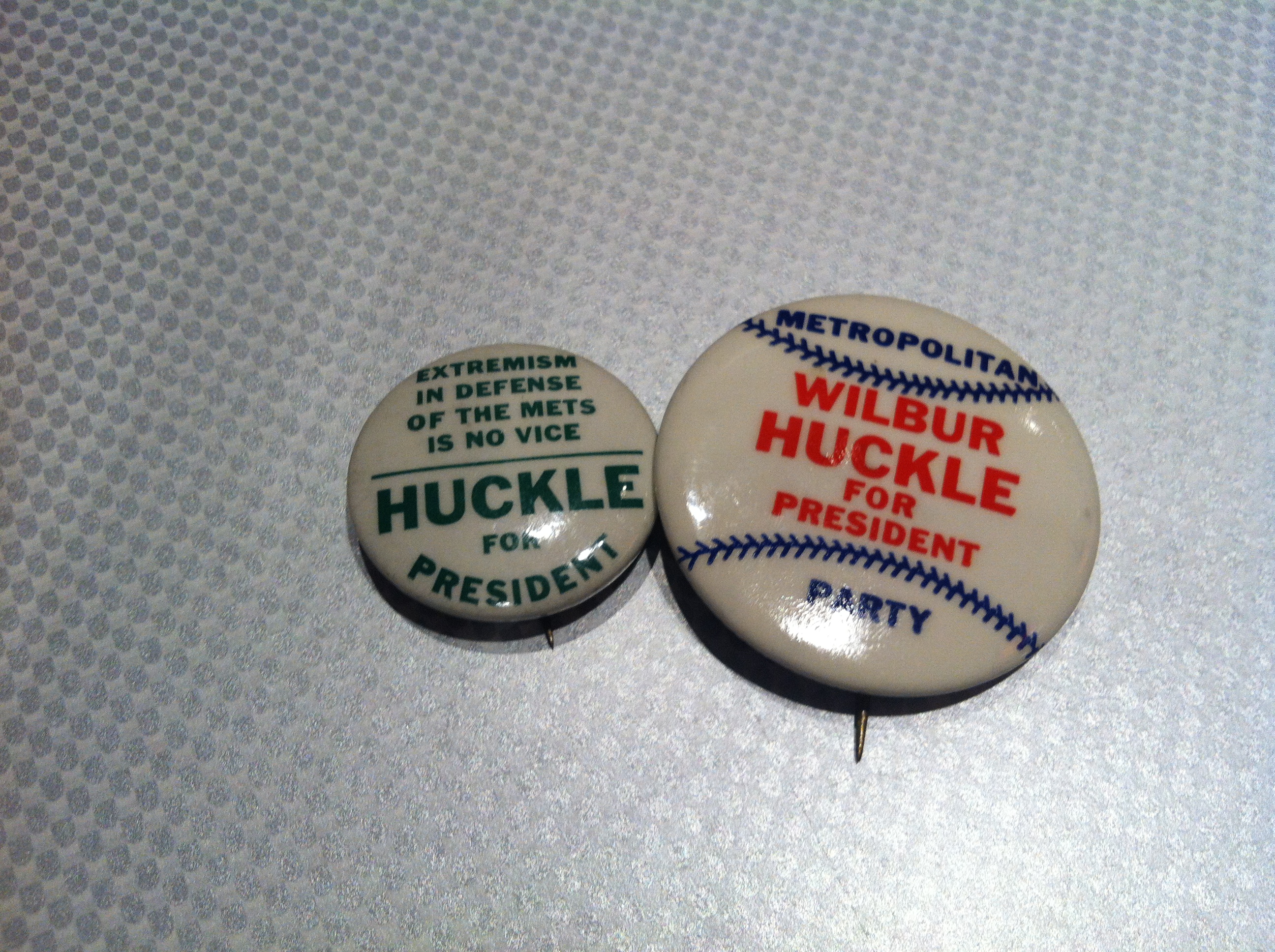 And why not? Huckle was the perfect candidate — he had that marvelous name, an unassuming blue-collar affect and red hair, making him more or less the Justin Turner of his day, except with an ocean of freckles instead of pies and “Call Me Maybe.” And because Huckle was never actually a Met except in spring-training or news briefs, he could be a vessel of hope and possibilities, with the disappointment of reality kept from intruding.





