The blog for Mets fans
who like to read
ABOUT US

Faith and Fear in Flushing made its debut on Feb. 16, 2005, the brainchild of two longtime friends and lifelong Met fans.
Greg Prince discovered the Mets when he was 6, during the magical summer of 1969. He is a Long Island-based writer, editor and communications consultant. Contact him here.
Jason Fry is a Brooklyn writer whose first memories include his mom leaping up and down cheering for Rusty Staub. Check out his other writing here.
Got something to say? Leave a comment, or email us at faithandfear@gmail.com. (Sorry, but we have no interest in ads, sponsored content or guest posts.)
Need our RSS feed? It's here.
Visit our Facebook page, or drop by the personal pages for Greg and Jason.
Or follow us on Twitter: Here's Greg, and here's Jason.
|
by Jason Fry on 21 June 2013 12:43 am It’s been a beautiful couple of nights in New York City, with gentle weather, nice breezes and the western horizon still faintly painted in sunset colors after 9:30. The Mets have been in Atlanta, far from here but right at hand — if you’ve got a TV they’re before your eyes, if you’ve got a phone or a pocket radio they’re in your ears. And the Cyclones are playing again, which means it’s officially summer. Baseball’s everywhere and the world is as it should be.
First the Mets, and tonight. They played one of their more satisfying games of the year — an all-hands-on-deck affair in which they looked resourceful and resilient.
The game came with a significant side of worries, unfortunately: Jonathon Niese departed in the fourth when his balky left shoulder indicated there were no more pitches available. Niese spoke bravely after the game about the doctor finding nothing wrong and things not being as bad as they were earlier this year, a self-diagnosis we should pay zero attention to, as it came from a pitcher. All pitchers are habitual liars about their health, to quote Dan Warthen’s much-misinterpreted line about John Maine; the only assessment that will matter is the doctor’s, which we can expect tomorrow. Niese is one of a parade of Mets who progressed in 2012 but have regressed this year; he has the excuses of freakish weather and his own health issues, but the end result is the same. That’s more troubling than we may realize when waxing rhapsodic about Matt Harvey and Zack Wheeler and drooling about Rafael Montero and Noah Syndergaard and others; Niese is left-handed and more accomplished, at least for now, than any of them, making him a vital piece of most any bright future we can imagine.
Niese left with the Mets down 3-2 and trying to win the rubber game of a seemingly endless five-game set in Atlanta, which they proceeded to do. David Wright collected three hits, including two home runs; Andrew Brown homered as a pinch-hitter; Omar Quintanilla led off the seventh with a mildly Dunstonesque 10-pitch at-bat that ended with a single, then scored on a double by Josh Satin. The former 51s, freed from secrecy in the Nevada desert, were supported by the bullpen, with fine work from David Aardsma, LaTroy Hawkins, Brandon Lyon, Josh Edgin and Bobby Parnell.
I haven’t been happy about this year’s Mets, to say the least, but their pluck kept my attention tonight, and I moved from watching them on the iPad while eating in the backyard to keeping them in my ears while running an errand a couple of neighborhoods over, then urged Edgin past the dangerous Jason Heyward while gazing at the dizzying lights of Manhattan from the Promenade. Baseball was good company tonight, and I was grateful for it.
* * *
Not numbered among my smattering of good qualities: the ability to think quickly when a foul ball is at hand.
It’s pathetic, really. My first encounter with a foul ball came 20-odd years ago, at a Bowie-Binghamton game down in Maryland. I was waiting in line behind home plate to buy a hot dog when a batter fouled one straight back over the screen. The ball bounded up the steps, tapped me in the leg and sat quietly spinning next to my foot. Dumbfounded, I stared at it until a kid walked over, shook his head at me in mingled amazement and contempt, and picked it up.
It hasn’t gotten better. There was this humiliating moment in the days of Shea, which Emily still enjoys recalling. There was a day when Emily finally took a four-year-old Joshua out of my arms because our section was getting bombarded by foul balls, which I’d react to approximately when the next pitch was thrown. I don’t know why this happens to me — time seems to slow down and my reflexes get molasses-like. The only foul ball I’ve ever gotten at a game became mine because it rolled directly to me after landing outside the Cyclones’ stadium, with no one else within 30 feet. Even I couldn’t screw that one up.
Recently it’s gotten worse. During the 20-inning disaster against the Marlins, two foul balls were lined into our section. The first one hit the guy directly in front of me and bounced away while I gaped at it and tried to will my hands to move. The next one hit a guy a row ahead of me and two seats to the right. It then bounced off my shoulder and the seat next to me, dropped two rows down and stuck between an older man and his wife, who apparently didn’t notice it. A nearby kid grabbed it — and as Joshua began to berate me for my ineptitude, I realized to my horror that the kid holding up the ball was one of his classmates. I mean really — what are the odds?
Last night Emily and Joshua and I took the ferry to Staten Island to watch the Cyclones play the larval Yankees. (Quick review: Brooklyn’s Eris Peguero makes Lucas Duda look like Garry Maddox.) While Emily fetched hot dogs, Joshua and I settled into our seats a few rows past first base — the section where right-handed hitters routinely hit foul balls. I looked towards home plate and could barely see it — the sun was setting directly behind the batter.
We’re going to get killed out here, I thought.
A few pitches later, Staten Island’s Mike O’Neill lofted a foul pop into our section. I couldn’t see the ball — no one in our sparsely occupied section could see anything — but I heard it rattle off the seats and plop onto the concrete not far behind me. I turned and trotted a couple of seats down, hopping into the next row with the grace you’d expect of a 44-year-old ex-non-athlete, and saw the ball sitting another row back — directly in the path of a kid of about 17 or 18. He hadn’t seen it, but in another second he was going to.
And after all these years, for once I thought fast.
“I think it went over there,” I said, and pointed to the left.
Incredibly, he took a couple of steps in that direction. (Who falls for this?) That allowed me to fake a little start of surprise, lean over the row of seats and scoop up the ball. I managed not to snicker like Muttley as I strolled back to my seat and handed an actual foul ball to my kid. Joshua was dumbstruck, then thrilled, and I was off the hook for years of incompetence.
Age and treachery 1, Youth and skill 0.
* * *
Jason was Will Leitch’s guest on his Wednesday podcast for Sports on Earth. The Mets were of course discussed, as was Star Wars, the Jupiter Pirates and ESPN. Give a listen here.
Please join Greg at Bergino Baseball Clubhouse in Manhattan Wednesday night, June 26, 7 o’clock, for a discussion of The Happiest Recap, followed by the Mets and White Sox live from the South Side of Chicago. Details here.
by Greg Prince on 20 June 2013 7:50 am If Tuesday was the baseball equivalent of opening Christmas and Chanukah presents on the same bright December morning, Wednesday was the post-New Years night before you had to go back to school and realized you never touched the assigned reading you swore you were going to get to…and, oh, god, you have a paper due, too.
The giddiness of Harvey and Wheeler gave way to the drudgery of Marcum pretty quickly. No beer showers for Shaun. No latent tales of standing up to bullying veteran relievers emerged to make Marcum appear extra heroic in hindsight. Just a guy who hadn’t won not winning some more, aided in his unintentional quest for defeat by an offense that had to be handed two of its three runs on a silver platter personally forged by Kris Medlen. And even when the Braves’ starter did Shaun a solid by enabling a pair of unearned runs with a pitch clear past third base, Marcum found a way to return the favor almost instantly.
Shaun Marcum exists in that netherworld between an abysmal 0-9 record and the damningly faint praise of, “He’s pitched much better than that.” I should hope so. Nobody gets to 0-9 by being blown off the mound every five (or six) days. As famed late 1970s Mets pitching coach Roseanne Roseannadanna once advised an 0-5 Pete Falcone, “It’s always something. If you have your command, you don’t have your control. If you have your control, you don’t have your command. If your pitches are breaking, they’re not moving in the zone. If they’re moving in the zone, they’re not breaking. It’s like my daddy, Rube Walker Roseannadanna, once told me, ‘Roseanne, you may not be as bad as your record indicates, but on this team, you have to be a whole lot better than what THEIR record indicates if you’re gonna be any good at all!’”
I read an enlightening article a few days ago by Jon Presser of The Shea Faithful detailing all that Marcum is doing right (“a pretty darn good job of controlling the things he can control”) while noting just enough has gone wrong to undermine the hell out of him. The lesson to be divined in cases like these seems to be when you’re going horsespit, you’re going horsespit. Shaun’s been pitching in some rotten luck, sometimes victimized by his own tendencies with runners on base, more often unfortunate enough to pitch in front of an assortment of teammates who never seem to be packing the right glove for the position they’re about to play.
That said, Wednesday night Marcum sensed a loss was within his grasp and he grabbed it. Or it fell on him. These things happen in years like this. He struck out six in four-and-two-thirds innings, which has been typical of his K/IP rate of late, but he also walked four, which was an ill-timed aberration — plus he let the go-ahead run score on a wild pitch before compounding his faux pas by giving up the key extra-base hit that sealed the Mets’ fate. That double to B.J. Upton buried the Mets in a 5-3 hole in the fifth, and the 2013 Mets cannot be counted on to score three runs in four innings while surrendering none in the interim.
Marcum offered an extraordinarily 0-9 quote afterwards: “It’s been a three-month ordeal for me.” It’s been a three-month ordeal for Mets fans, too, though Shaun’s never added up to significantly more than 1/25th of our distress. Having to effect our typically downtrodden view of the world last night, though, represented a sad reversion to the kind of a drag that had been temporarily absent from our thinking. Ever since Western Civilization declined in the bottom of Sunday afternoon’s ninth inning, most every Mets moment had actually crackled with the best kind of baseball tension.
Kirk Nieuwenhuis blasted the Mets out of a deep, dark tunnel; the Mets held their own against a fascinatingly interminable rain delay; Dillon Gee steered the Mets expertly past midnight; Dillon Gee’s heart was cruelly broken by Freddie Freeman; Matt Harvey yet again challenged history; the Mets didn’t blow up Matt Harvey’s masterpiece despite seizing the opportunity to do so; Zack Wheeler emerged from the cornfield and into our rotation; each of our catchers homered in a day-night doubleheader, a Mets first; Harvey, it was learned, didn’t take any guff from Jon Rauch a year ago; yet another leadoff hitter alighted in our midst and this one at least arrived toting a bit of a track record, albeit not a particularly dazzling one. Our being 3-1 in our last four seemed to trump our being 27-40 in our first 67. The present was pretty compelling and the future ceased to be so frightening
Then Shaun Marcum went into ordeal mode, and it became the season it had been all over again, with the Mets stuck in yet another game at which a person stares politely and feigns engagement until it’s socially acceptable to scat.
Please join me at Bergino Baseball Clubhouse in Manhattan Wednesday night, June 26, 7 o’clock, for a discussion of The Happiest Recap, followed by the Mets and White Sox live from the South Side of Chicago. Details here. And thanks to Mets Merized Online for a lovely review of my book.
by Greg Prince on 19 June 2013 4:07 pm What some called Super Tuesday worked out pretty well, eh? So let’s look ahead just a bit to Super Wednesday, one week from tonight. Can’t promise you Harvey and Wheeler (or either of them, probably), but it looks to be a pretty super evening nonetheless.
On Wednesday June 26 at 7 PM, I’ll be joining Jay Goldberg at Manhattan’s Bergino Baseball Clubhouse, 67 E. 11th St., between Broadway and University Place (conveniently located just south of Union Square), to discuss The Happiest Recap. If you don’t know Bergino, get yourself acquainted by coming on down. Its vibe is best described as part Cooperstown, part Polo Grounds, part Shea, all National Pastime. Jay’s a terrific guy, he’s got some incredible, one-of-a-kind items and I’m honored that he’s hosting this discussion of Mets history.
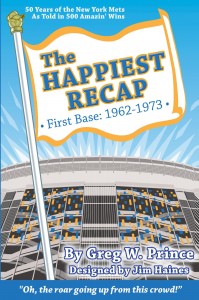 If you don’t yet know The Happiest Recap, consider a Super day like Tuesday. One ace overpowers a division rival in the afternoon, another ace (albeit one in training) sets the night to music with a resounding performance of his own, we’re floating on air for 24 hours after…maybe longer. That’s The Happiest Recap in the most contemporary terms possible. It’s the Mets’ greatest games, the era they were played in, the circumstances surrounding them, the people who made them happen. It’s 500-plus tales of the Mets at their best and sometimes overcoming their worst. It’s the championship years, the striving years, the stumbling years, too, but that’s OK, because there are always at least a few Super Tuesdays in every Mets season. These are the games you’ll always remember and the games you’ll be glad you finally met. If you don’t yet know The Happiest Recap, consider a Super day like Tuesday. One ace overpowers a division rival in the afternoon, another ace (albeit one in training) sets the night to music with a resounding performance of his own, we’re floating on air for 24 hours after…maybe longer. That’s The Happiest Recap in the most contemporary terms possible. It’s the Mets’ greatest games, the era they were played in, the circumstances surrounding them, the people who made them happen. It’s 500-plus tales of the Mets at their best and sometimes overcoming their worst. It’s the championship years, the striving years, the stumbling years, too, but that’s OK, because there are always at least a few Super Tuesdays in every Mets season. These are the games you’ll always remember and the games you’ll be glad you finally met.
I’ll have copies of the first volume, First Base: 1962-1973, on hand, will discuss the forthcoming Second Base: 1974-1986 and anything else you’re interested in. And when we’re done with the talking and signing and whatnot, Jay is graciously keeping the lights on so we can gather round and watch the Mets take on the White Sox live from the South Side of Chicago at 8 o’clock.
If those aren’t the makings of a Super Wednesday in 2013, I don’t know what is. Hope to see you there!
by Jason Fry on 19 June 2013 2:06 am All in all, we can agree, Super Tuesday went pretty well.
Matt Harvey, facing the odd circumstance of his start being the undercard, reminded us who’s the ace around here, absolutely dismantling the Braves with everything in his arsenal. And if you didn’t see it coming, you weren’t paying attention — just ask Jason Heyward, who heard a 100 MPH fastball go by in the first inning and no doubt knew he and his teammates were in for a tough day. Harvey made his monthly run at a no-hitter, which came unraveled on a flukey play in the seventh that was part Harvey’s fault, part Lucas Duda’s and part just bad luck. He then tired in the tropical heat, and some bad defense and relief left him with a pitching line — 3 ER over 7 IP — that in no way reflected how ridiculously dominant he was.
The nightcap was the debut of Zack Wheeler, our first ’90s-born Met, and he looked pretty much like a young power pitcher making his first big-league start typically looks — he was impressive and he was also wild, struggling to control his breaking stuff. But we can chalk some of that up to inexperience and some of it to nerves — Wheeler grew up just a short trip from Atlanta, where he was a Braves fan until remaking that part of his biography with a bit of fan-ambassador sleight of hand.
Emily said Wheeler reminded her a bit of Dennis Cook, the half-deaf, all-irascible reliever of a previous era, and I see that — Wheeler could easily play the younger Cook in some kind of origin story, down to the silly chin hair. His final line — 6 IP, 0 ER, 4 H — looked better than Harvey’s but wasn’t, but I mean that by way of observation, not dismissal. Though Wheeler’s complementary pitches weren’t much in evidence, his fastball sure was — it sat between 96 and 98, which is a helluva place to sit, and had befuddling natural movement on top of that. Furthermore, Wheeler’s long, lanky delivery looks efficient, repeatable and mechanically sound. Wheeler got away with a few sliders that didn’t do what they were supposed to, but that’s a privilege that comes with being a power pitcher with a thunderbolt fastball.
Wheeler looked like he was getting a typical Mets baptism, receiving handshakes in the dugout with the score still knotted at zero. But before Scott Atchison could provisionally take over (he did something bad to his groin during warmups and yielded to Brandon Lyon), Josh Satin singled and Anthony Recker bashed a Paul Maholm pitch over the center-field fence. Suddenly Wheeler was up 2-0 and in line for the win, which became all but assured when the Braves started walking people and kicking the ball around the stadium, highlighted by one farcical sequence in which they all but carried Marlon Byrd around the bases. Wheeler walked off a 6-1 winner, receiving a beer shower by way of initiation, and a very successful day had come to an end.
(Plus David Wright collected his 1,500th career hit. He’s 30 years old. We should all do the math, think about Cooperstown — and appreciate him more.)
Given this season’s rather sparse delights, it would be a kindness to stop right here. The Mets swept the Braves for the first time in Atlanta since ’87, and Wheeler won despite the worrisome presence of Chipper Jones himself next to his parents in the stands. No really, they did and he did. And it was awesome.
But I can’t help remembering that the Mets played not two games against the Braves over the course of 24 hours, but three. And in that first game Dillon Gee was as dominant, in his own way, as the prodigies celebrated hours later. Only Gee missed his location on a slider to Freddie Freeman with one on and one out in the ninth and the Mets up 1-0. It was Gee’s 101st pitch and his last — he was last seen trudging across the third-base line as Freeman prepared to vanish into the mob of happy Braves awaiting him in Walk-Off Land.
If Gee had been up 3-0 or 4-0, Freeman’s blast would have been an oh-well sign that Bobby Parnell needed to finish up instead of a disastrous bolt from the blue. But 1-0 leads are more along the lines of what the Mets typically provide their starters. Harvey won today to run his record to 6-1, but on April 19 — two months ago — he was 4-0. Between then and today, here’s how many runs the Mets had scored for Harvey when he was taken out of his starts: 2, 2, 1, 2, 3, 2, 0, 6, 1, 0. Somehow, starved of support, Harvey was 1-1 in those starts and the Mets were 4-6. Jonathon Niese, Shaun Marcum and Jeremy Hefner can all tell similar stories of woe.
The Mets’ starting pitching is pretty good — it’s easy to envision Harvey, Wheeler, Niese and Gee maturing into a truly formidable starting quartet, with arms such as Rafael Montero, Hansel Robles, Jeurys Familia, Jenrry Mejia and Noah Syndergaard possible fifth starters. (And don’t forget the unassuming but effective Hefner.)
But pitching’s only half the battle, and the other half’s gone pretty dreadfully: The Mets’ offense consists of Wright, Daniel Murphy, a short-term answer in Byrd, and little else.
It’s not crazy to imagine things having gone differently. In some better parallel universe, Ike Davis and Ruben Tejada and Duda all made strides this year, while Travis d’Arnaud stayed on the field and showed himself ready to make his own major-league debut. That Mets lineup would have six respectable bats, a nice Hairstonesque find in Byrd, and we’d be writing passionate posts about center field, debating the merits of Juan Lagares or Jordany Valdespin or Kirk Nieuwenhuis.
But we don’t live in that universe. In this one Duda is an enigma, Davis and Tejada have flopped, and d’Arnaud only just got cleared to start running again. Wheeler will soon find that the Mets aren’t given to six-run outbursts. And there will be too many no-decisions and teeny margins for error and too much disappointment. Harvey is a treasure, and things went very well for Wheeler the first time out. But until there’s a lineup worthy of their talents, there will be too many nights that end like Gee’s — with a trudge to the showers and an appointment in front of one’s locker, answering the same questions everyone’s tired of asking and answering.
by Greg Prince on 18 June 2013 2:25 pm Zack Wheeler’s soon going to be able to say something no Met, from Richie Ashburn to Carlos Torres — not even magnificent Matt Harvey — can say:
“I was born in the 1990s.”
Yes, gentle reader, you’re getting old, but this isn’t about you. This is about the New York Mets promoting and pitching, as precipitation and procedures permit this evening in Atlanta, their first player ever to come from the tenth decade of the twentieth century (May 30, 1990, to be precise). The Mets started life with a roster full of men who first drew breath in the 1920s and 1930s and have been moving incrementally through the decades since.
They haven’t been quick in delivering a ’90s baby. The first player anywhere born two decades before the current one was Starlin Castro, brought up by the Cubs on May 7, 2010. The Mets were chronologically close to turning the odometer that season, introducing 20-year-olds Jennry Mejia and Ruben Tejada to The Show, but those kids made the mistake of being born in October 1989. Since they came along, Robert Carson, Jeurys Familia, Juan Lagares and Mr. Harvey have joined the ranks of the Mets’ ’89ers, but nobody any younger than Tejada (born 10/27/1989) has debuted until now.
Soon enough, the born-in-a-decade distinction won’t be noteworthy. It’s only when it’s brand new or teetering into extinction that it gets your attention (mine, anyway). Nowadays, a player born between 1980 and 1989 is somewhere between 23 and 33 years old, prime baseball-playing years. But it caught my eye when the Mets first deployed an all-1980s born infield at the tail end of the 2005 season: Mike Jacobs, Anderson Hernandez, Jose Reyes and David Wright. It jumped off the scoreboard at me on a night in August five years later when the entire starting lineup was comprised of fellas who first came to be in that decade.
For the record, they were Reyes SS; Fernando Martinez RF; Angel Pagan CF; Wright 3B; Ike Davis 1B; Chris Carter LF; Josh Thole C; Tejada 2B; and Mike Pelfrey P. You can see that longevity, success, and what have you didn’t become a common denominator among these particular 2010 Mets. But they were all born in the 1980s and that had never happened before.
None of them, though, was the first to answer to that trivial point. That honor, if that’s what it is, went to Pat Strange, who was born August 23, 1980, and entered an eventual 11-8 loss at Montreal on September 13, 2002. You might say Strange was our Zack Wheeler ten-plus years ago, except Pat pitched in eleven games for the 2002 and 2003 Mets, was on the losing side in all but one of them, was never seen again on the big league level and…no, he wasn’t Zack Wheeler. In the name of all that is merciful, he was not Zack Wheeler.
Nor was the first Met born in the 1970s, Joe Vitko, who was added to the active roster of life on February 1, 1970, and made it as a Met on September 18, 1992. That distinction might have belonged to the more familiar personage of Bobby J. Jones, except an expansion draft was around the corner and keeping Bobby from the majors that September was the prudent thing. As for Vitko and his three Mets/MLB appearances, neither the Rockies nor Marlins jumped at the chance to grab him.
The first Met born the same decade as the Mets wasn’t me, no matter what I imagined. Instead, on September 12, 1981, second base prospect Brian Giles came up. The infielder for whom relatively big things were expected was born April 27, 1960. He never quite lived up to his notices, though for a couple of minutes in 1983, he and Jose Oquendo — the first Met born after the birth of the Mets (and me) — formed a flashy double play combination of the future. Their Met future turned out to be brief, but it’s worth noting each of them was still playing in the majors, albeit sporadically in Giles’s case, by the time baby Zack was demonstrating remarkable control of his pacifier.
The Mets didn’t wait nearly as long to get a player born in the 1950s into a game as they have since with decade-firsters, handing an opportunity to 19-year-old Tim Foli on September 11, 1970. The middle infielder, birthed on December 6, 1950, was on the fast track from the beginning, drafted first overall by the Mets in the 1968 amateur draft. Unlike his decade-pioneering successors, Foli did far more than pass through the bigs, participating in nearly 1,700 MLB games, even if only a bit more than 200 of them came in a Mets uniform. Foli was a shortstop stuck behind Bud Harrelson in the early ’70s and thus was fairly expendable in what became the Rusty Staub trade of 1972. Like Mike Jorgensen, but unlike Ken Singleton (who wasn’t so expendable), Foli would return to the Mets years after Le Grand Swap, but he’d be gone a little over a year into his second term, shipped to Pittsburgh in exchange for Frank Taveras. Taveras was briefly the greatest base stealer the Mets ever had. Foli won a world championship with the Pirates. Let’s call that one a draw.
The youngest Met ever was also the first Met born in the 1940s: 17-year-old Ed Kranepool, who needs little introduction in these parts. Born on November 8, 1944, the star slugger out of James Monroe High School in the Bronx couldn’t be kept from the Polo Grounds, making the leap in his first professional campaign, on September 22, 1962. Krane, of course, stuck around through thin, thick and terribly thin until the end of the 1979 season. For comparison’s sake, imagine having Wheeler tonight and then every year from now until 2030. Sounds pretty good, right?
For the record, the first 1920s-born Met to appear in a box score was the leadoff batter in their very first game of April 11, 1962, Richie Ashburn (born March 19, 1927). The first from the 1930s? That would be the second batter from the same first game: Felix Mantilla (born July 29, 1934).
Our theme isn’t “lasts” today, but as long as we’re in a decade state of mind, the final Mets born by decade were:
• 1920s: Warren Spahn, born 4/23/1921, finished 7/10/1965.
• 1930s: Jim Beauchamp, born 8/21/1939, finished 10/21/1973 (seventh game of the World Series, five days after Willie Mays’s last appearance)
• 1940s: George Foster, born 12/1/1948, finished 8/6/1986 after he talked himself out of town.
• 1950s: Julio Franco, born 8/23/1958, finished 7/7/2007 (snatching an honor that seemed destined to belong to Rickey Henderson once he was ushered off the Flushing stage in 2000)
• 1960s: Gary Sheffield, born 11/18/1968, finished 9/30/2009, five days after fellow 1960s baby Ken Takahashi threw his final Mets pitch.
Unlike with firsts, you’re never sure when you’ve seen a last. May tonight be only the first of many Zack Wheeler sightings…and may we never be sorry we so breathlessly anticipated the birth of this Mets career.
by Greg Prince on 18 June 2013 7:31 am The descent of Western Civilization from its state of earthly pre-eminence can be dated from the pagan celebrations that regularly engulfed the plates of home in the early stages of the twenty-first century Anno Domini. These were bacchanalia whose sheer offensiveness to long-established standards of morals and tastes crested with the actions of the False Idol of Nieuwenhuis going yard within the sacred grounds of Our Lady of Cholula. It wasn’t so much the deed that was executed off the iconic wooden bat that touched off such momentous impact as it was the untoward merriment that ensued in its wake.
An expositor of all that was good and decent spoke out against the Nieuwenhuis idolators, declaring that their exuberant secular embraces, repeated vertical motions of the feet and offering of baked goods to the face of the Nieuwenhuis itself ran counter to the spirit of social acceptability. This, the expositor foretold, portended “another indication of the ongoing decline of Western Civilization”.
For his steadfast foretelling, the expositor of all that was good and decent was mocked and rebuked, yet within less than two solar days, those who would perpetrate the offensive bacchanalia received their comeuppance, first from an unforgiving atmospheric disturbance that lengthily delayed their next opportunity to perform their native rituals; then from an endemic torpor that transformed their heretofore iconic wooden bats into hauntingly familiar piles of dust; and finally from the karmic fates that would not allow the idolators’ Joyousness of Gee — in which the first among bases was at last ideally attended to by he who could play the first among bases far better than he could the leftest among fields — to go nine unabated innings.
One did not need to be an expositor of all that was good and decent to predict that the mythic monstrosity known as Freeman of the Peach Patch would itself go yard well beyond the standard time frames of routine. Those who rallied around the False Idol of Nieuwenhuis were left to burn with the fury of a thousand bottles of hot sauce as the denizens of the House of Ted replicated essentially the same form of idolatry that had appeared to the former celebrants so innocent and uplifting not two solar days earlier.
Our Lady of Cholula wept. The False Idol of Nieuwenhuis was rendered impotent. The Joyousness of Gee was devastatingly curtailed. His prophecy having arrived on the edge of accuracy, the expositor smirked the smirk of the chronically self-righteous. All concerned were condemned to play and play again as the second solar day continued as if the first one had never ended. An offering of fresh young aces would be made to appease the gods, yet the gods were said to be determined to once more disturb the atmosphere with the grimmest of clouds, the most raucous of thunder and delays that might lengthen well into a third solar day before all could be said and done. Western Civilization thus sagged until it slumped on the verge of no longer standing straight.
Only the promise of perseverance on the part of the fresh young aces and, perhaps, an encore presentation of Mets Yearbook: 1978 could save the idolators now.
by Jason Fry on 16 June 2013 10:24 pm Missing a ballgame because you’re in Cooperstown is a pretty acceptable excuse — this weekend, for the second year in a row, my wife’s family gathered there and prowled the Hall of Fame. (Foreshadowing: Last year I was in the plaque gallery, headphones in ears, when Kirk Nieuwenhuis collected his first big-league hit.)
The 2013 Mets aren’t likely to contribute much to Cooperstown, though Matt Harvey Lego-style figurines were in evidence in the sublime and dangerous gift shop. But I kept track of the Mets nonetheless. I heard Thursday’s comeback effort against the Cardinals come to naught in the car on the way up, checked in briefly after dinner Friday as the Mets stumbled through a disaster, and heard most of Saturday’s horror show poolside. Nice surroundings, but I still gotthree straight games that were by turns frustrating and horrifying — your basic 2013 Mets fare, in other words.
Sunday’s game against the Cubs coincided with the drive back to the city, and Emily and I tuned in somewhat reluctantly, switching to yawing, warbling, sighing AM radio after At Bat fell victim to insufficient cell service. (If you’ve never been, Cooperstown is wonderful but far from … well, it’s far from everything.) This was baseball like it used to be, with a fan’s finely tuned ears able to pick the baseball signal out of the atmospheric noise, assembling the narrative of the game from some combination of the pace, the announcers’ tone and pitch, and multiple other clues assembled over years of listening to play by play.
With two on and two out in the fifth, David Wright snared Alfonso Soriano’s hot shot, leapt to his feet, and the horror began. Wright fired the ball over Daniel Murphy’s head at first, it caromed off the dugout railing, Murph fired it past John Buck, it caromed off the wall behind home plate, Omar Quintanilla fired it past Buck again, to be retrieved by Murph while everyone stood around unable to look at each other. (Even weirder: When you look at the replay, there’s a second ball sitting on the chalk of the batter’s box, apparently after it fell out of Lance Barrett’s bag. If some Met had picked up that ball and heaved it somewhere unwise, they might still be trying to sort things out.)
Disgusted, I almost declared Met Amnesty and switched the game off right then and there. And I wouldn’t have been the least bit embarrassed. This is as bad a Mets team as I’ve seen in a decade: unable offensively, inept in the field and often unplugged mentally. For the listener, they provide long lacunae of boredom shattered by occasional fusillades of anger. Baseball is supposed to be fun, or at least engaging, and the 2013 Mets are generally neither.
But we were still two hours or so from home, and we’re Mets fans. So we stuck grimly with the game, as the Mets swung and missed and popped balls up and offered not the slightest inkling that they’d succeed in moving runners over, let alone doing something as less-than-earthshaking as salvaging one game in three from the Chicago Cubs, that well-known baseball juggernaut.
Marlon Byrd’s blast into the second deck to lead off the ninth against closer-in-exile Carlos Marmol did little to cool my anger. “There’s some lipstick for this pig,” I muttered to Emily, and went back to pondering recap narratives: a) Swiftian essay proposing that contraction was inadequate for these Mets and the franchise should instead be expunged from the record books; b) a single line of profanity; c) just reusing last month’s jokey exchange of tweets.
I didn’t brighten when Lucas Duda walked, though that was the perfect spot for our theoretical power-hitter to content himself with 90 feet worth of offense. But when John Buck got a hit, as he largely hasn’t since Tax Day, I began to think the Mets might at least provide some extra baseball for the car ride, even though I was pretty certain that extra baseball would just lead to disaster and make me wish they’d expired in regulation. Quintanilla bunted, which seemed like the right call for once, and up came the star-crossed Nieuwenhuis, his average below .100 and his strikeout totals astronomical.
God, I muttered, at least send up Lagares.
But no, it was Nieuwenhuis. So be it.
“Save your career,” I said out loud in the car, with equal parts belligerence and hope. “This is the first day of the rest of your baseball life.”
OK, maybe it was more like 90% belligerence and 10% hope.
Of course Nieuwenhuis whacked Marmol’s first pitch off the facing of the Pepsi Porch.
It wasn’t exactly Howie Rose’s greatest call ever — he was yelling about way back, then that the game would be over — but events did unfold awfully fast, and the import was clear even if the narrative was cloudy. The Mets, somehow had won. The first two hours and forty-five minutes of Sunday baseball, accounting for 97% of the game, had been stupefyingly awful, but the last five minutes had redeemed everything.
I’ve said several times that you should do something else with your summer, and it’s still good advice. But even the worst teams are going to win 60 or so games a year. And a few of those games are going to be thrillers. Do something with your summer, yes. But every so often, you might miss something.
by Greg Prince on 15 June 2013 11:43 pm JOSH: Sixty-eight percent think we give too much in foreign aid, and 59% think it should be cut.
WILL: You like that stat?
JOSH: I do.
WILL: Why?
—The West Wing, “Guns Not Butter”
Saturday’s game really did put me to sleep. I nodded off with Jon Niese’s second or third pitch and wasn’t fully alert until LaTroy Hawkins was working out of a jam in the seventh. By then, the Mets were down an insurmountable 2-1, though there were a couple of moments late when — as I did the night before — I believed a rally could very well spark because these were the Cubs the Mets were playing, and somewhere deep down in the 1969 of my soul, the Mets can never not beat the Cubs when they really have to.
But that was probably the grogginess of a sleepy Saturday afternoon speaking. Besides, the Mets didn’t really have to beat the Cubs except that it would have been nominally preferable to the alternative. It’s difficult to get worked up over your favorite team failing to seize an opportunity to improve to 25-38 from 24-38 and instead plunge to 24-39.
As if their no-frills won-lost record doesn’t already illustrate what they’ve been down to, our 24-39 Mets have lost 10 of 12; 35 of 52; and, dating back to July 8, 2012 (spanning two seasons, but what the hell, we’re the ones who are in it for the long term), 88 of their last 140. That last trajectory translates to a full baseball year of 60-102 under the management of Terry Collins, Sandy Alderson and, most critically, Fred and Jeff Wilpon.
When I go to a Mets game, as I did Friday night, and they lose — which has been the case on my last seven visits to Citi Field — it’s a bummer in the moment. When I’m lollygagging and merely absorbing the result via television these days, unless the circumstances are particularly grating, it’s become just one of those unpleasantnesses with which you put up now and then, like rain or traffic. Into every fan’s life, a little Mets must fall, except since last July the defeats are bumper-to-bumper and the ground sure has grown soggy.
Yet I’m left not feeling all that badly that the Mets bow in matter-of-fact fashion to the Cubs by scores of 6-3 and 5-2, even though the Cubs are considered a crummy team and I’ve truly disliked them all my rooting life. I follow the trend lines of 2-10, 17-35 and 52-88, and the clarity they present may not be comforting, but it sure is clarifying. The Mets of Collins, Alderson, Wilpon and Wilpon are a disaster. There’s no more reason to accept at face value their outright deceptions, their crafted nuances or even their sincere miscalculations. The general manager can trade studied reserve for stated passion all he wants, but it’s all talk until the numbers say something else.
The manager is haplessly caretaking a vapid collection of the mostly talentless; the owners are undermining our confidence by their continued presence; and Alderson and his fellas…I get the hole they were asked to dig out from and I get the mix of financial constraints and time-lapse cleverness that’s somehow supposed to pan out in eventual competence en route to consistent contention. Yet there comes a point in a fan’s life when he’s got to see more than one great pitcher establish himself and a potential second one prepare for his debut. There comes a point when watching .371 ball played over a period of more than eleven months obscures your tendency to be the slightest bit reasonable about the vague outlines of a rumored improved future.
All who are emotionally invested in the well-being of this franchise are entitled to their talking points, whether it’s patronizingly informing the impatient that these things can’t get done right away (cue the overwrought Cashen 2.0 comparisons) or relentlessly recounting every crime against humanity and good sense committed by venal ownership and its clueless California stooge (cue the equally overwrought reminders of what the Madoff cloud hath wrought). Honestly, I sit in the Met-aphorical middle, whether at the ballpark or on the couch.
Things haven’t worked so far.
Things might someday.
Things might not.
I’d like them to.
I wouldn’t be shocked if they don’t.
But I’d really like them to.
None of this is a surprise or a solution. Sometimes a fan just wants to vent without being told much beyond, “Yeah, I know.” Sometimes a fan just wants to find a given 6-3 or 5-2 loss to be a relative pain unto itself, not another symptom of something devastatingly insidious and ultimately chronic. In the interim, when your team is collecting losses at such a prodigious pace, what’s one or two more to toss on the pile?
by Greg Prince on 15 June 2013 3:57 am  “In my life, there’s been heartache and pain…” How ya doin’ out there, Mets fans?! At Citi Field Friday night, Foreigner played “Urgent,” and Sandy Alderson woke up to contradict that characterization of the Mets’ situation, calling it “inaccurate…we’d say our plan is proceeding right on schedule.”
Foreigner played “Waiting For A Girl Like You,” and a Mets marketing department representative contacted 40,000 girls like her and asked them to please vote for David Wright to start the All-Star Game over Pablo Sandoval.
Foreigner played “Feels Like The First Time,” and Elias sent word that, no, technically it was the umpteenth time the Mets lost listlessly in 2013 — and that it actually felt like the eleventy-billionth time.
Foreigner played “Cold As Ice,” with John Buck, Jordany Valdespin and Justin Turner singing harmony.
Foreigner played “Double Vision,” and the Mets added a second set of convenience fees to all tickets.
Foreigner played “Juke Box Hero,” and Terry Collins ordered Scott Rice to warm up, just out of habit.
Foreigner played “Hot Blooded,” and nearly 3,000 miles away, Wally Backman suggested he knew the cure for hot blood, causing an unnamed Mets official to roll his eyes, shake his head and vehemently deny that anybody in the Mets organization knows how to fix anything.
Foreigner played “I Want To Know What Love Is,” and Shaun Marcum remained baffled as to what wins are.
by Greg Prince on 13 June 2013 7:55 pm Three weeks ago, though it seems longer, I experienced one of the true highlights of the 2013 season at Citi Field when, with two outs and the Mets down a run, Rick Ankiel tripled Daniel Murphy home from first to tie the Reds at four in the bottom of the seventh. That Rick Ankiel actually tripled — literally his third-to-last hit as a Met — was inconsequential. That the Mets would go on to lose, 7-4 (booted along by Ike Davis choosing to analyze a fair ball rather than field it), was secondary to that moment of triumph, for as soon as Murphy crossed the plate, the true goal of the day had been achieved.
Matt Harvey was taken off the hook.
“Harvey’s off the hook!” we exulted to one another in Excelsior. It was a line I distinctly recall having articulated eleven days earlier in a Promenade Box, and it was one that would echo from Promenade Infield seats on a Saturday that eventually trudged twenty innings deep. In this season when we step right up to greet the Mets at our own peril, our near-term aspirations for this team remain fairly reasonable. We don’t expect wins. We don’t much ask for wins. All we want is for our one shining hope to not be sullied by words like “lose,” “lost,” “loss” or anything in the “L” family.
Yet on this gloomy Thursday afternoon, when only a fraction of the “25,741” in attendance weren’t scared off by definitive forecasts calling for biblical floods, the offensive famine that has starved Harvey across the unlucky ’13 desert could no longer sustain the plump, delectable zero in his right-hand column. That scintilla of dignity — the sure, they didn’t score for Harvey, but at least he didn’t get stuck with the loss caveat that would probably make a good name for the Mets’ season highlight film if they still produced them as they did when the Winik boys made futility sing — was at last snatched from us.
Matt Harvey went seven innings, gave up one run and it was far too much for his teammates to overcome on his behalf. Score a run while Matt Harvey pitches? Why not ask rain to hold off for three hours?
The rain held off, but the Mets held no thunder in their sticks. They completely succumbed to Adam Wainwright for seven innings, and by the time they rallied in the ninth to ever so gently attempt wrap their feeble fingers around the hook in Harvey’s back, they trailed by two enormous runs. With one out, Marlon Byrd homered and John Buck doubled. Reverse that sequence and we’re reveling in Harvey staying hookless, but the Mets have far too many conditions in need of reversal. Buck’s pinch-runner Collin Cowgill got to third when Kirk Nieuwenhuis almost singled (the Cardinals are rat bastards about letting balls through infields), which set it up for Josh Satin…
Oh, c’mon. Look at these names. Nieuwenhuis. Cowgill. Satin. The Mets didn’t tie the game. Harvey was not taken off the hook. The best pitcher in the world is 5-1 instead of 5-0-9. He’s pitched poorly enough to lose once or twice (at Miami, of course), but otherwise should be topping double-digits in wins. Instead, Matt Harvey hasn’t been party to a personal positive decision since May 17, and in that one he had to do the batting as well as the pitching. Harvey’s near-impenetrability in every stadium that isn’t Marlins Park is so pervasive that Mike Matheny didn’t mind walking the Mets’ No. 8 hitter, Nieuwenhuis, with two outs and a runner on second just to force Terry Collins’s pinch-hitting hand in the bottom of the seventh. Collins took the bait and removed Harvey in favor of Justin Turner, who grounded out to end what other teams might call the threat.
The only real surprise in any of that is realizing the Mets had a runner on second to begin with.
In other news, save the Mets from their better/baser instincts and vote 35 times for David Wright to start the All-Star Game. At least you’ll be doing it because you’re enamored of his hitting and fielding.
It’s tempting to pivot toward making this latest Met defeat and corresponding lapse in decorum a platform from which to decry all that makes our fandom frustrating. But for the hell of it, let’s steer clear of the rampaging cougars for a night and consider a few other things worth knowing:
• Earl Monroe’s new autobiography is a New York sports fan’s delight, harking back to a great era when certain teams won championships and others came damn close. If you love a little basketball on the side, Earl The Pearl is definitely something to pick up and roll with.
• Once upon a time, there was a Met named Lastings Milledge, and in tribute, there was a blog called Blastings! Thrilledge. The Met left. The blog soldiered on. Then, like the 2013 Met offense, it more or less disappeared. Now it’s back, as Blastings! Trillage. It’s quite the lyric enterprise and heartily recommended for your perusing pleasure.
• I’ve never been a morning person, but mornings this season have brought the latest issue of The Slurve — Michael Dougherty’s sublime and comprehensive daily baseball newsletter — to Faith and Fear’s in-box, and we are better informed for having woken to receive it. Check out a sample after you’ve helped obliterate potential Panda sightings in Flushing this July 16.
|
|