The blog for Mets fans
who like to read
ABOUT US

Faith and Fear in Flushing made its debut on Feb. 16, 2005, the brainchild of two longtime friends and lifelong Met fans.
Greg Prince discovered the Mets when he was 6, during the magical summer of 1969. He is a Long Island-based writer, editor and communications consultant. Contact him here.
Jason Fry is a Brooklyn writer whose first memories include his mom leaping up and down cheering for Rusty Staub. Check out his other writing here.
Got something to say? Leave a comment, or email us at faithandfear@gmail.com. (Sorry, but we have no interest in ads, sponsored content or guest posts.)
Need our RSS feed? It's here.
Visit our Facebook page, or drop by the personal pages for Greg and Jason.
Or follow us on Twitter: Here's Greg, and here's Jason.
|
by Jason Fry on 2 March 2013 8:45 pm I’m the LaTroy Hawkins of Mets fandom.
At least I hope I am.
LaTroy Hawkins, 40 and a veteran pitcher, hasn’t pitched in a game yet and is not particularly concerned about that. He thinks spring training is too long, doesn’t seem too interested in the World Baseball Classic, and says he’ll be ready for the season.
Jason Fry, 43 and a veteran fan, has watched games somewhat half-heartedly so far and is … well, I don’t think I’m terribly concerned about that. I think spring training is too long, don’t give a fig about the World Baseball Classic, and sure hope I’ll be ready for the season.
I’ve thought spring training is too long for years, largely because it is: Pitchers need time to force their arms to adapt to the unnatural, ultimately destructive things done to them while standing on a mound, but for batters spring training is a holdover from generations ago, when guys drove trucks or sold clothes all winter, and a good chunk of them arrived in Florida needing to be turned back into athletes after an offseason spent like the rest of us. (Or, it seems, like Johan Santana, here thrown under the bus by Sandy Alderson via six or seven different conditionals and circumlocutions.) Now baseball players spend their off-seasons under the thumbs of nutritionists and personal trainers and hopefully staying away from dodgy Florida clinics. While pitchers torture their arms into surrender for another season, hitters arrive more or less ready and as fans we just hope they can make it six weeks without getting hurt/bitten by an alligator/succumbing to trouble in restaurant parking lots/going dangerously stir-crazy.
Yeah, hitters talk about getting their timing down, but of course they do — they’re hitters. It’s like CPAs chattering about taxes. Hitters talk about losing their timing when they wind up in slumps in May or July or September, too. Is that because spring training’s lessons have faded away? It’s all silly.
What would make more sense would be for pitchers to face minor-leaguers — who are gung-ho and have tons to prove — until St. Patrick’s Day, at which point the hitters would show up, everybody would don horrible green uniforms for a day, and the real not-real games would begin, to mercifully end after two weeks, which is pretty much when the novelty of spring training wears off and becomes a plodding grind.
Since my plan has zero chance of being adopted, I’m approaching spring training on the LaTroy Hawkins plan — and this year, at least, I’m finding that a fit for the 2013 Mets.
I’m interested in seeing more of Matt Harvey, of Zack Wheeler, and of Travis d’Arnaud — those guys are the keys to our medium-term future, which means no sifting through tea leaves is too much. I of course want the best for Jon Niese and Dillon Gee and David Wright and Ike Davis and Daniel Murphy and Ruben Tejada, whose years will probably determine whether the Mets leave 2013 looking ready for their resurrection or in need of an execution. But those players are making the team and I have baseline expectations for them — their dramas will unfold during the regular season, not March.
As for the rest of the club, I can’t get myself worked up about what bullpen spaghetti will be judged to have stuck to the wall by April 1, since those judgments will likely have little to do with how things go in the regular season and they’ll soon be replaced by newfound sagacity. Nor am I interested in an early read on what synonyms for “bad” and/or “pathetic” will prove most appropriate for our outfield. I’ll have six months to torture myself about that problem, so why start now?
I used to know it was truly spring when my blog partner would get anxious that this was the year he really wasn’t feeling it, and his fandom was in peril. (In case you haven’t noticed, that’s never happened and never will.) For my part, I’ve come to accept that this is a normal March for me — a mixture of anticipation for the season and increasing certainty that all this noise and makework has little to do with that season.
April 1 really is coming. And I’ll be ready. But I’m getting ready on the LaTroy plan.
by Greg Prince on 1 March 2013 5:08 pm For those who have been kind enough to inquire, why yes, the first volume of The Happiest Recap is now available on Kindle. The book that covers the truly Amazin’ games that transpired between 1962 and 1973 and forever defined the New York Mets’ DNA is $8.99 and can be downloaded here. (Kindle apps are easily downloaded, too, I’ve learned since recently joining the iPad generation.)
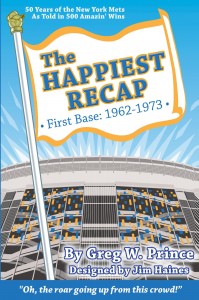 The Happiest Recap is the Mets family history as it’s never been presented before, great win by great win, covering every season and every facet of the Metropolitan baseball experience. This initial volume builds from the last days of the Polo Grounds and the opening of Shea Stadium through the maturation process of the ’60s to the miracle of 1969 and its aftermath, climaxing in the heart of the autumn of 1973, when we all learned to Believe. There are new spins on cherished Mets tales and there are Met stories I guarantee you didn’t know before, but will be Mets-thrilled that you do now. The Happiest Recap is the Mets family history as it’s never been presented before, great win by great win, covering every season and every facet of the Metropolitan baseball experience. This initial volume builds from the last days of the Polo Grounds and the opening of Shea Stadium through the maturation process of the ’60s to the miracle of 1969 and its aftermath, climaxing in the heart of the autumn of 1973, when we all learned to Believe. There are new spins on cherished Mets tales and there are Met stories I guarantee you didn’t know before, but will be Mets-thrilled that you do now.
On the print side, the “classic” version of the book remains available on Amazon and, if you’re the kind who likes your books inscribed, signed copies are available through the special Team Recap eBay store. Check it out here.
Volume 2, a.k.a. Second Base: 1974-1986, is in production currently and should be coming in both formats very soon. The early buzz on it is very promising. And if Second Base is in sight, Third Base: 1987-1999 can’t be more than 90 feet beyond.
by Greg Prince on 27 February 2013 4:40 am Old habits get put away but a few never fully die. About once a year, usually on a Sunday afternoon, I’ll reflexively tune in Channel 9 looking for the Mets game; the Mets turned to Channel 11 in 1999. When the Giants bump the Mets from the FAN during football’s encroachment on baseball’s final Sundays, I check 1050 on the AM dial, forgetting there’s no longer a WEVD there to accept our spillover business (and hasn’t been since 2001). Only recently did I find myself able to spit out “Citi Field” without first stopping myself from saying “Shea Stadium”. And what’s this I hear about the Mets no longer getting their running in in St. Petersburg?
Next thing you know, you’ll be telling me my beer isn’t Rheingold the dry beer.
Port St. Lucie is still, according to me, the new Spring Training Home of the New York Mets, despite the scoreboard indicating it’s caught up with its predecessor’s depth of experience. The Mets prepared for their first 26 seasons on the west coast of Florida and are now in their 26th spring on the other side of the state. St. Pete is essential to the Met narrative historically — Huggins-Stengel Field is where the franchise went into labor before a bouncing Baby Metsie could be delivered in St. Louis — and quintessential aesthetically. The Mets were introduced as an athletic endeavor in St. Petersburg; their original manager introduced them to the bases one by one, for goodness sake. Casey first declared the Mets Amazin’ there. Gil conceived of them as something more than ridiculous there. Davey decided they were capable of dominating there.
Yet St. Lucie’s got the numbers to match St. Petersburg and has built its own quirky history, even if none of it has led to a world championship or leavened the lousiness between periods of pennant contention. Actually, most of what’s transpired in St. Lucie, at least as it’s filtered north across 26 springs’ worth of selective memory, has seemed more embarrassing than uplifting. Bobby Bo led a media boycott in St. Lucie. Karim Garcia and Shane Spencer showed their talent for relief in a St. Lucie parking lot, even though they weren’t relief pitchers. In the last few springs, the Mets have gone bowling in St. Lucie, which seems to engage some people’s interest, though not mine. As a friend suggested, ballplayers go to strip clubs, too — how come the Mets aren’t breathlessly Tweeting those scores?
Maybe what makes St. Pete feel charming and St. Lucie brazen, besides the sepia-toning in which a person occasionally indulges regarding days he stubbornly deems good and old, is that when we were updated from St. Petersburg, it was daily and thus special. When we’re updated from St. Lucie, it’s constant, thus overwhelming. Perhaps that’s an allegory for society at large in an ever more supercharged technological age, but to paraphrase Prof. Stengel from his expert testimony before the United States Senate’s Anti-Trust and Monopoly Subcommittee, I am not going to speak of any other sport or any other thing. There’s plenty I want to know from Spring Training. Bowling results aren’t among them. How every side session and every swing against live BP went doesn’t thrill me, either, because it’s frigging February and reading into any of what a Met does right now offers few signposts toward the trail at large. The blanket coverage of Jenrry Mejia putting on his pants one leg at a time strikes me as a tad superfluous, too.
What do I want? A little color. A little news. An informative feature. Moderate doses of the rookie everybody’s buzzing about and the veteran who’s oozing wisdom, but not overkill if you can help it. The new arm angles and batting stances in due time, once they’re put into action and produce a sample size worthy of modest examination. I don’t care what anybody had for dinner or what they’re doing afterwards. Terry Collins’s briefings don’t have to be dissected like Jay Carney’s (unless Collins is unleashing unmanned drones on the Nationals and Braves). Lucas Duda should be left to swing in the cage in peace. The families of lieutenants don’t get as hung up on potential promotions to captain as those monitoring David Wright’s provisional status do. As long as David’s uniform is emblazoned with “Mets,” the addition or nonexistence of a “C” doesn’t amount to a hill of anything.
This is all howling into the Florida wind, of course. Spring Training is an exercise in minutiae, and minutiae fits neatly into 140-character bites. (Imagine the kinds of Tweets Casey Stengel would have inspired…for that matter, imagine how many.) If the most minute detail masquerades as information, it is transmitted. If it is transmitted, I’m bound to receive it and sort through it. I’m a total hypocrite that way, trust me. Spring Training, on whatever coast it’s held, is good stuff, and I’m a sucker for the whole if not every facet of its parts. My desire is to savor the appetizer portion of our seasonlong meal, not gorge on early spring’s unlimited breadsticks just because somebody keeps coming by and refilling our basket.
by Greg Prince on 25 February 2013 12:39 am The Oscars were handed out Sunday night. Thus, per Monday morning-after tradition, the Academy pauses for a moment to remember those Mets who have, in the baseball sense, left us in the past year.
JOHN EDWARD “Jack” EGBERT
May 28, 2012
Jack Egbert, a righthanded reliever with a last name reminiscent of a weird comic I recall from my childhood (all the single-panel action took place in utero), pitched two-thirds of the ninth inning, making him the 930th Met since there have been Mets; the 35th Met to see action since Opening Day; the thirteenth new Met of 2012; and the 183rd Met to debut as a Met since Faith and Fear in Flushing began blogging.
—May 28, 2012
(Free agent, 10/4/2012; currently unsigned)
JOSHUA RANDALL “Josh” STINSON
September 2, 2011 – September 27, 2011
Pitched pretty well before the return to the statistical mean knocked him for a loop. Given his recent arrival, both on Earth and in the big leagues, the jury should remain out for a couple of years.
—November 3, 2011
(Selected off waivers by Brewers, 4/4/2012)
FREDERICK DESHAUN “Fred” LEWIS
September 4, 2012 – October 2, 2012
I don’t blame Fred Lewis, a veteran of parts of six major league seasons, for keeping at his craft in lovely, lonely Buffalo. Who’d want to quit getting paid to play baseball? I’m pretty sure the answer is nobody.
—July 17, 2012
(Free agent, 10/19/2012; Signed with Hiroshima Carp, 11/9/12)
GARRETT ANDREW OLSON
August 8, 2012
I’ve always been fascinated by one-and-done Mets […] like — until further notice — the way Garrett Olson came up on August 8, made one appearance, left it with an ERA of 108.00 and was sent down probably not to be invited back.
—August 29, 2012
(Free agent, 10/4/2012; Signed with A’s, 10/27/2012)
ROBERT JAMES “Rob” JOHNSON
May 9, 2012 – August 12, 2012
[O]n Friday, Johnson pitched the greatest 1-2-3 eighth a team losing by nine runs has ever known, simply by virtue of being catcher Rob Johnson pitching. It’s a shame things really have to get desperate for a position player to pitch, because when it works, it’s so much fun. Johnson popped up the first guy he faced on one pitch. He popped up the second guy he faced on two pitches. And he struck out the third guy he faced. The names of those guys are being withheld as a protest against the circumstances that led to a catcher pitching, but it was fantastic.
—May 19, 2012
(Free agent, 10/17/2012; Signed with Cardinals, 11/13/2012)
MICHAEL JAMES “Mike” NICKEAS
September 4, 2012 – September 29, 2012
Standing there watching Mike Nickeas peer at the pitcher, I tried to remember all those becauses, and not get distracted by how harebrained it was letting Mike Glavine be a Met in the first place. But it was already stuck in my head: Mike Glavine, hideous baseball, dopey decision-making, 2003. By force of will I made myself fast-forward to 2010, and watched Mike Nickeas strike out.
—September 6, 2010
(Traded to Blue Jays, 12/17/2012)
VINCENT ANTONIO “Vinny” ROTTINO
May 4, 2012 – June 24, 2012
I got a very good feeling watching the Mets overwhelm the Padres this afternoon. Not just a 9-0 feeling, but a feeling that this was a throwback game, the kind of game I could’ve watched on Channel 9…the kind of game when Rusty Staub wasn’t a bobblehead, but a 3-for-5 right fielder robbing Johnny Grubb of a double. Alas, the real Rusty was confined to the SNY booth, but we were OK on the field anyway. After all, we had Vinny Rottino. Vinny from Racine (by way of Buffalo) was filling in as we might have had George “The Stork” Theodore do once, and Rottino inked himself in the Met annals with his very first home run.
—May 26, 2012
(Selected off waivers by Indians, 6/27/2012)
DANIEL “D.J.” CARRASCO
April 3, 2011 – May 16, 2012
CARRASCO? REALLY? Ugh. After which, we never, ever spoke of it again.
—June 16, 2011
(Released, 5/25/2012; Signed with Braves, 6/19/2012)
VALENTINO MARTIN “Val” PASCUCCI
September 8, 2011 – September 27, 2011
The Mets, though, had a little gumption in them. The left field corner isn’t the best place for judging long fly balls, particularly ones hit right at you, but the second Valentino Pascucci connected I was up and out of my seat, howling with glee. The ball landed about 25 feet in front of us, with Joshua’s late scramble just failing to end with a souvenir.
—September 24, 2011
(Free agent, 11/3/2012; Signed with Camden Riversharks, 2/12/2013)
RAMON SANTO RAMIREZ
April 5, 2012 – October 1, 2012
[Y]ou know how every couple of winters we get some “sleeper” or “hidden gem” in whatever deal occupies our attention for 20 minutes? That was supposed to be Ramon Ramirez. I knew it wouldn’t be. I’d love to provide a link to prove I knew this in December, but the acquisitions of Ramirez, Rauch and Francisco didn’t seem worth commenting on, because I knew at least one of those guys would be hit and miss, the other would be stop and go and the third would just suck out loud. Since all the smart money was on Ramirez to be “the steal” in the Andres Torres deal, I assumed it would be him.
—July 5, 2012
(Free agent, 10/29/2012; Signed with Giants, 2/5/2013)
KELLY BRIAN SHOPPACH
August 16, 2012 – October 3, 2012
Kelly Shoppach dropped a foul pop that extended a Kurt Suzuki at-bat long enough to turn it into a home run, which reminded me of an observation I made while sentenced to ten innings of Mets baseball at Citi Field on Sunday: if there is one modern-day player who seems likely to get caught up in a Black Sox-like scandal, my nominee would be Kelly Shoppach. That’s not to say I think he was throwing the game. I don’t think any of our catchers is capable of throwing a game, let alone a baserunner out at second.
—September 10, 2012
(Free agent, 10/29/2012; Signed with Mariners, 2/7/2013)
MIGUEL JEREZ (Descartes) BATISTA
September 1, 2011 – July 21, 2012
What a pleasure it was to watch Father Time tell Baby Next Year, “Not tonight, son. Not tonight.” Let’s hear it for the unlikely 100th big league victory of Miguel Jerez (Descartes) Batista, born when I was in second grade and not dead yet. Baseball Reference identifies Batista as having been the sixth-youngest National League player of 1992 and the sixth-oldest National League player of 2011. Batista’s looked at ball from both sides now. Now he’s on our side, for however long “now” lasts, which couldn’t possibly be very long. While he’s here, I hope he enjoys — per Bobby Parnell’s country & western warmup music — the rest of his eight-second ride.
—September 2, 2011
(Released, 7/26/2012; Signed with Braves, 7/27/2012)
MANUEL ALCIDES (Molina) “Manny” ACOSTA
April 21, 2010 – October 3, 2012
Most of the four-run homers, however, have been served up the ham-and-egger corps of Met middle relievers, including two by the generally competent if quickly forgettable righty Manny Acosta. The former Brave didn’t exactly have it goin’ on Sunday against his old club when he entered a tie game in the top of the seventh. The bases were loaded, two were out (a situation facing seven of the previous eleven grand slam pitchers) and Acosta worked Derrek Lee to 3-and-2. Manny threw a strike and Lee struck it. Twelve grand slams given up by Met pitchers this year…and the Mets’ record in those twelve games? 0-12, of course.
—September 19, 2010
(Free agent, 11/30/2012; Signed with Yomiuri Giants, 12/13/2012)
RONNY ALEXANDER CEDEÑO
April 5, 2012 – October 2, 2012
Ronny Cedeño drove in five runs. Really? The guy who nobody remembers is on the 25-man roster… and that includes his blood relatives. He hit a ball that clanged off Melky Cabrera’s glove, or as the Giants’ official scorer calls that sort of defensive lapse, a double. REALLY!?!
—August 3, 2012
(Free agent, 10/29/2012; Signed with Cardinals, 1/28/2013)
JON ERICH RAUCH
April 5, 2012 – October 2, 2012
Jon Rauch was so unhittable for so long this season, until the one moment in September when what he did had additional ramifications. Then Buck took him as deep as he had to, and a 4-0 Dickey shutout became a 4-3 Met nailbiter, and Marlins began to swim onto the basepaths and…Rauch got out of it. The satisfaction index plummeted like crazy, but a 19th win was a 19th win.
—September 24, 2012
(Free agent, 10/29/2012; Signed with Marlins, 2/5/2013)
PEDRO BEATO
April 1, 2011 – July 23, 2012
Collins, not surprisingly if you’ve been listening to him since he was hired, wanted to emphasize the “positive side” first. There was, he said, “joy” in the Mets clubhouse this week for and from the guys who had never made a major league roster before and for and from the guys who had no guarantee of making this one when camp commenced…[w]hen he informed Pedro Beato he’d be part of the Mets’ bullpen, there was a sense of “oh my god, it was worth all the work and all the bus rides.”
—March 29, 2011
(Traded to Red Sox, 8/14/2012)
ANDRES YUNGO (Feliciano) TORRES
April 5, 2012 – October 3, 2012
R.A. aside, the marquee name in the matinee was Andres Torres, who tormented Josh Johnson (and Chad Gaudin) with a double, homer and triple. (Nobody much mourns when you wind up a triple shy of the cycle, but the lack of a single stings, doesn’t it?)
—August 10, 2012
(Free agent, 11/30/2012; Signed with Giants, 12/14/2012)
CHRISTOPHER RYAN “Chris” YOUNG
April 5, 2011 – September 29, 2012
His Sunday in Milwaukee encapsulated the Chris Young experience in 2012. He pitched well enough to win for a club capable of clobbering the opposing pitcher. The Mets, however, aren’t that club. Ryan Braun extended his BrewerVision highlight reel by two long home runs off Young, and Aramis Ramirez added a spiffy clip on his own behalf. Each was a solo blast, which indicates Young was pretty much doing his job except for the moments he didn’t do it that great. It added up to three runs until there were two out in the seventh, which is when Terry Collins came and took the ball. The score was three-nothing. The score would stay three-nothing. The Mets and Young were the ones who would wind up with nothing.
—September 17, 2012
(Free agent, 10/29/2012; Signed with Nationals, 2/21/2013)
SCOTT ALEXANDER HAIRSTON
April 1, 2011 – October 3, 2012
I feel so bad for baseballs that are launched on a trajectory toward the top of the so-called Great Wall of Flushing. In most other ballparks, they’d be destined for their ultimate reward: some grateful fan’s loving mitts and a digit of immortality — anywhere between a 1 and a 4 — on the scoreboard. At Citi Field, the baseballs headed in that general direction mostly fall short of optimization, and even when they break free of the surly bonds of stifling architecture, they look like their little tongues are hanging out from all the effort it takes to surpass that hundred-or-so-foot-high fence. I swear I can see the sweat beads forming on the horsehide as it tries its darnedest to metamorphose into a home run. This, however, was not a problem for Scott Hairston’s mountain of a fly ball in the seventh inning Saturday. That baby, carrying the fates of two baserunners on it as it elevated, called to mind Crash Davis’s line about anything that travels that far having a damn stewardess on it…except in the case of Hairston’s homer, I’m assuming NASA assigned an entire crew to its journey. Scott Hairston piloted this mission perfectly. His ball did not look exhausted when it arrived in the Left Field Landing — and I can report first-hand it really did land up there, hard as it is to believe that a) it’s not still going and b) a Met homer can clear that wall that decisively.
—July 16, 2011
(Free agent, 10/29/2012; Signed with Cubs, 2/10/2013)
JOSHUA MICHAEL THOLE
September 3, 2009 – October 2, 2012
There’s forever a gold star affixed to his permanent record for coming off the disabled list on June 1, going into a crouch and coming away, two hours and thirty-five minutes later, clutching the last out of the First No-Hitter In New York Mets History. Since Johan Santana didn’t earn that milestone by pitching stickball — specifically the kind whose strike zone is a box chalked on a schoolyard wall — we have to assume Thole had something significant to do with his achievement. He was his catcher. Thole was also R.A. Dickey’s catcher for two one-hitters. When you think of Tim Byrdak casting a glare in Thole’s direction for pitch selection gone awry and Pedro Beato casually assigning blame to Thole for not blocking a blockable wild pitch, you have to pause and think of the good times, too.
—August 4, 2012
(Traded to Blue Jays, 12/17/2012)
JASON RAYMOND BAY
April 5, 2010 – October 1, 2012
We all need our scapegoats, and Bay is mine. I’d like to believe it’s temporary, though temporary is suddenly rounding third and heading for August. On a night when few did much and many did little, Bay continued to brave the storm in a skiff made of futility, standing in proximity to home plate six times for no immediately discernible reason. He produced a groundout, reached on an error and then struck out, struck out, struck out and…struck out. 0-for-6 with four strikeouts, none of which came with a Met runner on base, which prevents me, in all good conscience, from picketing the team hotel in L.A. this morning while chanting: HEY, HEY, JASON BAY! HOW MANY METS DID YOU STRAND TODAY?
—July 22, 2010
(Released, 11/7/2012; Signed with Mariners, 12/8/2012)
MICHAEL ALAN PELFREY
July 8, 2006 – April 21, 2012
That leaves us Mr. Pelfrey’s debut. All you need to know? Six feet, seven inches; 22 years, six months; 96 miles per hour, 104 pitches, five innings; one win, no losses. Mike Pelfrey is, by definition, our stopper. Upon early inspection, he’s also pretty much everything for which one could have hoped. Allow for some nerves and jitters and it was a tremendous debut. Unafraid, no nibbling, stronger as his day grew longer (as if he himself could grow any longer). If he’s not ready to stay on a permanent basis — John Maine, despite reminding me in aura if not stuff of John Mitchell, is more polished at this point — he will be very, very soon. He is as good as we hoped and dared to suspect. His postgame press gaggle was almost as much fun to watch as his pitching. The kid not only answered in complete sentences (as did Milledge in May), but he never ceased smiling. Why should he? He’s a big leaguer with a perfect record for a team in first place and his future has every likelihood of improving from there. The denizens of the visitors dugout can be forgiven if they are teal with envy.
—July 9, 2006
(Free agent, 11/30/2012; Signed with Twins, 12/20/2012)
ROBERT ALAN “R.A.” DICKEY
May 19, 2010 – October 2, 2012
Did the Citi Field scoreboard start every Oriole batter’s count at 0 balls and 2 strikes Monday night? You know, just to save time? I’ve seen hitters obviously overmatched by pitchers. I’ve seen hitters who it could be assumed had little chance against dominant pitchers in ungodly grooves. I’ve seen hitters who had to know it would take a near-miracle to get good wood on an approaching baseball when it left the hand of a pitcher on his best night. But I’ve never seen anything like this. I’ve never seen hitters so absolutely defeated across the entirety of every encounter with a given pitcher. I’ve never seen so many endings appear determined in advance since those scenes in Quiz Show where you knew the contestants had been given the answers. I’ve never seen a pitcher carry a veritable shutout into the (how appropriate) 43rd inning of what amounts to an extended game of catch with Mike Nickeas and Josh Thole. I’ve never seen anything like what R.A. Dickey is doing to opposing batters. When he began throwing from Olympus rather than a mound in late May, it was pretty standard stuff within the realm of competition. They tried to hit him and they couldn’t. We’ve seen that before. These last two starts, though? Somewhere in the midst of Dickey’s one-hitter against the Rays and through all of Dickey’s one-hitter against the Orioles, the other side simply sent its regrets that it could not attend. I’m not saying a series of professional hitters gave up rather than attempt to make serious contact with Dickey’s assortment of devastating knuckleballs and complementary fastballs. I’m saying it was like they weren’t even at the party.
—June 19, 2012
(Traded to Blue Jays, 12/17/2012)
by Greg Prince on 23 February 2013 10:53 am I’ll let you get back to warming up your television sets after a winter of presumed disuse in anticipation of 2013’s first Spring Training telecast on SNY in a moment. I just wanted to let you know Gary Cohen, the greatest baseball announcer working today (or any other day), is profiled beautifully by Greg Hanlon of Capital New York. Read it here…and not just to learn what blogs Gary goes to when he and his cablecast colleagues aren’t making the Mets the best show in town.
This starts Gary Cohen’s 25th year as Mets play-by-play announcer, 17 years exclusive to radio, eight all of a sudden on TV. That’s institution territory, and I don’t necessarily mean what describing in detail a quarter-century’s worth of Mets baseball might put a person in. By the time the first 25 years of the franchise were outta here, we knew we had been treated to the aural trip of a lifetime with Ralph Kiner and Bob Murphy, the only other announcers in Mets history with longer tenures behind in-game microphones. How lucky are we, if we experienced the Original Three — the sublime Lindsey Nelson checked out after the first 17 seasons — to have picked up the journey with Gary Cohen in 1989, let alone Howie Rose (in our ears since 1987, announcing full-time since 1996), not to mention their respective current partners?
If you missed Ralph, Bob and Lindsey, or only got a taste of Ralph and Bob or, for that matter, never took in the full McCarver when that was something to behold, I feel bad for you. But I don’t feel terrible, because we’re living in another golden age of Mets broadcasting right now. We haven’t had that many on the field. We’ve been pretty damn lucky over the air.
Happy exhibition baseball to one and all…and a Happiest Recap, too!
by Jason Fry on 21 February 2013 10:40 pm The Braves have announced that they’ll retire No. 10, recently worn by the player forever known in these parts as Larry Jones. The Mets might or might not have a ceremony of their own soon — they’ve been coy about the chances of putting Mike Piazza’s No. 31 on the wall when he’s inducted to Cooperstown, and there’s been a groundswell of support for retiring Gary Carter’s No. 8 since the Kid’s untimely death a year ago.
All this talk of retired numbers brought me back to a piece Greg and I penned for Amazin’ Avenue‘s 2011 preview, in which we discussed the art and science of retired numbers and pondered whether any Mets were worthy of joining 37, 14, 41 and 42 at Citi Field. I thought it was worth looking back at that article and seeing if my thinking’s changed.
There are no set criteria for retiring numbers — teams are all over the place in terms of whom they honor and why. The Red Sox, for example, only retire numbers for Hall of Famers who spent at least a decade in Boston. Whatever their ground rules, some teams are good at retiring numbers — take the Braves’ pre-Larry list of Cox, Smoltz, Murphy, Spahn, Maddux, Niekro, Mathews, Aaron and Glavine, or the Orioles’ roster of Weaver, Robinson, Robinson, Ripken, Palmer and Murray. Other teams, well, need some help: The Astros’ list is Wynn, Cruz, Scott, Ryan, Wilson, Umbricht, Bagwell, Biggio and Dierker. The Marlins retired Joe DiMaggio’s number. The Padres’ retired Steve Garvey’s. And lets reserve special scorn for the Nationals, who unretired the digits their Expo forebears had honored.
Whatever your take on retiring numbers, the arguments generally revolve around four factors:
* stats
* longevity
* titles
* X factor
The first three don’t need much in the way of definition. The latter, though unquantifiable, doesn’t either — we all understand that the name “Tug McGraw” quickens the pulse of Mets fans in a way that, say, “Howard Johnson” doesn’t.
Back in 2011, Greg and I looked at seven potentially wall-worthy Mets. Here they are, with credentials briefly summarized:
Dwight Gooden (No. 16): 157 Met wins and that amazing ’85 season; 11 years as a Met; one title; an icon turned star-crossed ex-con now thought of fondly but with sorrow and a certain wariness.
Keith Hernandez (No. 17): 939 hits as a Met; seven years in the fold; one title; X factor high as a player and enhanced by his becoming a broadcast-booth icon.
Howard Johnson (No. 20): 997 Met hits and three 30-30 campaigns; nine years as a Met; one title; for all that, not particularly remembered.
Jerry Koosman (No. 36): 140 wins plus four in the postseason; 12 years as a Met; one title; given his due but overshadowed, inevitably, by Tom Seaver.
Tug McGraw (No. 45): 85 saves; nine years as a Met; one title and one Dammit Yogi near-miss; “Ya Gotta Believe!”
Mike Piazza (No. 31): 30+ homers four times; eight years as a Met; no title; enormous X factor that his Hall of Fame induction will only enhance.
Darryl Strawberry (No. 18): only recently surrendered franchise hitting records to David Wright; eight years as a Met; one title; a polarizing figure while here, loathed for his exit but now embraced as a vaguely erratic crazy-uncle type.
Back then we didn’t consider the case of Gary Carter, which at first made me wonder if something had been accidentally deleted. Here’s the Kid:
Gary Carter (No. 8): 542 Met hits; five years with the team; one title; huge X factor as yin to Keith’s yang and then as a good man gone too soon.
Back in 2011, I came to a reluctant conclusion, one that surprised me: I said the Mets shouldn’t retire any of those numbers, and Greg didn’t dissent, at least not publicly.
If you retire Tug’s number, don’t you also have to honor John Franco, who was here far longer and racked up far more saves? And does anyone seriously think John Franco’s number should be retired? HoJo flunks the X factor test, as does (by a smaller margin) Koosman. Gooden and Straw are icons but ultimately cautionary what-if tales. As for Gary Carter, he’s beloved and should be, but our love for the Kid and our grief over his death shouldn’t blind us to the fact that he was a Met for just five years, or that one of those years was mediocre and another was awful.
That leaves Keith Hernandez and Mike Piazza. Keith’s a bit short in stats, while Piazza’s short in tenure and never won a title.
In 2011 I concluded that neither quite qualified for having their numbers retired. Is that still true in 2013?
The cute answer would be that neither Hernandez nor Piazza has driven in run since 2011, so how are their cases any better now than they are then? But as fans we’re constantly reassessing players and eras, so our conclusions may change.
And for whatever reason, mine have — I think the Mets should retire 31 and 17, in recognition of two players who defined their eras, and who have come to represent their teams.
True, Piazza’s tenure was abbreviated and he never got a ring. But he gave the Mets star power again when they desperately needed it, and he might go into the Hall of Fame with an NY on his cap. As for Keith, his Mets legend has been on the ascent since “Seinfeld,” and he now embodies the reckless, no-prisoners spirit of the ’86 team. Retiring their numbers would celebrate their accomplishments, but they’d also pay tribute to brief but glorious periods in team history.
But I think the Mets should then do something else — namely, ease certain numbers into quasi-retirement.
Not retiring a number doesn’t mean you hand it over to the latest wide-eyed arrival from Las Vegas. No Met has worn 31 since Piazza left town, and that’s as it should be. The Mets have kept 24 mostly mothballed since Willie Mays’s cameo, handing it out only to Rickey Henderson and, um, Kelvin Torve. But without speaking ill of Dave Gallagher, David Newhan or Tito Navarro, no Met should have worn 8 or 17 or 36 since their examplars left town either.
The Mets wouldn’t be alone in such quasi-retirements: The Tigers have kept 1 and 47 on ice since the tenures of Lou Whitaker and Jack Morris. It’s a good answer — not a retirement, but a sign of respect that deepens a sense of Mets history.
So there we have it: Retire 31 and 17, with tons of pomp and circumstance. But at the same time, put 8, 16, 18, 36 and 45 on the shelf next to 24, to be assigned infrequently, and only when circumstances warrant. (Sorry HoJo.) If you’re not a gamer of a catcher, you’re not wearing 8. If you’re not a cerebral, skilled lefty starter, you don’t qualify for 36. If you’re not a gutsy fireman with a certain swagger, 45 doesn’t go on your back.
And if Travis d’Arnaud should be the real deal and do 8 proud? We should have such problems.
Until the Mets retire more numbers, put 37 14 41 42 on your chest with a Faith and Fear t-shirt.
If you love Mets’ uniform numbers (and who doesn’t?) you’ll love Mets by the Numbers. Go visit!
by Greg Prince on 20 February 2013 5:22 pm Hello, is this the York residence?
Is this Mr. York?
Good day, Mr. York. I’m with the Metropolitan Baseball Club, and I’m calling to discuss your fanship. Our records indicate you signed on with us as a charter supporter of ours in 1962, which you might remember entitled you to a full Mets fan identity for the next 50 years. Your fanship expired in 2012, but it’s our standard procedure to automatically renew you and keep you on the books for another year after that. With that year having passed, I’m required to call to ensure your continuing fanship. I’m sure you’ve just been busy and haven’t yet had a chance to renew, so if I could take a moment to confirm a few pieces of information…
Uh-huh.
Uh-huh.
Could you tell me why you’re no longer interested?
Well, Mr. York, perhaps you haven’t heard about some of the great features we’ve added since you last fully took advantage of your Mets fanship.
No. No, we didn’t win one of those. I imagine you would have heard about it if we had. We do hope, however, to win another in the relatively near future.
No, we didn’t win one of those, either. That would’ve been big news, too. But I’m sure we’ll be competing for one very soon. In the meantime, we have all sorts of intriguing and exciting players…
No, he doesn’t play for us anymore.
I agree he was a good story, but he’s no longer here. On the other hand, we do have…
No, he’s gone, too. The year before last.
Yes, he was very good and we continue to wish him well.
No, we didn’t exactly sign anybody to take their places. We’ve been going another route.
Be that as it may, Mr. York, there are all kinds of benefits to remaining a Mets fan. I’d like to tell you about a young catcher…
No, not him. He retired a while ago. You certainly do go back with us, though. The young man I’d like to tell you about is going to…
Well, he hasn’t done anything yet. But the scouting reports are excellent. And when he arrives…
No, he’s not here. We expect him in a very brief while. And when he’s here, we look forward to him catching a pitcher who is also going to be…
No, he’s not here yet, either. We do, however, anticipate…
I wouldn’t put it that way, Mr. York. There are plenty of immediate benefits to remaining a Mets fan. We have one pitcher who is here who we’re very excited about.
No, he’s still here, but between you and me, he’s going to be phased out soon.
Yes, we’re aware of what he did last June, and I’m glad you heard about it, but we’re going in a younger, more “efficient” direction.
I wouldn’t characterize it that way. Perhaps you noticed that in last year’s playoffs…
No, I understand we weren’t in them, but there were teams who were that didn’t spend a fortune to get there.
Well, Mr. York, I respectfully disagree. It’s not an unwillingness or an inability to spend, it’s just that…
You may have read that, but it’s not necessarily true. But if I could, sir, I’d like to get back to some of our other features.
Three of them — just like everybody else: left, center and right. May I ask why you were wondering about that in particular?
To be fair, Mr. York, they haven’t proven they can’t play, and if you renew your fanship with the Mets, you’ll be able to tell everybody you were in on the ground floor.
No, sir, “ground floor” doesn’t necessarily equate with “basement”. Have I mentioned we have a catcher from whom we expect very big things?
It’s not that I’m avoiding talking about the outfield with you, I just think there’s more to the big picture. For example, the catcher…
Well, I guess we will see, and if you are interested in seeing, then I’d like to just confirm those few pieces of information and have you all set to keep your Mets fanship active. First name: N-E-…
No, there’s also a third baseman, a shortstop, a second baseman probably and a first baseman, plus a high-quality selection of on-site pitchers. We do have an array of players all ready to be enjoyed right away. Now, are you still living at…?
Uh-huh, I see. Well, about how much time do you think you’ll need to think about it?
That long? I was asking for a time frame, Mr. York, because you were willing to show us your support sight unseen in 1962 and, some variations in the marketplace notwithstanding, you seem to have benefited from the affiliation. Our records show your fanship was fully active in and around 1969, 1986 and at several junctures more recently. We’d really hate to lose your allegiance after all these years.
I’m afraid I can’t promise you that, Mr. York, nor do I think you would want me to. We’ve tried to make guarantees in the past and they generally haven’t worked. We ask that by agreeing to renew your fanship with the Mets that you trust we are making your long-term satisfaction, in conjunction with our long-term success, our primary priority.
No, no, I understand, this is a big decision. Can I ask you to allow me to contact you again at some point after the season starts to see if you have a change of heart? Maybe after you’ve had a chance to see our catcher? There are no obligations. Just a conversation.
That’s wonderful, sir. You will hear from me and we do look forward to convincing you that we know what we’re doing as soon as possible.
No, thank you, Mr. York. As we say around here, we’re not really the Mets if we don’t have New York with us.
by Greg Prince on 18 February 2013 11:24 am 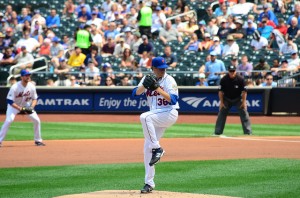 Ya gotta start somewhere, and Collin McHugh certainly did. (Photo by Sharon Chapman) He may barely register on the pitching staff radar as the first day of full-squad workouts commences (though it feels like the Mets have been in Port St. Lucie for a month already), but Collin McHugh was front and center in our attention not even six months ago. The date was August 23, 2012; the place was Citi Field; the occasion was McHugh’s first MLB start. The contemporary Met vibe was wan during that summertime stretch when the Mets were operating under a strict restraining order that kept them at least 90 feet from home plate at almost all times, but the numbers were spectacular in any league, let alone the biggest one: 7 innings, 2 hits, 1 walk, 9 strikeouts and 0 runs allowed. The only stat that put a crimp in that sunny Thursday afternoon was the final score of Rockies 1 Mets 0.
Whatever juice McHugh (a pitcher and a blogger) squeezed out of his performance seemed to evaporate pretty quickly in the eyes of his supervisors. Collin was sent down in a flash and hasn’t brought up much in Met pitching conversations since. But he’ll always have August 23, 2012, and we have a ton more insight on what that kind of experience is like thanks to some fine reporting and writing by a Mets fan at Williams College by the name of Elliot Chester.
The previously unpublished Elliot made Collin the subject of an in-depth profile for a class assignment. He spoke at length to the pitcher and, in the course of his diligent research, tracked down one of the alleged 22,544 attendees who bore first-hand witness to his pitching (me) to put together a terrific piece that I’m proud to direct you toward. It runs on Mets Merized Online — an Amazin’ly comprehensive news and analysis site, if you’re not fully familiar with it — in two parts. Get a sense on Collin McHugh the person in Part One and follow Collin McHugh the pitcher through his first major league chance, if not his major league first win, in Part Two.
The photo above, of McHugh in action in his first inning of Mets work, was taken by my friend Sharon Chapman, whose photography has lately been included in a couple of exhibitions, an honor she richly deserves. The most recent of them is this one in New Jersey. And someone among the “22,544” who watched McHugh with Sharon and me, Sam Maxwell, continues to blog our team beautifully at both Converted Mets Fan and Rising Apple. In particular, Sam and Rich Sparago have risen above the bile (lord knows I retain an ample supply of it) to find something nice to say about erstwhile left fielder and lingering money pit Jason Bay. Check it out here. Plus, as long as you’re on Rising Apple, read Danny Abriano’s salute to a stadium that took one last whack from the wrecking ball four years ago today.
One of the benefits of Mets blogging I didn’t mention in noting our eighth anniversary was that you find yourself in proximity to a bunch of talented people you might otherwise miss, 1-0 losses notwithstanding. It’s quite the bonus.
by Greg Prince on 16 February 2013 4:37 pm Eight years ago today, Faith and Fear in Flushing took flight. We’re still aloft. The Mets were taking off for the sky on February 16, 2005. These days they’re learning to crawl.
Time’s flight has been steadier than that of the Mets’ ascent, which stopped cold on a called strike three that I couldn’t have fathomed would mark the peak altitude for the Mets Jason and I began blogging 20 months earlier. I can’t believe the Mets didn’t win the pennant (and the World Series) in 2006. I also can’t believe the Mets didn’t make the playoffs in 2007 (and 2008). But if I’m honest with myself, I can’t believe the Mets soared as high as quickly as they did following our 2005 launch given how crummy they were from 2002 through 2004.
That’s a lot of not believing for a fan of a team in whom, by custom, you gotta believe. Yet 2005 to 2008, the salad days for Faith and Fear, were halcyon days for us as Mets loyalists compared to the four seasons of nosedive that followed. There were moments to treasure between 2009 and 2012 — there are always instances that transcend the depths of a given campaign, as anyone who’s read The Happiest Recap could tell you — but boy, oh boy, was the prevailing context a tough thicket to negotiate. I’ve spent the first halves of the last four seasons not quite accepting whatever good Met fortune was transpiring before my disbelieving eyes and all four second halves dutifully documenting how that tenuous progress had evaporated upon re-entry into the atmosphere.
But I can’t stress this enough: we were there to watch it burn up. We watched the Mets go to hell in 2009; make a return trip in 2010; go back to find the jacket they apparently left behind in 2011; and treat it like a timeshare in 2012. The Mets have made a late-summer home in hell these past four seasons, and Faith and Fear has been on top of every baseball day of it.
I’m strangely proud of that. It’s easy enough to check out when August and September become choke points on the calendar. Many Mets fans — bloggers and non-bloggers alike — swear they throw up their hands rather than throw up something worse as one dispiriting loss becomes a losing streak…which becomes a losing month…which becomes a losing record. But I swear faithfully (if occasionally fearfully) that I’m here: keeping tabs, watching closely, listening hard, giving it as much thought as it takes to glean something out of close to nothing so we harvest as much digestible fruit off the Met vine as possible.
Why? Because it’s what I do.
Probably the nicest thing a reader said to us in our eighth season of blogging was this, after yet another deflating September 2012 loss:
It’s amazing to me that with the incredible glut of horrific, unwatchable and indescribably boring games that you guys keep coming up with interesting posts. Seriously, you guys are having a Dickey-like experience. You keep winning despite this terrible team. Kudos!
Granted, a comment like that carries a very different emotional resonance than one that appeared on our site the morning of October 20, 2006, hours after that called strike three…
Brilliant as always. Poignant as expected. Well done. This goes for the 2006 Mets as well.
Ya know, if I didn’t read about the exploits of my beloved Mets on FAFIF, it’s like it never happened.
Thanks for a fantastic season, guys. (You too, Mets.)
…but I think each sentiment speaks for what we do here. High times and low, we do with this team all that we can. Maybe it involves the Mets as they valiantly fall one unhittable curveball from greater glory, maybe it involves the Mets as they trudge on and on until we wish they’d just trudge off a cliff already, but we’re with them in our own way and we don’t depart.
I was wondering yesterday on the eve of this anniversary if instead of 2005, Jason had asked me if I wanted to start a blog about the Mets in 2013. This time we wouldn’t have the promise wrought by the splurge that brought Pedro Martinez and Carlos Beltran to our shores and we wouldn’t be bolstered by having consumed a significant taste of the talents young Jose Reyes and David Wright had already exhibited. Instead, we’d be coming off a winter when R.A. Dickey was traded and no desperately needed outfielder in his obvious prime was acquired, whatever the means necessary to have done it. Yeah, there’d be one young pitcher we salivated over for a few starts the year before, another we’d been assured will be even better than that guy and a catcher capable of making trading the Cy Young winner seem like a bargain. But there’d also be an ownership not necessarily capable of doing anything that pushes the team from a maybe to an almost-definitely — and in real time, we’re not nearly assured of “maybe” territory yet; we’re maybe “maybe,” at best.
Having watched the unwatchable and described the indescribable as a matter of horrific course in terms of the four seasons that have withered and died on us (never mind the unhappy endings attached to ’08, ’07 and ’06), I can’t honestly say for sure that non-blogger me would be dying to jump in cold in 2013. Who would root limply through the belief-draining second halves of 2009, 2010, 2011 and 2012 and volunteer, “You know what I want to do? I want to write about this team every darn day that it plays!”
Then again, who am I kidding? The Mets lost 88 games last year on top of losing 85 the year before, pausing in between to let my favorite player leave as a free agent. Sound bad? Shoot, the Mets lost 91 games in 2004 on top of losing 95 the year before — and those were seasons played out in what were also sold as the gateway to a potentially brilliant new era (they all are)…oh, and they let my favorite player from just prior to that period walk as a free agent. Yet there we were, on February 16, 2005, ready to go, not knowing what Pedro had left from Boston or if the Carlos of Houston could possibly be the Carlos of New York or how far David and Jose had to go to live up to our burgeoning expectations, never mind the usual questions about a miserable bullpen (et al) and an ownership that hadn’t noticeably distinguished itself to date, checkbook availability or not.
Of course we’d start blogging now if we hadn’t already. I was Mets-miserable for most of 2003 and 2004, and I was on board the first day of Spring Training in 2005. The Mets were Mets-miserable all kinds of years and dispatches from St. Pete/St. Lucie beckoned regardless the following Februarys. If the technology existed in 1978, I’d have blogged those Mets from the first of their 66 wins to the last of their 96 losses and been gladly back for more in mind-shatteringly abysmal 1979.
This Metsian blog turns eight today, but I’m pretty sure I’ve been a Mets blogger all my life. I was born this way and I’m still this way. So whether we’re in for a “fantastic season” or an “incredible glut of horrific, unwatchable and indescribably boring games,” Flight FAFIF continues aloft. As a dependably friendly voice was careful to remind us from the cabin, fasten your seatbelts.
by Greg Prince on 15 February 2013 11:23 am Congratulations to Elliot, Bill and Joe, three Mets fans whose love for their team dovetailed well with our Valentine’s Day contest. For answering yesterday’s quiz, each wins a copy of The Happiest Recap: First Base (1962-1973), the first volume of the four-volume series that tells the story of the New York Mets’ first 50 years through 500 Amazin’ wins. You can get your copy here.
Other developments before we get to the quiz answers:
• Kindle version is closing in on reality. Will let you know the moment it drops.
• The second volume — Second Base: 1974-1986 — is in production and you’ll find out here first when it becomes available. (Spoiler alert: You’re gonna love it.)
• I engaged in what became a pretty passionate interview about the project with the guys from Rising Apple Report the other night: Matt Musico, Rich Sparago and Sam Maxwell. Listen to it here. (I come in around the 9:30 mark.)
• If you’re the mark-your-calendars type, then go to Wednesday, June 26, and circle 7:00 PM. That will be The Happiest Recap Night at Bergino’s Baseball Clubhouse in Manhattan, with book talk followed by proprietor Jay Goldberg’s invitation to stay and watch the Mets play the White Sox (yes, the White Sox) live from Chicago at 8. More details as the date approaches.
As for Bobby and the Valentines…
1. Who was the winning pitcher in Bobby Valentine’s first Opening Day victory as Mets manager?
Turk Wendell, in relief, in the 14th inning of the March 31, 1998 season opener, a game best remembered for Bambi Castillo sending us all home.
2. Three pitchers tied for most games started on the Mets in Bobby Valentine’s first full season as Met manager. Name all three.
In 1997, the ball most often went to the troika of Rick Reed, Dave Mlicki and National League All-Star Bobby Jones.
3. Bobby Valentine wrote John Olerud’s name into the three-hole in 1999 in 159 of 163 regular-season games played. Who were the other three Mets he used as starting No. 3 hitters that year?
Robin Ventura, Matt Franco and Benny Agbayani each filled in orderwise for Oly on his rare days of rest.
4. Who was the last Met to bat in a game managed by Bobby Valentine?
The last batter of the 2002 Met season was Matt Franco, but he was a Brave by then. The answer from the Met side of the box score is Esix Snead.
5. Mike Hampton, Al Leiter, Rick Reed, Glendon Rusch and Bobby J. Jones started 151 of the 162 regular-season games the Mets played in 2000. Who were the other five pitchers to whom Bobby Valentine gave the ball to start the remaining 11 starts in that pennant-winning year?
Now and then you’d get a start from Pat Mahomes, Dennis Springer, Bill Pulsipher, Grant Roberts and the Bobby Jones who was never a National League All-Star.
6. Which six Mets played in the most games during Bobby Valentine’s six full seasons as Met manager?
Going around the horn, there were the five stalwarts of 1999 (and assorted other years): Mike Piazza, John Olerud, Edgardo Alfonzo, Rey Ordoñez and Robin Ventura — and then there was the peripatetic Matt Franco, who nosed out Jay Payton in the call of duty.
7. Bobby Valentine took over Met managerial duties with 31 games remaining in 1996. He used four different starting first basemen during that period. Please name them.
With Rico Brogna already out for the year, Bobby V. leaned on Butch Huskey, Tim Bogar, Roberto Petagine and (there’s that man again) Matt Franco.
8. Bobby Valentine became a Met when he and Paul Siebert were traded from San Diego for Dave Kingman on June 15, 1977. How many hits did Bobby collect in all the games Paul ever won as a Met?
None. Siebert won two games, both of them as Joe Torre’s extra-inning option of something approaching last resort. Valentine batted eight times in those games and went hitless.
9. Between them, how many hits did Bobby Valentine and Ellis Valentine accumulate as Mets?
186; Ellis outhit Bobby 132 to 54.
10. Greg Harts went 1-for-3 in his Mets/major league career. Against whom did he register his only base hit?
H(e)arts and flowers to Rick Reuschel for getting Greg on the board.
Baseball-Reference was the indispensable source for these answers and much that appears in The Happiest Recap.
|
|