The blog for Mets fans
who like to read
ABOUT US

Faith and Fear in Flushing made its debut on Feb. 16, 2005, the brainchild of two longtime friends and lifelong Met fans.
Greg Prince discovered the Mets when he was 6, during the magical summer of 1969. He is a Long Island-based writer, editor and communications consultant. Contact him here.
Jason Fry is a Brooklyn writer whose first memories include his mom leaping up and down cheering for Rusty Staub. Check out his other writing here.
Got something to say? Leave a comment, or email us at faithandfear@gmail.com. (Sorry, but we have no interest in ads, sponsored content or guest posts.)
Need our RSS feed? It's here.
Visit our Facebook page, or drop by the personal pages for Greg and Jason.
Or follow us on Twitter: Here's Greg, and here's Jason.
|
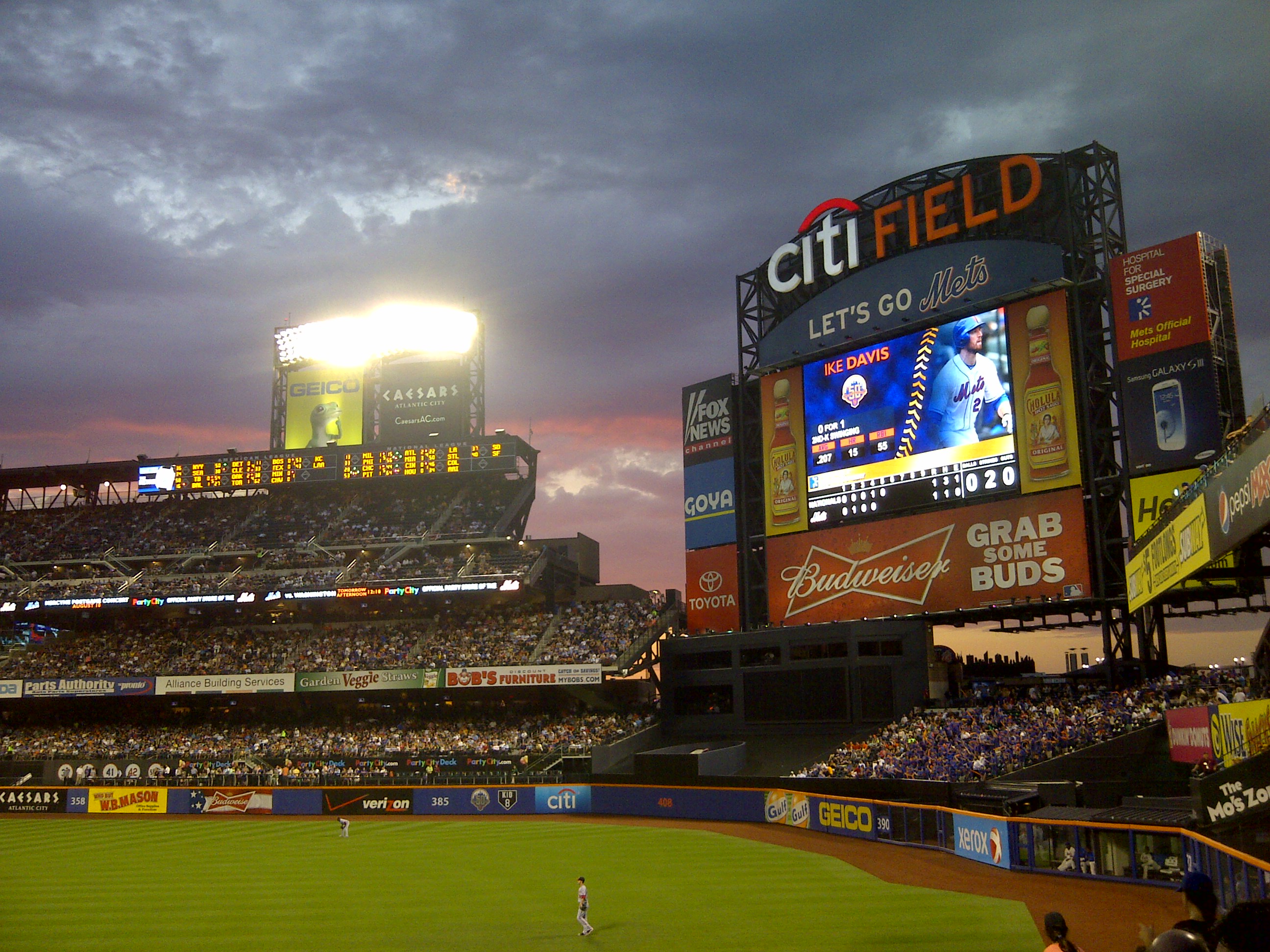
by Greg Prince on 25 December 2012 10:30 pm Ike Davis…he was at that Mets holiday party a couple of weeks ago, too. His attendance got kind of lost in the shuffle given the kerfuffle that was kicked up by the remarks of his (now erstwhile) teammate, but Ike’s presence at Citi Field on December 11 was both comforting and intriguing for several reasons.
First of all, Ike, like R.A. Dickey, modeled the new Mets uniform top. That’s three consecutive offseasons that Ike’s employer summoned him to the ballpark to try on something the Mets had never worn before. In December 2010, it was the dubious cream pinstripes; in November 2011, he donned the throwback traditional pins; this time around, it was the blue alternates. When it comes to team apparel, Ike Davis is turning into Matthew McConaughey’s Wooderson from Dazed and Confused — he gets older, those crisp, new, marketable uniforms stay the same age.
Not that long ago, Davis wasn’t necessarily a sure thing to remain a Hot Stove staple at Mets events. There were murmurs that indicated the Mets weren’t happy with Ike personally (not to be confused with the shouts that indicate Mets fans aren’t happy with the Mets professionally). These were reported around the same time Ike had revived his power stroke and was doing charitable work close to his heart. Yet somebody connected to the Mets murmured, as those connected to the Mets inevitably will.
Come December, the Mets found a higher-profile player to murmur their unhappiness about, and now that guy’s gone. But Ike’s still here, still modeling the latest in jerseys and still affably answering any innocuous question any curious person might ask to fill the time between baseball seasons. He even politely (if a little icily) answered the stringer from somewhere who asked him, “Can you talk about the contract you just signed that made you a Met for life?”
“That’s not me,” Ike informed the guy who assumed all Met infielders look alike.
Identity crises aside, that’s what the press portion of the holiday party was supposed to be: innocuous as the winter is long. We don’t really care about how Ike Davis is preparing for Spring Training. We just want to be reassured that he is preparing for Spring Training, that there will be Spring Training, that there will be spring; and that when spring returns, baseball players will greet it and us in full uniforms. Nobody gives a good gosh-darn over when Ike’s going to begin swinging in the cage. Merely having a reason to use phrases like “swinging in the cage” in December is motivation enough to gather ballplayers and the ball-curious in one room.
Ask ball. Talk ball. Write ball. Is it spring yet?
None of what Davis said was remotely newsworthy. He offered about a dozen Met-a culpas for having hit so far below .200 for so much of 2012 before recovering in the second half to achieve a homer-laden .227. “Guys,” he told those of us who weren’t off filing breathless Dickey dispatches, “I can’t play any worse.” When pressed as to why he clung so stubbornly to the Interstate for so long, Ike traced it to coming back from the injury that sidelined him most of 2011. Thirteen months earlier, we were surrounding Ike and asking with genuine curiosity about what Spring Training would be like for him and his out-of-action ankle. This time around, reflection on what went wrong was the order of Davis’s day.
“I lost the rhythm of the game,” he admitted, explaining that because he couldn’t play, couldn’t run, couldn’t do anything for months on end, it took a temporary toll on his abilities. That was an answer I found intriguing, so I followed up by asking how that worked exactly — you’ve been playing baseball your whole life, yet you can just sort of forget how after an extended layoff?
Well, yeah, he replied. “If you stop using your brain for six months,” he reasoned, “you probably wouldn’t be as smart.”
Maybe that was the problem for that stringer who mistook Ike Davis for David Wright. And maybe that was very much the problem for a first baseman whose body betrayed him when he was batting .302 on May 10, 2011, yet found himself wallowing at .160 on June 5, 2012. Perhaps baseball instinct, which might have been what I was thinking of as I attempted to use my brain to understand Davis’s explanation, shouldn’t be confused with baseball rhythm. I’m guessing he still knew how to hit but just didn’t know how to unlock the groove that would allow him to hit consistently.
Baseball fandom shouldn’t be confused with baseball playing, but maybe we don’t always have our rhythm, either. Sometimes we keep rooting harder and harder, even if we aren’t doing our team any good. Sometimes we just need a blow…particularly when blowing is exactly what our team has been doing for days on end.
I had an afternoon like that last summer, which seems ridiculous when it’s late in December and you’d kill for 80 degrees and a six-game homestand, but that sounds better in absentia than in reality. It was plenty warm this past July 25, but the Mets were ice cold. They had come out of the All-Star break losing five of six on the road. They returned to Flushing and got worse: swept three by Los Angeles, three more by Washington. They were on a 1-12 skein, their once-promising postseason bid was in tatters and the thought of sitting at my computer and stewing over their state was stifling.
I had to get away from the Mets. I had to go to my happy place. I had to go to Babylon.
I imagine every small town potentially looks like something special when you don’t live in it. For example, I don’t live in the village of Babylon, but I’ve come to think of it as something special. The place never pierced my consciousness until sometime in the 1990s when it was the subject of a relentless Long Island cable TV ad campaign urging investment within its township’s borders because “the heart of it all has it all…Babylon!”
It was an annoying as all get-out jingle, but it planted itself in my head in the same era that our adorable cat Casey was making himself at home in our hearts and on our laps and amid any personal space he could successfully infiltrate. Somehow, the way these things will, “the heart of it all…” morphed into my repeated pronouncements that, as Casey leapt into and onto us, our tabby was determined to be “a part of it all”. So, for a time, the concept of Babylon and the actuality of Casey merged into one.
Not everybody would derive such pleasant associations from the Babylon Industrial Development Association’s imagemaking efforts. Upon Googling “Babylon” and “the heart of it all has it all,” I found this 2004 LiveJournal take on the theme and the township in general from “James,” someone who grew up there in the ’90s:
“fuck babylon, the heart of it all has it all babylon = bullshit, go step in some goose shit.”
I’ll defer to “James,” who is not incorrect about the geese as far as I can tell, on his hometown’s full-time drawbacks. The heart of the village of Babylon is Argyle Lake Park and it is indeed unfortunately a magnet for Canada Geese and all they leave behind. Step lively as you walk is our advice should you decide to do what we did a few years ago and visit the heart of it all.
Other than that, we found nothing we didn’t like there.
Stephanie hatched the idea of exploring Babylon based on nothing much more than our LIRR line is the Babylon line. We board well west of its eastern terminus, and always head west — for Manhattan, for Woodside, for a transfer to what is now known as Mets-Willets Point — but she got to thinking, with a few days off ahead of her in 2009, that there must be something out there we don’t know about. So we decided to hop on one of those eastbound trains and find out for ourselves.
In the ensuing years, Babylon became something special, geese population notwithstanding. We’ve returned annually for a few hours at a time and have discovered something besides the charming downtown and the shimmering lake and the grassy park and the handy proximity to commuter transit that made us recurring visitors.
We keep coming back for the baseball — even on a day like the last Wednesday of July 2012 when I was pretty sure I was seeking out Babylon as a refuge from baseball.
Funny how that works. Stephanie was again off for a few days and had suggested we go to the game the night before. Of course I said yes. Of course it was a sweet time that Tuesday night. It always is when we go. We landed StubHub Field Level seats in right for what was already a looming Cy Young matchup between Dickey and Gio Gonzalez. For a while, it lived up to its billing. Then it went predictably to hell, but these were the Mets at home in the latter portion of July 2012, so it was bound to.
Sweet time, nonetheless. Whenever the Mets did something wrong, one or the other of us would groan, “c’mon…METS,” like the voice actress in the radio commercials that were airing constantly all summer long, the ones opposing Mayor Bloomberg’s bizarre beverage cup-size regulations (the lady was supposed to be a “real” New Yorker from Queens expressing her freedom of choice). Repetition on the radio made those commercials more and more grating, but “c’mon…METS,” sprinkled throughout the evening’s setbacks made a progressively worse 5-2 defeat incrementally more tolerable.
 Sweet, fun, aggravating: The Mets game, July 24, 2012. The kids from Camp Simcha in the Big Apple seats needed no such diversions. They were diversion enough as was. They dressed in blue yet were not at all blue about their situation (Camp Simcha caters to children stricken by serious illness) nor that of the Mets. They roared the national anthem. They waved lengthy balloons. They cheered their heads off for the home team. The Mets lost that Tuesday night. The kids from Camp Simcha betrayed no sense they were anything but winners.
What else? Well, there was, for the first time that I had noticed, a special R.A.-DICULOUS foam finger for sale, an item that got a vigorous workout from someone sitting to our left.
There was a woman in a THOLE 30 shirt sitting in front of us, also a Citi Field first by my reckoning.
There was Justin Turner walking to the plate to Carly Rae Jepsen, which somehow made him less endearing than it should have.
There was a low din of muttering for Jason Bay, no matter how much we told ourselves he hustles.
There was boorish booing directed toward Bryce Harper, which seemed premature, but why wait for a superstar-in-the-making to give us a good reason for bad behavior?
There was a moment of ultimately hollow excitement when Jordany Valdespin hit the pinch-homer that did little to alter the competitive trajectory of the game but set a team record for most pinch-homers in a season (it would be his last such shot of the year, though not because he slugged his way into the starting lineup).
There was even a John Franco sighting bordering our section, which was not the playground of big shots by any means. A guy who looked like he’s usually sipping cappuccino outside the pork store sashayed down the stairs. “Hey, isn’t that…?” Indeed it was: Johnny from Bensonhurst, slipping into an empty seat and whispering into the ear of an acquaintance. Moments later, the two of them were off to presumably ritzier accommodations (or to take care of that thing).
Wow! New York Mets Hall of Famer John Franco comes down to where the common folk sit to touch base with his buddy! I would’ve thought they had people for that. I was also surprised security let him pass. Imagine that conversation:
“Excuse me, sir, I need to see your ticket.”
“Oh, I’ll just be a second. I’m lookin’ for my friend.”
“I’m sorry, sir. You need a ticket for this section.”
“But I’m John Franco! I’m in the Mets Hall of Fame!”
“I’m sorry, sir, but I don’t know what that is.”
Fun, extracted from aggravation. The Mets lost their fifth in a row that Tuesday night. Then Wednesday afternoon they lost their sixth in a row. More aggravation. Thole, whose game-calling abilities had been vaguely grumbled at by a second dissatisfied reliever in a week’s time (first Pedro Beato, then Tim Byrdak), summed up the homestand’s vibe best when it was over. “I don’t think anything can get any worse than it is right now,” the catcher confessed. “We can’t wait to get out of here.”
Josh wasn’t demanding a trade to Toronto as far as he knew, and I’m guessing he wasn’t ready to renounce his affiliation let alone his profession. He just needed a blow or a chance to rediscover his rhythm or hone his instinct anew…he surely needed something. In Thole’s and his overwrought teammates’ case, they received a flight to Phoenix and an encouraging shot in the arm from a 23-year-old rookie making his 11-strikeout major league debut Thursday night. Not a bad way to break in and not a bad way to forget the perils of stubbornly inedible home cooking.
As for me, 24+ hours before Matt Harvey hinted that being a Mets fan might eventually be more fun than aggravating again, the remedy was backing away from my virtual home field online and jumping on that train to Babylon with my wife so we could enjoy an evening physically far from where I spend too much time thinking about the Mets. Our goal was technically a nice walk and a nice dinner in a picturesque town that had yet to be touched by a scourge named Sandy. We were not explicitly getting away from the Mets and baseball, but it sure felt good to do just that for a spell.
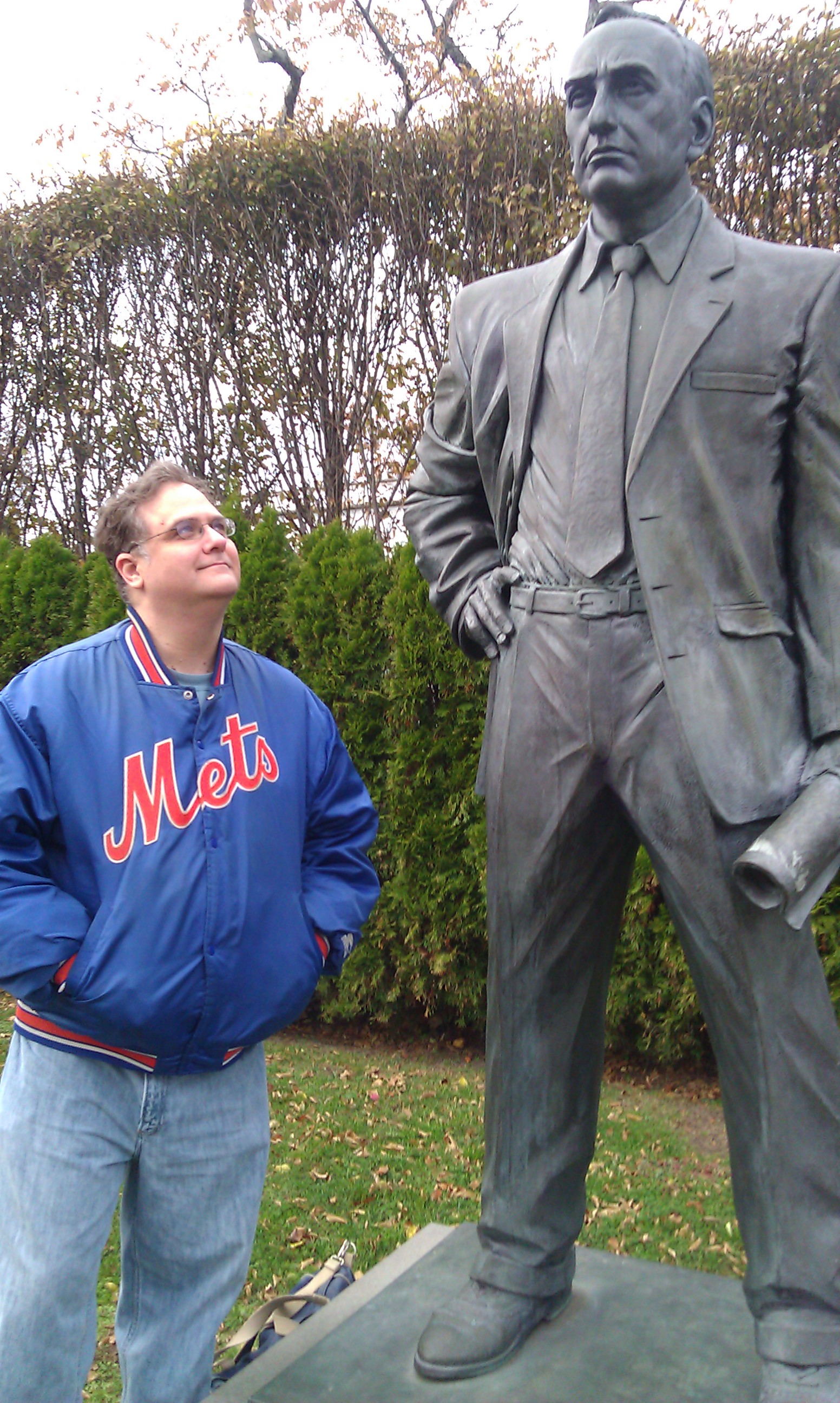
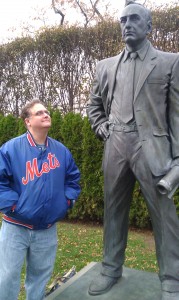 Looking up to the man who built us a home, November 13, 2011. Yet you know what we did while on the lam from the Mets and baseball? We sought out reminders of the Mets and baseball. That’s what we do every time we’re in Babylon. We get off the train, amble up Deer Park Avenue, hang a right onto Main Street and mosey over to Robert Moses. Moses lived in Babylon and they erected an impressive statue of him in memoriam. Moses, as I’ve been acutely aware ever since I devoured The Power Broker, conceived and constructed modern New York. He was simultaneously the best and worst thing that ever happened to this region, as Robert Caro explained across 1,344 absorbing pages. But mostly, for our purposes, he built Shea Stadium. He built the park that encompassed Shea Stadium. He built the roads that led to Shea Stadium.
And who among us wouldn’t have argued that between 1964 and 2008, all roads led to Shea Stadium?
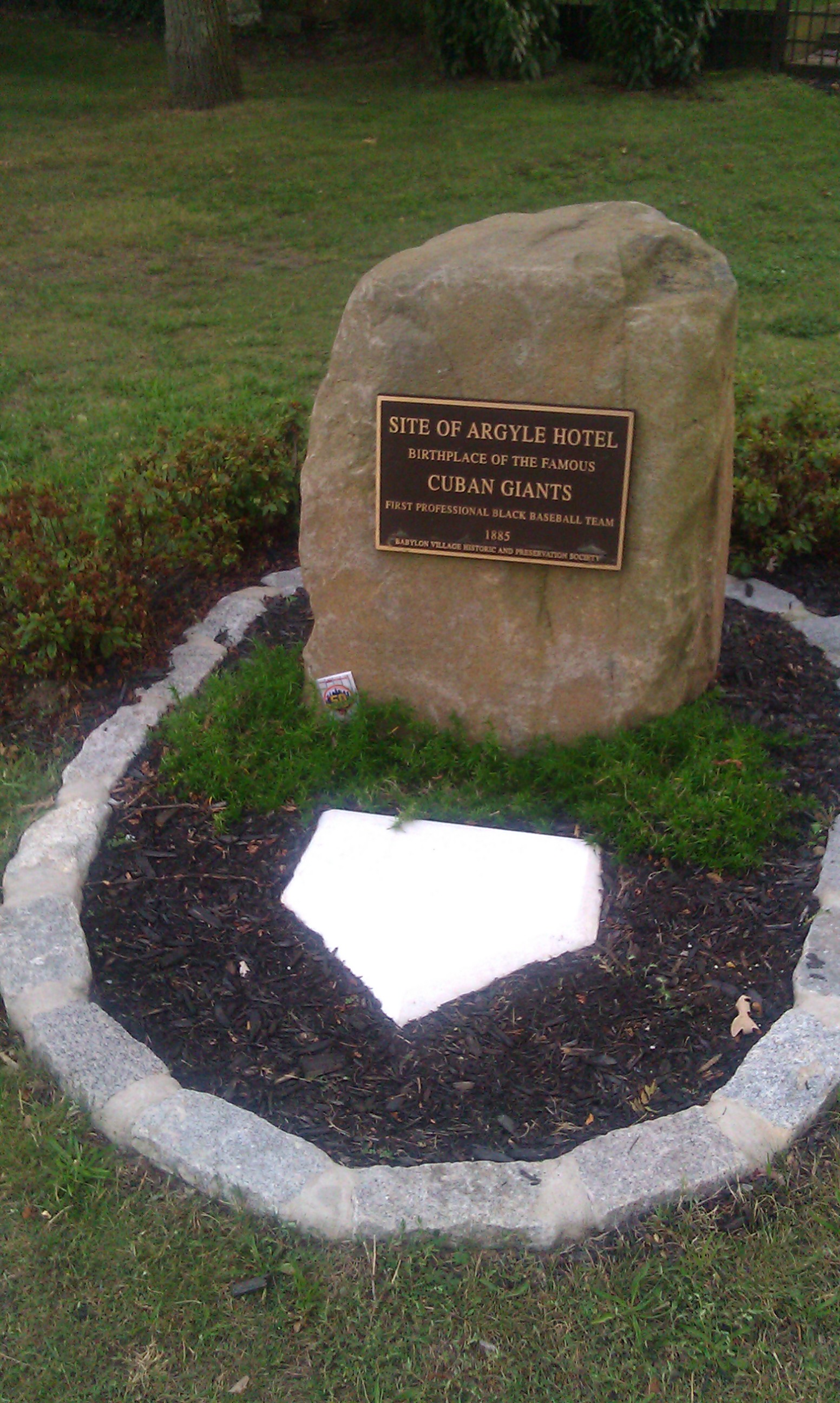
Hence, when we go to Babylon and I make sure I stop by the Robert Moses statue to pay homage to, when you get right down to it, baseball. Then we resume our walk, heading to Argyle Lake Park (goose droppings be damned) and we track down another monument, one we might have missed had we not known to be on the lookout for it. It’s the understated memorial set up a couple of years ago that marks the spot where the Cuban Giants played. The Cuban Giants were not really from Cuba. They were the first professional black baseball team; their roster was comprised of the staff of the Argyle Hotel, a local landmark that once stood approximately where we did in July.
That was in 1885, or 62 years before the so-called big leagues deigned to allow within its hallowed ranks a professional baseball player whose skin was a different color from everybody else’s on the diamond. Robert Moses’s life work may rightly be construed as a mixture of sublime and reprehensible, and you may legitimately wonder if a heroic statue is appropriate for the man who could be said to have destroyed as much as he built. But the circumstances that demanded the Cuban Giants and the myriad Negro League teams that would follow in their footsteps — 18 of them using the name “Giants” by one count — are not up for debate. Those were just plain vile. That’s not a baseball story. That’s an American story. And baseball is American as it gets in our estimation.
A group of people loved playing baseball more than they couldn’t stand being treated as something less than fully American…and they did it in Babylon, a half-hour train ride from where we live. Thus, in the summer of 2012, it became imperative that we seek out their marker and bestow upon its sliver of earth a small, belated token of our appreciation: a current New York Mets pocket schedule, of which I’m almost always carrying a few. I planted it into the specially designated grass of Argyle Lake Park as my way of saying, in essence, “You guys were big league in every way that mattered.”
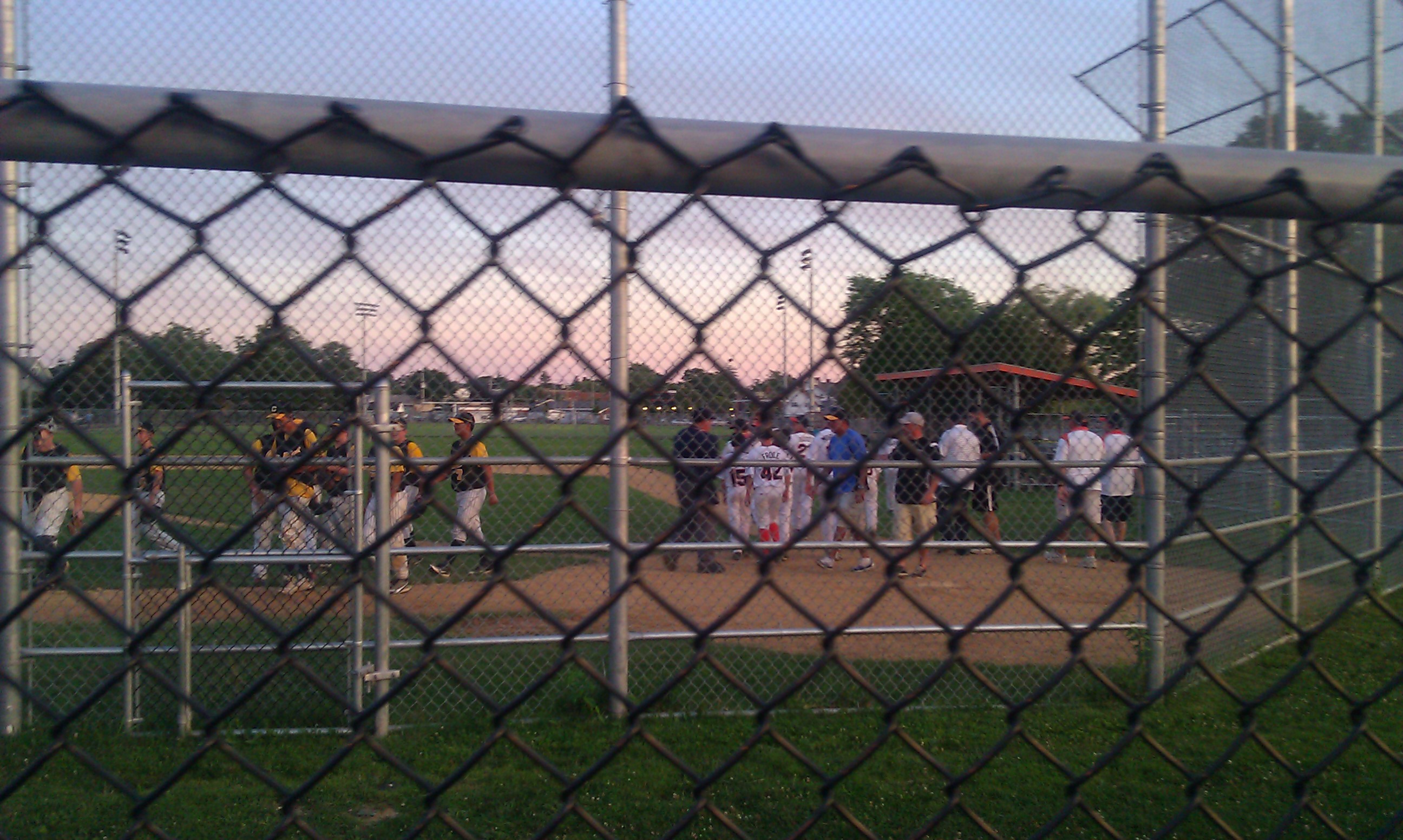
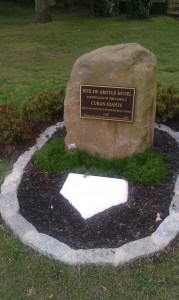 Small big league tribute, July 25, 2012. Then we continued our walk through that beautiful park, which sits next to Babylon High School, which wasn’t open on a summer evening, but there was something going on there nonetheless. It was a baseball game. I didn’t know the league. I didn’t catch the names of the teams. I could only guess the ages of the participants. And we were only on hand for the final out and rote handshakes that followed (though I did overhear one of the coaches exhort his players to keep doing more of what worked, leading me to wonder how effective motivational speeches really are). But I was delighted to have encountered real, live baseball. We had paid two private historical tributes — to Moses, to the Cuban Giants — but now we got the real thing, if just a taste. We got living, breathing baseball, a guarantee that this game we love goes on and on.
Longer than it took America to ascend from tacitly sanctioning black teams and white teams to having just teams.
Longer than it’s taken Robert Caro to profile Lyndon Johnson in full.
Longer than a six-game losing streak even, despite the irrefutable fact that those feel like they’re never gonna end.
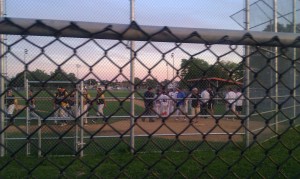 The game goes on, July 25, 2012. That’s when, as we walked on toward our nice dinner at the Argyle Grill & Tavern (where they serve an enchanting ale named for the causeway that was named for the man who built Shea Stadium), I realized I’m hopelessly incapable of getting away from baseball. I always find it and it always finds me. Months later, on Christmas night, no matter what Ike Davis tried to tell me about sustained periods of inactivity, I’ve got my baseball rhythm.
Who could ask for anything more?
by Greg Prince on 22 December 2012 1:25 pm 1. “And at Christmas, you tell the truth,” or so I heard it said in Love, Actually.
2. But I’m still seeking the truth in the trade that has left us Dickeyless in New York City.
3. Is it true somehow that sending away our singular Cy Young recipient was the brilliant Aldersonian chess move for which we’ve all been waiting two years?
4. I’m not trying to bait anyone or restart the same debate that dominated the week in Metsdom.
5. It’s more a rhetorical question, as we cannot know the answer just yet.
6. I admire the element of sophistication in those who see its brilliance.
7. And in a phrase I’ve heard repeated over and over again since Monday, I get it.
8. I get the potential payoff, I get the straits this organization has been in for too long, I get who was most likely to bring long-term value as a trading chip.
9. Still, though, I can’t quite say “yay!” to all that, because we just traded 20-6, 2.73, 230, 233.7, 1.053…and those are just the spectacular numbers.
10. That leaves aside the spectacular persona, which, when woven amid those award-winning statistics, gave us that rara avis known as the One and Only.
11. There was the One and Only R.A. Dickey, he pitched for our team, and our team told him to go pitch in another country.
12. But I get it — or I hope to at some point between 2013 and 2016 when Travis d’Arnaud, Noah Syndergaard and perhaps Wuilmer Becerra develop, emerge and become intrinsic cogs in the next Met juggernaut.
13. I don’t need a litany of the Met prospects who misfired; I can name them myself.
14. I want to believe in these kids whom I’ve never seen and until recently I had never heard of.
15. I want to believe the outfielder will fill one of those holes that’s never more than patched up; that the pitcher will throw hard, consistently, elusively and for a long time; and that the catcher is the catcher he’s been billed as during his six-year climb through the minor leagues.
16. By the way, what does Travis d’Arnaud have to be to have been worth it?
17. It’s probably too much to ask that someone who’s been coming along kind of slowly in the minor leagues (having suffered a couple of ascent-slowing injuries) to step up and become Buster Posey, but will we settle for something within the realm of John Stearns?
18. This trade defies easy historical parallels, but the one that comes closest in my mind is the one that, in essence, sent a franchise icon named Tug McGraw to Philadelphia for a stud catching prospect named John Stearns.
19. McGraw wasn’t at the top of his game when the trade was made in December 1974, but he would eventually recover his form and do great things for his new team, most notably record the final out of their first World Series championship six year later.
20. Stearns, who served the Mets from 1975 to 1984, never led his new team to the heights of its profession, but when healthy, he filled his position admirably and played the game passionately.
21. Would we be satisfied if d’Arnaud produces more like a Stearns than a Posey?
22. We’ve just limped through five seasons of Brian Schneider, Ramon Castro, Robinson Cancel, Omir Santos, Rod Barajas, Henry Blanco, Ronny Paulino, Rob Johnson, Kelly Shoppach, Mike Nickeas and, most disappointingly, Josh Thole (entombed with his Pharaoh so as to catch him in the afterlife), each of whom gave us a moment or two or glory, none of whom left us very comfortable with catcher on a long-term basis.
23. The second coming of John Stearns would be a dream by comparison, but Stearns wasn’t the catcher of his era by any means.
24. Not that d’Arnaud (originally, like Stearns, a first-round pick of those Phillies) is necessarily The Dude Reincarnate or, for that matter, a Grote or Hundley, but it’s probably too much to ask for a Posey, never mind a Piazza.
25. Dickey, on the other hand, almost always delivered everything for which he was asked, including honest answers.
26. I bring that up because, as mentioned previously, I was at what turned out to be R.A.’s final Met appearance, at the now infamous kids holiday party, and I want to reiterate what happened there.
27. Dickey headed into the main dining room with Ike Davis; he was greeted warmly by the Mets’ guests; then he was brought behind a curtained-off area to meet the media corps the Mets invited.
28. The press had one line of questioning on its mind and it expressed it without hesistation: “What about your contract negotiations?”
29. Dickey started answering and kept answering as long as he was asked.
30. No children were harmed during the Q&A portion of the morning — it was all out of view and out of earshot of the children from Far Rockaway.
31. Whatever R.A.’s perceived agenda, there would have been a small riot among the reporters and camera people who were at Citi Field solely to get R.A.’s thoughts had he brushed off their inquiries.
32. The kids kept on with their toys and their brunch, not at all scandalized, and one of them (a little girl whose picture I tried to take but she quite reasonably jumped for joy when Mr. Met entered the scene) wound up with the blue DICKEY 43 jersey he wore briefly.
33. Any other criticisms of Dickey as self-promoter or unpopular teammate strike me as sudden, shallow and opportunistic, and those who level them reveal the perils of being paid to write frequently when they have nothing of value to add to the overall baseball conversation.
34. Dickey, meanwhile, goes out on top, not just by performance but in esteem.
35. Although three years of R.A. Dickey as a New York Met don’t seem like enough, it might be that we had him for the perfect time span emotionally.
36. There are a bunch of relatively high-profile Mets who spent parts or all of three seasons here who, historically speaking, stayed just long enough to make an everlasting positive impression but not so long as to wear out their welcome.
37. Three-year Mets include Rod Kanehl, Ed Charles, Donn Clendenon, Ray Knight, Rico Brogna, John Olerud, Robin Ventura and now R.A. Dickey; all are remembered eternally fondly and none was burdened in real time by gripes about uselessness or contracts and none was subject to the kind of selective “what have you done for us lately?” amnesia we tend to inflict on our icons when they dare to be more enduring than fleeting.
38. Dickey also replaces the likes of Kanehl and Brogna and anybody you’d care to name who played for the Mets exclusively in the “pantheon” of seasons that include only 1962-1968; 1974; 1977-1983; 1991-1996; 2002-2004; and 2009-2012.
39. That is to say R.A. Dickey was surely the best Met never to play on a Mets team that compiled a winning record.
40. That’s an unfortunate distinction, of course.
41. And it helps explain, as painful as I’ve found thinking about it this week, why it helps to be sophisticated about the trade that cost us (to borrow a phrase Roger Angell applied to Tom Seaver upon his 1977 forced departure from New York) our sunlit prominence.
42. I will deeply miss writing about R.A. Dickey in the present tense, but I hated the “he’s the only good thing about this team” context that pervaded so many of those dispatches, and it is my fondest Mets wish that this transaction changes the context dramatically.
43. And that’s my truth this Christmas.
by Greg Prince on 18 December 2012 10:00 am  Final impressions, from the Mets’ 2012 holiday party at Citi Field. “How does Alderson go about reviving the more dormant aspects of our passion, those which have been dulled by two years of dismal sputtering on the heels of two years of dramatic letdown? By winning, of course. Winning will make us all feel better. Winning will bring new iconicism to the uniform, to the franchise and to our self-esteem. Seats will not go unfilled when we’re winning. Enthusiasm won’t need to be cultivated. It will emerge and it will roar the way it once did in these parts. And how does Alderson get us to that point? That’s the more difficult question, and for all the broad strokes (and narrow beseechments) we are all willing to offer, the only person who is entrusted to answer it is Sandy Alderson. That’s why they’re paying the man. But if he doesn’t mind a touch of fan interference, I’d be willing to remove a potentially perceived obstacle from his thinking. Explore every trade that makes sense to you and, if you are convinced in your role as our grand baseball poobah that it’s the right thing to do, trade anybody you feel you have to trade. Your job is improving the New York Mets. There are no sacred cows grazing in Citi Field. Not after 2010. Not after 2009.”
—A relatively typical Mets fan, October 29, 2010
“While your lead character R.A. Dickey is richly drawn, and his backstory is potentially appealing, we here at Limited Imagination agree there is no way he could exist. Since you insist on setting Dickey within the milieu of major league baseball, there needs to be at least some semblance of reality attached to your protagonist, and quite frankly, your Dickey may be the least fathomable sports character we’ve ever read. According to our research department, most successful baseball pitchers attain a level of peak performance in their 20s, but your Dickey is supposedly a career journeyman derailed by the lack of an essential component in his throwing arm who attempts to learn a magic pitch in his 30s, takes years to master it and then, quite suddenly, takes it to a whole other level where he becomes all but impossible to hit. The sports reader may ‘root’ for the unexpected, but that demographic is more and more grounded in statistical probability and the Dickey you describe in the latter chapters begins to do things that sound impossible. We could accept a certain literary license in making Dickey fairly articulate as a contrast to the usual ballplayer, but having him write a searing memoir that lands on the New York Times bestseller list in advance of creating this pitching alchemy again stretches credulity.”
—“Clueless Editor,” rejecting book proposal from “George Plimpton,” following the events of June 13, 2012
“It was a blast to be in R.A.’s ranks Thursday. I’d practically call it an honor to bear witness to the sixth Mets pitcher clinching the ninth 20-win season in franchise history. Every fifth or sixth day in the second half of 2012, R.A. lifted us from the benign disengagement you’d rightly infer a fourth-place team inspires to full-fledged immersion that seemed perfectly logical as Dickey’s knucklers rode their own private highway from his well-traveled fingertips to Josh Thole’s oversized mitt. It’s a shame his 20th win didn’t come in service to a better Mets team, but it was enough, I suppose, that R.A. Dickey made the Mets a better team whenever it was his turn to try. And besides, as fans who are unshakeable in our affinity, we need these kinds of stories and these kinds of seasons when the overarching narrative is lacking. Dickey winning his 20th as a tuneup for his projected start in Game Two of the NLDS would be as sweet as that sounds, but given what we know as reality, what could be sweeter than a 72-84 club being redeemed regularly by the presence of a 20-6 savior? Savior of our sanity if not our season.”
—A view from the not-so-cheap seats, as sat in and stood in front of on September 27, 2012
“Mets fans in New York City chanted his name, waved giant R’s and A’s and loved him in a way that people love a child or a monk or a dying man who has shed all his armor and come before them in his truth.”
—Gary Smith, current cover story in Sports Illustrated
“This was a baseball decision. And at some point the lines crossed. We did prefer to sign him at the outset. We felt we could sign him. I still felt confident we could sign him as we got into the winter meetings. But it also became clear that against the backdrop of a very hot market for pitching, his value in a possible trade was also skyrocketing. […] His value in trade to us at some point we felt exceeded our ability to keep him here over a one- or possibly two- or three-year period. We’re not going to replace him with a No. 1 starter in return, but we’re going to have to find someone who can give us some of those wins. We also have to hope the team improves in other areas to offset R.A.’s loss. […] R.A. was a very popular player. I’m sure he would have been very popular next year here. I’m sure he’ll be popular in Toronto, and for good reason. On the other hand, our popularity as a team, our popularity among fans, our attendance is going to be a function of winning and losing. And winning and losing consistently over time. Those are the kinds of things we have to take into account. […] I’m hopeful in coming years that our overall popularity will be more a function of our success than individuals. But, look, I recognize this is an entertainment business. It was great to have R.A. here, and yet we felt in the best interest of the organization and the long-term popularity of the team that this was the right thing to do.”
—Sandy Alderson, December 17, 2012
“Sometimes it makes me sad, though, Andy being gone. I have to remind myself that some birds aren’t meant to be caged. Their feathers are just too bright. And when they fly away, the part of you that knows it was a sin to lock them up does rejoice. But still, the place you live in is that much more drab and empty that they’re gone. I guess I just miss my friend.”
—Red, after Andy Dufresne escaped to a better place, The Shawshank Redemption
by Jason Fry on 17 December 2012 10:16 am The Mets have made what seems like a very good trade. But I hate that they’re making it.
After David Wright was re-signed, I wrote that I was happy but not particularly celebratory — retaining Wright struck me as a no-brainer, the kind of thing a franchise in decent working order would of course do. Back then the R.A. Dickey trade talk was a worst-case scenario, and I lumped Dickey in with Wright: 20-game winner, just won Cy Young Award, beloved by fans, not looking to break the bank, should be good for more years than his age should indicate. Of course you re-sign a guy like that. If you don’t, something’s really wrong. Right?
Well, sorta. As the unimaginable worst-case scenario turned into a maybe and then a probably and now a near-definite, my thinking changed a bit. Dickey is a knuckleballer and knuckleballers tend to pitch deep into their autumns, it’s true. But one of the most interesting things of the many interesting things about Dickey is what makes him different as a knuckleballer. Dickey subscribes to the Zen of Knuckleballing, yes, but he also does things with the pitch that few if any knuckleballers have. He changes speeds and locates it with far more precision than we’re used to, turning its fundamental chaos into a smaller-scale tactic.
The point is that having celebrated all the ways Dickey isn’t a conventional knuckleballer, it’s lazy to assume he is one when we discuss how he’ll age. He’s 38, throws harder than typical knuckleballers, and famously lacks an ulnar collateral ligament in his throwing arm. He might age like Hoyt Wilhelm or Phil Niekro, in which case 38 is nothing — but he also might age like a more conventional pitcher, in which case 38 is nearing the end. Anyone who tells you for sure is either from the future or full of it. In this as in so many things, R.A. Dickey is unique.
The Mets, meanwhile, have on-field problems to go with their copious off-field woes. Yes, they’ve re-signed Wright, but besides the Jekyll-and-Hyde bat of Ike Davis, he’s basically naked in the lineup — and when Wright’s trying to do too much, things get depressing in a hurry. No prospect is a sure thing, but baseball folks generally agree that Travis d’Arnaud projects pretty soon as a solid defensive catcher and a 20-HR bat, potentially turning a difficult-to-fill position that had been a black hole into a big positive. We’re still left with an outfield that actually makes you yearn for Agbayani-Payton-Hamilton, but it’s something. And that’s without considering the rather wonderfully named Noah Syndergaard, who also impresses generally sober-minded talent evaluators. The Mets may have sold as high as possible on a 38-year-old pitcher, which is a pretty good trick.
And yet perhaps they’re throwing away years of magic. Because whatever the outcome, the Mets are trading R.A. Dickey.
It’s horrible to write, horrible to read, horrible to think about. And it lands us right back in the depressing morass that has engulfed this team — the inescapable reality that the Mets are broke, an insolvent club being kept afloat by the commissioner of baseball’s shameful willingness to abrogate his responsibilities in order to protect his cronies. Supposedly there’s a plan to escape this mess, one that impressed Wright enough to buy in. But if you’re a mere fan of this team you don’t get to hear about it — you get denial and dishonesty. No one connected with the Mets seems interested in countering the dour analyses of the Mets’ current situation, which makes me conclude they’re fairly accurate. No one will tell us when this will end or if it will end. And nobody seems to care that it is doing corrosive, lasting damage to this franchise and its fanbase.
The Dickey trade is a fascinating one — you could argue about it at the bar until the glasses are polished and every other stool is upside down atop tables and still not have come to a definitive conclusion. But it can’t be argued about as just a baseball move, because nothing with the Mets these days is just a baseball move. Everything comes overshadowed by the stuff we’d rather not think about or explain to our kids.
And it’s R.A. Dickey we’re losing.
I’ve written that if Dickey didn’t exist, bloggers like us would have had to make him up. But he does exist — and he turned out to be much more interesting than the W.P. Kinsella character we would have created. Candid, reflective, philosophical, goofy — he’s everything I dreamed athletes could be while accepting that they generally aren’t. He names bats after Tolkien weapons and is a Star Wars dork and talks about baseball the way we like to talk about it. And, on top of all that, he’s a world-class athlete, a ferocious competitor who fought his way through countless travails to succeed on a huge stage. Few Mets have ever filled me with as much anticipation and wonder and simple joy as Dickey did, and it is beyond awful to have all of that taken away.
So what are we to do? Where does this leave us?
If you’re coolly calculating and rational about the trade, I’m reluctantly with you. If you’re heartbroken and furious, I’m with you too.
All I know is I desperately want to cheer for a normal franchise again. I want to root for a team that doesn’t require me to learn about debt obligations and amortization to guess whether we’ll be competitive in 2013 or 2015 or never. I want to root for a team that allows me to presume electric batting champs and cerebral Cy Young award winners will be kept, or at least let go for pure baseball reasons.
And, well, one more thing. I want to root for a team that doesn’t send players out the door with switchblades sticking out of their backs. The Mets’ sliming Dickey for answering reporters’ contract questions at a media event was deplorable — as was the normally rational Ken Davidoff deciding to audition for the role of the Twitter age’s Dick Young. (Next time I want to mock Wright for being deliberately bland after a game, I’ll remember what happened to Dickey for being candid and interesting.) And this isn’t the first time anonymous sources have done such things — the Walter Reed media hit on Carlos Beltran, Oliver Perez and Luis Castillo is one of the more shameful episodes in franchise history. I don’t know who’s behind this stuff, and frankly I don’t care. Whether it’s someone on the business side, ownership, or some ambitious Carvel sprinkle applier, I just want it to stop. It’s ugly and amateurish and embarrassing, and we’ve got plenty of that as it is.
So, again, what do we do? I suspect we’ll do what we always do — we’ll watch the games and grouse and fret, but over time that will recede, because baseball is the highest art form yet created by humankind, so that not even humans can utterly screw it up. I’m genuinely excited to see a full season of Matt Harvey, and to see if Ike and Ruben and Murph can build on intriguing years, and to wonder if poor Lucas Duda can figure something out, and to applaud David’s well-earned C, and pretty soon I’ll be able to recognize Travis d’Arnaud from some little thing in his batting stance, and Zack Wheeler will be burning it up at Las Vegas, and maybe Noah Syndergaard will have been just promoted to Binghamton, and we’ll be enmeshed in new storylines.
But if that doesn’t work, well … the Toronto Blue Jays somehow now employ R.A. Dickey and Jose Reyes. It’s a great city. The intersections with the Mets are few and far between. You can still hate the Yankees. Adultery is wrong in baseball as in everything else, but we can all make a convincing case for alienation of affections.
Jays fever — temporarily catch it!
by Greg Prince on 15 December 2012 9:04 pm For once, it was a good day for Mets fans to be ensconced in the basement. I don’t mean the National League East standings, lest Marlins fans grow jealous of our impinging on their hard-earned territory, but specifically the basement party room at Foley’s, where our little get-together to celebrate the recent release of the first volume of The Happiest Recap and, peripherally, my upcoming 50th birthday gathered steam away from a frigging, swigging swarm of Santa Clauses, average age approximately Not Old Enough To Drink.
While the Santas took Manhattan, most of my train in this morning and the cavernous bar area of Foley’s, we were, per AC/DC, safe in New York City in that down in the basement there were was no overrun of Santas (not counting the giggly line of young lady elves lined up to use the adjacent privy) and no Internet reception. In a room lousy with terrific bloggers, you might think that would be a problem…and not just because there went our chance to match the profile of our vocation (you know, blogging in our mother’s basement, albeit with pants fully on). No Internet meant not a single phone’s browser could track the progress of the R.A. Dickey trade talks.
And for that, I am glad.
Maybe you remember an episode from the later, preachier seasons of M*A*S*H in which Hawkeye, B.J. and Hot Lips conspire to fudge the time of death for one of their patients so it doesn’t appear the soldier on their operating table died on Christmas Day, lest his kid back home think only sad thoughts every December 25. In that same spirit, I didn’t want a few dozen Mets fans to remember that where they were when R.A. Dickey was traded was with that damn Greg Prince and his eminently readable and enjoyable book.
So I had that going for me. Dickey wasn’t traded Saturday afternoon, and even if he was, one would have to fight his way upstairs through, around and over the exponentially multiplying Santas to find out. Not worth the trouble, let alone the heartache.
But you know what was worth doing? This party. Geez, I can’t thank enough everybody who spent this Saturday away from the park with me. As David Wright has said again and again (and again and again), Mets fans are the greatest fans in the world, and I am compelled to add that Mets fans who read Faith and Fear in Flushing represent a whole other level of greatness, one generally inverse to the quality of the team itself. Let’s just say I’ve never sung the entirety of an a capella version of “Meet The Mets” with a better bunch of fellow travelers, and I doubt I ever will.
Thank you. You gave me and my book a day we’ll cherish for a long time to come.
The Mets can go and make their stupid trade now.
by Greg Prince on 14 December 2012 4:16 pm Quick reminder that we’re getting together tomorrow, Saturday, noon to two at Foley’s NY (18 W. 33rd St., between 5th and 6th Avenues), for a little Baseball in December. Ostensibly we’re celebrating a new book and an imminent birthday (sort of), but ultimately, it is a love of baseball that draws us together because that’s what baseball does sometimes, even out of season. Come join us if you can. The details are here. You’ll be among friends.
Today is terrible. Here’s to all our tomorrows somehow being brighter.
Thanks to Ron Kaplan of Baseball Bookshelf and Vinny Cartiglia of MetsBlog for having me on their podcasts recently to discuss The Happiest Recap. Hope you get a chance to listen in.
by Greg Prince on 13 December 2012 11:48 pm Mets fans understand each other because of our shared language, a common tongue that allows us to communicate with one another in a form of shorthand that speaks to our peaks of triumph, our valleys of despair and those plains on which we journey for the journey’s sake. Taken as a whole, our shared language provides us with an ever-growing vocabulary in which new phrases continue to enter our conversation, sometimes in narrow usage, sometimes for fleeting periods.
But then there are the nights when our unabridged dictionary requires a whole new edition be printed. June 1, 2012, was one of those nights.
Our Nikon Camera Player of the Year for 2012 — the award bestowed to the entity or concept that best symbolizes the year in Metsdom — is No-Hitter Nomenclature. Because once Johan Santana threw something we never saw before, we were able to say things we never had previously.
Here are some of the thoughts we never dreamt we’d be vocalizing prior to the night of June 1, as well as some the phrases we now speak in a completely different context.
***
• “It has happened!” Gary Cohen, voice noticeably breaking, channeling what each and every one of us was thinking when Johan Santana struck out David Freese to accomplish the First No-Hitter in New York Mets History. Gary’s succinct expression of amazement replaced the far more shopworn “You think it will ever happen?” and “Maybe tonight…nah, never mind.”
• “8,020.” That’s how many regular-season games it took for the Mets to have a First No-Hitter. Counting came into vogue in recent years, led by the doggedly dutiful nonohitters.com. The count ended with Santana’s last pitch. The current count is 110 — but who’s counting?
• “134 pitches.” The most internally controversial element of the no-hitter conversation. Santana, in his first season back from surgery, kept a no-hitter going past his pitch count. Only the killingest of killjoys would have been tempted to remove him…or Terry Collins, who was captured by cameras all but screwing himself into the dugout ground to resist the temptation to do the nominally responsible thing. A stubborn “shoulda taken him out” backlash developed when Santana a) failed to throw more no-hitters in 2012 and b) needed to shut his season down after pitching less and less effectively as the summer went on. But they were, in their own way, the best 134 pitches ever. Johan’s surgically repaired left shoulder was a small sacrifice to make to the gods who had devoured Tom Seaver and everybody else whole.
• “Beltran’s ball.” If “called strike three” was Carlos Beltran’s unwanted calling card as a New York Met, the double-that-wasn’t became his contribution to Met lore in his first appearance as a post-Met opponent. Why did it take 8,020 games until June 1? Because some Met pitcher always gave up a hit, usually one that didn’t need any interpretation. This time, though, Beltran belted a ball down the left field line that was or wasn’t a sure double.
• “Adrian Johnson.” Almost all umpires are anonymous until there’s a reason to notice them. Johnson, the third base umpire, forever earned a place in Mets fans’ hearts as the anti-Angel Hernandez when he ruled Beltran’s ball foul rather than fair to start the sixth inning. It was, depending on your viewpoint, the bad call or lucky break for which the franchise had been waiting 8,019+ games. Every no-hitter is said to require some sort of cosmic assistance as well as an outstanding defensive play on its behalf.
• “Mike Baxter.” Prior to June 1, Mike Baxter was a local boy made reasonably good as a surprisingly dependable pinch-hitter. “Mike from Whitestone” was best known for admitting to being a caller to WFAN during his youth. His identity changed forever when he slammed into the left field wall’s W.B. Mason sign to take the other sure double away from the St. Louis Cardinals, this one off the bat of the notorious Yadier Molina. Baxter wrecked a collarbone and damaged some rib cartilage, shelving him for close to two months, but he saved the no-hitter. We speak of him fondly forever more.
• “Gary Carter?” The question mark refers to the mysterious way the late Mets catcher’s spirit seemed to inhabit the evening. Maybe it was the way Kid’s memory was honored on Opening Day just before Johan went out and threw five shutout innings in his first outing since 2010, almost sanctifying the pitcher’s year as something special in the making. Maybe it was the haunting scoreboard readout below the Cardinals’ “0 0 0,” the one that read, “8 8 0” as the Mets put up Carter runs and Carter hits in support of Santana’s history-changing effort. Maybe it was Josh Thole (just returned from the Disabled List in an oversized hockey mask helmet) experiencing his finest hour when he recorded the final putout from behind the plate the way we always figured Gary was going to do sooner or later on the other end of a no-hitter from Gooden or Darling or Fernandez. Maybe — and we’re not condoning this behavior — it was the presence of the one fan who forgot he wasn’t allowed on the field to celebrate with Santana, Thole and everybody else. You couldn’t miss Rafael Diaz, the jorts-sporting Long Islander who attempted to join the festive players-only dogpile on the mound, no matter how much he wanted. You could pick out Diaz pretty easily: he was the one wearing the 1986-style Gary Carter No. 8 jersey as he was dragged away by security.
• “Jim Duquette.” The long-ago Mets GM replaced lifelong Mets fan Josh Lewin for the evening in the WFAN booth alongside lifelong Mets fan Howie Rose. (And isn’t it great how every inch of the Mets’ English-language broadcasting terrain is occupied by those bearing authentic Mets pedigrees?) Lewin was off attending his daughter’s high school commencement. Rose, meanwhile, graduated to Nirvana: “In the 8,020th game in the history of the New York Mets, they finally have a no-hitter! And who better to do it than Johan Santana?” Who better to pose the question than Rose, who one way or the other witnessed the vast majority of the previous 8,019?
• “Omar Quintanilla.” To the extent bar bets are still made over such things and you are dared to wager a friendly cocktail over the identity of the Mets’ shortstop on the night the Mets finally got their first no-hitter, the name you’ll want to answer with in order to win those three fingers of Glenlivet (after you buy Mike Baxter whatever he drinks) is that of the journeyman infielder who just a couple of nights earlier replaced the injured Justin Turner on the roster. Quintanilla would be gone before the season was over, but let the record show he was in on something that eluded Bud Harrelson, Rey Ordoñez and Jose Reyes, among many other Met shortstops. Omar also had the last hit of the no-hit night, an eighth-inning single off the last Cardinal pitcher, Maikel Cleto.
• “Adam Wainwright.” Mostly the guy who struck out Beltran on October 19, 2006. But now also the losing pitcher in the First No-Hitter in New York Mets History. Didn’t give up a hit himself for the first three innings, when things appeared uncomfortably close and not yet incredibly momentous.
• “Lucas Duda.” Drove in the first, third, fourth and fifth runs to stuff a comfortable cushion for Mr. Santana to rest on during the bottoms of innings, contributions largely overlooked on a night that wasn’t about Met offense. But without Lucas blowing the lid off Wainwright, the evening’s tension develops perhaps a whole other unwanted layer of subtext. Lucas had a lousy 2012, but Duda was an unspoken MVP on June 1.
• “Nohan.” Scoreboard graphic that became a t-shirt and a line of merchandised collectibles. The Mets weren’t shy about marketing the accomplishment that took 8,020 games and 134 pitches to materialize. It would get a little crass — they also sold tickets to the game after the fact, and not at a discount — but it’s not like the Mets would have a postseason revenue stream flowing into their coffers.
• “HI57ORY.” The 7 Line’s wearable contribution to the no-hitter legacy. The shirts were a constant at Citi Field for the rest of 2012. Clever without cringe.
• “Yeah, baby!” Johan wore the no-hitter with grace in the minutes that followed his 134th pitch. He thanked the fans and told them, via Kevin Burkhardt’s SNY microphone, that this was for them. He endured Turner’s unnecessary pie to the face in good humor. He absorbed a champagne shower while Ed Coleman interviewed him in the dugout. And in the clubhouse, we saw him address his teammates as if accepting their nomination-by-acclimation to higher office, playfully ending it with an Austin Powers exclamation of satisfaction. Howie was right: Who better to do it than Johan Santana?
• “Where were you?” Actually, nobody ever asked because nobody had time to form the question. Everybody volunteered their no-hitter story without hesitation once there was a story to be told. Mets fans had waited interminably for the end point of this heretofore fruitless part of their journey. All of a sudden, we had something to not just talk about but shout about. I did my shouting here and my someone calmer talking here. Jason did some fancy counting here, albeit from out of town. And then there was the no-hitter story I love best, from someone whose “where were you?” could be answered, “I was there.”
This is the story of Faith and Fear stalwart commenter Kevin From Flushing, who invited me to join him at the Mets-Cardinals game of June 1, 2012, but I unpresciently declined the offer. My no-hitter story would’ve been completely different had I accepted; not necessarily better but different. Yet I count myself lucky that I have mine as it is and his as well.
I don’t think he’ll mind my sharing some of it with you below.
***
I was sitting in row 1 of 515, so it was basically just me and the game. The 500 level was behind me, and the 400 level was just below my general field of vision. Heard a lot of riff raff behind me, but nothing out of the ordinary. At the very least, there wasn’t a wave in the 7th or 8th inning while Johan was pitching, so I guess people sensed what was happening.
I was pretty goddamn annoyed at the reaction to Beltran’s return, something which was entirely swept under the rug. I’d say 25% cheers, 25% boos, and 50% indifference (or maybe it was just all the empty seats). Among the TROVES of Cards fans showing up (I miss Shea not being worth a road trip), I had Birds fans directly behind me and to the left of me. To my right, a guy in a Mets jacket and Cardinal hat (yeah). He and a friend were watching their first baseball game since 2006, from what I could gather. The fans behind me were respectful enough and didn’t factor into my enjoyment. The pair to my left…well, with my extra ticket going unclaimed, it provided a nice empty-seat buffer between me and what looked like a 55-year-old meth head. He was quiet until the 8th, at which point he shouted at Beltran, “Break up this fucking no-hitter!” Glad neither you nor I had to sit directly next to him. After the 5th or 6th I would repeatedly catch myself dreaming of the third out in the 9th inning, then shut it out completely in an effort to protect myself from disappointment. I was doing a good job of it, but if the no-hitter didn’t happen and I had to hear that guy cheering…
Well, to the more important matter, the seats to my right: the Cardinal/Met fan and his buddy left sometime around the 5th inning, saying something about grabbing coffee. They didn’t come back. I was, in a manner of speaking, an island to myself as the game went on. With a smattering of empty seats/Cardinal fans around me and tunnel vision blocking out Mets fans in the foreground, I had no real feel of the crowd (this leads to me watching cell phone videos from Citi at the moment of the no-hitter and asking, “Was I there?”). This lasted until the top of the 9th inning, when 2 fans decided they wanted a better view of history, that view being the 2 abandoned seats to my right. It was VERY difficult to resist the temptation of saying “GET BACK TO YOUR FUCKING SEATS, ASSHOLES! YOU’RE PLAYING WITH FIRE!” Of course I didn’t: it’s not my business, and for all I know they sat in a different seat at the top of each inning and were therefore doing the right thing. They were, at least, Met fans who knew what was going on. They even engaged me after the second out, asking me to stand up. One of the nice parts about being in Row 1 was it allowed me to stay squarely in my seat, hunched over with my hands on my temples, viewing Johan through the safety rails as I’ve done the whole game while the crowd below me was on their feet. I waved off my new companion without speaking a word (what words could I possibly put together besides “come on Johan… come on Johan…”?).
Then it was over. In between the tears and euphoria I absolutely had the sense that the crowd knew exactly what this meant. We were fucking partying. I heard Cowbell Man and sought him out, looking to hug anybody, alas to no avail.
***
I don’t know about that last part. Wherever we were on June 1, 2012, we all embraced the moment that came to fruition at approximately 9:45 PM. You can hear it in our voices still, every time we say, in whatever context, “The No-Hitter.”
We all know what that means, right?
FAITH AND FEAR’S PREVIOUS NIKON CAMERA PLAYERS OF THE YEAR
2005: The WFAN broadcast team of Gary Cohen and Howie Rose
2006: Shea Stadium
2007: Uncertainty
2008: The 162-Game Schedule
2009: Two Hands
2010: Realization
2011: Commitment
by Greg Prince on 11 December 2012 5:02 pm I know what happens
I read the book
I believe I just got the goodbye look
—Donald Fagen
If R.A. Dickey were a garden-variety drama queen, I might have written off his use of phrases like “disappointment”; “impatience,” “emotional scope”; “we’re asking for less than what’s fair”; “you already think you’re extending the olive branch”; and “I don’t want to be taken advantage of” as typical Dickey, always with the drama. But watching R.A. as I listened to him at the Mets’ holiday party Tuesday morning, I didn’t sense there was anything typical about the way he was answering questions about his ongoing contract negotiations. R.A., who’s always been about passion over drama, was more downcast than the occasion was festive.
And besides, since when is R.A. Dickey a garden-variety anything?
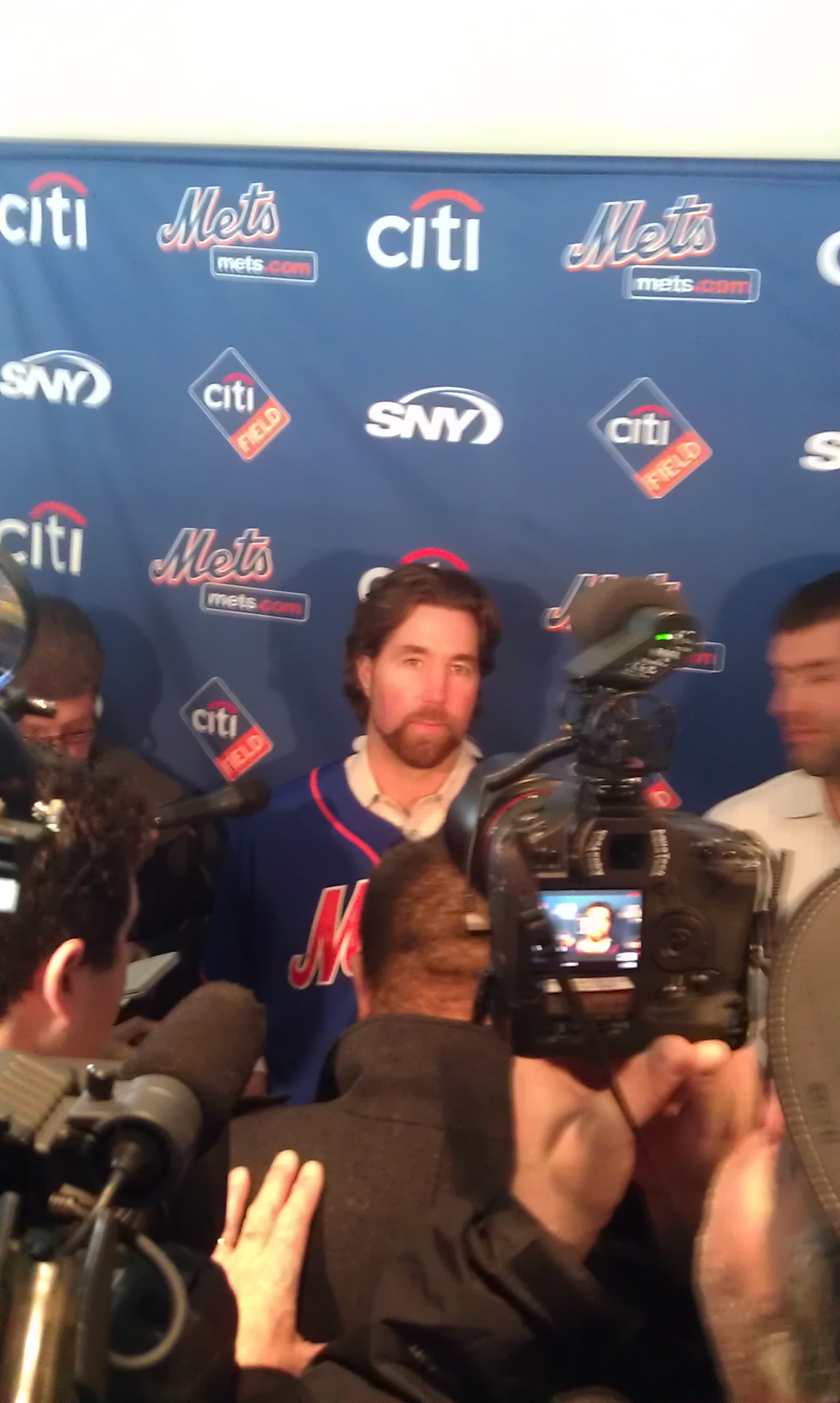
Dickey’s demeanor was a touch surreal, given that when you get a baseball player to stand in front of a baseball team’s wall of dancing logos at an event as nominally upbeat as a party whose purpose is to present children with gifts, the talk is inevitably of the happy variety. At the very least, you’d count on innocuous. But you’d count wrong here, for this was the aberration. This was the home team baseball star for whom you wouldn’t have guessed that over the last several months it’s been a wonderful life.
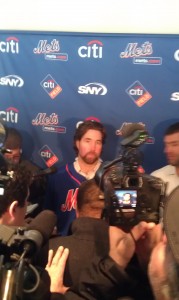 Happy holidays? Is there someone to blame between the player who just got done being certified the best pitcher in the league and the team that has hesitated in committing to his satisfaction? We love Dickey, and our default switch is set to the assumption the Mets are probably doing something wrong if they’re doing anything at all, yet I’m not sure there’s blame to be assigned in any of this. Here are the basics of this negotiation as I understand them:
• Dickey’s due a sizable amount of money in 2013.
• Dickey wants a more sizable amount of money for 2014 and 2015.
• The Mets are offering a more sizable amount of money for 2014 and 2015.
• The amount of money the Mets are offering isn’t really in line with the market value of the best pitcher in the league, so although it’s sizable, it’s not that sizable in context.
Thus, the Metropolitan Standoff. One is tempted to say it’s about money, but that would be the garden-variety answer. This is R.A. Dickey. He’s blossomed in a garden of his own tending, where feelings grow as tall as any stack of guaranteed dollars. “When people say, ‘It’s business, it’s not personal,’” he said to a small mob of media, “well, that just means it’s not personal for them.’” To the Mets — or any baseball team/business — R.A. Dickey’s contract is a figure on a ledger. To R.A. Dickey, maybe more so than any ballplayer we’ve ever encountered, you get the very strong impression that everything is personal.
That’s what makes him R.A. Dickey, for better or…actually, there’s almost never been a speck of “worse” where R.A. Dickey’s been concerned these three years we’ve known him. So as much as one wants to avoid hitting the default switch and blaming the Mets for doing what teams do and taking into account all factors that would go into extending Dickey’s contract to something closer to his satisfaction than theirs, boy is it difficult to not think that if R.A.’s feeling a bit bruised from this process, then something must be awry with the process.
R.A. was at Citi Field to play an elf, which is easy to forget when you’re not one of the hundred or so kids from Far Rockaway who the Mets invited for lunch and toys and a little Santa Claus action. John Franco was going to be along later to reprise his old-time role, so in the early going Tuesday, R.A. and Ike Davis donned blue Mets jerseys and greeted the children. A big “YAY!” went up when they appeared. R.A. the elf spread the good cheer as he’s been spreading it to us since 2010. Then the elf left the Acela Club dining area, making way for the Cy Young winner to stand in front of the dancing-logos wall behind the curtain where the media was waiting. Per usual, he seemed intent on answering all questions honestly.
And honestly, he didn’t seem too thrilled as he answered.
There he was, in Mets blue, against a wall of Mets blue, being kinda blue. There was a multitude of cameras and microphones and notebooks, every one of them wielded by someone asking about the progress of those negotiations. R.A. didn’t put a happy face on it. He said only good about being a Met and didn’t say anything bad about the people on the other side of the negotiating table (if there were true rancor, someone else likely would’ve played Ike’s elfin partner). They’re the people he’s still employed by, the people who are as likely as not to trade him if they can’t extend him soon. If he gets to Opening Day without a new contract, he’s as good as gone. If he’s not his current employers’ kind of investment at the price he desires, then it’s not unreasonable for them to gauge what he’s worth in a trade, considering how much his current team needs in order to compete. He’s been dangled plenty for weeks. He’ll be dangled some more unless he’s signed.
I don’t see him signing. I might have before the holiday party, but this was not the countenance of a man on the verge of professional satisfaction. This was not a man stoked by the spirit of the season. Even a question about the kids in the dining room, chosen to attend because they went to schools that were hit hard by Superstorm Sandy, didn’t seem to take R.A. out of the moment. He acknowledged that he “can’t fathom what they’re having to go through,” but the Dickey who would’ve found exactly the right words to show he probably fathomed it better than most wasn’t fully present at Citi Field. Some days even the best pitcher in the league doesn’t quite have his knuckleball.
Dickey was on a tight schedule Tuesday, having committed to a promotional appearance in the city. There was one big media scrum for his attention, which wound down with a backbeat of Jay Horwitz warning R.A.’s most persistent inquisitors, “He’s gotta go, he’s gotta go.” Sure enough, R.A. was going. He removed the new blue DICKEY 43 Mets jersey — a model he’s never pitched in — and put on his coat, grabbed his bag and left through the Acela Club’s back exit.
I had only my fan instinct for guidance, the one that told me Ray Knight, Darryl Strawberry, Edgardo Alfonzo and Jose Reyes couldn’t possibly not return when their status was in limbo, so don’t consider my hunches a leading indicator of anything. But honestly, once that uniform shirt came off, I couldn’t help but think I had just seen R.A. Dickey’s last appearance as a New York Met.
by Greg Prince on 10 December 2012 3:57 pm You are cordially invited to join your Faith and Fear family at Foley’s NY (18 W. 33rd St., between Fifth and Sixth Avenues) this Saturday, December 15, from noon to 2 PM, to celebrate the launch of The Happiest Recap book series.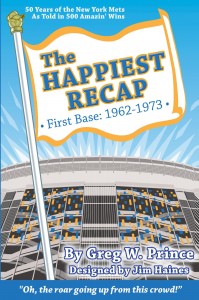
The Happiest Recap is the four-volume history that details the New York Mets’ first 50 years through the prism of 500 Amazin’ wins. The first book, subtitled First Base: 1962-1973, covers roughly the first quarter of the Mets story — the most memorable, most fascinating, most intriguing and most deserving of being hauled out of subconscious-storage wins our ballclub put on the board during its wonder years. I call it the Mets Classic period, when everything we know about the objects of our affection were established in blue and orange ink. To quote from the introductory section of First Base:
When you can’t help but love the Mets, when you can’t help but wait on the Mets, when you can’t help but dream for the Mets, when you can’t help but put up with the Mets and when you can’t help but keep faith in the Mets, that’s the legacy of 1962 through 1973 come to life. The Mets are what they are in large part because of who they were at their start.
Future volumes will touch Second Base (1974-1986), round Third Base (1987-1999) and come sliding into Home (2000 & Beyond). Right now, we have First Base, and as Casey Stengel indicated to his players on the very first day of the very first Mets Spring Training when he took them on a tour of the diamond, you gotta get to first base before you can score.
And you will score a marvelous afternoon of baseball in December when you join us at Foley’s at noon on Saturday. Copies of First Base will be available for purchase and signing. The price will be $15 for one copy, $25 for two (because The Happiest Recap makes a great gift for you and the Mets fan in your life). A portion of proceeds from all on-site book sales Saturday will be devoted to helping fulfill the East School Wish List on Amazon. East School — the elementary school I wrote about in reflecting upon my visits to my hometown of Long Beach before and after Superstorm Sandy — absorbed a great deal of damage from the hurricane and needs all kinds of new supplies as a result. I hope this helps in some way.
Besides books and facetime with the author, there will be a drink special, appetizers of some sort, good Mets fellowship and all the baseball talk one can ask for as winter sets in. It will also be, per the insistence of my dear friend Sharon (who spurred the organizing of this event), a begrudging acknowledgement of my forthcoming 50th birthday, though consider The Happiest Recap the guest of honor and me its chaperone.
I hope to see you there and share a couple of Metsian hours in the middle of December. If you can’t make it, remember The Happiest Recap (First Base: 1962-1973) is available on Amazon in plenty of time for any holiday you like. As one Mets fan to another, whenever you got caught up in this thing of ours, I know you’ll enjoy the hell out of it.
by Greg Prince on 7 December 2012 8:13 pm Man, were those winter meetings depressing. I really miss the days when the Mets took money that technically didn’t exist and gave the green light to a general manager with little concern for long-term implications to do with it as he saw fit. The illusion may have worked only fleetingly well, but danged if it didn’t make for fun winter meetings.
So let’s do it again on a limited scale. We can’t go out and gather up the current iterations of the Martinezes, Beltrans, Delgados, Lo Ducas, Wagners and whoever else we like and re-create 2006, but we can pretend.
Then why don’t we? I don’t mean giving Bernie Madoff a jingle in stir and asking if there are any other fake accounts that can be drawn on, and I don’t mean rekindling the magical moolah thinking of Omar Minaya. I literally mean let’s pretend we’re offseason big shots again.
Let’s rent Josh Hamilton.
Usually you hear “rent-a-player,” and you think about taking on some big contract for the final year of somebody else’s onerous pact or maybe just the last couple of months of one for a pennant drive. You know that player won’t be around, but you’re going for the win with all you’ve got.
The Mets can’t do that, but they can give us a momentary respite from their futile search to find a better version of Mike Nickeas, their grim machinations to rid themselves of their reigning Cy Young Award winner and their bulletins revealing Rule 5 finds they select and quickly sell off. They can rent Josh Hamilton.
For an hour.
Seriously, how much could it cost? As long as Hamilton is just sitting on the open market waiting for his multiyear megadeal, let the Mets swoop in and engage his services for 60 minutes. He doesn’t have to sign for longer than that. He doesn’t have to play ball. There’s no time for that. There’d be just time enough for this:
A crowd gathers in one of the Citi Field clubs.
Jay Horwitz steps to the podium and introduces Jeff Wilpon.
Jeff Wilpon welcomes one and all, marveling that this is a milestone day in the history of the New York Mets and introduces Sandy Alderson.
Sandy Alderson speaks to the creativity and persistence that led to this moment and how pleased he is to have not just filled a need but to have upgraded so meaningfully to a true game-changer: “We’ve gone from having no viable outfielders to the outfielder who’s the talk of the industry.” He then introduces the man of the literal hour, Josh Hamilton.
Josh Hamilton steps up and dons pinstriped Mets jersey No. 32 and the traditional blue cap with the orange NY. He is beaming from ear to ear as he poses with Alderson, Wilpon, Terry Collins and David Wright and then makes a few remarks.
Josh Hamilton says he is thrilled to be a New York Met.
He explains he developed a real bond with Jeff and Sandy and how they made him feel wanted.
He was inspired when he heard their plans for 2013 and beyond.
He is ready to play wherever Terry wants him.
He credits David for convincing him what a great fit New York would be for him.
He remembers the overwhelming passion of Mets fans the one time his old club visited Shea in 2008 and looks forward to rekindling it immediately.
He feels comfortable knowing the New York area offers him all kinds of options, whether he lives in the city or the suburbs.
He knows he will have a terrific support network here, thanks to the Wilpons, “who are just the best people ever”.
He calls his eyesight “perfect for any game — day or night”.
He announces the formation of the Josh Hamilton Big Apple Foundation, which will support an array of children’s charities “every time I make that big apple in center rise”.
And he singles out Jenrry Mejia for being gracious enough to let him wear No. 32.
David makes a brief presentation of a commemorative bottle of Schweppes Ginger Ale to Josh, letting him know this bottle is a “down-payment on the case we’re gonna be celebrating with as teammates when we win the World Series”.
Cameras click, boom mikes hover, Horwitz arranges the media into groups and sets select reporters up for one-on-ones with the Mets’ newest superstar.
Kevin Burkhardt tells Chris Carlin and Bobby Ojeda back in the studio that, “Guys, you can just see in Josh Hamilton’s face how happy he is to be a New York Met today.”
Joe Benigno asks the first radio question via remote: “Josh, you signed with the Mets as a free agent. The Mets have signed a lot of free agents, but a lot of free agents haven’t exactly worked out here. What about that?”
Bruce Beck records a standup, declaring, “The Mets may have played like turkeys these past few seasons, but now they’ve got a real HAM as the meat of their order!”
Everybody smiles. Everybody’s excited. Everybody’s happy for the rest of the hour. And when the 60 minutes are up, Hamilton removes the jersey and the cap, and the Mets aren’t on the hook for another dime — no muss, no fuss, no commitment…just like a classy escort service for teams that couldn’t otherwise take a date to the hot stove dance.
Compared to ginning up enthusiasm over Brandon Hicks and Anthony Recker, I’d take it.
|
|