The blog for Mets fans
who like to read
ABOUT US

Faith and Fear in Flushing made its debut on Feb. 16, 2005, the brainchild of two longtime friends and lifelong Met fans.
Greg Prince discovered the Mets when he was 6, during the magical summer of 1969. He is a Long Island-based writer, editor and communications consultant. Contact him here.
Jason Fry is a Brooklyn writer whose first memories include his mom leaping up and down cheering for Rusty Staub. Check out his other writing here.
Got something to say? Leave a comment, or email us at faithandfear@gmail.com. (Sorry, but we have no interest in ads, sponsored content or guest posts.)
Need our RSS feed? It's here.
Visit our Facebook page, or drop by the personal pages for Greg and Jason.
Or follow us on Twitter: Here's Greg, and here's Jason.
|
by Greg Prince on 29 April 2012 7:52 am With his second-inning two-run homer and fifth-inning two-RBI base hit, Lucas Duda raised his Saturday totals for this season — covering four games, through Saturday night in Denver — to the following:
• .500 batting average
• .500 on-base percentage
• 1.429 slugging percentage
• 1.929 OPS
• 4 home runs
• 8 runs batted in
• 5 runs scored
In games played on the other six days of the week, encompassing 17 games thus far, Lucas Duda’s 2012 looks like this:
• .203 batting average
• .284 on-base percentage
• .220 slugging percentage
• .504 OPS
• 0 home runs
• 5 runs batted in
• 5 runs scored
The Mets are 4-0 on Saturdays this year, including their most recent 7-5 victory at Coors Field; Lucas has now driven in 38.1% of all his team’s runs on that day to date. The Mets are 8-9 the rest of the time, when Duda — presciently dubbed “Saturday’s Child” by Josh Lewin on the season’s second Saturday — is doing not so much.
And the reason for this dichotomy between Lucas’s Saturdays and Lucas’s Sundays through Fridays is…
Well, I have no idea. I’m guessing Lucas has no idea. A Mets fan would wish for Saturday Lucas to be everyday Lucas, but a baseball fan would have to be satisfied that in an age when there’s a solid statistical explanation for almost everything, there is no earthly reason for this phenomenon to be occurring.
If our right fielder doesn’t pull out of his six-day-a-week funk, it will be alarming in the long run if it isn’t already. But for now, once a week, when we win and he hits as if by appointment no matter what might go wrong along the way (or, for that matter, the night before), isn’t it — at least in the abstract — mystifyingly beautiful the way Lucas Duda is in bloom on Saturdays and only Saturdays?
On Sunday morning, it is.
***
The preceding three days at Hofstra were much like a Lucas Duda Saturday: powerful, productive and a Met joy to behold. I’ll share further thoughts soon when I’m again as alert as I felt from the first pitch to the last out of the conference. But for the moment, if you were there, please know you have my deepest appreciation for being an intrinsic part of the teamwork that made the dream work.
by Jason Fry on 28 April 2012 4:18 am I’ve had a ball helping my co-blogger moderating panels at Hofstra’s New York Mets Conference over the last day and a half, as well as sitting and listening to smart Mets fans, former players and baseball historians amateur and professional discuss all things blue and orange. On Friday, for instance, I a) heard a great Craig Glaser presentation breaking down the odds of the Mets’ having no no-hitters; b) had fun shooting the bull at a lunchtime panel with blog colleagues and Mets fans; c) posed for pictures with Mr. Met; d) heard Art Shamsky, Bud Harrelson, and Ed Kranepool discuss their time in blue and orange; and e) chatted with John Thorn. That’s a pretty good day, and I had to go home before the evening sessions and the banquet.
But my favorite moment from the conference wasn’t academic at all — it was the roar from a nearby lounge as Kirk Nieuwenhuis drove the ball over Giancarlo Stanton’s head, sweeping the Marlins out of Citi Field. While I’d been sitting at a table with one earphone on, feeling simultaneously bad that I was listening to the game instead of chatting with some very interesting folks and insisting to myself that one could and should keep apprised of Mets doings at a Mets conference, other attendees had found a big HD set and tuned it to SNY, with the Mets obliging us by providing a scrappy classic. I like my Mets discourse academic and analytical and historically minded and literary and delivered in innumerable other high-falutin’ ways, but this was simple and transcendent: Mets win, that was awesome, we’re happy.
As for tonight, well … did anyone mention how great Nieuwenhuis’s hit was? Greg did? And then I just did again?
Oh. Well then.
Tonight’s game wound up being one of those spottily attended to semi-West Coast messes, seen in fragmented glimpses so that it seems halfway to a dream.
I watched the first few innings on Gameday while attending a gala raising money for my kid’s school, during which I drank blue martinis, the exact number of which can now only be approximated. (This is known in storytelling as foreshadowing.) Those innings were mildly worrisome but not the stuff of disaster: The Mets trailed the Rockies, and Gameday hinted pretty strongly that Lucas Duda was doing ill-advised things in the outfield, but it was only 2-1.
Emily and I got home, relieved the babysitter, and took in the next couple of innings from the couch. These were terrific. Scott Hairston clubbed a home run to tie the game, while fill-in starter Chris Schwinden — the lumpy pitcher with the graceless mechanics whom I’ve struggled to abide — seemed to have settled in. Then the Mets ambushed the Rockies in rousing fashion: Hairston tripled to pull within a double of the cycle, and the Mets strung together four more singles (including Zach Lutz’s first big-league hit and Schwinden’s second) for a 6-2 lead. It looked like a rout was in the offing, one I was thoroughly prepared to enjoy.
Well, I got the rout part right.
Emily went to bed; within a few minutes the Mets were playing like they were half-asleep. It began so innocently, as it always does. Schwinden fielded an Eric Young Jr. comebacker, lollipopped it to Lutz at first, Young slid in headfirst, Lutz didn’t bend down quite far enough to tag him. Then Young stole second, taking third on a high Mike Nickeas throw that Daniel Murphy muffed. Then Marco Scutaro walked and Jonathan Herrera singled to make it 6-3.
Not good, but I figured Schwinden would gather himself and escape the inning at 6-4 or so. Instead, he promptly served up a Carlos Gonzalez homer to tie the score. Exit Schwinden, enter Manny Acosta … and somewhere between Acosta leaving the bullpen and toeing the rubber against Troy Tulowitzki those martinis had their say and closing my eyes seemed like an excellent idea.
When I woke up Scott Hairston was being roundly congratulated and Gary Cohen sounded excited. Ah, I realized: He’d hit for the cycle, becoming the 10th Met to do so. This is what we do instead of throwing no-hitters — how weird is it that the Padres have never done either? That was great, but there were other things to process, and I was having trouble. The Mets had nine runs, but the Rockies had … 13?
What the hell?
Such evidence of Acostalyptic doings proved too much for my foggy brain; I hit my own personal snooze alarm, during which time passed and events occurred. When I came to again, Ruben Tejada was at the plate, the Mets still had nine runs, and that number by COL was still large and dramatic.
Still 13, though.
No, wait. It looked like a 13, but it was … an 18?
Jesus.
Tejada struck out, the ballgame was over, and of course I was awake.
by Greg Prince on 27 April 2012 12:35 am Thursday in Hempstead was incredibly outstanding, if not quite as incredibly outstanding as Thursday in Flushing, thus some last-minute changes to Friday’s program have been implemented.
HOFSTRA UNIVERSITY
NEW YORK METS
50TH ANNIVERSARY CONFERENCE
PROGRAM ADDENDA
FRIDAY, APRIL 27, 9:00 AM
THE NIEUWENHUIS EFFECT:
When Rookies Represent An Experience
FRIDAY, APRIL 27, 10:30 AM
KEEP THE HOME FIRES BURNING:
Sustainability Issues Related To Growing Nine Players
FRIDAY, APRIL 27, NOON
THEY WALKED THE WALK:
Mets Batters Who Stood And Delivered
FRIDAY, APRIL 27, 1:30 PM
46 PITCHES THAT CHANGED AMERICA:
The Downward Spiral Of An Overpaid Closer
FRIDAY, APRIL 27, 3:00 PM
AQUATIC TRAUMA:
Marlin Peril In Queens Waters
FRIDAY, APRIL 27, 4:30 PM
METS FAN CONFESSION:
“I Skipped An Entire Afternoon Session Of A Wonderful Mets Conference To Listen To The Last Few Innings Of A Wonderful Mets Game And I Can’t Say I’m Sorry That I Did.”
NOTE: Mets don’t play until 8:40 Friday night. So come to the wonderful conference!
by Jason Fry on 26 April 2012 12:13 am OK, the game. It was another beaut — it really was. Mark Buehrle and R.A. Dickey faced off in a corker of a pitcher’s duel, with Buehrle’s deadly sinking change evenly matched against Dickey’s fluttering knucklers. Omar Infante hit a home run that would have gone out of old Yankee Stadium to give the Marlins a 1-0 lead. Yet the Mets would fight back, with old friend Jose Reyes’s throwing error giving them an extra at-bat — which David Wright used to launch a home run of his own that carried over the new wall and carried David over Darryl Strawberry for the club mark in RBIs. The rest was cosmetic but satisfying, with Lucas Duda hitting a line drive that nearly killed an outfielder, Mike Baxter chipping in a you-can-exhale-now double and even Ike Davis looking better. Mets 5, Marlins 1. Very nice.
Now let’s get on to the real subject — my strange, slow-building fury at the Marlins for having the temerity to exist.
Let’s be clear about this: I’ve never liked the Marlins, except that one October against the Yankees, and that was more of a highly temporary shotgun wedding. It’s more that I never hated them, the way I hated the Cubs when I was a kid and the Braves when I was a young adult and the Yankees since basically forever.
Which, ultimately, was a measure of my real contempt for them. Hating the Marlins would have been giving them too much credit; it would have been acknowledging them as a real baseball team deserving of notice, which I never wanted to admit they were.
I’m not proud of this — it’s a little too classist, a little too refusing to talk to the neighbors who keep the garage door open so we all have to see the mess inside. But screw it, it’s only baseball — part of sports is that you can let your inner demons run free, or if not free then loose within a reasonably fenced yard. So I’m a baseball snob — I always thought the Marlins were too fundamentally tacky to deserve my hatred, the way the Braves and the Cubs and the Yankees deserved it.
To review, the Marlins were born tacky and awful.
Those colors, ugh. Silver and teal, like an overpriced Cuban place in a half-empty mall, the kind of place you’d go to against your better judgment, where you’d order the fish and wind up heaving and drooling over the toilet for the better part of two days.
That park, Gawd. A football stadium whose dimensions perpetually went too far in one direction and not far enough in another, where everything was subtly the wrong color and the dugouts were full of Soilmaster, as if the owners were too slipshod and cheapjack to tell somebody to put it in a storage room somewhere. Which they undoubtedly were.
Those players, yakk. Bobby Bonilla and Gary Sheffield and Kevin Brown and Armando Benitez and Brad Penny and Cody Ross and Luis Castillo. Plus the Marlins would specialize in employing the Worst Great Player in the Majors, a supremely talented ballplayer whose God-given gifts were only equalled by his sleepy disdain for the game that had made him millions. Miguel Cabrera, meet Hanley Ramirez.
Those owners, technicolor yawn. It’s really quite a distinction to have been owned by Wayne Huizenga and Jeffrey Loria. Huizenga, a garbageman by trade, dismantled the team and left it on the curb after its 1997 World Series title, one of the more amazing screwings of a fanbase ever perpetuated by an owner. Loria is a garbageman in spirit if not actual vocation, having aided and abetted Bud Selig’s shameful disemboweling of the Montreal Expos, for which bloody business he was awarded the Marlins in a shady three-way swap of franchises with the Red Sox and the commissioner’s office. Loria promptly decamped for south Florida, even taking the Expos’ computer equipment with him. Because the universe is malign, Loria got a World Championship in 2003, after which he screwed Miami’s handful of fans by getting rid of Derrek Lee in a salary dump and letting Ugie Urbina and Ivan Rodriguez walk.
To review, the Marlins can’t even win a World Series without immediately reminding any sentient fan that they are run by cynical, awful human beings. In fact, they’ve done it twice.
Marlins fans? It’s only a slight oversimplification to say they don’t exist — though after two post-title screwings, a certain lack of commitment is understandable as a defense mechanism. Soilmaster Stadium was always a home game of sorts for opponents, and after a good showing on Opening Night in the new park, the fans have mostly attended disguised as empty seats.
Tacky, tasteless, awful. For nearly two decades, those were your Florida Marlins. I could never bring myself to hate them so much as I simply wanted them to go away — to San Antonio or Portland or Contraction, whatever was available first. No, I’m not missing the fact that they were also a constant, gigantic thorn in the Mets’ side. They finished ahead of us in their inaugural season. They sat on our casket in 2007 and then again in 2008. Lots and lots of Marlins I loathed became Mets I loathed just as much if not more. They have as many World Series titles as we do. I am not blind to any of this.
So why do I finally hate them instead of just trying to make my contempt as withering as possible? Why, by the third inning tonight, was I tweeting misanthropic things that I kept misspelling in spastic anger?
I’m not sure. It’s probably a combination of things:
- They “took” Jose Reyes away from us;
- they have, improbably, so amplified their bedrock tackiness that they may be the most tasteless franchise ever; and
- they are temporarily rich while we are temporarily poor.
The first charge is, of course, nonsense. Nobody took Jose Reyes away from us because we let him go. Properly so, given the absurd number of years the Marlins gave a wonderful but fragile player, but it still rankles that he had to go there. I was hoping Jose would go somewhere far away, to be an occasional ache in the memory — Anaheim would have been ideal. Instead we have to see him 18 times a year, grinning next to the loathsome Hanley Ramirez. And while making Jose very rich (for which I begrudge him not a penny), the Marlins have also tried to neuter him, insisting he shed his Predator dreads. What on earth for? Because Hanley might develop a bad attitude? Because those uniforms cry out for clean-cut players?
The second complaint is thoroughly earned. The Marlins’ new uniforms are just stupendously, jaw-droppingly, apocalyptically awful. The everything-on-black color scheme looks like what you’d get after a teen barfed up Kool-Aid and a rainbow of pills on a formal dress. The new insignia looks like it was concocted by a neon artist on an ether binge. They have SIX team colors, for pity’s sake. And the unis suck in little ways, too — look at the back, at the contrast between the font used for the numbers and the font used for the names. I don’t have the vocabulary for what’s wrong there, other than to say something obviously is. And I haven’t even seen their stadium yet, with the fish tanks behind home plate and whatever the Mother of Holy Jesus is up with that giant Pachinko thing that celebrates home runs behind the center-field wall. I’m sure I’ll be very calm the first time Hanley Ramirez hits a home run and takes the better part of a global epoch to go around the bases while fake dolphins cavort beyond the fence.
But wait, you say, the Marlins’ unis aren’t that bad, Jace. They aren’t as bad as the Astros’ Tequila sunrises, or the Padres’ Taco togs, or the White Sox’x’x’s various disasters.
But that’s where you’re wrong, my well-meaning friend. (And stop trying to talk me down.) All of those uniforms were born in the mid to late 1970s. Look at snapshots from that era, and you’ll see everyone on Earth — hippies, office drones, doctors, White House officials — wearing horrifying things that they’ll cringe to recall today. The difference between what your hapless Padre middle infielder of 1976 was wearing and the clothes of the people in the stands wasn’t so enormous. Today’s mainstream style is essentially bland and inoffensive, stuck in a middlebrow amber — compared with someone in the stands at Citi tonight, poor Mark Buehrle looked like a rodeo clown. You have to judge baseball uniforms by their times, and by that standard, the Marlins’ 2012 uniform may well be the worst anything in the history of everything.
And now our final point — that the Marlins are up while we are down.
Weirdly, I think it’s the temporariness of this that’s grating. Of course it’s while the Mets are Madoff’d that the Marlins wind up throwing around free-agent cash like they’re on a coke binge. Of course they wind up with our beloved shortstop, dressing him in motley and making him cut his dreads. (Again — what the hell? Given the sartorial chaos of Marlin-land, wouldn’t it have made more sense to insist everybody else grow them?) Of course they are the talk of baseball while everyone snickers that the Mets’ biggest offseason move involved a wall. Who better than the Marlins to occupy that role?
The Marlins may even win a third title like this. But we all know it won’t matter. They still won’t have fans. Even if they win, they won’t make enough money to satisfy Jeffrey Loria. Soon enough, he will sell off his players, Reyes among them. The Pachinko thing will break and sit mute and gigantic behind the fence. Someone will get confused and pour Soilmaster in the fish tanks, leaving them cloudy and dead. The stomach-pumped-coed color scheme will get replaced by something dull but still awful. The park will once again be left to expats and Billy Marlin. The Marlins will be hapless again — divided into “over the hill,” “wet behind the ears” and “good enough to be dumped for prospects.” At best we’ll still only go 8-10 against them, with most of those losses infuriating.
Things will be back as they were, and perhaps my hatred of the Marlins will ebb, to be replaced by the old nausea and vague pity. Which will be better, yet at the same time worse.
I look forward to the day; for now, I’m just tired, and a bit surprised by how much bile the Marlins have stirred up. As well as frightened by a related question: How would I have felt if the Mets had lost?
* * *
We hope to see you at Hofstra tomorrow. Details are here. I promise to be calmer.
by Greg Prince on 25 April 2012 3:18 pm Hope you’re making plans to join us at Hofstra for the 50th Anniversary Mets conference, Thursday, Friday and Saturday. All of it will be worthy of your consideration and aims to do Dana Brand’s vision for it proud. But on a personal note, it occurs to me I might as well tell you where to find Faith and Fear while you’re there.
• Each day, I’ll be moderating the lunchtime “Bullpen” panel, composed of some of your favorite bloggers batting around some of the great issues of life as a Mets fan. Jason will be enhancing the proceedings Thursday and Friday. Others from whom you’ll be hearing across the Bullpen sessions include representatives from The Happy Recap, A Gal For All Seasons, ESPN New York, Optimistic Mets Fan, On The Black, LoHud Mets, Amazin’ Avenue and Mets Police as well as — special treat! — longtime FAFIF commenter (and original New Breeder) Joe Dubin.
• Thursday at 8 PM, I’m scheduled to introduce the filmmaker Kathy Foronjy and her terrific Mets fan documentary Mathematically Alive. If you haven’t seen it, you’ll love it a lot since you are, by proxy, probably in it.
• Copies of Faith and Fear in Flushing: An Intense Personal History of the New York Mets will made available for sale on Thursday at 2 PM, with author autograph if you’re so inclined. And if you already have a copy and want it signed at any time during the conference, I’d be most honored to do so.
• On Saturday at 11:15 AM, I will take part in a panel devoted to Mets communication. My topic is “The Shared Mets Fan Language: How Mets Fans Speak to One Another”. Also on that panel will be Kerel Cooper of On The Black, discussing the Mets and social media, and Ray Stilwell of Metphistopheles, exploring “The Decline and Loss of the New York Mets Radio Network”. WINS sports anchor Marc Ernay moderates.
• On Saturday at 3:15 PM, the “Passion of the Bloggers” will be on display as Steve Keane of The Eddie Kranepool Society, John Coppinger of Metstradamus, Taryn Cooper of The Gal For All Seasons and I delve deep into the wonderful world of fan blogging…Mets fan blogging, to be specific.
• Thursday afternoon (weather permitting) and Friday night (if you’re attending the Amazin’ Mets Gala Banquet), I’ll be frequently checking the score of the ongoing Mets games against the Marlins and Rockies, respectively.
I hope to see you at Hofstra, even if means removing the buds from my ears to say hi.
Read more about the conference from ESPN New York, New York Magazine, MLB.com and the New York Times.
by Greg Prince on 25 April 2012 4:27 am Between one of Tuesday night’s half-innings when nobody was touching either starting pitcher, Citi Field’s bounty of video screens posted a trivia question answered by a random face in the crowd. Engrossed in conversation, I didn’t catch the question, but when I heard the answer, I knew what would happen next: the answer would walk on camera, in the flesh, and present the winner with a prize.
Dave Kingman — the answer — appeared and received a warm ovation from history-minded Mets fans appreciative of his contributions to their team…as he should have.
Yet during both of Kingman’s Met tenures, from 1975 to 1977 and 1981 to 1983, fan relations with the slugger turned sour enough to make Sky King a go-to target for relentless ire, particularly as the Mets struggled for respectability. When he returned in other uniforms, he wasn’t welcomed back to Shea heartily, unless you count the hearty booing. But nobody remembers that now. He’s Dave Kingman, old Met hero. Give him another nice round of applause.
Hence, I believe there’s hope yet for an unalloyed happy return down the line for Jose Reyes. Waaay down the line, perhaps, but if he hangs in there another 30 or so years, he’ll be golden.
I wouldn’t have thought Jose would be on the clock in this regard. I wouldn’t have thought a lot of things where Jose Reyes, all-time New York Met great, was concerned. I wouldn’t have thought Jose Reyes would ever be anything but a New York Met. I wouldn’t have thought Jose Reyes could attract sustained boos from a New York Mets gathering. I wouldn’t have thought nine zesty years between a catalyst and those he fired up could be so casually written off in the name of intradivision competition.
Maybe I just think differently from the vocal plurality of the 20,000 or so who shared Citi Field with me Tuesday but don’t come close to sharing my sensibilities as a Mets fan. They booed their heads (or whatever they use to balance their caps) off when they saw Jose Reyes of the Miami Marlins. I cheered him. I cheered the brief, classy video montage of Jose’s Met years. I cheered his name when it was read to lead off the lineups. I cheered when he came to bat to lead off the game. I cheered him a little less on each of his subsequent trips to the plate, but I never booed him. And I never will.
I don’t root for Marlins, whether they be stamped Florida or Miami, but I sure as hell cheer great Mets. Jose Reyes was a great Met, which means he is a Great Met for good. His greatness in the context of his Met years is established. If it’s not present-tense in a practical sense at this time, its truth nevertheless marches on…or races from home to third on a ball in the gap, unless Kirk Nieuwenhuis tracks it down first.
The owners of the New York Mets, to paraphrase from former Texas Agricultural Commissioner Jim Hightower, were born on third base and think they hit a triple vis-à-vis what the Mets mean to Mets fans. Except for opening the gates, they have nothing to do with why our passion spreads out so far and wide when it comes to the Mets. We fall in love with a baseball team, not a baseball organization. Just the word “Mets” contains such power and goodwill based on deep and abiding passion that when confronted by the sight of somebody who embodied “Mets” as much as any individual has in the past decade, yet recently ceased doing so when compelled by a clash of long-term economic agendas, those who love “Mets” pivoted breezily to change that individual’s status from friend to enemy.
Not opponent, but enemy.
That’s “Mets” pride at work, I suppose, letting our old raw flame and live wire know he’s no longer welcome in the neighborhood. Jose Reyes (who sleeps on a bed made of money, so don’t cry for him, Flushing Meadows) opted for Marlinhood, which is distasteful, to be sure, but also, I’ve decided, the way it goes sometimes. There’s a gray area between the childlike innocence that absorbs us in picking a side for fun and games and the adult realization that it’s a livelihood for the players providing us the fun and a business for the barons who host the games. Somewhere in there, we make tradeoffs that might not pass a cognitive dissonance test between the emotion in which we choose to immerse ourselves and the reality that engulfs us.
• Jose Reyes was the perfect Met to match my emotional needs for nine years — a rechargeable battery that jolted me from my seat night after night. You just don’t get that kind of jump or feel quite that kind of emotion in the parts of life that aren’t sports.
• Jose Reyes made a decision bathed in reality, the place where he wasn’t childlike and electric, but a cool, calm professional seeking a financial windfall in exchange for his services on the open market.
What do I do with that dissonance once I am reminded that no athlete who is compensated for his abilities is explicitly plying them for me? He represents “Mets” as long as his contract says he has to. Then he’s without a contract and it’s another component of the major league monopoly that offers him a package to his liking. Then he no longer represents “Mets,” no matter that my emotional gratification in the realm of the sport I prefer above all others (all other sports and almost all other things) was so strongly linked to the intangible bond I felt with the way he played for me.
Jose Reyes played for me for nine years. Yet he plays for himself always. Same as Johan Santana. Same as Kirk Nieuwenhuis. Same as Lucas Duda and all of the Mets responsible for winning Tuesday night’s edgy 2-1 affair. Jose Reyes’s new teammates play for themselves as well. I know that. I’ve always known that. The brusque tap on the shoulder that free agency provides every winter should be enough to make that a matter of constant awareness not recurring surprise.
But if we walked around fully aware that baseball players are just people looking to make the best living possible and baseball teams are just businesses looking to make the most profit possible, we’d want nothing to do with either faction. So we forget, and we revel in the word “Mets” and we revel in those who represent the word “Mets” and, in my case, I deal with the dissonance by grudgingly accepting it. I accept that Jose Reyes eventually did what Jose Reyes perceived as ideal for Jose Reyes, even if it meant fitting himself into an identity every Mets fan finds anathematic to our values.
It may ultimately be “just a business” to players like Jose Reyes, yet it’s anything but to fans like me. Thus, when I cheer Jose Reyes as he materializes in a Miami Marlins uniform, I don’t offer my approval of the business decisions (the Mets’ as well as his) that led him into that unfortunate set of garments. What I’m doing is acknowledging all that happened before, back when I could convince myself Jose — like Tom Seaver, like Dwight Gooden, like Edgardo Alfonzo, like so many — was playing for me.
In my judgment, those whose actions embroider the actual meaning into “Mets” deserve that strata of acknowledgement, no matter that in a strict reading of the respective situations of the players who preceded Reyes as “my favorite Met,” Seaver demanded a trade while under contract to the Mets; Gooden’s repeated substance abuse violation earned him a suspension that ended his active Mets association; Alfonzo sought a better contract as a free agent than the Mets were prepared to tender him; and few who aren’t Ed Kranepool or Ron Hodges didn’t find a way to be at practical odds with the best interests of we the Mets fans. Almost everybody has left us, benignly or bitterly, whether of free will or not, and if they played against us as opponents, they sure as hell weren’t playing for us.
Still, there are enough enemies in this world without weaving together specious reasons (bunt! pinch-runner! injuries! no rings!) to create more of them. What were mostly good times don’t suddenly go bad because the individual responsible for them won’t be generating any more of them in our name, and now it’s his job to help prevent them.
Meanwhile, there are precious few continua whose relentless flow over the course of our lifetimes completely captivate us. My continuum of choice is the New York Mets, historically since 1962, personally since 1969. When somebody rises above that continuum and grabs my attention and ignites my passion, that guy is irreversibly golden to me.
Whether he signed with the stupid Marlins or not.
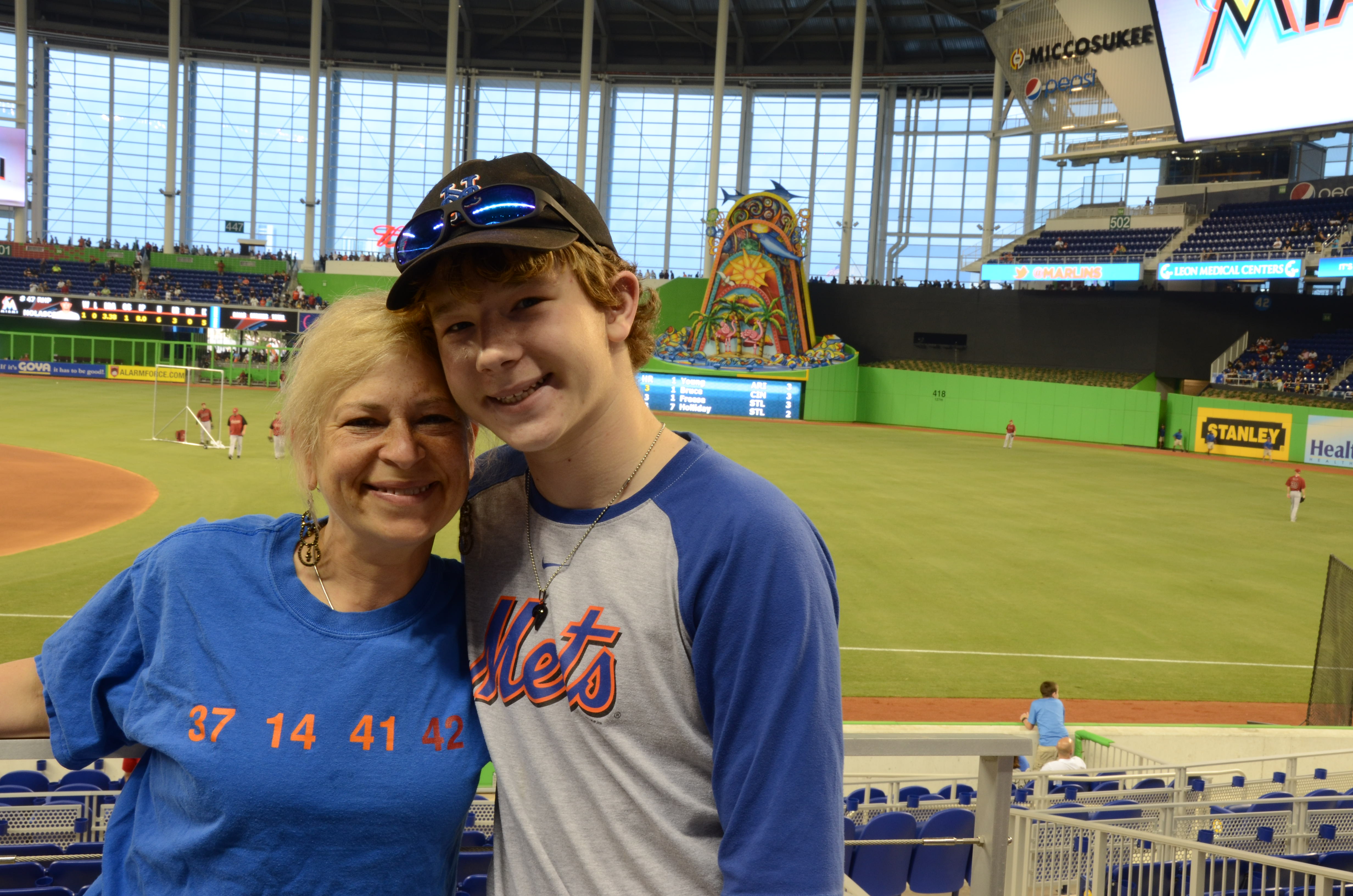
by Greg Prince on 24 April 2012 3:28 pm  May Fish tank at Citi tonight. The newly Miami’d and unfortunately Jose’d Marlins come to Citi Field tonight, but at least a few Mets fans have already inspected new Marlins Park, and at least one has done it in style. FAFIF reader and Team McGraw runner Sharon Chapman (pictured with son Ross) shows off The Numbers to the fan base that is presumably just discovering baseball for the very first time in South Florida. Not pictured: bus Ozzie Guillen had recently been thrown under…or threw himself under.
You can get yourself a shirt just like the one celebrating 37, 14, 41 and 42 here. And you can do a little mitzvah and support Sharon’s run for the Tug McGraw Foundation, coming up this weekend in Nashville, here.
By the way, their home run apple looks really weird.
by Jason Fry on 24 April 2012 12:50 am Somehow, I imagined that seeing my favorite team play a doubleheader that included two big-league debuts and began with David Wright poised to claim the club record for RBIs would be more fun.
After 10 days far from home, the idea of my own couch and the Mets on my own TV was pretty close to heaven. But the seven-odd hours of baseball presented on a clammy afternoon and evening were far more fit for that other place. I watched in annoyance, then aggravation, and finally in glum resignation. Joshua eyed the proceedings for a while before finding better uses of his time. Emily went off to Citi in time to catch the tail end of Game 1 and returned in the last innings of Game 2, chilled and dispirited. By then the Mets faithful were so few that my wife’s exit from the stadium ticked the percentage of enemy fans in attendance notably higher. And why not? It was certainly Candlestick weather.
But miserable as I was and miserable as Joshua was and miserable as Emily was and miserable as all those faithful, outnumbered Mets rooters were, it’s a safe bet that none of us ended the evening feeling as miserable as Ike Davis did.
We all still like Ike, of course, and have faith that this too shall pass. But until it does, yikes. Ike got caught looking by Tim Lincecum to lead off the second, then again with two men on to end the third. Lincecum — the elastic-armed Freak whose motion and backstory I adore — didn’t look quite himself, as he hasn’t all season, but against Ike he was more than good enough. His strategy in the third was worthy of a baseball time capsule, as he pushed Ike into a corner with fastballs, tried to get him to chase pitches out of the zone, disrupted his timing with change-ups and then erased him on an evil curveball — a third shoe dropping, if you will.
In the bottom of the fifth, Ike got another chance with the bases loaded and one out and Lincecum clearly tired. A long hit there might have made things interesting, or at least gotten our long, lanky first baseman to relax a bit. And Ike did smack a ball hard up the middle — but, alas, said middle was occupied by the glove of Emmanuel Burris, who flipped it into Brandon Crawford’s bare hand high above second, from which it traveled to Brandon Belt’s glove at first, well ahead of Ike’s arrival.
Ike got a last chance in the seventh, against Jeremy Affeldt, this time with two out and the bases loaded again. He grounded out, less dramatically this time.
But wait, here’s one from the Insult to Injury Department: He was charged — unjustly, we should add — with an error in the third when a two-out grounder off the bat of Pablo Sandoval shot upwards over his glove. With the inning extended, Buster Posey walked and Nathan Schierholtz ripped a home run over the right-field fence. Oof.
That’s eight LOB — two-thirds of the Mets’ total in a horrible game — and a key error. And how was your day at the office, honey?
Ike, mercifully, was excused for the nightcap — only to be pressed into service as a pinch-hitter in the bottom of the eighth against Clay Hensley. Once again the bases were loaded, a setup either for sweet redemption or torment worthy of the denouement of a Cormac McCarthy novel. Ike battled Hensley and Dana Demuth’s random strike zone, fighting back to 3-2 and then … getting caught looking.
Make it 11 LOB.
(The rest of Game 2? Dillon Gee was terrible, Sandoval hit one to Setauket and Jason Bay dropped a ball. Let’s just move on.)
As a ballplayer, Ike Davis has something of a split personality. In the field he generally looks serene and collected, ably corralling errant David Wright heaves with minimal fuss. At plate, though, his most pleasant expression could be described as vaguely irritated — and he’s awfully quick to bark at umpires, particularly for a guy who just turned 25. Still, the seething, temper-prone Ike would be better than what we’re getting these days: Ike’s timing is shot, his mechanics are a mess, and you can see the hopelessness of it all etched on his face. He looks like a guy stumbling across an unfamiliar room in the dark, or locked in a foreign country’s DMV with an exploded ballpoint in his pocket.
Every player has been there, and feels a deep sympathy for those trapped in that terrible dark country. But at the same time, there’s nothing to be done for the lost and slumping but to wait for them return from exile, bewildered by what’s befallen them and tortured by the inability to explain it, let alone do anything to ensure it never happens again.
Come home soon, Ike.
* * *
As a postscript, welcoming not one but two new Mets to The Holy Books wasn’t as much fun as it should have been, either. Batting just ahead of Ike in Game 2, Jordany Valdespin popped up the first big-league pitch of his career, going from on-deck circle to Baseball Encyclopedia to dugout in what has to be near-record time. Relatively unregarded Jeremy Hefner did far better, cleaning up Miguel Batista’s mess in Game 1 to keep an embarrassment from becoming a farce.
The melancholy part, for me, came from Gary Cohen and Keith Hernandez discussing Sean Ratliff. In 2010, Ratliff — a fourth-round pick out of Stanford — hit 20 homers and 80 RBI between St. Lucie and Binghamton. Near the end of 2011’s spring training, he was in the on-deck circle when he was struck in the right eye by a foul ball off the bat of his friend and fellow Mets farmhand Zach Lutz. The ball broke six bones in his face and partially detached his retina. Four surgeries followed, but Ratliff was able to resume his career this year with St. Lucie, raising hopes that his rise to the majors might have been merely delayed.
It wasn’t to be — Ratliff had problems with his depth perception and his night vision. He was forced to retire.
An unhappy percentage of baseball is luck, or the lack of it.
That screaming liner disappears into a fielder’s glove. That little roller goes through an infielder’s legs.
A team avoids trips to the DL, gets help from the minors and sees a summer’s worth of curving drives kick up chalk. A team sees its starting lineup decimated, discovers its kids aren’t ready and watches ball after ball land foul.
A ball just misses you in the on-deck circle. Or it doesn’t.
Jeremy Hefner hung in there, made it to the big leagues, and opened eyes by saving the bullpen on a raw and chilly day in an otherwise dismal game. Maybe that will be enough to give him a long and useful career — or maybe he’ll soon confused with Josh Stinson. A good spring training turned Jordany Valdespin from organizational problem child to potential sparkplug, and earned him the chance to wear the number once donned by Mookie Wilson and Lance Johnson. Sean Ratliff might have been a star, or an intriguing Lucas Duda type, or at least, say, Val Pascucci. But he was in the wrong place at the wrong time, and now we’re the only ones who’ll remember him, and maybe not even us.
It’s thoughts like that which make baseball as haunted as it is glorious.
by Jason Fry on 23 April 2012 11:56 am So for 10 days I was away from the Mets, but not away from baseball. In fact, there was quite a lot of baseball — through luck and a little driving, I was able to add three new ballparks to my list, bringing myself up to a respectable 15. I’ve now seen every big-league ballpark on the West Coast except Oakland’s, which would be headed for the wrecking ball if Bud Selig would just show some leadership and which I hear is missable anyway.
(If I get the chance I’ll be in Oakland first thing, of course. As any Mets fan could tell you from the late 70s until 2007, a crummy ballpark is still a pretty magical place. In the meantime, here’s Greg’s take on it.)
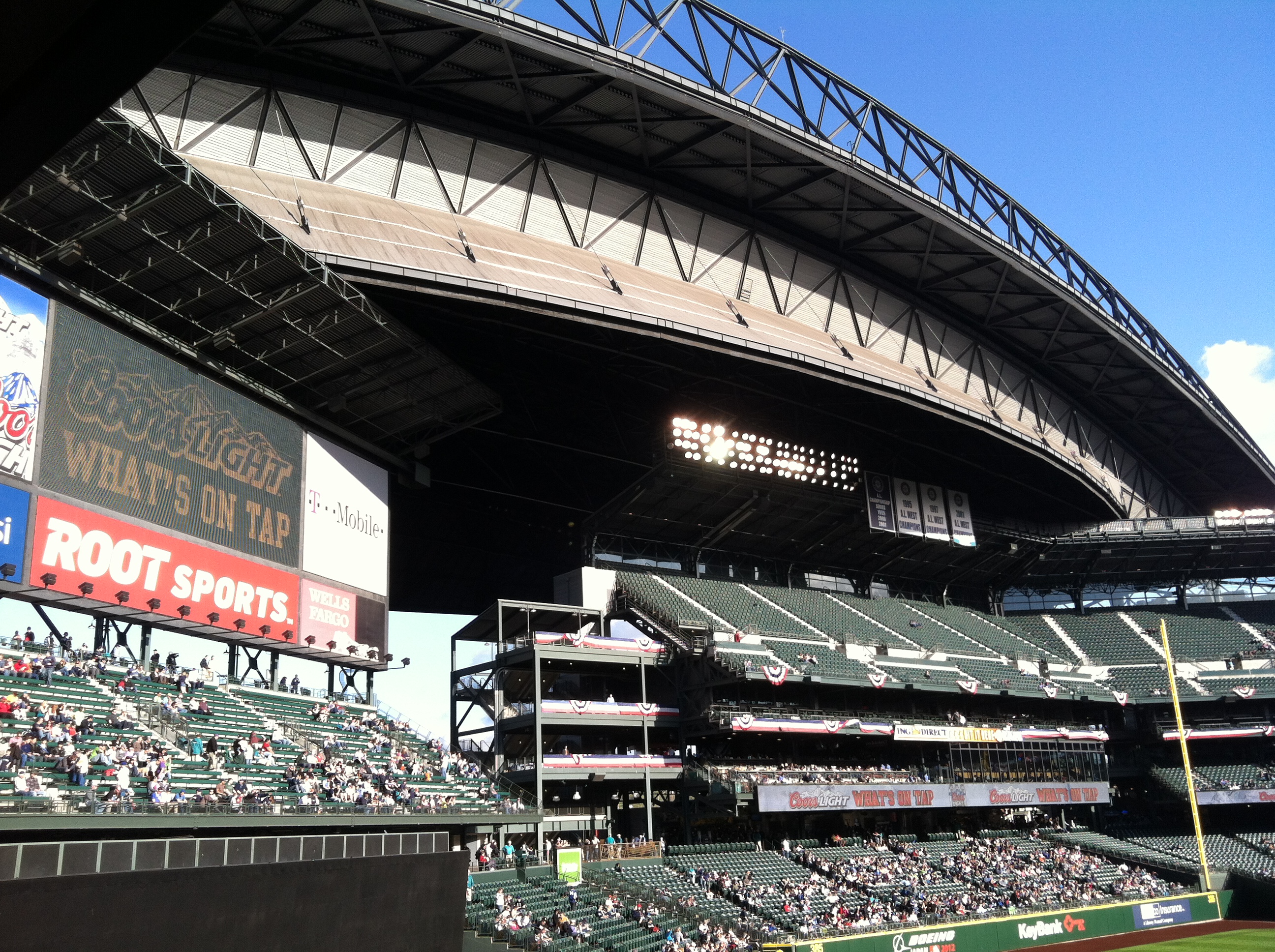
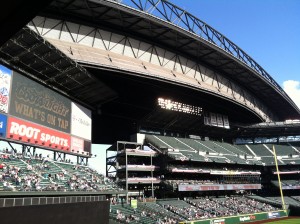 It's big, it's green ... it's Safeco Field. My first stop was Seattle and Safeco Field, with tickets kindly obtained by my old friends Allan and Eleanor. Safeco is green and big — it feels much bigger than it actually is, perhaps because the retractable roof looms over the place. It’s got some nice touches. In The Pen, an area beyond the outfield full of beer stands and food, you’re right on top of the home and visiting bullpens, though people behave better here than in, say, Philadelphia. (Granted, that statement applies to most every place on Earth where people in groups watch an event.) There’s a statue of Dave Niehaus, the ushers are helpful and low-key, and trains chug by outside the ballpark, which is kind of cool.
For all that, though, Safeco is frankly a bit generic. It’s a nice park, but nothing really stands out about it, and some things are inexplicable. For instance, the Pen is an ideal spot to hang out, eat and drink beer (or fancy-schmancy cocktails), but instead of the game you hear loud club music, so you have no idea what’s going on until you go back to your seat. It’s baffling — why did the Mariners reserve the most interesting, attractive part of their stadium for people who aren’t interested in the game? It doesn’t work for baseball fans and presumably doesn’t work for people who’d rather be somewhere else, either — that’s a hell of a cover charge.
As for the game, Hector Noesi pitched well enough that I picked him up for my fantasy team, thus ensuring that he will be terrible. Jesus Montero hit his first M’s home run since being emancipated from the Yankees and their turgid villainy, a laser-beam line drive over the center-field fence. (His at-bat music, by the way: “Jesus Walks” by Kanye West. Nice touch.) I got to see Ichiro Suzuki play. The M’s beat the A’s, 4-0. A worrisome sign, by the way: It was Seattle’s second home game of the year, and there were acres of empty seats.
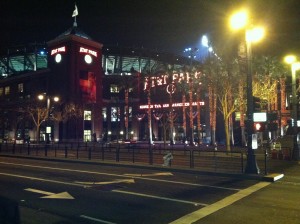 Best park I've ever seen. My next stop was AT&T Park and a date long deferred: I’ve had tickets and/or plans to go see the Giants play in Candlestick’s replacement several times, but it’s never worked out. This time, my friend Pete set me up and I could finally check out what’s often called baseball’s best park.
So is it? I haven’t seen PNC, which also sometimes wins that title, so I can’t give AT&T the crown. (Here’s Greg on the Pirates’ home.) But I will say that it’s the best park I’ve ever seen, and by a wide margin. It’s not just the great facility or the superb setting — it’s a customer-first attitude based around the idea that some little things matter and should be attended to, while other little things don’t matter and shouldn’t be worried about. The Giants understand which parts of a ballpark experience are which; seeing AT&T Park in action, I realized to my disappointment that the Mets fundamentally don’t. (More on this in a post soon.)
The setting, obviously, is great — on one side you have a lively strip of San Francisco restaurants and bars, while on the other you have San Francisco Bay. The place is dripping with Giants history — statues of greats such as Mays, Marichal, McCovey and Cepeda; plaques honoring lesser greats not much remarked by baseball fans in general but beloved by Giants faithful; markers recounting park milestones; baseball quotes and old uniforms and other things dressing up blank walls; a cable car (why the heck not?); the famous outfield glove and Coke bottle; the spot where you can watch a bit of the game through the outfield fence even without a ticket; and more, more, more. When I wrote that I wanted Citi Field to be a scavenger hunt of Mets stuff, I didn’t know I was describing AT&T Park. (Here’s Greg’s take, from when it was Pac Bell.)
Here’s a small example: Beyond the left field fence there’s a bunch of eateries, and one of them is Crazy Crab’z — described winkingly as “back from the sea and fresh as ever.” Crazy Crab was a brief-lived mascot that Giants fans were encouraged to hate, a mission they took up with frightening vigor. Citi Field opened with barely a nod to the Mets’ own history (though much has been done since then to right this wrong); AT&T Park celebrates even ignoble bits of Giants history.
The food is good — I had garlic fries and a Cha Cha Bowl — but then I knew the food was good. I had no idea about the music, though — and it’s jaw-droppingly awesome. The Giants fired up that night’s crowd with the Karen O/Trent Reznor version of “Immigrant Song,” spotlighted “The Magnificent Seven” by the Clash, and broke out Green Day’s “Know Your Enemy” for the top of the ninth, to name just three moments in which I shook my head in admiring disbelief. I wouldn’t be surprised if Citi Field’s ballpark music was selected by polling frazzled moms who drive pre-teens around in minivans and are stuck hearing a ton of Radio Disney. (The Giants, by the way, beat the Phillies — Pat Burrell threw out the first pitch, drawing cheers from both fans’ teams. I booed him savagely, causing a good chunk of our section to stare at me in puzzlement.)
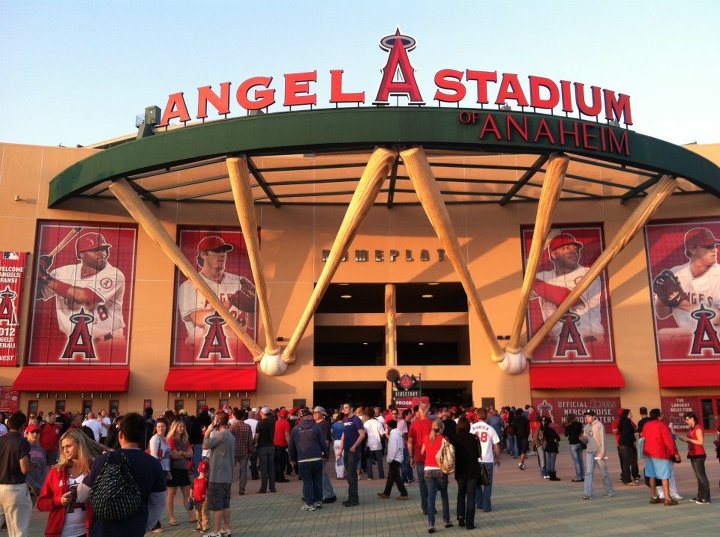
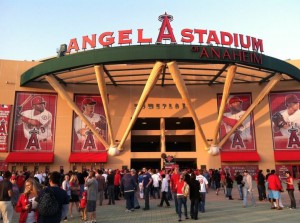 Big, red, and weirdly named. I almost scrapped the third and final new park of the tour — Angel Stadium of Anaheim, which proves the Angels are just as confused about how to name a park as they are about how to name a franchise. My chance to go to Angel Stadium came on my first night in San Diego, after I’d had only a couple of hours’ sleep, which made driving a rental car 90-odd minutes to Anaheim for a game and then driving it back late at night seem not just crazy but borderline dangerous. But when would I get another chance?
I decided to make things safer by doing the unthinkable: I’d leave in the fifth inning. (What the heck, it was Angels-Orioles.) Five innings was long enough to get a sense of Angel Stadium, and to see the Angels wallop the Orioles rather cruelly. By the way, it’s fun finding a white rental sedan you haven’t really looked at in a huge, full, dark parking lot with very few signs.
Angel Stadium is … interesting. It’s been around since 1966, was expanded dramatically and rather poorly in the late 1970s to also house the Rams, and was renovated in 1997 to feel like one of the new HOK-style parks. You can see the old, rather generic bones in places, but the renovation’s pretty successful overall — and whatever flaws it has are made up for with lots of enthusiasm.
Lots and lots of enthusiasm.
There’s the exterior, with baseballs as bollards; a frieze of bats and balls that’s equal parts grand and goofy; giant Angels hats; a brick baseball diamond complete with a little mound; and more. Inside, the most notable feature is the weird rockpile in the outfield, but at least that turns out to hide a pretty nice picnic area. The food isn’t great (I had a singularly forgettable BBQ sandwich) but the ushers are super-nice. And the nicest thing of all? The place is saturated with Angels stuff. It makes AT&T Park look subtle. There’s a huge, luxuriantly happy display dedicated to the 2002 World Champs — why doesn’t Citi Field have two of these? There are big, splashy infographics about significant Angels seasons. There are giant posters of current Angels as Little Leaguers. Even the columns in the corridors are wrapped in pictures of Angels important and not so important. (Greg’s take is here.)
It’s gaudy and splashy overkill — but isn’t gaudy and splashy overkill exactly what one wants in one’s favorite team’s home park?
Descending the back steps at Citi Field, I’m always annoyed that they’re featureless gray. Why? Why don’t they feature murals of Todd Pratt and Felix Millan and Ron Hunt and Paul Lo Duca? Why aren’t they at least orange and blue? In Angel Stadium you never have a moment’s doubt which team you’re there to cheer on.
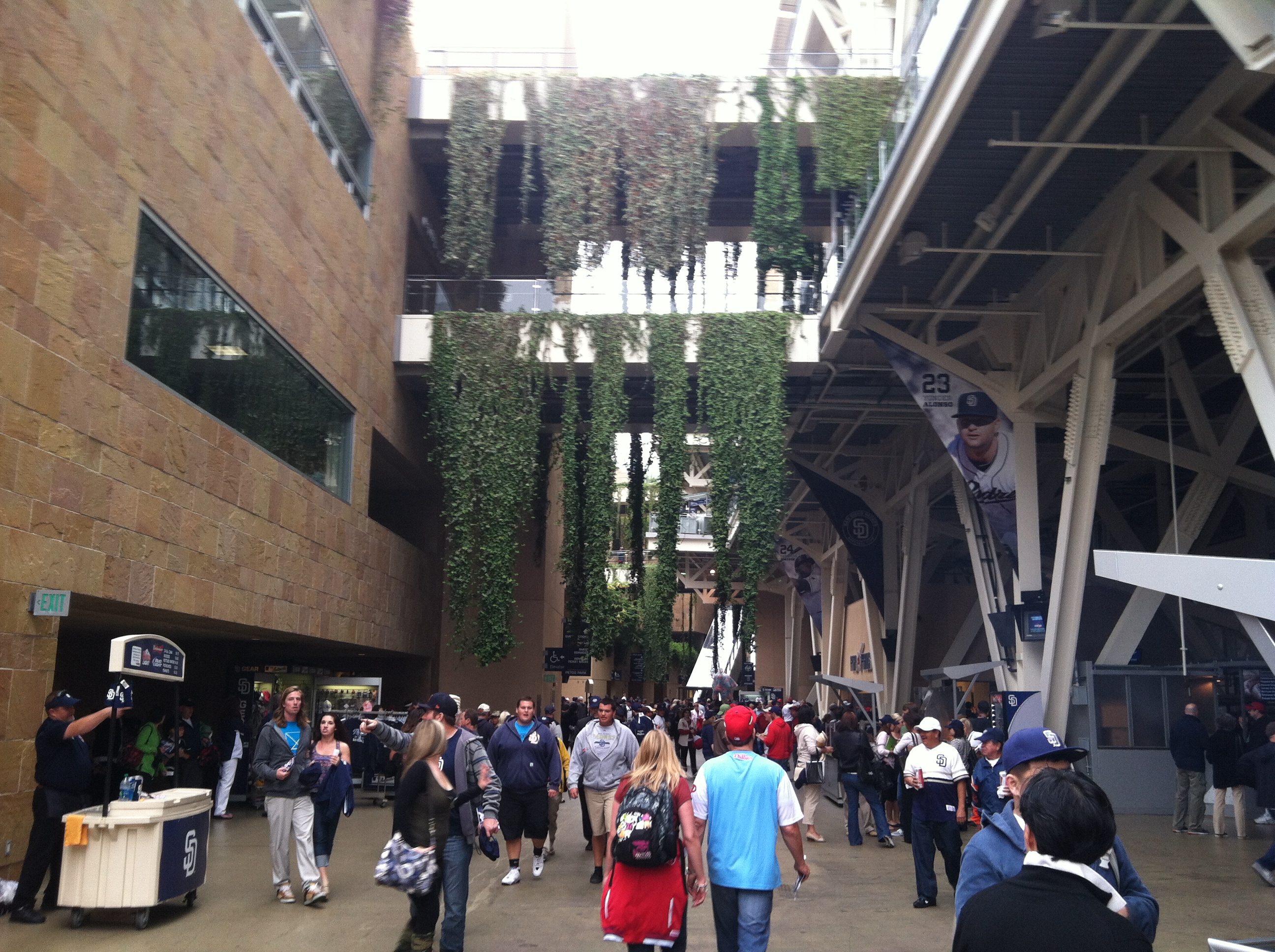
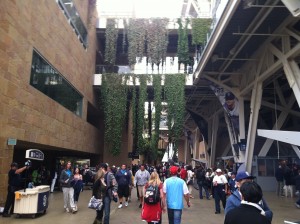 UN-DER-RAT-ED! (clap clap, clap clap clap) On my last night in San Diego, after all this, I went back to Petco Park. I’d seen it before, but by then my life had settled into a rhythm of bookstore events by day and ballparks by night, so why not? The Phillies were in town, and Petco was about 70% Phils fans — I’d listened to the game the night before on the drive back from L.A. and thought it was in Philly. (Happily, the Phils lost — home teams were 4-0 with me in attendance.) My thoughts on Petco are here, from a couple of years ago, but the park’s grown on me. It doesn’t get a lot of attention or praise, but I think it’s underrated: I like its white-and-buff color scheme, its vaguely Aztec hanging gardens, and quirks like the park beyond center field (with Tony Gwynn statue), the warehouse in left field and the weird pulpit in right field.
Anyway, it was nice to see Petco again — that last night was an appropriate coda to a symphony of baseball. Now how do I get to Oakland Coliseum?
by Greg Prince on 22 April 2012 7:36 pm You didn’t need to stare out the window this morning to know this was the kind of day to make like Zooey Deschanel and ask your iPhone to conjure you some tomato soup (although maybe you could do it less preciously than Zooey Deschanel). All you had to do was tap the weather app on your device of choice and observe nothing but “100%” chances of precipitation for ZIP Code 11368 forecast across the Flushing afternoon. Then you could look out the window. Then, if you were the New York Mets, you could put one and one together and come up with the decision to tell your customers well in advance of their leaving their homes, “Stay in today, have whatever kind of soup you like.”
It was a day meant for bisque, not bobbleheads. But the bobbleheads were on the schedule — the Tom Seaver bobbleheads, for Gil’s sake — and the tickets were sold, so…
Better get going, lest the Mets give away all 25,000 of what you’d purchased a ticket to secure one of months earlier. Better go against your soundest judgment and bundle up because even though the Nationals called their game way early in Washington and the appropriately named Thunder called their game way early in Trenton, the Mets of New York pretended blue skies were shining on them long enough to lure you onto the 10:56 to Woodside.
You disembarked by 11:26, you swiped your Metrocard through the turnstiles to the 7, you waited for the local and, after 11:30 AM — or almost 90 minutes to scheduled first pitch — you were informed via Twitter that the game was finally called.
So, you asked yourself, what am I doing up here waiting for the train to Shea/Citi Field? Why did I pay $2.25 plus the $7.00 in prorated 10-trip LIRR fare to get here, plus the $7.00 in prorated LIRR fare to now get home? Buyer beware, “ticketholder assumes all risks” and you love the game of baseball let alone Tom Seaver so much that we want to believe the clouds will part in deference to the conferring of his Terrificness’s porcelain likeness, but WTF, y’know?
No kid and few adults want to give up on a Sunday afternoon game. We’re all Charlie Brown at heart. We’re all willing to convince ourselves “it’s going to clear up.” But what separates us from our cartoon selves is we have weather apps and we have the sense of sight if we’re lucky and the sense of touch probably. We can tell it’s raining and that it’s not going to stop raining. And the only thing that can get us into that rain when we have no other reason to be soaking in it is because the Mets won’t immediately advise us to remain indoors where we belong and assure us our bobbleheads will be waiting for us on another date to be announced shortly.
Because they sold us the tickets. And they really wanted to scan them and have us inside their building for a while and sell us some more stuff while they waited for the weather window that was never, ever going to come. I can’t imagine that wasn’t the plan. Surely it wasn’t because rescheduling both the Mets-Giants game and the bobblehead promotion wasn’t easily solved. It was very easily solved. The Giants were sticking around through Monday anyway. Voila, doubleheader. The bobbleheads were moved to the next available weekend date that didn’t have a promotion, Saturday, May 5.
All that would have been lost in announcing those solutions early enough to keep people from schlepping in their cars and on trains and paying whatever their unnecessary trip cost them was Sunday’s gate…which was lost anyway and was going to be lost no matter how much magical/financial thinking the Mets applied to the gray skies grimacing on us.
Nobody likes to leave the gate closed. But sometimes courtesy and convenience is the better part of valor where the surprisingly predictable nature of nature is concerned.
Happy remainder of Earth Day. This part of the planet needed a little rain anyway.
|
|