The blog for Mets fans
who like to read
ABOUT US

Faith and Fear in Flushing made its debut on Feb. 16, 2005, the brainchild of two longtime friends and lifelong Met fans.
Greg Prince discovered the Mets when he was 6, during the magical summer of 1969. He is a Long Island-based writer, editor and communications consultant. Contact him here.
Jason Fry is a Brooklyn writer whose first memories include his mom leaping up and down cheering for Rusty Staub. Check out his other writing here.
Got something to say? Leave a comment, or email us at faithandfear@gmail.com. (Sorry, but we have no interest in ads, sponsored content or guest posts.)
Need our RSS feed? It's here.
Visit our Facebook page, or drop by the personal pages for Greg and Jason.
Or follow us on Twitter: Here's Greg, and here's Jason.
|
by Greg Prince on 22 April 2012 2:30 am The Mets all but screwed up a game started by Mike Pelfrey and it had absolutely nothing to do with Mike Pelfrey.
Now that’s what I call progress.
Other events covering the bottom of the eighth through the bottom of the ninth inning Saturday afternoon…now that’s what I’d call retrogression.
It was going to be such a simple and beautiful win. Big Pelf was at his beguiling 2008/2010 best. I didn’t know if it was indicative of long-term problem-solving, some strange Saberhagian alternating-year tendency or the Giants’ confusion at being greeted as one of two home teams all weekend, but it was lovely. Pelf was pitching as well as you could imagine any No. 1 pick the Mets made of a righthanded starter out of college between 2004 and 2005 pitching on Saturday. The top of the eighth was the loveliest half-inning of them all. Pelf throws six pitches, records three outs, barely cracks 100 pitches overall and is perfectly poised — even if “perfect” was on the verge of becoming a loaded word to toss around where former No. 1 Mets picks from between 2004 and 2005 who were collegiate righthanded starters are concerned — to go seal a Mets win with a complete game effort.
Even in this bullpen-crazy era (with nobody more crazed from bullpen management than Bruce Bochy), it didn’t seem too much to ask Pelfrey to attempt to finish what he started. Terry Collins used Ramon Ramirez, Jon Rauch, Tim Byrdak and Frank Francisco for an inning apiece the night before. According to my newly obtained 2012 pocket schedule, the Mets don’t have an off day until May 3. Pelf was going to have four days’ rest regardless. Everybody else in Terry’s late-inning relief corps could figure to use one extra day.
And Pelfrey was winning, 3-1, as he left the mound after his six-pitch eighth. The lead increased to 4-1 on some scratching and clawing among Daniel Murphy, David Wright and Ike Davis in the bottom of the eighth. Could have been more, but Davis got picked off first and Wright got thrown out at third immediately thereafter. When those two utterly unnecessary baserunning miscues went down (Ike Davis picked off?) it seemed unfortunate and a little foreboding, but c’mon, what was I worried about? We’d be taking a three-run lead to the ninth and putting in the hands of our horse of a starter who was toying with the opposition, giving us the best start any Met had produced yet this year.
What’s that? We wouldn’t be doing that? Terry was pulling Pelfrey? Because why? Because, per Gary Cohen, Collins very much wants to build an “aura of success” around Pelfrey, and those eight solid innings should serve as a requisite boost to the big fella’s confidence not merely a prelude to a successful ninth? And pitching genius Ron Darling agreed with that?
The first time I can remember a manager managing to a pitcher’s mental state was Davey Johnson 28 years ago when he didn’t push rookies Darling and Dwight Gooden to go nine because he wanted to establish them as big leaguers, get them a good taste from each start and nudge them in a positive overall direction for their next turns through the rotation. Like everything else about Davey and 1984, it seemed brilliant. Gooden’s and Darling’s growth, as part and parcel of nurturing a team in bloom, spoke for itself.
Mike Pelfrey isn’t a rookie. Mike Pelfrey is in his seventh major league season, his fifth full major league season. No one’s gonna argue he couldn’t use all the TLC he can get, but our resident TLC — Terry Lee Collins — can tend to his psyche by showing professional confidence in Pelf’s abilities to find three more outs without giving up three additional runs on a day when he’s his own grounds crew and truly mowin’ ’em down.
That’s how you build an aura of success, according to my amateur assessment.
Sometimes you may be better off being a blank slate about your team, the way (to borrow a phrase from one of our Saturday commenters) some hipster chick in a panda hat probably approaches her Giants. But no Mets fan is a blank slate. We all carry around a 50-year syllabus in our mental backpacks. Mine is heavier than most. Thus, as I filtered the “aura of success” Collins endeavored to fashion around Pelfrey, I instantly recalled another of Mike’s starts, from four years ago. It was, to that point, the best start of Mike Pelfrey’s career. He stifled the Diamondbacks for eight innings and was allowed by Willie Randolph to protect his own 3-0 lead in the ninth after having thrown 112 pitches. “Pitch count, shmitch count!” Howie Rose exclaimed in approval.
On June 11, 2008, I knew it was the right call. But I also had a feeling of dread wash over me that it didn’t matter, that something was going to go terribly wrong in the ninth. If Randolph stuck with Pelfrey, Pelfrey’s aura was going to take a hit…though I desperately wanted him to stick with Pelfrey. If Randolph gave up on Pelfrey, the game was going to be in peril…and I wasn’t particularly anxious to find out if Billy Wagner was going to prove me prophetic or paranoid.
Everything that could go wrong did go wrong in that ninth. Pelfrey allowed a leadoff single to Stephen Drew. Randolph allowed him to go no further. Wagner allowed a double to Conor Jackson and, eventually, a tying home run to Mark Reynolds.
Worst. Aura. Ever.
So that incident raced from deep within my mental backpack straight to the front of my mind when Frank Francisco replaced Mike Pelfrey. Something didn’t have to go wrong, I attempted to reason. I’m trying real hard to convince myself that the Mets are in the slow but sure process of turning a corner, that even if they never catch Davey Johnson’s first-place Nationals (or whoever succeeds them at the top of the East) this year, we’re inching into a new and better era for Mets baseball. Or at least we might be living in the year on which we look back and explain to those who don’t remember it, “Their record may not look that great, but they were really coming together for what followed.” To use the lingo of Saturday, I really want to believe the aura and era of Met success is in its larval stages.
Neither is close to fully formed, however. Frank Francisco did not put his lousy Friday or Wednesday, for that matter, behind him. Rather, he extended his sudden stretch of miseries with the kind of performance that gives richly compensated, highly accomplished closers a bad name (a name like “Wagner,” for example). As on Friday night, Frank generated a leadoff baserunner and the elements of disaster commenced to come into view. After four Giant hitters, there was one Giant out, one Giant run and two Giant baserunners.
Frank Francisco had become a giant pain.
In came Tim Byrdak, who struck out pinch-hitter Hector Sanchez — the Giant pain from Friday — to move us within one batter of escape. Of course I was rooting for Byrdak to end another game with a K, but matchups being what they are, Tim was removed for Jon Rauch. Brandon Belt landed at the plate as Bochy continued to juggle his personnel. (I can’t tell if Terry and Bruce are managing these affairs like they’re the seventh game of the World Series or the seventh game of Spring Training.)
Rauch, as he has tended to do all month, did his job, coaxing a seemingly harmless mid-level pop fly to short left-center. It flew a little more than it popped, however, and its whereabouts in the traditionally breezy sky San Fran brings with it appeared uncertain. Into the mental backpack I involuntarily dove, summoning two images, one vague, one alarmingly specific.
Vaguely, as Daniel Murphy jogged out from second, Ruben Tejada pedaled back from short and Kirk Nieuwenhuis rushed in from deep center, I recalled the kinds of trouble that used to occur amid Flushing’s original Iron Triangle of Dave Magadan at first, Tim Teufel at second and Darryl Strawberry in right. Balls fell in regularly between Teuf and Straw, and though those were hit to different sections of a different nearby outfield, this play was clearly developing into something Strawfeul. (And what kind of fate are we tempting by allowing Timmy to coach third in Darryl’s 18?)
Specifically, Castillo — obviously. We’re not nearly far enough removed from “Castillo” to require further delineation.
Well, Murph was out of the picture by the time Tejada realized he had no angle on the damn thing and Kirk, who had lunged and tumbled so spectacularly in the other direction Friday night, was rumbling from too far away to do anything admirable with Belt’s bloop. The best way to describe what happened is if Kirk was trying to not catch it, he made a helluva play.
Two Giants scampered home as the ball eluded everybody. The aura of success had crumbled.
Strangely, the remnants of the bad baserunning from the bottom of the eighth, the idiotic decision to remove Pelfrey between innings, Francisco’s continued implosion at the outset of the ninth and, at last, the two-man Castillo didn’t kill the Mets, though I’ll withhold judgment for a while on whether it made them stronger. Sometimes stuff like that is overcomeable in the short-term. That Pelfrey/Wagner debacle from 2008? The Mets won it in thirteen on a Carlos Beltran home run. It wasn’t at all satisfying — they blew another ninth-inning lead the next afternoon and hot-seated Randolph was fired within the week — but it was a win. Without shaking off that horrible ninth almost four years ago, the Mets wouldn’t have been in a position to blow a playoff spot on Shea Stadium’s final day.
One more image from the backpack hit me in the bottom of the inning as my team strove to extricate itself from its Met-made mess. Gary and Ron were making much of Aubrey Huff playing second base for the first time ever. When I heard that, I thought of the legend of the 23-inning game in 1964, which also featured the Mets and the Giants. Of the many things that made that twinbill nightcap noteworthy, it marked the only appearance of one Willie Mays at shortstop. Like Bruce Bochy, Alvin Dark found himself shy of players. Unlike Alvin Dark, Bruce Bochy would pay for playing somebody incredibly out of position.
Aubrey Huff is no Willie Mays, in case you were wondering. As the Mets mounted a rally, Huff didn’t get in their way by knowing where second was on a potential double play ball, certainly a sure fielder’s choice on Justin Turner’s grounder. We’re always happy to watch somebody else implode. Then we’re requisitely ecstatic when Scott Hairston, pinch-running from third, jars just enough of Buster Posey on a slide into home so that Posey can’t make a clean throw to first on what is otherwise going to be a 3-2-4 (Huff covering first) DP that seems certain to send this stupid game into the tenth and onto the thirteenth or twenty-third. As Posey’s fling made like Dennis DeYoung and sailed away, Tejada steamed in from second with the, if you’ll excuse the improbable expression, winning run.
The Mets deserved to win for the better part of eight innings. They deserved to lose for a wretched top of the ninth. But they were crafty enough to let the Giants redefine torture into something self-inflicted.
It was about as dumbass a win as the Mets could have cobbled together. Yet it beats a brilliant loss every time.
by Greg Prince on 21 April 2012 2:53 am Nothing makes you dislike a team you normally barely notice than being surrounded by a surfeit of its followers. Who knew the San Francisco Giants had enough followers in New York to constitute a dislikable surfeit?
It must be because every 23-year-old from the San Francisco Bay Area packed his or her belongings and moved to New York in the weeks following the Giants’ victory in the 2010 World Series. Now 24 or 25, each of these Northern California expats bides his or her time for 361 or 362 days a year until the Giants arrive at Citi Field. Then every goddamn one of them crowds into our ballpark and annoys the hell out of me.
That has to explain why there are approximately a jillion times more Giants fans — young Giants fans with (I would guess) little or no working knowledge regarding Willie Mays or Will Clark or William VanLandingham, even — at Mets games these last two seasons than there ever were before the San Francisco club won a world championship. It’s either that or the most massive case of front-running since the Kenyan contingent lined up to start the Boston Marathon.
Except for an extra layer of smugness, nothing glaring differentiates these twentysomething Giants fans from the flocks of Cardinal fans or sloths of Cubs fans or herds of Brewers fans who have invaded our ballpark(s) en masse in recent decades. While none of them is as bad as the murder of Phillies fans or yoke of Yankees fans — you can check the collective nouns here — the ostentation of Giants fans has the capacity to nibble on your nerves because they’re not supposed to be among us New Yorkers in such great numbers.
Not anymore they’re not.
The New York Giants were born in 1883 and lived to play 75 seasons in the National League. I’m fond enough of their legacy to attend regular meetings of the New York Baseball Giants Nostalgia Society at a church in the Bronx (of all places), most recently Thursday night. I make these sojourns because for two hours three times a year, I’m in a room with guys wearing New York Giants caps like they did as kids going to the Polo Grounds, as if the New York Giants didn’t quit the neighborhood in 1957. The New York Giants live a 76th, 77th and so on season in that room when those caps adorn those heads in full force.
The New York Giants would be in their 130th season if they hadn’t been lured to another coast. They’d laugh at any other New York team claiming to be the avatar of tradition. They’d see a hundredth-anniversary commemoration at Fenway Park and wonder what the big deal was. If New York Giants fans congregated at the Church of the Mediator in Kingsbridge on a Thursday night, it would be to ask a Higher Power to imbue our boys with good fortune in their weekend series against the Brooklyn Dodgers.
Yes, our boys. As mentioned now and then in this space, I consider myself a Mets fan at heart yet a Giants fan in my soul — a New York Giants fan, that is. It’s a whole thing with me. But because there was nothing after the 75th season, there was no reason for me to do more than barely notice the San Francisco Giants when I was a kid. I had the Mets. I have the Mets. That’s what makes it a little uncomfortable in that church meeting room when the nostalgists on hand reveal themselves as very much San Francisco Giants fans in the present day, leaving me to realize I joined a group essentially to be its nominal outcast.
The group’s ethos is really extraordinarily inclusive, except when the big Giants-Mets/Mets-Giants series approaches and we’re all going the next night on our annual group outing to root for…
Well, they root for the Giants, just like they did before Horace Stoneham ignored their anguished cries of “STAY TEAM STAY.” I root for the Mets, the team born to right the 1957 historical wrongs of Stoneham and Walter O’Malley. Say what you will about various Mets ownership groups since 1962, the one thing you can’t carp about is municipal delineation. They’re the New York Mets all the way. Nobody here needs to stay up late to watch the first inning of their home games. Nobody here has to seek refuge capwise in a house of worship.
My Giants compatriots don’t seem to mind the odd hours or their odd status in a city with two extant major league franchises, or at least they’ve grown used to it across more than a half-century of bicoastal insomnia, what with their baseball awake when they themselves should be asleep. Since their team won the World Series less than two years ago, they’re feeling pretty good about themselves, actually. Maybe even the slightest dollop of smugness has slipped into their fandom, too, but unlike the 24-year-old San Franciscans that were everywhere at Citi Field Friday night, I can’t begrudge my Nostalgia Society brethren. Their team was pried from their warm, live hands 55 years ago. They should enjoy everything about the technology that brings them their team live and in living color late at night and relish their opportunities to see it play in their midst a precious few times a year.
Doesn’t mean I have to like that they received what they consider a likable ten-inning result against the Mets. Doesn’t mean I like seeing people of any vintage in San Francisco Giants caps celebrating in a ballpark I finally consider home now that it contains a human-sized blue left field wall amenable to long fly balls jumping off of bats that belong to lefthanded home hitters wearing blue caps. Kirk Nieuwenhuis became the first Met to fit that description Friday when he homered to the opposite field. It hadn’t occurred to me it had never happened before, but it hadn’t. When Kirk hit one out to left, it not only served to tighten the score, but it helped hush the buzz of the visiting fans for a spell.
There isn’t supposed to be enough noise from the visiting fans to require hushing, but the San Francisco buzz was unmistakable as it was unmistakably annoying. Kind of like the way the game didn’t end in the bottom of the ninth and went to blazes in both halves of the tenth.
That part, sadly, was impossible to not notice.
by Greg Prince on 19 April 2012 1:58 pm You’re a Mets fan who likes to read. Chances are you’re a Mets fan who likes to think, to talk, to listen. Chances are you like doing those things about the Mets and with other Mets fans.
Boy, do I have an event for you.
One week from today, Hofstra University’s Cultural Center presents the 50th Anniversary of the New York Mets conference. It will delve into and dissect myriad aspects of the New York Mets experience at this milestone moment in our team’s history. Many of those doing the delving and dissecting have a vested interest in the Mets.
Because they’re Mets fans.
There are former Mets players, veteran Mets media members, academicians with a Mets bent, those who have studied and written about the Mets all contributing…but what makes this the event you’re definitely going to want to attend part or all of is the Mets fan influence. Because of us, this conference will be, in large part, the Mets as understood by people like you; the Mets as they matter most.
Our Mets.
So please come out. I’ve been talking this thing up since last fall, since I was asked to step in and play a small role in planning and organizing the conference’s content following the death of Dana Brand, the Hofstra professor, Mets blogger and Mets fan who saw our team and envisioned it as worthy of a serious and loving in-depth treatment. That’s what we’re going to give the Mets next Thursday, Friday and Saturday, April 26 to 28 in Hempstead.
You gotta join us — if not for all three days, then for at least one. At least a morning or an afternoon or an evening.
I’ll be there. Jason’ll be there. You know we’re Mets fans. Mets fans from Mets By The Numbers, Amazin’ Avenue, Eddie Kranepool Society, Gal For All Seasons, MetSilverman, Mets Police, Metstradamus, Optimistic Mets Fan, On The Black, Metphistopheles, Ron Kaplan’s Baseball Bookshelf, Mets Poet, LoHud Mets Blog and ESPN New York will be there, too.
And that’s just the bloggers. There will be Mets fans who collect stuff and Mets fans who notice stuff and Mets fans who don’t normally publicly express themselves yet have a lot to say. This is a forum for Mets fans like that. Like you. C’mon and listen. C’mon and exchange ideas. C’mon and celebrate our Mets in a place where for three days, nothing will be more important than the Mets.
Find out more here and register here. I look forward to seeing you there.
by Greg Prince on 18 April 2012 11:26 pm David Wright has 733 career RBIs, a .500 batting average and, I vaguely recall, a fractured pinky. Ike Davis has three home runs in four days despite playing no games for four-and-half months last season and contracting valley fever this spring. Kirk Nieuwenhuis has been leading off games in the major leagues for one day and he shows signs of being as skilled at it as Rickey Henderson. Mike Baxter is all of a sudden a pinch-hitting machine.
So many good things to cherry-pick that it’s hard to believe all of the above is true and came to be in a game the Mets lost by eight runs.
We’re still over .500, we’re still in second place (albeit tied with Atlanta) and we’re still in the portion of the season where baseball for baseball’s sake retains a few morsels of novelty. Twelve games down, 150 to go. R.A. Dickey will have better days — drier days, to be sure. Tim Teufel will make better decisions as third base coach and not have two runners thrown out at home on his watch. Andres Torres will heal…which of course we hope for…really we do. But in the meantime (and maybe more), there should be no rush to reacquaint Nieuwenhuis with the charms of Buffalo, considerable though they may be.
This Mets fan’s patience is by no means wearing thin despite our pitchers — led by top two starters — having surrendered 23 runs in less than 21 hours. The 7-3 record from Monday is now 7-5, but it beats the hell out of the 4-8 the first dozen games from the past pair of seasons gave us.
Things just feel better than I’m used to. Instead of being convinced there’s worse hiding behind every Met rock, I kind of assume things will be relatively OK. Check back with me if 7-5 becomes 9-15 and I’m on pins and needles (or needles and pins), but I’m rather Zen about the whole thing at the moment. I had no expectations last year but wasn’t easily assuaged when proven correct in lacking them because the state of no expectations was a defeat unto itself. This year’s lack of expectations feels connected to what’s possibly being built for another year somewhere down the road.
I’ll repeat an observation I made on the eve of the season opener: Murphy, Niese, Parnell, Thole, Tejada, Davis, Duda, Gee. Eight homegrown players between ages 22 and 27, brought up for their first tastes of the bigs between four and two years ago now maturing as a unit. Add Nieuwenhuis if you like. An investment’s been made in Niese, so we have to consider him a de facto staple for years to come. Everybody else is getting the chance to earn a similar status. None of them is the least bit expensive yet. If we can’t count on all of them breaking through, a few will do.
It’s a step in the right direction. Plus the step in the Wright direction has been pretty sweet to watch. When this young season has been good, it’s been a joy. When it’s been bad, it hasn’t been a chore. There may be an expiration date for this filter through which I’m accepting consecutive blowout losses, but wouldn’t it be wonderful if it didn’t kick in for a few months?
Or if there were very few defeats along the lines of 9-3 and 14-6 en route?
by Greg Prince on 18 April 2012 8:50 am If there’s one thing Johan Santana does not strike me as, it’s insecure. He suffered the worst outing of his career Tuesday night in Atlanta — same place his professional life had to be put on interminable hold in 2010 — yet judging by his calm demeanor and rational responding during a postgame media grilling that wasn’t nearly as scalding as the one the Braves gave him on the field, he knows he’s going to pitch another day and win another day…maybe even in five days.
We all should be as calm and rational as Johan Santana.
The management of the team that has made Johan financially secure is going through one of its rare calm and rational phases, which is as satisfying as it is reassuring. By no more than confirming that they will be doing the right thing twice in the upcoming weeks and months, the Mets have elicited from some quarters an overly touchy reaction born of what feels like innate and inappropriate insecurity.
They don’t deserve it. The Mets are being classy. It’s a pleasure to see.
Working back to front, the Mets have said, sure, we’ll acknowledge Chipper Jones when he swings by for the final time in September. Heavens to Betsy! cries a segment of the fan base as if on cue, I do believe I have come down with the vapors! Larry Jones is an opponent, and as an opponent, he has meant to do harm to our honorable cause! Plus he’s Larry Jones, oh my!
Exactly because he is Larry “Chipper” Jones — or Chipper “Larry” Jones — is why a moment of Citi Field acknowledgement as this surefire Hall of Famer makes his way out the National League door is so appropriate. Who else among our modern-day rivals has embraced the role of Opponent as Jones has? What other “villain” has shown the self-awareness Jones has in publicly understanding that he is viewed as a Met Opponent and accepts the infamy that accompanies that identity? Who has grown from the sneering, snotty kid who uttered that infamous putdown regarding choice of local licensed merchandise more than a dozen autumns ago into an elder statesman who has said in every way possible (except by failing at the plate, which is the way we’d prefer), “Sorry about that, y’all are OK”?
Plus the naming of his kid. For god’s sake, there’s a Shea Jones somewhere in Georgia. You don’t name your son after a ballpark where you’ve been Just Visiting merely because you compiled an OPS of .964 in 88 games there.
The Mets-Braves rivalry was a rivalry because we made it so. The Mets made it so by taking aim at them and getting heartbreakingly close to them. The Braves who refused to cede prominence for so long didn’t particularly require a rival and most of them carried on as if they didn’t have one. They were beating everybody in their most halcyon days. It was all business to them.
Chipper was deadly business to Mets pitching and thus deadly business to Mets fans. Yet there was a chemistry between us, informing our unconventional Special Relationship. It went deeper than merely resenting the unyielding success of the likes of Maddux, Gl@v!ne and Smoltz or being contemptuous of a hateful rube like Rocker. Brian Jordan, Rafael Furcal, Ryan Klesko, Javy Lopez, Andruw Jones…who cared? They all grimly did their share of damage and they’re all bad memories, but they were in the background when the Mets and the Braves were the Mets and the Braves. Chipper was always front and center and didn’t mind it. He handled it. He stayed around long enough to see the beauty in it. When he goes, so goes the last strand of the era when the orange boxes denoting a Mets-Braves series throbbed on the pocket schedule (remember pocket schedules?).
That’s worth a sportsmanlike acknowledgement on September 9. That’s worth presenting Chipper with a JONES 10 uniform for his son and telling him Shea can go home and put on his Mets stuff. It would be classy to stand and applaud as he enters his last game in Flushing. And it would be wrong to not work a derisive “LAAAARRRREEEE!!!” into that ovation simultaneously.
That’s the tribute Chipper Jones deserves and will no doubt appreciate.
More imminently, the Mets have told inquiring minds that Jose Reyes’s nine years as a Met star will be the subject of a brief video tribute when he returns as a Miami Marlin this Tuesday. This seems a pretty standard gesture of goodwill by precedent and sentiment, no matter where Jose has landed (on a disliked divisional rival), how Jose landed there (via free choice once the Mets did not or could not retain his services) or how Jose’s final moments in a Met uniform played out (ridiculously clumsily).
Unless Jose holds a press conference between now and Tuesday in which he questions how anybody could stand to ride the 7 train because it’s like Beirut, et al, or says something similarly inflammatory, he’s smiled his $106 million smile and mouthed nothing but the most pleasant platitudes about his feelings toward Mets fans. He may have even meant them. He should. There was a chemistry there, too, something I don’t know I observed otherwise between a heretofore lifetime Met player and a Met crowd.
Plenty of Mets have been beloved from the time they came up to the time they went away. Few totally fired us up as Jose did, though, and fewer seemed to regularly process the affection as a renewable energy source in return. Dykstra for a while. Tug when he had it going on. Other long-term relationships — Seaver, Mookie, Fonzie — felt more warm and respectful. With Jose, it was hot and passionate. Like Darryl, but with a different kind of edge to it. Strawberry sulked more than anybody cares to remember a quarter-century later. We found disappointment when we looked too close at him. Our disappointment in Jose was not that we didn’t think he was giving us his all, it was that he couldn’t give us all when a hammy barked or an oblique strained or a thyroid, of all things, became an issue.
Other than that, it was primarily peaches and cream between us and him until the cream curdled just enough to leave a sour taste on September 28, 2011. Then he takes the money and runs — no need for a pinch-runner in December — to Miami. That, in the most sensitive of scoring decisions, makes him the enemy or a traitor or whatever epithet a Mets fan might spit upon learning Jose will get his two minutes on DiamondVision?
I would have bristled if the Mets had gone in the other direction and pretended some more that their all-time runs, stolen bases and triples leader hadn’t existed as the pulse of their operation for the past nine seasons. I understand there’s an inherent awkwardness in a 50th anniversary season to hailing your best shortstop ever when your best shortstop ever just left (and you didn’t have the resources or perhaps the wherewithal to re-sign him). Their Izvestian revision of recent history — check the commemorative portion of the new yearbook — is unbecoming, though in the greater Metropolitan sky of 2012, it’s no more than a passing puffy, cumulus cloud over what should be a bright and sunny six months of celebration.
Thus, playing a quick clip scored to “Thank You For Being A Friend” (or whatever the hell Vito Vitiello chooses) and giving us the opportunity to say, hey, Jose, it was swell being in this with you for nine years, we sure had our fun together provides us the closure we didn’t quite get in September let alone December. Jose Reyes takes a bow, tips that unfortunate cap, steps into the batter’s box in the heretofore alien top of the first at Citi Field and…
…and then you can treat him like he’s Chipper Jones or something if you must.
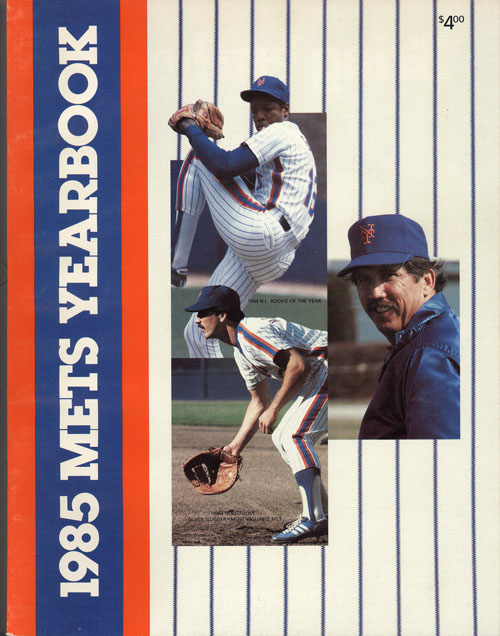
by Greg Prince on 17 April 2012 4:10 pm  Wednesday night at 7:00, SNY airs Mets Yearbook: 1985, the channel’s adaptation of the state-of-the-art ’85 highlight film No Surrender. I hope it’s nearly as spine-tingling in edited form as it was when it filled SportsChannel’s rain delays in 1986, particularly given that the original, from the heart of the MTV era, contained magnificent music video montages, and SNY has consistently avoided using any recognizable songs in recasting these productions (licensing fees cost money). Will Keith Hernandez still be “The Warrior” at first base? Will National League opponents still be warned that when they’re messing with Gary Carter, they’re “Messin’ With The Kid“? Might Buffalo Springfield still be on hand to let us know that “For What It’s Worth” nobody’s worth more than 20-year-old Doctor K? Wednesday night at 7:00, SNY airs Mets Yearbook: 1985, the channel’s adaptation of the state-of-the-art ’85 highlight film No Surrender. I hope it’s nearly as spine-tingling in edited form as it was when it filled SportsChannel’s rain delays in 1986, particularly given that the original, from the heart of the MTV era, contained magnificent music video montages, and SNY has consistently avoided using any recognizable songs in recasting these productions (licensing fees cost money). Will Keith Hernandez still be “The Warrior” at first base? Will National League opponents still be warned that when they’re messing with Gary Carter, they’re “Messin’ With The Kid“? Might Buffalo Springfield still be on hand to let us know that “For What It’s Worth” nobody’s worth more than 20-year-old Doctor K?
Either way, Tim McCarver still narrates and the Mets still don’t surrender. Cue the goose bumps.
And right now you can watch the new On The Sportslines, featuring a ten-minute interview with yours truly at the 13:00 mark. Check it out here.
Image courtesy of “Mario Mendoza…HOF lock” at Baseball-Fever.
by Greg Prince on 17 April 2012 3:56 am It’s not as rare as Jason Bay homering in a Mets uniform, but we saw something else we don’t see very often as the Mets beat the Braves in Atlanta Monday night. And we saw it at the exact moment the Mets beat the Braves.
With two away in the bottom of the ninth, Tim Byrdak struck out Eric Hinske. Game over, Mets win, 6-1. Just bookkeeping, right? The game wasn’t in doubt at that point. Dillon Gee saw to that with seven superb innings, particularly the seventh when he got out of a little in-Thole-rable trouble. Ike Davis saw to that as well when he truly blasted his second home run in two days, this one a three-run shot that made Gee’s efforts pay off for all concerned. Bay played a vital role, too, with an Endyish catch at the wall in the fifth and one of those four-base hits he used to get quite a bit with Pittsburgh and Boston in the top of the ninth.
Byrdak? He wasn’t exactly mopping up with a five-run lead, but he’d be the last guy you’d think of as having done something fascinating as he pitched the final inning. That’s the thing, though. It was the final inning. And in the spirit of what comes last, take a close look at the man’s last name.
Byrdak. Notice anything? At the end, specifically?
The last letter in Byrdak — or BYRDAK, per the back of his uniform — is a big, blue and orange K. I stared at it as the ninth began and decided what I wanted to see next, beyond a simple filing away of the Braves’ chances, was the man whose last name ends with a K end the game with a K.
That’s a strikeout, for you fans who are new to baseball.
Once Jason Heyward struck out for the second out of the inning, I began to feel good about my/Tim’s chances. When I saw the next batter was Hinske, whom Gee struck out after Thole committed catcher’s interference in the seventh, I figured this could happen.
These are the things you suddenly root for when your team is ahead by five with two out in the ninth.
Byrdak worked Hinske to oh-and-two. Then a couple of balls evened the count. Then, at last, the last pitch of the game…a swinging strike three.
Score it a K for BYRDAK.
Gee, Davis and Bay were the conventional stars of the game. Me, I was zipping upstairs to examine my lifetime Met roster to determine how many pitchers we’d ever had who had names that ended in a fashion similar to Byrdak.
There have been 18, in case you were wondering (and even if you weren’t). Had any of them done what Byrdak had just done to Hinske? Any other Met pitchers ending in K end a game with a K?
You weren’t wondering, but I sure was. So a little exploration of Baseball Reference ensued and this is what I found out:
Yes. Yes, it’s happened before. But not that much. It’s happened 32 times, courtesy of 11 of the Mets’ 18 last-K pitchers.
The last time it happened before Byrdak did it to Hinske was last July 26 when Byrdak did it to Jay Bruce in Cincinnati, preserving an 8-6 lead in what turned out to be Carlos Beltran’s last game as a Met. Anybody who’d followed Byrdak’s career closely — and that wouldn’t include me, someone only vaguely aware of him as yet another transient middle reliever before he arrived here in 2011 — understood it was a big deal because Bruce homered off Byrdak (then an Astro) to clinch the N.L. Central title the previous September. It was also noteworthy considering the K sealed Byrdak’s fourth career save, each coming with a different team, dating back to 1999.
When you think of pitchers ending games with a strikeout, you tend to think of a closer or, less frequently, an ace starter wrapping up his own complete game. If things are going to plan, a Tim Byrdak doesn’t get the chance to finish with a flourish. It has nothing to do with the K at the end of his name, though once a person starts digging into the possibilities, one appreciates why the last-K equation has so rarely added up in Mets history.
Who are your closers? As it happens, they haven’t been guys whose names end with a K, though not everybody entrusted with protecting a Mets lead since 1962 has been the so-called closer. Who are your aces? As it happens, they haven’t been guys whose names end with a K, though complete games aren’t (weren’t) just the province of so-called No. 1 starters.
Before Tim Byrdak — or Tim ByrdaK, for our purposes — the last Met pitcher to end his last name with a K was Chan Ho ParK, in 2007. He endured exactly one start as a Met, which should imply that he wasn’t bounced immediately thereafter because he recorded a 27th out with a K.
Before Park, there was 2005 reliever Tim HamulacK, who briefly launched a flurry of painful puns about pork products and not having enough of them. No K-K business there.
Before Park is where we find our most recent pre-Byrdak last-K recorder. His name was Jason MiddlebrooK, and except for remembering we had a guy named Jason Middlebrook (and finally getting it straight long after he left us that he didn’t resurface as Jake Westbrook), I recall nothing about him. But he struck out Craig Wilson of the Pirates to end a Mets win on April 17, 2003, nine years ago today.
Craig Wilson I used to confuse with Jack Wilson. Jack Wilson is who Jason Bay robbed in Atlanta Monday night. Ah, the circle of life…
Before Middlebrook, there was Mike BacsiK, whose one shining moment as a Met occurred on July 15, 2002, a seven-hit complete game victory over the Marlins that ended on a K of Andy Fox. Five years later, Bacsik would be way more famous for not striking out a batter who was sitting on 755 home runs.
Before Bacsik, there was Eric CammacK, who batted once as a Met and tripled. By comparison, Cammack finishing up an easy pre-playoff win over Montreal by K’ing Tomas de la Rosa on September 29, 2000, seems almost trivial.
Almost.
Before Cammack, we have — with no offense to everybody else we’ve catalogued as preceding Byrdak — a real pitcher, Dennis CooK. In the mind’s eye, Cook is (angrily) getting the Mets out of a jam in the sixth or seventh, setting up various combinations of Turk Wendell, Rick White, Armando Benitez and John Franco. But Cook found himself ending games here and there in three-and-two-thirds Met seasons, and five times in 1998 and 1999 he ended them with K’s. He holds the distinction of being the only last-K pitcher to K an Interleague opponent to put one in the books, striking out Tampa Bay’s John Flaherty on July 16, 1999. Dennis is also the last Met reliever to strike out an ex-Met to end a game, plastering a K on Tim Bogar on August 25, 1999.
Incidentally, Dennis Cook is third all-time in appearances on the list of pitchers whose last names end with a K, trailing Eric Plunk and Rod Beck.
Before Cook, we have another multiple last-K fellow, which shocked me since I remember John HudeK as being trusted by Bobby Valentine to close only in Mop Up City. Sure enough, Hudek brought down the decisive K’s in situations where he couldn’t create a Met mess, striking out the Cubs’ Scott Servais to end a 6-0 win on April 14, 1998, and Bret Boone to resoundingly slam the door on a 14-0 Mets triumph against Cincinnati five days later. That April 19 game tied the Met record for largest shutout margin of victory. Hudek struck out the side in the ninth that afternoon, so impressing the Reds that they traded for him by July.
Before Hudek, there was Rick TrliceK, who could have used an extra vowel during his noncontiguous 1996-1997 stays, but never collected a closing K.
Before Trlicek, there was de facto 1996 ace Mark ClarK, author of one complete game — his final start in a Met uniform, in 1997 — but it a CG he failed to punctuate with a final K.
Before Clark, there was Mike BirkbecK. No, really, there was. But his 1992 and 1995 Met sightings revealed no closing K’s.
Before Birkbeck, there was Pete SchoureK, and Schourek knew how to please a curious researcher…once. Working in relief (having been one of many to lose Dallas Green’s easily shaken confidence), the erstwhile starter struck out Tracy Woodson with two out in the ninth on August 1, 1993, to assure that season’s edition one of its 59 precious wins.
Before Schourek, there was Doug SisK, and you’re not going to believe this if you’ve been carrying around a quarter-century grudge against the righty reliever who inspired widespread dissemination of the words “you” and “suck” at Shea Stadium, but Sisk ended seven games with K’s during a career that commenced with genuine promise. The first of his final K’s was thrown to a future Hall of Famer, the Phillies’ Tony Perez, in what is otherwise remembered as Tom Seaver’s return to the Mets on April 5, 1983; Sisk was the winning pitcher that sunny day at Shea. The seventh of his final K’s was thrown to a probable future Hall of Famer, Barry Bonds of the Pirates, on September 27, 1986. (Mike Bacsik take note.) One of Sisk’s other last-K victims was Nick Esasky, in 1984. Before Hinske, Esasky was the only batter with a K anywhere in his last name to fall victim to a last-K Met pitcher’s last K. And before Bogar fell to Cook, Claudell Washington was the previous ex-Met to meet our parameters, against Sisk in 1985.
With so much going for him in the realm of last-K action, it’s hard to fathom that people didn’t cheer Doug Sisk more.
Before Sisk, there was Mark BombacK, and despite his status as the only 10-game winner on the 1980 Mets, Boom Boom saved his K’s for situations that preceded two out in the ninth.
Before Bomback, there was Bob MyricK, who turned the tricK against Gary Alexander of the Giants on August 5, 1977. Also, I just learned the other day that Bob Myrick is the grandnephew of highly regarded 1925-1941 American League shortstop Buddy Myer. So now that’s two things I know about Bob Myrick besides his having worn 44 so effectively that every other Met 44 gets in line behind him when I run my occasional digit double checks.
Before MyricK, there was Jon MatlacK, who would have been a great pitcher even if he’d gone by his middle name of Trumpbour. He is the Mets’ all-time last-K leader, with 10 strikeouts to end games the way he ended his last name between 1972 and 1976. Mind you, Matlack did that sort of thing as a starting pitcher, when men were men and complete games weren’t cause for shaving cream pies to be smushed in faces during postgame interviews. Among those who waved or looked at Matlack’s last Ks were future Hall of Famer Willie McCovey, former Met Tommie Agee and two repeat victims, each a Dodger: Ron Cey and Steve Yeager. Matlack wasn’t the ace on a staff headed by Tom Seaver and supplemented on the port side by Jerry Koosman, but he was plenty acelike every fifth day.
Before Matlack, there was Dick RustecK, who came out of the shoot like no Met starter before or since in 1966, but didn’t last-K any batter in his injury-shortened career.
Before Rusteck — before just about anybody — there was Original Met Jay HooK, who not only registered the first win Mets history, but was the first pitcher whose last name ended in a K to engineer a game-ending K when he struck out Ed Bailey of the Giants in the opener of a doubleheader at the Polo Grounds on July 15, 1962.
Bailey was caught looking at Hook’s last K, the same way I was caught looking at Byrdak’s name and grew curiouser and curiouser on a subject that I’m pretty sure wasn’t a subject until it crossed my mind. Watch baseball long enough, and you can be caught looking at just about anything.
by Greg Prince on 15 April 2012 9:57 pm The Phillies salvaged the final game of their weekend series with the Mets, but it’s plain from looking at them that they are in serious trouble this year.
They have Ty Wigginton. They’re doomed.
Last time we checked in with Ty, we noted that the holder of our rookie record for hits (146 in 2003) is the last guy you want on your team if you want your team to go to the playoffs. It’s by no means his fault alone, but since his first major league appearance with the Bad Ship 2002 New York Mets, he’s been a part of nothing but listing vessels.
Surely you remember his Mets teams of ’02, ’03 and ’04 as nothing to toast yet something to drink about. Ty’s shipping manifest since then has brought him to some of the saddest ports of baseball call: the perpetually lousy Pirates; the stuck in the mud Devil Rays; the going nowhere fast Astros; the shell of a franchise Orioles; and in 2011, the amazingly disappointing Colorado Rockies. Right around this time last year, we were in awe at how handily the Rockies were beating the Mets and everyone else, though especially the Mets. They took four in a row from us, as our bullpen melted down and Scott Hairston looked helpless in the field (thank goodness times have changed) and left New York at 10-2, poised to run away with their division. Then the Rox realized they were employing Ty Wigginton and went 63-87 the rest of the season.
Again, not Ty’s fault. Can’t be. He’s a hard-nosed player. He was a hard-nosed callup under Bobby Valentine, a hard-nosed Rookie of the Year candidate (tied with Jose Reyes for eighth place, 117 points behind Dontrelle Willis) under Art Howe and a hard-nosed good solider who moved off third base to make room for young David Wright before taking his hard nose to Pittsburgh. Soon thereafter, the Mets got pretty to very good for several years, while Ty failed to lift the Pirates, Rays and Astros to new heights.
Not his fault. Can’t stress that enough. But still, contention fails to grow where Ty Wigginton goes. Ten seasons, one over-.500 record and nothing resembling a pennant race for good ol’ Sluggo. He gets around. He just doesn’t get anywhere.
Yet the Phillies would seem to be the perfect opportunity for Wiggy to shake off the misfortune of being associated with so many losing teams. The Phillies…geez, there’s been no stopping them for five years straight. Not only do they win the East every year, but as an SNY graphic helpfully pointed out Sunday, they increase their win total annually, raising it from 85 in 2006 to 102 in 2011.
You might have noticed, however, before Mike Pelfrey’s admirable six innings went to waste, that — save for starting pitching (granted, a big save) — the Phillies we’re seeing early in 2012 look like the epitome of a Ty Wigginton team. That is to say, 1) they seem lethargic, undermanned and thoroughly subpar; and 2) they contain Ty Wigginton.
Which is not to say Ty Wigginton is anything less than a damn good Joe. His first exposure to major league baseball came inside one of the most toxic clubhouses of this or any other century, right around the same time Roberto Alomar tried to separate Roger Cedeño’s head from its neck until Robbie realized how hard it would be to find any evidence of a head on Roger Cedeño (besides, Alomar really wasn’t into doing anything laborious once he became a Met). Ty persevered nonetheless. If Ruben Amaro sees something in Wiggy, even if it’s as a stopgap while his real players rehab, his presence in Philadelphia shouldn’t be taken as a sign that the Phillies are finally in freefall.
Though that would be outstanding.
Ty Wigginton being a Phillie can be taken as a sign that he is what announcers like to call well-traveled. He’s on his seventh team in the past nine seasons. It’s fair to say that like other “old friends” we’ve seen lately, Liván Hernandez (a National League Easterner for everybody but Philadelphia thus far) and Xavier Nady (on his seventh team in eight seasons), Ty carries no more than the residue of that ex-Met smell. We’re long past the moment when a Wigginton or Hernandez or Nady appearance at Citi Field will elicit more than the tiniest smattering of appreciative applause. For Wigginton, gone from these parts since 2004, or Hernandez, who was only a little good for a pretty bad team in 2009, or Nady, who stopped being a Met in the middle of 2006, any acknowledgement from the stands is more about vague recognition, a fan assuring himself that he’s been a fan…a very engaged fan…a long time. I suppose it’s possible somebody still carries Met torches for Ty or Liván or Xavier — maybe they posed for pictures or autographed balls, and those small favors should never be forgotten — but for the relatively brief “formers” from your team, there’s a statute of limitations on hero’s welcomes.
On the next homestand, Angel Pagan will be in with the Giants. I will offer my thanks for four seasons of well-meaning if erratic play. Jose Reyes and the Marlins will come in next. For him, I’ll Reyes the roof. If I make it to the first Cardinal game in June, I’ll do the same for Carlos Beltran. Should I be around for, say, Chris Capuano’s return to Flushing, I’ll clap politely. The return on future returns figures to dwindle from there. It’s just the way baseball works.
Guys hanging in and hanging on are also the way baseball works. Personally, I admire the refusal of baseball players to quit being baseball players. Hell yes to Willie Mays manning center field in the World Series no matter what the sun and the cynics said. Hell yes to Tom Seaver needing Barry Lyons clobbering him in a simulated game in order to know he could no longer be Terrific in the present tense. Hell yes to David Cone missing his old gig and pitching on the same team that featured Ty Wigginton at third base. Hell yes to Jamie Moyer, the last player I’ll ever call my senior, not yet calling it a career. Hell yes to Octavio Dotel, 1999 Met and literally a dozen other things in the succeeding thirteen seasons, setting a record for peripateticacity while successfully continuing to collect his share of big league meal money.
When I noticed Wigginton on the Phillies during the season’s first week, I thought about the guys who don’t give up and heard myself humming the Steve Miller Band’s ode to album-promoting itineraries from “Rock’n Me”:
I’ve been from Phoenix, Arizona
All the way to Tacoma
Philadelphia, Atlanta, L.A.
Northern California where the girls are warm…
Ty Wigginton’s only been to Philadelphia on the back of that concert t-shirt. Octavio Dotel has Atlanta, L.A. and Oakland covered, but not the other two. Jamie Moyer’s been a staple in Seattle (adjacent to Tacoma and close enough for rock ‘n’ roll/MLB) and Philly, but where Steve Miller’s stringent demands are concerned, Jamie Moyer’s a piker. I got to wondering if anybody in this day and age of free agency has met the Miller standard. Has anybody, outside the Onion’s sports coverage, actually played for the Diamondbacks, the Mariners, the Phillies, the Braves, the Dodgers/Angels and the Giants/A’s?
Thanks to Baseball Reference, I can confirm that one baseball vagabond indeed rocked all those locales. Not shockingly, it was a lefthanded pitcher. He was never a Met, but he did take part in two particularly memorable moments against the Mets. (Chances are he took part in memorable moments against everybody.)
That pitcher — who threw out Keith Hernandez at first base by tossing the ball with his glove around it in 1986 and threw the defining pitch of a ten-run inning to Mike Piazza in 2000 — was Terry Mulholland, a veteran of eleven teams.
• He came up as a Giant in 1986.
• He was traded to the Phillies in 1989.
• He arrived on the Mariners the day after Moyer did in 1996.
• He joined the Braves when we hated them most, in 1999.
• He checked in with the Dodgers in 2001.
• He concluded his career with the Diamondbacks in 2006.
And for extra credit, he pitched for the Phoenix Firebirds as a Giant farmhand in the ’80s. They didn’t even need to invent the Diamondbacks to make Terry Mulholland the rockingest ballplayer of all time.
Or Steve Miller’s time, at any rate.
by Greg Prince on 14 April 2012 11:57 pm I took a fantastic pregame nap Saturday afternoon. It was fantastic because I awoke to the sound of David Wright playing, David Wright batting and David Wright going way deeper than I’d been sleeping.
No, Howie and Josh assured me, I wasn’t dreaming. David was not on the DL, despite what everybody and his Twitter account was insisting would be a sure and depressing thing as regarded our third baseman’s right pinky. Bison Josh Satin prowled the Met clubhouse, but was not activated. No need for his emergency services. David was able to grip everything he needed, so he grabbed a bat, gripped the hell out of it to homer some 428 feet from where he stood at Citizens Bank Park.
He was playing through the pain — he swore he could tolerate it — and he was putting the Mets into an early lead, one which increased as the day progressed. David kept playing and kept batting and kept getting hits. He even gripped the ball and threw it fine.
The Mets are 5-0 with Wright in the lineup. Wright is hitting .588. Hard to say how many more years he’ll be a Met, given all the usual folderol that surrounds the Mets and their franchise players, but he’s the Met of Mets right now, especially on Saturday.
The Mets look wide awake when that is so.
by Greg Prince on 14 April 2012 11:10 am In baseball circles over the years, there has been a certain cachet attached to the Oriole Way, the Dodger Way and the Cardinal Way. I’ve never heard anyone allude to, with or without irony, to the Met way.
But maybe they should…sans irony, no less.
The Met Way, the relatively ideal version, was on display Friday night in Philadelphia. The kinks aren’t fully worked out yet. Consider what we saw as the pilot program. Or Met Way 1.0.
This Met Way is achieved when the Mets are…
Pitching Solidly Consistently
What is more solid than a quality start? Ever since the term came into vogue in the mid-1980s, it’s been easy to mock it by its parameters: at least 6 IP, no more than 3 ER. At its outer limits, that adds up to a 4.50 ERA, which fails to scream quality or even competence. But that’s the worst you could be if you achieved the absolute minimum requirements of a quality start. Implied in a quality start is that you’ll go longer than six innings and/or give up fewer than three earned runs most of the time. Thus, the practical magic of R.A. Dickey and the fourteen consecutive quality starts he has proffered dating back to last July 25. His ERA in that span is 2.41, indicating if the Mets had fielded well and hit some, they conceivably could have won all of those starts. As it happens, the Mets have gone 8-6 in those games. The Mets stopped being much good right about the instant Dickey got really rolling in 2011, but it wasn’t because of their starting pitcher. He was quality.
And he remains quality. He remains quality to the point of being more consistent than any pitcher in baseball. Fourteen quality starts don’t sound like a big deal? Then why does no other pitcher anywhere have as long an uninterrupted streak? Dickey’s been the epitome of the man who gets the job done with his fourteen in a row. Not Justin Verlander, not Clayton Kershaw, not last evening’s opponent Cliff Lee or any of his Phillie buddies and certainly not Aaron Harang, who dared approach the greatness of Tom Seaver for nine straight strikeouts in Los Angeles before realizing there is only one Tom Terrific and (thankfully) falling short of a record-tying tenth.
Dickey the knuckleballer won’t strike out nine or ten in a row. Dickey the battler hasn’t gone eight full innings in any of his fourteen consecutive quality outings. Dickey the team leader reaped only four wins as the streak reached twelve over the final two months of ’11 — but, oh man, is he solid.
Jumping On Top
In the very first inning, while Lee sought location, the Mets knew exactly where they wanted to go. Ruben Tejada led off with a double to left. Daniel Murphy followed with a double to right. Two outs later, the animatronic Jason Bay sprang to life with a booming opposite-field home run to deposit three runs in the Mets’ Citizens Bank account before a Phillie batter could as much as approach the teller’s window. They say you have to get to the great pitchers early. The Mets listened to what they say and rode that 3-0 edge to a 5-2 victory over the great Cliff Lee.
Digging Deep
The Mets are now 1-2 without David Wright. It felt like the world would end without him in the lineup. Perhaps it still will. But Team Day To Day flourished another day without their best hitter because it found alternative hitting sources. Like the unexplored depths of Jason Bay’s power reserves; like the easily overlooked bat of Scott Hairston, who got to the great Lee later, in the fifth. Hairston platoons, more or less, with Kirk Nieuwenhuis in center field. That was Andres Torres’s gig. Injury happened. The Mets have persevered. We’ll see how much perseverance a likely extended absence of Wright might reveal. It’s not ideal. But it does happen. With experience in such matters, perhaps the Mets will not be overwhelmed when it inevitably does.
Overcoming Imperfections
The Mets were born to make mistakes. They’re only human. It’s what you do, or don’t do, when the mistakes are completed. Josh Thole being tricked in the second inning by Jimmy Rollins — who apparently wasn’t even trying to trick him — could have opened the floodgates to Met humiliation. Everybody has a fistful of disastrous Met baserunning boners catalogued in the subconscious…and in the second everybody had a new one prepared to be placed in the front of the brain.
Not that anybody was putting “brain” and “Thole” in the same sentence.
Thole’s on first with one out. Dickey bunts. Lee tags Dickey pat of the way to first. Thole races to second, preparing to slide. Rollins, seeming devious but acting mostly casually helpful, puts up a hand as if to say, relax, you’re in. Thole reaches second standing, turns tail and jogs back to first?
Rollins, no dummy, calls for the ball and fires to first. Thole, no scientist of rocketry in this scenario, attempts to remain vital on the basepaths. He speeds up as he heads from second to first. But he’s tagged out by Freddy Galvis, covering the bag.
I once saw Barry Lyons picked off second during an intentional walk in the ninth inning of a tie game. I’d say this was worse if only because Lyons essentially just stood there, while Thole had to make this happen. And happening as it did against the Phillies, late ’00s/early ’10s ruiners of everything potentially Amazin’, it had disaster written all over it.
Thankfully, the writing was in easily erasable pencil. Thole looked like a dope there for a minute, but no harm done ultimately. When, in the bottom of the very same inning, Jason Bay threw out John Mayberry, Jr., at second on a questionable decision to attempt an extra base, I took it as a sign — a far more fortuitous one than Rollins flashed Thole — that we’d get away with our most glaring imperfection of the night.
Not that another one didn’t crop up before the night was over. In the ninth, second baseman/potential third baseman Murphy totally Bucknered what should have been the final out of the game, E-4, cutting the Mets’ lead to 5-2, creating tension where there should have been handshakes. The murmur muttered all across Metsopotamia was of the “oh no” variety, yet y’know what Frank Francisco did? Struck out Shane Victorino for a new final out.
That’s what dependable closers on unshakeable teams do. Or so I’ve heard.
Looking Good..No, Great…No, GORGEOUS!
And I thought the home uniforms had been upgraded after fourteen years of shadows and fog. The whites and the pins pale by comparison to the away grays and their eye-popping blue accents. It’s not like I didn’t know it was coming. It’s not like I wasn’t on hand when the Mets paraded Lucas Duda into Caesars Club last November to model it. But maybe Duda just doesn’t quite cut the figure to show off a fall line. For whatever reason, the Mets in their roadwear on SNY last night simply dazzled me.
I have opinions on uniforms just like any Mets fan does, and like anyone whose rooting roots were planted circa 1969, blue is my choice by instinct. Yet black (save for the dissonant shadows set against the rarely worn pinstripes, a combination which always inflamed my headaches) never much bothered me. As long as it said Mets in distinctive script on the chest — or NEW YORK away from Shea (save for the characterless 1988-1992 visitors’ version) — I wasn’t generally distressed by whatever the Mets wore or didn’t wear on a given day or night.
Then I saw the refreshed road uniforms in action and I practically swooned. Somehow the Mets pulled off the toughest trick of all. They remained faithful to a classic yet managed to improve upon it. I stared and stared and stared and tried to figure out what was so strikingly different from not just the half-measure road grays of 1998-2011 (total absence of ebony, obviously) but also the revived NEW YORK of 1995-1997, let alone the editions in which the Mets — and I — came of age between 1962 and 1973.
It has to be the long undershirts. They are bluer and crisper than they were in the heyday of Hundley (just before black infiltrated) and the twilight of Beauchamp (just before “Mets” replaced “NEW YORK”). The sharp sleeves — and socks, in Dickey’s case — go so well with the caps. And they all accessorize the pants and jersey to a tee.
I have never had a conversation of this nature or texture in my life about any other clothes, and I doubt I ever will. The Mets road uniform, though…that (as a friend of mine who was eager to expound on this topic relentlessly until it was rightfully repaired would attest) is something else. At last, it is something else. It’s something beautiful. It’s beautiful enough to wear at home. It’s beautiful enough to wear on off days. It’s beautiful enough to wear in the offseason. It’s just beautiful.
As could be the Met way, if the Met way becomes more than a one-time thing.
|
|