The blog for Mets fans
who like to read
ABOUT US

Faith and Fear in Flushing made its debut on Feb. 16, 2005, the brainchild of two longtime friends and lifelong Met fans.
Greg Prince discovered the Mets when he was 6, during the magical summer of 1969. He is a Long Island-based writer, editor and communications consultant. Contact him here.
Jason Fry is a Brooklyn writer whose first memories include his mom leaping up and down cheering for Rusty Staub. Check out his other writing here.
Got something to say? Leave a comment, or email us at faithandfear@gmail.com. (Sorry, but we have no interest in ads, sponsored content or guest posts.)
Need our RSS feed? It's here.
Visit our Facebook page, or drop by the personal pages for Greg and Jason.
Or follow us on Twitter: Here's Greg, and here's Jason.
|
by Greg Prince on 13 April 2012 12:58 pm Magnetic schedules attract me. I have one from every season since the Mets have been giving them out. I was determined to not let that streak end last year. Magnetic Schedule Day was a Sunday, April 10, 2011. I’d been to the Home Opener on Friday. I’d been to the game the night before. Truth be told, I wasn’t all that revved up to make it three in a row, except for that magnet. I bought one ticket and didn’t bother trying to cadge company for the day.
“You’ll probably run into somebody you know there,” an out-of-town friend guessed.
He was right, several times over. It happened on the 7…twice. Then, after that magnet was securely in hand, it happened again, almost immediately, right there in the Jackie Robinson Rotunda.
Dana Brand had come to the third home game of the year alone, too. Except for Dana, this was his Home Opener, his personal Opening Day. He couldn’t be there any sooner. But once he got to Citi Field, he was doing what Dana was always doing: looking around and making notes for what he’d write later on his blog and, for all I knew, some future book. His note-taking became the basis of his previous effort, The Last Days of Shea, and I’m guessing he jotted down some observations along the way to Mets Fan, the book that introduced him to a slew of Mets fans who, in one way or another, shared a lot in common with him.
Once we recognized each other as each other, we embraced and fell into wherever we left off in what was now a five-season conversation. I told him my business, about the magnet and a milestone; he informed me how this was his de facto Opening Day. He was looking for signs of things that might have changed in Mr. Robinson’s anteroom. He brought me up to speed on the 50th anniversary Mets conference he’d been planning for so long, coming to Hofstra in April 2012, just over a year away. A brochure had already been printed up, but it was never going to be mailed out because it had a certain team’s logo on it and, well, that team, the focus of the conference, was being a little squirrelly about its formal participation. Maybe they’d come around, he hoped, but in the meantime, he’ll have to send me one. It’ll be a collector’s item, he laughed.
We stood and talked in the Rotunda long past the point where it made a lot of sense. We agreed we could eat and we agreed we wanted to try the new-for-2011 Hot Pastrami stand, which I’d seen during the Home Opener and he’d read about on the Eddie Kranepool Society. Off we went, securing first our food, then a center field food court table at which to chat and chew.
We talked about the pastrami and the knishes. Fantastic additions to the menu, we agreed.
We talked about licensed team apparel and how he’d never been one to wear it. Dana was trying to pinpoint when baseball caps and so forth became de rigueur wear for and even away from the ballpark. I traced it to the early 1990s, basketball and Michael Jordan, but I wasn’t necessarily certain.
We talked about Willie Harris and our shared belief that he might add some “veteran leadership,” no matter how out of fashion it had become to believe that was a tangible asset. In any event, we agreed it would be great to not have Willie Harris doing us in as an opponent this year.
We talked about our team’s prospects for 2011. The Mets were 4-4 after starting 3-1. Carlos Beltran hit two home runs the night before. Maybe they wouldn’t be so bad, Dana allowed. I had my doubts.
We talked about those folks noshing at the other tables in the food court, mainly that there were a lot of them. Pretty good turnout for a team that was supposed to be so bad or unpopular, Dana thought. I concurred that, indeed, we were not alone.
We talked about tickets and ticket prices. Mine was bought on Friday at the window for $25, Promenade 515, right behind home plate. Dana found his on StubHub for about the same price and he’d be on the field level, third base side. I marveled at his luck or skill, adding that I could never find those deals, not even against the Nationals, not even in a season when so little was expected from the Mets.
We finished eating and each of us headed off to our respective ticket locations. Wrapped in our goodbyes was the assurance we’d get to another game soon, one where we’d not just dine together, but sit together.
***
That game never came. Not quite seven weeks later, I got a phone call telling me Dana Brand died. Thus, April 10, 2011, in the hour prior to an eleven-inning, 7-3 loss to Washington, became the last time we saw each other or spoke to each other. Often as the season progressed, I’d glance at that magnetic schedule and that date was the only one I saw.
***
It’s been a year plus a few days since my last lunch with Dana. And it’s less than two weeks until the Hofstra conference celebrating 50 Years of New York Mets baseball — Dana’s dream — becomes a reality. Many have worked hard to make it a program worthy of a half-century of this thing we love. Nobody worked harder to make it great than Dana. The conference is dedicated to his memory. He, in turn, dedicated his work in building it from the ground up to the rest of us, the slew of Mets fans with whom he delighted in sharing common cause.
I’ll be taking part of this conference and thinking of Dana, the same way I look at our refrigerator’s magnetic-schedule space (now occupied by the 2012 model) and think of him often. Obviously we still have his books and, through the goodwill of the Internet, the blog he updated regularly from the fall of 2006 through the spring of 2011. In particular, I have the column he posted on April 11, 2011, processing all those notes he took on April 10 and, as it happens, reflecting a little on our time together. (It includes his take on my aforementioned “milestone” along with one of the nicest things anybody has ever written about me, so you’ll have to forgive me that indulgence.)
With the gracious permission of Dana’s wife, Sheila Fisher, I’m thrilled and honored to share it with our readers here.
***
My personal home opener was the third home game of the season, the Sunday game, where Chris Young pitched seven innings of one-hit ball. For the first time in many years, I wasn’t able to make it to the home opener. But of course, I managed to convince myself that this would be better. I’d get to see what the real season would be like.
I arrived an hour and a half before game time and was gratified to see all the tailgate parties in the parking lot. The disappointments of the past few years have not been enough to eradicate this appealing culture of grilling sausages, beer, and friendship. I remember parties that looked and smelled exactly like these back in the sixties. They used to have them out the back of real, gigantic station wagons with wooden sides. People with nerdy glasses and checked shirts, or kerchiefs over their hair, used to sit on very fragile-looking metal and plastic lounge chairs. The chairs are sturdier now, the cars are sleeker, the people are a bit bigger and the stadium is a bit smaller. But it’s all the same. And it is gratifying to see and smell all the Mets love as you cross the asphalt ocean with the parties like little boats.
For a while, I looked around for my family’s brick, but for some reason, I couldn’t find it. It was near the Rusty Staub poster. Did they move the posters? This is a mystery. I couldn’t do my usual brick touch before the game, and so of course I got superstitiously worried. Then I told myself to stop being worried because I am not superstitious.
I walked into the rotunda and everything looked the same. In the museum, it seemed to me that they had a few more pieces of memorabilia: hats, bats, balls with tags asserting that this is the real hat, bat, ball that plays a part in one of your memories. I went into the bookstore and once again politely asked if they had a section where they sell books about the Mets because I have a friend who’s a big reader and likes reading books about the Mets and I’ve heard that there are some good ones. I get the usual smile and the usual offer of the yearbook and promise of the press guide.
I walk out of the store and run into Greg Prince, the man I consider (and I know this won’t offend anyone) the pre-eminent Mets blogger. He tells me that this is his 500th game. I don’t know what it was for me. But this is one of the things that makes Greg Greg. He knows this, and has a record of it. We walk through the stadium, trying to get a sense of the crowd. It strikes me as a nice crowd, a relaxed crowd, a chill crowd. There isn’t much of a sense of urgency and I try to sort out whether or not I think that is a good thing. It’s good for people who have limited expectations, but I know that there is sometimes a point at which limited expectations, if proven justified, turn into poison. Greg and I, on a tip from Steve Keane, head to check out the new New York deli on the food concourse. Jewish guys from New York who like to eat, we consider ourselves experts, and we have limited expectations. Hand-sliced, lean, and soaked for a long time in exactly the right spices, the pastrami sandwich is unexpectedly superb. So is the mushy, evocative knish. Oh may this please be a season of such bounty, with things exceeding limited expectations! Standing up at one of the tables, we have a fine lunch and fine baseball talk as what looks like a big crowd swarms around us. It’s not a sell-out. But people are coming to see the Mets. We’re coming, they’re coming, everybody’s coming down.
After lunch, we find our separate seats. Greg is in the Promenade and I’m in a Field Box. Our tickets cost the same very limited amount of money, because I bought mine on StubHub. In a big, friendly section of the field boxes just past third base, I settle in to enjoy my personal home opener, to note the changes, to get a sense of the universal spirit circulating through a stadium that is slowly starting to feel more like home to me. I get a text message on my phone from my daughter who tells me she is listening to the game. I am very happy.
My original sense that the crowd is chill and in a pretty good mood is reconfirmed in the first few innings. The only National anyone is taking any trouble to boo is Jayson Werth. It’s a little disconcerting to see a pitcher as tall as a basketball player, or Nosferatu or Alexander Nevsky, on the mound for the Mets, but I really enjoy watching Chris Young pitch. When a guy that big is in control, he really looks in control. All the Nats seem to be able to do is hit foul balls or big pop-ups. And in the meantime, the Mets are being the good Mets. Reyes is asserting his right to get on base anytime or anyway he chooses. Wright is knocking him home. Ike is looking like he is absolutely for real. They still don’t score as many runs as they should. They are still the Mets after all. But they build the nice little lead that always used to be enough for Jerry Koosman in 1968, and with the way Chris Young is pitching, I feel, and we feel, that things will be all right.
And so the game goes on, relatively swiftly, 3-1 for a long time. I get to pay attention to the new between-innings activity-commercials. They look pretty lame to me this year. They still have the eternally popular Kiss Cam and the always loudly acknowledged returning veterans thing. But most of the new activities are really boring. It’s supposed to matter to us what the price of something is at a wholesale store? We’re supposed to get excited by a kid grabbing as many Topps baseball cards as he can in like, two seconds? We’re supposed to care that some kid threw a ball at 47 mph? That’s supposed to want to make us go to Hershey Park? As Steve Somers would say, what is this?
At its peak (why do half the people come late to a ballgame? I never understood that.) It looks like there are 30,000 people in the ballpark. That’s good enough. The stadium hardly looks pitiful, just as the Mets don’t look pitiable. Young comes out after seven innings, having given up only one hit. But we don’t want to push it, and D.J. Carrasco has been terrific lately. And so Carrasco comes in and gives up two runs. The mood changes.
Don’t lose this game, we’re all saying to the Mets. Lose other games if you have to, but don’t lose this one. The Mets have started 4-4. They’ve looked good and bad. They’re about where we expect but we don’t yet have a sense of the direction in which they’re moving. This is the game that feels as if it is telling us what the season will be like. I know it’s completely irrational, but I find myself feeling about this game the way I feel about a scratch-off lottery ticket. I rub, and hope, and am finding out more, the more I rub. This is the ninth game. Have we scratched off enough to know what we have?
Carrasco is booed by the crowd I thought was so chill. He’s been so good for us so far, but he’s getting booed for this. I know these boos. They’re situation boos, not personal boos. They don’t mean: go away and don’t come back. They mean: Oh, I am so sick and sorrowful. This kind can turn into cheers if something good happens. Nothing good happens. Buchholz comes in, then Byrdak, later Boyer. We don’t see Beato. This is kind of dreamlike. We have a bullpen consisting of one guy who beats up his girlfriend’s father, one guy who throws as hard as Koufax but nobody really knows if he’s going to be any good, and four guys I don’t really know whose names begin with “B.” And they screw up the game for the gigantic, brilliant starter.
Is this going to be a funny season, I wonder? A dream-like season? I look up at the scoreboard at one point and note that none of the nine Mets are hitting in the .200s. That’s weird. Never saw that before. I notice that David Wright has the longest last name in the lineup. Speaking of dreamlike, the Nationals bring in some guy named Laynce Nix. Who’s he going to lance, who’s he going to nix? What kind of a comic book name is that? And also speaking of dreams, who is this extremely familiar figure by the dugout we cheer for as he steps to the plate to pinch hit and redeem the game for us in the bottom of the ninth inning. Where have we seen him before? Where have we seen this exact situation before? Everybody gets to their feet. A guy a few rows ahead, who looks as if he has had a few too many beers, stands up and, as he’s been doing all afternoon, leads our section in a loud chant of “Lets Go Mets!” that doesn’t need anything from the prompters on the scoreboard. Beltran grounds out. I suddenly realize that this is his seventh season with the Mets. People don’t boo. They can’t. He hit two home runs yesterday.
The game goes into extra innings. In the bottom of the tenth, Reyes, Harris, and Wright are coming to the plate. That should do it. Two guys who have been around now for eight and nine years and have been supposed to bring us all the way. And one guy between them whose catch of what should have been a David Wright triple took away one of our division titles, and who knows maybe even our third World Championship It doesn’t happen, though.
This game is too close. All tie games, I suppose, are too close, but here I could really feel the closeness. I felt as if I could really understand how little difference there is between victory and defeat in a single game. But the problem was that I couldn’t shake my sense that this was the pivot of the season. Somehow I felt, although I didn’t believe, that this was the turning point. If they win this game, they have a chance this season. If they lose it, they don’t. That’s bullshit. But I couldn’t help but think it. I closed my eyes and rocked from side to side, hoping and hoping, my version of praying. In the meantime, all around me, from the ninth inning on, people were leaving. Where were they going? What were they late for? How vital was it to them that they be someplace else for the next half hour or hour? Why do so many people leave tie games in the ninth or tenth inning? The guy who kept standing up leading us in cheer was gone. Why? Did he not really care as much as he seemed to care?
The Nationals score one run. No matter. One run is nothing. Makes it more exciting. Then Laynce Nix hits a three-run homer. Nix. Can’t believe it. Everyone, it seems, stands up and heads for the parking lot. I’m stunned, like everyone else. And bitter and sad. But I also don’t understand the people leaving the stadium. Have they never seen the Mets score four runs in an inning before? Do they consider this impossible? Man, I remember when the Mets stunk to high heaven back in the early ’80s and they were losing to the mighty Dodgers by something like six runs and in the bottom of the ninth they scored something like seven runs. I remember how that felt. We’ve had moments like that. Several of them over the past fifty years. Why would anyone want to miss the chance, however small, to see something like that?
I know what I’ll do, I think. I’m going to go over to the field boxes on the other side of the stadium, the ones closer to the Mets dugout. That will give me a sense of how the Mets are taking this, as a team, as people. And if we get one of our miracle moments, I will be there with them. Me and the no more than one thousand people who are left in this stadium that earlier this afternoon held thirty thousand. I get up from my seat and run to the concourse, hoping not to miss any of the bottom of the eleventh. This was the most dreamlike moment of the afternoon. As I walked briskly down the concourse, past the big area where the concourse feeds into the Robinson rotunda, I was walking through an end-of-the-game crowd, a the-game-is-over crowd. There was nothing in the crowd I saw that would have let you know that the game was not in fact over.
I get to the first base field boxes, which are empty except for the few rows right down behind the Mets’ dugout. I start heading to a bank of empty seats. A white-haired guy in a green jacket calls after me, “Hey! Hey!” I’m startled, since we were well past the point at which the guys and green jackets would be or should be enforcing seating rules. The guy can see for himself that I’m one of the last people left in the stadium. Anyway, I go back up to him, smile, and hand him my ticket, which has an outrageous price printed on it, and a distinguished list of eateries and clubs to which I am entitled to be admitted. I say: “I just want to see what the last half-inning look like from this side. I have seats in the same kind of section on the other side of the stadium.”
The man in the green jacket looks at my ticket. And then, with the look and voice that cops use with juvenile delinquents, he says to me, “So go back there and sit in them.”
by Jason Fry on 13 April 2012 1:30 am Why did it take me nearly 43 years to get to Cooperstown? I’m not really sure.
For a while it was because I was a kid, and I don’t think it occurred to me that the Baseball Hall of Fame was somewhere you could actually go, even though I must have read approximately eleventy-billion Baseball Digest stories about it between 1976 and 1981. Perhaps I thought you had to have a special invite, or it was some kind of Valhalla whose gates where undetectable to any but the elect.
Later it was because my peregrinations took me far from New York, and for those years I am excused.
More recently (a once-small period of time that’s somehow grown to 17 years) it’s because I was busy, or had some other lame excuse — among them that though I knew Cooperstown was in New York, I couldn’t quite figure out where in New York it was, other than far away. Between growing up on Long Island and living in Brooklyn, my sense of upstate geography is laughably bad: There are suburbs, and the place cops live, and, uh, Albany, and then Buffalo, and then you’re in Canada. Right?
Well no, not really, but setting out last Friday, I wasn’t much more clued-in than that. (For the record, it was Emily who decided we were going and set things in motion — just as it was Emily who later bought Joshua a shirt with the names of all the Mets inducted into the Hall of Fame and then immediately put tape over ALOMAR. I am not worthy of this woman.)
Where is Cooperstown, anyway? I asked Emily.
It’s near Oneonta, she said.
Blank stare.
It’s kind of near Binghamton, she said.
Blank stare.
She shook her head and gave up.
For the record, Cooperstown is near Oneonta and is kind of near Binghamton, though it’s also kind of near Albany and Utica and Syracuse and other places that are perfectly well known to people who haven’t been conditioned to think Vesey Street and the St. Lawrence River are more or less at the same latitude. It’s smack in the middle of New York State, on the shores of Otsego Lake, which inspired native son James Fenimore Cooper to wax prolix about Glimmerglass. (Tip: In Cooperstown, do not ask of Cooper, “Isn’t that the writer Mark Twain savaged that time?”)
It is in fact a long drive from New York City to Cooperstown, but a striking one that takes you through rolling hills (and some minor mountains), amazingly fertile-looking farmland and other vistas that will make you reconsider your urban horizons. And it’s a lovely town — quaint would be a good word for it, if that word hadn’t been turned into a pejorative. It’s small and pretty and people are nice there, all of which are things to be envied. And if you’re a baseball fan, well, you’ll wonder why other towns aren’t like this one. Main Street must have the highest number of baseball-card shops per capita in the galaxy; passing by the seventh or eighth, I was mildly bummed that I now only shop for cards digitally and own everything I need. (If some Main Street shop specializes in Al Schmelz cards created from a cache of secret photos, well, the joke’s on me.) And at least half the people you see are wearing baseball garb, happily advertising their allegiances.
The Hall of Fame itself is surprisingly small — it’s across the street from the post office, with about as many parking places as a medium-sized bank in a small town. When it’s time to open, a woman in a satin jacket unlocks doors one by one, taking her time to do so, and when you walk up to the desk the admissions guys pause their long-running conversation and say hi to you. I don’t know what I was expecting — laser beams? satellite lots and shuttle buses? amusement-park queues? — but I’m glad those things were missing.
To folks who aren’t baseball fans, the Hall of Fame must be boring to the point of numbing. There are cases full of faded baseball uniforms, and old vaguely cowpie-looking gloves, and tobacco-colored balls, and thick bats that look like clubs, and semi-mummified shoes. (As well as newer things: white balls, interstellar-looking helmets, shoes in sizes you didn’t know humans wore.) But if you’re a baseball fan, these mundane objects are practically holy relics. Walter Johnson wore that uniform. That glove was on Willie Mays’s hand when he caught Vic Wertz’s drive. It’s pretty fantastic to be in a place where gasping “it’s Ty Cobb’s shoes” is perfectly normal and even praiseworthy behavior.
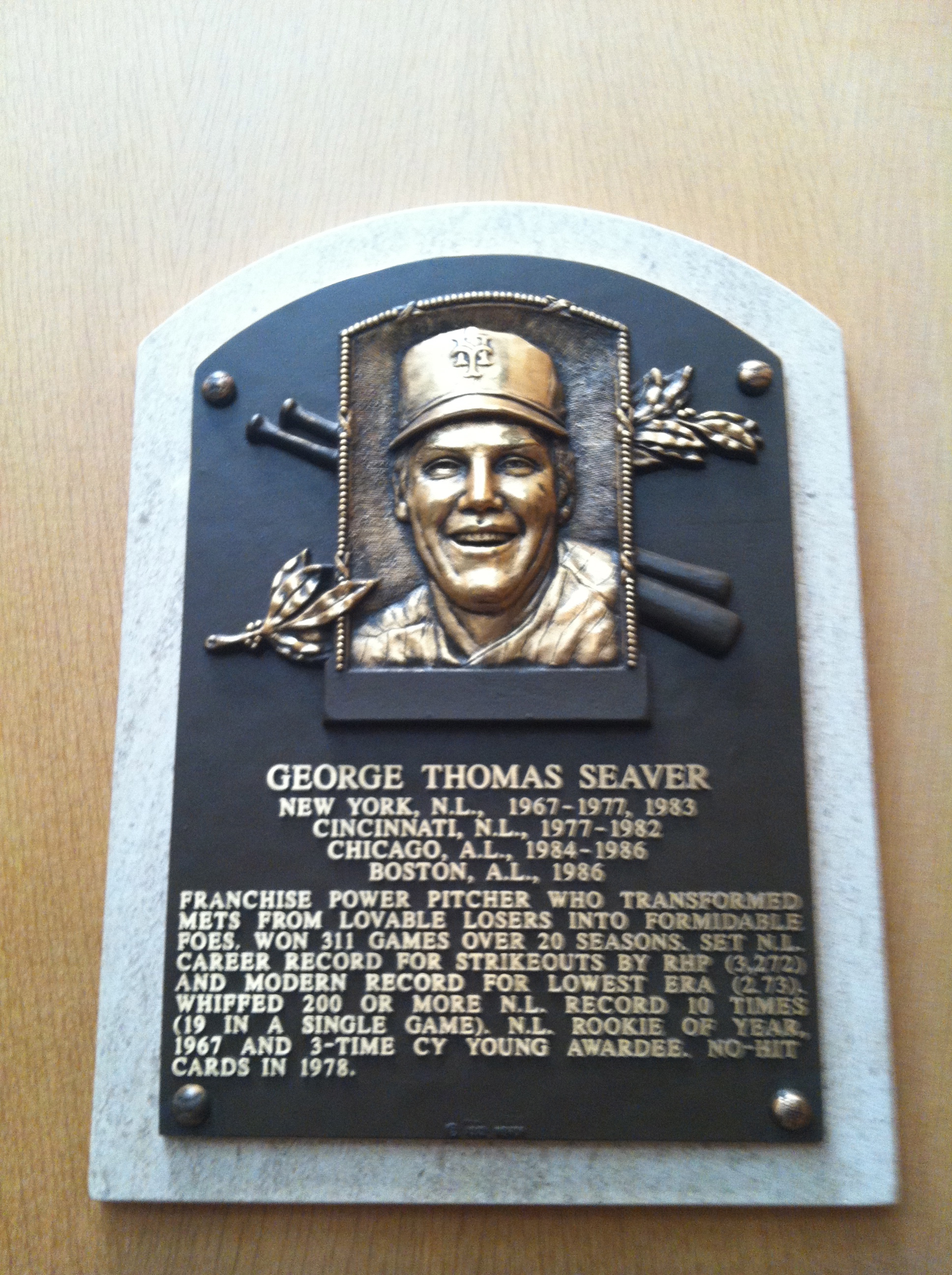
The Mets are a presence — Tom Seaver’s glove and spikes, ’69 and ’86 World Series rings, and random things such as an Al Shirley baseball card amid a slew of random issues. (“Al Shirley is in the Hall of Fame!” I tweeted somewhat meanly.) And you’ll find other unexpected bits of Metsiness, none more startling than the top Eric Bruntlett was wearing when he turned that game-ending triple play against us. (The video plays, somewhat cruelly, on a loop over one of Bruntlett’s shoulders.) Sadly, the most-notable item in the locker full of contemporary Mets stuff (every team has one) is a T@m G!@vin# uniform. I turned away from that one in disgust, refusing to even snap it with my phone.
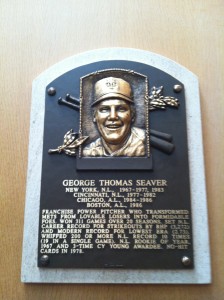
Then there are the plaques, of course — they occupy the center of the building, in niches and nooks. This is where you linger, and tell your kids stories, and reach out to rub the names and faces of the greats. It’s interesting to see which players’ features have been rubbed shiny by excited or respectful hands, and which ones are still dark. There’s an odd power to the fact that each player’s biography and accomplishments are boiled down to to one paragraph — I say odd because every Hall of Famer is a generation worth of feats and reputation, and that single paragraph should feel like short shrift. Somehow it’s the opposite: What’s written suggests much more, like the visible part of an iceberg hints at what’s below.
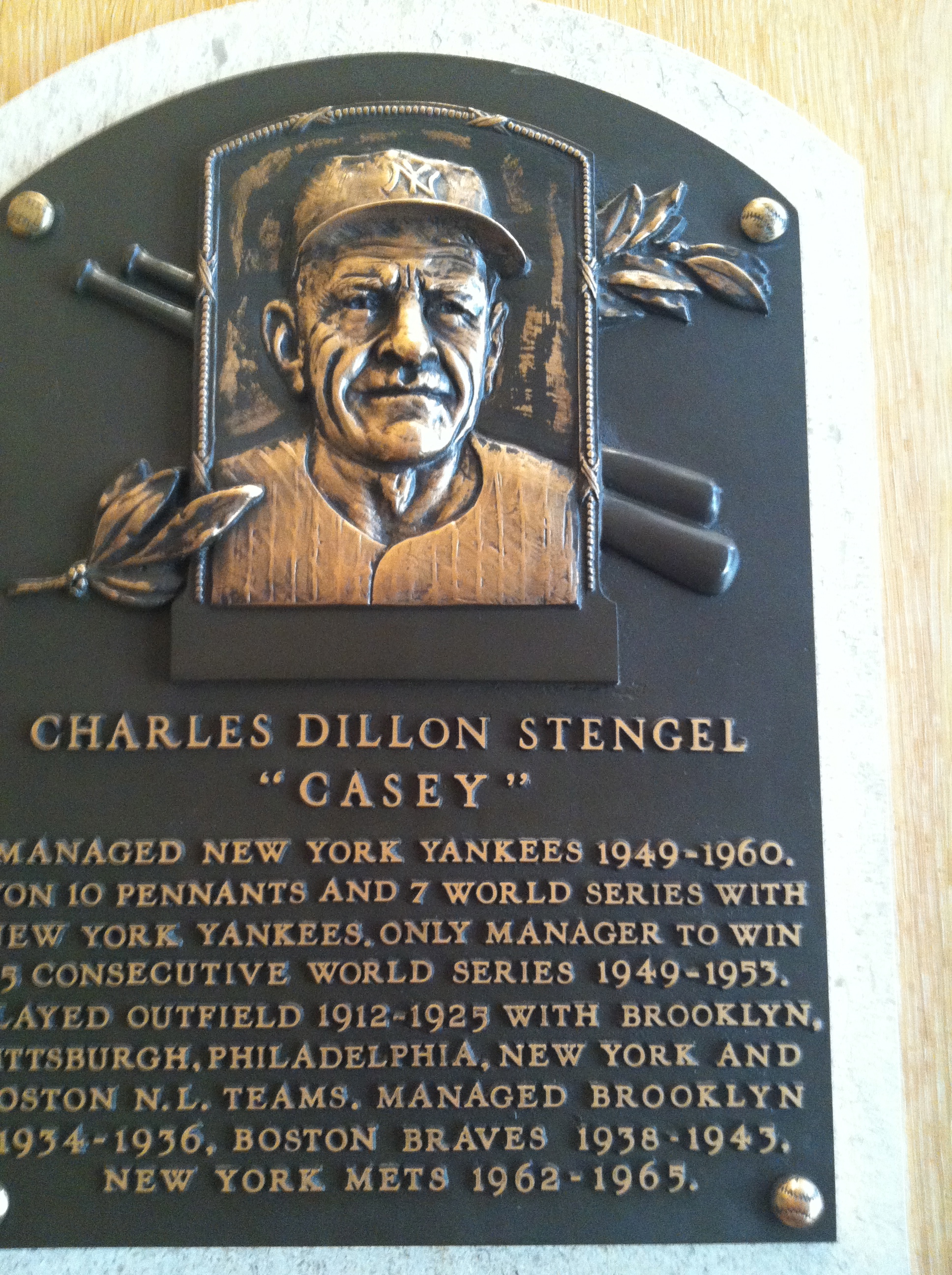
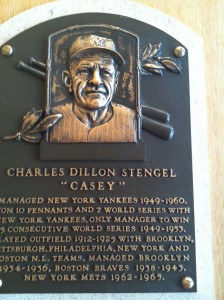
Joshua and I strolled among the plaques for a good hour or so. He wanted his picture taken with the Negro Leaguers he knows from We Are the Ship, a request I happily indulged; I pointed out the Hall of Famers who’d been Mets, took tons of snapshots, and alternated between respectful nods (Ruth, Lajoie, Wee Willie Keeler, Jimmy Foxx, Cobb, Mantle), affectionate rubs (Gehrig, Aaron, Walter Johnson, Gary Carter, Gwynn, Brett, Bill Veeck, Mays, Satchel) and moments of contemplation (Seaver, Mathewson, Teddy Ballgame, John McGraw, Casey, Branch Rickey, Jackie Robinson).
As with the rest of the Hall of Fame, the plaque gallery is human-sized and friendly rather than awe-inspiring. Which is nice, and better at forging a sense of connection that something larger and grander would have been. Plus I was making my own connections. I was listening to the Mets and the Braves as I strolled (if you can’t do that here, where can you?) and Kirk Nieuwenhuis collected his first big-league hit as I directed Joshua’s gaze to Carlton Fisk’s plaque. If you’re thinking that must have been nice, yes it was. The game goes on, an endless ribbon of small milestones to be enjoyed and remembered, and that was the perfect place to mark that little moment.
Cooperstown isn’t where baseball was invented, of course — that was ancient Egypt, or England, or innumerable town squares and farm fields, or all of the above. The Abner Doubleday story is laughable, a grab at glory made when the game was still raw and rough and slightly disreputable, and the Hall of Fame wisely mentions it in passing with the curatorial equivalent of an averted gaze. But Cooperstown sure as heck feels like where baseball — or at least the Ken Burnsian ideal of it we exalt in our heads — could have been invented. The day after our Hall of Fame visit, Joshua and his grandfather and I strolled over to a little park next to the Hall, so he could practice his fielding and throwing and hitting before Little League starts. Yep, three generations with a bat and a ball and gloves — we were our own Norman Rockwell painting, and happy to be it.
After a while I started to find my groove in terms of pitches over the plate and Joshua started to hit with authority, and for a moment I was worried my kid might break a window in the Hall of Fame, and then I kind of hoped he would. (I mean, c’mon — how mad could they really be?) We were a little too far away for that, but if you’re thinking that must have been nice, yes it was. The game goes on, an endless ribbon of small milestones to be enjoyed and remembered, and that was the perfect place to mark that little moment.
by Greg Prince on 11 April 2012 8:48 pm It may feel like we’ll see more losses like Wednesday afternoon’s than Ruben Tejada will see pitches this year, but it won’t be nearly that bad, statistically speaking. We can’t lose more than 158 games and Ruben sees almost that many pitches in a given week.
Yet sometimes you can’t argue with how something feels.
Wrightlessness equaled hopelessness for a second day in a row, which is too bad, considering what a blast we had zipping from 0-0 to 4-0. Now we’re 4-2, which works better as a pie chart than a trendline. The trend, pending the progress of the most important pinky in Flushing, is potentially fraught with peril.
It should all feel happier at the end of a day when the Mets officially turned 50 — outstanding call having Roger Craig on hand to once again throw a first pitch — and a battle of National League East aces proceeded partly to plan. Johan Santana found most of his groove and Stephen Strasburg seems close to where he was when Bob Costas was throwing the Big Train under the bus amid 2010’s initial onslaught of Strasburgmania. We still don’t know if Stephen is going to overtake Walter Johnson as the best pitcher to come out of Washington since Honest Abe Lincoln threw that gem against disunion from 1861 to 1865. We do know, after he won his first-ever start at Citi Field, the following:
• The way the Mets suddenly aren’t hitting, it wouldn’t take the second coming of Walter Johnson to shut them down. The second coming of Andrew Johnson would be tough to beat. Or the actual Andrew Johnson, and Lincoln’s less-than-beloved successor has been dead at the present time since 1875.
• Strasburg was doing well enough that he didn’t need help from the executive branch, which in this case means Larry Vanover’s desire to coax balls into strikes to make Jason Bay look even worse than usual was misplaced, to put it diplomatically.
The ejected Terry Collins probably put it less so, but whatever he said to get booted should be subject to presidential pardon. It’s Vanover who deserved ejection…and I mean with coils springing up from the ground and sending him skyward to his next assignment.
Which shouldn’t be in organized baseball.
No matter that the ump was a hump; the ace/off almost lived up to its billing. If it wasn’t Seaver vs. Carlton, we can owe that to prolonged precautionary periods that follow career-saving surgeries (and blame killjoy pitch counts). Santana struggled in spots, but Santana struggling doesn’t amount to much more than a few specks of dust on the Mona Lisa. A Johan the Mets don’t worry about stretching out hangs in there through the afternoon and keeps things excruciatingly close. And a Strasburg the Nats don’t worry about extending either continues to master the actual strike zone — lordy, what a breaking ball — or tires enough to be gotten to before Davey Johnson can rescue him.
As was, our ace was pulled in the sixth and their ace was gone by the seventh, 17 strikeouts between them. In the 1975 of the imagination, they both go nine or more. In the here and now, it’s another call to the bullpen, then another, then another, with walk after walk after walk of National batters. When your staff strikes out ten while walking ten, it’s startling how immaterial the strikeouts become.
On the plus side, one of our three hits was registered by Ike Davis, who is no longer oh-for-’12, and his flair for popups at or around railings and fences remains intact. Tejada, meanwhile, saw another 22 pitches, to go with the 20 from Tuesday night and the 23 from Monday. That’s 65 in a dozen plate appearances, which goes a ways toward explaining why young Ruben is slashing at a .333/.440/.524 clip. An eon or so ago, I was in a bar with my friend Joel Lugo when the band announced a break. “Hey,” Joel declared, “I’d pay to watch these guys drink!” That’s how I feel about watching Ruben Tejada work counts. Nothing is happening, yet everything is happening.
Alas, other than Ruben’s time spent in the box and Ike’s release from .000 purgatory, there was nothing to speak of offensively against Strasburg. Granted, he’s Strasburg, Vanover or no Vanover. There’s a difference between not touching Ross Detwiler and Stephen Strasburg constructing an impenetrable force field around himself. Still, it was a mostly hollow lineup and bench sent to take on all Nat comers without David Wright. That’s a scary thought if the pinky isn’t a quick healer.
Ike’s flirtation with foul territory acrobatics notwithstanding, there was little to recommend Met defense Wednesday. Josh Thole was baffled all day. Daniel Murphy, despite one impressive flip, refuses to transform into a second baseman just because we wish he would. And Johan Santana simply couldn’t catch a break.
The first four games aren’t forgotten, but they are no longer the most recent games the Mets have played. On the happy side of life, the last two aren’t the next two, either. An off day (surprisingly welcome so soon) will give way to the road, where six games will tell the tale…of the next six games.
It’s a long season. That’s how it feels, anyway.
by Jason Fry on 11 April 2012 1:30 am The 2012 Mets have been recalled from Cooperstown.
It was a night of firsts. They lost their first game. They lost their first game that made you roll your eyes and mutter and swear and stalk around. They lost their first game in which they looked absolutely hopeless and star-crossed and fatally flawed.
All of which was bound to happen, but it was still awfully nice to fantasize that it wouldn’t. And it was awfully cruel the way it all came unraveled.
First came the news that David Wright’s pinkie wasn’t bruised but broken, fractured on a hasty dive back into first. No sooner had we finished gaping about that than Dillon Gee — who’d soldiered uncertainly but courageously through five innings — ran out of gas and luck, yielding singles to Jayson Werth, who’s loathsome, and Xavier Nady, who’s not at all loathsome but still wearing the wrong uniform. On came Bobby Parnell, who promptly got Roger Bernadina to smack a double-play ball right to Daniel Murphy. Murph, a day removed from beating the Nats with bat and glove, clanked it abysmally. Parnell then gave up a deep drive to Wilson Ramos that Lucas Duda lined up … and failed to catch.
All of that trouble came with shocking speed, as if they’d announced Wright’s injury over the PA. Five minutes at most. Forget the air coming out of the balloon — this was the air blasting out of the balloon with such force that it propelled the empty skin into the open window of an orphanage where it smothered a puppy. Just like that, it was 3-0 Nats, and the game was essentially over.
The season, of course, is not. Wright has an injury of uncertain severity and duration — he might be back Friday, he might be stuck on the shelf for a few weeks of healing. That happens to teams all the time. We knew the Mets’ starting pitching was questionable even before Mike Pelfrey and Gee struggled, so there’s no news there. We knew the defense was shaky even before Murph and Duda did what you half-expect them to do on every play. Also not news.
So what is news? That the Mets are 4-1. That the Mets are 4-1 with definite signs of life from Wright, Murph, Johan Santana, Josh Thole, Jon Rauch and Ruben Tejada. If you’d told me a week ago that would be the record after five games and those would be the impressions, I’d have jumped for joy and you would have been jumping alongside me.
So stop — do not fall back into useless woe-is-us Metdom. There’s another game in a few hours — Santana vs. Strasburg, which ought to be can’t-miss stuff. You should sneak away from work to go see it, or at least palm a radio or MLB At Bat. The Mets are better than anybody thought so far, and their future is not yet written. Let’s enjoy the ride and not dwell too much on the occasional teeth-rattling jolt.
Still, yeah, those five minutes were pretty awful.
by Jason Fry on 10 April 2012 12:28 am Baseball’s beautiful and elevating and timeless and pastoral and all those good high-minded things, but it’s also a lot of fun — particularly when things go off the rails and the game is played roly-poly, pell-mell, tumble-bumble, like it was in the ninth inning tonight. And when you win. That’s important too.
But let’s not get ahead of ourselves — there was a lot more to like about this game than the frenetic, I-don’t-believe-what-I-just-saw way it ended.
To start a little earlier:
It’s the second series of the year. That may not mean “instant fun” to you, but it does for me. Opening Day is great, and so are the wild overreactions we all have to whatever happens in that first series, when you’re so keyed up that it seems obvious Player A will hit .667 with 100 homers while Pitcher B will go 0-22 with an ERA near 81.00. But the second series is the one that really makes me happy. Teams have stopped doing something silly in Japan, the annoying empty day for April rainouts is behind us, and you have the pinch-me realization that there will be baseball to keep you company pretty much every day or night for the next half-year. So much to discover, so much to dream about, and my goodness it’s wonderful to contemplate that mostly blank schedule and its yet-to-be-written dramas and morality plays and tearjerkers and low comedies and farces and tragedies and triumphs.
I did not freak out about Mike Pelfrey. To my co-blogger’s mild (or perhaps merely suppressed) annoyance, I have a habit of making one Met a year into my personal scapegoat. With Luis Castillo and Alex Cora having vamoosed, Big Pelf has inherited this role, and in the early innings he showed every sign of earning those honors, nibbling and throwing high sliders and stalking around the mound and generally looking as if he didn’t have a plan out there — in other words, looking exactly like Mike Pelfrey looks every single start. After some venomous tweets I threw up my hands — he’s Mike Pelfrey and we’re stuck with him until the farm yields some fresh produce. But Pelf, as he sometimes does, confounded his detractors as well as his defenders, perhaps because that way he can annoy everybody. He hung in there, somehow striking out eight despite Todd Tichenor’s smaller-than-a-breadbox strike zone, and kept the Mets in the game, exiting with a half-full/half-empty pitching line and a no-decision. Of course he did — Mike Pelfrey is the ultimate no-decision.
Ruben Tejada is awesome. He’s working counts with a jeweler’s eye, drawing walks, ramming doubles up the gap and generally looking much improved at the plate, a year after a season that was also much improved. His at-bat in the ninth against Henry Rodriguez was pretty impressive: I never played baseball at a competitive level (or was competitive at any level), but I’m betting it’s not easy to butcher-boy a fastball coming in at nearly 100 MPH. The pitch he finally did bunt was impressive too — Tejada initially pulled the bat back, sensed the pitch was a strike and coolly angled the bat to catch the ball and send it to the right of the mound. In the field, well, we already knew he was awesome — witness his stretch as high as he could reach without coming off the bag at second to sno-cone Ike Davis’s potentially errant throw. His one blemish was an ill-advised cross to third in front of a shortstop with the ball, but hey, let’s call it Ruben’s Amish stitch. (Besides, he got away with it.) I miss Jose — I will always miss Jose — but I really think Tejada is going to be an Edgardo Alfonzo-type player, the kind you know will do everything right and therefore the guy you want in the right spot when it really, really matters.
Josh Thole is learning. The bat looks better, he knocked down several errant pitches … and there was his quick visit out to see Ramon Ramirez, who’d missed with two pitches that might have been strikes on a Tichenor-less night. Ramirez looked agitated and the Nats smelled blood. I don’t know what Thole said, but Ramirez gathered himself and a few moments later the Mets were safely back in the dugout.
Is that the old David Wright? Wright struck out in the bottom of the fifth … for the first time in 2012. He got erased on a very good slider from Edwin Jackson, one close to the plate and not bouncing in the opposite batter’s box. He went down after climbing out of an 0-2 hole to force a 2-2 count. He looked, in other words, like the David Wright of Shea, for whom an 0-2 count meant only that the at-bat was beginning. Hitting .583, alas, is not sustainable. But perhaps calm, cerebral, controlled at-bats are.
Captain Kirk went where he had never gone before. Kirk Nieuwenhuis may not know it, but there’s now mo’ of the Mo Zone — enough mo’ for the kid’s first big-league home run. Who knows how long Nieuwenhuis will be around, but hopefully it’ll be long enough for his fluffy mullet to become the cult symbol it deserves to be. Maybe it can make one of the Mets’ Tuesday t-shirts. (Points also to my wife for noting that Fluffy Mullet would be an excellent band name.)
Murph for President! We all know he can hit. But man, that play to end the top of the ninth — that was a thing of beauty, Murph sprawled in the dirt, Tejada in perfect position, Ryan Zimmerman foiled.
Which brings us, finally, to that nutty bottom of the ninth.
Deep breath before we get it down for posterity.
Mike Baxter hit for Jon Rauch because Rauch is a relief pitcher with a strike zone the size of a minivan and Baxter walked and then Tejada bunted and Henry Rodriguez the pitcher who is not the cheating Expo of years ago alligator-armed the ball into the dirt at Danny Espinosa’s feet and the ball caromed by him and Espinosa turned just far enough to get Tejada’s knee or hand or something in the face as the ball squirted behind him and Baxter took off for third and Tejada took off for second and Espinosa crawled a step and then got up without his glove and chased after the ball and Baxter turned third and came like forty feet down the line and the camera caught R.A. Dickey high-stepping down the dugout and Terry Collins hanging on the railing with his eyes huge like a little kid and Thole actually got over the railing to celebrate at home plate but then Tim Teufel had second thoughts and sent Baxter back and Espinosa got the ball and tried to shake away the cobwebs and Thole scampered sheepishly back over the railing and Baxter fell on his face and everyone in the stands and at home in front of their TVs and looking up in bars went AUUGGHHHH!!!!!! and the gloveless Espinosa grabbed the ball and fired a seed to Zimmerman but it was too late and Baxter was safe and he got up and thought about strangling Teufel but didn’t do that either and everyone involved in the play or watching it needed oxygen and a moment to double-check what had happened.
And than Daniel Murphy came to the plate and rifled one through the infield and got piled on and emerged with both knees intact (like you weren’t thinking the same thing) and the Mets were 4-0 and everything, at least for one more day, was officially awesome.
* * *
Speaking of awesome, a reminder that Sharon Chapman is off and running once more to support the Tug McGraw Foundation‘s ongoing fight against brain cancer. Her next run to raise funds comes at the end of April, in Nashville’s Country Music 1/2 Marathon. When Sharon runs with Team McGraw, it’s always for a good cause in the name of a great Met. Find out more (and maybe contribute if you can) here.
by Greg Prince on 9 April 2012 4:02 pm I’d hoped the Mets would make tickets available at 1962 prices at least once this year, and they did…twice! It was a limited number with limited notice, but I love the gesture for three reasons:
1) Tickets (if bought at the service charge-free Citi Field windows) cost $2.50, which sounds like what an upper deck-type ticket to a Wednesday afternoon baseball game in April should cost. When those sold out, the idea was applied to Tuesday night’s game, too. Can’t say the price isn’t right.
2) The 1962 angle. A first-place team can unabashedly embrace its roots; the Mets should do it no matter where they stand across 2012. The 1962 club lost its first nine games and a half-century of shall we say mixed results ensued. The second half-century begins with three consecutive wins. With a cleaner start to these fifty years, who knows what greatness awaits us en route to October 2061? (Expectations, like quantity of specially price tickets, are limited.)
3) Unsold inventory for an upcoming game despite the magic of dynamic pricing? Fill ’em up! The Mets have gotten the hang of reaching out with deals and discounts in the last couple of years. Anybody on the fence (and I don’t mean Party City Deck) about going to a Mets game now have a reason to consider reaching out themselves.
And speaking of reaching out, maybe reach out to these links:
• Sharon Chapman is off and running once more to support the Tug McGraw Foundation‘s ongoing fight against brain cancer. Her next run to raise funds comes at the end of April, in Nashville’s Country Music 1/2 Marathon. When Sharon runs with Team McGraw, it’s always for a good cause in the name of a great Met. Find out more (and maybe contribute if you can) here.
• We missed being part of the Maple Street Press and Amazin’ Avenue season previews this year because neither of them published, but we are happy that one Met-centered publication is available online. It comes from the good folks at Mets Merized Online, with a portion of every sale going to the Gary Carter Foundation. Check it out here.
• Nolan Ryan speaks! And Kris Benson gets in a word edgewise! The Kiner’s Korner podcast recently spent time with a pair of Met righthanders of diverse vintage. Hear them talk about their Met lives (if not necessarily their Met wives) and what they’ve been doing lately here.
• Writer James H. (Jim) Burns celebrated Opening Day with a couple of essays, one on how baseball used to be, the other on what might make baseball better by their absence.
• Ted Berg wrote an awesome column during Spring Training, before we knew how awesome the Mets would be, but it’s still an awesome piece by an awesome writer, awesomely linked to here. (H/T to Ted Berg for making me appreciate the word “awesome”.)
• Dennis Bennett, who pitched briefly for the Mets in 1967 — he started the game of June 27 against the Pirates, the one in which Shea served as setting for the Bill Mazeroski triple play scene in The Odd Couple — passed away on March 24 at the age of 72. Learn more about the seven-year major league veteran’s life and career here.
• And don’t forget, coming April 26 to 28 to Hofstra University is the Mets 50th Anniversary Conference. Learn more about it here and register here.
by Greg Prince on 8 April 2012 7:03 pm The Mets may not be flawless, but so far this year they are perfect.
They’re undefeated through their first series, alone in first place in their division, alone in New York on the list of teams that have won at least one baseball game that counts this year.
That’s as close to flawless as they need to be right now.
If they were truly flawless, Ike Davis would have a hit, Jason Bay would record an RBI that doesn’t lead to two outs, Daniel Murphy would turn a clean double play, Lucas Duda would catch a relatively simple fly ball, Kirk Nieuwenhuis wouldn’t get in Lucas Duda’s way, Jon Niese would pitch hitless ball for nine innings rather than a paltry six and Terry Collins wouldn’t say silly things about taking Niese out if his no-hit bid had continued.
When the Mets iron out those minor kinks, we can look forward to their having more assets to pile up alongside the starting pitching of Santana, Dickey and Niese; the power bats of Wright and Duda; the electric hitting of Tejada and Murphy; the clutch defense of Scott Hairston of all people and the airtight closing of Frank Francisco. When that happens, they will be flawless — and then imagine how perfect this season might be.
Though how it could get a whole lot more perfect than it has been across its first three games is hard to fathom.
By the way, the Mets have started 3-0 while the Yankees have started 0-3 twice before, in 1973 and 1985. Whatever else happens with this season, we can see 2012 knows how to keep pretty good precedential company.
by Greg Prince on 7 April 2012 11:09 pm Perhaps you share my conviction that there’s Opening Day and then there’s Everything Else. We just had Opening Day. It was real and it was spectacular. But by Saturday, it was over.
So on to Everything Else! Onto the second game of the season! Onto Citi Field at Shea Stadium! If they’re having more than one baseball game this season, it would be rude to not go back for seconds immediately.
If it wasn’t exactly Opening Day II for the team that entered 2012 not getting much respect (and, before Thursday, not doing much to merit it), getting in the first game of the year that isn’t the first game of the year is a milestone unto itself. While Opening Day’s charms are considerable, the second game is when baseball offers up baseball. Limited introductions, no ceremonies, more routine — just the rest of the next chapter of your life as a fan.
Sounded good to me and it didn’t sound bad to Stephanie who got caught up enough in my post-Opening Day glow to be lured into an invitation to the ballpark before it’s particularly warm out. StubHub (or StubHub!) cooperated in a manner that undercut Met dynamism, so off we went on Texting Gloves Day.
Texting gloves…what will they think of next? Perhaps I should have asked the fellow to my left in the dividerless men’s room in the eighth inning. He was texting with both hands and no gloves. Infer for yourself what thus became his de facto hands-free device.
Anyway, we got to the park plenty early and were two of the 25,000 to receive our texting gloves. Outside the men’s room, I saw a lot of people wearing them. It was a big upgrade over 2011’s plan to give away factory irregular gloves — manufactured without fingers — and see if anybody complained too much. A little clever marketing goes a long way.
As does the popularity of the main Mets store. I could barely squeeze into it on Opening Day. Still pretty busy Saturday. Tell me there isn’t a reservoir of barely tapped goodwill for this baseball team. Three consecutive losing seasons, following two year-end implosions, following…oh hell, you know the post-1986 litany and its varying degrees of despair. Yet you get Mets fans in that building, plenty of them will line up and invest in the Mets logo, no matter who’s on the counting end of the proceeds. Maybe it’s still just early-year enthusiasm at work, but how unappealing could the Mets be if people are crowding into their retail outlets for more Mets stuff?
Fine merchandise in that main store but one item bugged me after I paid for it, brought it home and realized what I now owned. Every year I purchase the in-stadium set of Topps Mets cards. I grabbed what I thought was the 2012 set even though the design struck me as verrry familiar. It was actually the 2011 set, pushed out onto the shelves for a second go-round. Shame on me and my baseball card roots for not recognizing the 2011 design (I’m out of practice). But shame on the Mets for selling these cards as a set a year later WITHOUT several of the cards that were in the original set. No Reyes, no Beltran, no Rodriguez, no Pagan. This set wasn’t renumbered or reissued or priced to move. It was just depleted because god forbid you should be reminded that certain former Mets aren’t Mets anymore. Yet they still charged a pretty enough penny for it. Caveat Mets fan, I suppose (nice to know a buyer need be beware in what he likes to think is his own ballpark).
On the other hand, Stephanie picked out a luscious new Mets t-shirt and I found a pack of standard-issue Topps with a Duda, a Davis and, somehow, an Isringhausen. “Fan” must be Latin for “easy mark,” because though we aren’t crazy about supporting ownership, boy do we love supporting their team.
Our team, in theory.
We didn’t come to shop. We didn’t come to eat (though we did, relatively sensibly). We came for the same reason we came to Shea in its best days: to watch the Mets build on their winning record. And build they did. Saturday’s 4-2 win was constructed on addition by subtraction, namely the way management took its inane “pitcher’s park” dimensions and reduced them to reasonable. When Wright blasted his first-inning homer to right-center — let’s call it Wright-center — it didn’t matter that it would have cleared the old fences. David now knows that he can take aim at what was natural territory for him pre-2009 but then became anathema to his approach, which in turn got all screwed up. The mental walls that used to tamp down David’s confidence came crumblin’ down all over Jair Jurrjens at the moment of impact.
I don’t know if my amateur psychology is as on target as Wright’s ferocious contact was, but I do know the Mets’ second home run of the day, Lucas Duda’s first, wouldn’t have been a home run from ’09 to ’11. And I can guess Lucas’s second was probably monitored in the White House Situation Room. When was the last time you saw a laser like that? Is it possible for us to harness its power on a regular basis?
Modell’s sponsorship notwithstanding, National League pitchers better call (or text) Kenny Loggins. ’Cause when Lucas Duda is up, they, along with everyone sitting in the right field stands, are in the danger zone.
Somewhere between the texting gloves and the hitting shoes, R.A. Dickey outwitted the elements, Josh Thole outwitted Michael Bourn (throwing him out at home on a non-passed ball to choke off Atlanta’s best chance for a fast start), Ike Davis and Ruben Tejada outwitted tricky defensive challenges, Bobby Parnell, Jon Rauch and Frank Francisco (who doesn’t seem to believe in personalized warmup music, bless his untheatricality) outwitted those of us who just assume bullpen equals disaster and Kirk Nieuwenhuis outwitted whoever has probably already printed Andres Torres’s name on a hundred-million million N.L. All-Star ballots. Or as we are prepared to ask based on a tiny but satisfying sample size, “Andres Who?”
The Mets are 2-0. The crowds are robust. The fences are fair. The season, like Duda, is in full swing.
Opening Day III anyone?
by Greg Prince on 7 April 2012 12:24 am “This is the train to Woodside and Penn Station,” the Long Island Rail Road conductor informed us as the westbound 11:04 pulled out of Jamaica on Opening Day. “Change at Woodside for Shea.”
Best advice I’d heard since my iPod’s 1986 playlist was telling me twenty minutes earlier to get Metsmerized, get Metsmerized.
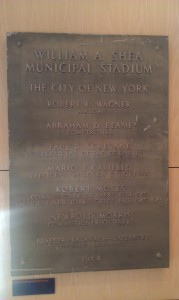 Hello dark plaque, my old friend. Shea the Stadium may have been impossible to find for a fourth consecutive Home Opener, but Shea as eternal psychic home for Mets fans was alive and well as the 2012 season emerged from its interminable 190-day gestation period. When Shea is going on in your head, then Shea as geography — bordered by chop shops to the east, a World’s Fair’s footprint to the south, a landing strip to the north and, for my commuting purposes, Woodside to the west — defies the efforts of dead-on balls accurate cartographers who pretend there is no such place anymore.
Oh, it’s there. To borrow from a now vintage t-shirt I saw in action Thursday, “I’m Calling It Shea” is best understood as a compliment on a day like Opening Day.
The LIRR conductor was surely speaking the Mets fan dialect as much as he was out of regional habit. I live in a co-op that is a converted school building. I once asked a cab driver to take me there. He had no idea where the address was until I described its location. “Oh, you mean the old school? Why didn’t you say so?” I didn’t say so because it hadn’t been a school for more than twenty years.
Citi Field? I know where that is. It’s at Shea, where we as Mets fans live when we’re not forced to be doing something else. And what on earth was there to do on Opening Day except be a Mets fan, wherever you were?
It was Opening Day long before 1:10 and it stayed Opening Day well after the 2:39 it took for the Mets to stifle the Braves. As there has been no Met baseball played since Frank Francisco zipped strike three past a lunging Jason Heyward, I’m in a mode to think it’s still Opening Day until we get on with the business of the next 161.
When Opening Day works, you don’t let it go so easily. When Opening Day looks promising, you rush headlong onto that train to Woodside. You grab a couple of papers en route because they contain baseball previews. True, they print little that you didn’t already know, but you’re tickled that for a day newspapers again seem the best delivery vehicle for baseball news (especially when every phone in Citi Field drains the battery of every other phone in Citi Field).
You take that conductor’s advice and disembark at Woodside for Shea. You’re up the two flights of stairs for the 7 in as much of a flash as you can manage when you hear the train you need rumbling into the station. Bam, you’re on the local (one of the better ones, apparently) streaking toward what the MTA insists on referring to as Mets-Willets Point. Is there a ballpark there? Is it surrounded by water, planes, “auto repair” joints and a transparent globe? Then it’s the Shea stop.
You’re there! You’re at Shea! It’s your…let’s see, I was there in 2011 and 2010; not 2009; in 2008 and 2007; not 2006; yes in 2005; not in 2004 or 2003; at the five in a row before then; plus ’96 and ’93…thirteenth Home Opener of your life. Home Opener Number Fonzie! And it’s actual Opening Day at home, the first you’ve been to since 2010 and, before that, 2002. The slate is the cleanest it can be. We’re 0-0. We’ve been 0-0 for 190 days, since the day after we finished 77-85, but now 0-0 counts for something other than a clever retort to a miserable Spring Training record.
Spring Training? What’s that?
Set loose on the Mets campus, my first stop, of course, was the OUR FIRST DATE brick, right where I left it. It, like its fellow bricks, looks a little more weatherbeaten every time I greet it. Someday it will look like the headstones in colonial-era cemeteries where you have to squint to make out anybody lesser known than, say, “Haym Solomon”. But I’ll be gone by then, so I won’t get on the Mets for that.
I will get on the Mets for replacing the Jose Reyes banner down the third base line — in the procession of those attached to the ballpark itself — with Mr. Met. I mean, c’mon…Mr. Met? I understand we’re not in the business of promoting Jose Reyes anymore, but I found that tacky 10% from a history standpoint and 90% from “you couldn’t rustle up an Ike or a Dickey to stand in until the distant future when all is forgiven?”
One more Jose-Jose coverup: there’s a gorgeous 50th anniversary insert in the yearbook (the cover of which features every yearbook cover since 1962). Within in its pages, however, Jose Reyes barely exists as part of the Mets’ first half-century. He’s mentioned as one of six Mets to make the 2006 N.L. All-Star team. No mention that he’s the franchise leader in runs scored, bases stolen or triples struck or that he won the Mets’ only batting crown.
Pravda lives.
I’ll also get on the Mets for not having printed a single pocket schedule in advance of Opening Day. I didn’t see any lying around ticket windows, so I asked at a fan assistance booth. “We’ll have them during the next homestand,” was the cheerful response. No pocket schedules on Opening Day? Did whoever’s in charge of such fundamental Metsiana not realize the season started Thursday? (Perhaps not, because that person had no pocket schedule to consult.)
One final gripelet before I get back to feeling very, very good about the Mets and Opening Day: How long does it take to get a person frisked and wanded? Well in advance of the deluge of this week’s “biggest crowd ever,” I stood for many minutes between the bag search and the turnstile waiting…waiting…waiting…to receive my requisite once-over. I didn’t want it but I accept it as part of the 21st century Metscape. Nobody seemed to be finding anything dangerous on anyone and no one was putting up a fuss. It was just taking almost forever.
OK, with those observations off my chest (funny how Mets personnel never detect any of that stuff when they feel me up), back to the excitement.
Yay! Opening Day!
After the brick, it was time — once I paid my own personal homage to Gary Carter by tapping my brand new 50th Anniversary cap on his old home plate — to make my perennial pilgrimage to Parking Lot E for the serious Chapman tailgate extravaganza. The Chapmans, truly the first family of Mets fans, are lighthearted; it was their annual soiree that was serious. There was so much to eat that you (or, more specifically, I) didn’t have to eat very much to feel nourished. And that was just the food. The soul derived its RDA of protein from being around such nice folks on such a nice day in such a nice spot (Section 12, if I have my Shea ghost fixed correctly). Here’s to incredibly hospitable people who make the Mets look good by choosing to associate with them as loyal customers.
The walk back to Mets Plaza to seek out my favorite Rotunda entrance security guard (a mensch among men) had a surprise in it for me. Passing through Lot D, I drifted to last August, when our family — me and Stephanie in the unprecedented company of Mr. and Mrs. Stem — took its one and only shot at baseball togetherness. We parked in Lot D and then proceeded to watch the Mets fall way behind the Brewers, surge comfortably ahead of the Brewers and, finally, lose in disgusting fashion to the Brewers. Somehow, despite Mr. and Mrs. Stem (my brother-in-law and sister) proving again their allergy to the game I love is untreatable and, oh yeah, the disgusting fashion of losing, that day, August 20, remains my favorite Citi Field memory of 2011.
And by Citi Field, I mean Shea. When it can all feel of a piece, I’m very happy.
Then I noticed the Jose-Mr. Met banner switch, and I was annoyed. Then I saw my favorite security guard had a short line, and I was happy. Then I waited and waited and waited for the wanding, and I was annoyed. The Mets giveth, the Mets taketh away. But I got given my wanding, my ticket-scanning, my surprisingly sincere-sounding greeting from the fellow with the scanner — “welcome back” — and my magnetic schedule (which I’ll obviously need until the next homestand) before buying my slightly Soviet yearbook and scorecard, the latter of which hyped the April series against the Marlins as bringing to town “one of the biggest fan favorites in Mets history”. Long lines for the store made knickknack shopping prohibitive, but the museum had space, so I detoured in there.
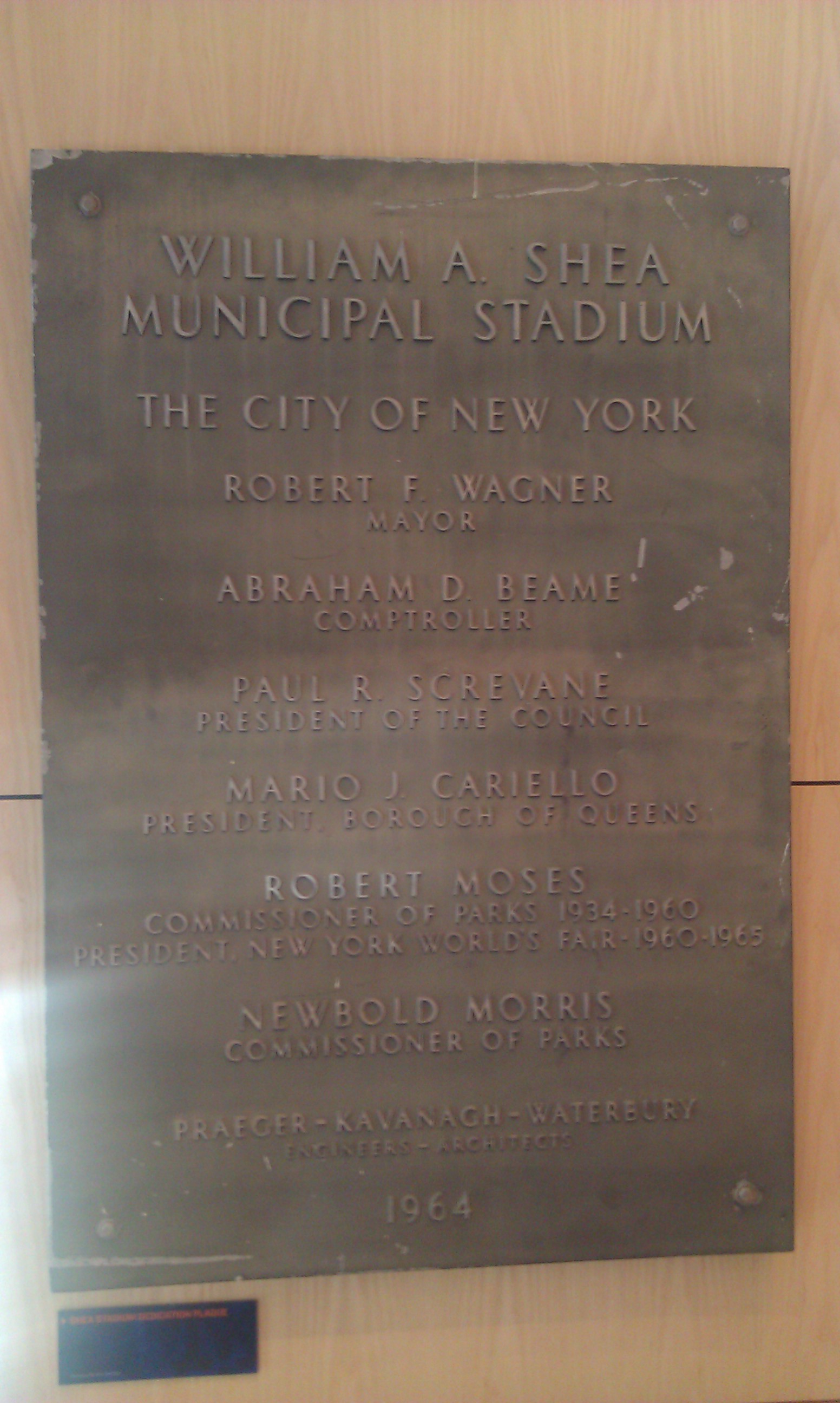
Good choice. I wish the museum was bigger but the 50th anniversary is receiving a representative exhibition there all season. The two additions that thrilled me to my Met core were a couple of seats from the Polo Grounds and the plaque from the exterior of Shea Stadium, the one that let all New Yorkers know the identities of the city officials they could thank for the 1964 construction of WILLIAM A. SHEA MUNICIPAL STADIUM. I used to stop at that plaque regularly on my stroll from the 7 extension to Gate E. I’d wondered where it went. I’m glad it’s on the premises again.
Oh, and blue. Blue walls. Beautiful blue walls. With an orange stripe to avoid or perhaps inflame complications should Jason Bay get a little closer to not quite hitting one out. The outfield fence now appears a Metsier shade of blue than even Shea showed off. Sometimes progress functions brilliantly if you wait long enough.
Once in my seat in the right field Promenade Boxes — h/t once more to the Chapmans and their recognition of Opening Day as the Metropolitan holiday it deserves to be — I soaked in the full blue of the walls as they stood against their repurposed black backdrop. No, it doesn’t quite flow aesthetically, but I relish realizing Citi Field has been around long enough to have a past. The black walls that are no longer the outer limits of the outfield declare 2009 through 2011 were here. They were lousy years, mostly, but they existed. The Mets attempted their first post-Shea iteration, none of it worked, and now everybody’s trying to make some sort of amends. The outfield has been scaled to human-sized, the color has been fine-tuned to correspond with the Met palette and a little more is right with the world. I feared the seven postseason banners that so overjoyed me when they were added to the erstwhile Great Wall of Flushing in August 2009 would be “misplaced,” but I saw them faux-fluttering in the breeze on the third base side.
Good job, Mets. If I had a pocket schedule, I’d circle a date to come back ASAP.
Then the old shoe slipped on and the ceremonies I lust after every late March/early April commenced. Alex Anthony introduced Howie Rose. Howie Rose directed our attention to Bill Shea’s progeny (and aren’t we all essentially children of Shea?) and their presentation of the good-luck floral horseshoe WHICH…I…LOVE! Then came the Braves. I spitefully jeered Fredi Gonzalez, the world’s worst manager, reluctantly put my hands together for pitching coach Roger McDowell (“homophobe,” I muttered) and stood to applaud Chipper Jones — while simultaneously booing him. Both gestures were offered out of respect.
When the Mets began lining up, Ray Ramirez heard an echo of the clever derision he took as head trainer two years ago for the injury-racked fiasco of three years ago. It’s not as clever anymore (though there’s always something to be said for tradition). The only Met I booed was bench coach Bob Geren, and I didn’t boo him for being Bob Geren. I booed him for being assigned No. 7.
Some booed Mike Pelfrey. Some booed Jason Bay. Some booed Frank Francisco. All who did were not using their heads. Cheer your Mets when the season starts. Encourage them so maybe they will succeed beyond your wildest boos. It’s just simple math, for cryin’ out loud.
Howie Rose introduced Ralph Kiner to introduce the starting lineup. That was simple poetry.
The Gary Carter tribute was absolutely beautiful, though one wishes it was unnecessary. “KID 8” on the blue wall, revealed by his wife and three children, was a perfect flourish. The four first pitches to the four Carter teammates was sweet, too. I suppose it’s the job of every 1986 Met to fill in as catcher from now on.
But nobody has to fill in as Mets ace in 2012. I don’t think I realized just how much I missed seeing Johan Santana in a Mets uniform. I knew I didn’t realize how much I’d love hearing “Smooth” again. I’ve been sick of that song since the end of the last millennium, but for a healthy Johan Santana, I’d gladly hear it 35 times this year.
Because he’s so smooth.
As the other Santana played on the PA and the real Santana warmed up, it was Shea again as far as I was concerned. It was that last unabashedly great date in Mets history, September 27, 2008. Has it really been that long since we saw Johan pitch? Of course it hadn’t been. He pitched a whole bunch of games for us in 2009 and 2010 — the man even hit a home run for us two Julys ago. But that’s how big the recurrence of Johan Santana felt shortly after 1:10 PM on Opening Day 2012. It was like he’d been as hard to find as Shea Stadium.
Just as was the case on 9/27/08, Johan didn’t give up any runs. No Met pitcher has this year, not even the unreasonably booed Frank Francisco. I mean, yeah, I had the same “here comes every Mets closer of the past two decades” thoughts as he warmed up (to, strangely, Todd Rundgren’s “Bang On The Drum All Day,” which sounds like a dare to opposing batters), but it’s Opening Day, and on Opening Day, no new Met is to be pre-emptively dismissed. I couldn’t even hold it against Ronny Cedeño that when it was announced, “Now playing second base, number thirteen…” I shivered in anticipation that the Mets had re-signed 38-year-old Edgardo Alfonzo without telling me.
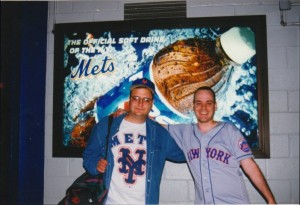 How 1-0 looked on Opening Day 1998... A 1-0 Opening Day win is always uplifting, no matter how many innings it requires. Jason and I high-fived as we did at the conclusion of the last 1-0 Opening Day win, gave our best wishes to Section Chapman and ambled down the stairs, good old “Let’s Go Mets!” providing a rousing 1998-style soundtrack to our journey (though fourteen years, fourteen innings and fourteen ramps earlier, “Let’s Go Mets!” shared vocal space with “Yankees SUCK!”).
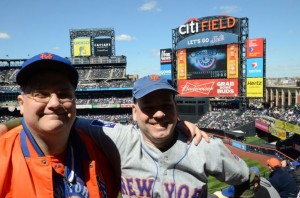 ...and evidence that some 1-0 things never change. Moments after we parted ways, I met up, as arranged via text before my phone’s battery gave out, with my non-biological sister/2007 Opening Day co-frostbitee Jodie and her own very friendly entourage. We attempted to avail ourselves of one of the many fine clubs Citi Field offers as a perk to holders of tickets like the ones they held. The only one of them open after the game was Caesars, and Caesars’ long bar wasn’t pouring anything by then. “They’re turning down revenue?” Jodie wondered. Indeed, a few postgame drinks could have paid the printers’ bill for at least a few pocket schedules, but who needed a cocktail when you remained intoxicated by a 1-0 win?
Left dry, we let the win wash over us anyway, until the Caesars staff told us (courteously) to take a hike. So I did. After another round of upbeat goodbyes, I carefully packed up Opening Day and transported as much of it as I could from the environs of Shea, onto the 7 and off to Sunnyside to meet my lovely wife for a celebratory supper. Following a steady stream of Stephanie’s colleagues congratulating me as unofficial Mets proxy, we decided to Discover Queens a little, walking from her office back to Woodside. Along the way, random Queensians reminded us — it wasn’t tough to discern by my garb where I’d been all afternoon — what a swell Thursday we all had just experienced in this blessed borough.
“Hey! The Mets won!”
“Hey! The Mets are one and oh!”
“Hey! The Mets are in first place!”
Hey! You can tell me that until the sun goes down on Opening Day, clear into the scheduled off day Friday, right up to 1:10 Saturday. We took the first game in nine tidy innings, but really, who wants a day like that to be over so soon?
by Jason Fry on 6 April 2012 1:03 am Somewhere around the poorly named 46th St-Bliss I got a little carried away:
On Opening Day even the 7 local seems awesome.
That wasn’t true. The 7 local is never awesome, particularly not when the MTA has decided that Opening Day at Citi Field is a fine time to do track work. But I swear it felt true — after Hunters Point the train emerged into a bright sunny day, the car slowly filling with folks in Mets garb, and everything seemed possible, as it always does when you’re 0-0 and those zeroes look like the top of glasses that are at least half full and who knows, maybe they’re soon to be overflowing.
The Mets themselves managed to KO this good mood briefly: I skipped the rotunda and walked to the normally speedy right-field gate, where I found myself at the end of a surprisingly long line. What was the problem?
Casual fans unacquainted with Citi Field? That played a role, but a relatively small one.
Bag check? No, that was smooth enough.
Polo Grounds-era ticket taker whose scanner finger was the slowest gun in the National League East? Bingo.
By the time I got through the gate I was stewing — I’d missed the player introductions and the moment of silence for Gary Carter, both of which I’d left plenty of time for. But things would get worse. On the other side of the gate was a minion in Mets staff green, handing out magnetic schedules. As I drew near, he peered into his box, looking puzzled, as if he’d been confronted with the mysteries of the universe. He raised his head, then lowered it to examine the box again. Then he shuffled off a bit sheepishly: The box was empty, and stubbornly determined not to refill itself. The magnetic schedules were gone.
Same old Mets!
(When I told Greg this sad tale he just blinked and noted that they didn’t have pocket schedules yet, because they were … still printing them. For God’s sake.)
In August, with a team 20 games out, a season lost and stands two-thirds empty, I might have fumed about such typically Metsian misfires for half the game. But fortunately, none of those conditions applied. And within a few minutes I’d regained my equilibrium and was happy.
Because that’s what Opening Day will do to you, even shorn of Jose Reyes and with finances uncertain and division rivals reloaded.
There were Mets down there on the green field, real live Mets. They were wearing traditional, grown-up uniforms that didn’t look designed by the Committee of the Desperately Trendy, and they looked great in them. They were throwing the baseball around in front of reconfigured walls that were appreciably lower and closer — not to mention bluer. I never liked Shea and shed no tears when it was knocked down, but to my surprise those retro-blue walls made me smile. The blue doesn’t work with the black and green and brick of Citi Field, but it does engage the heart of a veteran Mets fan. Considering Citi Field’s first campaigns had that equation backwards, a little aesthetic incoherence isn’t so bad.
Better than that, even, was the identity of some of those properly attired Mets down there in front of those blue walls. Why, that was Daniel Murphy taking grounders at second. And that was Ike Davis, he of the long lanky arms and soft hands, lassoing throws at first. And on the mound … why yes, that was Johan Santana, surgically repaired shoulder and all. Three very happy returns on the same sunny day.
For it was a sunny day — chilly in the shade, but warm and bright where I was sitting in the Promenade with Greg and a gaggle of Mets rooters assembled and cared for by the admirable Sharon Chapman. There were empty seats visible, particularly in the fancy sections where I’m told you can have Shake Shack delivered, but up in our higher precincts Mets gear abounded, and the fans were attentive and glad to be reacquainted with their team.
That team then went out and beat the Braves, 1-0, with the difference an Andres Torres walk, a Daniel Murphy single and a sharp, first-pitch RBI hit from David Wright. (The Mets might have had more but for the effective pitching of Tommy Hanson and an egregious neighborhood play at second — by a rookie, no less — allowed by reliably horrible umpire Phil Cuzzi.)
Johan wasn’t throwing in the 90s, and odds are he never will again. But his change-up was sharp, and more than that so was his mind. He certainly felt the same out there, cocking his glove and staring over it like a prizefighter calculating where to aim his punches. His biggest spot of trouble came in the fifth, when Matt Diaz doubled and a clearly tiring Santana walked Tyler Pastornicky (who can go from home to third in the time it takes to say his name) and then Hanson, loading the bases with two out. But Johan got Michael Bourn to tap a little spinner back his way, which he seized and heaved to first, with extra adrenaline carrying it a few feet too high on its way there. Last year it might have gone over the glove of Lucas Duda or Murph or Justin Turner, but Ike hopped nimbly skyward to nab it, allowing Santana to aim his final punch into his own glove and march into the dugout with his first 2012 test an unqualified success.
Wright won the not-so-coveted Player of the Game honors from the scoreboard folks, but the real hero was Tim Byrdak, summoned with one out in the seventh and Pastornicky on third, where he’d alighted after Torres misread a searing liner, then felt his calf grab as he tried to give chase. A recently repaired knee and no margin for error isn’t a fun combination, but Byrdak struck out Murph-killer Jose Constanza with a downright evil sweeping slider and then K’d Bourn to end the threat. Gigantic Jon Rauch handled the eighth and Frank Francisco contributed a drama-free ninth, and we were home free.
Psychologically, Opening Day is ridiculous: Win, and you’re half-convinced that 162-0 is in your grasp; lose, and the entire organizational blueprint seems like a hopeless mess. I know the Mets aren’t winning 162, and capturing half as many wins might prove difficult. But walking down the stairwells with Greg surrounded by LET’S GO METS bellowers, it was easy to let yourself dream.
Torres is hurt and St. Lucie-bound? Just a chance to learn to spell Kirk Nieuwenhuis’s name without cheating.
We don’t know how Johan will feel tomorrow? Hush up, you — look what we got from him today.
You hold your breath so much watching balls hit to Duda and Murph that you could follow James Cameron into the Challenger Deep? Why, both of our batmen afield were blemish-free today, thank you very much.
This good feeling will yield to reality soon enough. But for now, why usher it offstage even a moment early? On Opening Day you’re allowed a sweet dream or two.
|
|