The blog for Mets fans
who like to read
ABOUT US

Faith and Fear in Flushing made its debut on Feb. 16, 2005, the brainchild of two longtime friends and lifelong Met fans.
Greg Prince discovered the Mets when he was 6, during the magical summer of 1969. He is a Long Island-based writer, editor and communications consultant. Contact him here.
Jason Fry is a Brooklyn writer whose first memories include his mom leaping up and down cheering for Rusty Staub. Check out his other writing here.
Got something to say? Leave a comment, or email us at faithandfear@gmail.com. (Sorry, but we have no interest in ads, sponsored content or guest posts.)
Need our RSS feed? It's here.
Visit our Facebook page, or drop by the personal pages for Greg and Jason.
Or follow us on Twitter: Here's Greg, and here's Jason.
|
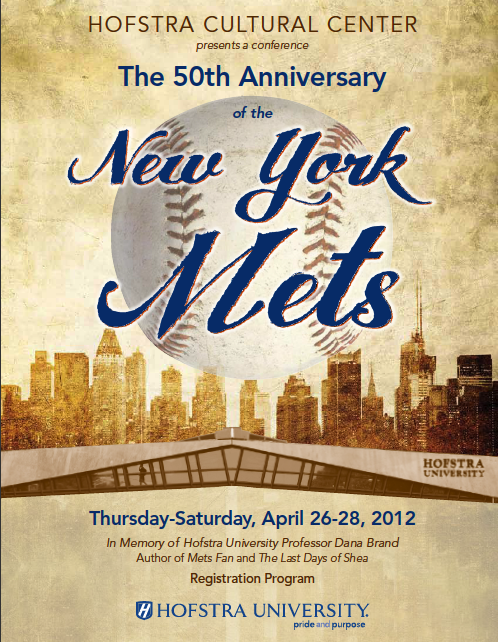
by Greg Prince on 4 April 2012 3:38 am  Register. Attend. Take part. The Hofstra 50th Anniversary Mets Conference must be getting close, and not just because I finally finished writing my paper for it. Indeed, the event Dana Brand envisioned and cultivated for years is upon us, arriving April 26-28, just three weeks from tomorrow. Registration information, along with a (mostly complete) program, is now available at the Hofstra Cultural Center site.
My advice? Go register and attend the conference. Spend three days there if you can. Spend part of one day there if that’s all you can do. But for Mets’ sake, take in as much of it as you can.
In my informal capacity as editorial consultant to the conference, I’ve been immersed in a dozen logistical details for the past few months, so it is only now that I’m pulling back and noticing what an incredible lineup Hofstra has put together. It’s 1986/1999/2006 strong. Brothers and sisters, this is the kind of event we as Mets fans always wish would come along…and it has.
I’m so happy to see so many people I know on the program, not because I know them but because I know they know their Mets and they are going to explore so many different aspects of the Mets experience. You’ll likely recognize a whole bunch of names, including a few who wore the uniform and some others who tracked their doings from the press box. Yet to me, the beauty of this conference is how many fans — bloggers and otherwise — are taking part. We the fans represent the filter for what the Mets truly mean. We tell the story to one another every day. Telling it in one concentrated forum, with an audience eager to hear about it and contribute their own stories, with everybody involved taking this thing we call the Mets seriously…that was Dana’s dream. It’s the dream for a lot of us, but Dana had the presence of mind to actually dream it and put it into action.
I’ll be talking this up in a little more detail over the next three weeks, but the time for talking about it has become the time to act. Check out what’s planned and make yourself a part of this once-in-a-lifetime Mets happening.
FYI, proceeds from the conference (above expenses) will go to the Dana Brand Memorial Scholarship Fund, one small way in which the conference is dedicated to the memory of the Mets fan who thought it up in the first place.
by Jason Fry on 3 April 2012 1:55 pm Some readers may know that in one of my other lives I write Star Wars books — the latest one, The Essential Guide to Warfare, just came out today. Between that and Opening Day, it’s going to be a pretty busy week — and so I couldn’t resist one post mixing these normally separate worlds.
They aren’t always separate worlds, of course — R.A. Dickey has been a one-man crossover, and I’ve even worn stormtrooper armor at Citi Field. But mostly they stand apart. At time I’ve found myself explaining Star Wars and sports fans to each other — and noting that they’re really not that different.
Yeah, I let the daily dramas of 25 young millionaires affect my happiness. But so what? They really are dramas — each season has twists and turns and heroes and villains as compelling as those in a galaxy far, far away.
Yeah, some of those dudes dress up as stormtroopers and Wookiees. But so what? You, my friend, appear to be wearing the top half of a David Wright costume.
The Mets have occasionally invoked Star Wars themselves — last year, they had a great skit with Darth Vader confronting Dickey (channeling Luke Skywalker in Return of the Jedi) and the new pitch he’d constructed, and years ago there was a scoreboard video with the Millennium Falcon amid the asteroids and various rival logos getting blown up while “The Imperial March” boomed out of the Shea speakers.
That video was kind of lame, but during the middle innings of one interminable loss I found myself musing about a Mets/Star Wars video that might really work, given some creatively added graphics and voice-overs. Or probably not, but it entertained me.
As prologue, think back to The Empire Strikes Back, and Darth Vader chatting over intergalactic long distance with the Emperor. We’re going to use that scene, except Vader has a Yankee logo on his helmet. The Emperor (who once upon a time was going to be George Steinbrenner) fulminates about a great disturbance in the Force. The sons of Shea, he warns Vader, must not become Jedi.
Now flip to the original Star Wars and the Rebel pilots calling in as they prepare to attack the Death Star. The X-Wings are orange and blue. The Death Star is pinstriped, with that other NY (the awful skeletal one) on the radar dish. Now we cut to a roll call of various Mets superimposed on cockpit footage, wearing a flight helmet with a Mets logo instead of the Rebel insignia. Instead of Red Leader, Red 2, etc., we have Met Leader, Met 2, and so forth. Johan Santana gets to be Met Leader. For our other pilots, let’s say Daniel Murphy, Ike Davis, and maybe Justin Turner. Perhaps Lucas Duda doesn’t say anything, shades of John Olerud in the grand Mets-Yankees stickball ad of a generation ago. David Wright, the earnest Luke of our age, gets to be Met 5. His number even matches and everything.
Now you get your highlights and shots of cheering fans, interspersed with bits of Star Wars. (Give Dickey gets a cameo as Han Solo, telling Wright/Luke he’s all clear, with Jon Rauch contributing a Wookiee roar.) Met 5 takes his shot and the pinstriped Death Star is blown to smithereens. Cut to the tag line (my favorite part): JOIN THE REBELLION.
They’d never do it, of course — the Mets hate the little-brother role, and that might be excessive use of footage or something lawyerly and tedious. But I’ve always thought it would be awesome, even for those of us whose worlds wouldn’t be in bizarre collision.
Plus if they do it, I promise to borrow a stormtrooper costume again.
by Greg Prince on 2 April 2012 8:58 am Every Mets fan who watches Mad Men religiously knows Lane Pryce is one of us, thanks to the orange and blue pennant that adorns his office wall. But perhaps you didn’t know just how devoted our British compatriot is when it comes to the fortunes of the 1966 Mets.
Unfilmed scenes tell the tale…
“Don, do you have a moment?”
“What is it, Lane?”
“You might be surprised to learn our very own New York Mets are the fortuitous beneficiaries of a grave clerical error on the part of the Atlanta Braves.”
“Atlanta? Didn’t they just move to Milwaukee?”
“Yes, well, it seems the Braves had their eyes on a prize pitcher and, as you Americans say, leapt before they looked.”
“You’ve really taken to our colloquialisms. How about taking me to the point.”
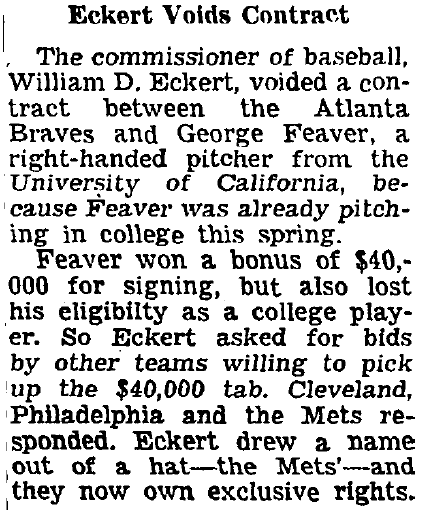
“The point, Don, is this young man, Seaver — the Times actually identified him as ‘Feaver,’ but my chum in the team’s front office assures me it’s Seaver — is supposed to be quite the comer.”
“And that helps me how?”
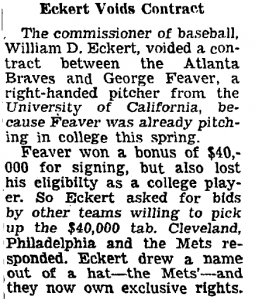 Lane read the news on April 4, 1966, oh boy. It was a little off, but oh boy anyway. “You see, the commissioner had to void Seaver’s contract with the Braves…something about signing him before his eligibility was permitted because of his collegiate status at the University of Southern California.”
“I’m familiar with the region. Is there anything else?”
“General Eckert held a drawing to determine which other team would have the opportunity to vie for Seaver’s services, which are projected to be considerable. The drawing involved the Mets and the teams from Philadelphia and Cleveland.”
“Some kid from California whose name is hard to spell doesn’t have to go to Georgia. Lucky him.”
“It’s the hat, Don.”
“The hat?”
“The Mets’ name was drawn out of a hat, securing them the rights to sign Seaver.”
“Hat sales are off ever since Kennedy refused to wear one. The Nixon people should have listened to us.”
“Yes, well, it got me to thinking about London Fog.”
“Aren’t you the one who insisted there was no such thing as a ‘london fog’? We take your word on these matters, Lane, though it would have helped with our youth-targeting if you could have warned us about the British Invasion. Peggy didn’t know. Pete didn’t know. They look young to me. Maybe we should have kept those two brats from the other agency, Smith and Smith, or whatever their names were.”
“I’m afraid I was otherwise engaged in securing us these ‘two floors’ the week the Beatles appeared with Sullivan. But I do recall you said our friends in Baltimore were looking for a way to diversify their product line.”
“You’d think selling raincoats with the knowledge that it is always going to rain would be enough, but they didn’t seem to want to hear my advice about limiting their exposure. Neither did our old art director, come to think of it. Why did you come in here?”
“The hat, Don. New York’s beloved Mets are getting a boost from a hat. The commissioner used a fedora for the drawing, much like the one you continue to wear despite the ever-changing cultural upheaval threatening to devour us all, and this seems the perfect opportunity…”
“Opportunity for what?”
“A bright young man like George Seaver and his association with a London Fog hat might be gold for an account that’s been lagging a bit, particularly in the local market.”
“From what you’re telling me, Feaver…”
“Seaver.”
“Whoever he is, this college dropout hasn’t played a professional game yet and you want us to do what — take out a spread in the Journal-American celebrating that fact? I’m not even sure that paper’ll be in business much longer. With conversations like these, I’m not sure we’ll be in business much longer.”
“My contact with the Mets tells me they might fly Seaver up here for a press conference. Perhaps he strides to the podium wearing a fedora manufactured by London Fog and announces, ‘I owe it all to this hat,’ while the photographers click away for the evening papers. Shea Stadium was very well attended last season, and if we can draw the attention of even a fraction of that 1.7 million…”
“And do what? Get them to fight over the last Sugarberry Ham? Did I miss something? Are you creative director now?”
“Something about my adopted country brings out the moxie in me, I suppose.”
“Look, Lane, I appreciate your interest in doing something more than counting our paper clips and keeping Manufacturers Hanover from shutting off our lights, but I told London Fog the risks of diversifying, and now isn’t the time…”
“That was three years ago, Don. Three years ago, the Rolling Stones were doing cereal commercials in England.”
“If you could get Brian Jones to wear a London Fog hat, that might be helpful. Crane tells me they’re coming to Forest Hills in a couple of months, though I wish he wouldn’t talk to me — or Megan. Otherwise, Lane…”
“That’s quite all right, Don. Seaver is slated to start the season in Jacksonville as it is. Manager Westrum would love to have him up here sooner, but they don’t want to put too much pressure on the lad.”
“Pressure? Are we talking about baseball or the Korean War here? The only pressure I can see is the Mets being stuck so far down in the National League cellar that they’ll run out of oxygen. The way the space program is going, we’ll land a man on the moon before the Mets win a pennant.”
“They do have quite the farm system, you know.”
“I wish we had one of those in this office. Ask Peggy to come in on your way out.”
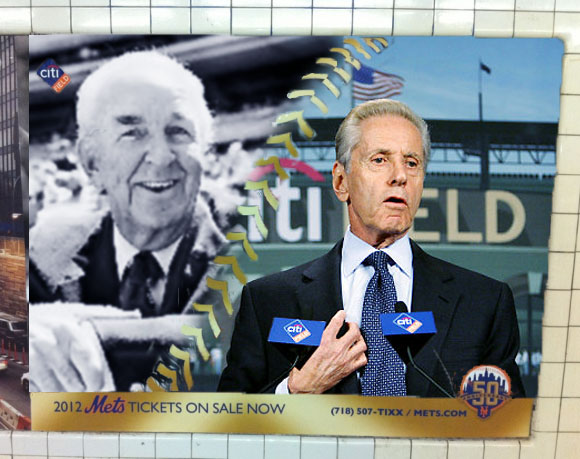
by Greg Prince on 1 April 2012 2:36 am The Mets’ 50th anniversary outdoor advertising campaign has been a preseason highlight. Perhaps you’ve seen the theme in action, with an image on the left representing the good old days and a modern counterpart representing hopeful new days. Seaver and Santana. Hernandez and Davis. That sort of thing.
But one iteration I caught sight of on the LIRR platform at Woodside last week really startled me. The historical figures weren’t plucked from the playing field but rather the executive suite:
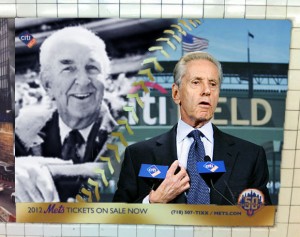 Here's the pitch, rightly celebrating enlightened ownership. No, your eyes don’t deceive you. That’s longtime New York Mets chairman of the board M. Donald Grant on one side and longertime New York Mets owner Fred Wilpon on the other.
This is how they’re marketing the team?
The Wilpons and Saul Katz have apparently gotten a little cocky in the wake of avoiding trial by jury in the Madoff mess. This, I suppose, is Fred’s version of Eminem so eloquently declaring, “I just settled all my lawsuits — f*ck you Debbie!”
But maybe just a shade more understated.
As I took a picture of the ad (designed by talented New York agency CP+F) and contemplated its inherent message, I tried to wrap my mind around the Wilpon ownership and, since the image invoked him, too, Grant’s influence on Mets history. I came to a surprising conclusion, namely that we’ve been better off as Mets fans thanks to the presence in our lives of each of these titanic figures.
I know, neither is a popular character, and praise for Grant, in particular, has never been widespread, but let’s take a step back from the heat of moments like that of the Seaver trade in 1977 or the pyramid scheme fallout of the 2010s and consider the bigger pictures in time and context.
First, take Grant, the Mets chairman from their founding in 1962 until he was compelled to retire after 1978. His story in intertwined with that of the Mets, and we know the Mets were a great story from their beginnings. As one of the de facto primary authors of that story, respect must be paid Mr. Grant. Working in concert with the beloved Joan Payson, Grant oversaw the business side of a franchise that quickly became one of the most lovable baseball had ever seen (and one of its most profitable). If the Mets were to be warmed to, why not Grant? He was an admirable blend of efficiency and commitment, making sure the checks went out and that, eventually, every Met had a roof over his head.
Under Grant’s graceful guidance, the Mets rose through the ranks of the National League to win a World Series and another pennant besides before they turned twelve. It was only after an arbitrator arbitrarily (how else?) changed the rules and revoked the reserve clause — the glue that held teams together like families — that some of Grant’s magic began to wear off. The result wasn’t pretty, but he proved, in the end, not just a visionary, but a person of principle. M. Donald Grant believed in the Mets more than he did any one individual. With any justice, we’ll read words like that on his Mets Hall of Fame plaque someday.
In that sense, Fred Wilpon is a worthy heir to the Grant tradition, and it’s only appropriate they share the advertisement pictured above.
Wilpon, like Grant, has presided over a fairy tale-like epoch in Mets history, highlighted by a world championship and another pennant besides, to say nothing of the three other postseason appearances the Mets have made with Mr. Wilpon in some degree of charge. The Madoff settlement seems to guarantee that the Wilponian influence on Met affairs, soon to reach a third-of-a-century chronologically, will go on in something approaching perpetuity. Fred Wilpon has a son who is involved in ownership and there will likely be untold generations beyond Jeff.
Good news for Mets fans, I believe. Nothing like a steady hand gripping the wheel. And whose hand has been more steady than Fred Wilpon’s? In his first year at the helm of the Mets, in 1980, the club won 67 games. In his 32rd year, 2011, the Mets won 77 games. A strong, steady incremental approach will yield results like those. Chances are very good the Mets can maintain that range in the season ahead.
Citi Field stands as a shrine to the Wilponian vision, with prices set at an aspirational level, views obstructed only by what the fan chooses not to see and a sense of local National League history that avoided obvious cues for the Mets loyalist upon its opening. In taking such an unorthodox tack, Wilpon can be said to have challenged his patrons, building up our inner constitutions in the process. We are better people today because Fred Wilpon has made us so.
He has also turned us, the fans, into a rather exclusive society. Skip over Opening Day, for it will attract the poseurs and politicians. When they melt away, we will be left alone in Citi Field for the most part in 2012. We will have the space to quietly ruminate in our Promenade section of choice in a way we couldn’t have imagined in the final few years of crowded, noisy Shea Stadium. By dint of his clever direction of Met affairs, Fred Wilpon has almost guaranteed us a degree of tranquility that is rare to attain in a public space constructed with seating for more than 40,000. Let others make surfeits of sound and put aside funds for October. We are destined to watch baseball in peace, unbothered by consequence let alone the stress that accompanies an overly competitive standing.
Again, we can thank our enlightened ownership for putting us in a position few others might have the awareness to envy on this, the first Sunday of the Wilpons’ 33rd April as tenders to the Metropolitan legacy. And when you step back today of all days and ponder the juxtaposition of M. Donald Grant, Fred Wilpon and the Mets’ pitch for ticket sales, you’ll understand everything you’ve read and seen here makes all the sense in the world.
by Greg Prince on 30 March 2012 6:33 am “His time is becoming part of history, not living memory, and we need to reach across the generations in new ways.”
—Caroline Kennedy, January 13, 2011, on her father’s presidency (1961-1963)
Mike Baxter appears to have beaten out Vinny Rottino for a spot on the 2012 Opening Day roster, though if Andres Torres isn’t ready to go, Rottino will make it, too.
Good thing we had more than a month of Spring Training to sort that out.
Lest ye who judge the 25-man roster be judged himself (or something like that), I found myself far less excited about exposure to Vinny Rottino, Adam Loewen, Lucas May, Garrett Olson and everybody else who came and went from St. Lucie — some of whom will no doubt come again — and way more thrilled when a righthander the team had already dealt away made an appearance at camp.
Very early in the exhibition schedule, the SNY booth welcomed Jay Hook to the broadcast. Jay Hook started the fifth game the Mets ever played, which the Mets lost to Houston in extra innings. Or, to put it in terms so optimistic Bob Murphy wouldn’t have dismissed them, it was the first time the Mets didn’t lose in nine innings. Hook’s next start, the tenth game the Mets ever played, marked the first time the Mets didn’t lose at all. It was their first win. Thirty-nine more of those followed in 1962, and a few more since.
Jay Hook was a good guest on camera — and an even better one on the Web, as you’ll see when you watch him with Ted Berg here — but what really hit me in listening to Hook was realizing that the guy who pitched our first win, from 50 years ago, is still with us.
I knew it factually. I know it’s not uncommon for there to be men aged between 67 and 85 (the current span of surviving 1962 Mets) walking this earth. Jay Hook is 75. Agewise, that’s no biggie. My dad is 83. I hear about people in their 90s and even triple-digits from my wife, whose profession has her in regular contact with New York’ senior population. The actuarial tables have changed since Don Draper was doing his worst to defy them.
Still, when I stop and think that the Mets commenced to being a full half-century ago, and the guy who won their first game swings by Spring Training a half-century later…that’s pretty Amazin’. If the announcers from the team Hook beat for that first win on April 23, 1962, the Pirates, were to interview somebody from 50 years before, they would have been talking to a Pirate from 1912.
Which sounds unfathomable.
Fifty years sounded unfathomably long in 1973, to use an example I can recall, when the Yankees wore patches to commemorate the 50th anniversary of their ballpark (just before it went into the shop for repairs). When Yankee Stadium reopened in 1976 — so we’re talking 53 years, a touch longer — their PR director, Marty Appel, made sure six 1923 Yankees were on hand, including the fellow who threw the first pitch in the original Stadium, Bob Shawkey. He threw the first (ceremonial) pitch in the renovated version, too.
If you told me in the mid-1970s that baseball players from the early 1920s could do that, I would have been shocked. Actually, I experienced my own shock that summer when my sister and I attended Old Timers Day at Shea and saw Lloyd “Little Poison” Waner come to the plate in his Pirates uniform. Lloyd Waner arrived in the majors in 1927. By 1976, a shade under 50 years later, he was 70. My sister and I laughed and made some predictably lame geezer jokes instead of appreciating that someone who played big league ball as Lindbergh was crossing the Atlantic and The Jazz Singer was bringing sound to motion pictures was on the field in front of us, representing a distant past we couldn’t begin to fully imagine.
Extended periods of time, as measured in decades, just don’t seem quite so long anymore — and I don’t think I’m saying that simply because nine months from tomorrow I will be fifty years old. Perhaps it’s due to a certain cultural stagnation that pervades our midst, something I’ve sensed for a while and something Kurt Andersen pretty much nailed in a recent issue of Vanity Fair. Our devices grow smaller and work faster, and we conduct wars against concepts rather than countries, but in a broader sense, we’re changing incrementally at most. As Andersen wrote, “try to spot the obvious, defining differences between 2012 and 1992.”
I’m not sure I can, other than to note that as overcompensated free agent outfielders who were better as Pirates than they were or have been as Mets go, Jason Bay is a whole lot more polite than Bobby Bonilla ever was.
Though I suppose they’re all ten years in length, decades in our day and age at least seem more condensed. It doesn’t seem anywhere near as unfathomable as it used to that you could have a baseball player from 1962 show up spry at the ballpark in 2012. Folks live longer as a rule. They live younger, you might say. You’ve seen Tom Seaver make cameos at Citi Field. Seaver was 67 on his last birthday, or three years younger than Waner was when I saw him at Shea. Nothing about Seaver — who happened to be the Mets’ starting pitcher that Old Timers Day in 1976 — suggests “old man,” no matter that he’s in Waner territory now.
Yet with perceptions giving way to new realities about how we measure time, 50 years is still 50 years. And the Mets are 50 years old this year. They designed a logo to commemorate the occasion, are wearing it on their sleeves and caps and have produced a slew of merchandise they hope you’ll want to add to your own Met collection. If you’ve seen the ad treatments at your local subway stop, they are casting their current product against an evocative historical backdrop, the Mets they hope you’ll love now as an extension of all you’ve loved about the Mets always. And as far as “sexy” milestone anniversaries are concerned (10th, 20th, 25th, 40th, 50th, 60th, 75th, 100th), the 50th is the last one that can be counted on to be marked more in living memory than as history, particularly when it comes to the actual participants…in this case, the actual 1962 Mets.
As of this writing, 29 of the 45 men who played for the 1962 New York Mets are still among us. That is to say Jay Hook has ample company. We’ve seen a few of his contemporaries lately. Al Jackson showed up on a Spring Training telecast, too, in team-issued windbreaker and cap, still tutoring Mets pitchers. Frank Thomas joined them on the dais at the BBWAA dinner in January. Choo Choo Coleman was in the audience that night. Joe Pignatano, better known for coaching the bullpen from 1968 through 1981, is alive and well despite hitting into a triple play in the eighth inning of the final game in 1962 (his final MLB plate appearance). He’ll be at Hofstra for the 50th Anniversary conference. So will Ed Kranepool, the youngster — 17 then, 67 now — from 1962. I don’t know what catcher Joe Ginsberg, 85 and the oldest of the 1962 alumni, is up to or what he’s up for, but I do know Original third baseman Don Zimmer remains in the employ of the Tampa Bay Rays at the apparently cuddly age of 81.
Felix Mantilla, Roger Craig, Hobie Landrith, Ed Bouchee, Jim Marshall, Ray Daviault, John DeMerit, Bobby Gene Smith, Chris Cannizzaro, Jim Hickman, Craig Anderson, Ken MacKenzie, Dave Hillman, Sammy Taylor, Cliff Cook, Joe Christopher, Willard Hunter, Bob G. Miller, Rick Herrscher, Galen Cisco and Larry Foss were all 1962 Mets. Better yet, they are still 1962 Mets. Like those catalogued above, they are the living memory of our beginnings.
And if we can allow ourselves a slightly more generous definition in the spirit of Lee Walls, so is pitcher Evans Killeen, who (as Nick Diunte lets us know here) was one ornery shaving kit away from making the final cut in the Mets’ first Spring Training. So, too, is Ted Lepcio, the utilityman who was beat out of a roster spot by Hot Rod Kanehl. Lepcio never made the Mets but we shouldn’t forget the name of the first major league veteran to take a chance on the Mets. A few weeks after the expansion draft, Lepcio, a free agent, opted to sign with the new ballclub. He wasn’t drafted by the Mets. He wasn’t purchased by the Mets. He sought out the Mets.
The Mets should seek him out (just as Dave Sullivan did here). They should seek out Killeen. They should seek out Bob “Butterball” Botz, 76, another would-be Original Met pitcher who didn’t make the club that first spring or ever, yet when the Mets began their second season at the Polo Grounds, a sentimental New Breeder unfurled a banner demanding, “BRING BACK BUTTERBALL BOTZ.”
Sounds good to me.
Bring back Botz and Lepcio and Killeen. Bring back the Bob Miller who isn’t the other Bob Miller (Bob L. Miller passed away in 1993). The Mets used seven catchers in 1962; only Harry Chiti, famously sort of traded for himself, is gone. So bring back the six catchers you can: Taylor, Piggy, Ginsberg, Landrith, Choo Choo and Cannizzaro (one Chris Cannizzaro has already been honored at Citi Field; why not two?). Bring ’em all back this year as a unit. Bring back the 1962 Mets for the 50th anniversary of the Mets. Bring on the living memory of the 1962 Mets. Reintroduce them to Ralph Kiner. Introduce them to the generations of Mets fans who never saw them, who have never heard of most of them.
These guys, as much as all those who have succeeded them, are why you have a 50th anniversary logo. They put the uniform on before Seaver, before Hernandez, before Piazza, before Wright. That they lost in it far more often than they won in it is not a reason to shy away from making them the focal point of at least one celebratory day in Flushing this season. If anything, surviving 50 years after playing a role in a 40-120 baptism deserves our admiration.
The Mets don’t believe in Old Timers Day anymore: partly because the Yankees believe in it fervently; partly because it costs money to fly in Old Timers and put them up for a couple of nights. The Yankee part should be irrelevant because of that 50 logo. The Mets are half-a-hundred. Management can stop pretending they just got here. For the most part, the Mets are heartily embracing key elements of their storied past in 2012…except they’re doing it without conducting the event that was invented to embrace storied pasts.
No Old Timers Day? Scattered, low-key, poorly publicized “alumni” events have become the norm, and we have tended to accept them for the unfulfilling substitute they are. No 1969 reunion on the 50th anniversary of the franchise? Regrettable, but we’re only three years removed from the last one. No 1986 reunion on the 50th anniversary of the franchise? There never seem to be less than five 1986 Mets circling Citi Field on a daily basis, so we’ll let that go, too. Besides, we expect a beautiful moment on Opening Day when Gary Carter is remembered.
But no scheduled 1962 reunion? While there are still, after 50 years, more 1962 Mets living than not? That’s no way to celebrate 50 years. If you can’t bear to call it Old Timers Day, then call it something else like Original Mets Day (and don’t dither because you worry every wanna-be wag will make some crack about the 2012 Mets paying tribute to the 1962 Mets already, look at their record, haw-haw). Expense? You just beat the rap…I mean settled out of court on your biggest potential expense. Surely the Mets alumni you’d have to fly in will rate a senior discount.
Bob L. Miller can’t be here. Hot Rod Kanehl can’t be here. Harry Chiti can’t be here. Gil Hodges, Richie Ashburn, Sherman “Roadblock” Jones, Sammy Drake, Vinegar Bend Mizell, Marvelous Marv Throneberry, Clem Labine, Gene Woodling, Elio Chacon, Herb Moford, Gus Bell, Bob Moorhead and Charlie Neal can’t be here. Bob Murphy, Lindsey Nelson, Casey Stengel and Joan Payson can’t be here, either. You’d sure love to see them again. But you can’t.
We can see a whole lot of other 1962 Mets, not in the grainy film clips or the dusty archives or the sterile statistics, but in the Mets ballpark in 2012, where they should be, one more time, for all of us to cheer.
Fifty years is still a long time. It’s certainly not going to get any shorter.
***
Two books you might want to know about if you’re interested in the roots of your favorite team, one fairly recent, the other newly reissued:
• A Year in Mudville by David Bagdade, released in 2010, endeavors to serve as the definitive repository of what really happened in mythic 1962. Bagdade is thorough and respectful of his material, bringing an honest curiosity to the task and offering dogged research in its support. Pretty good for a White Sox fan who didn’t grow up with Lindsey, Ralph and Bob filling his head with the legends of Casey & Co. Check it out here.
• Tales From the 1962 New York Mets Dugout by Janet Paskin was first published in 2004, in the wake of the 2003 Detroit Tigers’ assault (if you can call it that) on the Original Mets’ standard for transcendence. It’s been brought out again in honor of the 50th anniversary, this time with a foreword written by a Mets fan who did grow up with Lindsey, Ralph and Bob filling his head with the legends of Casey & Co. That would be me, who was delighted to be asked. If you’re wondering what somebody born in 1962 can tell you about a team that was born in 1962, I invite you to find out in my essay, “Ashburn to Pascucci,” and stick around for the rest of the Tales. Look for it here.
by Greg Prince on 28 March 2012 5:56 am “I don’t get drunk in front of people. I get drunk alone.”
—Recovering alcoholic Leo McGarry, “Bartlet For America,” The West Wing
I might be more qualified than ever to tell you whether the Mets will sell you worthwhile food in the coming season, and not just because I took them up on their graciously issued invitation to come to Citi Field’s usually exclusive Delta Sky360 Club the other night and sample their “All-Star Dining Line-Up”. I don’t eat the way I used to, which was early, often and with quiet abandon. That was, I’m confident enough to declare, the old me, prior to my recent decision to stop eating as if auditioning for a role in a series of “before” pictures. The new me — the “after” me — is still in the process of developing.
It hasn’t been fifty days since I broke off my engagement to the Entenmann’s company and its cohorts in the sugared edibles aisles of your local grocer. If there are diminished profits followed by massive layoffs in the Ring Ding sector of the economy for the first quarter of 2012, you’ll know who to blame.
There are many rivers to cross as I attempt to do what I’ve never really attempted to do, namely shed a number of self-detrimental habits along with a to-be-determined slice of myself. It’s been less of a “hardship” than I would have guessed (“hardship” is in quotes given that a real “hardship” is when people don’t have enough to eat…or the Mets don’t have a center fielder). Perhaps my latent maturity made this lifestyle direction a relatively uncomplicated turn to take. It also hasn’t hurt that baseball season was still almost two months away when I swore off sugar and commenced steering clear of sodium.
When there’s no baseball, there’s no reason to go to Citi Field. And when I’m not at Citi Field, I’m not at liberty to avail myself of what I’ve treated for three years as my own personal tasting menu.
Despite the many dissatisfactions I’ve detailed as regards my lukewarm-at-best relationship with Citi Field since it opened in 2009, I’m pretty sure you’ve never read me complain about the food. I’ve adored the food at Citi Field. I may not have been enamored of the prices nor consistently impressed with the performance of the personnel hired to handle the transactions in which my money was exchanged for what I was about to consume (or the guidance those working stiffs received from their supervisors), but geez, the food has been mostly terrific. It was as much a revelation in Citi’s inaugural season as the obstructed outfield views and shocking lack of team identity around the premises.
I complained plenty about that stuff, but not the food. The food was enough to get me out of my seat in the middle of a baseball game more than once. It was enough to get me to arrive early so I could partake from the many solid to spectacular choices the ballpark’s various stands offered. Heading to late, eternally lamented Shea, I’d think about which starting pitchers I had yet to see. Heading to overpriced, imperfect Citi, I’d wonder if I should stick with the concession whose specialty I enjoyed so much last time I was there or try that other place I hadn’t been to in a while.
My solution was generally, “Why not both?” It wasn’t cost-effective, but that’s why they planted so many ATMs in the new park. It wasn’t health-effective, but shut up, I reasoned to myself, I’m at the game. If I’m at the game, it’s all right. It’s the game. It’s Citi Field. They destroyed my beloved Shea Stadium for this place. The least they can do to make it up to me is allow me to graze in peace.
Believe me, I can cook up rationalizations for eating at the game as many ways as Citi Field can French-fry potatoes. And knowing that, amid my new outlook on life, I found myself a little apprehensive that another season was starting at the home of countless variations on French fries.
I’m in this personal reset mode in which I’ve embraced what I previously ignored while rejecting what I never seriously attempted to avoid, and it’s worked incredibly well to date. Like everybody else in Spring Training, I’m in the best shape of my life (even if that represents a bar set approximately as low as Jason Bay being on the verge of his best Mets season yet). What’s been most crucial is I haven’t been tempted to stray. Sugar doesn’t tempt me. Sodium doesn’t tempt me. Sitting still doesn’t seem automatically preferable to standing up and getting moving. I thought I’d feel “deprived,” but I realized pretty quickly what I was depriving myself of for years was an improved state of well-being. That’s what I’m after for the long haul.
Natch, the Mets put out a spread Monday while I’m trying to reduce mine.
I could’ve said no to the invite (which, ironically, I received while out on one of my character-building walks), but that was no answer. Aside from my quasi-professional responsibility as quasi-media to cover a press event from which we bloggers had been excluded in earlier iterations, the All-Star Dining Line-Up would provide a simulated game for me. There’d be all this great Citi Field food. I wouldn’t have to make the rounds from Taste of the City in center to World’s Fare in right to behind home plate in Promenade. It would all be in one room and there’d be no cashiers.
Just a test of my will.
• Could I handle a little Citi Field food when a lot could easily be on my plate?
• Could I overcome the (utterly non-professional…not even quasi-professional) instinct to load up on complimentary noshes because they were complimentary — semi-consciously squaring my account for all I’ve spent on Citi Field food since 2009?
• Could I keep my default response to social situations — eat if there’s food — in the past where it belonged?
• And could I get back to looking forward to games like I normally would be as a season approached without trepidation that the concessions would be calling to me as Todd Hundley once upon a time claimed the upper deck at Coors Field whispered to him?
The overall conclusion I reached to each of the above was yes, though not so resoundingly that I’m changing my nom de plume to Will Power. My new take-it-or-leave-it ethos generally prevailed even though at spreads like these, my M.O. has tended to be take everything I could find. There was lots to take, yet I didn’t take very much…though before the night was out, I took more than I knew I should have.
The first item to land in my mouth wound up there courtesy of my co-blogger, who was unaware of the inner dialogue raging in my soul. Jason arrived before I did and was already working on a small dish (all the dishes were small, which leveled the playing field in my favor immediately) from his Citi Field favorite, El Verano Taqueria. These were Vegetarian Tacos. “Want one?” he asked innocently. I had been inside the Delta club all of thirty seconds and hadn’t yet sorted out how I’d apportion my sampling, so I just went with good old dependable “sure.”
One tiny soft taco. It was fine. Jason left another tiny taco on his small dish. My impulse was to grab it since he wasn’t going to bother with it. But I didn’t.
Big victory over a little taco.
And if you’re scoring at home and are a vegetarian, try the regular-sized order this season at Citi Field. It consists of soft corn tortilla, roasted Portobello mushrooms, zucchini, corn and Poblano peppers, according to the press kit. I know a vegetarian who came to the park from out of town the last two years in search of a veggie burrito and each time “settled” for an eggplant parm hero. I think this is a reasonable alternative.
Now it was time to pick a vendor for myself, so to speak. My first choice was easy: Daruma. I’d been their noisiest proponent at Shea when their sushi was confined to Field Level, and God and/or Bob Mandt help the Loge, Mezzanine or Upper Deck ticket holder who attempted to explain to the guards that all he or she wanted to do was buy his/her California rolls and return to the level from which he/she emerged (confession: just typing “Loge, Mezzanine or Upper Deck” makes me misty even as my residual disgust for Shea’s concession caste system remains). Since they became ensconced in World’s Fare, I’ve been an occasional patron of Daruma, but not quite as fired up about it. Choice and accessibility will do that.
But in these surroundings, everything looked fresh and exotic. A nice lady in a kimono greeted me and gave me the rundown of what the Daruma chef had prepared. I must confess that though I enjoy sushi, I don’t know much about it (I’m the same way with pitching grips). I told her I’d go with whatever she recommended on the non-spicy side — I’ve never liked spicy food. She provided me with five colorful rolls. Each was sensational.
Visit Daruma at least once in 2012. And smack anybody who dismisses sushi as not real baseball food. It’s the perfect baseball food. That’s probably why the current major league campaign is beginning in Tokyo this very morning.
There was a brief pause in the research as Dave Howard took to the microphone to officially welcome everybody and introduce one of the chefs, who in turn introduced a bunch of other chefs. In my quest to perfect the Mets experience, I thought this portion of the program would have been enhanced by Alex Anthony bringing them out as if they were trotting to their carving stations. We would have cheered every one of them, especially if one was named Jose. Otherwise, for all their good work and the pleasant demeanor they displayed if you asked them a probing question like “uh, what’s this?” I didn’t know who these people were and didn’t listen to what they were saying. To be fair, I knew who Dave Howard was and I didn’t listen to what he was saying, either. I wanted to get back to the sampling.
When I did, I found myself at a table offering food you’ll find served in the Empire Suites. Lightning will have to strike to put me in one of those babies this year, so I figured I should try something I won’t likely be near again. I went for the Buttermilk Crispy Chicken: “Buttermilk marinated fried chicken, traditional macaroni and cheese, Southern corn bread.” Now that’s a recipe for personal disaster, except we’re talking about a plate the size that would fit on airline tray if airlines still served meals. The chicken was a small, boneless piece of white meat. The macaroni was a dollop. The cornbread was a cube. It wasn’t ungenerous, it was just sensible in an environment where there was so much to try.
It was, however, incredibly delicious, so my recommendation would be to get yourself attached to an Empire Suite soon and demand your host furnish you with the Buttermilk Crispy Chicken. And that brilliant macaroni.
At this point in the festivities, I’d tried three separate dishes and was 90% full. I get full so much faster now than in my unenviable past when I filled up with so much more yet was never compelled to fully call it a night until I was “satisfied,” which was a false bottom. I was never satisfied. The stuff I ate just made me crave more of it. Six-and-a-half weeks of the new me has revolutionized my intake. I barely wanted any more to eat.
But I plowed ahead regardless. Which was stupid, I was pretty sure Monday night and was certain by Tuesday morning. My reasoning was, “C’mon, you schlepped all the way out here for an eating event, how can you not eat a little more? I mean it’s just a taste, right?”
I fell for an offseason version of “It’s the game.” I’m not proud I did, but I chalk it up as a learning experience (and how many times has Mike Pelfrey done the same thing after four-and-a-third innings?). Mind you, I didn’t go on a tear. They didn’t have to call in a second wave of sous chefs on my behalf. I just noshed a little more than I should have. Because it was there. Because this was an unusual opportunity. Because I figured I should have enough to report back on. Because I was having a good time.
The food deserves its due, but I can’t say I enjoyed eating most of it as much as I did the first few items. That’s on me, not the chefs. So please give your consideration to trying the following on one of your visits to Citi Field (all of which were served in miniature Monday evening):
• The Fried Flounder sandwich at the Delta club should you gain entry. It’s lighter than the Catch of the Day version, which even in my old President Bartlet eating guise (“what’s next?”) I’ve always considered a touch too heavy to fully relish. This one would have made a good last bite for the night.
• The Smothered Swedish Meatball, also a Delta specialty. Pretty good as a novelty, though I don’t require a surfeit of smother. I tried it because two or three of my fellow bloggers raved about it. I was full by the time I indulged.
• The NY Cheese Steak Sandwich, from Caesars Club. I wasn’t crazy about this one, probably because it came covered in cheese and guilt. I picked at its insides and left most of the baguette. Too salty.
• The Pastrachos, described under the Brooklyn Burger logo as “fresh fried corn tortilla chips, chopped New York pastrami, Swiss cheese sauce, sauerkraut, Thousand Island dressing and scallions.” It was a case of me recognizing something that appeared to be nachos and wishing to greet an old friend. But I’m not friends with nachos anymore. I broke off a piece and tasted. It was OK if you’re into that sort of thing.
• The Harvest Veggie Burger, which I wouldn’t recommend even to the vegetarian I mentioned above.
• Keith Hernandez’s Mex Burger. Oh, like I’m going to Citi Field in March and not at least trying the slider version of the Mex? I forgot it was a little tangy and contained bacon, but it would be unMetropolitan to turn one’s back on it altogether. Like Keith in his prime, it produced a well-struck double down the line.
But I didn’t take a Tootsie Pop. And I stuck to my no-sugar pledge despite the presence of Fried Pies from Box Frites and a whole array of expertly crafted desserts, including Mr. Met Cake, though that might have been for display purposes only. Though the sight of Carvel helmets bearing the 50th Anniversary logo made me realize I’m going to have to scoop one off the Promenade floor because Carvel is also in my rearview mirror, I didn’t miss dessert…which is a switch from my tendency to never miss dessert. And I survived not trying the intriguingly dubbed Flash Fried Beer Battered Shrimp Skewers, the Reuben Quesadilla and the 7-1-Ate Special (clever!), all of which I can’t picture having resisted when I was posing for those “before” shots.
Bottom line for you: It’s all good, though it won’t be as financially fortuitous as Monday night was for the likes of Jason and me. I forgot to inquire how much any of this would be sold for in real life, but you can assume the Mets and Aramark will ask a nice price for it. But they mostly give you a pretty good portion for your money, so if you can swing it, go for it. You’re getting this appraisal from someone who’s planning to be pretty picky about what he picks at Citi Field. If I didn’t think the food selections were worth everybody’s calories or cash, I’d advise just bring a sandwich from home.
Bottom line for me: I felt bloated by Tuesday morning and annoyed that I gave in partially to old habits, but this isn’t a passing fancy, so what doesn’t kill me doesn’t kill me, or however that goes, and I’m kind of thrilled that I didn’t leave there severely infatuated with the food to the extent I’d be obsessing on it until April 5. Don’t get me wrong: it was mostly very good and I’m greatly appreciative that we were invited. But I was reminded that I rather like not feeling dependent on an excess of food for a burst of fleeting happiness.
No, I’m dependent on the athleticism and skills of 25 youthful millionaires to provide me enduring happiness. That’s much healthier.
by Greg Prince on 27 March 2012 10:30 am I was saddened Sunday to learn of the passing of Bert Randolph Sugar, the writer and raconteur who left us in his mid-70s but seemed sent here from a much earlier age. Bert, as you probably know if you’re a sports fan, was the gravelly-voiced, twinkly-eyed fella who wore a fedora, held a stogie and shared what he knew on those subjects he knew best. Primarily it was boxing, occasionally it was baseball, always it was entertaining. He was a regular in documentaries about the way things used to be, yet never seemed at a loss to discuss the way things were lately.
He was something you don’t hear people described as much anymore. He was a charming gentleman. Or maybe a charming rascal. Or a rascally charmer. I don’t know. I do know the fifteen or so minutes I spent with Bert Randolph Sugar were unlike any quarter-hour I’ve spent with anybody else.
Ever.
Our sole encounter occurred at a company holiday party a mere 15 months ago, in December 2010. Neither of us worked for this company but we had each had our services engaged by it, and the mutual friend who invited us was the only person I was sure I knew there. When I stuck close to my friend, it was a swell party. When he had to excuse himself to make his requisite corporate rounds, it became like most parties for me where I didn’t know anybody: a mostly desolate experience from which I sought to run out the clock, at least until my friend returned. Between nibbles and sips of whatever was handy, I looked around to see if, by some remote chance, there was anyone else I recognized.
There was. I recognized Bert Randolph Sugar, whose persona was as familiar as his name was unforgettable. How could you not recognize him? The fedora was on his head, the stogie was in his hand and the gravel and the twinkle were in full effect.
Thirty-five years earlier, before I knew what Bert Randolph Sugar looked or sounded like, I learned his name. It was the December I was about to turn 13. My Bar Mitzvah was around the corner, in January, but there was still a birthday on the calendar. I didn’t want to be greedy, but I asked my parents if I could have one thing unrelated to my allegedly “becoming a man,” namely The Sports Collector’s Bible by Bert Randolph Sugar. I’d seen ads in the backs of magazines for this unprecedented volume. The Sports Collector’s Bible promised to rate and value all manner of things people like me saved — baseball cards, baseball programs, baseball tchotchkes of all manner. My single birthday wish was granted and I received it.
And now the man who wrote the book on baseball card collecting, and would go on to write dozens of books besides (including one to which I had recently contributed a sliver of content) was in my midst three-and-a-half decades later. So I decided — despite being a socially uncomfortable almost-13-year-old trapped inside the body of a socially uncomfortable almost-48-year-old — to open my mouth and introduce myself to someone who surely had better things to do, or at least more important people to talk to.
Whether he did or not, Bert Randolph Sugar gave me no such impression. He talked to me as if I rated being in a conversation with Bert Randolph Sugar.
What did we talk about? A little about baseball, for starters. I told him I wrote about the Mets. We agreed the Mets probably weren’t going to be very good in 2011, but he assured me it could be worse. He grew up a fan of the old Washington Senators, the American League’s perennial cellar-dwellers of his youth. I thought the Mets were bad?
“The Senators were so bad, they had a double play combination of second base to shortstop to the right field stands!”
Bert Randolph Sugar made me laugh very hard.
I thanked him belatedly for my 13th-birthday present. He seemed to appreciate that, though rued how the hobby kids like me relished became a big business since he never made any money off it. Of course that was so many books ago for him. On why he was so prolific, he quoted his better half.
“My wife says I can’t say no. If I were a woman, I’d always be in a family way!”
As for everything else Burt Randolph Sugar held forth on after he invited me to sit with him in the midst of this bustling, buzzing holiday gala, I’m not sure I can repeat much of it in polite company. The party itself, for example:
“I’ve seen better-organized…”
Yeah, I better not say what he said he’d seen that were better-organized.
Nor should I be too explicit about his appraisal of some of the young ladies who sashayed by. What they, uh, had that met with his approval is better kept between him and me.
Same for his opinion of what he had to “haul” in order to make it to this party all the way over on the West Side, which I assumed that for Bert Randolph Sugar was a side too far, since he disdainfully placed our location as “almost to the river!” We were barely west of Eighth Avenue, but I didn’t contradict his sense of geography.
As it happened, the thing he had to haul was the same thing he admired on the young ladies. Or half of what he liked about each of them (you can do the math). Let’s just say that whereas I’ve heard many a person bemoan having to “haul ass,” I’ve never heard anybody other than Bert Randolph Sugar claim to have hauled what he claimed to have hauled to Eighth Avenue.
In the singular, no less.
Soon, somehow, he was on to a story about Las Vegas and being mistaken for Hugh Hefner. That was pretty tame, actually, but since it involved Playboy, it felt randy enough, so maybe it’s best to hold back on the details — though the punchline was his wife telling him upon his return home, “I’m glad somebody else still finds you attractive.”
This led to a joke he picked up from his Southern in-laws, one that involved multiple religions. It was pretty clever, but I suppose it has the capacity to offend, so I’ll resist the temptation to pass it along. But I can tell you Bert Randolph Sugar taught me the key to telling a good “a rabbi, a priest and a minister” joke — on the off chance that I plan to tell one in this century — is to make the first example in the joke a “throwaway” line. Sets up the payoff like Muhammad Ali’s rope-a-dope set up his knockout blow…which I imagine he might have added had I pressed him on the sport for which he was considered a walking encyclopedia.
Honestly, though, you didn’t have to imagine things Bert Randolph Sugar might have told you. What he told you was plenty.
“When you’re old, you can say what you want,” he assured me with his gravelly laugh. It was a preemptive cushion against the kind of shock he obviously knew he good-naturedly provoked in strangers who learned a few people still deigned to speak as he did in polite company. Advanced age — in concert with an anachronistic hat, an unlit cigar, an inherent level of fame and that undeniable twinkle — did indeed make his brand of chat seem less offensive than adorable. Nevertheless, I wouldn’t advise trying to replicate Bert Randolph Sugar’s conversational style should you find yourself adrift at your next party. Social mores suggest a guarded, tactful approach to small talk will serve you better in the long run.
Then again, if I were to add up all the pleasantries I’ve endured at all the parties to which I’ve ever hauled [whatever], the sum total wouldn’t remotely match the square tonnage of joy I accumulated from my fifteen minutes of listening to Bert Randolph Sugar say whatever he felt like saying, however he felt like saying it.
Polite company can be overrated, no matter what side of town you’re on.
by Jason Fry on 25 March 2012 4:17 pm Emily Dickinson long ago wrote a poem about a thing with feathers.
She didn’t mean Mike Pelfrey, which was for the best, as Mike Pelfrey with feathers would be horrifying in a Big Bird Turned Primal Nightmare way, sticking his tongue out and clomping around the mound on scaly clawed feet. Shudder.
She meant hope — which manifests itself frequently among baseball fans, less often among Mets fans in this current benighted era, and far less often among Mets fans in this current benighted era when they think about Pelfrey. He’s replaced Luis Castillo as my personal Mets scapegoat. Greg ably summed him up as the Human Pelfing Bag. Patrick Flood, in a great post of his own, compared him to a rock neurotically licking itself. (That’s an oversimplification, but he did.) As Flood notes, Pelfrey’s somehow managed to become the second longest-tenured Met, behind the stalwart, star-crossed David Wright, and has climbed the ranks of the Mets career leaders, coming into sight of the franchise’s top 10 list for starts and wins. With a lot of players, you’d hear that and look forward to seeing the milestone on the scoreboard. With Pelfrey, you hear that and get depressed, thinking that our baseball team sucks even more than you thought.
Mike Pelfrey. Goodness we’re sick of being sick of him.
So where’s the frigging hope already? Jesus, Fry, we know all this bad stuff. Show us the thing with the feathers.
It’s here, in this Anthony DiComo article for MLB.com, and this Times article by Andrew Keh and this Applesauce by Amazin’ Avenue. At the suggestion of Dan Warthen, Pelfrey started raising his glove high to start his windup, as he did in his college days. The results against the Cardinals were pretty horrible yesterday, but Big Pelf didn’t walk anybody and his fastball was sitting between 92 and 94, at least on an always-suspect spring-training gun.
That’s something, right?
A couple of years ago, the Mets had Big Pelf’s college coach on during an inning for the usual pleasantries, which featured Gary Cohen asking about Pelfrey as a college pitcher. His coach, apparently unaware he was supposed to be following a predictably bland script, expressed bafflement at what had happened to his once-prized pupil: Pelfrey didn’t throw hard any more, had scrapped his most successful pitches, and didn’t seem to know what he was doing. The interview ended on an awkward note, with the pretty clear impression that as far as Pelf’s old coach was concerned, the Mets had screwed him up. (Here’s more along those lines from John Sickels last winter.)
I was inclined to believe it then, because what hadn’t the Mets screwed up? I don’t know what to think now, but it’s pretty obvious that Big Pelf is a mess — constantly adding and subtracting pitches, altering his mechanics and rethinking his approach, until he seems baffled by what to do with himself out there. His consistently inconsistent results might be more acceptable to Mets fans if we didn’t constantly have the feeling — perhaps justified, perhaps not — that one of the key problems isn’t in Pelfrey’s arm or his defense, but between his ears.
From that point of view, maybe Pelf and Dan Warthen tinkering in the bullpen isn’t good news. Maybe there are no feathers on this particular bird.
But Pelf isn’t that old. He’s never had a significant injury. The kid who was a star At Wichita State has to still be in there somewhere. Maybe, after all the false starts, a silly thing like lifting his hands can bring that prospect out again.
Maybe not. Probably not. He still hasn’t had a decent start this spring.
But what the heck. It’s March. Isn’t March the time for hope? Even when it involves Mike Pelfrey?
by Jason Fry on 23 March 2012 1:42 pm The Holy Books have their share of oddities, from Lost Mets to weirdo minor league cards to guys with one career at-bat. But the oddest card of all comes in the section reserved for the 1961 Expansion Draft. That section includes the 22 players chosen by the Mets to stock their inaugural roster from the collection of has-beens and never-weres made available by the other clubs. (Confronting the motley goods available to him and Mets GM George Weiss, Colt .45s GM Paul Richards announced, “Gentlemen, we’re fucked.”)
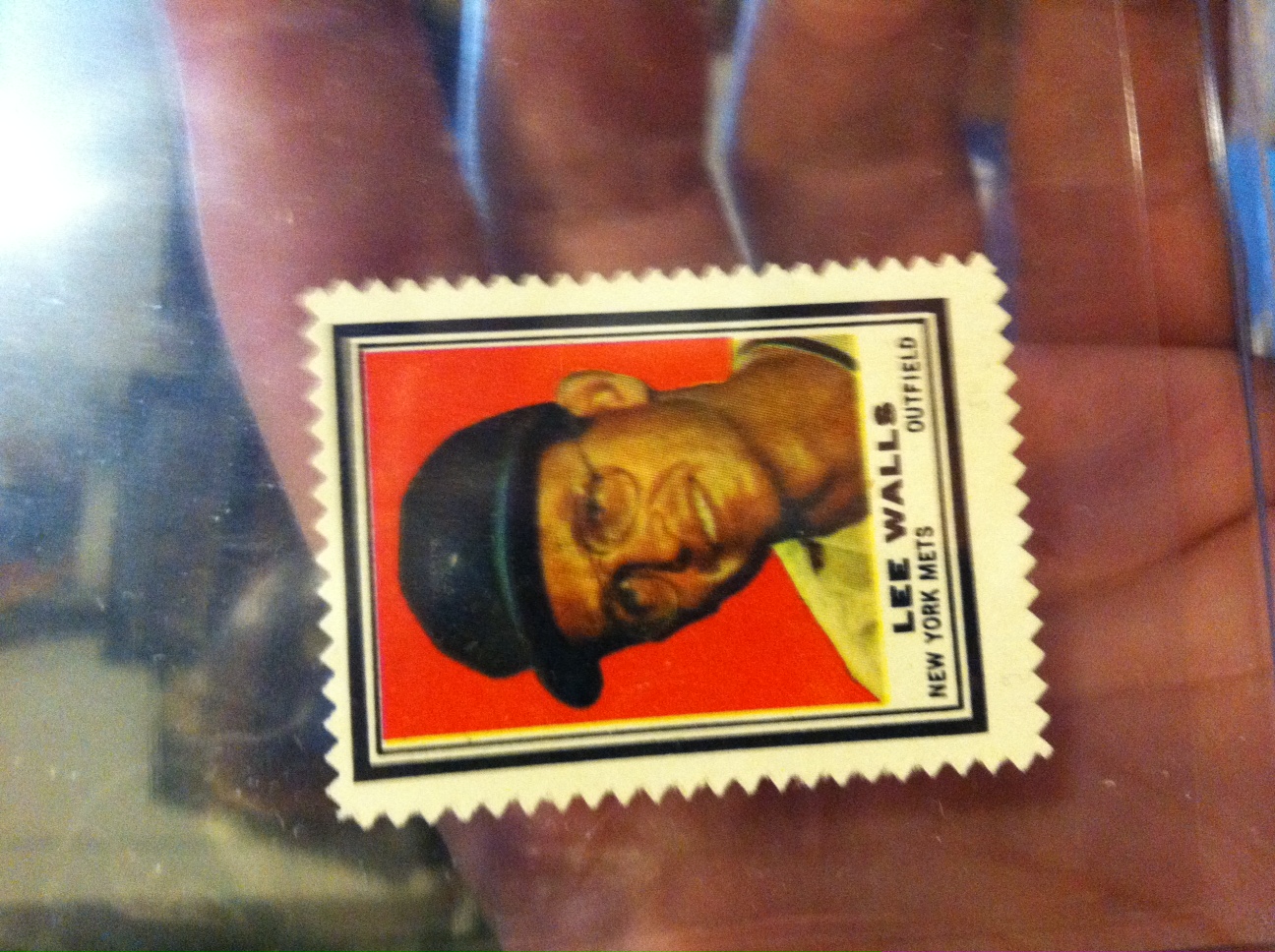
The first player in the THB Expansion Draft lineup is Hobie Landrith, the ur-Met. So it runs from there — immortal names such as Elio Chacon, Ed Bouchee, Choo Choo Coleman, Sherman “Roadblock” Jones, Jay Hook — until you get to the 22nd and final player, Lee Walls.
Who?
Ray Lee Walls, of course.
Lee Walls was indeed a Met in October 1961. But he wasn’t one by April 1962: In December Weiss traded him, along with $100,000 of the Mets’ money, to the Dodgers for Charley Neal and Willard Hunter. Walls, by the way, had cost the Mets $125,000 to select, so it cost the Mets $225,000 in 1962 dollars (about $1.7 million today) to watch Charley Neal hit 11 home runs and boot several zillion balls.
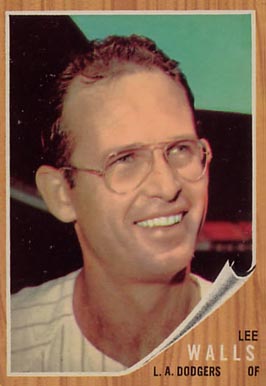
In THB terms, Walls’s legacy is a 1961 Topps card in which he’s wearing a Phillies uniform and his trademark spectacles — the only player enshrined in The Holy Books who never played for the Mets. It’s an interesting distinction, but I wondered what other Mets traces Walls might have left. And I wondered about him.
First up, his cardboard legacy.
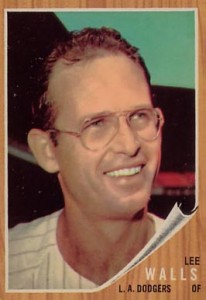 Walls wound up with two 1962 Dodgers cards — one in which he’s looking to his left and a variant in which he’s looking to his right. He’s hatless in both — standard Topps procedure as insurance against players changing teams. (This was also the era of horrific repaints of hats and uniforms by Topps to transfer late acquisitions into new uniforms, with little regard for players in the background — or sometimes the laws of physics.) The shot of Walls looking to his left has him in pinstripes that look a lot to me like Phillies’ pinstripes tinted gray. This, probably, was going to be Lee Walls’s 1962 Mets card, then replaced by a pinstripe-less shot. (I’m not going to swear on it — ’62 Topps is full of odd variations in photos, tint, etc.) Walls wound up with two 1962 Dodgers cards — one in which he’s looking to his left and a variant in which he’s looking to his right. He’s hatless in both — standard Topps procedure as insurance against players changing teams. (This was also the era of horrific repaints of hats and uniforms by Topps to transfer late acquisitions into new uniforms, with little regard for players in the background — or sometimes the laws of physics.) The shot of Walls looking to his left has him in pinstripes that look a lot to me like Phillies’ pinstripes tinted gray. This, probably, was going to be Lee Walls’s 1962 Mets card, then replaced by a pinstripe-less shot. (I’m not going to swear on it — ’62 Topps is full of odd variations in photos, tint, etc.)
But Walls did make the Mets in one Topps line — Topps Stamps. He’s No. 140, right between Bob L. Miller and Don Zimmer (who appears in a Mets hat on his ’62 Cincinnati Reds card, but that’s another story). I’d never heard of Topps Stamps, but I couldn’t resist the pull of Lee Walls identified as a New York Met. When the stamp came around on eBay, I bid on it, steeled myself not to go too crazy over a niche product featuring a guy who’d never actually worn orange and blue — and won it for the grand total of 99 cents.
Perfect condition, too.
So much for Lee Walls and Topps. But what about the man himself?
Lee Walls’s trade to the Dodgers was a blessing for him — he was a California kid, a renowned schoolboy athlete who’d thrown four no-hitters at Pasadena High. That was enough for Branch Rickey to give him a $12,000 bonus and a contract with the Pirates in 1951. Rickey saw Walls could pitch, but he also saw that he could hit, and a few spring-training home runs led the Mahatma to turn his new acquisition into an outfielder. Walls hit .342 for Modesto in 1951, then .308 for Waco the next year, which earned him a call-up to the Pirates as a 19-year-old. He hit .188 and wouldn’t be seen in the big leagues again until 1956.
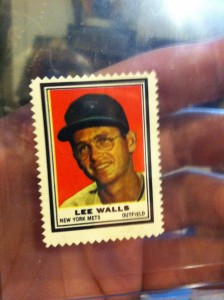 Most of my heroes ain’t found on no stamps… Walls spent three years playing for the Hollywood Stars of the Pacific Coast League. With the Dodgers and Giants still in New York, that was by no means a bad life — and Walls seems to have a ball supplementing it. He played gunfighters in Westerns and was a maitre d’ in a Palm Springs restaurant, where one day Miss Palm Springs and some friends came in to sell buttons promoting a rodeo. Walls parlayed the button into a date, and the date into a marriage. (Later teammates remarked that Walls had a gift of gab and loved charming his way into fancy restaurants where he and his companions had to stick to the cheap end of the menu.)
The Pirates brought Walls back to the big leagues in 1957, but soon traded him to the Cubs. In 1958, he’d become a folk hero — and a bit player in a baseball drama. The relocated Dodgers were playing in the Los Angeles Coliseum, where the left-field foul pole was just 257 feet away — an arrangement that prompted dire warnings that baseball’s home-run records would be besieged.
Those warnings seemed prescient on April 24, in the Dodgers’ fifth home game. In the first inning, Walls hit a two-run homer off Don Drysdale. In the fifth, he hit a three-run shot off Roger Craig. In the seventh, he hit another three-run homer off Ron Negray. Scribes howled, but Walls defended himself: All three homers had gone over the fence by a comfortable margin (just ask Walter Alston, he insisted), and he’d spent the off-season lifting weights to strengthen his wrists and forearms — heretical advice at the time, but touted by no less than Ted Williams.
Walls continued his home run barrage and became an All-Star during his finest season: a .304 average, 24 homers and 72 RBI. His unlikely heroics and horn-rimmed dark glasses earned him a pretty fantastic nickname from Cubs fans — “Captain Midnight.” His few months as a slugger would also intrigue a Kansas kid who wondered about ballplayers’ brief streaks of stardom, their explanations for such sudden success, and whether those explanations were sound or Just So Stories about statistical noise. That kid was named Bill James, destined to revolutionize the game.
Walls was never that good again, but memories of his 1958 campaign kept him afloat as a useful journeyman, one who could play any outfield position competently, and not embarrass himself as a corner infielder. He could pinch-hit — in ’62, he collected 13 hits in 27 at-bats for L.A. — and newspaper accounts from the early 60s hint that he’d become a wise old hand, respected by Alston and a reliable quote for reporters. But for all that, he was done in 1964, at 31. He played for the Hankyu Braves in 1965 (they’re now the Orix Buffaloes), but would never return to the majors. At least not as a player — he did make it back as a coach, one of Billy Martin’s confidantes with the A’s and then the Yankees, where he earned the derisive nickname “Echo” for supposedly repeating whatever Martin said.
Walls died in 1993. He was only 60. No, he was never a Met. But he lived a pretty interesting baseball life nonetheless.
by Jason Fry on 22 March 2012 11:24 pm It used to be a March ritual around here, or in our email exchanges: I’d ask Greg about some non-roster player or prospect in camp, his reply would be oddly noncommittal, I’d ask what was up, and he’d admit — with ill-disguised anguish — that this year he just wasn’t feeling it, that he wasn’t getting excited the way he usually was, and maybe this was the year his attachment to all things Mets withered or even broke.
It never happened, and eventually I came to treat Greg’s annual moment of doubt as part of the spring-training calendar, typically coming about at the midpoint between dopey stories about all the guys In The Best Shape of Their Lives and dopey stories hashing out roster spots 24 and 25, as if there isn’t going to be a last-minute waiver-wire transaction or dog-and-cat trade that turns the whole thing into an academic exercise. It’s as much part of the run-up to Opening Day as the first daffodils.
This year has been weird, though. It’s like our positions have been reversed. I haven’t heard a peep from my blog brother about not feeling it, but I’ve been busy or traveling, and have found myself popping my head up to note with shock that spring training is hurling by and the season is somehow nearly upon us. I’m the one who feels out of sorts and ill-prepared.
Throw in the oddity of the weather — tonight you’d think it was June in New York City — and I’ve really been thrown for a loop. Sure, unseasonable warm periods happen — 14 years ago, Greg and I spent 14 innings sprawled in our seats at Shea on a 88-degree Opening Day, exchanging disbelieving personal weather reports until Bambi Castillo beat the Phillies — but this year fall went out for a smoke break and spring came back. I’m not complaining: It was damn nice walking across Brooklyn today listening to R.A. Dickey throttle the Astros (whose 50th anniversary season doesn’t sound full of promise either) with the sun shining down and people beaming at each other from behind their shades. The flowers are up, the grass is turning green, the trees are budding — so what if the calendar seems to be a month off?
When I joined the broadcast (it was the Astros team, and they ain’t world-beaters) Dickey hadn’t given up a hit. That held true as I strolled from Flatbush to Downtown Brooklyn to Brooklyn Heights. The weather suggested T@m Gl@v!n# should be laboring to make Mets history with Kit Pellow waiting in ambush; out in the bright sunshine it was easy to think for a moment that what Dickey was doing really, really mattered, that if he got through that 27th out you’d see people paused with a hand to an earbud, stopping those in blue and orange hats, and that you’d be part of the slow spread of the amazin’ amazin’ amazin’ news. But no, Dickey couldn’t make history and didn’t make Grapefruit League history either. Which was good — jerks would have just made fun of us for it anyway.
(By the way, I love that the Mets PR department said there had been two Grapefruit League no-hitters by the Mets and Adam Rubin could only find one — a position apparently backed up by Howie Rose. It’s nice that there’s some part of baseball where stats and record-keeping is of the shrug-your-shoulders and what-the-hell persuasion.)
I’m not particularly worried about my out-of-body experiences, though they do seem to be adding up — for instance, I was in New Orleans when word of the Madoff settlement came, and so extracted analysis from my cellphone between gorging myself. The season will come and I’ll snap into focus, recording new Mets for The Holy Books and overanalyzing every move by David Wright and Jason Bay to divine if they’re rejuvenated and appraising the new walls and cheering for the resurrected Johan Santana and Ike Davis and hoping for the continuing development of Jon Niese and Dillon Gee and Ruben Tejada and Daniel Murphy and Lucas Duda and of course spinning goofy scenarios in which everything goes right and we pull a Norfolk State on the powers that be.
Or at least that’s what I assume will happen — my internal clock has been Mets-based for so long that the rhythms of being orange and blue have got to be encoded in my DNA by now. (Yeah, I know it doesn’t work that way. Hush.) Still, it’s funny — you spend the winter staring out the window waiting for it to be (officially) spring, and then March surprises you by hurrying along, at neck-snapping speed, to where you were waiting to be.
|
|