Faith and Fear in Flushing made its debut on Feb. 16, 2005, the brainchild of two longtime friends and lifelong Met fans.
Greg Prince discovered the Mets when he was 6, during the magical summer of 1969. He is a Long Island-based writer, editor and communications consultant. Contact him here.
Jason Fry is a Brooklyn writer whose first memories include his mom leaping up and down cheering for Rusty Staub. Check out his other writing here.
Got something to say? Leave a comment, or email us at faithandfear@gmail.com. (Sorry, but we have no interest in ads, sponsored content or guest posts.)
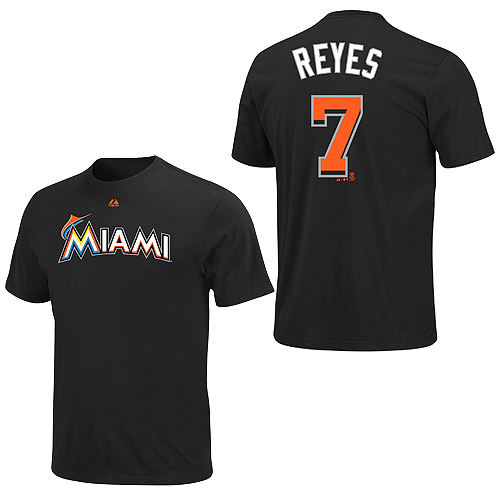
A confession: since the first week of December, I’ve been window-shopping at marlins.com. I’ve eyed, ogled and contemplated Item No. 12551066: Miami Marlins Jose Reyes Name and Number T-Shirt by Majestic Athletic. Out of curiosity after Reyes made his free agent decision, I looked to see if such a garment existed. It did, and it was back-ordered, so I forgot about it. Then in the depths of winter, I checked again. It was in stock and promised to ship within one to two business days, which gave me pause but then I rejected what I was thinking. Yet I kept checking back, never making a move, but never completely deciding against it. Then, today, I received an MLB e-mail alerting me there was a discount on just about everything they sell, including Item No. 12551066. The 25% Off brought it down to a reasonable-sounding price. All I had to do to was order it by four o’clock this afternoon.
That and lose my mind…which I almost did.
I came close. My browser was already in Secure Shopping Cart mode and my wallet was on my desk. Enter my info and it would be mine. I would own my seventh variation a REYES 7 t-shirt.
But I entered nothing. I couldn’t do it. No matter how much I wish Jose Reyes was still a Met. No matter how much I resent Mets ownership for finding a way to not have the resources to re-sign him or at least truly pursue him. No matter how I saw the shirt mainly as a statement of protest that one of the two or three best position players the Mets have ever developed was allowed to dash to sunnier, more lucrative climes. No matter that in this season celebrating the Mets’ 50th birthday, their all-time shortstop will be conspicuously absent from all festivities and montages as if he never existed.
I wanted REYES 7 on my back once more, but there was no way I could handle MIAMI on my front. Wrong affiliation for him, wrong affiliation for me. This despite deciding I had precedent in the potential purchase’s favor since I once owned a CINCINNATI 41 t-shirt (discovered at Shea Stadium, no less) and my deep-seated hope that Jose stays healthy and succeeds wildly, albeit in a vacuum of team non-competitiveness, for the next six years.
I will root against his employers and colleagues but I will not root against him.
I’m already permanently disgusted a hated division rival was suddenly so well-positioned to lure away my favorite player of the past decade. My giving them an additional $18.76, or whatever cut Jeffrey Loria would grab of the discounted t-shirt price, wouldn’t make me feel any better about the turn of events that leaves me Reyesless except in memory. It was too logical to not realize before I clicked off marlins.com once and for all. It was even emotionally resonant. My hatred for the franchise that pulled the rug out from under the last two final weekends that absolutely mattered in Mets history burns a bright teal…or orange…or black…or yellow…or whatever colors they now feature.
So I wound up making a pro-Mets statement, which is what I usually make, by not making an implied anti-Mets ownership statement, which was never intended to have been a pro-Marlins statement but couldn’t help but be perceived that way if I actually wore something bearing their stupid crest.
This, I suppose, is how the Wilpons get ya every time.
Lily Tomlin once wondered “what it would be like if we all became what we wanted to be when we grew up. I mean, imagine a world filled with nothing but firemen, cowboys, nurses and ballerinas.” In that fanciful spirit, imagine a world based entirely on the things we’ve seen in Spring Training.
The Mets hardly ever win.
The Mets hardly ever hit.
The Mets hardly ever heal.
With childlike wonder, we believe these trends — manifesting themselves in games that have never counted, don’t count now and will never count — represent the reality we are certain will always exist. We’ve been watching this particular spring’s baseball for a little more than two weeks, thus making it the only baseball we know.
It does quite the number on our highly impressionable psyches.
First we grow restless from the lack of winning, the lack of hitting and the lack of healing. Then we grow discontented, filling our minds with every conceivable form of Met anxiety. Then we grow a bumper crop of dubious assumptions (such as only Scott Hairston can replace Andres Torres and nobody can truly replace Scott Hairston, ergo we are irreversibly screwed) in the space where our long-term memory of previous springs’ chimeras ought to go. We forget that in other years when Met Marches were clunky, it didn’t much matter…and that in other years when Met Marches were smooth, it didn’t much matter, either.
Then we grow out of it, generally at a point between the last approving mention of “the berm” and the moment the Shea family presents our manager with a floral horseshoe of good tidings for what lies ahead. What lies immediately behind will be forgotten so completely that when next spring rolls around, we won’t remember any of it and we’ll go through the same mental machinations all over again.
Which, of course, is why fans need Spring Training just as much as the players.
If the Wilpons are still running this team for years to come and the Mets have been restored to some semblance of vitality because the organization is no longer distracted by an issue bigger than baseball, today’s settlement of the case concerning their involvement in the Bernard Madoff Ponzi scheme before it could go to trial was a good thing. If the Wilpons eventually have to sell anyway in light of all the zeroes that continue to follow them around and the Mets franchise is reinvigorated for the long term by new ownership, today’s settlement should be marked down as, at the very least, not a bad thing.
If the Mets continue to operate as if they’ve taken up residence in Kansas City because the Wilpons and all their presence implies are still here, then the settlement is lousy news. If the Wilpons still have to sell and the new buyers are worse owners than this crew has been — which is certainly a possibility despite the two bitter, barren periods (2002-2004, 2009-present) over which current ownership has presided in the past decade — then it’s not good.
That’s the least sophisticated analysis I can offer, perhaps the least sophisticated analysis you will read in the wake of the Wilpons apparently getting off cheap. At the risk of not taking into account whether justice was or wasn’t done, I’m going to take the provincial view and concentrate on whether this was good for the Mets…and by “the Mets,” I mean us, the Mets fans. Will we, when the current dust settles, have a team that year in, year out has a chance to compete and make us more proud than disgusted?
I don’t know. But that’s what will tell me if any good came out of this settlement today.
It’s relatively big news to us when former Mets show up in the majors in non-Mets uniforms. It’s huge news in Japan when somebody from their leagues show up in the majors (our majors, I guess they’d say). Yu Darvish as a Texas Ranger is the latest example of a Japanese star causing a Japanese stir simply by playing in America. What’s rarely more than a line or two in the agate type, however, is when former Mets become current Swallows or Lions or what have you. Yet it’s happened far more often than any of us who doesn’t track these things probably realizes.
Eric Hillman, for example, was an enormous New York Met of little renown in the first half of the early 1990s. Then he seemed to just disappear, which of course didn’t happen because you can’t make a 6’ 10” pitcher disappear, no matter how hard he is hit. Hillman went to Japan after the whole Mets thing didn’t work out and had a great time pitching for a former Met who never played in Japan but became its most famous manager (to us, anyway), Bobby V.
“I busted my butt and played well for him in Norfolk, in Tidewater, and he says, ‘you wanna go?’ and I said ‘yeah, I’d love to.’”
In a rollicking, must-listen interview with SportsTalkNY — mesmerizing less for his throwing former teammates under the bus than standing up and pointing out to the driver which of the erstwhile passengers were causing the ruckus that made the bus fly off the cliff — Hillman reflects for a few minutes on his time in the Land of the Rising Sun. Well, “reflects” may not be the right word, considering the first thing he talks about his height relative to the size of the standard Japanese toilet (Hillman never pitched for St. Louis but he sure is a card), but the remembrances are definitely fun and insightful.
Eric went to Japan and received “fight money,” significant bonuses of several thousand dollars doled out for winning efforts. “Luckily, I won a lot over there,” Hillman said, marveling that “the wild thing about Japan is they just leave it on your stool.”
“When you come in the next day, your money would just be in an envelope, in cash, on your stool, and they never 1099’d me for that stuff or anything.”
I have to admit I had no idea until Metstradamus mentioned the interview that Eric Hillman had pitched in Japan. With a couple of exceptions, I had no idea until looking it up that dozens of players who spent time as Mets found themselves playing baseball half a world away when the Mets and the rest of MLB were through with them.
Because Bobby V was so high-profile in his second term with the Chiba Lotte Marines, I knew Matt Franco and Benny Agbayani followed him to Japan and helped him win a championship. I was vaguely aware of a few other names that had gone West to East over the decades, such as Wayne Garrett (a Chunichi Dragon when his 1969 Met teammates were celebrating the tenth anniversary of their miracle), Tom O’Malley (who pinch-hit one memorable homer as a Met in 1990 and later won an MVP award for the Swallows) and Mike Hessman (whose sole Met home run in 2010 fascinated me enough to notice the agate type mentioning he’d signed with the Orix Buffaloes).
According to my exhaustive research — consisting of a thought-provoking e-mail thread with some friends, skimming a Wikipedia page listing expatriate American players and cross-referencing that with Baseball-Reference — I count about forty former Mets who continued their careers in Japan (as opposed to American players who boomeranged back from Japan to careers in America, such as Pat Mahomes, Brandon Knight, Julio Franco and current currency-waster D.J. Carrasco).
You know which ex-Mets go to Japan to keep playing baseball? Not great ones, to be perfectly frank. Probably the biggest name in the bunch, if it’s not Agbayani or Garrett, belongs to Kevin Mitchell, The man who scored the tying run in Game Six spent part of a season as a Fukuoka Daiei Hawk in 1995, after leaving the Reds and before realighting as a Red Sock. This was six years after he was Most Valuable Player of the National League and nine years after his crucial World Series base hit.
That figures. You don’t go from America to Japan at the top of your game. You go when you don’t have a better American option. You go when you’re Mike Marshall — the first baseman, not the pitcher — and it’s 1992 and you haven’t been an All-Star since 1984 and you were utterly ineffectual as a Met in 1990 so you give being a Nippon Ham Fighter a shot. You go when you’re Gary Rajsich, the great Tide hope whose impending brilliance gave us something to look forward to during the strike of 1981 but whose ensuing Met tenure in 1982 and 1983 didn’t quite measure up to his Triple-A notices; he extended his livelihood as a Chunichi Dragon from 1986 to 1988. You go when you’re Don Zimmer, the first failed 1962 Met third baseman, determined to hang on as a Toei Flyer in 1966.
You go if you enjoy a stockpile of cult cachet among Mets fans (Bruce Boisclair, 1980 Hanshin Tigers) or just a hint of it (Kelvin Torve, 1992-1993 Orix BlueWave). You go if your “future star” status from the back of the Mets yearbook never quite came to fruition (Ike Hampton, Kinetsu Buffaloes, 1981). You go if you were a few tools short of what the Mets swore you were packing (Alex Ochoa, Chunichi Dragons, 2003 to 2006). You go if you enjoyed a solid, unspectacular stretch in orange and blue (Mark Carreon, Chiba Lotte Marines, 1997-1998). You go if your extra-inning homer spoiled somebody else’s playoff hopes but you never homered again (Craig Brazell, Sataima Seibu Lions, 2008).
Even if you didn’t know who went before you looked it up, you’re not surprised that their ranks include a slew of Mike Fyhiries, Shawn Gilberts and Jon Nunnallys. It’s not surprising, either, that Lastings Milledge, a top draft pick who famously didn’t pan out, and Chris Carter, a pinch-hitter judged quickly by a new regime as fatally one-dimensional, are preparing to join the ranks of Met gaijin. You’re only surprised when you hear a former bit Met who lengthened his career in Asia might be coming back…as C.J. Nitkowskimight be.
The least surprising aspect of any of this? That baseball players will attempt to immerse themselves in a completely foreign culture nearly 7,000 miles from Flushing (or at least put up with it) to keep playing baseball. Baseball is what they do and, I think we’d all agree, baseball is just that great, no matter where it is played.
Plus those envelopes filled with fight money sound pretty sweet.
(NOTE: Readers have pointed out Edgardo Alfonzo and Felix Millan were pretty fair Mets who extended their careers in Japan, Fonzie as a Yomiuri Giant and Millan as a Taiyo Whale. I’d say they move to the front of this particular class.)
If you can handle a brief diversion from achy players and tetchy managers (not to mention defendant owners), it overjoys me to report that in a rare March game that counted and got my attention, it was USF 65 Cal 54Wednesday night in Dayton. Really, it was more like Silent Cal, as they trailed your University of South Florida Bulls by as many as thirty, thus reminding me of the lady who told notoriously taciturn President Coolidge that she’d made a bet that she could get him to say more than two words. His response?
“You lose.”
Enough about the Golden Bears. It’s the Golden Brahmans — as my alma mater’s teams were long ago known — who are moving on in the NCAA Tournament for the very first time. USF was previously party to March Madness in 1990 and 1992, one and done on both occasions. This year, we seeped into truTV’s prime time lineup as one-eighth of what they call the First Four. Some said we didn’t belong, not even on the outskirts of the Big Dance. But the First Four represented a foot in the door, and now we’re fully inside the gymnasium.
Next up for the Bulls is Temple on Friday night. I don’t think I’ve been so excited by such a prospect since I was nine and briefly entranced by what they were telling us in Hebrew school.
Tim Byrdak is slated to miss six weeks because of knee surgery. While we wish him well, what’s six weeks when compared to 72 years? And what’s torn meniscus cartilage next to a wet schmaltz sandwich?
A wet schmaltz sandwich isn’t yet another injury for which Mets doctors have no known cure. Rather, it was a symptom of why Cousin Milton went on baseball’s inactive list in 1940 and came off it only last week.
Cousin Milton isn’t my cousin, but my friend Jeff’s. Jeff planned a March trip to visit family in Florida, which made for a convenient excuse to take in a Mets-Marlins game at Roger Dean Stadium in Jupiter (or it might have been the other way around). Cousin Milton joined Jeff, his son, Dylan, and his dad, Murray, at the ballpark, which wouldn’t be terribly noteworthy except it was Milton’s first live, professional action in 72 years.
That’s even longer than it’s taking David Wright to resume baseball activities.
Why the gap? As Milton explained to Jeff, he was a lad in Brooklyn before the war when he got his first chance to attend Ebbets Field. It was, he recalled, the Dodgers and…well, he had to think about it. Maybe it was “a team that isn’t playing anymore; maybe the Pittsburgh Pirates” (Dear Pirates: your profile could use raising). The important thing was there was a ballpark; and there was Milton and his cousin Murray; and there were the schmaltz sandwiches they brought from home; and, most vividly, there was a revelation once the kid got to his seat:
“He said that he never saw grass that green.”
You hear that a lot from adults remembering their first baseball experience, but in this case it’s no default cliché. “You have to remember,” Milton reminded his relatives in 2012, “there was no TV.” To know a lawn grew in Brooklyn, you had to see it for yourself.
Alas, Milton saw the grass, but he didn’t see a game. He saw rain. Great for the grass. Not so great for baseball. “The sandwiches were ruined,” Jeff relays from Milton, leaving one to contemplate how a sandwich featuring rendered chicken fat wasn’t already a precarious proposition. On top of that, Milton caught a cold “and his mother yelled at him for going.”
And he never went again, until last week.
A few things to consider, beyond how someone left the schmaltz out in the rain:
1) Seven decades and change later, much has come, much has gone, but baseball remains. If ever you require additional evidence to back up the “one constant” speech from Field Of Dreams, I’m sure the trustee won’t mind if you call Cousin Milton to the stand.
2) Though Milton caught hell as well as that cold and maybe let baseball slip away from his daily concerns, when the family got together for dinner after the game in Jupiter, he could still rattle off every National League lineup of the era from when he was a boy and he really cared about such things. Says Jeff, “My father never heard him talk about baseball before.” (The one constant through all the years, Ray…the one constant through all the years.)
3) While nobody would dispute Milton’s characterization of the verdant Ebbets outfield, what he might have witnessed before the weather got the best of him, Murray and their lunch can’t help but be a little hazy 72 years after the fact. Milton said the game was rained out in the second inning and Paul Waner, the Pittsburgh Hall of Famer who allegedly received his “Big Poison” nickname from the Brooklyn fans (so as to distinguish him from his brother, Lloyd, the little person — or “poison” in Flatbushspeak), homered. Except when you comb the Sporting News and New York Times archives, you learn it rained through batting practice and fielding drills on Thursday afternoon, May 23, 1940 — the date of the only Pittsburgh at Brooklyn rainout of that season — and the Bucs and Bums never actually got started. Depending on how wet our guys allowed themselves and their sandwiches to get, they might have seen a pretty good show anyway. According to the Times, Pee Wee Reese (then a rookie), Cookie Lavagetto (later a Met coach under Casey Stengel) and Vito Tamulis (a lefty pitcher) took the field after the game was called and had coach Charlie Dressen “slash” grounders at them “while a handful of incorrigible fans who were still in the stands applauded vigorously”. Maybe Milton and Murray were part of that crowd. Maybe that’s how you catch a cold.
4) Oh, Milton’s mom…how could you snuff the candle on your boy’s baseball fandom so early in life? Because he got sick? He got well again. The Dodgers would only be in Brooklyn another seventeen years. What a shame Milton never got another look at that green grass. What a shame he wasn’t of a baseball mind to have his passion reignited when the Mets came along five years after the Dodgers vamoosed. At least that’s the view of someone whose first game at Shea Stadium was missed because he had a cold. If I’d caught it there instead of a few days earlier in September 1972, perhaps my mother would have attempted to have brought the hammer down my budding baseball affections when I was just a lad. It wouldn’t have worked (we had TV by then) but it could have gotten ugly. On the other hand, what would have been just another Spring Training game last week wouldn’t have become a connection to all that once was good, and all that could be again.
5) If you eat schmaltz sandwiches when you’re a kid (except for the ones that are soaked through), there’s apparently a decent chance you’ll live into your eighties. Who knew?
You’ve all seen it: The fan who draws back from the bar or the TV with a look somewhere between shock and disbelief on his or her face, then gets it together and manages to mutter, “Oh man … THIS TEAM.”
If you’re true to the orange and blue, you’ve probably muttered that yourself a few thousand times in the last few years. You’ve probably also noticed the media and fans of other teams behaving like vultures, all too eager to broadcast the latest Mets-related disaster. You’ve probably gotten pissed off about this. And perhaps you’ve sworn that you’ll be less quick with the groaning and the muttering, determined to starve this particular narrative. Heck, it’s not like the Mets haven’t had company in their recent misery: The Yankees and Phillies saw playoff series end with sluggers taking called third strikes, while the Braves and Red Sox rolled into this year’s spring training not wanting to talk about stunning collapses. No other team’s financial foundation has been damaged by a white-collar criminal in quite the same way as Bernie Madoff, but the Rangers and Dodgers have been roiled by balance-sheet woes and ownership crises.
So no, we aren’t unique or alone.
But for all that, “Oh man … THIS TEAM.”
Johan Santana’s looked pretty healthy (though slow on radar guns) and Ike Davis seems to be both mobile and unaffected by Valley Fever, but everybody else seems ready for the knacker’s yard. Say temporary farewell to Scott Hairston, who’d been in Port St. Lucie about five seconds before succumbing to last year’s oblique injury. Say goodbye for now to Tim Byrdak, reduced to photobombing Facebook snaps of pissed-off people in hospital waiting rooms, as his torn meniscus will keep him out of action for four to six weeks. David Wright is in New York, getting an MRI for a rib-cage injury. Lucas Duda’s battled back problems. So has Danny Herrera. I can’t spell Kirk Neuwenhuis’s name without cheating, but “oblique” rattles off my keyboard thanks to long practice. I couldn’t pick Robert Carson out of a police lineup, but I know he’s been held back by an intercostal muscle, which I’ve never heard of and assume is one of those parts of the body that exists just to sideline baseball players. (See also: hamate bone.) And of course Reese Havens has shed a part or two somewhere along the way.
I know, it’s not yet St. Patrick’s Day. Injuries heal, the bad luck of March can be long forgotten by May, and the Mets likely won’t be as bad as all the hyenas out there seem to think. (Which isn’t the same as saying they’ll be good.) And soon we’ll have regular-season baseball back, which will be a boon and a blessing even if the DL’s more crowded than we’d like.
But guys in MRI tubes and under the knife and not on the bus … it’s an old, unwelcome refrain, and at this point I can’t blame my fellow Mets fans who look up and assume they’ll find a little black cloud sitting right overhead.
Mike Pelfrey’s still here, isn’t he? And if he’s still here, he’s going to be Mike Pelfrey, isn’t he?
It’s a fact of life. Pelf’s gonna go out there and drive us nuts. He’s gonna put somebody on the twelfth pitch of a 3-2 count that he started ahead 0-2, he’s gonna balk him over to second, he’s gonna wander around behind the mound wondering if he left the stove on, he’s gonna contemplate the dryness of his fingers and…
That’s the thing. You just don’t know. Pelf is very capable of building himself a mess yet attaching a secret exit we can’t believe he had the sense to include in the blueprints. He might throw thirty pitches in that inning, yet escape relatively unscathed. Or he might remain in that inning long enough so that it swallows the entire game whole. He might kill us or he might save us. It’s rarely neat and it can be as agita-inducing as any Met closer’s ninth, except with Pelf, it can come in the first as easily as the third or the fifth.
If he sees the seventh, it usually means he’s left trouble behind him. Or it didn’t seem worth the trouble of getting Elmer Dessens up a third time.
We’re talking about 2011’s Opening Day starter here, a guy who flirted with All-Stardom in 2010 and seemed practically corner-turned as far back as 2008. Mike Pelfrey is not unskilled, untalented or wholly unsuccessful. But boy can he suck the life out of a day or night at the ballpark.
He doesn’t even need to wait for the season to start. Just a couple of days ago he was eminently uninspiring in one of those games that doesn’t count. I heard it dissected by two gentlemen of advanced age as I stood in the checkout line at Waldbaum’s that very night.
“Didja see it today?”
“No. What happened?”
“They lost. Pelfrey was terrible.”
“Uch.”
“If it wasn’t for Pelfrey in the first inning, they would’ve won.”
As enamored as I am of the concept of being allowed to cancel out the inning of our choice so as to promote better results for your team (as long as others can’t do it to us), I was more impressed that Mets fans aren’t waiting for the regular season to be discouraged by Mike Pelfrey. And it ain’t just Waldbaum’s talking. Promenade Reserved groans as Pelfrey struggles. Twitter shifts into oversnark. Eyes everywhere roll.
At age 28, Big Pelf has found his niche. He’s our pitching scapegoat, our figurative punching bag, our default reason (besides ownership) why things aren’t better around here. Jason Bay, too, I suppose, but they’re lowering and bringing in the fences for Bay, so reasonable judgment must be reserved at least another couple of months on his behalf. Plus he runs hard and once took on a wall with his face.
Pelfrey? His thoroughfare to rational forgiveness is closed to emotional traffic every fifth day. For example, consider those shorter and closer fences. Batters in non-Mets uniforms get to swing at them, too. Theoretically it shouldn’t matter that much to a sinkerballer like Pelf, but wait for the one grounder that eludes the combined efforts of Tejada and Murphy. Experience as empathetically as possible the spiritual journey that unfurls as the pitcher tries to come to grips with the unideal situation at hand. Watch him with digits tensed (yours, his) until he gets one up to Hunter Pence or some other divisional irritant.
Yeah, the fences’ll matter. Everything’ll matter. And unless Pelfrey has harnessed his command while quelling his his doubts, he will make us all nuts.
Pelf’s blame niche is not one to take lightly. It’s different from being simply reviled the way Oliver Perez was or derided as Steve Trachsel was or wearing out his welcome as John Maine did. The critical mass for Pelfrey is different, befitting someone who has come up through the system, carried large hopes on his broad shoulders and largely left them unredeemed. It’s not that Pelfrey is an object of hatred. He’s too likable to inspire genuine vitriol. But he does demonstrate a knack for inviting blame.
When strikes aren’t thrown and outs aren’t collected, who ya gonna blame? Before ya start throwing bodies from the bullpen, I mean?
You can’t blame Santana. He was Santana before he got here, and whatever’s gone wrong is presumably more the fault of the Mets being the Mets than Johan ceasing to be Johan.
You can’t blame Dickey. Dickey’s entire Met oeuvre is thick, fascinating gravy, and it comes accompanied by a half-dozen beguiling biscuits besides.
You can’t blame Niese, because Niese is a lad of 25 and lefthanded and maybe has been held back only by not being able to breathe correctly, a situation to which he’s apparently tended (with an assist from an old teammate).
You can’t blame Gee, because honestly, you barely knew who Gee was before September 2010 and you only noticed Gee was faltering by late summer 2011. Give the kid a chance! He won’t be 26 until April! It’s not like he’s Pelfrey and 28!
Somebody’s inevitably gotta blame somebody. It’s the nature of the fan-beast. And Pelfrey’s perfect for the assignment. He’s taller than almost everybody. He was drafted higher than almost everybody. He’s been here longer than almost everybody. He’s almost broken through to the point of consistency but keeps backsliding to the point of madness. Not a few of his outings have shared the Seaver quality of “you’re gonna get to him, you’ve gotta get to him early,” yet they never feel the least bit Terrific, even those you look up from during and realize it’s the sixth, he’s still in there and he’s not losing or at least it’s not over.
Pelfrey’s career trajectory reminds me a bit of the last homegrown righty of extended tenure, Bobby Jones’s, except Jones was dependable when nobody expected much out of him, a fright to watch when we assumed he had taken the next step and then delightfully surprising just after we gave up on him altogether. Jones also had the good sense to get out of town two starts after his signature 2000 playoff one-hitter. If Bobby Jones comes up among Mets fans a dozen years later, it’s to be toasted for shutting down the Giants and instigating a celebration. It’s not to mention what a frigging disappointment he had been for most of the previous three-and-a-half years when not falling apart might have meant at least one more playoff spot, possibly two.
There has been no defining great start in Mike Pelfrey’s career. He beat the Braves in Turner Field at the dawn of September 2007 but was otherwise implosive the rest of that accursed month. He was outpitched by Brett Myers in one of his must-have games in early September 2008 and made like Mike Paltry the final weekend of the season versus his unyielding Marlin nemeses. There haven’t been many occasions to which to rise since, and Pelfrey’s made the least of those, too.
If you’ve gotten used to blaming Pelfrey, you may have to go in another direction soon. Slated to be the fourth-highest paid Met on the 2012 roster, he’s signed to a one-year deal worth not quite $5.7 million, about 44% more than he was paid for 2011. If he makes it through another year making his starts and piling up his innings (a compensable skill set unto itself these days, regardless of the caliber of the innings), he’ll be up for a substantial raise heading into 2013. Free agency looms beyond that, as do — it is hoped — Matt Harvey, Jeurys Familia, Zack Wheeler and the second coming of Jenrry Mejia. Even if Big Pelf rekindles his 2008 or 2010 best, he might be on track for the Big Squeeze in terms of payroll.
There’s always the chance that the man makes himself indispensable this year. It’s March, so that’s perennially a pleasing conclusion to broach before a season has yet to commence. But we’ve been here with Big Pelf a whole lot since 2006. If the revelatory grip or arm angle or boost of confidence comes and sticks (instead of comes and goes), then swell, of course.
I haven’t had the opportunity to open a freshly waxed pack of 2012 Topps baseball cards yet (it won’t truly be spring until I do), but I got to do something just about as good, probably better, a couple of weeks ago when my friend Sharon and I visited the Met.
Not the Mets, the Met.
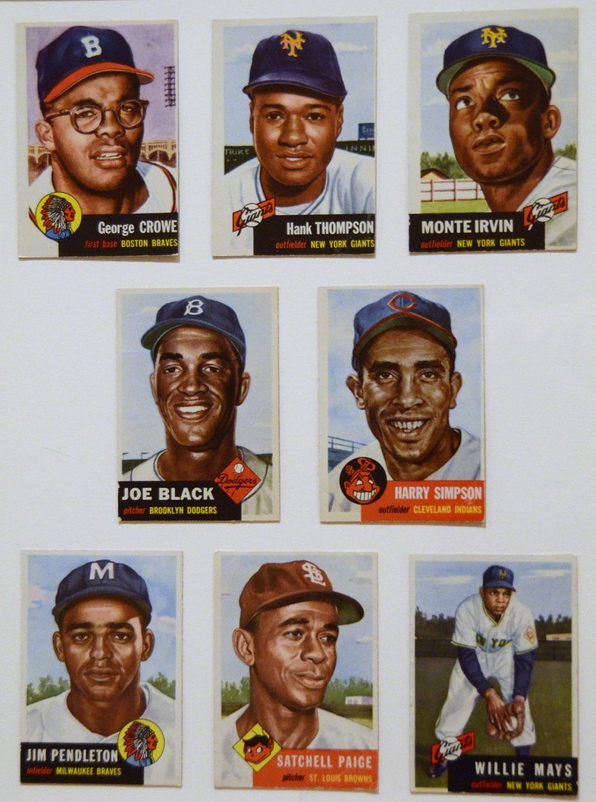
The Metropolitan Museum of Art dipped into its legendary Burdick Collection and set up an exhibit devoted to those ballplayers responsible for Breaking the Color Barrier in Major League Baseball. It takes up but a veritable speck of space inside an immense cathedral, but what it features is larger than life: Willie Mays, Hank Aaron, Jackie Robinson, Satchel Paige and dozens of other greats in their late 1940s Bowman and early 1950s Topps best, streaming ahead in time to future Met Pumpsie Green, pictured as a 1961 Red Sock. (Boston was the last team to integrate, in 1959, thus his inclusion among the immortals.)
Implicit in the display is respect for these pioneering players and a reminder that baseball, like America, sure took its time getting on the right track when it came to justice for all. But let us not undersell what beautiful work these baseball cards were and are. There’s no mistaking why they have a home in a place like the Met. They are art. Those 1953 Topps above, in particular, drew me in to a point where I think I could have produced a few raindrops of my own on a misty day.
Man, I thought after being disgusted all over again that the most wonderful sport ever invented blocked its doors to gifted athletes based not on fielding, hitting or throwing but on skin tone, can you imagine getting a pack of these in 1953? Can you imagine being a kid and opening one? Topps had just gotten into the baseball card business in 1951, had produced its first legitimate set in 1952. By 1953, wow, did they nail it.
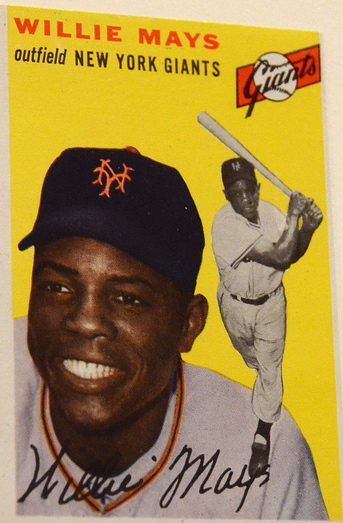
Say Hey, still the stuff of imagination.
Oh, and Willie Mays, New York Giant then, New York Met eventually, Say Hey Kid always. Imagine having him drop out of your pack in 1954, the year he returned from the army and ascended to the top of his game, where he’d stay for the rest of eternity. Imagine Willie and Monte Irvin and Hank Thompson — each represented at the Met — composing the Giant outfield in the first game of the 1951 World Series at Yankee Stadium, the first time three black players manned left, center and right in any “big league” ballgame, let alone in the Fall Classic. Imagine how many people saw a trio of African-Americans on such a grand stage and, a moment later, realized it never should have been any bigger a deal than three white men playing the same positions. Imagine if the Giants were still in Manhattan, and the next time I was heading uptown, it wouldn’t be to a museum on Fifth Avenue but to a ballpark at 157th Street and Eighth Avenue.
I did a lot of imagining during my brief visit. I guess that’s what art is supposed to make you do. Share in the imagining and visit this brilliant exhibition honoring our national pastime. You can find it, fittingly, in the American Wing of the Met through June 17; information here.
Photos (and gallery admission) kindly provided by Sharon Chapman.
***
Jason and I didn’t have to imagine too hard to come up with The 10 Best Things About Being a Mets Fan. The real challenge was limiting ourselves to 10. See for yourself at Yahoo! Sports Big League Stew.
Monday night I did something I’m certain I hadn’t done since the twilight of Fran Healy. I turned down the sound on a Mets-generated telecast so I could listen to the game on radio. GKR heresy, I know, but I gave Gary, Keith & Ron part of the exhibition season opener off so I could get a taste of Josh Lewin’s debut.
WFAN became a revelation for those innings, though not for the reason one might intuit. It’s not that I fell in love with Lewin all at once on his own merits, though he certainly did nothing to make me want to tune him out (which is a victory unto itself given what’s transpired in that booth since Gary Cohen vacated it). It was that I fell in love all over again with Howie Rose because of how he meshed with Josh Lewin. I’d go as far to say I might fall in love all over again with the Mets on the radio again given the simpatico these two seemed to have right off the bat.
At some point between pitches, Josh invoked the 2002 Mets as an example of when things don’t go very well in Flushing. A little later, he brought up the 1984 Mets as evidence that sometimes things go better than expected. Howie warmed to both subjects instantly. Of course he did. He’s Howie Rose. He’s every Mets fan’s rabbi, disseminating our Old Testament — the Book of Stengel, the Book of Hodges, the Book of Frank Howard even — when not tending to balls and strikes.
Think Wayne Hagin ever played to Howie’s strengths? Oh good lord, Wayne Hagin…I so wanted to not detest him if only to push against the popular tide of anti-Haginism that developed as soon as he opened his mouth in these parts in 2008. In four seasons, I never met a single Mets fan who told me, “Y’know who I like? Wayne Hagin.” The nicest thing I ever heard anybody say about Wayne was when I would hear myself say, “At least he’s better than Tom McCarthy.” The second-nicest thing was my characterization of Hagin as someone who knew his baseball and brought a useful outsider’s perspective to this thing of ours. We already know what Howie knows because Howie has been knowing it since 1962 and has been telling it to us in various capacities since 1987. Howie knows what we all know, but at a depth the rest of us could never hope to attain in this lifetime. So, I reasoned at the outset of Hagin’s tenure, let’s hear what somebody who knows other stuff has to say.
It was occasionally enlightening, but mostly it was slow. I’m pretty sure there are galaxies that Hagin’s description of a double play ball from 2010 is just now reaching. And as for that dandy outsider’s perspective, after a while hearing stories about what Dante Bichette or Jim Edmonds would do in this situation lost its charm. By last year, I was as awash in the popular anti-Hagin tide as anybody: get Hagin out of here, I insisted to my radio.
What I disliked most about him was he sapped the sparkle out of Howie’s voice. Half the time, it seemed Howie was explaining the Met way to Wayne, reminiscent of Ralph Kiner drawing Lorn Brown a verbal diagram of Banner Day because Lorn had never heard of perhaps our most beloved tradition (which wouldn’t have disqualified the late Mr. Brown from working in the Mets marketing department over the past decade, I’m guessing). The other half of the time, Howie edged into kvetchiness. Not uncalled for kvetchiness — to the contrary, it was often righteous kvetching (the black uniforms, the Sunday night start times). But it was taking a toll. Between McCarthy for two seasons reminding me he was no Gary Cohen and Hagin disturbing Howie Rose’s chemistry, I grew to consider my hours away from SNY as some kind of Radio Nowhere purgatory.
Which bummed me out no end. Put aside the sublime GKR trinity and how you’d never want to skip their nightly baseball buffet if you didn’t have to (it was so cute listening to them catch up with each other Monday night like they were eighth-graders returning for the first day of school). Mets games on the radio were a cherished way of life for me from the moment I discovered they existed. I almost never felt like I was missing anything if I couldn’t be by a TV, not in the Original Three days, not when Bob Murphy became exclusively audio in the company of Steve Lamar and then Gary Thorne, certainly not in the long and amazing heyday of Murph and Cohen. When Murph retired and Howie Rose was named his successor, and we were granted 162 audiences with Howie and Gary…honestly, I’m not sure why I kept paying my cable bill.
Then our world changed, all for the better where television was concerned, generally for the worst on WFAN. McCarthy was not a worthy partner to Howie. Hagin was not a worthy partner to Howie. It had gotten so bad that I almost didn’t mind Ed Coleman subbing…and every time Ed Coleman says “cut on and missed,” an angel tears out his wings.
Monday night, though, I was living in a double-dream world. There were five announcers on two media (along with amiable roving reporter Kevin Burkhardt) who totally got the Mets thing. Gary and Howie are lifelong Mets fans. Keith and Ron are all-time Mets idols. Josh, we’ve learned, grew up a Mets fan way the hell upstate, choosing Willie Montañez as his favorite hitter, Nino Espinosa as his favorite pitcher and Nino’s afro as his favorite hairstyle. If we didn’t know that about Lewin before Monday night, it was there to pick up on throughout that maiden broadcast.
It was only a few innings of a spring game, so nothing was at stake, but geez he and Howie sounded at ease, and when you get right down to it, that’s what I want. I want two guys with whom I relish spending an evening; the business of home run calls and hit-and-run analysis tends to take care of itself. Howie was the Howie who spent those five-hour shifts edifying and entertaining me when the FAN was new and sports talk could be intelligent. He was the Howie who thrived in 2004 and 2005, when he and Gary broadcast on a special high-pitched frequency only true Mets fans could really hear. He was Howie Rose in full revival, a little like Bob Murphy was when Gary Thorne (and the 1985-1988 Mets) showed up to nudge him back to total Murphness, a state of being every Mets fan intrinsically understands as transcendent.
Part of me still feels a bit bad that we couldn’t hack it with Hagin. It almost seems the easy way out, hiring a Mets fan who sprinkles just the right amount of Metnip in Howie’s vicinity. So many who didn’t have to sit through Hagin’s labored play-by-play or his alien intonations swore he was a sweetheart. I have no reason to doubt it. For all I know, Howie loved him. But I didn’t and we didn’t. Yet I wonder if we as Mets fans have gotten to the point where we have to be spoonfed with blue and orange flatware. Everybody who announces to us comes at us with a Met pedigree. Is that what it takes to satisfy us? If young Bob Murphy arrived here from Oklahoma on a flight with Tennessee’s Lindsey Nelson and Pittsburgh Pirate great Ralph Kiner in tow, would we snarl because we’d assume they don’t get us?
I don’t think it’s geography. Ted Robinson and Tom McCarthy had grown up as Mets fans, and it didn’t buy them much goodwill. Maybe their mistake was shoving that part of their identity deep within their souls in the name of some bland, nebulous quality labeled professionalism. We want professionalism, of course, but we want people, too. Rose and Cohen are people — Met people, as it happens. Murph was people. Tim McCarver, with no Met connection whatsoever prior to joining us in 1983, was more people than younger viewers could probably fathom now. I suppose there are matters of taste and perception involved with cottoning to announcers. But we the consumers deserve to cotton to whom our ears and our brains are attracted. I probably won’t be turning down the sound on SNY this season as I once did routinely with MSG and the defunct Fox Sports Net New York (Healy…there’s another all-time mystery), but I will no longer be cringing when left to my Mets radio devices.
Piazza: Catcher, Slugger, Icon, Star by Greg Prince is available from Amazon, Barnes & Noble and other online booksellers.
Amazin' Again: How the 2015 New York Mets Brought the Magic Back to Queens by Greg Prince is available from Amazon, Barnes & Noble and other online booksellers.
Volume I of The Happiest Recap: 50+ Years of the New York Mets As Told in 500+ Amazin' Wins by Greg Prince is available in print and for Kindle on Amazon.
Faith and Fear in Flushing: An Intense Personal History by Greg Prince (foreword by Jason Fry), is available from Amazon, Barnes & Noble and other online booksellers.