The blog for Mets fans
who like to read
ABOUT US

Faith and Fear in Flushing made its debut on Feb. 16, 2005, the brainchild of two longtime friends and lifelong Met fans.
Greg Prince discovered the Mets when he was 6, during the magical summer of 1969. He is a Long Island-based writer, editor and communications consultant. Contact him here.
Jason Fry is a Brooklyn writer whose first memories include his mom leaping up and down cheering for Rusty Staub. Check out his other writing here.
Got something to say? Leave a comment, or email us at faithandfear@gmail.com. (Sorry, but we have no interest in ads, sponsored content or guest posts.)
Need our RSS feed? It's here.
Visit our Facebook page, or drop by the personal pages for Greg and Jason.
Or follow us on Twitter: Here's Greg, and here's Jason.
|
by Greg Prince on 27 February 2012 10:01 pm I was thinking about t-shirts before Jeff Wilpon hung one in every Met’s locker today. On Friday I finally got around to enhancing my t-shirt drawers with Super Bowl XLVI wear. Meant to run right out after the Giants won and stock up…but I didn’t. That was all right for two reasons:
1) When I finally got around to going to Mo’s, the prices were reduced dramatically. Modell’s over-order? Perhaps they need the space for Linsanity merchandise (still full-priced)? Whatever, I got my bargains.
2) As I expected, my glow from the Giants’ victory had dimmed over the three weeks since it occurred. It was bound to happen since football tends to fall from my radar as soon as the last one is put away. The Giants had their parade, and suddenly (for the first time in about ten years) I was watching the Knicks. Then I was mourning Gary Carter. Then it was Spring. Yet once in the store, being assaulted by shirt after shirt declaring my favorite team in a given sport — even if it’s not my favorite sport — reignited my spirits all over again. “Hey, that’s right! I root for a world champion in something! Ooh, only ten bucks!”
I love my Giants Super Bowl shirts and am wearing one proudly right now. But I’d rather be able to buy a “Champions” shirt that says Mets…and I’m not looking for another throwback model.
As it happened, I plucked out of my drawer over the weekend one of my 2006 N.L. East Champion shirts, the only one that remains in rotation. It still fits and the Mets are still 2006 N.L. East Champions, so despite some misgivings about it having become an unintentional throwback, I keep it among the active and put it on a few times a year. It’s less and less current and taunts me a little more with every wearing, but I can’t consign it to the shelf of history. Even if it’s a reminder of the 2006 followup shirts that were never commercially distributed. Even if it almost inexplicably lists Dave Williams on the back.
Now the Mets have one new shirt apiece. You may have read or heard the Mets COO, in a motivational moment, gave every one of his athlete-employees a tee with a “U” on the front. No, not to indicate the shirt is pareve, but to invoke Underdog.
Or as probably all of the players wondered, “Who?”
The sentiment is supposed to be the Mets are underdogs, like that eminently rootable cartoon pup from the 1960s who only appears to be humble and lovable Shoeshine Boy, but in reality is a superhero bent on saving Sweet Polly Purebred from Riff Raff and Simon Bar Sinister and whatever vile villainy they prepare to pull. I found Underdog quite the hoot when I was five or six. The Simpsons got a big laugh out of how ancient and obscure the character and the series were in 1990.
So anyway, the Mets of 2012 are almost universally picked to finish last, which makes them, in the sporting sense, underdogs. And Jeff Wilpon, who is nothing if not a man of the people, arranged for these shirts to…well, now I’m lost. They’re underdogs, as Mets teams often have been over their half-century of existence, and Underdog would wind up the winner in his adventures…
I’m still lost.
It wasn’t that the villains doubted Underdog’s ability to fight them when he showed up with his speed of lightning and roar of thunder (both of which the Mets lineup could use). When Underdog appeared, it was more or less all over for his rivals. The Mets, on the other hand/paw, won’t step into a phone booth and put on their superhero costumes. They’re not humble and lovable Shoeshine Boys, no matter how affable and disregarded they may be. They’re the Mets. They’re underdogs because they’re undermanned.
Which makes J. Wilpon’s message what exactly? That everybody doubts them? That nobody knows their true identity? That if we can just channel that doubt into can-do spirit, boy won’t those bastards from Philadelphia to Miami be surprised?
Knute Rockne can rest easy. His motivational mantle is not about to be usurped.
Thirty-three years ago, in a spring much bleaker than this one, the Mets sought inspiration from a t-shirt. John Stearns ordered garments emblazoned with a slogan he (and maybe only he) fervently believed:
WE CAN WIN
Every Met got one. Then, to raise the stakes, Stearns, who did not take losing well, made a revision. He taped over “CAN” and replaced it with “WILL”.
WE WILL WIN
The 1979 Mets, as always seems to be the upshot of these recollections, didn’t win much. But for the few days “WE CAN WIN” and “WE WILL WIN” made the papers, gosh, what a boost to the morale of the fan base. It was thrilling knowing one of our own took it upon himself to personally attempt to raise the sights of everybody in his clubhouse (oh how the newly acquired Richie Hebner must have rolled his eyes into a migraine that first week).
Jeff’s shirt seems more like the wearable equivalent of the morale-boosting memo everybody in the office is supposed to pin prominently in his or her cube. It’s inane, but it’s the boss’s…or boss’s heir’s prerogative to do inane things. If it weren’t for saturation coverage of Spring Training and instantly transmitted backlash to anything Wilponian — much of the backlash richly deserved — these shirts would probably meet the same fate another set of shirts once met in a Met clubhouse.
It was the end of 1998 and Turk Wendell helped himself to a stack of tees the Mets wouldn’t be using. They declared the Mets the Wild Card winner in the National League. Don’t look for confirmation on the left field wall should you dynamically price yourself into Citi Field this season. The Mets lost their last five games and blew the playoff spot the shirts were meant to celebrate. Nobody was going to be spraying champagne on these babies. Nobody was going anywhere with them, save for Turk, who must have figured a shirt is a shirt.
“I’ll take one,” John Franco was witnessed to have said as he grabbed a shirt from Wendell’s pile. “I could use something to clean my house.”
by Greg Prince on 27 February 2012 12:44 am As has become annual custom here on the day following the night the Oscars are presented, the Academy would like to pause for a moment to remember those Mets who have, in the baseball sense, left us in the past year.
MICHAEL PATRICK “Mike” O’CONNOR
May 7, 2011 – June 1, 2011
Impressive too was the work of Mike O’Connor (who looks vaguely like an accountant out there but so far succeeds)…
—May 21, 2011
(Free Agent, 9/29/2011; Signed with Yankees, 11/16/2011)
DALE SCOTT THAYER
May 28, 2011 – September 27, 2011
I watched Thayer’s journeyman essence again and sensed imminent doom. I watched Morgan — as good an advertisement as has ever been for the well-placed purpose pitch — drive Thayer’s last delivery down the right field line to score Counsell. I watched Morgan hop, skip and jump like he’d just won the sausage race. I watched what was about to be an exhilarating 6-2 triumph dissolve into a miserable 7-6 defeat. Then I flipped to Jon Stewart and tried to forget what I just saw.
—June 9, 2011
(Free Agent, 10/21/2011; Signed with Padres, 12/5/2011)
TOBI NEAL STONER
September 10, 2009 – April 18, 2010
Former Cyclone could really help the Mets sell more merchandise to snarky college kids. We’ll have to reserve judgment on what he might contribute in actual games.
—October 20, 2009
(Still in Mets organization at last check, but hasn’t pitched for the major league club since April 2010; split 2011 between Single-A St. Lucie and Double-A Binghamton — compiling a combined 6.05 ERA; and was not invited to big league camp this spring. For the purposes of this feature, Tobi Stoner is considered no longer with us. UPDATED TO NOTE TOBI STONER WAS RELEASED ON MARCH 25, 2012.)
JESUS FELICIANO
June 10, 2010 – October 3, 2010
Perfection is a fourth outfielder, Jesus Feliciano, tripling to lead off the ninth and thereby imperil a 4-4 tie. And, as if packing Hisanori Takahashi, Manny Acosta and Jesus Feliciano onto the same roster isn’t a perfect enough display of personnel, perfection is taking a piece of Kirk Gibson strategy — walking Angel Pagan and David Wright to load the bases to get to some nonentity named Carlos Beltran — and pumping a fist at it after a no-doubt sacrifice fly by Beltran renders it stupid.
—August 1, 2010
(Free Agent, 11/2/2011; Signed with Rays, 1/19/2012)
BRADLEY MARK “Brad” EMAUS
April 1, 2011 – April 17, 2011
Brad Emaus looms as a bargain-basement steal, except he’s more basement than bargain, thus far — and on the Mets, that’s saying something. The Mets’ front office would love, you’d figure, to confirm their brilliance by having plucked a starting second baseman in the Rule V draft, and Mets ownership would probably prefer 25 Rule V salaries constitute their payroll right about now. But Brad Emaus is thus far forgetting the first rule of Rule V draftees: prove your worth at some facet of the game.
—March 11, 2011
(Returned to Blue Jays, 4/21/2011)
BLAINE THOMAS BOYER
April 1, 2011 – April 10, 2011
In the bottom of the fifth, Blaine Boyer was victimized by a Victorino check-swing double, a little parachute by Placido Polanco that evaded Carlos Beltran by six inches or perhaps another three weeks of right-field experience, and a Ryan Howard grounder that Boyer deflected to land 20 feet in front of a horrified Emaus. Buzzards’ luck, to be sure, but an inning later Boyer was greeted by a Ben Francisco drive that might have landed in Portugal if it were summer.
—April 6, 2011
(Free agent, 4/13/2011; Signed with Pirates, 4/18/2011)
CHIN-LUNG HU
April 1, 2011 – May 16, 2011
Everybody is your favorite player when your team is winning. You stop asking Chin-lung Why.
—April 29, 2011
(Free agent, 11/2/2011; Signed with Indians, 1/11/2012)
TAYLOR BUCHHOLZ
April 1, 2011 – May 29, 2011
Buchholz went on the DL at the end of May with shoulder fatigue, but stayed there because he was battling depression. Not so long ago, the Mets’ reaction to Ryan Church sustaining a concussion was basically to tell him to man up; this year, faced with something that might have seemed more ephemeral, they did far better.
—November 3, 2011
(Free agent, 11/15/2011; Voluntarily out of professional baseball)
LUIS A. (Mendoza) HERNANDEZ
August 28, 2010 – September 18, 2010
Thus, technically, Luis Hernandez’s last act as a New York Met batter (if he never puts one foot in front of the other en route to the plate for us again) was to swing, to connect and to go deep. Now that’s showmanship. When you hit that high note, per George’s pal Jerry Seinfeld, you say “good night” and walk off. Or, in Hernandez’s case, limp off.
—March 29, 2011
(Free agent, 10/14/2011; Signed with Rangers, 11/30/2011)
RYOTA IGARASHI
April 8, 2010 – September 27, 2011
Ryota Igarashi is a day closer to no longer being a Met.
—August 22, 2011
(Released, 10/19/2011; Signed with Pirates, 12/20/2011)
CHRISTOPHER RYAN “Chris” YOUNG
April 5, 2011 – May 1, 2011
Someday when I again run into one of those big-time Mets fans with whom I spent Tuesday night, we might be moved to remember that time we watched the Mets beat the Phillies at the Pine and Chris Young became the first Met pitcher to collect two hits in the same inning, but I have a hunch that will be far down the list of Met topics that occur to us organically. First we’ll remind each other of disappointments ancient and recent. Then we’ll implicitly congratulate ourselves for sticking with our guys anyway. Then maybe Chris Young, big-time hitter and pretty good pitcher for at least one start in Philadelphia, will arise as an example of how good it used to be, in 2011, when the Mets would beat Cole Hamels like a drum…
—April 6, 2011
(Free agent, 10/30/2011; Currently unsigned; UPDATED TO NOTE CHRIS YOUNG SIGNED A MINOR LEAGUE DEAL WITH THE METS ON MARCH 26, 2012.)
PATRICK THEODORE JOSEPH “Pat” MISCH
June 24, 2009 – May 26, 2011
The Mets’ next five starts in real life are scheduled to be taken by Mike Pelfrey, Tim Redding, Pat Misch, Bobby Parnell and Nelson Figueroa, though Jerry Manuel told Joe Benigno and Evan Roberts that if he has to use Misch in relief to win a game tonight or tomorrow (because using Pat Misch is such an ironclad guarantee of success), he’ll go with Lance Broadway on Friday. Stephanie asked me if Lance Broadway was actually somebody’s porn name.
—August 26, 2009
(Free agent, 9/29/2011; Signed with Phillies, 11/29/2011)
JASON ORVILLE PRIDIE
April 22, 2011 – September 28, 2011
An intense internal debate ensued over the ethics attached to invoking the spirit of the departed in order to gain a desired sporting result on this mortal coil and how dirty I should feel about really wanting exactly that to happen, but — unlike a pair of Metsian beards — it was cut mercifully short when Pridie lashed Jurrjens’s final pitch of the night into right to score Bay and put the Mets up 1-0. “Yeah! The guy with the beard did it!” Is that so wrong?
—June 5, 2011
(Free agent, 11/11/2011; Signed with Athletics, 11/18/2011)
RONNY LEONEL PAULINO
April 29, 2011 – September 28, 2011
Ronny Paulino’s fifth hit in seven attempts and Taylor Buchholz’s outbreak of effectiveness kept this game from stretching into the absurd category. I was glad. Lengthy was OK, but absurd would have been disrespectful.
—May 2, 2011
(Free agent, 12/12/2011; Signed with Orioles, 1/30/2012)
WILLIAM CHARLES “Willie” HARRIS
April 1, 2011 – September 28, 2011
Pujols popped to Nick Evans at first for the second out, but Berkman lined a ball that had “gap” written all over it, just above Bud Selig’s signature. Only thing was it seemed to travel for an eternity, as if it hadn’t been given clearance to land. Which was when Willie Harris reappeared. I don’t mean Willie Harris showed up in the picture from left field. I mean Willie Harris arrived from approximately 2008. The Willie Harris we’d been waiting for finally decided to don a Mets uniform, rob somebody else of a sure run-scoring extra-base hit and quite possibly ruin somebody else’s season.
—September 22, 2011
(Free agent, 10/30/2011; Signed with Reds, 1/23/2012)
CHRISTOPHER FRANK “Chris” CAPUANO
April 3, 2011 – September 27, 2011
Chris Capuano has been…how to put this? Workmanlike? Distressingly predictable? He’s had a habit of looking very good early, giving up a run or two in circumstances you want to shrug off as unlucky, and then imploding hideously. But not tonight. Tonight all of the mysteries of baseball were an open book for him. His fastball, change-up and slider were all superb, borderline untouchable. He knew it, the Mets knew it, the nicely appreciative crowd knew it, and the Braves certainly knew it.
—August 27, 2011
(Free agent, 10/30/2011; Signed with Dodgers, 12/2/2011)
JESUS FERNANDO (Alvarez) MARTINEZ
May 26, 2009 – July 2, 2011
I suppose I’m disappointed Fernando Martinez isn’t a staple of the Mets lineup the way he was projected to be when he was signed out of the Dominican at the age of 16. I’m sorry in a general sense that things haven’t worked out for some kid I’ve never met, and I’m sorry in a Met sense that my team eternally gropes for some semblance of outfield stability. Yet “disappointed” may not quite describe my reaction to a big-deal prospect fizzling. Reyes and Wright notwithstanding, I just don’t expect Mets prospects, save for the ones whose potential looms as extremely loud and incredibly close, to pay off.
—January 12, 2012
(Selected off waivers by Astros, 1/11/2012)
NICHOLAS REGINALD “Nick” EVANS
May 24, 2008 – September 28, 2011
Do you remember Nick Evans? The Mets brought up him up when they were desperate for outfielders in 2008 and he doubled three times, knocked in two runs, played a respectable left and helped the Mets break a losing streak. It was pretty exciting. Whaddaya suppose ever happened to Nick Evans?
—May 24, 2008
(Free agent, 11/16/2011; Signed with Pirates, 11/29/2011)
LUIS ANTONIO (Donato) CASTILLO
July 31, 2007 – October 3, 2010
Luis Castillo? Until Friday night, not the Mets’ biggest problem. But he’s bearing the brunt now. Luis Castillo did not help the Mets win a very big ballgame. In fact, he lost it for them not because he isn’t good enough but because he didn’t play well enough. There’s a difference. If you’re not helping us win baseball games, you’re hurting us. If you’re hurting us, you shouldn’t be here. I don’t know why anyone would run a baseball team any other way.
—June 13, 2009
(Released, 3/18/2011; Signed with Phillies, 3/21/2011)
OLIVER (Martinez) PEREZ
August 26, 2006 – October 3, 2010
Ollie Perez made fourteen starts in 2009 before his season ended, murkily, on the Disabled List. He wasn’t what you’d objectively call good in more than five of them. He made seven starts before being pulled from the rotation in 2010, and was undeniably dreadful in five of them. His ERA as a starter over the past two years is 6.53. Perez has now made four relief appearances in which he has faced a total of 26 batters. Thirteen of them have reached base via hit (7), walk (5) or hit by pitch (1). He was getting worse and worse as a starter. He isn’t getting any better as a reliever. He won’t consent to a professional intervention. And he gets paid regardless. I’d love to be the one to tell you something different from what you’ve already figured out for yourself. But my conclusion is likely the same as yours: Let Oliver Perez go collect his enormous fucking paychecks somewhere else.
—June 1, 2010
(Released, 3/21/2011; Signed with Nationals, 3/23/2011)
FRANCISCO JOSE “Frankie” RODRIGUEZ
April 6, 2009 – July 8, 2011
But then, suddenly, it’s the top of the ninth, and the main video monitor heats up, and “Sandungueoso” stirs and the bullpen gate swings open and all at once Francisco Rodriguez from all those breathless tabloid stories is Frankie the Met closer again. There was nothing to close — just a can of worms to open. As it dawned on however many of the 39,000 in attendance still on hand who was entering the game, I could feel a tangible pause in the air. “Look,” I could hear us think. “It’s him.” And then? Boos, mostly…though a few people stood and applauded as if he had persevered through a difficult personal ordeal — which one could say he had, if one were to apply a very generous reading of the circumstances.
—August 15, 2010
(Traded to Brewers, 7/12/2011)
ANGEL ANTHONY PAGAN
March 31, 2008 September 22, 2011
That brought up Pagan, who looked at a ball, fouled one off and then got a fastball from Zavada that was high and not particularly fast. He sent it deep into the left-field seats, one of those bolts that brings everybody with a modicum of baseball sense to their feet even before an irrelevant outfielder kicks helplessly at the grass. It was Pagan’s first home run since July 2007, his first as a Met, his first grand slam ever. As Zavada dispiritedly went to work on Luis Castillo we were all standing and cheering and yelling. Everybody wanted a curtain call, but I’m not shy to say I wanted it most of all. Heck, I’d only been thinking of something like this since the early days of the Bush administration. Pagan bounced up the stairs and pointed at the crowd, smiling hugely, and it was exactly like Emily and I had imagined it, in Coney Island once upon a time.
—August 2, 2009
(Traded to Giants, 12/7/2011)
JASON DERIK ISRINGHAUSEN
July 17, 1995 – July 31, 1999;
April 11, 2011 – September 6, 2011
But for now, Izzy is a Met again. Izzy from Shea. Izzy from the selectively idealized past. Izzy from when things were about to turn a corner. Izzy, perhaps, from when things will turn a corner again. “Mets” on the front of his chest. “ISRINGHAUSEN” crammed between his shoulder blades. It’s pretty special.
—April 12, 2011
(Free agent, 10/30/2011; Signed with Angels, 2/22/2012)
CARLOS IVAN BELTRAN
April 4, 2005 – July 26, 2011
Carlos Beltran’s grace came off better when he had two good knees and a few fewer years than the 34 he carries around now. Grace’s value has diminished since Joltin’ Joe has left and gone away, since SportsCenter came on the air, since a critical mass of opinion formed that it wasn’t so much what you did but how interested you looked while you were doing it. If you did it the hard way and succeeded, you were that much more impressive. If you made it look — because that’s just how you rolled — easy, and you made the mistake of not succeeding every time out…well, why isn’t that guy giving it his all? We can only guess how difficult it’s been for Carlos Beltran to give it his all since his legs began to betray him a couple of years ago. It didn’t look that easy for him trying to come back from too much injury in 2009 and 2010. The obvious effort didn’t necessarily translate to the desired results. Yet he didn’t much let us see him sweat. Carlos Beltran isn’t given to the grimace. He has maybe two expressions: the one that’s practically blank and the one where he smiles. He wears the former about 95% of the time. He wore the smile after Thursday’s game in Denver. It wasn’t a gloat, but there was definitely a twinkle to it, just a touch of “I could tell ya so, but I think my bat just did.”
—May 12, 2011
(Traded to Giants, 7/28/2011)
JOSE BERNABE REYES
June 10, 2003 – September 28, 2011
With that, there’s a swing and a drive to left and — yes! It’s in the gap! Here comes Pagan from second. Here comes Pelfrey from first (Christ, don’t get hurt on a play at the plate). Is Mike gonna score? He is, which is great and all, but now I want to know what I really want to know. And then I know because Howie Rose tells me: Jose Reyes slides into third with his first triple of the season. Jose Reyes with a triple. The 74th of his major league career, more than any Met. The first he’s collected since April 29, 2009, almost a year. There had been triples at Citi Field since then, but none by Jose Reyes, he for whose bat and legs and particular talent for creating triples this park was designed. Earlier, in the first, there had been a single. Later there’d be two more, plus a stolen base. But for now there was a triple. A Jose Reyes triple. I don’t know how much or even if they were singing at Citi Field. But alone in the car, I sure as hell was.
—April 21, 2010
(Free agent, 10/30/2011; Signed with Marlins, 12/7/2011)
by Greg Prince on 22 February 2012 2:05 pm With a handful of numerical matters in the news and the 13th birthday today of Jon Springer’s pioneering Mets By The Numbers site (whose generally uncredited research provides the data for articles like these), I decided this morning to do one of my periodic number spot checks. It works like this: I count up from 1 and blurt out the first Met player who wore or wears that number who comes to mind. Then I run through them again to see who else comes to mind. Doesn’t take more than a few minutes and lets me know if I still have my Met wits about me. When I begin to stumble over the single digits, it may be time to see a doctor.
Who showed up in uniform first? Second? Let’s find out.
1. Mookie Wilson; Luis Castillo.
A note on 1: The reviled Castillo, off the payroll at last, beat out Esix Snead, who wore 1 in a second callup well after he hit a walkoff home run in September 2002 as No. 23. By “beat out,” I mean, “One: Luis Castillo…ah hell, I could’ve said Esix Snead!” Yet I can still see Snead as 1 even though MBTN says he was Mookiefied for no more than a few days. Random is sometimes how these number associations go. (Separately, Mookie’s been designated roving instructor and club ambassador for this season and hopefully every season; here’s to No. 1 in our programs, our hearts and most everything else.)
2. Bobby Valentine; Larry Bowa.
A note on 2: Larry Bowa? No, really. I can see his 1985 cameo like it was yesterday.
3. Buddy Harrelson; Sergio Ferrer.
A note on 3: Maybe it’s because Ferrer was the first to don it after Harrelson. Maybe it’s because of a recurring Sergio Ferrer obsession that only took hold once he switched to 1. But I think of him as 3.
4. Lenny Dykstra; Rusty Staub.
5. Ed Charles; David Wright.
A note on 5: Logan Morrison will wear it for the Miami Marlins although the Florida Marlins (the same outfit, despite the new uniforms) retired it from the outset of their existence to honor their founding president, Carl Barger. Barger’s favorite player was Joe DiMaggio. Heartfelt tribute bestowed on someone responsible for getting the franchise off the ground. Similarly heartfelt tribute on Morrison’s part to want to wear it in honor of his late father, whose favorite player was George Brett. Unretiring a number is tacky on principle, even for a team whose old stadium changed names like Hanley Ramirez changes positions, but given Morrison’s reasoning and respectful words toward the late Barger, you can’t blame the guy. You can blame the Marlins, which we’re always happy to do. “Hey, memory of guy who helped us come into existence: our thoughtful gesture on your part is rescinded. Be sure to let your family know.”
6. Wally Backman; Daryl Boston.
7. Ed Kranepool; Jose Reyes.
A note on 7: It suddenly belongs in real time to Bob Geren, bench coach. A Twitter picture snapped by Newsday’s David Lennon reveals GEREN 7 resembles the uniform of a fantasy camper who idolized the Krane growing up. Since Geren has no obvious history with 7 (he was 17 as A’s manager), it feels like the Mets are ripping off the Band-Aid brand bandage so as to pretend Jose Reyes never existed. “See, he was nobody! A coach wears his number! And we never made him an offer!” Then again, it’s not like Reyes was using it on the Mets this year, so I’m not quite as offended as I thought I’d be. Still, a horrible, sad thought passed through my head in light of the horrible, sad news from last week: If an ex-Met icon we haughtily treat as the enemy because he’s now in another uniform encounters tragedy down the line, our impulse would be to honor him ASAP. And we’ll wonder why our team was so cavalier with his number so quickly.
8. Gary Carter; Yogi Berra.
A note on 8: As GEREN 7 and everybody else reacquaint themselves with baseball activity at what should already be named the Gary Carter Complex in Port St. Lucie, I maintain my stance on potentially retiring 8. If the Mets were to do it, that would be the right thing to do. If the Mets were not to do it but keep it out of circulation until somebody incredibly fitting came along, that would also be the right thing to do. Handing it to the next Matt Galante would not. 8 on the left field wall would enhance the left field wall. A lack of it would not dishonor Carter’s memory, but honestly, the time to do have done it would have been during the 2011 season when Carter was alive and would have known about it. Nobody I’ve ever seen in all my years a fan would have appreciated the honor more than Carter. It comes off as a little hollow without him able to at least send word north from Palm Beach Gardens how much it means to him. But it also wouldn’t be wrong. As for the inevitable “he only played five seasons as a Met” objection, I’d retort, yeah, but those first two seasons — in the scope of his Hall of Fame career and in the context of this franchise’s history — were about as significant as anybody’s two seasons as a Met. Whatever you do with 8, Mets, handle it with care.
9. Joe Torre; Todd Hundley.
A note on 9: Old habits die hard.
10. Dave Magadan; Duffy Dyer.
A note on 10: I resisted a second Staub here and it took me a moment to conjure Duffy. A moment well-spent.
11. Wayne Garrett; Tim Teufel.
12. Ken Boswell; Shawon Dunston.
13. Edgardo Alfonzo; Neil Allen.
A note on 13: When you get to 46, you’ll see I was lazy on my second 13.
14. Gil Hodges; Ken Boyer.
15. Jerry Grote; Carlos Beltran.
16. Dwight Gooden; Angel Pagan.
A note on 16: I think we’re up to the first 16 since Doc who has no reason to be issued 16, as the current holder, longshot backup catcher candidate Rob Johnson, wore 32 with other teams. The 16s since Doc are Hideo Nomo, Derek Bell, David Cone, Doug Mientkiewicz, Paul Lo Duca and Pagan. Bell and Cone asked for 16 to honor Gooden, the rest had 16 at other stops. Now that Doc’s back in the Mets family, it seems strange 16 would suddenly lack sentimental juice.
17. Keith Hernandez; Jerry Morales.
A note on 17: What would life be without Mex wondering why 17 (not assigned since Fernando Tatis) gets issued to every wayward pitcher and utility infielder? It would be OK if 17 got its left field wall due…but then you’d have to look at 8…and 16…and 18. That’s the thinking, anyway. Let’s think about it a little more in a sec.
18. Darryl Strawberry; Joel Youngblood.
A note on 18: Thanks to MBTN, I know nobody has 17, nobody has 18 and nobody has 8 this spring. The guy who has 16 is about as spare a spring part as can be imagined (dismissal revocable if Rob Johnson turns into Omir Santos or something more). I wonder if for the Mets’ 50th anniversary the Mets will fulfill my deep-seated dream and retire all four in one four-pronged fell swoop as the long, long, long overdue tribute 1986 deserves. Crowded up there where Jason Bay’s fly balls will be flying out with regularity? Fine with me. It’s been uncrowded too long. You really can’t single out one 1986 powerhouse player to the exclusion of the other three as the catalyst for this franchise’s most monumental year in the heart of its most successful era. There’s no “41 and then everybody else” the way you can (at a certain level) describe 1969. 8 16 17 18 — what a team. They’re all in the Mets Hall of Fame, which is an honor unto itself, but maybe the best team we ever had deserves a wee bit more overt acknowledgement. Only Carter is in the baseball Hall of Fame, but since when do we look to Cooperstown as the arbiter of what matters in Flushing?
19. Bobby Ojeda; Ron Gardenhire.
A note on 19: Honest to Gosger, I was stumped to remember a single 19 since Bobby O off the top of my head. An MBTN peek reveals I drummed Anthony Young, Lenny Harris, Roger Cedeño and Ryan Church out of my consciousness during this exercise. Sorry, fellas.
20. Howard Johnson; Tommie Agee.
21. Cleon Jones; Billy Baldwin.
A note on 21: This is one of those numbers so owned by one player, that my first instinct on a second 21 yielded Ryan Thompson. [Press buzzer indicating incorrect answer.] BLAMPH! Sorry, Ryan wore 20 after he wore 44. A little thinking would have reminded me 21 was taken by Bill Pulsipher during the latter stage of Thompson’s stay, but the numerical spot check is about instinct, not thinking. So once MBTN confirmed I was mistaken, I went with Baldwin, whose too-soon 2011 passing should have been remarked upon here but wasn’t, and who, like Ferrer, gets dibs because he wore it directly after the guy who so owns it.
22. Kevin McReynolds; Al Leiter.
23. Bernard Gilkey; Esix Snead.
A note on 23: Snead on the brain shunted sentimental favorite Doug Flynn aside. To make it up to him, listen to a swell interview NY Sportstalk did with him recently.
24. Willie Mays; Kelvin Torve.
A note on 24: The 24 treatment for 8, in effect since Carter made the Hall (the one upstate), worked for 24 once Rickey Henderson came around. I still think if 24 had been retired circa 1974, everybody would have applauded and few would have grumbled. It’s one thing to see Lucas Duda in 21 and think of Cleon Jones. It’s another to look at anybody who isn’t Rickey-caliber (like Torve) and be reminded 24 was left to dangle by the organization with whom the greatest New York National League ballplayer ended his playing career. Willie Mays turns 81 this May, just about 40 years since he became a Met with an unforgettable flourish. Knock wood, he turns 82 next year, the 40th anniversary of the year he gave the most stirring farewell address this side of Lou Gehrig. What I’m saying, hey, is do something to honor this giant baseball and metropolitan New York legend before it’s too late for him to show up.
25. Del Unser; Jim Dwyer.
A note on 25: These answers have held steady since 1976.
26. Dave Kingman; Rico Brogna.
27. Craig Swan; Dennis Cook.
28. John Milner; Bobby Jones.
29. Frank Viola; Dave Magadan.
A note on 29: My favorite après Reyes Met, Ike Davis, wears this. I’d totally forgotten in the realm of numerical spot check. Most current Mets do not come to the fore when the light goes on. I’m still chillin’ with Del Unser.
30. Nolan Ryan; Cliff Floyd.
A note on 30: I not only didn’t think of Josh Thole here but this morning I spent several minutes convinced he wears 9. (Confidential to Josh: Do something memorable this year.)
31. Mike Piazza; John Franco.
A note on 31: Newsday’s Lennon rather casually mentioned last week that 31 will be retired for Mike as soon as he’s voted into the Hall and (hopefully/presumably “goes in” as a Met). Really? Just like that? Good to know.
32. Jon Matlack; Rick Anderson.
33. Pete Falcone; Ray Sadecki.
34. Bob Apodaca; Kris Benson.
35. Rick Reed; David Weathers.
36. Jerry Koosman; Wayne Twitchell.
A note on 36: The deeper I dig into my ongoing Met research, the more I understand how I didn’t quite appreciate Jerry Koosman when he was active and for years thereafter. My impression of him is somebody almost always coming off an injury. He missed a little time in 1970, a little more in 1971, and that was basically it. I’m berating my eight-year-old self for forming that mis-Kooz-ception as we speak.
37. Casey Stengel.
A note on 37: Do yourself a favor and read Robert Lipsyte’s golden anniversary remembrance of the first Mets camp here. I came away from it thinking Casey is probably one of the best managers in baseball right now even though he’s been dead at the present time for nearly 37 years.
38. Rick Aguilera; Victor Zambrano.
A note on 38: Jerry Cram usually finishes in the top two here.
39. Doug Sisk; Gary Gentry.
40. George Stone; Pat Zachry.
41. Tom Seaver; Gordie Richardson.
42. Ron Hodges; Ron Taylor.
43. Jim McAndrew; R.A. Dickey.
44. Bob Myrick; Lastings Milledge.
A note on 44: The Mets could have signed Hank Aaron. They could have signed Reggie Jackson (after failing to draft him as a collegiate). They could fix it so the 44th President of the United States has to deliver the State of the Union in a Mets OBAMA 44 jersey. Wouldn’t matter. Bob Myrick, for whatever reason, will always be the 44 to begin all 44 discussions. It’s from no personal affection or childhood attachment. Until I looked it up recently, I didn’t ever realize Myrick was a lefty unspectacular 1976-1978 reliever, not a righty. Other 44s have come and gone, yet Bob Myrick stays at the head of the class. For no other number does the expression “go figure” seem so appropriate.
45: Tug McGraw; Pedro Martinez.
A note on 45. Pedro undoubtedly got a memory boost from this Marty Noble gem on the spiffy reimagining of the Mets clubhouse in St. Lucie. It’s got all kinds of Mets history commemorated, save for any from the past quarter-century or so. As Noble points out, “not even a square inch from the time of Lo Duca, Pedro and Reyes spent in this burg on the East Coast of Florida…” So relatively recent, so shockingly far away.
46: Neil Allen; Manny Acosta.
A note on 46: Allen was all I had until I remembered Acosta decided he didn’t like being Jerry Koosman’s latest followup act and switched. Allen later got my second 13. Quite an impression he made on me.
47: Mardie Cornejo; Jesse Orosco.
A note on 47: I laughed out loud when Mardie “The Chief” Cornejo from 1978 came out of my mouth instead of Jesse “The Man Who Threw The Last Pitch That Won The Mets A World Series” Orosco. Him, Myrick and Cram ought to get together and wonder what they ever did to embed themselves to deeply in my head.
48. Randy Myers; Aaron Heilman.
A note on 48: I BLAMPH!ed on the second choice here, initially giving it to Paul Gibson (a miscast 45) and then wondering how I managed to so obfuscate the memory of six-year Met vet Heilman yet can’t forget the Septembers he helped define to our everlasting regret. Thus, circle gets the square, or something like that. Upon further review, however, I think Randy Tate got jobbed.
49. Dyar Miller; Armando Benitez.
50. Sid Fernandez; Benny Agbayani.
I reached 51, said “Mel Rojas” and then decided the Mel with it. It’s primarily coaches, afterthoughts, signature pieces and oddities from here on up.
Like standing around and telling yourself to name a Met to go with a number isn’t odd enough.
by Greg Prince on 20 February 2012 12:03 pm The tree branches resist betraying their plans. The air maintains a stubborn, residual chill. The roll call of our living legends has been mournfully diminished. The immediate future for that which we treasure is at best blank, more realistically bleak.
But who cares today? Today there are pitchers and today there are catchers and soon there will be second basemen and left fielders and coaches running drills and platitudes mouthed in full force and a starting lineup jammed primarily with young, high-numbered strangers, one or two of whom may someday grow into memorable figures. The prospects in our minds aren’t likely to match the prospects in our heads, but that’s hardly the point.
The point is spring. Better yet, Spring.
If it’s not quite the source material for Baseball Like It Oughta Be, it is baseball, and that is as it ought to be for people like us. To borrow a phrase imagined decades ago but I heard this weekend for the first time, someday just started. And even if it hasn’t, Pitchers & Catchers have.
C’mon Pelf. C’mon Niese. C’mon Thole. C’mon the whole bunch of you. It’s February 20. We’ve been waiting not quite five months for this…or in baseball terms, forever.
The Happy Recap podcast’s tribute to Gary Carter, featuring interviews with several bloggers (myself included) is here. A New Yorker piece on the humor inherent in the Mets of late, with some thoughts from yours truly, is here.
by Greg Prince on 19 February 2012 1:52 pm I’ll be on with the guys from Happy Recap radio tonight at 6 to remember the life and Met times of Gary Carter. Other great guests join the show between 5 and 7. You can listen live or to the podcast later .
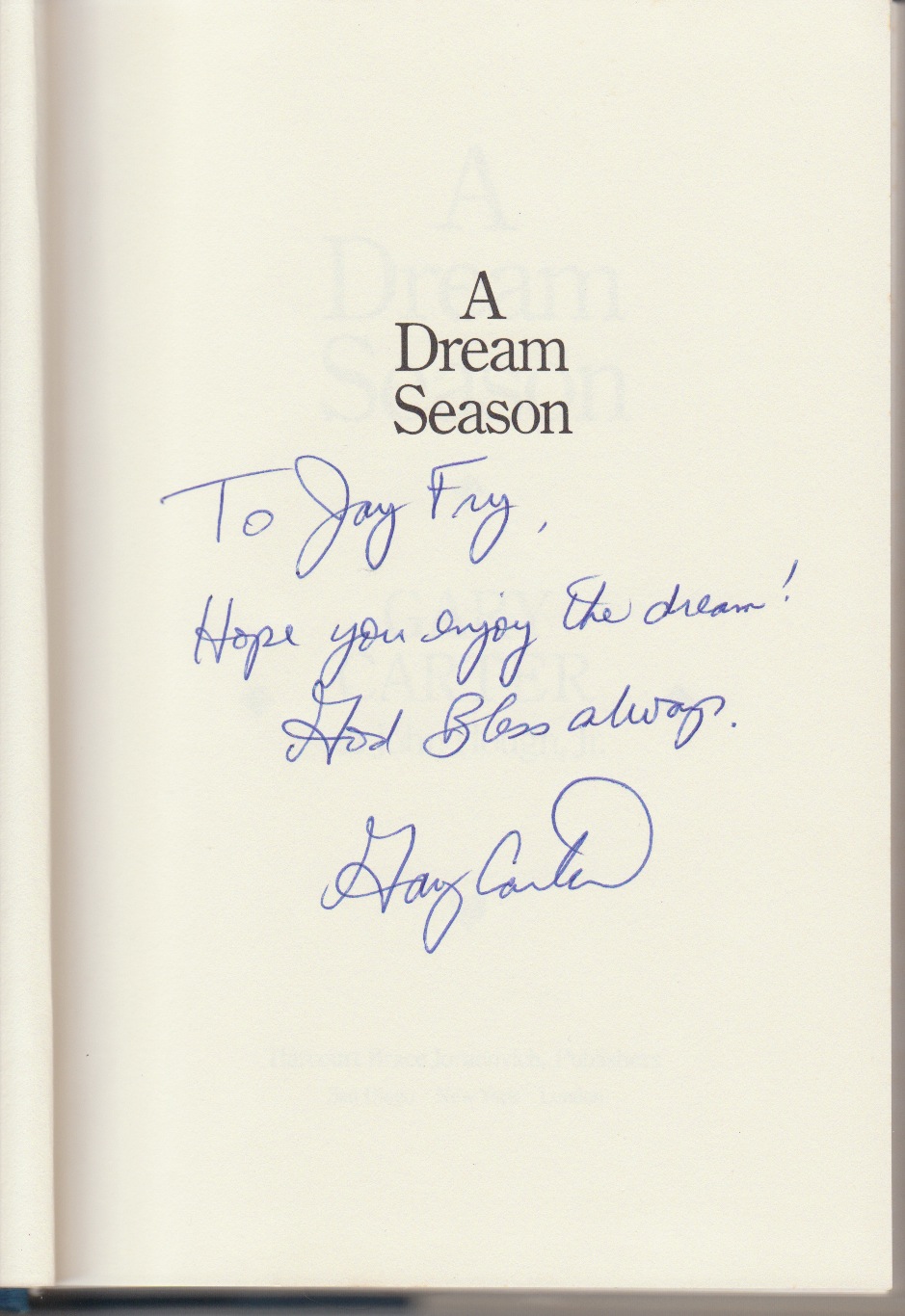
by Jason Fry on 17 February 2012 12:10 am In the spring of 1987, Gary Carter’s book A Dream Season hit stores. My mom heard Carter would be at Haslam’s Book Store in central St. Petersburg and drove down there to get me a signed copy, leaving plenty of time to wait in line. Only there was no line — St. Petersburg was still affectionately disparaged as God’s waiting room then, and not even the presence of the All-Star catcher of the World Champions of baseball was enough to draw a crowd to a bookstore in the middle of nowhere on a hot afternoon. There was just Gary Carter, looking somewhat wan and bored.
My mom felt sorry for him, and so she stayed and chatted for a while — about the Mets and their season (she has always been a huge fan), but also about her sometimes wayward son and his writing ambitions and where he might go to college the next fall. As this story unfolded over the phone, I had two reactions:
1. MOMMMM! QUIT IT!
2. Please don’t let this story end with another rich athlete being curt or dismissive to a fan. Not when the athlete is Gary Carter and the fan is my mom. Because that really might break my heart.
 I had, of course, nothing to worry about. Carter couldn’t have been kinder. He signed my book — To Jay Fry, Hope you enjoy the dream! God bless always, Gary Carter — and my mom left, a fan who’d met one of her heroes and come away thinking better of him. I had, of course, nothing to worry about. Carter couldn’t have been kinder. He signed my book — To Jay Fry, Hope you enjoy the dream! God bless always, Gary Carter — and my mom left, a fan who’d met one of her heroes and come away thinking better of him.
After I learned that Carter had died — a blow no less painful for the fact that we had all braced for it — I picked up Joshua at school and walked him home in the clammy dark. He vaguely remembers Carter from highlight films, and had him somewhat jumbled up with Mike Piazza, Mookie Wilson and Dwight Gooden. (Which isn’t bad as jumbles go.) I set the record straight and we wound up talking about how it was all too easy to inflate athletes’ successes or failures on the field into judgments of them as people. This is something that started while watching Ken Burns’s Baseball, with discussions of how most people were neither heroes nor villains: Ty Cobb said and did unforgivably horrible things to people but was also a pitiable man damaged by a cruel and horrifying childhood, while Barry Bonds was a cheater and a superstar and a jerk and a sad figure all at the same time.
Given such complexities, it was a relief to talk about Gary Carter. It was a relief to tell Joshua that I’d never heard anyone speak ill of him as a teammate, husband, father or friend. It was a relief to say that he was by all accounts something simple to describe and unfortunately easy to mock, probably because it’s so hard to achieve: a good man. Not because of what he’d done behind the plate or at bat, but because of how he’d lived his life and how he’d treated others.
Carter was more complex than that, of course, and he wasn’t perfect: There was a whiff of self-aggrandizement to his relentless enthusiasm, and he was embarrassingly tone-deaf to politics, repeatedly trying to put himself in managerial chairs that were still occupied. But those things didn’t make him a bad person, just human — all of our obituaries, if fairly told, will have buts and to be sures and clauses we’d prefer struck from the record.
It’s been heart-breaking and fascinating to hear Carter’s teammates remember him. For a good chunk of his career, Carter played the toughest position on the diamond while enduring derision from his own teammates, who resented his rapport with the media, ever-present smile and gift of gab — and, one suspects, his unshakeable faith in who he was. They sneeringly called him Teeth, and Camera — even Kid was originally a put-down, one Carter embraced and turned into his own Charlie Hustle.
Those stories from Montreal followed him to New York, where all of his nightcrawling teammates admired him but few seemed to like him. But hearing from them tonight, you could tell the remorse was genuine, and sense that in finding themselves older and grayer and thicker they’d come to think differently of square, uncool Gary Carter from Sunny Hills, California. Keith Hernandez’s grief was so raw that listening to it made you feel like an intruder, but what really got me were the words of a sadder, wiser Darryl Strawberry: “I wish I could have lived my life like Gary Carter.”
Once upon a time, comparing Keith’s Goofus to Gary’s Gallant, I declared myself a Keith person. And I am. But you can declare for the one without diminishing the other. I was always drawn to Keith’s ferocity and brains and his success despite all-too-evident foibles. But that’s not to say I didn’t beam in response to Gary’s buoyant curtain calls, or admire his unflappable stoicism crouching behind the plate in pain and dust, or see his victories over Charlie Kerfeld and Calvin Schiraldi as little parables, lessons that hard work and self-confidence would be rewarded. And as I’ve gotten older and grayer and thicker myself, I’ve come to grasp that the truest measure of who we were will be how others remember us. Living your life like Gary Carter? We should all have such courage of our convictions.
Twenty-five years ago, Gary Carter was kind to my mother. It’s a little thing, but most of our lives are little things, and we determine whether they’re done well or poorly, graciously or indifferently. He wrote God bless always in a book for me. Now I realize he was the blessing.
Greg’s thoughts on Gary are here.
by Greg Prince on 16 February 2012 7:12 pm Welcome aboard, and thank you for joining our tour group. We know you could have chosen any Met season to get lost in for a little while, but we think you chose wisely in deciding to join us here in 1985. We’re not supposed to play favorites, but between you folks and me, this is the one where you’ll want to wallow for a while.
We’re ready to start our tour here on December 10, 1984. Now I know what some of you are thinking, that technically this isn’t 1985. Well, not just yet, but the journey begins here by necessity, because we can’t take you where we’re going without stopping first at this spot. This is where Gary Carter gets traded to the Mets. It’s a stunner, all right. Carter’s an All-Star, a slugger, a Gold Glove catcher, but until now, he’s been an Expo.
Not anymore. We give up four promising young players to get him, including one of our favorites, Hubie Brooks, but it’s a bargain. You want promise? The promise of 1985 begins with Carter’s acquisition. The promise is literally spoken by the Kid himself. He stands in front of a room full of New York reporters and tells them about his right ring finger. Why that one? Because that’s the one he’s reserving for his World Series ring, the one he plans to earn as a New York Met.
Such promise. A season never approached with that kind of feeling before. The surprisingly good Mets of 1984 were instantly enhanced by Gary Carter. We see them coming into Spring Training and we see a contender, something we haven’t envisioned so clearly in February in a very long time.
That brings us to our next stop, St. Petersburg, Florida, Spring Training home of the New York Mets. Spring Training home of Gary Carter’s New York Mets. The energy around this team is off the charts. The feeling is they can do anything. If you look closely, you can even see a pitcher in camp on a non-roster invitation, No. 21, Sidd Finch. Sidd’s not going to make the team, but these Mets are loaded with pitching: Gooden, Darling, Berenyi, Lynch, Latham. Orosco, Sisk and McDowell in the bullpen. They’re all young and they all figure to benefit from throwing to the National League’s best catcher.
And this lineup — as strong a lineup as a Mets manager has ever committed to a lineup card. There’s Keith Hernandez, the team MVP from last year. And there’s Darryl Strawberry, the budding superstar. And George Foster, who still has some pop. Wally Backman can hit righties. Mookie Wilson can fly. Rafael Santana shouldn’t be overlooked, either. Howard Johnson comes highly recommended off the world champion Detroit Tigers.
In the middle of all that? A cleanup hitter who’s a threat to hit one out every time up. A batter who knows National League pitchers like he knows hitters. A guy who’s probably on his way to the Hall of Fame.
Gary Carter is here. Gary Carter is making us feel like more than contenders. He makes us feel like favorites. Like we’ve got something going on that’s special and is going to last a very long time.
Let’s move along, shall we?
Our next stop on the tour should look familiar to all of you. It’s Shea Stadium in Flushing, New York. This is April 9, Opening Day. What a crowd! It’s blustery today, but you can feel the heat rising from the Mets, particularly when No. 8 is introduced for the first time. That’s Carter. A year ago, we thought of him as the enemy. A year ago, in Montreal blue, he hit the grand slam that ruined Darling’s day and the Home Opener. But he’s not wearing somebody else’s uniform anymore.
He’s wearing ours. And look at the difference it makes ten innings after he’s introduced. Yes, that’s Neil Allen, the ex-Met, pitching for the Cardinals, and that’s Gary Carter, the Met now and forever more ending the game. Let’s listen to Steve Zabriskie on Channel 9 welcome him to New York.
Yup, he’s here, all right. He’s here to stay.
We’re still at Shea. It’s a couple of days later and the Mets are living up to their advance notices. The pitching is as billed, and that’s due in no small part to the new catcher, the catcher from Montreal. Here he is in the third game of the season guiding home Bruce Berenyi and Doug Sisk to a 1-0 win. The one run is on Carter’s second home run as a Met. And here he is in the fifth game of the season, hitting another home run and catching another shutout, the first of the year from Dwight Gooden. Doc strikes out ten Reds. Carter catches every one of them. One of them will wind up in a video Bruce Springsteen is making: “Glory Days”. It couldn’t be more appropriate for where Gary and the Mets are right now. They’ve won all five games they’ve played, giving up only two runs in the last four.
Carter’s catching them every day and they’re winning every day. The Mets are 5-0, folks. There’s a sense that nothing can stop them. It’s glorious.
It’s a month later now. We’re still at Shea. Things have warmed up but not everything has gone exactly as hoped for. The Mets are no longer undefeated, which isn’t a surprise. Gary Carter’s in a bit of a slump, which is, but he’s busting out tonight, May 7, against the Braves. Recognize the pitcher? That’s Bruce Sutter, one of the best relievers ever. And the hitter is Carter, lashing his first Met grand slam. The Mets win this game and they, like Gary, appear to be putting their stumbles behind them.
Our next stop is a month later, the middle of June, to be precise. The Mets are still trying to find their groove. They’ve had some injuries and they’re immersed in a dogfight for first place with the Cardinals, the Expos and the Cubs, the team that happens to be at Shea tonight. If you took the full 1984 tour, you’ll recognize the Cubs as the Mets’ nemeses, the ones who cost them the division last year. Somehow the Mets have yet to play them in 1985, so there’s a ton of anticipation for the opener. It’s Ron Darling and Rick Sutcliffe in a scoreless duel in the fourth inning…and can anybody take a guess at what happens next?
That’s right. Gary Carter leads off the fourth with a home run and the tension transforms into cheers. The fans know everything’s gonna be OK. By the end of the week, the Mets sweep four from the Cubs and they’re never heard from again for the rest of the season. This matters to us here in 1985 because when we got Gary in December, we had it in our heads that he would be the difference-maker between them and us. And he is.
Unfortunately, it’s the Cardinals who emerge as the Mets’ new rivals by now and as you’ll see on the edges of our tour, we have to keep a pretty close eye on them. You may not have bargained for it when you signed up for 1985, but that’s what happens.
But first, we’re going to ask you to buckle up for our flight to our next stop, and that’s Atlanta in early July. It’s a night like no other, a 19-inning marathon that includes two rain delays, all kinds of oddities and, when it’s over, fireworks at four in the morning. But not one minute before it is over does Gary Carter stop playing. He’s a 31-year-old catcher but he will not yield. He crouches for every gosh darn pitch and, as if that’s not enough, he goes 5-for-9 as the Mets win a game that would have been brutal to lose. The final score is 16-13. Manager Davey Johnson gives Gary the next night off.
As our tour winds into Houston just ahead of the All-Star break, does anybody notice anything disturbing? That’s right, it’s the lack of Gary Carter in the Mets’ lineup when word gets out that his knees aren’t right. There’s a lot of mileage on those joints and it might be catching up with this great catcher. The Mets cross their fingers while their trainers unspool their tape. The Kid’s well-being will bear watching the rest of the way.
Thankfully, we can watch him in action as we resume our tour after the All-Star break, as Gary Carter literally grins and bears it, He’s in the lineup and behind the plate again. You can’t miss him — though one of his old teammates comes perilously close. Our next stop is Shea Stadium, July 30, the Mets and the Expos. Headhunting Bill Gullickson, who Gary used to catch in Montreal, decides to play some chin music for Carter. Gooden, pitching for the Mets, returns the favor on Gary’s behalf. This is Gary’s team and Gary’s teammates are going to watch out for him. Of course Gary returns the favor by catching yet another brilliant performance from Gooden: another ten-strikeout, shutout win — Doc’s tenth victory in a row, the most since Tom Seaver in ’69.
Gooden is having the season of his life, as you might have noticed as our tour has taken us from April to August. He breaks Tom’s record for consecutive wins on the same day Tom wins his 300th as a White Sock. He fans sixteen Giants soon after, his most since last September. He becomes the youngest pitcher ever to win a twentieth game, against the Padres before August is done. And who’s catching him every time he makes history?
Gary Carter. Carter’s shepherding Gooden to superstardom. He’s helped Darling reach the All-Star team. He’s nurtured Sid Fernandez since returned from Tidewater and he’s welcomed Rick Aguilera to the big leagues, too. Carter’s impact as the catcher for these Mets as they sizzle through the summer cannot be understated. As our tour moves near September, you should take a good, hard look at that aspect of his game.
But now that we’re in September, there’s no way you can’t focus on his bat. Our next stop is San Diego. This is where Gary Carter takes off all over again. We advise you to put on your special neck gear otherwise you might strain something watching what he does.
There’s three home runs on Tuesday night, September 3, to beat the Padres.
And there are two home runs more on Wednesday night, September 4, to beat them again.
That’s five home runs in two days, something hardly anybody in major league history has ever done, certainly no Met. Going back to August 29, covering six games he’s played, Gary has whacked eight home runs. This is the veteran power bat the Mets craved when Frank Cashen traded those youngsters to Montreal. It’s exploding at the perfect time of year. The Mets and the Cardinals are neck and neck. Every hit is humongous. Every game is gargantuan. Everywhere you look, Gary Carter is hanging in there, bad knees and all. He catches all thirteen innings of a big win on a Friday night in Los Angles and he catches all fourteen in an equally big win on Sunday afternoon. Then he and the Mets fly home to take on the Cardinals in a three-game set that will decide who leads the division for the stretch drive. The Kid doesn’t rest and the Mets win two of three.
Gary Carter’s Mets are in first place on September 12. New York has been hanging on this team since they came north and this season since it began — since Carter beat the Cardinals on April 9. And they’re still hanging on. Everybody is buzzing. This is the month we as Mets fans have been waiting for.
I’m going to need you to hold on tight for the last part of our tour. The going gets very tough, though no tougher than Carter. In the 32 games he plays in September and the first week of October, Gary totals 13 homers and 36 runs batted in all while catching day in and day out, guiding Gooden to his mindblowing 1.53 ERA. The National League will name him its Player of the Month.
Our next stop is Three Rivers Stadium in Pittsburgh, the final Sunday in September. You can see Gary Carter’s final home run of the 32 he hits for the season. It comes in the tenth inning of a game the Mets must have. It’s a two-run shot that rescues the team from slipping out of the pennant race. The Mets win, 9-7, and go to St. Louis with a puncher’s chance of catching the Cardinals, who went on a hot streak and have taken a three-game lead with six to play. Now you understand why you had to keep an eye on them.
We stop now at Busch Stadium and watch Carter the catcher do maybe his finest work of the year, bringing Darling through nine pressure-packed innings and Jesse Orosco through two besides. The Mets take a lead when Darryl Strawberry launches a homer in the top of the eleventh and it hits the stadium clock. The Mets win this one, 1-0. They win the next night, too, behind Gooden’s 24th win. Carter, as usual, is behind the plate and leaps up to congratulate him when it’s over.
I’m sure you’ve noticed by now on the tour how ebullient Gary Carter is throughout 1985. He’s an instant sensation in New York, and it transcends anything he brought with him in the way of reputation. He’s making commercials and he’s pumping his fist and he’s thanking the fans after the fans thank him. He’s lighting up Shea Stadium and he’s lighting up the away games on TV. He’s not leading the Mets alone. We haven’t mentioned Keith Hernandez’s myriad contributions and we’ve skimmed over some of the other players, but as we get close to the end of our tour, we come back again and again to Gary Carter and how he’s made this the season of a lifetime for all of us lucky enough to feel like we’re living it again.
We’re going to close the tour back at Shea Stadium. The Mets didn’t win the third game in St. Louis and the Cardinals clinched the division a couple of days later. It was heartbreaking in a sense, yet the whole season was so full of life that the pain heals by this final stop on the last day. Here’s Carter and all of his teammates taking one final curtain call. The love affair between these 1985 Mets — his Mets — and we Mets fans is so strong, so palpable, that the 98 wins they rack up…most of them in stirring fashion…only partly describe what a special bunch they are and what an extraordinary season it’s been.
See Gary there, right there, practically smiling his teeth out? See those arms in the air? And the way he’s blocking the plate, giving no ground? And coming through so many times when it counted like you couldn’t believe it counted? And drawing you into the Mets like you’ve never been drawn in before?
You spend 162 games with the Mets in 1985, you never forget somebody like that.
Never.
(Jason’s farewell to Gary is here.)
by Greg Prince on 16 February 2012 3:09 pm Seven years ago today, the blog for Mets fans who like to read was born. Thanks to all who have read along with Faith and Fear in Flushing since its founding on February 16, 2005, no matter what condition the Mets’ condition’s been in at any given juncture between then and now.
To mark the occasion, I’m gonna make seven blog-birthday wishes and maybe an eighth to grow on. I’ll skip the 2012 world championship since my wishing won’t make it so. But maybe a few sincerely chosen words offered in this space might make a difference here and there.
1) Live and let live a little. Make your Mets case as you will across the marvelous spectrum of media available to us. But don’t begrudge your fellow fans their fury or their fun. We all agree we like the Mets as a going entity. Where we take our opinions from there is up to each and every one of us. Express yours, but don’t think you’re going to negate others’ by shouting or hashtagging them into submission. Everybody just grows louder and crankier when absolutism and obstinacy set in. Preserve lungs. Seek hearts. Change minds, perhaps.
2) See it another way. Best mind to change? Your own, at least once this year. Alter a worldview the way you might bring a pair of slacks to the tailor at your local dry cleaner. Maybe your dearly held assumption about a player or an owner or an announcer or whoever isn’t 100% right. Nothing wrong with being, say, 95% accurate now and giving yourself some wiggle room down the road.
3) Don’t boycott what you love. My tenth-grade social studies teacher learned I was a Mets fan. I’m a Mets fan, too, he told me, but I hope they lose every game they play this year. HUH? I gasped. The year was 1979, the depths of de Roulet, and he wanted the team sold ASAP. I got it but I couldn’t quite go with so draconian a solution. (The Mets were kind enough to forge a middle ground, losing merely 99 times and only then going on the market.) In that vein, I get the notion that an inoccupation of Citi Field theoretically speeds along certain transactions that may seem necessary in light of where the franchise has undeniably gone awry…but why wholly deprive yourself in the interim? Don’t want to overly support the Mets? You can curb your habit, I suppose. Yet you’re not sitting there rubbing your hands together over news of the veritable swallows returning to Port St. Capistrano only to turn your nose up if someone asks you to go to a game in 2012. I never try to spend anybody else’s money, but I’d advise investing in at least one game this season. Why? Because when the season ends, there won’t be any more for another six months.
4) The Mets are fun even if their record isn’t. I loved this article by Adam Rubin about @JedSmed and the Mets Twitter hashtag of the day. I had no idea concepts like #MetsMafiaNicknames emanated from somebody specific. I just saw a mob of them being Tweeted and jumped in. So have a lot of other people — Mets fans, mostly. It’s generally brilliant, 140-character fun if not always flattering to the state of the Mets. So what? I love the Mets yet have been laughing at/with them whenever they’ve deserved it all my life — including in tenth grade social studies, if memory serves. The figurative terrorists won’t win because you acknowledge the Mets’ prevailing tendency toward imperfection. Their laudable qualities will eventually shine through, even if they’re harder to detect at this moment, even if they have yet to regenerate in full. When they do, it’s all we’ll be talking about. Until then, as Seth Berkman noted in the New Yorker, plenty of high-profile people who love the Mets (and at least one fan of much less renown) don’t fear their inherently amusin’/Amazin’ nature. Faith should always trump fear here.
5) Negative is just what you used to get with your pictures. Springtime is the season of the true believer, which is as it should be. You’re a Mets fan, you should be as optimistic as you wanna be. But don’t wield your sunny side like a cudgel at those you perceive as “negative”. Does the net perception of the Mets, seven weeks from Opening Day merit an outlook overwhelmingly sanguine? We can quibble over the particulars, yet it’s not surprising forecasts veer to the mostly cloudy. Three consecutive sub-.500 seasons, an incredibly uncertain ownership situation, a slashed payroll, the deletion of the team’s most outstanding player, no camera-ready hot prospects, crossed fingers over recovering shoulders and ankles…damn right it’s not a positive scenario. Yet what a great story it will be if the Mets surpass their modest expectations. I’m not optimistic that will occur in 2012, but that doesn’t make me negative toward the Mets. I’m prepared to be uplifted from the waters of pessimism as contrary proof materializes. And if it doesn’t? The Mets’ll still be fun, somehow. I like being a Mets fan too much to be turned off by something as pedestrian as a fourth consecutive sub-.500 season. If this springtime doesn’t lead anywhere, I hear they’ll have another one next year. My true belief will be intact.
6) If you can’t beat them, don’t enjoin them. When this blog began, I was — as I’d been for as long as I’d had nothing else to lean on for Mets information and insight — extraordinarily sensitive to what beat writers and columnists wrote about the Mets. They set the agenda for how we as a people thought about the Mets on a daily basis and I saw as one of my charges correcting the record when I thought something inane or worse was written. I don’t much care what beat writers and columnists write, blog or Tweet these days save for the information and (hopefully) insight they bring me from their unique vantage point. There are just too many sources for Mets thoughts of which to avail myself. If I read a good story by a writer paid to write it, I like to let you know. If I read a good story by a writer whose labor is, like mine almost all of the time, derived from love (per Patsy from Ab Fab, “of course they don’t pay me; you can’t put a price on what I do”), I try to mention it, too. The stuff that’s awful? The stuff that exacerbates my recurring headaches? The stuff that gets facts wrong? I try my very best to let it die in the shadows. Why publicize what I don’t recommend? Why stress over it, either? I’ve got some absolutely fabulous bookmarks to go with whatever still works on our mostly dormant sidebar. You probably do, too.
7) Everybody is people. From what I’ve been able to ascertain in my blogging travels, nobody is as venal or calculating as you’re willing to assume. Nobody’s really an idiot. Nobody’s out to sink the ship from within or without. The Mets attract good people to their cause, no matter the results or the commentary they produce. It’s easy to make assumptions about people you don’t know. It’s also folly. I’d urge one and all determined to reach conclusions regarding motives to think before typing. You might be surprised to discover people who take actions or positions you don’t embrace aren’t bad people. If you’re really interested in their motives, just ask them.
And one to grow on: Let’s Go Mets. Can’t be said enough.
Congratulations to Howard Megdal and the Mets on reaching accord so he will continue to be credentialed to cover them in 2012 as he’s been in the past. Readers of his work at LoHud Mets Blog and other venues come out the real winners from his quest to maintain optimal access.
by Jason Fry on 15 February 2012 1:59 pm Apparently Sandy Alderson made the media rounds yesterday, discussing Mets doings with Mike Francesa. I didn’t hear it, as I have it on good authority that Francesa is the exclusive radio voice in Hell, and see no reason to get an early start on that. MetsBlog summed it up anyways, and most of it was the usual pre-spring-training can-do hoo-ha, pleasant February background noise that one can simultaneously appreciate and safely ignore.
One thing stood out, though:
[Alderson] said he expects to have the necessary payroll flexibility to add to the major league roster when and if necessary (such as the trade deadline, should the team be in contention).
Here, it seems to me, is one of the central dilemmas of being a Mets fan right now — or, more properly, here’s a subset of the two-headed problem of the team being broke and no sane fan trusting anything ownership or the business side says about the situation. (We’ve all heard more than enough about that and are due for a lot more in spring training, so let’s skip it this morning.)
Put simply, I think Sandy is a smart guy, and I agree with most of the moves he’s made so far. He’s constructed a solid bench, refitted the bullpen, made some low-risk, high-reward moves (some successful and some inevitably not), drafted sensibly, traded off pieces when it made sense, and refused to give Jose Reyes an ill-advised deal, or to play PR games on the road to not giving him that deal. Should he have traded Reyes earlier? Arguably yes, but Jose was damaged goods, the team needed SOME reason to keep fans out of nooses, and I’m glad we finally got that batting title. So I give him a pass there.
I think he’s built a solid foundation for future success. The thing is, building a solid foundation is a pretty empty exercise if all you can construct atop of it is a shack, or a cut-rate ranch house in a ritzy neighborhood.
If Sandy really can add payroll, that’s fantastic. But I have no faith that he actually can, and I have no faith that he thinks he actually can.
Has he been told that he can add payroll under the appropriate circumstances? I’m sure the answer to that is “yes” — I don’t think the man’s a liar, beyond the necessities of propriety in his job. But I’m also sure he’s been told lots of things during his exceedingly weird tenure as Mets GM. It would be fascinating, to say the least, to get his unvarnished take on those things. But I suspect that’s a tale that won’t be told for years, if ever.
In the meantime, hey, the man’s funny as hell on Twitter, the walls are changed and the unis are better. And baseball’s baseball, with plenty of delights even when you suspect your October will be free. But man oh man. When there was money we had Omar Minaya, and now that we have Sandy Alderson there’s no money. Unless you’re an aficionado of irony, it’s hard to find a silver lining there.
We ain’t as funny as Sandy on Twitter, but you can follow us too if you like. Greg is greg_prince, and I’m jasoncfry.
by Greg Prince on 15 February 2012 10:49 am The bobbles are coming! The bobbles are coming! And, no, that’s not a fielding forecast for Daniel Murphy playing second base.
The historical bobbleheads we’ve been asking for are really coming to Citi Field this season, marking the Mets’ 50th anniversary like it oughta be.
The lineup:
Tom Seaver: Pretty fair country pitcher, representing the 1960s (and eternity), Sunday, April 22, 1:10 PM, versus the Giants.
Rusty Staub: He could hit some and play some right from 1972 through 1975 (and later), Saturday, May 26, 1:10 PM, versus the Padres.
Keith Hernandez: Mex! From when the world’s most fun analyst was the world’s clutchest player, and the Mets were the 1980s’ best show, Sunday, June 17, 1:10 PM, versus the Reds.
Edgardo Alfonzo: FONZIE! Yeah, I used all upper-case. Didn’t you from 1995 to 2002? Saturday, July 21, 1:10 PM, versus the Dodgers.
Mike Piazza: Cue Hendrix and remember the first part of the 21st century, Saturday, August 25, 1:10 PM, versus the Astros.
Let us not forget the not so Slight Return of Banner Day, Sunday, May 27, prior to the Mets-Padres game at 1:10 PM, and the induction of the New York Mets Hall of Fame‘s 26th member, John Franco, Sunday, June 3, ahead of the 1:10 PM game against the Cardinals. That’s seven well-conceived nods to true Mets fandom, seven promotions that don’t pass off plastic cups as premiums, seven days to support your local baseball team.
The other 74 dates on the home schedule will include Mets baseball, so that’s something to consider, too.
And if you can’t make it out to the ballpark, all games will be broadcast on the New York Mets Radio Network, primarily by Howie Rose and Josh Lewin. We know and love the former. We wish the latter, newly named to his post, all the best with his mic and our ears.
Hey, most of us yearned to be deHaginated, and Wayne has taken leave of Flushing after four seasons of well-intentioned if terminally miscast Met announcing. So the Mets do come around on many things eventually. I’m willing to wager consistent winning will be one of them again someday.
|
|