The blog for Mets fans
who like to read
ABOUT US

Faith and Fear in Flushing made its debut on Feb. 16, 2005, the brainchild of two longtime friends and lifelong Met fans.
Greg Prince discovered the Mets when he was 6, during the magical summer of 1969. He is a Long Island-based writer, editor and communications consultant. Contact him here.
Jason Fry is a Brooklyn writer whose first memories include his mom leaping up and down cheering for Rusty Staub. Check out his other writing here.
Got something to say? Leave a comment, or email us at faithandfear@gmail.com. (Sorry, but we have no interest in ads, sponsored content or guest posts.)
Need our RSS feed? It's here.
Visit our Facebook page, or drop by the personal pages for Greg and Jason.
Or follow us on Twitter: Here's Greg, and here's Jason.
|
by Jason Fry on 17 February 2012 12:10 am In the spring of 1987, Gary Carter’s book A Dream Season hit stores. My mom heard Carter would be at Haslam’s Book Store in central St. Petersburg and drove down there to get me a signed copy, leaving plenty of time to wait in line. Only there was no line — St. Petersburg was still affectionately disparaged as God’s waiting room then, and not even the presence of the All-Star catcher of the World Champions of baseball was enough to draw a crowd to a bookstore in the middle of nowhere on a hot afternoon. There was just Gary Carter, looking somewhat wan and bored.
My mom felt sorry for him, and so she stayed and chatted for a while — about the Mets and their season (she has always been a huge fan), but also about her sometimes wayward son and his writing ambitions and where he might go to college the next fall. As this story unfolded over the phone, I had two reactions:
1. MOMMMM! QUIT IT!
2. Please don’t let this story end with another rich athlete being curt or dismissive to a fan. Not when the athlete is Gary Carter and the fan is my mom. Because that really might break my heart.
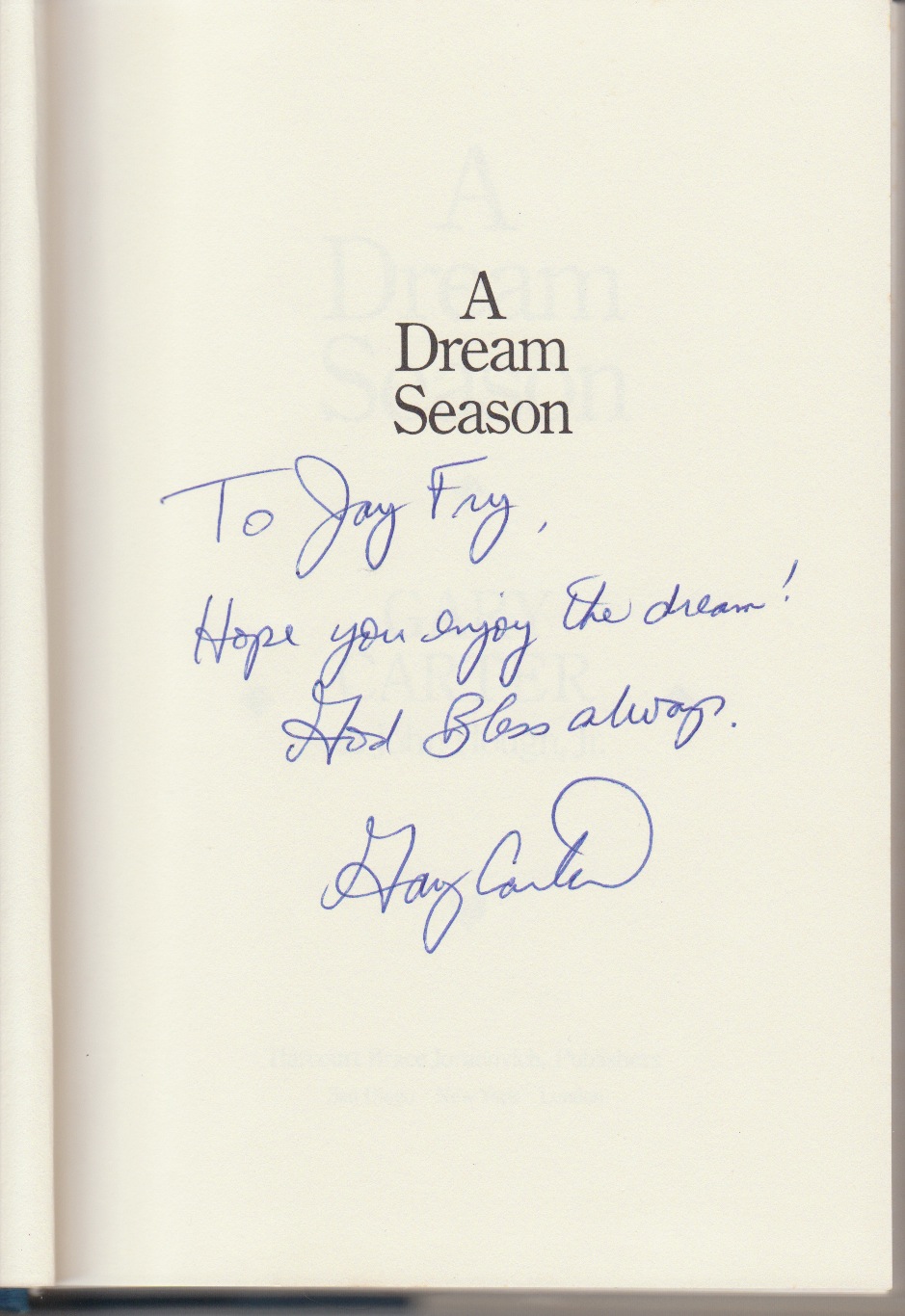
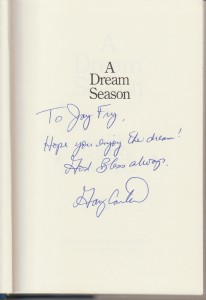 I had, of course, nothing to worry about. Carter couldn’t have been kinder. He signed my book — To Jay Fry, Hope you enjoy the dream! God bless always, Gary Carter — and my mom left, a fan who’d met one of her heroes and come away thinking better of him. I had, of course, nothing to worry about. Carter couldn’t have been kinder. He signed my book — To Jay Fry, Hope you enjoy the dream! God bless always, Gary Carter — and my mom left, a fan who’d met one of her heroes and come away thinking better of him.
After I learned that Carter had died — a blow no less painful for the fact that we had all braced for it — I picked up Joshua at school and walked him home in the clammy dark. He vaguely remembers Carter from highlight films, and had him somewhat jumbled up with Mike Piazza, Mookie Wilson and Dwight Gooden. (Which isn’t bad as jumbles go.) I set the record straight and we wound up talking about how it was all too easy to inflate athletes’ successes or failures on the field into judgments of them as people. This is something that started while watching Ken Burns’s Baseball, with discussions of how most people were neither heroes nor villains: Ty Cobb said and did unforgivably horrible things to people but was also a pitiable man damaged by a cruel and horrifying childhood, while Barry Bonds was a cheater and a superstar and a jerk and a sad figure all at the same time.
Given such complexities, it was a relief to talk about Gary Carter. It was a relief to tell Joshua that I’d never heard anyone speak ill of him as a teammate, husband, father or friend. It was a relief to say that he was by all accounts something simple to describe and unfortunately easy to mock, probably because it’s so hard to achieve: a good man. Not because of what he’d done behind the plate or at bat, but because of how he’d lived his life and how he’d treated others.
Carter was more complex than that, of course, and he wasn’t perfect: There was a whiff of self-aggrandizement to his relentless enthusiasm, and he was embarrassingly tone-deaf to politics, repeatedly trying to put himself in managerial chairs that were still occupied. But those things didn’t make him a bad person, just human — all of our obituaries, if fairly told, will have buts and to be sures and clauses we’d prefer struck from the record.
It’s been heart-breaking and fascinating to hear Carter’s teammates remember him. For a good chunk of his career, Carter played the toughest position on the diamond while enduring derision from his own teammates, who resented his rapport with the media, ever-present smile and gift of gab — and, one suspects, his unshakeable faith in who he was. They sneeringly called him Teeth, and Camera — even Kid was originally a put-down, one Carter embraced and turned into his own Charlie Hustle.
Those stories from Montreal followed him to New York, where all of his nightcrawling teammates admired him but few seemed to like him. But hearing from them tonight, you could tell the remorse was genuine, and sense that in finding themselves older and grayer and thicker they’d come to think differently of square, uncool Gary Carter from Sunny Hills, California. Keith Hernandez’s grief was so raw that listening to it made you feel like an intruder, but what really got me were the words of a sadder, wiser Darryl Strawberry: “I wish I could have lived my life like Gary Carter.”
Once upon a time, comparing Keith’s Goofus to Gary’s Gallant, I declared myself a Keith person. And I am. But you can declare for the one without diminishing the other. I was always drawn to Keith’s ferocity and brains and his success despite all-too-evident foibles. But that’s not to say I didn’t beam in response to Gary’s buoyant curtain calls, or admire his unflappable stoicism crouching behind the plate in pain and dust, or see his victories over Charlie Kerfeld and Calvin Schiraldi as little parables, lessons that hard work and self-confidence would be rewarded. And as I’ve gotten older and grayer and thicker myself, I’ve come to grasp that the truest measure of who we were will be how others remember us. Living your life like Gary Carter? We should all have such courage of our convictions.
Twenty-five years ago, Gary Carter was kind to my mother. It’s a little thing, but most of our lives are little things, and we determine whether they’re done well or poorly, graciously or indifferently. He wrote God bless always in a book for me. Now I realize he was the blessing.
Greg’s thoughts on Gary are here.
by Greg Prince on 16 February 2012 7:12 pm Welcome aboard, and thank you for joining our tour group. We know you could have chosen any Met season to get lost in for a little while, but we think you chose wisely in deciding to join us here in 1985. We’re not supposed to play favorites, but between you folks and me, this is the one where you’ll want to wallow for a while.
We’re ready to start our tour here on December 10, 1984. Now I know what some of you are thinking, that technically this isn’t 1985. Well, not just yet, but the journey begins here by necessity, because we can’t take you where we’re going without stopping first at this spot. This is where Gary Carter gets traded to the Mets. It’s a stunner, all right. Carter’s an All-Star, a slugger, a Gold Glove catcher, but until now, he’s been an Expo.
Not anymore. We give up four promising young players to get him, including one of our favorites, Hubie Brooks, but it’s a bargain. You want promise? The promise of 1985 begins with Carter’s acquisition. The promise is literally spoken by the Kid himself. He stands in front of a room full of New York reporters and tells them about his right ring finger. Why that one? Because that’s the one he’s reserving for his World Series ring, the one he plans to earn as a New York Met.
Such promise. A season never approached with that kind of feeling before. The surprisingly good Mets of 1984 were instantly enhanced by Gary Carter. We see them coming into Spring Training and we see a contender, something we haven’t envisioned so clearly in February in a very long time.
That brings us to our next stop, St. Petersburg, Florida, Spring Training home of the New York Mets. Spring Training home of Gary Carter’s New York Mets. The energy around this team is off the charts. The feeling is they can do anything. If you look closely, you can even see a pitcher in camp on a non-roster invitation, No. 21, Sidd Finch. Sidd’s not going to make the team, but these Mets are loaded with pitching: Gooden, Darling, Berenyi, Lynch, Latham. Orosco, Sisk and McDowell in the bullpen. They’re all young and they all figure to benefit from throwing to the National League’s best catcher.
And this lineup — as strong a lineup as a Mets manager has ever committed to a lineup card. There’s Keith Hernandez, the team MVP from last year. And there’s Darryl Strawberry, the budding superstar. And George Foster, who still has some pop. Wally Backman can hit righties. Mookie Wilson can fly. Rafael Santana shouldn’t be overlooked, either. Howard Johnson comes highly recommended off the world champion Detroit Tigers.
In the middle of all that? A cleanup hitter who’s a threat to hit one out every time up. A batter who knows National League pitchers like he knows hitters. A guy who’s probably on his way to the Hall of Fame.
Gary Carter is here. Gary Carter is making us feel like more than contenders. He makes us feel like favorites. Like we’ve got something going on that’s special and is going to last a very long time.
Let’s move along, shall we?
Our next stop on the tour should look familiar to all of you. It’s Shea Stadium in Flushing, New York. This is April 9, Opening Day. What a crowd! It’s blustery today, but you can feel the heat rising from the Mets, particularly when No. 8 is introduced for the first time. That’s Carter. A year ago, we thought of him as the enemy. A year ago, in Montreal blue, he hit the grand slam that ruined Darling’s day and the Home Opener. But he’s not wearing somebody else’s uniform anymore.
He’s wearing ours. And look at the difference it makes ten innings after he’s introduced. Yes, that’s Neil Allen, the ex-Met, pitching for the Cardinals, and that’s Gary Carter, the Met now and forever more ending the game. Let’s listen to Steve Zabriskie on Channel 9 welcome him to New York.
Yup, he’s here, all right. He’s here to stay.
We’re still at Shea. It’s a couple of days later and the Mets are living up to their advance notices. The pitching is as billed, and that’s due in no small part to the new catcher, the catcher from Montreal. Here he is in the third game of the season guiding home Bruce Berenyi and Doug Sisk to a 1-0 win. The one run is on Carter’s second home run as a Met. And here he is in the fifth game of the season, hitting another home run and catching another shutout, the first of the year from Dwight Gooden. Doc strikes out ten Reds. Carter catches every one of them. One of them will wind up in a video Bruce Springsteen is making: “Glory Days”. It couldn’t be more appropriate for where Gary and the Mets are right now. They’ve won all five games they’ve played, giving up only two runs in the last four.
Carter’s catching them every day and they’re winning every day. The Mets are 5-0, folks. There’s a sense that nothing can stop them. It’s glorious.
It’s a month later now. We’re still at Shea. Things have warmed up but not everything has gone exactly as hoped for. The Mets are no longer undefeated, which isn’t a surprise. Gary Carter’s in a bit of a slump, which is, but he’s busting out tonight, May 7, against the Braves. Recognize the pitcher? That’s Bruce Sutter, one of the best relievers ever. And the hitter is Carter, lashing his first Met grand slam. The Mets win this game and they, like Gary, appear to be putting their stumbles behind them.
Our next stop is a month later, the middle of June, to be precise. The Mets are still trying to find their groove. They’ve had some injuries and they’re immersed in a dogfight for first place with the Cardinals, the Expos and the Cubs, the team that happens to be at Shea tonight. If you took the full 1984 tour, you’ll recognize the Cubs as the Mets’ nemeses, the ones who cost them the division last year. Somehow the Mets have yet to play them in 1985, so there’s a ton of anticipation for the opener. It’s Ron Darling and Rick Sutcliffe in a scoreless duel in the fourth inning…and can anybody take a guess at what happens next?
That’s right. Gary Carter leads off the fourth with a home run and the tension transforms into cheers. The fans know everything’s gonna be OK. By the end of the week, the Mets sweep four from the Cubs and they’re never heard from again for the rest of the season. This matters to us here in 1985 because when we got Gary in December, we had it in our heads that he would be the difference-maker between them and us. And he is.
Unfortunately, it’s the Cardinals who emerge as the Mets’ new rivals by now and as you’ll see on the edges of our tour, we have to keep a pretty close eye on them. You may not have bargained for it when you signed up for 1985, but that’s what happens.
But first, we’re going to ask you to buckle up for our flight to our next stop, and that’s Atlanta in early July. It’s a night like no other, a 19-inning marathon that includes two rain delays, all kinds of oddities and, when it’s over, fireworks at four in the morning. But not one minute before it is over does Gary Carter stop playing. He’s a 31-year-old catcher but he will not yield. He crouches for every gosh darn pitch and, as if that’s not enough, he goes 5-for-9 as the Mets win a game that would have been brutal to lose. The final score is 16-13. Manager Davey Johnson gives Gary the next night off.
As our tour winds into Houston just ahead of the All-Star break, does anybody notice anything disturbing? That’s right, it’s the lack of Gary Carter in the Mets’ lineup when word gets out that his knees aren’t right. There’s a lot of mileage on those joints and it might be catching up with this great catcher. The Mets cross their fingers while their trainers unspool their tape. The Kid’s well-being will bear watching the rest of the way.
Thankfully, we can watch him in action as we resume our tour after the All-Star break, as Gary Carter literally grins and bears it, He’s in the lineup and behind the plate again. You can’t miss him — though one of his old teammates comes perilously close. Our next stop is Shea Stadium, July 30, the Mets and the Expos. Headhunting Bill Gullickson, who Gary used to catch in Montreal, decides to play some chin music for Carter. Gooden, pitching for the Mets, returns the favor on Gary’s behalf. This is Gary’s team and Gary’s teammates are going to watch out for him. Of course Gary returns the favor by catching yet another brilliant performance from Gooden: another ten-strikeout, shutout win — Doc’s tenth victory in a row, the most since Tom Seaver in ’69.
Gooden is having the season of his life, as you might have noticed as our tour has taken us from April to August. He breaks Tom’s record for consecutive wins on the same day Tom wins his 300th as a White Sock. He fans sixteen Giants soon after, his most since last September. He becomes the youngest pitcher ever to win a twentieth game, against the Padres before August is done. And who’s catching him every time he makes history?
Gary Carter. Carter’s shepherding Gooden to superstardom. He’s helped Darling reach the All-Star team. He’s nurtured Sid Fernandez since returned from Tidewater and he’s welcomed Rick Aguilera to the big leagues, too. Carter’s impact as the catcher for these Mets as they sizzle through the summer cannot be understated. As our tour moves near September, you should take a good, hard look at that aspect of his game.
But now that we’re in September, there’s no way you can’t focus on his bat. Our next stop is San Diego. This is where Gary Carter takes off all over again. We advise you to put on your special neck gear otherwise you might strain something watching what he does.
There’s three home runs on Tuesday night, September 3, to beat the Padres.
And there are two home runs more on Wednesday night, September 4, to beat them again.
That’s five home runs in two days, something hardly anybody in major league history has ever done, certainly no Met. Going back to August 29, covering six games he’s played, Gary has whacked eight home runs. This is the veteran power bat the Mets craved when Frank Cashen traded those youngsters to Montreal. It’s exploding at the perfect time of year. The Mets and the Cardinals are neck and neck. Every hit is humongous. Every game is gargantuan. Everywhere you look, Gary Carter is hanging in there, bad knees and all. He catches all thirteen innings of a big win on a Friday night in Los Angles and he catches all fourteen in an equally big win on Sunday afternoon. Then he and the Mets fly home to take on the Cardinals in a three-game set that will decide who leads the division for the stretch drive. The Kid doesn’t rest and the Mets win two of three.
Gary Carter’s Mets are in first place on September 12. New York has been hanging on this team since they came north and this season since it began — since Carter beat the Cardinals on April 9. And they’re still hanging on. Everybody is buzzing. This is the month we as Mets fans have been waiting for.
I’m going to need you to hold on tight for the last part of our tour. The going gets very tough, though no tougher than Carter. In the 32 games he plays in September and the first week of October, Gary totals 13 homers and 36 runs batted in all while catching day in and day out, guiding Gooden to his mindblowing 1.53 ERA. The National League will name him its Player of the Month.
Our next stop is Three Rivers Stadium in Pittsburgh, the final Sunday in September. You can see Gary Carter’s final home run of the 32 he hits for the season. It comes in the tenth inning of a game the Mets must have. It’s a two-run shot that rescues the team from slipping out of the pennant race. The Mets win, 9-7, and go to St. Louis with a puncher’s chance of catching the Cardinals, who went on a hot streak and have taken a three-game lead with six to play. Now you understand why you had to keep an eye on them.
We stop now at Busch Stadium and watch Carter the catcher do maybe his finest work of the year, bringing Darling through nine pressure-packed innings and Jesse Orosco through two besides. The Mets take a lead when Darryl Strawberry launches a homer in the top of the eleventh and it hits the stadium clock. The Mets win this one, 1-0. They win the next night, too, behind Gooden’s 24th win. Carter, as usual, is behind the plate and leaps up to congratulate him when it’s over.
I’m sure you’ve noticed by now on the tour how ebullient Gary Carter is throughout 1985. He’s an instant sensation in New York, and it transcends anything he brought with him in the way of reputation. He’s making commercials and he’s pumping his fist and he’s thanking the fans after the fans thank him. He’s lighting up Shea Stadium and he’s lighting up the away games on TV. He’s not leading the Mets alone. We haven’t mentioned Keith Hernandez’s myriad contributions and we’ve skimmed over some of the other players, but as we get close to the end of our tour, we come back again and again to Gary Carter and how he’s made this the season of a lifetime for all of us lucky enough to feel like we’re living it again.
We’re going to close the tour back at Shea Stadium. The Mets didn’t win the third game in St. Louis and the Cardinals clinched the division a couple of days later. It was heartbreaking in a sense, yet the whole season was so full of life that the pain heals by this final stop on the last day. Here’s Carter and all of his teammates taking one final curtain call. The love affair between these 1985 Mets — his Mets — and we Mets fans is so strong, so palpable, that the 98 wins they rack up…most of them in stirring fashion…only partly describe what a special bunch they are and what an extraordinary season it’s been.
See Gary there, right there, practically smiling his teeth out? See those arms in the air? And the way he’s blocking the plate, giving no ground? And coming through so many times when it counted like you couldn’t believe it counted? And drawing you into the Mets like you’ve never been drawn in before?
You spend 162 games with the Mets in 1985, you never forget somebody like that.
Never.
(Jason’s farewell to Gary is here.)
by Greg Prince on 16 February 2012 3:09 pm Seven years ago today, the blog for Mets fans who like to read was born. Thanks to all who have read along with Faith and Fear in Flushing since its founding on February 16, 2005, no matter what condition the Mets’ condition’s been in at any given juncture between then and now.
To mark the occasion, I’m gonna make seven blog-birthday wishes and maybe an eighth to grow on. I’ll skip the 2012 world championship since my wishing won’t make it so. But maybe a few sincerely chosen words offered in this space might make a difference here and there.
1) Live and let live a little. Make your Mets case as you will across the marvelous spectrum of media available to us. But don’t begrudge your fellow fans their fury or their fun. We all agree we like the Mets as a going entity. Where we take our opinions from there is up to each and every one of us. Express yours, but don’t think you’re going to negate others’ by shouting or hashtagging them into submission. Everybody just grows louder and crankier when absolutism and obstinacy set in. Preserve lungs. Seek hearts. Change minds, perhaps.
2) See it another way. Best mind to change? Your own, at least once this year. Alter a worldview the way you might bring a pair of slacks to the tailor at your local dry cleaner. Maybe your dearly held assumption about a player or an owner or an announcer or whoever isn’t 100% right. Nothing wrong with being, say, 95% accurate now and giving yourself some wiggle room down the road.
3) Don’t boycott what you love. My tenth-grade social studies teacher learned I was a Mets fan. I’m a Mets fan, too, he told me, but I hope they lose every game they play this year. HUH? I gasped. The year was 1979, the depths of de Roulet, and he wanted the team sold ASAP. I got it but I couldn’t quite go with so draconian a solution. (The Mets were kind enough to forge a middle ground, losing merely 99 times and only then going on the market.) In that vein, I get the notion that an inoccupation of Citi Field theoretically speeds along certain transactions that may seem necessary in light of where the franchise has undeniably gone awry…but why wholly deprive yourself in the interim? Don’t want to overly support the Mets? You can curb your habit, I suppose. Yet you’re not sitting there rubbing your hands together over news of the veritable swallows returning to Port St. Capistrano only to turn your nose up if someone asks you to go to a game in 2012. I never try to spend anybody else’s money, but I’d advise investing in at least one game this season. Why? Because when the season ends, there won’t be any more for another six months.
4) The Mets are fun even if their record isn’t. I loved this article by Adam Rubin about @JedSmed and the Mets Twitter hashtag of the day. I had no idea concepts like #MetsMafiaNicknames emanated from somebody specific. I just saw a mob of them being Tweeted and jumped in. So have a lot of other people — Mets fans, mostly. It’s generally brilliant, 140-character fun if not always flattering to the state of the Mets. So what? I love the Mets yet have been laughing at/with them whenever they’ve deserved it all my life — including in tenth grade social studies, if memory serves. The figurative terrorists won’t win because you acknowledge the Mets’ prevailing tendency toward imperfection. Their laudable qualities will eventually shine through, even if they’re harder to detect at this moment, even if they have yet to regenerate in full. When they do, it’s all we’ll be talking about. Until then, as Seth Berkman noted in the New Yorker, plenty of high-profile people who love the Mets (and at least one fan of much less renown) don’t fear their inherently amusin’/Amazin’ nature. Faith should always trump fear here.
5) Negative is just what you used to get with your pictures. Springtime is the season of the true believer, which is as it should be. You’re a Mets fan, you should be as optimistic as you wanna be. But don’t wield your sunny side like a cudgel at those you perceive as “negative”. Does the net perception of the Mets, seven weeks from Opening Day merit an outlook overwhelmingly sanguine? We can quibble over the particulars, yet it’s not surprising forecasts veer to the mostly cloudy. Three consecutive sub-.500 seasons, an incredibly uncertain ownership situation, a slashed payroll, the deletion of the team’s most outstanding player, no camera-ready hot prospects, crossed fingers over recovering shoulders and ankles…damn right it’s not a positive scenario. Yet what a great story it will be if the Mets surpass their modest expectations. I’m not optimistic that will occur in 2012, but that doesn’t make me negative toward the Mets. I’m prepared to be uplifted from the waters of pessimism as contrary proof materializes. And if it doesn’t? The Mets’ll still be fun, somehow. I like being a Mets fan too much to be turned off by something as pedestrian as a fourth consecutive sub-.500 season. If this springtime doesn’t lead anywhere, I hear they’ll have another one next year. My true belief will be intact.
6) If you can’t beat them, don’t enjoin them. When this blog began, I was — as I’d been for as long as I’d had nothing else to lean on for Mets information and insight — extraordinarily sensitive to what beat writers and columnists wrote about the Mets. They set the agenda for how we as a people thought about the Mets on a daily basis and I saw as one of my charges correcting the record when I thought something inane or worse was written. I don’t much care what beat writers and columnists write, blog or Tweet these days save for the information and (hopefully) insight they bring me from their unique vantage point. There are just too many sources for Mets thoughts of which to avail myself. If I read a good story by a writer paid to write it, I like to let you know. If I read a good story by a writer whose labor is, like mine almost all of the time, derived from love (per Patsy from Ab Fab, “of course they don’t pay me; you can’t put a price on what I do”), I try to mention it, too. The stuff that’s awful? The stuff that exacerbates my recurring headaches? The stuff that gets facts wrong? I try my very best to let it die in the shadows. Why publicize what I don’t recommend? Why stress over it, either? I’ve got some absolutely fabulous bookmarks to go with whatever still works on our mostly dormant sidebar. You probably do, too.
7) Everybody is people. From what I’ve been able to ascertain in my blogging travels, nobody is as venal or calculating as you’re willing to assume. Nobody’s really an idiot. Nobody’s out to sink the ship from within or without. The Mets attract good people to their cause, no matter the results or the commentary they produce. It’s easy to make assumptions about people you don’t know. It’s also folly. I’d urge one and all determined to reach conclusions regarding motives to think before typing. You might be surprised to discover people who take actions or positions you don’t embrace aren’t bad people. If you’re really interested in their motives, just ask them.
And one to grow on: Let’s Go Mets. Can’t be said enough.
Congratulations to Howard Megdal and the Mets on reaching accord so he will continue to be credentialed to cover them in 2012 as he’s been in the past. Readers of his work at LoHud Mets Blog and other venues come out the real winners from his quest to maintain optimal access.
by Jason Fry on 15 February 2012 1:59 pm Apparently Sandy Alderson made the media rounds yesterday, discussing Mets doings with Mike Francesa. I didn’t hear it, as I have it on good authority that Francesa is the exclusive radio voice in Hell, and see no reason to get an early start on that. MetsBlog summed it up anyways, and most of it was the usual pre-spring-training can-do hoo-ha, pleasant February background noise that one can simultaneously appreciate and safely ignore.
One thing stood out, though:
[Alderson] said he expects to have the necessary payroll flexibility to add to the major league roster when and if necessary (such as the trade deadline, should the team be in contention).
Here, it seems to me, is one of the central dilemmas of being a Mets fan right now — or, more properly, here’s a subset of the two-headed problem of the team being broke and no sane fan trusting anything ownership or the business side says about the situation. (We’ve all heard more than enough about that and are due for a lot more in spring training, so let’s skip it this morning.)
Put simply, I think Sandy is a smart guy, and I agree with most of the moves he’s made so far. He’s constructed a solid bench, refitted the bullpen, made some low-risk, high-reward moves (some successful and some inevitably not), drafted sensibly, traded off pieces when it made sense, and refused to give Jose Reyes an ill-advised deal, or to play PR games on the road to not giving him that deal. Should he have traded Reyes earlier? Arguably yes, but Jose was damaged goods, the team needed SOME reason to keep fans out of nooses, and I’m glad we finally got that batting title. So I give him a pass there.
I think he’s built a solid foundation for future success. The thing is, building a solid foundation is a pretty empty exercise if all you can construct atop of it is a shack, or a cut-rate ranch house in a ritzy neighborhood.
If Sandy really can add payroll, that’s fantastic. But I have no faith that he actually can, and I have no faith that he thinks he actually can.
Has he been told that he can add payroll under the appropriate circumstances? I’m sure the answer to that is “yes” — I don’t think the man’s a liar, beyond the necessities of propriety in his job. But I’m also sure he’s been told lots of things during his exceedingly weird tenure as Mets GM. It would be fascinating, to say the least, to get his unvarnished take on those things. But I suspect that’s a tale that won’t be told for years, if ever.
In the meantime, hey, the man’s funny as hell on Twitter, the walls are changed and the unis are better. And baseball’s baseball, with plenty of delights even when you suspect your October will be free. But man oh man. When there was money we had Omar Minaya, and now that we have Sandy Alderson there’s no money. Unless you’re an aficionado of irony, it’s hard to find a silver lining there.
We ain’t as funny as Sandy on Twitter, but you can follow us too if you like. Greg is greg_prince, and I’m jasoncfry.
by Greg Prince on 15 February 2012 10:49 am The bobbles are coming! The bobbles are coming! And, no, that’s not a fielding forecast for Daniel Murphy playing second base.
The historical bobbleheads we’ve been asking for are really coming to Citi Field this season, marking the Mets’ 50th anniversary like it oughta be.
The lineup:
Tom Seaver: Pretty fair country pitcher, representing the 1960s (and eternity), Sunday, April 22, 1:10 PM, versus the Giants.
Rusty Staub: He could hit some and play some right from 1972 through 1975 (and later), Saturday, May 26, 1:10 PM, versus the Padres.
Keith Hernandez: Mex! From when the world’s most fun analyst was the world’s clutchest player, and the Mets were the 1980s’ best show, Sunday, June 17, 1:10 PM, versus the Reds.
Edgardo Alfonzo: FONZIE! Yeah, I used all upper-case. Didn’t you from 1995 to 2002? Saturday, July 21, 1:10 PM, versus the Dodgers.
Mike Piazza: Cue Hendrix and remember the first part of the 21st century, Saturday, August 25, 1:10 PM, versus the Astros.
Let us not forget the not so Slight Return of Banner Day, Sunday, May 27, prior to the Mets-Padres game at 1:10 PM, and the induction of the New York Mets Hall of Fame‘s 26th member, John Franco, Sunday, June 3, ahead of the 1:10 PM game against the Cardinals. That’s seven well-conceived nods to true Mets fandom, seven promotions that don’t pass off plastic cups as premiums, seven days to support your local baseball team.
The other 74 dates on the home schedule will include Mets baseball, so that’s something to consider, too.
And if you can’t make it out to the ballpark, all games will be broadcast on the New York Mets Radio Network, primarily by Howie Rose and Josh Lewin. We know and love the former. We wish the latter, newly named to his post, all the best with his mic and our ears.
Hey, most of us yearned to be deHaginated, and Wayne has taken leave of Flushing after four seasons of well-intentioned if terminally miscast Met announcing. So the Mets do come around on many things eventually. I’m willing to wager consistent winning will be one of them again someday.
by Greg Prince on 14 February 2012 9:24 am Not everybody who’s born to be a Mets fan reaches his destiny immediately. Take Sam Maxwell, who went through a harrowing transitional period between birth and his Mets fandom. He mistakenly rooted for some other team through his youth but then saw the light (no matter how dimly it flickers some years) and embraced Metsishness with the zeal (or Zeile) of the converted. Thus he welcomes us to his new blog, Converted Mets Fan, with an opening opus he’d like to share with his fellow congregants, “Dumping the Navy Pinstripes for the Orange and Blue”. Check it out here.
For all the worms who slithered off in the other direction, circa 1977 or 1996 or whenever, it’s good to know we get a fine, upstanding young person ultimately rejecting the unseemly and joining our ranks now and again.
by Greg Prince on 11 February 2012 6:37 am Monday night, nine o’clock, MLB Network: Bobby Valentine, former Mets manager, joins Bob Costas on Studio 42. His erstwhile identity may be incidental to why he’s on — I hear he has a new gig — but a couple of clips (here and here) indicate his lively 1996-2002 tenure in the blue, orange, black and white will come up in conversation.
What better way to spend the night before Valentine’s Day?
by Greg Prince on 8 February 2012 10:58 am Last week, Daniel Murphy told reporters at the Thurman Munson Awards Dinner that, “Expectations for us this year are like any other. We expect to go to the playoffs.”
Good for him. If I expected the Mets to go the playoffs, I’d mark myself as delusional, but if he didn’t expect the Mets to go to the playoffs before Spring Training commences (or couldn’t muster the self-confidence to declare he does), I’d be rather despondent.
David Wright tried the same line a couple of Februarys ago, very dutifully delivering some variation on “we expect…” and it actually bummed me out. The Mets were sliding in the wrong direction then and it felt like David (no matter how he might have believed what he was saying) was acting as Minister of Propaganda for a corrupt regime. The Mets are no closer to contending status now than they were then, but these days only the delusional among the non-uniformed personnel believe it, so when Murphy says it in that Murphy way of his, it’s almost a psychological shot in the arm.
Doesn’t particularly matter what anybody says in winter. It’s early fall when a statement regarding going to the playoffs has some merit. The Cardinals were able to say it at the end of September, and look where it got them. If we use the football calendar, summer talk is just talk. January and especially February talk truly tells the tale, sometimes as ticker-tape settles gently over the tale’s final postscript.
The 2011 St. Louis Cardinals needed 188 games — 162 of theirs, 26 of the incredible, disappearing Braves — to make the playoffs with a 90-72 record. It was the least best record of teams in the playoffs, but the key phrase there is “in the playoffs”. The Cardinals were just that, and after a few weeks, they were the champions of their sport.
The 2011 New York Football Giants won and lost regular-season games in almost the same proportion: 9-7. It was just good enough to edge them into a division title, which entitled them to one ticket to one playoff game. From there, they earned another…then another…then another…then the trophy everybody else wanted. You gotta be in it to win it. The Giants were. And they did.
It doesn’t always work that way. It can’t. For most of the postseason tournament entrants, the ticket doesn’t get punched successfully clear to the end of the line. Seven baseball teams played in October but did not achieve what the Cardinals achieved. Players representing eleven very recently active members of the NFL weren’t brushing confetti from their shoulder pads Sunday night. But those teams and their runner-up brethren in other top professional leagues at least had a conceivable shot at the so-called brass ring — a better shot than those who didn’t make the playoffs.
So if Murph wants to say that’s where the Mets are headed in 2012, more power to him. Because saying it may be as close as we get. It’s as close as we’ve gotten since 2006.
How long ago was that, by the way? Consider that there hasn’t been a top-level professional sports team based in the New York Metropolitan Area since Called Strike Three to have not made the playoffs in whatever league they’ve played. Some of these teams and leagues have come and gone; some of them, to be honest, I barely knew or didn’t know existed. But they each made it to a championship tourney more recently than the Mets have been in one.
Seriously…
• Last New York Giants (NFL) playoff game:
February 5, 2012
• Last New York Red Bulls (MLS) playoff game:
November 3, 2011
• Last New York Yankees (MLB) playoff game:
October 6, 2011
• Last New York Liberty (WNBA) playoff game:
September 19, 2011
• Last New York Knicks (NBA) playoff game:
April 24, 2011
• Last New York Rangers (NHL) playoff game:
April 23, 2011
• Last New York Jets (NFL) playoff game:
January 23, 2011
• Last Long Island Lizards (Major League Lacrosse) playoff game:
August 21, 2010
• Last New Jersey Devils (NHL) playoff game:
April 22, 2010
• Last New York Titans (National Lacrosse League) playoff game:
May 15, 2009
• Last New York Dragons (Arena Football League) playoff game:
July 5, 2008
• Last New Jersey Ironmen (Major Indoor Soccer League) playoff game:
April 12, 2008
• Last New Jersey Nets (NBA) playoff game:
May 18, 2007
• Last New York Islanders (NHL) playoff game:
April 20, 2007
• Last New York Mets (MLB) playoff game:
October 19, 2006
This doesn’t count minor league locals like the Long Island Ducks, but the Ducks were in the playoffs more recently — October 2, 2011 — too.
The Giants were the only New York-area team whose very last playoff appearance was a victory. Everybody else stood by and watched various bands of Tigers, Celtics, Steelers and so forth celebrate. The defunct Dragons, I just learned, lost a heartbreaker to the Philadelphia Soul. That’s the chance that is taken when the playoffs are made. The Mets have avoided that kind of crushing final scene for more than five years now.
Further, it’s the way it goes that some teams don’t make playoffs for quite a while. Check with the Kansas City Royals (1985), the Pittsburgh Pirates (1992), the Toronto Blue Jays (1993) and the handful of teams who’ve waited longer than the Mets to return — or, in the Washington Nationals’ after-Expo case, debut — in Major League Baseball’s postseason. Also, the Mets can take solace in remaining a going concern, unlike, say, the unironically named New Jersey Ironmen, who didn’t have the endurance to keep playing beyond 2009, when they migrated to the Xtreme Soccer League…which also doesn’t exist anymore. And they can rationalize that MLB is more selective than the NFL, NBA and NHL in choosing its playoff participants. Even when Selig & Co. get around to shoehorning a second Wild Card into each league, baseball will take only ten teams in thirty to its postseason dance.
Still, the Mets are the fifteenth-most recent New York-area major league professional team to play a playoff game. Don’t tell Daniel Murphy. I don’t want him to know.
by Greg Prince on 7 February 2012 8:15 am “OK, settle down everybody. We’ve got Spring Training coming up in a couple of weeks, so this meeting is important as it allows us as an organization to address the issues that might be holding us back from succeeding in 2012. First on the agenda is deciding how to replace Jose Reyes’s output at the top of the order. Any suggestions?”
“Deny Howard Megdal’s press credentials.”
“Good idea. Now what about helping Ruben Tejada break in as the starting shortstop. That’s a big job.”
“Deny Howard Megadal’s press credentials.”
“All right. Ike Davis and Johan Santana are each coming back from injuries and we’re going to need them to return to form. How do we do that?”
“Deny Howard Megdal’s press credentials.”
“This is going better than planned. We have high hopes for Lucas Duda’s bat, but his glove might be a project. What’s the best way to bring him along in right?”
“Deny Howard Megdal’s press credentials.”
“We are really rolling. Listen, we all love Murph, but his defense is going to be a tough fit at any position. Can we improve his pivot on the double play so he can be at second every day — anybody?”
“Deny Howard Megdal’s press credentials.”
“Beautiful! We have a whole new bullpen this year, with everybody moving into new roles. Any suggestions so the late innings aren’t a nightmare?”
“Deny Howard Megdal’s press credentials.”
“Nice going. Catching’s a little thin. Is there a way to enhance what we have between Thole and Nickeas?”
“Deny Howard Megdal’s press credentials.”
“That’s some real forward thinking there. The walls are coming in, but Jason Bay may need more than that. Do we tinker with his stance, get him counseling or what?”
“Deny Howard Megdal’s press credentials.”
“I’m writing that one down. Next on the agenda is Pelfrey…need I say more?”
“Deny Howard Megdal’s press credentials.”
“Nail on the head! On the off-field issues, what about attendance? It’s been down the last couple of years and the lack of any big acquisitions isn’t necessarily going to fire anybody up. What to do?”
“Deny Howard Megdal’s press credentials.”
“Taken care of. Finally, the ownership thing…that’s a mess you’d need a whole book to explain fairly and clearly. We need an out-of-the-box solution. The floor is open…”
“Deny Howard Megdal’s press credentials.”
“Splendid! Apparently we’ve solved all our problems. Somehow we just knew it was all Howard Megdal’s fault.”
by Greg Prince on 6 February 2012 6:29 am The first time the Giants won the Super Bowl, I was shocked — not because the Giants of 1986 weren’t a very fine team but because the Giants of 1969 and 1971 and 1973 and 1974 and clear through to the Giants of 1980 were so darn awful.
The Giants to whom I established diversionary ties as a six-year-old seemed to exist so I wouldn’t take sports team success for granted. When I fell into them in the autumn of ’69, the Mets had just completed their Miracle and the Knicks were making a high art of hitting the open man. The Giants, as introduced to me by my father, were any given Sunday’s bad news, grounding me in how sports fan reality actually worked.
It worked like this: The Mets won the World Series…then the Giants lost seven games in the seven weeks that followed. When they finished their 1969 by raising their record from 3-8 to 6-8, I swear I was beaming. Six and eight, I calculated, was extremely close to 7-7. Seven and seven, I then reasoned, was the essence of not bad.
My baseball team was a champion. My basketball team was en route to being a champion. I could live with my football team striving to be not bad.
Took a long, long time for the Giants to attain that standard on a going basis. After a couple of modestly encouraging campaigns in which wins slightly outnumbered losses, the Giants avoided spreading further encouragement as if vaccinated against it. From 1973 through 1980, they played every week and lost in most of them, compiling a record of 33-84-1. As diversions went, the Giants were not a fulfilling one.
But I hung with them in the non-Met months and was finally rewarded with all I ever thought to dream of: a playoff appearance, in 1981. I didn’t expect them to do anything with it. I didn’t expect them to repeat it annually. I was just happy that for one weekend after the end of a football season, there’d be another Giants game.
Standards changed. The Giants managed to improve themselves enough to transcend not bad by the mid-’80s and ultimately attain excellence in the form of that first Super Bowl victory, January 25, 1987. They had gotten so good that it was actually disappointing when they didn’t achieve a second immediately.
But they did get a second eventually, January 27, 1991. A third arrived almost out of nowhere, February 3, 2008. And last night, February 5, 2012, a fourth materialized in brilliant fashion.
I swear I was beaming each time.
The Giants are four-time Super Bowl champs. They’ve won the biggest game there is to win in four different decades in four different time zones* on four different networks. They’ve won more Super Bowls than all but three franchises, yet nobody has won more in the span that began with the Giants winning their first. For as long as I’ve been following them with a tangible measure of heartfelt allegiance, they’ve never been a dynasty and never been positioned as one of their league’s glamour teams, yet by the ultimate measure, they’ve risen to stand among what some would call the elite in their sport.
Which is all well and good, but all I ever wanted out of the Giants was enough Sundays when they’d be not bad and a few years that weren’t part of a 33-84-1. I got that and I got it again…and again…and now again.
Trust me: My appreciation for it is boundless.
And until further notice, it’s the Mets who keep me grounded.
*Indianapolis apparently runs on Eastern time nowadays, so there goes that one. Giants will need to win Super Bowl XLVII in New Orleans to restore this factoid to factual.
|
|

 I had, of course, nothing to worry about. Carter couldn’t have been kinder. He signed my book — To Jay Fry, Hope you enjoy the dream! God bless always, Gary Carter — and my mom left, a fan who’d met one of her heroes and come away thinking better of him.





