The blog for Mets fans
who like to read
ABOUT US

Faith and Fear in Flushing made its debut on Feb. 16, 2005, the brainchild of two longtime friends and lifelong Met fans.
Greg Prince discovered the Mets when he was 6, during the magical summer of 1969. He is a Long Island-based writer, editor and communications consultant. Contact him here.
Jason Fry is a Brooklyn writer whose first memories include his mom leaping up and down cheering for Rusty Staub. Check out his other writing here.
Got something to say? Leave a comment, or email us at faithandfear@gmail.com. (Sorry, but we have no interest in ads, sponsored content or guest posts.)
Need our RSS feed? It's here.
Visit our Facebook page, or drop by the personal pages for Greg and Jason.
Or follow us on Twitter: Here's Greg, and here's Jason.
|
by Jason Fry on 28 March 2011 1:18 am The Times’ baseball preview brought along a column by George Vecsey that couldn’t have been better calibrated to infuriate Mets fans.
Vecsey writes that we are conditioned to accept a magical season every generation or so, but know nothing of the sort is in the cards for 2011. “Absolutely not this year,” as he adds for emphasis.
He goes on to suggest as a positive that our team will continue to exist since there’s no relegation in the National League, though he imagines the possibilities of the Mets and Pirates fighting it out in September to avoid taking up residence in the International League.
After some blather about the Yankees, it’s back to us:
The Mets, who open Friday night in Florida, have truly hit the skids, as the owners seek a minority partner. They are saddled with the salaries of the departed Luis Castillo and Ollie Perez, and the injured and expensive Johan Santana, Frankie Rodriguez and Carlos Beltran, and also have a long investment in Jose Reyes, who may never be more than occasionally exciting. Even with Ike Davis, David Wright, Josh Thole and Angel Pagan, the Mets could be a last-place team under Terry Collins, who sounds like a competent baseball lifer.
Then it’s on to a second mention of Bernie Madoff, annnnnd scene.
To the extent that columns are supposed to provoke a reaction, this one worked, because by the time I finished it my blood was pretty much at full boil. But there are columns that provoke with unwelcome truths, that work because they afflict the comfortable — and then there are columns that provoke because they’re clinically brain-dead, and you’re embarrassed to find them in the New York Times. (Insult to injury: This is the same George Vecsey who wrote the marvelous Joy in Mudville once upon a time, a book I read more times than I could count as a Mets-obsessed kid.)
Where to begin? The Mets do not have a long investment in Jose Reyes — that’s just flat-out wrong. Reyes is up at the end of the season, as is Carlos Beltran. (I’ll give Vecsey Santana, and he could have made more of Frankie Rodriguez’s nightmare option for 2012, AKA the Omar Special.) Yes, the Mets are saddled with money owed to Castillo and Perez — but unlike the last two seasons, they have accepted that those are sunk costs, and will at least derive some value out of formerly wasted roster spots. As for the team’s financial mess, I’ll choose to believe Sandy Alderson that the team can add payroll this summer if it needs to — though I doubt our new GM is privy to all that’s rotten in the House of Wilpon, I haven’t caught him lying to us yet. If anything, so far he seems to err on the side of truths another executive might varnish a bit more.
Moreover, Vecsey himself notes that last year he predicted fire-and-brimstone doom and the Mets won 79 games, which might have suggested a more rigorous testing of assumptions this time around. Judging by WAR, the Mets look to be a 79-to-85 win team. That’s not keep-October-free territory, but it’s not the stuff of relegation either. Could the 2011 Mets finish last? Sure. But if a few things break the Mets’ way and they make some smart moves, they could win 88 or 89 games, and then who knows?
It may be too much to ask George Vecsey to deal with WAR and other sabermetrics, but he ought to be capable of realizing that the Mets won 79 games last year despite starting the season with a horribly constructed roster that wasted playing time on the likes of Mike Jacobs, Alex Cora and Gary Matthews Jr., not to mention the black holes of Castillo and Perez on the roster. No, they don’t have Johan Santana for the first half of the year (and maybe more), but they have a full year of R.A. Dickey, two decent back-of-the-rotation bets in Chris Capuano and Chris Young, and reason for optimism with Jon Niese. It’s not crazy for them to expect a better year from Jason Bay, or to think Beltran may settle in as a right-fielder, or that Thole and Davis and Pagan will continue to perform well. Is it a lot to ask for all of those things to break right? Maybe — but it’s not impossible, or even that improbable. Moreover, as Vecsey himself notes, the Mets have a competent manager now, not to mention a front office that seems much more likely to make wise choices. Even without delving into advanced stats, all of that would suggest the Mets can expect to be about as good as they were last year, and might be better.
Ah, but what about Madoff? Well, what about him? Last time I checked he doesn’t play for the Mets. To suggest he nonetheless has some effect on the players — evoked poetically but not terribly convincingly as sulfurous fumes that still pollute the team — is to either warn that players’ paychecks will bounce, which would indeed probably have a deleterious effect on the on-field product, or to veer into psychobabble. Really, invoking the black cloud of Madoff is just the inverse of the Pollyanna column that rabbits on about leadership or intangibles or knowing how to win. (In other words, 90% of columns about Derek Jeter.) One may anger fans while the other puts a spring in their step, but they’re equally nonsensical.
Maybe I’ve gone Pollyanna myself, but I’m not that worried about my team. I’m really not. As Will Leitch wrote last week in New York, the Mets were going to be retrenching financially this year (and maybe next) anyway, even without Madoff and Picard and all the rest. The time they spend doing that — which, again, they were most likely going to do anyway — is time for the current legal mess to sort itself out. Which will happen, one way or the other. When it does, the Mets may or may not be controlled by new owners, but they’ll still be a club in the baseball and media capital of the world, with a new stadium and a regional cable network as money generators. They will be immensely valuable and well-positioned to spend. Except in the fever dreams of George Vecsey, they aren’t going to be the Pittsburgh Pirates.
And in the meantime? I think my team is being run wisely. That should help ensure they’re in the best possible position once the retrenching is over. And if things should break right, and they somehow head into September with a wild card within reach? Well, then I’d like to see how the current braintrust deals with a little good news.
by Greg Prince on 27 March 2011 2:04 pm I believe there’s a reason above all others that Ed Kranepool resonates like no one else in the Met mythology: He was here from the first year through the eighteenth year of the franchise uninterrupted. Ed Kranepool’s entire Mets career (his entire major league career, for that matter) can be expressed via a simple en-dash.
Ed Kranepool 1962–1979
Ed began with the Mets in a particular season, ended in another season and that was that. Put aside the spiritual notion that Ed Kranepool’s Mets tenure is eternal, and what strikes you is not just the length — longest in Mets history — but the continuity. No interruptions. Ed Kranepool put eighteen consecutive Met seasons on the board. Oh, he occasionally had to dip down to the minors to hone his craft (as late as 1970, when he was still a veritable lad of 25), but he was never gone for the duration of an entire major league campaign. There was no chronological break in his action.
If there were, then Ed Kranepool would be something else altogether. He’d be a Comma Met.
There is no shame in being a Comma Met. Some of the greatest Mets who have ever been are Comma Mets. Should there ever be a revival of the House Un-Metropolitan Activities Committee and witnesses are asked, “Are you now or have you ever been a member of the Comma Met party?” there should be no shame in answering, “Yes…yes I have.”
There are three ways you can become a Comma Met:
FIRST WAY YOU GET A COMMA
You become a Met, you’re traded away (or are released or leave as a free agent; whatever) and then you come back some other season. This, in FAFIF terms, makes you a Recidivist Met, and it earns you a not altogether uncommon Comma.
Tom Seaver 1967–1977, 1983
See how that works? Tom Seaver shouldn’t have had to have punctuated his Mets career with anything but an en-dash (and an exclamation point) but the horrid fates intervened and a Comma became necessary. Of course his retrieval — the luster of which was diminished by some hare-brained scheme that makes 1983 look awfully lonely — should have earned him a double en-dash on either side of his Comma. That’s what you get when Recidivism among Mets works for the best.
Rusty Staub 1972–1975, 1981-1985
Rusty is the very model of a modern Recidivist Met, a starting stalwart in his first go-round, a wise role player of continuing service in his second. Staub’s Comma Met path is one rarely replicated as neatly.
Lee Mazzilli 1976–1981, 1986–1989
Alas, Second Acts of Metdom don’t always work out for the best. Some Comma Mets, hot starts notwithstanding, just seem destined to flame out a second time as they did the first.
Dave Kingman 1975–1977, 1981–1983
And those that were clearly ill-advised, such as the cases in which the first act had no one clamoring for an encore, should have been avoided at all costs.
Bobby Bonilla 1992–1995, 1999
The homecomings don’t always have to be so Bobby Bo traumatic. Sometimes they don’t do any great harm, but they don’t provide much in the way of help.
Hubie Brooks 1980–1984, 1991
Sometimes the Comma is just the mark of mundane journeymen not being all they were cracked up to be the first time around.
Mike Jacobs 2005, 2010
Once in a while, though, you get a Met who earns his Comma status in unorthodox style, such as by bouncing out of sight and out of mind. Sometimes they bounce to Japan and you don’t even notice they were gone. But they were for a year, and they are apparently better off for it in the surprisingly long run.
Pedro Feliciano 2002–2004, 2006–2010
Until they sign with the devil and then that’s their problem.
SECOND WAY YOU GET A COMMA
You are brought up from the minors and become a Met, probably in September. You are young and you have great things forecast for you. You are sipping your very first cup of coffee. Thing is, you may not be old enough for coffee (or whiskey or whatever). So you’re back down where you came from the next April and you’re not seen again for the course of an entire season. You may have not done anything wrong, it may just be that your time has not yet fully arrived.
But it will.
Cleon Jones 1963, 1965-1975
Cleon was 21 when he got his first shot at the Polo Grounds in September of ’63. Technically it was his last shot at the Polo Grounds because there’d be no more Polo Grounds to shoot at come 1964. It wasn’t a stellar audition (2-for-15) and Buffalo beckoned…and then rebeckoned. Jones spent most of two seasons growing strong as a Bison. Thus, when he returned to stay in September ’65, en route to winning the starting center field job in April ’66, he wasn’t going away for the longest time.
It seems almost cruel to give a prospect a first taste and then withhold the whole plate for another season, but sometimes the plate is hard to find.
Nolan Ryan 1966, 1968–1971
Sometimes the Comma can represent a career-reset for a Met who thought he had made it but found himself on the verge of unmaking it.
Tug McGraw 1965–1967, 1969–1974
Tug was part of Casey Stengel’s Youth of America (by pitching until 1984, he survived as the last Stengelite active in the bigs) and etched his name into Met lore his rookie year by becoming the first in our colors to paint an “L” on current Mets Spring Training gadfly Sandy Koufax. It wasn’t a nonstop upward trajectory from there, however. McGraw’s stint in the Marines was a factor as was his own callowness. His unreadiness for prime time as a 21-year-old sophomore and 22-year-old junior in 1966 and 1967, respectively, eventually showed. By March 1968, he was trying to impress new manager Gil Hodges and he was failing.
So it was back to Jacksonville for the flaky lefty, but not off to obscurity by any means. Tug earned another chance the following spring, reinvented himself as a reliever by May and recarved his niche in Mets history from the bullpen (to say nothing of the heart).
It’s become less common to see a minor leaguer brought up to the majors in September and then disappear until two Aprils later, but as with McGraw, the results can contribute to the stuff of legend.
Kevin Mitchell 1984, 1986
Though not always.
Bartolome Fortunato 2004, 2006
THIRD WAY YOU GET A COMMA
The least desirable way to earn Comma Met status is not by transaction or demotion but by injury. You’re sailing along in your Mets career, everything’s relatively swell and then…ouch.
John Franco 1990–2001, 2003–2004
Franco’s Met career came to a screeching halt at age 41 for Tommy John surgery. The old lefty stood in front of a press conference and broke down emotionally over his physical breakdown, talking about how his then ten-year-old son wondered whether it was a game of catch between them that left his elbow injured.
You might have thought John Franco was through, but they make ’em tough in Brooklyn, and on May 30, 2003, Franco trotted in from the bullpen for the first time since the Brian Jordan horror show of September 29, 2001 (the second one, that is). Johnny received a huge Shea ovation for his perseverance when he returned and hung in there for the remainder of two seasons.
And that son from the sad story? Drafted by the Mets in the 42nd round of the 2010 amateur draft.
Indeed, injuries can be transformed into Commas. But it’s not easy.
Bill Pulsipher 1995, 1998, 2000
The first member of Generation K to make the majors saw his future curtailed in Spring Training 1996 and it didn’t get any better any time soon. Ligaments send Bill’s left elbow to the sidelines and depression kept him moored in the minors until June of ’98. The return was a feelgood story but the results weren’t spectacular and the second stay was short-lived. Come the 1998 trading deadline, Pulse was shipped to Milwaukee.
And then, in 2000, Pulsipher earned a second Comma — not unheard of, but also not indicative that a career is going all that well. Sure enough, Pulse’s hybrid Comma Met status — once from injury, once from reacquisition — came to fruition on May 1, 2000 when he started in San Francisco for his once and future team. Alas, the Met future for Bill Pulsipher didn’t last a week. He got wracked by the Giants and then, five days later, cuffed around by the Marlins. That was it for Bill Pulsipher and the Mets. He’d be traded again, this time to the Diamondbacks, within the month.
And this month, Pulse, 37, is in camp with the Somerset Patriots of the Atlantic League.
Pulsipher’s resolve may be touch to match, but his Double Comma Met status isn’t unprecedented.
Mike Jorgensen 1968, 1970–1971, 1980–1983
Jorgy, as he was known, had some bad timing from a Met perspective. Earned a glimpse as a twenty-year-old phenom at the tail end of 1968, but was handed a Comma the following season, ensuring he couldn’t claim even a little piece of 1969. He got a long look in the two years that followed. Mike (a Queens native, no less) loomed as a potential first baseman of the Met future but, along with Ken Singleton and Tim Foli, was sent to Montreal on the eve of the 1972 season for future Comma Met Rusty Staub. Staub helped lead the Mets to their 1973 pennant. Could have Jorgensen and the other youngsters have done something similar and maybe more?
That’s not a matter for Commas. That’s for question marks and, maybe, ellipses to discern.
Mike Jorgensen would return to the Mets for the 1980 season (as Tim Foli did in 1978–1979) and contribute to the Magic Is Back revival of June with a game-winning grand slam against the Dodgers. His glove was as golden as ever but as he hung on as a pinch-hitter and defensive replacement — which first baseman/Comma Met Dave Kingman definitely required — the Mets didn’t tangibly improve. In fact, the move that pushed the Mets toward legitimate contention is the one that pushed Mike Jorgensen out of Flushing for good. The Mets acquired first baseman Keith Hernandez on June 15, 1983. Keith Hernandez rendered obsolete the concept of a defensive replacement at first base. Thus, on the same day Mex became a Met, Jorgensen was sold to Atlanta, meaning he again missed the chance to participate in some of the best Met years ever.
Jim Gosger 1969, 1973–1974
But the key, from our perspective, is to participate as a Met, period. Two Commas are on the verge of being issued as this spring winds down. If the Met record books are adorned by them, it will represent a triumph of the human spirit as much as punctuation.
Daniel Murphy 2008–2009
Murph seems assured of earning his Comma. He was never supposed to be straining for one so soon. The kid will be 26 on Opening Night and he’ll be very happy to celebrate it on the Met bench at Sun Life Stadium if he can’t do so in the field. The field hasn’t been Murphy’s best friend since he proved inadequate in left, superfluous at first and unsuited for second. And the basepaths that have eaten him alive. He suffered a season-delaying injury just about a year ago between third and home, and then another that took him out completely when a baserunner’s unsportsmanlike slide (to put it kindly) ended his year at Buffalo.
When Murphy makes the Mets this week and gets his first at-bat over the weekend, he earns his Comma. There’ll be no 2010 on his Met line, which no doubt hurt while he was missing it, but in the long run, he didn’t really miss anything.
Jason Isringhausen 1995–1997, 1999
A Comma wouldn’t be anything new to Izzy, having endured a route similar to Pulsipher’s when he was young and his future was limitless. He missed most of 1997 and then all of 1998 before a truncated return to his original team in ’99.
A dozen years later, Isringhausen’s almost pitched his way back in. If he makes it — elbow troubles and contract conflicts might prevent a happy ending — he’ll go to the front of the Comma Met class in one sense. By potentially appearing as a Met twelve season since last appearing as a Met, Izzy would break the record set by Original Met Bob L. Miller in 1973 and tied by Kelly Stinnett in 2006. Stinnett was a backup catcher in 1994–1995 and then went on his merry journeyman way until just enough things went awry to reinsert him behind the plate as the Mets were about to clinch their most recent division title. Kelly’s homecoming flew under radar in plain sight. Izzy’s, on the other hand, has been a very sweet story. It would be nice if it could continue.
Even if, eventually, the en-dash closes on every Met’s career.
by Greg Prince on 26 March 2011 8:49 am Fall was when the leaves fell and you had to go back to school.
Winter was when it was cold and snowy and you were still in school.
Spring was when it got warm again and you were still in school.
Summer was hot and sunny and lasted about fifteen minutes.
—Brendan C. Boyd and Fred Harris, The Great American Baseball Card Flipping, Trading and Bubble Gum Book
Spring began nearly a week ago. It was 26 degrees this morning anyway. We convince ourselves that Pitchers & Catchers means spring. But then it’s still as likely to be 26 degrees as it is anything else. We ratchet up our excitement incrementally when position players report; when full-squad workouts commence; when Sandy Koufax alights from the heavens and lays his immortal left paw on this year’s southpaw reclamation project; when an intrasquad scrimmage ensues; when the inevitable pros vs. college boys score filters northward; and when, at last, the Mets play another major league team in a game that counts for absolutely nothing.
And it’s still 26 degrees. The Mets play the Marlins. They play the Nationals. They play the Braves. They play the Cardinals. They mix in a few other teams just to say they have, but mostly they play the Marlins and the Nationals, the Braves and the Cardinals. The Mets who we’re sure will be Mets play for two innings, three innings, five innings at most. By the sixth inning, No. 79 is pitching and No. 97 is around in right. We sort of pay attention to what’s going on but we sort of don’t, because we know No. 79 and No. 97 will probably never have names on their backs where we can see them.
And it’s still 26 degrees. The regulars play longer. There are fewer higher numbers. There are fewer bodies in general. The feature stories about what the old vet did to get in shape over the winter and how the young phenom plans to prove he was no fluke fade. Now everything is about Getting Ready and Getting This Over and paring down the roster that once brimmed with possibilities but is now coming into focus. Twenty, twenty-one, twenty-two spots are set. Now it’s just a matter of who’s that eleventh or twelfth pitcher; who’s that extra infielder who can maybe fill in in left; who’s got an option; who’s got an out; who’s fully healthy; and who, heaven forbid, needs to start the season on the DL.
And it’s still 26 degrees.
Spring Training began more than a month before spring. Spring has been actual spring for nearly a week but you couldn’t tell from stepping outside. It couldn’t be staler, the whole thing. Yet you also have this: In less than a week — six days! — the kabuki is over. The Mets will still be playing the Marlins, except there will be no Digital Domain and you won’t hear of anyone named Roger Dean. You don’t know what the stadium will be called by the time you tune in, but the Mets will be playing at the actual home of the Florida Marlins. And it will count. They’ll play on Friday night and again on Saturday night and then on Sunday afternoon. They’ll all count. Come the following Tuesday, the Mets will be in Philadelphia, which usually sounds gruesome but right now sounds glorious. Three games there and then it’s the Mets’ turn to be home, first of 81 times.
It’s coming. It really is. It’s still 26 degrees, but it won’t be forever.
by Greg Prince on 24 March 2011 8:29 pm Was on another Mets-arranged blogger conference call with Sandy Alderson tonight. Of course those are splendid opportunities for the likes of we who write about the Mets yet traditionally haven’t been considered Mets writers. Downside is you’re on the phone with 15, 20 other bloggers. They’re not downers by any means — to the contrary, they’re solid folks with solid blogs who ask very solid questions.
Too solid, maybe, for by the time I get to ask one question and one question only (per the rules), some questions that were burning a hole in my mind have already gotten asked. What fun is that? So when my turn came up, I scrapped my incisive queries on second base and Rule V in order to avoid redundancy. I went instead for the semi-philosophical, wondering aloud to the general manager of the New York Mets if he was feeling substantially less like an outsider than he did when he took the job and started answering questions from curious New York Mets writers, New York Mets fans and everybody else up here with a passion for the New York Mets.
Five months in, I’m still getting used to Sandy Alderson being the individual with his hands on the wheel of my fan fate. That’s not to say I miss Omar Minaya in any way, shape or form (you know what I’m sayin’?). It’s just that Sandy still has that new GM smell to me…not 100% Met, not quite broken in, not quite yet. Specifically, then, I wanted to know how much does he still feel like a stranger in a strange land — could there be any stranger land to a savvy baseball man than Metsopotamia? — or is the transition complete and are the New York Mets, for lack of a less dramatic term, Sandy Alderson’s team?
“There’s still a little getting-used-to-itness,” is how the general manager put it, going on to explain what a big help the concentrated nature of Spring Training is in melting away lingering unfamiliarity. The focus for six weeks is baseball, baseball and, as much as it can be when you’re talking about the Mets, nothing but baseball. Everybody’s together by necessity, thus it’s something of a de facto corporate retreat every day (my phrase, not his).
The major league staff is in one place. The PR staff is in one place. The training staff is in one place. Alderson gets to see more of the minor league staff than he will for the rest of he season. “Cross-fertilization” occurs and newness evolves into a comfort level. Everybody becomes “knit together” as a unit. This is all very positive to building an organization.
And, he added, it helps that in Port St. Lucie, “there’s not a lot to do.”
All these years, it never occurred to me the legendary dullness of what Marty Noble termed “Port St. Lonesome” was a Met asset. Maybe the problem was the Mets never treated it as one. Goodness knows clusters of Mets have found trouble hard by those swamps and pizza parlor parking lots. yet maybe Alderson and his lieutenants have unlocked a secret about the place where bowling is king when baseball is over. Maybe it’s great that the Mets are relatively isolated from the more intriguing aspects of civilization. Maybe they’re really getting to know each other and their craft that much better because that part of Florida has nothing much to recommend it.
This afternoon, the Mets pounded out 16 runs and 23 hits. Could it be an outgrowth of St. Lonesome’s godforsaken nature? Do they know each other’s tendencies extra well because few other interesting people cross their paths with distractions like lively conversation? Are they so bored from playing basically the same four teams that they’ve come to like and rely on each other more than the average team that plays in a hotbed of temptation like Kissimmee? What are they mixing into the shooters at Duffy’s and why has it given everybody a keener batting eye?
The chamber of commerce may not care for the characterization that there’s not a lot to do in St. Lucie, but Sandy Alderson’s endorsement may be the best advertisement I’ve ever heard for it.
Expansive transcript from the conference call, covering all the bases, available at MetsBlog and Amazin’ Avenue.
by Greg Prince on 24 March 2011 1:58 pm In addition to falling into the second base job (because legally you can’t just place an orange traffic cone between short and first), Brad Emaus seems to be the frontrunner for an award that is probably no more familiar to you than, well, Brad Emaus. He certainly qualifies as the favorite, which speaks less for Emaus and more for the lack of competition — sort of like second base.
Sometime in the next week it is likely to be announced Emaus, or Lucas Duda, or maybe Pedro Beato or…can’t think of anybody else…has been voted recipient of the John J. Murphy Memorial Award, given annually to the top rookie in Mets camp.
I’ve been assured the award still gets announced, as it has most every year since 1972, but word doesn’t seem to readily seep out about it. Last year’s winner was…ya don’t remember, do ya? Don’t feel bad. I missed it entirely when it came down, and I pay attention to this stuff. The 2010 John J. Murphy Memorial Award, as voted on by the members of the media who cover Mets Spring Training like a tarp, was Ike Davis. Ike enjoyed a hellacious spring a year ago — batting .480, socking three homers, driving in ten runs — and won an all-expenses-paid trip to Buffalo to start the season.
When the Murphy — named for the general manager who helped build the 1969 World Series champs and died the following offseason — was first instituted, the winner received a Omega Dynamic wristwatch from the good folks at Clive Jewelers. It was a big enough deal that the New York Times reported not just the announcement that John Milner was the inaugural recipient, but the statistics that earned it (.296, 3 HR, 12 RBI) and the vote total (Hammer 8, Buzz Capra 2) that made it official.
It was never much more than a one-day blurb, befitting anything that happens in Spring Training. By the time the real season began, it was something for Ralph, Bob or Lindsey to mention a couple of times, and then it would be tucked into the press guide for posterity. Still, I always liked to learn who won it. It used to be a staple of late March and early April Met reportage.
Has it proved predictive of rookie success? Sometimes. Milner had a fine rookie campaign in 1972, though interestingly, his teammate Jon Matlack, who received no Murphy support in spring, won the National League Rookie of the Year Award (while Milner placed third). No offense to Clive Jewelers, but that’s a more impressive piece of hardware. Darryl Strawberry, who had to endure an Ikelike detour to the minors before taking the Senior Circuit by storm in 1983, pulled down the only Murphy-ROTY double win in Met history. Dwight Gooden, Rookie of the Year by November 1984, however, was aced out of the John J. Murphy in March by Ron Darling…who would go onto finish fifth in N.L. Rookie balloting.
Other Murphy winners who garnered Rookie of the Year support included Roger McDowell (1985) and Kevin Mitchell (1986) in addition to Davis. Conversely, some of the more noteworthy Mets rookie outings of the past four decades were overshadowed in the runup to Opening Day. Hubie Brooks’s 1981 was stellar (.307 batting average, third to Fernando Valenzuela and Tim Raines in Rookie of the Year balloting), but it was Tim Leary’s sensational spring that attracted Murphy voters (en route to his career-altering injury in the chill of Wrigley Field on Opening weekend of that fateful April). Gregg Jefferies won ROTY votes in both 1988 and 1989 yet in neither spring did he take home the Murphy, coming in behind Kevin Elster in ’88 and Mr. March himself, Darren Reed, in ’89. Jason Isringhausen would spring to rookie prominence in the summer of ’95, but it was Edgardo Alfonzo who carried the month of April the year Spring Training was strike-delayed. And when David Wright was first opening eyes in March 2004, it was the legendary Orber Moreno who put up what was judged the superior spring.
Moreno’s Murphy was presumably the only award the forsaken righthander ever won at the major league level (on the other hand, Orber pitched in 40 more games than I ever will). He beat out not only Wright but Kaz Matsui, which was probably a bad sign for Kaz — and if you’re thinking maybe Kaz wasn’t considered rookie enough for John J. Murphy voters because he wasn’t “really” a rookie, Japanese league veteran Tsuyoshi Shinjo won the award in 2001, as did Masato Yoshii in 1998.
Is Orber Moreno the most obscure John J. Murphy winner? Define obscure. These are the Mets, and their media horde has also been blinded by the Florida light provided by the likes of Mike Bruhert (1978), Mario Ramirez (1980), Doug Simons (the Emausish Rule V draftee who shared JJM jubilation with Pete Schourek in 1991; Ron Gardenhire and Charlie Puleo were the other co-winners, in 1982), Mike Draper (another Rule V’er, in 1993), Steve Bieser (1997) and fellow Subway Series hero Dae-Sung Koo (2005). Kelvin Chapman was so dazzling in St. Pete in March 1979 that he won not only the Murphy but the second base job, making him the last second baseman with zero major league experience to start for the Mets there since (presumably) Emaus. Kelvin proved not so hot at second in ’79, but redeemed his Murphyness five years later when he re-emerged from the discard bin to serve as Wally Backman’s effective platoon partner for parts of two contending seasons.
Some Murphmeisters, as in the case of Strawberry and Davis, don’t make the team out of spring but make a mark later. Jose Reyes won the award in 2002 as a 18-year-old, but wouldn’t see the Mets for another year (nobody won the award in 2003, the second time in the bling’s history that happened; a labor-stoppage curtailed Spring Training in 1976, and no award was given then, either). Jon Niese, at 21, whetted Met appetites with a strong spring in 2008 then disappeared into the minors until September. Melvin Mora tore up St. Lucie in the March of ’99, but wasn’t truly ready for his closeup until October 3 of that magical year. Others who left a calling card the previous September — Lee Mazzilli in 1976, Anthony Young in 1991 — maintained their cup-of-coffee momentum and seized the Murph the following spring.
Only one winner of the John J. Murphy Memorial Award never saw game action in the regular season, not as a Met, not as anything. Yet he had more big hits than Ramirez, Reed and Chapman combined: the 2000 recipient of the award, Garth Brooks.
Yes, Spring Training games are taken so seriously within the industry that a celebrity who alighted in Mets camp on a goodwill, fundraising mission on behalf of his charitable foundation…a country music megastar who went 0-for-17 in exhibition games…was voted the top rookie in Mets camp.
Did it do any harm? Other than to the psyche of Jason Tyner and any other freshman hoping to make a meaningful impression that spring? Well, the Mets were so distracted by Brooks’s participation in their contests that they went out and won the National League pennant in 2000. Through his visibility in March ballgames, Brooks’s Touch ’Em All Foundation elicited the aid of 120 MLB players and millions more dollars for his philanthropic endeavors. Upon Brooks’s departure from St. Lucie, Bobby Valentine referred to Garth as “one of the most special people I’ve ever been around”.
Garth Brooks was a bigger attraction than Mike Piazza that March. He didn’t contribute to a single Mets win, but essentially nobody minded. He didn’t collect one lousy single, yet they were happy to present him with a trophy (prior to the Home Opener, no less). Hard-bitten writers and broadcasters looked past his 0-for-17 and went along 100% with the spirit of his briefly “being” a Met.
By next week, we’ll know the identity of this year’s John J. Murphy Memorial Award winner. And by the week after, we’ll have probably forgotten. In the meantime, in case you’re tempted to take any Grapefruit League result close to heart in the next several days, remember that Garth Brooks once won an award that Hubie Brooks didn’t, and it wasn’t a Grammy.
by Jason Fry on 23 March 2011 10:56 pm The idea that there can be losses that are also moral victories is a trap sentimental sports fans need to avoid: Nobody gets an extra win because they had an exceptional year in the LMV column. But chiefly in March, there is such a thing as a clarifying loss.
You know what I mean: You hear that the Mets have lost a spring-training game, and your first thought isn’t about the W-L record or the standings or the upcoming schedule. It’s to hope is that some scrub got pounded or made a frightful error. Let the blame fall on a poor schmo with a number in the 70s whose real clock doesn’t start for a couple of years yet, or on some moth-eaten veteran in camp for a sympathetic look-see, or on some replacement-level player who doesn’t particularly matter in the moderate scheme of things.
For instance, today: The Cardinals beat the Mets, 5-3, in a game I saw not one second of. R.A. Dickey did just fine, giving up one earned run in 5 1/3. The goat was Manny Acosta, helped out by Luis Hernandez, who made an error. Tim Byrdak pitched OK. And that’s a wrap, Mets fans.
Manny Acosta is eminently replaceable, a one-pitch reliever. Luis Hernandez is the kind of player so beloved by Omar Minaya that it’s a miracle he isn’t stuck with an option giving him $3 million if he has 11 at-bats. It’s never fun losing a game, but if you’re going to, best to have the loss be one in which on-the-bubble relievers and interchangeable middle infielders are the guys who lose it.
I’m not claiming this is science — spring training is entirely too small a sample size to be worthy of the term — but it’s clarifying. In all likelihood, that’s farewell Manny Acosta to the waiver wire, reducing the derby for last reliever to Izzy, Pat Misch and Blaine Boyer. And Hernandez’s gaffe should make Brad Emaus’s road clearer. Two fewer questions and a day closer to games that count.
You can have clarifying losses from April through October, too — of course. But those leave a mark. As losses go, I like these better.
by Greg Prince on 23 March 2011 6:22 am Even though Andy Martino asserts we’re racist, Mike Vaccaro implies we’re idiots and a market research company concludes we’re more fickle than Philadelphians, I still believe in us. I maintain bedrock faith in the faith of the Mets fan. I have a lifetime of experience as a Mets fan among Mets fans to back me up, but just as assuring, I have three examples handy of the depth and suppleness of the Mets fan mind at work.
You should have them, too.
Two annual publications and one commemorative book are out and I urge you to obtain all three: read them, absorb them, keep them close by, refer to them often. They’re not simply informative. They are, both in terms of quality and in the context of our times (or at least this week), revelatory.
What I like about Maple Street Press Mets Annual 2011; Amazin’ Avenue: The Mets 2011 Preview; and New York Mets: 50 Amazin’ Seasons is they are the brainchildren of Mets fans and largely the handicraft of Mets fans. The contents, therefore, are honest, analytical, entertaining, incisive and did I mention honest? That’s the thing about Mets fans. Give them free editorial rein and they don’t rah-rah you into sugar shock. Mets fans lack an amen corner. We’re too self-aware for that. Perhaps it’s why our best face isn’t always instantly interpreted by the world at large as one capable of smiling, laughing and enjoying our team over the very long haul.
We do. We really do. We just know too much to do it brainlessly and breezily. It’s why we write so much. It’s why what we, as a people, write is so often compelling to read. It’s what makes each of the editions alluded to here must-haves.
Maple Street and Amazin’ Avenue are season previews, per se, but don’t think their usefulness expires once Spring Training ends. The history sections alone make them keepers. It’s history processed and related by Mets fans for Mets fans. As is the case when Mets fans get together to talk, nothing is spoon-fed nor sanitized. You come away informed, not snowed. Amazin’ Avenue, in particular, dares to venture into the outside world a good bit for targeted third-party viewpoints of pressing Met issues and puts those perspectives to good use, but overall, whether it’s the state of the Mets in 2011 or what the hell the Mets were thinking in some other year, you have the sense that the editors have our interests at heart. In a cold, cruel, not always blue and orange universe, it’s a comforting feeling.
As for New York Mets: 50 Amazin’ Seasons, prepare to immerse yourself completely in a galaxy that is nothing but blue and orange (and, yes, a little black since 1998). To call it a coffee table book is to unnecessarily glorify coffee tables. This is a Mets book, through and through. This is practically the Mets Museum if you can’t make it out to Citi Field on a given evening. The reason it transcends attractive design (though it is attractively designed) is it was put together by a grade-A Mets fan who took not one iota of his assignment lightly.
Matthew Silverman has been through this terrain before, as the author of Mets Essential and 100 Things Mets Fans Should Know & Do Before They Die and editor of The Miracle Has Landed and, come to think of it, Maple Street Press Mets Annual. When you pick up this new volume, you realize it was all leading up to 50 Amazin’ Seasons, wherein every damn one of them is covered lovingly, thoughtfully and, yes, critically. Matt knows his stuff like few Mets fans I know, and he worries about his stuff enough to get it right. Inside this lavishly illustrated book, he practically recreates a half-century of good and bad, of hope and dismay, of, well, faith and fear. Matt absolutely gets what has made the Mets the Mets since their DNA commenced to coalescing with the departures of the Giants and Dodgers and he carries that ethos of “getting it” clear to the present.
I’m enhanced by having all three of these titles in my baseball library. You will be, too.
Semi-disclaimer: I wrote an article for Maple Street Press, as did Jason; we co-wrote another piece for Amazin’ Avenue. And Matthew was kind enough to acknowledge me in 50 Amazin’ Years. These glowing recommendations, however, are based on the entirety of the above works, surely not merely our contributions.
by Jason Fry on 21 March 2011 11:25 pm Back in mid-February, we all pretty much knew Luis Castillo and Oliver Perez were going to be released. Which, come mid-March, led some of us to wonder what the heck was taking so long — and to start concocting the usual woe-is-me Mets fan scenarios. The Wilpons won’t allow Sandy to eat those contracts. Slappy will hang around forever because Murphy and Emaus and Turner and Hernandez look so bad. Ollie will do just decently enough to make the roster, ensuring that he will suck harder than the mutant bastard child of Doug Sisk and Rich Rodriguez, while Jason Isringhausen signs on with the Yankees and pairs with Feliciano to be deadly setup men. We are dooooooomed.
Eh, whatever.
Maybe I’m just still starry-eyed that my team is no longer run by executives who made it rain with ridiculous option years, but I think Sandy & Co. knew exactly what they were doing, and handled the departure of Castillo and Perez capably and professionally. They had at least three constituencies to satisfy, and they managed to do right by all of them.
Fans. We were the easiest. We wanted Luis and Ollie gone, and as long as that got done before we started panicking en masse that maybe it wouldn’t get done, we were going to wind up satisfied. Everything before that point was noise, and not to be worried about. Heck, it gave us something to do: Fan anxiety helps pass the time when there’s nothing else to talk about except dead-arm periods and St. Patrick’s Day hats.
Ownership. The new regime communicated clearly to the first 637,240 people who asked that they were allowed to ditch bad contracts, and a certain firmness of tone to the answers strongly suggested that bad contracts would indeed be ditched. All the same, general managers in that position have a decidedly unenviable task when talking to ownership. “You know those truckloads of money you let my predecessor give to crappy players, making 100% of the media and 90% of the fans say that you’re dumb as a rock? I want to release those guys so everybody talks about how dumb you are all over again, and you’ll have to keep paying those crappy players to play for somebody else for basically nothing, and it’s possible they might have decent years and beat us and then everybody will say you’re even dumber.” Would you like to deliver that message? Me neither. The Alderson regime waited long enough so that the media didn’t instantly demand to know why Omar hadn’t been allowed to turf the Terrible Two, gave the Wilpons sufficiently long looks at Luis and Ollie to make it clear that they deserved what they were getting, and waited long enough for credible alternatives to suggest themselves. (It would be easier if some second baseman was tearing it up, but things aren’t always easy.)
Players. You think it’s easy being an incumbent Mets second baseman and knowing Brad Emaus is in camp at the urging of an Alderson lieutenant — Brad Emaus who has never done anything to make people at Citi Field boo him? Even if you aren’t an incumbent second baseman, you think it’s easy knowing you’re a product of the tainted old regime, and the new men in charge never saw you hit that walk-off or work extra in the cage or drill to improve your footwork? The new bosses gave Luis and Ollie every chance — something Luis may not have wanted to admit, but Perez did. They didn’t cut them loose for vengeful political reasons (though if I were Sandy, I would have bit my lip about Luis and fan reaction), they actually used them in spring training instead of half-heartedly running them out there alongside guys wearing pinned-on numbers, and they even did what they could to minimize the humiliation of being pink-slipped. Mets present and future will have taken note.
Yes, the Mets seem to have finally grasped the principle of sunk costs, and stopped wasting two roster spots. For which the cheers have been well-deserved. But they’ve also walked through a minefield and gotten to the other side unscathed. That deserves cheers too.
by Greg Prince on 21 March 2011 11:01 am Some Mets I can’t wait to see go. Roberto Alomar in 2003, T#m Gl@v!ne in 2007, Luis Castillo from June 12, 2009 to last Friday…those departures represented addition in my soul via subtraction from the squad. I didn’t much want to pull for them as Mets and I was eventually delivered from that basic responsibility of fandom. There simply came a juncture with all three when the mere sight of each in the uniform of the team I’d called my own since I was six years old saddened to sickened me. It transcended the “surely we can do better for a catcher than Brian Schneider” judgment, wherein you’d like to see a severely limited player replaced by a potentially higher-ceilinged one. You want to root for every Met, yet sometimes it just feels wrong to have to root for someone you have no rooting interest in.
It wasn’t that way with Ollie Perez. Mind you, I’m plenty happy that he’s been instructed to receive his $12 million at an address that isn’t the New York Mets clubhouse. I’m relieved that the new regime extricated itself from somebody else’s lingering mistake. I’m elated, really, that the “24 + 1” construction that became necessary last year when Ollie wouldn’t accept a Bobby Jones/Steve Trachsel-style fix-trip to the minors won’t occur this year. We may have lousy pitchers in the pen in 2011, but we won’t be shackled to them the point of utter uselessness.
Still, I’m not overcome by the urge to dash into Times Square and kiss the first pretty nurse I encounter now that Oliver Perez has been released. I liked Ollie — or wanted to — until he rejected taking the team-first tack of attempting to sort out his continual pitching woes at Buffalo for a few weeks. Would it have worked? We’ll never know. It surely didn’t work having him around cluttering up the roster. He surely couldn’t consistently get batters out for two full seasons. Whether he was acting out of insecurity or selfishness or principle, I lost most of my sympathy for his (well-compensated) plight when he wouldn’t try to partake of a latter-day Norfolk Miracle Cure.
Nevertheless, Perez showed up to camp this spring and I thought maybe he could get some of it back, provide a fraction of the effective innings he gave us in the desperate hours of October 2006 and then often enough in 2007 and 2008 so that he cashed in come 2009. He was never going to be a Mets starter again, but I bought into his potential as a reliever. He wasn’t so old. His success wasn’t so far removed from the present. He had been a lefty with baffling stuff. That’s always too enticing to dismiss cavalierly.
It didn’t happen for him, not how it had to. At his best this month, he flashed signs of adequacy. Then Saturday, facing successive righties on the Nationals, he provided a strain of rocket fuel that the engineers at nearby Cape Canaveral must have envied when trails of it appeared in the Space Coast sky. I have to confess I kind of involuntarily clapped when Jeff Frazier and Brian Bixler took him deep and deeper because I could hear the Band-Aid being ripped off in two easy swipes. It was inevitable Ollie would be going. Now the moment would have to be at hand.
Released from the Mets, Ollie can move on (if, in fact, his Blassification isn’t irreversible) and so can we. We are suddenly blessed with a team from which we’re not sitting around waiting for extractions. We’re not reminding each other and anybody who’ll listen that $18 million spent on Castillo and Perez is spent whether they’re here to soak it up or not. Two guys who aren’t them will be here instead. On the first actual day of spring, that’s as fresh a start as we can ask for.
The Mets might be better in 2011 than they were in 2010. They might be worse. They might be tangibly the same when 162 games are over. Right now, however, they feel different in a very good way. I’m beginning to get a grasp on this year’s model. Up until recently, the names that bubbled up from the bargain bin — Young, Capuano, Harris, Hairston, Byrdak — represented a blur of austere allocation and indifferent aspiration. Now they, combined with those who carry on from seasons past, are the Mets to me. There’s nobody here I’m wishing would get lost, which in itself is kind of new: new and most welcome. I haven’t liked not being behind everybody on my team. It’s not why I decided to have a team to call mine.
Let’s Go Mets. All of them.
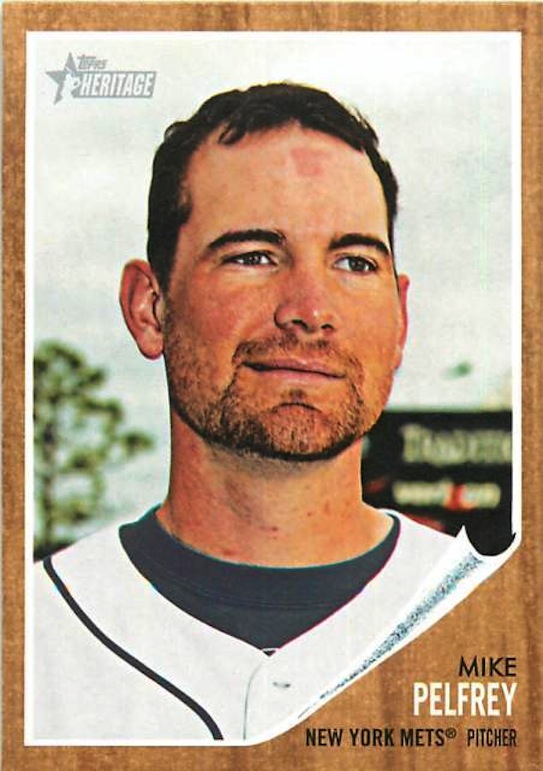
by Jason Fry on 19 March 2011 12:18 pm For several years now Topps has released a set it calls Heritage, spotlighting modern players on card designs from the past.
Depending on how these have been handled, my reaction has varied from “that’s cool” to “that’s a cynical cash grab.” But 2011 Topps Heritage? It’s an absolute winner, because the approach to the cards and history — specifically Mets history — is pitch-perfect.
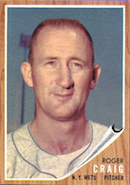  First off, the cards themselves. They’re done in the wood-grain style of the ’62 cards, and produced using plain old cardstock. They aren’t glossy, or festooned with holograms, or otherwise Jetsonized in some unfortunate way. Yes, there are some acknowledgments of the modern age: They have a (subtle) Topps Heritage logo, they say New York Mets® instead of N.Y. Mets, and the backs have a bunch of lawyerese, a web address, and the logos of MLB and the MLBPA instead of the ’nuff-said © T. C. G. P R I N T E D I N U. S. A. of another age. But that’s admissible — when nostalgia won’t be satisfied with anything less than perfect recreation, it’s crossed the line into mania. First off, the cards themselves. They’re done in the wood-grain style of the ’62 cards, and produced using plain old cardstock. They aren’t glossy, or festooned with holograms, or otherwise Jetsonized in some unfortunate way. Yes, there are some acknowledgments of the modern age: They have a (subtle) Topps Heritage logo, they say New York Mets® instead of N.Y. Mets, and the backs have a bunch of lawyerese, a web address, and the logos of MLB and the MLBPA instead of the ’nuff-said © T. C. G. P R I N T E D I N U. S. A. of another age. But that’s admissible — when nostalgia won’t be satisfied with anything less than perfect recreation, it’s crossed the line into mania.
The images are great too — they have that simultaneously static yet rich painterly quality of old Topps cards, and the poses are static, not action frames captured with a close-to-lightspeed modern shutter. The backs are wonderfully reproduced, too, with statistics boiled down to a brusque YEAR and LIFE and the little cartoons terrific recreations of a half-century-old style. (If you’re curious why Topps originally opted for YEAR instead of 1961, the answer was so holdover packs of ’62 cards might still sell in ’63.)
But here’s where it starts getting really good. There are 16 Mets in the ’11 Heritage set, plus two Rookie Parade cards featuring Jenrry Mejia and Mike Nickeas (first Met card!) as disembodied heads alongside those of other aspiring pitchers and catchers. Of the 16 Mets, nine are hatless, staring past the camera with the red badges of cap marks on their foreheads and vaguely sheepish expressions. Only one of the guys in a cap is visible to the waist.
The hatless shot is an old Topps standby, taken so a Topps artist could mock up a new uniform (sometimes with comical results) in case of a trade or some other move. There are hatless guys on other teams in ’11 Heritage, but a hasty and admittedly unscientific look around eBay finds many more hatless Mets.
This almost certainly isn’t a mistake or a statistical quirk: It’s Topps knowing its history, and offering an additional homage to 1962. Then, of course, the Mets were a brand-new team, with a dearth of photographs of players in heretofore-unseen blue and orange. Topps had to populate its Mets set with shots of guys in their old uniforms, and that was easiest if hatless shots were used. The ’62 Topps set has 21 guys and three Rookie Parade cards. Of the 21, 16 are hatless, three are wearing hats with the team logos removed, one guy (Al Jackson) wears a Mets hat, and one guy (Ed Bouchee) appears in full uniform. (For the trivia-minded, Don Zimmer wears a Mets hat on a Cin. Reds card, while Bobby Gene Smith wears Mets gear on a Cardinal card, but his cap is angled so you can’t see the NY.)
The percentages aren’t exact, but Topps has got the spirit wonderfully right. After I decided I loved the set, I spent 20 minutes irritably hunting around on eBay and the web looking for the Mets team card. Had Topps forgotten it? No, they hadn’t — I was the forgetful one. The ’62 Mets hadn’t had a team card. And so neither do the ’11 Mets.
Appropriately then, my hat’s off to them.
(Happy aside: The ’11 Heritage set, like us, also lacks Luis Castillo.)
|
|