The blog for Mets fans
who like to read
ABOUT US

Faith and Fear in Flushing made its debut on Feb. 16, 2005, the brainchild of two longtime friends and lifelong Met fans.
Greg Prince discovered the Mets when he was 6, during the magical summer of 1969. He is a Long Island-based writer, editor and communications consultant. Contact him here.
Jason Fry is a Brooklyn writer whose first memories include his mom leaping up and down cheering for Rusty Staub. Check out his other writing here.
Got something to say? Leave a comment, or email us at faithandfear@gmail.com. (Sorry, but we have no interest in ads, sponsored content or guest posts.)
Need our RSS feed? It's here.
Visit our Facebook page, or drop by the personal pages for Greg and Jason.
Or follow us on Twitter: Here's Greg, and here's Jason.
|
by Greg Prince on 15 August 2010 2:00 pm Lost, perhaps, in the euphoria over R.A. Dickey’s one-hitter on Friday night was the astounding arrival of Mike Hessman into the land of triples. As noted previously, Hessman’s first four Mets hits have been a veritable cycle: a double in his first start; a single the next day; a home run eight days later; and then the temporary home run that was permanently downgraded by one base eight days after that.
It only took eleven games, 29 plate appearances and one wack-ass video review to give Hessman one of the strangest quasi-cycles in Mets history. The man with the most minor league home runs among active professional ballplayers is having quite a ride. On August 6, he became the 69th Met to hit exactly one Met home run. On August 13, three umpires conspired to keep him the junior member of that particular club.
As far as the bizarre accomplishment of producing a single, a double, a triple and a homer as your first four Met hits, that’s got to be unprecedented, right?
Right?
If you think so, you haven’t met Jim Tatum, 1998 Met and — depending on how you view things — the proto-Hessman or the über-Hessman.
I learned from Elias via ESPN that Tatum was the last player to pull off the veritable cycle to begin his Met career, yet Tatum had the elegance to do it in order: a single in his fourth game; a double in his fifth game; a triple in his ninth game; and a walkoff home run to beat the Astros in his eleventh game.
A natural! And in a span of only thirteen plate appearances at that.
But that’s hardly the end of Jim Tatum’s Odyssey of oddity as a Met. Though he struck out a ton (once every three plate appearances) and didn’t hit very much in general (.180 average in 50 AB’s), he sure did sort of make his hits count.
Let’s put it this way: How many players in the trackable annals of the major leagues — since 1920 — have had as many as 50 plate appearances in a season, registered as many as nine hits, produced more extra-base hits than singles AND more triples than doubles?
According to Baseball Reference, one is the answer. And The One is Jim Tatum. In 1998, his only Met season, Tatum chalked up four singles, one double, two triples and two homers.
More XBH than 1B; more 3B than 2B. Even for a fairly limited sample, nobody does that. Nobody but Jim Tatum in his 35 games as a New York Met.
Anybody else want to join Mike Hessman and Jim Tatum (who both wore No. 19 as Mets) in a little triple-based weirdness? Remember, triples are the hard hits to get. Even in these days of Citi Field, they’re not supposed to be more common than doubles, and only noted Lance Johnson-type speedsters are supposed to get them significantly more than they do homers. At worst/best, they should hit eight triples and eight doubles in the same season with at least one homer…which describes Mookie Wilson’s 1981 to a tee. By going 8 2B/8 3B/3 HR, rookie Mookie became the only Met with at least that many triples and no more than that many doubles while also homering a little.
Try telling what you’re not supposed to do to Cory Sullivan, unlamented 2009 Mets alumnus. Last season, the worst season of all time by most Met-rics, Cory stood out, in his way, as a triple-loving, homer-hating, double-despising machine. Well, maybe it wasn’t as dramatic as all that, but he did hit five triples, two doubles and two homers.
Meaning? Meaning Cory Sullivan became the only Met with as many as nine extra-base hits in a season AND more triples than doubles and homers combined.
The only other Met in his, er, class? My blogging partner’s childhood favorite, Mike Phillips. In 1976, the utility infielder who cycled that season for real had more triples (six) than he did doubles (four) OR homers (four). It wasn’t quite Sullivan, but it was a bit more than Gilbert.
That’s Shawn Gilbert, one homer, but no triples or doubles in 32 games as a New York Met in 1997 and 1998.
Somewhere between Mike Phillips and Jim Tatum lies the unlikely Met career of Billy Baldwin. Baldwin was Phillips’ teammate late in the 1976 season. Promoted from Tidewater after coming over as the throw-in with Mickey Lolich in the dreaded Rusty Staub trade, Baldwin made hard-to-fathom history of his own.
On September 24, he came up as a pinch-hitter in the bottom of the ninth and ended what had been a 3-3 game between the Mets and Cubs by homering to beat former two-time 20-game winner Joe Coleman. It would be Baldwin’s only Met homer (earlier that same month, Coleman surrendered the only Met homer ever struck by Leo Foster; he must have liked being a two-timer).
OK, Baldwin is hot, so Joe Frazier inserts him in the lineup on September 25. What does he do? He triples in his first at-bat, doubles in his second at-bat and singles in his third at-bat. Billy Baldwin thus accomplished the Two-Day Reverse Natural Cycle: homer, triple, double, single. When all was said and done for Baldwin in the Bicentennial year, he had finished his Met career with exactly one of each kind of extra-base hit.
Three other Mets can say that: David Newhan (Lord, he was useless), Pat Tabler (also useless, but not here as long as Newhan) and, of course, Mike Hessman — though Hessman hopes there are more two-, three- or four-baggers in his blue and orange future. Dude’s batting .167.
We couldn’t leave the subject of Hessman and triples without a little Mets fan pathos. You might recall that after Mike’s home run was diminished to a leadoff triple Friday, he was not driven in from third, which left the score dangerously tied, as Cole Hamels was just about as effective as R.A. Dickey Friday night (to say nothing of just lethal enough with a bat). Not driving in a runner who had led off an inning in a tie game with a triple brought back memories of one of Metsdom’s most haunting dates, September 24, 2008.
While Billy Baldwin celebrated the 32nd anniversary of his walkoff blast the Mets commemorated it by again playing the Cubs at Shea and by again going to the bottom of the ninth tied. Bobby Howry surrendered a leadoff three-base hit to Daniel Murphy (whose t-shirt you can get a good deal on at the Citi Field team store). My goodness, we were excited out there in the Picnic Area! We get this win, it will be huge in our dual races versus Philadelphia for the division lead and Milwaukee for the Wild Card.
Murphy on third, nobody out, tie game…all we need is a fly ball.
Well, you know I’m not bringing this up (again) to relive the triumph of the moment. David Wright struck out, Howry intentionally walked Delgado and Beltran, Church grounded to second and Castro struck out.
Not that it still haunts me.
Anyway, I got to wondering, what with Hessman’s jury-rigged triple and all so top of mind, how common is that sort of thing? I did a little checking (a little?) and divined the following:
Post-9/24/08, the Mets have five times begun an inning in a tie game with a leadoff triple. Three times they scored the tripler, most notably two weeks ago when Jesus Feliciano chugged to third against the Diamondbacks to open the bottom of the ninth. Jose Reyes hit a short fly ball that Feliciano didn’t tag on, but after the ol’ double intentional walk to Pagan and Wright, the ghost of Carlos Beltran arose and hit a long-enough fly ball to score Jesus and win the game.
It was only two weeks ago, but it seems lost to the mists of time. Feliciano came home, we won…who remembers? Murphy didn’t come home nearly two years ago, we lost…who can forget?
For the record, there was a game at Citi Field in September 2009, almost a year to the day since Murphy was stranded at third in the future Citi Field parking lot, when Murphy led off another inning with a triple and he did score. No kidding: Josh Thole brought him home on an infield hit. The Mets were a million games out of first at the time. And the inning in question was the second inning. You’re excused for forgetting it ever happened.
Jose Reyes led off the home half of the first on June 23 of this year with a triple in a scoreless game and wasn’t brought home. Didn’t matter — the Mets beat Jeremy Bonderman and the Tigers easily. Ten days later, Alex Cora led off the top of the eighth at Washington with a triple and was brought home by none other than David Wright. It put the Mets up by a run, which looked huge at the time. The Mets would go on to score three in that eighth inning.
But y’know what? It wasn’t huge enough. That was the notorious Stephen Strasburg game, the one R.A. Dickey was in line to win until Bobby Parnell (a little) and Frankie Rodriguez (a whole lot) conspired to give it back.
Then, Friday, Hessman, trotting around the bases, then being ordered to trot back one, then standing at third as Jeff Francoeur struck out and Henry Blanco struck out and Ruben Tejada was intentionally walked and R.A. Dickey tapped out to the pitcher. Tie game still. Yet eventually a win…a one-hitter win…a one-hitter win when R.A. Dickey was the star of the show and Mike Hessman was, per usual, something else.
by Greg Prince on 15 August 2010 5:00 am You know, I would have canned the K-Rod entrance music for one night.
It had occurred to me Francisco Rodriguez might pitch at this game I was going to Saturday, but caught up in the Mets’ passive resistance movement (passing on scoring, resisting ground balls), I’d sort of forgotten he was back. But then, suddenly, it’s the top of the ninth, and the main video monitor heats up, and “Sandungueoso” stirs and the bullpen gate swings open and all at once Francisco Rodriguez from all those breathless tabloid stories is Frankie the Met closer again.
There was nothing to close — just a can of worms to open.
As it dawned on however many of the 39,000 in attendance still on hand who was entering the game, I could feel a tangible pause in the air. “Look,” I could hear us think. “It’s him.”
And then?
Boos, mostly…though a few people stood and applauded as if he had persevered through a difficult personal ordeal — which one could say he had, if one were to apply a very generous reading of the circumstances. Certainly there were more boos than I’d ever heard for Francisco Rodriguez at Citi Field. Sure, we instinctively tense our bodies when he’s announced into a game and we cringe in agony as soon as he goes to ball one on his first batter, but really, Rodriguez has never been received as unpopularly live as he is in online and talk radio settings. This was a new sensation, Rodriguez booed before endangering a lead.
Yet it wasn’t endless and it wasn’t vicious — though it’s hard to think of a “boo” as vicious compared to whatever Rodriguez allegedly did to the father of his girlfriend/common-law wife. It felt a little obligatory, actually, as if the crowd knew it shouldn’t approve of his actions. But it also didn’t keep up. I think if Mets fans who paid to be at a Mets game they still hoped the Mets would win really couldn’t stand the sight of a Met who had been officially charged with third-degree assault just two days earlier, he would have been castigated for a lot longer than the time it took him to jog from the pen to the mound. Once he began his warmups, the mass attention moved on to whatever the next between-innings time-filler was.
I’m pretty sure David Wright, stand-up guy of stand-up guys who punches nothing more than a clock, was booed more for his two-run error than Francisco Rodriguez was for his (alleged) third-degree assault. Likewise, I saw one tough guy a few rows behind the Met dugout shout his head off at Luis Castillo after Castillo’s predictably weak pinch-hit grounder in the eighth. Maybe he shouted at Rodriguez, too, but I didn’t notice.
After the warmups, it was uncharted territory between the crowd and their closer. When the Phillies hit the ball hard, the boos revived — definitely stronger than you get for your typical K-Rod leadoff baserunner. When the inning ended without any runs scored, there were few boos. Instead, there was applause after the third out, though I’m pretty sure that was directed primarily toward Carlos Beltran’s nice running catch of Raul Ibañez’s fly ball.
While innocence until guilt is proven is a cornerstone of the American way, I found it a little disturbing that Francisco Rodriguez was back at work so soon after he caused what we can clearly call a major disturbance where he works. He’s a free man, which is fine if that’s what the judge decided he should be for now, but it’s a little ludicrous that his employer couldn’t take pronounced punitive steps against him considering the ruckus he raised flared right there on the premises of their physical plant.
Cap tip to the Major League Baseball Players Association for negotiating so effectively on behalf of its membership, but what a lousy message it sends that an action like Rodriguez’s is what they implicitly defend. A court of law will decide what kind of wrongdoing occurred outside the Met family room, but from a sheer public relations standpoint, an undeniable mess was left behind because Francisco Rodriguez couldn’t control his temper. You make a mess at work, there are usually specific consequences outlined in a human resources manual somewhere.
It can be disingenuous to apply “real life” to professional sports considering how utterly unreal professional sports are, but it doesn’t seem too terribly far-fetched that if an employee engages in an (alleged) assault on company grounds, that it might instigate, at the very least, a thorough investigation and some form of discipline. It’s not unreasonable to expect the employer to have that kind of recourse.
Yet if the Mets wanted to shelve Rodriguez for more than a two-day stay on the Restricted List — and it sure seems they did — they couldn’t. Again, kudos to the Players Association’s iron fist. It packs quite the punch, and there’s nothing alleged about that.
Francisco Rodriguez returning to uniform, let alone game action, on Saturday after being arrested Wednesday reminded me of the 1993 suspension by Major League Baseball of Cincinnati Reds owner Marge Schott after she made a series of ugly racial and ethnic remarks. Those who reflexively snort about the tyranny of “political correctness” had their usual field day in criticizing the decision, but I thought those people missed the point. Schott needed to be suspended not strictly because she said idiotic/insensitive things about people of African-American, Japanese and Jewish descent, but because she was an embarrassment to the baseball industry — Marge Schott was simply bad for business. You don’t let someone like that serve as a spokesperson for your product if you are at all concerned about attracting the widest possible audience to your product.
Francisco Rodriguez’s alleged misdeeds were of a different nature than Marge Schott’s, but there’s no good be to had at this moment from featuring him as one of your nominal star attractions. Carlos Peña is the one who literally suffered the most from this incident, but on an another level, the Mets were victimized. They have a huge investment in the K-Rod brand. I don’t know how many fans come to Citi Field specifically to root for Frankie Rodriguez, but he’s part of the overall package. He’s the bottom of the ninth inning if things are going well. As such, the Mets have taken it upon themselves to nurture Rodriguez — making sure they don’t go too many days without using him; treating his entrances into games as events; pretty much looking the other way every time, prior to this week, when he engaged in a loud disagreement with someone.
In the main team store before Saturday night’s game, there was still plenty of RODRIGUEZ 75 merchandise to be had. It wasn’t exactly in the front window — in fact, a rack of his jerseys was subtly covered up by some less controversial Metwear — but it’s there, and it’s not marked down to MURPHY 28 priced-to-move lows. I saw quite a few RODRIGUEZ 75 jerseys and t-shirts in the stands. Maybe there was irony attached to the choice, but I kind of doubted it. There are always quite a few RODRIGUEZ 75 jerseys in the stands.
Francisco Rodriguez wasn’t exactly the toast of Citi Field in his first season and two-thirds, but he was deployed in a high-profile role, and more than a few Mets fans bought into the K-Rod brand. Memorable blown saves notwithstanding (and the worst of them seem to happen on the road), I’ve never picked up on a virulent anti-Rodriguez vibe at the ballpark. If he hasn’t exactly been beloved, he was about as warily supported/tolerated as his predecessor Billy Wagner was once we got past the initial euphoria of “Wow, we got K-Rod!” (a similar honeymoon period was applied to Billy and it, too, more or less evaporated). He may have set eyes rolling and incited comparisons to previous closers of whom we eventually had our fill, but Francisco Rodriguez was never, before Wednesday, treated or greeted like Armando Benitez at the depths of Armandomania.
And now? From a practical standpoint, the Mets have a pitcher to whom they’re paying a boatload of money, someone they couldn’t keep suspended, someone they ultimately rely on to win games. They’re already burying one pitcher deep in their bullpen because of contractual niceties, they simply cannot hide two. They either have to figure out a way to cut ties with Francisco Rodriguez because they are appalled by his behavior — as if allegations of hitting the father of the girlfriend aren’t bad enough, there are allegations of incidents of domestic violence toward the girlfriend herself in California and Venezuela — or they are stuck with him.
Or, perhaps, they believe that a combination of stated contrition and anger management will have a redemptive effect on a wayward soul who, if nothing else, is nice to small dogs. Jeff Wilpon and Omar Minaya liked Francisco Rodriguez enough to sign him to a three-year, $37 million dollar deal (with an easily vesting option for another year) a mere 20 months ago. They must have seen something in him besides saves to invest that much money and that much faith in someone who has never come off as what you’d call mild-mannered.
When this story broke, I thought two things:
1) Violence like that which was reported is absolutely inexcusable, but family dynamics are an entanglement one shouldn’t try to pry apart from a distance.
2) K-Rod had retired 28 of his previous 31 batters — damn, why did this have to happen when he was FINALLY going good?
If there had been some story on the news the other day about a random fellow going after his girlfriend’s father in a rage, I would have shaken my head, wondered what this world was coming to, and changed the channel. It’s crass, but it’s true: The only reason I care about Francisco Rodriguez’s family dynamic or his journey through the criminal justice system or the way his employer handles its relationship with him is because he’s a New York Met…and because I’m not necessarily sold on the idea that a bullpen-by-committee can routinely nail down the final three outs of games the Mets are leading by three or fewer runs.
Saturday night, that wasn’t what was going on. Francisco Rodriguez wasn’t coming in for a save. He was just trying to shake off the rust. He hadn’t pitched since Tuesday and he hadn’t been just another pitcher since Wednesday. So they played his song. They flashed his image. He made his jog. Most booed. A few applauded.
I did neither. I just watched.
by Greg Prince on 13 August 2010 10:02 pm There was a home run that became a triple that became an extended farce of a video review session that became a nagging left on base. There was, at last, a double followed by another double and those became a run. There was a no-hitter that unfortunately became a one-hitter, but ultimately stayed a one-hitter as well as another complete game shutout.
That’s a lot of baseball packed into two hours and nine minutes. Minus one bad overturned call and one achingly sinking line drive, it’s all we could have asked for.
No one has to tell R.A. Dickey to “man up,” that’s for sure. That man is ready for anything. Friday night he was ready to follow up his worst Met outing with his best Met outing, maybe the best Met outing Citi Field has ever seen. It was certainly as efficient an outing as any pitcher could unfurl.
It was, considering the absence of a designated closer, definitely just what the Dickey ordered.
R.A. allows just one baserunner via walk for five innings. Then Cole Hamels gets a hit with one out in the sixth. We knew it was nauseating as soon as it fell in. What we couldn’t have known was Hamels wasn’t too many minutes removed from joining then-Cardinals Ray Sadecki (1966 off Jack Hamilton) and John Curtis (1974 off Jon Matlack) plus Rockie Chin Hui-Tsao (2003 off Steve Trachsel) as the only opposing pitchers to register the sole besmirchment in a Met one-hitter. Oh well, a pitcher is a hitter as long as he’s got a bat in his hands, and Hamels is quite a pitcher besides; he went all eight innings that the Mets batted, making this the fifth dual complete game in which a Met starter has engaged in the past fifteen years.
But really, was anybody else on the field as long as R.A. Dickey was on the mound twirling those nasty knucklers? Didn’t feel like it. He got some nice defense early. He stayed in a groove from first to last. It was his show. At the moment, it’s his world, and we’re all just kvelling in it.
Naturally you can’t simply rely on a Met starter to throw a gem of a shutout and expect to win. For that, you need at least one Met run, and the Mets and the umps both seemed determined to avoid that total. Mike Hessman hit his second Met home run — goodbye list! — until inconclusive replay evidence mysteriously refashioned it a triple — hello again list! (Mike Hessman’s first four Met hits, spread over eleven games, have been a double, a single, a homer and now a triple…how’s that for a cycle?) I’m still fuming at the three men in blew who reduced Hessman’s blast to a three-bagger, but I’m angrier at whatever dope stuck his arms over the left field wall and cast doubt on the entire process. It was a home run. Even if it wasn’t a home run, there was no video that made that clear it wasn’t after it was ruled that it was. Video replay remains an odd duck in the baseball pond, but it’s still better than just guessing.
Jeff Francoeur and Henry Blanco each were granted an opportunity to make it all good by driving Hessman home from third, but they chose passive resistance instead. So much for the one run Dickey needed. Fortunately, Wright finally hit a ball with enough distance to get him as far as second and Beltran woke up to do the same. That made it 1-0 after six, and Dickey made it cruisingly through nine.
Two hours and nine minutes, and that’s with seven or eight minutes devoted to getting the home run call wrong. Amazin’! Back-to-back complete game shutouts during the two days of Francisco Rodriguez’s suspension. Doubly Amazin’! No-hitter steered clear of every single game since 1962. We know how that goes, particularly when one lousy ball lands safely, but the part where their one hit doesn’t kill you and your one run puts you over the top…that’s as Amazin’ as we needed to be on a night like this.
One-hitter mania here from ESPN’S Mark Simon.
by Greg Prince on 13 August 2010 6:11 am Welcome to Flashback Friday: Take Me Out to 34 Ballparks, a celebration, critique and countdown of every major league ballpark one baseball fan has been fortunate enough to visit in a lifetime of going to ballgames.
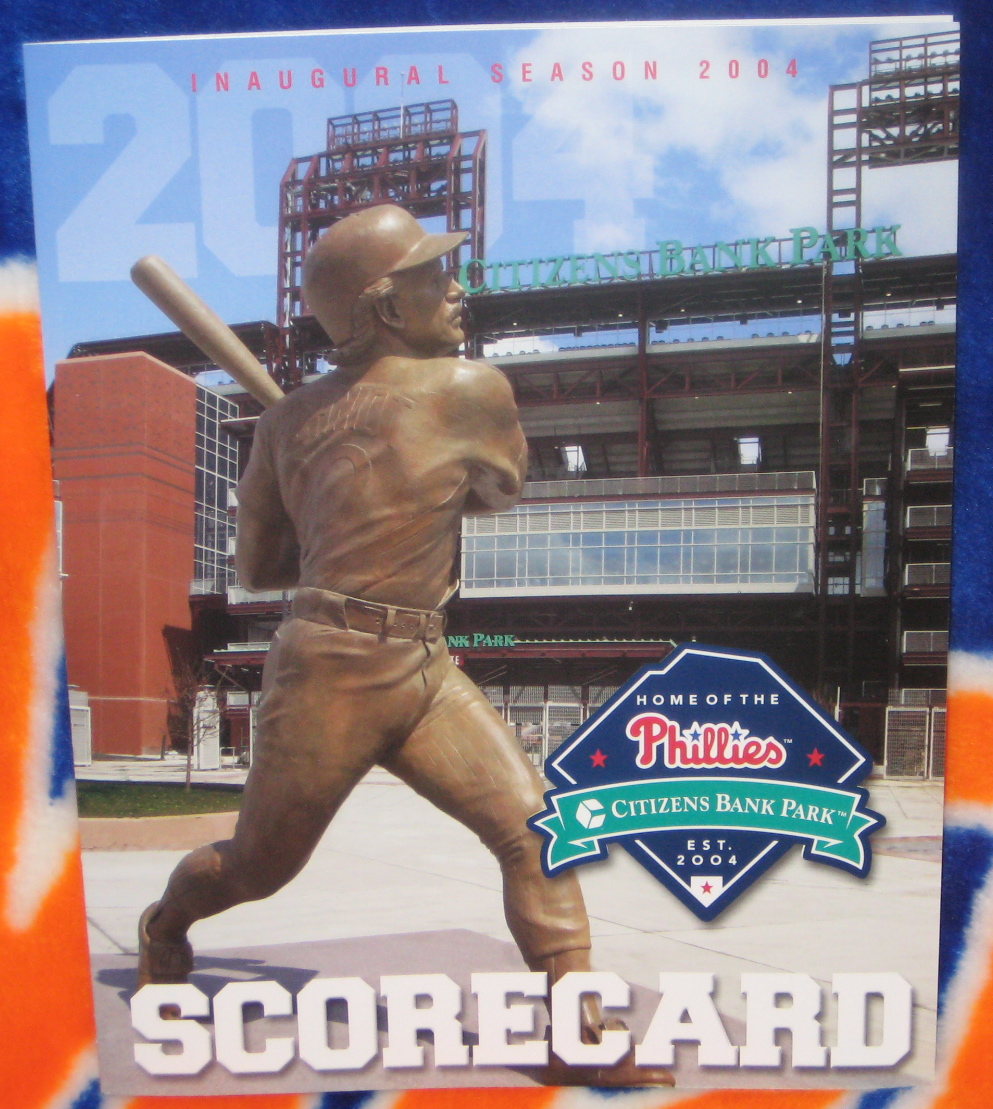
BALLPARK: Citizens Bank Park
HOME TEAM: Philadelphia Phillies
VISITS: 4
FIRST VISITED: September 5, 2004
CHRONOLOGY: 28th of 34
RANKING: 14th of 34
Keeping an extra ballpark right where one can access it with relative ease is a great idea, and I thank the Philadelphia Phillies for hosting Citizens Bank Park so conveniently these past six seasons. It’s good to know it’s there if I ever need it.
OK, so it’s not there as an alternate venue for my own personal enjoyment, but it sometimes feels a little that way. All trolls can stand down now, for those are not intended as fightin’ words. I’m praising your ballpark is all. Except that it doesn’t seem practical, I’d almost like to come down one of these days and see the Phillies play somebody besides the Mets and get a handle on how it feels to be a disinterested observer as opposed to a partisan whose loyalties are not greeted warmly by the natives. Even as such (twice victorious, twice otherwise), I’ve enjoyed the place a great deal every time.
Sorry Phans, I make for a lousy archrival (just like the Mets…I know when I’ve tossed out a straight line). I have no “smack” or “trash” or whatever the kids are calling disparagement to talk here. If it makes you feel any better, the presence of a few jerks in your ranks makes these trips less than thrilling, perhaps, but in four visits to CBP — and three before to the Vet — I’ve never had a real problem. My sensibilities were a little put off, but I wasn’t. I’m a recidivist visitor and I’ll probably stop by again in the years to come.
Seriously, though, the proximity is a big help. Its 2004 opening served to keep my streak of visiting at least one new ballpark per year — new to me if not necessarily new to the landscape —alive at thirteen consecutive seasons. We had just bought our co-op that summer and our travel budget was restricted. But an Amtrak excursion was definitely doable, even if StubHub had to be called in to provide the game tickets. And I will tell you right away that attending a game at Citizens Bank Park exactly one week after attending a game at Shea Stadium was a revelation.
CBP wasn’t my first retro rodeo by any means, but it was such a breath of fresh air compared to my beloved Shea (let alone the Vet, no offense to its sainted memory). The timing couldn’t have worked better in the Cit’s favor on one note in particular. 2004 was the year the Mets opened a full-blown team store on Field Level. The aisles were cramped and the merchandise was ridiculously marked up, but that was Shea for ya. Stephanie and I each purchased an overpriced t-shirt and encountered two obstacles in appreciation for our patronage.
1) We had to present our receipt at the door, a few steps from the cash register, on our way out (as if we’d stolen the shirts and cleverly shoved them into Mets team store bags).
2) We were not — because we held Loge tickets — permitted to walk the maybe twenty feet from the store to the Daruma stand for our one and only favorite Shea culinary delight, the sushi. We could spend $70 or so in the store, but not another $10 at the stand…unless we agreed to take the escalator up a level and walk clear to the right field ramp and walk back down and approach Daruma from the other direction.
I had a few loud words with a few Shea staff people that day.
Anyway, it’s a week later: another park, another Sunday. Another team store, the Phillies’. Before we realized we were supposed to despise them, we decided we wouldn’t mind a couple of shirts associated with their ballpark and their history (Stephanie got a powder blue number with the groovy “P” from the ’70s, I went with one celebrating the Whiz Kids and another with an Inaugural Season stadium logo…no, they are not worn that often these days). We bought our stuff and pulled out our receipt for inspection.
There was no inspection. There was somebody stationed by the exit telling us to enjoy the game, but nobody asked for proof that we had just bought apparel or anything else. And — shocker of shockers — nobody demanded our tickets and told us to skedaddle to the Terrace level where we belonged. We were free to roam, just like people.
I have relatives who emigrated to the United States from the Soviet Union in 1979. One of them said that the first time she visited an American supermarket, she nearly fainted from the contrast to Russia. That’s how I felt at Citizens Bank Park in 2004 one week after engaging in a cold war with Shea Stadium personnel.
As attractive as CBP is, what I truly love about the place is the friendliness and the courtesy extended by those who run it. There are prettier ballparks, but none is smoother at making you feel welcome. I’ve had this discussion time and again with my Central Jersey friend Sharon, who lives closer to Philly than Flushing and has had more experience in that neck of the woods. No, we don’t care a whit for the team. No, we don’t much care for the Phans, at least en masse. But gosh yes, the Citizens Bankers do their jobs beautifully. It was true in 2004, it was true in 2007, it was true last week.
In this post-Shea, post-Vet world, amenties are amenities, bricks are bricks, retro is retro. While I was blown away by the service aspect of CBP, I had seen enough other parks by 2004 that the overall presentation was fine and dandy, but nothing groundbreaking. “The New Adequate” is the way I phrased it to a friend of mine with whom I compare ballpark notes.
That is to say Citizens Bank did everything right and little badly. In that light, it was The New Adequate to me. The stakes had been raised in the generation that followed Camden Yards. It wasn’t enough to be not round and have a playing surface that was not artificial. The standard, thus, had become this in my mind: If you’re at least as good as Citizens Bank Park, you’re doing something right. If you’re better than Citizens Bank Park, you’re doing most things right. And if you’re not up to the level of Citizens Bank Park, then you aren’t trying.
If you’re following the rankings in this series, you’ll note I have Citi Field two notches below Citizens Bank. To be honest, through last year, I thought they were close. But returning last week reminded me how distant the two are. (Yes, yes, just like the two ballclubs.)
While I didn’t think CBP broke much new ground in 2004, it wears very well in 2010. It has a nice, easy slope to it. Its architecture doesn’t try too hard. It feels not like a drawing board project gone awry in the transition to real life but an actual ballpark, comfortable for its purpose, civilized in its approach. It’s intimate without the claustrophobia. It emits a lighthearted sense of self. The statues and other heritage-minded tributes (Ashburn Alley, Harry the K’s) burst with the kind of pride a fan — even an “enemy” fan — feeds off. I’ve sat in four different areas on my four trips, and they all have something to recommend them. It all looks good, it all sounds good — the PA is crystal clear and the music selection’s superb (though the announcer is overbearing) — it all tastes good and it all feels right. I also love that getting there from 30th Street Station via SEPTA is pretty much a breeze.
The Phans…some are better than others. The noise they make when something good (for them) happens is unique. It’s an explosion, almost. When the game is not going well (for them), it’s not all that raucous, which is fine with me, because I can hear the music even better. I’ve noticed a higher ratio of older fans, 60+, than I’m used to on my two Sunday visits, owing, I’m guessing, to a fan base with deep roots in the franchise. In 2004, I picked up a bitter, fatalistic vibe, which seemed to come with the territory of pulling for a team whose legacy was mostly losing.
Come 2010, locals of all ages seemed happier, but there was still some residual resignation in the air. Stephanie and I met a man, maybe 65, who joined us to linger over a model of Connie Mack Stadium/Shibe Park on the gorgeous Hall of Fame level (which itself devoted ample space to, among other Philly touchstones, the Athletics, a nod that struck me as appropriate and sporting). He started telling us, without our asking, what it was like there, how the grass was kept immaculate, how you had to pay somebody to “watch your car” lest it not be there after the game, what a great place it was to watch baseball. I liked that guy. And I’ve had nothing against most of the folks with whom I’ve shared rides on the Broad Street line to the Pattison stop.
Those I haven’t cared for? Oh, probably the kid who sat behind us in 2004 and screamed that Mike Piazza was a “homo” and Todd Zeile was something even more unprintable during the national anthem; or the kid I crossed paths with in 2007 who started in on the Mets’ home borough’s name which happened to be on my t-shirt that day (yeah, it’s Queens — what about it, schmuck?); or the onslaught of well-wishers last week who waited for Roy Halladay to get through the seventh with a one-run lead before running over to our little party to let us know their team was still winning; or some dude three years ago who just kept calling out to several rows of us in orange and blue, “Mets…BOO!”
Maybe it’s my age or just a different vantage point on how one enjoys a game that makes me find this behavior — non-violent, to be sure, but confrontational just the same — a little tiresome. I’m all for yelling at the players. Yelling at fellow fans, even fans in different colors, does not appeal to me. I like to believe we’re all kind of in this together, that we’re all fans of a great game, and that we’re more alike than different if we’ve bought a ticket to the same event. Unless provoked, I’ve never yelled anything at a fan of another team at Shea or Citi. It’s just not what I do, perhaps because I’m too busy harnessing my anger and frustration regarding my own team and my own stadium’s shaky customer relations policies.
I’ve worn my Mets gear to Mets games in Montreal, Detroit, Baltimore, Chicago, Arizona, the Bronx, Cincinnati and Washington and (except for the Bronx, obviously, and D.C., a little), it was greeted either benignly or good-naturedly — and believe me, Cubs fans didn’t let a little thing like the calendar get in the way of still holding 1969 against us decades after the fact. There has definitely been a sharper edge to the reaction at Citizens Bank than anyplace else I’ve rooted for the Mets, including the Vet.
My 2007 trips were prior to the Met-Phillie tipping point. It was late June and everything was going misleadingly well for us, less so for them. We were the invading hordes as we had been regularly since the ’80s (the Phillies used to advertise to us on Mets broadcasts and we took them up on their hospitality) and I remember thinking I’d probably generate an unreasonable hate toward the other team’s fans if so many of the other team’s fans were coming into my house that frequently and their team was doing better than my team as a rule. Now that the home team — in Philly — is doing better than the Mets, I don’t fully fathom the continued edge as regards our presence, but if the seniors can still seem bitter from 1964 or whenever, then I guess old feelings die harder in some places than others.
Me, I wear my Mets shirt and my Mets cap and I applaud my team and I may chant a little LET’S GO METS, but I’m a polite guest. Politeness ain’t exactly the coin of the realm in the stands at CBP, however, certainly not the way it is valued by its management and put into practice by its employees. Oh well, you can’t have everything.
If you could, I’d pull Citizens Bank Park a lot closer to where I live so I could get there more often. It’s just that nice.
by Greg Prince on 12 August 2010 5:50 pm Nothing is wrong with the Mets’ world when Johan Santana is right.
There is no arrest.
There is no arraignment.
There is no civil suit.
There is no issue over who pitches the eighth.
There is no wondering who will pitch the ninth.
There is no pitch count.
There is no endless slump.
There is no idiot manager.
There is no inane remark about the sun coming up.
There is no waste-of-space rightfielder resenting his benching.
There is no waste-of-space lefthander resisting demotion.
There is no Chris Carlin in the studio.
There is no unconquerable margin in the standings.
There are no problems capturing rubber games.
There are no problems at all.
There ain’t no mountain high enough.
There ain’t no valley low enough.
There ain’t no river wide enough.
There ain’t no “here we go again…” narrative.
When there is Johan Santana, there is Baseball Like It Oughta Be.
There are nine shutout innings.
There are ten strikeouts.
There are insurance runs set up by a hit-and-run single.
There is a New York Mets victory over the Colorado Rockies.
There is a New York Mets triumph over the forces of doom.
There is too much time between Johan Santana starts.
by Greg Prince on 12 August 2010 1:48 am You know exactly what happened between Frankie Rodriguez and his father-in-law…what exactly provoked the Mets’ closer into a situation from which he’s to be charged with third-degree assault?
Neither do I.
Thus, I’ll leave the amateur psychology to experts like SNY’s doctors of uneducated guessing and conjecture, Bobby Ojeda and Chris Carlin. Any event that involves the police and ambulances qualifies as an unfortunate incident, to say the very least. To say the most would be irresponsible…which didn’t slow Ojeda (once arrested in the middle of a baseball season himself), Carlin or anybody else from inferring whatever fit the narrative of the moment as they attempted to definitively analyze the breaking news that fell into their laps. “Not at all good on any level whatsoever” will have to suffice until the details emerge or are burrowed out.
As for the game the preceded Rodriguez’s arrest, that can be boiled down to its essential details easily enough:
Angel Pagan launched a two-run homer in the first inning.
The Mets did nothing offensively after that.
Jon Niese pitched beautifully for seven innings.
Jerry Manuel went with Hisanori Takahashi, his new setup man, in the eighth until he panicked and pulled him with two on and two out, bringing in Manny Acosta, who threw a wild pitch, was ordered to issue an intentional walk and gave up — to Melvin Mora — the Met staff’s ninth grand slam of the season.
Knowing the details doesn’t necessarily make them any more palatable, but it’s helpful to know them before deciding what happened. I know what happened during the game Wednesday night: the Mets lost. I don’t know all that happened after the game Wednesday night. I’m sure we’ll hear more.
Maybe even exactly what happened.
by Greg Prince on 11 August 2010 11:15 am The Mets throw all sorts of obscure statistics on their scoreboard in the hours before a game starts, including how they’re doing at home on a given day of the week. For example, before the Mets opened against the Rockies, word was posted that the Mets were 9-0 this year on Tuesday nights at Citi Field.
Coincidence? Biorhythms? The tides? Whatever. Tuesday’s obviously a good night for home games in 2010.
This most recent Tuesday was a great night at Citi Field.
You’d think a ballpark you’ve been hanging out with for 55 games plus various and sundry events isn’t capable of showing you much new, but you’d be wrong. Then again, I spent more than 400 games with another ballpark and I was always getting something unexpected out of it. Part of why we go to ballgames is for the constancy it provides our lives — familiar team, familiar people, familiar sensations — but its magic is also embedded in giving you what you hadn’t experienced before.
I keep going and I keep getting the best of all worlds.
Some of what was new to me from Tuesday…
• The Empire Suites. Through one of those Degrees of Separation you had no idea existed from you to this person as well as to that person, Stephanie and I made our Citi Field suite debut. Until last night, this level was merely a rumor to me, something behind carefully guarded doors, somewhere Kevin Burkhardt materialized every few nights to interview whichever Met alumnus didn’t rate the SNY booth. Gary, Keith and Ron got Mike Piazza, Kevin got Benny Agbayani.
Not that there’s anything wrong with Benny Agbayani. But I didn’t see Benny on the Empire level. I did, however, break through those doors and saw what there was to see.
I saw what an Empire Suite looks like (gracious living, no more over the top than the Diamondview Suite of yore).
I saw the ballgame from between home plate and the visitors’ dugout (at approximately Loge level; yes, I still translate most things into Shea).
I saw a very nice spread of ballpark fare for dinner (try as I might to translate, there is no word to describe how much better the Citi Field rendition of the chicken tender is than that which emanated from the Shea kitchen in 2004 and literally made me sick).
I saw the most padded seat I’d ever been permitted to sit in for a ballgame and, shall we say, sat my ass off.
I saw CNN instead of SNY on the men’s room monitor, though I guess the real story is the Empire level has a TV in the men’s room.
And I saw a lovely woman named Felicia who attended to our suite with a plateful of courtesy and chocolate chip cookies.
The real treat for me, besides the view and the — wait for it — amenities was getting to personally inspect the oversized Topps baseball cards that line most of the Empire level hallway. Ever since they were affixed to the walls early in the 2009 season, I strained to make them out from the Rotunda, and never did any better than 1983 on the right to 1988 on the left. Who, I wondered, was represented? Was every year up there? What other fun stuff were they hiding from those of us who were not Emperors?
I can now tell you there is indeed one Topps for every Met year, starting with 1962, 1963 and 1964 which, for some reason, are represented chronologically by cards from 1963, 1964 and 1962, respectively. I’d love to issue whoever hung them the benefit of the doubt, but no, I can’t. You put stuff like this up for people who will obsess on them. Don’t get them wrong.
Just because Marv Throneberry’s signature year was 1962, you can’t place his 1963 card first and call it 1962 on the nameplate (even though the Mets are Capital-A Awesome for continuing to embrace Marv Throneberry when the Astros likely haven’t done a damn thing for Al Heist since LBJ was vice president). Duke Snider’s only Met year may have been 1963, but his card is a 1964 model. Stick him over the 1964 tag, let Throneberry live in 1963 where his card belongs and for gosh sake, Casey Stengel’s 1962 card — in which he’s wearing a pinstriped jersey and an airbrushed cap — should not be filling the 1964 slot. By 1964, even Topps had pictures of Casey Stengel in the right pinstriped jersey with the right NY cap.
That said, what a collection. Yogi’s 1965. Mets Maulers from ’67 (Kranepool and Swoboda, who Mauled to the tune of 22 combined home runs in ’66). The legendary Ryan-Koosman/Koosman-Ryan rookie card from ’68. Matlack horizontally in ’74. Grote in full gear in ’76. Mazzilli’s bedroom…I mean dugout eyes from 1979. Then the good players of the ’80s for as long as they will last into the ’90s (Eddie Murray shows up eventually, but no Bonilla), followed by Valentine’s Men of Valor — Fonzie! Oly! Robin! — and a smooth transition into the recent relatively good times of Floyd, Reyes, Martinez, Wright, Beltran, Santana, Delgado and, standing up for 2010 for reasons nobody will be able to adequately explain to the Empire Suite holders of 2020, Jeff Francoeur.
Then again, I kvelled from Marvelously Misplaced Marv nearly a half-century removed from his not touching first or second, so the cult of Frenchy may have legs. It’s not like it has a batting eye.
But to reiterate, no Benny.
Except for a few framed photos of Mr. Met and Citi Field construction workers, there wasn’t much else that Metsified the otherwise chilly corporate Empire level. I could make suggestions, but I don’t expect to be up there to inspect again for a while. As with the oversized Mets yearbook covers that line the corridor that leads from the press conference room to the field, what a shame this kind of cool Metabilia is seen by so few fans. Then again, whoever’s paying big bucks for a suite deserve some kind of premium. They get a cookie and they get a big Jeff Francoeur.
Seems reasonable.
• The Chasins. True story from our trip to Philly on Sunday. A kid named Alex, early teens I’d guess, came up to me to tell me how much he was enjoying my book, which I appreciated, of course, but I thought he was a friend of the birthday boy we were there to fete, and it wouldn’t seem out of the ordinary that someone who knew the Chapman family would have read Faith and Fear in Flushing. But he wasn’t part of the Ross celebration. It was a chance meeting between two Mets fans on foreign turf — one who wrote the book the other was currently reading — which made the bump-into rather unusual and particularly wonderful. Or as Alex’s mother said to me when I came across their brood a few minutes later, “He reads one book in his whole life, and he meets the author. I told him he should read more books.”
Sound advice, no matter who you meet.
I’ve been lucky enough to meet or correspond with dozens and dozens of former strangers who read FAFIF and not one demanded his or her money back. It’s amounted to an incredible emotional annuity for me since it began happening with the release of the hardcover edition in March of 2009, and it continues to humble me now that it’s in paperback.
Within that realm of being recognized or sought out, nothing has ever compared to the Ryder Chasin experience.
The back story is here, but the Baseball Digest version is Ryder was, last September, a newly minted 13-year-old with a burgeoning Mets obsession that was on pace to match my own. He’d read my book and wrote me a letter that asked, really nicely, would I mind attending his Bar Mitzvah party at Citi Field in November?
Would I mind? Would Jeff Francoeur mind swinging on three-and-oh?
Stephanie and I were delighted guests of Ryder and his parents at a memorable affair last fall, an event whose only drawback was it didn’t come with a baseball game. That little detail we took care of Tuesday night.
That’s where the Degree of Separation I mentioned comes into play. It turns out Ryder, a young man of many talents (and nearly a head taller from when I last saw him), was pitching a whale of a season at the Babe Ruth level in his Connecticut hometown this summer. Somehow it came up in conversation between Ryder’s dad and the dad of a teammate that I was at Ryder’s Citi Field Bar Mitzvah.
And the dad of the teammate said, hey, I know that guy.
Small world strikes again. The dad of the teammate is somebody with whom I’ve communicated intermittently in one of my other online Met incarnations. I knew him only by screen name. It took Ryder to tell me his real name — Nick. And then I found out Nick has access to a suite…and since we’d been talking about going to a game together…and Nick (who couldn’t make it himself Tuesday) turns out to be a super nice guy in real life…there we were, Stephanie and me, Ryder and his dad Rob, getting the cookie and the oversized cards and the outstanding view and a really fantastic evening that would have been off the charts even without Mike Pelfrey’s crucial contribution.
It also would have been wonderful without benefit of a suite, but who’s going to turn one of those down the only time it’s offered?
When we met outside the park, Rob and Ryder were all, “We’re following you, you know your way around this place.” But the Chasins showed me at least one thing I had never seen at Citi Field. They showed me the Hershey’s Dunk Tank. It was one of those things I vaguely knew existed but wasn’t sure where it was and had never been curious enough to track down what it was. It’s pretty cool, actually. The Mets make an employee (who treats it, truth be told, as grim duty) put on the opposing team’s jersey and wait for a patron’s pinpoint fastball to release the mechanism that will send him or her plunging into wetness. I don’t know why they don’t get dunked in chocolate since it’s Hershey’s. Probably insurance reasons.
Nick had clued me in that Ryder showed quite an arm in his summer league. I can confirm that. On the second of Ryder’s three pitches, down went the grumbling “Rockies” player into the tank. Great velocity. Great control. Great fun. Only feature they could improve would be having Oliver Perez serve as dunkee. It’s not like he’s doing anything else.
Dunking done, the four of us together then discovered the Empire level, and from there we discovered all over again the properties that make the constancy of baseball so appealing.
How many so-called diversions can bring together people who didn’t know each other a year before — and had only met once since then — as if they were all the oldest of friends? How many “events” are perfect for following intently while simultaneously chatting amiably? And how many topics come replete with an expansive vocabulary that give every user instant comfort? Go flag down somebody on the street and get into overuse of middle relievers or runners scoring from second on ground balls or long ago 0-0 scores and they’ll look at you funny (or worse). Ryder and Rob and Stephanie and I…we all spoke the same language.
It was a terrific Bar Mitzvah last year, but this was better. This was a ballgame.
• Upstairs. It’s worth noting that the date we arrived upon with Rob and Ryder wasn’t so random. Sharon Chapman told me she and Ross (Stephanie’s and my original 2009 Mets-themed Bar Mitzvah boy, he of the Citizens Bank birthday gala on Sunday; I swear this week has been like a reunion tour sponsored by Manischewitz) would be inviting a couple of people on August 10 I might like to meet — they were all going to their first Mets game together, too. Nice symmetry, it occurs to me now.
Sharon, as you know if you’ve been following this blog, has been training diligently for the New York City Marathon and, in concert with her running, raising funds for the Tug McGraw Foundation. The Foundation works like Sharon trains — all out — in search of a cure, better quality of life and awareness where brain tumors are concerned.
Sharon’s and Ross’s guests were another mother and son, Sharon and Connor McKean. Connor, just a little younger than Ryder and Ross, is who Sharon Chapman is running for. He and his family are dealing with something called ependymoma. It’s a tumor Connor was diagnosed with three years ago. It’s no understatement to say the McKeans have been waging a battle ever since.
Tuesday night, however, was a Mets game. Connor’s a Mets fan. He was wearing a BELTRAN 15 jersey, which was nice to see not only for loyalty’s sake but because Ryder, who joined me to say hello to these nice folks up in Promenade, was also wearing BELTRAN 15. More symmetry. More shared vocabulary.
I didn’t get much of a chance to say anything more than hello to Connor and his mom before Ryder and I headed back to rejoin my wife and his dad in time for first pitch. I wouldn’t have known what else to say besides enjoy the game. And I’m guessing they did.
The Mets are now 10-0 on Tuesday nights this year at Citi Field.
***
Scattered observations besides…
• A quick visit to the Hall of Fame and Museum before leaving filled me with naches or what people who don’t get to too many Bar Mitzvahs would call pride. Pride of the Met variety. I wanted an up-close look at the four new plaques for our four new Hall of Famers. It gave me chills to see one for Frank Cashen, one for Davey Johnson, one for Darryl Strawberry and one, at last, for Dwight Gooden, Mets pitcher from 1984-1994.
Except the plaque says he pitched for them from 1984-1995. Which he didn’t. He wasn’t under contract to the Mets in 1995. Doc was suspended by Major League Baseball in 1994 for violation of his Aftercare Program. He was cut loose during the strike, before the new year. All in 1994. Back among the Empire card collection, Doc’s Topps image is captioned with the correct dates. Other than it taking far too long to enshrine this quartet and establish a physical Hall of Fame, I can’t think of a bigger mistake in this vein than getting an easily confirmed fact wrong. This is worse than the Game Seven “win” with which the Mets temporarily credited Sid Fernandez on the Fanwalk. Sid’s middle relief really was the key to victory in 1986, Roger McDowell’s gaining of the decision notwithstanding. Doc, on the other hand, did not pitch for the Mets in 1995. Doc was not a Met in 1995.
So why does his plaque say he was?
• Citi Field attracted just over 30,000 fans Tuesday night, a respectable showing for a home team that’s been amazingly lousy for six weeks and an opponent that, despite its quality, is forever flying under the National League radar. The 30,000 sounded like 3,000 most of the night, and that’s not just the suite level talking. It’s simply not a season to get noisy about anymore. That’ll happen.
But the Mets A/V squad, bless their button-pushing souls, is always trying to rev us up, particularly with meters and metrics to let us know just how loud we are and how loud we should aspire to be. This has been a staple of DiamondVision prompting for years. I can never remember whether “FRENZIED” is suitably voluble or whether it falls short of the desired “CRAZY”.
Tuesday night Stephanie and I were fixated in the late innings on a new loudness measurement, one that likened our mass reaction to an array of venues. From lowest to highest, depending on the decibels we generated, it contained five steps:
LIBRARY (Universally understood as quiet)
CAFETERIA (Within the context of a school, louder than a LIBRARY)
SUBWAY STATION (Like a Mets game, those can be ear-splitting or deadly silent, but let’s assume they meant when a train is rumbling through)
SMALL ARENA
CITI FIELD
OK, let’s back up here…
SMALL ARENA? What is that, a Family Feud answer? Name something that makes lots of noise…survey says…sorry, nobody said “small arena”.
How big are arenas supposed to be? I think of arenas, I think 20,000 tops, like Madison Square Garden. So what’s a “small arena”? Like a practice rink? An ABA home court? Why not just ARENA? Stephanie figured a really loud arena, 20,000 strong, could make more noise than Citi Field, particularly when most of the 30,000 Tuesday night seemed disinterested in a scintillating pitchers duel or had already left. I wondered if there had been a meeting about this.
“C’mon people, we need one more level of loudness, something between subway station and Citi Field.”
“You know, I don’t want to be counterproductive here, but I’ve been in some subway stations that are louder than Citi Field. It can get really loud at rush hour and it doesn’t get all that loud here. I’m just saying…”
“You’re being counterproductive.”
“Well, we’re twice as big as the Garden. We’ve got to be twice as loud, right?”
“I dunno. I was at a Rush concert there once and it got pretty fricking loud.”
“Rush can really blow the roof off a place, all right, but what if the roof wasn’t as big. How much noise could they conceivably make in an arena that’s not as big as the Garden?”
“Are we counting the fans? Because if you add Rush to Rush’s fans, I imagine it could get pretty loud.”
“What if it’s not the Garden. Not every arena’s that big. Why don’t we just say ‘small arena’?”
“Small arena?”
“C’mon, Citi Field’s gotta be louder than that.”
“To tell you the truth, I’ve been in cafeterias that get pretty intense at lunch time. Citi Field not so much.”
“Enough counterproductivity. Just write down SMALL ARENA and we’ll come back to it later.”
• Continental Airlines ads have replaced Budweiser ads in the Mets-Willets Point station. The Budweiser ads had Mets logos that I took great care to tap or rub on my way in and out of the 7. The Continental ads have U.S. Open logos. Thus begins the annual anti-tennis jihad from the baseball fans who resent the imminent August intrusion of that which doesn’t exist from April through July. The Mets won 14 in a row while I was tapping and rubbing. “Don’t blame me if they lose tonight,” I warned Stephanie. They’re 1-0 since Continental moved in. We’ll see how this goes.
• The only Rockie I wouldn’t have encouraged Ryder to dunk in the Hershey’s tank led off the eighth pinch-hitting for Ubaldo Jimenez. When I recognized him, I applauded heartily for Melvin Mora, one of the last of the 1999 Mets still active. I’ll applaud any 1999 Met not named Bobby Bonilla, but Melvin with extra fervor. I fell in baseball love with Melvin on October 3 of that unforgettable year and never fell out, despite his being gone from our midst by July 28, 2000. Melvin Mora remains one of my all-time favorite Mets. If there’s a quotient reflecting time spent as a Met to my ardor for that Met, Melvin Mora would quite possibly rank as my favorite Met. But you can’t apply sabermetrics to the heart, just as I can’t get enough of the utilityman who sparked the rally and scored the run that made those playoffs possible.
So I applauded heartily. I sensed some momentary confusion from Ryder (who turned three years old at the outset of the extraordinary stretch drive of 1999), but he catches on quickly. He joined me in my applause for our nominal enemy.
Don’t get me wrong, I assured my young friend — “I hope he strikes out.” The applause was for 1999. The rooting interest is firmly planted in the present.
By the way, perhaps inspired by the return of Melvin Mora to the National League, I finally figured out an antidote to the unwieldy
1999
WILD CARD
& NLDS
WINNERS
and
1999
WILD CARD &
DIVISION SERIES
WINNERS
banners (Bullpen Plaza and left field wall, respectively) that don’t quite do justice to the year of seven-game losing streak; the Olerud grand slam off Maddux; the heartbreaking eleven-inning defeat the next night; the Friday night resurrection against the Pirates; the Reed shutout; the Brad Clontz wild pitch that allowed Mora to score; the Leiter two-hitter; the sneak attack on Randy Johnson; the Fonzie grand slam off Bobby Chouinard; the Tony Womack drop; Pratt; the 0-3 hole in the NLCS; Olerud again, off Rocker; the fifteen innings; the Grand Slam Single; Leiter’s awful first inning; the comeback to take two leads, including one in the tenth at Turner Field; and dying with our boots on, Kenny Rogers or no Kenny Rogers. By not winning a division, a pennant or a World Series, it’s not easy to encapsulate how 1999 is forever wallworthy.
But this might do the trick:
1999
BEST
DRAMA
• Since April 3, 2009, I’ve reflexively referred to “Shea” when I meant Citi Field too many times to count. I wasn’t making a t-shirt kind of point. It was just habit. Last night, on our way home, I was telling Stephanie some story from long ago and reflexively referred to “Citi Field” when I meant Shea. Good lord, time really does march on.
Sharon Chapman’s run for Connor McKean and the Tug McGraw Foundation has surpassed its goal of raising $4,500 and has now hit the $5,000 mark. Let’s help Sharon keep that total running. Please, if you can, donate here to a great cause.
by Jason Fry on 11 August 2010 1:29 am Well, anybody see that coming?
I just got back from three days in San Francisco (where I risked my college pals’ wrath during our annual get-together by riding shotgun on Johan’s no-hit bid, resulting in a curious ambivalence when Placido Polanco RUINED EVERYTHING) and tomorrow morning I’m heading out for six days in Orlando and Providence, R.I. So today was a brief spot of normalcy — and my one chance for a while to follow normalcy’s dictates, as in “7:10, the game is on.”
So imagine how I felt to see that the game I’d drawn was Big Pelf, stalker of mounds and mutterer of imprecations, against Ubaldo Jimenez, of the thunderbolt fastball and the old-timey, age-of-pitchers W-L record. Pelf might return to June form, working quickly and aggressively and keeping out of his own way? Yeah right. He might match Ubaldo zero for zero, 122 pitches for 122 pitches, deep into a wet-blanket, dog-panting-in-your-face night? Good one. The Mets might hand the eighth inning to a new reliever and have him not immediately spit the bit like a kid with a juicy watermelon seed and a little sister on the verge of a nervous breakdown? Lies, lies, lies! Eighth-inning messiness and disappointment for Pelf would be prevented by a diving catch from one Fernando Martinez — and F-Mart would get to his feet with no apparent need to go on the shelf for six to eight weeks? Now you’re stretchin’ it. And K-Rod — whose latest assumed misdeeds in my book include antagonizing the Jet Blue flight attendant and deciding that Triceratops never existed — would work yet another one-two-three inning? Purest fantasy.
Actually I didn’t see K-Rod’s relatively placid outing, because I was snoozing — somewhere between the end of the bottom of the eighth and Frankie emerging from the bullpen my eyelids shut, and so I woke up to an empty Citi Field and had to judge whether or not Gary and Ron were trying to be consoling. They weren’t — all was OK, thanks in large part to Ike Davis beginning the inning with a jai alai save on a ball behind him, then offering an odd little shot put of a throw to K-Rod. They and we could exhale.
Kudos to Big Pelf, K-Rod, Tak II and Ike, but for me the most interesting half-inning was the bottom of the seventh, and not just for the obvious reasons of the scoreboard. Rather, it was because you could simultaneously see what the Mets had been and what they might be becoming, with the two somewhat awkwardly sharing space and trying to find a way forward.
Moderately useful spare part Chris Carter walked and was replaced by Jeff Francoeur, the greatest guy you’ll ever beg to completely rethink his approach to being a major-league hitter, and who probably has seven weeks at most remaining in his Met tenure.
Next came a double off the Mo Zone by Josh Thole, who’s replaced Rod Barajas at least a few months early behind the plate.
Up came Ruben Tejada, whose sudden promotion had me simultaneously cheering and fretting. The cheers were for the exile of the torpid Luis Castillo to the bench, the next best thing to removing him from the roster entirely, and for the Mets having escaped the second year of the idiotic deal they handed to the wise but otherwise useless Alex Cora amid competition from absolutely no one. The fretting was that too much was being asked of Tejada too soon, and that the Mets’ long-term plans might be better served by playing out the string with Tejada reflecting on a big year in his development while Luis waved vaguely at balls three feet to his left or right, and never mind the short-term effect on my temper.
It was a little morality play, and I was rooting desperately for Tejada to prevail — for the sake of Big Pelf and the score and the faithful sweltering out there, but mostly for the sake of Tejada’s own confidence. What would happen? He looked like a child in a too-big batting helmet, but he also looked like a determined, capable child, refusing to bite at sliders off the plate and fouling off fastballs over it. When he fought back to 3-2 amid rising cheers, I thought to myself, That’s good, but it’s not success — all you’ve done is put yourself in a position to succeed. Don’t confuse the two.
Tejada fouled off another one — and then looked at strike three.
Up came Carlos Beltran, as a pinch-hitter, and I don’t know what to call Carlos Beltran these days. He pretty obviously isn’t the stellar midseason acquisition we thought would catapult us to the top of the NL East, though that seemed plausible at the time. He might just be fighting through on-the-job spring training. He might be trying to do more than his body can do yet, out of a sense of pride and professional duty and a desire to have everybody in New York shut the fuck up already. Or he might be descending steeply toward oblivion, betrayed by his knees as many a ballplayer has been before him. We don’t know what he’ll be in 2011, or for whom he’ll try to be it, or what the best answer is for him or us. The Rockies, for their part, clearly thought he was the Carlos Beltran of recent years, and walked him intentionally.
Up came Jose Reyes, he of the huge smile and the too-frequent errors and the lost 2009 and the faintly maddening 2010. Jose worked the count to 2-2 and then connected with a curveball. It was kind of an odd hit — he put kind of a funny short-handed swing on it, like he hadn’t hit it very hard at all, but he had. In fact, it drove Brad Hawpe back into deep right, far enough so Francoeur could amble home, not to mention saunter, stroll or join Ike Davis for a three-legged race to the plate. Mets 1, Rockies 0.
And then there was Fernando Martinez, our prodigal prospect, the oldest 21-year-old in baseball, once a key part of our future and now the subject of collective shrugs despite the fact that his tender years ought to buy him around three more years of patience. F-Mart, who began the year with his path to Citi Field hopelessly blocked by Beltran and Angel Pagan and Jason Bay and Francoeur and Gary Freaking Matthews Jr. and his own rotten karma, but now somehow stands one Beltran change-of-scenery trade away from a 2011 job. Like Tejada before him, this was F-Mart’s chance to make a statement, to confront a big moment and emerge victorious.
He went up 3-0 in the count — and struck out.
And so it went. Sometimes the morality plays aren’t ready for an audience yet. Sometimes the principals still need more time to rehearse. But that’s OK, because sometimes you win anyway. And that feels pretty good too.
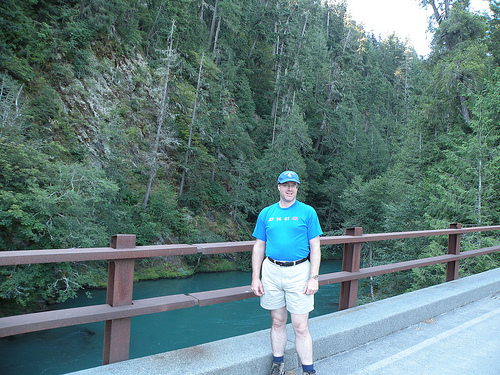
by Greg Prince on 10 August 2010 6:21 am  The state is Washington, but the numbers aren't the Mariners'. That Faith and Fear shirt, a hardy perennial of better wardrobes since 2006, sure gets around. Its latest stop is the Evergreen State, also known as Washington. Bringing it to the Pacific Northwest is Kevin Chapman, he who resiliently started one defiant LET’S GO METS! chant after another at Citizens Bank Park on Sunday. Whether it’s standing up for his team in hostile climes or showing off its retired numbers far from home, Kevin wears his fandom well.
As can you, if you click here.
by Greg Prince on 9 August 2010 4:08 am The 2010 Mets emerged from their hole in the ground one final time Sunday and I got as close to them as I could and looked hard to see their shadow. I sought the sight of the shadow of a doubt to which I’d been clinging through ever darkening times.
I kept searching for a sliver of a reason to continue to believe this Mets team’s season was not practicably over. If there was the thinnest shaft of light shining on them, any hint that implied they were still part of the conversation when it came to talking playoffs, I’d tell you to keep hope alive, keep your spirits up, keep the faith.
The shadow, however, completely disappeared over the course of nine innings on a brilliantly sunny afternoon in Philadelphia. By the end of the day I spent at Citizens Bank Park, I saw nothing — nothing that indicated any chance whatsoever that the 2010 Mets will play a meaningful game across their final 51 scheduled contests.
There is no shadow of a doubt for these Mets anymore. The last shred of it was overshadowed by a road trip during which they lost two of three to the first-place team in their division and two of three to the second-place team in their division. A third-place team that wants to be in the same league as the teams ahead of them has to win at least one of those series.
This third-place team did not. Thus, I can report with the certainty of Staten Island Chuck on Groundhog Day that the competitive aspirations of this Met season have been thoroughly eclipsed…eclipsed by the Braves, eclipsed by the Phillies, eclipsed by a Wild Card mob scene and eclipsed by six dreary weeks when these Mets played 36 baseball games and lost 24 of them.
The forecast: Seven additional weeks of winter, starting 7:10 Tuesday night at Citi Field.
Fifty-one games of baseball are still 51 games of baseball, and I will partake in as many of them as I can, just as I have the previous 111 — I’ll be at the first of them, in fact. But it’s different now. I won’t say there’s no sense of purpose, but the purpose has changed. The stakes have changed. The standings have changed. When the Mets began the road trip that nailed their 2010 coffin shut, they trailed Atlanta by 6½ games. They come home from their journey 9 games out. Not taking a series and losing ground? That’s not what a team that plans to make use of its August does.
The Mets have done nothing with their August. They did nothing with their July and they let a promising June curdle. They may have their shortcomings, but it wasn’t foretold they’d be a .333 ballclub for 22.2% of the season. That’s 12-24. Extrapolate that out to the whole year, and that’s 54-108. That’s not a contender. That’s a disaster.
Which is what they’ve been since June 28. Why I thought they’d pull decisively out of that state on August 2 or August 3 or clear up to the top of the ninth inning on August 8 I do not know, though I suspect it had something to do with their record prior to June 29: 43-32, a half-game from the division lead and two games in front of all comers for the Wild Card. This was after they’d taken four of six from Detroit and Minnesota, not long after they’d taken six of six from Baltimore and Cleveland.
The Mets should have put in for a transfer to the A.L. Central — for themselves and for the Orioles. It was the only way they weren’t going to become what they became in 2010: a disaster.
But they did have that one final shot in my mind Sunday. Sure it was against Roy Halladay, but I looked at it this way: the Phillies would have to do what they had to do against R.A. Dickey. And for a while there, both lineups were doing unto each other’s top-flight pitcher what seemed unlikely when the game began. The Mets got to Halladay early, and it was beautiful. Jose Reyes hadn’t heard Roy Halladay is unbeatable, because he hit him like he was using a fraternity paddle.
Sadly, Jose fielded his position like he was using a frying pan.
The defense let down R.A. Dickey once the Mets staked him to a 2-0 lead, but for the only time since he’s been a Met savior, it is accurate to say R.A. Dickey let the Mets down. The early margin was obliterated, the Phillies were up by four, Citizens Bank was in full yahoo mode — which doesn’t take much to achieve — and the countdown was on to end the Met season.
Strangely, they hung in there. After Dickey joined the ranks of the dearly departed (from the mound, that is), the Met pen stiffened and the mostly young, mostly homegrown Mets eventually went after Roy Halladay like he was Roy Lee Jackson. They took back one run in the sixth and what appeared to be a dead issue showed signs of life — we were only down by three. And then, the seventh…the last inning in which the 2010 Mets played for something and almost succeeded.
Five Mets in a row did something productive off one of the best pitchers in baseball, the theoretically immovable object in their path. Fernando Martinez (leadoff single); Josh Thole (double); Ruben Tejada (fielder’s choice RBI groundout to short); Chris Carter (pinch RBI double); and Reyes (walk) resisted the inevitability of Halladay. Their combined efforts left the Mets down by one run, with first and second, one out and the consistently clutch Angel Pagan up.
If the 2010 Mets were ever going to extend their season, this was going to be the moment. It is as much a comment on the progress of Pagan as it is on the offensive futility of his teammates — especially David Wright, who has driven more Lincolns than runners home — that there was nobody I wanted up there with everything on the line than Angel.
But Angel flied out to center. I wished it farther than it flew, but even in the Citizens Bank bandbox, wishes and fly balls can only travel so far.
The once great Carlos Beltran then struck out to allow Roy Halladay to escape with a lead. Pedro Feliciano and Manny Acosta followed up on the stellar work of Raul Valdes and Hisanori Takahashi and kept the Phillies from increasing their advantage. The notoriously mediocre Phillie bullpen appeared to give us a potential toe in the door in the eighth and ninth, but Ryan Madson was perfect in the eighth and Brad Lidge, despite Thole’s leadoff single and subsequent advancement to second and third, didn’t yield a run in the ninth.
We needed that run. We didn’t get it.
We needed this game. We didn’t get it.
We needed this series. We didn’t get it.
We needed a lot. We got very little.
And now it’s nine games out with 51 to play and two golden chances to not so much make a statement but just whisper “We’re not dead yet” gone by the wayside.
When those opportunities were tossed, there, too, went 2010, a surprisingly pleasant year until it became surprising how unpleasant it had grown…which was before it stopped being at all surprising that it was such a disaster.
The Mets are done except for 51 games they are slated to play. It’s exponentially better than nothing, but not nearly as good as we briefly dreamed it could be.
***
As for being in Philadelphia, I wasn’t there to personally certify the time of death for the last remote possibility of Met contention — 4:08 PM — but for a much happier occasion that my wife and I were tickled to be a part of. Sunday was the 14th birthday of FAFIF favorite Ross Chapman, and his parents threw him quite a party, taking over a slice of the lovely Hall of Fame Club Deck at Citizens Bank and making everything about the day absolutely wonderful, save for two details:
1) The outcome of the game as described above.
2) The presence in Philadelphia of Phillies fans, which is hardly the fault of Ross, Sharon or Kevin Chapman.
Citizens Bank Park is a whole other story from this particular contest, and I’m pretty certain we’ll get to it on a future Flashback Friday, but I will reiterate from previous trips that I am a fan of that ballpark and how it is operated. Except for attracting Phillies fans to Phillies games, they do everything right.
Speaking of the Citizens Bank customer base, my experience with multiple individuals Sunday indicates to me they lack the ability to enjoy good fortune in what one might quaintly refer to as a sportsmanlike fashion. Thus, I’d like to take a moment to answer a few questions that were thrown at me in the course of Stephanie’s and my visit to the City of Brotherly Love.
• No, I will not be looking for a new team.
• Yes, I am aware that six runs surrendered in two innings could be considered “pitiful”. Thank you, however, for volunteering to go to your Thesaurus and pass that assessment along while I was drying my hands.
• There were “so many Mets fans in Philadelphia” because that’s where the Mets happened to be on this day and geographic proximity made a visit feasible.
• My team indeed came up short against your team. The score speaks for itself in that regard.
• I do not agree it was “quite a game,” but I can understand your interpretation of the events as such.
• Your sentiment, if sincere, that it’s a “shame” the Mets are not playing well because you’d like to see the “rivalry” retain a certain level of intensity betrays, I believe, your unhealthy obsession with New York. We don’t particularly care about this matchup when we’re not playing your team. And except for pondering its historical significance every Fourth of July, we don’t think about your city whatsoever.
But I will admit, after spending an afternoon in your company, I do find myself, for the first time since the 1996 World Series, feeling kindly toward the Atlanta Braves. If it can’t be us for the division title — and I now know it can’t — I really and truly want it to be them.
Because I sure as hell don’t want it to be you.
Don’t be fooled by the headline on this fine Jesse Spector piece in the News. It’s really about Doug Flynn and it includes a little perspective on the great Met defensive second baseman from yours truly.
|
|