The blog for Mets fans
who like to read
ABOUT US

Faith and Fear in Flushing made its debut on Feb. 16, 2005, the brainchild of two longtime friends and lifelong Met fans.
Greg Prince discovered the Mets when he was 6, during the magical summer of 1969. He is a Long Island-based writer, editor and communications consultant. Contact him here.
Jason Fry is a Brooklyn writer whose first memories include his mom leaping up and down cheering for Rusty Staub. Check out his other writing here.
Got something to say? Leave a comment, or email us at faithandfear@gmail.com. (Sorry, but we have no interest in ads, sponsored content or guest posts.)
Need our RSS feed? It's here.
Visit our Facebook page, or drop by the personal pages for Greg and Jason.
Or follow us on Twitter: Here's Greg, and here's Jason.
|
by Greg Prince on 18 July 2010 11:22 pm You could have colored me the whitest shade of pale orange and blue when I saw Frankie “Release K-Rod Now” Rodriguez return to the mound in the bottom of the tenth inning to attempt to do with a one-run lead what he couldn’t do with a two-run lead in the bottom of the ninth inning.
“I wanted to go back out and try to finish it,” the pitcher credited with the decision for the team that wound up with the most runs on the scoreboard — to call Rodriguez the winner Sunday seems a bit much — told reporters.
Commendable on the part of one who felt responsible for this series’ brush with death. And more than a touch insane that his desire to make things right was allowed to manifest in a continuation of his participation in this game. That could describe the Cult of The Closer, too, but what cult doesn’t veer toward craziness?
“If he’s our guy,” Jerry Manuel explained after it all somehow worked out in the end, “we have to give him the ball. We have to give him every opportunity.”
You do? Since when? Was General Custer granted a Next Stand at Little Bighorn? Do we really have to take what failed five minutes earlier and give it another go with the confidence if we just do the exact same thing it will work to plan?
I’m familiar with the concept of a win that feels like a loss because “closer” is just one letter removed from “loser”. This wasn’t quite that, I don’t think. Too many things went right on Sunday to get irretrievably hung up on the one inning in ten that was nearly disastrous. But make no mistake that the ninth inning was about as asinine as it gets and that the tenth loomed as too hot to be playing with firemen.
After emerging from the ninth- and tenth-inning hall of mirrors as the (ahem) Winning Pitcher in Sunday’s quasidebacle, Frankie remains unreleased if untrusted. But he is here and we are going to need him. I admit I’m as capable of being brainwashed as any Good Baseball Man about closers. I was half-expecting Bobby Parnell to pick up the gauntlet to start the tenth, yet I was half-nervous about putting a veritable must-win on his relatively untested shoulders. Parnell’s pitched great since coming back from Buffalo, which alone gets me nervous because I worry he will fall victim to Manuel’s New Toy fascination, a syndrome that revealed itself in, shall we say, stark relief last year when Jerry overused the one and same Bobby Parnell.
So no, I wasn’t thrilled that we had to give General Disaster another stand in the tenth, but I get it. I get the not giving up and not giving in. I get the preservation of precious psyches. I get that you have to manage to both the situation and the season, though one could argue if you don’t get out of the situation — holding that tenth-inning lead after blowing that ninth-inning lead — you may not have much of a season worth strategizing, no matter that the schedule indicates the season remains slightly more than 43% unplayed.
Carp away at K-Rod at will, but this doesn’t feel like a loss. It feels like a very, very lucky win. And you can bet your ass we’ll take it.
We’ll take it no matter how much Phil Cuzzi had to do with wrapping a bow around it — after his inconsistent strike zone, insipid self-control and inane deference to third base umpire Mike Estabrook on revoking the fourth or fifth out of the ninth nearly titled things in the other direction. Forgive me, I couldn’t keep track of how many times the Giants should have been deemed done in that inning, though my ability to maintain a sense of what was actually going on isn’t nearly as important as Cuzzi’s.
The Giant elephant in the room isn’t so much K-Rod pissing away a lead or Manuel giving him another shot to load up and do it again or weird regulation of strikes that weren’t called, fair balls that weren’t foul or emotions that couldn’t be held in check. Neither is it Johan’s eight ultimately rigid innings; David first homering off Jonathan Sanchez and later refusing to be felled by Pat Burrell’s line drive (Pat Burrell can feel free to leave this mortal coil anytime he likes); nor Jason Bay and Ike Davis doing outstanding impressions of Darryl Hamilton and Jay Payton in the same ballpark in the same inning at the dawn of another decade. It wasn’t even the intriguing nugget which had, in its own way, as much to say about how this day wound down as did Rodriguez and Cuzzi.
As the ninth unraveled all around us, Jeff Francouer’s arm elicited the kind of respect in right that nobody else’s likely would have, part-time right fielder Angel Pagan’s included (though Pagan played a beautiful center in the ninth, handling two bouncing singles that conceivably could have been doubles, particularly Edgar Renteria’s), and it was a phantom boxscore play on the part of Francoeur that kept Travis Ishikawa from advancing all the way from first after his two-run single.
When Andres Torres’s double into the right field corner — the shallowest right field corner this side of Fenway — was played flawlessly by Francoeur, Ishikawa had to be held at third. Giants third base coach Tim Flannery had no choice. Frenchy may be inadequate to many tasks in a given lineup, but his ability to throw from right is a core competency that cannot be taken away from him, and in the ninth inning on Sunday, we were fortunate to make use of it.
It was because Francoeur generally makes great throws that Torres’s double didn’t score Ishikawa. And it was because of that little reality that the biggest falsehood in this game exploded immediately thereafter.
Freddy Sanchez’s one-out grounder to third should have scored Ishikawa. It did score Ishikawa in the eyes of everybody but the eyes that count, Cuzzi’s. Wright made a lousy throw. Blanco made a valiant if heartbreakingly late tag. Ishikawa was safe if you factor in his foot touching the plate before Blanco’s mitt touched him. Ishi (they call him that, apparently) didn’t do himself any favors by looking over his left shoulder as he ran the ninety feet from third to home — if he wants to be a San Francisco tourist, he should take the boat to Alcatraz — but he, unlike Rodriguez, did what he was supposed to. And he was called out for it.
Blown save for Frankie. Blown game for Cuzzi. A win for the Mets. Remember this the next ten-dozen times we get screwed and you reflexively whine, as I assure you I will, that nothing ever goes our way. Amid as messy a Met ending as any of us would ever imagine, something did.
I can also say it went well for me, Al Franken.
It’s a matter of self-aggrandizing public record that the Mets have not lost in the last thirteen games I’ve gone to watch them at Citi Field. Yet for a month there’s been an insidious flip side to my streaking ways. Only now that it’s no longer applicable am I comfortable revealing it
Jason and I adhere to a loose, primarily ad hoc schedule of who’s going to do the postgame recaps in a given series. There’s no magic or pattern to it — it’s mostly about availability and convenience. And for more than a month it’s been about incredible personal frustration because, until Sunday, save for the games I’ve attended (and goodness knows I’m grateful for those), the Mets have lost EVERY FUCKING GAME it’s been my responsibility to recap. That means I watch TV, the Mets lose and I trudge morosely upstairs to write about it.
The last time I watched TV, the Mets won and I skipped giddily upstairs to write about it was after the game of June 16 when it was Pleasantly Warm in Cleveland. That was a very long time ago. Until Sunday, I’d been stuck, by nothing more than luck of the draw, with nine miserable couch-as-couch-can losses in a row to recap. It was like getting to lose twice in any given night. (Jason’s recap record of games he didn’t go to in the same span, in case you’re wondering, is 8-5…luck of the draw, I assume, though I might have gone on a long blogging vacation if only one of us was mysteriously bringing the Mets wins and it wasn’t me.)
As someone who tends to detect and dissect trends to within an inch of their lives, I began quietly beseeching the baseball deities to stop this madness during the Puerto Rico trip. That’s when it became A Thing in my mind. That’s when I began to wonder why all the Mets did was lose when I stayed home and wrote. Those gods came close to coming through on my behalf on July 3 when a standout starting pitching performance staked the Mets to a two-run lead heading into the ninth on the road, and all they needed was three simple outs to salt it away. It didn’t have to be Ideal, it just had to be a save.
Alas, Frankie Rodriguez couldn’t do it, which gave me seven consecutive losses and one case of total apoplexy. Then he entered today’s road ninth nursing a hard-earned two-run lead and very nearly raised those totals on my watch to ten and two, respectively. But he didn’t, so hallelujah. Here’s to barely adequate relief pitching, comically abysmal umpiring and hopefully basking in a gentle glow from the dry heat of Arizona.
Still, I find it hard to believe I’m the one between me and Jason who doesn’t hate Frankie Rodriguez. Maybe it’s because I understand anew, after those nine TV losses that became my nine unhappy recaps, that you always want to stay out there and keep pitching until you can say, hey, we won.
by Jason Fry on 18 July 2010 6:50 pm
by Jason Fry on 18 July 2010 2:04 am I have to confess that after the Giants finished subjecting Hisanori Takahashi to every indignity short of drowning him in San Francisco Bay I exiled this game to radio and the occasional look-in, if only to save my own sanity. I registered the Mets’ basically cosmetic comeback, noting that it was just numerically sufficient to give me another look at the obnoxious showboating closer I dislike who doesn’t wear our uniform, and got on with life. Sure, it was good to see some life in Ike Davis’s bat, some spring in Carlos Beltran’s step, and David Wright emerging upright from encounters with Matt Cain. Beyond that, though, there were not a lot of positives to extract.
You could argue that a dip like this was inevitable, and given that the Mets are on a tough road trip (the longest in years) that will be followed by a tough homestead, it stands to reason that this would be the time for that dip. Let Beltran get his legs under him and Jose Reyes get the stitch out of his side and then Jason Bay and Ike can relax a bit. And Luis Castillo will be back soon, which I won’t say is grounds for celebration except for the fact that Ruben Tejada’s growing pains have become cruel to ignore. Staying positive, Rod Barajas can’t be this bad forever, and if he is, Josh Thole has shown that he deserves a chance to join the Homegrown Mets movement. If the Mets can survive this current stretch they’ll be looking at a pretty soft schedule. And then who knows?
On the other hand, plenty of promising seasons have run aground come July, with flawed teams revealed as such in unforgiving heat. We’re just five games over .500 now and once more looking up at the Phillies. The high point of the year may have come and gone.
But if that’s true, you know what? I can deal with it.
I did a book signing in Greenpoint today and wound up chatting with a Yankees fan who seemed like a decent enough sort about our respective seasons. He offered his sympathy for our season going down the tubes, to which I objected. First of all, I said, we were still very much in it. Second, I said that even if we didn’t wind up going anywhere, after the wreck of 2009 it was a relief just to watch normal baseball again instead of bracing for agony and futility on a nightly basis.
Which had the added benefit of being true. Jerry Manuel annoys the hell out of me with his bunting and his slash-and-burn use of the bullpen, I still think Omar was negligent in planning (word used very loosely) for the starting rotation, and we’re stuck wondering if the post-Madoff Mets will be able to take on the salary of a Ted Lilly or pay for bullpen help in the next two weeks. But I’ve gone from fearing 2011 will be the wreck of everything to hoping it will be something wonderful built on the foundation of 2010. And that’s nice. And if the next couple of weeks reveal that 2010 isn’t all we dared to dream of a month ago, it will still be nice.
by Jason Fry on 17 July 2010 2:41 am Didn’t we just see this game?
Yeah, it took a couple of minutes longer to lose, the Mets gave up one fewer run, and the Giants’ starter didn’t go all the way. But other than that there wasn’t a lot of difference between tonight and Thursday night: The Mets’ starter looked awesome, his teammates holding bats looked asleep and/or hungover, and no Met foot disturbed home plate.
At least it was quick.
I had a bad feeling about this one from the get-go, what with Jose Reyes still on the shelf, Angel Pagan on the bench and Carlos Beltran still finding his way. Beltran has a firm alibi for now, but the other two situations are disturbingly Metsian. For the sake of safety and sanity, Reyes should have gone on the DL instead of farcically trying to hit wrong-handed before the break, and his return is slipping farther away like it’s the end of the hallway in Poltergeist. For the sake of offense and sanity, Pagan should have been starting instead of Jeff Francoeur, who as usual approached each at-bat like the stadium was on fire. So between the Mets taking half-measures on an injury and their decision-makers continuing their phrenology-based appraisal of Francoeur’s abilities, the lineup had two sizable holes in it already, and that’s not even considering the current struggles of Jason Bay, Ike Davis and Rod Barajas and the daily struggle that is Alex Cora with a bat in his hands.
Ugh. I think I just pissed myself off.
Anyway, for all that it was a terrific display of pitching. Jon Niese is growing up before our eyes, nearly matching Barry Zito with excellent location and a savvy mix of pitches. (And he had the best at-bats of anybody in the lineup.) As for Zito … man. There was that evil hook that started at the shoulders and wound up at the waist (learned from Randy Jones, who never did the Mets a single favor), the high fastball, and the occasional deadly change, all thrown in maddeningly shifting sequences. Which was the pitch that made you cluck loudest in exasperated admiration? For my money, it was a toss-up between the gorgeous curveball that left David Wright walking away in silence in the fourth, the pulled-string change that Barajas waved at to start the sixth, and the curve that froze Tejada to end the sixth. And Ike may wake up tonight screaming: When he lofted a harmless fly ball for an out in the eighth, it almost felt like a victory.
And then Brian Wilson arrived.
As I get older I somehow find it harder to dislike players on other teams. Roger Clemens is not only gone but could only sink lower in public estimation if it turned out he was an Al Qaeda member, Bobby Cox and Chipper Jones are in twilight, and Angel Hernandez is an ump. (I’m leaving aside my irrational certainty that K-Rod and Luis Castillo are responsible for everything that’s wrong with the world from AT&T’s cellular service to the BP oil spill.) Not counting the retired and the ineligible, off the top of my head the List of the Loathed is down to six:
1. Anyone wearing a Yankee uniform
2. That fuckhead Cody Ross
3. Shane Victorino (though if you hate him, you should admit if you weren’t a Mets fan you’d also hate Reyes)
4. Brett Myers (who I fear will be 2010’s Michael Tucker)
5. Greg Dobbs
6. Brian Wilson
Happily, we only see the Giants’ closer a couple of times each year, but that’s more than enough for me. There’s the annoying rooster-tail hairdo, but more than that there’s his irritating personal cosmology, a mashup of ultimate-fighting psychobabble and God Squad showing off. It’s simultaneously weird and boring, the kind of thing you’d get if weight-room goons played D&D. And ultimately, whatever it means to Wilson is irrelevant. Showboating is showboating, and you don’t get an exemption on religious grounds — particularly not when your offering to Jesus Christ is repurposed from a line of Mixed Martial Arts mookwear.
That said, I sure do respect his stuff: That fastball and slider combination is evidence of some kind of higher power. In my personal cosmology the higher power is the genetics that formed Brian Wilson’s right arm, but whatever it is, it’s pretty damn effective.
Addendum: I take it all back. Brian Wilson has won me over, because this is awesome.
by Greg Prince on 16 July 2010 8:25 pm Welcome to Flashback Friday: Take Me Out to 34 Ballparks, a celebration, critique and countdown of every major league ballpark one baseball fan has been fortunate enough to visit in a lifetime of going to ballgames.
BALLPARK: The Ballpark in Arlington
LATER KNOWN AS: Ranger Ballpark in Arlington
HOME TEAM: Texas Rangers
VISITS: 1
VISITED: May 31, 1997
CHRONOLOGY: 18th of 34
RANKING: 17th of 34
I meant it as a compliment. In my head, it was a compliment. When it was spoken, however, I could see where it could be taken otherwise.
It was a late inning in my one and only visit to the Ballpark in Arlington, an event that took some doing on the part of myself and others to pull off. The key player in putting me in my seat was my wife’s cousin Lisa. She lived in Arlington and prevailed upon her employer to provide us — me and Stephanie, Lisa, her husband Todd and their infant daughter — with the company box, which was nine rows from the field between home and first. Lisa asked how I was enjoying the experience. I was enjoying it a great deal and told her so…in my own way:
“I’d say this is my ninth-favorite ballpark!”
Lisa was actually a little offended. She called me a “ballpark snob”. I tried to explain, no, you don’t understand, ninth-favorite isn’t bad at all. It means I like it more than nine others I’ve seen and, really, almost as much as eight others. The game went on and, fortunately, it didn’t become too touch a bone of contention as our weekend continued amiably enough.
This, though, is the problem of those of us who chronically rank things we like. We like all of it, but some of it we’re going to like a bit more. There’s no shame in being No. 9 of 18, as the Ballpark in Arlington was when I was in the midst of it, just as it speaks well that with 34 ballparks now in the books, it’s still in the top half. Calling something your 17th-favorite may sound like faint praise, but let’s be clear: it is praise.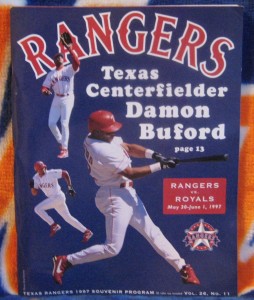
I come to praise the Ballpark in Arlington despite it having become, in the years that have followed, a symbol for a type that is not so flattering. Every time a team builds a ballpark that goes the retro route yet fails to take into consideration that ballparks from the golden era of the early 20th century resonated because they were a component of a community, I think it’s another Arlington situation. The Ballpark in Arlington is as striking as can be, but there’s no escaping its contrived nature. It’s basically in the middle of nowhere, at least nowhere where a stylish, red-bricked ballpark would look most at home.
You know how Citi Field is sort of like that? The Ballpark in Arlington is exactly like that. It’s the original Ye Olde Ballpark attraction planted in a parking lot off a highway. Even if the highway is the Nolan Ryan Expressway, it feels cut off from the kind of baseball tradition it aches to evoke. You can’t approach TBIA and not be conscious how far you really are from anything having to do with it.
The good news is once you get close and then inside it, your ballpark snobbery fades because even if it is a bit of a baseball theme park, it happens to be a very good baseball theme park. And though those of us who value integrated neighborhood aesthetics and all that might be put off by a ballpark whose immediate community is a vast parking lot, it’s Arlington, Texas. Where else are they gonna put the darn thing?
They had to invent a little tradition on the fly down there. TBIA’s bloodlines didn’t stretch back to a Forbes Field or a Shibe Park. Its daddy was Arlington Stadium, described not altogether unlovingly by former Fort Worth Star-Telegram Rangers beat writer Mike Shropshire in The Last Real Season as “half-ass, backwoods, pissant little”. The Rangers’ first home was a converted minor league ballpark first called Turnpike Stadium. It didn’t look like much on TV and apparently it didn’t much impress the locals, either.
TBIA, on the other hand, was one of those parks that, when it opened (for a Mets at Rangers exhibition, of all things), I knew I had to see for myself. It was beautiful on television. Remember, this was April 1994, a mere two years after Oriole Park at Camden Yards. Retro wasn’t yet a trend. You might say that by being the second of its kind — it and Jacobs Field, which also opened in ’94 — TBIA made retro a trend.
All I knew was Arlington seemed a million miles from Long Island and I would need a good excuse to make a trip there. You don’t just go to Arlington, I decided. I needed to be sent there.
Enter a fine institution called the Dr Pepper Museum in Waco. Those good folks (genuine sweethearts) were dedicating the W.W. “Foots” Clements Free Enterprise Institute on the last weekend in May of 1997. Foots Clements was one of the guiding lights in the growth of the carbonated soft drink industry and he was going to be there along with other company and area dignitaries. The beverage magazine for which I worked, as title sponsor of the Soft Drink Hall of Fame — housed in the museum — needed to be represented. With the Rangers home the very same weekend, and Arlington a mere 80 miles north of Waco, who do you think was going to represent us?
Well, that took care of getting me to Texas. I’d have to spring for Stephanie’s airfare, but that was doable. As far as tickets to the Rangers, which were in demand at the time, Cousin Lisa took care of the rest. Not only that, but she and Todd were gracious enough to invite us to stay over. I’d never met either of them and Stephanie hadn’t seen Lisa since some long ago summer in Kansas when they were in high school. I’ve almost never been a houseguest and offered a dozen times to find a motel for the portion of the trip I couldn’t expense, but, no, I was told, we were family.
Who knew there were baseball-related benefits to being related to people you’d never heard of before?
We flew into Dallas on a Thursday night and (with characteristic trepidation) drove to Waco Friday ahead of a tornado. Earlier that month, a twister somewhere between the two cities had left a trail of death and destruction. I was aware it could happen again. I was also aware I suddenly had tickets for the Rangers and Royals. In other words, what tornado?
Our professional commitment in Waco was twofold: a black-tie dinner on Friday night and a ribbon-cutting on Saturday morning. The company that owned my magazine staked me to my very own Sy Syms tuxedo for the formal occasion (it hangs in my closet to this day). I was more casually dressed for the dedication when somebody told me to get on stage, I was going to be one of the ribbon-cutters. Surprising the things that make you nervous — I was almost done snipping my portion before the actual dignitaries began theirs. I pledged to take it slower next time I’m asked to cut a ribbon, but I haven’t been asked yet.
Eating dinner in a fancy suit, using a scissors and partaking in a post-ribbon Dr Pepper float — vanilla ice cream plus Dr Pepper; you won’t be sorry — was not the toughest assignment I ever put in for. Even the 80-mile car trip to Arlington didn’t throw me. We were making such good time that I acceded to Stephanie’s request to pull off I-35 when she spied an outlet mall. She was excited by the Fossil store. I was floored by a designer name, and not because I suddenly craved more formal wear.
JONES NEW YORK, the sign said. Not being much of a fashionista, I’d never seen it or heard of it before. After beating Pedro Martinez and the Expos three nights earlier, the only JONES NEW YORK I cared about — righty ace Bobby Jones — raised his record to 9-2 and lowered his ERA to 2.32. Deep in the heart of Texas, I thought, they have a store dedicated to our best pitcher!
If they were advertising the greatness of Bobby Jones, we couldn’t have been too far from the Met-roplex, and sure enough, we were in Arlington, at the cousins, soon enough. Lovely people, Todd and Lisa. Todd had been in the Air Force. Was stationed in Germany when the Berlin Wall fell. They had a chunk of it in the garage if we wanted to see it. They were so cavalier about it, I said, nah, that’s OK. Their newborn daughter was quite precious. They had two adorable kitties, to boot, that were going ignored since the baby came along. As cat people, we were able to make up for the lack of doting.
I never knew a thing about Arlington except it was where the Rangers played since moving to Texas from Washington in 1972. I’m not sure I know anything about it after visiting it. Our cousins drove us the short distance to the ballpark and it looked like any suburb in America with strip malls and whatnot, but I did find it pretty cool that you could live in the same specific town as your team if your team played in an offshoot of its metropolitan area. Arlington equaled Flushing in my mind in that regard.
I suppose I could live in Flushing, or at least Corona; there are weeks I’m not sure why I don’t.
Lisa and Todd were quite amused, as the car radio played the kind of tunes you might expect to hear in the Dallas-Fort Worth area and they asked, “you hear a lot of country music in New York?” and I responded that we used to have a country station. The amusing part to them was that it was a country station, singular.
Everybody was all-out affable as we arrived in the vast parking lot, which is not a bad thing to have in a place where there is no 7 train. The stadium’s exterior was a beauty. I’d only been to Texas twice before, so I couldn’t say for sure, but I decided it had a very Texan feel to it, according the New Yorker who didn’t even have a country station to call his own. I loved the effect of arches and shadows and nostalgia as we entered. It wasn’t nostalgia for the Rangers perhaps (Shropshire, in Seasons in Hell, on the previous place: “Arlington Stadium bestowed about as much big league magic as a Wal-Mart store”), but it was old-timey…or lived up to our collective sense of what old-timey is.
I explained to our gracious hosts that I had certain rituals I needed to perform in the coming minutes, none of which were pagan (lest they wonder about us New Yorkers). I needed to walk around a lot and take a lot of pictures. I needed to spend quality time in the team store, a feature that amazed me since Shea didn’t have one. I needed a program for my collection. As this was my eighteenth ballpark, the process had become pretty institutionalized. Lisa said go right ahead, we made sure to get here plenty early so you could do whatever you wanted.
What a considerate cousin my wife has! I guess respect for/indulgence of my baseball Jones, as well as my Bobby Jones, runs in the family.
I did explore. I secured my program as well as a t-shirt (which I still have — the oldest in my rotation) and a discounted 1996 A.L. West champions Rangers cap. I had really wanted a Rangers cap in 1975 when I discovered they were sold at Shea Stadium, but my mother decided I wasn’t worthy of one and rejected my request. Twenty-two years later, I grabbed the makegood. (Though I bore the grudge for more than two decades, I discarded the cap in 2004…but I still have that tux.) I took in all the odd, built-in nooks and crannies that were there simply for the sake of being nookish and crannyesque. It may be pretentious to pretend you’re accommodating for crazy geographic quirks in a parking lot, but at TBIA, it didn’t make them any less charming. The whole stadium was a conglomeration of greatest hits from other parks: a bit of Tiger Stadium here, some Fenway style there, a sense of Wrigley and Camden…and even Shea; I saw a guy wearing a HUSKEY 42 jersey.
Like I said, very attractive overall, especially the out-of-town scoreboard — the Mets beat the Phillies 10-3 and I let out a Texas-sized hoot and a holler. I didn’t wake the baby, I’m happy to note, but I wonder how she slept through the horribly loud PA. That was my one and only explicit complaint for the Ballpark. I know they do everything bigger down there, but relentlessly souping up the crowd to make noise did not need to be one of those things.
Save for that one overbearing flaw and the inescapable intuition that there was something a little too faux about the whole setup, it was a great night. I told Lisa it was grand, “ninth-favorite” or otherwise. I also told her, after learning she was planning on soon leaving the job that provided us with these tickets, that all things being equal, I didn’t get that. “Why would you quit a place that put us in these seats?”
Just as with Stephanie, my baseball logic had an impact on Stephanie’s cousin. Lisa reconsidered her plans and wound up keeping the job a while longer based, she later affirmed, on my endorsement of the company box.
So yes, I was quite fond of a ballpark that ranked ninth of eighteen then and ranks seventeenth of thirty-four now. Why so relatively low? Well, that’s what happens when you rank things you like.
Speaking of the Lone Star State, congratulations to our own Landslide Lyndon, Howard Megdal. He swept the FAFIF primary referendum on his becoming the next general manager of the New York Mets by a margin of 71-29. Now that’s Texas-sized!
by Greg Prince on 16 July 2010 3:36 am I know I’m not the first to note their facial and follicle similarity, but on Thursday night Tim Lincecum really put me in mind of Mitch Kramer, the newly minted ninth-grader doing his best to avoid a paddling from the SOB seniors in 1993’s 1976 homage Dazed and Confused. Whenever I see Lincecum’s locks, I think of Mitch at the moment his Little League game is over and he, his teammates and their opponents have to go through the sportsmanlike motions of exchanging disinterested high-fives and muttering — as 14-year-olds will, when forced to do anything — the ritual “Good game, good game…”
The sight of Lincecum, who, at 26, still looks like he just turned 14, never fails to elicit a “good game, good game” out of me. That’s how much Tim resembles Mitch. This time, however, I mean it. Dickey vs. Lincecum, the unappealing outcome notwithstanding, was, in fact, a good game. A very good game. One of those games that’s so good within the context of crispness that you’d be a fool to stay mad about losing it.
Dickey, true to the cinematic identity he forged for himself prior to his loss in Puerto Rico, gave us just about every Chance to win. One pitch was a mistake, a knuckler that failed to float south of Pablo Sandoval’s happy zone. Otherwise, R.A. tended his garden just fine across seven innings of five-hit ball. Being There on the mound for the first post-break start was just what the Mets needed, despite various shouters on ‘FAN and SNY caterwauling that “YOU CAN’T START THE SECOND HALF WITH R.A. DICKEY!” as if his excellent first half wasn’t a matter of public record.
Likewise, being there for reporters after the game was right up R.A.’s alley, too. This guy is both substantively and literally a pleasure to listen to when it comes to explaining his night.
Dickey has a way with words you just don’t expect from ballplayers in the minutes after they’ve finished working. He couldn’t hold back his disappointment at being outdueled by one of the best pitchers in the game. “Sad,” he kept saying. He was particularly upset with himself for popping up a bunt in the third inning. Not advancing Ruben Tejada certainly didn’t help his cause, but Dickey didn’t earn his way into being trusted to kick off the back end of a pennant contender’s season by not being meticulous about all aspects of his performance. No wonder he thought Thursday’s result sad.
Another word he used truly tickled me. He was asked whether the Phone Company Park wind gave his knuckleball an advantage. Dickey paused, thought and answered: “Inconsequential.” Not “it didn’t matter” or “nah” or “not really,” but, “Inconsequential.”
Who, major league pitcher or otherwise, has a go-to word like inconsequential on the tip of his tongue? It was as if R.A. had just been studying for the S.A.T. And oh, that voice of his! Listen to him speak sometimes and then listen to Shawn Mullins open his one hit, “Lullaby,” with its spoken-word intro: “the children of the stars/in the Hollywood hills and the boulevard…” Mullins even mentions Dickey’s hometown of Nashville (“with a tan”) toward the end of the song. I swear these guys’ vocal cords must have been separated at birth.
R.A. Dickey: losing pitcher this time, winning interview all the time.
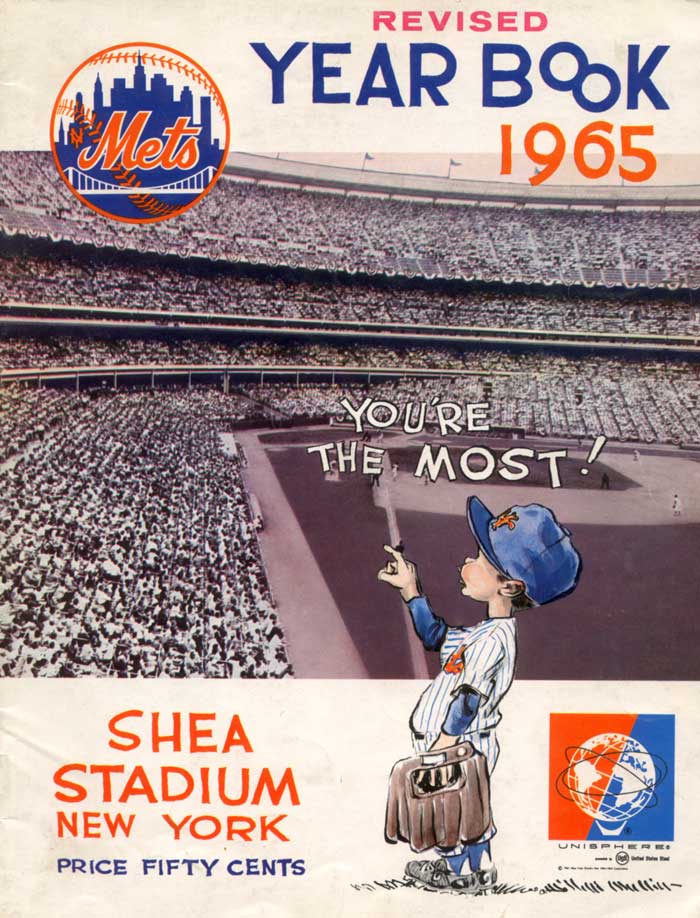
Tim Lincecum, meanwhile, left Met batters dazed and confused between his fastball and his changeup. The Mets weren’t exactly high on hitting before the break and they weren’t about to start paddling these pitches. One could dissect the few chances they had and where they went awry, but I find it healthier, after inhaling the tasty pregame appetizer that was Mets Yearbook: 1965, to look at it through the prism of some of that season’s top National League hurlers.
Sandy Koufax beat the Mets 17 times in his career. Jim Maloney did it 19 times, Don Drysdale, 24; Juan Marichal, 26; and Bob Gibson, 28. Now Tim Lincecum has won once versus us. Unbalanced scheduling and pretty good luck had kept him off the board until now. No shame in losing to one of the great ones. And that’s what this kid is.
Speaking of great ones, who was that stranger batting cleanup and patrolling center field for New York?
Carlos Beltran hath returned! And he looked…all right. Hard to say, as he was greeted by Tim Lincecum for four at-bats. Carlos returned with one hit, one cheeky steal attempt (it took a dart of a throw from Buster Posey to nail him) and no collisions in the outfield. The brace on the right leg is pretty noticeable, but I detected no limp.
The only thing that bothered me in the slightest, really, was Beltran sort of jogging to first as he made the second out of the ninth. If it’s because he wasn’t capable of running 90 feet at full speed, that’s not good. If it’s because he figured it was best to conserve his legs as they build up strength, it’s still not good. I’ve seen Met pitchers and Met catchers not bust it now and again this year, and I rationalize that they have an excuse given the demands of their positions. It was just one grounder that wasn’t likely to be thrown away, but watching Beltran not run it out gave me shivers of the 2009 variety, the year when too many Mets didn’t run balls out. First night back, getting the feel of full activity, it’s not a huge deal. But I’m hoping it’s not a sign that Beltran isn’t up to the mission of the 2010 Mets physically or attitudinally.
In 2010, the Mets run out most everything. It’s one of the reasons they’re still in it despite having no Carlos Beltran for 88 games.
Now to be totally inconsistent on the subject of hustle, it’s tough not to worry about Jose Reyes and his doubtless desire to go all out. J!4 was in the starting lineup for about twenty minutes Thursday afternoon before somebody noticed he still wasn’t capable of hitting lefty. Being without Jose Reyes just as we are finally with Carlos Beltran is a cruel baseball joke, but we may to be without him on the active roster already yet. Half a Jose really isn’t better than none. Obliques apparently don’t play themselves into shape.
Last chance to vote in the FAFIF primary for Howard Megdal. Our polls close at 5 PM EDT.
by Greg Prince on 15 July 2010 4:30 am Sure, I thought it was a little kooky, some fan/writer declaring his candidacy for an office to which he couldn’t be elected because it’s not an elective office. I like a good gag, but how far can you stretch one? Howard Megdal was practically Plastic Man in that regard. He was stretching the gag. He was stretching it like Rico Brogna to haul in a throw from a young Rey Ordoñez.
You don’t want to stretch anything too far. It can wear thin.
But y’know what? It’s not a gag what Howard Megdal is doing. Oh, it’s technically impossible. He can’t run for general manager of the New York Mets, and he knows it. Well, he can run, but it’s a non-binding election, a “beauty contest,” as we political junkies would call those primaries that yield no delegates. Howard can gather all the victories on all the blogs that, like this one, are hosting his referendum, but even a clean sweep won’t give him entrée to the front office at Citi Field.
Doesn’t matter, though. The journey is the destination in Howard’s case. The exercise alone is worthwhile (and not just because he plans to write a book about the experience). Howard will not be the general manager of the Mets in this life.
But he oughta be.
I’ve enjoyed two long conversations with Howard since he brought his campaign to my attention and I’ve watched him electioneer our AMAZIN’ ALL-STAR MONDAY audience. It’s not crazy to want what he wants out of the Mets — not for him but for all of us. His shorthand is “Logic. Transparency. Passion.” As triple plays go, it sure beats Bruntlett (unassisted).
Howard’s given the Mets as much thought as any of us has, which as you yourself know, is a ton. Anything that captures our imagination not just daily, but continually throughout the day, Howard reasons, is something that almost demands we have a say in it. “If it takes up that much of our time,” he figures, “it’s almost counterintuitive for us not to.”
See? This gag makes sense. Howard makes sense. Howard’s also not delusional. He understands he will not be Omar Minaya’s immediate replacement or eventual successor. “I don’t have an overwhelming desire to sit at a Marriott bar and make a deal for a reliever at 11 o’clock at night,” he admits. But he does like the idea of having an obligation to and taking the responsibility for making a better Mets: for him, for his wife, for his baby daughter, for Mets fans everywhere.
Ultimately, it’s about “ideas,” Howard says, not just having them but putting them forward. “If the Mets take on some of them,” he says, “then this has had an impact.”
What kind of ideas? Howard is calling for areas of “common sense improvement” in two broad categories: player personnel issues and “treatment of fans”.
Within the former, the Logic plank of the Megdal platform is clearly on display. It may not be the most original stuff from a Metsosphere standpoint — who among us hasn’t rued the re-signing of Perez, the indecisive handling of Mejia, the inconsistent reporting of injuries, the detour to Jacobs and Matthews and the general lack of a plan? — but that doesn’t make it wrong. It would be beautiful if somebody who had grouped those thoughts together in a cogent matter was in a position to mold them into reality.
As for the latter, the fan stuff, it’s not, by Howard’s reckoning, disconnected from building a better on-field team.
Among some great questions he asks and answers:
• Why not sell the unoccupied $460 seats behind home plate as discounted “student rush tickets,” and get something out of them on a given evening? In Howard’s estimation, you build a future customer base that way and, in the meantime, fill some seats with some enthusiastic people — and you get a little revenue besides.
• Why not revive what Dick Young referred to (in the script for the 1968 highlight film) as the “Mets’ soul” promotion, Banner Day? We invented it, after all, and, as Howard pretty astutely points out in response to the Met excuse that there are no longer doubleheaders to have Banner Day in the middle of, if you’re gonna have folks stick around for a Mr. Met dash after a game, why can’t you do it for the placard parade everybody loves and remembers? “It’s a way of saying, ‘You matter to us, express yourself.’ Not embracing a tradition started by the New York Mets is like the Yankees not embracing Babe Ruth. It’s a fundamental part of our history.”
• Why limit giveaways to 25,000 and disappoint the kid whose parents got stuck in traffic? The Phillies, for one, make sure everybody who shows up gets the premium, and they have roughly the same size ballpark we do.
• Why can other venues (baseball and otherwise) let you choose your specific seat location but mets.com can’t? This isn’t just a random gripe from Howard. His wife was pregnant in 2009, and sitting in the first couple of rows of Promenade was a must for them. Picking a seat by price range was of no use to them, yet unless they were going to buy on StubHub, the Megdals got no help from the Mets’ Web site, which was content to place an expectant mother in the twelfth row upstairs. “Nobody,” he wryly notes, “grows up saying, ‘I want to sit in the best available seat I can pay $64 for.’”
At the heart of the Megdal message is we should be “welcome, not just tolerated”. Do you think anybody connected to Met decision-making has ever looked at us that way?
Welcome and not just tolerated…that gave me chills, to tell you the truth. I’m tired of men in crimson golf shirts standing at various intervals of Citi Field emitting the vibe that I am to move along. I am tired of being implicitly treated like I’m up to no good. That’s how the Mets off-field personnel generally make me feel. I don’t put it on the ballpark. I felt that way at Shea, too. I’m certain it transcends general managers. Maybe Howard Megdal couldn’t overturn that attitude in a day or a season, but somebody who makes it his business to welcome fans instead of holding them suspect would be on his way to doing a great job in my book.
You can tell Howard isn’t really a politician because he wouldn’t necessarily pander to me on my every fan grievance. I brought up a few of my pet peeves when we last spoke, and while he was with me on being turned off by the canned noise level between innings and disappointed by the lack of any kind of New York Giants acknowledgement (even though he comes from a Brooklyn Dodgers family), he wouldn’t bite on my complaint that the alignment of ads surrounding the main scoreboard is aesthetically unsightly and unworthy of a big league franchise. Not a high priority for him, he says, and he’s not against the Mets widening their revenue streams wherever possible. More revenue equals the chance to sign better amateurs and fill holes as they happen with better major leaguers.
“Think about it,” he advises. “The difference between drawing 2 million fans and 3 million fans is [approximately] $30 million in revenue. If that’s coming in, it’s gonna help me as general manager do the things I want to do.”
It would also help, he says, to not throw money at the likes of Alex Cora.
Howard mentioned Monday at Two Boots that what he’s doing isn’t unprecedented in a sports context. Around the world, presidents of top soccer teams (Real Madrid, for example) are popularly elected. In Britain, “there’s a movement on for more fan ownership of teams. The connection between a team and its fans is so significant in terms of time and energy that a more direct say by the fans makes a lot of sense.” Besides, he adds, we live in a representative democracy. Why should Mets fan in America be limited to spouting off on blogs and WFAN?
For something as fanciful as a campaign for a job to which you can’t be elected, Howard is conducting himself with notable grace. Given every opportunity to knock Omar Minaya, he won’t. It’s not about Omar or any individual, he says. It’s about the underpinnings of an organization that repeatedly gets itself into fixes and shows itself incapable or unwilling to fix them. He also understands that it’s an odd time to want to unseat somebody whose under-the-radar moves (like acquiring R.A. Dickey) have vaulted the Mets into somewhat surprising contention. But a 48-40 start isn’t the end of the story to Howard.
“This is not about results,” he says. “The results will come once the process is in place.” To Howard, the Mets have groped their way through recent seasons with no distinguishable process. Maybe process and planning would have won them a couple of extra games in 2007 and 2008. Maybe it would have prevented a total evaporation in 2009. And, beyond 2010, maybe it would mean a sturdier, steadier ship for the years ahead.
Howard’s written some of this stuff before, either on his campaign Web site or in columns for sny.tv or nybaseballdigest.com. Again, it’s stuff we’ve all written give or take a detail here or there. But as a self-appointed candidate, he’s truly articulated a vision. What he’s doing may seem like a goof, but talk to him, Mets fan to Mets fan, and it’s not goofy. It’s inspiring.
We’ve been conditioned to expect the Mets to, in dozens of ways large and small, let us down. Howard calmly and rationally paints a picture of an organization that’s equal to our ideal for them. It’s hard to resist such a vision, especially knowing it’s coming from a lifelong Mets fan.
Sure there’s self-promotion of Howard Megdal in all this, but I’m tempted to say what’s good for Howard Megdal is good for the USA…or the M-E-T-S Mets of New York town. He’s one of us. I trust us. I trust Howard. You should, too.
I heartily endorse a “Yes” vote for Howard Megdal. It may not do anybody who loves the Mets any practical good, but it makes me feel better to think it just might.
by Greg Prince on 14 July 2010 4:34 pm Time moves glacially between the last game before the All-Star break and the first game after it (a West Coast game, at that), but to make it through the final hours of the void, there is, thankfully, a time machine: Mets Yearbook. SNY is sprinkling in several greatest hits in the course of Thursday…
• 1976: 1:00 PM
• 1978: 1:30 PM
• 1984: 6:30 PM
• 1971: 7:00 PM
…and, come 9 o’clock (just ahead of Pregame Live), the network of record is debuting the twelfth installment in this magnificent series, Mets Yearbook: 1965.
Spoiler alert: You will enjoy this one immensely.
It was originally produced under the charming title, Expressway to the Big Leagues, the implicit message being that when you have a team that’s going 50-112, you (if you’re a promising young ballplayer) have an excellent chance of getting a shot very soon.
The ’65 Mets were beginning to make good on that promise. Not every kid who comprised Casey Stengel’s final Youth of America class will ring recognizable to those who aren’t Tal-Metic scholars, but 1965 saw some serious seeds planted at Shea. Eddie Kranepool was the Mets’ All-Star representative. Ron Swoboda burst out of the gate with 19 home runs (16 of them by mid-July). Tug McGraw became the first Met pitcher to defeat Sandy Koufax. Cleon Jones and Bud Harrelson got their feet wet, too. The 1969 Mets and their twice as many wins could not have been envisioned four years in advance, yet a fifth of that world championship roster was, as of 1965, quietly settling into place.
That place may have been tenth, but the Mets were, as the Expressway theme suggests, on their way.
This seems like a good opportunity to mention again that if you want to understand the genesis of the Mets from historic losers to miraculous winners, you should read The Amazin’ Mets, 1962-1969 by Bill Ryczek. I first wrote about it here and you can order it for yourself here. It’s an incredible work.
This is also a good time to go to the polls and consider the candidacy of Howard Megdal for Mets GM. When not watching Mets Yearbook on Thursday, you can come back to FAFIF and read our in-depth interview with the candidate.
Image courtesy of kcmets.com.
by Greg Prince on 14 July 2010 5:37 am First, to the McCann of the Hour…
I didn’t have a favorite Brave before, but I do now.
Thank you Brian McCann for ending a streak of twelve consecutive negative All-Star decisions that seemed destined to reach thirteen on habit if not merit. And you’re welcome, Brian McCann, for our firing you up properly at Citi Field this past weekend. We’ll do our best to be the ones who make use of the home field advantage you were kind enough to earn for us.
Hence, you can stop hitting three-run doubles starting…now.
***
Next, to the greatest clue that the National League was finally going to win one…
When the All-Star rosters were announced, three 2004 Mets were included in the festivities: National League starting third baseman David Wright; National League reserve shortstop Jose Reyes; and American League reserve handyman Ty Wigginton.
Oh, that’s it, I thought, this is the year. No offense to the 2004 Mets, four of whom — Mike Piazza, T#m Gl@v!ne, Steve Trachsel and Ricky Bottalico — were members of the previous N.L. winners in 1996, but the presence of Good Ol’ Wiggy on any team at the major league level all but guarantees that team a losing record in the season he’s one of its members.
Consider:
2002 Mets: 75-86
2003 Mets: 66-95
2004 Mets: 71-91
2004 Pirates: 72-89
2005 Pirates: 67-95
2006 Devil Rays: 61-101
2007 Devil Rays: 66-96
2007 Astros: 73-89
2008 Astros: 86-75 (exceptions proving rules, et al)
2009 Orioles: 64-98
2010 Orioles: 29-59
2010 A.L. All-Stars 0-1
Entering Tuesday night, the Curse of Ty Wigginton brought Ty’s teams a cumulative record 244 games collectively under .500. What were the odds Sluggo would prove anything but Schleprock for the heretofore indomitable American League?
***
Finally, to the definition of an All-Star…
Except desiring for as many remotely deserving Mets as possible to be named to the N.L. squad, I don’t get too worked up over who makes these teams, but I do kind of assume a certain stellar quality is inherent in their composition. Yet as I watched each All-Star side introduced, I found myself thinking quite often, “Who the hell is that?”
There are usually a couple of guys answering to that description every July, but this year’s cast felt particularly anonymous. Maybe it’s me not doing my homework, but when, in the midst of the decisive seventh inning, Matt Thornton was pitching to Chris Young, I rather wanted my proverbial money back.
Matt Thornton? Chris Young? Who vs. Who?
Now that I’ve given Chris Young bulletin board material for our upcoming series in Arizona, rest assured I am familiar with his name and have an idea of his talent. Yet I have to confess if I had been asked to name a dozen…no, two-dozen potential National League All-Star outfielders two weeks ago, Chris Young wouldn’t have occurred to me. I wouldn’t have rejected him based on credentials. I just wouldn’t have thought of him.
And I still have no idea who Matt Thornton is.
***
Winning this game was rewarding, just as winning in general is enticing. These are sports; sports are competitive; we root for our on-field surrogates to win so we can feel like winners. With an All-Star Game, it’s just for a night (and, if we’re überlucky, four to seven nights come autumn). With our teams, it’s for keeps. We love the Mets no matter what. When they win, we love the Mets a little more.
Maybe a lot more.
We love the 1969 Mets. We love the 1986 Mets. We love various editions of Mets who didn’t win it all probably because they won more that we expected them to. We love Met players who helped us win. We would love Met players we can’t stand if they had helped us win. We would find a place in our heart for the most hardcore denizens of Met Hell had they been every bit as unpleasant as we recall them yet had been successful in the process of alienating us. We’d find the nicest things to say about Richie Hebner, Bobby Bonilla, Roberto Alomar and Vince Coleman, to name the four we’ve singled out as our most hellish. (Hell, I’ve found nice things to say about a Brave for one night.)
George Steinbrenner’s passing is being treated with head-of-state reverence because the teams he owned won a lot. A lot. He’s been credited for seven World Series victories; the seventh was attained under the practical auspices of his son, Hal, though what’s one extra trophy between family? Let’s say it’s seven.
Seven World Series in modern times is a spectacular record. It explains to a great extent why Steinbrenner’s death has been given greater coverage than Wellington Mara’s, Leon Hess’s, Sonny Werblin’s, Roy Boe’s, Ned Irish’s, John McMullen’s, Mike Burke’s and Joan Payson’s combined. They all owned or ran teams in the New York area in the past forty-plus years, many of their teams winning championships during the same era Steinbrenner’s were winning theirs. Except for Mara (whose longevity was as astounding as his success), their passings were one-day stories, sometimes inside-the-paper/“in other news…” stories.
George Steinbrenner transcended sports ownership because he forced himself onto the back pages and leads of newscasts. He was the most famous sports owner in America, never mind New York. He would have been well-regarded for the track record the Yankees put up had all he done was work behind the scenes, like a Wellington Mara, or show a knack for star-making, like a Sonny Werblin, or sign the checks and happily sit back and watch good things happen, like a Joan Payson.
He had to be megalomaniacally more than that. Maybe he figured turning George Steinbrenner into a brand name was the key to revitalizing the New York Yankees as a brand name. Maybe making himself part of the story — Steinbrenner’s bluster, Steinbrenner’s bombast, Steinbrenner’s antics, Steinbrenner’s coffers — was just the right ingredient at the dawn of the souped-up media age. His first championship teams were famously termed the Bronx Zoo. Zoo…circus…the biggest show in town, that’s for sure. Steinbrenner made it about him and it made the Yankees famous for more than winning.
Or he made the Yankees famous for winning and wanting to win at all costs. That’s the thing they’re praising Steinbrenner for: how much he wanted it, how he’d do anything for it. It’s a strange thing to give him credit for. Did Louis Nippert not want to win? Louis Nippert was the owner of the Cincinnati Reds in 1975 and 1976 when the Big Red Machine churned out its back-to-back championships the two years before Steinbrenner’s Yankees won their first two.
Did John Galbreath not want to win? John Galbreath owned the Pittsburgh Pirates in 1979, world champions the year after Steinbrenner’s Yankees won their first two. Ruly Carpenter, Peter O’Malley, August Busch, Jr., Edward Bennett Williams, Tom Monaghan, Ewing Kaufman, Nelson Doubleday, Carl Pohlad, Walter Haas, Marge Schott, the executives of Labatt Breweries and Ted Turner all followed as the principal owners whose teams won World Series before Steinbrenner’s won another in 1996.
Did they not want to win? Did they not try to win? Some shied from public attention. Some showered in it and could be as outrageous at times as Steinbrenner was as a matter of course. But none was or will be eulogized for how much they valued winning. It’s as if Steinbrenner invented the pursuit of championships…and maybe he did, certainly in the relentless, go-for-broke way we understand it now.
One of the common themes that has arisen in paying tribute to George Steinbrenner is the assertion that no matter his methods — no budget too enormous, no tantrum too petty — any fan would have wanted that kind of commitment to winning, because winning is everything. Being that this is New York, it is usually left to fans of Brand X over here to fill in the blank. “Sure, I’m a Mets fan, but I wish George Steinbrenner had owned my team because he did whatever it took to win!”
That’s not a universal opinion, but I’ve heard it quite a bit through various media since Steinbrenner’s death was announced. I suppose it’s the highest form of tribute: I didn’t like his product but I sure liked what it produced.
I’d love to sit on my high horse and tell you George Steinbrenner owning my team — the Mets — would have sickened me, but I imagine I would have dealt with it OK. He was an unalloyed embarrassment to the sport of baseball and to the human race for roughly two-thirds of his tenure, but who in that sort of position doesn’t make you cringe now and then? Doubleday didn’t? The Wilpons don’t? If you’re a Jets fan, does everything Woody Johnson says or does strike you as benign? Are you, if you’re partial to the Knicks or Rangers, thrilled by the presence of the Dolans? (Try not to laugh or wretch at the thought.) Has Charles Wang brought nothing but happiness and dignity to you Islanders fans? Except that it can’t get any worse in Newark or Brooklyn than it did in East Rutherford, is Mikhail Prokhorov projecting to make much of a net-positive difference in your life as a Nets fan?
Not likely to all of the above. But you don’t really think about it one way or the other, do you? We haven’t stopped being Mets fans no matter how dunderheaded we believe our ownership group is on occasion, and I doubt I’d have stopped had the Dolans or Marge Schott or Charlie Finley or the ghost of Walter O’Malley gotten involved. M. Donald Grant ran the place after Mrs. Payson died and ran it into the ground, and I didn’t go anywhere. Lorinda de Roulet took control after Grant’s presence became untenable and made the situation even worse, and I didn’t go anywhere. There may have been Yankees fans who cringed themselves so out of shape over Steinbrenner firing managers and haranguing underlings and paying off hoods to spy on superstars that they quit the franchise. But the ratio of those attracted by Steinbrenner’s teams’ output since 1996 to those repelled by his actions before then (and occasionally after then) is probably astronomical.
If George Steinbrenner had owned the Mets, I imagine I would have coped with the unbecoming aspects and hoped for the best. But at no point since he became the brand name George Steinbrenner have I wanted the actual George Steinbrenner running my team. My mind generally doesn’t work that way. That owner and that franchise were made for each other, and you can take that as a knock or you can take that as a compliment. It’s your Rorschach Test.
Besides, if I really wanted a George Steinbrenner-owned team, I knew where to find one.
***
When Wellington Mara died in 2005, the coverage was unabashedly positive. He was an engine for growth in the NFL and, despite some bumps in the ’60s and ’70s, led the New York Football Giants mostly for the better. Woven within the tributes to his accomplishments was endless testimony to what a good man he was. There was not a bad word spoken about Wellington Mara.
I mention that because with George Steinbrenner, there are lots of good things being said about his charitable impulses. “Nobody knows how much he did…” is the way it’s posited, and then it’s spelled out how much he did. And that is fantastic. The man had resources and he had the heart to put them to great use. There’s no telling how many lives are better because of George Steinbrenner’s generosity.
But I find it curious that all these anecdotes and examples are brought up as inoculation because it’s obvious that no matter how much philanthropy the man may have committed, we’re not going to remember George Steinbrenner as a philanthropist. Likewise, no matter how many championship banners he added to the Yankee collection, we’re not going to remember George Steinbrenner as a sportsman. Even allowing for the soft-soaping of reputations of the suddenly deceased, our first thoughts are inevitably going to gravitate to Steinbrenner the outrageous, Steinbrenner the mercurial, Steinbrenner, the bizarre and absurd.
He acted like a nut. It may have worked on some level. It may have pulled a mediocre organization from its slumber and it may have sparked bursts of championship play, but he was nutty. He was firing people left and right, and not just managers and general managers. As Dave Anderson recounted in the Times, he made loads of lives miserable. From the time he began barking orders and demanding haircuts to the time he was suspended for enlisting Howie Spira to gather dirt on Dave Winfield, he was an incorrigible bastard, no matter what splendid gestures he was undertaking when the cameras were off and the microphones were put away.
Once his lifetime suspension was lifted and the Yankees were back on the road to dynasty, he didn’t seem quite as nutty anymore. Now and again, as if to prove he could still pull it off, he’d be his old self (theatrically directing traffic to one of the snarled Yankee Stadium lots; characterizing Hideki Irabu as a fat, pussy or pus-sy toad; playing the us against the world card when it suited his PR), but the Steinbluster faded as a back page staple. Perhaps he was, after a lengthy rain delay of the soul, at last on his path, as the Buddhists might say, and it would be unfair to forever measure the total Steinbrenner simply by the Steinbrenner he was until he was 63 years old or thereabouts. Perhaps even the most impregnable factory can only blow its stack so many times before running low on steam. Perhaps his teams won so often that after a while, everything about him seemed as mellow and endearing as people wanted it to seem.
George Steinbrenner may have been a wonderful man who indulged in some terrible behavior. Or he may been a terrible man who compensated for it with some wonderful behavior. As much as some wish to remember him as nothing but a winner, it’s instructive to keep in mind that most of us spend our lives playing pretty close to .500 ball.
The Howard Megdal for GM campaign continues. Read his platform here. Cast your ballot here.
by Greg Prince on 13 July 2010 3:50 pm Howard Megadal, still running hard, brought his campaign to AMAZIN’ ALL-STAR MONDAY last night at Two Boots Grand Central and no doubt earned himself some votes with a winning stump speech and earnest Q&A. Thanks to Howard for setting the stage and Marty Noble taking it from there. Marty’s session, covered beautifully by Matt Artus of Always Amazin’, was of the “died and gone to heaven” nature for any Mets fan of any vintage. They were both incredible guest speakers. Jon Springer and I thank Phil Hartman and his staff for their space and help as well as all of those who came out to make it an Amazin’ly memorable evening.
The polls remain open. Declare if you want Howard Megdal as Mets GM by voting here. We’ll have more with Howard as the week progresses. If you have a question for the candidate, please leave it on our comments section and Howard will respond.
|
|