The blog for Mets fans
who like to read
ABOUT US

Faith and Fear in Flushing made its debut on Feb. 16, 2005, the brainchild of two longtime friends and lifelong Met fans.
Greg Prince discovered the Mets when he was 6, during the magical summer of 1969. He is a Long Island-based writer, editor and communications consultant. Contact him here.
Jason Fry is a Brooklyn writer whose first memories include his mom leaping up and down cheering for Rusty Staub. Check out his other writing here.
Got something to say? Leave a comment, or email us at faithandfear@gmail.com. (Sorry, but we have no interest in ads, sponsored content or guest posts.)
Need our RSS feed? It's here.
Visit our Facebook page, or drop by the personal pages for Greg and Jason.
Or follow us on Twitter: Here's Greg, and here's Jason.
|
by Jason Fry on 25 July 2010 2:17 am The Mets lost another dreary game on the Road Trip From Hell, walked off the field for the numbing, seemingly impossible 12th time this season. (The franchise record is 14, an unhappy distinction shared by the ’74 and ’78 clubs; the major-league record is an all-too-achievable 16, which befell the ’69 Giants and the ’75 Astros. Hat tip to Adam Rubin.) The immediate cause of defeat was a meatball served up by Oliver Perez in the 13th inning to James Loney, but for once let’s not be too hard on Ollie, who’d already escaped a tied-to-the-tracks jam the inning before. Someone was going to lose, and given the Mets’ utter lack of offense — no hits and just two baserunners after the sixth, 14 total pitches seen in the 11th and 12th innings — it was pretty clear it was going to be us. Mike Pelfrey’s vastly improved performance was a silver lining, but boy did it come wrapped in a lot of gray.
Around the time that Ollie was trudging off for the showers, I heard that John Maine had had surgery to remove scar tissue from his shoulder, the one that betrayed him over the last three seasons. Not surprisingly, given all that’s transpired this year, he chose to have it done by a doctor not affiliated with the Mets. The news release said Maine was expected to be ready for spring training, while politely not mentioning the certainty that he will report somewhere in Florida or Arizona as something other than a New York Met.
It’s a cruel business. Maine hasn’t been right for three years, and I think we long ago got tired of the parade of injuries and mysteries and arguments and frustrations about what was wrong inside his shoulder. So this comes as a merciful end, quickly followed by the unhappy realization that our last sight of Maine doing something reasonably active in a Mets uniform was him arguing furiously with Jerry Manuel in the Washington, D.C., visitors dugout. Ollie, for his part, has pitched on this road trip in the only games he is now allowed to pitch in — extra-inning Verduns in which the focus turns from winning to mere survival. The Mets would gladly like to be rid of Ollie while unhappily aware that the only way to be rid of him is to eat the massive contract they themselves so foolishly gave him. So there we have it. Maine is gone; Perez remains on an enormously expensive technicality.
But it was different once. In October 2006, recall, the Mets roared to the postseason, then suddenly found themselves stripped of Pedro Martinez and then Orlando Hernandez. And so the postseason plan became T#m Gl@v!ne, Steve Trachsel, then gulping desperately and hoping Maine and Perez could somehow do a job none of us thought they were ready to do. If they had failed, we would have been disappointed but borne them no particular ill will. But they didn’t fail. In Game 1 of the division series Maine pitched admirably into the fifth against the Dodgers, then followed that with an indifferent performance in Game 2 against the Cardinals, a.k.a. the Scott Spiezio Game, a.k.a. lots and lots of profanity. Perez, for his part, was successfully hidden until Game 4 against the Cardinals, and was predictably awful, giving up five runs while lasting into the sixth. But the Mets won. And we weren’t done yet.
Recall that Maine drew the do-or-die assignment in Game 6 of the NLCS, with Chris Carpenter looking to extinguish our season, and he beat the Cards’ ace with 56,000 Mets fans baying in the Shea Stadium seats, me and Greg among them at nosebleed prices. He was wonderful, a folk hero, our thin blue-and-orange against death and ruin. (As he would be again on the next-to-last day a year later.) The next night was another, even more desperate roll of the dice, for the only person available was Ollie. Ollie, who’d arrived as a throw-in when Omar was calling around looking for someone to replace Duaner Sanchez after his middle-of-the-night car accident, and been tucked away at Norfolk as an afterthought. Now, the biggest game for the franchise in six years was his to win or lose. And he somehow gave up just one run over six, matching Jeff Suppan. (The idea that Oliver Perez and Jeff Suppan would have locked horns for anything important seems hilarious in 2010, doesn’t it?)
Yes, the Mets lost and the Cardinals went on to win it all, but oh what might have been. A Jose Valentin sac fly, a Cliff Floyd bunt, a Jose Reyes liner that knuckled a bit on Jim Edmonds, Carlos Beltran looking curveball … the Mets came within a whisper of the promised land, and Maine and Perez were big reasons that they came that close.
That’s easy to forget now, with Maine finished as a Met and everybody wishing Ollie were too. But it’s our jobs to make sure it’s remembered.
by Greg Prince on 24 July 2010 3:21 am The great thing about having a scapegoat is giving him up. Jason Bay, I hereby release you from all the blame for the Mets’ season having ended prematurely early two nights ago.
Unless, of course, it ends again before it’s supposed to and you seem responsible for facilitating the process.
But let’s not think like that. We’ve been thinking like that all week — all month, really, with the impetus to back it up. Let’s instead revel in the Jason Bay career rehabilitation plan:
1) Take hour upon hour of additional batting practice.
2) Slam your face and assorted body parts into the business end of a chain link fence.
One outstanding catch, two hits and three ringing runs batted in later, the Mets are winners in L.A. and Jason Bay’s bobblehead suddenly doesn’t seem quite as inane.
It was a good night all around, save for the air conditioner in my office here going on the fritz. Would I trade cool comfort for the Mets’ first win under the stars since July 6? Well, it appears I have. Never let it be said I wouldn’t schvitz for my team.
Enough about me and my sudden need to visit P.C. Richard. More about our outfielders who made, depending on your judgment calls, five or six really, really good catches Friday night. Bay’s, with his nose taking on a door handle, was the bravest. Pagan’s, where he lifted his right leg while sliding to avoid the cement under the padding along the right field side wall, may have been the smartest. Beltran giddying up and getting on his horse like he did pre-injury might very well prove the most important in the long run.
And there’s a long run ahead of us, believe it or not. One game does not reverse the results of the umpteen before it, but shovels have been known to work in reverse — they can be used to dig dirt off a presumed stiff if said stiff still has some life in it. The Mets are not a corpse, not when they have a lively left arm like Johan Santana’s and a beating heart we would not have suspected.
In the meantime, kudos to the following, as long as we’re all happy over our one-game winning streak:
• Caryn Rose for chronicling life on the West Coast with and without the Mets since the second half began. Read her travel dispatches and admire her ballpark photography at Metsgrrl here.
• Matt Artus of Always Amazin’ for his superb historical roundup on the paranoia our little old team caused a great big owner. Check out the clips and perspective here.
• Gary Smith of Sports Illustrated for a story about what a fan and a player accomplished together in the way of the NFL Hall of Fame. Check out their commitment to their cause and each other here.
• Chris Feeny for writing to Mets Police and reminding any and all of us who haven’t to buy our tickets to Mets Hall of Fame Day, August 1 for the inductions of Messrs. Cashen, Gooden, Johnson and Strawberry. Chris and I are among those who jumped on this event the day tickets went on sale because we didn’t want to get shut out. Read Chris’s convincing sales pitch here.
• The WFAN Mets production crew for being extra clever this year regarding the opening credits to its broadcasts. In past years we’d mostly hear a generally unsurprising montage of highlights before a given game: home run, nice play, strikeout, big hit, closer gets final out. Same thing over and over. But this year I’ve noticed actual attention paid to context. When the Mets played the Yankees, we heard a rollup consisting of great Subway Series moments. When the Mets visited Puerto Rico (worst trip ever…before this one), it was the Puerto Rican-born Mets whose highlights were in the spotlight. And Friday night, with the Mets needing a win very badly, we heard one dramatic 2010 PUT IT IN THE BOOKS! after another. Great, great job on a small, small detail. Note to the immortal Chris Majkowski: some of us are paying attention.
• Paul Lukas for really paying attention to Wayne Hagin and isn’t crazy about what he’s hearing. Life feels too short to promote “Fire Him!” campaigns, but as one who doesn’t stay with the radio any longer than I have to, I have to admit Paul makes a compelling case where Wayne’s limitations are concerned. I’ve reasoned for three seasons that Wayne Hagin is all right because he isn’t Tom McCarthy, but maybe the statute of limitations is running down on that particularly low-set bar. It’s Wayne’s job, but it’s our team, y’know? Decide for yourself here.
• And in memory of the great New York Giants fan Vic Ziegel, a little something that took my breath away regarding the greatest Giant of them all and one of the better Mets of our time, courtesy of the Times’s David Waldstein. Say Hey? Say David! Read here.
by Greg Prince on 23 July 2010 9:06 pm One of the great New York sports columnists, Vic Ziegel, has passed away at age 72 from lung cancer. You can and should read about his life and career here. He covered the early Mets as a beat writer with the Post and once told me there was no greater group of guys he came across in his professional travels than the 1969 world champs. He was also probably the most vocal of torchbearers for his childhood baseball team, the New York Giants. Vic was gracious enough to respond to my queries on a few occasions regarding the team I never saw but has always fascinated me. I was fortunate enough to meet him and, though I didn’t get to know him well, found him to be a wonderful man whose kindness matched the talent he consistently displayed whether he was writing about baseball, boxing, racing or anything. I’ll miss him.
Vic wrote a column in 2000 that was inspirational to me in my quest to understand the Giants as best I could. It appeared in the News the same morning I finally made good on a longstanding pledge to visit the site of the Polo Grounds. The timing — he had just gone there himself and rediscovered the remains of the John T. Brush Stairway — was coincidental but oh so appropriate. The whole thing is here, but I’d like to share a bit of it below:
One of the worst days in my life — I know you’ve been wondering — was a baseball afternoon in 1957 when it became indisputably clear that the Giants, the only team I would ever love, were leaving the Polo Grounds and New York.
Winters were for the Knicks and Rangers. The football Giants were more than a passing fancy. But I rooted harder for snow.
Baseball was the game and the Giants were my team. Until they left, and did the small quiet thing known as breaking hearts. It hurt then and — I made this discovery when I visited the Hall of Fame a few summers ago — it still hurts.
The New York Giants have disappeared. Which may not surprise anyone who has gotten off the subway at 155th St. and 8th Ave. Father Knickerbocker now pitches beer in that great saloon in the sky. Willard Marshall never calls. Sal Yvars never writes. The Giants are another lost tribe.
This man had been a pro for decades, yet in that instant, he was a fan again. A fan of a team that had neither won nor lost in more than forty years. A fan who could be honest and self-deprecating and sincere and dry and funny as hell. All fans who wish to write about their love affair with their team would be blessed if they could write as well and as long as Vic Ziegel.
And I just came across this: Vic on being a sportswriter, replete with Wes Westrum/Cleon Jones anecdote. Geez, he was good.
by Greg Prince on 23 July 2010 11:30 am Welcome to Flashback Friday: Take Me Out to 34 Ballparks, a celebration, critique and countdown of every major league ballpark one baseball fan has been fortunate enough to visit in a lifetime of going to ballgames.
BALLPARK: Citi Field
HOME TEAM: New York Mets
VISITS: 51 regular-season games, 1 exhibition game, 2 open workouts, 3 off-field events
FIRST VISITED: April 3, 2009
FIRST OFFICIAL GAME ATTENDED: April 16, 2009
CHRONOLOGY: 33rd of 34
RANKING: 16th of 34
There’s a Citi Field I can’t stand and never will. There’s a Citi Field I think is OK. There’s a Citi Field of which I’ve grown fond and feel increasingly positive about.
There is not, however, a Citi Field I love, and that’s too bad.
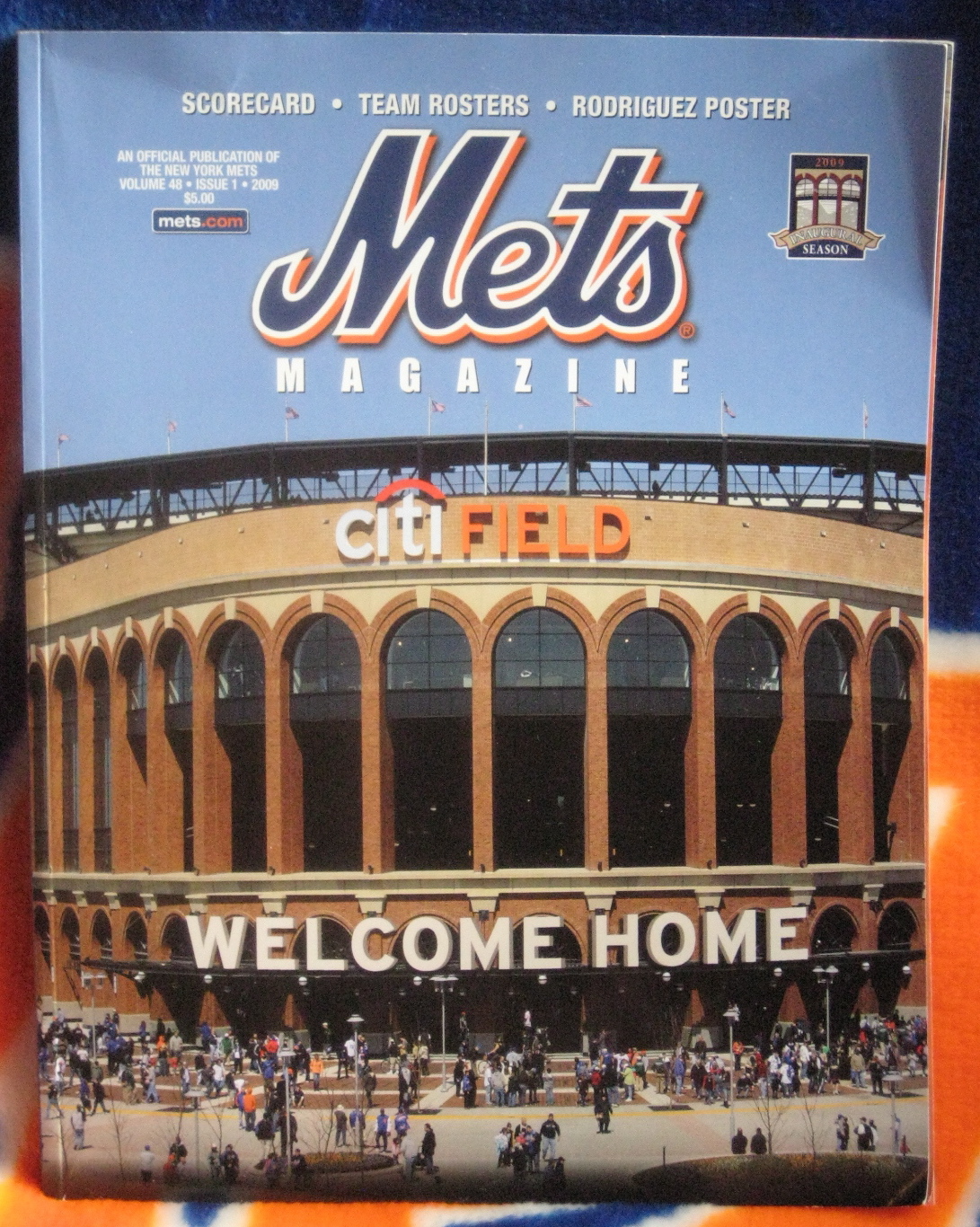
I’d like to love the home ballpark of my favorite ballclub because it’s supposed to be my home. It is by technicality, but not by heart. I can’t quite throw my arms around Citi Field the way I did Shea Stadium. Neither can I view it — no matter how I attempt to adjust my blue & orange-colored glasses — as a damn sight better than most of its stylistic peers. The grudge I held against its mere existence has mostly melted, yet when I look at it closely I still don’t see a great place to see a ballgame.
Because it’s where the Mets play, I’d like to rank it higher than I do, but I can’t. I don’t love it emotionally and I don’t love it objectively. Yet I keep coming back to it. My actions if not my words will have to stand as my implicit endorsement.
I tend to rank the ballparks I visit as soon as I exit them. Most of them I see only once, and I know I’ll likely never see again. Citi Field is different in that respect. I didn’t rank it right away. In fact, I kept it unranked until I’d finished a full season there, and even now I view its status as relatively provisional. I have a hunch Citi Field will always be a work in progress for me, which is fine. Shea was always going to be the static standard by which I instinctively measured every other ballpark. Citi’s place in my head (and maybe, eventually, my heart) can’t help but be more dynamic. My thoughts on it will be more subject to change than the other 33 parks I’ve seen combined.
But it does have a ranking, which is No. 16 — in the upper half of the ballparks in which I’ve watched one or more games, but behind three handfuls of its predecessors and contemporaries. Such a ranking implies not bad, not great — which seems about right.
I like Citi Field. I don’t love it.
A year ago, it will come as no surprise to inveterate readers of this blog, I would have spit out the part about liking Citi Field through gritted teeth, as I cursed it first for having the nerve to replace what I never wanted replaced and then for doing such a poor job of replacing it. I came home after one of my first games there in a state of absolute crisis over how this place was going to be my ruination as a fan and a blogger — how, I asked Stephanie after about 90 minutes of ranting and lamenting, can I serve my readers if I don’t want to go to that stupid ballpark anymore?
Citi Field and I have come a long way since then.
Nowadays, it’s the other half of the uncharacteristically terse appraisal above that I issue with reluctance. I wish I could say I love Citi Field. I wish I could tell you that all my exposure to it, combined with the time that has passed since Shea Stadium became no more, has brought me to a zone where I feel at one with my ballpark, the only ballpark that’s going to be “my ballpark” for the rest of my life.
Can’t quite do it yet. Can’t quite tell you I love the place. I just don’t. It hasn’t been for lack of trying to get to know it better. It is creeping into my heart, in its way, but my head still rejects it. It has less and less to do with my lingering attachment to Shea and more to do with the sense that Citi simply could have been designed better and could be run better.
How many of the things that bother me about Citi Field would have bothered me had I been just passing through Flushing on a ballpark excursion? I have no idea. But Flushing, Queens isn’t Arlington, Texas to me. On the road, a few things strike me and I move on. Here, I care about everything. It’s personal if it’s the Mets. Thus, nothing has been assessed or graded on a curve in my mind. Leave leniency for RFK Stadium or the Vet. Citi Field should have gotten everything right. It didn’t come close.
But it didn’t screw up completely. If you’re a Mets fan, you understand that not screwing up completely is sometimes as good as it gets.
THE CITI FIELD I CAN’T STAND AND NEVER WILL…
• Eliminated decent mid-priced, mid-level seating. Maybe the Mets wouldn’t be crying about BETTER SEATS and LOWER PRICES if there were actually better seats at lower prices.
• Is short on whimsy and long on clunky.
• Turned a sweet idea about an homage to a dear, departed ballpark into a creepy carbon copy exterior.
• Hovers all around me like it’s going to demand my hall pass.
• Slapped mismatched ads everywhere in sight.
• Picked an awful color for its outfield fence. Black has nothing to do with a Giants tribute (ha). It was just another clumsy attempt to seem different. And it is different…which doesn’t make it any good.
• Engenders claustrophobia in most of its seating bowl.
• Kills any momentum you may gather from coming in the front door by having an escalator lead you almost smack into a brick wall and preventing any immediate glimpse of the green grass once you turn left or right.
• Stuck too many seats in the outfield and didn’t figure out how to make sure you could see enough action from there.
• Encourages guests to act like disengaged patrons instead of rabid fans.
• Had to be pulled kicking and screaming into acknowledging almost anything about the history of the team that plays there.
• Forced idiotic geometry into dimensions that have made the home run an unnecessarily endangered species. (I like triples, but I’ve had it with the endless parade of deep fly balls to nowhere.)
• Shows little in the way of improved personnel training from the edgy days of Shea.
• Includes too many areas that carry an R-rating for Restricted.
• Wastes space with the barren and charmless Bullpen Plaza.
• Forgot to innovate in any meaningful fashion.
• Would be enhanced if a centrally located clock and flagpole had been part of the plan. Those are little things, but little things make a big difference in a ballpark.
• Could not be deader at more inappropriate junctures. A friend and blolleague thinks a Citi Field postseason “will make Shea seem like a monastery inhabited by Trappist monks.” I sincerely doubt that, but I look forward to the chance to help make him look like a prophet.
• Will forever be held back by a rash of crummy sponsor names — starting with the one on the front of the joint — as long as everything about its identity is for sale.
THE CITI FIELD I THINK IS OK…
• Offers expansive (if expensive) food choices and amenable areas in which to enjoy one’s generally delectable selections.
• Saved the scoreboard skyline from Shea and placed it where it could inject some needed personality into what would otherwise be cramped and grim.
• Is navigable enough to decipher by section number in no time at all.
• Stands literally steps away from the 7 train.
• Never leaves you wondering if there’s an ATM around here.
• Lets me loiter on a bridge that allegedly has something to do with there being five boroughs of New York City.
• Is lit by distinctive light stanchions.
• Permits planned and impromptu meetings with friends away from the action, though I’ve pulled back on this option since I’m supposed to be watching baseball at the baseball game.
• Honors a great American and outstanding local ballplayer at its primary entrance even if the noble fellow in question was never a Met.
• Reveals interesting angles of its environs if you peek hard enough despite “enveloping” you within its claustrophobic walls.
• Provides decent Promenade perspectives once you figure out where they are.
• Created a successful signature seating area with the Pepsi Porch, where the promise of “intimacy” seems more or less fulfilled.
• Veers to the modest versus the grandiose, which is worth mentioning because I honestly find this modest ballpark preferable to the grandiose Stadium that opened the same week. Grandiosity has its limits; modesty is capable of pleasant surprise.
THE CITI FIELD OF WHICH I’VE GROWN FOND…
• Once it was dragged kicking and screaming, produced a marvelous museum as well as representative Met decor outside and occasionally inside the ballpark.
• Brought the real Apple out of hiding and made it a front yard centerpiece.
• Installed oversized Topps cards of Mets greats on the first and third base sides of Field Level.
• Christened the Shea Bridge and labeled its VIP entrances after three Very Important People in Mets history (too bad you have to be a VIP to enjoy the displays dedicated to Hodges, Seaver and Stengel).
• Shows me the Mets’ starting lineup as soon as I ascend the Rotunda escalator.
• Gave those who were willing to shell out (or, as in my case, were lucky enough to have somebody willing to shell out on their behalf) a personalized brick that’s always right where you left it.
• Captures my imagination from Section 326 — the money shot, vista-wise, at the ballpark, even if those seats are mostly prohibitive budget-wise.
• Provides me (albeit at $7.50 per cup) a favorite beer in Blue Point Toasted Lager at Catch of the Day…and I’m not really a beer drinker.
• Is the place where I’ve seen the Mets go 40-11 in games that count, including 13 consecutive wins since April 19.
• Has been the setting for dozens of wonderful interactions with dozens of wonderful people who share with me, at the very least, this one particular passion and probably more than that.
Back when word came down that Shea Stadium was on the clock and a new ballpark would rise to take its place, my co-blogger wrote off the old place in one swift, unsentimental stroke, citing as his Shea memories “good ones by the bushelful, but for me they’re bound up with the people (in player uniform and fan uniform), with precious little left over for the place.”
I got what Jason was saying, no matter how much I disagreed with his verdict that turning Shea into a parking lot “sounds like a vast improvement” — but now I really get it. I have lots of apparently intractable problems with Citi Field, but I’ve experienced more than a year-and-a-half of instant classic moments, innings, afternoons and evenings there, because of the people I’m sitting with and the people I’m cheering for. As long as I have both, Citi Field is only going to mean more to me.
It’s home. Eventually home, like family, gets graded on a curve. Just not yet.
ONE FAN’S TOP FIVE CITI FIELD GAMES:
1. Chris Carter’s pinch-double in his Met debut keys a six-run, eighth-inning come-from-behind rally and Ike Davis’s tumbling catch over the Met dugout railing preserves a rollicking 8-6 win over the Nationals. Stephanie and I celebrate the 23rd anniversary of the night we met by dining at the Acela Club, but mostly by winning 8-6. (5/11/2010)
2. Henry Blanco ends a long, windy and intriguing afternoon by homering in the eleventh inning off ex-Met Guillermo Mota to beat the Giants 5-4. Joe and I embrace for only the second time I can recall at the end of a game after going to games together for nearly 20 years — the last such occurrence was also against San Francisco, when Bobby Jones clinched the 2000 National League Division Series. (5/8/2010)
3. Nelson Figueroa does what he can to erase the bitterness inherent in a lost Met season by twirling a four-hit 4-0 shutout at the Astros on Closing Day. Jim and I temporarily abandon our lovely wives to take advantage of our first mutual access to the Caesars Club concourse bars and decide it’s as ideal a set-up as we had hoped it would be. (10/4/2009)
4. Jon Niese is almost spotless, throwing a 3-0 one-hitter past the Padres to win the second half of a day-night doubleheader. Entering the ninth, Kevin and I agree we’d be a lot more anxious if one fewer hit had been allowed earlier, yet we were pretty nervous about preserving this non-no-hitter because we’re Mets fans and one-hitters may be the most we ever get to fret about. (6/10/2010)
5. I’m not exactly sure, but the basic ingredients would likely be the same as above: a resounding Mets win, some superb Mets company and another in a burgeoning portfolio of memories that allows me to call this ballpark my very own.
And what fun it shall be to extend this list in the years to come.
by Jason Fry on 23 July 2010 1:51 am Being a Mets fan lends itself to a certain pessimism — Tug McGraw’s “YA GOTTA BELIEVE!” always struck me as more of a desperate entreaty than a statement of confidence. But this stretch? This is as bad as it gets to be a baseball fan. If Phil Cuzzi doesn’t vapor-lock last week, we’re 0-8 since the break. 0-8, Jesus. Betcha never thought 1-7 would be lucky.
When your team’s winning, you become happily distracted. Being a fan sits lightly on your shoulders: Hey, lookit that, we won! Got scary there for a moment, but it all turned out great! Wheee! Winning is fun! When you’re losing here and there, either getting better slowly or steadily or puttering around at .500, losses hurt but don’t strike you to the quick: You won one yesterday or the day before that and you’ll win one tomorrow or the day after that, so there’s no reason to get too worked up.
But every now and then, your team’s not just losing but flat-lining. And then every game hurts. Every opposing run hurts. Every half-inning where nothing happens hurts. Every out hurts. Every called strike hurts. Everything that happens shoves you down deeper into the muck and mire of hopelessness. The team is incapable of winning, of getting a run, of getting a hit, of working a good count. They will never, ever win again.
This is one of those times. And there is no end in sight.
But “no end in sight” is what defines these times. It isn’t actually true that the Mets will never win again, of course. It never is. The Mets will win again, will even get on a roll again, and our step will grow light and lively.
But when that happens, we’ll look ahead without any illusions about 2010. I’m not saying the year is a failure, by any means. The Mets have been reassured about David Wright and Jose Reyes returning to form, seen Angel Pagan emerge as a player to build around, been shown enough by Mike Pelfrey and Jon Niese and R. A. Dickey and Ike Davis to feel optimistic about their futures, and have raw but promising young talent to further develop in Josh Thole and Ruben Tejada and Jenrry Mejia. That makes 2011 look a lot brighter than I could have imagined in March, and that’s a victory.
But 2011 won’t help the rest of 2010. And this team can’t hit with any consistency and can’t win on the road. The division’s gone, the wild card’s slipping away, .500 is a rapidly approaching floor that’s about to be a ceiling. It’s not a disaster, but it sure is a shame.
by Greg Prince on 22 July 2010 4:29 pm Time to forget the current plight of 2010 for a moment and cheer up. Travel via the magic of video to the heart of The Magic Being Back in 1980.
If you’ve never seen it in its full context, here it is, the most talked about home run ever hit by a member of a team that would finish a season 67-95. It’s courtesy of our own LarryDC, an unparalleled Met video pastiche auteur. The June 14, 1980 game action begins at the 1:00 mark and the home run comes just after the 2:00 mark but watch from the beginning for a little bonus coverage of what Metsomania was like as that summer broke, and for goodness sake stay tuned to the whole thing and watch Mets fans react like Mets fans just don’t react anymore.
by Greg Prince on 22 July 2010 4:03 am A few positive developments can be found buried deep within the detritus of the Mets’ otherwise soul-killing 14-inning loss at Arizona Wednesday night.
• Carlos Beltran drove in his first run since September 30 and is now only 43 behind Jason Bay for the season.
• Angel Pagan was one triple shy of a cycle. And Jason Bay was one base short of a single.
• Rod Barajas hit his first home run since the end of May. Jason Bay has yet to hit a home run in a standard National League road ballpark this season.
• Oliver Perez didn’t implode on contact, automatically earning him the status of Best Ex-Pirate On The Mets Who Isn’t Elmer Dessens.
Jason Bay would be the worst.
We all need our scapegoats, and Bay is mine. I’d like to believe it’s temporary, though temporary is suddenly rounding third and heading for August. On a night when few did much and many did little, Bay continued to brave the storm in a skiff made of futility, standing in proximity to home plate six times for no immediately discernible reason. He produced a groundout, reached on an error and then struck out, struck out, struck out and…struck out.
0-for-6 with four strikeouts, none of which came with a Met runner on base, which prevents me, in all good conscience, from picketing the team hotel in L.A. this morning while chanting:
HEY, HEY, JASON BAY!
HOW MANY METS DID YOU STRAND TODAY?
I am the proud owner of a Jason Bay bobblehead, and every day I stare at it and wonder what the hell it’s doing here. That is, why did the Mets choose to make Jason Bay their poster doll for 2010? Oh, right, because, in addition to showing next to no marketing imagination, they threw $66 million at him in late 2009 and are obligated to propagate the pretense that he is a star.
He’s not a star. He’s not much of anything at the moment, but when he’s not sucking like Jason Bay has sucked as a Met, he is, I sort of recall, not as bad as Jason Bay has been. But I’m in possession of his rather bland ceramic figure just as the Mets are stuck with his fabulously extravagant contract through 2013. Until then, they can throw it on the pile over there with Castillo’s, Perez’s and that clever quarter-century buyout genius Steve Phillips cooked up for Bobby Bonilla.
The whole team’s been Bayish, of course. The Diamondbacks were rumored to be horrendous, yet they’re 3-0 since the Mets passed through Phoenix on their way to nowhere. That bullpen of theirs was supposed to be the most flammable item since Mrs. O’Leary’s barn, but it extinguished every Met hope for three nights. Then this series ends with Chris Snyder smacking a ball over the head of — who else? — Jason Bay in the fourteenth. Best thing you can say regarding the losing run is Kirk Gibson didn’t drive it over the fence in the twelfth.
I’m sure the Mets aren’t any happier than they’ve made us. And if they are, Alex Cora will be certain to dampen their mood even further. “Have some respect!” Cora chided giggling reporters and maybe Mike Pelfrey in the Met clubhouse Tuesday night.
Score some runs, Mets fans chided back.
by Greg Prince on 21 July 2010 11:00 am Aw, how can you get mad at these Mets for being, per coach Dennis Green, who we thought they were? We thought they were going to be not very good and now we are beginning to be proven fairly prescient.
It was a heckuva first half. There may be some heck left in the second half. Or it may be all hell. I don’t know. But I can’t get mad at these Mets. These Mets brought me back to life in April when I dreaded them in March. They brought me back around in late May when I was ready to write them off in mid-May. These Mets gave me three solid months, or at least three months that were more often solid than sodden. For that I cannot and will not excoriate them.
You don’t forget a team that made you genuinely happy for a spell when all you anticipated was total misery. And you can’t stay mad at them. You just can’t.
Pending all the ifs, buts, candies and nuts you can stuff into the remaining 68 games of the 2010 season, I have a hunch I won’t. Better yet, I have a precedent that almost guarantees I won’t.
On July 9, 2010, the Mets’ record fell to 47-39, which was neither here nor there, except 47-39 represents, to this day, a monumental Met milestone in my mind. Not the transient 47-39 of 2010, but the transcendent 47-39 of another time.
To understand that 47-39, you have to start with a wholly different set of numbers:
64-98
66-96
63-99
9-18
The historically savvy Mets fan, particularly one drifting ever deeper into middle age, will recognize those first three as the won-lost records of the 1977, 1978 and 1979 Mets. If you lived through those years, you know those numbers scratch only the surface of how bad it was to be a Mets fan in those days. If you weren’t around then or were on fan hiatus, the numbers — exactly 100 games below .500 — give you enough of an idea.
The 9-18? That was the continuation of the trend in 1980. It was shaping up to be another year exactly like the three years before it when the Mets were a last-place club that finished a cumulative 31 games out of next-to-last place and a cumulative 95 games from the distant galaxy we’d learned about in astronomy class, the one known as first place.
It was a place we were told existed, but one we knew we’d never see from anything but the most powerful telescope.
On May 13, 1980, the Mets visited Riverfront Stadium to play the Cincinnati Reds. After scoring twice in the top of the fifth inning, they trailed the home team 6-4. Manager Joe Torre sent Mark Bomback to the mound to relieve Kevin Kobel in hope of keeping things close. Bomback gave up a leadoff home run to Reds third baseman Ray Knight. One out later, pinch-hitter Rick Auerbach singled. Center fielder Dave Collins did the same. Then right fielder Ken Griffey homered to make it Reds 9 Mets 4. Bomback stayed in to allow a single to shortstop Dave Concepcion and a walk to left fielder George Foster.
Torre removed Bomback and replaced him with Ed Glynn. Glynn retired first baseman Dan Driessen on a fly to center for the second out of the inning. He then walked catcher Johnny Bench to load the bases. Knight came up again and homered again — a grand slam, the third Cincinnati home run of the inning. It was now Reds 14 Mets 4.
The Mets would lose this game 15-4, lowering their record to 9-18, keeping them 8½ games arrears of the first-place Pirates and dropping them three games behind fifth-place Montreal. They had lost two of every three games they had played through the first sixth of 1980. Their record since the start of 1977 had declined to 202-311, 109 games below the break-even point, a cumulative 103½ games out of first place in a span that now covered more than 500 games.
For 3.1667 seasons, the Mets had consistently lost three games for every two they had won. On average, if they won on Monday and Thursday, they lost on Tuesday, Wednesday and Friday — and it wasn’t likely they were going to have an above-average weekend, either
64-98
66-96
63-99
9-18
202-311
This felt as painful as it did endless. The decade had changed. The ownership had changed. The trend did not change. The Mets lost and lost and lost and projected to keep on losing. To be a Mets fan was to be trapped in a perpetual 15-4 loss to the Reds, with an eight-run fifth in which the same guy who homered to lead it off belted a grand slam nine batters later.
Then on May 14, 1980, the Mets won. It took ten innings, but they won.
They won again the next time they played, on May 16. They would play twice on May 18 and win once. They were idle on May 19 and they lost on May 20, but they won on May 21. With that win, they left last place for the first time that late in a season since August 16, 1978.
There would be a loss on May 22, but then three consecutive wins. Another loss came, but so did three more consecutive wins. On May 30, 1980, the Mets were 19-22 — 10-4 since losing on May 13, only 4½ games from first place. They hadn’t been that close to the top of their division that late in any season since May 31, 1978.
The 1980 Mets slipped back into old and bad habits immediately thereafter, losing four straight. But then they won four straight and were again just three games under .500 at 23-26. Another loss came but then three wins — a sweep of the Dodgers at Shea — made up for them. They were 26-27, a single game under .500 after 53 games. The Mets hadn’t been that good this late in a season since the end of the 1976 season when they finished 86-76.
One more loss was followed by the most dramatic win of the season and the era, the oft-remembered Steve Henderson Game, the one against the Giants in which the Mets trailed 6-0 in the middle of the fifth, 6-2 entering the bottom of the ninth and 6-4 with two on base and one out from defeat. That’s when Steve Henderson launched a home run off Allen Ripley that landed in the right field bullpen and made the final score Mets 7 Giants 6.
It wasn’t just a come-from-behind walkoff win. It was the win that assured us the bad times were over. It was the punctuation mark on the sentence we had been formulating for a month. “Hey, we may be in this thing!” Since that horrific night in Cincinnati, the Mets were 18-10, almost the inverse of the 9-18 with which they started 1980. We took the most recent 28-game sample as indicative of where we were going and quickly consigned the 27-game sample that preceded it to the ash heap of history. The Magic Was Back and the fourth-place Mets — only six out of first, only three out of third — were on their way.
Alas, those Mets went out and lost their next seven in a row, six of them on the West Coast. But once more, they recovered with a stretch of seven wins in eight games, all on the road. Two losses followed, but then three wins came on their tail. After another loss and another win, the Mets were, as of July 5, 1980, again just a game under .500 and in fourth place, but only 3½ out of first. The last time the Mets had been as close to first place as 3½ games this deep in to a season was on August 17, 1975.
Five years.
A half-decade had passed since the Mets were in contention in July. The 1976 team finished strong, but was long out of it by the time the nation’s Bicentennial bells rang. The 1977, 1978 and 1979 teams were nowhere to be found as summer took hold. None of these editions was even single-digits from first place by July. But the 1980 Mets were. The 1980 Mets were a contender on July 5. The Mets were in a pennant race on July 5. How else to describe a team that was 3½ games out of first after having played 77 games?
The Mets would lose one, win one, lose two and then win three. That 4-3 stretch that concluded on July 15, when combined with the 38-39 mark of July 5, added up to a record of 42-42. The Mets, 3½ out, were now at .500 for the first time this late in a season since 1976 ended.
The Mets were not a losing team. They had been a winning team for two months: 33-24. They were still in fourth place, but the National League East was a dogfight. The Mets had 78 games to make up 3½ games.
We had a dog in this fight.
The teams ahead of the Mets were the Expos of Gary Carter and Andre Dawson, the Pirates of Bill Madlock and Dave Parker and the Phillies of Mike Schmidt and Pete Rose. Montreal could throw Steve Rogers. Pittsburgh had Jim Bibby. Philadelphia featured Steve Carlton.
We had Steve Henderson hitting and Mark Bomback pitching. But we were at .500 and we weren’t going away.
Or were we? We lost a game and then we won a game — 43-43, still a .500 team on July 17, 1980, just 4½ back of the lead. There’d be more losses (8) than wins (3) for a little while. But then there’d be four straight wins through August 2, at which point the Mets were 50-51, still in fourth, now six lengths behind Pittsburgh and Montreal. It was, after 101 games, still doable and still conceivable that the Mets, who had been so awful for so long, could win a race for the division title. Clearly they were in that race to stay.
A loss to Houston broke the four-game winning streak. The Mets traveled to Montreal for a showdown with the front-running Expos and split four. They took two of three in St. Louis, then two of three at Pittsburgh. On August 13, 1980, the Mets’ record was 56-57, good for fourth place in the N.L. East, 7½ behind the co-leading Expos and Bucs. It wasn’t ideal, but it wasn’t impossible. On the same date in 1969, the Mets were 10 out of first place. On the same date in 1973, the Mets were the same 7½ out of first place they were now — but in last. Both years became magical years against long odds. 1980 had been magical for exactly three months. They had played 86 games since bottoming out in Cincinnati and were 47-39 in the more than half-season that had passed.
No way 1980 wasn’t a success.
You quite possibly know the rest of the story. The Mets, beset by injuries and a general lack of talent, went home to face third-place Philadelphia, whom they trailed by only 2½, for a five-game series. When it was over, the Mets’ aspirations were done. They had been swept and swept badly: 8-1, 8-0, 11-6, 9-4 and 4-1. That’s Phillies 40 Mets 12. The wreckage of that weekend left the Mets eleven games out of first place and, in a way that I refused to accept for the longest time, reeling.
The Pirates, Expos and Phillies would soon be out of our sights, but I treated us as contenders a little longer. I knew coming back from eleven out was all but impossible, but we didn’t feel like the losers we had been in 1977, 1978 and 1979. We had just been within realistic dreaming distance of first place. We were a game under .500 less than a week before. The Mets stayed home and lost two to the Giants before winning one. They beat the Dodgers one before losing two to them and two to San Diego.
Then it was off to California where they lost one, won one and never won again. They took an eight-game losing streak to Olympic Stadium for a makeup game that they lost. They then returned to Shea and lost another three, including two to the Phillies who had grown ragingly hot since sweeping us those five in August.
It was September 12. The Mets were 59-82, or 3-25 since I sat hunched over the 1980 pocket schedule on August 13 allotting three wins here, two wins there and however many more it would take to push the Mets past Philadelphia, then Pittsburgh, then Montreal. Instead, the Mets had slid not just out of contention, but out of fourth place. They were five behind the Cardinals and only 3½ in front of the last-place Cubs. Most discouraging was their 82nd loss — their 13th in a row — guaranteed a fourth consecutive losing season. The record would show the Mets would not be winners in 1980.
But I’ll be damned if I ever saw them as losers once they started up that mountain on May 14 and gave me the baseball summer of my adolescent life.
They went 47-39 over 86 games. They were a winner for more than half a season after being the worst kind of loser (the hopeless kind) for three-plus years. It’s thirty years later and it’s all I can do to not cry as I recall what it felt like. The 3-25 tumble after 56-57 was harsh, no doubt. The Mets would lose eight of their final 21 from there to create a miserable 11-38 bookend to more than match the 9-18 start. 11-38 sticks with me because it was the exact inverse of how 1969 ended. Those Mets won 38 of their final 49 and became indelibly immortal. The 1980 Mets lost 38 of their final 49 and became statistically forgettable.
Yet I haven’t forgotten them. I don’t forget anything, I know, but I really haven’t forgotten 47-39. I haven’t forgotten Steve Henderson, which isn’t uncommon for Mets fans of my generation, but I also haven’t forgotten Mike Jorgensen and Tom Hausman and Mark Bomback and Lee Mazzilli and Elliott Maddox and Joel Youngblood and Frank Taveras and John Stearns and Ray Burris and Alex Treviño and Pat Zachry and Craig Swan and Roy Lee Jackson and John Pacella and Doug Flynn and Neil Allen and Jeff Reardon and the rest of those summer of 1980 Mets. The tendency here is to use those names as a punchline or as the “before” picture for the Mets who would begin to slowly emerge in their wake — starting that September, actually, with the callups of Mookie Wilson, Hubie Brooks, Wally Backman and Ed Lynch. But I’m not doing that here. They were my winners — our winners — for 86 games in 1980 and they left behind a stealth legacy that is this:
1980’s run of 47 wins in 86 games changed our perception of what the Mets could be.
The Mets could contend again someday. That was the legacy of 1980. It was all but impossible to imagine in 1977, 1978 and 1979, yet it became fathomable in 1980. It was a thought worth holding onto in 1981 and 1982 and 1983 even as the strides of 1980 were snowed under by another blizzard of losses that felt as if they’d never, ever melt. Sure we relied on 1969 and 1973 to remind us anything was possible, but we looked, too, to 1980 and remembered what it was like to have the impossible kind of, sort of, just a tiny, little bit in our grasp.
Next time SNY shows it, pay close attention to Mets Yearbook: 1980. As much as a highlight film of a fifth-place, 67-95, 24-games-out team is going to strain its right shoulder in order to accentuate the positive, this one wasn’t kidding. It really was all new and exciting even if it didn’t endure in the standings. Listen as Bob Murphy narrates the stirring series in Atlanta when the Mets reach .500 in July. There’s no irony to it. Reaching .500 in July was explosive stuff. It was fireworks. It was how far we had come in such a short time from the depths of the immediately preceding years.
I’d recommend keeping Mets Yearbook: 1980 in mind in a couple of weeks when the Mets honor their new Hall of Fame class, Dwight Gooden in particular. You know how we twist ourselves into contortions to “forgive” Doc his continual transgressions when if he were anybody else we’d write him off as an inveterate addict? Of course it’s because he helped us win in 1986 and was magnificent in 1985 and burst upon the scene in 1984, but I am telling you the true answer lies in that 1980 highlight film. 1980 gave this fan base its first fleeting taste of tangible hope in a Koonce age. The miracles of 1969 and 1973 were dusty history. The comforting mediocrity of 1975 and 1976 may as well have been traded to Cincinnati on June 15, 1977. Until the 1980 Mets went out and started winning a few more games than they lost for a few months, the concept of the Mets ever winning as many as 82 games in a season, let alone 90, 98 or 108, seemed absurdly unattainable.
1980 changed that. 1980 gave us a sip. 1980 made us thirsty for the whole keg. And that’s what we knew had arrived in 1984 in the sleek delivery vessel that was Dwight Gooden. He ended Prohibition for us after seven horribly dry years. If you can, watch Mets Yearbook: 1984 on the heels of Mets Yearbook: 1980. You will sense the connection. You will sense what we sought and when we began seeking it in earnest. The greatest era of Mets baseball, the one that culminated in 108-54 and a world championship, found its first tentative footing the day after its World Series MVP to be, Ray Knight, hit two home runs out of Riverfront Stadium in the fifth inning of a 15-4 Met loss.
You have to watch those Yearbooks and you have to take my word for the link between them. It goes unmentioned in the ’84 film, because nobody wants to be explicitly reminded of a season that ended with 95 losses. Thus, there’s no map that traces the connection. There were no Mets from when the Mets were good between May and August 1980 who were Mets when the Mets got great in April 1986. Dwight Gooden was a high school sophomore in the late spring of 1980, Darryl Strawberry a senior, Keith Hernandez a Cardinal, Gary Carter an Expo and Knight, obviously, an enemy. Jesse Orosco, who broke camp with the team in 1979, spent all of 1980 at Tidewater. The coming of Wilson, Backman and Lynch occurred when the Mets were in their 11-38 death spiral. Lee Mazzilli would help spark key rallies in Games Six and Seven against the Red Sox, but he had to leave our midst for an extremely long exile, and when he returned, he was the cherry atop the sundae, not part and parcel of the incredibly rich 1986 ice cream itself.
Let’s put it this way: If the 1984 Mets who rose to certifiable contenders were 1607 at Jamestown, and the 1986 Mets who ruled baseball were 1776 in Philadelphia, the 1980 Mets who went 47-39 and who made Magic for 86 games were Walter Raleigh’s Roanoke, circa 1587. They’re our lost colony of contention that barely shows up in the history textbooks.
But they are an essential part of our history and they taught — and perhaps teach — us a great lesson. The 1980 Mets were a happening for every Mets fan sentient from the middle of that May to the middle of that August. They thrived. They flourished. And then they disappeared. That inconvenient little detail doesn’t make them any less real in the recounting.
Today, those of us who were around in 1980 are thirty years older and likely lack both the patience and naïvete to particularly appreciate another relatively brief spurt of success that defies our expertly crafted cynicism. Expectations are supposed to be higher, prices are definitely higher, and the pressure to keep on winning can’t help but be higher. When results don’t climb accordingly, our reaction often leaps right over disappointment and clear into fury. Right now many in our tribe are simmering with anger because our team hasn’t kept up the surprisingly agreeable pace it set earlier this season, leaving us to fume over moves they’ve made, moves they haven’t made and a few moves that we were convinced they were going to make but didn’t. Far be it from us to shake loose of the ire we decided we would gather on a contingency basis just in case they did something we considered counterproductive.
Meanwhile, the 2010 Mets, who perhaps peaked the afternoon of June 24, when they were eleven games over .500 and in first place by percentage points, have under contract at least three players for whom I wouldn’t trade the entire aggregation of mid-1980 Mets, and maybe a dozen more who’d have no problem jumping into a time machine and grabbing whatever roster spot they liked from their predecessors in evanescent progress.
Don’t give up on this bunch just yet. The Magic Is Never Really Gone, not if you can bring yourself to resist shooing it away at the first, second or even third extended sign of adversity.
by Jason Fry on 21 July 2010 12:39 am In fact, I would like my money back, please.
What’s that? I listened to it on the radio, which is free?
Oh. WELL, THEN IT WAS WORTH EXACTLY WHAT I PAID.
/ fumes for a while
What’s that? You want a discussion of significant events? What on earth for?
Posterity?
Yeah, there is that, though I have trouble imagining there ever being a time when I’ll think to myself, “I’d really like to remember that dull, teeth-grinding July 2010 game in Arizona in which the Mets lost by one and it felt like 100.” Perhaps not even if I’d done something really bad and was being fitted for a noose. But OK, posterity. Josh Thole and Angel Pagan hit home runs in the late innings to put a little lipstick on a pig of a loss. You know Josh Thole, right? He’s the young catcher whose roster spot is in the crosshairs, despite the fact that he can hit and get on base without hitting, unlike Rod Barajas who at the moment can’t do the former and has never shown any ability to do the latter. Yeah, so Thole went deep. And so did Pagan — the same Pagan who’s shifted over to right field for Carlos Beltran, despite ominous signs that Beltran is missing at least a step and maybe two or three, and we’d all be better off (at least for the moment) with him not trying to cover all that ground on a knee that isn’t 100% yet.
I am not being a bringdown. A bringdown is watching the Atlanta Braves vanish into a distant point of light against the darkening sky of the NL East. (Yes, the same Braves we once upon a time passed in the standings for a sunny technicality of an afternoon, but suddenly that was a long time ago.) A bringdown is hanging one-handed from the rickety ladder of the wild card while teams scramble past you, stepping on your fingers and head in passing. A bringdown is sighing about Jerry Manuel and wondering if Jason Bay will ever show up and worrying about Mike Pelfrey and bracing yourself for Oliver Perez. Those are bringdowns, not….
Actually you’re right, I am being a bringdown.
We could dissect this one further, but I could also knee you in the kidneys repeatedly if we were crammed into a crowded subway car together. You’d put up with that once, maybe twice, but definitely not a third time. You’d be like, “Dude, that really hurts — cut it out!” So even though we’re not in a crowded subway car together and I haven’t been actually kneeing you in the kidneys, you’re right that friends shouldn’t inflict pain on friends. So I’m going to stop, and we’re going to go our separate ways, and we’ll all meet up here tomorrow night at some horrid West Coast hour, and perhaps things will be better.
by Greg Prince on 20 July 2010 4:03 am Less news flash than point of fact: On Monday night, Justin Turner, a largely anonymous utility infielder with perhaps the most generic ballplayer name to grace a Met roster since 2004 catcher Tom Wilson arrived and departed, became the team’s 141st third baseman Monday when he replaced David Wright in the seventh inning of an eventual 13-2 loss at Chase Field.
It used to be a big deal tracking Met third basemen given that nobody could hold down the position for more than five minutes. Wright happily placed that particular meme into cold storage six years ago tomorrow, yet the third base count is still a staple of the Mets Media Guide; it’s appropriately on page 141 this year. They’ll have to be sure to add Justin Turner to the next edition, just as they added the immortal Andy Green and Wilson Valdez last year.
Oh, you know what else used to be a big deal? Mike Pelfrey. He used to be a great Met pitcher, back in April, May and select portions of June 2010. There was a time when you heard Big Pelf was pitching and you felt pretty comfortable predicting a competitive evening for the Mets.
Hmmm…doesn’t feel so competitive lately when Pelfrey pitches. Mike claimed a stiff neck got the best of him on the flight to San Francisco, which is why he pitched Monday against the Diamondbacks instead of Saturday against the Giants. His neck couldn’t have improved much watching Diamondback hitters and Diamondback baserunners do their Diamondback worst to his many, many pitches in his short, short outing. The Mets didn’t improve much, either. If anything, they, like their starter, just kept getting worse and worse.
I could go on about how bad Pelfrey’s been; how tenuous our rotation appears two of every five starts; how frightening it was to learn Oliver Perez will likely be reinstated for active duty in a couple of days; how our extracurricular concern is swiftly shifting from how the Braves are doing to how umpteen potential Wild Card rivals are doing to whether there’s any point in monitoring the out-of-town scoreboard; or how downright shaky this team has looked since accepting the Marlins’ invitation to briefly summer in San Juan. They’re 6-12 since alighting on Thunder Island, and the American Southwest is so far no more welcoming a venue for these Mets than was picturesque Puerto Rico.
I’m neither psychologist nor physiologist, so don’t ask me what the hell is wrong with Pelf. I’m no Jon Heyman scoop artist wannabe, so don’t ask me who the Mets can get to bolster their moundsmanship on the nights that quality early innings are suddenly up for grabs. I’m no legal scholar, so don’t ask me how the Mets can slither out of their contractual commitment to employ Perez no matter how large a detriment he proves to their bottom line. Most of all, I’m no soothsayer, so don’t ask me to tell you whether the Mets will emerge healed and whole from this disheartening morass in any kind of contending shape or come home limping as anything more than a barely .500 team. I sure hope they will, though, as it’s way more fun worrying about keeping pace with the Braves than it is looking up at the Diamondbacks.
Feel free, however, to ask me about the 141 Mets who have played third base, a list that began with Don Zimmer and has now pulled up at Justin Turner. I know it’s not a subject that’s top of mind for most Mets fans, but after 13-2 drubbings that are too horrible to contemplate for too long, it’s the sort of thing that gets me through the night.
|
|