The blog for Mets fans
who like to read
ABOUT US

Faith and Fear in Flushing made its debut on Feb. 16, 2005, the brainchild of two longtime friends and lifelong Met fans.
Greg Prince discovered the Mets when he was 6, during the magical summer of 1969. He is a Long Island-based writer, editor and communications consultant. Contact him here.
Jason Fry is a Brooklyn writer whose first memories include his mom leaping up and down cheering for Rusty Staub. Check out his other writing here.
Got something to say? Leave a comment, or email us at faithandfear@gmail.com. (Sorry, but we have no interest in ads, sponsored content or guest posts.)
Need our RSS feed? It's here.
Visit our Facebook page, or drop by the personal pages for Greg and Jason.
Or follow us on Twitter: Here's Greg, and here's Jason.
|
by Greg Prince on 1 August 2010 1:20 am The perfect team needs no enhancements at the trading deadline. Enhancements are for teams with glaring imperfections, first-place outfits like the Cardinals, the Padres, the Braves, the Yankees. They admitted their imperfections by making trades. So much for them. Perfection is obviously embodied in the tied-for-third place Mets, a club that stood pat Saturday afternoon and went out Saturday night and did what a perfect team does:
Win a baseball game.
Perfection is a fifth starter, Hisanori Takahashi, striking out ten Arizona Diamondbacks in six innings.
Perfection is the lowest-ranking member of the bullpen who isn’t Oliver Perez, Manny Acosta, rolling out his second consecutive inning-and-a-third of flawless relief.
Perfection is a fourth outfielder, Jesus Feliciano, tripling to lead off the ninth and thereby imperil a 4-4 tie.
And, as if packing Hisanori Takahashi, Manny Acosta and Jesus Feliciano onto the same roster isn’t a perfect enough display of personnel, perfection is taking a piece of Kirk Gibson strategy — walking Angel Pagan and David Wright to load the bases to get to some nonentity named Carlos Beltran — and pumping a fist at it after a no-doubt sacrifice fly by Beltran renders it stupid.
Perhaps you were channeling Jack Buck, unable to believe what you just saw when Carlos flied to deep enough right and Jerry’s Mets bested Gibby’s Snakes in walkoff fashion. But I was completely credulous. I had known my team was perfect ever since the deadline came and went and Omar Minaya left his chemistry-laden clubhouse undisturbed. Many players changed hands the last couple of days but our dealer sat with a hand that was pat — as pat as Misch, you might say.
We’re still tied for third, we’re still residing in the distant exurbs of contention, but ever since I learned just how perfect we are, the Mets are 1-0.
Go argue with perfection.
by Jason Fry on 31 July 2010 2:44 am Part 1: Friday Night Frights
Went to see the Mets play ball. Lovely evening, and great company in my pals Wayne and Amanda, the latter a visitor and, horrible to say, a Yankee fan. (She was also a model guest — I didn’t once hear the number 27, an invocation of rings or a sentence ended with a superfluous “baby.”) The only problem was the Mets diverting us from a pleasant evening with whatever it was they were doing down there on the field.
It started out well enough — both Mike Pelfrey and Ian Kennedy had to contend with a strike zone that seemed the approximate size of a postage stamp, and settled unhappily on “give up a lot of runs” as the answer to that particular riddle. David Wright hit two home runs that looked like they’d been fired out of a cannon, no-doubters to left and dead center that had even the folks in the spendy seats up and gaping before the ball cleared the second baseman’s airspace. But after Pelfrey was left in for approximately 1,316 pitches, Raul Valdes came in and got mauled for five runs on just 14 pitches in the top of the sixth. He slunk off looking bewildered and unhappy and then there was nothing much to see except Aaron Heilman come in for the ninth, shot-putting the ball plateward and looking, as usual, like a man who’d just chugged a glass of sour milk. Of course he somehow held the Mets scoreless, tagged only by jeers from the helpless fans.
Watching Luis Castillo flailing against Aaron Heilman made me simultaneously angry and tired. So, for that matter, did knowing Jeff Francoeur would swing at first pitches like a dog lunging for a cheeseburger left on the edge of the counter, and having to sit through that ghastly mall anthem of Eminem’s that someone has saddled Angel Pagan with. Oh, and I might be mistaken but during the middle innings I think I heard the Yankees acquired Lance Berkman, Austin Kearns, the Milwaukee Brewers’ team bus and the Lesser Antilles. (On the other hand, I’m glad the Mets did nothing except send Mike Jacobs away in exchange for the Blue Jays promising to stop teasing us for reacquiring him. This team isn’t going anywhere in 2010 and I’d much rather see it hold its pieces for use in the offseason and in July 2011.)
Anyway, that was Friday night, on which the only thing wrong with the Mets game was the presence of the Mets.
Part 2: From the Basement to the Dugout
Instead of lingering on the recent unpleasantness, I’d like to go back to offer my thoughts on Wednesday evening’s blogger visit to Citi Field, as chronicled by Greg here, Shannon of Mets Police here and Matthew Artus of Always Amazin’ here. I felt weirdly self-conscious as we made our way through the bowels of the stadium and out onto the green field, populated by big-as-life, honest-to-goodness Mets in pregame motley. Part of it was the oddity of the experience, of going somewhere I’d never been before except for the occasional Kids Dash or pregame event in which actual Mets were far away, instead of 18 inches from me. But another reason for my self-consciousness was that I wasn’t sure what I was supposed to do or, frankly, what I wanted to do.
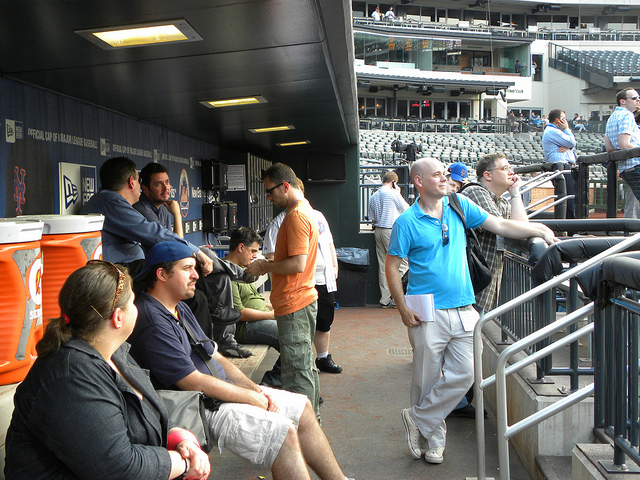 A bunch of Mets bloggers in a familiar dugout. (Image courtesy of OnTheBlack.com's Kerel Cooper) Like my co-blogger, I have years of experience as a professional journalist. I’ve been a beat guy and a columnist and an editor and run a section. I’ve talked to people who wanted to spin me, people who were adversarial at every turn, people who said as little as possible, and people who were infuriated with something I’d written. So I didn’t necessarily feel out of my element on the field or in the dugout, or petrified by the idea of talking to the players. And yet I did feel out of my element — because I decided years ago that I didn’t want to be a sportswriter.
To be clear, I love sportswriting. I admire the men and women who do it. I appreciate that their jobs can be exceedingly difficult, a delicate mixture of diplomacy and truth-telling, with late nights and sudden rewrites and endless travel making everything still more complicated. I didn’t turn my back on sportswriting because of any of that, but because of a more basic consideration: I knew that becoming a sportswriter would require me to stop being a Mets fan, to accept that there is no cheering in the pressbox. Given those two choices, I chose to stay a Mets fan — until blogging let me find a way to be a sportswriter after all. Or, if you don’t like my use of the term, to be someone who chronicles a team from a close distance but a certain remove, serving as a loyalist and historical-minded complement to the folks working the clubhouse with pens and tape recorders.
Anyway, long ago I chose fandom and distance — and then, on Wednesday, all of a sudden there was no distance. We bloggers were briefed on the dos and don’ts of pregame and turned loose, free to wander up and down the VIP area behind home plate and the warning track along the first-base line and even hang around in the dugout. We were allowed to interview players, with the proviso that they were going about their business and all had different routines. The Mets’ media-relations folks helped us understand that; they couldn’t have been nicer or more helpful. And they weren’t worried about us in the least.
Greg chatted with Ed Kranepool, but while I appreciated the opportunity, I didn’t talk to any players. Part of that was not knowing the routine. One rule of BP that I grasped immediately (with the help of lots of signs) is you don’t go on the grass — that’s the players’ workplace and sanctuary. If you want to grab a player, you have to do it while he’s crossing the warning track, and if he’s doing that he’s generally on his way to the clubhouse (where we weren’t permitted) at a decent rate of speed. I hung back because I didn’t want to interfere with either the players’ preparations or those of the beat writers, clustered in the dugout when we arrived.
But I also wasn’t sure I wanted to talk with the players. I’d never been across the line that divides us, and if I was going to cross it, I wanted to be better prepared than I felt on Wednesday, with a clearer idea of what I was looking for and how it would help the blog. Should we be given another opportunity like Wednesday, I’ll think about it more beforehand, since I won’t have to fret about the basics. But honestly, I’m ambivalent. I think our blog has worked pretty well without direct interaction with actual New York Mets — our point of view has never included that, chance meetings in Catskills resorts aside, and there’s a freedom in calling things as we see them from the stands or the couch, unencumbered by the need for clubhouse diplomacy. On the other hand, the reporter in me likes the challenge of finding new stories to tell, things the beat writers might see as just part of the scenery but be of interest to the rest of us. And the reporter in me has always felt queasy at the fact that I’ve said horrible things about various Mets and never had to look them in the eye. At one point Wednesday I had a brief fantasy in which Francisco Rodriguez turned out to be a Faith and Fear reader, and I was about to play the role of a much smaller Brian Bruney. It was vivid and unpleasant. It also wouldn’t have been unjustified. That’s worth thinking about.
After 10 minutes or so of pointless angst, I did what I’ve always done to settle myself down in such situations. I opened my notebook and started writing down what I saw.
Part 3: Up Close and Sorta Personal With the Mets
One thing I’d expected was that the Mets would seem much bigger up close than I’d imagined. But that was only true sometimes. The first Met I passed was Pedro Feliciano, and he was broader than me but built to the same scale. The same was true of plenty of other Mets — they were obviously fit and athletic and spent their days outside, but they didn’t look like members of another species. But some of the Mets were imposingly large. On TV, Josh Thole’s youth and crouched batting stance makes me think of him as somehow slight, but he’s a big, solid guy. I don’t think of Carlos Beltran as enormous — he’s only about two inches taller than me — but if he walked down the street in civilian clothes you’d immediately notice him, struck by his size and purpose. And then there’s Albert Pujols. He was on the other side of the field, but when he came out of the dugout all eyes jumped involuntarily to him, and I knew him at a split-second’s glance.
The Mets spent plenty of time playing catch, shagging flies and doing other baseball routines that look like a lot of fun, and I’m sure are. Jose Reyes and Luis Castillo were tossing the ball back and forth a couple of feet away when we arrived — except Reyes wasn’t really tossing the ball, at least not by my standards. It was coming out of his hand fast, much faster than a ball does even when I throw it with maximum purpose, and you could hear it hiss as went past, until it snapped into Castillo’s mitt with a crack.
Batting practice and infield practice are interesting to watch because they’re so intertwined. At one point Randy Niemann was throwing to the Met hitters while Chip Hale stood to the side of the cage, hitting grounders to Ike Davis and Mike Hessman at first, who’d field the ball and throw it back to Dave Racaniello. (Who was everywhere and doing everything during practice.) What struck me was that Niemann and Hale never had to look at each other, never had to exchange hand gestures, never had to indicate that one or the other should go ahead. The rhythms of their routines were perfectly synched, fitting inside each other. That was something I noted over and over again — the amazing control the players and coaches have over what they’re doing at any moment, the way so much of what they do has become muscle memory.
During their pregame routine the players are surrounded by people — not just loitering bloggers, but reporters from print and TV and radio and the Web, speaking Spanish and English, alongside Mets officials and security guards and groundskeepers and camera operators and other stadium personnel. After 4:40 the stands began to fill with fans watching BP, cajoling players for balls and autographs as they descend into the dugout. And the VIP area fenced off behind home plate is a zoo, an endless parade of kids and businessmen and young women and random folks admitted by the two teams. Pop songs chosen according to no discernable rhyme or reason blast over the PA — I found Genesis’s “Paperlate” particularly random — and the players do their work amid constant noise and chatter, with eyes following them everywhere they go. The chatter rises to a tumult when they leave the field. At one point Wright came into the VIP area and was frankly besieged, almost lost behind outthrust pens and balls and even a stack of WRIGHT jerseys people wanted signed. He handled it with grace and ease, but I felt uneasy for him at the center of all that attention and interest and naked want, and couldn’t imagine being him.
On the other hand, at one moment I found myself very much wanting to be Jeff Francoeur. Hitting in the cage, Frenchy needed a couple of pitches to find his timing and set himself. But once he had it, he started smashing home runs into the second deck in left field, one after the other. The swing was utterly fluid, a mathematically defined arc, executed with flawless timing. Each swing in that series was a ruthlessly efficient conversion of the ball’s velocity and the bat’s and Francoeur’s muscles into a majestic trajectory. Each swing was perfect, and I found myself thinking that the pitcher’s job was to interfere with perfection, to scramble the pieces of the equation to yield a decidedly imperfect outcome. I’d never thought of hitting as something that could be perfect, but there it was, in laboratory conditions, and I found myself nodding in delight that I’d been able to see it.
(Thanks to Kerel Cooper of OnTheBlack for the photo, and to all of our fellow bloggers for great company in the dugout and in the stands.)
by Greg Prince on 30 July 2010 12:26 pm Growing up
You don’t see the writing on the wall
Passing by
Moving straight ahead, you knew it all
I heard the theme from the terrible movie St. Elmo’s Fire a little while ago. I make it sound as if it was an accident, but it’s on a playlist of what I call, with characteristic understatement, The Top 500 Songs of All-Time. It’s a big, garish, stupid song from the midpoint of a big, garish, stupid decade, so I won’t be offended if you don’t share my assessment of John Parr’s greatest hit as No. 482 for all eternity. Still, sometimes you come across something that’s so over the top, you can’t help but be taken in by the enormity of it.
Then or now.
The first time I heard “St. Elmo’s Fire (Man In Motion)” was the night of July 13, 1985, probably the early hours of July 14 to be perfectly accurate about it. I was in a hellacious Saturday night/Sunday morning backup on the southbound approach to the Whitestone Bridge, heading back from having driven my college friend Rob Costa home to Connecticut. We had hung out all day Saturday, first in the city where we converged by train at Grand Central and later on Long Island. I was 22 and, à la Parr, a man in motion, thinking nothing of giving somebody a lift to another state. Technically speaking, I would have been a man in motion had the traffic to the Whitestone been moving…which it wasn’t.
I don’t precisely remember if “St. Elmo’s” bombast hit me before or after the toll booth. It would make more sense if it was the latter, so let’s say it was. Let’s say I finally pulled away from the gate and revved my pair (two pair, actually) of wheels up to 55, 56 miles per hour and, per Parr, could suddenly see a new horizon underneath the blazing sky…or perhaps just the exit to the Cross Island. In any event, I’m pretty sure that’s the first time I heard the song that I would come to grudgingly adore because it so fit the mood of what consumed me most that very same summer.
On Sunday night, July 14, Dwight Gooden would pitch in Houston, the Mets’ last game before the All-Star break. All the Mets would give him in the way of offense would be an unearned run in the eighth, but at the midpoint of the 1985 season, two singles and a bad throw to first of a potential double play ball was about as much as the Doctor would think to order. Doc gave the Mets a nine-inning shutout as their going-away present: five hits, two walks, eleven strikeouts. Once he got a lead in the top of the eighth, he struck out the side in the bottom of the eighth. He struck out Kevin Bass to end the ninth. The Mets won for the twelfth time in thirteen games. Doc won for the thirteenth time in sixteen decisions. His last loss had been ten starts previous.
John Parr from “St. Elmo’s Fire”:
Just once in his life
A man has his time
And my time is now
I’m coming alive
Dwight Gooden from 1985:
13-3, 1.68 ERA at the All-Star break
11-1, 1.34 ERA after the All-Star break
While not technically a one-hit wonder — anybody else remember “Naughty Naughty”? — John Parr reached No. 1 on the Billboard Hot 100 only once, with “St. Elmo’s Fire,” the week of September 7, 1985. He and it stayed atop the chart for two weeks. While America’s disc jockeys were playing “St. Elmo’s Fire” to death, Dwight Gooden was burying nearly every National League hitter he encountered. In Doc’s final six starts of the season, the Mets played 59 innings; Doc pitched 53 of them.
Why only 53? Well, the first two games went thirteen and ten innings, respectively, and his manager had a rule about not letting him go more than nine. There was also a start in which Davey Johnson pulled him after eight innings with an eleven-run lead. Doc’s line that day: 3 hits, 2 runs, 0 strikeouts…
…oh sorry, that was Dwight Gooden’s hitting line. Doc did allow an unearned run to Pittsburgh on the afternoon of September 21 when he went only eight innings, but considering he socked a three-run homer and collected four RBI, I think we can pardon his not going the distance.
Which should remind us: Over his final nine starts of 1985, Dwight Gooden gave up one fewer home run than he hit.
He hit one.
He could climb the highest mountain. He could cross the wildest sea. He could confound every expectation a sane person would have for any pitcher in any season. 1985 was Doc Gooden’s Fire.
• His ERA after his first start, on Opening Day, was 4.50. After his second start it fell to 1.80. And it never rose as high as 2 again.
• On a steamy Shea afternoon in August, he simply did not have it: five earned runs in five innings against the Phillies (in a game the Mets eventually won 10-7; the other starter didn’t have it either — some 42-year-old lefty by the name of Jerry Koosman). The damage it did to his ERA? It was driven all the way up from 1.64 to 1.82.
• He went 14 weeks between losses. During that span, he won 14 consecutive decisions, a Mets record. The loss that snapped his streak came on the last day of August. And then in September, he gave up no earned runs.
• He made 35 starts overall. He was removed in the middle of an inning twice — and once was the crazy, rain-delayed July 4-5 eventually 19-inning nearly four in the morning game in Atlanta, when the craziest thing would have been to have risked Doc Gooden’s twenty-year-old right arm.
You can express it any way you like. You can add up the complete games (16), the shutouts (8), the strikeouts (268), the wins (24) and the ERA (1.53). You can gawk at his September and remember that the Mets needed every single inning he gave them as they chased, caught, passed and fell — again — behind the Cardinals. You can go straight to his last start, at St. Louis, when he was not at all sharp and still managed a complete game victory with ten strikeouts to move the Mets within one of the division lead with four to play. You can note his Cy Young Award was unanimous, his fourth-place finish in the MVP voting ludicrously low or that Wally Backman summed up the Mets’ ultimate three-game deficit in a nutshell when he wryly observed that it was all Doc’s fault — after all, he did lose four games.
I can hear the music playin’
I can see the banners fly
For four minutes and eleven seconds this morning, I was at the midpoint of a big, garish, stupid decade which also happened to the midpoint of the most remarkable baseball season I can possibly imagine one individual giving me. And I was 22. If you’re going to take a 251-second trip back in time, you can do worse than when you spent the day with a good friend from college who’s no longer around and you looked forward the next night to watching a great young pitcher who you knew was only going to get better as that season and that decade eased into their respective second halves.
I’m going to Mets Hall of Fame Day Sunday for Dwight Gooden’s induction. I figure it’s the least I can do considering how all my other tentatively set plans where he’s concerned went awry. See, I had hoped to be at Doc’s 300th win or his perfect game or when he threw that shutout that clinched our third consecutive world championship. I certainly thought I’d be there when the Mets retired his number and was sure I’d make the trip to Cooperstown after he made it in on the first ballot.
But I missed all those events, which I find surprising, considering I had more or less penciled every single one of them in while singing along with John Parr a quarter-century ago.
by Greg Prince on 29 July 2010 5:06 pm On Umbrella Day at Citi Field, R.A. Dickey shielded Mets fans everywhere from the elements.
Let the Phillies have Roy Oswalt (the big snot). No way he’s as perfect a righthanded addition to their rotation as R.A.’s been to ours. Kudos to Omar Minaya for making the under-the-radar acquisition of the century last December. Kudos to Jerry Manuel for not pulling him from today’s game until he absolutely had to. Just let R.A. Dickey do his thing and, more often than not, good things will happen.
God, I love this guy. God, don’t we all? For two months we’ve been invoking Terry Leach and Rick Reed to explain the element of delightful surprise R.A. Dickey has brought to Met pitching, how an emergency afterthought became a life preserver and then an every-fifth-day staple. Leach went 11-1 in 1987 when nobody was counting on him. Reed went 13-9 in 1997 and made himself a cornerstone of Met success for five seasons. In the future, I get the feeling that if we’re compelled to cite Leach or Reed, we’ll be able to say, “They came out of nowhere and to our rescue — you know, like R.A. Dickey in 2010.”
In the postgame interview on SNY, Dickey told Kevin Burkhardt there should be no doubt about hard this team works, citing the dirt on the uniforms of Jose Reyes and Angel Pagan after thirteen innings the night before. It was his way of saying “we never give up” without being banal about it. Typical R.A. Isn’t that something? We have enough of a sample to frame something as typical of the journeyman whose arrival in our organization we barely noticed when it occurred. I’d also say getting to one out in the ninth with a shutout the afternoon after a late night bullpenpalooza is Typical R.A.
And as if to back up Dickey’s thoughts on Met effort, Ike Davis said not being in the lineup yesterday allowed him to spend three hours in the batting cage and get some things worked out. Three hours yesterday led to a three runs on one swing today. Another great in-season pickup (of sorts) for those diligent Mets of Omar Minaya and Jerry Manuel.
I’m really glad we won this Thursday rubber game, just as I was really sorry we lost the Wednesday middle game and was happy we won the Tuesday opening game. I’m thrilled we won a series. But I have to confess I’ve almost thought not at all about the standings while we’ve been taking on the Cardinals. I’ve glanced at Brave and Phillie scores and just took a look at the daunting Wild Card alignment, but I’ve stopped actively thinking of us being in any kind of race. Maybe that’s why the Oswalt deal isn’t fazing me at the moment. Does it really have anything to do with us for 2010, at least? We’re just some .500 team trying to get back on track, I’ve kind of accepted.
Yet I haven’t accepted that every game doesn’t matter on its own merit. My own personal experience aside, last night sucked because last night sucked. The night before was great because the night before was great. This afternoon’s result fills me with jubilation because it’s a Mets win engineered by guys for whom I root very hard. Even if this Met August becomes as irrelevant to the National League playoff picture as last Met August, these Mets demand our support and our attention. Whatever you think of Minaya and Manuel, their players transcend their performance even in the wake of the horrid several weeks before this very nice bounceback set.
Mets baseball can always be better, but when you’ve got a Dickey and Davis making you happy, it can’t be beat.
by Greg Prince on 29 July 2010 5:37 am Fourteen out of fifteen isn’t bad, and, considering from how far back we traveled to get as far as we did, 8-7 in 13 isn’t inexcusable.
But it still sucks to lose that way. Or lose at all. I hadn’t forgotten the feeling, no matter how unusual it had become to experience in 2010.
The Streak — the stretch of Mets baseball that produced fourteen consecutive wins at Citi Field in my previous fourteen appearances there — is over, going the route of where they say all good things eventually go. But I gotta tell ya: The Streak did not go gentle into that good night.
It was, however, plainly on its way out the Rotunda gate in the very first inning on Wednesday night. Johan Santana, who had started four of the fourteen wins that composed The Streak and had even homered in support of it, pitched without a clue for the first inning. Was he tipping his pitches? Were the Cardinals bribing Henry Blanco for the signs? Was it the spillover from the full moon of three nights earlier? I ask whether that’s a possibility because whenever the bizarre happened around our house when I was kid, my mother would write it off with, “Must be a full moon!”
There’s nothing more bizarre than Johan Santana surrendering six runs and eight hits in the first inning of a baseball game. Then again, it was pretty bizarre that I’d been on a fourteen-game winning streak. And that I’d been chatting no more than two hours earlier with Ed Kranepool.
Yeah, that’s right. Ed Kranepool, the all-time Met hit king and me, hanging out on the warning track behind the batting cage at Citi Field. And by hanging out, I mean I stood in close proximity to Ed Kranepool while he went about the business of being Ed Kranepool — chatting up several of his successors and dispensing his signature — and I spouted an occasional inanity that was vaguely related to our surroundings.
Things I learned during my ten or so minutes intermittently bothering but mostly relishing proximity to Ed Kranepool:
• He enjoys the Hamptons.
• He agrees with my assessment that he’s probably signed more autographs than any Mets player in history — “Probably,” he confirmed.
• He thinks Ike Davis is a good, young player and had no idea why he wasn’t in the starting lineup Wednesday.
“I guess it’s a lefty-lefty thing,” I said in my desire to furnish Ed Kranepool with potentially useful background information.
“He’s looked pretty good against lefties,” Ed Kranepool, good-looking lefty himself, responded.
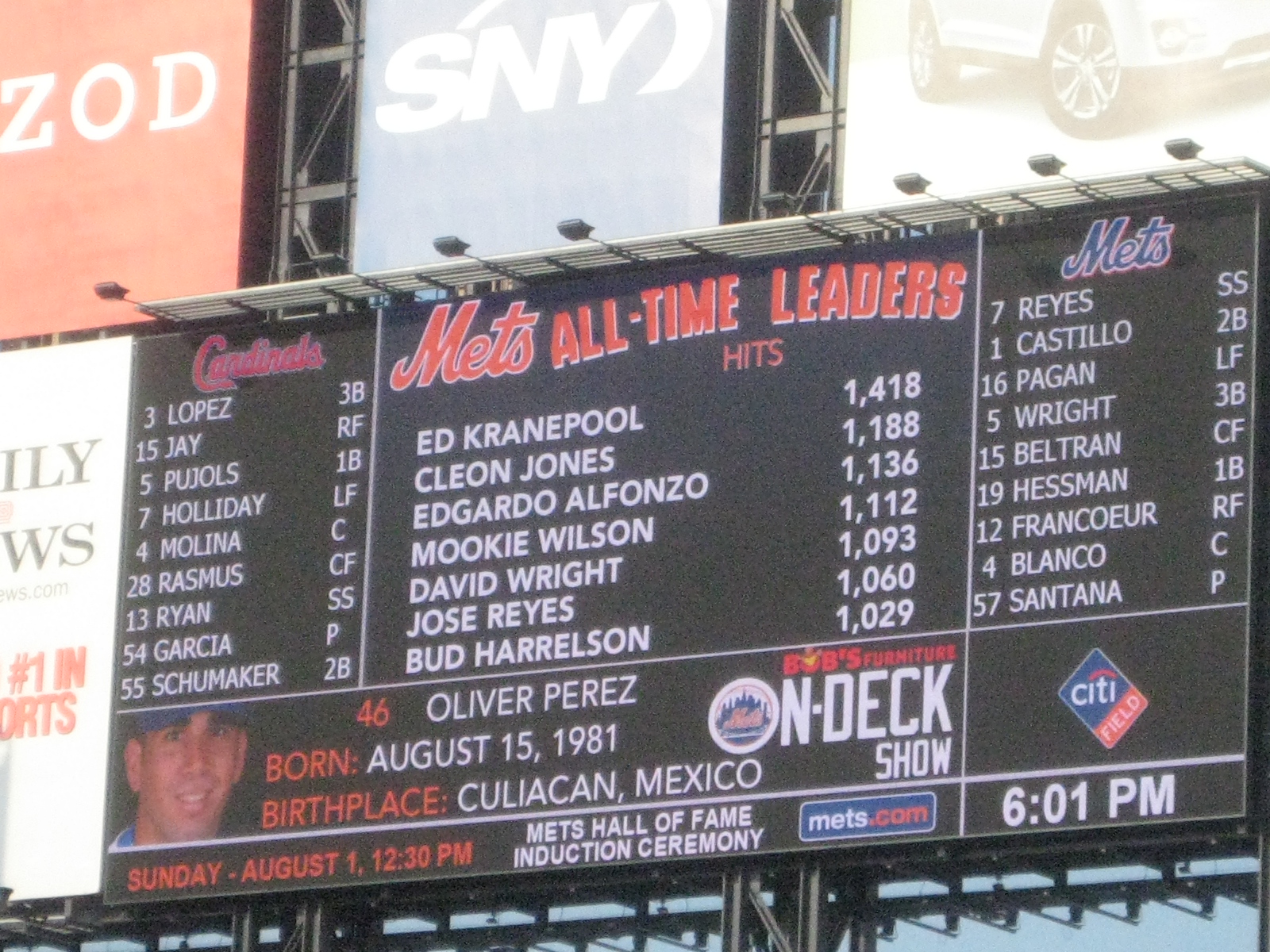
Ed Kranepool has 1,418 hits. I had a one-time field pass as part of a generous Mets blogger outreach program. It was hanging from a button on my shirt. All bloggers, reporters, guests, what have you had to have a pass to be on that warning track. Ed Kranepool, the only Met to play in eighteen seasons, did not require such mundane ID.
 Ed Kranepool's credentials, where everybody can see them. All the credentials Ed Kranepool needs to show appear on page 408 of the Mets Media Guide and occasionally on the Citi Field scoreboard. First in hits; first in doubles (since passed by David Wright); first in pinch-hits; first in sacrifice flies; first in multi-hit games…and first in the hearts of any countryman who watched him personally script the batting portion of the Mets record book from 1962 to 1979. If Ed Kranpeool didn’t see a reason lefty Ike Davis shouldn’t be starting against Cardinal lefty Jaime Garcia, he was right.
Probably.
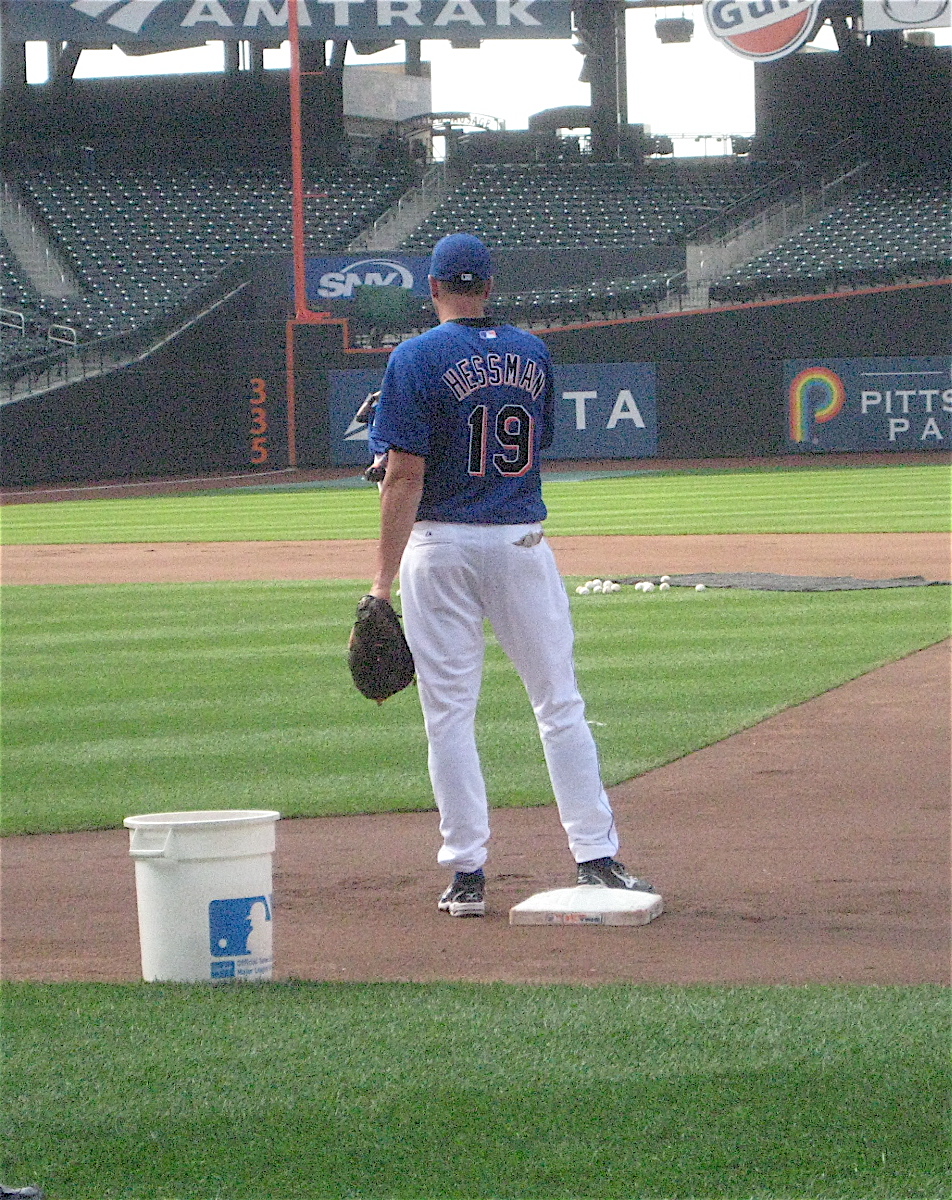
When I wasn’t orbiting the surface of Ed Kranepool, I walked the track during BP, or as much of the track as our passes allowed. Mostly I joined my blolleagues in loitering in front of the Mets dugout for most of our allotted time. This gave me a good look at the righty hitter who was taking Davis’s place for the evening, Mike Hessman. Hessman stretching. Hessman taking ground balls. Hessman not being bothered by anybody the way an Ed Kranepool might, which seemed reasonable given that Ed Kranepool played first base for the Mets in 1,304 games and Mike Hessman still has that new-callup smell.
Mike Hessman isn’t without his own set of credentials. Per Al Pacino in Scent of a Woman, he’s been around, ya know? He hasn’t been around the Mets before or the majors much, but if you want minor league power, Mike Hessman’s been your man for a generation. He’s slugged 329 home runs of the Triple-A and lower variety since 1996. You’d figure that would have earned him more of a shot at a higher level than he’s received (77 games in four seasons spanning 2003 to 2008 with Atlanta and Detroit). It didn’t. He’s been a Bison this year. He’s homered 18 times as such. He’s also played a lot of third, a little first and a bit of everything else since turning pro. He became a Met two days ago when Rod Barajas went on the DL. He became a Met first baseman last night, Ed Kranepool’s lack of blessing notwithstanding.
Maybe it was the recent full moon or maybe it’s just that this is what you get when you rematch the two pitchers who threw cartons of goose eggs in what became a twenty-inning test of nearly scoreless endurance in April, but Garcia didn’t look a lot better than Santana in the bottom of the first. The Mets, far from shellshocked after landing in their 6-0 ditch, loaded the bases for their first baseman and five-hole hitter, Mike Hessman. And Mike Hessman creamed the third pitch he saw for a very deep drive to a very high left field wall. In Buffalo and International League points south, that’s probably a grand slam. At cutesy-poo Citi Field, that’s a two-run double.
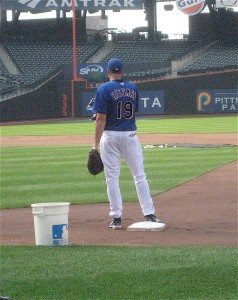 First baseman Mike Hessman: he's never heard of me, either. Still, a two-run double isn’t at all something at which you sneeze when it was 6-0 a second ago. Hell, I even allowed myself to think that it was just as well it didn’t go out because, sure it would be 6-4, but the bases would be empty, our momentum would be spent and Mike Hessman would do nothing but swing for the fences the rest of the night.
I didn’t sneeze at 6-2, but I must be allergic to optimal good fortune.
Our momentum turned moot. It stayed 6-2 for a long spell. Johan settled in, I guess, but so did Jaime. It was The Twenty-Inning Game all over again, save for the tiny difference that the first inning featured eight runs. Eventually the Cards would push across another run off Santana, who left in the sixth. The Mets would answer in their half when Carlos Beltran reasserted his power by smashing a homer to left. Hearing “El Esta Aqui” again and seeing El himself circle the bases was mighty gratifying, but we still trailed by four with time running down on The Streak. Once we played seven and it was still 7-3, I surrendered to the inevitable. I knew I was going home on the proverbial “L” train for the first time in fifteen games.
And with that, a mini-miracle unfolds. Castillo leads off the bottom of the eighth with a single and Pagan rockets one to right. It’s 7-5. Hey, I reasoned silently while otherwise screaming loudly, 7-5 is doable. A home run doesn’t necessarily nip momentum in its bud. Sometimes it scatters the seeds for imminent success. Didn’t Mike Piazza reach Curt Schilling for a leadoff single and Robin Ventura follow with a two-run homer in the bottom of the ninth on May 23, 1999? Yes indeed they did. That trimmed a four-run lead to two on another day when the Mets seemed endlessly out of it and it opened a door to what soon became a five-run ninth that beat the Phillies and their often intolerable ace (all five runs were given up by Schilling) 5-4.
At 7-5, Wright reaches on an infield hit. Beltran strikes out, but Hessman — who hasn’t homered — has the decency to be nicked by a Mitchell Boggs pitch. The Tony La Russa overmanaging carousel begins to spin: righty Jason Motte gets Jeff Francoeur to fly out with runners on first and second after an admirable ten-pitch battle on Frenchy’s part. Lefty Dennys Reyes comes in to face lefty Josh Thole, but walks him. Now the bases are loaded. The pitcher’s spot is due up. Reyes is still standing on the mound, left arm dangling as a weapon to discourage production by lefty hitters. Lefty-lefty matchups may not be what Jerry Manuel wanted when Jaime Garcia began this game, but he has no other option now.
Thus, the batter is the apple of Ed Kranepool’s eye, Ike Davis. The regular first baseman of the New York Mets, pinch-hitting for the second time in his young career (whereas Ed Kranepool pinch-hit 370 times in his old career), singles through the right side of the St. Louis infield. David Wright scores from third. Mike Hessman lumbers — and I mean lumbers — from second but scores as well. Thole can go no farther than third. Davis is on first.
And the game is tied at seven.
The Streak, one person in 35,009 thinks, is still alive. Or at least it’s not yet deceased. The Mets can win this thing they seemed destined to lose. And if that goes down as a fifteenth consecutive “W” in my Log, then everybody wins.
La Russa continues to manage. His fourth pitcher of the eighth inning, Kyle McClellan of the righthanded persuasion, enters. Jose Reyes, worthy inheritor of No. 7 from Ed Kranepool, sees six pitches and walks. The bases are loaded yet again. Luis Castillo can drive in the run that will give us our first lead of the night, a lead that can be handed off to Frankie Rodriguez and (theoretically) put in the books.
Man, it would be great if Luis could do that. Castillo actually won the Mets a game on a walkoff single versus Trevor Hoffman his first month as a Met. Omar Minaya was so excited, he granted little Luis a lifetime personal services contract that precluded any other second baseman from ever playing the position for the New York Mets. I exaggerate slightly, but Luis wasn’t always the guy at whom you yell “bunt him over!” as I did all night. Luis can do this, we’ve all decided to decide. We came back from 0-6 to make this 7-7. It would be a shame to let our general disregard for Luis Castillo discourage us from believing it can be 8-7.
We believe (I actually muttered “faith…faith…faith” under my breath his entire at-bat) and Luis tries, but we are not rewarded for our belief. On the sixth pitch he sees, he grounds to short.
Still, 7-7 going to the ninth. We’ve been routing the Cardinals 7-1 since that pesky top of the first when Johan was abducted by aliens and injected with a serum for failure. Now it’s a clean slate. Now it’s Frankie being used in a tie game because we’re home; if we were on the road, Frankie would have to make John Candy’s bunk, but because we’re home, Jerry Manuel can actually use his ostensible best reliever to keep things tied. Which is what Frankie does. He’s so brilliant in the ninth and it’s a game whose sudden chance to become a Met win was so hard-earned, even Jason Fry of Faith and Fear in Flushing is cheering his Frankie-loathing heart out for him.
We’re all set up for a dramatic and wonderful conclusion to our long night. Very long night, I should digress. The blogging bunch has been here since four o’clock. We saw up close how much the Mets prepare for a game. We saw the stretching drills and the infield repetition (I learned Angel Pagan takes throws from Ike Davis at second and then whips them back to first — is there no end to this man’s versatility?) and the enormous home runs that are hit when the balls are grooved by batting practice pitchers. Jeff Francouer must frighten LaGuardia’s air traffic controllers late every afternoon. We saw, too, that the Mets conduct themselves like nice guys, posing for pictures with little kids, signing baseballs, answering questions from all manner of media (Jose had a Latin American contingent following him diligently). The rest of BP is a lot of standing around, but for the players, all of this is simply what you do when you come to work.
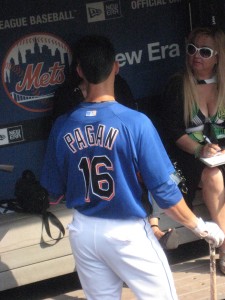 "Now if you'll excuse me, I have to go practice crushing awesome home runs." Yet let’s not kid ourselves: you also see, when you’re privileged with a gander, how much baseball is a game. It’s not one I, at 47 and decidedly in not the best shape of my life, can play, but I recognized it as essentially the same fun activity I dived into every chance I got when I was kid. The Mets playing catch, I swear on a stack of revised yearbooks, isn’t much different from me playing catch, save for the exponentially better skill at all facets of the throwing and catching involved. Granted, you look at everything these fellows do through the prism of their megabucks salaries — who wouldn’t want to play a game for a luxurious living? — but you can’t help but notice that when they’re just going through the motions of throwing, catching, swinging and preparing for a game, they seem to be having the time of their lives.
And they get to do it daily.
That’s baseball. That’s the grind. That’s what separates it from football, the scholar Earl Weaver noted: “We do this every day.” Whatever the tasks that compile an evening of Mets baseball, you can tell, when you’ve got a field pass, that it takes a lot of people doing a lot of likely the same things on a daily basis to make it all happen. In my short time around it, I admired the effort put in, whether it was from the trainers, the bullpen catcher, our friends in the PR department or even the security guard whose job it was to sneer at me slightly as I stood in the Met dugout where I technically wasn’t supposed to be (Ed Kranepool doesn’t mind me hanging around, but the guy in the yellow supervisor’s golf shirt’s got it in for me).
But ya know what? I wouldn’t want to be a part of it every day the way all those folks are. I wouldn’t want to be one of the beat writers whom I noticed waiting around for the chance to get a few minutes with Wright or Reyes or whoever. I wouldn’t want the Mets to be my job. If it were, I couldn’t have been in the stands in the eighth showing no objectivity and demonstrating no pretense of professionalism. It was fun to be around the way it works for a day. I think it would be a shame for it to be anything but fun any more than that. I want the drama and the wonder and the full moon bizarreness and the chance for joy. Everything else should be somebody else’s responsibility.
(Though I am obligated to point out I am available for consulting.)
Good thing there are people trained to deal with whatever comes up, because something very big came up in the bottom of the ninth in the section next to ours. While the Mets attempted to push across that one run that would certify Wednesday night as practically magical — Wright and Beltran singled with one out — a man had taken ill. I couldn’t tell you what it was, but he was in bad shape, and various security and EMT personnel rushed to his aid. That sort of thing may not be uncommon, yet to watch it unfold while the stadium PA did its job — blaring rallying cries and blasting upbeat music — was surreal. I swear it was something out of The Naked Gun: in the foreground, earnest medics struggle with transferring a patient onto a stretcher; in the background, tens of thousands of oblivious fans chant LET’S GO METS! It would have been funny if it hadn’t been potentially tragic.
I have to admit I sort of hoped the Mets could find a way to foul off fifty or sixty pitches in the bottom of the ninth so the emergency responders could finish their job in something less than a carinval atmosphere. It felt unseemly to root for a baseball team while a baseball fan was in what appeared to be peril. I sure hope he’s all right.
Wright and Beltran weren’t driven in. The Mets didn’t score that eighth run and it felt like the momentum had slipped away. Frankie was money in the tenth and Bobby Parnell was just as valuable in the eleventh and twelfth, but we weren’t getting anywhere versus La Russa’s lobbers. Our only baserunner in extras, Reyes, was gunned down by Yadier Molina, who remains the only public figure upon whom I perpetually wish an onslaught of physical harm (come to think of it, he did come out before the game ended and I did read something about a sore shin…suck on it, destroyer of dreams). Second base was not a lucky bag for Mets baserunners. Prior to Beltran’s sixth-inning blast, Wright singled on what he (and I) thought would be a double. A good throw by Matt Holliday and an overslide by Wright cost us a baserunner for Beltran. Would have Carlos necessarily homered with David on and would have we won 8-7? And if Jeff Wilpon hadn’t insisted on wacky walls, would have Mike Hessman’s double been a grand slam? And what about the presence of candies and nuts replacing ifs and buts — wouldn’t that make every day Christmas?
Anyway, two key Mets were out at second base and not enough Mets crossed home plate and sooner or later, the team with Albert Pujols is going to get an opportunity to take the measure of whichever reliever the team trying to retire Albert Pujols has kept hidden until some very late inning. Pedro Feliciano was not, on this occasion, the equal of Frankie Rodriguez or Bobby Parnell and he sure as hell wasn’t up to the task of setting down Pujols with runners on first and third and two out. Prince Albert kinged Pedro with a hot grounder to left, scoring Skip Schumaker (whom Pedro hit either because Pedro hasn’t been all that effective or he was just pissed there are grown men running around calling themselves Skip**) and the long day was nearing its inevitable, unsuccessful end.
Fourteen consecutive games that I’d attended have ended with “Takin’ Care of Business” following the final pitch. This time, the Citi DJ went straight to “New York State of Mind,” the Mets’ good night music when there’s nothing good about it. There was plenty good on Wednesday, but my mood when I had to handle loss for the first time since Willie Harris snared a sinking liner on April 10, wasn’t in that category. Losing 8-7 didn’t leave me in a “New York State of Mind”. It left me in a state of dismay.
Losing at Citi Field had become so rare an occurrence as to grow seemingly nearly extinct. But I spotted, at last, a loss, right out there in the wild. It’s a thrill I could have lived without at least one game longer.
It’s worth noting in this context that on July 28, 1993, exactly seventeen years before my version of The Streak whimpered to an end, a far more famous and far less desirable Met streak snapped. Anthony Young finally won a game after losing 27 of them in a row, the most any pitcher ever lost in one ongoing string. He did it the hard way, giving up the go-ahead run in his only inning of work against the baby Marlins before being rescued by Ryan Thompson’s and Eddie Murray’s tying and winning RBI. I was really happy AY was no longer the biggest loser as of July 28, 1993, and if I had to pay for that karmically on July 28, 2010, so be it.
That’s one rationalization. Another is it had to end sooner or later, damn it, yet it wouldn’t go down without a fight, and I appreciate the Mets giving it a puncher’s chance in the eighth — and regret how their offense played pat-a-cake from the tenth through the thirteenth.
I recently found myself reluctantly rewatching Billy Crystal’s 2001 Yankee gushfest, 61*, when it appeared on one the HBOs. Late in the movie, Babe Ruth’s widow dismisses the suggestion that her late husband wouldn’t necessarily have minded Roger Maris breaking his mark since Maris, after all, was another Yankee. No, Mrs. Ruth said, she didn’t think so: “The Babe loved that record.”
That’s how I felt about The Streak, even if it existed for me and me alone (though many of you have been kind enough to wish it well). I am all but certain I will never experience this run of luck again. For three months, I considered myself the luckiest fan on the face of the earth. How do you keep going to the same ballpark to root for the same ballclub and come home every single time having gotten exactly what you rooted for?
I don’t know how it happened, but it did. I’ll always cherish that it happened.
Now if you’ll excuse me, I have between now and Sunday to figure out how to vanquish a one-game losing streak.
**Or, to borrow a phrase from George Read, Tory delegate to the Continental Congress from Delaware, “in many cases”. Apologies to the good Skips out there…besides Lockwood, I mean.
by Greg Prince on 28 July 2010 12:40 pm To pick up on the theme of Met hesitancy turned Met happiness described so well by my partner, I was indeed running late Tuesday night. Earlier in the day, I wasn’t so much running as sitting…sitting, then standing, then pacing, then growling into a telephone at the ironically named Action Repair, a firm I’d enlisted to hopefully fix an air conditioner that was running not so much late as warm.
It was classic “hurry up and wait” stuff. Action Repair promised me a home visit by no later than 11:30 AM — “You’re their first call,” the dispatcher assured me. Then, because “The routes got screwed up,” I would see them by 3:00 PM. Then, because “The boss made them do two installations,” they’d show no later than “before” 6:00 PM.
The only two lines the dispatcher didn’t feed me were “The dog ate my Freon” and “They’re on their way right now.”
Action Repair arrived at my home at approximately 6:40 PM, more than seven hours after they were due and half-an-hour before first pitch. Despite the grand annoyance wrought by their callous disregard for other people’s time, the technician and his assistant, who indeed appeared to have been shuttling from one demanding job to another all day — jobs so demanding they apparently couldn’t take two seconds to call the dispatcher with an updated ETA to pass their customer’s way — sprung into Action of the most effective sort. Seven hours in the waiting, thirty minutes in the fixing; they were miraculously done making my office cool just as the Mets’ bats were beginning to defrost in Flushing
That mission accomplished, my ticket, courtesy of Jason, was still in my wallet and still good for admission to the night’s baseball game. It was diminished in the sense that I wasn’t going to be able to use it to its fullest potential and see the first, second, third or probably fourth inning of said game, but it was still good. My next possible train and its various connections would land me at Citi Field’s doorstep no sooner than 8:40, which seemed unconscionably late on one level, yet a fine consolation prize on a higher level.
My day, like Action’s routes, had been screwed up, but now there was a chance to make everything cool.
I rode my rails: to Jamaica, to Woodside, to Willets Point. On the final approach to the final stop, I was genuinely surprised by what I saw to my left: Citi Field all atwinkle, its parking lot formerly known as Shea Stadium dense with cars, its sky brightened by the lights I’d never seen turned on from this perspective before.
As evidenced by my figurative (and literal) lack of worms, I’m no early bird, yet it’s become my Citi Field custom to arrive at least an hour before a game begins. In the first season of Citi, it gave me a chance to explore the new environs. Since then, it’s allowed me to purchase food and beverage and enjoy it peaceably before getting fully in the swing of baseball things. It’s just worked better for me when I can manage to get there early.
But it wasn’t going to work for me Tuesday night. I could only get there late. Very late. As late as I can recall showing up for a non-doubleheader. Circa 7:10, I had briefly thought of texting my air conditioned regrets to Jason — I’d waited so long for climate control and now I was a bit reluctant to abandon it in favor of two LIRR trains and one 7 local — but I didn’t like the idea of a valid ticket becoming a bookmark. I also didn’t want the first Phantom Game of the Citi Field era to occur so soon. A Phantom Game is a game for which I’m supposed to go but simply can’t. Those don’t get put in The Log. Those don’t get put anywhere except atop my towering pile of regrets once that game gets played without me and my unused ticket. Maybe the Mets lost, maybe the Mets won, but I always wish I could have gone after I couldn’t/haven’t.
Tuesday night was going to be a loss, I was pretty certain. The Streak had been too strong and gone too long. It was a relic of the first half of 2010, like the best of Rod Barajas and the last of John Maine. It would be too much to ask it to continue into the second half, not when runs ceased to be scored in Los Angeles, not when Adam Wainwright loomed from sixty feet, six inches away.
But The Streak, if it was to go down, was going to have to go down honorably. I didn’t like the idea of a valid ticket becoming a bookmark, sure, but I also didn’t like the message I’d be sending the baseball gods, that I had a something of an out — the pliable relationship Action Repair has with time and the way it would make rushing to Flushing something of a fool’s errand — and I took it so as to artificially preserve my winning ways.
Couldn’t do that. It would be unfair to The Streak. It would also be unfair to me because I like to go to Mets games, particularly with Jason.
So screw Adam Wainwright and the chances he’d shut us down as he had in April (to say nothing of a distant October). Screw sitting on thirteen consecutive wins. Screw the odd feeling one gets joining in progress a game that started seamlessly in your absence ninety minutes before. Delight, instead, in a ballpark all aglow with baseball, knowing you can still get in on four, maybe five innings before it’s all over.
Comprehensive testing has shown four, maybe five innings are better than none.
The Mets were losing when I left the house. They tied while I waited for my first train. They went ahead Frenchy-style between Jamaica and Woodside. And they built a definitive lead as I made my way from the Rotunda to the elevator to the Promenade. I stood with Jason and watched the Met margin increase to 6-1 on the food court big screen, messily cramming a rack of Blue Smoke ribs into my meathole in the process because I missed my leisurely pregame meal opportunity and never thought to eat while I awaited Action. The chewing and viewing continued from there as Jon Niese pitched out of his last jam in the top of the sixth. This has worked out beautifully, I thought, but there is still one problem:
I haven’t seen any of the game in person.
The code of The Log is a game counts once I’ve seen one pitch live. The rule was put in place on the occasion of a twinight doubleheader I couldn’t make until the seventh inning of the first game — the Robin Ventura two Grand Slam doubleheader from 1999, as you Mets Classics aficionados might recognize it. I only caught three innings of that twinbill opener, but I was at Shea and I witnessed a chunk of it. Witnessing any of it, even a fragment, I decided then and there, would have sufficed. And witnessing it means watching the field, not an HD monitor.
Still gnawing on those imposing yet delicious ribs, I told Jason I needed to go watch a live pitch, any live pitch. Gotta go take advantage of this unforeseen abundance of runs. Thus, at the beginning of the bottom of the sixth, I stood behind a Promenade box and observed Fernando Salas deal ball one to Jeff Francoeur. Well, now I’d seen everything…or everything I needed to see. It was, for me and The Streak, an official game.
I also would have been on the hook had the Cardinals rushed back into contention, but this wasn’t a night to think like that.
Naturally I hung around to take in more than just one pitch. Four or so innings bought me Reyes’s two-run homer to the Pepsi Porch; Billy Joel’s wistful Last Play at Shea rendition of “Take Me Out to the Ball Game” on what I should refuse to refer to as CitiVision; Mike Hessman’s low-key Met debut; and Frankie Rodriguez not blowing a six-run lead. By the time K-Rod was uneventfully finishing off those pesky Redbirds, I was wishing a little bit that I could have more baseball before saying good night to Citi Field — but more baseball when you hold an 8-2 lead with two out in the ninth is neither a viable nor desirable option.
With The Streak, the win and the air conditioner all properly serviced, everything at last looked good on Tuesday, at least until I barely missed the 10:17 at Woodside, not two hours after having transferred there in the other direction for my four or so innings of action, having lost most of the first five innings to Action. I wasn’t too happy with the LIRR not giving me an extra fifteen seconds’ grace as I trundled down its stairs, but honestly, what’s one more screwed up route when you’ve made it, at last, to your fourteenth win in a row?
by Jason Fry on 28 July 2010 1:37 am So tonight I was on the subway, and glanced up to see Citi Field outside the windows, and thought something strange: I don’t want to go.
There were a lot of reasons. For one, I had a ton of work to do — too much, it suddenly seemed, to burn an entire night at the ballpark. For another, Greg had emailed me that he was delayed and possibly couldn’t come.
And, well, you probably guessed this third reason already: The team had just staggered home from an amazingly horrible road trip, one that seemed to have deep-sixed the season. They’d played futile, excruciating walking-in-concrete-overshoes baseball, and now were squaring off against Albert Pujols, Yadier Molina and Adam Wainwright. Well, to be more accurate, the hitters had played futile, excruciating walking-in-concrete-overshoes baseball. If the various tomato cans they’d faced in Arizona and L.A. had made them look like the wrong end of Pros Vs. Joes, what would an ace riding a 26-inning scoreless streak do to them?
And why on earth would I want to sit by my lonesome in the Promenade and watch it while people booed?
So. Did I want to turn around and go home? Yes, I did.
Did I do that? No, I didn’t. And thank goodness.
The doors opened at Willets Point and I realized another beautiful night was coming, another respite from the jungle-rot weather of recent weeks. People spilled out of the 7 train, lots of them in Cardinals red, but many more in Mets blue or orange or black or white. They weren’t bearing pitchforks or torches. They weren’t even complaining. Rather, they seemed happy with the weather and each other and the prospect of baseball. So I let them carry me down the stairs and through the turnstiles and down the stairs again and across the plaza with the Apple, past the McFadden’s girls and up to the rotunda and the fanwalk, with its invocations of great Mets moments and messages of hope and joy and perseverence. And I began to feel better about things. In fact, I began to feel mildly embarrassed about my earlier moment of doubt.
Look, the Mets’ swoon was almost perfectly timed to crush our fragile hopes. They came out of the break with us mildly worried about their hungover play since Puerto Rico, then went to the West Coast and made us stay up late night after night watching them lose and hurtle out of contention. We hadn’t seen a home game in two-and-a-half weeks, during which an enormous amount had happened — there was a moment of silence before the game for George Steinbrenner, which made me do a double-take until I realized that he’d been alive when the Mets last played a home game. Carlos Beltran got a mild response from the crowd in his first at-bat, but I don’t think it was indifference so much as the fact that, well, we kind of forgot the context. It didn’t register with me that this was Beltran’s first game back at Citi Field, because by now I’m used to him being back. That’s how long the road trip was.
Anyway, yes, there’d been reasons to want to turn around and go home. But walking up the right-field stairs, I found myself smiling. It was a beautiful night, there was a baseball game, and I had a ticket to it. Plenty of nights, including some perfectly nice ones, don’t measure up to that.
It’s true that this reminder was tested almost immediately, when the Cardinals poked and jabbed and dinked Jonathon Niese for a first-inning run before I even got out of the Taqueria line. But one cheapie run wasn’t enough to mar the kind of summer night that makes you wish you had a good beer and something great to eat and a ballgame to watch, particularly since I actually had all those things. So I wandered here and lingered there, keeping tabs on the game via the ever-present monitors and letting the flow of Citi Field carry me along backstage. I texted two friends of mine who were there and visited happily with them for a while, then chatted with another friend up atop the big baseball in the Promenade food court for a time. And by now Greg was on his way, my phone buzzing with updates on his progress. On the train I’d feared being lonely, but I hadn’t been — and even if I had been by myself, baseball and the ballpark were proving good companions.
For down there on the field, the Mets were looking nothing like the team that had sleepwalked its way across a distant time zone. First they drew even on the Cards thanks in large part to a Beltran double off Wainwright, irony noted and then quickly waved away as irrelevant at this remove. Then they did some dinking and jabbing of their own, and Jeff Francoeur nailed a Wainwright offering to left-center. (Wainwright later said he was trying to walk Frenchy; irony noted again.) I thought Francoeur’s drive would be off the wall, hopefully bouncing back past the outfielders, but it was just high enough to be gone for a three-run shot. And the Mets were on their way.
When Greg arrived we scaled the Promenade and sat happily up there, jousting mildly about Mets we’d blamed everything on and talking shop and just generally catching up, as we’ve done hundreds of times before and will hopefully do hundreds of times more. Then K-Rod was in the game, and Pujols had struck out, and it was time to go home winners. 8-2 certainly helped, but it was just the capper on the night and the park and everything else. And it was a lesson — a welcome one, for once.
There are lots of times you’ll be busy and that ticket will seem less like an invitation than a burden. But push through these moments. Get up and go. Because it’s baseball.
by Greg Prince on 27 July 2010 7:47 am I was no fan of Whitey Herzog’s when he was The Enemy in the middle and late 1980s. Man, did I hate those Cardinal teams, probably more than I hated the Bobby Cox Braves of the late ’90s and early 2000s, Durocher’s Cubs, Leyland’s Pirates or Charlie Manuel’s Phillies of recent vintage.
That’s a lot of hate, I tell you what.
The White Rat was the implacable face of those teams. Vince Coleman may have possessed the legs that could outrace every one of Gary Carter’s frustrating throws (if not a mechanical tarpaulin roller); Tommy Herr may have been the pre-eminent pain in the Mets’ ass; and Terry Pendleton may have become a brand name at Roger McDowell’s expense, but it was Herzog who came off as one goddamn smug son of a bitch in the opposing dugout. Ooh, did I truly despise him.
Thus, I regret to note that I loved Whitey Herzog’s Hall of Fame speech Sunday. It brimmed with the humility and awe appropriate for someone whose major league playing career was confined to spare outfield duty on second-division clubs yet whose managerial résumé eventually encompassed six division titles, three pennants and the 1982 World Series championship, all compiled across eighteen busy seasons. Didn’t like him when he was lefty-rightying the Mets to death in 1985 and 1987 and couldn’t stand him when he was demanding Howard Johnson’s bat be checked for cork, but loved him on Sunday.
Loved that speech. Loved that Herzog remembered his first minor league manager, future Mets coach Vern Hoscheit — just like HoJo (still) and Herzog, come to think of it — taking him to Sunday dinner in McAlester, Okla., before a game and permitting the young Rat to order a beer because Herzog was German and “by the time I was five…I had drank more beer than milk.
“Luckily, I got four hits that night.”
Loved Whitey’s sober scouting report on Dorrel Norman Elvert Herzog: “I was able to get nine years. Wasn’t a very good player, but I did get nine years in the big leagues and there was only sixteen teams and 50-something minor leagues, and I got my pension. I was the kind of player everyone wanted; when they got me, they didn’t know what the hell to do with me.”
And I really loved that he generously recalled his friendship with someone who hasn’t been around for a very long time — Casey Stengel. It was a mentor-protégé relationship that commenced when Herzog was just another Yankee minor leaguer who had no chance of making the big club (Herzog’s theory as to why he drew special attention in Spring Training is Stengel assumed this kid was the grandson of early 20th century Giant Buck Herzog and Whitey never corrected the misconception) and continued for the rest of the Ol’ Perfesser’s life. Their bond was particularly strong during those days in St. Petersburg when the just-retired Stengel was a very special guest and Whitey was finally getting his shot in a New York uniform as Wes Westrum’s third base coach.
“Casey told me so many things that became valuable to me,” Whitey said at Cooperstown. “He said, ‘You’re going to be a manager. You’ve got to learn how to handle the press. When I managed the Mets, you got a bad team, here is how you handle the press.’ He said, ‘You’re very nice to them.’ And then he said, ‘You feed them and you drink with them and you stay up all night with them having a few pops. Put them to bed about 4:30 and by the time their deadline comes, they won’t even put the score of the game in.’
“Well, that was the way to handle the Mets, I’ll tell you that.”
Herzog indeed impressed the press (which wasn’t Westrum’s forte) but never got the chance to handle the Mets himself, though he did have a hand in the development of the 1969 world champs. After 1966, his single season on the Met coaching lines, he was reassigned to the Met minor league system. As recounted by the Times’ Richard Sandomir — aided by an interview with ranking Mets Herzogologist/Numerologist Jon Springer — the Rat’s touch was all over the talent-laden rosters of the late ’60s and early ’70s. Herzog proudly recalled for Anthony McCarron of the News how Gil Hodges thanked him with the firmest of handshakes in the midst of the Mets’ World Series celebration for all he did to get the Mets to the mountaintop.
“’For three years now,’” Herzog quoted Hodges, “every time I called you about what I need, you have sent me the right player.’ Believe me, that went right to my heart.”
Herzog was viewed by many in the Mets sphere as a future manager, and when tragedy forced an untimely choice to be made, after Hodges died in 1972, he was considered by his acolytes in the press the logical candidate. But the man making the decision was M. Donald Grant, someone whom time would reveal wasn’t always on the same page as logic. The Shea manager’s office instead went to Yogi Berra. A year later Whitey Herzog went to Texas and was off soon enough on his Hall of Fame journey in Kansas City.
NEW YORK N.L. doesn’t show up on Herzog’s plaque because all his managing took place elsewhere — Rats, one is tempted to say; Rats that the guy who did us in a couple of times couldn’t have been the one to steer the ship away from the iceberg it didn’t have to head toward as the ’70s unfolded. When he was farm director, Herzog didn’t want to trade Amos Otis or Nolan Ryan. His advice went unheeded. Who knows where the Mets would have gone had Grant listened to him or, better yet, gotten the hell out of the way? Then again, a decade after he left New York, Herzog took a liking to Neil Allen and was more than happy to rid himself of Keith Hernandez to bring him to Busch Stadium. These things have a way of working out sometimes.
***
I don’t know that anybody gets particularly excited when a manager is inducted into the Hall of Fame, but I’m glad it happened for Herzog if just to hear the speech and find the chance to contemplate the qualities that made those who held the job he never did so Amazin’ly memorable:
• Stengel knowing exactly what he was doing when he knew there was nothing he could do with the pieces expansion dealt him;
• Hodges instilling professionalism and pride in the clubhouse when there were finally players on the premises who could play;
• Berra remaining unflappable until the storm that swirled all around him swirled itself out;
• Bobby Valentine managing full games while his opponents were stuck in whatever inning it happened to be;
• And Davey Johnson deciding it was time for his team to win big, and so they did.
That’s a little simplistic for Davey, who dueled Whitey to a 2-2 tie in their concomitant quest for N.L. East titles (the pair later teamed up to run a celebrity fishing camp — fishing with celebrities, not for celebrities). As Herzog said Sunday, without Hall of Famers like Ozzie Smith, Bruce Sutter and George Brett executing the moves he made, “I’d probably be back in Illinois digging ditches or something.” You can’t be a genius without the players to back it up. The only manager who ever seemed capable of motivating his charges by merely pointing out the necessity of winning precisely enough games (32) to clinch a playoff spot was the original sabermetrician, recently deceased Cleveland Indians skipper Lou Brown — and he was peeling off pieces of a cardboard dress when he said it.
Still, what do we think of when think of Davey Johnson now that he’s on the cusp of his ridiculously delayed induction into the Mets Hall of Fame? We think of the declaration he put forth before the start of the 1986 season: we’re not just going to win, we’re going to dominate. 108 dominating wins later, Davey Johnson was proven a prophet. It was a bit like Joe Namath guaranteeing the Super Bowl except with seven months’ lead time and delivering on his pledge nearly every day.
Johnson was never put on the same strategic pedestal as Herzog (he acknowledged he relished alternating Jesse Orosco and Roger McDowell in the outfield in one highly bizarre game because it was similar to something Whitey had done the year before) but he was no push-button manager, either. The “we’re going to dominate” theme wasn’t just bluster. Marty Noble, when he spoke to our AMAZIN’ ALL-STAR MONDAY group earlier this month, said he thought Johnson’s greatest attribute as Mets manager was making his players believe they could do anything. It wasn’t that bashful a collection of athletes to begin with, so embellish their determination with Davey’s confidence and, well, no wonder they plundered their division by 21½ games.
A signature element of Davey’s first season as Met manager, in 1984, was that he used a computer. That was particularly exotic in a year when the sport was just as happy to bask in the reflected sepia glow of The Natural as it was to hint that any of its masterminds was technologically ahead of the curve. A computer? In his office? To help him manage a baseball game? Who was this guy who swaggered so much that nobody needed to use that now overused phrase to describe his style? Davey Johnson wasn’t pushing buttons so much as he was producing keystrokes — and 90 wins from a perennial cellar-dweller.
Yet his brain combined with his gut to create a state-of-the-art operating system, as Noble pointed out when asked to share a couple of memories of Davey. The one I liked most came from the game in which the Mets passed the Phillies to take first place on the first day of summer in ’84. Bill Campbell was pitching for Philadelphia in the bottom of the seventh. Ron Hodges had just tied the score and now there were two on. Davey called on Rusty Staub to face Campbell even though Rusty had literally not gotten a hit off this reliever in eight years. From July 19, 1976 through April 22, 1984, Staub could not touch Campbell: 0-for-14 with a few walks.
Yet Davey sends up Rusty and Rusty singles in two runs and the Mets win and they’re in first place. Afterwards, reporters ask Davey what the deal was with that. You’d figure the manager with the computer would be highly cognizant that Staub never hit Campbell and would look elsewhere down his bench for alternatives. Instead, according to Noble, Johnson saw it this way:
“I figured Rusty was due.”
That’s confidence.
***
The induction of Davey Johnson into the Mets’ Hall is comically overdue, just as it is for his cohort for the occasion, Frank Cashen, Darryl Strawberry and Dwight Gooden. Herzog said in Cooperstown that fellow Cardinal legend and Hall of Famer Enos Slaughter, after having to endure a long wait to be elected by the Veterans’ Committee, greeted his selection with, “It’s about time. Should have happened twenty years ago.” Whitey was more gracious than that on his own big day: “You know, any time is a good time when you receive an award like this.”
I’ll buy that in general terms. Johnson should have been a Mets Hall of Famer at least a decade ago, but then again, the Mets Hall of Fame should have been up and running as an active entity between 2002 and 2010. Old story. It won’t, in the spirit of Whitey’s words, lessen one bit the thrill of attending Mets Hall of Fame Day at Citi Field this Sunday, August 1.
I sincerely hope every FAFIF reader who appreciates the Mets picking up the pace where acknowledgement of their history is concerned will be in attendance this Sunday — not just in appreciation of Johnson, Cashen, Strawberry and Gooden, but for ourselves. We deserve this.
***
• If you’ve got the scratch, there’s a super-sounding luncheon with the four Hall of Famers to be and several of their generational MHOF peers on Saturday at Citi Field. The tag is $300 for season ticket holders, $325 for everybody else (a bit out of my league, alas). It includes a ticket to the July 31 game and proceeds benefit the Mets Foundation. More information here.
• I don’t much worry about what other teams do when it comes to honoring their greats, but Ed Leyro of Studious Metsimus sharply observed upon his visit to Dodger Stadium that Gil Hodges’s number 14 is mysteriously doing time on the back of Jamey Carroll. It’s bad enough it was allowed to linger all over Mike Scioscia in 1988, but Uncle Jamey? I hate Uncle Jamey! Anyway, a good look here by Ed at Gil’s two-team greatness, both from a Dodger first base and Met managerial perspective. To borrow from Gil’s Met colleague’s assessment of induction into the National Baseball Hall of Fame, any time would be a good time to award Gil Hodges his rightful place upstate…and despite his being passed over too many time, it may not be too late to maintain a realistic glimmer of hope that it will happen.
Thanks to the St. Louis Post-Dispatch for transcribing Herzog’s speech.
by Greg Prince on 26 July 2010 3:51 am The Mets are so far out of first place in the National League East that I woke up Sunday realizing I never bothered to check how Atlanta did on Saturday (they won, natch). They’re behind everybody you don’t want to be behind for the Wild Card, and have a few teams closing in on them that nobody would mistake for late-charging contenders. They’ve been outscored Something-Nothing more often than I care to count and have suffered through a West Coast swing pungently reminiscent of July 1991, when they went to California 15 games over .500 and came home in throes of what turned out to be a six-year slump. Worst of all from my “It’s So Much Better This Year Than Last Year” perspective, their record at this juncture of 2010 is exactly two games better than their record at this juncture of 2009.
I’m still not mad at them, but I’m becoming resigned to the likelihood that “The Best is Yet to Come” will not be this September’s version of “L.A. Woman”. We had enough problems with L.A. Dodgers these last four games. We had problems aplenty with Arizona Diamondbacks and San Francisco Giants, too, and we haven’t beaten anybody a series since we were matched up with the Minnesota Twins. Good golly, we haven’t taken a set from a single National League club since the San Diego Padres visited Citi Field the second week of June.
Nevertheless, not mad. Just resigned until I have a reason to jump on board again. If only the Mets still had all those players who were doing so well a month or so ago. You remember: Wright, Reyes, Pagan, Dickey, Santana, Davis, Niese, Feliciano, Parnell, some other dudes…why did we get rid of that bunch and bring in these clowns?
That’s not a sideswipe at Carlos Beltran, by the way. Carlos Beltran’s major drawback is his possession of a human body, one that didn’t heal quickly and one that hasn’t rounded into 100% playing shape. Give Carlos Beltran two weeks — there are ten left on the schedule — and he could very well remind us of the Carlos Beltran we know and love. Right now he reminds me of the Carlos Baerga we knew and wondered, “What the hell?” But I take Beltranism in its present state as a temporary condition.
I take the 7-17 dregs that have washed ashore since that ill-fated trip to Thunder Island commenced as impermanent, too. Not every game is destined to be like Sunday’s…even if Sunday was the perfect apotheosis of what every game of late has been like. At any rate, not every inning will necessarily be Sunday’s sixth, the frame in which Reyes singles; is caught stealing 1-3-6 ahead of a Castillo double; Wright fouls out; Beltran hits a shot that is clearly headed to left until it’s intercepted by Casey Bleeping Blake; and Dickey’s left hip — if not his fighting spirit — has to be dragged kicking, screaming and tweaked from the mound while he’s pitching an unsupported gem.
You can give yourself whiplash looking for reasons this team has crumbled like a Drake’s Cake just as you can get a lethal sunburn waiting to meet a Met as he crosses home plate at Dodger Stadium. You can do anything you like, but there’s nothing you can do.
It’s just one of those weeks that effectively ends your season until further notice.
by Greg Prince on 25 July 2010 12:00 pm The 8,702nd day of my life was October 27, 1986. You will almost definitely recognize that date as the last time the Mets won a World Series — and perhaps as Jon Niese’s birthday. Back then, in the aftermath of that blessed event of which I was cognizant, I figured the next episode of the Mets winning a World Series would come in 1987 or 1988 or soon enough. That would make it roughly 365 days until another Mets world championship was secured. Or approximately 730 days if it wasn’t done at the next available juncture. Whatever it would be, it surely wouldn’t be long.
Miscalculation on my part. The days that would pass would, by July 23, 1989, reach four digits — a thousand days. Another thousand days would go by as of April 18, 1992. And so the thousands would come and the thousands would go.
The bottom line is the next Mets world championship has yet to arrive. What’s come since October 27, 1986, instead, is, as of today, July 25, 2010, 8,703 days. That equals literally more than half of my life waiting for another Mets championship.
Though the mathematics are mine, this is not a solely personal lament. If we’re at least as old as Jon Niese, we’ve all waited 8,703 days for another title. If we’re no older than Josh Thole — born October 28, 1986, the day of the ticker-tape parade that followed the World Series — we’re waiting for just one. This is 8,703 days on the debit side of every Mets fan’s ledger.
Tomorrow will be 8,704 days. Tuesday will be 8,705 days. That’s partly a function of the baseball calendar; you can’t win a World Series in July. But we’re going to get to late October, early November, whenever it is this year and, the way things are going, we’ll be pushing 8,800 or so days since the last time the Mets won a World Series. Mets fans a little bit older than me will, by then, be able to say what I’m reluctantly able to say today:
More than half a lifetime has passed since my team reached the pinnacle for which I hold out hope daily — every day as long as I live — that I will get to see them reach again.
Other teams’ fans have waited nearly as long or even longer, but that’s for abstract consideration. In tangible terms, we don’t care about those other teams’ fans. We care about us.
And we’d sure like us to get another sooner than later.
For the record, the Mets won their first World Series on the 2,482nd day of my life, better known to you as October 16, 1969. Seeing as how I’d only found out about the Mets in earnest no more than 60 to 75 days earlier, I can’t legitimately say I was actively waiting all that long. Yet even if I am to consider myself a born Mets fan who was, on some innate level, yearning for that first World Series from the word Go (along with the words Let’s and Mets), 2,482 days is cake compared to 8,703. The personal wait for me to get to miraculous Championship No. 1 was 28.52% as long as the wait has been for hypothetical Championship No. 3.
Fast-forwarding from October 16, 1969, I’d be at 2,483 days and counting on August 3, 1976 — marking my first experience with having gone more than half a lifetime waiting for the Mets to win another World Series. From there, it would take more than a decade to luxuriate in the Promised Land. In all, it would take 6,220 days for the Mets to get from their first world championship on 10/16/1969 to their second world championship on 10/27/1986. The wait for resounding Championship No. 2 was 71.47% as long as the wait has been for unattained Championship No. 3.
The Mets equaled the wait between their first and second titles when they arrived at November 7, 2003 sans a third ring. The wait since then has piled an additional 2,483 days of yearning onto the tab. That’s one more day than I waited from birth (muttering not “papa,” not “mama,” but “Metsie! Metsie! Metsie!”) to land wide-eyed upon the wonders of October 16, 1969….which was the day I unknowingly signed a waiver declaring I was willing to be put on hold indefinitely where the Mets would be concerned.
Anyway, it’s been a while for all of us and the way things have been going lately, it figures to take a while longer. Although our hairtrigger reactions to various and sundry setbacks may indicate otherwise, I would say anybody who’s given thousands of days over to waiting for another Mets championship demonstrates a remarkably patient soul. Nevertheless, I would beseech the Mets to bestow upon us that third world title they’ve been hiding from us as soon as possible. Cats and reincarnationists notwithstanding, we each have no more than one lifetime to spend waiting for them.
Seriously, that’s it. I’m not doing this again in the next lifetime.
|
|