The blog for Mets fans
who like to read
ABOUT US

Faith and Fear in Flushing made its debut on Feb. 16, 2005, the brainchild of two longtime friends and lifelong Met fans.
Greg Prince discovered the Mets when he was 6, during the magical summer of 1969. He is a Long Island-based writer, editor and communications consultant. Contact him here.
Jason Fry is a Brooklyn writer whose first memories include his mom leaping up and down cheering for Rusty Staub. Check out his other writing here.
Got something to say? Leave a comment, or email us at faithandfear@gmail.com. (Sorry, but we have no interest in ads, sponsored content or guest posts.)
Need our RSS feed? It's here.
Visit our Facebook page, or drop by the personal pages for Greg and Jason.
Or follow us on Twitter: Here's Greg, and here's Jason.
|
by Greg Prince on 4 May 2010 9:49 am I can’t get enough of Gary Cohen in the course of a game. Except for when I know he shouldn’t have just said what he just said.
Example one from Monday night: Oliver Perez is cruising along, as calm as the Ohio River. It’s the top of the fifth, game knotted at one. Ollie is being not just Good Ollie but, after some choppiness in the first couple of innings, Efficient Ollie. The only element that can disturb Ollie’s rhythm is explicitly acknowledging what an unusually low pitch count Ollie has registered thus far.
That’s exactly what Gary does as the fifth begins. So what happens? The baseball gods (who listen to Gary, too, because they know quality when they hear it) mess with Ollie and he goes to three-and-two before striking out Ramon Hernandez. OK, I think, it’s an out. A little more effort than I would have liked, but nobody’s on, and the pitcher, Mike Leake, is coming up.
Nine pitches later, the pitcher, Mike Leake, has walked. The fabulously economical pitch count that was languishing in the low 50s after four innings is now up on its feet and climbing. Where Ollie’s pitches climb, trouble is sure to follow. Granted, there wasn’t all that much immediate damage — just one pesky go-ahead run — but Ollie, after being lauded by Gary for not throwing too many pitches, had to labor through a 38-pitch fifth and was suddenly pushing 90 for the night.
I think we’d all agree that Oliver Perez doesn’t need much of a nudge to throw too many pitches. But he was nudged…which is why I cringed. “Don’t mention how well he’s doing! He’s going to stop doing well!”
And he did.
Fast-forward to the eleventh. Ollie, who left after six innings and (ahem) 108 pitches, gave way to excellent relief: Mejia to Nieve to Feliciano to keep matters tied at two. Sadly, the Reds’ pen has been just as ungenerous to Met hitters. That’s why we’re still playing. The new Met pitcher is Manny Acosta. One out in, Laynce Nix is up as a pinch-hitter. Not really the guy Dusty Baker would want up here, Gary asserts. Too bad, for Dusty, that he already used Jay Bruce in a similar situation and that he’s not still in the game.
Yes, too bad for Dusty. Except Dusty is jumping up and down not a minute later when Nix’s fly to right carries no more than two rows into the stands and the Mets have lost 3-2, seconds after I cried in anguish to the television, “NO, don’t say that about Laynce Nix!”
Let’s be clear: Gary Cohen is doing his job, a job he does better than anyone on the planet. But once or twice a game (some games, not all games) he identifies a situation or trend that appears, on the surface, legitimately positive for the Mets or negative for their opponents and I shudder because, on some intrinsic level, I know he has reversed it.
Gary Cohen has more power than even Laynce Nix when it comes to game-changing. I don’t think he’s aware of it. He’s reporting and analyzing. It’s what he’s supposed to do. It’s why there are cobwebs on my living room radio. Since Gary left WFAN for SNY in 2006, I stick to television on non-Fox, non-ESPN occasions as long as the remote is accessible. But once in a while, probably because the baseball gods are jealous that Gary’s better at what he does than they are at what they do, he is compelled to say something perfectly logical that will be proven inoperative in a matter of pitches. Ollie Perez will stop being efficient. Dusty Baker will not regret having already used Jay Bruce. The Mets will lose.
It’s not the announcer’s fault. It’s mine for noticing.
by Jason Fry on 2 May 2010 11:58 pm Once upon a time I liked this baseball game just fine. David Wright took Old Man Moyer convincingly deep in the very first inning for a 3-0 lead, and yesterday’s memories of dropped pop-ups and Doc Halladay and getting shellacked receded at the best possible speed. Yes, it got interesting in the bottom of the first, with solo shots by Placido Polanco and Ryan Howard off Johan Santana bringing the Phillies to within 3-2. But Santana seemed to settle down, and Rod Barajas continued his Citizens Bank domination, whacking a two-run homer to restore the Mets’ three-run lead. Jamie Moyer didn’t seem to be fooling anybody, and obviously Johan would settle down and throttle the Phils. The Mets would head for Cincinnati in first by 1 1/2, having Not Blinked and Made a Statement and Proved Something to Themselves, and all would be just fine.
Yep, that was pretty obviously what was going to happen.
This is what happened instead.
Let’s start in the fourth inning, with two outs and Utley standing on third.
- Johan’s fourth pitch after that point was a Raul Ibanez single that made it 5-3.
- Johan’s fifth pitch was a Juan Castro single.
- Johan’s ninth pitch sent Carlos Ruiz to first via a thoroughly intentional unintentional walk.
- Johan’s 16th pitch walked Jamie Moyer, forcing in a run and making it 5-4.
- Johan’s 18th pitch disappeared into the seats, a Shane Victorino grand slam that put the Phillies on top, 8-5.
- Johan’s 21st pitch was a Placido Polanco single
- Johan’s 23rd and mercifully final pitch was an Utley home run that made it 10-5.
Hisanori Takahashi came on, but the delights of this particular game were not over.
- Takahashi’s second pitch was a Ryan Howard single.
- Takahashi’s fifth pitch — the 28th since Ibanez came to the plate with two out — was a Jayson Werth double that it made it 11-5.
And then, at last, that elusive third out, made by Ibanez. Nine two-out runs. Sitting there like a gaffed fish in front of the radio, I mused that at least one Mets fan somewhere out there must have needed an extended bathroom trip, thought to himself, “eh, two outs and it’s Johan,” and emerged some time later to assume his TV had broken. It’s always faintly shocking when a starter unravels this quickly and thoroughly, but to see it happen to Santana was almost unimaginable — and deeply disturbing.
(Update: Rewrote the conclusion, because what I wrote originally was emotional and dumb.)
And then, after that 28-pitch disaster, the Mets had one baserunner for the rest of the night. One walk. No hits. Not one.
I don’t think that says anything about character or guts or anything else. Teams go through five-inning stretches without hits. It happens. If the Mets had had their hitless spell in the beginning of tonight’s game, and come back from 11-0 to get slightly less tar beaten out of them, we’d be tempted to talk about their Never Say Die attitude. But that would be silly. So, therefore, would be trying to measure their character by snarking that their response to Santana’s getting walloped all over creation was to mount a Gandhi-esque civil disobedience campaign, minus the high moral standing. Even though it’s tempting.
So let’s just leave it at this: It sure was horrible to watch.
by Greg Prince on 2 May 2010 8:02 am It was billed in some quarters as a battle of aces. Ours slipped out of the deck in the fourth inning. Theirs ran the table, collected the pot and was home in plenty of time for Cops.
So much for Pelfrey vs. Halladay. Just as well we still have Santana to deal as we await (and await and await and await…) the series finale at 8:05 tonight. And while no news is good news from a 10-0 drubbing in which the Mets were schlubbing, absorbed a clubbing and were in desperate need of subbing, there is one truth that remains.
It’s still early.
It was still early when we were descending to 2-6 and 4-8, though we acted as if the window was shutting on a season that had at least 150 games remaining. It was still early when we were 14-9 and riding roughshod on four different opponents whom we lapped at every turn. It continues to be early this Sunday morning, no matter the unpleasant thud! that resounded from the Citizens Bank Park grass as one ball escaped Jose Reyes’s grasp, another fell away from Alex Cora and an eight-game winning streak crashed to Earth.
Funny thing about the sport in which it legendarily gets late early: it does, yet it doesn’t. Sometimes you know a season is over before it’s over — in 1993, the Mets were done by the middle of May, probably sooner. Sometimes you know no such thing — in 1999, the Mets had to do the near impossible to survive after having played a presumably definitive 159 games, yet they did just that and kept playing, memorably so, for several weeks longer. Most of the time, however, 24 games is just 24 games, especially when they’re the first 24 games of a season. Unless you’re 20-4 (which only the 1986 Mets were) or 4-20 (which even the 1962 Mets weren’t), it’s still early.
There was a strain of Mets fan who didn’t want to hear it when “early” was a synonym for let’s show a little patience. Patience had worn as thin as Gary Matthews’ batting average in these parts, and eight games or twelve games was as much a sample size as we needed in order to know that the rest of our season would be played an under an intractable doom. Another segment of the fanbase chafed when “early” was bandied about in a different cautionary context, as in perhaps we’re not really on a pace to win our next 139 games. For these folks, this was a blasphemous, mean-spirited interpretation of a beautiful 14-9 record.
We’re in first place!
We’ve won ten of eleven!
We just pounded the Phillies!
In other words, tell your early to shut up.
In the spirit of Joni Mitchell, I’ve looked at early from both sides now. At neither 2-6 nor 4-8, I didn’t want to hear that these bums could be trusted to turn it around and, ten rabbits in eleven hats later, I didn’t want to hear lots of luck, lousy opponents and uncommon hotness were primarily at work. I wanted to believe, more than anything, that I knew what was going on. I wanted to be certain that my team sucked/ruled.
I didn’t. And I’m not.
It’s still early, no matter how you care to examine it. It’s too early, despite our recent run of exhilarating success, to say we’re home free. It’s too early, despite our reluctant referral to Dr. Halladay, to say we’re screwed. We’re all gonna be right sometimes about how bad this team and several of its players in particular really are. We’re all gonna be right sometimes about how good this team and several of its players really are. We’ll come together in about five months, underscore our favorite data points and prove how much we knew all along. That much — probably — is certain.
But it’s too early for that. We’re still finding out what 2010 has in store for us, which is fine. It’s a baseball season, the thing for which you wait an eternity to arrive. Why you’d want to know how it ends not even four weeks after it began is beyond me. Put your certainty aside. Read one page at a time. No skipping to the final chapter. It isn’t written yet.
It’s still early. Take that as you will.
by Greg Prince on 1 May 2010 12:25 pm 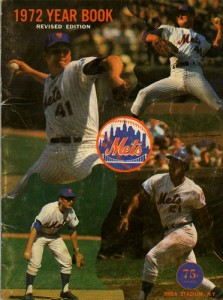
It’s Saturday night, 8 o’clock, the Mets game, unless it’s going 20 innings, is over. What’re ya gonna do now?
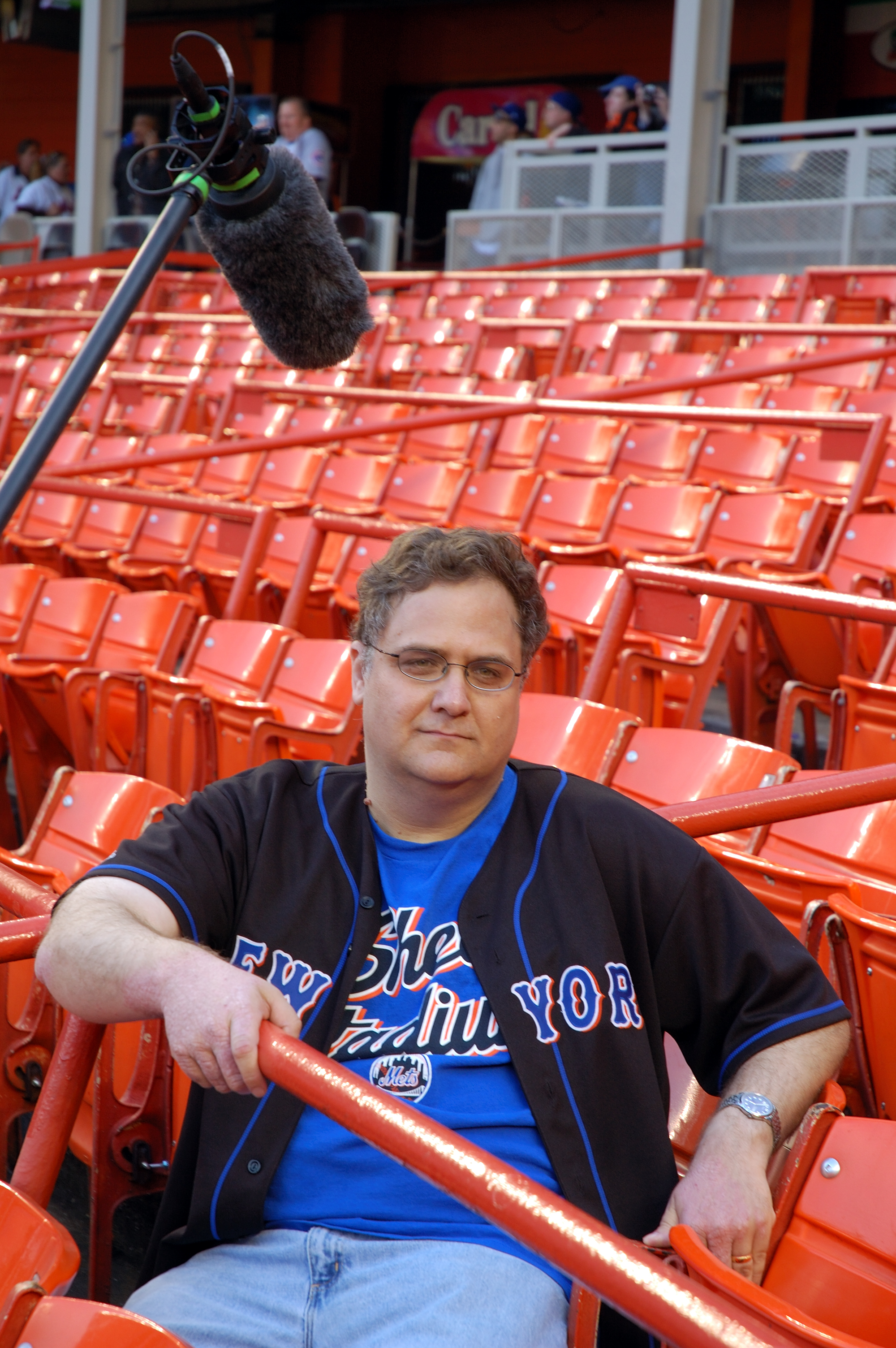
You’re gonna watch Mets Yearbook: 1972 on SNY, of course. Cool down from your Pelf-injected excitement (or cheer up from your Pelf-related depression…just covering the bases here) with a look at the season that started a tad late due to strike, began sadly because of the passing of Gil Hodges but then accelerated with the best 32-game start in team history: 25-7, a six-game lead over the second-place Pirates.
That ended soon enough (accursed injuries), but no doubt this edition of the Yearbook will provide many happy thoughts to chew over, including the Hall of Fame induction of new manager Yogi Berra, the acquisition of slugger Rusty Staub, the homecoming of favorite son Willie Mays, the All-Star selection of Tug McGraw, the stellar rookie campaigns of Jon Matlack (ROTY) and John Milner and a 21-win season from Tom Terrific. Less likely to be mentioned: No Met collected as many as 100 hits, but they weren’t called “highlight films” for nothin’.
Looking ahead, mark Memorial Day, May 31, on your DVRs. Starting at 4:30, SNY will air, in chronological order, all Mets Yearbooks produced to date, culminating in the premiere of Mets Yearbook: 1988 at 9:00 PM. Then stay tuned for the Mets at Padres. Or go to bed. I’m not going to get all up in your business.
Image courtesy of “Mario Mendoza…HOF lock” at Baseball-Fever.
by Jason Fry on 1 May 2010 12:56 am Not so long ago, an off-day for the Mets was secretly a little bit welcome. But that was before Ike Davis rolled away the stone from Citi Field and commanded that the Spirit of 2006 come forth — and be quick about it, dammit. (What’s that? Putting too much pressure on the rookie? Don’t know what you can possibly mean.) Thursday I was antsy because there was no game to play; today I was nervous and excited, trying to will 7:10 p.m. to hurry up and arrive. In my desperation I even wound up watching 15 minutes of WPIX News, an experience dangerously close to being lobotomized.
I think for a lot of us there was a sneaking suspicion that tonight would see an immediate and painful return to cold, hard terra firma. Yes, the Mets were on a roll, but the Cubs are mediocre at best, the Braves played like they’d never seen a baseball before, and the Dodgers have degenerated into a squalid soap opera. The Phillies have had injury problems, but they just stuck a shiv in the Giants to pull out a pretty amazing victory, they were returning home, and, well, they’re the Phillies. How many balls would they launch into that dinky left-field porch, seemingly built to the opposite specifications of the Great Wall of Flushing? How many Met drives would Shane Victorino snag in the gap? Would a Met reliever walk in the winning run? Perhaps an overenthusiastic Met runner would get called out for obstruction? Even without Jimmy Rollins woofing sweet nothings, there’d be Chase Utley to contend with, and the blandly surly Jayson Werth and the foaming-at-the-mouth Greg Dobbs and who knew who else. In recent years the Mets have had to claim, not entirely convincingly, that the Phillies aren’t in their heads; since late 2007 I’ve never tried to claim they aren’t in mine.
One game out of 18 means pitifully little, I know, but this one sure felt different: The Phillies got steamrolled in every aspect of baseball except mascot antics. A shaky second inning aside, Jon Niese was sublime: His strikeout of Placido Polanco was one of the most beautifully unhittable and downright unfair curveballs I’ve ever seen not end a season. There’s something appealingly lunch-bucket about Niese, from his squashed-looking nose and his ungainly grasshopper legs to the way he snaps his catcher’s throw out of the air and turns his head as if annoyed with himself, tramping back to the rubber to give it another try. Meanwhile, Jeff Francoeur was the night’s Indiana Jones, suffering injuries and indignities from chain-link fencing and hurled fastballs and abusive fans and afterwards declaring it all great fun. Francoeur plays baseball like a dog racing after a Frisbee, and even when he’s doing something spectacularly ill-advised you can’t help grinning at the idea that he just might pull it off. And there was David Wright golfing a homer into the shrubbery and Barajas slamming two of his own and Jason Bay somehow plucking Victorino’s two-run triple out of the flowers, among other wonderful things. (Does it surprise anyone else that flowers survive in Citizens Bank Park? I’m faintly amazed Phillies fans don’t incinerate them with lighters.)
April sure looked like the cruelest month in the early going, but it’s ended on a hopeful, downright gleeful note. The Mets are somehow in first place, and playing like they belong there. And to my happy surprise, I find myself eager for May.
by Greg Prince on 30 April 2010 5:05 am Two things of note happened to me this week, taking place in roughly a 24-hour period. I’ll go with the second first.
It was the bottom of the sixth Tuesday night, second game of the doubleheader. My co-shiverers had absorbed all the wind chill they could possibly take and bid me adieu. I was tempted to join them on their walk through the exit, but my train wasn’t going to be immediately accessible and besides, I should be able to outlast two petite ladies on an icy April night, shouldn’t I? Never mind that I tolerate New York winters like the Floridian I was for four years of college. I must be manly, I thought. I must stick out most of the rest of this doubleheader. Do your worst, frostbite!
So we parted company at the bridge and my first instinct, not surprisingly, was to find something steamy to hold for a couple of minutes before fully ingesting it. My best bet from a line-waiting perspective was El Verano Taqueria. I ordered up the carnitas (because I hadn’t eaten nearly enough across 15 innings already) and cooled my cold heels for a couple of minutes while Danny Meyer’s minions made them delicious.
The Mets were leading 6-3 at this point of the nightcap. While the carnitas were being roasted or folded or whatever it is that makes them marvelous, I looked up at the monitor. The bases were full of Mets: Blanco on third, Pagan on second, Castillo on first. Reyes was coming up with one out. He took one ball then slapped a grounder to Dodger shortstop Jamey Carroll. Carroll threw home. Blanco appeared to be a dead duck. As I calculated the situation-to-be — two out but the bases still loaded for Jason Bay — I saw the throw get away from catcher A.J. Ellis. Blanco, suddenly live gazelle instead of dead duck, was safe. It was 7-3 Mets.
Yet it was so much more.
It was the jolt I didn’t realize I was dying for, more than I was dying for warmth, more than I was dying for carnitas. When Blanco slid across the plate successfully, I didn’t think.
I just jumped. I jumped in the air and clapped. Then I did it again. As I was jumping and clapping, I was yelling, something along the lines of “YES!” and “ALL RIGHT!” and, in case the Taqueria cook wasn’t sure, “HE SCORED!”
It wasn’t what I was yelling, it was that I was yelling. Yelling and clapping and jumping. It was instinct. It was Mets fan instinct.
It had been missing for so long that I instantly savored the realization of what had just happened.
The Mets went up 7-3. Big deal. I saw the Mets go up 7-3 last July. Tatis came up as a pinch-hitter in the eighth and hit a grand slam against the Rockies. At the time I stood and I applauded and I exchanged high-fives with my friends, but I felt very little for the moment. I saw the Mets go up 9-5 a few nights later on another eighth-inning grand slam, this time from Pagan. Again, I stood and I applauded and I high-fived. And again I felt very little.
I felt next to nothing for the Mets of 2009 even when they were doing well. Two eighth-inning grand slams during their one flickering stretch of Wild Card contention didn’t do it for me. The first win I saw at Citi Field — Santana outdueling Yovani Gallardo of the Brewers 1-0, Omir Santos executing the throw ’em out portion of a game-ending double play — didn’t do it for me. A 3-2 win over the Marlins at the end of May to finish off a 19-9 month and keep us within a half-game of first didn’t do it for me. I saw 36 games in Citi Field’s inaugural season and the sum total of the unquestionably positive results, 26 wins in all, didn’t do as much for me as Blanco being called safe Tuesday night.
The 2009 Mets went 70-92. They needn’t have bothered with the 70. There was an emptiness to the experience of the entire baseball season that transcended a bad fundamentals team, an injury-wracked roster or an aloof, unfamiliar stadium. I still called myself a Mets fan. I still sought out Mets games and I still loved keeping Mets fan company. I didn’t want the Mets to lose, but I was surprised at how little it truly bothered me if they did.
I was also surprised at how I’d been feeling that way for a while, since some point in 2007. It predated the Collapse. It reached back to June, probably, just after the Mets had peaked at 33-17 on May 29. The Mets fan I was in late May three years ago is a Mets fan I stopped being for a very long time.
That Mets fan was enchanted by the 2006 Mets and the early 2007 Mets. That Mets fan was roughly the same Mets fan he had always been, always putting the Mets above all, never not believing (save maybe for portions of darkest 2003) the Mets could or would win, hardly accepting any single Mets loss easily. Near the end of May 2007, the Mets led the National League East by five full games. They had just won a most dramatic 12-inning showdown with the Giants; Armando Benitez balked home Jose Reyes and then gave up a walkoff home run to Carlos Delgado. The weekend before, the Mets had swept the Marlins in Miami while the Braves were being swept by the Phillies, the preferred outcome then. The whole world was spinning our way, spinning us toward October when we’d reverse the previous autumn’s accidental outcome.
It was all downhill from Delgado’s home run. It was 15 losses in the next 19 games. It was an indifferent summer. It was failure to halt the Phillies’ forward momentum at Shea in June or Citizens Bank in August. It was that seven-game lead with seventeen to play and everything thereafter.
Then it was 2008, and the hangover, and the colorless, offense-free Brian Schneider and the mopey before the concussions Ryan Church and the parade of leftfielders and the endlessly rehabbing Pedro and the 3 A.M. firing of the manager who shouldn’t have been brought back after blowing the seven-game lead with seventeen to play and — zipping past the temporarily uplifting 40-19 spurt that served to get my hopes almost back to where they were in late May of 2007 — the Echo Collapse that brought down another September and a ballpark with it.
Then 2009. Then the first couple of weeks of 2010, culminating in the honest-to-god stupidest 20-inning victory an honest-to-god stupid team ever won. I didn’t want the Mets to lose in St. Louis two Saturday nights ago, but a part of me dared them to try. A part of me thought “good!” when Yadier Molina — Yadier Fucking Molina, for crissake — retied the score in the 19th. I didn’t care if the Mets won games last year and I was off on that same wayward path this year. You can’t hit infielders who are masquerading as pitchers? You don’t deserve to win, not in 20 innings, not in 40 innings.
The Mets fan who thought in those terms needed a DNA test to prove he was the same Mets fan from May of 2007 let alone April of 1985. I mentioned college and Florida before. It just so happens that it was 25 years ago this week that I graduated from the University of South Florida. Big day, right? Do you know what obsessed me as I underwent that rite of passage?
The Mets. They were playing an 18-inning marathon at Shea against the Pirates. With my diploma in my back pocket, I stopped at every pay phone I saw and dialed Sports Phone for updates. They told me it was still tied. They told me Tom Gorman was still pitching. They told me Davey Johnson kept switching John Christensen Clint Hurdle and Rusty Staub between corner outfield positions depending on who was batting and who posed less peril for the 41-year-old Rusty, by then a pinch-hitter deluxe who would never again play the outfield. Davey couldn’t hide Rusty forever, and a Rick Rhoden flare nearly foiled the redhead, but Staub — in literally the last chance of his career — ran and ran and tracked it down for the third out of the top of the 18th. We won in the bottom of the inning.
A day later, I was bound for New York to spend the next five months devoted to the Mets. The summer of ’85 was the summer I’d been waiting my whole life for. The Mets and the Cardinals…the Cardinals and the Mets, back and forth, first and second, day after day after day. I can vividly recall* the Sunday before the All-Star break. Doc shut out the Astros in Houston 1-0 — 11 strikeouts — to raise his record to 13-3. Ronn Reynolds was catching because Gary Carter’s knees were giving him serious trouble; Reynolds scored the only run of the day when Billy Doran threw away a Kelvin Chapman grounder in the eighth. It was our third straight win, twelfth in thirteen games. The only thing that would make it more perfect would be a Cardinal loss. St. Louis was home to San Diego. I took a long walk. At :15 and :45 after the hour, I’d tune my Walkman knockoff to WINS (no ‘FAN yet) for an update. The Padres took a 1-0 lead in the seventh on a Kevin McReynolds RBI single. Yay! But Terry Pendleton homered in the bottom of the seventh to tie it. Boo! Vince Coleman scored what proved to be the winning run in the bottom of the eighth. Damn! Talk about a good walk spoiled.
*My vivid recollection’s half off — not on the details, but on the sequence of events. Cards played in the afternoon, Mets played at night. Hat tip to FAFIF reader Guy Kipp for straightening me out.
Still, it was the Mets in a pennant race, 50-36 at the break, 2½ out, never giving up. Just like me as regarded them. I never gave up in 1985. I never gave up on the Mets after 1985, not for the balance of the ’80s, not throughout the ’90s, not for the first decade of the twenty-first century.
But I hadn’t been that Mets fan from 1985 when 2010 began. I don’t know that I was close to being that Mets fan from 1985 when the last homestand began. I’m not sure I was necessarily rounding into form, either. Then Ike Davis was promoted; Mike Pelfrey was stifling; Jose Reyes was tripling; Johan Santana was unbending; Hisanori Takahashi was a lifesaver; Pagan and Bay and Wright were all recording long and key hits; Davis bombed Shea Bridge; Pelfrey danced through raindrops; Santana was unflappable in a wind storm.
It all began to coalesce, yet it took a simple E-6 to completely unleash the Mets fan within once more. Henry Blanco wasn’t the only one undeniably safe at home Tuesday night. I arrived there, too. I jumped up and down because a Met scored a run; because the Mets increased a lead; because the Mets were in the process of lifting themselves from third place to first place; because, in a way I hadn’t felt in almost three years, I was a Mets fan.
You know what I did when I got home, actual home, Tuesday night? I turned on the Phillies-Giants game on XM. I became the biggest San Francisco Giants fan this side of Christopher Russo. I wasn’t watching the scoreboard. I was living it. I was thrilling to the Mets inching one-half game ahead of Philadelphia. Never mind that our record was a pedestrian 12-9. Never mind that it was no later in the season than the wee hours of April 28, technically the 25th anniversary of my college graduation. The Mets had taken first place. That’s all that mattered.
It’s all that continued to matter during the afternoon of the 28th, with John Maine rediscovering some semblance of his fastball and Jeff Francoeur accidentally poking an RBI double to right and Frankie Rodriguez not losing interest despite being asked to close out a non-save ninth. The Mets had swept the Dodgers and provisionally led the East by one game.
The Phillies began playing the Giants by the time we were done beating L.A. I remembered MLB Network was showing it. I had other things to do, but I kept coming back to the TV. It was that July day in 1985 again, constantly checking out the competition, not wanting to give an inch no matter how much time remained in the season, dying with every archrival hit, being reborn with every run they gave up. It didn’t work out any better on April 28, 2010 than it did on July 14, 1985. The Cardinals won by one run then, the Phillies won by one run now. But we were still in first place and we would be in first place when we started a three-game series at Philly Friday night.
I’ve watched scoreboards thousands of times. I watched scoreboards in 2007 and 2008 and even 2009 a little. I haven’t necessarily waited for a year to turn 22 games old to do it, either. In 1985, I was watching the Cubs relentlessly from Opening Day until the Cardinals emerged as the locus of our concern. I watched the Braves every April in the late ’90s and early ’00s. So what I was doing the other day, worrying about the Phillies on April 28 wasn’t unique to my Mets fan experience.
Maybe that’s why I liked doing it so much. I did it, just as I jumped at the Taqueria the other night, without thinking, because it was what that Mets fan I was when I was 6 and 22 and 43 and all the years in between would do. Ever since jumping for Henry Blanco, I’ve stopped being wary of the Mets. I’ve stopped waiting for something to go wrong. I’ve stopped begrudging them their intervals of competence because I was certain they were setting me up for disappointment.
I’ve stopped being that Mets fan. I’ve resumed being the one I always was.
I like me better this way.
That was the second thing that happened to me this week. The first was the night before this big revelation and transformation, the night the Mets were rained out — which was kind of OK with me because I had other plans. Stephanie and I attended a screening of The Last Play at Shea, the long-awaited documentary that covers the Billy Joel concerts, the Robert Moses-driven rise of Queens, the history of the Mets and the life of Shea Stadium. I had a particular interest in it beyond it being pretty obviously up all my alleys. Before Joel played Shea, a fellow blogger had referred me to one of the producers of the project and he hired me to deliver some research on various aspects of the story the director wanted to tell. That September, the movie folks got in touch again, asking if I’d sit for an on-camera interview the last week of the season.
Um, yeah, I said, I could do that.
Other than a little polishing on one section of the prospective script the following winter, that was the extent of my involvement in The Last Play at Shea. Now and again I’d get curious and do a search, yet not find anything new. I’d heard the film was in post-production, but with the concerts more than a year in the past and Shea down, it wasn’t top of mind. Still, it lingered in the back there somewhere. I’d never had anything to do with a movie before. And as long as a film was en route, it was as if Shea Stadium wasn’t quite gone.
In March I learned from Dana Brand (who sat for an interview the same time I did) that Last Play was coming to to the Tribeca Film Festival. I found out when tickets would go on sale and snapped them up for the Monday night showing as soon as they were available; it premiered Sunday night, but Sunday night I had a ballgame to attend. I had no idea whether the research I did would be evident in the finished product or, for that matter, whether I would. The phrase “cutting room floor” hung heavy in my thoughts.
Good news came Monday afternoon from Dana, who saw it Sunday. Both he and I made the final cut. We were in the same movie with Billy Joel, Paul McCartney, Mike Piazza, Tom Seaver and Keith Hernandez (among many others). I won’t lie: I was excited. Dana told me where I showed up in the film, in the section that described, in the gentlest terms possible, the Collapses of 2007 and 2008.
That was fine. That was even appropriate. Those were touchstone moments in my life as a fan. Not good touchstones, but definitely memorable.
Stephanie and I go to the movie Monday night. It’s fantastic. Great early clips of Joel, amazingly shot concert footage, killer interviews, clever animation, nice intertwining of the various documentary subplots. If I had seen Shea so alive and so vital in 2009, I would have cried. In 2010, it was akin to uncovering home movies you weren’t sure you had seen before. I saw Dana a couple of times on screen: “Dana Brand, Author,” identified like everybody else who had something to say. I applauded when I saw him.
The movie rolls on. The Mets win the World Series in 1986. Billy Joel marries Christie Brinkley. Billy Joel stops recording new material. Shea Stadium is a staging ground for 9/11 rescue and recovery efforts. Mike Piazza hits a home run. Mike Piazza talks about it.
Then I hear my voice. And I see myself on screen. I’m there for, I don’t know, 10, 15 seconds. I’m sitting in orange Field Level seats behind home plate at Shea. I say something about how it would sure be nice if the Mets could win one more World Series here at Shea. I have to confess I wasn’t listening to every word I said because I was waiting to see how I’d be identified on screen.
Greg Prince, Author? Nah, my book hadn’t come out when this was shot.
Greg Prince, Blogger? That would be correct, but at that moment it didn’t look right as I tried to picture it.
Greg Prince, Writer? Broad, but somebody introduced me to somebody else last week as a writer, and I liked how that sounded…very tweedy. But I’m not terribly tweedy in real life.
You know what it ultimately said on screen?
Nothing. I was not identified at all. And by not being identified, it was clear who I was.
Greg Prince, Fan.
 Mets fan, ready for his closeup? (Photo by David G. Whitham) That’s all. I was the fan. I was the Mets fan. Truth be told, the bit they used of me talking about wanting the Mets to win one more World Series at Shea was not an insight. You could have found anybody in the crowd of 54,416 that night to say what I said, or at least what they used of what I said. I said a lot. I answered several questions about Shea — my memories, its deeper meaning — for about ten minutes before the fateful game of September 24, 2008 (the Murphy on third, nobody out, Wright up, score tied ninth inning that can still haunt). But they used what they used and they didn’t see fit to run a graphic to identify me.
They didn’t have to. It was obvious I was the Mets fan. It wasn’t just that I was dressed as a Mets fan — blue Shea Stadium t-shirt, black NEW YORK road jersey. It was my whole demeanor. I looked about as beat up as that stadium did by then. I was going to every game that week, every game that month. I was dying a little every day knowing that Shea was dying for real. I was graying at the temples, perhaps from knowing my place of worship was about to turn to dust. And I was shouldering the cynicism of one eternally corrupted September and another that was about to crumble on impact.
Yet there I was on the screen, seeming quite hopeful, talking about a World Series, letting the camera know without saying it explicitly into my microphone that as down on the Mets as I had been and would be for the indefinite future, I was still a Mets fan. They could tear down Shea Stadium, they could blow another playoff spot, but they couldn’t take that away from me.
At first, I was downcast at not being identified onscreen. Per Mr. Joel’s “Big Man On Mulberry Street,” I wondered what if nobody finds out who I am? Then I got over it. My name showed up in the credits twice, once for the research, once with a raft of people who were thanked for sharing for their memories whether they were used or not (among those sharing but not shown: Rusty Staub). And — oh yeah — I got to be in a movie with Billy Joel and Shea Stadium and a whole lot of Mets and my friend Dana. Not a bad night’s realization for a rainout.
Twenty-four hours later, I was grayer and more tired and still burdened by cynicism while I waited for my carnitas. Henry Blanco scored and I — bundled in a shiny orange Mr. Mets jacket, blue and orange giveaway Mets scarf and black, blue and orange giveaway ski cap — was jumping and clapping and yelling not because I’m an author or a blogger or a writer, but because I am, as whoever edited the film figured out, a Mets fan.
Last play at Shea. First place at Citi. It’s all good.
Flashback Friday: Take Me Out to 34 Ballparks will return next week.
by Jason Fry on 29 April 2010 1:07 am Metsie, Metsie, Metsie!
The amazin’, amazin’, amazin’ Mets capped a 9-1 homestand with yet another dismantling of the surprisingly hapless Dodgers, with good signs blooming all over the ballpark despite a chilly day. There was John Maine, throwing almost all fastballs and racking up swings and misses with them. There was Jason Bay, as hot as he once was cold. There were balls banging off the Great Wall of Flushing (I officially love that nickname) and plumbing the depths out by the Mo Zone and sailing past crestfallen Dodgers. There was an effusive post-home-plate greeting between David Wright and Jose Reyes, all pumping elbows and flying fingers. And there were people cheering in the stands and back here on couches and proud and happy — no, make that giddy — to be Mets fans. Including me. I’d missed that. My God how I’d missed that.
I spent most of the matinee listening on the radio and zipping two rooms over to the TV when something good happened. (Which, happily, meant a lot of zipping around.) But afterwards, the giddiness ebbed and I found myself poor-mouthing my team.
Maine was still really inefficient, and his fastball was stuck in the high 80s. How of much of that was Maine, and how much was a whipping wind and general Dodger suckiness?
Opposing hitters’ BABIP against Pelfrey is .249, which is a textbook example of the concept of unsustainability. Ollie’s still a textbook example of the concept of Ollie. Niese is still a rookie.
We all love Ike Davis — I’m amazed at how he consistently reaches across the plate, catches balls on the end of the bat and proves strong enough to serve them to the outfield — but he’s not a .355 hitter. (Over on Amazin’ Avenue, someone noted that Davis has more hits than Mark Teixeira.) And let’s recall that we all once loved Daniel Murphy with similar fervor.
But then I stopped myself. What was all this? Forget Pelfrey and his BABIP — why was I behaving like a textbook example of a pathologically unhappy Mets fan?
Once in a while, your baseball team gets on a roll and starts leading a charmed life. The Mets right now could drop the toast every morning and have it land not only butter-side up, but neat as a pin on a clean plate the opposing team unaccountably left in the middle of the living-room carpet. Most of the time this lasts for a week or a week and a half — two if you’re really lucky. But while it does, there’s really no point in trying to take its measure through statistics or psychology. It simply is, and the wisest thing to do as a fan is to soak up every single blissful second of it. Don’t poke and prod it, don’t try to outguess it, don’t duck it, don’t poor-mouth it, don’t apologize for it. Just let it be. And until it comes to an end — as it surely will — let yourself strut and dream and say foolish things. Yeah, the baseball gods know hubris, but they also know false modesty. You’re not going to fool them by refusing to gambol in the sunshine because your own forecast called for rain.
Mets/Phillies on Friday. Friday? That’s entirely too far away. I say the Mets bring the bus to Citizens Bank Park first thing in the morning and demand the Phillies play on the off-day. You were flying back from the Coast and you’re tired? Pffft, crybabies. For a bunch of guys wearing maroon, you sure are yellow.
First place is on the line. Bring it!
by Greg Prince on 28 April 2010 3:15 pm  Front Page News! While the Wall Street Journal tries to pump up area newsstand sales and perhaps take down a stolid competitor with the launch of a Greater New York section, which includes the assignment of yet another Mets beat reporter (one who took on the heretofore uncovered subject of how the Mets don’t get their history right at Citi Field weeks after the opening of the Mets museum, misspelling Tommie Agee’s widow’s name and inventing a statue of Jackie Robinson that isn’t there in the process), the New York Bulletin cuts right to the chase by giving the Mets’ Tuesday night sweep of the Dodgers exactly the kind of play it deserves. Kudos to the Bulletin!
While pitching and hitting indeed combined for twin victory, it saddens me to inform you (if you hadn’t figured it out already) that the New York Bulletin, unlike the aforementioned sweep, is fictional. This front page is from the premiere episode of Get Smart, a clip of which was cleverly posted on Remembering Shea this morning. Watch the first couple of minutes for the full context; I particularly enjoyed the score being reported as “99 to 86”. They couldn’t have known in 1965 how much those Mets years would have in common.
Incidentally, on September 18, 1965, the day that first episode of Get Smart aired on NBC, the Mets lost to the Cubs 4-3, dropping their tenth-place record to 47-103, slotting them a mere 42 games behind the league-leading Giants. So much for saying the ’65 Mets missed winning the pennant by that much.
***
EXTRA! EXTRA! The Mets have just completed a series sweep of the Dodgers, a seventh consecutive win, a 9-1 homestand and maintained their grip on first place. I can’t wait to see the Bulletin‘s evening edition.
by Greg Prince on 28 April 2010 2:37 am That was the coldest doubleheader in the history of Citi Field.
Granted, it was the first doubleheader in the history of Citi Field: the first one that required only one admission, the first one that left you doubting whether you’d leave with all the fingers and toes you brought and the first one that led us into first place.
Good god, it was freezing there and good god, it mattered not at all by the time all the chips fell from Tuesday night.
The Mets win.
The Marlins lose.
The Mets win again.
The Phillies lose.
And now your National League East looks exactly like this:
 Those standings don’t reflect temperature, let alone wind chill. Wind chill would be leading the league if it had enough at-bats. As was, 18 innings at Citi Field felt like 18 degrees. And a half-game lead over the Phillies, following our frigid 2-6 start, feels like a week in the Bahamas. Those standings don’t reflect temperature, let alone wind chill. Wind chill would be leading the league if it had enough at-bats. As was, 18 innings at Citi Field felt like 18 degrees. And a half-game lead over the Phillies, following our frigid 2-6 start, feels like a week in the Bahamas.
As if a night in first place all to ourselves isn’t paradise enough.
This is the part where in past years I’d be cringing at acknowledging the current reality. Mentioning you’re in first place is a good way to get karma to bounce your ass right out of first place. Maybe so. But in 2010, when this was all unexpected — remember the hopeless 2-6 Mets from two weeks ago? — a dreamy interlude may be all we get, so let’s slather it on.
Or, conversely, it may be the start of something big. It makes this weekend’s trip to Philadelphia less a certain descent into poor-mannered misery and more a battle for first (Marlins and Nationals notwithstanding). First place in early May doesn’t quite carry the resonance of first place in early October, but the calendar says what the calendar says, and the standings say what they say.
What did the thermometer say Tuesday night? Whatever it said, it was a bald-faced liar. It was colder than that. The wind blew harder than Oliver Perez and he blew…hard. But the Mets persevered in the face of both the elements and the Ollie-ments. Johan Santana mastered nature for the first six innings of the first game, getting control of his pitches after ascertaining and then taming the atmospheric conditions (three walks in a tightrope second, no such things thereafter). Jason Bay unfroze to belt a leadoff homer to high and distant left in the fourth, his first as a Met, though I can’t help but think he should have hit his first home run as a Met around 2004 (thanks Steve Phillips). The Dodgers, like the Cubs and Braves before them, looked dead, but the Mets have been administering lethal injections all homestand, so who’s to say who’s dead and who’s very much alive?
In the second game, Ollie did seem inclined to give back all the good and chilly vibes of a 3-0 lead. Even spotting him the benefit of the doubt for how the ball must have felt like a rock, geez. This is not something you want to go through every fifth day, whatever the climate. Fortunately Hisanori Takahashi (and a little kind umpiring from Angel Campos, surely no relation to Angel Hernandez) righted the listing ship, making with the winning middle relief for the second time since last Friday, and from there, all was Wright with the world. Congratulations to David on your first thousand hits and the end, perhaps, of your stay in the dark forest. Jerry Manuel had said he could see you coming out of it when all anybody else saw was hopelessness. Jerry’s been correct about a few things of that ilk this year, a little ahead of the curve regarding his team’s fortunes.
Could it be Jerry Manuel knows what he’s doing more than we imagined? Could it be Jerry Manuel knows the Mets better than everybody else? We’re in first place, so anything’s possible.
It was a night when you had to think through such burning issues because burning issues gave off the only heat that was to be had outside the private clubs of Citi Field. Did I mention how cold it was? Way up in Section 508 for the first game, it was Arctic. Using whatever parts of our noodles weren’t coated with ice, our hardy band from Row 13 vowed to remain on Field Level for Game Two. Down there, it was Antarctic. There was no escaping the cold. We tried camping out on Shea Bridge for a couple of innings, which proved tolerable in terms of wind until it proved intolerable in terms of screaming, picture-taking idiots. We then slipped by the best security guard at Citi Field, a fellow huddled for warmth and not checking tickets, and sat in one of the myriad empty rows in the outfield. It was still cold, but sitting was looking pretty good by then.
Eventually cold won out over sitting. My companions, hardy as they were, thought a train sounded ideal while their extremities were still attached to the rest of them. Me, I decided to hang in a little longer, returning to the bridge, where the wind had blown away the early-inning idiots. It was a nice and undisturbed view for an inning or two before a large lead and my own train schedule gave me the confidence to get home and get warm. Though I know standing and watching is permitted, I kept expecting a man in a maroon or green jacket to tell me to move it along. But nobody did. Sometimes Citi Field personnel are at their finest when they’re not doing a damn thing.
Sixteen innings spent inside a ballpark (I missed the beginning of Game One due to real life not necessarily sanctioning a suddenly scheduled 4:10 start) will draw you closer to its inner self, and I felt better about Citi Field having endured, me and it together, through the bulk of two games in such dreadful conditions. Listening on the ride in, I heard Howie say he and Wayne were bringing us “a doubleheader from Shea,” then immediately fine himself a dollar. But I got why he reflexively reverted to pre-2009 form. Doubleheaders are what happened at Shea Stadium, if not all that often toward its end (last sweep I enjoyed there: the Ventura Grand Slamathon, 1999). This was new for Citi Field. Made it feel a little more like, dare I say, home.
Alas, there are still the moments when Citi Field feels like the Citi Field I strained to cotton to in its first season. For example, why is my 80% full bottle of water a threat to the physical plant? Why, when we’re playing the Dodgers, are Dodgers jerseys so ostentatiously displayed in the team store (the Mets team store)? Why is a criminal patdown of my receipt necessary seconds after I’ve paid for an item in said store? Why are there peppers all over my sausage when I said to the guy (the guy who gave me all onions when I asked in the past) “mostly onions, please”? Those questions all occurred to me in the ten or so minutes between the security table and approaching Section 508 when I experienced each of those little shots Citi Field still takes at my developing goodwill toward it.
My friend Sharon (whose generosity made my doubleheader attendance possible) and I agreed it’s not because the Mets are malevolent in their guest relations. It’s because they don’t think everything through. At Shea, we were used to it. At Citi Field, sometimes it simply feels like there are nicer things for them to run badly. While Sharon was pleased that the manager at one particular concession made up for the stand’s sluggishness by comping and enhancing her order, she was rightly turned off when a request she made of a ticket operative was met with bureaucratic blankness. She wanted to know if there was any way, since this night was by no means a sellout, to “upgrade” our seats for the second game — apply the cost of the previously bought tickets to a some better, warmer seats; we’d gladly pay the legitimate difference. Sounded like a good chance for the Mets to unload some inventory that was going to go unused for the rest of the evening.
The person at the ticket window on Promenade basically told Sharon to go outside and buy another ticket.
I don’t think that was malevolent on the ticket agent’s part. It’s just that it didn’t compute. Citi Field personnel are still capable of being badly thrown by queries that come out of very short left field. Sharon had earlier this year asked a Mets employee why her four-seat, 15-game plan in Promenade — quite a commitment, I think we’d all agree — doesn’t include some sort of club access.
Because it doesn’t, she was told.
Well, she asked, how about some sort of pass be made available for those who are interested? This did not compute with whoever was charged with handling her call. In fact, it almost caused the entire system to go TILT! In order to reboot, they tried to distract her with a keychain or some similarly shiny trinket.
If I’m running a ballclub, I don’t do that. I think of ways to make all my customers as happy as possible. If it means opening the doors to a club, then I open the doors. Next thing I know, my happy customers are purchasing things. And that, in turn, provides jobs for people who can wear maroon or green jackets and circle receipts immediately after the purchases. That’s what they call a win-win.
Just like the Mets themselves accomplished in this first-ever doubleheader at Citi Field, where you’ll stand in the cold half the night if it means waking up the next morning in first place.
by Jason Fry on 27 April 2010 8:00 am Update: Here’s this story revisited for NPR.
Near the end of winter my neighbor’s younger brother died unexpectedly. Emily and I are friendly with our neighbor, and offered him our condolences. But we don’t really know each other, for all the usual city reasons that you regret on one level but mostly look past while you’re busy being busy.
On Sunday I was walking through the neighborhood when I came across my neighbor rolling a luggage cart piled with stacked bags and boxes. I waved, and he stopped me.
“Just the person I wanted to see,” he said. “You’re a baseball fan, right?”
He’d just finished the unhappy business of cleaning out his brother’s apartment. A lot of stuff had gone to the charity shop, but there were some things he hadn’t wanted to just hand over. He said his brother had been a baseball fan and had kept some things, which he didn’t know what to do with.
 Standing there on the street, my neighbor drew out one of the bags from the stack on the luggage cart and opened it. Inside was a stack of yearbooks. The 1961 Yankees were on top. Farther down in the stack I saw the Jets logo, and then a familiar sight: Tom Seaver smiling behind assembled baseballs. Mets, 1975. Then a Seventies Yankee, swinger’s locks flying, about to crash into a catcher at home plate. Then Mr. Met in a tri-cornered hat. 1976 — I’d had that yearbook, when I was a kid. Standing there on the street, my neighbor drew out one of the bags from the stack on the luggage cart and opened it. Inside was a stack of yearbooks. The 1961 Yankees were on top. Farther down in the stack I saw the Jets logo, and then a familiar sight: Tom Seaver smiling behind assembled baseballs. Mets, 1975. Then a Seventies Yankee, swinger’s locks flying, about to crash into a catcher at home plate. Then Mr. Met in a tri-cornered hat. 1976 — I’d had that yearbook, when I was a kid.
My neighbor explained that he hadn’t wanted to leave the baseball stuff to be thrown out or sold to just anybody. He wasn’t interested in getting money for it, but he did want it to go to someone who would appreciate it. He looked harried, but mostly sad: He knew there were people out there who would love this stuff, but he didn’t know how to find them.
“I can help you with that,” I said.
So later that afternoon I stood in my neighbor’s apartment, looking at a daybed covered with a stack of baseball books and four boxes — his brother’s baseball collection. The books tended toward big volumes celebrating the game’s history — the kind of lavish coffee-table things I’m always tempted by in bookstores. They looked brand-new. A big box held a stack of games by Cadaco, a company I’d never heard of. The games were some variant of Strat-o-Matic, from the late 1960s and mid-1970s. Another box held the yearbooks. And then there were two shoeboxes. My neighbor said those were full of baseball cards, and I could have them if I wanted them.
I told him I’d take the collection and look through it. Some of it might be pretty valuable, I said, adding that I’d set that stuff aside so he could figure out what to do with it. The things that weren’t so valuable I’d find homes for. The books, for instance, would be a great baseball introduction for Joshua, a way for him to quietly read and soak up knowledge and backstory on his time, arming himself with tales of Ty Cobb and Ted Williams and Frank Robinson. That’s how I’d caught up with the adult baseball fans in my life, spending evenings and car rides reading “Strange But True Baseball Stories” and hagiographies of vanished stars and chronicles of long-ago seasons.
We ferried the stuff down to my apartment. I sorted through the baseball books, putting some in the upstairs bookcase and some in Joshua’s room for him to discover. I put the mysterious games in the closet for closer scrutiny some other time. I looked through the yearbooks (they turned out not to be worth as much as I’d thought), pondering who might like them. There wasn’t a yearbook newer than 1980, though there were copies of Street and Smith’s annuals from 1985 and 1986. The newer stuff was pristine, almost as if it hadn’t been read. The older stuff showed its wear — it had been well-kept, but obviously read quite a bit.
And then I turned to the shoeboxes. These weren’t the long white boxes that card collectors use these days, but honest-to-goodness shoeboxes bearing the logos of old brands: Thom McAn and Walk-Over. 9 1/2. They would have fit me, I thought idly.
I opened the first one. There were cards stacked this way and that, and I suddenly remembered something I’d known as a child: Despite their place in Americana, shoeboxes aren’t a great fit for baseball cards, as long rows of cards don’t completely fill up the box, leaving it vulnerable to flexing. This box was tightly and carefully packed, with no wasted space. The second shoebox was the same way, but there was a baseball nestled among the cards. I eased it free and saw a signature on it, one I knew.
BABE RUTH
Wow, I thought. Then realized: No. It was a stamp. Next to the Babe’s signature was a stamp of Hank Aaron’s. The ball was white, but you could feel its age: It had gone hard as stone.
I put the souvenir ball aside and took out stacks of cards, arranging them on my dining-room table. There were hundreds of 1974s, with chevrons top and bottom. The corners were tight and perfect. I realized I wasn’t used to seeing old cards like this, as pristine cardboard rectangles. Mixed in with them were dozens of gaudy 1972s, with their Pop-Art colors and 3-D stars, a handful of 1975s, and ranks of dour, almost-military white 1973s. Then there were lots and lots of silver-gray 1970s, the last Topps cards to bear painterly portraits.
I started sorting the cards, at first idly, then methodically. There were few if any doubles from the 1972s and 1973s and 1975s. For the other two years there were lots — the stacks of doubles quickly topped 50, then 100. My neighbor’s brother had all but cornered the market on 1974 traded cards of Steve Stone, and the cards practically sang with a frustration I recalled: In 1976, the first year I’d collected, I’d been a magnet for traded cards of Mike Anderson.
The 1970s were in good shape, but not collector-quality. A lot of the corners were rounded, and some cards had been written on. Same with the 72s: Many had positions added on the front in pen. The 74s, on the other hand, were marred only by the occasional faintly burred front or discolored back. I remembered what caused those patterns. In a wax pack, the rectangle of dry pink gum was bound against the front of the first card, and adhesive often got on the back of the last card.
My neighbor’s brother had been born eight years before me. Looking over his cards, I did the math. He’d been nine when he collected those 1970s, and 14 when he bought a few 75s. I’d started collecting in 1976, when I was seven, and quit (the first time) in 1981, when I was 12. The ages were different, but the age range was the same. And so was the pattern of wear. I’d played with my 1976s endlessly, and today they’re almost round. My 1981 cards? They were put away basically untouched.
I kept looking for signs of order as I sorted the cards, but there weren’t any. Well, except for one thing: I wasn’t finding star cards or valuable rookies. Until, in the middle of the second box, I came to a 1970 Willie McCovey. Next was a 1972 Willie Mays (with CF added in ballpoint pen). I wasn’t surprised by what followed: Dave Winfields, Nolan Ryans, a Mike Schmidt, Tom Seavers, Joe Morgan, Harmon Killebrews, Pete Rose, Rollie Fingers. At some point (around 1980, by the evidence) my neighbor’s brother had taken down those shoeboxes and searched for stars. I suspect he sold, traded or gave some away — there were fewer valuable cards than chance would dictate, and no 1971s — and then put the rest back, where they sat undisturbed for another 30 years.
And there was one other, much subtler sign of order.
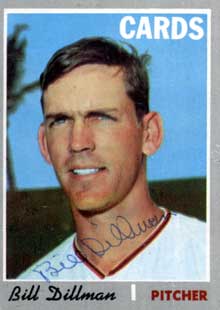
Looking through the 1970s, I found this sequence: Rod Gaspar (Mets), Bob Aspromonte (Braves), Jose Cardenal (Cardinals), Dave Marshall (Giants), Larry Stahl (Padres), Joe Foy (Mets), Sandy Alomar (Angels), Calvin Koonce (Mets), Bill Dillman (Cardinals), Ron Herbel (Padres), Dick Selma (Phillies).
That is not a random grouping: All of those guys were Mets at some point, except Dillman. I looked up Bill Dillman. He was a member of the 1972 Tidewater Tides.
My neighbor’s brother was a Mets fan — and not a casual one, either. He knew Larry Stahl and Ron Herbel had worn blue and orange even if they’d never had Mets cards, and he knew that Bill Dillman hadn’t quite earned a ticket back to the Show as a member of the Mets organization. He’d collected cards for a while, then put them aside, their apparent randomness hiding patterns that the right person would be able to read. Someone who knew not just baseball cards, but also obscure Mets. Someone like me.
Looking at those cards, I knew he’d loved the same team I do, and I could see how his mind had worked. I sorted his cards carefully, separating them into years and doubles. I put aside the small stack of valuable cards for my neighbor to consider. I checked to see if the cards of Mets and guys who’d been Mets were in better shape than my own, swapping mine for his when they were. I put aside the partial sets of 1970s and 1974s I’d reconstructed. And then I sat at the table pondering homes for yearbooks and thinking about baseball fans I knew who would see a packet of random 30-year-old Cardinals or Yankees or Expos as a welcome gift, worth pondering at odd moments or kept to be passed on to someone else who would appreciate them.
I never knew my neighbor’s brother, but I think he would like that.
|
|