The blog for Mets fans
who like to read
ABOUT US

Faith and Fear in Flushing made its debut on Feb. 16, 2005, the brainchild of two longtime friends and lifelong Met fans.
Greg Prince discovered the Mets when he was 6, during the magical summer of 1969. He is a Long Island-based writer, editor and communications consultant. Contact him here.
Jason Fry is a Brooklyn writer whose first memories include his mom leaping up and down cheering for Rusty Staub. Check out his other writing here.
Got something to say? Leave a comment, or email us at faithandfear@gmail.com. (Sorry, but we have no interest in ads, sponsored content or guest posts.)
Need our RSS feed? It's here.
Visit our Facebook page, or drop by the personal pages for Greg and Jason.
Or follow us on Twitter: Here's Greg, and here's Jason.
|
by Greg Prince on 27 December 2009 9:11 pm “He said he would have been happy staying in the Polo Grounds.”
—John Mara on his father Wellington’s reaction to building another new stadium, 2005
I listened to the last quarter the Giants would ever play at Giants Stadium on the radio, before, during and after a shower. The Giants were taking a bath, so there was no need to stay glued to the screen. Besides, there’s something about listening to the Giants as opposed to watching them that appeals to me.
Particularly in the shower.
When I was a kid of 7, 8, 9 years old, the Giants were regularly on the radio on autumn Sundays in our house if they were home. The perfect TV sport was blacked out in each team’s own market by league fiat. Doesn’t matter that every Giants home game was sold out and that the waiting list to buy a Giants season ticket was long and legendary. That was just the rule before 1973. Thus, it was standard operating procedure for my dad to tune into WNEW (1130 AM) for all the action from, if you’ll excuse the expression, Yankee Stadium. He always seemed to be taking a shower just before kickoff, so he and his portable radio would disappear into the bathroom sometime between 12:30 and 1:00 and they’d emerge together as things were getting underway. We’d spend much of the afternoon between 1 and 4 at the kitchen table, the Giants on in the background, him reading the papers or doing some work, me reading whatever papers weren’t spoken for and both of us keeping one ear on the Giants. Half the time the Giants were on the road, so it’s quite likely we watched those games in his and my mother’s bedroom, but the mind’s eye reveals us listening in the kitchen. The blackout rule was itself blacked out when I was 10 and we got a color television when I was 11, but I’m sure Dad would transport the radio out from the bathroom as a matter of course and we continued to listen in the kitchen.
We weren’t listening that closely. The Giants didn’t obsess either one of us. The Giants weren’t good enough to grab my attention the way the Mets (and Knicks) did when I was of impressionable rooting age, and my dad has never been an over-the-top sports fan. As a result, except for pockets of championship-driven fervor, I’ve always followed football like a “normal” person — loyal to my teams, but not life or death. Not like baseball.
Yet I’ve always liked the radio part. That’s where the Giants play, I believe. If you wake me up and ask me to name their frequency, I’ll tell you it’s WNEW-AM, never mind that WNEW-AM hasn’t broadcast anything since 1992. Never mind that Marv Albert hasn’t announced Giants games since 1976. I still semi-expect to hear him giving downs and yards to go alongside Chip Cipolla and Sam Huff. If it’s not them, it’s Jim Gordon and Dick Lynch, who held down the Giant mics from the late ’70s through the early ’90s. It’s not that I’m much of a football fan. I think mostly I like the sound of the Giants coming out of a speaker, at least if there are no Mets around to do the same.
I’ve followed the Giants less and less every year since peaking with them on January 27, 1991, the moment Scott Norwood’s kick wide right won us Super Bowl XXV. That made it two titles in five years, and deep down I probably didn’t feel I could rightly ask for any more out of a franchise that I never saw play a single playoff game until I was nearly 19. It didn’t help that after the Giants edged the Bills, Ray Handley replaced Bill Parcells, the football personnel equivalent of Art Howe supplanting Bobby Valentine (though Art Howe couldn’t have effectively succeeded a misshapen tree stump). My radio sought the Giants out less and less, too, though I noticed in recent years that I still enjoyed flicking on the bathroom radio and taking a shower with the Giants, if you will. I wasn’t hanging on every snap, but I liked hearing them if not exactly listening to them.
Today I was feeling a bit nostalgic about it being the last Giants game at Giants Stadium. I never attended a Giants game there, but I was relieved when it was announced to general shock and dismay around New York that they were moving to New Jersey. I didn’t like the idea that my favorite football team played in Yankee Stadium. Yeah, it was strange that they were putting down roots in the Garden State, but it’s not like I was on that season ticket list. If I happened to be making use of that color set in my parents’ bedroom, it was fine with me that I was looking LIVE at East Rutherford, New Jersey, per Brent Musberger.
Eventually, Phil Who? would become Phil Simms, and Lawrence Taylor would become unstoppable and the heretofore Hackensack Giants would stampede through their swamp to nail down an NFC championship in January 1987. My dad and I, for the only time ever, set up two TVs so we could attempt to watch the first part of the Giants and Redskins while taking in the conclusion of the Broncos and Browns. I think we had Gordon and Lynch on the radio, too.
It seemed unlikely the Giants would pull a Mets this afternoon, closing out a stadium by coming up painfully shy in an effort to make the playoffs against an opponent who had absolutely nothing at stake. It was such a nice day outside. “Mara weather,” the old-time football writers like to say. How could the Giants not win their last game at Giants Stadium in Mara weather? I’m not sure, but they didn’t.
Since they still have one away game remaining, and because they had not yet been mathematically eliminated, the reality wasn’t exactly allegorical to what the Mets experienced in ending Shea’s life on September 28, 2008, but the sensation was close enough. Really, the Giants losing 41-9 to the Carolina Panthers was closer in spirit to the Mets losing 8-1 to the Marlins at the eternally dispiriting finish of 2007 than it was to the wan 4-2 loss that deflated the Shea Goodbye ceremonies a year later.
Either way, it wasn’t worth watching to its bitter conclusion. So I decided to take a shower and close out the Giants’ portion of Giants Stadium the way I experienced so many Giants home games for the past forty seasons…with soap, water and uncommon acoustics. I showered, I dressed, I lingered. I listened to Bob Papa and Carl Banks wax more contemporary than nostalgic. Football isn’t as concerned with looking back as baseball is. Football is all about marking forward progress. The Giants stumbling out the door of Giants Stadium before inching into their next pleasure palace was more an issue for Wild Card positioning — or the lack thereof — than for sentimentality’s sake. I suppose that was the case with the Mets and Marlins the second time, but I’m pretty sure I was sadder that the Mets closed Shea with a playoff-eliminating loss than I was that they missed the playoffs.
Different sports, different values. No way I would have been standing around the bathroom listening to the end of a big Mets game.
Now, improbably, a different team closes out Giants Stadium with something tangible on the line. The Jets, only having recently stopped being the Titans, closed out the original home of the Giants — both Giants…and the Mets — in 1963, but who thinks of the Jets when they think of the Polo Grounds? The Jets have played 26 seasons’ worth of home games at Giants Stadium, but who thinks of the Jets there, either? The Jets never should have left Shea Stadium. Then again, Shea Stadium never should have left Shea Stadium. And fans of several 8-7 and 7-8 AFC teams must be thinking Jim Caldwell never should have taken out Peyton Manning this evening.
However they managed to approach the brink of something besides despair, here’s hoping the Jets, whose weather usually involves a very dark cloud, shine on in East Rutherford next week. I assume my dad will be into it. He drifted from the Giants to the Jets a long time ago.
by Jason Fry on 26 December 2009 11:57 am How was your Christmas? Did you enjoy the latest blue-and-orange gift? Yessir, that was Kelvim Escobar whom you unwrapped. He’s pitched all of five innings since 2007, so please handle him with care. In fact, maybe you’d better put him up on that shelf for a bit. No, that’s the end of the presents. But hey, have you tried this fruitcake? It’s … well, it’s not as bad as you might think.
That was more or less my reaction, and probably yours too. But it’s more of a reaction to the egregious context of being a Mets fan these days than it is a fair criticism of a pretty minor move. Sure, Escobar is a reclamation project. Yes, shoulder problems have trashed the last two years of his career. OK, it’s a major-league deal. But he will only be 33 on Opening Day — not young, but not superannuated like, say, El Duque. He won 18 games back in 2007, before his shoulder betrayed him. His envisioned role is as a setup guy, not a part of the rotation. It’s a low-risk, high-reward move from a team that’s offered too may high-risk, low-reward ones in recent years.
The Mets haven’t had much luck with this kind of thing of late, sure — but they’re not relying on luck to play an enormous role here. So it goes for their other recent moves. Granted, R. A. Dickey isn’t a name to warm hearts around a lukewarm stove, and the list of Mets knuckleballers isn’t exactly distinguished: There’s Dennis Springer, and primeval Amazins’ hurler Bob Moorhead, and that’s about it. (Rich Sauveur fooled around with it, but then Rich Sauveur’s singular career includes just about everything a pitcher could try and just about everywhere he could try it. As well as a very elusive baseball card.) But as Greg has also advised, let R. A. Dickey alone. He’s not ticketed for the rotation either, and he doesn’t have … let’s say “much” to do with Springer or Moorhead.
The Mets’ record with Japanese players isn’t exactly great, from Takashi Kashiwada (coached by Alberto Castillo with the advice “throw that teriyaki ball”) to Ken Takahashi (coached to throw to Raul Ibanez, with tragic results). I know I will be confusing and combining those two’s names forever, while mostly trying to forget the other Japanese imports — I’ll see your Kaz Ishii and raise you Kaz Matsui, with what fond feelings I can muster reserved for Masato Yoshii. (Who was more determined than good anyway.) But we all know it’s only fair to ask Ryota Igarashi to answer for his own performance, not that of anybody else and certainly not those of his countrymen.
Jason Bay and Bengie Molina … now there’s another question. I think Matt Holliday is worth a long-term megadeal while Bay is not — he’s not as good a defender as Holliday (one horrid lowlight aside) and I don’t think he’ll age as well as a hitter. And I want no part of Molina at all — he combines the on-base ability of Jeff Francoeur with the speed of an Aldabra giant tortoise. But whatever I think of the Mets’ priorities there (and whatever I may not know about their budgetary constraints), those moves haven’t been made yet. They may be, or they may not be. And certainly other moves will come — perhaps even ones that we approve of without reservation. Recall that Johan Santana wasn’t confirmed as a 2008 Met until February, and before his arrival, the offseason hadn’t exactly been scintillating: The Mets had made one big move (the still-controversial swap of Lastings Milledge for Brian Schneider and Ryan Church) but otherwise added backup catchers (Gustavo Molina, Raul Casanova) and spaghetti-at-the-wall middle relievers (Brian Stokes, Matt Wise, Ricardo Rincon). Sound familiar?
This isn’t to say that I trust Omar Minaya. I don’t. I think he should have been fired last year, I’m not sure he has a coherent plan now, and I fear he will make desperate moves in an effort to save his job if the Mets get off to a lackluster start, which will only make things worse for whomever succeeds him. But nothing he’s done in the last couple of weeks has made me trust him less. He hasn’t given in to impatience, adding years and/or money in an effort to put the Bay in Beirut or let us watch Molina become even more like molasses. (And do you know how long Aldabran tortoises live?)
These are tough times, and they may get a lot worse. But Decembers and Januarys aren’t like Junes or Julys. There aren’t winning streaks or games to be made up in the standings. You have to wait and let the entire offseason (including spring training) play out to have a sense of what was accomplished. And even then you’re just guessing, waiting for the real show to begin.
by Greg Prince on 24 December 2009 6:29 pm You Gotta Believe we’ll be talking this up more as we move into the new year, but I wanted to alert our little slice of Metsopotamia that one of our most stalwart citizens is in the midst of doing something very special. Sharon Chapman — Inside Pitcher on the BlogHarbor version of us and the lady who takes all those great pictures of her son Ross in the FAFIF t-shirt — will be running in the New York City Marathon next fall, hopefully with confetti still dotting the streets from the Mets’ World Series celebration (one can always dream). That’s admirable in itself, but what makes it a special event is that Sharon will be running as a member of Team McGraw to support the great work of the Tug McGraw Foundation. We lost Tug to a brain tumor almost six years ago, and the Foundation carries on in his name, raising funds for pioneering brain tumor research and increasing public awareness of the disease.
Sharon’s initial fundraising goal is $3,000 and she’s just about halfway there, meaning she’s already passed the magical 45% mark for Tug. Anything FAFIF readers can do to help Sharon sprint past 50% and toward the first of her finish lines will go to help a cause every bit as wonderful as every Mets fan’s favorite Screwball reliever.
Thanks to Sharon for lacing up her running shoes this way and thanks to you all for your consideration.
To learn more and donate about Sharon Chapman’s New York City Marathon mission on behalf of Team McGraw, please visit her fundraising page.
by Greg Prince on 23 December 2009 6:51 pm I know, I know…the Mets are yet again revealing themselves an unserious and possibly inept organization for not (or not yet) signing an impact free agent while instead laying in a supply of R.A. Dickeys for the hard winter ahead. It’s an easy enough charge to level.
Still, can I say something in some combination of the Mets’ and Dickey’s defense?
There’s nothing wrong with signing R.A. Dickey.
Oh, eventually there might be. There might come a time when he knuckles under rather than hunkers down as his most unusual pitch flutters past one of our many backup catchers — or, worse yet, over one of the league’s many outfield fences — but we don’t know that. I don’t know a damn thing about R.A. Dickey other than what I’ve been reading regarding his lack of elbow ligament…which, I admit, doesn’t inspire oodles of confidence…and his inglorious track record. I kind of recall his excelling against the Mets one June night not long ago when Oliver Perez was decidedly doing no such thing against the Mariners. I recall it being considered aberrational (the Dickey part, not the Perez part).
But so what? He’s a minor league signee who will either descend into the land of forgotten relievers or surprise us with his effectiveness. The problem is not R.A. Dickey or Ryota Igarashi or Henry Blanco or Chris Coste. If those are the guys on the cover of the media guide, yes, that’s bad news. But they’re spare parts at the moment, and who honestly cares if we pick up our spare parts before we finalize our engine shopping?
You never know when a spare part will become essential in the short or long term. Rick Reed, Brian Bohanon, Darren Oliver and Omir Santos, to name four, all raised yawns in their time of acquisition. Then they each gave us some big innings and great swings down the road. I don’t know that the unexciting signings of late 2009 will remotely approach the contributions those guys made…but maybe they will. If not, they won’t be here or relied upon forever and a day.
R.A. Dickey isn’t why the Mets didn’t go harder for Jason Marquis or somehow get involved for Javier Vazquez or get around to landing Jason Bay. He’s just R.A. Dickey. He’ll report to St. Lucie before too long, he’ll be the subject of a few “look, it’s a knuckleballer!” stories and we’ll either be glad we got him or practically forget him as soon as we can. It’s not like we traded Bubba Trammell for Donne Wall or, for that matter, Jason Bay for Steve Reed here. It’s a minor league contract. It’s low-risk. It’s simply one of those things.
The Mets need to do more of the bigger things, but until then, get out the oversized mitt and make R.A. Dickey feel at home. What the hell? Consider it in the spirit of the holiday season.
by Greg Prince on 23 December 2009 1:29 pm When Mad Men‘s brilliant third season ended in November, I thought I had seen every compelling thing I could possibly see on 2009 television regarding life as it was lived in 1963 Manhattan. And then last week came Mets Yearbook: 1963, and all I could say was, “Eat your hat, Don Draper.”
It’s not a competition per se, but Mad Men has to take a late back seat as my favorite show of the past year now that SNY’s Mets Yearbook has grabbed the wheel. Five episodes in and it brings new meaning to the phrase Mets classics. It is everything a Mets fan could want out of TV and maybe life. It is, to paraphrase John Adams from 1776, a masterful expression of the Metropolitan mind.
A standing O for SNY is in order — and this from someone who has sat on his hands for a good long while.
Since debuting in March 2006, the channel we reasonably considered “our” channel too often swung weakly and missed consistently, clogging its valuable airwaves with poker shows, boating shows, the most grating of shout shows, news shows plagued by smarmy attitudes and smug anchors, and a glut of mindlessly scheduled filler. The Met Quotient was never as high or as strong as any of us would have calculated had any of us been consulted. True, SNY produced all non-national Met broadcasts, employed the finest announcers imaginable, aired a weekly magazine show, a kids show, an offseason news show, a sprinkling of old games and recent ceremonies, a handful of interview specials, a couple of documentaries as well as breaking coverage of news both bad and good…and yet I can honestly say, without irony, that it was never enough. It never felt like anybody there at the highest precincts of decisionmaking truly lived and died with the ideal of the Mets. The network talked up “all things NY sports,” but came off as tone deaf to its true hardcore audience of Mets fans.
Not the case anymore, not with Mets Yearbook. Watch or rewatch any and all of the five episodes that have run to date and you will conclude there hasn’t been a more extensive and extraordinary representation of New York Met genius since Gary Cohen dined alone.
Just a few highlights from the highlight films of yore:
Mets Yearbook: 1971 — The Winning Way
• The wonders of the Florida Instructional League
• The oncoming curse of Jim Fregosi
• Bud Harrelson, chatting in a not at all stilted manner
• Tom Seaver, setting records
• Banner Day!
Mets Yearbook: 1984 — Don’t Stop Us Now!
• The sweetness of Strawberry Sunday
• The oncoming blessing of Gary Carter
• Baby Doc’s unlimited future
• Shea Stadium, overcome by The Wave
• Banner Day!
Mets Yearbook: 1975 — Meet The Mets
• Dave Kingman, friendliest Met ever
• Mike Vail, budding star
• Joe Frazier, asked if he’s gonna bring more Vails with him
• Dairylea Day
• Banner Day!
Mets Yearbook: 1968 — Year Of The Met Pitcher
• Jerry Koosman’s internal monologue
• Tom Seaver conducting a pitching clinic while wearing No. 38
• Ron Swoboda’s media onslaught
• Bud Harrelson invoking God at a Little League dinner
• Banner Day!
Mets Yearbook: 1963 — Let’s Go, Mets!
• The lady who says all her children are “a Mets fan”
• The gent who adds the Mets have nowhere to go but up
• The Mr. Met bobbleheads sold in the Polo Grounds stands
• Ed Kranepool, world-weary 18-year-old, and Casey Stengel, unstoppable at 73
• Banner Day!
Yes, Banner Day was quite the constant in these things, making one wonder why, for the umpteenth time, why the Mets abandoned what Dick Young (who, before turning evil, was quite a nifty conflict-of-interest script writer) called their “soul promotion” — and we’re not accepting “because there are no more scheduled doubleheaders” as an excuse. I can’t get enough of those placards. I can’t get enough of Old Timers Days and Helmet Days. I can’t get enough of Lindsey Nelson narrating. I can’t get enough of the incidental footage, like how the people filling the box seats looked so different from ’63 to ’68 and again from ’68 to ’71. I can’t get enough of the ballpark advertising, especially the outfield wall of the Polo Grounds where Hebrew National was, in 1963, introducing Delicious STUFFED CABBAGE IN JARS. I can’t get enough of watching the Mets at home in the Polo Grounds and marveling at Shea Stadium being built. I can’t get enough of the innocence and implicit honesty of these films, particularly 1963 when they made losing 111 games somehow sound like brand equity. None of the years above resulted in more than a second-place finish, yet I felt like a champ just for being a Mets fan listening to the Mets tell me how much I meant to them.
The stream of Met consciousness is unbelievable. Doesn’t matter if they’re focusing on Seaver and Stengel or Staiger and Stearns or Singleton and Schiraldi. It’s the Mets video family album. It’s about why we became Mets fans, whenever we became Mets fans, certainly if we hopped on board between 1962 and 1988, the years that Mets Yearbook will eventually cover in twenty-seven Amazin’ chapters.
To whom do we owe this simple pleasure of unearthed treasures and recovered memories? Let’s credit Gary Morgenstern, vice president of programming for SNY. He green-lit the concept and guided its creation, though the better word might be its resuscitation. The content of Mets Yearbook has existed for literally decades. It was Gary, however, who got it on the air. For that I wanted to thank him and pester him for information. He was kind enough to spend about twenty minutes on the phone with me last week to indulge my curiosity.
“These films have been in the Mets’ archives for some years,” Gary began. “It was unclear to us exactly what they had, where they existed and in what format.” The goldmine was struck in the process of moving from Shea to Citi Field. That’s when the film library revealed itself and “we confirmed what they had.”
You mean it took the destruction of Shea Stadium to give us these peeks into the life and times of Shea Stadium? Gary wouldn’t go quite that far, but did acknowledge that the transition “might have sped up the process and moved it forward”. He says a project like this had long been on the SNY radar, “conceptually” speaking: “We were aware there was stuff in the library, that there was a library full of content. We just didn’t know what they had. We imagined it was really compelling.”
That much has been proven. What wasn’t clear to SNY viewers starved for such content is why the network waited one more second than it had to to debut this stuff. Gary explains they had to answer their own questions, including, “How do we get our hands on them? What format are they in? Are they good for TV? It’s taken a little while.”
Of the five that have aired thus far — purposely nonchronological to offer us tastes of different Met eras — SNY had to work with different formats and running times. “They were not created for TV,” Gary notes; indeed, Lindsey, Ralph and Bob used to regularly remind us we could write to the Mets about having one of them shown if we were a civic organization or church group. “Some were 28 minutes long, some were 24 minutes long, some were 33 minutes long.” They needed to be properly formatted for 2009 cable television, edited for commercial breaks and generally spiffed up for broadcast.
The cynic in me wondered if the Mets gave a damn. After all, these are the people who needed a year of haranguing before painting their staircases orange and announcing a Hall of Fame. “The people in the broadcast department were fantastic,” Gary assured me. “They pushed it on us. They were aware of the content in their library and very supportive. They waded through boxes and boxes of tapes. They love seeing this stuff as much as we do.”
The Mets highlight films had taken on a mystical quality during their interminable absence. No fan much over thirty won’t immediately spurt “rain delays” when the subject arises. These were what you watched when the tarp was pulled over the field. Since that ad hoc tradition dried up, sightings were rare. SportsChannel aired the entire oeuvre to commemorate the Mets’ 25th anniversary in 1986, and some memorable clips emerged in An Amazin’ Era, the franchise’s celebratory VHS. The Mets transferred the 1969 production, “Look Who’s No. 1” to tape and handed it out at Shea one Sunday in 1999 (best…giveaway…ever). MSG ran the films from the playoff years to welcome the Mets to their frequency in 2002. Mets Weekly has spliced segments into its program periodically. But mostly…nothing.
Gary admits he had not seen them before Mets Yearbook began coming together, though “there were a couple of films I was aware of” and a general awareness they existed, thanks to their use on Mets Weekly. I have to confess it never occurred to me that anybody connected to airing Mets games wouldn’t have known about the sacred rain delay cache, and it frightened me a bit, but that’s now water under one of the many bridges that connect the Five Boroughs…especially since — hold onto your blue caps — Gary promises we will see Mets Yearbook during rain delays in 2010, even if they are not modern, even if they in no way explicitly promote Citi Field and even though they’re not Beer Money.
“Charming is the right word,” Gary agreed when I threw it at him. “They are so innocent and charming in their own way.” What fascinates him as a television executive is each film goes its own way despite the prevailing logic of today. When he thinks of a highlight film, Gary says, “I think of a game-by-game recap of the season. Our inclination would be to sort of follow a chronological progression of Game One through Game 162.”
Instead, he continues, “you get little bits and pieces and nice little stories, or highlights of a particular player. There is no recapping of the season, but you do get a flavor of that season. It’s really interesting and not necessarily something we would think of doing.”
But how about doing it that way? I asked. How about, given what we all know about 2009’s shortcomings, taking the 1963/1968 tone of “We didn’t win that many games, but baseball sure is fun!” Gary allowed that might work on some level. “As you know,” he says, “there were positives. Maybe by focusing on them and telling those stories, that would be the right approach for a 2009 season in review and even beyond. It’s not the traditional approach these days.”
I bit my tongue and didn’t ask what positives there were, but if I try, I can see a 2009 highlight film that straddles the line between innocence and whitewashing. Give me a few segments: one on Pedro Feliciano breaking his own appearances record; one on the tasty Taqueria; one on Josh Thole’s Gee Whiz! September; one on the ’69 reunion; and one on Omir Santos’s home run off Jonathan Papelbon in Boston — and don’t try to convince me the Mets were merely a couple of MRIs away from legitimate contention. Don’t overwhelm me with phony salutes to sightlines. Make me feel 1971 warm and fuzzy with the material you have at hand without attempting to pull the wool over my eyes regarding 92 losses and poor fundamentals. Use catchy music and don’t cheap out.
And, no disrespect to the admirable Kevin Burkhardt, see if you can resurrect Lindsey Nelson.
OK, tough to imagine a Let’s Go, Mets! treatment translating to today but it might be fun trying. It’s already fun watching the years we’ve seen. It will be more fun when SNY airs its next five Mets Yearbooks, which will be — in an order yet to be determined — 1966, 1972, 1976, 1980 and 1988. Each resulted in a record better than the year before it, though only one, ’88, yielded as much as a division title. Still, I’ll bet there’ll be a golden glow around each of those seasons in those films. Gary says he’s yet to watch the raw material in full, but that we can look forward to “the same array of great unseen before content.”
He couldn’t say when the next five will air, though they will likely be keyed to Spring Training and the beginning of the season. More will be spread out across 2010 and 2011, which means we shouldn’t go hungry for long and we’ll be able to make this treat-laden Met smorgasbord last. At some point, we might see a Mets Yearbook marathon, though none has been scheduled (and no discussions with the Mets or Major League Baseball have occurred regarding a DVD release…though that would surely rock).
Since 1988, the Mets have made exactly four five annual highlight films: 1989*, 1990, 1999, 2000 and 2006. Gary says they’re MLB productions, thus out of SNY’s immediate grasp. Everything between ’62 and ’88 was “work for hire,” meaning the Mets are free to do with them what they want, even if local Knights of Columbus lodges are no longer clamoring to run them during their winter smokers. I mentioned it was a shame the Mets stopped doing these every year. After all, the NFL mandates a highlight film every year from every one of its franchises, even the Detroit Lions. Gary seemed sympathetic, but that’s not his charge.
SNY is, so I did ask about one other topic: Mets Classics. With the recent enshrinement of the “Omir-acle” at Fenway, we have seen, by my count, 43 different old games on SNY. The Mets are an impressive 42-1, with Game One of the 1969 World Series constituting the only loss in rerun history. Not that I’m not grateful for repeated chances to watch Endy Chavez to lay down a squeeze bunt against Colorado in April 2007, but, uh, Gary, what else ya got?
“We’re targeting for this year the ’86 NLCS versus Houston,” he reports, specifically the four Met wins. It occurs to me they were all shown in 2006 when SNY went heavy on 1986 (including the excellent Simply Amazin’ documentary). “Those are truly classic games and we’ll see full versions of those.”
More, I asked. When are we going to see more?
The answer was two-part. Stuff after ’86, such as the thus far buried 2000 NLDS and NLCS triumphs, is coming…eventually. As for old stuff, like say the ’73 postseason, probably not. Not a single full game from either series, versus Cincy or Oakland, exists in the Met library. Generally, Gary informs me, the MLB archives are light on full games from before 1980. Me, I’d settle for a stringing together of videotaped highlights, and Gary says a 1973 documentary is a possibility, though he’d sure like to find a full game telecast.
“We want to get more games into that pool” of Mets Classics, Gary says. “In the first year, we showed the same nine games over and over. Now we’re up above thirty.”
I left the vice president of programming with one final programming suggestion — and it’s not particularly original in that several Mets fans have suggested it to me over the years. How about just showing a Random Mets Game? Just pull one from whenever. It doesn’t have to be “classic” or fraught with historical significance — and it doesn’t have to be a walkoff win. It just has to be a Mets game from quite a while ago. Just put it on without giving away the ending (we’ll take it on faith that it engenders a happy recap).
“We will get to that point,” Gary forecasts. “Every year conjures up a certain era in Met history. If it’s not a ‘classic,’ then it’s a classic in memory.” He says SNY will get its hands on some Mets games whose main appeal is that they are Mets games — 1992, 1995, whenever — and “go more in that direction”.
Do enough of that and it will be a banner day for all of us.
*An incredibly reliable source informs me a 1989 highlight film was produced, correcting my mistaken assumption that the Mets weren’t anxious to publicize the Juan Samuel Era.
by Jason Fry on 22 December 2009 1:00 am From David Waldstein in the New York Times:
In 2002, three years after Valentine urged them to do so, the Mets brought in Satoru Komiyama, a control pitcher they called the Greg Maddux of Japan. Again, their timing was off. By the time the Mets got Komiyama, he was more like the Mike Maddux of Japan.
Based on a statistics sheet from Japan, Steve Phillips, the Mets’ general manager at the time, thought Komiyama was an experienced reliever. But Phillips misread the category Games Finished to mean saves, when it actually referred to complete games. Komiyama went 0-3 with a 5.61 earned run average (and no saves) for the Mets and went home after one year.
Good luck, Ryota Igarashi. All the same, we’d suggest you rent rather than buy.
by Greg Prince on 20 December 2009 3:55 am Apologies in advance if a technical matter temporarily disappears this post. We’re still in the process of switching blog platforms, and I was going to wait on any further posting ’til it’s done, but I wanted to continue to get the word out about the following project…plus snow is falling on Long Island like pop flies on Luis Castillo’s head, and I need to stop staring out the window.
Back when Bob Costas was an up and coming broadcaster whose every other utterance was cheekily charming (as opposed to now, when he comes off as curmudgeonly condescending), he made a characteristically cute remark about wanting to follow the Gideons into hotel rooms so he could place the Elias Baseball Analyst alongside their Bibles in every hotel room in America.
That’s how I feel about The Miracle Has Landed. If I could, I would put this Good Book that details like no other the mitzvahs committed by the 1969 World Champion New York Mets in the hands of every single Mets fan. I can’t, but I can urge every citizen of Metsopotamia to bless himself or herself — as well as a loved one — with a copy. The Miracle Has Landed is undoubtedly the definitive Word on the definitive moment in the Genesis of the modern Mets.
This book is a near-religious experience. I preach its Gospel to the village elders who remember first-hand the Old Testament of Casey Stengel, and I preach its Glory to the Met-aphorical child Who Does Not Know How To Ask. For the wise and mature Mets fan, The Miracle Has Landed offers depth that outdistances even the 410 feet between home plate and deepest center field at the late, lamented Shea Stadium. For the youngster among us who wonders why such a fuss continues to be fomented over a team from forty years ago, The Miracle Has Landed provides an answer that could have been brewed straight from the Maxwell House Haggadah:
It is because of what the almighty Gil Hodges did for us when we left ninth place.
I could continue to get spiritual with you about this book, but better you should know what’s actually in it so you’ll be suitably convinced to secure it.
It has everything.
It has everything you could possibly want to know about the 1969 Mets. It is a most friendly encyclopedia on what stands, still, as the most improbable championship baseball has ever known. It is a library of biography, a repository of history, a stream of curiosities and a stage for eternal drama. It is a parade of perspectives. It is an endless sense of wonder.
It is 1969 come to life and come to stay. Invite it in to your home and to your heart.
Me, I invited Matt Silverman to tell me a little more about it.
The Miracle Has Landed offers not one voice but dozens of full-throated articulations of what made 1969 the incandescent year it remains. The Society for American Baseball Research, under whose auspices the book was produced, had the good sense to seek out an expert conductor to turn the choir into a vocal symphony rather than a cacophony. That would be Matt, an experienced sports author and editor, particularly where the Mets are concerned. SABR asked Matt to put this project together in 2007, and he would spend the next two years of his life devoted to its cause and deadlines. It took a lot of work, but Matt saw a bright side, particularly in the past year. See, while the rest of us were mired in the misery of the disabled and the diminished, Matt got to take frequent side trips to a happier, more miraculous place.
Matt tells me he’d be watching a game last summer, would see the Mets fall behind some random opponent 4-1, feel the deficit widening and adjourn to his office to work on captions or one of the many sidebars he personally contributed. “What a wonderful escape from 2009,” he says.
Any year is a good year to journey back to 1969. “It’s the touchstone,” Matt believes. “It’s the Met moment. It’s when they really became a franchise.” It’s also when The Franchise earned the only World Series ring he’d ever wear. “They really made Tom Seaver’s career,” Matt says. “They made everybody’s career.” After living with them for more than two years, the editor takes a step back and marvels at his subject matter.
“Whenever I look at the ’69 Mets,” Matt says of their statistics, “I still ask, ‘how did this team win?’ Even if pitching is 90% of the game, the Mets didn’t even have enough hitting for the other 10%.”
Seaver would go on to approximate his 1969 performance several times. Nolan Ryan would famously exceed what he accomplished, while Jerry Koosman would later win 20 games twice and Tug McGraw would become one of the game’s top closers. But, to Matt’s point, that’s basically it. “Most of those guys would never have another year like 1969,” Matt notes. Most of them never had a year like it before 1969. For instance, “Art Shamsky had had one great week with the Reds,” recalling his four home runs in four consecutive at-bats in 1966. “Otherwise, he was just good.” Yet Art (a .538 hitter in the inaugural NLCS) and his 1969 Met teammates, together, became immortal.
Matt draws one overarching conclusion for why it all merged so miraculously: “Gil Hodges made all these pieces work. Even when he got Donn Clendenon, he still platooned him with Ed Kranepool, who at that point wasn’t the most reliable player the Mets had except that you knew he’d be on the roster every year.”
They’re all champions now, just as they were all champions then, and you’ll read about each of them in The Miracle Has Landed. You’ll read about everybody who had something to do with 1969, from Seaver the Cy Young and Clendenon the World Series MVP to the bit Mets who exist less in memory than agate type. All 35 men who were 1969 Mets are profiled. That includes Amos Otis, then a young man who failed a couple of tryouts (before being shipped off to stardom in Kansas City in exchange for the doomed Joe Foy); Al Jackson, a 1962 refugee who redeparted as the miracle was finding its footing; Kevin Collins, an ultimately lost component of the pre-’69 Youth of America; and Jessie Hudson, who threw exactly two innings for the Mets in his only major league appearance on September 19, 1969. The bio of Clendenon is spectacularly epic. The bio of Hudson is relatively brief. But all of the biographies are lovingly and carefully crafted.
Silverman’s all-volunteer army of writers came from diverse baseball backgrounds. Some (like yours truly, who contributed two original pieces) were high-voltage Mets fans. Others were baseball historians who recognized a good story when they saw it. A couple came at it from the perspective of not being happy the miracle in question was pulled off. Everybody took the assignment at hand to heart. “The guys hit it pretty well,” Matt agrees, happily adding the writeups “didn’t have that cookie cutter feel.”
In addition to the player bios, there are profiles of Hodges, his coaches, the owner and front office poobahs (even M. Donald Dastardly) and articles/sidebars galore on every aspect of ’69. For example, did you realize that in the midst of widening their September lead over the Cubs and, four days from clinching the first-ever National League East crown, that the Mets were no-hit in the last no-hitter ever thrown at Shea? That the Mets were inundated by rain early in the schedule when they were yet to gel and had to play a boatload of doubleheaders later, when they were perfectly coalesced? That a roll of film from a Seaver start at Wrigley Field — the week after Jimmy Qualls made himself infamous — lay undeveloped for forty years, until it was developed for this book?
You’ll see the pictures. You’ll read the stories. You’ll step out of the path of the black cat so he can go haunt the visitors from Chicago. You’ll find yourself lost in a year like no other. “It’s your team,” Matt says to every Mets fan who harbors any doubts about what made 1969 so incredibly Amazin’. “There will never be another team like it.”
And there may never be another book quite like this.
The Miracle Has Landed is available from Barnes & Noble, Amazon, other online booksellers and New York-area retailers.
by Greg Prince on 16 December 2009 12:06 pm 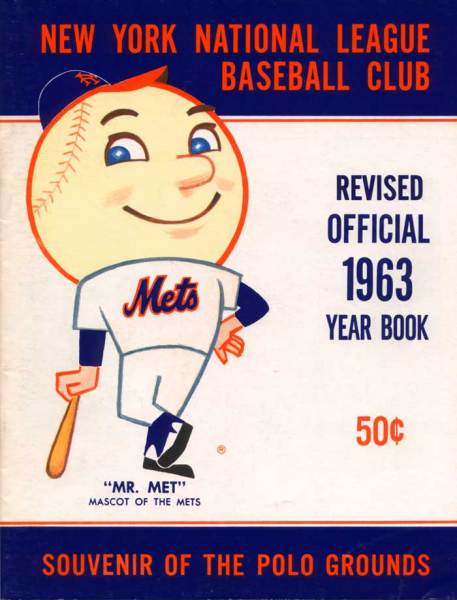
Thursday night (12/17) at 7:30 marks the fifth and oldest to date installment of Mets Yearbook on SNY. It’s 1963 and, based on my previous viewing of this particular highlight film, it promises to be a gem among gems. That’s sayin’ something considering the channel has batted 4-for-4 with a quartet home runs thus far. I hope you saw 1968, which was as trippy as any acid dropped at the Chicago Democratic Convention that August. I hope you’ve seen them all. These are the best half-hours you’ll enjoy all offseason, save perhaps for the impending Ryota Igarashi introductory press conference.
Nah, these are better.
Image courtesy of kcmets.com.
by Greg Prince on 16 December 2009 11:25 am It’s hard enough being a Mets fan these days without inventing apoplexies. Thus, when I read John Harper in the Daily News go tabloid-dramatic and declare December 14 was Black Monday, I rolled my eyes and shrugged at the insipidness of it all.
Tuesday, when Harper’s piece ran, was a worse day for sports journalism than Monday was for the Mets.
Too bad the Phillies have Roy Halladay (though not so bad that they’re stripped of Cliff Lee). And newly Red Socked John Lackey no doubt could have poured us a nice, tall glass of Johan-Aid, which is a drink our notoriously short rotation is thirsting for. But under no realistic scenario were we going to get Roy Halladay, while overextending ourselves for John Lackey would have been a long-term folly. The transactions that landed them in Philadelphia and Boston, respectively, were discrete events. They had nothing to do with the Mets. It was not a Met failing that neither is a Met. Not everybody is potentially a Met.
I suppose it’s progress that our expectations have been raised so high in the last few years that we consider ourselves automatic players for almost every big name, many of whom have successfully draped Mets jerseys over designer suits in front of blue and orange logo walls. There was a time not so long ago when an aggressive Met offseason consisted of lowballing Vladimir Guerrero and scooping up in his stead Karim Garcia and Shane Spencer, a.k.a. the Glimmer Twins.
Not trading for Halladay and not signing Lackey wasn’t that. It just wasn’t. Halladay would have taken a load of prospects (Phillies had to give up a few) as well as a truckful of cash. It didn’t hurt that his new team could come at him from a position of strength. The word on ol’ Roy was he wanted to be near his Suncoast home for Spring Training and not so far from a World Series. The Mets happened to be on the other side of Florida and the wrong end of the recent competitive divide. Geography, standings and finances notwithstanding, who exactly were we going to trade to gain another Cy Young winner? The Phillies could part with Lee and not feel it. We did our prospects ‘n’ paychecks deal two years ago with Johan. It would have been fantastic to have lured another ace since, but I don’t see it as an organizational sin that Halladay didn’t happen for us. It’s Met-opic to believe it was.
Lackey? A real solid No. 2 framed as a No. 1 because he’s the cream of a feeble crop. Did you see what he got from Boston? The $85 million is insane enough, but the five years may be crazier. How many long-term contracts have the Mets given out in which somebody didn’t miss time or noticeably decline? The rationale has been that the Mets needed the help immediately, thus the front-loaded upside was worth the unwanted years at the end. Lackey is 31, not old. Fourth year, fifth year, we’re talking way more mileage and limited tradability based on what he’d be owed.
Perhaps it wouldn’t matter if Lackey was setting the world on fire in the first year or three, but a five-year commitment? At $17 million a year? That’s $17 million every year for five years, an albatross waiting to happen every winter when we’re drooling after other, better, more desirable saviors to fill needs that will loom as equally urgent if not more so.
So Omar didn’t make a Red Sox-sized pitch for Lackey. Y’know what? Good for him. At best he would have driven up Lackey’s asking price and wound up paying it.
It wasn’t Black Monday. It was just another Monday, no matter the perceptions fed by hacks like Harper who toss every dry twig they can gather into the Mets R Dopes narrative machine. Read his article and note the cheap shot he takes toward the end regarding the Mets possibly inviting Kelvim Escobar to Spring Training. Harper the Hack packages this non-development with not getting Halladay and Lackey to form a neat Bad Things Happen To The Dumb Mets In Threes package.
We’re not shy about criticizing the Mets here, either, you may have noticed, but not every good thing that doesn’t happen for them equals a bad thing that they caused. It’s rare that I say this regarding Minaya, Wilpon and the rest of management, but get off their backs.
The Mets are still in need of pitching and a lot of everything else. I thought somebody was talking out the side of a mouth when Jason Bay’s name came up as a Met target last week, but maybe this is a self-fulfilling prophecy coming to fruition. The Red Sox have kissed him goodbye, other suitors are falling by the wayside and the Mets…well, they have to sign somebody. They could do worse than Bay. I suppose they could do better, but in this free agent market, not much. Judging by the offer the Cardinals have reportedly made Matt Holliday — eight years, $128 million — Bay is the most reasonable big bat available. He ain’t perfect, but he’s an upgrade over the incumbent leftfielder who, at present, is nobody.
The Mets’ offer is four years, $65 million. It’ll probably have to be hiked up to five years, which I don’t like either, but I’d rather see five years go to a hitter of Bay’s caliber than a pitcher of Lackey’s. That’s not a knock on Lackey. It’s a knock on pitcher durability. Jason Marquis for three, no more than four years strikes me as a safer investment. Hell, he actually wants to pitch here. I try not to fall for the New Yorker Wants To Come Home storyline, but we could really use his bat.
We’re also still after Bengie Molina. I would give him one year and ask him to change his last name, but I understand it will take at least two and that he’ll still be related to Yadier. Shiver.
The Mets aren’t close to complete for 2010, not anywhere near close. Thankfully, the next Monday that counts is Monday, April 5 — and that’s still sixteen Mondays away.
by Jason Fry on 13 December 2009 12:47 pm If all goes as planned, sometime next week we will be reborn on the WordPress platform.
This should mean very little is different. Those finding us through faithandfearinflushing.com should continue to do so. Ditto for those using our blogharbor address. All our posts are being moved over. At least at first, the design will look very familiar.
The one thing you’ll notice is that existing comments* will no longer be tagged with names — they’ll all be anonymous. This is unfortunate, and in fact stopped us from moving for a long time, but we’re told there’s no way to fix it. I also suspect RSS feeds may need to be tweaked — information when I get it. On the plus side, we will debut with better commenting tools, including the long-requested ability to edit comments. As well as better tools for sharing posts, printing them and more.
Oh, and Matt Holliday promised us if we moved to WordPress he’d sign a below-market deal, including a clause requiring the Mets stop splitting hairs over “obstructed views” vs. “sightlines” vs. “bad seats that shouldn’t have existed in the first place.”
Sorry, just kidding on that last part.
Anyway, within a couple of days the move will be under way, and we’ll close up comments on any new posts, as they won’t migrate over once the move begins. And then we’ll cut the ribbon on the new, familiar place.
Thank you to all of you for reading and commenting, and for putting up with our construction dust.
*To clarify, NEW comments WILL have names; in fact, we plan on doing away with anonymity altogether under the new platform. It’s the ones from the old posts, from before the switchover, that will, because of software restrictions, be unfortunately listed as anonymous.
|
|






