The blog for Mets fans
who like to read
ABOUT US

Faith and Fear in Flushing made its debut on Feb. 16, 2005, the brainchild of two longtime friends and lifelong Met fans.
Greg Prince discovered the Mets when he was 6, during the magical summer of 1969. He is a Long Island-based writer, editor and communications consultant. Contact him here.
Jason Fry is a Brooklyn writer whose first memories include his mom leaping up and down cheering for Rusty Staub. Check out his other writing here.
Got something to say? Leave a comment, or email us at faithandfear@gmail.com. (Sorry, but we have no interest in ads, sponsored content or guest posts.)
Need our RSS feed? It's here.
Visit our Facebook page, or drop by the personal pages for Greg and Jason.
Or follow us on Twitter: Here's Greg, and here's Jason.
|
by Greg Prince on 3 December 2008 7:56 am “Josh. What are you doing?”
“I don't know. What are you doing?”
“Protecting oil companies from litigation. They're our client. They don't lose legal protection because they make a lot of money.”
“I can't believe no one ever wrote a folk song about that.”
—Sam and Josh, “In the Shadow of Two Gunmen,” The West Wing
When my mother wanted to hurl an insult my way, she'd call me an idealist. It came out when I expressed an opinion or conducted an action that didn't fit with her world view. By definition, an idealist isn't practical. The nerve of me, in my late teens and early twenties, for not having it all figured out according to somebody else's standards.
I've never considered myself all that idealistic. In theory maybe. Otherwise, I've just thought what I've thought and done what I've done. Sometimes it appears idealistic. Perhaps from being browbeaten for alleged idealism, I more often instinctively followed the pragmatic road to realism. I'm generally more realistic than idealistic. I try to see the big picture and operate within that framework. I'm not a dreamer. A close friend, concerned by my lack of concrete goals, once fretted that my problem was I didn't have any dreams. The “idealist” charge, wielded as epithet, probably tempered the dreamer in me.
The realist-idealist dynamic came to mind with the ongoing flap over the name of the Mets' new ballpark. Two years ago, when it was announced we would be watching our team play in a structure called Citi Field, I balanced my reflex antipathy toward the sale of such corporate naming rights with my awareness that almost no stadium's identity is not put up for highest bidder. My conclusion was Citi Field was all right:
Listen, I advocated going for top dollar and avoiding utter embarrassment if possible. The Mets seem to have achieved the first part, and while the second part is a matter of taste, Citi Field — albeit a little generic to the point of fictional and rather resonant of a minor league facility in Islip — isn't a total disaster. As Mets fans, we've conditioned ourselves to treat noncalamities as moral victories. Score one for us.
Quite the rallying cry, eh?
Citi Field is already a part of our Met lexicon even though the Home Opener in its corporate confines is a little less than nineteen weeks from now. Even as we've intermittently debated the merits and potentials of our unborn ballpark, we have thrown the Citi name around as a matter of course, just as those who signed on the dotted line had hoped. For two years, it's been “Citi Field this” and “Citi Field that,” whatever the context. The branding was in full swing and, until last month, it probably represented invaluable word-of-mouth advertising. Now…not so much.
When the Mets partnered with Citi in November 2006, it sure looked all good on paper. The Mets were going to get their not inconsiderable sum of $400 million over 20 years while Citi was going to receive whatever benefit companies believe is en route when their names are plastered all over sports facilities. Despite having lived through the mishegas of Enron and other magically disappearing stadia signage, you couldn't ask for a more solid bet than Citigroup in terms of continuity (been around in some form since 1812); locality (two Citi towers in two boroughs in plain sight along the 7 line); fluidity (despite some “rhymes with…” issues, it beat Jason's predicted Federated First Union Bankshares Field, to say nothing of Petco Park); liquidity (big, big company) and image. I don't know that Citi had the best or highest profile, but they didn't have, to the best of my knowledge, an evident Enron problem lurking.
Not a pitch has been thrown at Citi Field, yet hoo-boy, have things changed. The long-term prospects for Citigroup and the Citi name are no better than that of any three Met relievers. Whatever regional cred they had has likely dissolved into the morass of however many of the 52,000 jobs being lost come from the New York area (52,000 — why, that's more people than you could fit inside Citi Field). And as far as image, it's going to take a lot more than $20 billion in cash and $306 billion in assumed assets to bail out Citi's PR.
This is reality. And it's not ideal. Not by a long shot. Not ideal seems to be the going rate for much of reality these days. I am not equipped to explain it or analyze it. Hide under the bed from it is the best I can come up with.
The baseball end of things, admittedly not a patch on the Francesalike fanny of the economic crisis, should be examined within the parameters of its own foul lines, and there it is tempting to see the ideal coming into view if you squint hard enough: Having been visited by the Ghost of Naming Rights Yet to Come, one Wilpon or another snaps awake, realizes what a folly Citi Field is and pastes over those wretched salute-to-Domino's logos with the finest four-letter word this side of Mets…
Shea.
Fat chance, we were told Tuesday, but it's nice to dream, says the man who doesn't much bother with such frivolities.
Ideally, Citigroup; a slew of other gigantic corporations; the regular folks who work for them and are impacted by the lot of them; and the whole darn country aren't in a mess of massive making, either, but let's stick to baseball. It would be ideal if William A. Shea would continue to be honored, seeing as how he is no less responsible for securing us our franchise now than he was in 1964. It really would be better. We wouldn't have to wait for the inevitable next knife to drop. We wouldn't be gritting our teeth and rolling our eyes in anticipation of Citi being called something else down the road. We wouldn't feel so used. We wouldn't be reminded countless times in 2009 not just that corporate naming rights never really feel right but that this corporation's name feels really misplaced in light of what it came to represent in the fall of 2008.
And yet I can't really commit to that seemingly ideal vision, as much as I'd kind of like to join the torch and pitchfork brigade. Perhaps it's because I'm in no mood to align myself with those who have demagogued the Citi-Mets issue. Politicians (surprise!) have done it. Hack columnists and worse have done it, using the bailout as an excuse to dump all sorts of unrelated nonsense on their favorite blue and orange targets. Even those media members for whom I have enormous respect have brushed up against the easy answer of assigning villainy and sticking out tongues. Vile corporate bastards! Venal baseball business! Vengeance be ours! And your bullpen sucks, too!
It's not that simple, it really isn't. It's also not fair to the principals, as unsympathetic as they come off at every turn. Whatever role Citigroup played its own near-demise, the matter of $20 million a year to name the Mets' ballpark for 20 years isn't at the crux of its ills. A $20 million commitment for, say, 2017, has very little (or less) to do with hundreds of billions gone awry. Marketing expenses, whatever you think of the efficacy of ballpark-naming as a business-building exercise, are legitimate expenses. You and I, at our federal government's behest, are literally supporting Citigroup with the idea that they will stay on their feet so as to prevent widespread fiscal calamity. Marketing's a part of that, a part of what every company does. I don't know how you quantify the impact of this kind of sports facility marketing, but there must be a little something to it since so many companies have invested in it and so many franchises continue to jump on board.
I'd redirect the $20 million due the Mets for 2009 to save 52,000 jobs if it worked that way. I don't get the sense that it does. Among other moves, Citigroup is selling its German unit and is cutting back on investment banking (another big surprise). “Don't sponsor the ballpark” is not going to reverse those kinds of presumably necessary strategic decisions or bring those particular jobs back. Citigroup's annual operating costs are supposed to be reduced — reduced — to $50 billion after all its cuts. If we were to have them not pay the Mets for Citi Field next year, then it would be $49.980 billion. A couple of business writers have used the rather cavalier term “a drop in the bucket” to describe the company's baseball obligation. Easy to drop that in a bucket if you've got it, which I'm guessing nobody reading this does on his or her person. But $20 million is 0.0004% 0.004% of $50 billion. A drop in the bucket?
Yeah, basically.
Twenty million dollars in the eyes of the Mets, on the other hand, is not a drop in the bucket. That's a Cy Young winner on the mound, or at least the money freed up to pay one because the debt service on the ballpark has a going source of cash. The Mets are counting on that $20 million. The Mets and Citigroup have a deal.
Is it ironclad? I haven't seen the contract and I'm not a lawyer, so how the hell should I know? But why the hell would the Mets not want to get paid? They've set up their whole business model in order to get paid. Sometimes the intersection of the Mets and money is plainly obnoxious, and as fans we feel it directly (which will feel like a discretionary drop in the bucket once all these bailouts come due), but can you blame the Mets for not wanting to rip up the Citi Field contract? If somebody said I'd be getting an enormous sum of money in return for promotional considerations, I'd want the money. We all would.
This is not the moment in time when you want to be promoting a ballpark named Citi Field, that's for sure. The Mets will have to decide (if market forces don't do it for them) whether it will always be the wrong moment for promoting a ballpark with that name. The First National City Bank of New York, Citigroup's progenitor, dates to 1812. They weren't supposed to be Enron or any of the other now-ya-see-'em/now-ya-don't propositions that got into stadia and arenas. They were supposed to be solid. Nearly two centuries of brand equity and marketplace goodwill was supposed to have legs.
Might all the brand equity and all the goodwill have gone the way of those 52,000 jobs? Could be. Could very well be. At this moment in time, it ain't there. But is that the forever answer? Forever is a long time. Is this a passing public relations storm or a low-hanging, unpuffy, uncumulus cloud that will never lift?
I don't know. No one does. Apparently the Mets don't think so, or don't want to think so. If it were a one-year deal, I imagine some smart lawyer would have undone this pact. It's for 20 years with a 200-year-old enterprise. The principals, particularly the Mets — the principal with everything to lose in flying the Citi banner — are banking (if you will) on the long term being more forgiving that it would appear presently. Should Citi become less a sponsor than a stain on the Mets brand, one imagines a squadron of skilled attorneys will be dispatched to deCitify every sign in sight.
Given that we have sadly passed the age when we name no more than a showy rotunda for a great human being, an extrication from Citigroup would merely open the gates to another alliance with another corporation. The most relevant commentary I've read regarding the Mets' position comes from Darren Rovell of CNBC, who wrote, in the wake of the bailout, “No other company, in this environment, would give them $20 million a year. I don't even think they could get $12 million at this point, to be frank.” Twelve-mil is better than no-mil from a financial (if not spiritual) standpoint, but it's not in the same ballpark as twenty-mil. The contract calls for twenty-mil. If the Mets are willing to withstand the current undeniably lousy publicity, then they stand to collect.
It's a screwed-up triangle among the Mets, Citi and the taxpayers, to be certain; not a few teams find themselves under the TARP of this kind of awkward three-way arrangement. Taxpayers are bailing out to one extent or another the rights holders of Chase Field, PNC Park and Comerica Park. Not a lot of hands are clean, not even at pristinely dubbed Yankee Stadium (major corporate partner on deck: TARPed up Bank of America). Leave it to the Mets to become the quick and convenient symbol for all that's wrong in this realm.
(Of course it might be helpful to their cause if ownership would refrain from offering baffling soundbites like, “It's not really Citi's fault they're in this problem,” when it's clear 52,000 jobs didn't mysteriously eliminate themselves by some random act of mondo attrition.)
Maybe this is the weapons of mass distraction shooting irrelevancies at their deadliest, but if the money's flying around in unconscionable sums and it's going to land at the turnstiles of privately held baseball clubs, well, damn it, let my baseball club get the share it signed for, and let them remain competitive. Playing in a park named for a bank, as has been amply demonstrated at the confluence of the Allegheny and Monongahela rivers, is no foolproof recipe for on-field success. But that's Pittsburgh. This is New York. These are the Mets. We've seen them fall achingly short with a big payroll. We've seen them come not remotely close with a lesser one. There won't be enough seats and the prices will be too high for those there are in that vanity plate of a venue rising in what used to be the parking lot, but from wherever I follow them as long as Citi Field stands, I'm going to want its team-in-residence to play well and contend. Taxpayers were stuck with the bill for the previous stadium as a matter of course. We get stuck again for some unforeseen aspect of the coming attraction?
So what else is new?
They held another media tour of Citi Field Tuesday, the first since the grass was planted. It's shaping up as a very pretty park from the pictures I've seen. Staring at them and reading all about it whets my appetite for baseball and certainly stokes my curiosity. I'm convinced it will be fresher than its predecessor; it can't help but run smoother. I'm not convinced that will make it extraordinary, which is what I want it to be versus what else has been built, but that's something that cannot be judged without some innings shared between me and it. Right now, frankly, the photographs sadden me more than they excite me. It looks like some place from somewhere else. It doesn't look like where the Mets play, at least not as I've always understood it. Perhaps the Mets need to actually play there to rectify that particular perceived liability.
It would be ideal if Citi Field lives up to its overwrought World-Class billing and feels like home immediately. But like I said, I don't get too terribly hung up on what's ideal versus what's really going on.
ADDENDUM
Good and comprehensive article (minus the demagoguery) on Mets-Citi by Richard Sandomir in Thursday's Times here.
by Greg Prince on 28 November 2008 5:22 pm Since arriving in the middle of October, my authentic Shea Stadium outfield wall brick and I have had a running dialogue. Not necessarily the most scintillating of conversations. It can be like talking to a fraction of a brick wall.
My brick calls me Mack, as in “Hey Mack…” He hasn't bothered to learn my name but he reminds me at every turn that he's a union brick, Brick Local 1. Brags that Donn Clendenon once tattooed him with a double that was smacked off a Milt Pappas pitch, “and I didn't flinch, Mack. Never missed a game.” Still wears a dab of mortar from when he was original laid — which he says with a straight face, what with his being a brick and all. Asks if the shelf where he sits is in fair territory, that he used to be in fair territory before they changed the dimensions of Shea on him. I have to explain that there's no fair or foul territory in my living room, that he's not in a ballpark anymore.
This gets my brick riled up because as he never tires of pointing out, “I ain't a ballpark brick, Mack. I'm a stadium brick. I built Shea Stadium. We're a multipurpose stadium, ya got that?” Then he asks when the hell football season starts and is that expletive Richard Todd gonna be benched or what?
He's a brick that's been sitting behind a reconfigured outfield fence since around 1980. He's missed a few memos. He's missing more than that lately.
“Listen, Mack,” he said the other day. “It's all well 'n' good that my shop steward got me transferred me up here to the whaddaya call Diamond Chew Suites.”
“Diamond View,” I corrected him, gently.
“Yeah, whatever. Thing is, it's cushy as hell, but I'm bored with it. It's a no-show job and I'm a friggin' stadium brick. Now ya wanna get me back on the wall where I belong? Kickoff's gotta be comin' soon.”
I had to break it to him that there's no more football at Shea Stadium.
“Then battin' practice, Mack. Battin' practice. Ya wanna see where Henry Aaron himself got me in BP one night?”
There's not going to be any batting practice anymore. There's no more baseball at Shea Stadium.
“Mack, you gone soft in the head? No baseball at Shea Stadium? We can't host Jehovah's Witnesses and Jethro Tull every night. Listen, Mack, the Jets were just a few Sundays every fall — to tell ya the truth, I thought they were playin' awfully quiet lately. But the Mets? Where the hell are the Mets? They didn't move to California or nothin', did they?”
No, I told the brick. The Mets are still in New York. They're almost right where they've been since 1964. It's just that you're not.
“Mack, you ain't talkin' sense. I'm a stadium brick, a Shea Stadium brick. They could move back the fence, they could cover me up, they could make a horrible racket with that “clap your hands” bit every two minutes, but they can't have a stadium without us bricks. Say, come to think of it, where are all the other bricks?”
I was dreading this, but the brick deserved to know the truth about what happened to Shea Stadium. So I told him. I told him about Citi Field.
“Citi what?”
Citi Field, I said. The new World Class Home of the New York Mets.
“Never heard of it, Mack. Never heard of it.”
You didn't notice the construction behind you these last couple of years?
“I just thought it was more of that DiamondPigeon crap they're always blastin'. I never listen to any of that. How does anybody think straight anymore?”
DiamondVision, I said. It was called DiamondVision. And I don't know how anybody thought straight, but it wasn't that. It was a new ballpark.
“What do we need that for? We got a stadium. We got Shea Stadium.”
Not anymore, we don't, I said.
My brick wasn't having it. “Look, Mack, you're a nice guy and all, but you don't know the way things work around here. I'm gonna talk to my shop steward.”
You don't have a shop steward anymore, I told him.
“Well, I'm gonna get in touch with somebody at the home office.”
What home office? I asked
“Listen, Mack, I got friends. I ain't just some dumb brick. Thomas Crimmins put me on this job.”
The construction company that built Shea?
“You got it, Mack. Crimmins. And Carlin.”
P.J. Carlin, the other company that was involved in the building?
“Yeah, and not only that, Mack, I got a cousin who's got an in with Praeger-Kavanaugh-Waterbury.”
The architects who designed Shea?
“You bet your ass, Mack. My cousin's a brick at their headquarters. I know people.”
I had to tell my brick that I wasn't sure if any of those companies was still in business.
“Lemme tell ya somethin', Mack. I got seniority. I been on the job since '63. I got layed before Christmas. If necessary, I'll take this to Mr. Shea.”
You're not going to find Mr. Shea, I told my brick.
“Mack, what are you talkin' about? Mr. Shea is a big man around here. This is Shea Stadium we're talkin' about.”
I wasn't getting through to the brick by dancing around the issue, so I had to explain the whole thing, not just what Citi Field was but that there wasn't a Shea Stadium anymore.
“Mack, yer talkin' crazy. Shea Stadium is…it's Shea Stadium! It's huge! It's multipurpose! It's exactly what ya need in this day and age.”
I had to elaborate that in this day and age, it's been judged that you don't need something huge, that you don't need something multipurpose, that you don't need Shea Stadium.
“Seriously, Mack. Get Mr. Shea on the phone. I don't have time for this pussyfootin' around. I got BP. I gotta brace for Dave Kingman. He's a mope, but he can hit, boy.”
So, once again, I took it very slowly. I went through the list of ballparks…stadiums that had been knocked down in the last twenty years, how this was what they call a trend in the industry, how the Mets decided they wanted to be a part of this trend, how they spent many years and lots of money putting together a deal that would build a new ballpark in the parking lot…at which point my brick started laughing.
“The parkin' lot? That's a hot one, Mack! Where's everybody gonna park their cars?”
I kind of skirted that issue and explained that it was very important to the Mets ownership to have a new ballpark since almost everybody else in baseball had one and that they didn't want Shea Stadium anymore.
“Listen, Mack, you got a future on Johnny Carson maybe, but seriously, I gotta get back to work. There's a game tonight.”
There's no game tonight.
“There's always a game tonight. Get me back to the wall. You want me on that wall. You need me on that wall.”
There's no wall.
“So where the hell am I?”
You're in my living room, I said. When they started taking Shea apart, I made a point of asking for a brick from the outfield wall. I gave the Mets some money and they sent me you.
“This guy,” he said as if to somebody else. “What a card. Ya wanted a brick? Ya buildin' yer own 'ballpark'?”
No, I said. I just wanted something from Shea Stadium.
“Hey Mack, why don't ya just do like everybody else and go to the game and buy a scorecard? Gotta be cheaper than sendin' away for a brick.”
I went to the game, I said. I went to lots of games. There aren't any more games to go to at Shea Stadium.
“Oh, right. They're buildin'…what's it called?”
Citi Field.
“Well, why don't ya be a pal an' go get me Mr. Citi on the blower, an' I'll ask if I can be in your and his imaginary ballpark.”
There's no Mr. Citi, I said.
“There ain't?”
No, I said, there isn't.
“Well, I know there's a Mr. Shea. Mr. Shea saw to it that New York got the Mets. Mr. Shea saw to it that there'd be Shea Stadium. If there ain't no Mr. Citi, who's namin' a 'ballpark' after him?”
They don't name ballparks for people anymore, I said. They name them for companies.
“Is it a baseball company?”
No, Citi is not a baseball company. It's a bank.
“I see. A bank. Gotta be a pretty big bank that it's got a stadium inside it.”
It doesn't work quite that way, I said, but yes, Citi is a pretty big bank. More or less.
“Whaddaya mean, 'more or less,' Mack? Speak English.”
I tried to explain as best as I understood it the whole Citigroup situation, how they agreed to pay $400 million over twenty years to call the ballpark Citi Field. Then, after my brick stopped laughing hysterically, I went into their various woes, how they had to eliminate personnel, how the government is bailing them out with $20 billion in cash and by assuming more than $300 billion in toxic assets, though I have to confess I barely understood what I was talking about.
“Mack, that's a lotta samolians. Too much for me to wrap my brick brain around.”
Me too, I said. Me too.
“And when you say 'the government,' that means taxpayers, I'll bet.”
Yeah, I said.
“Whoa, Mack! That's gotta make this Citi a pretty unpopular character right now.”
Probably, I said.
“So if I'm hearin' you right, this Citi's got a lotta problems.”
Yeah, I said. I guess they do.
“Then how is it they still got a 'ballpark' in the parkin' lot like you say?”
Well, I told my brick, it's complicated.
“Accordin' to you, Mack, I got nowhere to go. Gimme the skinny.”
The complicated part, I said, is that the Mets and Citi signed this deal for the ballpark name on the assumption that Citi will be around a long time…
“And they're gonna put a bank on the field?”
Not exactly, I said. It's more of a marketing thing. Companies like their names on ballparks and arenas.
“Don't they have 'em on banks no more?”
The idea, I said, is people who come to the ballparks will be more aware of the banks because they'll go to the ballpark or watch the games and hear the name.
“Ain't that what they got names on banks for?”
It's complicated, I said.
“Sounds like a company that ain't got its books in order ain't gonna be able to pay no $400 million for no 'ballpark'.”
You'd think not, I said, but it's complicated.
“Mack, I'm a brick, and I get that you can't be buyin' no fancy brickyard when ya got Uncle Sam to be yer business partner.”
Well, I continued, they're a big company, and it's a long-term deal, and marketing expenses are different from the various financial obligations that have entangled Citi. But my brick wasn't having any of it.
“Mack, lemme ask you a question. Why would the Mets want this name in the parkin' lot or on the stadium or whatever you say it's gonna be if they're a buncha moochers with everybody else's money?”
Again mentioning the complication factor, I said Citi has been around a long time and the idea is it will still be around a long time, that this current problem, as deep and serious as it is, isn't necessarily fatal to their brand or their business.
“Mack, I lost track of all the billions you say they're in the hole for, but I'd think — and mind you, I'm just a stupid brick from a stadium that you tell me ain't open for BP tonight — that's not the best sign.”
You could be right, I told my brick. But the Mets have a contract…
“A contract? Is it a union contract?”
No, I said. Not a union contract.
“Well,” my brick said. “I'm a union brick, Brick Local 1, and I know ya don't mess with the union. But otherwise, I'd think yer muckety-mucks have ways of gettin' outta contracts. The Mets trade players under contract all the time, don't they?”
Yes, I said. They do. But this may be more complicated.
“Mack, yer talkin' gibberish. Ya keep sayin' it's complicated, but I keep hearin' Citi's got no scratch, needed a big-time handout and now they want their name plastered all over this thing that between you 'n' me I still say yer pullin' my leg over. If I say that yer tellin' me the truth, that there is a new stadium or 'ballpark' or whatever, you gotta be tellin' me that it's not gonna be called Citi Field if Citi is the kinda operation you been describin'.”
It's complicated, I reiterated.
“Yeah, complicated. Very complicated. Ya know what wasn't complicated, Mack? It wasn't complicated that Mr. Shea got us a ballclub and got us this stadium and Hizzoner Mayor Wagner said we gotta do somethin' for this great man who made sure we'd have National League baseball. So they named the stadium for him. They named it Shea Stadium. That's what ya do, see? Ya build a stadium, ya name the stadium for somebody who deserves it and ya play in the stadium. That's what I say. But I'm just a dumb brick.”
No, I said. You're a very smart brick.
“Yeah, smart brick. If I'm so smart, where's my wall? Where's my outfield? Is this fair territory? When's BP? If I'm supposed to believe you, I'm out of a job and there's gonna be a Citi Field in the parkin' lot.”
Well, the name could change because Citi's name could change. It's been known to happen.
“But you said it's a big company. Why would a big company change its name?”
Sometimes these things happen. Some other company might take over Citi. And if they change the name, then the name on the ballpark would change. It happens a lot, actually.
“Somebody's gonna want a piece of this outfit that can't keep its books straight, that's got Mr. and Mrs. Taxpayer on the hook for 300 very, very large, and that company's gonna get to have its name on the new stadium?”
It's complicated, but yeah, something like that.
“This guy…” my brick said of me. “Yer a scream, Mack. Ya almost had me goin' there. The Mets are gonna play in another place, in the parkin' lot, named for a company that can't pay its bills or keep its workers employed, because the company's gonna pay them for the honor even though it's essentially on the dole. But then the company might not exist — which is what you say Shea Stadium does not anymore, even though I know for a fact they played a whole schedule there every year for a very long time and it was perfectly all right, or at least perfectly all right enough so somebody didn't have to slip somebody 300 billion big ones for some new joint.”
Uh-huh.
“Ya keep tellin' me these stories, Mack, and I might stick around. Hey, I ever tell ya about the time Clendenon clanked a double off me?”
by Greg Prince on 26 November 2008 9:55 pm In the platinum cheap seats, the mood was indeed one of good-natured dislike rather than holy war hatred; bonus points to the Mets fan who intermittently waved a sign referring to their Mr. Damon as JOHNNYCAKES.
—”The Cool of the Evening,” May 22, 2006
One of the things my friend Charlie Hangley says he'll remember about Shea is the way I would walk toward his perch in the Upper Deck on Saturdays and give him “the Sopranos greeting: 'Ho! Dere he is!'” before launching into my tirade of the week. I remember it fondly, too, even if I'm fairly certain I never, ever used that exact phrase. But because I like Charlie's version better than whatever it was I actually might have said (I used to think the ideal fantasy camp would be held not in St. Lucie but at Satriale's, and all the campers would spend a week immersed in This Thing Of Ours), I feel compelled to pass the following along.
Tuesday night Stephanie and I went to do our weekly grocery shopping at our nearby King Kullen. I stopped in the recycling area to crush my soda bottles and receive a voucher for my deposits when I noticed a guy who looked a great deal like Vito from The Sopranos out in front smoking a cigarette. This being Long Island, we have our share of men who look a great deal like Vito from The Sopranos, so I didn't think much of it.
Until we were inside the store and I saw that it was, in fact, the guy who played Vito from The Sopranos. He was peddling his pasta sauce — though I've been led to believe the proper term is gravy — and Bada Bing bric-a-brac to not exactly a turnaway crowd in the appetizing/produce section. He was at a table underneath a sign urging one and all to meet Vito from The Sopranos. One customer was schmoozing him as we shopped in the general vicinity.
You can't think you saw the guy who played Vito from The Sopranos and not acknowledge him when he turns out to be who you thought you saw, especially when the one customer schmoozing him has left and the guy who played Vito from The Sopranos is up and restless, examining the cheese & cracker platters and other appetizing delicacies. Hence, before we took off for detergents, air fresheners and the other wonders of Aisle 2, I made my move.
“Hi,” I said. “I just wanted to say we really enjoy your work.”
“Thank you, brother,” the guy who played Vito from The Sopranos said, shaking my hand well but not so hard as to strangle it. “I really appreciate it.”
After the slightest of pauses, he continued.
“Would you be interested in some sauce?”
I really wasn't. I tried to pass the buck to Stephanie, as in, “Are we interested in some sauce?” but that wasn't going to work. Stephanie's too nice to play bad cop.
“It comes with an autographed picture,” the guy who played Vito from The Sopranos added.
I didn't really want an autographed picture either. I wasn't averse to having one, but it wasn't on our shopping list. Even still, I realized right away that you really can't engage the guy who played Vito from The Sopranos and leave him hanging. So Stephanie pointed to one of the jars of sauce, the Sunday Sauce as opposed to the Roasted Garlic & Eggplant (which would likely not agree with me), and the guy who played Vito from The Sopranos handed it to her. He was careful to note he was a chef before he was an actor, so we could be confident that this wasn't just a case of some TV schlub making a few bucks off his fairly famous face.
With the jar handed over, the guy who played Vito from The Sopranos peeled a picture — one of Vito, Tony and Christopher — off a stack and prepared to make good on the rest of the bargain. I asked the inscription be made out to both of us, and if we ever open a diner, you know what we'll be hanging behind the cash register.
The guy who played Vito from The Sopranos seemed grateful for the sale (at $6.99 per 32-ounce jar, so would I). He shook hands with Stephanie, then me again, and we wished Mr. Joe Gannascoli a very happy Thanksgiving.
Not incidentally, the same to all of you.
Speaking of great television drama, look to SNY for a marathon of most gripping Subway Series action Thursday afternoon: Dave Mlicki at 1:00, Matt Franco at 4:00, Dae-Sung Koo at 7:00. Don't know about the guy who played him, but Vito probably didn't enjoy any of those if you recall the episode in which he offered Finn something more than a jar of sauce.
by Greg Prince on 25 November 2008 10:27 pm There are supposed to be 162 games every season. Since 1962, the Mets have failed to play at least that many to a conclusive result in eleven different campaigns. A total of 132 were lost to labor stoppages in 1972, 1981, 1994 and 1995. Eleven more were forever rained out or cancelled by whatever means necessary: two apiece in 1962 (imagine the N.L. not forcing the Mets and Colt .45s into a replay of a 7-7 rain-shortened tie) and 1988 (ever wonder why the Mets took a legendary ten of eleven from the Dodgers as opposed to eleven of twelve?); one each in 1966, 1973 (we clinched in the 161st game the day after the season was supposed to end — so much for the planned doubleheader), 1991 (Olympic Stadium was falling down), 2002 and 2003 (a confluence of the August blackout, the Springsteen concerts in October and the Giants ultimately not getting hung up on home field advantage).
By my reckoning, somebody owes us 141 games. And no, the 163rd game in 1999, as awesome as it was, does not reduce the total. We’re entitled to the full complement.
More to the point, the full complement is entitled to us. Whatever constitutes a complete season knows what it’s doing. It’s the Mother Nature of baseball: you can’t fool it. It knows all. It will hunt you down. It will take your measure. It won’t let you get away with any more shortcuts than those itself is willing to give. It eats you alive, it catches you at the border, it shakes you down and it won’t get out of your way.
In light of the way the most recent version of itself played out, Faith and Fear announces that the Nikon Camera Player of the Year for 2008 is the 162-game schedule. In the end, it always wins.
You can consider this a lifetime achievement award, certainly one earned in 2008, but not a factor for the first time and probably not for the last time. The 162-game schedule, in the words of Beavis, rules.
It rules!
That’s an innocuous thing most years, a good thing some years, a rather unfortunate fact of life these past two years. In 2008 and, yes, 2007, the Mets could not hide from the full complement. These weren’t the first instances of the Mets’ fate being determined at the finish line.
• If the 2008 season had ended after the Mets played 157 games, there would have been a postseason at Shea.
• If the 2007 season had ended after the Mets played 158 games, there would have been a postseason at Shea then, too.
• Conversely, if the 1999 season had ended after the Mets played 159 games, there would have been no postseason at Shea…and imagine how dull life as we know it would have been these past nine years without everything that happened from the 160th game of 1999 to its bittersweet end.
• In 1998, double-conversely, we would have had some October action for sure if we could have put a capper on matters after 157 games.
The Mets brought the 162nd game to the National League in 1962, they and the Houstons. Expansion spurred the lengthier schedule, up from the 154 that was the standard from 1904 through 1961. It would figure that the last few Met-mandated contests would make such a tangible difference in our fortunes four times in eleven seasons.
If the 162-game schedule, the six-month equivalent of ninety feet from home to first, underscored anything in 2008, it’s that it’s a very long year. To those of us who try to make sense of it on a going basis, we are plainly shot down again and again by the length of baseball’s year. So many times I sorta, kinda had this team figured out, only to have time undo my assumptions. It’s not so much a matter of whether I was wrong or right — believe me, I was wrong a lot — but rather how impossible the 162-game season makes it to reach a definitive conclusion about your team, let alone live in the moment.
I can’t tell you how often and how much I wrote off the chances of the 2008 Mets well in advance of their 162nd game. That they did not successfully extend their season would seem to prove me out, but I’d say no, it proves nothing of the sort. My thoughts on the ’08 Mets weren’t of the “they’ll come up just short again” variety. They were “don’t even get me started.”
The Mets began to be written off by me, a professional writer, on April 6:
On our side of the fence, the Mets clearly aren’t clicking, save for Santana and Church. Let’s hope they can resist the pull of their new teammates and their old karma. It’s already begun to suck Schneider and Pagan into that stale and dismal vortex that seems unchanged from last September, the one that makes you forget we’re only five games into 2008.
One game later — six games in — I confirmed that it was going to be a lousy and long year:
It wasn’t a brand new season full of hope we saw take shape on Tuesday. It was September 31, 2007. And it was damn depressing to watch.
Well, it would be long. One-hundred sixty-two games long. It always is, save for the exceptions noted above. But that wouldn’t stop me from having it all figured out after ten games:
I’m past comparing this season to last season. The current edition has yet to put together an early stretch of dominance even close to what the Mets of 2007 racked up. Ten games in, they are, in the argot of the chronically inarticulate, what they are. They are a .500 ballclub, good some days and nights, less so on others.
After eleven games:
It’s an average-ish team in an average-ish league.
After nineteen games:
The Mets defy useful analysis at the moment. The slippery slope of trying to unravel their ennui runs from “what’s wrong now?” to “what’s wrong tomorrow?” to “will it ever be righted?” and in about 15 seconds you’re hosting one of those enlightening shows on SNY wherein second-tier WFAN talent shouts each other down for half an hour.
After 21 games:
Your 2008 Mets: They could be better, they could be worse, they don’t look, after an eighth of a season, like they’ll have much to do with the playoffs.
After 28 games:
They’re not thoroughbreds, but perhaps the Mets might give Nascar a whirl. It seems to feature lots of going in circles.
After 39 games:
The just-completed seven-game homestand against the sincerely second-division Reds and Nats should disabuse us of the notion that Mets are a good team. They are not good. They’re not necessarily bad. I’d call them ungood. Ungodly ungood.
After 49 games:
This is not an illusion, this is not a rough patch, this is not one of those potholes a team has to steer around in the course of the schedule. This is an abyss and the Mets are not equipped to rise above it. They’re not. So why bother kidding myself that they are?
You’re getting the idea, I’ll bet. The Mets weren’t going to be any good. Mike Pelfrey wasn’t going to be any good. Carlos Delgado wasn’t going to be any good. We were, individually and collectively, doomed.
The season wasn’t one-third over when I buried them. The season wasn’t close to half over when I dismissed a starting pitcher who, at 24, would win 13 games, and a first baseman of borderline Hall of Fame credentials who would hit 38 home runs and drive in 115 runs. After 75 games, I wasn’t all that sold on Johan Santana. The Mets were more than three months away from their 162nd game when I decided, for sure, they weren’t going anywhere.
As fun as it is to indulge in self-deprecation, that’s not the purpose behind saluting the 162-game schedule. You have to give it its props because not only does it outwit the baseball fans and baseball analysts and baseball bloggers, it outwits the baseball teams. It outwitted the Mets.
Outlasted them, to be sure. The other side of the 162-game coin was when they started to look very good, the impulse was to give the Mets plenty of rope. The idea wasn’t that they would hang themselves with it; rather, we (and they) thought they would lasso themselves a playoff spot. I sure hoped they would — after spending the first three months condemning them under my breath and on our blog. But they didn’t.
The 162-game schedule knew I couldn’t have it both ways. It knew I couldn’t not trust them and trust them implicitly. Likewise, it knew the Mets couldn’t float 3½ games above the crowd with no bullpen (Stokes to Ayala…it didn’t seem that crazy), no second baseman, two-thirds of an outfield and a crate full of catchers not worth a bucket of spit without rediscovering gravity. It knew — it just knows — you can’t get a division title or a Wild Card with four dependable everyday known quantities, no more than three go-to starting pitchers and zero bullpen.
We thought we knew different. Then we learned it wasn’t so. Then, in turn, we decided it could be so. Then it couldn’t. Until it could. And so on. And so on. Until there was no more so on.
The 162-game schedule won this round. It wins every 162-game round. It did us in in 2008. It did us in in 2007. Yet we still look forward to the next full complement in 2009. And I still want those extra 141 we never got.
Let’s face it: Baseball’s got our number but good.
FAITH AND FEAR’S NIKON CAMERA PLAYER OF THE YEAR
2005
The WFAN broadcast team of Gary Cohen and Howie Rose
2006
Shea Stadium
2007
Uncertainty
2008
The 162-Game Schedule
by Jason Fry on 22 November 2008 6:44 am 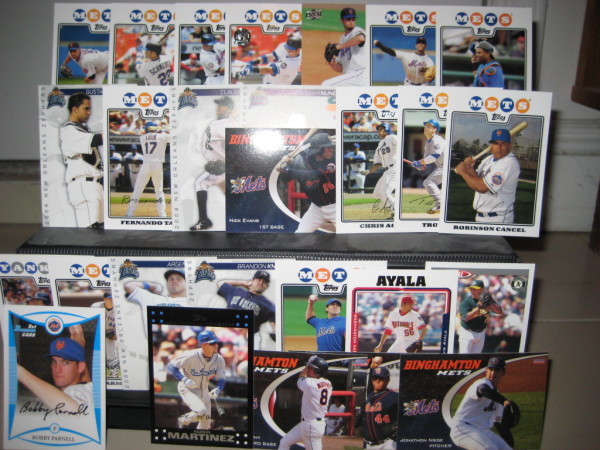
In all their glory. Accompanying commentary here.
by Jason Fry on 22 November 2008 6:17 am The World Series has come and gone, as has a rather lengthy trip to Europe for Yours Truly, the arrival of Topps Updates and Highlights and various busyness and procrastination. Which means that at long last, it’s finally time for the fourth annual rundown of players who made their Met debuts last season and are now to be immortalized atop Cardboard Olympus. (Previous annals here, and see this year’s class photo here.)
Brief review for newcomers and the similarly obsessive: I have a pair of binders, dubbed The Holy Books (THB) by Greg, that contain a baseball card for every Met on the all-time roster. They’re ordered by year, with a card for each player who made his Met debut that year: Tom Seaver is Class of ’67, Mike Piazza is Class of ’98, Jose Reyes is Class of ’03, etc. There are extra pages for the rosters of the two World Series winners, including managers, and for the 1961 Expansion Draft, with the latter including the infamous Lee Walls, the only THB resident who neither played for nor managed the Mets.
When a player has a Topps card as a Met, I use that unless it’s truly horrible — Topps has been around a decade longer than the Mets, so they get to be the card of record. No Met Topps card? Then I look for a Zephyrs card, a non-Topps Met card, a Topps non-Met card, or anything I can get my hands on.
Topps had a baseball-card monopoly until 1981, and minor-league cards only really began in the mid-1970s, so cup-of-coffee guys from before ’75 or so are a problem. Companies like TCMA and Renata Galasso made odd sets with players from the 1960s — the likes of Jim Bethke, Bob Moorhead and Dave Eilers are immortalized through their efforts. And a card dealer named Larry Fritsch put out sets of “One Year Winners” spotlighting blink-and-you-missed-them guys such as Ted Schreiber and Joe Moock.
Then there are the legendary Lost Nine — guys who never got a regulation-sized, acceptable card from anybody. Brian Ostrosser got a 1975 minor-league card that looks like a bad Xerox. Leon Brown has a terrible 1975 minor-league card and an oversized Omaha Royals card put out as a promotional set by the police department. Tommy Moore got a 1990 Senior League card as a 42-year-old with the Bradenton Explorers. Then there are Al Schmelz, Francisco Estrada, Lute Barnes, Bob Rauch, Greg Harts and Rich Puig, who have no cards whatsoever — the oddball 1991 Nobody Beats the Wiz set is too undersized to work. Best I can tell, Al Schmelz never even had a decent color photograph taken while wearing his Met uniform. (I’ve asked him — he doesn’t respond to letters and emails on the subject. Possibly he too is bitter about the lack. More likely I frightened him.) Anyway, the Lost Nine are represented in THB by fake cards Photoshopped together out of scrounged yearbook photos.
A 10th Lost Met seems unlikely — today it’s rare to sign a pro contract and not wind up on a card somewhere. During the season I scrutinize new card sets in hopes of finding a) better cards of established Mets; b) cards to stockpile for prospects who might make the Show; and most importantly c) a card for each new big-league Met. At season’s end, the new guys get added to the binders, to be studied now and then until February. When it’s time to pull old Topps cards of the spring-training invitees and start the cycle again.
Enough yip-yap. Let’s meet the Class of 2008, those players who probably donned the blue and orange thinking they were safe because there ain’t no way one team can finish blowing a lead on the final day of the season two years in a row. Suckers.
Here they are, in order of matriculation:
Johan Santana — Well, it wasn’t his fault. Grand slams to pitchers aside, Santana pitched ably in the first half of the year, only to watch canvas after canvas get spray-painted by bullpen pinheads. In the second half he was flat-out brilliant, culminating with his complete-game throttling of the Marlins in his final start of the year. Unfortunately, the Mets had another game to play. Updates & Highlights #330 captures him in mid-flight, a classic card that will make you think of springtime and redemption.
Brian Schneider — Unlikely car pitchman arrived with a reputation for defense, then let an unseemly number of passed balls and untagged runners occur on his watch. Mike Piazza hasn’t been gone long enough for us to remember that lousy catching is the baseball norm — you get some warm body to catch and hope he’s the pitching version of “The Horse Whisperer,” a reputation all lousy catchers get as a prerequisite for continuing to ply their mediocre trade. Schneider gets a rather desultory card from the New York Mets team pack hawked at Shea, but then he had a rather desultory year.
Angel Pagan — A Cyclones favorite in the team’s inaugural season, Pagan was a nice early-season story, prompting a cute fan pantomime of angels’ wings in the bleachers. Those pinions bore him too close to the sun, however — his batting average plummeted and then so did he, landing on his shoulder in the stands in L.A. His season was over a week later. Pagan gets the honors from U&H, about to make what looks like it will be solid contact. He’ll likely never be heard from again, but we’ll always have Brooklyn.
Ryan Church — Arrived from Washington in much-decried trade for Lastings Milledge, and accompanied by fooferal about his having expressed gape-mouthed wonder over some nutbag Bible-thumper’s explanation that the Jews didn’t accept Christ as their personal savior and were therefore damned. Not the best start for a career in New York, but Church then displayed a rifle arm, a line-drive bat and a hard-nosed approach to the game. He won over the town, made fans feel bad about doubting Omar, and seemed headed for a breakout season. But in late May he took a Yunel Escobar knee to the head, a blow that would begin a by-turns farcical and frightening odyssey in which the Mets alternated having him play in mountain cities that lack air and making him sit in the dark for days on end. The end result was a rather convincing demonstration that the Mets were blithely stupid about the effects of concussions, and a lost season for Church. Here’s hoping for better news on both fronts in ’09. Church gets a team-set card a la Schneider.
Matt Wise — Next time you or someone you know is getting a little too amped up about deciding on the final middle reliever to break camp, remember the name Matthew John Wise. Wise hurt his forearm two games into the season, came back and pitched abominably, and was gone by Memorial Day with a bad shoulder. After the first two or three guys, anybody else who breaks camp as a middle reliever has the life expectancy of spastic in a minefield — don’t even bother learning their names until it gets warm. Somehow got a Met card from Upper Deck.
Nelson Figueroa — Figgy was a nice homecoming story, a Brooklyn kid who’d almost made it to the bigs with the Mets a decade ago, only to be traded away. Remember his extended family hooting and hollering from Billy Wagner’s box on those cold April nights? The league caught up with him soon enough, though, and the feel-good story turned into a tale of endurance. Made it back in September, and (like everybody else summoned from the bullpen) was fine when it didn’t matter and horrible when it did. Figgy did get a Met card for his troubles — one of the five “bonus cards” inserted into the Met-themed full set of ’08 cards.
Raul Casanova — If you had the initials R.C. and looked like you were familiar with the bottom of many a bag of Cheetos, you got to catch for the 2008 Mets. The joke within the joke is that all those blobby R.C. backup catchers acquitted themselves decently enough — Casanova, a veteran of 19 pro seasons, hit .273 in his 20-game stint. He gets another full-set bonus card, one whose back includes a rather stupefying factoid about his ’07 season: “…came within one of setting a record for most HRs by a catcher playing in fewer than 30 games.” Oh.
Gustavo Molina — Despite the name and the job description “catcher,” not related to any of the 45,932 Molina siblings. This can’t be true. Zephyrs card.
Fernando Tatis — Arrived as seemingly incontestable proof that the Black Hole of Left Field had devoured any conceivable talent at the position, then did away with the Chan Ho Park jokes by putting together a courageous, stirring comeback season. Tatis was back in the big leagues in large part because his hometown in the Dominican Republic needed to buy land to build a church. So, with apologies to “The Blues Brothers,” he really was on a mission from God. Got a well-deserved U&H card which unfortunately shows him from the back, rendering him thoroughly anonymous. Better luck in ’08.
Claudio Vargas — Stats indicate he had some solid starts before he got figured out, but I confess he’s all but gone from my memory. Zephyrs card.
Nick Evans — Broke in with a bang in Denver, then immediately started hitting like a kid airlifted in from Binghamton, which is exactly what he was. But hung in there and quietly put up a pretty good rookie season as half of what may go down as baseball’s All-Time Most Successful Platoon of Double-A Kids Playing Out of Position. Has annoying horizontal Binghamton card that will be dumped once his Topps Red Hot Rookie Redemption card arrives.
Abraham Nunez — Pointless June call-up. Zephyrs card.
Chris Aguila — Since ’07 U&H came out, Topps has obviously hired some obsessive Met fan. How can I tell? Because Chris Aguila got a Met card. Chris Aguila, who did OK in Triple-A and then went 2-for-12 in two tours of lukewarm summer duty with the big club. And it wasn’t just Aguila — luminaries such as Tony Armas Jr., Robinson Cancel and Trot Nixon were similarly honored for showing up in blue and orange, and former minor Mets Chip Ambres, Matt Ginter and Jorge Velandia all got cards. As an obsessive with a dual major in Mets and baseball cards, I was thrilled by these questionable marketing decisions. I doubt a nation of kids shares my joy.
Trot Nixon — See above. How does hitting .171 in a brief tour of duty that ended before July get you a baseball card? U&H, for no apparent reason.
Robinson Cancel — Surprisingly fast for an endomorphic catcher. Basically useless, but still fun to watch — if you don’t root on at least some level for the Robinson Cancels of the baseball world, something within you is dead. The back of his U&H card chronicles a bizarre career that includes repeat visits to such bush-league hot spots as Beloit, Stockton and Huntsville.
Andy Phillips — DFA’d by the Reds on June 22 to make room for scorned former Met Jeff Keppinger. Claimed by the Mets on June 25. DFA’d by the Mets on July 1. Claimed by the Reds on July 3. This string of transactions seems unnecessarily complex. Yankees card.
Tony Armas Jr. — Pitched OK in winning his first start against the Cardinals, threw a scoreless inning against the Phillies, then got bombed in the 10-9 win the Mets recorded against the Phils in homage to Bob Murphy’s “They win the damn thing” call. And that was his year. U&H card, God knows why.
Argenis Reyes — Former Indian farmhand whose abundant spunk, obvious love of the game and friendship with the Other Reyes made you try your hardest to overlook the fact that by any statistical measure he was a terrible baseball player. Needless to say, would still rather see him than Luis Castillo. Zephyrs card.
Brandon Knight — Began his Met career by getting incinerated by the Cardinals, ended it by pitching capably enough against the Nationals. Won a bronze medal in Beijing, which, because Bud Selig hates America, didn’t count for an extra game in the standings. Zephyrs card.
Daniel Murphy — The bright young hope of sentimental Met fans everywhere, a serious-as-a-heart-attack kid with a beautiful swing, a jeweller’s eye for the strike zone and no position to play. Infamously left standing on third after a leadoff triple as Wright struck out. One hopes that will be an “oh yeah, that was him” moment instead of a defining memory. Until it’s settled one way or the other, GODFUCKINGDAMMIT. Binghamton card, pending arrival of his Topps Red Hot Rookie.
Eddie Kunz — Hulking closer-in-waiting revealed as not ready in brief trial. One of many Binghamton cards this year.
Brian Stokes — Tampa Bay refugee briefly raised hopes with electric fastball before quashing them with said fastball’s utter lack of movement. Could be a very valuable arm if a pitching coach could find a way to add a little wrinkle to that fastball, but we’re not the first team to have thought that. Card from oddball Mets gift set, showing him in wretched spring-training motley.
Luis Ayala — Pitched bravely but not very effectively as emergency closer. Gets a pass for bearing up as best he could under the weight of injuries and various misfortunes. Represented by 2005 card from Washington Nationals inaugural set. Like Ayala himself, not a great answer but the only one available.
Jonathon Niese — Undone by nerves against Brewers in first start. Brilliant in whitewashing the Braves in second start. Shellacked by Cubs in third and final start. Exactly what you’d expect from a hurler barely old enough to take a legal drink, in other words. Born on the day the Mets won their last World Series, but unfortunately not only 25 months old. Binghamton card.
Ricardo Rincon — Oh yeah, he really did pitch for us. 2004 Topps Total card.
Ramon Martinez — Briefly a cult hero for big late-season hit against Marlins, which makes me feel bad for remembering his failure to go first-to-third against the Nats in a September game the Mets lost 1-0. Not Pedro’s brother. 2007 Topps card in a Dodger uniform.
Bobby Parnell — Thrown into the fire in mid-September when Jerry Manuel ran out of bullpen bodies, and fared about as well as his mates. Yet to pitch in a Met victory. 2008 Bowman card.
by Greg Prince on 21 November 2008 5:00 pm Another award season has come and gone, and the Met display case has been modestly enhanced. Two Gold Gloves, for Wright and Beltran; another shiny Silver Slugger for Wright and his 124 RBI — man on third/nobody out notwithstanding; one semi-official Comeback Player of the Year for Fernando Tatis (Sporting News version, not MLB's)…nice, unobtrusive additions, but nothing that requires another wing or a press conference. No Manager of the Year for the 39th consecutive November; no Rookie of the Year for the 24th consecutive campaign; no Cy Young for the 23rd straight year. No MVP after 47 years in business.
This wasn't the year to make too rabid a case that any of our contenders got robbed. Santana could have been Cy Young, but Lincecum was hotter longer. The Most Valuable Delgado bandwagon lost some steam there toward the end. Jerry Manuel got a touch of support for skipper honors but that's not a fight I'd pick. And Daniel Murphy's 131 at-bats weren't really enough to ROTY him up, though it was just enough to disqualify him for 2009 (assuming he's healthy).
I've always taken a great interest in where Mets rate in these votes and an outsized share of pride when one of them wins something or, in recent years, comes moderately close to it. I'm beginning to wane in this regard as I have in the Hall of Fame voting. It's yet another one of those baseball things that's out of my control (well, all baseball things are out of my control, but I can fool myself into thinking I have something to do with more immediate Met matters) and too heavily dependent on the judgment of others — others who do not have Met interests at heart or even top of mind.
But it's nice to be in the conversation. Johan finishing third for the Cy was pretty monumental in recent Met pitching history. The last time a Met pitcher drew as many first-place votes as Santana was the last time a Met pitcher won the darn thing, 1985, when Doc did it. Our Gang of Five that won MVP votes — Wright, Delgado, Santana, Beltran, Reyes — was our biggest contingent since 1986 when six Mets (Carter, Hernandez, Knight, McDowell, Dykstra, Ojeda) collected points. At least three Mets have shown up in the Most Valuable totals every year for the last four years.
No, we never win the MVP, but it's a far cry from how we used to lose it. We never used to show up at all.
In 17 separate seasons, representing 36% of the franchise's life, no Met received a single vote for Most Valuable Player, according to the tabs kept by Baseball-Reference.com. Mind you, each ballot lists ten players, ranked first to tenth. Two beat writers per team in each league vote. Thus, in National League MVP voting, there are theoretically 320 opportunities for a player from any given team to garner support, even if it's just a tenth-place vote. Seventeen times, between 20 and 32 writers (the number varying based on number of teams in the league since 1962) voted and none of them saw fit to recognize a single Met as one of the ten most valuable or best players in the league. Whatever criteria an individual writer used, 17 times nobody thought it applied to a Met.
Talk about irrelevance. Talk about feeling excluded. Talk about a lack of validation at the end of a long hard slog of a season.
It shouldn't surprise you that all 17 of the seasons in question were seasons in which the Mets had a losing record. Only seven times have the Mets lost more games than they've won yet had a player show up in the MVP balloting. You might figure that some Met had such a standout year that he transcended the team's performance and attracted a great deal of support. It's never happened. The only Met to finish in the Top Ten in voting for MVP when the Mets were sub-.500 was Howard Johnson, who finished fifth in 1991 after leading the league in homers (38), RBI (117) and stealing 30 bases. He didn't receive a single first-place vote.
It's quite dispiriting to examine a given year's MVP balloting, read a long list of names (34 in 2003) and see no Mets. It's like the National League had a party and our invitation got lost in the mail. All it would have taken for posterity's sake was for one writer — a Mets beat writer or somebody else with an open mind — to have noticed, for instance, that in 1981's infamous second season, the Mets made a pretty decent run at first. Dave Kingman finished the season third in homers, tenth in ribbies and sixth in walks. Only Mike Schmidt, the eventual MVP, hit home runs more frequently than Kingman. This was Dave's first season back with the Mets; he made an impact on their fortunes. Hence, you had some “value” to go along with some stats.
Nobody could throw him a tenth-place vote? Journeyman catcher Milt May, for having one of those above-average years for a team that finished a little better than previously managed (3½ back in the second half), was thrown a tenth-place vote, tying him for 25th and last among MVP candidates. Milt May hit .310 with two homers for the Giants. Twenty-six players from ten of the twelve extant National League clubs received at least one Most Valuable Player point in 1981. The Mets and Padres were completely shut out.
This is not a jihad against Milt May's only MVP vote ever nor a revisionist revolt on behalf of Dave Kingman (who hit .221 and led the league in strikeouts) per se. It's just an example of the way these things have worked. Seventeen times out of 47, it was as if the Mets hadn't even played a season. We understand we can only make the playoffs now and then (not as much now as we would have thought). But individually, to trudge through the schedule and be told, sorry, nobody here was particularly valuable — in fact, everybody here was worthless — is bracing, to say the least. You and I watch the Mets so closely and are convinced, in any year, that somebody had a good year, that somebody made a difference for the better, that somebody was the reason we lost only 95 games instead of 103. Then you have this body, the Baseball Writers Association of America (keepers of the world's worst Web site; seriously, don't stare directly into it), making evaluations for the ages, and you and I are told: no, not really, nobody on your side was any good for the past six months.
It's a slap in the face. It's a bigger slap in the face, I believe, than a Met never having won an MVP, than the three times — Seaver '69, Hernandez '84, Strawberry '88 — a Met finished second instead of first. It's like we didn't even exist.
Not the case in 2008. Wright finished seventh, Delgado ninth. Santana, at 14th, finished ahead of Lincecum and Webb, the two pitchers who finished ahead of him for Cy Young. Beltran at 21st and Reyes, tied for 24th, rounded out the Met delegation among 27 National Leaguers named on at least one ballot. All things considered, it was a pretty good showing.
Beats the hell out of 1962-63; 1965-66; 1974; 1977-82 (Tom Seaver got one tenth-place vote in '77, so if you want to slice a third of that off considering he started the season as a Met, be my guest); 1992-93; 1995; and 2002-04. We complain a lot nowadays if our team does something silly like lose its last game of the year to cost itself a playoff spot, but obviously the mere act of contending goes a long way in maintaining relevancy. The idea is to get to the playoffs, of course, but failing that (which is something 22 of 30 teams do every year), it's nice to at least be spoken of in some positive light when all is said and done.
by Greg Prince on 17 November 2008 1:14 pm Happy 64th to the greatest vintner in Mets history. He’s not shy about his ranking.
One day late, but Happy 44th to our former chief surgeon.
Mid-November is a very good week for pitchers, too, no?
by Greg Prince on 10 November 2008 2:44 pm Mounting a furious late-innings rally to finish the book (writing one, not reading one), so please forgive if I can offer you only bullets for a bit.
• Want to hear someone ramble on about Doug Flynn and related topics for twenty or so minutes? Please visit Mike Silva's NY Baseball Digest and start listening just past the 62:00 mark.
• Want to hate the Phillies (the only serious Met archrival, it occurs to me, to ever beat us out of a playoff spot and then win the World Series; I'm not counting the '97 Marlins, though I will always count '97) a little less? Probably not, but you might after reading Doug Glanville's piece on the Phillie Phamily in the Times.
• Nothing to do with baseball per se in this Op-Ed piece, but you'll love Matt Mendolsohn's line about radio if you've ever gathered around one with strangers to catch a pitch or more from Murph or Gary or Howie.
• Speaking of one of those fellas, the Gary, Keith and Ron cabal is in a good mood these days and is offering a nice discount if you'd like to purchase some of their excellent items and contribute to the community-minded works supported by their Pitch In For a Good Cause Foundation. Use the coupon code BLOGGER by November 28 and receive 10% off your next order.
• MiarcleMets.net is dead, long live BlueandOrange.net, Chris Wilcox's always thought-provoking blog. It's got a new name but remains the same good read it's always been. Check out his piece on best offensive seasons by Mets catchers for one example of why he's terrific under any name.
• Thanks to Metstradamus for Scribbling us up. We'll pass the love along shortly.
• Belated Happy Fiftieth to my main man Mike Steffanos, who shares a birth date with Keith Hernandez and Mickey Mantle and, to my way of thinking, belongs in exactly that kind of company.
• Finally, in the cheapest anniversary gesture I could come up with, Happy No. 17 to my darling wife, who married me on this date in 1991 and still hasn't figured out that the joke is on her. (Don't tell her, OK?)
by Jason Fry on 8 November 2008 6:00 am You don't know the half of it, partner.
Italy is a lovely place, full of more or less kind people who are willing to forgive monolingual Americans their spastic attempts at communicating through six or seven Italian words, idiotic smiles and kabuki-sized arm gestures of questionable meaning. But all this kindness can't make up for an irreducible lack in Europe: There is no baseball.
I know, there's no baseball back home right now either. But it's different. It started with the absence of baseball fields below the airplane flying from Amsterdam to Milan — I suppose the rectangles of soccer fields evoke some poetry in the hearts of European travelers, but I'm not one of them. What I wouldn't do to glimpse, through ragged clouds, the rounded wedge of a baseball field with a diamond at its heart.
Still, there is baseball here, in a way. Channel-surfing late-night Italian TV is a blur of homegrown Italian slapstick, oddly dubbed American movies and shows (watching “Lassie” in Italian is the equivalent of several blows to the head), softcore personals featuring vaguely scuzzy naked girls and, every once in a while, a Wii ad featuring an Italian family battling at computer baseball. (By the way, using baseball to entice Italians to buy a Wii seems like the equivalent of luring Americans with computer petanque, but then what do I know?) Then there was last night, when a colleague and I walked up Milan's most-famous shopping street, the Via Montenapoleone, and one of the chicer-than-chic display windows had a pyramid of softballs in it. I stared at those red stitches on white like I was gazing at the Holy Grail, which in a way I was.
Oh, and far too many Italians wear Yankees gear.
Entering my third week in Europe, I can say with renewed venom that the ubiquity of the Yankees makes it all the more clear what a fucking scourge they truly are. I swear, I could visit a band of headhunters south of Java and at least two of them would be wearing blingy hats with the goddamn Vertical Swastika on it. This morning I was walking back to the office with my however-many-millilitres of Coca-Cola and a kid in full Yankee regalia flagged me down to ask for directions. He's probably wondering why the weird American's Mi dispiace, non capisco Italiano sounded gleeful rather than apologetic. I mean, I get that the Yankees are an American symbol — it's just that they're the wrong American symbol, the sports equivalent of an supersized carbon footprint. I miss the hell out of baseball, but God forbid I should ever miss it enough to find comfort in the sight of a Yankee hat.
To be sure, I have access to the Internet, and I've faithfully made the rounds of Metsblog and the newspaper sites and ESPN. We're hell-bent on trading Aaron Heilman, want to employ Derek Lowe, are playing footsie with Orlando Hudson and like Brian Fuentes better than K-Rod, or at least we're saying so for agents' consumption. I get all that. But even though it's the same cyberspace reached from my desk back in Brooklyn, it's different. The World Series expired quietly in the pouring rain in the middle of the Amsterdam night, leaving me to awaken in a world without baseball. (And taking the $20 I'd bet on the Rays back in January at 175-to-1 with it, more's the pity) And now there's nothing at all.
That's not nothing as in “no baseball,” though that's bad enough. It's the Big Nothing, marked by knowing that no other soul within 100 miles is trying to figure out how to get rid of fucking Luis Castillo, or waiting to give Johan Santana a standing O, or wondering with equal parts anxiety and excitement about that first walk into Citi Field. I'm homesick for my wife and my son and my friends and my familiar streets, but it would also make me borderline giddy to see an NY in orange and blue, or a back emblazoned with WRIGHT 5.
When that finally happens it'll still be November, baseball-free as always, but man oh man will it be a happier November.
|
|