The blog for Mets fans
who like to read
ABOUT US

Faith and Fear in Flushing made its debut on Feb. 16, 2005, the brainchild of two longtime friends and lifelong Met fans.
Greg Prince discovered the Mets when he was 6, during the magical summer of 1969. He is a Long Island-based writer, editor and communications consultant. Contact him here.
Jason Fry is a Brooklyn writer whose first memories include his mom leaping up and down cheering for Rusty Staub. Check out his other writing here.
Got something to say? Leave a comment, or email us at faithandfear@gmail.com. (Sorry, but we have no interest in ads, sponsored content or guest posts.)
Need our RSS feed? It's here.
Visit our Facebook page, or drop by the personal pages for Greg and Jason.
Or follow us on Twitter: Here's Greg, and here's Jason.
|
by Greg Prince on 14 April 2008 4:49 am 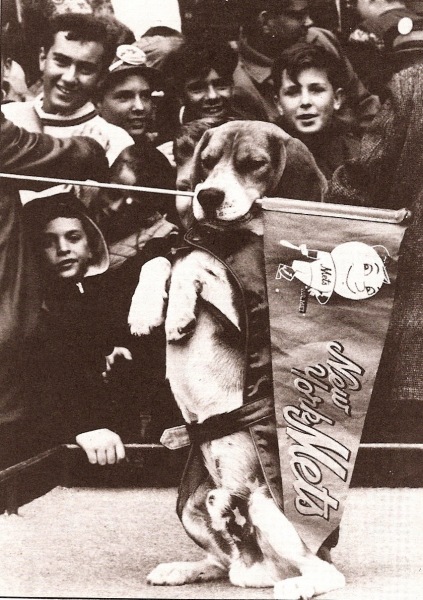
Reader Matt L. asked if we knew of any pictures of Polo Grounds top dog Homer the beagle. As your full-service Mets blog of choice, we scanned this one from Jack Lang’s The New York Mets: Twenty-Five Years of Baseball Magic and present it to all of Metstopotamia to enjoy. According to the caption in the book, Homer, sponsored by Rheingold, “was the official mascot of the Mets and had his own seat on a platform behind home plate.”
Are we like the funnest franchise ever, or what?
As long as we’re borrowing a picture from Mr. Lang, it’s a good time to ask you to please consider supporting Jack Lang Day at Shea on April 26, wherein tickets in several sections of the ballpark are being sold to raise funds for the Epilepsy Foundation of Long Island.
by Greg Prince on 14 April 2008 4:41 am 
The numbers on the Faith and Fear shirt don’t go any lower than 14 for Gil Hodges, but leave it to Dave Murray to take them as far down on the map as you can without leaving the country. Our Michigan friend wore his garment of choice on a recent trip to Key West where the sun was bright and the reception for Marlins broadcasts was, we assume, not bad.
You can wear your Faith and Fear shirt anywhere you like, but first you have to get one, which you can do here. (These are the classics, unaffected to this point by the addition of SHEA to the left field panel of glory, since some of you folks were thoughtful enough to ask.)
by Jason Fry on 14 April 2008 2:40 am Wow did I ever have a weird dream this morning.
I'd gone back to sleep for a little bit, but it was a couple of hours until game time, and that must have been weighing on my mind, because I dreamt a whole baseball game in my head. And not a good one.
You know how lots of dreams begin with some kind of real-world event that you're still wrestling with? That's how this one started: It was Oliver Perez and Jeff Suppan, just like Game 7 of the NLCS, only this time Suppan was on some other team and it wasn't for the all the marbles, it was just a game like any other. And Suppan pitched terribly, but Oliver pitched even worse — one of those classic O.P. messes where you wind up looking through your fingers while Willie steams in the dugout. And then when they finally took him out, no one else could pitch either. Not Sosa and not Joe Smith — and get this, they both got pounded by Gabe Kapler. Yeah, Gabe Kapler. I knew I was dreaming because Gabe Kapler's retired and managing in Single-A for the Red Sox somewhere, but in my dream he was bashing Met pitchers like he was Pat the Bat.
And the Mets couldn't hit at all. Well, they could but it kept not mattering. I started keeping track because it got so crazy — in my dream, they got the leadoff man on in the second, third, fourth, fifth, sixth, seventh and eighth — and hit into double plays in the fourth, fifth, sixth and seventh. I know, insane, right? And then in the eighth, I dreamed Guillermo Mota came in to pitch for the other team, and he was overthrowing and stalking around the mound and being Guillermo Mota, and it was clear the Mets were about to pound him and take the lead again, and I briefly thought this was turning into a good dream, only Luis Castillo grounded out to first and Brady Clark tried to go home for some reason and was out and then Mota walked two guys and Delgado came up with the bases loaded and flied out and we got nothing. Oh, it was infuriating. I had to remind myself it was just a dream, the way you can do sometimes without waking up. (Yeah, Luis Castillo. I keep dreaming about him — remember the dream I had this winter that we resigned him to a four-year deal even though he's a terrible hitter with no range and one working leg? Man, I'd take a dozen bad dreams like this morning's instead of having that one be true.)
Oh, and David Wright got a Gold Glove and then looked horrible even on routine throws. I know, ironic right?
Anyway, finally I woke up and it took me a minute to realize it really was all a dream, and there was no game today, just this inexplicable two-day break before we play the Nats. Which I'd been thinking was weird ever since the schedule came out, but thank goodness. Because if a game like this really happened, I think it would frustrate me to the point of insanity.
by Greg Prince on 13 April 2008 11:00 am 22: Tuesday, August 19 vs Braves
While it is fairly common knowledge, ladies and gentlemen, that Shea Stadium has hosted many a megastar concert in its 45 years, those who are Mets fans above all else probably have a slightly different ear for the music they've heard at Shea, particularly since 1980 when our audio/video crew began picking out just the right selections for just the right moments, either to celebrate victory or inspire one. All through this series, the Shea Stadium Final Season Countdown Like It Oughta Be is going to salute the musical acts who provided the soundtrack to some of Shea Stadium's most memorable seasons.
First up, to remove number 22 from the right field wall, we have an internationally renowned group whose career leapt up and howled for success with the release of what some would call a novelty hit at the turn of the century. Call it what you will, it sounded pretty good emanating from Shea's loudspeakers as the 2000 Mets won dramatic game after dramatic en route to the National League pennant that October.
Please let out your loudest woofs for Isaiah Taylor, Rick Carey, Marvin Prosper, Omerit Heild and Herschel Small. They asked the musical question, “Who Let The Dogs Out?” The answer was the Baha Men.
21: Wednesday, August 20 vs Braves
Why, ladies and gentlemen, do some songs resonate in the public imagination when others, no matter how hyped by the powers that be, simply fall flat? It's a great mystery of the music business and the same could be said of the tunes that get teams and their fans going.
No song ever seemed to have the positive effect on the goings on at Shea Stadium like the one we honor tonight. Its lyrics and accompanying video have nothing to do with baseball, not even remotely. Yet from a DiamondVision diversion came a rallying point for two of the best clubs in Mets history, the diehard Mets of 1985 and their world champion successors of 1986.
It was just a novelty hit built around some public domain clips. But given the frenzy it touched off here in its day, the novelty never wore off where “The Curly Shuffle” was concerned. To remove number 21 from the right field wall, we have invited to Shea, for the first time, those masterminds whose homage to “comedy classics on late night TV” made the Mets a prime time smash in the mid-1980s. Please welcome nobody's stooges: Peter Quinn, T.C. Furlong, Barney Schwartz, Tom “Shoes” Trinka, Rich Gorley and Vincent Dee, better known as the Jump 'N' The Saddle Band.
20: Thursday, August 21 vs Braves
Baseball is fun, ladies and gentlemen, but it is also business. We don't refer to the deals made in the executive suites and offices of Major League organizations, but rather to the transactions that count the most in the only bottom line to which any fan pays serious attention. We're talking, quite simply, wins and losses. The best business to be in, of course, is winning.
In their division championship season of 2006, the Mets took care of business quite effectively for six going on seven months. And when they got their business done, there was no better soundtrack by which to celebrate a job completed to satisfaction than that first recorded by a group of Canadian rockers in the 1970s. It fit the vibe of the Mets to a tee as they took the National League by storm two years ago and we play it to this day after just about every win.
We refer, of course, to “Takin' Care of Business” by Bachman-Turner Overdrive. And to put our countdown in overdrive as we have every day this year, we welcome the members of BTO so they can remove number 20 from the right field wall on this day: Randy Bachman, Fred Turner, Randy Murray and Blair Thornton. Gentlemen, if you would…take care of some Shea Stadium business.
Numbers 25-23 were revealed here.
by Greg Prince on 13 April 2008 1:06 am There were gophers, there were weasels, there was one oversized gadfly…oh wait, that was me.
The final fifth game of a season in the history of Shea Stadium: from it I will remember almost nothing fondly. It was just one of those days, even if it was a Saturday, even if it was the home debut of Santana the Savior, even if it didn’t rain and instead cried out for shedding one’s layers of caution against the elements in the upper deck. There may have been pieces of April to recommend you spend this April afternoon at Shea, yet there have been far better Saturdays in the park.
How come?
• Johan: Sometimes home runs are just fly balls that carry. Those weren’t what the Brewers hit. The three Santana gave up could have been cancelled by American Airlines. Maybe it’s the jetstreams, though those seem to stop acting up the moment a Met comes up with runners on base. We heard he has a tendency to give up homers, especially having pitched half his life in the Homerdome. When he wasn’t introducing the friendly skies to Bill Hall and Rickie Weeks, he was aces up. By the time he got to Gabe Kapler, he was huffin’ to the finish line, a destination he never quite made. Santana himself said afterwards he didn’t pitch well. Four earned runs in 6-2/3 attest to that evaluation. Still, he did have his moments (7 K) and he sure looked good in the pinstripes. I’m not worried.
• Johanmania: The Mets have made back a significant portion of Santana’s salary in jersey sales (I’m always surprised when people dig deep for a new guy, even this new guy), but the atmosphere that surrounded him was lacking. I guess I expected Pedro II. The debut of Mr. Martinez the Met in 2005 was electric enough to put the Keyspan sign to shame. That was special. This was the turn in the rotation between Figueroa and Perez. When Johan entered, he got nice applause. When he was pulled in the seventh, he got a little less. He will have his days, but it’s interesting to me that he didn’t get one right away the way Martinez did. Some guys just light up a room.
• Slopfest ’08: I’m past comparing this season to last season. The current edition has yet to put together an early stretch of dominance even close to what the Mets of 2007 racked up. Ten games in, they are, in the argot of the chronically inarticulate, what they are. They are a .500 ballclub, good some days and nights, less so on others. Saturday they were lame everywhere: in the field (Easley’s no shortstop, Wright’s only occasionally a Gold Glove third baseman, Schneider’s reputation as a catcher exceeds him); at bat (Sheets is good, but he shouldn’t have manhandled our lineup so easily); and on the bench (untighten at once, I command thee, Jose’s hammy!). The Brewers wore their hitting shoes. The Mets barely laced up.
• Amnesia: You know how Scott Schoeneweis won the respect of the crowd the other night by rescuing his teammates in that extra-inning thriller versus the Phillies? It’s been forgotten. He was announced, he was booed. That’ll show him! I do believe I heard the slightest smattering of disapproval for Johan’s performance when he left. One would like to believe there was some distorted sense of irony at work there, though given that the most clever thing I heard all day (amid a thousand references to Prince Fielder’s weight, welcoming back Gape Kapler and “Sunglasses At Night” for Corey Hart even though “Never Surrender” actually topped it on the charts) was “THROW THE FUCKING BALL SHEETS!” I’m guessing no.
• Wrong Angle: From section 13 upstairs, I studied how the rotunda sticks out of Citi Field, almost too tumescent for its own good. Oh well, I thought, I shouldn’t judge it until it’s done. Next year when I’m sitting in the upper deck at Shea, I’ll have a better idea of how Citi Field really looks.
• Commerce: It was Citi Field Cap Day. I arrived early enough to get one, displayed enough impact-free high dudgeon not to wear it. Besides, I didn’t want to be badgered for a free pizza half an hour after not delivering one. The Citigroup vice president of nothing in particular not only got to throw out the first ball but he unveiled number 77 in the parallel universe Shea countdown. “Now to represent the destruction of Shea Stadium…” After classing it up beyond belief with the Shea family on Tuesday, the Mets have reverted to form, handing the counting-down honors to, in order, their mascot; the countdown’s sponsors; a tie-in to their kids’ fan club; and the sponsors of the giveaway cap and the building next door. C’mon, Mets — I’ll bet Ron Hunt would fly coach if you asked him nicely. How pervasive is the Citi-Mets relationship? David Wright’s ineffectual but well-intentioned solo shot in the eighth — Let’s Get It Done! — was implicitly brought to us by our naming rights providers, according to DiamondVision. And leave it to the Mets A/V squad and their corporate weasel puppetmasters to make me the last person on Earth to consider “We Built This City” by Starship somehow less than wonderful when the “y” becomes an “i”.
• The Sounds of Silence: Rick Astley can relax. Neil Diamond is now less popular than he is in Queens. The fehcockteh singalong voting is nothing if not cathartic. After harmonizing happily with Neil through the climax of ’06 and the bulk of ’07, the Mets crowd turned on “Sweet Caroline” Saturday with the vengeance of the manipulated and fed up. I hadn’t seen an overbearing New England mainstay’s fortunes turn so quickly and harshly for the bad since corrupt Warden Samuel Norton stuck that pistol in his mouth once the authorities were on to him in The Shawshank Redemption. Allow me to be the umpteen-millionth Mets fan to publicly wish they’d can this whole thing and let us chat amiably among ourselves between half-innings. If they really need a tune to distract us — and since this promotion is sponsored by the Carpenters union — how about “We’ve Only Just Pagan” for our favorite temporary leadoff hitter?
• Serene Exit System: The whole torpid affair Saturday looked like it would have a silver lining in that at around 3:42, the bottom of the ninth approached and the Mets could do one of two things to help my own cause. They could rally for real, and that would be appreciated; or they could get it over with posthaste and let me catch the 4:24 out of Woodside. You know which one they chose. As long as The Log was going to be disgraced, fine. I did my best Mo Carthon impression, opening up holes in the crowd across the upper deck concourse and then down the thousand ramps that would lead me out Gate E (people do not know how to walk down ramps). The new staircase actually kind of works and the 7 turnstile wasn’t at all a mess. Plus I’d been sent this cheery press release by the MTA so bloggers like us could tell fans like you that “The first ever weekend express service (day or evening game) from Shea will follow ‘Post Game Express’ service plan.” The game sucked, the day blew, but at least the trains would fly. But they didn’t. There were no weekend express trains — and what locals there were sat like Raul Casanova and crawled like Brian Schneider. The 4:24 went from sure thing to dicey proposition, and it was only the deluge of LIRR customers crowding Woodside and a rare personal sprint that kept it from leaving without me. No seats to be had, no escape from the feeling of frustration that pervaded the entire afternoon.
Perversely nice to be reminded why winning so kicks losing’s ass.
by Greg Prince on 12 April 2008 12:00 pm On Tuesday as the Home Opener got away from the home team, I heard myself think “I'm glad I'm not watching this at home,” as if any barrier more substantial than four decks from the field wouldn't let me cope with the rampant futility at hand. Friday night, after having turned down a ticket from two different sources, I wasn't at all unhappy that I was missing reaching out and touching Nelson Figueroa's flirtation with perfection.
It played better on TV.
If I were at Shea, I would have crossed my fingers and counted the outs and all until the inevitable imperfection smudged Figgie's pitching line. I would have sat in the fog, said “oh well” and gotten back to the business of rooting, moderately aware that this was a hometown boy making good. When it was over, I would have dug a Babylon schedule from my bag and left, conscious mostly of what I saw last, not what I saw early.
But from the living room, I could see and hear what was really going on, that this was Mets fantasy camp come north and come true.
We criticize SNY for reasons overwhelming and petty, and no doubt we will continue to do so, but on Friday night, we saw the power of television when deployed for good. We got the closeups of Figueroa. We got the cutaways to the bulging box of Figgie's family — and the information that their accommodations came courtesy of the Sandman, the first of two Billy Wagner saves on the evening. We got the interviews with the father and the son from trusty Kevin Burkhardt. We got Gary and Ron narrating the drama as well as calling the pitches. We got the whole picture on television.
I'm not interested in turning this into a critique of SNY right now, so let's just say they did their job just about as well as Nelson Figueroa did his, and we know he did a swell job. There would be no no-hitter, no perfect game, but this was one of those nights that was perfect enough, fulfilling if not flawless…not unlike, for two examples that came to mind while watching, Bobby Jones' one-hitter against the Giants in 2000 and Rick Anderson's no-decision in the callup he'd waited forever for in 1986.
There were elements of nights like those that served as precedent for Nelson Figueroa's excellent adventure, but ultimately, April 11, 2008 was a Shea original. This was the kid who — unlike Seaver, unlike Gooden, unlike Santana later today weather permitting, unlike all the greats and not-so-greats who have thrown the first pitch that counted on a given night in that old house — really, really, really cared that it was taking place where it was. A few Mets over the years have raised the issue of playing in New York as something they aspired to as youngsters growing up in New York rooting for the Mets. Never did they look or sound as convincing as Figueroa in terms of what it actually meant.
No wonder it meant something to someone like me. Usually a Met win can be credited to any pitcher not named Hitler, bin Laden or Clemens and it makes me no never mind. Once in a great while, however, you get choosy. If there's a chance that the win can go to someone who you can imagine checking the Mets yearbook and marveling at the presence of his very own picture, maybe even clicking on to his very own Ultimate Mets Database page, choosy Mets fans would choose Nelson Figueroa.
When Wagner who lent out his box ($200 bricks, $8 beers, closers with suites…don't wake Branch Rickey) recorded one of the most authoritative saves of his Mets career, I was the most excited I'd been since this shaky season began. Our four previous wins — even the walkoff won on the wings of Angel — served only to remind me that triumphs in April can be canceled out if you don't keep compiling them through September (yeah, I'm that screwed up from 2007). This, though…this was different. This was better than anything we've witnessed to date in '08. This was the Figueroas piling into their stationwagon and one of their boys drawn at random to participate in a Dynamets Dash whose route ran right to the mound and straight to a W.
No wonder, fog be damned, it looked so perfect on TV.
by Jason Fry on 12 April 2008 2:51 am It's the new guys who will heal us.
I don't just mean that Angel Pagan has been a revelation, that Ryan Church has so far proved a good bat and an excellent glove, that Johan Santana is Johan Santana or that Nelson Figueroa had a very nice night. (Or that even Raul Casanova chipped in when finally allowed to play.) All those things are true, but there's another factor.
We aren't mad at them.
Those guys weren't stumbling around these precincts after Memorial Day, plummeting back to the Phillies' level in September or getting keel-hauled by the Marlins on Tom Glavine's day of disappointment. Hopefully we'll soon get over being mad at all those branded with the tag “2007 Met” — it's no fun being mad at David Wright — but it hasn't happened quite yet. It's too early for that. But it's not too early for thoroughly enjoying the derring-do of Pagan and Church and Santana, the innocents.
Which brings us to Figueroa.
Being a baseball fan of a certain stripe means sentimentality is always waiting to swallow you up if you're not careful. Baseball really is about lyrical green fields and the arc of the ball. But it's also about sweating and bleeding and cheating and managing egos and guys who don't get along and hangovers and baseball Annies and contract strife and labor wars and drug worries and the ruthless business decisions that assemble and maintain teams and franchises and ballparks. It's not all Ken Burns — black-and-white photos and piano and mannered narration.
But sometimes, man. Shut up, play that piano and let John Chancellor talk.
Nelson Figueroa grew up a Met fan in Coney Island. Scorned for being too small and not throwing hard enough, he wound up at Brandeis University, not exactly a baseball hotbed. His boyhood team drafted him in 1995, but without an excess of faith in his future — he went in the 30th round, the 833rd overall pick. And then the Mets sent him away in 1998, as part of a package for the utterly forgettable Willie Blair and Jorge Fabregas. He made it to the big leagues with the Diamondbacks in 2000, pitched well for the Phillies in 2001, then tore his rotator cuff after a cup of coffee with the Pirates. Then it was a minor-league deal with the Nationals and a spring-training look-see from the Mariners. It was a tour of duty in the Mexican League and a late-season job with the Uni-President Lions of the Chinese Professional Baseball League. He did well there, but Figueroa was 33, owned a 7-17 lifetime record and a suspect rotator cuff, and was pitching in Taiwan.
But somehow his story was just beginning.
You know the rest, but imagine it from Nelson Figueroa's perspective: He got a minor-league deal from his original team, the one he grew up rooting for, the one that sent him away. He pitched well enough in spring training to shove himself into consideration — and got cut on the last day of camp anyway. And then got called back almost before he left. Walking off the mound in Miami, wearing a Met uniform at last, he said he didn't want to be seen tearing up in HD.
Heck, he wasn't alone. That was a wonderful story right there, one that made anyone with a heart made of anything softer than granite excuse themselves for a moment because, hey, it's getting a little dusty in here. But you want more? You want Figueroa to take the mound at Shea with his family spilling out of a luxury suite and cheering him on? OK, the baseball gods can do that. You want him to retire the first three Brewers? Well, sure. The first six? Hmm, OK. The first nine? Easy there — sure, what the heck. The first 12? Man…but OK. The first 15? No. Too much! Sorry.
No, you had to settle for six innings of two-hit, two-run ball — and a win whose final moments were etched on Nelson Figueroa's face, in the arch of his eyebrows and the too-quick flash of his smile and every nervous duck of his head as Billy Wagner retired the last three Brewers somewhere out there in the fog. No perfect game, no no-hitter — even the baseball gods can reject a story as too perfect, too cornpone, too hard a yank for the heartstrings to bear.
But that's OK. That's more than OK. We thought about the perfect game, the no-hitter. We thought about it, hoped for it, knew it wasn't coming, nodded our heads when it didn't arrive. I bet Nelson Figueroa did all that too. And I bet he knew there wouldn't be 27 up and 27 down. After all, he knows how things work around here. He knows because as a kid he was one of us, and because now he is — at long, long last — a New York Met.
(Tip of the cap to the Star-Ledger's Jeremy Cothran for background via a nicely told tale.)
by Greg Prince on 11 April 2008 4:00 pm Welcome to Flashback Friday: Tales From The Log, a final-season tribute to Shea Stadium as viewed primarily through the prism of what I have seen there for myself, namely 359 regular-season and 13 postseason games to date. The Log records the numbers. The Tales tell the stories.
4/8/08 Tu Philadelphia 16-19 Perez 10 195-164 L 5-2
The Mets lost the final Home Opener in Shea Stadium history to the Phillies. But I won. I usually do.
I am hesitant to admit what fun I have at Shea even when the Mets lose, even when the Mets collapse. But it is fun for me to go and be what I can’t possibly be anywhere else. I can’t be completely in my element anywhere else. I can’t be completely surrounded by Mets fans anywhere else. I can’t do what I honestly believe I’m supposed to do anywhere else. Those feelings are enhanced by Met wins. They are surprisingly little diminished by Met losses.
By the time I get home after a loss, sometimes the loss overtakes me as it did Tuesday, especially as it did Tuesday. It really was too much like what ended last year when I was almost having fun in spite of the Mets, at least until the Mets cut off their noses to spite our faces. But that was at the very end of a very long season when the whole concept of fun becomes subordinate to angst. Tuesday was the beginning of what is not yet a long year. Tuesday you could lose one and by Thursday you could wonder, the unhelpful 5-2 result notwithstanding, why you were so upset.
You had fun at Shea Stadium with your friends who are Mets fans just like you and were surrounded by smiling strangers (the sober ones) who are Mets fans just like you. You hadn’t been immersed like that in a Koonce age. How could you let a score get you down? How could you not let a score lift you up?
The score of the second part was from 1970’s Company, which opened on Broadway twelve days after the Mets raised their 1969 World Championship flag. I told you last week how I like to listen to soundtracks from Broadway musicals en route to Shea. It was by rigged chance — its insertion in the Amazin’ 2008 playlist was intentional, the timing of when track 11 would click on a coincidence — that as I began to ascend an ancient staircase from a teeming commuter railroad platform I heard this lyric through my earbuds:
Another hundred people just got off of the train
And came up through the ground
While another hundred people just got off of the bus
And are looking around
Yes, and they were all wearing some variation of orange, black and blue. And better yet I heard it seconds after receiving a phone call from Dan, waiting for me at Gate E. I’ve been to a handful of Mets games with Dan since 2002, the dreariest of them a death march to mediocrity in September 2005 when Reyes was a foal, when Wright was a pup, when Beltran was a deer in the headlights, when Martinez was not yet Old Yeller, when Jose Offerman romped in fields of gold….when nobody expected much of our Mets and even fewer were showing up to confirm their lack of expectations. It was during that sorry series, a Nationals sweep, that I connected Company and “Another Hundred People” to the Mets, fans exiting a briefly rolled bandwagon that had halted by the hundreds, by the thousands. But there were me and Dan, still on it then, as we had been individually and together all those years, with no substantial clue that the wagon would regain traction in 2006 and expectations would soar and another million people would get on to our train for the next few seasons.
I could have looked to any number of people to keep me Company at the last Home Opener Shea Stadium would ever host. I thought of Dan first. I thought of September 2005. I thought of a spectacularly warm midweek afternoon in April 2002 when we converted our e-mail relationship to face time in the middle innings of a hard-luck loss to the Braves (as if there’s any other kind). I thought of late March 2007 when we chatted and I declared that I could live without attending that particular Opening Day at Shea (a lie, it turned out), but it sure would be nice to be there in 2008, the last one. Yes, Dan said, that is something to think about. I figured Dan had probably moved on to other thoughts in the intervening year, but that’s OK. Remembering conversations like those is what I do.
That and pine for Shea Stadium, something I backed off from doing after one particularly hectic Home Opener a few years ago until a trusted friend with an impeccable Met pedigree — Dan, again — turned me back around, convinced me it wasn’t Shea’s fault some fans were louts, some were drunks, some were unpleasant and that it wasn’t Shea’s fault that the Mets ran the place out of the FEMA handbook and into the ground. Don’t take it out on Shea, Dan more or less said. The message sunk in. Embrace what will come later later. Embrace what is here now. I tracked down two tickets on my own a couple of weeks ago and contacted Dan. He arranged for the day off from work and to await me by noon at Gate E.
“Do I pick you up or do I meet you there or shall we let it go?”
“Did you get my message? ‘Cause I looked in vain.”
“Can we see each other Tuesday if it doesn’t rain?”
“Look, I’ll call you in the morning or my service will explain.”
And another hundred people just got off of the train.
My cell phone rings at home at 9:45 AM. I’m only very recently showered. The readout says it’s Sharon. I had told her I’d look for her and her husband Kevin and her all-world son Ross in wherever they’re keeping the parking lot. Her family tailgates on Opening Day. I had never done any such thing. I didn’t know how I’d find them, but I’d try. If she was calling at 9:45, I was guessing there was some terrible traffic between Central Jersey and Shea, that they were running late, that the tailgating was off.
No, that wasn’t it at all. They were already there. Was I there? Because if I was, I could come by right away.
I haven’t even left the house yet, I said, but by 11:30, you’ll probably see me if I can see you. Where are you?
You’ll see us, she said. You can’t miss us.
If Sharon, Kevin and Ross Chapman are the Beatles of Mets fan families — and for my money they are — then I’m their Murray the K. Depending on how many kids are involved on any one of their outings (they have another son and a daughter who are not big into baseball), I am the fourth or fifth or sixth Chapman. It’s a fab group to latch onto, especially on Opening Day.
As another hundred people got off of the aforementioned train, I made my way across the LIRR boardwalk, through the 7 station and down the new staircase that — once made permanent — will presumably glide us right into the Jackie Robinson Rotunda. Halfway down those stairs, I couldn’t miss it: no, not the Rotunda; the Chapman minivan. They got what will probably be Space 1A in 2009. It was actually pretty damn good for 2008.
Sharon greeted me with a media guide. Kevin offered me a quesadilla (their menu honored Ollie Perez’s Mexican heritage). Ross peppered me with minor league trivia that I couldn’t answer. And I was, for the first time in my life, tailgating at Shea Stadium. Citi Field, too.
Hold on, I said, I gotta go get Dan. Given that Space 1A didn’t exist until this season (I think this is where we used to get off of the train), I had no idea you could park so close to Gate E.
They find each other in the crowded streets and the guarded parks
By the rusty fountains and the dusty trees with the battered barks
And they walk together past the postered walls with the crude remarks
And they meet at parties through the friends of friends who they never know
I had goaded Dan into taking an early enough Metro-North so there would be no way we’d be gypped out of our magnetic schedules and the laying on of Shea family horseshoe wreaths and all the pomp of Opening Day. But now I was shaking his hand, twenty to twelve, and telling him, “I’ve got these friends, they’re tailgating, they’re right over there and…”
“Let’s go,” Dan said.
Within about two minutes, it’s quesadillas all around, Dan and Sharon comparing notes on the concert she’s attending that night (Santana — who else?), Kevin inviting passersby to partake in his bounty and Ross doing shtick with a plush version of the Home Run Apple. My blolleague Coop, who finds me when I’m not finding her, stops by with her dad, our fifth accidental meeting in our last seven games. (There would also be a Very Special Laurie sighting in the upper deck as she searched high, low and unsuccessfully for a pretzel; we agreed it was good Shane Victorino didn’t hurt himself colliding with Jayson Werth because neither of us wanted to feign sympathy for a fallen Phillie.) More than an hour before the last first pitch and I’m eating, I’m drinking, I’m quite happy to be here. I’m watching wave upon wave of Mets fan tromp on by. They drove. They parked. They dressed for the occasion. So many blue caps. So many satin jackets. So many worn blankets. So many who sense the sincerity of the last opener for the ballpark about to gain dignity by dint of its death sentence.
I suppose I should be impressed or taken aback by Citi Field having gone and grown into a big boy over the winter, but I had spent the wee hours Monday night surfing from one Web album to another tracking its progress just so I could avoid shock. I wasn’t surprised the successor was taking definitive shape. I was actually a little surprised that I wasn’t surprised. Maybe I should have used spoiler tags and not looked so I would be surprised. But it was too tempting. How could I not look? I still don’t know what to make of Citi Field except that someday when it’s the only ballpark on the premises, I hope to take a guided tour of it or perhaps be told of its wonders by those who gain admission to an actual Mets game.
It’s a city of strangers
Some come to work, some to play
A city of strangers
Some come to stare, some to stay
And every day
Some go away
Citi’s the stuff of some other time. Tuesday was the stuff of Shea, before the game, when even the strangers were familiar, when even the post-apocalyptic Mets were worth our anticipation, when even the cops didn’t seem to notice Kevin’s Margaritas were as delightful as his quesadillas. At some point Dan and I pulled ourselves away from the feast to assure ourselves of magnetic schedules and a fighting chance at special-edition programs and all the Shea you could get, the last time you could get it for the very first time all year.
While another hundred people just got off of the bus
And are looking around
At another hundred people who got off of the plane
And are looking at us
Who got off of the train
And the plane and the bus
Maybe yesterday
***
There were many fine perspectives on Shea’s First Finale amid the Metsosphere this week, but two deserve special note: Dana Brand as he comes to grips with all the day’s juxtapositions and The Legend of Cecilio Guante narrating a one-of-a-kind photo essay that shows why Shea is Shea…and why it won’t be for much longer.
by Jason Fry on 11 April 2008 4:06 am So long as they end properly, tense, nobody-can-break-through extra-inning games are the coolest. There's the initial annoyance/delight of free baseball (emotion dependent on whether your team's the one that tied it up or the one that let it get tied), the settling in for the long haul once things aren't settled in the 10th, and then the fretful wait from the 11th until whenever things will end. You figure out the rest of the rosters in your head. You think about the tales of redemption that might fit (Bruntlett? Delgado?) and try to spin plot reversals along with the baseball gods. You figure the end is near when it isn't (Jesus, they're a hit away with Utley up) and are sure the game will never end when in fact it's about to (Schneider and Clark make meek outs to start the inning, what's the use), and the whole time you're thinking that somebody's fated to wear the laurels and somebody's fated to wear the goat horns and soon it will make perfect sense who was who, even though you can't possibly guess who will be who at the moment.
Another fun thing about these marathons (again, assuming all winds up OK) is how much of the regulation game disappears into the ether of “almost forgot about that.” Like John Maine's mostly reassuring start — he looked unfocused and gassed at the end, but it was April and an unseasonably warm night. Like Brian Schneider's rifle-armed erasure of Shane Victorino at second, which left me with my fist in the air and Victorino pop-eyed in protest. (He thought he was safe; he was out.) Like the pinball shot hit off the first-base bag immediately afterwards by Chase Utley. (In our recent nine-game stretch of martyrdom, that would of course have been preceded by Victorino being called safe, and followed by all sorts of bad things; instead Maine somehow escaped after walking the next two guys.) Like Pedro Feliciano coming in, pitching dismally, and then finding his slider in the way you devoutly hope off-kilter relievers will, while knowing they rarely do.
Where predictive powers are concerned, I was right about two things and wrong about one. First, I was right that Aaron Heilman was not going to follow Feliciano's example in righting himself. I had paused the game while rushing out to get spaghetti sauce, returned to watch Marlon's epic at-bat, then TiVo'ed too far through the commercials and missed Ryan Howard's bomb entirely. How in hell is it 3-2? I wondered, and almost thought for a crazy second that Heilman's mere presence is now worth an enemy run. (Just to make me think I really was insane, SNY then stubbornly refused to put the Phils' third run up until the end of the inning.) It's cruelly ironic that with the Mets down two starters, the reliever who'd most like to start is instead auditioning credibly to be the guy called in to catch bullets in his teeth when it's 7-0 in the second.
Next, I was wrong about what Scott Schoeneweis's arrival meant — as was most of Shea Stadium, by the reaction. Schoeneweis got the ground ball he also got in the home opener, this time with better results — and just maybe, a chance for a do-over with Met fans. HIs fist pump was uncharacteristic, welcome, and well-earned.
And finally, happily, I was right about Angel Pagan emerging as the hero. One of the occupational hazards of baseball blogging is with the game in the balance, you find yourself rehearsing posts in your head. (This post was provisionally titled “Sent Me an Angel” until the Shea Stadium A/V guys made the same musical connection.) Pagan has been easily the best story for the 2008 Mets, a minor-league hero come back wiser and, so far, much better than the player we sent away. Of course in a game like this Pagan just had to fire a sharp shot up the middle, instead of a little parachute that could have let Reyes walk home. Of course Jayson Werth just had to hurl the ball in head over heels. Of course Reyes just had to be within a whisker of an eyelash of an iota of a sliver of being out. But no matter. He wasn't; we win.
The first 2008 classic's in the books; more importantly, it feels like 2007 is finally over.
by Greg Prince on 10 April 2008 7:12 pm 25: Friday, August 8 vs Marlins
Tonight, ladies and gentlemen, is Faith Night at Shea Stadium where our Countdown Like It Oughta Be is concerned.
It's a chance for us to salute the players who came to Shea on the wings of high hopes and a prayer. They were touted to the heavens and flew momentarily close to the sun, giving Mets fans every reason to believe at often less than ideal junctures in team history that they would lead the way to a brighter tomorrow. For an instant or two upon introduction, anything seemed possible. And as the Mets and Shea Stadium have always stood as one in conveying a sense of optimism about the future, these men, no matter how brief their tenures or limited their résumés, surely deserve to be remembered for giving us something to grow on.
Representing hope at Shea in the 1960s, he was introduced to Mets fans as a defensive centerfielder the potential equal of Willie Mays. In his very first at-bat, leading off the 1967 home season, he singled against the Pirates. It was an auspicious start for Don Bosch.
Representing hope at Shea in the 1970s, he came up in late August of 1975 and started hitting, not stopping until the middle of September, reaching safely in 23 consecutive games — a rookie record. Say hello to Mike Vail.
Representing hope at Shea in the 1980s, he was a minor league sensation who tore the cover off the ball in August and September of 1988, stirring visions of an endless Met dynasty. He would have some fine seasons down the road, albeit away from Shea, but boy could he hit. Welcome back Gregg Jefferies.
Representing hope at Shea in the 1990s, this lefty is inextricably tied to two righties in the public imagination, forming the core of a rotation of dreams that would carry the Mets into the next century. It didn't work out that way for the trio, but our guest today enjoyed every minute of his promotion to the big leagues in 1995 and so did his many fans. Give it up for the portside third of Generation K, Bill Pulsipher.
Finally, representing hope at Shea in the 2000s, and leading our Faith Night contingent down the right field line to remove number 25, is an outfielder who became more than a name in the transaction agate on the afternoon of September 25, 2004 when with one swing he tied a seemingly untieable game in the ninth inning. With that ninth-inning, two-out, three-run shot off the Cubs' LaTroy Hawkins, he became a bulwark of hope for thousands of Mets believers. Ladies and gentlemen, the kid from Chicago, Victor Diaz.
24: Saturday, August 9 vs Marlins
In the history of the New York Mets, ladies and gentlemen, only three editions of the club have put up one hundred wins in the course of a regular season. Two of them, from 1969 and 1986, are famous for reasons beyond their win total. The third we salute tonight.
The 1988 Mets are considered by many the most talented team in the annals of the franchise. That they fell short of another World Series appearance by a single game should not diminish the thrills they gave Shea Stadium in the course of the season that preceded the National League playoffs as they set a record for most home wins in a year at Shea, 56. The Mets have won five division titles. Theirs, like the others, is emblazoned proudly above the right field wall, above where we will ask several members of that team to remove the number 24.
He finished third in the 1988 National League Most Valuable Player balloting, a left fielder always on the hunt for another assist, stolen base or big hit, say hi to Kevin McReynolds.
1988 was his first full season in the bigs and he fit right into the infield with some of the surest hands Shea has ever seen. Welcome home Kevin Elster.
A catcher by trade, his talent shone most brightly at the plate when he had a bat in his hand. One of the most dangerous lefties off Davey Johnson's bench, how about a nice round of applause for Mackey Sasser?
Proprietor of one of the sweetest swings you'll ever see, he spent 1988 as understudy to one of the best at his position and proved himself worthy of an eventual starting role at first base. Give a big Shea Stadium greeting to Dave Magadan.
Up from Mississippi, delighted to have him just as the Mets were in the late '80s whenever they needed a dependable backstop or a determined at-bat. He's the catcher, Barry Lyons.
Many different types of vessels of dock at the World's Fair Marina, but in 1988, Flushing Bay was home to not one but two kinds of submarines…well, submarine deliveries. One was fashioned by the man who bewildered hitters as a starter and reliever during his frequent stays with the Mets in the 1980s — nobody will ever forget how he rescued the rotation in 1987 — Terry Leach. The other submariner holds the distinction of pitching in more games for the Mets than any Met who never pitched for another team. Say hello to Jeff Innis.
In the Met bullpen in 1988, the sight of this lefty warming up was generally a sign to opposing lineups that the game was about to end, and not well for them. Twenty-six saves in '88, all of them with a little extra on the fastball. It's Randy Myers.
Finally, leading the pack from 1988, one of the most dominant pitchers in all of baseball from that or any season during his 17-year career. He went 20-3 in '88 and won forever the affection of Coneheads everywhere. Ladies and gentlemen, David Cone.
23: Sunday, August 10 vs Marlins
Today, ladies and gentlemen, it gives the New York Mets special pride to turn our countdown attention toward two gentlemen who never played a single game in Shea Stadium yet inform in so many ways why Shea had to be built and the Mets had to be founded.
Generations removed, one may not automatically appreciate what it meant for New York to be left bereft of National League baseball in 1958 or to have it return in 1962. The phrase “National League town” was not a marketing slogan. The fabric of this city was almost literally intertwined by the deep and abiding allegiances to and sometimes against the New York Giants and the Brooklyn Dodgers. To say their triumphs and heartbreaks represented life and death to millions of New Yorkers is to accurately state their impact on the pulse of a metropolis that was beating at its peak in the middle of the 20th century.
Those Giants and those Dodgers, no matter the westward direction their respective ownerships took, bequeathed a legacy of loyalty and passions to their successors, the New York Mets, and it is a legacy that the Mets, to this day, take very seriously. That is why we have invited back, to remove number 23 from the right field wall, the living embodiments of the twin traditions that gave way to this team and this ballpark.
One man threw a pitch. The other swung a bat. The result is talked about still, as is the friendship, the sportsmanship and the quality of the both of them as individuals. It is irony that the one who grew up rooting for the Giants would pitch for the Dodgers and that the one who grew up rooting for the Dodgers would hit for the Giants. That they would converge as they did on October 3, 1951 and create history that echoed from the green of the Polo Grounds to the field they take today to that which rises next door was, when all is said and done, a very good stroke of fortune for us all.
Ladies and gentlemen, the New York Mets are proud to welcome back to the National League town where both starred, the Dodger pitcher Ralph Branca and the Giant hitter Bobby Thomson.
Numbers 28-26 were revealed here.
|
|






