The blog for Mets fans
who like to read
ABOUT US

Faith and Fear in Flushing made its debut on Feb. 16, 2005, the brainchild of two longtime friends and lifelong Met fans.
Greg Prince discovered the Mets when he was 6, during the magical summer of 1969. He is a Long Island-based writer, editor and communications consultant. Contact him here.
Jason Fry is a Brooklyn writer whose first memories include his mom leaping up and down cheering for Rusty Staub. Check out his other writing here.
Got something to say? Leave a comment, or email us at faithandfear@gmail.com. (Sorry, but we have no interest in ads, sponsored content or guest posts.)
Need our RSS feed? It's here.
Visit our Facebook page, or drop by the personal pages for Greg and Jason.
Or follow us on Twitter: Here's Greg, and here's Jason.
|
by Greg Prince on 4 February 2008 8:31 am Eighteen weeks ago yesterday I learned definitvely the dangers of counting chickens and magic numbers before their proper and complete hatching. Yesterday I learned the flip side: never assume something can’t happen just because it doesn’t seem remotely probable that it will.
What a difference eighteen Sundays make.
For the Baseball Mets-Football Giants fans among us — particularly if you list yourself in that order — the breathtaking unlikelihood of January and February triumph does not necessarily compensate for the C-word that defined September and ruined 89% of the succeeding offseason. The direct connection between one too many losses then and four increasingly incredible wins now is nil. Yet, gosh — it’s nice to be reminded that the lessons of You Gotta Believe weren’t lost on somebody we liked.
This has not been a gauzy Super Bowl run for me. It was nothing like the slightly garish but overdue romp from the winter of ’87. Despite comparisons and a couple of functional similarities, it didn’t feel of a piece with January 27, 1991, the non-baseball sports date that will always tower above all others in my life. The Giants meant way more to me back in the day. XXI was what I’d waited for all my sentient autumns. XXV was uniquely intense, emotional, jubilant and profitable.
XLII was nice. It’s getting nicer the more I think about it. But nice is the honest sum total I come away with once I take my thumb off the scale. Yes, the Giants are my football team longer than any other football team. Yes, I stuck with them through the sour ’70s and reveled in the golden age of Parcells and absorbed the sting of cruel Whack-A-Mole losses to the Vikings in ’97 and the 49ers in 2002 and a cringeworthy Super blowout to the Ravens in between. No, I never took up with Dallas or some “national” team, heaven forbid.
Since the mid-’90s, however, the Giants have not really been a going concern of mine. I’ve cared about them when I’ve cared about them and cared less when I didn’t, if that makes any sense. When they did not put forth their best foot attitudinally, or presented personalities I found disagreeable, I chose to tune them out. It’s the Mets I love without question or qualification. Everybody else has to earn it as I grow older and maybe more mature. As much as I could never leave the Giants, there have been times when I couldn’t take them. I’ve pruned all my sporting priorities that way. When I was a kid, a teen and a younger adult, I could soak myself in football and basketball and hockey when their pools filled up with fortune for my teams in those endeavors. For the last dozen or so years, I don’t feel it like that. For the last dozen or so years, it’s been Mets against the world in my mind. Everybody and everything else just kind of gets in the way.
Somehow, though, every time I looked up since the end of December, there were the Giants. Perhaps as a defense mechanism, I found reasons not to be worried about their fate. The day they beat the Bucs, I was coming down with a cold. The day they beat the Cowboys, Stephanie was sick. For two consecutive Giants playoff wins, I had my mind more on Coricidin than football. Then I had a specific selfish reason (no, not a bet; I gave up gambling after losing a 2008 Carvel helmet on the USF-Rutgers fiasco in October) to be unsorry in case the Packers beat the Giants for the NFC title. When that moment of ambivalence dissolved into Tynes’ winning kick, it was like a time-release capsule of joy. Not euphoria, but a jolt of joy. The Giants were going to the Super Bowl; why shouldn’t that be joyous?
The Patriots have never done anything for me, yet a little bit of me disdained the idea — the idea — that such a phenomenal season would go to waste. The Patriots have never done anything for me, yet I thought it would be sort of fun to see one team go 19-0 in my lifetime. I generally go for the underdog, but once in a while, I’ll suddenly decide, respect must be paid particular overcats. It’s the reason I was practically the only guy in my dorm 25 March Madnesses ago disappointed that N.C. State shocked Phi Slamma Jamma…and I wasn’t any kind of college basketball fan. It’s the reason I was slightly excited when the very sated Chicago Bulls won surplus championships…and I never liked them at all.
Again, I reason in the aftermath of a Giants win that could have been a Giants loss, I was employing a defense mechanism worthy of Steve Spagnuolo. If I convinced myself that I was in a no-lose situation if the Giants did lose — I just witnessed 19-for-19, what a treat — then how sorry could I be when they lost? Happily, I’ll never know.
As I give it one more burst of pre-parade, pre-Santana press conference thought, how could anybody sitting on a couch in a grungy Giants sweatshirt watching Eli Manning breaking free and David Tyree soaring in defiant regard to gravity (Endy: The Sequel, a friend suggests) and Steve Smith showing up everywhere and Plaxico Burress cradling what needed to be cradled and Michael Strahan harassing who had to be harassed and Tom Coughlin succeeding after many of us insisted he never could survive in his job (crow equals delicious!)…how could you look at those Giant hearts practically leaping from those Giant chests and pretend you didn’t care? How could you see these guys in those uniforms, realize that because sports works the way it does that they may never get so close again, and not treat this as the milestone it is? How could I deny myself the ancestral thrill of at least brushing a hand against this third Giants Super Bowl trophy as it figuratively passed among the True Blue deserving diehards?
As this Giants championship seemed more plausible, then possible, then probable and, finally, definite, I thought of other Giants fans. I thought of a clutch of our readers who have been far more active Giants fans than I of late. I was particularly happy for them, for their families, for those who passed the Giant gene on to them. Less happy for myself than satisfied that the now extraordinarily grungy sweatshirt can also be certified as pretty darn lucky. When Burress caught the go-ahead pass, I jumped up and hollered by Giant fan instinct, pausing not an instant to analyze why I was so happy.
After the events of last September, I might do well to indulge more in yelling and less in thinking.
by Greg Prince on 4 February 2008 3:46 am The Mets completed a trade for the best pitcher in the world 52 hours ago. Eli Manning just led the heretofore mediocre Giants past the heretofore undefeated Patriots for the championship of professional tackle football. And, for all I know, cats are doing math.
Sheesh…these days everything is possible.
by Greg Prince on 4 February 2008 3:40 am 
Given the opportunity, you had to know these Giants wouldn’t Skip the opportunity to win Super Bowl XLII.
Thanks, CharlieH, for sharing the cake.
by Greg Prince on 3 February 2008 10:55 am You’ll hear the word perfect tossed around quite a bit today. Nineteen football wins in nineteen football games, should the nineteenth of them come to pass, is admittedly awesome. Nevertheless, our idea of absolute perfection for a Super Bowl Sunday is transcribing the call of Hall of Fame broadcaster Lindsey Nelson for one half of one inning, specifically the top of the eighth from July 9, 1969.
Tom Seaver on the mound for the New York Mets. Through seven innings he has retired twenty-one consecutive batters, and Ron Santo, who leads the National League in runs batted in with seventy-four, is up to lead off. He has struck out and flied to center.
Rod Gaspar has come in in right field now in place of Ron Swoboda for the New York Mets. Rod Gaspar, that’s a defensive move by manager Gil Hodges.
Wayne Garrett comes in at second base now and Bobby Pfeil moves over to third as Charles comes out of the ballgame.
Here’s the pitch to Ron Santo. Swung on — hit in the air to deep centerfield, Agee going back, he has a bead on it, he’s there, and he makes the catch.
Listen to the crowd, riding on every pitch of the ballgame now, riding on every play as Tom Seaver has retired twenty-two consecutive batters at the start of the ballgame.
Wayne Garrett is playing second base. Bobby Pfeil is playing third.
In the history of the Mets, the longest that any Met pitcher has ever gone without allowing a hit, seven-and-one-third innings, by Al Jackson, in Pittsburgh against the Pirates. Seaver has gone seven-and-one-third here.
The pitch to Ernie Banks is high for a ball.
The crowd is humming.
Here is the one-oh pitch now to Ernie Banks. Swung on and missed, it’s one-and-one. Seaver has struck out nine and he’s walked none in this game tonight.
This will be a one-one delivery, it’s on the way — curveball, swung on and missed, GOOD curveball. One-and-two now to Ernie Banks, as Seaver faces the heart of the batting order of the Chicago Cubs.
Santo opening up with a LONG fly to center, Banks is at the plate and Al Spangler’s on deck.
Here’s a one-two pitch — swung on and fouled back, he’s still alive at one-and-two.
In the first inning, Kessinger struck out, Beckert lined out, Williams struck out. In the second inning, Santo struck out, Banks struck out, Spangler struck out. In the third, Hundley flied out, Qualls flied out, Holtzman struck out. In the fourth, Kessinger struck out, Beckert grounded out, Williams grounded out. In the fifth, Santo flied out, Banks grounded out and Spangler struck out.
There’s a swing and a foul ball back and out of play.
In the sixth, Hundley grounded out, Qualls grounded out and Abernathy struck out. In the seventh, Kessinger lined out, Beckert flied out, Williams grounded out. Here in the eighth, Santo has flied to center.
The count is one-and-two to Ernie Banks and Seaver’s pitch is on the way — curveball misses WAY outside, caught in the webbing of the glove by catcher Jerry Grote, who leaned WAY out. Count goes to two balls and two strikes now.
Here is a two-two delivery to Ernie Banks. Swung on, fouled back, it’s out of play, the count HOLDS at two-two, as 38-year-old Ernie Banks continues to foul that ball off.
The Mets lead by a score of four to nothing. Here’s the two-two pitch — swung on and missed, he struck him out! Listen to the CROWD! Strikeout number TEN for Tom Seaver.
He has retired twenty-three consecutive batters from the start of the ballgame.
Left-hand batter Al Spangler’s coming up. He’s been up twice and he struck out swinging both times. The Cubs are batting in the top half of the eighth inning here at Shea Stadium.
There’s a swing and a miss at strike one!
Seaver again takes the sign from Jerry Grote, two men out and nobody on base. He’s into the motion again and here’s the strike one delivery.
It’s in there for a called strike two!
Oh-and-two the count now, to Al Spangler. Seaver again takes the sign. Here is the two-strike delivery — it’s high and away for a ball, one-and-two.
Nancy Seaver, Tom’s wife, seated in one of the lower field boxes, on the EDGE of her seat, RIDING with every pitch of this ballgame. Here’s a pitch now — swung on and missed, he struck him out!
The side is retired. Seaver has gone through EIGHT innings; he has retired TWENTY-FOUR consecutive batters; he has not allowed a HIT or a BASERUNNER; he’s getting a STANDING OVATION; he’s gone LONGER…without allowing a hit than any MET pitcher in the history of the New York Mets.
That was his ELEVENTH strikeout.
No runs, no hits, no errors and none left. In the middle of the eighth inning, the score IS the Mets FOUR and the Cubs nothing.
Cap tip to Joe Dubin for passing along this greatest of baseball broadcasts. And, though we choose to salute baseball on this particular Sunday as we would any partcular Sunday, we are not completely tone deaf to other pursuits of local sporting interest. Go You Giants!
by Greg Prince on 1 February 2008 11:45 pm 
It took four months and three slightly agonizing days, but the Met Fairy has finally delivered the offseason goods in the form of a done deal that makes Johan Santana a pitcher for the New York Mets. Way to go, you crazy, blessed seraph!
(Thanks, too, for Ross Chapman’s inspired character and mom Sharon’s impressive illustration. Thanks to Omar as well. Plenty of gratitude to go around tonight.)
by Greg Prince on 1 February 2008 11:38 pm WFAN is reporting Johan Santana is actually a Met. Six years, $22 mil per, $150 mil when everything (including '08) is added up. He still needs to pass a physical*, but with that kind of scratch, scratch, scratch on the table, you can be damn sure he'll be healthy as a horse and awesome as an ox.
Metsopotamia exhales.
*Saturday: He passed — and we feel great!
by Greg Prince on 1 February 2008 8:43 pm It's beginning to feel like 1776 in here…
It's a megadeal, I say
They will cheer every clause
Every number
I wish I felt that way
That we won't still have
Phil Humber
But then again
The Mets are Mets
And wrought with implication
If they blow
This trade of trades
They'll need another nation
An agent, a GM and an ace
With lightning for an arm
It's a simple fact
To think that now we act
As midwives to a pact
We're waiting for the scratch, scratch, scratch
To be paid Johan Santana
Waiting for this trade to hatch
On this soggy Friday afternoon a
Fortnight before spring training
God knows the contract is high enough
To choke a giraffe
But will it draft Johan?
We're waiting for the swap, swap, swap
To soon be deemed official
Waiting until five o'clock
For the Wilpons to start doling out that
Citi Field naming money
God knows the pile is high enough
To solve the debt
But will it yield a Met?
Johan's gonna make big bucks
So he oughta make 'em at Shea
Brother, it would suck, suck, suck
If twenty million stood between us
And penciling in Santana
I'm gonna click on MetsBlog again
And hope that Omar has grabbed a pen
To make sure Johan
Belongs to us!
by Greg Prince on 1 February 2008 1:51 pm Welcome to Flashback Friday: Tales From The Log, a final-season tribute to Shea Stadium as viewed primarily through the prism of what I have seen there for myself, namely 358 regular-season and 13 postseason games to date. The Log records the numbers. The Tales tell the stories.
9/26/07 W Washington 3-6 Humber 1 194-160 L 9-6
It started, in a sense, where it all started long before. It started in Long Beach, at the library. This whole Mets thing of mine took on perhaps its most vital dimension when, as a child, I commenced to taking out books that caught me up real fast on everything I’d missed, those years before I had the good sense to be baseball-sentient, those critical spring and summer months when the miracle I’d celebrate in my first baseball fall marinated. There weren’t many of those years and months between me and the Mets — we were born the same year, you know — but I was on surer footing when I understood where we came from, why, beyond the obvious serendipity of falling into a world championship when they were 7 and I was 6, the Mets were considered so very Amazin’. Men named Koppett and Durso and Vecsey and Zimmerman and Schaap schooled me, told me what the deal was, who the Mets were before I could step right up and meet them for myself. That’s where it began, this ability to process baseball anecdotes and statistics and build on them and, eventually, tell the stories myself. It started in Long Beach, at the library.
It started with books called The Year The Mets Lost Last Place and Joy In Mudville and The New York Mets: The Whole Story and, naturally enough, Amazin’. It started at the library in Long Beach when I was a kid and the only thing I wanted to do as much as watch the Mets was read the Mets. And the final Wednesday of the 2007 season…it started there, too.
Silly me. I didn’t put the two together until many weeks had gone by, not until the final Wednesday of the 2007 season was — along the lines of those tales of Throneberry and Chacon and Fisher and Bosch — a dark chunk of franchise folklore. I didn’t realize just what I was doing the afternoon before that 7:10 start. I do now. I was tagging up at home, going back to where it all started, just in time for the beginning of the end. Within five days, everything about 2007 would be ruined. Within five days, I would be to Shea Stadium five times, absorbing four losses and bearing witness to a three-game swing in the standings that will eternally mark the difference between two teams, scarring one for god knows how long.
I watched.
I yelled.
I groaned.
I flinched.
I hoped.
They collapsed.
But first I went to the library.
It was grandly refurbished from my youth, but it was still the library to me. It still stood on the exact spot off the corner of National and Park as it did in those years when I was I carrying Koppett and Durso and Vecsey and Zimmerman and Schaap to the checkout desk. It was still a mere eight blocks up and three blocks over from the house where I brought those guys home to learn who and what the Mets were before they made themselves apparent to me.
It’s worth mentioning here that I went to the library hours before first pitch that Wednesday to meet an author who had written — what the hell else? — a book about the Mets. Not just meet him, but to go to an actual Mets game with him. When I was a kid, I hardly ever got to go to a Mets game, so I went to the library to read about Mets games instead. Now, without realizing it, I was melding the two cathedrals of my youth: the accessible Long Beach Public Library and the once unattainable Shea Stadium. I wasn’t going to the library because I couldn’t go to the game. I was going to the library in order to go the game.
From where I live now, it was an indirect route to Shea. In the great scheme of Mets things, however, it was absolutely on the way.
The author of the Mets book on this Wednesday was Dana Brand. He published Mets Fan last summer and because he became a blogger to support it, we had dropped each other a few lines. Since he makes his living on Long Island, not too far from where I do, I suggested we hook up and go to a game, maybe in September. Sure, he said. His book tour was taking him to local libraries, usually at night, but it so happened he’s doing a reading in Long Beach the afternoon before the Mets play a night game against Washington. Long Beach — do I know where that is? Yes, I said. Yes, I do. Yes, I’ll meet you there.
I broke away from the computer midday and drove to my hometown. It’s about six miles from where I’ve settled, but it feels a little further every time I make the trek. It feels years away. Long Beach, The City By The Sea, is one of those places you don’t pass through on the way to anywhere. When I finally crossed the bridge and moved to another Nassau County locale, I appreciated the extra 10, 15, 20 minutes I wasn’t spending in my car getting somewhere else from Long Beach.
Parking on National Boulevard and walking to the library, the plan was to sit in on what was left of Dana’s session and then he’d drive us to the game — he lives in Connecticut, so it was more convenient that way. I’d take the train back to Long Beach (the station is a block from the library) and drive home from there. Usually when I meet a fellow blogger for the first time, it’s at Gate E, maybe Gate D if I’m feeling frisky. On the final Wednesday of 2007, it was at the library. It made perfect sense.
The afternoon was an unqualified success. From the moment his group broke up and we shook hands, Dana and I were lifelong comrades in arms. We were Mets fans. I suggested Gino’s across the street for pizza and baseball chat. He was up for it. He seemed to enjoy being an audience for somebody else’s Mets stories for a change. Me, I don’t need much prompting, either for Gino’s or to talk about myself and the Mets.
It went like that the rest of the afternoon, finishing our slices, getting in his car, finding the Southern State and the Cross Island and making it to Shea around 5:30. It was way earlier than I was used to, but it was fine. The company was good and we had a pregame agenda. We wanted to partake in the Citi Field Preview Center, the virtual tour of Shea’s successor the scoreboard had been relentlessly hyping. Arriving early to beat the lines worked. We got our peek into the future, at least at what the luxury boxes of tomorrow would look like. We were wary of Citi Field when we entered. We were close to appalled when we were done. The emphasis of the “tour” was on what high rollers could expect for their megabucks. That wasn’t going to apply to either of us or anybody we knew. We probably also weren’t too happy that our respective pasts, enmeshed as they were with the past of the Mets, were slated to be plowed under for parking in just over a year.
The last words Dana read to his group at the library were from the chapter of his book titled “For Shea”:
I will endure its passing, but I would have loved to have been an old man in these seats, under these lights.
Until I had read that in Mets Fan, it had not really occurred to me that if all goes to plan, kids who grow up taking books out of the library to become better Mets fans become old men. It never occurred to me Shea wouldn’t be where it had always been. Shoot, the Long Beach Public Library was right where I’d left it almost 17 years earlier. Come 2009, it would be where it had always been. Shea wouldn’t.
No, the future wasn’t our ally that Wednesday night — especially the immediate future.
We had mezzanine seats that Wednesday night. And in those seats, under those lights, Dana and I aged gradually, then rapidly. The Mets, losers of eight of their previous twelve, sprinted ahead of the Nationals. Beltran and Alou homered in succession in the first. Beltran homered again in the third. Somewhere in between, Castillo drove in two. The Mets led 5-0, giving aid and comfort to their neophyte starter Philip Humber. Humber, 24, represented the future and present simultaneously. Neither was looking good from the vantage point of his dusty right arm.
Humber shouldn’t have been starting, not under the circumstances that brought him to the mound for his very first career start on the final Wednesday of the 2007 season. The former No. 1 pick had joined the big club early in September and was promptly put and kept under wraps. You were as likely to see Philip Humber head to the mound as you were the old bullpen buggy. Now, with a division title in the balance, he was handed a ball and told to keep a staggering team afloat the way you might tell a 20-year veteran to do the same. It was repeatedly proving difficult for the staggering team’s 20-year veteran in residence to accomplish such a task. It would prove impossible for its first-time starter.
To be fair, in the wake of El Duque’s ailing right foot and Brian Lawrence being rightfully left out, Willie Randolph’s choice was narrowed to pitching Humber on a young lifetime’s rest or offering Austin Kearns a hitting tee and relying on his honor to not take undue advantage. By the fifth, you would have liked to have seen what kind of stuff the tee had.
Dana and I, 75 seasons of Mets fandom to our combined ledger, were seeing the beginning of an end the likes of which neither of us had ever seen…and between us we’ve seen or read everything that’s happened to the Mets. We’d earlier shared stories of rooting and pizza from Gino’s and apprehension over Citi Field. Now we were sharing something unfortunately unforgettable: a mezzanine view of the acceleration of what was about to be known as The Greatest Collapse in Baseball History. As the Phillies were beating the Braves, the Nats knocked out Humber, then toyed with the similarly callow Joe Smith. They spotted the Mets a 5-0 lead yet won quite methodically, 9-6. Worse than the numbers was the lack of honest surprise that it went down the way it did, even if the Mets were still in first, even if the Nats were still next to last. It was nine of thirteen now. The starter was brand new to his job. How surprised could you be? The Mets did everything but open a Collapse Preview Center and give virtual tours.
We departed the ramps dazed when it was over. Dana muttered correctly what a horrible, horrible game this had been. I didn’t disagree one iota, but mentioned, for the record, that I’d really enjoyed hanging out and going to this game before it became as horrible it did. Yes, he said, it had been fun…except for the cruel business of blowing the game and quite possibly the season. Can’t wait to do it again next year, I said…without the losing of course, heh-heh. It was an exchange the essence of which I would repeat with other people I also really liked on Thursday night and Friday night and Sunday afternoon, though I guess if I really liked them, I would never, ever again threaten to expose them to the New York Mets.
Returning to Long Beach became a bigger pain than I imagined. There are fewer LIRR trains headed there after a game than there are for where I live now — just missed one at Woodside that would have sped up the process; plus, as with driving, you’re looking at an additional 10, 15, 20 minutes to get where you’re going if you’re going to Long Beach. My train didn’t pull into the station until almost one in the morning. It briefly crossed my mind that this was the same depot from which I traveled to my first game on my own, when at 14 I could begin to routinely reach beyond the shelves of the library to show up at Shea at will. But it was too late to get caught up in that kind of thinking. I walked back down National Boulevard to my car, wiped the City By The Sea’s considerable condensation off my windshields, and drove into what felt like total darkness.
by Greg Prince on 31 January 2008 7:49 pm 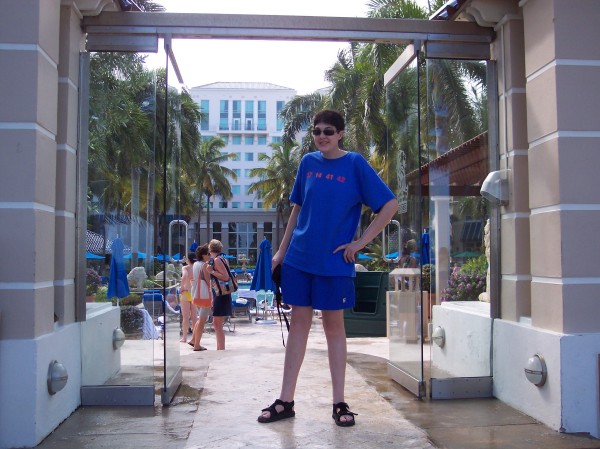
Faith and Fear reader Steve Rogers wasn’t suggesting a yearly compensation package to satisfy the demands of Johan Santana when he visited the Ritz-Carlton in San Juan. He was, of course, showing off the only four (for now) retired numbers in Mets history on his FAFIF t-shirt (click here to get yours), giving it, as Omar Minaya has tentatively bestowed upon us, some sun in January. Reports Steve, “Spotted in the casino, I was asked if I was going to play any of those numbers! Sadly only 14 is available on the roulette wheel, not that I didn’t use 36, 24, 5, 17, 8, 16, 18, 7 and others in heavy rotation, though this past weekend was not my weekend in that casino.”
Can’t wait for 57 to come up a winner at Shea.
by Jason Fry on 30 January 2008 3:13 am Johan Santana has a career record of 93-44. He has a career ERA of 3.22, amassed in a league where they ought to have a keg behind second base. He has struck out 1,381 guys in 1308.2 innings. He has two Cy Young awards on his shelf. He led the American League in strikeouts in 2004, 2005 and 2006. His arsenal consists of an 91-92 MPH fastball, a biting slider and one of the game's best changeups, which makes that fastball look like it's sporting an additional 3 to 4 MPH. He's a lifetime .258 hitter, for Pete's sake. He'll be 29 years old on Opening Day. He's left-handed.
And unless something so awful happens that this blog will immediately be renamed Fire and Famine in Flushing, he's about to be a New York Met.
Despite the press corps biting at his ankles and a traumatized fan base in open rebellion, Omar Minaya locked up a guy who could be the best pitcher in baseball for a stunningly reasonable price: Carlos Gomez, Kevin Mulvey, Deolis Guerra and Philip Humber. Fernando Martinez and Mike Pelfrey remain in our employ. I'd still like an explanation for Lastings Milledge's exile and the firehose of money blasted at Luis Castillo, but these now go in the “oh, by the way” file, to be brought up post-hosannas. Omar's got a lot of credit for being creative and for being persistent, but he pulled off this deal by showing patience that bordered on the superhuman.
We could regret the names of the departed, of course: Gomez held his own in a Shea Stadium trial when he should still have been in the minors, Humber put up not-bad PCL numbers while on the rebound from Tommy John surgery, Mulvey's been talked up as a blue-chipper and Guerra is a 19-year-old with an awesome arm. And, as always, there's the shadow of the past: We root for a team that traded Amos Otis, Jason Bay and Scott Kazmir, after all. On the other hand, we once wondered whether it was worth mortgaging the bright futures of Tim Foli, Floyd Youmans, David West and Alex Escobar for short-term gains. Anybody heard from Geoff Goetz and Ed Yarnall recently?
And we're talking about Johan Santana here, not Victor Zambrano or Kris Benson. Heck, Santana's barely the same species as those two.
What will happen with Santana at the top of the rotation? Can't tell you. How could I? OK, I can predict one bad thing: As you read this, some nitwit in the Met A/V department is excitedly putting Johan highlights to the tune of “Smooth.” (Because the kids today, they go crazy over that Santana.)
But that aside, I can tick off a long list of things that now won't happen:
* I will not stare numbly at Grapefruit League games listening to Rick Peterson telling me that Kyle Lohse has done a great job visualizing success or hearing Omar say that Livan Hernandez “knows how to pitch.” Hearing either of those two beater cars talked up like a vintage, low-mileage Ferrari would have been … well, not devastating, since that's for much greater things in life, such as seasons thrown down the toilet by choking loafers. But it sure would have been disappointing.
* My scenarios for the Mets making it back to the playoffs no longer begin with Pedro Martinez being sturdy, John Maine and Oliver Perez not regressing and El Duque's brittle bones surviving a full season intact. All of those things remain important, but they're no longer the foundation without which all higher aspirations crumble.
* I will not have to read Marty Noble wax eloquent about the inherent nobility and wise perspective of Tom Glavine, as prelude to pointing out (correctly) that the Mets never found a replacement for his innings.
* The inane chatter of pitchers and catchers will be about how Santana has changed the clubhouse dynamic (or whatever), instead of 63 billion questions about the worst collapse in baseball history.
And finally, there it is. For once, the talk-radio gasbags were right: If ever a club desperately needed a page turned, it was the current incarnation of the Mets. By collapsing on the final day of the season, there was no way to turn that page. With no next chapter, there was nothing to do but brood over what had happened. The collapse was destined to dominate February and March, to haunt April, and there was the very real danger of it shaping the narrative of late spring and summer. There was no escape.
But it turns out there was a way out. Omar found it, and he didn't even pay the king's ransom we would have forgiven as the price for the key. Here's to Omar. Here's to a clean getaway. Here's to 2008. Here's to Johan Santana.
|
|






