The blog for Mets fans
who like to read
ABOUT US

Faith and Fear in Flushing made its debut on Feb. 16, 2005, the brainchild of two longtime friends and lifelong Met fans.
Greg Prince discovered the Mets when he was 6, during the magical summer of 1969. He is a Long Island-based writer, editor and communications consultant. Contact him here.
Jason Fry is a Brooklyn writer whose first memories include his mom leaping up and down cheering for Rusty Staub. Check out his other writing here.
Got something to say? Leave a comment, or email us at faithandfear@gmail.com. (Sorry, but we have no interest in ads, sponsored content or guest posts.)
Need our RSS feed? It's here.
Visit our Facebook page, or drop by the personal pages for Greg and Jason.
Or follow us on Twitter: Here's Greg, and here's Jason.
|
by Greg Prince on 27 November 2007 12:15 pm The players were confident in mid-September.
• “I can't see how we can lose unless we all drop dead,” declared one of the pitchers.
• “I don't see how we can lose unless everything goes wrong,” the starting catcher predicted.
• “I think we'll win now,” was the future Hall of Famer's verdict.
• “We will walk in,” enthused the veteran outfielder.
• “I can't help thinking we are sure to win,” said one of the rookies.
The manager didn't want to stoke the fires — “I am not making any claims just now. It's going to be a hard fight.” — but he had always fancied himself a winner.
The press was impressed, too. The Times said the locals were “practically certain of winning the pennant, having established an almost impregnable position in the race.” One of the other papers insisted on September 20 that the chances New York's National League powerhouse would be overtaken were as likely as a “snowfall on the Fourth of July”.
But it did snow. There was a blizzard of disappointment. The team that couldn't possibly blow it blew it, succumbing to hubris and a hard-charging rival.
It happened in '07, as we know. But it also happened in '08, a scant 99 years ago, covered and enlivened all over again of late by Cait Murphy in Crazy '08, the incredible true story of what she terms with justification “the greatest year in baseball history”. The quotes above, as you might have suspected, were jury-rigged into our post-Collapse context from Murphy's retelling of the 1908 pennant race among the Giants, the Cubs and the Pirates. New York led the pack, Chicago and Pittsburgh stayed on their tails, Fred Merkle didn't touch second…
Listen, there's so much more to 1908 than just the Merkle Game, and it all receives its due and then some by Murphy's hand. I began reading Crazy '08 in early summer, put it aside as I, like my cat, got distracted by newer, shinier objects, but just recently picked and lapped it up. As fate would have it, I had left off on almost precisely the page where New York (N.L.) begins to believe the flag is in the bag. Thus, learning how confident the Giants were entering their final few weeks of play in the light of the events surrounding their descendants' impersonation of two-dozen folding chairs was eerie to say the least. Actually, it gave me chills to read about the Giants nursing a Met-like lead (4-1/2 up with 21 to play, 7 in the loss column) and acting as if the issue had been settled for good.
Everybody thought so. Everybody was wrong.
“Sportswriters can be excused for saying stupid things; it is part of their job,” Murphy offers on page 180. “What is unpardonable is that the Giants begin to preen.”
Why was this bad behavior? Do you have to ask?
“It is unwise to estimate World Series winnings until the season is over; it is essential not to do so in public. The baseball goods demand humility, and when it is not forthcoming, they extract it.”
Superstitious as players were a century past, they may not have fully understood that in 1908. We sure as hell know it in 2007. Still, even taking into account terrible timing and devastating disappointment, I wouldn't go too nuts drawing sharp parallels between the '08 Giants and the '07 Mets.
First off, the Giants didn't collapse. They were outplayed by sizzling competition from Chicago, with Pittsburgh pushing both of them to the bitter end. The Cubs finished 99-55, the Giants and Pirates 98-56. The Mets failed to win an 89th game.
Second, the Giants had Christy Mathewson, who started 44 times and won 37 games. Met victory leaders Oliver Perez and John Maine together started 61 times and won 30 games.
Third, Matty completed 34 of his starts, lessening the need for a prehistoric Guillermo Mota, Jorge Sosa or Scott Schoeneweis to give back one of his many leads.
Fourth, there was the Merkle matter, an inimitable episode that Murphy posits is the keystone moment in American sport. The New York Giants fan that resides inside my soul says we were robbed on September 23 at the Polo Grounds when Fred Merkle didn't touch second as the winning run scored because it was not custom for trailing baserunners to advance to the next base (especially when the field was being deluged by a swarm of bugs, cranks and “fans” — all of which were the same thing). The logical person in my head understands, however, that a rule is a rule (he was supposed to touch second), regardless of custom…though if custom has prevailed all along, then how do you suddenly decide the Cubs can summon a ball, maybe not even the right ball, and force the kid at second when he's just doing what he's been doing all along? The greatest game of its time and maybe all-time was declared a tie and wound up being replayed at the end of the season, which was when the Cubs made off with the pennant and headed for the World Series, which they would win handily…and never again.
If the 2007 Mets were robbed, it's safe to say it was an inside job.
Cait Murphy's book is brilliant as history, riveting as drama, heartbreaking as baseball. I got to meet the author at a New York Baseball Giants Nostalgia Society dinner in July and was delighted to discover she is a Mets fan. Knowing that after finally finishing Crazy '08 leaves me to wonder how much of her massive research resonated for her 99 years after the fact when the Mets made our '07 far crazier than it needed to be.
I still have chills.
The players referenced above, Giants all, are pitcher Red Ames, catcher Roger Bresnahan, Hall of Fame hurler Christy Mathewson, outfielder Cy Seymour and rookie Fred Merkle. The manager is John McGraw and the other paper in town was the New York World.
by Greg Prince on 23 November 2007 4:18 pm I have wasted thousands and thousands of kisses on you — kisses that I thought were special because of your lips and your smile and all your color and life. I used to think that was the real you, when you smiled. But now I know you don't mean any of it. You just save it for all your songs. Shame on me for kissing you with my eyes closed so tight.
—Faye to Jimmy, That Thing You Do!
Met Hell has a new Member. His name is T#m Gl@v!ne.
It is pronounced as it appears: like a curse word.
From here on out in this space, when you see a reference to the pitcher who came to the Mets from the Atlanta Braves in December 2002 but who never, ever gave the slightest impression that he wouldn't have preferred in an instant to be back in Atlanta, it will appear as T#m Gl@v!ne.
Just as it was pronounced on March 31, 2003 when he grimly marched to the mound and surrendered 8 hits, 4 walks and 5 earned runs in 3.2 innings and 32 degrees upon the occasion of his Met debut.
Just as it was pronounced on September 30, 2007 when he trudged to that same pitching rubber under much hotter conditions and gave up 5 hits, walked 2, committed 1 error, hit 1 batter and allowed 7 earned runs in 0.1 innings upon the occasion of his Met farewell.
In saying hello and goodbye, T#m Gl@v!ne posted an earned run average of 27.00.
In between, generally speaking, T#m Gl@v!ne pitched better than that, though it bears noting that he couldn't have pitched any worse. He won 61 regular-season games in five years as a Met, was named to two All-Star teams as a Met, earned two playoff victories as a Met and famously posted his 300th win as a Met. Take away his first and last impressions and T#m Gl@v!ne's Met statistics would give you the impression that he was all right.
Met Hell, however, is not wholly a performance-based destination. In fact, performance isn't the key determinant of whether a Met winds up there. When my partner incorporated Met Hell just over two years ago, he set out the parameters:
[It] takes more than incompetence or not living up to your potential or saying the occasional stupid thing or becoming a Yankee or just being a lunkhead. There's got to be something worse, something that still makes the blood boil…
I like to say style points don't count in baseball, that there's no such thing as a bad win. I would counter that when considering what Met winds up in Met Hell, it's all about style points. It's all about who you were as a Met and how you conducted yourself.
Where T#m Gl@v!ne is concerned, he conducted himself like a professional. That's the word I heard Gary Cohen use on Mets Hot Stove after T#m Gl@v!ne returned to Atlanta. He meant it as a compliment. I don't.
There is being professional, then there is being cold and bloodless. It can probably be viewed an admirable trait under the right circumstances. With T#m Gl@v!ne, it was not. Not here, not as a Met, not at the end of 2007. There was never a worse time to be cold and bloodless as a Met than at the end of 2007. There was never a worse time to be disappointed and not devastated, just as there was never a worse time to compile three consecutive starts in the latter half of September in which you permitted 17 earned runs in 10.1 innings.
We could forgive three consecutive godawful starts from a Hall of Fame pitcher. We could forgive three consecutive godawful starts from any pitcher. We could, perhaps, forgive three consecutive godawful starts at the worst possible moment in team history.
But not when you're as bloodless and cold and professional as T#m Gl@v!ne was as a Met.
Not when the very next thing you do is return to where you were The Enemy and tell everybody what a hardship it was to have been here for five seasons during which you collected massive paychecks and were lavished with praise and gifts for your personal milestone, an event built primarily on your accomplishments as The Enemy. You can wrap it in concern for “trying to keep my family off a plane,” but it still comes off as tasteless self-pity from a man who was paid more than $50 million over five seasons and came up small, smaller and smallest in the last three opportunities he had to come up big as a Met.
Fifty million bucks buys quite a few round-trips on Delta, by the way.
Without labeling it as such, Jason already made the case very well for the induction of T#m Gl@v!ne into Met Hell:
His sneaky alibi-ing, the way he always sounded like he was being diplomatic or philosophical while he was actually blaming his teammates or casting himself as an innocent bystander in the schemes of Dame Fortune.
And without knowing it, one of our all-too-infrequent commenters, Kevin from Flushing, seconded the nomination:
My favorite quote from him on his return to Atlanta was why he didn't come back to New York, because “I couldn't do that to my family”…Seriously?! What's the matter, you don't like your family putting up with unwed mothers, purple-haired guys with AIDS, and people who don't speak English on the 7 train, is that it? I vote that when his plaque in Cooperstown goes up it must have big quotes around “New York, N.L.,” and maybe a few asterisks with it. Ugh…we just HAD TO steal him away from the Phillies in 2003, didn't we?
I've been sort of waiting for some contrarian fan to come along as one often does when I think there's universal agreement on a Met matter and tell us that we're wrong to be so full of bile toward this pitcher, that he was actually somebody's favorite Met, that he will be missed. It hasn't happened — not even the semi-practical concern of replacing 200 innings in the rotation has been mentioned by any of our readers. It is my very strong sense that nobody who calls himself or herself a Mets fan will miss this pitcher.
Jason said he'd like to never, ever think about him again. Amen, buddy. But he will come up in our thoughts and, inevitably, in our conversation. And I won't be able to think of him or speak of him without wanting to curse out the fact that he ever wore a Met uniform along with my decision — born of what I considered fanly obligation — to attempt with as much of my heart as I could muster to respect and accept him as one of our own.
There are phrases in this world that rankle me. One of them is “get over it already,” implying as it does that it hasn't occurred to us that life goes on despite our particular personal hangups regarding something that happened before. Sports engenders a lot of “get over it already” sentiment since there's always another contest and another season on which to concentrate our fullest energies, and nothing's more important than forward progress. Didn't like that call, that decision, that trade? Get over it already.
If I'm at the stage where somebody is telling me to get over it already, I'm probably not going to. If I'm not past it on my own, it's probably because it meant something more to me than today's random score will. That's how baseball works for me, for a lot of us. I'm not a Mets fan because of what the Mets might do next year, but because of what the Mets — individually and collectively — have done for me every year up to this year. I wouldn't care about next year if not for all the years before. I don't forget that. I don't get over it already lightly.
But I have, in my own way and on my own time, tried to get over already what I've considered the ungetoverable. The future is all there is to look forward to in any year. I don't want to miss it altogether.
So I tried to get over my twinned inclinations from five winters ago. I tried to stop being upset and angry that in a three-day span my favorite Met of his time was dispatched to free agentry and my least favorite Brave of his time was signed to a large Met contract and had his face slapped on the front of Met yearbooks and Met pocket schedules and his name on the back of giveaway Met t-shirts.
It may not have been the plan to literally replace Edgardo Alfonzo with T#m Gl@v!ne — I understand that not retaining an infielder didn't directly affect the inking of a pitcher except perhaps by way of an allocation of resources — but the sequence of events from December 2002 charred my soul in a way that all the losing in Metdom couldn't. My identity with and affinity for the Mets of the previous half-decade, coupled with my corresponding disdain for their archrivals, was all at once invalidated. The Met era I'd loved more than any other, already evaporating in '02, was now completely gone.
With the success of '06, I thought I'd gotten over it already. Other Mets came along to help me push the loss of Alfonzo and what he represented to me (believe me, I'm not going to argue on behalf of his post-2002 production) into the past the way others had always come along to help me push the loss of previous favorites into the past. If T#m Gl@v!ne was helping my new favorites create the better future of which I'd been dreaming since '02…well, how bad could the guy be?
After the way T#m Gl@v!ne comported himself on the mound and in front of microphones in his final scenes as a Met, I can't tell you how sorry I am that I caved even that much. The 61 regular-season wins weren't worth it. The All-Star berths weren't worth it. The playoff victories weren't worth it. None of it was worth it. Rooting hard for a guy you just don't like never is.
Thus, he's condemned to Met Hell. He can take his 300 golf balls with him and he can tee off to his heart's content on the steamiest 18 holes in creation…if he can unglue them from that piece of plywood to which they were stuck. And he can play in a foursome that includes Guillermo Mota, Mike Stanton, Braden Looper or any of a rotating series of inept former Met relievers who blew leads and cost him wins. And when he thinks he has an off day, he can rush to the airport and discover all the flights out of Met Hell have been interminably delayed.
They always are.
Also, he enters Met Hell as T#m Gl@v!ne. Since he was a curse on our franchise's history, it is only proper that when you see his name printed here, at least under my byline, you will see it spelled exactly the way it would be spelled in a forum where the explicit spelling of curse words is discouraged.
I've wasted enough curse words on him already.
But let's not be entirely unreasonable about this. He did win those two playoff games, did make those two All-Star teams, did not unleash firecrackers in the Dodger Stadium parking lot. There are worse villains in Met Hell. That's who the Sixth, Seventh, Eighth and Ninth Circles are reserved for.
T#m Gl@v!ne will now and forever be ensconced in the One-Third Circle of Met Hell. We might have assigned him a few circles lower, but he proved on September 30 that one-third is as deep as he goes when it really counts.
by Greg Prince on 21 November 2007 3:13 am First Glavine, now Mota. Gone and gone! Ohmigod, what have we done to deserve this? Not having to root any longer for two guys I and, I suspect, most of us never wanted on the Mets must be like when your sentence is suspended by a kindly judge or president. It’s a Get Out Of Mezzanine Jail Free card…twice!
Who’d we get for Guillermo the choking, cheating coward who sucks on so many levels that I do believe he is the perfect storm of suckitude? Does it matter? Not really. But it’s a catcher, Johnny Estrada, the dude who mixed it up with Ned Yost in the Miller Park runway last August. Johnny Estrada, to whom I have always referred privately as Johnny Blue Jeans for no reason except the name stuck in my mind from a show I never watched but for which I saw a ton of commercials ten years ago, is pretty good I seem to recall (until somebody produces those helpful stats that will make me realize what a disaster he is and how I’ll be an idiot for enjoying his first RBI), though he does move from club to club quite a bit. Is there a correlation between his being on his fifth team in eight seasons and his personality? The fighting with managers maybe? Is he some kind of catching Bruce Chen? Whatever. I’m guessing he’s better than our heretofore tentative 2008 starting catcher, which was slated to be 40% Ramon Castro and 60% I Don’t Know.
And I don’t care. Not when Mota’s out the same door Glavine just went through. You give me anything short of food poisoning for Mota and it will be a Happy Thanksgiving.
by Jason Fry on 20 November 2007 2:18 am I'm not devastated, but I am disappointed. Devastated is a word used for greater things in life than a game. I was disappointed in the way I pitched. I got some ground balls, but I can't control where they go. A couple got through. Another was too slow to turn a double play.
— Tom Glavine, Sept. 30, 2007
Yes, he's gone south, less than two months after he played his part in helping our season do the same. As a parting gift to go with the 300 golf balls and the $50+ million, I'd like to send him off with whatever bile I can spare, and to fervently wish that he never return. I don't care if that means sacrificing the chance to boo him, or to watch some gang of 2008 Mets beat him around on a day when the ump isn't giving him the wide strike. I have thought and written far too much about him over the last five years, and I'd love for this to be the last time I do so. Though I know that won't be true.
Glavine's final failing — that endless, awful seven earned runs in a third of an inning — wasn't what did it, though it certainly didn't help. Nor is it that he returned to the Braves, though that makes for some nicely loathsome symmetry. It was what he said after that horrific final start that tore things irrevocably.
Remember (I promise it'll only be for a bit) what the afternoon of Sept. 30 felt like, what it was like watching nearly a year of hopes and dreams gurgle down the toilet? OK. Now, re-read those words at the top of this post again.
That quote — that astonishing, awful quote to end a month of astonishing, awful quotes— perfectly sums up all the reasons I only fitfully warmed to Tom Glavine, and why I'd like to never, ever think about him again. It's all there. His sneaky alibi-ing, the way he always sounded like he was being diplomatic or philosophical while he was actually blaming his teammates or casting himself as an innocent bystander in the schemes of Dame Fortune. (Here's a sampler of Glavine-speak from this blog's early days.) Never mind the ball he threw clean over David Wright's head in that endless third of an inning, clearing the bases, or the pitch — his final one as a Met, as it turned out — that hit Dontrelle Willis with the bases loaded. Got some ground balls, can't control where they go. Oh well.
And then there's his aloofness, never expressed more noxiously than here, with Glavine waxing philosophical while fans cried in the stands. Devastated is a word used for greater things in life than a game. Look, I bow to no one as a Met fan. (OK, I bow slightly to my co-blogger.) Even at my most livid that day, I was perfectly aware that, as the old saying goes, it wasn't my wife and it wasn't my life. I didn't need lessons from Spouting Thomas to put the disaster he'd completed in perspective.
By the way, Glavine wasn't the only one discussing disappointment and devastation that day. Those terms were heard elsewhere in the Met clubhouse — but in a somewhat different context.
To say disappointed would be the understatement of the year.
— Shawn Green, Sept. 30, 2007
We're devastated, also.
— Willie Randolph, Sept. 30, 2007
I don't know if Shawn Green was really in a state beyond disappointment, or if he was just saying the right thing. I have no reason not to think it's the former, but even if it's the latter, as a fan I'm grateful. I'm inclined to believe Willie Randolph — if you read Wayne Coffey's long, characteristically great piece this weekend, you probably are too. (More on that another day.) As for me, when the Mets' collapse was complete, I wrote how I was OK. Which I was. But that was a post addressing how I'd turned my back on the 2007 edition of the Mets some time before. The year? That's different.
I will think about the wreckage of 2007 off and on for my entire life. Years after the events, I'll suddenly realize I've been spending 10 minutes fuming about Gary Carter packing his gear as Orel Hershiser smothered us, or Armando Benitez and [insert one of several players here], or Jay Payton getting thrown out at third, or Kenny Rogers throwing ball four, or Carlos Beltran straightening up at the plate. 2007 was about falling out of love with a team, about learning to doubt players I'd come to trust, about enduring what I normally cherished. And sometimes, in the middle of the night, I fear it'll be about more than that — about how a plan for returning a ballclub to glory started to go horribly wrong. 2007 was devastating, and I'm not the least bit ashamed to feel that way. I'm a fan. Of course that's how I feel.
That Tom Glavine didn't feel our final defeat as deeply as we did is one thing — we rarely if ever discuss this, because it's the third rail that separates fans and athletes, but deep down we know few of our heroes care the way we do. That having failed so utterly, he chose to lecture those of us who cared more, even if it's just a game and therefore one of the lesser things in life? That's another thing entirely. That's when he touched that third rail. That's when he became unforgiveable.
by Greg Prince on 19 November 2007 4:45 am AP reports Tom Glavine, last seen walking off the Shea Stadium mound after surrendering five of eventually seven runs after hitting Dontrelle Willis with the bases loaded in the first inning of the final game of the year with the National League Eastern Division title on the line, is going back to Atlanta for good. He will officially be a Brave in 2008 after wearing a New York Mets uniform for five seasons.
I am neither devastated nor disappointed.
See you in Met Hell.
by Greg Prince on 18 November 2007 1:36 am This weekend, in honor of November 17 being Tom Seaver’s 63rd birthday, we offer you the following eleven pitchers…
Kevin Brown (not to be confused with the Kevin Brown who hit the wall for the Yankees in 2004 or the Kevin Brown who pitched two innings for the Mets in 1990), Ron Darling, Sid Fernandez, Wes Gardner, Dwight Gooden, Tim Leary, Jesse Orosco, Doug Sisk, Craig Swan, Walt Terrell, Floyd Youmans
..two catchers…
John Gibbons, Junior Ortiz
…seven infielders…
Hubie Brooks, Dave Cochrane, Ron Gardenhire, Keith Hernandez, Kevin Mitchell, Jose Oquendo, Eddie Williams
…and six outfielders…
Terry Blocker, Lenny Dykstra, Stanley Jefferson, Darryl Strawberry, Herm Winningham, Mookie Wilson.
We give you those 26 players because that’s what the Basic Agreement in effect on January 20, 1984 said we could do what we want with them. Every other Met was up for grabs.
In case you’ve forgotten or were never quite sure, the Mets and every Major League team were annually required to offer just about everybody in their organization to a monstrosity known as the free agent compensation pool. That’s what the 50-day strike of 1981 boiled down to: free agent compensation. Owners wanted direct compensation from the team that signed a free agent, but players objected because they feared it would limit their employment possibilities. The pool was the settlement. The owners wanted to protect somewhere between 15 and 18 players. The players wanted to protect 40. It wound up being 26 for a Type A free agent, 24 for a Type B.
And that is how we lost Tom Seaver the second time. Pitcher Dennis Lamp (Type A) left the Chicago White Sox as a free agent and signed with the Toronto Blue Jays on January 10, 1984. Ten days later, the White Sox were permitted to choose any player whose club did deem him unpoachable. They didn’t have to choose a Blue Jay. They could choose from any franchise.
The Mets franchise did not protect the Mets’ Franchise. The White Sox noticed and picked Tom Seaver to replace Dennis Lamp.
We get so worked up recalling M. Donald Grant, Dick Young and June 15, 1977 that we tend to gloss over January 20, 1984. Of course the seasons that succeeded the latter black date in New York Mets history were a vast improvement over what had come directly before, so it was easy to sort of look past the second Seaver debacle while we were contending again. The Mets won 90 games in 1984, so no harm done, right?
But it wasn’t any less of a spiritual debacle than the first time the Mets let Seaver go. The PR was bad and the competitive aspect wasn’t all that helpful either. It was shameful and disgraceful and incompetent. If Grant’s trade of Seaver in ’77 was unforgivably malevolent, Frank Cashen’s decision to gamble on Seaver not being chosen by another team in ’84 was criminally negligent. It had taken more than five years to bring Seaver back where he belonged. It took one quick year to watch him walk away again. Where once we got Henderson, Flynn, Norman and Zachry, now we got nothing but grief.
The worst part? Worse than no longer having Tom Seaver be a New York Met a second time? It’s looking at the list of players who were deemed more worthy of protection by the Mets than Seaver.
Mind you, Tom had turned 39 the previous November 17, so he wasn’t quite in Cy Young trim any longer. Still, he had given the Mets a pretty good show in 1983, beginning with his triumphant walk in from the bullpen at Shea on Opening Day. The W-L was tepid (9-14 on a 68-94 club) but the ERA was respectable (3.55) and the 231 innings were hefty — led the team, in fact. Plus he was Tom Seaver, a Hall of Fame head attached to a capable arm linked to a stature second to none among New York Mets.
“As soon as I got their list, I looked to see which kids they protected,” White Sox GM Roland Hemond said in Jack Lang’s The New York Mets: Twenty-Five Years of Baseball Magic. “But when I saw the list and saw that Seaver was not protected, I almost jumped out of my seat. Seaver, in my mind, was still a quality pitcher who could win ten or fifteen games. Where are you going to get someone who can guarantee you that? That’s the reason we picked Seaver.”
Still, if you had to choose between protecting 39-year-old Tom Seaver and 19-year-old Dwight Gooden (who turned 43 on Friday, though I contend he’ll always be 24-4), there was no question you’d go with Doctor K. You’d have to see some kind of doctor if you didn’t. Gooden, Ron Darling, Sid Fernandez…these pitchers were clearly the future of the team. Of course you wouldn’t risk exposing them in a draft, even one that was cockamamie.
But didja see some of the other names, names of Mets players who were protected instead of Tom Seaver? I do believe the acronym “WTF?” was invented for just this scenario.
As we are almost 24 years beyond Debacle II, we know a few things. We know it was right to hold Doc and Ronnie and El Sid in abeyance. We know you wouldn’t have dangled Keith Hernandez or Darryl Strawberry if your life depended on it. We know Jesse Orosco had just come off a legitimate All-Star season and was, save for Bruce Sutter, the best closer in the N.L. at the time. In January 1984, these six Mets were unquestionably untouchable and history bears out that designation.
That leaves twenty Mets considered less expendable than Tom Seaver. Two of them, Hubie Brooks and Mookie Wilson, had established themselves as regulars, though neither was quite untouchable at this juncture. Brooks was an adequate third baseman with not a lot of power. Centerfielder Wilson didn’t get on base enough for a leadoff man (new manager Davey Johnson would drop him in the order). But they were regulars and in the spirit of Hobie Landrith, you were going to have a lot of balls get by third and through center if you lost your starters at those positions. Hubie and Mookie had plenty of good baseball left in them, so we can’t argue with reserving their spots.
That brings us to 18 Mets, several of whom had shown promise in 1983. Doug Sisk — don’t laugh — was a sharp setup man in his first full Met year. Somebody had to get the ball to Orosco in 1984, and Sisk would indeed be very good at that for a while. Junior Ortiz was considered something of a coup when he was acquired the previous June, an outstanding defensive catcher who was penciled in to get most of the work behind the plate in the coming year. Jose Oquendo was just a baby, having turned 20 in ’83 and had longtime starting shortstop written all over him. Walt Terrell, while not in the sensation class of Gooden, Darling and Fernandez, showed flashes of dependability in his midseason callup (and, as everybody who was a sentient Mets fan then probably remembers, he hit three homers as a rookie).
Let’s give Cashen those four players in the context of January 1984, which leaves us 14 Mets to consider instead of Seaver. Really 13, because before you can say “Craig Swan was clearly washed up by 1984,” he had a no-trade clause, which made him poolproof. So you couldn’t replace Seaver with Swannie on the unprotected list even if you wanted to.
Some guys clearly look like very bad choices in hindsight, but let’s try to think in January 1984 terms. Five of the remaining 13 protected players had been top picks in a fairly recent June amateur draft. Just as you wouldn’t take a chance on giving up Strawberry (1980) or Gooden (1982), it was reasonable for the Mets to keep their hands on Eddie Williams (their No. 1 and fourth in the nation in 1983) and Terry Blocker (same status, 1981). You could argue they were not genius picks in the first place, but that’s another story. You can’t risk them while they’re still practically in utero. Likewise, Stanley Jefferson (’83) and John Gibbons (’80) had been first-round picks in years when the Mets had a surfeit of first-round choices. Those two still had a real shot at big league success.
The other top June pick was Tim Leary, the Mets’ first selection in 1979, a hard-throwing righty who had gone through all kinds of arm-rehab hell to get back in the Mets’ plans by 1984. In fact, he was supposed to become Tom Seaver once and, as he was only 25, perhaps again.
So let’s give the benefit of the doubt to not making available these five youngsters thought to have high ceilings entering ’84. That brings the total down to eight players the Mets protected instead of Tom Seaver. Since I don’t think we have to think too hard about Lenny Dykstra and Kevin Mitchell given what they would contribute in short order and become in the long term, we’re really down to six Mets. Let’s examine them individually.
Floyd Youmans was a second-round amateur pick the same year Gooden was selected in the first round. In fact, he was Gooden’s pal. He hadn’t put up hellacious numbers in the minors like Doc, but he was the same age as Dwight. You can’t be risking Floyd Youmans in January 1984.
Herm Winningham was the Mets’ first pick in the old January amateur draft in 1981. He swiped 50 bags at Lynchburg in ’82. That’s a lot of stolen bases in an era when speed was highly valued. You can’t be risking Herm Winningham in January 1984.
Kevin Brown, one of twelve different Kevin Browns who have been drafted by Major League clubs since 1981 if not nearly the most famous of them, was a first-round January pick in 1983. In his first professional season, at Columbia, he struck out 221 batters in 170.2 innings. Though he would never rise above Double-A, you can’t be risking this particular Kevin Brown in January 1984.
Frank Cashen is pardoned for those three. In fact, he’s pardoned for everybody mentioned in the preceding paragraphs, which encompasses 23 of the 26 Mets who were protected instead of Seaver. Some contributed big-time to the Mets of ’84, ’85 and especially ’86. Three — Brooks, Youmans and Winningham — helped bring Gary Carter to the Mets, not a bad historical consolation prize if we’re talking Mets Hall of Famers. Some did nothing but sure looked like they’d do something. You can’t fault Cashen for not having the clearest crystal ball on the block.
But the remaining three? The three who had to be kept at arm’s length from the White Sox instead of Tom Seaver? Ensuring their continued Metliness in lieu of Seaver’s was worse, worser and worst. In terms of risking Tom Seaver, they were January 20, 1984’s Worst Decisions in the World.
1) The Mets took precautions to reserve Dave Cochrane instead of Tom Seaver. Who the hell was Dave Cochrane?
Dave Cochrane was a third base prospect chosen in the fourth round by the Mets in 1981. He wasn’t quite 21 on the day Tom Seaver was plucked by the White Sox. Would have Dave Cochrane been chosen instead? Cochrane did show pop in the low minors: 22 homers in 70 games at Little Falls in ’82, then 25 in 120 at Lynchburg. Of course he struck out more than 100 times in both seasons. The Mets had Hubie for third base, though as mentioned, Hubie wasn’t much for homers. Hmmm…you know, the White Sox would eventually accept Dave Cochrane in a trade for Tom Paciorek in 1985 (the Jeff Conine of his day, as our friend CharlieH put it to me this past September), but that seemed more an out-of-it team dealing a veteran for whomever they could get swap than Dave Cochrane as holy White Sock grail. Cochrane’s Met stock dropped like a rock after Howard Johnson came aboard. It kept dropping as Dave journeyed through five American League seasons, accumulating about 500 at-bats with the Sox and Mariners and homering only eight times. Couldn’t have known that in ’84, but scouting’s got to be worth something.
The Mets were never satisfied with Hubie Brooks or third basemen in general, yet here we have to go with hindsight. It was a bad call to protect Cochrane over Seaver.
2) The Mets took precautions to reserve Wes Gardner instead of Tom Seaver. Who the hell was Wes Gardner?
Wes Gardner is the first Met prospect I can recall being groomed (or at least hyped) as a potential closer. Drafted in the 22nd round of the June 1982, draft, the righty struck out around a batter an inning at Little Falls and Lynchburg, saving 15 while used exclusively in relief in 1983. He would be 23 in 1984, when he eventually made it to the big club off a big year at Tidewater (20 saves, 1.61 ERA). It was almost foresightful of the Mets to think in terms of cultivating a reliever instead of just converting a failed starter. I almost can’t blame the Mets for being certain they would hold onto him. I can definitely understand the attraction. And Lamp, the guy who started all the trouble, led the White Sox in saves in ’83 with 15. Chicago needed to replace him.
But freaking Wes Gardner proved to be freaking Wes Gardner when he actually got a chance in New York, and if you can remember freaking Wes Gardner when he got his chance, you know he was totally freaking Wes Gardner. After 37.1 mostly dispiriting innings in ’84 and ’85, Wes was shipped north to Boston as part of the deal that brought us Bobby Ojeda. As the Red Sox had tired of Ojeda after ’85, I have to believe Gardner wasn’t the make-or-break element of that key trade. It was a bad call to protect Gardner over Seaver.
3) The Mets took precautions to reserve Ron Gardenhire instead of Tom Seaver. We knew who the hell Ron Gardenhire was.
And you have to be totally kidding me that Ron Gardenhire was protected from the compensation pool instead of Tom Seaver.
For that matter, Ron Gardenhire was protected instead of Calvin Schiraldi, Mike Fitzgerald, Brent Gaff, Tom Gorman, Wally Backman, Brian Giles, Ed Lynch, Mike Torrez, Rusty Staub, Danny Heep, Ron Hodges, John Christensen, John Stearns and George Foster to name a whole bunch of 1984 Mets who, whatever their perceived liabilities that January or in retrospect, I would have protected over Ron Gardenhire. The Mets protected Ron Gardenhire over Dave Kingman, who was still rotting on the roster in wait of his inevitable release, and I would have kept Kingman — no matter that he was completely obsolete as a Met after the acquisition of Keith Hernandez — over Gardenhire.
Ron Gardenhire hit .062 for the Mets in 1983. He drove in one run. He stole no bases. He lost his shortstop job early to Oquendo. What was clever on his part that year was by getting demoted to the Tides, he wound up catching the eye of Davey Johnson, who totally dug his spit and vinegar. Ron Gardenhire remastered Triple-A in 1983 after having done the same in 1981. Gardy became a Davey special in ’84, like Backman, like Kelvin Chapman, like Jerry Martin. He hit .246, ceded short to Rafael Santana after an injury (before Santana got hurt and gave way to Brooks who had given way to Ray Knight at third down the stretch) and wasn’t a regular or semi-regular again. Where the unforeseen revival of the Mets in 1984 is regarded, Gardenhire wasn’t on the same map as Wally Backman, was less of a help than the shockingly resuscitated Kelvin Chapman and not that much more of a factor than the legendarily useless Jerry Martin, no matter how much spit and vinegar he displayed at Tidewater a year earlier.
He would eventually become a heckuva manager for the Twins, but protecting Ron Gardenhire over Tom Seaver was a hellaciously bad call by the Mets general manager. Cochrane and Gardner at least had promise attached to them. Gardenhire had peaked in the minors and hadn’t proven anything in the majors.
And who the hell, given the chance to peruse 25 organizations’ depth charts, was going to skip over everybody else available in all of baseball to grab a 26-year-old middle infielder of limited range in the field and no particular accomplishment at bat? Admittedly, the White Sox were no great shakes at short (though the combination of Scott Fletcher and Jerry Dybzinski had just helped them to a division title in ’83), but they did have Ozzie Guillen developing in the minors. In other words, there was no legitimate chance in this or any life that Chicago would have chosen Ron Gardenhire instead of Tom Seaver…or any of the couple of thousand players left unprotected by every other club. None.
And even if they had, so what?
But the Mets protected Ron Gardenhire and left Tom Seaver hanging on the vine. And as Seaver himself would learn in his future endeavors, you always pick the most enticing grape you see. The White Sox thrived on starting pitching in 1983, and adding Tom Seaver figured to make them that much stronger. It didn’t, but it wasn’t Seaver’s fault. Seaver went to a new league and won 15 games in 1984 and 16 more (including his 300th) in 1985. Even at ages 39 and 40, he clearly had Amoco Unleaded left in the tank.
The Mets, on the other hand, had to improvise those two years among a series of fourth and fifth starters, none of whom — Lynch, Leary, Torrez, Bruce Berenyi, Rick Aguilera chief among them — was a better bet than Tom Seaver at that stage of their careers. Aguilera was the best of them, winning 10 games in ’85, yet when it fell on his young shoulders to keep the Mets alive in the final week against the Cardinals…well, imagine you could throw Tom Seaver in a pennant race instead of a visibly nervous rookie.
There was a mid-’80s narrative that suggested the absence of Seaver accelerated the arrival of Gooden, but it’s hard to imagine the presence of Seaver would have impeded the arrival of Gooden for very long. The kid was too much of a phenom to be kept down on the farm. Imagine that phenom and that Hall of Famer on the same pitching staff in ’84 and ’85 and maybe ’86 and ’87.
In the aftermath of Debacle II, Don Fehr of the Players Association told Murray Chass in The Sporting News that Seaver’s involuntary transfer “indicates that everybody would have been better off if they had left everything alone” where free agent compensation was concerned. “The system forced the Mets to make choices they didn’t want to make. The system put the Mets in a position to make choices and run risks. It’s needless and it’s silly.”
Soon enough, everyone basically agreed the Basic Agreement could do without the compensation pool. It died in the next negotiation…but not before any chance that Tom Seaver would finish his brilliant career as a Met, win his 300th game as a Met, pitch in another World Series (or two) as a Met and enjoy an uncomplicated retirement as a Met died as well.
Dennis Lamp was a good pickup by the Blue Jays. He went 11-0 for Toronto’s division winners in ’85. And I curse his name every time I see it.
by Greg Prince on 18 November 2007 1:30 am 
There was about a five-second window when all was right with the New York Mets, when Tom Seaver and Dwight Gooden wore Met uniforms together. This was June 6, 1987, the day after Gooden returned from drug rehab to beat the Pirates and the day Seaver began his final attempt at pitching after injury and collusion had kept him sidelined since September of ’86. Other than simulated games and an exhibition start against the Tides, Tom never pitched for the Mets after October 1, 1983 and, sadly, was never actually on the same staff as Doc.
Happy 63rd birthday to Tom Seaver (born November 17, 1944) and happy 43rd birthday to Dwight Gooden (born November 16, 1964). You’ll both always be at the top of my rotation.
by Greg Prince on 18 November 2007 1:25 am 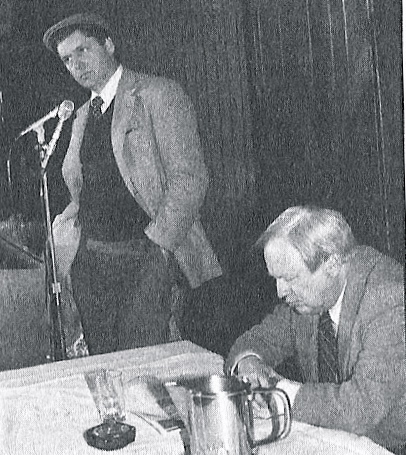
After his wildly wonderful 1983 homecoming, it was a kick in the gut (and probably lower) to watch Tom Seaver say goodbye a second time after a rightfully downcast Frank Cashen left him unprotected in the monstrosity known as the free agent compensation pool in January of ’84. The Chicago White Sox chose Tom Terrific to make up for losing Dennis Lamp to the Toronto Blue Jays, which shows how effed up baseball can get.
Not that I followed Tom Seaver around in the winter enough to know if this was normal headwear for him, but I was always struck by the vaguely European driving cap he sported in this, his adios again press conference. I’ve always wondered if that was his angry hat or something. Didn’t even take it off indoors, y’know?
by Greg Prince on 18 November 2007 1:22 am 
It was so great to have Tom Seaver come home again on April 5, 1983, almost six seasons beyond the wretched trade that turned him into an ex-Met.
by Greg Prince on 17 November 2007 10:17 pm Forget what I said about not writing off Yorvit Torrealba before we have a chance to fall in at least like with him. We will not have that chance, so write him (like Lo Duca) off all you want. Newsday is reporting our once future but neither once nor future platoon catcher has opted out of his Mets contract without ever opting in.
He didn't sign, he isn't signing, he isn't gonna sign. No agreement, no negotiations, no Torrealba, no Castroalba.
DiFastro, anyone?
|
|






