Faith and Fear in Flushing made its debut on Feb. 16, 2005, the brainchild of two longtime friends and lifelong Met fans.
Greg Prince discovered the Mets when he was 6, during the magical summer of 1969. He is a Long Island-based writer, editor and communications consultant. Contact him here.
Jason Fry is a Brooklyn writer whose first memories include his mom leaping up and down cheering for Rusty Staub. Check out his other writing here.
Got something to say? Leave a comment, or email us at faithandfear@gmail.com. (Sorry, but we have no interest in ads, sponsored content or guest posts.)
He's been a constant companion to this team even when thousands of miles away, even when the team was in first place and he didn't have a single IP next to his name. What's the latest on Pedro? Is he long-tossing? Making a rehab start? How'd he feel the day after the rehab start? When's he expected back? After the All-Star break? In August? When rosters expand?
Accompanying those questions were others — enough other questions to support a cottage industry of Gotham sportswriters. Was Pedro the best trading-deadline addition any team in the league would get? Would he restore the Mets' swagger? What would the Mets do if his rehabilitation went awry?
To be honest, sometimes it got kind of annoying, the waiting on Pedro. Not because of the man himself — he was down in St. Lucie or in the Dominican working his ass off to beat the knife, his own accumulated mileage and the doubts that can doom an athlete in twilight. No, what was annoying was the way the constant questioning gave short shrift to all the Mets had become. Few of us are sold on the 2007 Mets the way we were on the 2006 edition, but this is a first-place team without Pedro J. Martinez — just as the 2006 team clawed to within an extra-base hit of the World Series without him. Pedro was always a mournfully empty place on the roster and in the clubhouse, but to suggest the team was just treading water until his return was to insult the work of Wright and Reyes and Beltran and Maine and Perez and Glavine and El Duque and Feliciano and Wagner and all the other players who have brought the Mets to the brink of a second-straight magic-number countdown.
And yet yesterday was something special, as my co-blogger recounted. Down here on LBI, each time I looked at a clock in the morning there was a countdown in my head that hadn't been there the day before, even with the Mets trying to send the Braves into winter. 9:15 — four hours till Pedro. 11:30 — 90 minutes till Pedro. Charlie Hangley — a.k.a. CharlieH in our comments section — and I spend the same week on LBI, and had looked forward all summer to linking up. The day that worked wound up being Pedro's day, so around 1 Emily and Joshua and I headed up Long Beach Boulevard to their house for food and beer and kind-hearted camaraderie. (Many thanks to Charlie and Sarah for their hospitality — double FAFIF shirts pic coming when I can upload a photo.)
The buzz surrounding the game increased exponentially once we got our first look into the Met dugout. Over the years at weddings I've calmed a few nervous groomsmen who've worked themselves into tizzys over where they're supposed to look and what direction they're supposed to face. This is the easiest thing in the world, I've told them. You just look at the bride. Well, Pedro was the bride. Before Aaron Harang took the field, you could find Pedro simply by looking where the rest of the Mets were looking — and laughing and dancing. Whether it was an uncharacteristically animated Moises Alou or a characteriscally animated Lastings Milledge, one by one they waited for him, and once he came near they sprang to life in a way we're not used to seeing from professional athletes in their never-get-too-high, never-get-too-low worlds.
All very nice, but none of it would have meant much if Pedro had been hammered by Cincinnati. But he wasn't. No, he didn't have his killer arsenal of years past, but those weapons were decommissioned some years ago. What he had left was more than enough — he touched 90, changed speeds and threw strikes by the bushel. Defense and mischance undid him in the first (a Philliesque roller by Josh Hamilton, a bad break by Alou on a catchable ball, a Beltran heave to the plate that was just to the first-base side), but he shook it off and started simply erasing the Reds. Dunn. Valentin. Hatteberg. Encarnacion. Harang. Hamilton. Gonzalez. Griffey. Phillips. Nine Reds in a row retired before a spot of trouble in the fourth on more shoddy defense. So much for the gloomy talk about the difference between kids in the Florida State League and big leaguers.
And then the fifth, Hamilton on second, one out, Griffey at the plate with the deadly Brandon Phillips and slugging Adam Dunn behind him. At Charlie's house I think we all subconsciously leaned closer to the set. Whatever the radar gun showed, however the shoulder is now rebuilt, from the neck up the man on the mound was every bit the old Pedro. Looking in at Griffey, you could see him gather himself and narrow his eyes, his expression not growing cold so much as becoming blank, as if his will had shoved everything else aside. Pedro isn't a particularly big guy — he's got half an inch and a few pounds on me — but seeing that look on his face I would rather do anything than find myself between him and something he was determined to do.
He walked Griffey, I doubt with any particular regret, then bore down on Phillips and Dunn, coming back from 2-0 to get Phillips to fly out and getting Dunn to hit his pitch. And you know what? It wasn't particularly a surprise.
Mentally, Pedro Martinez can beat anyone in the game. We and he had grown so used to this that it was frankly shocking to him and us alike to realize, in those dark days against Atlanta and Pittsburgh, that his body had failed to the point that that will was unmoored and useless. Red Sox fans had seen him annihilate the Indians with half an arm; we'd really half-believed that with no arm he was more valuable than most pitchers. Of course that wasn't true, but whatever arm surgery and rehab have given him sure look like enough to give that will a vehicle to work through, and to electrify a ballclub and its fans once more.
When Joshua is older, I'll tell him about lots of players he's now too young to remember. And when the conversation comes round to Pedro, I'll tell him that 90% of what he'll read about intangibles and “beyond the box score” is claptrap. Then I'll tell him that Pedro Martinez was the other 10%. With Pedro, every legend was absolutely true.
I’d had a vague plan to go see the Glory Days exhibit at the Museum of the City of New York today. It’s been on my to-do list since before it opened and it’s right up (or, technically, across town from) my alley.
But then I learned Pedro Martinez would be starting in Cincinnati. That’s enough glory for any day.
Pedro is back. Pedro is back. Say it again ’cause it feels so good…Pedro Martinez is an active pitcher for the New York Mets once more.
It wasn’t just a glory day. It was a spiritual Opening Day II.
How is it that Pedro Martinez has only pitched one Opening Day for the New York Mets? He was on a different schedule (he usually is) in ’06 and was busy pounding an unfathomable comeback trail this past spring. But the first Opening Day, Pedro’s Opening Day, will always stay with you if you’re a Mets fan. You can’t look at us in Cincinnati without thinking of the beginning of the Pedro era, the 12 strikeouts in six innings that told us that this Pedro Martinez, late of Boston, Montreal, L.A. and the Dominican, was going to be a fine fit for Nueva York, for Los Nuevos Mets. With hindsight, you can look past Braden Looper’s anagramic meltdown from April 4, 2005 and just remember Pedro being Pedro.
We’ve got a new and better Great American Ball Park image where our Great American Ball Club is concerned. The layoff is over. The rehab is over. The spate of reports on what Pedro was doing against batters from Manatee and Jupiter is over. Pedro Martinez is all Metted up again. And we are totally Pedroed.
They gave him 75 pitches. He took 76. Five innings, three runs. Not a quality start by definition, only the best one of the year. Command? Yes. Control? Yes. Velocity? Enough. Movement? He’s Pedro. He moves to a rhythm that’s all his own.
Pedro recorded his 3,000th strikeout (I’d like to think the Shea scoreboard lit up at last for him; it’s been known to do so even when he’s not in residence). The inevitable if seemingly unreachable milestone reminded me of another Labor Day, another great Labor Day in Mets history: September 1, 1975. Tom Seaver struck out his 200th batter of the season, the record-setting eighth consecutive season he’d done that. There were all kinds of good signs in that game: Bud Harrelson’s return, Mike Vail’s first homer, the Mets pulling within four of the Pirates thanks to Tom shutting them out.
The year peaked right then and there for the ’75 Mets, but on this day, with Wright and Alou and Castillo and Delgado all contributing and the Phillies losing and our streak growing and our margin lengthening, it doesn’t feel like the end of summer. It feels like the beginning of something better. It feels like Pedro Martinez was on the hill to open 2007 and that the true glory days of these Mets have just commenced.
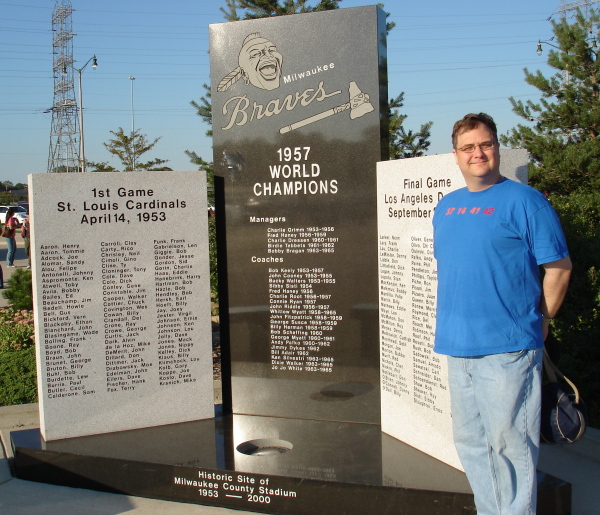
An evening at Miller Park awaits, but Faith and Fear first stops outside to pay homage to dear, departed County Stadium, home to the 1957 World Champion Milwaukee Braves, an outfit that accomplished what the currently located Braves could not manage when called upon: defeat an unsavory New York unit in the World Series. Perhaps it was this ad hoc cross-blessing between our retired numbers and their old Milwaukee glory that positioned the Mets to sweep those deadbeat pretenders in Atlanta the three games that immediately followed. Or maybe we just got good pitching all weekend.
As for the FAFIF shirt, photographed in its dozenth United State (WI joins NY, NJ, PA, DE, MD, GA, FL, TX, MI, IL and IA along with DC and Switzerland in showing off The Numbers), it elicited the following exchange with a Miller Park vendor.
“What’s that? The combination to your locker?” “Casey Stengel, Gil Hodges, Tom Seaver, Jackie Robinson.” “I figured it was something like that. I wouldn’t know because I’m not a Mets fan.” “That’s why I’m here, to spread the gospel.”
We met many fine folks during our brief stay in eastern Wisconsin, but I have to ask…do people in the Midwest really reveal their locker combinations on their clothes?
You never know in baseball. Ecstasy can follow agony can follow ecstasy, round and round, fast enough to make your head spin. You’ll go mad trying to make sense of it, so don’t even try. But I do know this: The Braves are a game over .500, 7.5 behind us and 6.5 back in the wild-card standings with five teams to jump over. Adios, bitches.
“I give you permission to take a vacation from your problems.”
“Not a vacation from your work, not a vacation from daily life…”
“But a vacation from my problems.”
“Exactly!”
—Dr. Leo Marvin's prescription for Bob Wiley, What About Bob?
It wasn't intended to be a break from the Mets. Actually, that's always the worst part, the separation pains. I couldn't even leave them behind practically until the FAA demanded I do so. There I was, sitting at LaGuardia, Gate B3, careful to find a window for the first inning on Thursday afternoon. Perfect reception. Imperfect results almost immediately. It was 2-0 Phillies as boarding was beginning.
It was 10-9 Mets when I landed. I fiddled with the Web function on my presumably ancient (three whole years old) Sprint PCS phone. As we wandered through the terminal of a mostly unfamiliar airport toward a completely unfamiliar van service, I barely looked up. It's 10-9? And we were down 5-0? And he has HOW MANY home runs against us now? I'm not that swift with anything that isn't a simple telephone call, so it was all just a big blur of Burrell on my cell.
We get in the van to take us to our downtown destination. I'm focused on the little numbers and notations that are indicating it is no longer 10-9. It is now 10-10. Billy has thrown like 40 pitches. How long has he been in? Everybody's stealing. Oh crap. The winning run is on. The Mets have finally decided to score runs but neglected to keep from allowing them. What happened to El Duque?
C Utley, the screen reported, singled to right. T Iguchi scored. NYM 10 PHI 11.
I grumbled softly about the result as we sped up the Interstate. I had kept Stephanie informed of every development that I could refresh, knowing full well she was absorbing maybe 20% of what I was prattling on about, processing half of that. I know she doesn't care about Met details, but I always offer her the service (besides, it makes me feel I'm watching the game…or the data with somebody). Anyway, she was playing with her iPod while in the row ahead of us, an old lady who wasn't nearly as loaded with taciturn wisdom as she fancied herself explained she and her husband were in town for a World War II reunion of some sort. The husband, the actual veteran, didn't say much. The driver didn't shut up. He was very intent on playing tour guide.
He was so intent on pointing out the joys of the local art museum and casino and, yes, ballpark, that he was apparently oblivious to the construction all around him on his city's major artery. For while he talked and the old lady yammered and my wife Podded and I stewed over a four-game sweep and a two-game lead, it was left to our emissary from The Greatest Generation to be a hero once more and point out forcefully yet calmly to the driver that you're about to run into that barricade in front of you.
The driver did a quick right swerve. “I didn't see that,” he admitted. Neither did the rest of us who hadn't seen action in The Big One. Like the Mets most of the week, we didn't hit anything. But it was close.
What's wrong with Wagner? I kept wondering.
Unharmed by this closest of calls — I didn't realize how close it was until Stephanie painted the word picture later — I continued to click away at my Sprint, looking for bits and pieces of information that would describe if not explain how the hell we lost 10 to 11, how a seven-game lead had become two, how, how, how? Right out of the van, into the hotel, through check-in, up the elevator and into the room. Wha' hoppen'?
Our hotel's cable system was sadly lacking. ESPN yes, but no Deuce, no News. No telling when video of the Mets and Phillies was going to come up. SportsCenter? When's SportsCenter on again? When would that be in this time zone?
Then, epiphany. I'm on vacation. I'm somewhere else. We didn't come here to sweat the Mets. We're here because people go on vacation and sometimes forget about their — not problems, because if my team's my biggest problem, then I've got no problems, not really…but maybe sometimes you have to unobsess on something that you are normally wrapped up in a little too tight.
The Mets lost a crusher. Let's go take a walk and find some dinner.
And that was how I conducted myself on our trip to Milwaukee, just completed. I didn't forget about the Mets. I wore my black and blue Mets cap, three different Mets t-shirts (including the most beloved if unintentionally elusive Mets t-shirt ever manufactured on a limited basis) and participated in recurring patter with Milwaukeeans who wanted to know what we New Yorkers were doing in, as one store clerk put it, “One Horse Town, Wisconsin,” but I otherwise took a vacation from my team.
Even as I craned my neck left at the out-of-town scoreboard at Miller Park on Friday night (resenting that I had to follow what was happening at Dolphin Stadium every bit as closely as what I was monitoring from Turner Field)…even as I noodged the fellow with the BlackBerry — a Shea season ticket holder also on a ballpark expedition, if you can believe it — for John Maine specifics…even as I heartily applauded the visiting Xavier Nady and the late Warren Spahn when their names were invoked by the PA…even as I flipped my phone back on Saturday afternoon to see what was going on in the Fox broadcast I could have insisted on sitting in the room to watch but didn't…even as I sat on an efficient Milwaukee County Transit System bus and shook my head over six innings and one hit…even as I revived my college-era habit of grabbing the sports section first thing in the morning and poring over every line of the boxscore…even as I carried myself as a Mets fan in full, I took two entire games — against Atlanta in the heat of a division race — off.
It was kind of nice. And it went on just long enough.
Today we flew back into LaGuardia. A van picked us up. Without prompting, WFAN was turned on; 1-1 in the second, according to Howie Rose. “Music to my ears,” I told the driver, a professional who could talk and watch the road simultaneously. He and I spent the ensuing ride deconstructing the bullpen, signing Santana to a long-term contract and hating on the Braves and Phillies with comparable fervor.
It was kind of nicer.
Let me be the 40 gazillionth or so person to note that while it can be good to go away, it's even nicer to come home, especially to…
When you go to the beach, kids, don't assume there'll be an Ethernet cable waiting for you.
Anyway, this half of Faith and Fear is up and running on Long Beach Island, meaning baseball has taken its rightful space alongside sand, sun, water, trips to the grocery store for beer/grilling stuff/etc. and the continuing results of an experiment in how much sugar a four-year-old can hold without exploding.
In my case, of course, “its rightful place” means playing softball with kids one-handed because the other hand has a radio cupped to the ear (like some cut-rate version of Radio Raheem); interrogating all comers from the house about the score, inning, how Pelfrey looks, etc.; and generally fretting and agitating.
Happily, Pelfrey looked superb from each and every report — his story is a small part of the 2007 Mets, but he still could be a large part of 2008 and beyond, and it was nice to know that a difficult season included at least one afternoon in which all comers could see exactly what he can do. And hey, the much-abused bullpen did its job. I howled in anguish when Guillermo Mota entered the game, rejoiced at the double play that allowed him to escape, further rejoiced when he didn't return, heartily applauded Feliciano's pefect inning of work, prayed for at least another run so Wagner's vacation could continue for another day, got that run, and then sat on the beach goggle-eyed as Feliciano absolutely erased the middle of the Braves' order in the ninth. Relievers go through cold streaks; sometimes relievers go through them all together. But they can get hot, too. Right?
Oh, and it's nice doing a cartwheel in the sand when Carlos Beltran hits a home run. (OK, I can't actually do a cartwheel. But I did stick my feet in the air and flop over joyfully.)
And now, today. Rumor has it the safest place in the National League is being a team the Mets are trying to sweep. And I've heard this Smoltz fellow is a pretty fair pitcher. But that's all right — I also heard (sometimes within my own head) that we were dead men walking, and now we seem to be up and running.
Layered into the manifold embarrassment of growing up nonathletic was gym class and the indignity — the season or sport didn't matter — of being picked last or close to it. In my case, there was usually someone considered slightly more pathetic than me so I didn't necessarily go down as Mr. Irrelevant, but being in the final four was hardly solace.
Standing around in a dwindling semicircle as the faster, stronger kids who were inevitably assigned captaincies chose first those comparably capable to their skill sets; then their popular friends; then the less inept-appearing strangers and kids who had just moved into the district; then some kid who I knew I was better than; then some kid whose left arm was in a cast; then some kid who had to be convinced to put down his looseleaf notebook because he'd rather do algebra extra credit than sports; then me…that's a cliché, no matter how authentic its roots. The phenomenon has been covered well on television from Les Nessman's haunting right field flashbacks on WKRP in Cincinnati to Bill Haverchuck's vengeful phone calls on Freaks and Geeks. Funny how there's always a writer around who can relate those feelings years after the fact.
Y'know what didn't help (even if it did in the F&G softball episode, a total classic of the genre) was the well-meaning phys ed teacher who took the schlubs of the class and made us the captains for a day. First jock-type I'd pick (after making a statement by choosing one of my own leadfooted kind) would immediately complain that, “oh, we're not gonna win if Prince is on the team.”
Come to think of it, any time one of the teachers wanted to be a gym class hero and tell one of the regular captains to pick me or a member of my cohort for a change, I'd hear the same thing. Sometimes I'd just shut up and take it, sometimes I'd speak up and mention that's a pretty lousy attitude — how are we supposed to win if you've already decided it's the fault of the (theoretically) worst player in advance of the game?
I may not have had much in the way of talent or stamina, but I sure had desire. I took this stuff so seriously that I still consider the nicest thing anybody wrote in my high school yearbook to be these encouraging words from the gym teacher who took notice of my first-one-on/last-one-off Super Joe tendencies for any game we played: “You're really better than you think. —Mr. L.” (He couldn't have been talking about dodgeball, however.)
This particular rite of humiliating passage occurred to me recently when I was considering the plight of our friend Damion Easley. As noted the morning after the night he went down with that third-degree ankle sprain, I thought of how sad it is that Easley has been playing in the bigs since 1992 and never made it to the playoffs and this appeared to be his golden shot at it and now, barring miraculous rehab and roster rejiggering, he's out of luck.
Bad break for Damion. Nobody's at fault, per se, but it got me wondering about others who have not made it to the business end of October. I've heard all my life, for example, what a shame it was that Ernie Banks never played a postseason game. Given that there are so many more opportunities for a player to move around and for a team to earn a playoff berth, it's not surprising that, according to Baseball-Reference.com, Banks still owns the dubious record of 2,528 games played without a sniff of a championship tournament. It was always “poor Ernie, stuck with the Cubs.”
I guess that's a fair assessment of his fate. I mean Ernie did his part, 512 home runs and tireless lobbying for a schedule that included a daily doubleheader, but I never cared for the implication that as a member of a team, it was all the crappy Greg-like players who dragged him down. Ever hear of putting the team on your back, Ernie? You and Santo, who's also high on this list? I also don't like the Cubs, so how can I expected to go overboard with sympathy for “Mr. Cub”?
Easley was leading all active players with most games played sans playoffs when he went down (he's since been passed by Jeff Cirillo whose recent acquisition by Arizona and unsprained ankle may remove him from the rolls). Was it Damion's doing? Should Damion Easley have on his own dragged terrible Tiger teams and atrocious Angel armies and post-hangover schools of Marlins to October? Hard to imagine the bulk of the futility surrounding him was entirely Easley's fault. But he must have wondered more than once why he couldn't have been picked by a more able team.
Other Mets dot the list of most games played without a postseason appearance. How responsible should we as Mets fans (thus representatives of the Mets) for the bottom line fruitlessness of their long careers?
Let's see…
Joe Torre Sixth all-time with 2,209 games and no postseason appearances. Torre ended his playing days as a Met when the Mets were at least nominally contenders, especially in his first year, 1975. Hard to say it's his fault we didn't make it to the NLCS against the unstoppable Reds (would have more Wayne Garrett taken care of business?), equally hard to say it's our fault he didn't make it. We bear some responsibility for keeping him out in '73, I suppose, when the Cardinals fell short. But that's our job. Of course Joe Torre has more than made up for his October deficit as a manager, so as one of my favorite magazine art directors would have said, “Miss Torre? Screw her!”
Roy McMillan Tenth all-time with 2,093 games and no postseason appearances. Roy had the misfortune to leave the Reds before they made the '61 World Series and join the Braves just past their Milwaukee prime. He was a Met from '64 to '66. He couldn't have possibly been thinking World Series. As he's credited for helping bring young Buddy Harrelson along, I'd like to think his spirit was on the field against the Braves and Orioles in 1969.
Jim Fregosi Nineteenth all-time with 1,902 games and no postseason appearances. I sure hope Fregosi didn't think in 1972 what those bastards in my gym classes were thinking all those years. “Oh great, I'm on the Mets, I have no chance right now.” If you had been either better or not here, the '72 Mets might have made a stiffer run at the division title. Or if you had been less bad, you might have been kept on for the run to glory in '73. But you not only sucked, you cost us Nolan Ryan (well, lots of people cost us Nolan Ryan, but never mind them right now). Fregosi, like Torre, got a bite of the October apple as a manager though unlike Torre, not repeatedly and not altogether successfully.
Frank Thomas Thirty-second all-time with 1,766 games and no postseason appearances. The lousy Mets of 1964 practically stamped Thomas' ticket to the World Series by dealing him to the lock of the year, the Philadelphia Phillies. No way the 1964 Phillies would blow a big lead and lose the pennant, right? Well, there was a way, but don't blame us — hell, I don't blame Thomas for our not being instantly successful.
Jimmy Piersall Thirty-fourth all-time with 1,734 games and no postseason appearances. Piersall's brief stay with the Mets (made possible by the trade of Gil Hodges to Washington so Gil could hone his managerial craft out of town) in 1963 is noteworthy for his running around the bases backwards on the occasion of his hundredth home run. You'd have to be thinking backwards to believe we were your pass to a championship match.
Jeromy Burnitz Thirty-eighth all-time with 1,694 games and no postseason appearances. I blame Burnitz for our not being better in 2002. If he had been, instead of finishing 75-86 and in last, we're probably good for 79-82 and creeping past Florida for fourth. OK, he wasn't alone in dragging us down. If anything, I'm mad at Roberto Alomar for ever having gone to the postseason…which he did for the three teams he played with directly before playing for us. (Somebody's gotta take the fall.) As for Burnitz, he managed to miss Cleveland's multiple joyrides to the playoffs by not making the '96 roster and then getting traded to Milwaukee. We did what we could for him by sending him to the Dodgers as they pursued a division title but they fell short in 2003. I always kind of liked Jeromy, more so during his first unsuccessful stay in '93 and '94, but he seemed to have had a Schleprock thing floating over his head no matter his affiliation.
Hubie Brooks Forty-fourth all-time with 1,645 games and no postseason appearances. Dear Hubie: We're sorry. We're sorry we weren't a little more highly developed in 1984. We're sorry we traded you before 1985 even though getting Gary Carter was a primary reason for our reaching The Promised Land in 1986. We're sorry that we brought you back in time for the great decline in 1991. We're just sorry you never got a better deal. It's our fault, not yours.
Willie Montañez Forty-fifth all-time with 1,632 games and no postseason appearances. Willie, unlike Ernie Banks, put his team on his back in 1978 and lifted the Mets from a dismal 64-98 to an uplifting 66-96. No harm, no foul, I suppose. Montañez was another of those players whose best bets for October were foiled by bad timing, leaving the Phillies just as they started winning division titles and returning just after they were about done. I honestly thought he'd get us out of the basement and push us at least ahead of the Expos and Cubs. He didn't.
Easley's ninth on the list among playoffless Mets at the moment, No. 50 all-time with 1,599 games and no postseason appearances. Somewhere down the line behind him are Joe Orsulak, Ron Hunt, David Segui, Jerry Morales, Jim Hickman and Joel Youngblood. Every one of these luckless fellows was on the Mets when they were in the toilet and no single player could have been expected to make much of a difference.
In fact the only Met player with a long Mets career (parts of nine seasons) who never saw the postseason with the Mets or anybody else was Todd Hundley. Hundley was a coffee-cupper on the last-gasp 1990 Mets and the main man on the surprising 1997 Mets. You could make a reasonable case that if he had adapted better to left field in 1998 and hit like he had pre-Piazza, then maybe the Mets make up that one-game deficit on the Cubs and Giants and win the Wild Card.
Maybe. Maybe not. It's hard to pin a team's failure on just one hapless participant. So to the other kids in the gym classes of my youth…get off my back.
Come in off the ledge. Come down from the bridge. We’re not out of the woods, but there’s some sunlight coming down through the trees.
In the box score this looked like a laugher, but we know better. John Maine’s sixth inning was a passion play. Up 4-0 and with Hudson out of the game, Maine looked like he was going to let it all come crashing in on him, as he’s tended to do recently. Pete Orr single. Kelly Johnson walk. Matt Diaz walk. On CW11, Ronnie was talking about how Maine was in uncharted territory innings-wise and what a toll that had taken on him as a young pitcher. But never mind that – at the plate was Chipper Jones, the Pat Burrell of the South, standing in as the tying run with nobody out.
Raise your hand if you thought Chipper just might hit one to Stone Mountain. (Mine’s raised.) You could see into a terrible future, couldn’t you? The ball would clear the fence by eight or 10 feet, bracketed by a disappointed Beltran and Endy. Chipper would grin his joker grin as Whoa-oh-whoah-a-whoahs rained down on the Mets’ heads. Gary would say something about Pat Burrell and give us the latest grim tidings about what the Marlins were suffering at the hands of the Phillies, those hellhounds on our trail. Maine would wipe his brow and try not to hang his head. Willie would emerge from the dugout, grim as death, and soon we’d be watching Sele or Schoeneweis get whacked around, the Phils would be one game out, and all would be sackcloth and ashes.
He popped up, allowing me to exhale and briefly mock his horrible-looking chin beard. But here came Mark Teixeira – and here came a wild pitch by Maine to make it 4-1. Only Teixeira too popped up. (Raise your hand if you thought Teixeira just might hit one to Athens.) But here came Brian McCann – and Maine promptly went to a 3-0 count on him. (Raise your hand if you thought McCann just might hit one to Macon.) Rick Peterson had already been out, so here came Carlos Delgado. And, after whatever counsel he offered, Maine gathered himself and got McCann on a borderline strike at the knees. Out of the inning! And with the added benefit of pissing Bobby Cox off! (Emily and I were amused to see Roger McDowell sitting absolutely still beside Cox, the way one sits when the giant drunk stranger on the next barstool suddenly turns red and starts screaming about the government.)
How appropriate that it was Delgado playing emergency pitching coach with no second visit possible. Delgado had reminded us of all that’s gone wrong this season on the very first batter Maine faced, looking very much like a statue as Kelly Johnson rifled one not very far from him into right field. But he’d also reminded us of all he can do that's right by connecting off Hudson — a majestic shot far over Andruw’s head. I’m a big fan of small ball, but there’s nothing like a three-run homer or a grand slam for releasing a baseball fan’s pent-up frustrations. Delgado connecting brought back Olerud hitting his grand slam off Maddux and Piazza capping the 10-run inning off Mulholland. It was like a thunderstorm sweeping away stifling heat and leaving you free to breathe. It was exactly what we needed. And then he gave us exactly what we needed again and reminded us of his not-be-overlooked intangibles, stiffening Maine’s resolve and willing him through that one more batter so he too could breathe again.
And we’d get more than that. We got Jose Reyes looking like Jose Reyes again, and Endy Chavez stifling an outbreak of Bravery with a wonderful catch off the annoying Willie Harris, and the continuing magic of Marlon Anderson, and news that with El Duque’s annual September break here and Pedro Martinez looking good in a bullpen session, The Man may be done with St. Lucie and with us for the duration.
A lot of good news all at once. But after the horrors of Philadelphia, weren’t we due?
If it’s the final Friday of the month, then it’s the eighth installment of the special Top 10 Songs of All-Time edition of Flashback Friday at Faith and Fear in Flushing.
Toward the end of the 1995 season, I found myself unusually enchanted by the Mets. It could have been their smiles, their personalities, their promise.
Or it could have been that they were winning regularly for the first time in a Koonce age.
Nothing succeeds like success, and if the Mets were down so long that they could hardly see .500 for half-a-decade, their late-year surge to the cusp of respectability — 34-18 to finish 69-75 and tied for second — was exhilarating. For all the sincere lip service we pay sticking with our team when it is aching with one nameless need after another, we really like winning sometimes. It may not be noble, but it sure feels good.
There’s nothing wrong with liking something because it’s good. When I get right down to figuring out why I’m so enamored of what I’ve deemed the No. 3 Song of All-Time, that’s the best answer I can divine.
Why do I love “Roll To Me” by Del Amitri? Because it’s a great song.
That kind of conclusion will get you a D on a seventh-grade book report. “I liked ‘Treasure Island’ because it was good. It was good because I liked it.” (I only skimmed “Treasure Island,” actually, and was lucky if I pulled a D.) But I gotta tell ya, after seven months of digging up happy little nuggets of memory to explain why I fell for widely dismissed and/or forgotten hits by artists to whom not too many cling fiercely, it gives me pleasure and relief to tell you I love a song because it deserves to be loved.
It would be fitting if I ended the Flashback right there. Del Amitri would. Del Amitri doesn’t need a lot of time to achieve greatness. Del Amitri’s best-known song ran all of two minutes and twelve seconds. That’s 2:12 on the label. That’s 132 seconds in heaven. You can’t read a boxscore in 132 seconds. But you can hear “Roll To Me,” be taken aback by its beauty and brilliance and then use some of your leftover seconds to cue it up again. And again. And again.
That was me in the late summer and fall of 1995. I had to hear “Roll To Me” repeatedly. It got pretty decent airplay for a group with no particular stateside following, at least none of which I was aware save for Daily News music critic Jim Farber (who should get a commission for all the CDs he’s sold me for twenty years). Hell, first time I went into the Great Neck Sam Goody to find Del Amitri’s album, I couldn’t find it. I looked under male vocalists. Del Amitri was a guy, right? You know, like Del Unser.
No, Del Amitri was a group, a band from Scotland. Best thing ever from Scotland. Sorry Bay City Rollers, you got served.
It would violate the spirit of “Roll To Me” to dwell too long on it. Two minutes and twelve seconds of song means it better get right to the point. And it does.
Look around your world pretty baby
Is it everything you hoped it’d be?
The wrong guy, the wrong situation
The right time to roll to me
Boom! No screwin’ around by songwriter, vocalist and bassist Justin Currie. Hard time, love? I’m here. Talk about direct.
Look into your heart pretty baby,
Is it aching with some nameless need?
Is there something wrong and you can’t put your finger on it?
Right then, roll to me
Y’know what I love about these lyrics? They are so adult. Drew Barrymore wishes somebody would write dialogue like this for her, never mind music and lyrics. “Aching with some nameless need” is so simple, yet so grown up. Not sappy, not assclown Michael Bolton boring and sterile. Just to the point.
This is not a song. This is half a phone call.
And I don’t think I have ever seen a soul so in despair
So if you want to talk the night through
Guess who will be there
Praise Be to the gods of internal rhyme! “If YOU want TO talk the night THROUGH guess WHO”…I swear I’m in love with this pattern of speech. I do believe there are MCs who would envy that verbal beat.
So don’t try to deny it pretty baby,
You’ve been down so long you can hardly see
When the engine’s stalled and it won’t stop raining
It’s the right time to roll to me
For a song that got pretty hefty CHR and AC spinnage in the fall of ’95, peaking at No. 10 in Billboard early November, I don’t remember seeing the video all that much on MTV or VH1 (though I kind of recall Beavis & Butt-Head making fun of the band members in being rolled around town in a stroller like ugly babies or something). “Roll To Me” is a throwback to songs that required no video. “The engine’s stalled and it won’t stop raining”…can’t you just see that in your mind? Can’t you feel Del Amitri’s object of consolation herself frustrated? The car not starting, the rain pouring down? Isn’t that what songs should do at their very best, provide you the imagery on your own?
So Look around your world pretty baby
Is it everything you hoped it’d be?
The wrong guy, the wrong situation
The right time to roll to me
The right time to roll to me
The right time to roll to me
There. It’s over. That’s all you need, pretty baby.
My man Farber asked a simple question in the late ’90s when the band released its greatest hits collection:
Why isn’t Del Amitri the biggest band in the world? It may well be the best. Main songwriter Justin Currie erects verses and choruses of terrific beauty, linked by the sturdiest bridges this side of the George Washington. His band elaborates those tunes with pert guitar leads, hard drum flourishes and smart bass intrusions, finding hooks in every clang of a cowbell or strum of a six string.
Exactly.
I don’t know enough about music to identify those instruments on command, but yes, I can hear them. There’s the slightest hint of Latin flavor to “Roll To Me,” pretty good for a Scottish trio. But it’s not gimmicky. It’s timeless is what it is. “Roll To Me” is my favorite song of the 1990s, but it could have been released in any decade in which I’ve been alive and it would have fit like a glove.
I gave “Roll To Me” its No. 3 All-Time ranking in 1997, less than two years after getting hooked on it. When I showed my original Top 100 list to a mildly interested friend, she was surprised that such a recent pick would land so high. She suggested I’d look back in a few years and regret the placement. I’m happy to report my initial instinct has held out. I’ve listened to “Roll To Me” a lot lately to prepare for this writeup and I love it every bit as much now as I did in 1995. Maybe I love it more because unlike the other, older songs in the Top 10, I have fewer instant associations of “this is what I was doing” when it came out. My feel for the pop scene, or at least the pop charts, was fraying by the time I was 32, but it was the right time for “Roll To Me,” a song that doesn’t require me to lean even a little on period context to enjoy it.
Del Amitri has never had anything else succeed on the level of “Roll To Me” in the United States, though as Jim Farber suggested, they have provided lots of worthy contenders. One track in particular that I picked up off The Best Of Del Amitri: Hatful Of Rain was “Kiss This Thing Goodbye.” I put it on a compilation tape in 1999 and happened by chance to be listening to it on my Walkman on the LIRR returning from Game Three of the NLCS. The Mets had gone down 0-3 to the Braves and the song’s sentiment felt most apropos (though the lip I was getting from some drunk that my black Mets cap proved I wasn’t really a Mets fan kind of broke the mood).
When I posted my Top 500 last December, I expected some blowback and was actually kind of amused at the good-natured derision some readers expressed at my choices. That was fine, I was prepared for it. But when somebody actually left this comment…
I am a fan of your blog but your taste in music sucks. Sorry. Del Amitri?
…I was blown away. You mean somebody dislikes Del Amitri? Somebody dislikes Del Amitri enough to use them — not Vanilla Ice, not C.W. McCall, not Vicki Lawrence — as surefire evidence that my taste in music sucks?
Sorry pal. Del Amitri is proof that my taste in music is, once in a great while, exquisite.
The No. 4 Song of All-Time was heard at the end of July. The No. 2 record will be played at the end of September.
…your declarations no longer make us laugh. You're to be taken seriously, because you've backed up everything you said.
OK, Pat Burrell. Dumb people may have referred to you as “once terrifying, now vaguely pathetic,” but that was a while ago. Those people have been chastened, and never want to see you at the plate against us again. You're every bit the Met killer you once were.
For the vast majority of our existence, the Phillies were the team that should matter more than they did, the rival that wasn't and possibly never would be. In the last couple of years they've finally mattered standings-wise, but not competition-wise: We knew they'd revert to Philliedom, to punching the clock in their curiously listless way while their fans chanted for the Eagles. Somewhere along the line Aaron Rowand and Ryan Howard and Chase Utley and Shane Victorino and Jimmy Rollins — great baseball players, ferocious competitors and stand-up guys all — changed that clubhouse. Their Philies are very real, and this series' two black eyes, bloody nose and final knockout blow were the last bit of proof anyone could need.
For the series, Rollins went 9 for 19, 5 runs scored, 2 HRs, 3 RBIs. Utley was 5 for 15, 2 runs scored, 1 HR and 3 RBI. Burrell was 5 for 15, 4 runs scored, 3 HR and 7 RBI. And Howard was 9 for 18, 3 runs scored, 2 HR and 4 RBI. Goodness. That's an absolute beatdown.
As yesterday's game roared along (an absolute classic, though I get the feeling it won't be repeated on SNY), I suggested to an equally nervous Emily that maybe the Mets and Phils should just declare whoever won the Champion of the Universe and then go home until February. Should either or both of us make the playoffs (and after these last four days, that conditional is not just baseball superstition), it's hard to believe there will be a game this thrilling — or exhausting. Apologies that this is late, but I went to bed at 8:30 and didn't stir until 7. A baseball apocalypse will do that to you.
Once Wagner gave up the home run to Pat the Bat, I knew we were going to lose. Whether it was fatigue or just a bad day at the office, Billy didn't seem to have it and it was painfully apparent this wasn't the day he was going to get a six-out save. (That's not a second-guess, by the way — if not Wagner, who? There are no good answers for Willie right now.) The Phillies did everything right all series. They played with an amazing, un-Phillielike intensity, and they got all the breaks — as teams playing at that level will and should.
At least the Mets' twin comebacks — fueled by a maturing-before-our-eyes David Wright — took some of the sting away. Yes, yesterday and the three days before that hurt like hell. But once El Duque fell behind 5-0, I think a lot us figured the Mets would throw in the towel, take their beating and slink off to Atlanta saying philosophical things. Instead they came out of the coffin all nails and teeth, throwing punches and roundhouse kicks and biting and clawing, and if not for some terrible luck for Aaron Sele we might now be celebrating our escape and saying that hey, for all that we're still four games up.
Didn't happen. We're two games up with another tormenter still to confront and no shortage of fears. OK then. Jimmy Rollins, my cap is tipped to you and your teammates. It's a pennant race again, with a month of anxiety and exhiliration ahead. Proportions — and final outcome — to be determined.
Piazza: Catcher, Slugger, Icon, Star by Greg Prince is available from Amazon, Barnes & Noble and other online booksellers.
Amazin' Again: How the 2015 New York Mets Brought the Magic Back to Queens by Greg Prince is available from Amazon, Barnes & Noble and other online booksellers.
Volume I of The Happiest Recap: 50+ Years of the New York Mets As Told in 500+ Amazin' Wins by Greg Prince is available in print and for Kindle on Amazon.
Faith and Fear in Flushing: An Intense Personal History by Greg Prince (foreword by Jason Fry), is available from Amazon, Barnes & Noble and other online booksellers.