The blog for Mets fans
who like to read
ABOUT US
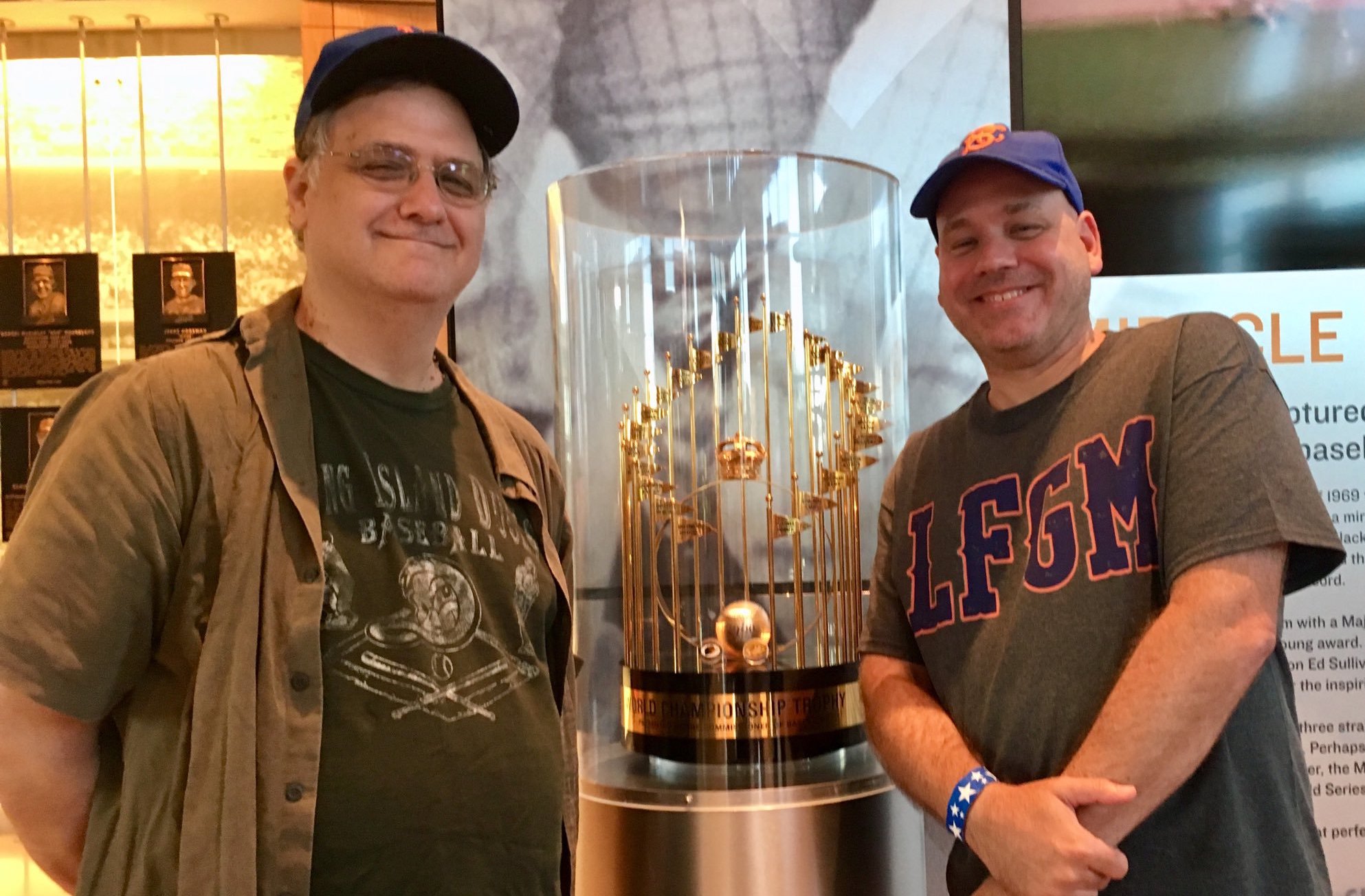
Faith and Fear in Flushing made its debut on Feb. 16, 2005, the brainchild of two longtime friends and lifelong Met fans.
Greg Prince discovered the Mets when he was 6, during the magical summer of 1969. He is a Long Island-based writer, editor and communications consultant. Contact him here.
Jason Fry is a Brooklyn writer whose first memories include his mom leaping up and down cheering for Rusty Staub. Check out his other writing here.
Got something to say? Leave a comment, or email us at faithandfear@gmail.com. (Sorry, but we have no interest in ads, sponsored content or guest posts.)
Need our RSS feed? It's here.
Visit our Facebook page, or drop by the personal pages for Greg and Jason.
Or follow us on Twitter: Here's Greg, and here's Jason.
|
by Jason Fry on 20 July 2007 5:00 pm In the morning I'm frequently awakened because a four-year-old just stamped on my clavicle, bounced himself next to my head, snaked the covers off me or is jumping up and down yelling “AND THE METS WIN!” This is one of Joshua's newer habits — he makes up baseball games and runs the bases. In his parents' bed. Where I'm sleeping. (My head's about where the shortstop would play.)
Occasionally I'm awake enough to listen to the script of one of these games, and they're pretty amusing — random lineups, vague opponents, shifting rules and unlikely reversals. In other words, they're a lot like last night's game.
I mean, come on. 13-9? Jose Reyes running the bases with the acumen of a drunk frat boy sliding on the tarp? Good plays from the frequently maligned Shawn Green and Carlos Delgado? Tom Glavine spotted two enormous leads in pursuit of #299 but still not recording seven outs? Backup catchers hitting majestic home runs? Slumping center fielders hitting majestic home runs? And apparently Joshua's so frustrated with trying to figure out who the heck's playing left field that he re-imported a guy who hasn't been Met property since 2005. (Where'd he hear about Marlon Anderson, anyway?)
As is typical with the latter parts of a West Coast swing, by the middle innings I was fading, kept awake only by steady jolts of offense. Normally, I would have succumbed to the inevitable, closing my eyes around the sixth and waking up with a start a couple of hours later to check the final score online and go to bed for real. But last night I was superstitious, convinced that if I fell asleep, I'd wake up in the middle of the night and find out the final score was Dodgers 14, Mets 13.
LOS ANGELES — Brad Penny pitched in with three innings of emergency relief, giving the Los Angeles Dodgers time to regroup and prevail thanks to another unlikely hero: Starter Hong-Chih Kuo connected for a pinch-hit home run off New York Mets closer Billy Wagner for a delirious, 12-inning walkoff win. While Kuo enjoyed a beer shower from his jubilant teammates, Penny was unrepentant about opening his relief stint by hitting two Met batters in the back, or about his full-throated challenge to the Mets dugout — a challenge that went unanswered. After the game, Mets manager Willie Randolph…
As it was, I finally did nod off at some point in the eighth and woke up with a start to find there were two outs in the ninth and Gary Cohen sounded tense. I'm not sure what I missed. Never mind — I don't want to know.
The Dodgers' humiliation of us on our first 2007 trip to L.A. (thanks, Katy Feeney) unfolded while I was on vacation at the beach. Then, I basically shut down and refused to admit any of the terrible things that were happening were real, probably because I knew I'd spend half my vacation stewing about how we'd been not only beaten but made to look like cringing wusses. Or maybe I was just waiting for this trip and the prospect of revenge. If so, consider us a third of the way there.
Assuming last night was real, of course.
by Greg Prince on 20 July 2007 9:28 am Jose Reyes was swinging at the first pitch.
David Wright was learning on the job.
Carlos Beltran seemed, at last, to be finding himself.
Aaron Heilman pitched a couple of key innings.
Ramon Castro came off the bench and made you wonder why he doesn't start more often.
Tom Glavine looked like he'd never get close to 300 wins.
And Marlon Anderson was the player of the game.
It's recent vu all over again!
Thursday night was 2005 Night in Los Angeles, an inadvertent salute to our own rookie season — the beginning of the Omar Minaya, Willie Randolph and Faith and Fear in Flushing eras. It was a more innocent time, when you would have been thrilled to have seen the Mets win two games out of four on the West Coast, astonished that they'd rise even one game over .500 and ecstatic to learn a six-run lead hadn't been given away by some combination of Kaz Ishii, Danny Graves and Braden Looper.
Welcome to back to those moderately thrilling days of yesteryear or, more accurately, the year before it; to the Sixthies; the Dirty Thirty; the identity of Deep Throw; the ill-advised Collapse-O-Meter; the whirlwind journey of Mister Koo; the earliest revelations of The Holy Books; the Pedro who wasn't Feliciano; the string of self-referential allusions that continues unabated to this day.
The 2005 Mets…ya hadda be there. For one night at Dodger Stadium, it felt like we were once more. While the ninth inning loomed like something out a twisted radio commercial that fed off your darkest fears, the result was as much fun as a pinch-hit inside-the-park homer with bubbles blowing…or perhaps a megarun romp through Arizona.
Aw, c'mon, don't tell me you've already forgotten 2005? The New Mets? The relative joy of 83-79? Maybe you weren't with us back in the 730-days-ago day, but watching Marlon Anderson's dynamic return to the team from which he never should have been permitted to wriggle (we give three-year deals to batboys and Scott Schoeneweis, we could've given two to Marlon) brought back some fine semi-fresh memories. Anderson's a real ballplayer. That's admittedly a strange observation when the 25-man roster is supposed to feature two-dozen other professionals who fit that description, but Anderson carries the aura of a guy who knows how to play the game. The Moneyball crowd would cackle at such scouty appraisal, so let's try this:
He had two hits, including one in the first when the Mets were deconstructing Derek Lowe.
He drove in two runs.
He scored one run while improvisationally coaching the runner in front of him (the unsettlingly regressing Jose Reyes) to get the hell home.
He hit the ball hard all night.
He made a diving catch to prevent the ninth from hemorrhaging momentum.
He caught the final out in left, even though he's not really a leftfielder.
It's hard to imagine Marlon Anderson is going to be inserted in the outfield and be the catalyst who will jumpstart our tender divisional lead into an imposing margin, what with Milledge around and Alou allegedly en route, but wasn't I just saying that we needed to pick some forgotten veteran off the scrap heap and have him go all Cesar Cedeño on the rest of the league
I think I also said that Marlon Anderson wasn't going to be the answer, but what do I know?
I'm also the guy who was suppressing every instinct to count this as Tom Glavine's 299th win after the top of the first, mildly giddy that I'm holding tickets to his next likely start and, oh boy, potential 300th win. But Tom Glavine's streetcorner Rolex of an outing kept me honest (it was only two years ago that I was in my third year of adjusting to Tom Glavine being a Met). To tell you the truth, I had a sinking feeling about Glavine once we went up 6-0 in the first. It was just too good a setup. The 2007 pessimist in me would note we were outscored 9-7 from the moment Glavine threw his first pitch, but the 2006 practicalist interrupts and says a win is a win, don't be a schmuck.
Meanwhile, the 2005 revivalist can't believe Ramon Castro doesn't play more often. He's the same guy who pushed Mike Piazza for playing time again and, ahem, for all of Paul Lo Duca's wild-eyed passion, Paulie ain't Piazza. Unless the nine runs surrendered were the direct result of Ramon's lousy pitch-calling — and as long as we're harboring three catchers — let's see some more Castro out there.
The rest of the '05 crew meshed nicely with modern times, particularly offensively. I've been having a running argument with a friend over Beltran for weeks. He's been giving me the two-year-old line that he's soft and he plays for the money and he's not a New York type of ballplayer while I've been countering with yeah, he's in a slump, but if you don't realize you're watching the best, most complete player this franchise has ever had, then you're just not watching the same centerfielder I've been. I'm not going to forecast great things for Beltran from here on out, because I learned two years ago in this blog's infancy that my blessing is generally the kiss of death on any Met I single out for praise, but I'll take my chances with the man who first called us The New Mets.
Thursday night's edition felt like a new Mets, certainly an improvement over the creaky version that's gone 18-23 since early June. But as in 2005, we've been threatened to go off on a season-pleasin' roll a lot lately only to sputter in our own mediocrity. Whatever year this is, let's keep the spirit of the last game we played going. And enough of the Dodgers already. To paraphrase Green Day from the summer prior to last summer, wake me up when this road trip ends.
Marlon Anderson and the Mets win…I tell ya, it's enough to make a 44-year-old feel like he's 42.
by Greg Prince on 19 July 2007 4:00 pm We’ll be running into Jeff Kent in Los Angeles this weekend, something you might not have bet on 15 years ago next month. Jeff Kent was not wanted by Mets fans, not for David Cone. The 1992 Mets had already reached base camp at the bottom of their mountain after having careened steadily downhill through the summer. They had exactly one All-Star that nonstellar season, Cone. Now he was being dispatched for some seemingly random Blue Jay.
Ahead of Kent was a nightmarish four-year stay in New York during which he rubbed just about every Mets teammate the wrong way and secured the loyalty of few Mets fans. Beyond that, however, waited a brilliant offensive career that has earned him the title of greatest power-hitting second baseman ever and probably a ticket to Cooperstown.
On the other hand, he still rubs just about every teammate the wrong way and he has yet to secure the loyalty of many fans. One senses Kent doesn’t care. He has his records, he gets paid well and, as long as Barry Bonds is in the news, he’ll never come off as the biggest a-hole in the ol’ ballgame.
“Jeff doesn’t talk to anybody,” Dodgers third base coach Rich Donnelly told the Times‘ Jack Curry in a story about Bonds’ and Kent’s history of mutual contempt and general frostiness last Sunday. “Jeff says hello to his kids once in a while, when he brings them in the clubhouse.”
When the Mets arrive at Dodger Stadium tonight, they will see Jeff Kent in uniform, rarin’ to go at second base. They will not see — at Dodger Stadium or any other ballpark in the Majors — any of the following on an active roster:
Vince Coleman, Dick Schofield, Chico Walker, Eddie Murray, Bobby Bonilla, Kevin Bass, Todd Hundley, Pete Schourek, Jeff Innis, Mackey Sasser, Barry Jones, Daryl Boston, Anthony Young, Bill Pecota or Dave Gallagher.
None of that motley crew — 15 of the 16 Mets who comprised the Mets’ half of the boxscore in their 4-3 win in the opening game of a twinight doubleheader against Cincinnati at Shea on August 28, 1992 — is playing anymore. The sixteenth Met was Jeff Kent. The occasion was his Met debut. He went 0-for-4. But in the nightcap, Kent’s 2-for-5, 3-RBI performance keyed a 12-1 romp and twinbill sweep for the Mets. Their cast in that second contest included Jeff McKnight, Chris Donnels, Lee Guetterman, Charlie O’Brien and Wally Whitehurst.
Those Kent teammates aren’t playing anymore either. In fact, of the 44 men who can call themselves 1992 New York Mets, 43 are retired. Only Jeff Kent survives to tell the tale to 2007 big leaguers, as a peer, of what it was like to give Todd Kalas a Mets Extra interview; to abide by Jeff Torborg’s no-alcohol policy on planes; to be immortalized in The Worst Team Money Could Buy.
Jeff Kent remains, as initially uncovered the spring before this one, the reigning LAMSA champion. LAMSA, of course, stands for Longest Ago Met Still Active. Nobody else from the Metropolitan Class of ’92 or any time before then plays in the Major Leagues today. Kent has been all alone in the ’92 distinction since July 1, 2005, the day John Franco threw his last pitch for the Houston Astros. Jeff became 1993’s only refugee when Jeromy Burnitz retired in March.
Kent also is tightening his grip as sole survivor from 1994, though we might need to wait a tad before officially declaring him the last of those particular Methicans. Kelly Stinnett joined Kent in carrying the ’94 banner for eleven games with the Cardinals in June. But with the recovery of Yadier Molina (for which we all prayed so hard), Stinnett was outrighted to Triple-A Memphis, an honor the ex-Met backstop refused. At the moment, Kelly doesn’t appear to be playing for anybody, but catchers have a funny way of reappearing when you’re not looking for them. Hell, Kelly Stinnett emerged a Met from out of nowhere last September. The same could be said currently for Sandy Alomar, Jr., whom I would guess fans of most other teams have no idea is a Met.
But back to Kent. He is the LAMSA by at least two, probably three seasons — likewise, for each of those campaigns, he is Last Met Standing. Next in line, if we are prepared to discount the marginal-at-best Stinnett, are the only other indisputably active 1995 Mets, both of whom, like Jeff, still play pretty vital roles in the bigs: Jason Isringhausen of the Cards and Paul Byrd of the Tribe. Each pitcher debuted with the Mets a dozen seasons ago, Izzy eleven days before Byrd. In Stinnettian limbo is Alberto Castillo, who beat both of them to the bigs by several weeks in ’95. Injuries made Bambi a Baltimore backup earlier this year. Recuperation makes him, of all things, a Norfolk Tide. (FYI, they don’t think kindly of us in Virginia anymore.)
Regional pride and unyielding fealty to certain infielders compels me to note two other 1995 neophyte Mets, Edgardo Alfonzo and Carl Everett, are slogging away in Central Islip as Long Island Ducks. But if it doesn’t quack like a Major League affiliate, it’s a gray area. Fonzie, for the record, has collected 39 ribbies in 60 games as Duck third baseman; Everett’s got 14 homers in 212 at-bats.
And David Newhan continues to be David Newhan (though, praise be, in New Orleans starting tonight).
Kent, Izzy, Byrd, Castillo…they are the final Mets from 1996, Kent’s last year in New York, to be Major Leaguers in 2007. Rey Ordoñez, rookie shortstop sensation that spring, was cut by Seattle this spring. He receded into retirement and the Mariners went on to become surprise contenders. Draw your own conclusion.
Mets don’t seem to last long anymore, do they? I don’t mean just as Mets, but as a rule. With so many players who bowed in the 1980s having crossed our path of late — Glavine, Alomar, Alou (still in baseball, rumor has it), Clemens, Ju. Franco, Griffey, Moyer, Wells, Maddux — you’d think somebody who was a Met back in the day might have survived on a roster somewhere, that Kevin Tapani would have guzzled from the fountain of youth or Craig Shipley would have taken up catching or Blaine Beatty would have caught on with the Royals. But nope. Jeff Kent, first a Met in 1992, is totally The Man in this category.
Even if he only talks to his kids. Sometimes.
How does Kent’s longevity compare to others in that position? For fun, or my idea of it, I have compiled a year-by-year list of who has been Last Met Standing from each season in club history. Some of them you’d guess right off; a few knocked me for a loop.
LAST MET STANDING/1962-1991
1962: Ed Kranepool. He’s one you would have guessed. Eddie played until the end of 1979, outlasting by five years and two days Bob L. Miller and Chris Cannizzaro, each of whom played his final big league game on the same day in September of ’74.
1963: Ed Kranepool. Runner-up: Cleon Jones, who stopped by just in time to say hello and goodbye to the Polo Grounds. He was a White Sock in 1976.
1964: Ed Kranepool. With Jones back in the minors, Cannizzaro is tied for second from Shea’s first year with Ron Hunt. Hunt, like Cannizzaro and Miller, ended his career on September 28, 1974, a couple of months after Jim Hickman wound down his. While all those early ’60s Met stalwarts were finally retiring, Ed Kranepool wouldn’t turn 30 until November.
1965: Tug McGraw. Hey, not Ed Kranepool! The Tugger finished as a Phil in 1984, making him the final Stengelphile in captivity. Fellow ’65 rook Bud Harrelson also greeted the 1980s on a roster, as a Ranger.
1966: Nolan Ryan. This name will soon look very familiar in our discussion. Ryan pitched until 1993.
1967: Tom Seaver. Ryan spent none of ’67 with the big club, so Tom’s MLB tenure, which extended clear to 1986, is the longest-running from Wes Westrum’s last Mets team. Jerry Koosman, retired in ’85, wins honorable mention.
1968-1971: Nolan Ryan. A certain sameness to Last Met Standing takes hold here, with Nolan and Tom running one-two. Suffice it to say this Ryan kid defied a certain organization’s assessment of him as someone who would never last. It’s been said by different sources that Gil Hodges signed off on the Fregosi trade and that Gil Hodges was against the Fregosi trade. Either way, Ryan was the last Gil Hodges Met to remain in the majors. Given his ’66 cameo, he’s the last Wes Westrum Met, too. (But by missing ’67, Ryan cedes the championship of the Salty Parker Division to Seaver.)
1972-1975: Tom Seaver. And the runner-up from each of these four seasons? Rusty Staub, who stayed just a little longer at the fair (10/6/85) than did Koosman (8/21/85). Seaver was the last Yogi Berra and Roy McMillan Met.
1976-77: Lee Mazzilli. Mazz was the final Joe Frazierite active, contributing to the Blue Jays’ division title drive in 1989. Seaver was second in longevity from the ’76 Mets but, somewhat appropriately, fellow Wednesday Night Massacre participant Joel Youngblood came in second to Lee among the ’77 set, finishing his career just a couple of days earlier (plus Mazzilli had eight at-bats in the ’89 ALCS).
1978: Alex Treviño. This was the shocker for me (in addition to the shocker that I bothered to look any of this up). Alex was a fairly obscure backup catcher during the prime of his career, but as Kelly Stinnett and Alberto Castillo recently taught us, obscure backup catchers can keep playing almost as long as they like. By coming up in ’78 and lasting parts of a dozen more years, Treviño would become the second Met ever who would eventually play in the 1990s, after Nolan Ryan. (Ryan and Treviño were Astros teammates in 1988, but you don’t think of them as contemporaries exactly.) He even managed the shortest of stints with the 1990 Mets themselves when they were — yup — strapped by injuries for a catcher, any catcher.
1979: Jesse Orosco. Before he ruins all the fun by playing until 2003, we can take solace that Jesse was demoted to Tidewater for the entirety of 1980, giving us one more year to absorb a mild surprise in this category.
1980: Hubie Brooks. I missed this one in my guesswork, but Hubie hung in there until July of ’94, nosing out the equally unlikely (by my reckoning) runner-up, Jeff Reardon, who retired that pre-strike May. Reardon was also second to Orosco among ’79ers and second-to-last Joe Torre Met in the majors…to Orosco.
1981-1987: Jesse Orosco. Yeah, he wouldn’t be going anywhere for a while. Jesse flourished under George Bamberger and Frank Howard, so it’s fitting he was the last of their Mets to collect a player-size paycheck.
1988-89: David Cone. It was actually a pretty spirited race or perhaps war of attrition to the checkered flag among late-’80s Mets once Orosco kindly vacated the premises to make room for newer blood. Between 1999 and 2001, a whole crop of post-’86 Mets played their last, including Randy Myers, Darryl Strawberry, Dwight Gooden, Gregg Jefferies, Kevin Elster, Rick Aguilera, Dave Magadan and David Cone. But Cone had the good sense to give baseball one more shot in 2003, making the not particularly well-stocked Mets out of Spring Training. His comeback, even though it ended in May of ’03, ensured him this particular crown. Meanwhile, Jesse Orosco spent sixteen years pitching after the Mets first sent him away in 1987 (they would reacquire him for 2000 but dispatch him before that season started) and endured four months beyond Cone’s retirement.
1990-91: John Franco. He outlasted Jesse and Coney for the distinction of final Met managed by Davey Johnson, Buddy Harrelson and Mike Cubbage.
Jeff Kent and 1992-96 is where we came in.
Looking ahead to looking back? Here’s who is still more or less Major League active from the most recent suddenly distant past.
1997: Jason Isringhausen, Alberto Castillo.
1998: Alberto Castillo, Mike Piazza, Preston Wilson, Jay Payton.
1999: Jason Isringhausen (injured throughout ’98), Mike Piazza, Jay Payton, Melvin Mora, Armando Benitez, Kenny Rogers, Octavio Dotel. (Vance Wilson is on Detroit’s DL for the year).
2000: Mike Piazza, Jay Payton, Melvin Mora, Armando Benitez, Jason Tyner.
Among other Mets from our last National League championship season, Rick White was released by the Astros after pitching 23 games for them this year; Mike Hampton, like Vance Wilson, is out all of ’07 with an injury; Joe McEwing and Timo Perez are playing for the AAA affiliates of the Red Sox and Tigers, respectively; and 2000 seems like a good place to stop for now.
Tip of the cap to Ultimate Mets Database for being so damn ultimate about the Mets.
by Greg Prince on 19 July 2007 10:47 am Want to take a slight positive from Wednesday night's miserable loss — besides Wright's act of tying it temporarily and our somehow giving no ground to our divisional pursuers? Consider that erstwhile chum Mike Cameron didn't catch miscast designated hitter Carlos Delgado's home run in the seventh. It could have/would have been a great catch, a Web Gem from here to Kingman come…but it wasn't.
I was instantly reminded of the great catch Aaron Rowand nearly made on a Carlos Beltran home run in Philadelphia…but he didn't. In June, Rowand draped himself over a wall in the gamest of efforts, yet all his glove nabbed was a bundle of air. Last night, Cameron made a sensational but slightly mistimed leap that would have worked a bit better at his local fronton.
In each case, close but no Chavez.
If you're having “one of those seasons,” which it often seems we are, those balls are caught and you mutter that we get no breaks. We got one on Delgado's dinger, so let's not give ourselves something to mutter about.
You could argue that Smith giving up the tie in the eighth or Maine's second frightening first in a row or Carlos D's lack of D are all more tangible signs of “one of those seasons,” but…hey, I said it was only a slight positive.
by Jason Fry on 19 July 2007 2:00 am A few years back I decided to torture Greg with a thought experiment: Would you want the Mets to win the World Series if you couldn't watch any of the season or postseason? (At least that's how I remember it. Correct me if I'm wrong, Mr. Prince.)
The answer I was expecting was a flat “no,” possibly followed by calling me insane, a jerk, etc. Greg's reaction was to stop and think for a while, then start asking questions. Could he record the games and watch them later? No. Could he buy the season-to-remember DVD? No. Could he … No, no, no. He would know it was in the record books and part of Mets history, but he could never feel that rush of delight, or even its echoes reliving the moments. That was the deal.
Greg looked tormented, and I decided that he must have viewed the thought experiment as a referendum on how much he loved the Mets — if he loved them enough, shouldn't he want them to win even if he couldn't be part of it? Which was interesting, though more than a little sadistic, but not what I'd had in mind. All I was after was some half-baked philosophical point about the team's doings being inseparable from the fans' enjoyment of/torment over those doings. If a Met wins the World Series and no one cheers, does the title make a sound? Or something along those lines.
All of this is top-heavy prelude to last night's game, in which I was the worst fan ever. First I groused at length about the shortcomings of various Mets, a bitter monologue that Emily endured with eye-rolling and periodic rejoinders to the contrary. (I believe I called Valentin done, picked on Beltran for playing too conservatively, excoriated Green for his defense while he was at bat, ranted about Milledge not working counts and settled for ad hominem attacks about Heilman, who wasn't even in the game. I don't recall declaring that I didn't like Chip Ambres' face, but anything's possible.) Finally Emily grew weary of this and said she was going to sleep.
I decamped to the study to work on the computer and listen on the radio — not so much because I had work to do but because the way the Mets have been playing, I figured my full attention would just lead to further indignation and upset. (Honestly, after Beltran doubled off the bag only to have Wright fly out to the Petco equivalent of a coat closet in the attic bedroom, did any of us think we'd break through against Jake Peavy?)
Given at most fitful attention, the Mets began to blossom. I started for the upstairs TV, then reconsidered, a la Keith drinking beer in Davey's office. I paid more attention to what Howie and Tom were saying. Things went south. I paid less attention to what Howie and Tom were saying. Things perked up.
OK then. For the rest of the night I gave the Mets vague attention at best and before I knew it we were home-free.
Just don't ask me to follow this strategy the next time we have a playoff game. Or, come to think of it, five minutes from now.
by Greg Prince on 18 July 2007 10:44 pm Julio Franco is back with the Braves. They’re desperately giving one last shot to an old, broken-down baseball refugee in the hopes he will rekindle the lost magic both he and they had together…or he and they will revive on contact and wreak all kinds of vengeful havoc on the Mets.
Guess which scenario I’m living in fear of.
Cesar Cedeño was as scrap heap as scrap heap could be in 1985. Then Whitey Herzog picked him up, cleaned him off and inserted him at first base down the stretch. He hit .434 in 28 games for the Cardinals who flew by the Mets for the Eastern Division title. Two years later, a similar (he batted only .233 in 24 games but it was similar enough) phenomenon unfurled, except the washed-up vet who helped do us in was Dan Driessen, also a first baseman. And precisely one decade later, our mini-miracle of 1997 was derailed when the Marlins poached Darren Daulton from the end of the line and stuck him at first.
What position does Julio Franco play again?
Past isn’t necessarily precedent. Not every oldie grab is a goodie. The Phillies, for example, picked up Jeff Conine late last year and they didn’t make the playoffs. Speaking of Conine, he’s on the Reds. So is Brandon Phillips.
Let’s get Brandon Phillips.
I don’t usually care to indulge in hypothetical trades, but waiting for West Coast starts and a position to be definitively filled is making me antsy.
Let’s get Brandon Phillips.
I don’t mean to be the big-market team fan who believes small-market teams’ rosters exist for our plucking pleasure, but the Reds are atrocious and show no signs of ambition toward being anything but that.
Let’s get Brandon Phillips.
I don’t like the idea of giving up our own young chips, not so much Ambres, but the ones I’ve actually seen. Pelfrey I believe has a future. I do like Lastings. Humber was a No. 1 pick for a reason. I’d hate to give any of them up.
But I would for Brandon Phillips.
Not much used to trolling in trade talk, I have no idea if Brandon Phillips is explicitly available, but the way baseball works and the way Omar works, everybody is available. Omar once made Brandon Phillips available, trading him five years ago for Bartolo Colon, one of the gutsiest moves the GM of a constricted, contraction-bound club could have made. Didn’t work out, but it was the right move for the Expos then.
Getting Brandon Phillips for the Mets would be the right move now.
What would it take? Damned if I know. I don’t do hypotheticals normally. But if they wanted one of our pitching studs, go ahead. If they wanted Milledge, too, go ahead. If they need Gotay to help fill the void and ironically chill with Jeff Keppinger, fine. If we have to take Conine or even David Weathers off their hands, I have no problem with any of it.
Let’s get Brandon Phillips. This guy has been killing us for two straight seasons. Murdering us. He should be extradited to New York and brought up on charges. Or, better yet, traded to New York to become our second baseman for the next several years.
Brandon Phillips was all that stood between us sweeping the Reds this weekend. (Well, that and our general nimrodedness Friday.) He had a deleterious impact on us last year. I just watched him almost singlehandedly beat the Braves. I’d leave him to do that some more except I don’t think Cincinnati’s schedule will allow him the luxury.
We need a second baseman. We’ve needed a second baseman since Roberto Alomar decided to quit the game (albeit several years before he retired). We haven’t had a dependable second baseman since Edgardo Alfonzo moved to third. We’ve had one Danny Garcia after another. Bless Jose Valentin’s heart and one good knee and uplifting 2006, but he ain’t getting it done either.
Brandon Phillips apparently hits well against not just the Mets and Braves. Brandon Phillips is only 26. Brandon Phillips, unless I’m missing something nobody’s told me, can play his position, a position nobody around here has played competently in anything approaching a long-term nature in six seasons. Brandon Phillips is probably due for arbitration soon, which means the Reds could be talked out of him. They love youth movements in Cincinnati. It keeps them feeling hopeful.
We need youth. We need a bat. We need a glove. We need a spark. It’s not going to come from Chip Ambres. It’s not going to come from Marlon Anderson. It could very well come from Brandon Phillips. He’s playing on the Reds. It’s not like he has something important to do.
Let’s get Brandon Phillips. Now.
by Greg Prince on 18 July 2007 8:30 am When I think of the San Diego Padres, I think of a line from The Shawshank Redemption, what Andy Dufresne says to Red Redding about where he wants to live out the rest of his life:
You know what the Mexicans say about the Pacific? They say it has no memory.
From one season to the next, I remember next to nothing about the Padres. Their roster is forever 70% surprise, 20% Gileses and maybe one or two Gwynnian stalwarts just so I can recognize them if I flip by SNY too fast. Hey, isn’t there a baseball player named Khalil? Ohmigod, the Mets are on! Their history is a muddle of Big Macs, fish tacos, fire sales and camouflage. This is the fourth season in a row in which I’ve looked at that stadium of theirs and thought, “hey, the Padres just built a brand new ballpark!”
The San Diego Padres are the Pacific Ocean to me — less because they play so close to it than because we play so far from them. If the Padres aren’t going up against the Mets two series a year, they simply don’t exist, and I mean completely out-of-sight, out-of-mind, when did Columbus get a hockey team? don’t exist. They exist way less than their California neighbors because the Giants and Dodgers have their roots in our backyard and my subconscious and occasionally materialize on Baseball Tonight. The Padres? They’ve won two consecutive division titles and are the only National League team at the moment with a legitimate shot at making it three straight. They have the lowest ERA in the known world. They have…
…I forget. Who are we talking about again?
It’s not that the Padres don’t rate our respect. They do. Anybody whose games start after my wife kisses me good night is potentially bad news. But that’s the other thing. The Giants start their homes games a little after 10. The Dodgers either 10 or 10:30. The Padres? They come on after The Tomorrow Show With Tom Snyder, right? They make me sleepy just thinking about them. I went to Jack Murphy Stadium once and couldn’t enjoy it without grabbing a few winks at my seat between the fifth and sixth. Every time I see them, they’ve just completed a wardrobe change. They annually acquire some big shot — Willie McCovey; Rollie Fingers; Gaylord Perry; Steve Garvey; Jack Clark; Rickey Henderson; David Wells; Mike Piazza; Greg Maddux — whom you will never, ever associate with their franchise even if one of them is on your screen at this very moment in Padre…blue is it now? And, furthermore…
…I forget again. Who are we talking about?
Never mind the Padres. How about those Mets? How about that El Duque? If there’s one thing I can say about El Duque, it’s…it’s that he’s the Padres of our pitching staff, at least to me. Honestly, I tend to forget he’s in the rotation at any given moment. That’s on my head, I suppose, but also indicative of the way he’ll get an extra day or month between starts and then suddenly reappear from out of nowhere. Plus there’s that Friar-like tendency to give you something different every time out. There is no rhyme and less reason to El Duque. Sometimes he’s magnificent, as he was Tuesday night; sometimes he’s magical, as he was hitting and stealing!; sometimes he’s completely unfathomable and gets bombed and turns edgy as he disintegrates in full view; and sometimes…
…who pitched? Of course. That guy. He won. All right!
The best thing to say about the Mets who aren’t Orlando Hernandez in their second game in San Diego is they forgot who they had been during their first game. This was a much-improved version, replete with a No. 3 batter who lived up to his spot in the order and a second baseman who, at last, looked like he could hit the side of a wall (and not hurt himself in the process). Keeping with our current policy, I will praise the Mets only lightly lest they become satisfied with one-game winning streaks. They have more business to take care of tonight in…
…I’m sorry — where are we playing again?
by Greg Prince on 18 July 2007 7:24 am 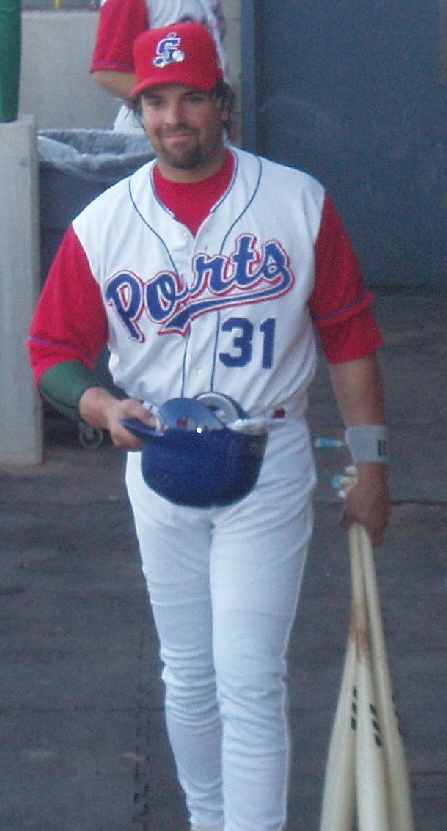
Who’s that bearded busher? That’s no minor leaguer, but our (all but technically) own Mike Piazza, rehabbing for the Stockton Ports, the California League affiliate of the Oakland A’s. FAFIF reader Joel Lugo swung by Banner Island Ballpark Tuesday night, snapped a few photos of the Met legend and brought him a little good luck. Mike hit one out of Stockton, just like he used to do in Queens.
by Greg Prince on 17 July 2007 4:00 pm Baseball comes down to rituals, too many to count, too wonderful to bother. Some recur in some form annually. Others 162 times a year and then some. Once in a while they collide.
Saturday night, one of my favorite rituals of baseball, one of the bonus tracks on every season’s DVD, popped up on the menu. It was the honoring of someone grand, someone vaunted, someone who demands our attention.
It was Ralph Kiner Night. If it wasn’t long overdue, it was certainly due. Ralph is due whatever the Mets and we can think to give him, starting with our respect. We respect a Ralph Kiner, we respect the game we love.
I’ve lived for this sort of ceremony since I was a kid, since I asked that my annual trek to Shea Stadium be reserved for Old Timers Day. I was irked when the Mets dismissed the need for such affairs, highly gratified whenever they eventually succeeded them with something, anything that acknowledges they and we have a past that is responsible for creating their and our present.
Of course I was at Shea for Ralph Kiner Night.
Nobody could be more of that past-to-present Mets roadmap than Ralph Kiner. Nobody. Nobody was a face of the franchise in its first year and still shows his face in its current year. He was on the air for Hobie Landrith and he’s on the air — irregularly, but there — for Jose Reyes. He’s 1962 and 1969 and 1973 and 1986 and 1999 and today. He’s WCBS-FM with the occasional new hit sprinkled in. He’s the music of your life.
An announcer should be able to tell you if a ball is a ball, a strike is a strike, an out is an out and if a runner moved up to second on the grounder. Other than that, he needs to be your companion, just as good a companion as baseball itself. Ralph has been a great companion, somebody you’re happy to run into at the game, somebody who’s going to keep you company, somebody’s who’s going to tell you a couple of things you didn’t know and are glad you do now and somebody you’re sorry has to leave in the seventh except he has to get to work. His real job, you would learn, started just after the final pitch.
To entertain us while the stage was literally being set for Ralph Kiner Night, DiamondVision showed some vintage Kiner’s Korner klips (they at first came on silently, so Joe and I offered a spontaneous vocal arrangement of Franz von Blon’s “Flag of Victory March”…you’d recognize it in a beat as Ralph’s theme). They weren’t as vintage as I would have preferred, mostly from the ’80s and early ’90s. It was what got saved, the stuff somebody had the good sense not to tape over. These were the editions with the slightly self-conscious production values that indicated Channel 9 management realized at last they had on their hands not just a postgame interview show but a genius-in-residence. None of it, unfortunately, was from the golden age of Kiner’s Korner, with that fair-play wall that listed each of the National League teams in funky ’70s fonts, with Ralph hosting the star of the game, not just the star of the Mets. Willie Stargell may have just pulverized Mets’ pitching, John Candelaria may have just shut us down, but seeing them talk it over with Ralph made them seem, I don’t know, human.
Not complaining, though. Any Korner is a desirable Korner. I would have settled for the turn-of-the-century Fox Sports Net version, the one he co-hosted with Matt Loughlin now and then for a couple of years. It seems strange to choose it, but my favorite Kiner’s Korner ever was not one with Agee or Grote or somebody from my childhood, but with Steve Phillips of all people at the end of ’99. The GM was saying very politic things about Rickey Henderson until Ralph nudged Phillips into admitting that he was pretty sure Henderson didn’t even know his name.
“Yeah,” Ralph said. “That’s one strange guy.”
The rituals within the larger ritual of a night like Ralph Kiner Night are fun to observe. For example, what’s the dress code? I find it both classy and inane when men wear suits and ties on a baseball field. Ties are for weddings and funerals and the stodgiest of white shoe law firms. If I admired nothing else about Ted Williams, it was his refusal to don a necktie for any occasion. But then flip it. If you’re going to wear the very antithesis of the togs of summer to the summer game, then it must be an extremely special event motivating your sartorial splendor. So good for those who saw fit to tie a tie and those, perhaps by dint of generation, who would have felt underdressed without one…and just as good for those who would flaunt such an outmoded conceit and, like Jerry Koosman and Bud Harrelson, sport a tropical look.
Hawaiian shirts on Ralph Kiner Night? Don’t you think Ralph would have been more comfortable in one?
I also like to deconstruct the guest list. Who was invited? Who wasn’t invited? Who was invited but didn’t show? Who should have been invited? Who am I surprised to see? Who could have I done without? All guests should be honored guests, but on something called Ralph Kiner Night, there is only one guest of honor. Anybody who would fly in just for a Howie Rose nod, an acknowledging wave and twenty minutes of sitting and listening to somebody else talk about himself is both a true friend of Ralph and a true citizen of baseball.
We had to endure only one Deputy Mayor for Superfluous Introductions and then only because Mayor Bloomberg had proclaimed Saturday night, July 14, Ralph Kiner Night in New York City, meaning…what, six to midnight? (Only the Mets would rate a proclamation potentially laden with alternate side of the street restrictions.) A bevy of Kiner kin followed. We never heard of any of them, but would we begrudge Ralph their presence if he wanted it? No Met brass — staying in the shadows and signing the checks is big of them.
Though I’d read a sample of who would be here, there’s usually one name I don’t imagine and don’t expect. Saturday night’s surprise guest (to me) was Ernie Harwell, associated generally with the Tigers but primarily with excellence. Ernie’s in everybody’s objective Top Three Broadcasters: Barber. Scully. Harwell. You can no longer get Red. Vin’s still working. To have Ernie Harwell drop by and offer via his presence a benediction that not only has Ralph Kiner been around and been fun and called Gary Carter Gary Cooper but has been a certifiably great announcer for 46 years…I think that was very significant.
I stood and applauded for Ernie Harwell though I’ve heard him only a handful of times. I didn’t stand for everybody. I didn’t necessarily applaud everybody. If there is protocol incumbent upon the on-field participants, what of us? For whom is it kosher to sit and applaud? I found myself tepidly receiving Kiner’s relatives; Bob Friend; and Joe Pignatano — but Piggy only because I got caught in between. To politely ignore? That deputy mayor. And Gary Thorne whom I rather loathe, though it was nice that he came.
For whom do you stand and clap enthusiastically? All the not-quite-immortal championship Mets, since you never know when you’ll see them again: Buddy, Kooz, Rusty, the Glider, the Krane — of unaccompanied Eddie, Joe declared “Ed Kranepool walks alone.” Keith, of course, the most latter-day Met they could find. (John Franco too busy?). For whom do you leap to your feet? In my case, I gave it up for Harwell and capital-G Great Bob Feller — neither related to the Mets but Hall of Famers who respected Ralph, so I respected them; for Tom; for Yogi (looking very much at home where he played, coached and managed for eleven years); for Joye Murphy probably more than any of the above.
I stood for Joye Murphy and I applauded as long and hard as I could. Of course I thought of Bob Murphy on Ralph Kiner Night. How could you not? I thought of Bob Murphy Night from September of ’03. What a sad, sad, terribly sad affair that was. It was so damn final and so hastily arranged. Bless Mets’ management for emphasizing 50 times over that this was not a retirement for Ralph, just an appreciation. And doubly bless Mets’ management for having the good sense to keep a seat available to Ralph Kiner to analyze the occasional Mets game just as they are to be eternally blessed for letting Murph find his way to the exit on his own terms. I flat-out loved Murph more than I’ll ever flat-out love any other broadcaster. Since August 3, 2004, I make sure to love Ralph a little extra every time I hear his voice.
Who wasn’t introduced? Who wasn’t invited? Who didn’t make it? The night was about Ralph, so it didn’t really matter, but you couldn’t help but think of names. McCarver? Doing a Fox game (he, like broadcasting greats Scully, Kallas, Brennaman plus overrated gasbag Jon Miller recorded thoughtful messages). Zabriskie? Living in Florida. I would have enjoyed seeing him. Healy? That would have been interesting. Few liked Fran Healy but other than Murph and Lindsey, did anybody do more games with Ralph? Is Fran holding a grudge for being deSnighed a job? Did he leave on bad terms with the powers that be? Was he taping an urgent Halls of Fame with Bob McAdoo? I didn’t really miss Fran, but it would have been interesting. What about Steve Albert? Lorn Brown?
Now we’re just being completist. And silly.
Seaver…Feller…Berra…Harwell…pretty stellar turnout for a Saturday night. But Ralph deserved as many stars in the baseball constellation as could be rounded up. He deserved the very gorgeous video tribute set to Sinatra’s “The Summer Wind” (it lost its impact on television where it was scored generically — somebody cheaped out — but believe me, it lost nothing in person, save for a few Kleenex). And he deserved the swelling Standing O the crowd gave him when he and his wife were driven in from centerfield in a vintage Chevy convertible (though it was my understanding that home run hitters drive Cadillacs). I wouldn’t say the entire crowd, many of whose members missed the glory days of WOR-TV, was riveted by all the niceties of the ceremonies, but they got on board for the main event. Everybody knew by the time Howie ushered him on stage that Ralph was one of theirs, one of ours.
Ralph’s speech was one part Ralph (who else would or could quote Phil Harris and Casey Stengel in the first 90 seconds?), one part Ralph Now (blowing Casey’s “dead at the present time” line) and one part Murph, actually. When Bob Murphy was honored in 2003, he didn’t talk about Bob Murphy. He talked about the Mets. His history with us was our history with the Mets and he would never presume anyone was interested in him without them. Like Bob, Ralph recounted those crazy early days of losing nine to start one season, eight to start the next and so on until the Mets won four to end the most magical season of them all. Funny how both announcers who made it into a fifth decade never really delved into much beyond the initial one. With Casey Stengel as an opening act and 1969 as an encore, it’s hard to think of anything that would top that set.
What a life Ralph Kiner has led. A Hall of Fame life, and I don’t mean just those ten years that got him into Cooperstown. We don’t know Ralph the way we’ve known some announcers and broadcast personalities who describe what they do away from the booth in occasionally numbing detail. We don’t have to know Ralph that way. We can only imagine the entirety of what Ralph knows, what Ralph has known. It is staggering to attempt to comprehend. That he has shared what he has shared as he has — casually and without airs — makes us feel just a bit like Hall of Famers, too.
Why does the chance to applaud Ralph Kiner Saturday night or the 1986 Mets last August or Bob Murphy in 2003 or the 40th Anniversary All-Amazin’ Team in 2002 or those who committed the Ten Greatest Moments in Mets History in 2000 or all those Old Timers I couldn’t wait to embrace going back to when I was 11 get to me so? Get to so many of us so? I won’t pretend everybody was into it as I was. For lots of people Saturday, they went to a Mets game and a ceremony broke out. But I did not stand alone, certainly not when the festivities revealed to all that they were in the midst of Yogi Berra and Tom Seaver and Ralph Kiner. Everybody got that.
Why does this particular ritual get to us so? Part of the answer lies in what Marsellus Wallace reminded Butch Coolidge in strongly suggesting he not try too hard in his prizefight that night: “Boxers don’t have an Old Timers Day.” Neither does most anything in this world. All we do in our lives is move on, get over it, get on with it. Little of what we do permits much in the way of reflection, of enjoying what’s come before. Sure, there’s the occasional class reunion and there are holidays with extended family, but, at the risk of betraying (or even portraying) a cynical streak, those are burdens. Somebody goes to the trouble of summoning the vibe of a great day or a great year or, in Kiner’s case, a great presence in a realm that you’ve chosen to link yourself to for as long as you’ve been around and for as long as you will be around…well, my friends, that’s an uncommon gift.
A more all-encompassing answer would be because baseball’s better than anything else. You can figure out the rest for yourself.
Ralph wrapped up his remarks, jumped into his Chevy with his wife and took a lap on wheels around the track, reaching out and touching Mets fans, just as he’s been doing since 1962. Then he was out the centerfield gate, one very powerful slugger and equally powerful ritual rolling into the sunset. Or perhaps back up to the booth.
Then there was the other ritual, the one that I said collided with this one. That was over around the same time. It was as much a ritual as any championship reassemblage or numerical retirement or mass appreciation Shea Stadium has ever hosted. It was a ritual that takes place so regularly that you don’t notice it unless you look for it.
It’s called getting ready for the game — stretching and running and loosening. Ralph Kiner did it who knows how many thousands of times. His successors, baseball players generations removed from his last at-bat in 1955, were doing it even while a night in his honor was picking up steam.
On one side of the Ralph Kiner ceremonies, around the rightfield line, there were several Mets — Reyes, Wright, Delgado, Gotay, Milledge — in the able hands of physical therapist Jeff Cavaliere. They were limbering and preparing for the Reds. A little deeper in the outfield was Paul Lo Duca playing long toss with assistant bullpen coach Tom Nieto. He was readying his right arm and preparing for the Reds. In the bullpen? Starter Tom Glavine, warming up and preparing for the Reds. Down the leftfield line were a couple of Reds doing whatever they needed to do to prepare for the Mets.
It was incongruous. Tens of thousands made a point of arriving at Shea early enough on Saturday evening to direct their gaze squarely upon Ralph Kiner, to feel as close to him in person as they have through radio and television for 46 years. Yet the ballplayers, those who Ralph has built an institution of a career around describing, couldn’t pause in their maneuvers — little drills they’ve repeated into infinity — to watch Ralph Kiner, to listen to Ralph Kiner, to not distract from Ralph Kiner?
No. They couldn’t. And incongruous though it was, good for them. They, too, were respecting the game we love.
Baseball was never more the circle of life than it was in the tableau you witnessed if you showed up at Shea Saturday night and watched both rituals unfold. Honoring our elder statesmen is what we do. Honoring the need to play hard and win…we do that, too. For purity of event’s sake, we could quibble, we could ask why all that stretching and running and throwing couldn’t have been taken care of by 6:30 when it was known the ceremonies would start at 7:00. We would probably be told there is a science to this, that first pitch was scheduled for 7:35 and that you don’t want your players’ bodies to be too hot or too cold when the whistle blows. If the story afterwards isn’t Glavine Wins on Kiner Night, but Reyes’ Hamstring Tightens, then what do we gain from an unsullied view of the grass onto which icons not in the starting lineup strolled?
Surely the manager and the front office knew the difference between a playing field devoted solely to Ralph Kiner Night and one otherwise partitioned. On the 2006 version of Jackie Robinson Day, I can still see Carlos Beltran, David Wright and Cliff Floyd being pulled into a proper foul line formation on the frantic gesticulation of Jay Horwitz so as not to detract from whatever Rachel Robinson was saying at the podium. Goodness knows Willie Randolph (caught on DiamondVision grinning a big Mets fan grin at the Ralphfest from the dugout) spent most of his career immersed in an organization where everybody queued by uniform number, height, weight, hat size and hair length for the national anthem. Willie, who grew up in Brooklyn watching the same Channel 9 telecasts as the rest of us, could have ordered his charges off the field so they could soak up a little history and pay a little mind to somebody who had glorified their ilk for going on five decades. He chose otherwise. His team lost 8-4 the night before. Their job was playing and beating the Reds.
Would it have been prettier, more aesthetically pleasing, more right to watch the Mets watch a Mets legend, to watch baseball players watch a baseball great in every sense of the word? Yes. Definitely. My first instinct was to carp that they didn’t (and also wonder what happened to the happy little tradition of the current team coming out and presenting a gift to the man of the hour). But a bit of thought on it negated my protest.
Ralph Kiner and his peers — a distinction only a few can claim — had plenty wide a berth on which to stroll to the center of the action. We could have both pregame rituals simultaneously. It was, given the continuing and constant nature of the game, appropriate — just as it shall be on some future Saturday night in some not-yet-built ballpark if one of those stretching in 2007 is the honoree and his successor is paying him little or no mind because that shortstop or that third baseman has a game to play and win.
Mets stretch for a game. A voice stretches across time. We pause to celebrate. We take no respite from rooting. It’s all special. It’s all baseball. It lingers there, so warm and fair…our gentle breeze for all seasons.
by Jason Fry on 17 July 2007 4:59 am If you went to bed at 10 and looked at the box score in the morning, maybe you thought, “Eh, ho-hum loss. Mets didn't convert hits, Padres got to Sosa early, Heilman stank.”
But it's not so. Or, rather, it's not the whole story.
Sosa was fine and the Mets fell apart late, but you could see the collapse coming. They were like a car that left a trail of little, seemingly inconsequential parts — washers and bolts and what-not — on the side streets before dropping a transmission in the middle of the freeway.
As Gary and Ron ably chronicled on SNY, even when the game was close, the Mets kept doing dopey things — dopey things that won't show up in the box score. Like Wright being too aggressive in the sixth and getting instantly erased by a lefty hurler's pickoff move. (Though charging for second without bothering with the rundown was a good try.) Like — and this was the one that really stuck in my craw — Shawn Green working the count to 3-1 against an obviously overamped Heath Bell, then grounding out on a shoulder-high outside pitch. Like Reyes inexplicably watching a 3-1 cookie go down the pipe and turn into a caught stealing for Gotay. Like Feliciano rushing a throw to third on a catcher. The same stupid shit we've seen over and over and over again since Memorial Day, in other words.
The best thing for this team would be two weeks in Port St. Lucie running the kind of drills teams run in February. Failing that, what? I guess we could hope that the Braves and Phillies play .400 ball for the rest of the season. (And even that might not win us the division.) We could convince ourselves that Moises Alou has been rehabbing in a time machine. Or we could keep telling ourselves that a 35-year-old starting pitcher with surgically repaired parts will fix everything just by showing up.
The longer we keep talking about June and July and ruts and funks, the more we have to admit another possibility: Maybe April and May were the outliers. Maybe this team just isn't that good.
|
|