The blog for Mets fans
who like to read
ABOUT US

Faith and Fear in Flushing made its debut on Feb. 16, 2005, the brainchild of two longtime friends and lifelong Met fans.
Greg Prince discovered the Mets when he was 6, during the magical summer of 1969. He is a Long Island-based writer, editor and communications consultant. Contact him here.
Jason Fry is a Brooklyn writer whose first memories include his mom leaping up and down cheering for Rusty Staub. Check out his other writing here.
Got something to say? Leave a comment, or email us at faithandfear@gmail.com. (Sorry, but we have no interest in ads, sponsored content or guest posts.)
Need our RSS feed? It's here.
Visit our Facebook page, or drop by the personal pages for Greg and Jason.
Or follow us on Twitter: Here's Greg, and here's Jason.
|
by Jason Fry on 26 July 2007 1:54 pm Joshua and I are back from five blissful days up in the piney woods in Maine, a nice dose of anti-New York City for a New York City boy. My parents' summer house is idyllic for a kid who loves animals and learning about nature, offering no shortage of rewarding sights and sounds for small boys who manage to stop and watch and listen. A sextet of turkeys marching through the juniper, eating blueberries. Hummingbirds dueling and quarreling like miniature fighter jets. Chipmunks so tame they'll eat sunflower seeds out of your hand. (Not an expression. Literally.) Downy woodpeckers, scarlet tanagers, nuthatches, bluebirds, goldfinches. After all that, the city's close horizons and right angles were decidedly jarring.
Still, while we had lots to see and do and much to enjoy thanks to the indulgence of Joshua's grandparents, we were missing one thing up in Maine: the Mets.
Joshua likes to ask me what the Mets did last night; recently he's learned enough to also ask what the Braves did. Over the weekend he had to content himself with the briefest mentions gleaned from staticky postgame WFAN, or forays onto dial-up. In coastal Maine WFAN doesn't even begin to come in until the sun has completely gone down, and that far east in the time zone at this time of the year you're talking 9:30 at the earliest. The only live Mets action of the trip was heard Tuesday night, in what turned out to be the ninth inning.
One of these years I suppose I'll manage to borrow an XM radio from someone for the annual Maine trip. But truth is that I never try that hard. Pretty soon, the summer cottage in the pines will have crystal-clear cellular coverage, wireless Internet, holographic HDTV and who knows what else. For now, it's kinda nice that it lacks those things, even if the price is missing such shoulda-been-theres as Billy Wagner's high-wire save, Chip Ambres's big hit and John Maine getting the keys to his Cadillac.
On the flight home yesterday, I reminded Joshua of all the birds and critters he'd seen. I showed him pictures of the adventures we'd had. I also reminded him that he'd get to see three or four innings of the Mets for the first time in a while. (To a child's loss-of-innocence file add the concept of West Coast swings.) That cheered him up, and come 7:10 he was parked on the couch while I finished hauling in dishes from outside. When I came in there were too many orange dots on the diamond schematic and Joshua was barking at the TV, his tone equal parts encouragement and exasperation, “Come on, Tom Glavine.”
Yep, we were home.
by Greg Prince on 26 July 2007 5:32 am You know that baseball season that began a few weeks ago on a Sunday night in April? It's one hundred games old now. Time has alternately flown and dragged, but somehow we have again reached triple digits.
And?
We're 57-43, in first place in the N.L. East, four games in front of the second-place team, holding the best record in the National League.
One year ago?
We were 59-41, in first place in the N.L. East, 11-1/2 games in front of the second place team, holding the best record in the National League.
Big difference in one of those descriptors, to be sure, but otherwise we have practically the same record 100 games in to 2007 as we did 100 games in to 2006. We have played lethargically for most of the past two months, yet we maintain a solid if not overwhelming margin in our sector of the circuit. Some nights are better than others. Some are undeniably worse. But we're 57-43. We're in first place. We're almost shadowing '06, not after a third of a season but nearly two thirds.
We're all right, I think.
Mind you, I'm not giving up the toughlove. This is no time for curtain calls, unless another Mets pitcher hits another home run. Nor is it time for pats on the back for six decent innings against an eminently beatable team, even if I am enjoying the 9-4 molehill we've mounted since the All-Star break and am looking forward to Tom Glavine achieving his milestone. I just don't want to revel in this recent burst of eptitude too much, lest my favorite squadron of Nye Mets take a casual attitude toward work.
Wednesday night's baseball match at Shea (where I've been spending many a happy, sweaty evening of late) was fine and good. It got the job done. All wins are created equal from this seat in the mezzanine. But there remains in me the nagging feeling we could be doing more to grind our heels into the Pirates' generally useless throats and we're not. This is the one team to whose level we really play down. Did it last year, doin' it to a certain extent this year. The last two games were won by scores of 8-4 and 6-3, both of which are fairly satisfying tallies.
Y'know what, though? We should have won by more. Not to run up the points in case of a tiebreaker and not even to stick this bizarre Milledge-plunking fixation down their throats, but because we can and we haven't. This team's gotta keep takin' care of business. This team's gotta bring runners home from third with nobody out. This team's gotta shred desperate bullpens. This team's gotta be safe at second when it has the refreshing moxie to attempt the extra base. This team's starters gotta avoid letdowns even as they edge one win shy of 300. This team's outfielders gotta stop hurting themselves. (Plus I don't think featuring Moises Alou in DiamondVision's “Whatever Became Of…?” segment sends a positive message.)
I'm verging dangerously close to whiny Mets fan territory here, you know the “we never beat anybody who we're playing right now” supporter, the one who can't get over how every trade has backfired, every move was the wrong one, every ex-Met who takes us on beats the crap out of us with a vengeance (oh wait, that one is true). I'm trying to not do that.
We're doing all right. We could be doing better is all. We could've done better last October. It would be most sweet to take another swing at that particular month.
From my 19th visit to Shea Stadium in 2007, a few observations:
• It's too darn loud. The bloggerhood was in full effect Wednesday night: me and Mike Steffanos of Mike's Mets converged for our first-ever mutual win. We made a point of arriving early so we could sit and chat for the hour before first pitch. This is where you insert a laugh track. It was Discover Queens Night, which is when you discover if you still have an eardrum. For 20 minutes before the national anthem we were treated to a blaring cacophony of Queens' finest cultural attractions — something Latin, something Asian, something rockin'. None of it is why Mike or I (or you) go to Shea. There was also a presentation of Mets Good Conduct certificates to various Queensians, also loud for no sane reason. This all reeked of municipal payola. From 1964 to 2005, the Mets barely acknowledged their borough. Now it's head-hitting-over time. You promote the county, we approve whatever zoning variances you need to build your ballpark. Both parties somehow do everything with a straight face. (The DQ people handed out a brochure that strongly intimated Shea opened in 1962 — I guess this really is a marriage that Discovered convenience and religion at the same moment.)
• It's too darn commercial. This hasn't been news since Harry M. Stevens first sold Breyers to the Indians, but boy are all the ads and sponsorships grating. Usually it's background noise. Last night, as one conversation after another had to be put on hold for another commercial, I wanted to reconsider capitalism as an economic system. I kept telling myself that as long as whatever money the Mets are making by pimping the new Jackie Chan movie and Bon Jovi CD is going to building an effective on-field product (and I'm just assuming that), that it's a small price to pay. It's not, actually, but that's what I told myself. Meanwhile, Mike noted after the twin assaults of Kiss Cam and Smile Cam, “They have too many cams here.”
• It's not too darn crowded. But there are a lot of people at Mets games all the time now. Mets' attendance is the great underreported story of the summer. That four-game series against the Reds after the break drew 203,515. The Reds. It set a record for a four-date set at Shea, breaking by 4,000 what the Mets and Pirates drew in 1988 when they were dueling for first place in the heat of summer (note to anyone who just began following baseball over the past 15 seasons: the Pirates used to be competitive against everybody). These last two games have brought more than 49,000 per game to Shea. Against the Pirates. The Pirates. Even if the tickets-sold thing is a fudge versus the ol' fannies-in-the-seats metric and even if Six-Pack extortion gooses the advance, that's bleeping amazing. The Mets weren't giving anything away the last two nights, not even ballgames. Also, kudos for — after more than half a season of not doing so — making the trains run on time. Or making the foot traffic flow smoothly after games. The weeknight express 7 seems to be making a difference. It more than makes up for the disappearance of the perfunctory April and May “Welcome to Shea Stadium” greetings that have vanished as I predicted they would (right after I predicted the sun would come up most mornings).
• It's so darn close, or at least getting closer. The bricks on the 126th St. side of Citi Field are in place. Noticed them Tuesday night when my buddy Rich, who discovered Queens a long time ago, took us to his special parking place. I walked over myself Wednesday night, through a very dusty rightfield parking lot (where precious spaces were given over to tailgater setups…more Fan Magic at work), to press my nose up to the chain link fence that keeps us and the future separated. It's stunning, as in I'm stunned the bricks are already there. My first impression is it looks more like the side of a school than a ballpark, but that's quite a sketchy, incomplete take. For the first time, I hear myself referring to Citi Field as living thing, not just a marketing concept or a construction site — which scares the bejeesus out of me on behalf of my big blue friend due west of there. Maybe life begins when you lay the first brick. I noticed there was a Jay Buckley Baseball Tours group sitting near us in Mezz Section 6, folks who travel the country going to a different ballpark every night. I thought about asking what they thought of Shea, but then I decided it would be nice if the volume on the PA would be cranked so I wouldn't have to hear an objective analysis.
• It's gonna have cats! Thanks to Loge 13 for this link to a Times story on what will likely become of our furry, feral friends as we move across the asphalt. Come home, King Felix…all is forgiven.
by Greg Prince on 25 July 2007 4:49 am The American League doesn’t know what it’s missing.
Eff the DH. Eff the “nine hole”. Eff the whole concept that the pitcher is an automatic out, because in those lunar eclipse moments when maybe once a year, maybe once every few years, you see your guy take the other team’s guy deeper than the night, stronger than the north wind blowin’…well, shoot — is there anything more fun in this ol’ game of ours?
And when it’s John Maine? Not just “the John Maine” of your staff, as in the pitcher who’s batting ninth only because they won’t let him bat eleventh, but actually John Maine himself who didn’t connect for even one base safely until the end of the 2006 season? John Maine himself who was carrying (presumably folded up in his back pocket) an .088 average to the plate in the bottom of the fourth when all 49,122 of us at Shea assumed a bunt was in order? That or a white flag attached the to barrel of his bat?
When it’s exactly that John Maine who finds a high strike from Ian Snell in what we’ll assume is his wheelhouse and it’s exactly that John Maine who decides a swing is as good a bunt and it’s exactly that John Maine who sends a high fly ball to left that never stops being high until Jason Bay is watching it be gone?
Nope. There’s nothing more fun.
Except, perhaps, watching John Maine round the bases. There was plenty of time for that.
Remember Darryl Strawberry doing in Al Nipper and the Red Sox once and for all in Game Seven? Remember how he Cadillac’d around first and made it home just in time for the next day’s parade? Remember Vin Scully snorting upon the replay, “It’ll take him about 20 minutes to go around the basepaths.” and Joe Garagiola concurring, “Oh, he really took his time.”?
Darryl Strawberry’s still waiting at the plate to greet John Maine.
I don’t think Johnny M. was trying to show up Snell or the Pirates or the fans at PNC Park for serenading him with DAAARRRYYYLLL! last September. I think he was just wondering “uh, which base is next?” I swear, though, I watched the homer, I indulged in a celebration, I considered the last time I saw one of these (Bobby Jones in the Home Opener in ’99) and I looked down and he was only at third. His reluctant curtain call was quicker and believe me, it was reluctant.
Once you’ve got your pitcher hitting a home run, you’ve got no business losing, so Maine took care of that, too. He seemed, as he so often does, uncomfortable in the early going. Hitting the homer seemed to straighten him out. (“So that’s what one of those feels like? Dang, I don’t want to have to stand on the mound while somebody else rounds the bases. I’m gonna pitch much better now.”) Thus, that was pretty much that. Lastings Milledge would tickle the stratosphere for emphasis later and the Mets oh-by-the-way won decisively.
Where does a pitcher home run rank in terms of “you know what I saw tonight?” events? I’m not exactly sure. A pitcher home run isn’t a no-hitter (not as if we would know) and it’s not a cycle. Maybe it’s a triple play, though one run on one swing is one run on one swing regardless of who swings, whereas three outs on one pitch is pretty fricking amazing. Maybe it’s a steal of home, an inside-the-park job; maybe the moral equivalent of a five-for-five or a three-homer night by a nonpitcher. A pitcher home run is more than an oddity, maybe a bit shy of an epiphany.
But when the John Maine of your staff does it…it’s just so cool is what it is.
***Speaking of cool, I’d be remiss if I didn’t ( again) quote the late Howard Beale to express my joy and gratitude that so many you took up the righteous cause of enshrining Dick Young in the singularly sublime Metstradamus Hall of Hate, letting it be known that we, the truest of the blue and orange, will not be distracted by petty flavors of the month when it comes time to set in virtual stone our hardiest grudges:
Last night I got up here and asked you to stand up and fight for your heritage, and you did, and it was beautiful…the people spoke, the people won. It was a radiant eruption of democracy.
It won’t negate the trade of Tom Seaver nor the several lean years that ensued, but this little statement of ours certainly feels appropriate to this particular endeavor, doesn’t it?
by Greg Prince on 24 July 2007 9:15 am It's too hot for a sermon. Just go to Metstradamus and cast a vote for Dick Young.
The third annual Hall of Hate balloting is nearing its close, 11:59 tonight. As the dawn approaches, Dick Young is 13 votes behind the All-Star Home Field Rule in the election for the second of two spots available to enshrine the worst of the worst, the lowest of the low, a list that encompasses — in the words of its brilliant creator — the biggest enemies in Mets history, “the ones who the mere mention of their names makes one want to drink a bottle of ipecac just so you can puke all over your dog.”
Hate is a hateful emotion to carry around with you. We're all about the peace and the love here, but sometimes we have to make an exception. Hall of Hate voting is one of those occasions. Metstradamus was clearheaded enough to make the Hall the repository for all our bile. No need to boo or stew. Just vote.
Just vote for Dick Young. And no one else.
True, Metstra fashioned a thoughtful ballot of worthy villains but has imposed a stringent limit on who gets in this year. He says just two. I say just fine. As long as one of them is Dick Young.
Don't bother with anybody else on the ballot. It's too late for Richie Hebner this year. All ticket-splitting detracts from the mission at hand. Don't bother with runaway leader Braden Looper. He's a passing fancy anyway. And certainly don't bother with the All-Star Rule. It shouldn't be in second place. It garnered support in a fit of passion. Metstradamus rendered unto us the ballot in the days following the All-Star Game. Of course the Rule is going to look bad in its wake. It always looks bad. It's a stupid rule. But honestly, it's two weeks since the All-Star Game. Have you thought about it at all lately?
On the other hand, how can the actions of Dick Young not keep occurring to you if you are a Mets fan? Dick Young was M. Donald Grant's key henchman in running Tom Seaver out of New York. Dick Young was the company man of his day (even though he was technically on the Daily News' payroll). Dick Young printed scurrilous gossip — Nancy Seaver is jealous of Ruth Ryan! — and did all he could to remove Tom Seaver from the New York Mets. Dick Young didn't like Tom Seaver, didn't care for modern times, didn't want players who thought for themselves. For Grant (already enshrined) and Young, it was imperative the old order be preserved and that Seaver be dispatched.
Grant's and Young's plan worked like a charm: Seaver was gone and the Mets went into the toilet for the next seven years. Your team was ruined. Your enemies celebrated. You or your forebears were cackled upon. Your baseball life was in ruins.
How can you not hate that? How can you not hate Dick Young? Even if you weren't around in 1977, how can you look back on the history of your club, the club you shape at least part of your identity around, and not want the world to know Dick Young, one of the most powerful columnists New York ever read, was one the most hateful men who ever lived?
American League gets home field advantage in the World Series? So what? We're talking about the single most important player in Mets history and the single worst move in Mets history. M. Donald Grant pulled the trigger. Dick Young cleaned the gun. Together, they destroyed the New York Mets.
Do your heritage a favor. Do your self-esteem a favor. Vote Dick Young for the Metstradamus Hall of Hate. You have until one minute before midnight tonight. Go. Get it done. You'll feel better knowing you did the right thing.
by Greg Prince on 23 July 2007 5:27 am 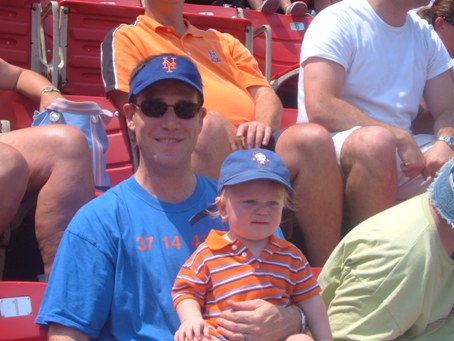
You know the FAFIF retired numbers t-shirt has made it big when the grand poobah of Mets uniform numerology himself is sporting it at Shea. No, not Charlie Samuels, but our buddy Jon Springer from Mets By The Numbers, one of the greatest Web sites in the history of the world (we are told its core data has gone into the shop for detailing and will emerge all new and glistening in the coming weeks).
Not yet wearing any numbers but definitely making an impact is 14-month-old Ivan Springer, taking in his first afternoon at Shea Stadium last Sunday. How did he like it? We are told that he was a real gamer, at least for the first four innings. Alas, the cumulative effect of a ceremonial flyover on Military Appreciation Day and oodles of cheering Mets fans sent the Springer men to an uncommonly early exit.
The kid’s lifetime record stands at 1 win and 0 losses. He’s got some nice numbers of his own there.
by Greg Prince on 23 July 2007 5:15 am Some successful cultural phenomena defy mortal understanding. One of them is the Broadway genre known as the jukebox musical, one that has turned the catalogues of pop artists or soundtracks from familiar films into excuses for shows — expensive-to-attend shows. With the exception of the GrandABBA of them all, Mamma Mia, Stephanie and I have avoided these with plaguelike precision. Until Sunday afternoon.
Having timed our way into hella discounted third-row tickets, we rolled the dice on Xanadu, a musical based mostly on the 1980 Olivia Newton-John vehicle of the same name, with a few extra ON-J and ELO chestnuts (a very music critic-y word) thrown in. About three notes into the very first resuscitated number, Electric Light Orchestra’s “I’m Alive,” I couldn’t help but think:
They made a musical out of this? They made a musical out of bleeping Xanadu? They made a musical out of perhaps the worst movie ever?
That they did. And with up-close seats that cost no more than some of your ritzier Gold, even Silver dates at Shea, I am compelled to report that Xanadu lived up to its surprisingly glowing notices. It moved fast, it was totally aware of itself (who would have thought roller disco could be so tolerable and leg warmers such a plot point?) and it starred the delightful Kerry Butler, whose performance as “checkerboard chick” Penny Pingleton charmed us so in Hairspray five years ago. The show was as fluid as the film was torpid.
I’m predisposed to like anything that features a Top 500 smash, which Xanadu most certainly did, specifically the No. 270 song of all-time, Olivia Newton-John’s “Magic”. It was my anthem for June and July and August of 1980, perfectly synced to those “Magic Is Back” Mets, continuing to echo in what’s left of the mind I had when I was 17. I couldn’t hear it Sunday without thinking of Steve Henderson and Allen Ripley and all that hope I invested in the Torreadors of 27 summers ago. My musings usually drift to baseball during stage productions (or anytime I’m in an audience), so having a legitimate shove like “come take my hand…” was all the more appreciated.
I mentioned it was a fast-moving show. It started at 3:00. It was over by 4:30. Just long enough to give us our money’s worth, just quick enough to get us out onto 44th Street in the second inning. You have to believe I switched the FAN on. Nothing could stand in my way.
Through dinner at the dependable Westway Diner on Ninth Ave., through the 10-block walk south to Penn Station, most of the trip home on the 6:04…everything stood in our way. Rafael Furcal…Nomar Garciaparra…that annoying Eric Stults from last September…the first seven innings sounded decidedly unmagical. I was beginning to really resent Xanadu for being set in and around Los Angeles.
But then! All over the world, gotta tell you what I just heard…
• The top of the eighth, somewhere east of Valley Stream: A Reyes double, a Milledge grounder, a Beltran fly ball. Dodgers 4 Mets 3.
• The top of the ninth, driving home from the station: infield single, wild pitch, helpful grounder, rightfield error. Dodgers 4 Mets 4.
• The top of the tenth, on the well-worn couch: Milledge and Beltran with the base hits, Wright with the beatout of the double play and the muse-assisted Chip Ambres finds a hole. Mets 5 Dodgers 4.
• The bottom of the tenth, edging from our seats: Billy Wagner, not without bumps (nor as smoothly as Heilman and Feliciano), strikes out three dangerous Dodgers. The Mets hang on to something it didn’t seem they would have at all.
And now, open your eyes and see, what we have made is real. We are in Xanadu.
Well, we’re in first place, still, even after the turbulence of one too many West Coast flights. We’re in first place, still, no matter how many pebbles have accumulated in our shoes. We’re in first place, still, despite having played few eighth, ninth and tenth innings as transcendent as the three final frames we gutted out Sunday afternoon.
Should these Mets use this 4-3 road trip, this 7-4 stretch since the break, as a launching pad for further momentum, to build a more impenetrable divisional margin, to ride to another Eastern title, to ascend Mount Olympus as planned but pre-empted a year ago, then this game was totally magic — the Chip Ambres Game, we’ll call it; he walks in and he’s suddenly a hero.
And if this was just one isolated sparkly Hollywood win and it’s back to wallowing in muddy waters on the shores of Flushing Bay against the Bucs and Nats, so what? It was still a helluva win. We’re alive and the world shines for us today.
by Greg Prince on 22 July 2007 4:29 am We deserved that.
Every one of us who thought “yeah, that's too bad about Valen…oh boy! Ruben Gotay is gonna play more!” deserved to watch Gotay throw away a sure double play ball in the sixth and, with it, any hope of keeping the Dodgers in sight Saturday.
For shame. For shame on anyone who took the least bit of solace in any Met's injury, especially one as serious as that which befell Jose Valentin.
Myself included.
I like what Ruben Gotay has shown with the bat, I really do. But he's a subpar second baseman. If he plays enough, he will be exposed. He has been exposed. He might get better and he might be worth it because he might hit, but I have to believe there's a reason that Gotay was made readily available by Kansas City last year and went unclaimed when he was dropped off the major league roster over the winter. As a part-time contributor, he qualifies as one of Omar's potential gems. As an everyday second baseman, I'm not nearly sold. Not yet.
I'm having a bit of déjà vu with Gotay. This is, on a less monumental scale, Melvin Mora all over again. Mora became the everyday shortstop when Rey Ordoñez went down in 2000. Mora could hit. There was no doubt about that. He was 1999's Endy Chavez except with added versatility. Problem was he wasn't an everyday shortstop, certainly not when he was asked to prove he was in the heat of a pennant race. Watching Melvin play short was painful seven years ago, as much because I had fallen in love with his hitting and outfield skills the fall before as because he wasn't a good shortstop and it was the costing the Mets baserunners and potential outs.
The Mets traded for a great shortstop, Barry Larkin. But Larkin vetoed the deal. Then they traded for a proven shortstop, Mike Bordick. He wasn't all that proven anymore at that stage of his career. Plus they traded Melvin Mora to get him. Mora went on to become an All-Star for the Orioles, if not an All-Star shortstop. Bordick went on to find the bottom of the hill as a Met.
Might have the 2000 Mets gone on to an N.L. flag with Mora at short? I honestly can't say. He really was a poor shortstop. I didn't want him traded, but I didn't want him in there at that moment playing at that spot. But injuries mean hard choices. Willie has one right now at second, juggling among Gotay's bat, Anderson Hernandez's just-recalled glove, Marlon Anderson's moxie and whatever Damion Easley has left once he returns to the roster. I've still got that fantasy trade for Brandon Phillips on the front burner, but I'm not the GM…of the Mets or the Reds.
I don't know who's going to play second or who should play second or if anyone's going to emerge as the answer. I do know none of us should have felt even ancillary relief that Jose Valentin was no longer an option. I know I did and I know I was wrong.
by Jason Fry on 21 July 2007 6:04 am A plea for Jose Valentin, AKA “Other Jose” when Reyes's cheer was adapted for his good deeds: In six to eight weeks please be careful crossing streets and going down stairs. Because it ain't your year.
Valentin's run of miserable luck (knee, wall-punching hand, etc.) has now culminated with a broken tibia, one I imagine will end his season and his Mets career. So now what? Hmm. Well, the signing of Marlon Anderson now looks even smarter, doesn't it? Ruben Gotay, recently entering his period as Promising Young Player Being Hazed by Willie Randolph, has a crack at finishing stealing the second-base job away for his very own. (Provided he hits against lefties.) Does David Newhan get back on the Crescent City shuttle? Hey, forgotten man Anderson Hernandez's hitting .259 against lefties down in New Orleans, which for Anderson Hernandez is a lot of hitting.
On the other hand, it sure looks like it's Oliver Perez's year. Never has an ill-advised taxi ride proved such a blessing in disguise: It gave us Oliver, a once-and-potentially-future ace, and Roberto Hernandez, whose poor outing in enemy colors let us finally break through. (Who knows, maybe Xavier Nady was out letting the air out of various Dodgers' tires.) I've written it before, but it bears writing again and again: Every time I doubt Omar, I try to remember that forced into a desperate midnight trade (and don't let hindsight and fungible memory convince you we weren't desperate), he turned a serviceable but unexceptional outfielder into an OK reliever and a guy whom I firmly believe could shutter the Clubhouse of Curses and lead us to a title.
On the other hand, I was aghst during Omar's in-booth chat about Pedro (Martinez, not to be confused with Feliciano, who did a marvelous job keeping the Dodgers at bay). The conspiracy theories will bloom, but I don't think Omar was playing possum by ratcheting down expectations with his talk that anything we get from Pedro this year is a bonus. That sounds to me like Dr. Altchek has recommended more than a mental rest. It sounds to me like something is wrong or Pedro's coming along a lot more slowly than we believed a couple of weeks ago.
Bad news. But, well, let's take 'em one game at a time, and the good Lord willing, things'll work out. Like they did tonight: Oliver was masterful, both Carloses seem to be reviving, and we got to display a second raised middle finger to the schedule-makers.
And now I'm off with the kid to the piney woods of Maine. Back in '05, my trip didn't go so well: It was Humberto Cota and Braden Looper and Greg ordering me back home. Last year there was a bit of Lima (any bit of Lima is too much Lima), a lot of runs for newborn met Mike Pelfrey, and then the All-Star break.
This year? Who knows. Though with Brad Penny taking the mound later today, I've got a hankering for revenge. The Spanish have their own expression about revenge, but I've always heard it's a dish best served by breaking it over Brad Penny's fucking head.
by Greg Prince on 20 July 2007 9:52 pm 
| For the first time in 33 years, I have Joe Torre’s 1967 Topps card, the first baseball item of any kind I can ever recall latching onto, a dead ringer for the one that my mother threw away in an unprecedented purge of my mess of a room in 1974. Though there is no contemporary shortage of opportunities to bask in his gentle decency, it’s nice to have the Joe I knew from four decades ago back amid my current piles of crap. |
|
|
by Greg Prince on 20 July 2007 9:43 pm If you’ve been staring at the same damn face for four decades, chances are it’s Flashback Friday at Faith and Fear in Flushing.
Some facts I was exposed to when I was 4 years old:
In 1960, Joe led the Northern League with a .344 avg.
In 1964, Joe led the N.L. with a .994 fielding mark.
The young receiver is the best all-round catcher in the National League.
Last year, Joe set a new personal home run high with 36 circuit blasts.
Joe Torre entered my life when I was 4.
I’m 44.
He’s still here.
Who invited him in the first place?
Topps did. Their RSVP was the card numbered 350 in its 1967 set. Joe Torre’s baseball card is the first baseball card I can ever remember holding. I’m sure it was one of dozens in my grasp at the time, but Torre’s is the one that stayed with me — physically for seven more years until my mother made good for the first and only time on her tired threat to throw out all that crap on my floor if I didn’t start picking it up (and even then she left it to sit in the basement for a few weeks because, she swore later, she figured I’d have the good sense to sneak downstairs and rescue the crap that I wanted) and mentally to, well, right now.
Joe Torre never goes away. Joe Torre, when he was on the verge of turning 27, was the first baseball presence in my life, courtesy of my sister‘s small stack of baseball cards that peer pressure compelled her to collect half-heartedly in fifth and sixth grades and that her apathy wound up bequeathing to me by the time she was in junior high. At some point in the late 1960s, before I had a solid idea of what baseball was (besides the bane of Charlie Brown’s existence), before I put together New York, Mets and me, I handled Joe Torre’s 1967 baseball card.
And then I handled somebody else’s.
And then I was hooked.
Hooked on baseball. Hooked on baseball cards. Hooked on…Joe Torre?
Not really. He may have been the first player I could identify by team (Braves) and position (Catcher) and locales like Eau Claire, Louisville, Milwaukee and Atlanta, but in 1967 or whenever I first laid a finger on Joe Torre’s image, I consumed the information with no particular appetite for he who was responsible for generating it. My sister’s retroactive assessment of Torre as having been “cute” — not a universal consensus if you’ve read Ball Four — was probably the most enthusiastic endorsement by either of us as regarded Braves Catcher Joe. That I wound up with this card, all her cards and complete possession of the family’s baseball interest indicates to me that she didn’t think he was all that cute.
Joe Torre of 1967 became one card of many for me. Eventually I’d collect so many that there’d be enough runoff on my bedroom floor that it could be scooped up in an unfortunate raid on my clutter and I didn’t miss it, not that much. I don’t even know when I noticed it in particular was gone. What did I care about some old Braves Catcher?
Except he was the first one. So that annoyed me slightly. Plus, Joe Torre was good. I could tell that not just from his card’s cartoon chockablock with all that data about his .994 fielding percentage but because I grew to follow baseball very closely. I noticed that Joe Torre was no longer a Braves Catcher, but a Cardinals Third Baseman. That he was hitting .363 in 1971. That he was named MVP. That he was from Brooklyn. That he was continually rumored to be coming to the Mets.
That he did.
In his first act as Mets general manager, Joe McDonald traded two pitchers, the awesomely named Ray Sadecki and the perpetual prospect Tommy Joe Moore, to St. Louis for Joe Torre on October 13, 1974.
My god, I thought, we’re actually getting Torre. He’s not even a third baseman lately even though, as the Mets did with Jim Fregosi, they said he’d play third for us next year. Why do they keep playing guys who aren’t third basemen at third base? Why do they hate Wayne Garrett so much? He was at first for the Cards every time I saw them. I didn’t think the grand scheme made sense, but Joe Torre had two of those qualities I envied about non-Mets: he was a star; and he was a star who wasn’t on the Mets. I was excited enough by the announcement to call my sixth grade Mets pal Jeff Mirrer and break the news. That may have been the first time I ever did that.
Torre was newsworthy immediately. Because they won the pennant in ’73, the Mets were asked to play a goodwill tour in Japan after the ’74 season. By then the Mets were a fifth-place club, but diplomacy is diplomacy and off to the Far East the Mets went, new third baseman Torre included. He was all over the ’74 highlight film even though his only Mets action was in meaningless exhibitions thousands of miles away.
The 1975 yearbook was similarly brimming with excitement over Torre having joined the Mets for an extended sneak preview:
Swarthy local product’s initial exposure in New York uniform pure Hollywood script-ure: won MVP honors for Mets before playing an official game for them! Earned distinction for exploits on Japanese tour with .437 contribution in all 18 games (71-for-31) embroidered by 18 RBI and five home runs, in atmosphere significantly reflecting leadership.
Yes, it said “71-for-31,” but we assume that’s an innocent transposition error. Yes, “script-ure” seems intentional (intentional tort-ure, that is). And yes, the first thing they called Joe Torre was “swarthy,” code from another era — an era concluded before 1975 except at M. Donald Grant’s shop — for Italian when that was considered worth noting. In case you’re wondering, the yearbook described both Wayne Garrett and Felix Millan as soft-spoken, Jerry Grote as battle-scarred, Jerry Koosman as king-sized, Bud Harrelson as pocket-sized and Rusty Staub as the “sophisticated gourmet”. But the really bizarre portion of that passage is the part that contends Torre’s nice showing in Japan had something to do with “atmosphere significantly reflecting leadership”. By going 31-for-71 in Japan, Joe Torre apparently provided the template for Mr. Sparkle.
The larger point seemed to be that Joe Torre, eight years removed from that Braves Catcher card, was destined for greater things off the field and in the dugout. Joe didn’t play a very swift third base. The ’76 yearbook would have been well off to describe him as range-free, to say nothing of lead-footed. If Mets fans remember anything about Torre’s playing career once it wound down in Flushing, it would be that one night against Houston he followed four Millan singles with four double play grounders. It’s Felix’s fault, he said afterwards. He got on base so much.
His leadership significantly reflected, Swarthy Joe was on his way to the manager’s chair at Shea. When the 15-30 Mets dismissed the forlorn Joe Frazier in 1977, Torre was elevated, first as a player-manager, then just as skipper. He wasn’t quite 37, still the youngest manager in Mets history.
Joe Torre lasted a long-ass time as Mets manager, particularly considering his low-ass success rate. Joe managed more Mets games than Casey Stengel, than Yogi Berra, than (though this one comes with a sad asterisk) Gil Hodges. Joe had a higher winning percentage than Casey Stengel but a lower mark than Art Howe, than Dallas Green, than Jeff Torborg, than Joe Frazier, none of whom lasted nearly as long as Torre.
The extenuating circumstances of Torre’s failure-to-longevity ratio were that the Mets had few players of undisputed Major League caliber for the balance of Torre’s tenure. So my tendency, at least, was to give Joe a break. I rooted for him more than I had for Frazier or would the other blanks the Mets would fire in later seasons. Maybe it was his local roots. Maybe it was his “it’s Felix’s fault” charm. Maybe it was his familiarity. Maybe it was his 1967 card. Joe made a lot of moves as Mets manager. He was criticized because they didn’t work out. Probably had something to do with the pieces on his chess board all being Dwight Bernards and such.
Joe Torre, like Jimmy Carter, served in office from 1977 to 1981.
Joe Torre, like Jimmy Carter, was more popular when he came in than when he went out.
Joe Torre, like Jimmy Carter, remained one of my favorites while I was in high school despite some grim results on his watch.
Joe Torre, like Jimmy Carter, went back to Georgia.
Joe accepted the Atlanta managerial job in 1982, which made me far happier than you’d expect. Marooned in college in Tampa, my only connection to Major League Baseball that counted was Braves Radio as it was called. They became my adopted second team, what with them in the West and us in the East (glad I wasn’t studying geography). Now they would be helmed by my field general, my Joe Torre of Brooklyn, N.Y.
The Braves reeled off 13 straight to start ’82. Joe was a genius in Atlanta. The Braves went reeling after losing 19 of 21. Joe was as big an idiot in Atlanta as he was in New York. But Joe and the Braves hung in and outlasted the Dodgers to win their division. The Mets under George Bamberger lost 97 games.
Torre had another pennant race in ’83, which the Braves lost. Then they began to crumble and Ted Turner fired him. For the first time in my living memory, Joe Torre disappeared from uniform, from public view. It was rumored he was announcing California Angels games, but out of sight, out of mind.
Then he reappeared with the Cardinals in 1990. I have to say I wasn’t really thinking about Joe Torre anymore. My residual goodwill, for the card, for the Met stewardship, for along with Al Lang getting me through my first year or two of college, had dried up. I was actually pretty annoyed that Torre was credited in some circles for being exactly the manager Gregg Jefferies needed. Jefferies, like Torre, wore out his welcome in Flushing. In St. Louis, under Joe’s tutelage and tender loving care (he moved him to first base), Jefferies blossomed into one of the best hitters in the National League. He hit .342 in 1993. His batting average was almost as high as our winning percentage.
More irksome was something Torre said sometime in the 1990s, in the first half of the decade, I think. He said it was really special managing in St. Louis. It was a great baseball town and he enjoyed such success playing there, winning the MVP, the fans were wonderful. It had been really special managing in Atlanta, too. The Braves were his first club and it meant something to him to put that uniform back on. What about the Mets, Joe, he was asked. You grew up in New York and you finished your playing career in New York. Getting your first managing job with the Mets, that must have been special, too, right, Joe?
No, Torre said. The Mets never really meant anything to him.
Well eff you, too, pal. I defended you for the better part of five seasons. I was genuinely melancholy when you were finally fired for losing almost 60 percent of your games. I insisted that the sports jacket my mother was determined to buy me at Roosevelt Field before I went off to college be bought at Bonds because my favorite commercial when I was in twelfth grade began with “Hi, I’m Joe Torre for Bonds.” But we didn’t mean anything to you?
Joe. You coulda made me proud. You chose not to.
The Cardinals no longer felt it was special to have Joe Torre as their manager by 1995. Despite reviving Jefferies’ career, he had led St. Louis to no division titles in five years. In fact, among the three jobs he held over parts of 14 different seasons as a manager, Joe Torre made only one playoff appearance, in ’82. And those Braves were swept. There was no reason to think this 55-year-old washout would be hired to run anybody else’s team.
We know what transpired next and transpires still.
With Joe Torre back in New York in 1996, a few old feelings came crawling back. It was unfathomable that he was fished out of mothballs to take over a fourth team, but it was also unfair, I thought, for the Daily News to refer to him as CLUELESS JOE right off the bat. (Obviously the paper has been making it up to him ever since.) When Torre did make his first World Series — with his entire family’s well-being concurrently hanging in the balance — there was a very, very, very, very small part of me that, in the most theoretical abstract, was just an eensy bit happy for him, if not for anybody else attached to his sudden success. Seeing Joe Torre overcome expectations in 1996 reminded me of all those days and nights circa 1980 when I thought he would do it for us.
But of course he didn’t do it for us. And of course he kept doing it for them.
Joe Torre and I remain estranged.
His 1967 card, though…I wanted it back. My mother threw it out when I was eleven. It had historical significance for me. It was my first card. I had lived without it for 25 years when I decided to seek it out. In late 1999, for the first time in more than two decades, I attended a baseball card show, at Hofstra. I found a dealer. I asked — after prefacing my question with my obligatory assertion that I had no interest in his current affiliation, knowing perfectly well that this merchant did not care — do you have a 1967 Joe Torre?
The guy did. It was maybe four bucks. I handled it. I examined it. I saw Joe Torre. I saw the face that first welcomed me to baseball before I really knew what baseball was.
I handed the dealer back his card.
In late 1999, I couldn’t stand the idea of even tangentially endorsing anything Joe Torre was up to at the moment in his professional life. If I still had the Bonds sports jacket, I would have burned it. A year later, after Torre defended Roger Clemens for throwing a shard of a bat at Mike Piazza, I would have resewn the jacket just to burn it again.
Forty years since Joe Torre became the first baseball player and baseball card I could identify, he’s still around — around like crazy. Gary Sheffield accused Joe Torre of unsportsmanlike behavior and all it does is tighten the halo over Joe Torre’s head. It’s a St. Joe Zone…cross at your own risk. Torre recently told his relentlessly worshipful biographers at the Daily News that this has been by far his toughest season in the job he’s held since ’96 (that a manager confirming that a bad record is worse than a good record rated the back page last Sunday tells you everything you need to know about the state of the Daily News). New York magazine recently took Torre’s pulse to see how he’s holding up under the strain of not winning regularly; they called him the city’s father figure. That was almost as funny as that line about Felix Millan getting on base four times. When Joe Torre was not winning regularly as Mets manager, he wasn’t called the father of anything. It was more like “when are they gonna fire that Torre son of a bitch?” And nobody cared how he was holding up.
Beyond the fawning coverage is the amazing reality that Joe Torre continues to be such a presence on the baseball scene. In New York yet. Joe Torre was part of my life four decades ago as a picture and a name. Three decades ago as a player turned manager. A quarter-century ago as a Met icon turned Brave pilot. For the last decade and some as an enabler of some of my worst baseball nightmares come true.
Joe Torre will not go away. I cannot escape his swarthy pervasiveness. So I have given up trying. A few weeks ago I decided to let bygones be bygones and square the Torre circle. I went on eBay and, for a few bucks, I purchased No. 350 from 1967. He and I are face to face again at last.
It’s just as I remember it:
JOE TORRE • CATCHER on top.
BRAVES on bottom.
In between, the heavy eyebrows and the distracted glance that my sister inexplicably found cute. Joe Torre in the prime of his career reminds you why Jim Bouton quoted Seattle Pilot teammate Jim Pagliaroni so approvingly in 1969:
He was describing a girl that one of the ballplayers had been out with and said, “It’s hard to say exactly what she looked like. She was kind of a Joe Torre with tits.” This joke can only be explained with a picture of Joe Torre. But I’m not sure any exist. He dissolves camera lenses.
Topps would beg to differ.
I’d be remiss if I didn’t point out one more fact from Joe Torre’s 1967 Topps baseball card. Yes, you know he was a Northern League hot shot. Yes, you know he was quite the defensive backstop in 1964. And it shouldn’t surprise you to know he was a .300 hitter for his six-year career through 1966. You’ve probably heard, even if you don’t remember first-hand, that Torre was a borderline Hall of Fame player…and you’ve gotten the message since 1996 that he will eventually be a Hall of Fame manager.
But there’s also this — the card says Joe Torre was Born: July 18, 1940. Hence, he turned 67 on Wednesday. I didn’t need to recover the card to know Joe Torre’s birthday is July 18. I’ve known that about him since he came to the Mets. That date’s been instantly recognizable to me since before I really knew what baseball was.
July 18 was also my mother’s birthday.
Next Friday: The No. 4 Song of All-Time and how it didn’t sound sad upon the radio.
|
|







