|
||
 
Faith and Fear in Flushing made its debut on Feb. 16, 2005, the brainchild of two longtime friends and lifelong Met fans. Greg Prince discovered the Mets when he was 6, during the magical summer of 1969. He is a Long Island-based writer, editor and communications consultant. Contact him here. Jason Fry is a Brooklyn writer whose first memories include his mom leaping up and down cheering for Rusty Staub. Check out his other writing here. Got something to say? Leave a comment, or email us at faithandfear@gmail.com. (Sorry, but we have no interest in ads, sponsored content or guest posts.) Need our RSS feed? It's here. Visit our Facebook page, or drop by the personal pages for Greg and Jason. Or follow us on Twitter: Here's Greg, and here's Jason. |
So there they are, your 2007 Major League Baseball All-Stars, gallivanting about in black and orange, orange and black. Every batting practice, home run contest and celebrity softball participant is resplendent in Giant colors. Gary Carter even managed to assimilate in a cap that says SF, for the team with which he’s so closely identified. The San Francisco Giants are your gracious hosts for the 2007 All-Star Game. They celebrate themselves as well as the game this week. Well, they celebrate the part of themselves they can lay their hands on. They celebrate Bonds. They celebrate McCovey. They celebrate Mays. I’ll be shocked if anybody in San Francisco utters these two Giant words: Mel Ott. Who? Sounds vaguely familiar… I think I heard his name mentioned the last time somebody hit his 500somethingth home run. Oh, I know! And with that, the slugger passes Eddie Murray. Next up on the list: Mel Ott at 511. Mel Ott hit 511 home runs. Repeat: Mel Ott hit 511 home runs. Long before anybody had ever heard of the clear or the cream, long before anybody expanded and depleted pitching staffs, long before television became a way of life. Mel Ott hit 511 home runs back when hitting 511 home runs was an almost unmatched feat and without anybody setting a VCR to record a single one of them. But he hit ’em. He hit ’em and hit a load of ’em right around here. And yet, have you, especially if you’re younger than 50, ever heard of Mel Ott beyond the most cursory of statistical mentions? Do you know who this man was and what he accomplished and where he accomplished it? I’m guessing no. I’m not blaming you. You can only seek out so much baseball. The rest is to be absorbed by osmosis, and for osmosis to occur, the baseball’s got to be out there somewhere. Mel Ott’s substantial slice of it isn’t anymore. Mel Ott has been lost to the mists of time. Mel Ott may be the greatest ballplayer to play in the greatest city in the world to have all but vanished from public consciousness. It’s tough to remain an active immortal when your team has left you behind. That, of course, is what the New York Giants did to Mel Ott the second they became the San Francisco Giants. They left behind John McGraw and Christy Mathewson and Carl Hubbell and Bill Terry and hundreds of others, too. A few have managed to have the pilot lights on legends relit in recent years. Ott, though, has fallen through the cracks and pretty much straight down the memory hole, he and every one of his 511 home runs. Which were huge in their time. Mel Ott was a star. He was an All-Star rightfielder/third baseman for a dozen consecutive years, from 1934 to 1945. He was the face of the New York National League franchise for two decades, beginning with when he was a teenager. Between Mathewson and Mays, he was, even at 5 feet 9 inches, the Giant among Giants. Ott’s entire 22-season career has essentially been reduced to a rest stop on the home run highway. He’s where boppers collect themselves ever so briefly before preparing to pass Eddie Matthews and Ernie Banks just one dinger up the pike. Then it’s off to McCovey and Ted Williams at 521 and so on. Mel Ott gets left in the dust. He’s a marker. Merely the signpost up ahead when he deserves to be an entire road unto himself — or at least have one in New York bear his name. Such an action is not unprecedented and the honor would surely be appropriate. You may still refer to the West Side Highway in Manhattan as the West Side Highway (or the “bleeping West Side Highway” at rush hour), but a good chunk of it is officially the Joe DiMaggio Highway since 1999. A hardy band of fans of those departed New York Giants, the team that was identified with Manhattan for decades every bit as much as the Clipper’s club was tied to the Bronx, has petitioned two mayors and various municipal muckety-mucks to name at least part of Harlem River Drive after Mel Ott. (The Ottway has a nice ring, no?) It would be geographically spot on, given that it winds right past where its namesake player made his living and made his fans very, very happy. DiMaggio, I’ll grant you, cast a wider PR net after his retirement, but I’ve got news for you. Before the Yankee Clipper clocked a single base hit, Ott outed 242 balls for home runs. The 511 he hit, that total passed so often in the injection era? It’s still 19th-most all time. A decade ago, it was 14th-most. And when Mel Ott retired on July 11, 1947, exactly 60 years ago tomorrow, it was the third-highest home run total in baseball history, trailing only Babe Ruth’s 714 and Jimmie Foxx’s 534. Until 1966, Ott’s 511 was the N.L. standard. The man who eventually topped him was Willie Mays, six seasons a New York Giant himself and the only fellow to be mentioned in a serious discussion of greatest everyday New York Giant ever. Willie was Willie, but San Francisco unfortunately beckoned for the balance of his prime. Bill Terry compiled a lifetime .341 average, but little of the power and, at best, a fraction of the affection Ott did. Mel Ott, beyond his staggering numbers (notably 1,860 RBI, eleventh-most all-time) was beloved in ways that defy our modern, cynical perceptions of professional athletes. It wasn’t for nothing that Time placed him on its cover in the twilight of his career, pronouncing him “Everybody’s Ballplayer.” It wasn’t a coincidence that when Lou Gehrig acknowledged the Giants paying him consideration in his darkest hour (“when the New York Giants, a team you would give your right arm to beat, and vice-versa, sends you a gift — that’s something”), that those were Ott’s Giants. It wasn’t a fluke that a nationwide poll of war bonds buyers in 1944 identified him as the most popular sports hero of all-time even after batting .234. And it’s no accident that the most famous and famously mangled quote in baseball, Leo Durocher’s “nice guys finish last,” started out as a tribute to the nicest guy of them all: “Do you know a nicer guy than Mel Ott?” Durocher offered his lefthanded praise to the Giants’ skipper (in his fifth season of seven as player-manager, when the Giants, in fact, were eighth of eight in the league) in the service of promoting Durocher, but it wasn’t an inaccurate assessment of Ott’s persona as it was widely viewed through his 22 seasons as a player. • Is it any wonder that the National League officially honors its annual home run champion with the Mel Ott Award to this day? • Is it any wonder that the evening after Ottie banged his 500th homer, renowned saloonkeeper Toots Shor abandoned entertaining the Nobel Prize winner who happened to be in his establishment, Sir Alexander Fleming, to welcome Master Melvin to the premises with a perfectly reasonable, “Excuse me, Alex, I’ve got to greet someone who’s really important”? • Is it any wonder that after he was dismissed as manager by the Giants in 1948, they didn’t pretend he never existed but instead made sure to retire his number 4 the very next year? (It remains retired; thanks for that much, San Francisco.) So he was a sweetheart and he hit a lot of home runs. Is there more to Mel Ott than that? How about this: Mel Ott is the Home Run King of New York. Aw, come on, you may be thinking. Everybody knows that’s Babe Ruth’s gig; we’ve seen the pictures with the Babe wearing the crown. Yes, of course, Ruth set the records for most home runs in a season and in a career, but not even the Bambino homered as much in New York City as Mel Ott did. As documented in Stew Thornley’s essential Land of the Giants: New York’s Polo Grounds, Babe Ruth hit 299 regular-season home runs between the PG (Yankee home Ruth’s first three seasons in town) and Yankee Stadium. That, though, is a full 24 shy of Ott’s Coogan’s Bluff total of 323 — which doesn’t even take into account his frequent visits to Brooklyn and the 25 homers he hit out of Ebbets Field. Granted, the Polo Grounds was as strangely shaped then as Barry Bonds’ head is now. Lefty Ott and his singular stance — lifting his right foot “completely off the ground and slightly crook[ing] his knee more as if he were pitching a ball than about to hit one,” Roger Angell wrote — surely took advantage of the 257-foot rightfield foul pole. If that’s how she played, that’s how she played. The wondrously weird dimensions of the Polo Grounds (including 483 feet to center) were as nutty for every Giant and every opponent as they were for Ott. If Yankee Stadium was The House That Ruth Built, the Polo Grounds turned out to be the crib where Mel Ott was born to deposit line-drives over a short fence. Did somebody say “crib”? It wasn’t long after he first drew breath that he was swinging there. Mel Ott made his Major League debut in 1926 at the preposterous age of 17 (no minor leagues for this minor), thus earning that endearing and enduring nickname, Master Melvin. In Yogiesque terms, he was mighty young for an awfully long time. There was also something oxymoronic about his appearance, all 5′-9″, 170 pounds of it: A boy that green, a frame that slight, a signature right leg lift that unorthodox…yet home runs that plentiful. It’s as fitting and can be that the definitive book on him, by historian Fred Stein, is titled Mel Ott: The Little Giant of Baseball. It’s sadly apropos that Ott got such an early start seeing as how his life ended too soon, at age 49, after a gruesome car accident in his native Louisiana. It’s unfortunate in a less tangible way that his death in 1958 accelerated the forgetting process that erases far too many figures from the collective memory. Mel Ott is gone nearly 50 years. He fleetingly re-emerges in the collective baseball consciousness from time to time. • Like when Ken Griffey became the most recent player to pound a 511th homer and when Frank Thomas or Alex Rodriguez becomes the next to reach that plateau. • Like when TV Land airs that episode of M*A*S*H in which Colonel Potter, irked by Major Winchester’s assertion that operatic tenor Enrico Caruso is a giant, makes the same reference any American would have thought of as late as the Korean War: “If I want a Giant, I’ll send for Mel Ott!” • Like when 37-Across in the Times crossword contains the clue “Giant Mel” and there are three squares to fill. • Like when the United States Postal Service issued four stamps last July to honor four Baseball Hall of Famers. Three of them — Mickey Mantle (61*), Roy Campanella (It’s Good To Be Alive) and Hank Greenberg (The Life And Times Of…) — were immortalized in film. The fourth is Mel Ott. He’s a hint. He’s a sitcom rejoinder. He’s a line in The Baseball Encyclopedia to be hopped, skipped and jumped by the next slugger who doesn’t test positive for something a 5′-9″ legend in his time never needed. Now he’s a stamp. Anything that affixes him in memory is a good thing, I suppose. Seems like he should be more, though. He was Mel Ott, for goodness sake. When I was in third grade, I found four ancient biographies of long-retired ballplayers in the school library: Ruth, Cobb, Gehrig, Ott. Ott was the only one I hadn’t really heard of before. Those other guys have stamps and movies to burnish their accomplishments, and a seemingly perpetual place in the National Pastime’s mythology. I’d be shocked if a single third-grader in America is reading about Mel Ott this term or next, no matter how often the post office cancelled his image in the past year. Mel Ott played the 2,730th and final game of his Hall of Fame career 60 years ago Wednesday. He made his retirement as a player official at the end of 1947, returning as manager for ’48 — by then they were routinely referred to as the Ottmen — only to be replaced midway through the campaign by the far more fiery Durocher. Leo the Lip would do great things as Giant general, but it is no hyperbole to say an era ended with that momentous change of command. Mel Ott played for John McGraw. McGraw defined his franchise and his circuit in New York for more than a quarter-century. There was an unbroken line there that ran from McGraw’s hiring in 1902 and Ott’s dismissal in 1948. There’s never been a stronger baseball tradition in New York, not in the sense that generations and families inform tradition. Mel Ott was National League baseball in New York in the way that…I don’t know that there’s an obviously analogous Met. I’d like to say Tom Seaver, but we know evil forces sent him on a wayward path far from home. (Ott, by the way, was a Tigers broadcaster when the Giants played their final home game in Harlem in 1957 and missed its farewell; imagine Seaver not being on hand at Shea next September.) Maybe if Buddy Harrelson had become a beloved and tenured Met skipper, maybe him, but we’re also talking about a playing career that is nearly unparalleled in all big league annals. No, there is no Met (yet) who quite measures up in Ottman terms. Not too many teams have had anybody like that, but it is worth mentioning the Mets in all of this. Our New York Mets play under the same NY as Mel Ott did. Our New York Mets started life in the same Polo Grounds where Ott, as Angell put it, “consistently, quietly and always reliably” established his indelible statistical imprint of most National League home runs, runs batted in, runs scored, total bases, bases on balls and games played as of his retirement. Our New York Mets’ reason-for-being is born of two paternities once removed — one about to be commemorated for the umpteenth time while being permanently set in brick and another that’s amazingly obscure considering its rich history — a lore known far and wide by the middle of the 20th century, disappeared from view by that same century’s end. Mel Ott doesn’t require a rotunda in Queens. But I thought it would be nice if somebody brought up his name and delved a little into what it represents within our New York National League genetic code. It’s something not nearly enough people in these parts do anymore. You can read Fred Stein’s profile of Mel Ott at SABR’s Baseball Biography Project. It is adapted from an excellent book, available here. Fifteen teams are sending just one representative to San Francisco for the All-Star Game: the Braves (Brian McCann), Marlins (Miguel Cabrera), Nationals (Dmitri Young), Cardinals (Albert Pujols), Pirates (Freddy Sanchez), Reds (Ken Griffey Jr.), Giants (Barry Bonds), Rockies (Matt Holliday), Blue Jays (Alex Rios), Orioles (Brian Roberts), Devil Rays (Carl Crawford), Royals (Gil Meche), White Sox (Bobby Jenks), A's (Dan Haren) and Rangers (Michael Young). Some of those guys are superstars (Pujols, Griffey, Bonds), while others are rising stars (Cabrera, McCann, Holliday, Crawford). But some of the others fairly shout obligation. Do Michael Young's underwhelming numbers shout “midsummer classic” to you? Gil Meche has five wins — should he go to San Francisco for that? Does a punchless singles hitter like Freddy Sanchez really deserve an All-Star berth? Yes, yes and yes. And I won't hear otherwise. Why? Because of John Stearns. And Pat Zachry. And Joel Youngblood. And Lee Mazzilli. I remember those players from my first plunge into Met fandom, which started when I was seven and was as all-encompassing and life-changing as anything you love to distraction when you're seven. Except having traded Tom Seaver away, the Mets were terrible. Embarrassingly terrible. Avert-your-eyes, bag-over-your-head terrible. A few thousand at Shea terrible. And growing up on the North Shore of Long Island as a Met fan, not surprisingly, was terrible too. In the late 1970s, I made many, many bus rides to and from school and many, many circuits around the cul-de-sac where the kids of my neighborhood rode bikes. And from March through October, many of those bus rides and bike circuits were spent taking heaping portions of abuse for being a diehard fan of an irrelevant team. Most of my neighbors were Yankee fans, an allegiance they'd either come by honestly (if being soulless and evil can ever be arrived at honestly) or taken up because it was the easy thing to do. Up and down Miller Place I'd go, hearing the catcalls of sneering, braying junior Yankee fans. Mets suck. The Mets are so gay. How are the gay sucky Mets doing this year? Back and forth to school I'd go on the bus, tormented by the Steinbrenner Youth singing the version of “Meet the Mets” that was better known in our town than the real thing. Beat the Mets, beat the Mets Step right up and beat the Mets Hit your kiddies with a bat Guaranteed to want your money back Because the Mets are really stinking this year Fourteen behind and still acting queer From Expos to Giants, everybody's comin' round To beat the M-E-T-S Mets of New York town! I wasn't stupid. I knew the Yankees spent money and had a good chance of winning their division every year. I knew the Mets were embarrassingly cheap and had no chance. I knew they and I would be disrespected for it from spring training to the fall, that nobody wanted Met cards, that Herman's Sporting Goods barely bothered stocking Mets caps, that everybody in Little League wanted to be on the Yankees and groaned when they had to be on the Mets. (I was a Dodger.) This was my lot in life, and I gloomily accepted it while reading about 1969 and 1973 and dreaming about years yet to come, when things would somehow be different. I had one thing, once the hope of spring training faded and the reality of another dismal regular season set in: the All-Star Game. No matter how good the Yankees were, or how bad the Mets were, a Met would go to the All-Star Game. Unfortunately, when I was a kid the Met who usually went was John Stearns. Stearns would be the backup catcher, the just-in-case guy who never got to play. The Bad Dude went in '77 (Tom Seaver wore the colors of the Reds), '79 and '80. Between those three All-Star appearances he got one at-bat. And so it was for the Mets: Pat Zachry got tapped in '78 and didn't pitch. Joel Youngblood went in '81, after the strike, and went 0 for 1. But that was OK. Because what mattered to me was all the silly stuff I now usually miss. Just hearing “from the New York Mets” and seeing John Stearns come out of the dugout to the tepid applause of some far-off place was enough. Why, he'd slap hands with Pete Rose and Johnny Bench and Dave Parker, then look up at the crowd and tug on the bill of his cap. He was a New York Met All-Star, one of the elect, on national TV like all the rest of them. It didn't matter that he was usually alone in orange and blue, or that Sparky Anderson or Tom Lasorda wouldn't find a place for him. By lining up with the rest of the National League's best he was proof that we mattered after all, no matter what the kids on Miller Place said. And then there was 1979. Stearns went to the Kingdome and didn't play. But that year we somehow had two All-Stars. Lee Mazzilli, he of the basket catches and Italian good looks and Brooklyn roots, went too. And Maz did get to play. He led off the top of the eighth, pinch-hitting for Gary Matthews, whom the Mets had famously tried to recruit as a free agent by sending him a lowball offer via telegram. Facing Jim Kern, Maz cracked a home run to tie the game at 6-6. Then, in the top of the ninth, Mazzilli batted again. With the bases loaded. And on the mound was Ron Guidry … of the New York Yankees. Ron Guidry. Louisiana Lightning. The year before, he'd won 25 games and the Cy Young Award. And for all that he seemed overshadowed by the Yankees' other stars, by Reggie and Thurman and Nettles and Randolph and Piniella and Gossage. We didn't face the Yankees, unless you counted the farcical Mayor's Trophy Game, which nobody did. But now we were. Tie game, bases loaded, the entire nation watching. It didn't count, but it sure as heck mattered. And Maz, the New York Met, coaxed ball four from Guidry! He walked! In came what would prove to be the decisive run in a National League victory. I lay awake that night thinking happily of how tomorrow I'd get to see if the Yankee fans wanted to talk about how Ron Guidry had lost the All-Star Game to the young star of the Mets. I'd get to argue, perfectly plausibly, that Mazzilli should have been the MVP instead of Dave Parker. It wasn't a home run or a liner up the gap or even a clean single, but it had done the job. Guidry had thrown a complete game two days earlier and tired himself out warming up several times, but that was excuse-making. It wasn't winning the World Series, but I knew we weren't going to do that. Maz had beaten Guidry, and that was enough. And so every time I hear that it's an anachronism for every team to be represented in the All-Star Game, I remember those summers and that night, and the only day I ever got to strut through the halls of my elementary school because I was a fan of the New York Mets. And I think, for once utterly without irony, “Won't someone please think of the children?” There are young fans of the Nationals, Pirates, Royals, Orioles, Devil Rays and other downtrodden clubs who'll stay up to watch the All-Star Game tomorrow night. They're fans every bit as rabid as me and Greg and all of you reading. They pass the time memorizing stats and collecting cards and asking for replica jerseys for their birthdays. And mostly they spend their time dreaming — fantasizing about an impossible time when their love will be requited and their loyalty repaid. When their fandom won't hurt. When they won't feel their shoulders slump at the first brush of disdain and pity from those who root for winners. Does John Maine deserve to go to the All-Star Game? Undoubtedly. Would I trade Freddy Sanchez's spot to right this wrong? No way. Because I have no doubt that a generation ago there were players who deserved an All-Star berth more than Stearns or Zachry or Youngblood or Mazzilli, and that the Sporting News or Baseball Digest or Dick Young said so. Not getting to see John Stearns tip his cap might have derailed me from the tough business of fandom, and I know there's a kid in Pittsburgh who feels the same way today. He reads about the We Are Family Pirates and wonders how the heck Sid Bream could have been safe and mourns how Barry Bonds got away. He daydreams about Jason Bay hitting the home run that secures the win for Ian Snell in Game 7 of some future World Series. And he's waiting — far too excited for his own good — for the Giants' PA announcer to introduce Freddy Sanchez, to see him in the Pirates' colors, to revel in the fact that for a few seconds he'll be standing by his lonesome at the center of the baseball world. Take that little ritual away, and you just might steal that moment that keeps him faithful amid all the middle-of-the-night fears that the game is rigged and his hopes are for nothing. I needed that moment, and I got it. He deserves no less. 1) Keith Hernandez has highly selective recall of his own career. Last night he invoked the infamous Terry Pendleton game, framing it as a crushing loss (no argument), coming as it did in the second game of a series (it was the first), after a game the Mets beat the Cardinals (again, a nonexistent game) and before the finale, which the Mets came back and won (the Mets were blown out of the game right after the Pendleton game but won the day after that). Today he placed himself in the 1988 All-Star Game (it was the '86 game) at the Astrodome (the '88 game was in Riverfront; '86 was indeed in Houston). Dates and places aren't everybody's forte, I understand, but Keith had a hammy problem in '88 he's referenced several times before and even if the years do tend to run together after a while, 1986 was, y'know, 1986. I guess the important thing is that Keith's career was, in fact, Keith's career and the rest of us can file away the particulars. 2) Scott Schoeneweis pitched the seventh and eighth. David Newhan remained in left. Shawn Green continued to patrol right. It took 87 games, but finally my mini-vigil paid off as the first three Jewish Mets to be on the same Mets team were in the same Mets game in the same Mets inning. This would be a greater source of pride if a) Schoeneweis, Newhan and Green had led a remarkable Met comeback; b) Schoeneweis and Newhan weren't Schoeneweis and Newhan; and c) I just came off the boat at Ellis Island 80 years ago and had to convince mama and papa that it was all right to take time from studying the Talmud to throw a ball around. It's not really that big a deal to me, but with only nine Mets Jewish out of 814 to date, I tend to notice these things. 3) Sandy Alomar, Jr. became the 814th Met. Nice gesture to give him a start before he's either dispatched to New Orleans/retirement or, in that way things happen with this team and 41-year-old reserves, gets 200 at-bats in the second half. Alomar was kept at the expense of Ricky Ledee, who was designated for assignment even after his clutch leftfield defense in the seventeenth inning made Saturday night his best game as a Met. All of Ricky Ledee's other games as a Met are tied for second. 4) Sandy Alomar, Jr. also automatically became the most likable Alomar brother to ever play for the Mets. 5) The last player to debut as a Met before today was Ben Johnson. His birthday is June 18. Sandy Alomar, Jr.'s birthday is June 18. Alomar is 15 years older than Johnson, yet Sandy's the one who goes by “junior”. 6) We promote the 41-year-old while the 26-year-old stays at Triple-A. But nobody ever said anything about the Mets and a youth movement. 7) Aaron Sele went two solid weeks without pitching between June 19 and July 3. He's now pitched in four of the past six games. He seems to pitch better when he's used a lot than when he's not used at all. When he's not used at all, he does absolutely nothing. (Of course that's the case for most of us.) 8) I was delighted when Saturday night's game reached a seventeenth inning because it meant Gary Cohen would reference the Mets' last seventeen-inning game, a 1-0 win over the Cardinals at Shea at the end of 1993. The winning pitcher for the Mets that night was Kenny Greer, a one-game wonder whom I gently jibed in this space in April 2005 for his most fleeting Mets tenure. Well, the Internet being the Internet, Kenny Greer just got around to weighing in a few weeks ago on why he got to enjoy only one game in blue and orange. Read the exchange here. Always nice to hear from Mets, especially the fleeting kind. 9) Imagine Willie had thrown down the gauntlet to Reyes about not running to first (remember that anymore?) by not only benching him for one inning Friday but by announcing that to learn his lesson there's no way he's playing Saturday. And then Saturday goes 17 innings and Willie either sticks to his guns and/or throws out the baby with the bathwater by not playing him, thus risking losing OR Willie adapts to the situation and/or gives in too easily by playing him, thus risking severe criticism in some quarters. Either way, good for Jose for owning up to his momentary lapse of hustle. He didn't really deserve the example-making business, but his actions did. 10) Jose Reyes ran his ass off all day Sunday, but ran it off wisely. He would have been thrown out in the first had he challenged Hunter Pence. But if he had made it and the Mets took an early lead, would it have altered Roy Oswalt's approach the rest of the day? Would have Dave Williams, lead in hand, calmed down and not thrown breaking pitches that didn't do as they were commanded? Those are technically unanswerable questions. But the answer to both is no. Some games, unless it's 1988…I mean 1986, you're just going to lose. This was one of them. After an epic triumph crowned by a once-in-a-lifetime catch Saturday night — and an emergency starter rolling the dice this afternoon in advance of three days off with four (oughta be five) first-place Met All-Stars tipping their caps in San Francisco, you just have to look past it and find other things to notice. But we don't take off. Stay with Faith and Fear to feed your baseball reading habit throughout the break. Before you know it, it will be Thursday night and you won't feel the least bit at a loss.
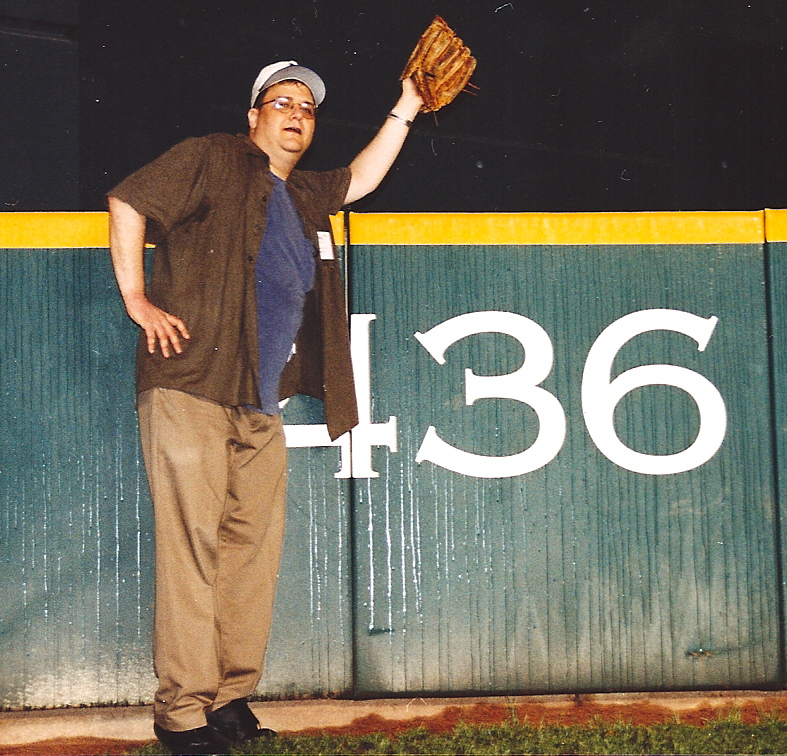
I know Tal’s Hill is a silly place because I’ve been up on top of it. On September 21, 2003, in another phase of my professional life, I had occasion to wander Minute Maid Park. Natch, I headed 436 feet from home plate, straight out to center and climbed right up that hill.
It is high. It’s maybe not as bad as my decision to pose — the one and only chance I’d ever have to be out there — with my throwing hand on my hip, but I don’t recommend it (or me) being allowed within the field of play. Kudos for Carlos once more on conquering Tal’s Hill and tracking down Luke Scott’s otherwise gamewinning fly ball. I repeat: It was quite a feat. A man built a field A man said quirky! Is what I'll yield I'll make one wall close Make one wall far I'll make another wall stand Behind something bizarre Gonna have a hill Gonna put it where? Puttin' it in center Nobody digs it Everyone complains But at least there's a roof In the event it rains Two teams played a game Two teams played forever What time would they finish? The teams said “whenever” Cut to the chase Get to the point Arrive in the fourteenth A victor to anoint Lamb on first Burke on third Joe Smith on the mound Now isn't this absurd? Houston had Scott I've heard that before They once had a Scott From the hardware store Not that Scott It wasn't Mike But with first and third What was there to like? One out was needed To keep things tied When Luke Scott connected We nearly died His ball is long His ball is deep His ball might end it That Houston creep Wait just a minute! Wait just a sec! His ball is headed It's heading for the hill It's heading there now It's gonna take a miracle Scott can take a bow The hill is quirky The hill is high I suspect the same Of the architect guy It's a Crosley tribute? Unique incline? The rest of us think It's just asinine Nobody could catch up Nobody could hope Unless Carlos Beltran Was workin' his lope Carlos ran long Carlos ran deep Carlos kept climbing Carlos went steep He lunged and he grabbed He secured it and soon He fell and held on Like he was Al Toon The Astros were stopped At the one-foot line Wanna play some more? The Mets said “fine” Is truly the pits I mean can you believe Where that silly hill sits? But hitting it to Beltran Is your mistake Boo him all you want He drove in the winner The 'pen did the rest Tal's Hill is the worst That catch was the best! Yes, Jose Reyes should run out all ground balls, all fly balls, all fair balls, all foul balls. Yes, Willie Randolph should slap even his superstars on the wrist and nail their buttocks to the bench when they fail to put one foot in front of the other. Good character-building exercise there in the eighth. Randolph was firm afterwards and Reyes — steaming and snorting in the dugout to the point where I was worrying for his (and our) future — was genuinely contrite. If we are to assume that Reyes will hustle, take nothing for granted and live up to his manager's work ethic…and if we are to continue to assume that if Jose Reyes can take a one-inning benching, his teammates can receive the same message, then we can ultimately assume our Mets will conduct themselves like professionals. 'Cause they're sure playing like a bunch of goddamn amateurs lately. All hail Wandy Rodriguez and take nothing away from his Friday night, but wow have the Mets forgotten how to do everything again. Mike Pelfrey's progress is absolutely snailish and painful to sit through. In another era he'd be just now reaching Binghamton since this is only his second professional season. Come to think of it, why is he pitching in the bigs already? Oh. Right. Everybody's injured. This was Pelf's best start of the season and it was still a grim scene, baby. Young Michael has almost never shown any proclivity for escaping a jam unscathed, certainly not more than one in any game. Maybe Rodriguez wasn't going to be bested, but you gotta hang tougher than Pelfrey does. I'm trying to remember he's a child, he's a neophyte, he has talent. But my patience a thin commodity this week. As for the Mets' offense, Reyes' barely fair tapper (even Mike Lamb seemed surprised it wasn't called foul, practically walking the ball to first as if he thought Larry Vanover might want it back) was one of the better hit balls of the night. Maybe Jose didn't run because he didn't believe the magic Wandy would give up even a 45-footer to anybody in a NEW YORK uniform. One double, three singles, one walk, all registered in different innings was the extent of our production. Easley's slide to break up a DP was the best thing I saw all evening. Just as well Jose lollygagged. If he had taken off for first in the eighth, there'd be nothing to remember from this game at all. Here's wishing a helluva lot more luck to our friend Dan Ziegler, Lone Star Met himself, who's going to be taking in the final two games of this series up close and personal. His guide to watching the Mets at Minute Maid Park is a must-read. We can only hope what he's driving east from the Metroplex to witness is must-see.
NostraDennis recently turned NostraDaytona, visiting Jackie Robinson Ball Park in the Florida State League, taking care to represent No. 42 via the Faith and Fear t-shirt. Quantum Distributors hasn’t abandoned its post; it’s just a rainout. Thus, Dennis couldn’t see his St. Lucie Mets take on the Daytona Cubs, but he could show off his numerical pride. And that we appreciate.
When their season began, they were nobody. When it ended, they were somebody. If it’s the first Friday of the month, then we’re remembering them in this special 1997 Mets edition of Flashback Friday.
Ten years, seven Fridays. This is one of them. Woven deep into the legend of the 1969 Mets is the story of 18-18. That’s the record the Mets reached after 36 games: .500, a percentage theretofore unapproached by any Mets squad. The version I’ve read many times goes something like this: Beat reporters race into the clubhouse to check out the wild celebration and find Gil Hodges’ young men quietly going about their business. Tom Seaver speaks up and says there’s nothing special about .500, we’re serious about winning. The wise old heads chuckle at the rascal’s impudence…doesn’t he know the Mets should be thrilled to have won as many games as they have lost? The Mets go out and lose five straight. Ha-ha, indeed. But then they set a standard that three Mets teams have matched but none has ever exceeded: They win eleven consecutive games. They’re 29-23 and as the season proceeds, new and more rewarding milestones make themselves apparent. Finishing at .500, after smashing through that statistical barrier, would have seemed pretty disappointing. 1997 wasn’t 1969. It wasn’t even 1984, when the franchise, mired in futility after seven years of lean, shocked the baseball universe and rode a winning record into summer and first place throughout July. It was a giddy season — even the wave didn’t seem so bad — though not as giddy as it could have been had the Mets persevered through August and done what their ’69 forebears had done, namely shove the Cubs deep into second. Once the ’84 Mets slid out of first, runner-up status, an unimaginable high coming off the misery of 1977-1983, was a downer. If 1969 was the Tiffany’s of surprise seasons and 1984 was a discounted, Wal*Mart version of 1969, then what was 1997? Thrift shop? Garage sale? eBay BUY IT NOW for 99 cents? What do you do with a season in which it’s obvious you’re going to be a lot better than you thought you could be but signs keep creeping in that you’re not quite as good as you’re going to need to be to fulfill your wilder dreams? All you can do is root your ass off. You don’t even bother, while it’s in progress, with the possibility that it isn’t 1969 even though by July you have yet to fly as high in the standings as you did in 1984. The Mets were exceeding expectations left and right in 1997, but it wasn’t necessarily getting them far in tangible terms. Worse, a little slip could make all your first-half progress and your competitive currency melt right down the drain. The ’69 Mets went all the way. The ’84 Mets remained viable into September. Would the ’97 Mets, with those two blessed memories serving as franchise precedent, live up to their possibilities? Without a Tom Seaver? Without a Dwight Gooden? With Bobby Jones as their ace? The heights, occupied by the Braves and, in still-fresh Wild Card terms, the Marlins, eluded them but so did the depths of the Dallas Green era. When the season began, I would have been thrilled by 81 or 82 wins. By the middle of the year, I wanted so much more. *** Our semi-charmed kind of life appeared in a degree of danger after the six-game winning streak that stamped us for real ended in late June. I began to dream big, really big, when we faced the Braves in a Shea series finale. We were sending bona fide All-Star Bobby Jones (12-3, 2.29) to the hill against Tom Glavine. We were not just breathing down the Marlins’ neck, but we were four out of first. Imagine sweeping Atlanta. Imagine zooming past Florida and taking on the perennial division champs. Imagine the Braves, who couldn’t do us the solid of solids the previous October and win the 1996 World Series, spiraling to obscurity at the hands of a real New York team. But Bobby Jones let us down. Couldn’t get out of the fifth. The Braves scored in six of the first seven innings. We lost 14-7 and it wasn’t nearly that close. The Mets never came within five games of first place again in 1997. It was off to Pittsburgh where we took two of three (though Rick Reed, who had shocked everybody for so long, looked abysmal against his old club in one of the wins) and then Detroit for what would become an infamous Interleague series. We dropped three straight in Tiger Stadium by a combined score 31-13. Mark Clark, Dave Mlicki and Jones were all slapped around mercilessly. The Mets came home to face their Wild Card competition, the Marlins for a four-game holiday set and the misery continued. Armando Reynoso couldn’t last two innings in the opener. We were down 8-0 before the second was done. Were we done as well? The Mets were seven games over .500, 45-38, theoretical cause for celebration on some level, but suddenly five behind the Marlins for playoff positioning. We had given back everything we gained after the Subway Series. *** But the 1997 Mets would not go down that easily. Three July games remained against the Marlins, critical games. Hard as it may be to believe, the Marlins were a powerhouse that year like they’ve never been in any other year (even the ’03 world champs had to sneak up on people well into September). Those Marlins were Wayne Huizenga’s grand experiment. I’ll spend a zillion bucks putting together a contender, went his reasoning, and if that draws fickle Floridians to my football stadium, then I’m onto something. If not, I’m outta here. His evil scheme worked on the field, more or less. Though the Fish couldn’t stay with the Braves, they were clearly the class of the Wild Card division: Gary Sheffield, Moises Alou, a not altogether decrepit Bobby Bonilla led the offense; Charles Johnson was a state-of-the-art catcher; young Edgar Renteria was a phenom; the pitching, led by Kevin Brown, Al Leiter and closer Robb Nen, was hot stuff. This was a Marlin team built to win now, not yet slated to be torn apart five minutes later. The Mets? The Mets were still a mélange of yesterday’s heroes, last-chancers and unknown quantities. We were the underdogs in this race. The Marlins — the Marlins! — were the decided overcats. But the 1997 Marlins were knocked for a loop by the 1997 Mets, living up to our heightened expectations after hinting they’d be returning to Earth any minute now. The Mets of ’97 weren’t the rag-armed bunch that was banged around for 14 (yes, 14) Tiger dingers in Detroit. Instead, they were a team that wasn’t about to say die to something as synthetically nouveau-riche as the Florida Marlins. Friday night, July 4: Another Bobby Valentine special materializes. Todd Pratt, an obscure backup catcher who had left baseball to manage a Domino’s, delivered in 30 minutes or less, homering in his first Met plate appearance. His two-run job off Leiter tied matters at two. Reed did the rest, gutting the Fish and Jim Leyland, the manager who never gave him much of a chance in Pittsburgh. Lidle and McMichael complete the 6-2 Met win. Saturday afternoon, July 5: Workaday Mark Clark and three relievers defeat another shiny Marlin free agent, Alex Fernandez. Alfonzo homers. Baerga homers. Mets win 5-3. Sunday afternoon, July 6: Stephanie and I are at this game, the last one before the All-Star break. I’m not sure if the Marlins know this was a showdown, but we do. Car parked under the Northern Boulevard overpass for the only time I can remember (no ticket) and heads fortified by giveaway Kansas City Monarchs caps on yet another Jackie Robinson appreciation day, we grow tense as Jones and Pat Rapp battle into the seventh. Jones allows Charles Johnson an RBI double to make it 2-1 Marlins. But Alfonzo (we have begun calling him Fonzie) doubles home Lance Johnson in the bottom of the inning. The game moves into extras, into the twelfth. Dave Rosenbaum, in If They Don’t Win, It’s A Shame: The Year the Marlins Bought the World Series, picks up the action as the Mets come to bat: First, Gary Sheffield lost the ball in the sun. He twisted and turned his body, trying to make the sun go away, but it wouldn’t, and Alex Ochoa’s popup struck the heel of his glove and fell to ground. Ochoa ended up at second. The next batter [Carl Everett] grounded a single into rightfield. Sheffield approached the ball with slightly more speed than he had recently mustered in jogging out infield grounders, which wasn’t much. His one concession to expediency was bending over to pick up the ball bare-handed, but that didn’t work, either. The ball dropped out of his right hand, and by the time he bent over to pick it up again, Ochoa was only thirty feet from home plate and closing fast with the winning run.
Sheffield knew there was no use throwing. He completed a day in which he had gone hitless in five at-bats by dropping his shoulders and trudging off the field. The Marlins had lost, 3-2, in twelve innings, their third straight defeat by the Mets, and no player was more at fault than Sheffield. Indeed, I remember the play unfolding in slow motion, pinching myself a little to realize Alex Ochoa was going to score the winning run in a big game, to realize the recently stumbling Mets had righted themselves quickly and taken three consecutive decisions from the mighty Marlins, to realize that a little more than nine months since finishing a season 71-91 we were entering the 1997 All-Star break a mere 2 GAMES from the Wild Card spot. One year earlier, a great closing rush in the first half had put the 1996 Mets five games under and eight behind the Expos for second — an Ochoa throw of a prayer from contention — and I was delirious by dint of that much. So for a Mets team to actually compete for the playoffs… I mean we were 2 GAMES out! *** The All-Star Game in Cleveland flew by. Todd Hundley begged off with an injury, but Jones made us proud by striking out Seattle’s Griffey and Oakland’s McGwire, both challenging Roger Maris’ unbreakable home run record. The A.L. won for the first time since 1993, Sandy Alomar the MVP, but I was just counting the hours ’til Thursday and the excitement of an impending four-game rematch with the Braves in their new home, Turner Field. On their inaugural trip in, the Ted would treat the Mets well. *** In 1997, it doesn’t seem strange. Even as the Braves have resurrected themselves from their ’80s malaise and the Mets have been, well, the Mets, we are 20-18 versus them since 1994. We have no reason to fear this stadium. Sure enough, Thursday night in Atlanta tilts New York’s way as we dent John Smoltz and destroy Bobby Cox’s bullpen. Three ninth-inning runs, keyed by the suddenly undisabled Manny Alexander’s triple, secures a 10-7 triumph. Friday night is similar. The Mets persevere against Tom Glavine, erasing a 5-1 deficit with four in the sixth and four more in the eighth. Todd Pratt scores three runs but wins few friends when his bat flies out of his sweaty hands and into the Turner crowd once too often. Manny Alexander collects two more hits and three RBI. Manny had been injured, now he’s fine. Manny, to paraphrase Shawn Colvin’s ubiquitous FM phrasing, came home with a vengeance. Mets win 9-7. Saturday the Mets jump out to a 3-0 lead on Greg Maddux (Gilkey and Ordoñez with RBI singles, Eddie Perez with an error) but Mark Clark can’t hold it. Mets eventually lose 7-4, but the New Yorkers have just hung tough with three Cy Young award winners. Their reward is a date on Sunday Night Baseball and the alleged soft spot in the Atlanta rotation, Denny Neagle. A nationwide audience must wonder what the fuss is over Bobby Jones. He cracks for six earned runs in the first. But y’know what? Valentine leaves him in and Jones rewards him and us with six shutout innings. In the meantime, Butch Huskey nails Neagle for a two-run, then a three-run homer. Neagle would grumble about retaliation afterwards, but forget about him. Suddenly, the Mets are back in it. It’s 6-5 in the fourth. In the fifth, an Alexander double and an error on a John Olerud ground ball make it 6-6. It stays that way through regulation. In the tenth, Ochoa, fifth outfielder on the resurgent Mets, takes Mike Bielecki deep, very deep, with two out. John Franco works around a leadoff single to Andruw Jones, a wild pitch and a walk to save it for ex-Brave Greg McMichael. The Mets have marched into Georgia and taken over Turner Field. It’s apparent love at first sight, three of four in the new ballpark. Maybe we’ll hold a whammy over them there. The Mets are 51-39 at the end of the night, 1-1/2 behind Florida. It’s no wonder that when Joe Benigno begins his overnight show on WFAN after Mets Extra, he declares the Mets are bound for postseason baseball in 1997. I don’t call in, but I don’t rhetorically argue either. *** Of course it’s not that easy. It never is. After taking the measure of their statistical betters, six of seven against the Marlins and Braves, the Mets piss away three straight against the pitiful Pirates and crappy Cubs. They nearly blow a fourth until Huskey singles home Alfonzo to pull out a 4-3 win in the tenth over Chicago at Shea. Gilkey contributes a sixth-inning homer but his batting average continues to dial Manhattan. It is .212. “What’s wrong with Gilkey?” is as much a question surrounding this team as “how about them Mets?” Another weekend is at hand. Another four-game set. The last-place Reds are in. It rains a lot Friday night, but with the schedule already rather wonky (there are more two-game series this year than in any other, reportedly an excuse for Bud Selig to execute league-blurring realignment), all concerned wait. A ferocious thunderstorm clears the field after two. Joe Crawford, yet another Valentine discovery from nowhere, takes over for Jones in the third and goes four-and-a-third for his first win. Saturday is sunny and bright, especially for Rick Reed who homers off Pete Schourek and retires the Reds with relative ease for eight innings. Gilkey, calling friends and family in Philly (.215), settles matters with a three-run shot in the eighth. Sunday is a laugher: 10-1. Two homers for Hundley. Another for Bernard, who leaves traditional area code territory behind at last, his average up to a hard-earned .221. Lance Johnson, like Hundley and Gilkey, a shining light from the dim year before, re-emerges with two hits. Dave Mlicki, seven strong, gives way to Takashi Kashiwada and Cory Lidle. The final is 10-1. My friend Joe, next to me in the field boxes, is angry the Mets couldn’t give him a shutout to ink in his everpresent scorebook. In a rare moment of candor between us, I giggle at his ire: You only root at one speed, don’t you? Joe returns the chuckle. He likes that description of himself. On the other side of the ledger, our old hero Ray Knight is in trouble as Cincy’s manager. He’ll be fired within the week. His leftfielder Deion Sanders, booed all weekend for being Deion Sanders, takes a moment out of packing for Cowboy training camp to play the piety card. He says he’s going to pray for us Mets fans and our troubled souls. He calls Shea a sad place. No, actually it’s quite joyous, and its mood only improves in the finale Monday afternoon. Everett’s eighth-inning homer with Olerud aboard gives the Mets a 5-3 lead. John Franco — brace yourself — pitches a 1-2-3 ninth. The Mets sweep. They have climbed to a season-high 14 games over .500. They haven’t been this many above the break-even point since July 1991, just before they fell apart for the balance of the decade. They’re a silly millimeter behind the Marlins for that gleaming Wild Card, just a half-game’s difference between us. *** With Cincinnati swept, I was more than jubilant. I was reflective. On that July 21, with the Mets 56-42, I wrote something that I posted to an AOL Mets board I then frequented. I printed it out and I saved it. It went something like this: I hereby interrupt the wild card chase to get Met-aphysical. The year is 2005 or 2010 or 2020. Maybe the Mets aren’t doing so well in Conference “A”. Maybe they’ve just lost a doubleheader to Charlotte or Monterrey. Maybe Edgardo Alfonzo is breaking Paul Molitor’s hit record in another uniform. Or Todd Hundley has just gotten another player’s name wrong in the booth. Whatever. I guarantee that each and every one of you, if you’re anything like me when it comes to this team, will be warmed by the thought of the 1997 Mets. Depending on your age, you know what the mere mention of “1969” or “1986” and maybe another year or two you hold dear do to you. 1997 will do the same. Seasons of love. They are rare. You will feel goosebumps the next time a down-in-the-dumps franchise you root for, trashed by arrogance, bad drafting and shortsighted trades, makes its turnaround. You will feel this way because you’ll remember the summer of 1997 when a team picked to do absolutely nothing won game after game after game in astounding fashion, picking off the league bullies and taking care of the doormats. Treasure this season, gang. They don’t come along very often. ’69. ’84. ’97. Three times in 36 years have we (or, perhaps, our slightly older siblings) gotten the feeling that there is justice, there is fairness, there is relief for those who live and mostly die with a bad baseball team. In typical worrisome fashion, I’m already slightly dreading 1998. No matter what happens this year, next year can’t possibly top it for the element of pleasant surprise. I don’t know if the next 64 games can keep pace with the previous 86 (the season truly started on Jackie Robinson Night). Having shown up just in time to figure out why we were the Miracle Mets, I looked at all those 50-112 seasons in the team history section of my “World Champions” baseball card and, as a kid, I just figured that would never happen again. Imagine my shock when 1977-1983 came along. Then, all at once, they started playing well in 1984, better in 1985, the best in 1986. The malaise was over for good. Imagine my shock when 1991-1996 came along. History is giving us a third chance. I don’t know if we’ll cash in this October, or two Octobers from now or any October. But I damn sure want to savor every line drive and backhanded catch and improbable bleeping win. Is this a great time or what? *** Time didn’t prove me much of a prophet. I sense I’m mostly alone in treasuring that season, in holding 1997 up to 1969 and 1984 and seeing a spiritual triplet. I don’t know if anybody else gathers goosebumps at the mention of the names and games I’ve dug up here. I don’t know how many others who have been live-and-die Mets fans since they were old enough to know better can reach back and feel what I felt then and feel still. I may have been wrong that 1997 would stand forever as an iconic Met season, but I stand by the emotion of every word of what I wrote 10 years ago this month. For giving me back my team as a serious entity, for making me care every night for six months, for granting me a baseball rebirth at the age of 34, for competing with the best of them, and for finally, finally, finally putting measurably more wins than losses next to our name in the standings, 1997 was, more than any other, I believe, my season of pure, unadulterated Met love. It wasn’t the last year in which nothing was expected of the Mets, but I think it was the last time shaping up as nothing special seemed not a crime in this market. We were just so used to it. That the Mets would go out and shatter all their low expectations and establish themselves as a legitimate contender for that year and the years to follow… …that was awfully nice of them. *** A killer road trip to all three California outposts plus Houston awaited, a challenge the Mets tackled with élan, at least for a while. On a Friday night in the middle of it, we rose to 16 above .500, as high as we’d get in 1997. The next afternoon, the Marlins would lose to the Cardinals, dropping them 15 above. For several hours, before playing the Padres on Saturday night July 26, we led the Wild Card race. I happened to be over at my sister’s just after learning the Florida score. I was as thrilled as she was clueless. “If the season ended right now,” I explained to Suzan, “the Mets would be in the playoffs.” “Oh,” she said, trying to be empathetic or sympathetic or something other than apathetic. “Then I wish the season would end right now.” I didn’t. Even knowing what I know, I still don’t. Next Friday: First-time, long-time. *** And don’t go anywhere during the break. While some Mets go to San Francisco and others go home, Faith and Fear stays true to its mission, giving you baseball to read about on those treacherous off-days…because that’s what we do. Does the hamate bone exist for any reason except to sideline baseball players? Holy Benny Agbayani — how many outfielders can one playoff contender lose and still stay upright? With Carlos Gomez lost until September, I had to remind myself not to look askance at Ricky Ledee. Because if not him, who? The Mets were obviously thinking the same thing, hastily bringing back David Newhan and dispatching Lastings Milledge to play anywhere — Binghamton, Cooperstown, a rap studio, an argyle-sweater factory — where he could get some quick at-bats. With Moises Alou still trapped in the Quad Zone, perhaps Lastings will get the extended audition fate denied him repeatedly after all. If the Mets' line of outfield succession was like that of the presidency, Lastings would be the Secretary of Labor. But looks like he'll make the Oval Office — I mean, left field — anyway. This week I keep missing the beginning of games, which means I've been missing the only part one would want to see. It's strange to see your team is up 2-0 and mutter obscenities. Fortunately, neither Reyes nor Delgado nor Castro nor Beltran nor the reluctantly accepted Ledee were done. Neither was John Maine, who pitched like he was hurling a gauntlet down before Roy Oswalt. I can strike people out too, All-Star. I've got 10 wins, All-Star. What are you going to do, All-Star? (By the way, with Smoltz 86'ed the Braves somehow have just one All-Star.) Oliver on the shelf. Sosa on the shelf. Alou still on the shelf. Gomez on the shelf. Lastings trying to get off the shelf. The reconstructed, glued-back-together Pedro not yet ready for picking up from the shelf. Yes sirree, we live in interesting times. |

Piazza: Catcher, Slugger, Icon, Star by Greg Prince is available from Amazon, Barnes & Noble and other online booksellers. 
Amazin' Again: How the 2015 New York Mets Brought the Magic Back to Queens by Greg Prince is available from Amazon, Barnes & Noble and other online booksellers. 
Volume I of The Happiest Recap: 50+ Years of the New York Mets As Told in 500+ Amazin' Wins by Greg Prince is available in print and for Kindle on Amazon. 
Faith and Fear in Flushing: An Intense Personal History by Greg Prince (foreword by Jason Fry), is available from Amazon, Barnes & Noble and other online booksellers. |
|||||
|
Copyright © 2026 Faith and Fear in Flushing - All Rights Reserved |
|||||||
 Comments closed | |