The blog for Mets fans
who like to read
ABOUT US

Faith and Fear in Flushing made its debut on Feb. 16, 2005, the brainchild of two longtime friends and lifelong Met fans.
Greg Prince discovered the Mets when he was 6, during the magical summer of 1969. He is a Long Island-based writer, editor and communications consultant. Contact him here.
Jason Fry is a Brooklyn writer whose first memories include his mom leaping up and down cheering for Rusty Staub. Check out his other writing here.
Got something to say? Leave a comment, or email us at faithandfear@gmail.com. (Sorry, but we have no interest in ads, sponsored content or guest posts.)
Need our RSS feed? It's here.
Visit our Facebook page, or drop by the personal pages for Greg and Jason.
Or follow us on Twitter: Here's Greg, and here's Jason.
|
by Greg Prince on 8 March 2007 3:15 pm The year was 2007. I was old.
I didn’t think I required confirmation of that biological fact, 44 residing securely as it does in what is commonly described as middle age, but I seemed to have received a reminder last night. Nothing creaked, at least not more than usual. And nobody said anything, but as sure as Joe Foy flopped at third base 37 years ago, I sure could tell.
Joe Foy? He was the Met acquired for Amos Otis in 1970.
Amos Otis? That’s the unproven outfielder we sent to Kansas City to get Foy. He became the Royals’ first big star, emerging ahead of George Brett.
George Brett? Oh come on. Surely you remember George Brett. He only retired…what is it now?…my goodness, that was 1993, 14 years ago.
In 1970, 14 years ago was 1956. Thirty-seven years ago was 1933. And almost every year I’ve ever lived in, save for maybe the last five, is likely the Mesozoic Era if you’re the type who haunts trendy/ironic nightspots in relatively obscure locales on frigid Wednesday nights in late winter and thinks nothing of it.
Let me not let observation get ahead of good manners. I want to thank Carl Bialik of Gelf Magazine for inviting Jason and me to be part of an excellent program of Varsity Letters last night. I want to thank the several to many patrons who came up to us before and after we spoke for telling us such nice things about Faith and Fear. I want to thank the other sports bloggers who manned the podium for excellent and entertaining presentations for which it was my pleasure to be an audience member. Mostly, I want to thank the throngs of Dugout acolytes for patiently waiting through our words to get to their main event of the evening (Dugout is amusing online, but an absolute revelation when the three guys explain it and act it out right in front of you).
Yes, I enjoyed it immensely, even if the charms of the Happy Ending Lounge — VL’s venue of record and a swell place to get your drink and interpersonal transaction on if you’re of a hookup mindset — escape me and my 44-year-old sense of hanging out. I’m a couch guy. I like TV. About the time Carl brought Jason and me to the microphone, I imagine I would have been sunken comfortably into my couch in front of my TV watching M*A*S*H.
M*A*S*H? You know, the all-time great sitcom that ran from 1972 to…now cut that out! You know what M*A*S*H is. Don’t you? Its overblown finale had the highest ratings ever. Why, it just aired at the end of February.
February 1983. I remember it like it was last week. Twenty-four years ago last week.
Carl instructed each blog/site to take 10 minutes to read or talk or whatever we wanted. That meant Jason and I each had five minutes of our own. If you’ve read Faith and Fear, you know five minutes is what I call the preamble, at least for anything that I’d go to the trouble of printing out and packing on the 6:11 to Penn Station in order to make it to Happy Ending by 8:00. After reviewing the last two years of posts, I decided to smush together a compendium of salient anecdotes from Flashback Friday, the original version from our rookie season, all of which are available under “A Year to Remember” toward the bottom of our sidebar. I wouldn’t have time to take the audience through my 35 years of personal and baseball revelations in full (Carl would need to book the joint until its closing time of 4 AM), but I figured a nice sample would do the trick. We could all relate to growing up as fans of a team and remaining fans of that team; we could all smile about childhood and adulthood being linked by the experience of sport; we could all endure me, then Jason to make room for Dugout ten minutes hence.
Here were the first words I read aloud, just as I posted them on August 19, 2005:
The year was 1970. I was 7 years old.
No sooner had those two sentences escaped my lips when it dawned on me that there were probably close to a hundred souls crammed into Happy Ending and not one of them besides me could have had a clear and tangible memory of 1970. They couldn’t have. Look at them — they’re so young!
I think they were. How the hell would I know? As much as I like to track my own chronology, I’m terrible at judging the rings around other people’s trees. These are the ages of man (and woman) as far as I can tell:
• Really old: I mean really old
• My contemporaries: Everybody who’s not really old
• Kids: Everybody who’s not really old but I can’t carry on any kind of conversation with them
All those 40ish Mets do seem older than me, but they’re not (save for one notable exception who could presumably kick my ass without spilling a single egg white). So I’ve got a handful of years on Tom Glavine and Moises Alou and Sandy Alomar, Jr. I must. I was already past the prospect stage when they were just coming up. They couldn’t have passed me, right? But they’re not old. They’re ballplayers. Ballplayers have dates of birth on the backs of their baseball cards but for the most part, they’re ballplayer age. When I was a kid, they looked really old. Now, from Fernando Martinez to Julio Franco, they’re my contemporaries. More talented, more agile, more valuable on the open market, but we’re all adults here.
It’s just that some of us were entering adulthood while others were just getting themselves born.
I went on about the wonders of being 7 in 1970, about how somewhere in the back of my mind I’m experiencing every aspect of being a baseball fan for the first time all over again when I watch the Mets today. I believe that sort of almost unconscious manner of thinking is a universal sensation if you love watching sports, but at Happy Ending, I kept thinking, even as I continued to read aloud, that there was another universal sensation: that everybody listening to me, all of whom looked more comfortable in this setting than I felt, heard I was 7 in 1970, did the math as it applies to 2007 and concluded “wow, that guy is old.”
I wouldn’t argue. When I was in the early throes of my legal drinking eligibility and spending time as a matter of course in the Happy Endings of my youth (there weren’t a lot, but there were a few), if some dude started reminiscing about what it was like 37 years ago, I would have made the same calculations. Me invoking 1970 for these mostly, I’m guessing, twentysomethings would have been the mathematical equivalent of me in 1987 being subject to ramblings regarding the Whiz Kids of 1950 (they do predate me, but I have read about them).
My payoff story for the 1970 Flashback is the June night my sister challenged me to pull a wishbone from her fried chicken. I made my wish, I pulled, I won and less than 24 hours later I received what I asked for. My wish — the “first time I can remember subjugating all other concerns to concentrate on the Mets’ well-being” — was that we would sweep the Cubs the next afternoon. It came true. The score was 8-3. Jerry Koosman, I noted, defeated Ken Holtzman.
Jerry Koosman? Jerry Koosman the slick southpaw from Appleton, Minnesota? Jerry Koosman who has that neat Sporting News card in the 1970 Topps set? Jerry Koosman, No. 36? Jerry Koosman, rushed by Jerry Grote to his south and Ed Charles to his west the previous October? Jerry Koosman who I can still see going out there after Seaver and before Gentry if he’s not on the DL?
That’s my Jerry Koosman, the only one there’s ever been. For just about everybody else in the room, though — if they were Mets-savvy to begin with — Jerry Koosman wasn’t any of that. He was a dusty relic from the history books. He was to them what Robin Roberts or Lefty Grove or George Washington would have been to me. He was some ancient name thrown out by somebody obviously much older than I was.
And Ken Holtzman? Who’s that? A dermatologist from Cedarhurst?
1970’s Flashback morphed into 1980’s, then 1990’s, then 2000’s (I opted to skip the “5” years lest the audience age any more than five minutes). I peppered in a few more ballplayer names, almost all of them Van Lingle Mungo to the Happy Ending generation. Then I morphed into my own happy ending, the autobiographical point that I suppose informs my blogging. It seemed like the appropriate grace note:
All I ever wanted to do was be was a Mets fan. And that I got good at.
It was fun, but I felt old when it was over. What was a middle-aged man like me doing in a hip place like this?
I left for the D train uptown. As I walked down the platform, a guy who was apparently at Varsity Letters stopped me. “Hey, you’re from Faith and Fear in Flushing, right?” Yes, I said. He said he was new to reading blogs and such, but he liked what he’d seen and heard from us. I thanked him very much. Then he asked me what I thought of our chances this year.
For the next maybe 15 minutes, we talked Mets baseball. We talked about the Phillies posing a threat. We talked about the rotation and who might be in it. We talked about our great start last year and whether we could get another one. We talked about how bad Shawn Green has looked so far. We talked about what he or Moises Alou might be in for if they come home with a low batting average on April 9. We talked about Billy Wagner undermining our confidence far too often. We talked about Game Seven. We talked about John Franco and Armando Benitez and Brian Jordan. We jumped back and forth among Mets past, Mets present and Mets immediate future until this fellow got off at Fourth Street.
“Thanks for letting me chew your ear off,” I said as he left.
Seriously, that was great. It reminded what I was doing at place like Happy Ending on a frigid Wednesday night at the tail end of my 45th winter not four weeks from my 39th baseball season. I love to talk about the Mets. I’d go to Chinatown to talk about the Mets with another Mets fan. I might go to China if that were my only option. Fortunately this medium here makes such a trip unnecessary, but I think I kind of mean it.
The year was 1970. The year is 2007. It doesn’t matter. It doesn’t matter if I saw what you didn’t or you see what I don’t. We’re all in this together and I love that. And I love, regardless of dueling birth certificates, that baseball is so utterly timeless. It’s the biggest cliché in a game chock full of them, but it’s so true. Yeah, 1970 did just happen in my mind. It’s still happening. The last game I lived, Game Seven, is still happening. Steve Henderson’s walkoff home run off Allen Ripley in 1980 is still happening. It’s all always going on. I have a gift of sorts for separating out the details of what occurred when they occurred, but for big-picture purposes, there are no discrete seasons when it comes to me and the Mets. It’s a big, beautiful never-ending continuum for me. It’s somewhere I’d gladly abandon my couch and my TV and my M*A*S*H reruns for and take the LIRR and the D to in order to rediscover that feeling any 18-degree night of the week.
by Greg Prince on 7 March 2007 7:17 am Spring Training proceeds. I’m sure fine things are taking place on the field, right alongside not so fine things. That’s baseball last I checked. But it’s still a week in. Until some strangers in Mets uniforms are told to shed them and hit the minor league complex or the road, I still can’t get excited or agitated over a single personnel development. Excited and agitated that they’re there, sure, but not over what anybody in particular does.
Thanks to the near-saturation coverage provided by SNY (can’t believe they’re pre-empting Northeast Angling as often as they are for something as esoteric as the team that owns a third of their channel), I’ve certainly kept an eye on our surfeit of Mets. I’m beginning to notice some things about some players, none of which I choose to put any emphasis on whatsoever. The ones who look good? They’re professionals. They’re supposed to look good. The ones who are not so sharp? Tempting as it is, I’m not going to write them off a handful of games into the meaningless exhibition season.
How meaningless is the exhibition season? It’s no Mr. G when it comes to reliable forecasting. The Mets posted the exact same record of 13-13 in 1967 as they did in 1986. They won the World Series in 1986. They lost 101 games in 1967. They were also impressed enough by rookie George Thomas Seaver to add him to the rotation, but not until after he worked some relief early and then got a couple of starts late in camp. Tom didn’t reveal himself as Terrific in the first week of March. I doubt anybody does. Hence, I’ll continue to enjoy the sights and sounds of all that orange and blue beamed north to us polar bears but I refuse to take it seriously as death even though I’m kind of dying to.
Toting this uncommon maturity regarding exhibition games has left a void in my soul. I have to find something to rile up the blood (it’s the blogger’s code). I think I have it. And wouldn’t you know it comes in pinstripes?
No, not the Yankees. I don’t have the foggiest what they’re up to lately. I’m sure the sleepovers have recommenced and all is peaches and cream in Tampa.
But yes, the Yankees. Through no fault of their own (except for existing, the bastards), they continue to infiltrate our benign good times.
Three recent examples of a disturbing long-term trend…
1) A profile of Mike Pelfrey by John Harper in the News last week:
You go from one side of the state to the other, from the Yankees to the Mets, and after watching Phil Hughes wow onlookers in Tampa, it felt important to see Mike Pelfrey as soon as possible. It’s the year of the phenoms, after all. For both New York teams this seems destined to be remembered as the spring training in which an ace was born, and as such Hughes and Pelfrey may be linked forever.
I understand the itch Harper describes. On my few sojourns to Yankee Stadium, I couldn’t wait to go home, take five showers and head to beautiful Shea — as soon as possible. If that were John’s angle, I’d applaud mightily. But it wasn’t. Instead he couldn’t just tell us, “Mike Pelfrey is quite the prospect, here’s how he’s doing.” Why oh why was it necessary to couple him with Hughes? I’ve been aware of each pitcher independently since 2005 and it’s never once occurred to me that they need be linked. Did it occur to Harper that when covering Hughes it was required to note, “The Yankees may have an answer to Mike Pelfrey on their hands and his name is Phil Hughes”?
We know the answer.
2) A Tuesday story in the same paper by Peter Botte about the defensive prowess of Jose Reyes:
[I]t’s not far-fetched to believe the 23-year-old rising star soon will join three-time winner Derek Jeter as Gold Glove shortstops in New York.
Would it be far-fetched to have framed Reyes’ ascension into the ranks of elite defenders by pointing out he could soon join Bud Harrelson and Rey Ordoñez as Gold Glove shortstops who have won the award as Mets? What in the name of Dick Schofield does Jeter have to do with any of this? That he plays in New York? So have lots of shortstops. That he’s won Gold Gloves? So did Ozzie Smith. There was no reason to inject him into a story about another player on another team except that there’s apparently a rule that Mets can only be explained in certain quarters by using Yankees as examples. The next time Jeter steals second, will Botte liken the footwork involved to “the speed shown off by Jose Reyes”?
We know the answer.
3) Bob Klapisch’s followup on the Wright/A-Rod nonstory at ESPN.com:
None other than Derek Jeter says Wright has to be careful about choosing his friends as his star quotient grows.
It would be amusing if Jeter were referring to Rodriguez as the unsavory character to steer clear of, but he’s talking about…oh, who cares who he’s talking about? Who cares what a guy on the Yankees says about a guy on the Mets? I’ve never for a second bought this “Wright could be the Mets’ answer to Jeter” line they’ve been pushing down our throats since David came up. Why should we? Because David’s talented? Because David’s first language is English? They play different positions, they have divergent offensive skills and David, as my partner pointed out, comes off as a helluva nicer guy than Captain Automaton.
If we were living in the distant past, say 1998, ’99 or thereabouts, I wouldn’t be any happier with the contexts presented by these writers but I’d have to grudgingly admit that the Yankees are such consistent champions that it’s no wonder they come up so often in conversation.
But have you noticed? They’re not consistent champions, at least not in terms of the only championship they institutionally claim to care about. A Yankee ticket brochure fell into my hands (don’t worry, I washed them) the other day and it’s right there on the second page: “Thank you for supporting us as we give everything we have toward winning a 27th world championship. Yankees fans deserve nothing less. Sincerely, George M. Steinbrenner III”. I imagine it’s the same closing he’s been using since the winter of 2001.
Do you realize that 12-year-old Yankees fans may as well be hundred-year-old Cubs fans for all the World Series they’ve seen their team win? A whole new generation of long-suffering Yankees fans is actually taking root — if we are to assume they consider perennial participation in the postseason without ultimate reward to be suffering. (Not everybody thinks so.)
Listen, it’s easy enough and always fun to creep into Yankee-bashing without really trying. That’s not my mission, not today anyhow. What I’d like to contract from the sport at the moment is not New York’s American League representative but rather this rancid notion that too many card-carrying baseball writers cling to: that the present-day Yankees — not the 1927 Yankees, not the 1936 Yankees, not even the 2000 Yankees — define baseball and that you can’t report on the doings of another baseball team, especially one in New York, without invoking them relentlessly. To a certain extent I can understand the easy segues from February, the lazy “…unlike in Yankeeland, all’s tranquil for the Mets in St. Lucie as Otis Livingston tells us…” But once you’ve cleared out the cobwebs, you have two disparate organizations to report on and two disparate fan bases to report them to. Unless we’re trading Rafael Santana for Phil Lombardi again, keep them disparate.
What is the point of namechecking Yankees in so many Mets stories? Will we not understand what a pitcher does if you don’t illustrate his job by elaborating that pitching is what we see a Yankee do when he throws a ball from the mound? Will we not grasp the concept of shortstop defense if you leave us without a reference to a Yankee practicing it? Will we not be able to identify a burgeoning star in our midst if we are not spoonfed repeated reminders that a star on the Yankees once burgeoned?
C’mon, give us some credit. If you’re going to write about the Mets, write about the Mets. I’ll bet we can figure it out from there.
by Greg Prince on 6 March 2007 6:08 pm 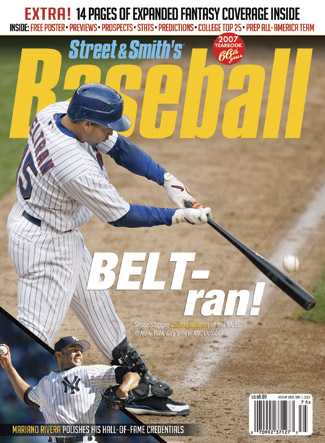
| Come May when we’re being told that the Subway Series has run its course, I will point to this as Exhibit S for the defense: The cover of the only locally available 2007 Street & Smith’s Baseball Yearbook. Came upon it in Pathmark last night and nearly spiked the entire detergent section, touchdown-like, out of exhiliration.
Unlike with our well-meaning but wishy-washy friends at Athlon Sports, there’s no Choose One option for the New York market. If you want Street & Smith’s here, you have to buy the magazine with the big Met and the little Yankee, just as I have had to buy the opposite for the past decade.
In the words of Johnny Drama, VICTORY!
Small one anyway. You know, like tiny Mariano down there on your bottom left. |
|
|
by Jason Fry on 6 March 2007 4:23 am When you're a basically solid team without a lot of job openings or questions, spring training is, ideally, all about what you're not. News? Bad. Questions? Generally bad. Particularly any that start with formulations like, “Can the Mets survive…” or “What's Plan B now that…” The absence of questions, beyond banalities such as work visas and days off to attend to personal matters and commonplaces such as working on new pitches and re-examining swings? That's good. Or, rather, it's not bad.
So far, it's been a camp of nots. Orlando Hernandez's neck pain? Not thought to be serious. Lastings Milledge's hand? Not broken. John Maine leg after that comebacker? Not injured. Not exciting, but that's not disappointing. Exciting is so overrated this time of year.
But it occurred to me today that there's something else we're not.
There's been a lot of speculation about Alex Rodriguez and that opt-out Scott Boras built into his contract all those years ago in Texas — speculation that the clause was designed to let the Mets correct their mistake of having Steve Phillips call in a pre-emptive strike on A-Rod's supposed contract demands during the winter of 2000. The Mets were the team A-Rod loved as a kid (and seems to genuinely have loved, unlike, say, the diplomatically variable childhood loyalties of Al Leiter) and had always wanted to play for. As it's a rarity for agents to be dealing with the same GMs seven years down the road, the opt-out would give both player and team a second chance to make things right.
It's a great story. Great stories always make me suspicious. It seems a lot more reasonable to think that seven-year escape clause was designed to let A-Rod catch back up to a salary curve that in 2000 sure looked destined to rise above $25 million per for the game's greatest stars by 2008. That sounds a lot more like Scott Boras than any kind of sentiment about what logos were on a client's jammies once upon a time.
But it's spooky how the Mets' lean seasons did track the opt-out pretty closely, from 2001's gallant near-miss to the travesty of Alomar and Vaughn, Art Howe lighting up rooms, Jeff Wilpon running down Jim Duquette's cellphone batteries, Kazmir for Zambrano, pitchers running the clubhouse and every other disappointment and embarrassment of that wretched era. Shaun Powell doesn't mention A-Rod, but he does a nice job in Newsday today discussing how these Mets are not those Mets anymore. If Boras really was plotting a course for A-Rod around the Mets' fallow years, his only mistake was being pessimistic by a season.
This isn't a plea to put A-Rod in orange and blue for 2008. That's not going to happen. Though if there were a chance, I wouldn't be so high and mighty that I'd turn up my nose at a player who's going to wind up owning every offensive record in the book and, as no less than dedicated Yankee hater Jim Caple has pointed out, seems like a decent guy whose biggest fault is letting his emotional neediness guide his foot to his mouth. A-Rod would be insane to go for double or nothing on the other side of town. The Mets would be taking an awful risk letting him take that gamble with an enormous amount of their money. And that's not what got me thinking anyway.
What got me thinking was David Wright's reaction to the idea of A-Rod as a Met. Wright is an All-Star, the recipient of a six-year, $55 million contract, a marketing phenomenon and one of the faces of his franchise. So what would he do if A-Rod arrived in Flushing? That's easy, he told Bob Klapisch — he'd change positions. Really? To where? “Anywhere.”
On one New York team, when you're Alex Rodriguez you pull into town, are left to read the writing on the wall and decide you're the one who's going to change positions, even though most everybody except geeks who do motion capture for videogames thinks you're far superior at the position you're vacating. On that team the guy you moved for is more interested in punishing you for something stupid you said a long time ago than in drawing down the venom of the fans, even though he could accomplish that with a sentence or two and thereby allow you to relax and just be who you are, which is only one of the best players in the history of the game.
A-Rod seem stunned by Wright's comments, and who can blame him? In the Daily News today, Wright calmly acknowledged he'd said what he said, then cracked that “I really do hate” Reyes. In Port St. Lucie, one half of the left side of the infield saying that about the other half is a laugh line. In Tampa, it'd launch half a billion headlines.
I can't wait to find out all the things the Mets are this year. In the meantime? It's nice taking stock of all the things they're not.
Reminder: This Wednesday March 7, we'll be reading at Varsity Letters, the monthly sportswriting event hosted by Gelf Magazine's Carl Bialik. The night's other readers will be True Hoop's Henry Abbott; the Dugout's Jon Bois, Nick Dallamora and Brandon Stroud; Deadspin's Will Leitch; Dan Shanoff of eponymous sitedom; and With Leather's Matt Ufford. If you're in or near New York City (or have a sudden urge to visit), please come cheer us on and/or laugh after we fall on our faces. Admission is free; full details are right here. Carl even interviewed us, the sucker.
by Greg Prince on 4 March 2007 11:31 pm Edward: I think we need some major sucking up.
Hollister: Very well, sir. You’re not only handsome but a powerful man. I could see the second you walked in here you were someone to reckon with.
Edward: Hollister.
Hollister: Yes, sir?
Edward: Not me. Her!
—Richard Gere and sycophantic salesman, Pretty Woman
Peter B. Maglathlin has won me over. He knows exactly how to pluck my strings.
Peter — or Pete (he addressed me as “Dear Friend,” so I guess I can be familiar with him) — is the best kind of judgmental. He makes judgments that I like.
My man Pete works for the Danbury Mint in Norwalk. He’s the director there. No wonder. He knows quality when he sees it. When he looks at the Mets, he sees quality.
This is the very first sentence Pete wrote me a little while back, right after Dear Friend:
When the greatest sports franchises are counted, the New York Mets are always at the top of the list.
Pete, I couldn’t agree more. In fact, here is the entirety of my Greatest Sports Franchises list:
1. New York Mets
So it’s clear right off the bat that Pete and I see things eye to eye. I don’t know about his wealth, but Pete is definitely a man of taste. And judgment. Who would argue over his choice for the top of the Greatest Sports Franchises rankings? Nobody I respect.
I respect Pete because Pete obviously respects me. He doesn’t just tell me what I want to hear, he backs it up with solid factual facts:
With two World Series championships and four National League pennants, the Mets are one of the most successful teams in all of sports.
Inarguable evidence. I can think of lots of teams that don’t have a single National League pennant. For example, the Cleveland Indians are a total zero in that department. The Mets, by Pete’s calculations, have the Tribe beat on all-sport success. And the Green Bay Packers? How many World Series championships are they packing? Not a one. They, like the Boston Celtics and Manchester United and my high school swimming team, are waaaay back in the World Series pack. Losers.
If you’ve got two World Series championships and four National League pennants plastered to your right field wall (to say nothing of Wild Cards and Eastern Divisions…but why make other, less successful teams feel bad about themselves?), you are indeed emitting the sweet smell of success.
Damn, Pete. You’re making me feel good! Tell me more, tell me more…
And an integral part of the Mets success has been their home field dominance.
Pete doesn’t have to say it, but I can infer what he’s getting at. Nobody’s ever won more games on the Mets’ home field than the Mets. The Mets play 81 games a year at Shea Stadium. Opponents? They’re like “we’ll play three or four against you, but then we’ve gotta go.” Chickens! And since I’m often at Shea Stadium for Mets games, I think he’s telling me that I have a great deal to do with that home-field dominance. I’ll accept that.
To sum up Pete’s major points in the first paragraph I read in his letter to me, His Friend:
• The Mets are the greatest
• The Mets are always at the top
• The Mets are successful
• The Mets are dominant
It all checks out with me. Pete didn’t have to say anything else. He had me at “greatest”.
The beginning of the note Pete sent me was so warm and accurate that I haven’t bothered to read the rest of it. I assume it’s filled with more accolades for the Mets and a further telling of their many positive attributes. They are the mightiest of the mighty. The skillfullest of the skilled. The Metsiest in all the land!
Let’s see…
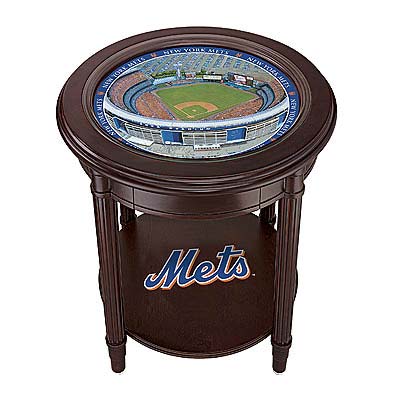
Now, you can honor this great baseball tradition by acquiring The New York Mets End Table, a handsome hardwood and glass end table that features a stunning art print of Shea Stadium.
Hmmm…that’s not another heaping helping of praise. That reads like it’s a…a…
SALES PITCH!
Ohmigod! My Friend Pete didn’t write to me just to confirm how great, successful and dominant the Mets are! He’s trying to sell me something!
When you examine the brochure I’ve enclosed, you will begin to experience the elegant beauty and brilliance of this unique end table.
What? Nothing more about the Mets’ rippling muscles or classic good looks or uncommon intelligence? You’re just talking about the table?
Crafted of genuine hardwood, it features an exquisite art print of Shea Stadium set under beveled glass.
What’s this have to do with the Mets’ eternal awesomeness? Their spectacular soulfulness? Their untoppable two World Series championships?
The print shows the stadium on game day, with the packed stands dotted with orange-clad fans, and even players on the field!
I’m beginning to think that Pete doesn’t much care about the Mets or about me, His Friend, and my interest in being reminded how you can’t top the Mets. I think he’s just trying to get my money.
He is! He is!
Requiring only minimal assembly, The New York Mets End Table is attractively priced at $149, payable in four monthly installments of just $37.25 (plus $15 total shipping and service).
Attractively priced? You mean I don’t just get one of these for being an orange-clad part dotting the integral success of our home-field dominance? Not even the “sliding felt-lined drawer that opens to store everything from remote controls or coasters to an address book”? How am I supposed to contribute to that legendary home-field dominance if I’m sending $164 to Norwalk? That’s practically a full day at Shea (including shipping, service and maybe a pretzel).
Oh Pete. I’m so disappointed in you. I thought you sought me out as a Dear Friend just to share with me your well-considered opinion on the magnificence of the Mets. You said all the right things. You made perfect sense. I thought we would have a beautiful thing going. Now I just realize you’re trying to sell me a piece of…of…
You know, it is pretty attractive. And “satisfaction is completely guaranteed.” Even the greatest of sports franchises doesn’t make that claim. I mean “Your Season Has Come”? What if it hasn’t? That’s highly unlikely, given our greatness, but technically you never know.
Sadly, I think I might have to have this stupid thing, minimal assembly and all. (When it comes to me and assembly, there is no minimal.) But a hundred sixty-four smackers? What if I want a bottle of water to go with that pretzel?
Thanks a lot, Pete. Some kind of Friend you turned out to be.
While I mull over my big-ticket purchasing decisions, read what your bloggers have to say about this, that and the other thing at Gelf Magazine. And if you’re reasonably accessible to downtown Wednesday night, please stop by for Faith and Fear’s first-ever public appearance, when Varsity Letters hosts us, Dan Shanoff, Deadspin, The Dugout, With Leather and True Hoop in a discussion of all things online sports media. Unlike The Danbury Mint, Varsity Letters charges nothing, so you’re already coming out ahead. We look forward to seeing you.
by Greg Prince on 4 March 2007 11:17 pm
by Jason Fry on 2 March 2007 6:05 am And I don’t think I ever got Fred Norman. What am I going on about now? Click here.
by Jason Fry on 2 March 2007 5:54 am If you’ve almost made it to Saturday, then it’s Flashback Friday at Faith and Fear in Flushing.
I don’t know where I got the notion — maybe from a friend or from someone at school or from watching older kids at the five-and-dime — but one day in 1976 I made up my mind: I’m going to collect baseball cards.
I got ideas like this fairly often, back in the late 1970s. I have enough allowance money to afford two Star Wars figures. I kind of liked that Hardy Boys book Dad got me. I’m going to collect baseball cards. Each time it was an idle thought that unleashed a years-long avalanche of collecting, list-making and obsession — I’ve never done anything by halves, though most of the time that would be a good idea. But baseball cards marked the first such avalanche, and the blueprint for all the rest of them.
In the spring and summer of 1976 in Long Island, I lived to collect baseball cards. Specifically, I collected rack packs. Some shops up by the Finast and the King Kullen had wax packs, but a) I didn’t have any reason to go in there; b) they were the province of scary teenagers who smoked; and c) I didn’t know. So I was ridiculously old before my teeth shattered my first flat rectangle of pink Topps gum. Rack packs didn’t have gum — they were an accordion fold of three packs of cards in clear plastic (photo here), with a fourth panel that was just a red rectangle that said “trading cards” with the Topps logo, in that affectless style that all but screams, “It was the 1970s! None of us knew how to market anything!”
You got 42 cards, and if memory serves they were 55 cents after tax. But the crucial thing was that clear plastic. That meant you could see six of the 42 cards you’d be getting — three fronts and three backs. (Why backs? Why not turn half the cards around so you could see six card fronts? Because it was the 1970s, and nobody knew how to market anything.) On top of this, if you knew how and the shopkeeper wasn’t hanging over you like an avenging angel, you could push and pull the cards within the plastic this way and that and sometimes get a glimpse of the colors of the next card or even the card two down. That gave you a fighting chance at knowing if any of the outermost nine or even 12 cards were Mets — they had yellow bottoms, though they shared that characteristic with a few other teams. (The Yankees were a sky blue.)
The key to rack packs, as you’ve probably intuited by now, was prospecting for the Met-heavy ones. It was digging down for the one near the bottom of the box that had Mike Vail on the front, or noting that the white-on-green letters visible on a card back said BUD HARRELSON, or putting aside a pack you’d pushed and pulled to see that the middle blister had a card with a yellow bottom right below the one showing.
Prospecting, though, took time. And time was reckoned differently by seven-year-olds and adults.
There were two significant places available to me to prospect for rack packs. The first one was a stationery store down the hill from King Kullen, one that had packs hanging from a big spinning rack and sometimes boxes of rack packs, too. I don’t remember the store’s name, but I can still hear the sound that spinning rack made as it rotated: whine-chunka-chunka-whine-chunka-chunka. Unfortunately, the stationery store was a lousy place to look for rack packs, because the owner (whom I have no recollection of whatsoever except as a dark, frightful presence) did not like kids, particularly not kids who wanted — no, needed — to take half an hour to excavate all the rack-pack boxes from top to bottom and turn that spinning rack again and again and again (whine-chunka-chunka) until every blister of every rack pack had been checked front and back. Sometimes he wasn’t there, in which case you could wallow in rack packs for as long as your mom let you, but most of the time he was, and you knew you had just time enough for a quick dig-dig-dig through the top layers of the boxes and one single spin (whine-chunka-chunka) of the rack before he’d rise up from his lair somewhere behind the counter and bark at you that there was no looking in the store.
Now, I understand that every kid (including me) would leave the rack packs scattered all over the other merchandise and many a kid would steal as many packs as the pockets of their Mighty Macs would hold. (Not including me — I would have been deeply shocked at the idea of stealing anything, even a rack pack with a visible Dave Kingman if I had no money.) Then, all I knew was prospecting for rack packs at the stationery store should have been great but wasn’t.
The other place to prospect for rack packs was much farther from our house, but it was so much better that I used to dream we were going there. It was McCrory’s, a now-extinct five-and-dime that sold everything from bolts of fabric to model kits to baseball cards. Oh, how McCrory’s sold baseball cards. The aisle on the way to the registers had these big tables with raised sides, each one like a giant open drawer, with another big display drawer underneath, perfectly positioned for rummaging through while sitting on the floor. McCrory’s reserved each of those big tables for a different class of notions, and during the season at least one of them — sometimes two or even three — would be full of rack packs. Overflowing with rack packs, so much so that you could reach your hands into them and slosh your hands through them and feel plastic sliding over and under your hands and hear that crackle and shhh as you wiggled your fingers. We’d go to the Smith Haven Mall (which was near the hardware store and the McDonald’s and everything else of note in our part of Long Island) every week or two, and I would make a beeline for McCrory’s and the baseball-card table with the understanding that my parents would come collect me there when they were done with whatever adult thing they had gone to the mall to do.
Unlike the stationery store, in McCrory’s nobody cared what you did. You could divide an entire table of rack packs into rejects and potential keepers. You could sit on the floor and pull rack packs out one by one for careful examination. You could wiggle the plastic for as many subsurface peeks as you could manage. It was like a trip to the Planet of Baseball Cards, and the only limiting factor was when you’d hear heels on linoleum in what you knew was your own mother’s distinctive rhythm.
I never did get all the ’76 Topps cards — I wound up missing like 50 or 60 of them, somehow. Years later, at card shows, I’d occasionally flip past one of the missing ’76es and stop and stare at a card that my seven-year-old self swore couldn’t exist. (On the other hand, I think I got about 54 Mike Anderson Traded cards.) I did get all the Mets, and I still have them tucked away in a binder. Jerry Koosman and Del Unser are practically round. Randy Tate is liberally splotched with what I’m pretty sure is now 31-year-old Nestle’s Quik. They’re testaments to the fact that children love things half to death, and I’ve kept them because there’s nothing whatsoever wrong with that.
It’s a sight to make any mint collector shudder, but to me it’s comforting: This what baseball cards look like. Simply framed photo above, name, team and position below. The player’s name is set against a blue background; METS is in black, against that sometimes-deceptive yellow. On the lower left, a little stylized figure showing the player’s position. (I think I was about 30 when I noticed that there’s a right-handed pitcher and a left-handed pitcher.) The blue of the Mets gear varies strangely in the photos, from Buddy Harrelson’s navy cap to Felix Millan’s near-aquamarine batting helmet. The composition is all over the place, too: For every terribly dull card (Jesus Alou is fat, Ed Kranepool looks fat, tired and possibly hungover, Joe Torre is both unhappy and vanishing into shadows), there’s one I remember as being thrillingly stylish (Jon Matlack grinning like he’s just come into possession of the secret of the universe, Felix Millan with his hands choked halfway up the bat, John Stearns thoroughly enjoying his Bad Dude batting stance).
I still collect cards. I quit when I was 12, then took it up again by accident in 1988. (The kids who lived next door to my parents wanted — no, needed — one of the four 1980 Rickey Henderson rookies I’d put in a doubles box when Rickey Henderson didn’t mean anything. To get rid of them I told them I’d trade them one for every Met card they had in their house. They had a lot of Met cards.) I now have every Met card Topps ever made, and every Topps card, of whatever team, of any player who has ever been a Met. (As this account will address in frightening detail.) In fact, I got the first series of 2007 Topps in the mail this week, and assessed them quickly with a practiced and by now somewhat dispassionate eye: They look like the ’71s, which look like the ’86s. Hey, Darren Oliver got a card. El Duque’s wearing the ’86 throwback uniform. Today I buy cards via eBay, or Beckett — PayPal transactions yield mail a few days later. Instead of opening packs I get the series hand-collated in a box.
Needless to say, I don’t sit around in five-and-dimes hunting for rack packs anymore. (That would be scary.) But I think I can trace too many oversized emotions back to rack packs in 1976. Gluttony? That’s arriving at a birthday party and seeing a friend’s mother has wildly exceeded the Setauket, N.Y., party-favor mores by getting every kid in attendance three rack packs — and realizing half the other kids there don’t care about cards and will trade them for noisemakers or Oreos. Feeling smug because you’ve got this life thing figured out? It’s thinking my grandmother might just possibly be good for three rack packs at McCrory’s, asking for six and having her counter with four. Anger at a corporation? It’s sending 50 cents — practically a rack pack! — and a baseball wrapper to Westbury, N.Y., to get all 24 team cards, waiting a month and having the team cards come back on flimsy white stock that doesn’t match your other cards. Wild elation? It’s coming to the last possible unknown card of a rack pack — the one before the one with the back showing in the final blister — and coming up with Mike Phillips. Despair? That’s spending three weeks’ worth of allowance on rack packs, getting nothing and then watching my friend Andrew pull a Mets team card and his brother Robert (who liked the Yankees!) pull a Tom Seaver when he already had two of them.
And anticipation? It’s cracking that first blister of a rack pack and shuffling past the card on top that you know about.
Crinkle…snap. Jerry DaVanon (Astro), Phillie, Cub, Stupid Traded Card, Brave, Cub, Expo, Ranger, AL ERA Leaders, Expo, Pirate, Pirate (what the heck?!), YELLOW — Darn! a Red!, Bobby Murcer (back was showing, Giant.)
Crinkle-snap. Barry Foote (Expo), Checklist, YELLOW — Another Red!, Rangers Team, Padre, Ranger, YELLOW — Ugh, an Angel!, Brewer, Pirate, White Sock, Cardinal, Padre, One of Those Black and White Cards (Who’s Pie Traynor?), Kevin Kobel (back was showing, Brewer.)
Crinkle-SNAP! Come ON! Gary Carter (Expo), YELLOW — Crud, a Tiger! And it’s Mickey Lolich!, Dodger, YANKEE, YELLOW — NO! An A or an Athletic or whatever the heck it is! I HATE this pack!, Rookie card (nobody), Phillie, ANOTHER YANKEE, Stupid Traded Card, Oriole — ANOTHER DYAR MILLER?, Cub, Checklist, I know the last card is John Mayberry (back showing, Royal) so come on…YELLOW! MET! YES!
Aw heck. Gene Clines.
Next Friday: The speech we long to hear.
by Greg Prince on 1 March 2007 9:13 pm
One vote for wearing the real uniforms in these games. Mets look sharp, whoever they are. Not that the Delgados of our world require enhancement by haberdashery, but all the No. 62s and higher seem more legit in crisp snow whites with their actual names embroidered on the back than in those drab blue, grab-one-off-the-pile batting practice shirts. Not that I remember most of who donned them, except that we seem to have a second Jose Reyes. He’s a catcher. There’s no confusing him with the original article, though it seems rather whimsical that they gave him four 7s to wear (two in the back, two on the front).
Only time I actually paid attention was when that reliever we got for Bannister…wait, let me check the spelling…Ambiorix Burgos came into pitch the ninth and get the pretend save. I expected a nine-run disaster that would prompt an avalanche of calls to the FAN that we must trade this guy at once and bring back maybe Jorge Julio, but no, he pitched well. Except for a flare that fell in and an error on an unnecessary DP attempt by whichever infielder was trying to impress, he came away unscathed. He even retired rightfielder Rick Ankiel. Yup, same Rick Ankiel who pitched so poorly in the 2000 NLCS. There’s only one of him, but he apparently has uncommon versatility.
Final: Mets 4 Cardinals 3.
It’s not the Mets 4 Cardinals 3 that we really needed, but like I said, the uniforms looked nice.
by Jason Fry on 1 March 2007 2:04 am Ah, Day One. As my partner noted, it was a bunch of sweet nothing.
I had the game on at work and so was only paying fitful, vague attention — which was fine because this was, after all, a spring-training game.
By now I'm used to this. About 10 years ago, it was different. I remember one year in the late 1990s the first spring-training game came on a Saturday afternoon in March. I woke up early (this was before I was a dad, so if I saw the early side of noon on a weekend morning I felt virtuous and superior all day) and by mid-morning I was so hyped up that I went out and did errands, something that normally I would actively avoid unless I had nothing to wear or eat or was about to be divorced or set upon by bill collectors. (See “before I was a dad,” above.) After doing all the errands I could think of (and inventing some new ones), I bought all the papers, came home, read all the interchangeable spring-training articles and then hopped up and down on the couch for the half-hour or so I had to kill until finally the telecast started, complete with the crate of oranges being opened and the sight of Fran and Ralph in Floridawear.
And by the top of the second I was flipping through the Real Estate section.
Hey, it's spring training for everybody. As Emily noted during the Fry family's brief TiVo rebroadcast for Joshua's benefit (he didn't pay much attention either, though he did recognize Jose Reyes and let out a cheer), if you make it to October you have to pay laser-like attention to every pitch, so it's hard to dial it up on the last day of February. This is a marathon, not a sprint — heck, compared with baseball season a marathon's just a day you decided to run around. It isn't like football, with just 16 afternoons plus whatever the playoff gods give you. It's 162 games with hope for 11 to 19 more, and an overly long preseason. That's 200-odd games at three or four hours a pop. Pace yourself.
I was happy just to have my left ear filled with announcer burble and the thwack of bats and the clapping of a small Florida crowd. Day One being Day One, even Oliver Perez's less-than-marvelous work summoned a nicely familiar feeling. When the first Tiger run scored, I felt a twinge and recognized it at once: It was the nose-wrinkle of annoyance at an early run you know you have plenty of time to get back and therefore have no reason to get too concerned about — quite a different thing than the wince and expletive of a seventh-inning run in a tie game, or the gut punch of the extra-inning run that beats you, or any kind of enemy run in October. Feeling it and registering it was the fan equivalent of the first curve ball broken off or the first time bringing the bat 90% of the way across the plate but not breaking your wrists. OK, got it. That still works.
It being spring training and all, I guess we have to give today's uniforms a mulligan, too. By now the sight of a new, hide-your-face hideous Mets spring-training uniform is as routine as the first batch of crocuses, so on the one hand it was good to see regular-season unis there on the TV. On the other hand, it's not the regular season. Regulation gear in Florida? That's Yankee stuff. (If we've done this in previous years — or in every year — forgive an old man's failing memory. I'm sure I hated it then too and will complain about it again in 2008.) And our sartorial misstep wasn't even as bad as Detroit's. Not only are those Tigers hats appalling, what with the little above-the-ear crescent of white, but every schoolkid knows the Tigers wear an orange D on the road, not a white one. That's one of the great uniform traditions of baseball, and some MLB doofuses failed to honor it. I know every team is stuck with similar hats this year, and I've long since given up complaining about the churning out of new baseball things to buy at the mall, but if MLB must foist junk on us, it could at least not be careless about it. They couldn't make crappy caps with orange crescents?
Oh well. It's spring training. Getting mildly exercised about it is all I can manage. Because like I said, I'm pacing myself.
Addendum: Next Wednesday March 7, it's Faith and Fear Live! No, we're not live-blogging a spring-training game or anything. (That would be ridiculous.) We'll be reading at Varsity Letters, the monthly sportswriting event hosted by Gelf Magazine's Carl Bialik. The night's other readers will be True Hoop's Henry Abbott; the Dugout's Jon Bois, Nick Dallamora and Brandon Stroud; Deadspin's Will Leitch; Dan Shanoff of eponymous sitedom; and With Leather's Matt Ufford. If you're in or near New York City (or have a sudden urge to visit), please come cheer us on and/or laugh after we fall on our faces. Admission is free; full details are right here.
|
|