The blog for Mets fans
who like to read
ABOUT US

Faith and Fear in Flushing made its debut on Feb. 16, 2005, the brainchild of two longtime friends and lifelong Met fans.
Greg Prince discovered the Mets when he was 6, during the magical summer of 1969. He is a Long Island-based writer, editor and communications consultant. Contact him here.
Jason Fry is a Brooklyn writer whose first memories include his mom leaping up and down cheering for Rusty Staub. Check out his other writing here.
Got something to say? Leave a comment, or email us at faithandfear@gmail.com. (Sorry, but we have no interest in ads, sponsored content or guest posts.)
Need our RSS feed? It's here.
Visit our Facebook page, or drop by the personal pages for Greg and Jason.
Or follow us on Twitter: Here's Greg, and here's Jason.
|
by Greg Prince on 17 March 2007 2:17 pm 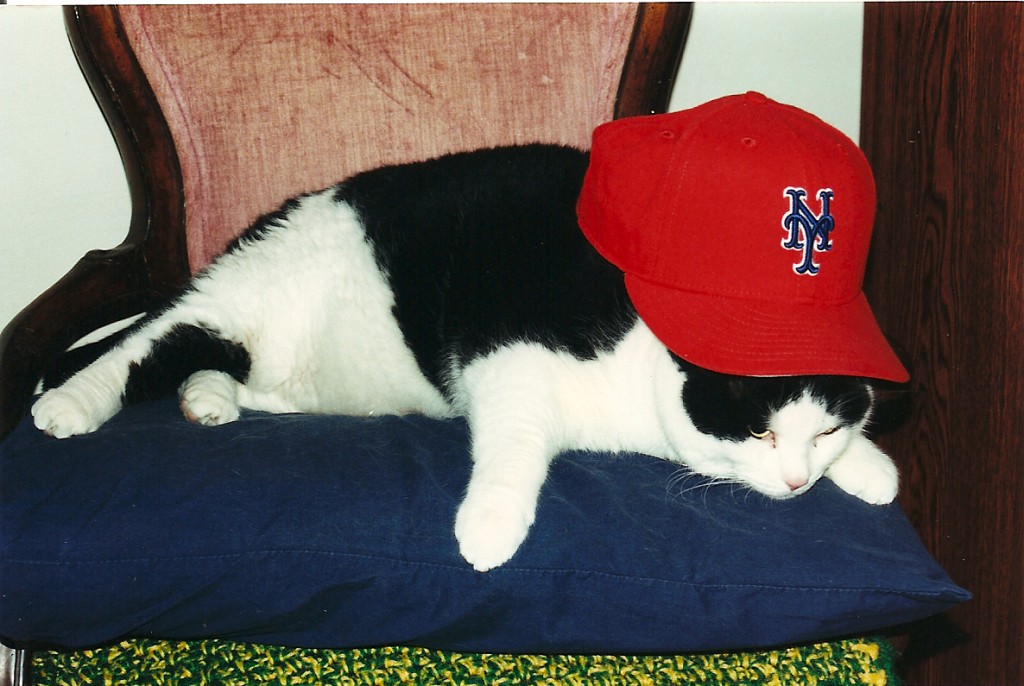
The first March 17 that we had Bernie The Cat, we were watching the news when a reporter made reference to the Ancient Order of Hibernians. On cue, we looked over toward our kitten, counted to three and greeted him with a big, hearty HI BERNIE!
Needless to say this startled him. But an annual tradition was born and it’s one we continue, even if we have to project our voices a little skyward for this or any World’s Greatest Cat to hear us.
Later this St. Patrick’s Day, should the mood strike you, pour yourself a wee bit of whatever captures your fancy for the occasion and maybe toast those you love, wherever they happen to be residing this March 17.
(By the way, Bernie is non-denominational. He just happens to favor the orange cap.)
by Greg Prince on 16 March 2007 10:32 pm Cinderella tried on her slippers, bracketbusters saw their shadows and the action was fast and furious on the first full day of March Metness Thursday. Sixteen games, four in each region, were played, setting the matchups for Saturday that will determine half of the Rick Sweet 16.
Friday will see the rest of the Don Aase round unfurl. But that’s for later. For now, here are Thursday’s results.
MIRACLE REGIONAL
Let’s Go Mets (1) vs Mercury Mets (16)
Let’s Go Mets was loud and strong from the start. It need only have cleared its throat. Mercury Mets thought the game took place in the future. Should there be a rematch in 2021, they’ll be ready. But not yet. Let’s Go Mets gave its fans everything to cheer about in a romp.
Sidd Finch (8) vs Mojo Risin’ (9)
Finch’s 168-MPH fastball had the ’99 Mets rallying cry in a slump right there toward the end, but George Plimpton’s creation proved a paper lion once Mojo rose for good. Mojo Risin’ takes on top-seeded Let’s Go Mets on Saturday.
Jane Jarvis (5) vs It Ain’t Over ‘Til It’s Over (12)
As Yogi started sizing up the chances of his 1973 prognostication, he started to lose his way. And when Jane Jarvis tickled the Thomas Organ for a spry version of “The Mexican Hat Dance,” it was over.
Black Cat (4) vs Mike Vail (13)
The famous feline who spooked the ’69 Cubs into definitive freefall was a heavy favorite to take on the ultimate flash in the Met pan. But Vail hit his first 23 shots and the black cat got distracted and traded Rusty Staub. Those who had the four-legged creature going far in their brackets should have known better than to trust one of those damn things. Vail, the first upset winner in the 2007 March Metness tournament, will try to maintain his momentum against Jane Jarvis next.
MAGIC REGIONAL
The 7 Train (1) vs Cliffdweller (16)
Wes Westrum muttering about the latest one-run loss did not go over well, not with the 7 Train rumbling past. “Ohmigod, wasn’t that awful?” he commented before giving way to Salty Parker to finish the first-round defeat.
K Korner (8) vs In Ten Years… (9)
Dwight Gooden’s loyalists were looking good for the long-term, waving their strikeout signs in 1985. However, Casey Stengel’s pronouncement that, much like Greg Goossen, Doc was 20 and in ten years had a chance to be 30 proved to be prescient. Gooden was suspended from baseball for all of 1995. In Ten Years… waits only ’til the weekend for a showdown with the 7 Train.
Outta Here! (5) vs Basement Bertha (12)
Gary Cohen’s home run call is sure and true. Bill Gallo’s Met-loving character has seen better days. Many of them. She’s OUTTA HERE! The O.H. advances.
Grand Slam Single (4) vs Bleach (13)
Was there anything worse in the fetid summer of 1993 than Vince Coleman exploding firecrackers in a little girl’s direction in the Dodger Stadium parking lot while Bobby Bonilla cackled nearby? Probably not, but it was the appearance of a child’s toy water rifle filled with Clorox and directed at reporters by Bret Saberhagen that seemed to push the ’93 Mets clearly over the top as one of the worst assemblages of baseball-playing human beings ever. Or under the bottom, if you like. This representative misdeed from that dread-soaked season was seen as an upset candidate given what it had in common with the Grand Slam Single, namely that both the 1993 Mets and Robin Ventura quit running before they were supposed to. But in Ventura’s case, it was charming. Grand Slam Single shows down with its flagship voice Saturday for the right to go to the Rick Sweet 16.
BELIEVE REGIONAL
Shoe Polish Ball (6) vs Cow-Bell Man (11)
Not only did Gil Hodges come out of the dugout to convince umpire Lou DiMuro of the righteousness of his protest that Dave McNally’s pitch indeed glanced off Cleon Jones’ shoe, but he was able to have the Cow-Bell Man sit down for an entire inning, thus allowing patrons in the mezzanine to enjoy part of a game unimpeded by his self-styled cheerleading. Shoe Polish Ball rolls on in unhyphenated fashion.
The Franchise (3) vs Lazy Mary (14)
A potential singalong showdown was short-circuited when the best nickname in Mets history stepped out of the dugout and waved its cap to an adoring throng in the seventh-inning stretch, The Franchise making everybody forget about Lazy Mary before the lyrics went from Italian to English. Tom Seaver’s grandest and most appropriate identity tangles Saturday with the Shoe Polish Ball.
Baseball Like It Oughta Be (7) vs The Worst Team Money Could Buy (10)
The Mets’ most forceful slogan was determined to outlast the chronicle of their most shameful season. All the money in the world can’t buy what oughta be. It couldn’t even buy 71 wins. Bob Klapisch and John Harper wrote a helluva book, but they go down to an ad man’s brevity.
Meet The Mets (2) vs 40-120 (15)
When the world met the Mets, they posted the worst yet most memorable record in team history. It still stands. As does another memorable record, no matter how often it is desecrated by new versions. Sadly, you can only meet the 1962 Mets for so long before the .250 winning percentage gets to you. Playing to a 40-120 level got the ’62 club eliminated in August. Meet The Mets plays on against Baseball Like It Oughta Be come Saturday.
AMAZIN’ REGIONAL
Kahn’s Hot Dogs (6) vs Jack Lang (11)
The quintessential Shea Stadium food item versus the quintessential Mets beat writer. Mr. Lang passed away earlier this year, but even if this original Met scribe were still pounding out those ledes, it would cost less to buy his paper than it would to buy a hot dog at Shea. Kahn’s already lost the concession to Nathan’s. Now it loses to Lang.
Kiner’s Korner (3) vs Tomatoes In The Bullpen (14)
Two venerable stalwarts of the Shea scene in the spotlight here. The tomatoes grew for many years over the right field fence under the loving care of bullpen coach Joe Pignatano. Kiner, meanwhile, became famous for what he did under the stadium after the game. The tomatoes continued to blossom even as Ralph’s show faded from view. But then Kiner’s Korner returned for a couple of campaigns. The tomatoes haven’t been seen lately. But Ralph has. It was surprisingly close for a 3-vs-14 contest, but Kiner’s Korner proved the slightly hardier perennial. It will be Jack Lang and Kiner’s Korner in a Saturday faceoff. The winner will interview the star of the game.
The Odd Couple (7) vs Jimmy Qualls (10)
Oscar Madison covered Mets games and wore Mets caps in the movies and on television. In between, Jimmy Qualls broke Mets hearts. Madison missed a triple play. Qualls made Tom Seaver miss a perfect game. He is a symbol of the no-hitter that got away, the holiest of holy grails in all of Metsdom. The Odd Couple series was as New York as it got in the 1970s, but alas, it — unlike its cinematic forebear — was filmed on a Hollywood soundstage. Qualls, ironically, does what ’69 Cub Antichrist The Black Cat couldn’t: survive and advance.
Buckner (2) vs Dairylea (15)
There was time when clipping coupons off of Dairylea milk cartons could earn you free passes for the Mets. Bill Buckner, however, provided the ultimate get out of jail card for the Mets. Thus, it’s a battle of ex-Cubs, Buckner and Qualls, on Saturday, albeit partially by way of Boston gray.
by Greg Prince on 16 March 2007 4:24 pm If the meaningless games in March take on occasionally deeper meaning, then it must be Flashback Friday at Faith and Fear in Flushing.
“The baseball exhibition! The baseball exhibition!”
That was my roommate talking. He didn’t know anything about baseball, but he knew that the proper phrase was “exhibition game,” a nugget that had thus far eluded my new girlfriend. She had been calling what I’d be taking her to that Saturday “the baseball exhibition” and he must have caught me rolling my eyes.
Call it what you want, Spring Training 1982 was underway and I was on the verge of meeting one of my long-term goals as a fan: Go see the Mets at Al Lang Stadium in St. Petersburg. I can’t say it’s the reason I opted to attend the University of South Florida practically next door in Tampa but I can’t say it didn’t enter my thinking.
What I never saw coming, because I never thought about it in tangible terms, was that I’d be going to my first preseason showdown ever, Mets versus Dodgers, with my girlfriend. My girlfriend. Though it certainly sounded ideal in theory, it never occurred to me I would have one.
But 25 years ago, in March 1982, the second semester of my freshman year at USF, I did. I’d been going out with a girl from down the hall of my co-ed dorm for a little over a month. As I was the type who never took the USF Bull by the horns, it was she who approached me for our first formal date. And even then, it took a quaint institutionalized throwback to get it done.
Our dorm was holding a Sadie Hawkins dance, where the girls ask the guys. I knew what it was because there was a Sadie Hawkins Day in Li’l Abner, the only high school musical I will ever be in for the rest of my life (pump me with Bacardi and I will perform my mercifully brief solo). This girl didn’t know from Sadie Hawkins. In fact, she referred to the event in question as the Sadie Hopkins dance. Probably because I was so stunned to be in this conversation at all, I didn’t feel compelled to correct her.
Would I go to this dance with you? Uh, sure, I guess. I mean, yeah! Wow, an actual date with an actual girl. What will they think of next?
Did I mention the date of the dance was February 13? Nothing unlucky or extraordinary about that, except the next day was February 14. Valentine’s Day. On The Office, morose Ryan and gregarious Kelly have their first date on Valentine’s Eve, and Ryan — who’s pretty reluctant to begin with — lives to regret the timing. In a way, I would, too, because it probably ratcheted up the romantic stakes a little quickly. Then again, by the time I was 19, I pretty much required a kickstart in the dating department.
The two of us (both a lot more like Ryan than Kelly for what that’s worth) went to the dance and had a lovely time. We had known each other in a slight, nodding fashion through the first semester, so it wasn’t all that awkward. I remember us being the only couple whose slow dancing didn’t involve the guy’s hand on the girl’s ass. We didn’t know each other that well and that sort of behavior struck me as ungentlemanly. I was probably shy around girls from a lifetime of watching sitcoms in which platonic relationships came perilously close to being ruined by the guy inferring the “wrong message” from the girl’s kindness toward him. I probably should have watched less TV all the time.
Like I said, the dance was the 13th, a Saturday night. It seemed only polite to ask her out for brunch on Sunday, the 14th. I took her to the Bennigan’s near University Square Mall. She ordered quiche. I had a bite. I still felt like a real man. Brunch, like the dance, went well. We hit it off as February progressed. She had a motormouth roommate she was anxious to complain about. I liked my roommate fine but was always annoyed that when there was a knock on the door, it was almost always for him. She voiced the same complaint about her situation. I suspect if she and I each had our own rooms — or if we weren’t so apparently unpopular — we may never have gotten together.
March rolled around and it was time to make my move. On Al Lang Stadium, I mean.
Al Lang, which the Mets shared every spring with the Cardinals, wasn’t Shea. It didn’t have to be. It was the Mets, just a bay away. In Tampa, home of incessant chatter over the Bucs and the Rowdies (professional soccer — oy), who could ask for anything more? It was like Mr. Doubleday and Mr. Wilpon airlifted the team to my neck of the woods for a month every year just as a personal favor to my sanity.
Not knowing Al Lang from Al Schmelz, my girlfriend couldn’t have appreciated that, but she did appreciate that I was sharing my overriding passion with her. Most guys she’d dated, she said, were only interested in one thing. I heard that. I was only interested in one thing that semester if you get my drift.
George Foster, of course…what the hell did you think I was talking about?
Yeah her, too, I guess. I don’t mean to sound blasé about finally being involved with someone, even five weeks involved. It was pretty cool, actually. “My girlfriend and I are going to the Mets game this Saturday” sounded decent. The key phrase in that sentence was Mets game, but I liked having company. And if she, art major that she was, thought the baseball exhibition was akin to something you’d see down the street in St. Pete at the Dali Museum, well, neither of us was going to get in the way of each other’s Grapefruit League good time.
Nice, hot sunny day that Saturday. Nice, hot sunny day all the time in the Tampa Bay area in March. (Another good reason to discover higher education Florida-style.) Big crowd at Al Lang for the Mets and Dodgers. Probably for the Dodgers. Yeah, definitely the Dodgers. They were defending world champions, having defeated the Yankees the previous October. They didn’t often trek across the state from Vero Beach. The Mets? Until further notice, they were still the Mets and all that implied to the outside world. But they were the Mets suddenly plopped into my backyard. Oh what a nice, hot sunny Saturday.
What could make it better? What could improve a scenario that included the Mets, the girlfriend and the warmth?
How about a foul ball?
To that Saturday, I had been to Shea Stadium on 20 different occasions. Not a lot, but enough to know that foul balls were for other people. I had never come close to even thinking about catching one. Ah, but we weren’t at Shea. We were in a ballpark maybe a seventh its size. Plus I was coming into all sorts of things I’d never gotten close to before. If I could have the Mets while I was away at college, if I could have a steady date, if I could have 80 degrees on the third weekend in March, why couldn’t I have a foul ball?
I could!
I can’t believe how easy it was. In the second inning, Ken Landreaux faced Craig Swan. Landreaux, who always struck me as rather shifty around the eyes, batted from the left side. We were sitting somewhere down the left field line in the grandstand behind the box seats, my girlfriend on my right, nobody to my direct left. Shifty Landreaux did not get all of Swannie’s delivery. It looped foul on an arc, took one bounce off the concrete walkway separating the boxes from the grandstand and settled softly into the palm of my unchallenged left hand.
Just like that I caught a foul ball.
Holy smokes! I can’t believe this! I’ve seen it on TV. I’ve seen it from a distance at Shea. Now it’s me. For two solitary seconds, everybody is looking at me because I’ve got the ball! I know what to do, too!
I raised my left arm high and showed it off. Turned to the right, turned to the left, basked in the well-meaning pointing of the Mets fans and Dodgers fans, imagined that a glimpse of me was on Channel 9 back in New York.
To all of which my girlfriend, an inning-and-a-half into her first baseball exhibition, craned her neck away from me and toward the top of Al Lang.
“I think that guy up there got it,” she surmised.
I shoved the ball in front of her face.
“Oh! You got it!”
OK, so she missed my heroics, but she understood at once that a foul ball is special. Everybody did. When I brought it back to the dorm, I knocked on every door of everybody I knew even a little and showed it off. I didn’t really know any big baseball fans, let alone Mets fans there, but everybody — everybody — was impressed. Everybody gets a foul ball because nobody gets a foul ball. But I did.
Man, I can still feel that ball landing in my left palm. It spoiled me. For years I just assumed I’d grab another one that easily. It’s never happened. Picked up one at a White Sox game in 1999, but that was the result of an unseemly scramble in which somebody else’s fingers had just a little too much butter on them, leaving me to vulture the unclaimed sphere. I cherish that one, too, but the Ken Landreaux ball is the only one I can say I caught, even if it was on one extremely felicitous bounce.
Mets would lose to the Dodgers 10-4 that afternoon. Spring Training scores don’t matter. This one really didn’t matter. I got a ball. I had a ball. I had a girlfriend at a ballgame. She got a low-key kick out of the whole thing. She asked a few “what’s that?” questions as regarded the field of play but otherwise just soaked up the baseball exhibition atmosphere. On the way back to the dorm and for days thereafter, she kept thanking me for sharing such a personal passion with her. And it’s always nice to be thanked.
As with the foul ball, appreciation by her for me being simply being me would never come quite that easy again. Oh, we carried on what I would guess was a typical college romance — a lot of hanging out punctuated by bouts of drama. We lasted without too much turmoil clear to the end of the following academic year, never officially breaking up as much as simply expiring. After a fashion, we just kind of ran out of things to talk about. To be fair, I wasn’t necessarily all that interesting at 19 and 20 without a baseball game in front of me. Besides, she was a senior when I was a sophomore. She was graduating and moving back to Miami. I was continuing my studies and annual Spring Training forays in Tampa-St. Pete. That was essentially that.
Her last month at school, April 1983, we did go to another baseball exhibition, the Mets versus the Yankees. It was called off on account of rain. Seemed appropriate for where we were versus one spring earlier.
We kept in touch on and off for a few years after she graduated. No real point to it. I kept in touch with everybody. We were friends, just like in the sitcoms. In my last letter to her, in the summer of ’87, I mentioned I’d met a girl I was getting pretty serious with. She wrote back to tell me not to go overboard too soon, that “we girls don’t like to be rushed.” I never bothered writing back.
Y’know, it never occurred to me until now that our first date of any measurable off-campus distance was an exhibition game, while my first date with Stephanie five years later, 1987, would be at Shea. Makes sense: Some players look good in a Florida State League ballpark in March, but the truly special ones have what it takes to make it in The Show.
Next Friday: When life begins.
by Jason Fry on 16 March 2007 3:06 am It seems amazing that our little blog can already have traditions, but here we are at the third annual edition of Spring Training Central Casting, in which players from the 2007 edition of Port St. Lucie are assigned to the unchaning roles that await players in every camp every year. (If you're feeling historically minded, here's the 2005 edition, and the 2006 one. Does anyone still remember who Joe Nelson was.)
I do note that I'm late this year — in our two previous campaigns, this feature made its appearance with plenty of February left to go. Interesting. One thing I've noticed about 2007 is my co-blogger and I seem to have switched spring roles. Normally around this time Greg would be going through his annual worry that this year's Met team doesn't grab him the way all the others have, which I would find amusing during whatever moments I wasn't spending scribbling incredibly detailed scenarios for the makeup of the middle-relief corps or trying to will April to arrive more quickly. This year I'm the one keeping a calm and sometimes slightly distracted eye on what everybody's doing down there in Florida, while Greg keeps the home fires blazing. That's where the turnabout ends, though — I know in three weeks I'm going to either be daydreaming about October because we're 5-2 or drinking antifreeze because we're 2-5, and any idea of being disengaged will be hilarious.
But that's still three weeks from now. Tonight I lay in bed watching Mets vs. Red Sox (though it was more like Mets vs. Alumni), except for the innings I snoozed through and the times I was checking on March Madness. (Which I could give a rat's ass about but find vaguely interesting for its value as a spectacle, like a big ethnic parade in New York City.) I woke up long enough to fret mechanically about Billy Wagner, chuckle at Keith discussing Wagner's spearing a liner as “purely reactionary” (as if Wags had caught the ball and screamed “MARRIAGE CAN ONLY BE BETWEEN A MAN AND A WOMAN!”) and pity poor Robert Paulk, pressed into warming up despite wearing 90 and apparently being 11 years old. Happily, he stayed over there on the sidelines and the game ended in relatively normal fashion. (Turns out Paulk turned 26 yesterday. There is no way this is possible.)
Anyhoo, your spring-training roles and the Mets bidding to fill them:
Guy Who's About to Burst Onto the Scene: Last year I wrote that Mike Pelfrey and Lastings Milledge would get a write-in vote and then get assigned to minor-league camp, which was more or less accurate. This year, it's those two in a rout, even though one or both will most likely have to wait in the wings in New Orleans.
Guy MIA Because of Visa Problems: Chan Ho Park. I did wonder if the rule against him performing in an exhibition for which attendance was charged meant you needed a work visa to be a Marlin. How could Jeff Loria miss this chance to save some more loose change?
Journeyman Who Just Might Stick: David Newhan. This slot is usually something of a left-handed compliment, as it generally goes to a lefty specialist or pinch-hitter who can't play defense and disappears by Memorial Day.
Minor Leaguer in Awe of It All: We don't seem to have one of these this year, which is for the best. You'd try to typecast Joe Smith in this role, but he doesn't seem particularly in awe of anything. (Though perhaps names that communicate something other than utter anonymity frighten him, or at least his parents.)
Minor Leaguer With an Interesting Story: It goes retroactively to Joe Hietpas, before now notable solely for being the beneficiary of the only in-game move made by Art Howe that I applauded with real feeling: After spending September glued to the dugout rail, Young Joe was sent out to catch for the final half-inning of 2004. Facing the distinct possibility of that being his entire big-league career, Hietpas will now become a pitcher. Good luck with that.
Guy in the Best Shape of His Career: The easy move would be to give it to Julio Franco, but even Captain Egg White has seemed fragile this spring, and for all his value as a wise old hand and unofficial coach, he can't really hit anymore and doesn't make a lot of sense as a backup first baseman, a job that should really go to Shawn Green. So I'm giving it to Lastings Milledge, who no longer seems to play with a life-size replica of the True Cross smacking him in the face, fall down in the outfield, or routinely piss off the veterans. Lastings is just shy of 22; it would be insane to give up on him.
Comeback Feel-Good Story: Juan Padilla, all but forgotten amid the glitter and roar of 2006. (I'd confused him with Jose Parra, which isn't right considering his contributions in 2005.) Padilla's huge smile coming off the mound after his first inning of work this spring left it a little dusty for a moment in the Fry house.
Guy Enjoying His Last Go-Round: Tom Glavine? He's been remarkably quiet this spring, maybe because he finally doesn't have to spend each day answering 44 variations on the question, “Do you ever regret leaving a perennial divison winner for a pathetic outfit like this one?”
Guy Who's Just Happy to Be Here: Carlos Beltran. And this is a Good Thing.
Guy Who Works Harder Than Anybody: Duaner Sanchez. Ha ha.
Guy in New Surroundings: Moises Alou.
Guy Going Back to His Roots: Shawn Green, what with all the talk of batting stances and timing mechanisms and hitches. Keep digging, Shawn.
Guy Who Doesn't Take It Too Seriously: Duan — oh, that's enough. Let's give it to El Duque, who seems to approach everything from a bases-loaded jam to a hurt neck with a placid countenance and a quiet faith that he'll figure something out.
Guy Who Knows He'll Be Elsewhere: Farewell, Alay Soler. You leave behind mental snapshots of some very good starts, some very bad starts, and one extremely expensive rookie card.
Guy Swearing You'll See Him in July: One word, two syllables, infinite hope. Pedro.
Guy Who's Making This Team, Dammit: Lastings, but he's wrong. Hello, Ben Johnson.
Guy Who's Buying a Suit Because He's Headed North: I'm betting on Mr. Smith Goes to Gotham.Though that picture's opening could be delayed until May or June while various re-releases fail to draw a crowd.
Guy Under the Microscope: Aaron Heilman, again. John Maine and Oliver Perez have largely escaped the casting agents for this one because so far they've pitched well. Heilman's been hurt (mildly, we hope) and remains uncomfortable in a role he clearly doesn't like.
Guy Who Is Just So Damn Selfless: Happily, we've got several candidates. I'll give it to Glavine, for trying to calm down Philip Humber.
Guy Who Doesn't Know Why the Hell He's Here, Either: I guess a few weeks in the sunshine with meal money to spend at Applebee's beat whatever else it was Ruben Sierra, Andy Tracy, Sandy Alomar and The Other Jose Reyes could have been doing with themselves.
Guy Who Would Like to Remind You He Is NOT, in Fact, Armando Benitez: This one was cooked up last year as a one-off joke at the expense of poor Jorge Julio, who got booed on Opening Day — before he ever threw an official Met pitch — for the crime of bearing an uncanny resemblance to our throughly unlamented ex-closer. But between Ambiorix Burgos' live arm and penchant for giving up grand slams, it's back. Ulp.
Guy Who Already Went to New York for an MRI: El Duque. Happily, it was of his neck.
by Greg Prince on 14 March 2007 10:01 pm Listened to a bit of the Mets and Detroit via the Tiger radio network on XM (why doesn’t SNY do road games in spring — don’t they have a long enough cord?). It’s always a touch jarring to hear others talk about you, even talk about themselves when they’re talking about those who used to be your own.
The Bengalcasters brought up three ex-Mets who were or are Tigers. They mentioned:
• Vance Wilson may be the best baserunner on their club. Not fastest, but best. (How come the fastest guys are never considered the best? I’m thinking Jose — Jose! Jose! Jose! — kind of knows what he’s doing out there.)
• Rusty Staub was one of the best baserunners ever. Ron LeFlore credited him for improving his basestealing game. (See?)
• Kenny Rogers, who will never return to Shea but seems to face — and baffle — the Mets every third afternoon in the spring, is “The Old Professor”. (Come up with your own damn nicknames.)
As for those Mets who aren’t yet or have never been Tigers, they noted that “Ricky” Peterson is damn near a genius, Oliver Perez is quite a risk to depend on as a fourth starter given his 6ish ERAs of the last two years and David Wright is the most popular third baseman in New York (they chuckled, but no kidding).
Wasn’t able to listen long, but sounded like a good one (2-zip) if you like pitching. Like Ricky Peterson, I do like pitching. Maine and Pelfrey continued to solidify their status as, if not the young professors, then the thesis candidates of this staff. We didn’t hit, but we had to schlep all the way to Lakeland. Apparently there’s nothing worse for a Major League ballplayer than taking a bus in Florida.
Come to think of it, since when did we start playing the Tigers, the Indians and even the Red Sox as much as we have lately? Did we all, as a people, simply put our foot down and decided taking on the Dodgers 50 times, the Cardinals 50 times and the Marlins 50 times every spring was redundant? In 18 days, it will all be mist evaporated from the corners of our minds. For now, it’s still the middle of the pretend season. The mind wonders, the mind wanders.
The mind just stopped at three names that we won’t have to kick around anymore, at least not without a little extra effort.
Jeromy Burnitz has retired. Has it been 14 seasons already? (Don’t play dumb, date boy, you know it has.) Talk about being a master of poor timing. While John Franco and Carlos Delgado overcame endless waits for a moment in the postseason sun, Jeromy never got a taste. You’d think that passing through Cleveland when they were hot stuff would have given him one lousy October at-bat, but no, he never made their playoff roster and once he was gone from there, it was a whirlwind of horrible teams with horrible records, most notably our horrible team and our horrible record in 2002 — to which he was a prime contributor — and 2003 — when he looked much better before lifting himself to trade bait status. Had so much hope for him when he came up amid the dregs of the dreggiest of years, 1993, and showed off a bat and an arm that were bound to be building blocks of this team’s future. Uh-huh, just like Ryan Thompson’s. I whined throughout the ’90s about the fit of Dallas Green pique that sent him away. It took his decidedly unspectacular 21st-century return to placate me that his having been disappeared probably didn’t matter all that much in the scheme of things.
Javy Lopez has been released by the Rockies. I confess I had no idea he was with the Rockies. Pending his being picked up by another team, this is good news. This is great news. Wow, I hated this guy with the Braves. I’d like to think it was baseball hate, but after season upon season of being pelted by him (4-14-.386 in 44 at-bats as recently as 2003) and Larry and Andruw and Brian Jordan and assorted assassins, it’s hard to separate baseball hate from genuinely burning disgust that someone like this is permitted to walk the earth unaccosted. He broke Todd Hundley’s catcher home run record, which was also rather nasty of him. How did Hundley and Lopez get to set that mark but not Mike? (Speculate among yourselves.)
Alay Soler has been released by the Mets. He must be thinking, I defected for this? Well, this and freedom. Boy, he looked good for four or five starts last year. Then he looked clueless, maintaining that uncomfortable stance into this spring. We’ve seen the Mets dismiss enough of the seemingly hopeless only to re-sign them for less money down the road, so maybe Alay — Alay! Alay! Alay! — isn’t finished crossing our path yet. If he is, could he have had a worse number than 59?
Snigh is back on the broadcasting beam tomorrow night, which gives us the opportunity to wish our very own cable channel a happy first birthday. SportsNet New York hit some if not all of the airwaves on March 16, 2006. Here in Cablevision Country, they didn’t exist for another week. I’m not sure they’re everywhere they need to be yet (the Extra Innings debacle will only make that more confusing), but we don’t hear the hum of complaints about carriers that don’t carry it, so I guess we’re pretty close to taking it for granted.
How have they done? Once you allow for whatever gremlins undermined their early technical efforts and you give them a mulligan for their callow sales department accepting far too many advertisements featuring a New York shortstop who wasn’t Jose Reyes, I believe our lives are better off with them than without them.
• Where once there was a handful of Spring Training broadcasts, now it seems odd when a March day goes by sans St. Lucie.
• Where once there was no peripheral Mets programming with any kind of pulse to it, there has been an off-season talk show, a praiseworthy weekly magazine show (putting aside my intermittent involvement with it, I really liked the first year of Mets Weekly), several highlights specials (a little light on non-Snigh highlights for some strange reason; how did they do UltiMet Long Balls and skip the inning with two grand slams just because they were launched on ESPN?) and a commitment to breaking into regular programming (such that it is) with Mets news as it happens. Even if it is propaganda, it’s our propaganda. We got wall-to-wall Citi Field coverage. We got El Duque’s trade as the ink was drying on the paperwork. We got Willie’s new deal live from the Snigh studios (in front of one of those logoed backdrops that every team seems to think it’s fooling us with…are we supposed to believe little Mets and SNY emblems dance in the air?). The SportsNite news show does a fairly honest job of covering the team, though they’ve had a good team to cover. One can only imagine how Snigh would handle not the rehiring but the firing of a manager or general manager. Actually, one would prefer not to even think about that the tiniest little bit.
• Where once there were no Mets Classics, there are some. In their first year on the job, the Snighs ran 1986 into the ground. I didn’t think it was possible, but they did it. (Congratulations?) While there is something to be said for flipping on the TV at a random hour and rewitnessing a little roller up along first, there is such a thing as saturating the specialness out of anything. The twenty-year-old smorgasbord of the ’86 division clincher, the four NLCS wins and the four World Series wins — along with the repeatedly enjoyable Simply Amazin’ documentary— was so tasty that it only left us yearning for more. Outside the diminishing emotional returns of the 1986 collection, SNY gave us one game from 1988, one game from 1999, one game from 2001 and literally the same five games from 2006 (Pedro’s 200th; Bannister’s downfall; Subway Series comeback; The Carloses going deep; “after running roughshod over the National League…”) over and over again until they treated us recently to Game One from the NLDS just past (Game Two and some 1969 WS are coming soon). No need to list the hundred or so broadcasts each and every one of us assumes still exists and is yearning to see dusted off and popped in. I don’t know why they’ve been stingy with the mustard, but we are a community of Curtis Sharpes. Give us more and different Mets Classics! NOW!
• Where once there was Fran Healy, there is, save for a bit of vintage audio, none. That alone is not worth an Emmy. That alone is worth the Nobel. No Fran in the booth. No Fran glued to the studio introducing stuttered-up footage from last week’s series against the Reds. No Fran at all. We could debate the progress of Ron, the tangents of Keith, the value of planting Gary on television, thus removing him from radio, but the bottom line is SportsNet New York rescued us from 22 strangling seasons of Fran Healy’s association with the Mets. For that I will put up with the ’86 overload, the odd proliferation of boat-related programming, the poor PSA bastard who should have quit smoking and even the Yankee bimbo with the badly painted toenails. All of that in exchange for no Fran Healy? Shoot, that’s a can of corn.
by Greg Prince on 12 March 2007 3:26 pm 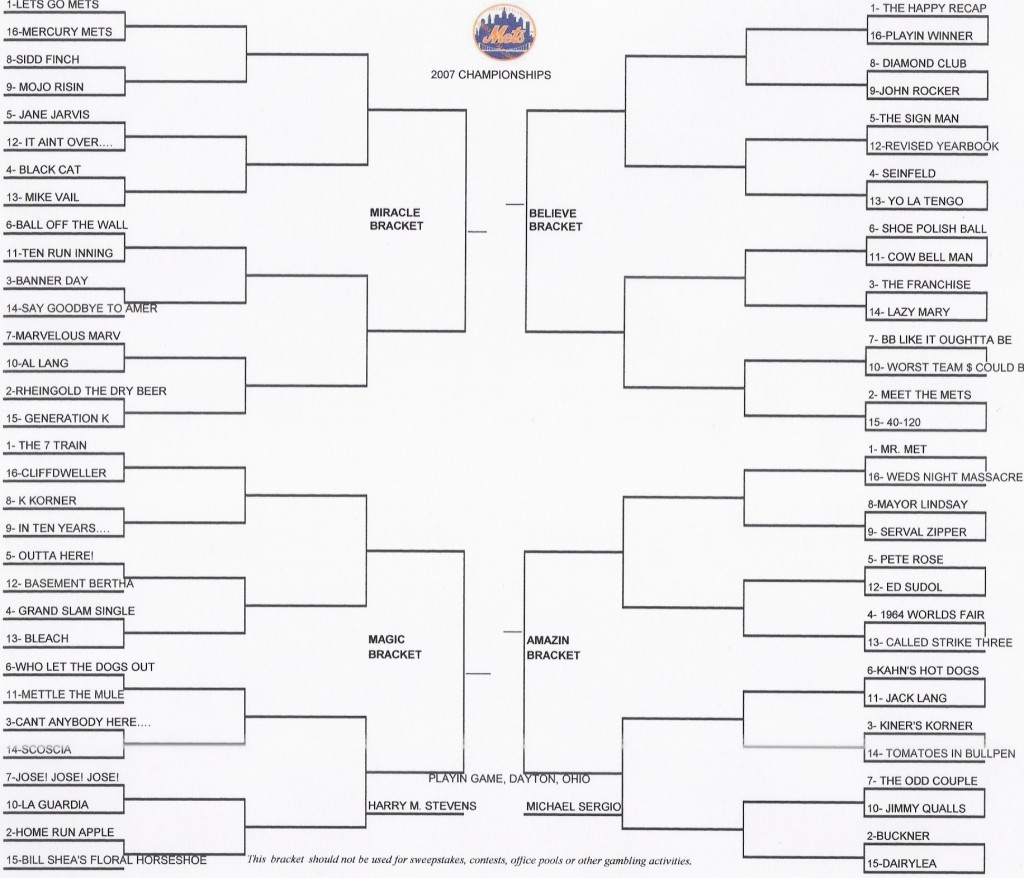
| Thanks to Ray of Metphistopheles, we have an actual bracket-by-bracket rundown of the field of 64 for this year’s March Metness tournament for your printing and prognosticating pleasure. He even went to the trouble of including the dreaded play-in game in Dayton, for which Michael Sergio has already built an insurmountable lead on Harry M. Stevens.
Be sure to get your brackets filled in before first-round action tips off Thursday. |
|
|
by Greg Prince on 11 March 2007 11:37 pm It’s always a controversial process and there’s always going to be somebody who’s dissatisfied, but the March Metness selection committee has made its picks and seeded the entries. Now it’s time to unveil the brackets that will play out over these next three weekends until we have a champion.
The goal, as always, is to see what emerges as the Quintessential Mets Thing. What will persevere through the field of 64 to stand alone as 2007’s icon of Metsiana? What phrase, what item, what word or words will, come the finals on April 2, stand alone as that most Metsian of Metsian totems?
Enough talk. You’ve got office pools to get in on and brackets to fill out.
THE MIRACLE REGIONAL
1 LET’S GO METS
__________________
16 MERCURY METS
8 SIDD FINCH
__________________
9 MOJO RISIN’
—
5 JANE JARVIS
__________________
12 IT AIN’T OVER ‘TIL IT’S OVER
4 BLACK CAT
__________________
13 MIKE VAIL
—
6 THE BALL OFF THE WALL
__________________
11 TEN-RUN INNING
3 BANNER DAY
__________________
14 SAY GOODBYE TO AMERICA
—
7 MARVELOUS MARV
__________________
10 AL LANG
2 RHEINGOLD THE DRY BEER
__________________
15 GENERATION K
THE MAGIC REGIONAL
1 THE 7 TRAIN
__________________
16 CLIFFDWELLER
8 K KORNER
__________________
9 IN TEN YEARS…
—
5 OUTTA HERE!
__________________
12 BASEMENT BERTHA
4 GRAND SLAM SINGLE
__________________
13 BLEACH
—
6 WHO LET THE DOGS OUT?
__________________
11 METTLE THE MULE
3 CAN’T ANYBODY HERE PLAY THIS GAME?
__________________
14 SCIOSCIA
—
7 JOSE! JOSE! JOSE! JOSE!
__________________
10 LaGUARDIA
2 HOME RUN APPLE
__________________
15 BILL SHEA’S FLORAL HORSESHOE
THE BELIEVE REGIONAL
1 THE HAPPY RECAP
__________________
16 MICHAEL SERGIO
8 THE DIAMOND CLUB
__________________
9 JOHN ROCKER
—
5 THE SIGN MAN
__________________
12 REVISED YEARBOOK
4 SEINFELD
__________________
13 YO LA TENGO
—
6 SHOE POLISH BALL
__________________
11 COW-BELL MAN
3 THE FRANCHISE
__________________
14 LAZY MARY
—
7 BASEBALL LIKE IT OUGHTA BE
__________________
10 THE WORST TEAM MONEY COULD BUY
2 MEET THE METS
__________________
15 40-120
THE AMAZIN’ REGIONAL
1 MR. MET
__________________
16 WEDNESDAY NIGHT MASSACRE
8 MAYOR LINDSAY
__________________
9 SERVAL ZIPPER
—
5 PETE ROSE
__________________
12 ED SUDOL
4 1964 WORLD’S FAIR
__________________
13 CALLED STRIKE THREE
—
6 KAHN’S HOT DOGS
__________________
11 JACK LANG
3 KINER’S KORNER
__________________
14 TOMATOES IN THE BULLPEN
—
7 THE ODD COUPLE
__________________
10 JIMMY QUALLS
2 BUCKNER
__________________
15 DAIRYLEA
by Greg Prince on 10 March 2007 10:34 pm It’s spring ahead, fall back tonight at 2 AM, so in honor of the clocks jerking forward three weeks earlier than necessary, I suppose it’s time to take Spring Training a little more seriously.
The Mets have just allowed their pretend record to dip to 3-8 with an irritating-sounding loss to the Nationals. It may have looked bad, too, but it was a WFAN-only affair (which, with Hockey Howie otherwise engaged in Uniondale, only made it sound worse). Once I get past the gee whiz, good golly, Donald Rumsfeld-type exclamations of awe that there is baseball being played somewhere, I’ve noticed that almost every game to date — eight of eleven, to be exact — has involved a shoddy display of Met defense, Met offense, Met fundamentals, Met relief and Met starting in roughly that order.
They don’t sound ready for spring or spring ahead or even Spring Training. Thankfully it matters not a whit in real time, but it gets late early around here, y’know?
Speaking of whom, what the fudge is up with Duaner Sanchez? Last year we discovered Duaner, Duaner discovered Queens and all was good with the world until Cecil Wiggins discovered his car keys. We enter these seasons taking several things for granted based on widely held assumptions. One of them was that Sanchez overcame the car wreck, the surgery, the winter and now he’d be ready for Opening Day. It appears very much that he won’t be. And that’s cool, because who the hell are we to tell a guy who’s been through that kind of trauma to get his body in gear exactly when we want it?
But Duaner, you can get to camp on time every morning. That’s big with managers and coaches. Even John Madden, the quintessential loosey-goosey head honcho who harbored the hijinks of John Matuszak and all those wacky Raiders, said he had but three rules:
• Be on time
• Pay attention
• Play like hell when I tell you to
The on-time part came first (which means I never would have made it with the Raiders; or the Randolphs). So wake up, Filthy. We need you eventually. And it’s your job.
As for everybody else, whatever percentage of life Woody Allen ascribed to showing up isn’t getting it done. Are we really going to war with the bench we have and not the bench we want? Jesus Alou, this is not encouraging. Castro is Castro. Fine. Franco’s a legacy. Whatever. Endy is awesome. No complaints. I don’t begrudge Easley or Newhan for that matter.
But we could use a guy who could hit one out now and then as a matter of course, not as a total surprise. Ruben Sierra probably won’t limp across the finish line, but he can pop. Ben Johnson has been mighty intriguing. Is there room? Do we have to carry 12 pitchers, thus making it untenable to have more than five role players, all of whom left the yard a grand total of 22 occasions last year?
Yeah, probably. We need to carry those seven relievers. But which seven?
Wagner and Heilman (you’re a reliever, learn to deal). Schoeneweis and Feliciano (yes, we have us some lefties). And? No Mota until at least June. No Sanchez until nobody knows. That leaves…
Ambiorix Burgos? I’d like to think so. The wolves will be out for his first mistake, no matter what cooler heads advise, yet he’s kind of my cause this spring. But those ninth-inning, Bo Diaz-style grand slams aren’t going to cut it (he pitched much better today…by the sound of it).
Joe Smith? Now there’s a baseball name for you. I get the sense, based on my two glimpses thus far, that he’s a novelty that will only go so far. But then again, I don’t wear a jacket all the time, so what could I possibly know about pitching?
Jason Vargas? We could use a long man.
Jorge Sosa? We could use a long man, but not him (he’s sort of the rule-proving exception for In Omar We Trust, at least until I’m presented compelling and overwhelming evidence to the contrary).
Alay Soler? Not after today. I could dig up the stats, but suffice it to say Tom McCarthy and Eddie Coleman weren’t impressed, and if you can’t impress Eddie Coleman, you’re coming up way short. (And if you want a terrific take on Mets broadcasters, take a gander at a terrific new blog, The Ballclub; gads, we so have to update our links.)
Jon Adkins? I’m too focused on Ben Johnson among the ex-Padres to have noticed much from him.
Chad Bradford? Crap. He’s not here anymore.
Some years this would be window dressing. This year it’s critical. Even with Maine and Perez in the rotation (I think they’re givens at this point), you know inning-eating is going to be at a premium among these five starters, whoever these five starters are. Almost nobody goes seven anymore. Hardly anybody goes six. Whether rookie Pelfrey or wily Park gets the fifth spot — it’s got to be one of those two, and in a chilly April, I wouldn’t mind it being Park — there will be work for the bullpen. It’s amazing how quickly a seven-man corps can deplete itself after a couple of quickie hooks.
My analytical skills are rusty. If any of this made sense, I’d be surprised as anyone. Either way, it doesn’t count. Clock ahead, clock back…it’s still spring. We may be 3-8, but we’re really still oh and oh.
Seriously, though. Duaner Sanchez, take your wakeup call.
by Greg Prince on 10 March 2007 12:21 am If Joan Hodges is stepping to the podium in Cooperstown this summer, it would be justice. At the very least, it’s Flashback Friday at Faith and Fear in Flushing.
Thank you Commissioner Selig, members of the board of the Hall of Fame, all of the Hall of Famers here today and all of you who made the trip upstate.
I can’t tell you how much this day means to me and would have meant to Gil. He never played or managed for individual accolades, but I know he would have deeply appreciated this honor.
It’s been 35 years since we lost Gil. Thirty-five years since that awful April afternoon in Florida in 1972. I was beginning to think he’d been forgotten. I’ve been reminded since his election, however, that I was wrong. And it’s not just because he was, at last, elected to this wonderful Hall of Fame.
I’ve been reminded over and over again by the fans and by the press and by a lot of people who love baseball that they’ve never forgotten my husband. Ever since the veterans committee took their special second vote last spring and elected Gil Hodges to the Hall, I can’t tell you how many Mets fans and Dodgers fans and just baseball fans have come up to me and said just the most lovely things about him.
I have to admit I’d been disappointed all those times Gil came close but never made it. Maybe I was so wrapped up in my disappointment that I hadn’t noticed that the love for Gil was always there, that it never dissipated, especially in New York where the memory of Gil remains so cherished. If I took a step back, I think I would have seen that no plaque, even one as meaningful as the one you’ve unveiled today, could affirm that feeling toward Gil as well as the love and respect Gil still brought out in people.
Then again, we always said “Wait ’til Next Year” in Brooklyn, and when next year arrived in 1955, I know we were a lot happier, so it does mean a great deal to me and our whole family that Gil has been acknowledged for all time here in Cooperstown.
Of course I wish he could be with us today. Tony and Cal, my husband never had a chance to see you play, but I think he would have loved the way you went about your business, bringing so much grace and dignity to baseball. He would have welcomed the chance to manage both of you or, if he were a little younger or you had been born a little earlier, played with you. That’s no knock on Pee Wee or Carl, you understand. Gil always loved his teammates.
Ron, Gil thought the world of you as a competitor, even in 1969 when you were clicking your heels in those heated games between the Mets and the Cubs. He’d be thrilled to be sharing this day with you, too, and would probably be surprised that you hadn’t been on this stage sooner.
You fellows who helped put Gil in with your votes were men Gil admired no end. Sandy, I’ll never forget Gil telling me about that great young lefty the Dodgers brought up and how if he ever got his control that he’d be something else. I think he was right. Willie, Gil never got tired of watching you play, even if your being on the Giants didn’t make our lives any easier back in Brooklyn. And Frank, I think Gil would be very proud that you helped bring baseball back to Washington these last few years. Not too many people remember that the Senators were Gil’s first managing job. It would have made him smile to know that such a great player and competitor had inherited his old job.
Tom, Gil always knew you’d be here one day. I’ll never forget the beautiful speech you made when you were inducted and how you singled out Gil as such a big influence on your career. I’ll also always appreciate all the wonderful things you said when you were broadcasting Mets games, helping to keep his memory alive. To you and the Wilpons and the entire Met family, I want to thank you for never forgetting Gil. You held a night in his memory, you voted him the team’s all-time manager and you’ve been nothing but royal in your treatment of me. I can’t express nearly enough my appreciation for all the warmth you’ve bestowed on us. He’d be so pleased to see the Mets doing as well as they are again, to watch Willie Randolph, a kid from Brooklyn who grew up rooting for the Mets when Gil was the manager, succeeding him so beautifully. And I don’t think he’d mind one bit the new ballpark going up in Queens, particularly the beautiful tribute to Jackie Robinson.
Gil Hodges was, as a biographer once put it, the quiet man. Not all the time, though. He made plenty of noise with his bat. The 370 home runs Gil hit were the tenth-most ever at the time he retired. Plus he drove in a hundred runs or more seven different times. Gil may have preferred it quiet, but the ’69 Mets certainly celebrated loudly enough to break some of their manager’s rules when they won the World Series and, if I recall correctly, he didn’t issue a single fine.
But it’s true that he was a quiet man. He kept a lot to himself. It was just his way. Yet I know if he were here today that Gil wouldn’t be nearly as quiet as we remember him, at least not up here on this stage. He’d smile that warm smile of his and say a great big thank you to everybody who helped enshrine him in Cooperstown.
On his behalf, allow me to do it. Thank you so very, very much.
Next Friday: Lucky bounce.
by Jason Fry on 9 March 2007 5:53 am Last night, after Varsity Letters, a few of us blogger types were sitting around drinking beer and talking baseball, and the conversation came around to baseball names. And the one that I found myself groping for was Stubby Clapp — not for anything fabulous he did (5 for 25 as a 2001 St. Louis Cardinal), but for having the greatest baseball name in at least a generation.
I remember Stubby Clapp (you have to say or type his entire name every time, just because you can) coming to bat at Shea and hearing the rather strange sound of half a stadium laughing. Not in derision, but in appreciation. You knew before you even looked that Stubby Clapp would be squat and not hugely talented but full of grit and fire, that he was one of those guys they'd have to tear the uniform off of, that 20 years from now he'd be a roving instructor or coaching first base in the Appy League. Stubby Clapp sounds like a guy who would have raised hell in a roadster barnstorming with Ty Cobb and Rabbit Maranville, or maybe won a batting title in Altoona before the war interrupted his career. After Class D ball and Dubya Dubya Two I did a stint in the merchant marine, kid, running cargoes from Java to Peking. Lemme tell ya, them port girls were wild, but they'd kill ya soon as look at ya. Woke up once in this flophouse in Formosa with this tattoo…don't tell the missus, but those were some times. Stubby Clapp. He'd have gnarled fingers and hate doctors and refuse to wear reading glasses and wait up all night for his grown children to arrive safe for Christmas but never tell them he loved them. (It's OK. They'd know.) Stubby Clapp. Close your eyes and you can see him clear as day, can't you? (He's actually Canadian, which is just so…disappointing. I say we all pretend he isn't.)
Baseball has always been a wonderful source of names, from American classics (Smokey Burgess) to primally minimalist (Ty Cobb) to gleefully silly (Hank “Bow Wow” Arft) to evocatively mysterious (Greg's recently mentioned Van Lingle Mungo) to not-so-evocatively mysterious (Sibby Sisti). As relatively recent arrivals, the Mets have missed out on some of the fun — sportswriters had abandoned much of the purple-prosed mythmaking that bred great nicknames by 1962. But there's still plenty to love in four and a half decades of Met names.
With some exceptions (Stubby Clapp), names inevitably pick up characteristics from the players who bore them. The pleasure of Nolan Ryan's name comes from its deceptive mildness, but take away 5,600 strikeouts and it would just be mild. Gary Carter and David Wright's gee-whiz, can-do spirits are perfectly reflected in their utterly ordinary names. Ron Darling's name sounds smart and a bit fancy, but has a certain “Boy Named Sue” quality that a fiery competitor could build upon — a not-bad description of Ron Darling. Edgardo Alfonzo's name is at once faintly exotic (at least to whitebread Americans), sensibly balanced and musical without being showy about it — which sure sounds like Fonzie to me. In hindsight, the name Gregg Jefferies is self-absorbed and too complicated (you can easily misspell both ends). That's a match.
A good name needs balance — it's the double repeated consonants that make Todd Pratt, Eddie Murray and Bobby Bonilla good baseball names. (Not to mention Stubby Clapp.) But too much balance and a name feels fussy. To switch to that other team in town, the repeated M makes Mickey Mantle a good baseball name, but it's the way the vowels and sounds keep changing that makes it a great one. Leaving aside his vaguely girly first name (which isn't his fault), Derek Jeter isn't a great baseball name for all kinds of reasons — it only has one vowel, that one vowel appears twice in each name in the same exact places, and the first and last name have the same number of letters and sound the same. It's the baseball-name equivalent of a matchy-matchy outfit.
Baseball names rely on nicknames — Danny Staub, Clarence Coleman and Steve Wendell are all crummy baseball names. (As is Richard Clapp.) Baseball names sometimes need middle names to pinch-hit, as Lynn Ryan, George Seaver and Cornelius Floyd could tell you. And then they need a certain, hard-to-pin down something — a certain quality that makes you want to tuck your chin and try for the timbre of a PA announcer. “Now batting….” I envy my co-blogger's perfectly respectable baseball name; I knew I was doomed as a big-league player because there was no way my name would ever sound cool echoing around a stadium. (Well, that and hitting .080 as a Little Leaguer.)
Without further ado, eight classifications of great baseball names (and interesting failures), as typified by New York Mets….
AMERICORN: These are those names that just sound like baseball names. Nicknames help, though they're not everything. Choo Choo Coleman and Vinegar Bend Mizell are obviously names thought up by wise old syndicate writers of 50s serials. Tug McGraw, Rico Brogna, Henry Owens and Mo Vaughn should have razzed each other from Omaha Beach to Berlin, smoking and shooting Germans and balling French girls along the way. Their names ensured Duffy Dyer and Mackey Sasser would be backup catchers the day they were born. You know immediately Turk Wendell is a character. And Buzz Capra gets not only a no-BS nickname (real name=Lee), but also the last name of the director who personifies Americorn.
FUSSY: These sounds like baseball names, but they're a bit complicated, with a whiff of the manor. And as such, they present the bearer with a stark choice: succeed or come in for an extra heaping of scorn. Marv Throneberry is a fussy name redeemed by that plain-as-mud first name. Darryl Strawberry is a fussy name redeemed by towering home runs. (And a well-chosen repeat consonant — Daryl Strawberry doesn't work.) Because Brock Pemberton didn't hit, he sounds like a product of inbreeding and English public schools. Skip Lockwood (real name=Claude) sounds like a guy wearing glasses, which he was. Joel Youngblood's usefulness didn't redeem his comic-book-hero name. The convoluted last names of Jason Isringhausen and Bill Pulsipher, in retrospect, spelled trouble. If Lastings Milledge hits .300, his name will be complicated and interesting. If he hits .240, it'll be vain and showy.
DIFFERENCES: OK, this isn't really a category, but it's worth noting that baseball names walk a knife edge between success and utter failure. Gerald Wayne Grote chose wisely in choosing a J instead of a G: Jerry Grote looks satisfyingly plain and direct, while Gerry Grote is effete. Tommie Agee has a grace and glide that Tommy Agee could never aspire to. The simplest subtraction turns run-of-the-mill Mike Hampton into pretty-cool Ike Hampton. Bobby Valentine is a bit too blandly all-American, but Ellis Valentine sounds slightly off and therefore interesting. Elliott Maddox has four vowels, triple repeated consonants and a final X. Very cool. Kelly Stinnett has triple repeated consonants, but weak vowels and a girly first name. Not so cool.
FUN TO SAY: Ron Swoboda's name just begs to be mispronounced Suh-boda. (On the other hand, you fear to mispronounce Philip Humber, and then fret that you added an extra L.) Carlos Delgado arcs off the tongue like a long double headed for the gap. Bartholome Fortunato is a name to be savored. Marco Scutaro's last name sounds like something an agitated third-base coach should yell.
NO-FRILLS KILLERS: These are my favorite baseball names — simple, short, and blunt to the point of brutishness. Names that'll get up out of the dirt after you put one under the chin, then crack a clean single to left. Ron Hunt. Cleon Jones. Amos Otis. Rusty Staub. Hank Webb. Cliff Floyd.
WONDERFUL: Donn Clendenon sounds like rolling drums. Felix Millan sounds brisk and athletic and flashy. Dave Kingman had to be a slugger. Lenny Randle sounds sneaky and speedy and vaguely illicit. Clint Hurdle's name alone should have been worth 200 home runs. You knew Butch Huskey was at least a XXL before he arrived. A great name is no guarantee of anything, as Royce Ring (real name=Roger) could tell you. But it sure doesn't hurt.
WHA?: There really is a Yogi Berra. Nolan Ryan. Bob Apodaca. (Imagine if he'd had a complicated first name. Ambiorix Apodaca? Now that would be something.) Mac Scarce sounds like an invisible private eye, but he existed. (Real name=Guerrant McCurdy Scarce. The nickname was a good choice.) Del Unser. Brent Gaff. Wally Whitehurst. Esix Snead, who sounds more like a Star Wars alien. Xavier Nady. Braden Looper, the closer with the least-threatening name ever.
And yes, someone really did name a child Orel Hershiser.
|
|






