The blog for Mets fans
who like to read
ABOUT US

Faith and Fear in Flushing made its debut on Feb. 16, 2005, the brainchild of two longtime friends and lifelong Met fans.
Greg Prince discovered the Mets when he was 6, during the magical summer of 1969. He is a Long Island-based writer, editor and communications consultant. Contact him here.
Jason Fry is a Brooklyn writer whose first memories include his mom leaping up and down cheering for Rusty Staub. Check out his other writing here.
Got something to say? Leave a comment, or email us at faithandfear@gmail.com. (Sorry, but we have no interest in ads, sponsored content or guest posts.)
Need our RSS feed? It's here.
Visit our Facebook page, or drop by the personal pages for Greg and Jason.
Or follow us on Twitter: Here's Greg, and here's Jason.
|
by Greg Prince on 23 March 2007 11:25 pm If we’ve been waiting all winter yet have to wait a little longer, then Opening Day must be rushing close on the heels of Flashback Friday at Faith and Fear in Flushing.
Life, despite what Thomas Boswell says, does not begin on Opening Day. But it does peak then.
Is there any day better than Opening Day? Like what? Your birthday? On your birthday, you just get older. On Opening Day, we all get younger.
Opening Day is better than Christmas and Chanukah and Kwanzaa all rolled into one. Whatever their merits, they each occur in December, when it’s nasty outside. Opening Day might carry the chill of late winter, but it’s really early spring — the glass is at least 75% full on Opening Day.
You like getting gifts? How about the gift of baseball, presented in 162 pinkynail-sized boxes on your pocket schedule? And the first box you open is always the best. It has to be. There’s nothing to which you can compare it. You’ve been 0-0 since October. You get to start filling up those columns with W’s and L’s after six months of Z’s. Happy new year!
Several years ago, a friend of Stephanie’s sent her one of those pointless Internet surveys. She forwarded it to me. The only question I answered with any conviction was, “What’s your favorite holiday?” Without irony, I replied, “Opening Day.”
Opening Day is my holiday. Opening Day is an Upper-Case occasion for celebration. For baseball fans, it is our day of jubilee. Life may not begin on Opening Day, but it does leap from mundane to magnificent. And for that I am thankful.
Opening Day is good any way you can get it, and if you have to get it on TV or radio or Internet or smoke signal, well, get it there. But it’s not a fully realized sensation unless you attend its ceremonies, partake in its rituals, surround yourself with its affirmation. I’m not in the habit of telling anybody “ya gotta” do anything. But to observe Opening Day, ya gotta go.
I realize saying so does not make it a done deal. Admission for these sacred rites is, as a rule, hard to come by. We’ve been subject to an avalanche of ticket-package come-ons and vague lottery promises and demand always outstrips supply. But you’ve got months to strategize if you’re bound and determined. What is there to do in December and January except, as Rogers Hornsby suggested, stare out the window and wait for spring? Rogers Hornsby would figure out a way to get to Opening Day, and he’s been dead for more than 40 years.
It has been my great fortune to attend Opening Day services eight times since 1993. Four of those were true season openers, the rest Home Openers, but the spirituality is the same. Just because the Mets played two games in Japan or three in Florida or four in Canada doesn’t make the first appearance on Shea soil any less sacred.
My most recent true Opener was the very first game of the 2002 season, five years ago next week. It was April 1, just like this season’s starter in St. Louis will be. It was a win, 6-2 over the Pirates. Of course it was a win. It was Opening Day. We’re not supposed to lose on Opening Day. I myself am 8-0, forever skewing my expectations. (Somebody get me a ticket for this Opening Day if you want 2007 to get off on the right foot.)
Entwined with the score was the inherent optimism — this was the sun-drenched Opener of Alomar and Vaughn, Cedeño and Burnitz, the year of the big comeback from the letdown of 2001. There’d be plenty more of these, 53,734 of us assured each other. It didn’t turn out to be so, but on Opening Day, who knew? A 1.000 in the Pct. column looks good no matter that it foreshadows nothing.
I came into six tickets that year through the graces of a friend with connections. Immediately surrounded myself with all my favorite Mets people from the earliest part of the century: Jason, Rob, Laurie and Richie, who came with his son, also named Richie. (This business needed an actual hooky-player, I decided.) I’m a big man when I’ve got six tickets on Opening Day. I live to spread the wealth.
Everybody was pumped. Rob met me at home and we took the train in together. We met Jason and the Richies at the gate. Laurie, who worked in the same place as me, already had her ticket and met us at the seats in the right field boxes. She proposed a pre-game toast to the Diamondbacks, who brought all of us so much joy the previous November. We were giddy.
My cell phone, which usually lay quiet in my bag, blew up. That’s hip-hop for rang a lot. I had put the word out that I would be going to Opening Day; if you’re going, give me a call, we’ll hook up. A couple of guys called. They were in the stadium somewhere or on their way. Yes, Shea Stadium was the center of the universe…even more than usual.
Like I said, the game was a success on field and off. The best line belonged to Richie the Elder. On a grounder to first in the ninth, Mo Vaughn went after the ball and Armando Benitez covered the bag. “Geez,” Richie said. “I think the whole stadium is tilting toward us.” Ha!
The great part about Opening Day is that it is a whole day. The excitement swells in the small hours’ sleeplessness, crests as one grabs one’s LIRR schedules and Walkman and water bottle (how did my father go places without a bag?) and then, of course, the game. The yearbook, the media guide, the first program. I get weighed down. The first pretzel or chicken sandwich or, if I’m gastronomically daring, hot dog. The first win. And the first happy recap and enthusiastic exit of the year.
And then? Then, the thrill continues. On the train back to Long Island, Rob and I stick out among the work-weary. We went to the game. We went to Opening Day. The day is still in progress, ours a lot better than that of everybody who wasn’t there. Somebody at Jamaica asks who won. Somebody at Jamaica always asks who won on Opening Day. This is no obscure affair in August against the Expos (it’s 2002, there are still Expos). Everybody knows this is Opening Day. The Mets won, I volunteer to anybody who even looks curious, 6-2.
I say bye to Rob at my place and the day continues. Stephanie is home and I fill her in on all the fun, on Richie’s stadium-shifting remark, on Laurie’s Diamondbacks toast, how exciting it was to see all the new players and old pals. I pass along my publications for inspection.
But it’s still not over! We go to dinner at the East Bay Diner. I’m wearing my Mets sweatshirt and my Mets jacket. People can figure out where I’ve been. I’ve been doing something important. Important to me, noteworthy to them. Then, because this is a Monday and we didn’t do it Sunday, we go grocery shopping. In the Waldbaum’s lot, we run into Officer Tom, a Nassau County cop with whom I went to high school and ran into at our reunion the previous summer. He’s one of the Yankees fans who stuck it to me but good back in the day. But now, like Rupert Pupkin’s fantasy in The King of Comedy,
I’m getting even everywhere. That’s right, Tom, I was at the game today. The Mets won. Get used to it. Go arrest somebody.
We do our shopping and then we land on Sydra, our favorite cashier, the only cashier who asks after us, asks if we found everything we were looking for (we realize in later years that this is kind of robotic-friendly, but at the time, it’s refreshing). I’ve worn enough apparel to Waldbaum’s so she remembers my allegiances, reinforced tonight. “Today was Opening Day, wasn’t it? Did you go to the game?” she asks. Did I go to the game? Why yes I did! Let me tell you about it.
It’s one more chance to extend Opening Day. I never want it to end.
Next Friday: Not quite a quarter-century since the No. 8 song of all-time came along.
by Greg Prince on 23 March 2007 8:20 am No losers reach the Rick Sweet 16. You get this far in March Metness, you can stake a serious claim to being a quintessential element of the overall Mets experience. While there are no losers, only half of the entries in any given matchup will get to walk away a winner.
Here’s how that inevitable winnowing process unfolded Thursday night.
MIRACLE REGION SEMIFINALS
Let’s Go Mets (1) vs Jane Jarvis (5)
Ms. Jarvis gets this party started by tickling the Thomas Organ as she did so expertly at Shea Stadium from 1964 to 1979. Whether it’s a simple “CHARGE!” or a trademark rendition of “Meet The Mets,” the crowd is suitably moved. Moved? How about revved? Shea has heard the Beatles, the Stones, Grand Funk and Bruce Springsteen, but no live musical act has ever owned the old ballpark like its organist of record. There’s been more to this accomplished pianist’s career than the Shea gig — she recorded several well-received jazz albums and helped run the Muzak company. As recently as 2006, having passed 90, she was playing dates in Manhattan. Recorded music has been the rule since Frank Cashen imported it from Baltimore in 1980, but Jane Jarvis will forever remain a singular name recalled for producing a singular sound as long as Shea Stadium is remembered. If anybody could give Let’s Go Mets an aural run for its money, it’s her. She did, but Let’s Go Mets is a 1-seed for a reason. Truth be told, the Shea crowd doesn’t need much revving beyond the promise of the next pitch. Jane plays her best — she always has — but Let’s Go Mets takes another round.
Banner Day (3) vs Rheingold The Dry Beer (2)
Miracle proved a musical region because you simply cannot think of Rheingold The Dry Beer without wanting to break out into jingle. That’s RTDB’s not-so-secret weapon in taking on one of the great Met traditions. My beer is Rheingold the dry beer/Think of Rheingold whenever you buy beer/It’s refreshing not sweet/It’s the extra treat/Won’t you try extra dry Rheingold beer? If you grew up hearing those commercials, you can’t forget the melody or the lyrics. If you didn’t, you wish you had. Rheingold wasn’t just a beer either. It was the sponsor of Mets baseball, the one with approval on who would announce the games. If a man named Norm Varney, account executive from J. Walter Thompson, had balked, there might have been no Murph, no Ralph, no Lindsey. Fortunately, Varney — and George Weiss — had good taste, at least as good as Rheingold’s. “To Err Is Human, To Forgive, A Mets Fan” went one famous fan-drawn banner. It left out the thought that to beer is divine. Banner Day made for some great parades. Rheingold provided an even better backbeat. The Dry Beer douses Banner Day’s championship dream and proceeds to the Larry Elliot Eight against Let’s Go Mets, a classic 1-vs-2 matchup.
MAGIC REGION SEMIFINALS
The 7 Train (1) vs Outta Here! (5)
The 7 Train will eventually get you to Shea Stadium, but it’s been known to slow down at most inopportune stations. If you and it were running late in tandem between 1989 and 2005, you could depend on the voice of Gary Cohen to whisk you to the Willets Point stop in your ear if not in person. As long as you stood near a window, you had as good a seat as whatever the ticket burning a hole in your wallet entitled you to…eventually. Listening to Gary Cohen on whatever radio you had handy was one of the privileges of being a Mets fan during his 18-year stint on WFAN, whether he was calling home runs Outta Here! or merely reading the lineups at Junction Boulevard. Gary’s won greater exposure on television, as fans who would never think to bother with something as hopelessly retro as a radio have discovered him. But for those who relied on him in a pinch, it just isn’t the same. As the 7 Train gets in gear and begins to rumble toward 103rd Street, we listen for Gary. And he just isn’t there. Alas, neither is Outta Here! in this tournament. The 7 Train grinds, squeaks, sputters but, in the end, rolls on.
Can’t Anybody Here Play This Game? (3) vs Jose! Jose! Jose! Jose! (7)
Talk about old school against new school. Can’t Anybody Here Play This Game encompasses everything about this beloved team’s beloved roots: Casey, Marv, Whitey Ashburn, Hot Rod Kanehl, Roger Craig, the Polo Grounds — the whole tragicomic bit. Jimmy Breslin’s volume describing their downs and further downs is as physically thin as the portfolio of 1962 Met wins but as rich as any baseball book for sheer color. And it’s been said you can’t be too rich or too thin. Just ask Jose Reyes. He’s lithe, he’s well-compensated and he’s writing a new chapter for another generation of fans. They love him every bit as much as the gang from Gilmore’s Tavern in Breslin’s book loved his shortstop predecessor Elio Chacon. (We used to think Pee Wee Reese was pretty good. That was until Elio Chacon came along.) There’s not much irony to the loyalty Jose inspires, just joy. “The New York Mets are in existence,” Breslin wrote, “for a simple reason: New York City needed them.” New York needed Reyes in its own way when he came into our lives in 2003. By 2006, the need had grown in intensity. The legend of the ’62 Mets will not diminish (an odd thing to say about a 40-win unjuggernaut). Yet the legend of Jose! Jose! Jose! Jose! is poised to only grow. Thus, new tops old in an upset. It will be the 7 Train versus the 7-seed on Saturday.
The Believe and Amazin’ regional semis get underway Friday night.
by Greg Prince on 22 March 2007 6:07 pm 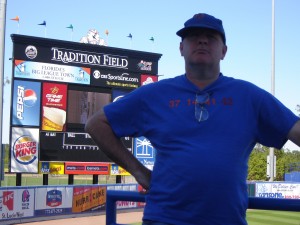
| If it’s spring, it must be time to break out the Faith and Fear t-shirts. Not quite warm enough up here to go coat-commando, but perfectly appropriate for our own NostraDennis, taking time out from touring Tradition Field long enough to show his true numbers and colors, just as he did ‘neath the Big Chicken on the outskirts of the home of the former defending National League East champions in November. That’s two states down, 48 and Washington, D.C., to go for the man who will, should he get to a National home game, log in here as NostraDistrict.
ND’s decision to take in Spring Training was a win-win. Read all about it at Mike’s Mets. |
|
|
by Greg Prince on 22 March 2007 5:48 pm I developed a newspaper habit when I was 6, right in sync with the other habit we begin feeding in earnest 8:05 a week from Sunday night. I know I can read much of the content from the same machine where I type, but I love the actual sensation of buying and opening a newspaper. I love sorting through the Sunday papers, going right to the sports, finding all the columnists who I can’t stand and the few I can. I don’t even mind the ink on the hands. It’s a smudge of honor.
A new book is a gift. So is an old book. I almost never open a book and read it from page one to page last. I skip around, sometimes for weeks, before I settle in. Skipping around is the highest compliment I can give a book. It means the author has sent me into flights of contemplation and silent debate. There are three recent releases that should be not skipped by Mets fans in the broader sense, and I keep meaning to recommend them. Recommending a book is another thing I love to do, so I urge you to look into these three and, if so intrigued (you will be), purchase them:
• The 100 Greatest Days in New York Sports by Stuart Miller is a touchstone reference work for anybody who grew up in this area rooting for the Mets or other teams that have called one or more of the five boroughs home. You will get lost in the history of the city’s magnificent sporting tradition every bit as much as you’ll wonder how Mookie-Buckner only rated 11th place (or Bobby Thomson a mere 6th). You’ll also discover yourself overwhelmed by the research, thoughtfulness and scholarship Miller put into creating something so definitive. My Long Island upbringing forces me to quibble with the decision to shunt the feats of the ’86 Giants, the Islander dynasty, the ABA Nets and even Secretariat into “The ‘Burbs,” as if they are unworthy of association with “New York,” but the author remains true to his standards and I admire that. I admire everything about this book. So will you.
• The Best New York Sports Arguments by Peter Handrinos is a lighthearted yet mature and detailed examination of a hundred questions we’ve all probably thought about at any given moment watching games in these parts. What I love about this extraordinarily logical book is it takes every issue seriously because we as sports fans do. Handrinos doesn’t level cheap shots or seek easy ways out and is marvelously even-handed. There’s plenty of Mets in here, but it’s not necessarily pro-Met or anti-Met (or pro- or anti-anybody). It’s in favor of free thinking. That’s always appreciated by the sports fan who loves to read.
• Mets Essential by Matthew Silverman lives up to its title and then some. Silverman is no dispassionate factory-approved, all-purpose author (in other words, put your Golenbock fear away), but, at the same time, this is no hagiography. This is an informed and experienced Mets fan who writes an honest history of his and our favorite team. He pilots us on a breezy flyover of everything that’s happened to this franchise since the Giants and Dodgers made that bizarre decision to abandon the nation’s largest market. If you look out the window to your left, there’s Casey Stengel…You can see on your right Gil Hodges…We are now approaching 1973… So the journey winds, stopping along the route at every year, the uplifting and the dreadful, right through the high, puffy, cumulus clouds of 2006. Silverman doesn’t use the first-person plural, but you can feel the “we” all over this thing and that feels very good indeed.
Each of the above will make, to borrow one of the most brilliant handles in all of blogdom, a beautiful addition to your baseball library.
Oh yes. Blogs. They’ve been a most beautiful addition to my baseball library, the one up here (I’m pointing to my head), since I became aware of them the moment I began writing one. I no longer remember how I followed baseball without them. I hope more fans who haven’t ever clicked beyond espn.com or mlb.com get curious and find the lot of us. If they care about baseball, they won’t be able to put us down.
The point of this virtual media tour is to get me to magazines. I love magazines. I don’t know that I love magazines more than newspapers, books or blogs, but I feel a jolt of excitement every time I come across one I want to read.
I shop for magazines like Carrie Bradshaw shops for shoes. They pick me up whenever I’m down. I have more than I need but I can always use more. They’re piled up all over the house. Some I read on special occasions, others anytime.
Having worked off and mostly on as a writer and editor for magazines, almost none of which you’d recognize unless you’re an aficionado of the likes of Truckstop World (in which case, ten-four good buddies), for the past quarter-century probably informs my love of them, too. I can look at them and discern what they were thinking when they put that box there or this sentence here. But my professional interest in magazines doesn’t nearly account in full for why they give me such a big kick.
Newspapers come out daily. Books come out when they come out. Blogs are constant. And magazines? Their individuality is their beauty. Weekly, biweekly, monthly, bimonthly, quarterly, annually. If you’re a schedule-hugger, magazines, as a rule, don’t fit easily. But I’ve never been much on schedules that don’t come with little orange and white squares.
Also, magazines are shiny. Those to which I don’t already subscribe (I have internal rules about that, too) beckon to me from the newsstand. One of the things I miss about commuting in and out of Penn Station — the only thing, actually — is that I could always find new magazines the day they were released. Out here in my stretch of Stuart Miller’s suburban sports wasteland, there are no newsstands to speak of. Very small selections locally. I find most of what I’m looking for by accident in the CVS or supermarket. The magazines are the same magazines as they are in the city, but tossing them in a shopping cart alongside the bagged salad and fabric softener dulls the sensation.
Glossiness is an attraction but content is truly king. I’ll buy almost any magazine I’ve never heard of if the cover lures me to pluck it off the rack and the TOC (sorry…table of contents) has the headline or blurb to get me to turn to Page 109 or wherever. If there are two stories I want, that’s it, I’m buying it. I might look at the price, but I usually don’t. It’s $3.50 or $4.95 or $6.99 well spent, I figure. Look at all the writing this thing has! And it’s mine! I’ll probably discard it after thoroughly depleting the information I came for, but I might love it so much that I’ll keep it forever.
I mean forever. I have magazines I bought when I was 13. Yes, they’re baseball magazines, but they don’t have to be. But it always helps if a non-baseball, non-sports magazine finds a reason to discuss baseball…and discuss the Mets.
For example, even though I’m not particularly manly or all that healthy, I’ve been keeping an eye out for the April issue of Men’s Health because David Wright is on the cover. I’ve already looked at the online version of the article and I’m pretty sure I won’t be all that interested in what David has to say about applying his “4-day-a-week practice formula” to my own non-baseball endeavors, but that’s not the point. The point is a fairly major magazine has put a Met on the cover.
A Met making the cover’s a plum, but it’s not a must to make me pony up. I bought GQ twice last fall because of the Met content inside despite there being none on the outside. One was the ill-conceived David & Jose fashion show, the less recalled the better (though “Newcomers of the Year” was a pretty flattering appellation); the other was a sports-themed issue which included a gallery of athletic legends. One of them was Willie Mays. That was all I needed to see to plunk down my George Washingtons. What made it even better was this latter-day description of the Say Hey Kid’s prime:
Nobody’s as complete on the field; there’s no point of reference. The closest thing would be this: a big-league freak with Ichiro’s average, Torii Hunter’s glove, Vlad Guerrero’s arm, Albert Pujols’s power and Jose Reyes’s speed.
Did you see that? Jose Reyes is big enough to be a reference point in a definitely major magazine! Jose Reyes’s speed is state-of-the-art! You need to mention speed to someone? That’s something Jose Reyes has! Say nothing of the gratifying fact that he has been compared, even if it’s just in one facet of the game, to WILLIE MAYS. You know I’m keeping that page forever.
I hadn’t read Esquire in quite some time when I was alerted through various sources that there were two reasons to take a look at the April issue. I stumbled across it the other night at King Kullen (sigh) and was immediately lifted. Two Met mentions in a magazine that needs no introduction — an honest-to-goodness, long-established, quasi-general-interest, literate monthly magazine. The Mets are that big now.
One was a baseball article, a feature on Barry Zito. Zito’s gigantic contract is that big now, too. Zito stayed professional in his description of meeting the Mets — “I’ll just say that the Giants meeting was more positive” — but the writer, Chris Jones, inferred an allusion to San Francisco management lacking “a lot of ego” was really a shot at Jeff Wilpon. Don’t know if that’s so, but Zito’s quote that “you don’t want to go into a situation feeling like you’re having to prove to them how good you are” was a little revealing.
At the Mets offered rate of $75 mil over five years, you should feel you’ve been viewed as pretty worthwhile by your suitor (at the final number of $126 mil over seven, your left arm should be deposited in the Cayman Islands until absolutely needed). Zito said he was curious about playing in New York, but not $51 million curious. At that kind of price differential, curiosity is entitled to dwindle, but still, when somebody starts negotiations at $15 million a year, I find it hard to believe you’d say anything but “they were very nice to me”.
Either way, the best part of the Mets section of the Zito article was learning it was “interrupted at one point by Tom Hanks and Ron Howard, just saying hello”. Don’t know if they were greeting Jeff and Omar or Zito and Scott Boras, but those guys did come out to see us in Cincinnati last summer. Funny how they weren’t unnerved by the presence of Metness.
And if you like movie stars who pay homage to the Mets, this issue of Esquire hits it out of the park with its cover story on Hilary Swank. I knew who she was and that she’d won a couple of Oscars but I had formed no definitive Hilary Swank opinion until I picked up the magazine. Her pictorial has it all over that Wright & Reyes spread by any objective and slinky standard, but I actually do read magazines for the articles, so here’s what makes Mike Sager’s article blue and orange gold:
As Chris [her hairstylist] works, Swank will simultaneously try to give an interview, telling a story about her reaction to Mets outfielder Carlos Beltran’s now infamous strikeout to decide the National League Championship, which she attended in person and which she will talk about for nearly seven minutes, a rather incisive discourse by a rabid fan (forgetting for a moment the fact that she calls them points instead of runs) on matters of fame and talent and opportunities lost, on the value of the long run and the big picture, meanwhile carefully keeping close the ranks of celebrity, never once even suggesting that the great man might have choked.
Ohimigosh, Hilary Swank uses the Mets as a metaphor for practically everything. Now that’s my idea of a $126-million baby.
Ironically, I was planning to mention most of this stuff even before the words “Faith,” “Fear,” “In” and “Flushing” appeared strung together in Sports Illustrated this week. SI‘s decision to include us in a “best Mets info” poll with our friends and blolleagues at Mike’s Mets, MetsGeek and MetsBlog (Matt’s minions are running away with this thing, but vote anyway, just as you would have or possibly did for John Milner over Steve Garvey) and to “feature” each of our sites on their Mets page this season was enough of a thrill to kind of get me really going about how much I love magazines.
Who knows? Maybe someday some magazine dude will be excited about scoring a mention in a blog.
by Jason Fry on 21 March 2007 10:32 pm Last night I got some welcome signs of spring.
First off, it was my fantasy-baseball draft — this will be the third season I've played since getting sucked back into the fantasy-sports black hole. I spent 2005 staring at the computer like a cargo cultist, amazed at the fact that there were players and stats behind the glass. Pathetic, but grade me on the curve: Last time I played fantasy baseball, there was still a Soviet Union. I was commissioner and had to put the stats together by hand using USA Today, then mail them to my college pals. By attaching them to the wings of pterodactyls. (Oh, and I was 20 and I wasted a night a week while living for the summer in New Orleans. I hate myself.)
Last year I actually came in third, largely by betting on Ryan Howard and Justin Verlander. Though my real contribution to my fantasy-baseball league was insisting I was taking David Wright with the #2 pick in the draft, then actually doing it. That helped me formulate my commandmants for playing fantasy baseball without losing your soul:
1. Go With Your Heart. I wanted Wright, I got Wright. Santana? A-Rod? Pujols? Ppppt. Watching David Wright play baseball made me happy all year. Having my favorite player on my fantasy team was better than all those Ryan Howard dingers.
2. Don't Be Too Much of a Moron. This is a corrective measure to #1. I don't remember whom my next pick after Wright was, but it wasn't some middling Met. Sure, I opted for Mets I liked over roughly equivalent players — and utterly disdained Mets I didn't like over their rough equivalents. But being a fan doesn't mean you take Shawn Green over Vernon Wells.
3. He Who Rides With Yankees Rides With Satan. In fact, I excluded every one of them from my Auto-Draft. Now, I didn't use the Auto-Draft, but that's not the point. I was making a statement of principle. Along those lines, this year I also used the Auto-Draft to symbolically excommunicate the Jones boys, Roger Clemens, Victor Zambrano, Braden Looper, Armando Benitez, Kaz Matsui, Kenny Lofton and Brett Myers. The only Yankee who's ever been a member of Jaison D'Etres (I know, sorry) was Chien-Ming Wang, and I'm still apologizing to Emily for that one.
4. No Having It Both Ways. If the Mets are facing “my” pitcher, you will never hear me spinning have-my-cake-and-eat-it-too scenarios like “I hope he pitches a one-hitter with no walks but a reliever gets beaten 1-0 in the ninth.” That's deplorable behavior. Same goes for being upset because “my” Met was in the on-deck circle when the winning RBI came. Eyes on the prize: If the Mets trash “my” closer for a crooked number and win, it's a good day.
5. Don't Draft Billy Wagner. This is nothing against Billy Wagner. Rather, it's a simple statement of survival. Closers are notable primarily when they fail, and having them on the mound is stressful no matter what. If Billy Wagner is your real-life closer and your fantasy closer, weeks are being taken off your life with each appearance. No one needs that level of stress. I refused Wagner in a mid-season trade last year, opting instead for Bobby Jenks ( who promptly ate Idaho and began to suck, but that was OK). Wagner was available this year when I decided it was time to grab a closer. I took Huston Street.
So how'd I put the commandments into action? This year I had the third pick, and after watching Pujols and Santana vanish from the board, I shockingly let David Wright go to a subsequent bidder.
Because I took Jose Reyes.
I confess to a brief fear of karmic backlash — that my opting for Reyes might somehow make one of his hamstrings twang at a frequency only dogs can hear and then immediately disintegrate. But I'm getting less superstitious (within reason) as I get older: If my wishes and secret thoughts really affected anything more than an arm's length away, by now I'd either be living the life of a pasha or been struck down for being habitually low and vile. Watching Jose Reyes whirl around first on his way to third or perform celebratory taekwondo with Carlos Delgado makes me laugh out loud, so having him on my fantasy team is a beautiful bonus — whether he's MVP or winds up with a year that's supposed to build character.
I assembled the rest of my offense without further Mets (though somehow I have A.J. Pierzynski as my catcher for the third-straight year), but on the pitching side I scooped up Glavine (another three-time D'Etre), then took Mike Pelfrey, and finally pounced on Oliver Perez. Is having three-quarters of the Mets' probable rotation a good idea, fantasywise? Probably not. But I really do believe in all three of those pitchers. And I was going to live or die with them anyway, so why not?
The night wasn't done with Mets, though. The draft ran very long, which was a problem even beyond being a burden on poor Emily — because I had a ticket to see the Hoodoo Gurus in midtown. The Gurus are a semi-legendary Australian rock band, one of those groups that rules the charts in a better parallel universe where power-pop rave-ups get the respect they deserve. In 1985 I heard “Bittersweet” on WBCN at like two in the morning and sat transfixed in my dorm room, speechless with delight and then numb with fear that the DJ might not tell me what that song was, meaning I'd quite possibly never hear it again. He did and I've loved the Gurus ever since — but I'd never had a chance to see them live.
The Gurus were supposedly going on at 9; as 8:30 turned to 8:45 and the draft kept creeping along, I got antsy. Surely they wouldn't really go on right at 9, I thought — normally, the concept of Musician Time annoys me, but last night the idea of the Gurus hanging around backstage was just fine with me. No such luck: I arrived at around 9:25 and the band was galloping along onstage. I shamefacedly got a beer and hunted down Steve Reynolds — a commentor here, co-proprietor of the very fine Zisk Online and all-around Good People — to find out what I'd missed. (About five songs. Ugh.)
But here's the thing: The Gurus have a song called “Where's That Hit?” in which singer Dave Faulkner imagines himself as a young hitter facing bases loaded and two out in the bottom of the ninth.
Just up from the minors
A kid with potential, they said.
You've dreamed of this moment,
One game you'll never forget.
And then there's this little detail:
Here you are at Shea, your heart's in your throat
Will you make the grade? Will you miss the boat?
Hero of the day — Hero, or the goat?
Winners never quit waiting for that hit.
Where's that hit?
It's a pretty good song — and I always admired the fact that an indie rocker from the other side of the world had gotten the lingo and feel of baseball pretty much dead-on. In fact, for a while a few years back, when an enemy reliever would come in in a big spot I would grab the Gurus CD and give “Where's That Hit?” a quick spin. (I stopped doing it because, to be frank, it never, ever worked.) But I'd always assumed that use of Shea was just chance — that it was a one-syllable name that fit the meter.
Not so. Steve had interviewed Faulkner earlier that day, and it turns out the singer of the Coogee, Australia-based Hoodoo Gurus is a huge Mets fan. Steve kindly shared the transcript of his interview with me — here's an edited bit:
Dave Faulkner: You know there’s a song on one of our albums that is all about the Mets. It’s called “Where’s that Hit,” on the Magnum Cum Louder album. It’s all about baseball. Well if you think about it, it says — the lyrics specify “bottom of the ninth, here you are at Shea” so it’s gotta be the Mets batting.
Steve Reynolds: So when you wrote that, had you been to a bunch of Mets games?
DF: Oh God yeah, I’ve been to millions of them. Cause apart from all the touring — we’d catch Mets games on the road, not just in New York City. I went to Busch Stadium, and in San Diego against the Padres.
SR: Too bad South By Southwest wasn’t in April, so you could work a Mets game into your schedule.
DF: Exactly! You don’t think I didn’t look at that? And when we come back again — we’re talking about coming back again hopefully in October, and the World Series will be on and hopefully the Mets will be in it, but I think it’ll be too late for me to get a ticket.
An Aussie rocker who loves the Mets. Reyes and Glavine and Pelfrey and Perez on my fantasy team. I sense a season just around the corner.
Addendum: Vote for your favorite Mets blog at SI.com. (Visual proof here!) Exciting to see SI dipping into the Mets blog world, and we're thrilled to be mentioned alongside three pretty awesome blogs.
by Greg Prince on 21 March 2007 9:47 pm 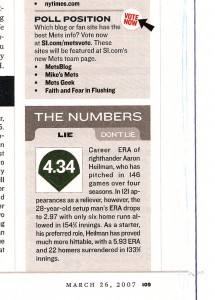
| Page 109 of the current Sports Illustrated — Baseball Preview issue with Daisuke Matsuzaka on the cover — offers you, the FAFIF reader, a chance to express your choice for the fan site with “the best Mets info”. Since it doesn’t seem to be a sudden-death competition (the above blurb indicates each of us will be “featured” on SI‘s Mets site this season), then this is just for fun.
Then just for fun, vote for your favorite blog. Or, if we’re not it, vote for us. I can’t speak for Jason, but I’ve been waiting all my life just to get on the ballot in a meaningless, unscientific popularity contest.
Whatever the outcome, it’s pretty cool to have opened the mailbox, torn into my favorite magazine, turned to the Mets preview and seen our name pop out. The other ones, too. A blog victory, indeed.
(But seriously, vote for us. I have self-esteem issues.) |
|
|
by Greg Prince on 21 March 2007 10:06 am It happens almost every spring, or least by fall. We pick up the guy who’s widely identified for something besides what he has accomplished in the realm of baseball statistics and achievements. This isn’t a Central Casting call per se, but rather the guy whose playing fame and whatever skills that has entailed is augmented, sometimes overshadowed, by his infamy, notoriety or slightly off-kilter triviality. What makes them stand out is less reputation than recitation. They’re known for something that they did or was done to or around them before they became Mets and you hear about it an awful lot upon their arrival. There always seem to be a few of those guys around, mixed in with the run-of-the-mill free-agent studs, utility infielders and such. Just by luck of the draw, one supposes every team gets its share. But it sure seems we’ve dipped into that pot fairly frequently over the past decade.
You know who I mean…
The guy whose father’s a sportswriter.
The guy who hardens his hands by not disturbing the plumbing.
The guy who didn’t catch what Steve Bartman shouldn’t have tried to (whoops…same guy).
The guy who played for his pop (Moises Alou — one-man curiosity sidebar).
The guy who was (was, apparently) the greatest Jewish ballplayer since Hank Greenberg.
The guy who was chased into a Spring Training clubhouse by Mike Piazza (though that may have been more our pet peeve than an issue for the industry at large).
The guy who named a Time after himself.
The guy who didn’t stand for “God Bless America”.
The guy who was really old even before he got here and became even older.
The guy who was born in Saigon.
The guy who kept the ball from the last out of the World Series and caught hell for it.
The guy whose wife wasn’t exactly camera-shy.
The guy who mixed it up with a Fenway Park groundskeeper while Don Zimmer attacked a Red Sox pitcher.
The guy, for that matter, who threw Don Zimmer to the ground in the same playoff game (in self-defense) and hoisted a midget on a regular basis (don’t know what that was).
The guy who was traded for Ken Griffey.
The guy who played for everybody…including us already.
The guy who spit at an umpire.
The guy who gave up the record-breaking homer to McGwire.
The guy who was a fashion model in Japan.
The guy whose manager kept a pair of his shoes on his desk so upset he was to have him traded away.
The guy who had been (had been) the first great Japanese pitcher.
The guy who brushed his teeth between innings before somebody told him it was bush.
The guy who wore a helmet in the field.
Some of ’em, like the helmet guy, work out quite nicely. Some of ’em, like the spitting guy, don’t. Others, like Vietnamese native Danny Graves and cantankerous ex-Skank Karim Garcia…I have to confess I’d all but forgotten they were ever here, and they weren’t here terribly long ago.
As for the latest crop of Mets with pasts that don’t show up in the box score, we’ll see if those imported anecdotes about Ross Newhan’s son — what, you hadn’t heard a dozen times in the last month that David’s dad writes about baseball? — are embellished with actual production in a Mets uniform. If they are, then the “did you know Newhan’s father…?” stuff will fade in due order, as did Carlos Delgado’s stance outside the batter’s box and Pedro Martinez’s eccentric Bostonian past. Can’t do anything about Julio Franco’s age — he just keeps getting older. (So do we all, but he had a head start.)
If Newhan doesn’t succeed? We won’t much care if his spouse’s name is Anna or his maternal grandfather’s full name was Zeile Shinjo Rockefeller. All of the above is footnote stuff, more glaring in spring than in summer. Mets fans create their own histories about their guys, making the contents of their prefab backgrounds immensely irrelevant. After all…
The guy who, if he wasn’t startin’, wasn’t departin’ turned into our last-legged backup first baseman.
The guy who punched out his manager turned into our most dynamic player amid a dismally dark season.
The guy who was at loose enough ends to rate a biopic turned into our man who ran the bases backwards.
The rest of the baseball world may not remember Garry Templeton, Lenny Randle or Jimmy Piersall — to name three — for their Mets deeds, but we do. And that’s the identity that counts with us.
Sure hope Moises’ hands got good and hard by the time he left San Francisco, though. New York’s a soap-and-water kind of town. And we’re big believers in Flushing.
by Greg Prince on 19 March 2007 4:33 pm In many ways, the first weekend of March Metness ran true to bracketology form, with each of the four 1-seeds still alive. Then again, did anybody see two 7-seeds advancing to the Rick Sweet 16? Did you think you would hear Jane Jarvis playing on? Was there a lot of money put down on Pete Rose hustling to two victories?
And how do your brackets look after the first 48 games? Home Run Apple’s stunning loss to 15-seed Bill Shea’s Floral Horseshoe may have upset more than a few, well, apple carts.
The big question is who and/or what’s left to compete for the title of Quintessential Mets Thing. Right off the bat, it’s a noticeably broadcast-heavy tournament now, with Bob Murphy (The Happy Recap), Ralph Kiner (Kiner’s Korner) and Gary Cohen (Outta Here!) all represented, to say nothing of television’s Seinfeld. Two chants — Let’s Go Mets and Jose! Jose! Jose! Jose! — both have their chance, too.
The field also includes one promotion (Banner Day), one sponsor (Rheingold The Dry Beer), one conveyance (The 7 Train), one mascot (Mr. Met) and one favorable miscue (Buckner) to go along with one villain (Rose), one organist (Jarvis), one slogan (Baseball Like It Oughta Be) and a pair of entries best described as hybrids. The Franchise nickname and the Terrific pitcher who inspired it are inseparable, while Can’t Anybody Here Play This Game? stands both for Casey Stengel’s extraordinarily Original Mets and the Jimmy Breslin book that helped immortalize them.
However these indelible components of signature Metsiana arrived at this next level, they’ve survived, they’ve advanced and they figure to make Rick Sweet 16 weekend an exciting one. The Miracle and Magic regional semis will tip off Thursday, to be followed by the quartet of Believe and Amazin’ games on Friday. As ever, Faith and Fear will be on hand to report and analyze all the action.
The tourney as it’s been reset:
THE MIRACLE REGIONAL
1 LET’S GO METS
__________________
5 JANE JARVIS
—
3 BANNER DAY
__________________
2 RHEINGOLD THE DRY BEER
THE MAGIC REGIONAL
1 THE 7 TRAIN
__________________
5 OUTTA HERE!
—
3 CAN’T ANYBODY HERE PLAY THIS GAME?
__________________
7 JOSE! JOSE! JOSE! JOSE!
THE BELIEVE REGIONAL
1 THE HAPPY RECAP
__________________
4 SEINFELD
—
3 THE FRANCHISE
__________________
7 BASEBALL LIKE IT OUGHTA BE
THE AMAZIN’ REGIONAL
1 MR. MET
__________________
5 PETE ROSE
—
3 KINER’S KORNER
__________________
2 BUCKNER
If you missed any of the Don Aase round matchups, you can come from behind and catch up here:
Thursday
Friday
Saturday
Sunday
by Greg Prince on 19 March 2007 2:23 am The weekend that makes March Metness the memory-laden free-for-all that it is came to an end Sunday, with the final eight qualifiers for the Rick Sweet 16 earning their trips to the next round. While some pack for home, others pack for quintessence. Here’s who and/or what made it to Getaway Day and what they did once they got there.
MIRACLE REGIONAL
Ball Off The Wall (6) vs Banner Day (3)
Ball Off The Wall gave Mets fans every reason to Believe. The one-of-a-kind bounce (score it Fence-7-5-2) allowed the Mets to move within a half-game of first place on September 20, 1973, a position they’d seize the next night and, improbably, never let loose of the rest of that year. It’s moments like those that make fans want to scribble uplifting message on bedsheets for years to come. Funny thing, though, is the Banner Day banners came out in seasons far removed from 1973. No matter how much the Mets fan outlook is informed by a play as perfect and perfectly bizarre as Ball Off The Wall, the banner phenomenon was in place 11 years before Richie Zisk succumbed to Ron Hodges’ well-placed tag. There were banners and placards flying through the Polo Grounds before the Mets could ever dream of reaching .500 let alone reaching a game below .500 — which is where their record stood when Hodges drove in John Milner in the bottom of the inning when he outed Zisk. This, like that game, was a battle that lasted a full 13 innings, but when it was over, Banner Day slid home with the winning score.
Marvelous Marv (7) vs Rheingold The Dry Beer (2)
“CRANBERRY! STRAWBERRY! WE LOVE THRONEBERRY!” So went the chant at the Polo Grounds in 1962. What were those fans…drunk? Only on love for the quintessential 1962 Met. Or perhaps a little on the sponsor’s product. We can’t tell from here. It is ironic, in light of this matchup, that Marvelous Marv Throneberry’s latter-day fame would come from his starring in a beer commercial. It’s too bad it wasn’t for Rheingold The Dry Beer, a brand that disappeared from the market by the time Miller Lite was hiring old athletes to demonstrate the manliness of being calorie-conscious. The Mets would find other cult heroes, other first basemen, even another fan-magnet whose name ended in berry. They’d also take their business to Schaefer and, once the company that brewed it evaporated, Budweiser. But does anybody think of Mets and beer without thinking of Rheingold? Anybody over 40 at least? Even somewhat under 40? The sudsy connection is too strong to be watered down, even at the stone hands of Marvelous Marv. Rheingold The Dry Beer wins — it will take on Banner Day — and graciously throws a victory party for everyone to enjoy. Everyone? Even Throneberry? Well, they wuz going to give Marv a cold one, but they wuz afraid he’d drop it.
MAGIC REGIONAL
Mettle The Mule (11) vs Can’t Anybody Here Play This Game? (3)
Some futility is cuter than other futility. 1962 futility, as painful as it was to have lived through for the uniformed personnel of the New York Mets, lives on fondly recalled because there is a mulligan and an innocence to be applied to first-year expansion teams, particularly one helmed by someone as eminently quotable as Charles Dillon “Casey” Stengel. When he rhetorically asked, “can’t anybody here play this game?” all anybody could do was laugh (and, in Jimmy Breslin’s case, take copious notes). But there is nothing cute or innocent or funny about an eighteenth-year expansion team. That was what the Mets had become by 1979, and the introduction of Mettle The Mule as mascot and de facto grounds crew helper underscored that sad, sad fact. It’s not Mettle’s fault the Mets lost 99 games in ’79. Nor were the jokes that followed his removal from the Shea scene — usually involving that strange meatlike dish they were serving in the press room — in good taste. He was just a mule stuck where no more than 788,905 persons chose to be in 1979. Can’t Anybody Here Play This Game? may have been a question born of frustration, but it advances here for having left behind the happier legacy. One Hundred Twenty losses, yes, but nobody ever had to clean up after it.
Jose! Jose! Jose! Jose! (7) vs Bill Shea’s Floral Horseshoe (15)
Is the lowest seed to make it out of the first round any more than an early season wonder? Bill Shea deserves to be remembered longer than the stadium that bears his name will stand, and it is fervently hoped that the Shea family’s tradition of offering the Mets’ manager a good luck floral horseshoe every Home Opener will survive into Citi Field. It is also hoped that the new joint will vibrate just as the current one did in 2006 with cries of Jose! Jose! Jose! Jose! and then some. The Sheas did New York proud by returning National League baseball to the city where it belongs. Jose Reyes and those who encourage his exploits are ready to keep the pride going. A happy new tradition edges a beloved and well-meaning established ritual. The four Jose!s next set their sights on answering Can’t Anybody Here Play This Game?
BELIEVE REGIONAL
The Happy Recap (1) vs John Rocker (9)
The mere thought of “Hi everybody!” emanating from the tinniest of transistor speakers obliterates every ugly thought associated with the ugliest buffoon to disgrace Shea Stadium in all of its 43 seasons. If Bob Murphy can dismember John Rocker at the beginning of his broadcast, imagine what The Happy Recap would do to him. Murph moves forward. Rocker can buy a MetroCard.
Revised Yearbook (12) vs Seinfeld (4)
Given in-season trading deadlines, waiver wire pickups and minor league recalls, it would figure the Mets’ always colorful annuals with their suitable-for-framing team pictures would require a Revised Yearbook. Seinfeld, on the other hand, was Mets-friendly from the beginning. The fifth scene in the pilot episode, when the show was still called The Seinfeld Chronicles, showed Jerry picking up a ringing phone and anxiously telling his caller, “If you know what happened in the Mets game, don’t say anything, I taped it,” before ever mentioning “hello”. Now that’s media that had its priorities start from the first run. Seinfeld is already lobbying for its next gig, against the Happy Recap to be scheduled for — when else? — Thursday at 9.
AMAZIN’ REGIONAL
Mr. Met (1) vs Serval Zipper (9)
The Queens skyline hasn’t been quite the same since the Serval Zipper sign came down. Mr. Met is sympathetic for the loss, but notes he doesn’t bother with zippers. He’s a stitch man himself. And let’s be honest: In your life as a fan, you might peer over the fence and notice Serval Zipper. You might notice U-Haul. You might even notice the occasionally blazing car fire in what’s left of the parking lot. But when he pads on by, you can’t take your eyes off Mr. Met…especially if he stops and sits right in front of you. For now, he stands at the head of his bracket.
Pete Rose (5) vs 1964 World’s Fair (4)
While Shea Stadium and the 1964 World’s Fair are linked by birth, boardwalk and Marina, they were not a single-admission ticket. Shea was considered a commercial success, boosting Mets attendance by 650,000 versus the last year at the Polo Grounds and instantly attracting attention among tourists and locals with rides and exhibits like the 32-inning doubleheader, the Jim Bunning perfect game and Ron Hunt’s start in the All-Star Game. Robert Moses’ other Flushing Meadows project didn’t, uh, fare quite as well. The ’64 version was not as well received as its 1939 predecessor, did not attract the crowds predicted for it and, not long after it was over, its grounds did not maintain itself as any kind of cohesive going concern — as the New York Pavilion’s Gilkeyesque gag cameo in Men In Black illustrated. Pete Rose never called the Shea area home, but as a visitor, he was hardly an alien presence. You gotta have somebody to root against, and for a quarter-century nobody ever quite filled the despicable shoes of Mets Opponent as did Rose. He takes it to the Fair and will bet all he has that he can upset Mr. Met the way he upset Mets fans for a quarter-century.
by Greg Prince on 18 March 2007 8:10 pm March Metness isn’t so much a big dance as it is a three-week Merengue Night. The first Saturday is when everybody starts to get up and move in earnest. Let’s see who and/or what among Day One’s winners will be shaking and/or grooving their way to the Rick Sweet 16.
MIRACLE REGIONAL
Let’s Go Mets (1) vs Mojo Risin’ (9)
Did you know “Mr. Mojo Risin’,” the mystical refrain from the Doors’ “L.A. Woman,” is a perfect anagram for Jim Morrison? Did you know that Robin Ventura intuitively knew it would provide the backbeat for perhaps the craziest September and October in Mets history? Do you remember the bass accompanying Todd Pratt’s trip around the bases once it could be ascertained that Steve Finley caught nothing but air to end the 1999 National League Division Series? There’s never been a less sensical yet simultaneously more appropriate theme for any Mets’ pennant drive. It was “You Gotta Believe” without actually spelling it out. Mojo Risin’ belongs to the dying and resurrecting days of the last Mets season of the last century, a magnificently momentous stretch by any measure. But Let’s Go Mets is eternal. Eternity beats back the Risin’ challenge.
Jane Jarvis (5) vs Mike Vail (13)
Vail is the Cinderella of the Miracle region, ironically going up against the only lady in the March Metness tournament. Mike made it this far based on both the electrifying 23-game hitting streak he put together shortly after his August 1975 elevation to the big leagues and his resounding lack of followup. He earned a starting role for ’76 after his strong debut, but sabotaged himself by breaking a foot playing offseason basketball. Not that basketball has anything to do with March Metness, but let’s just say flashing in the pan will only get you so far. Ms. Jarvis can pound out a triumphant charge as she heads to the next round against the formidable Let’s Go Mets.
MAGIC REGIONAL
The 7 Train (1) vs In Ten Years… (9)
It is not widely known whether Casey Stengel ever opted to take the Times Square-bound IRT after skippering one of his team’s many home losses in 1964 and 1965. If he did, it’s not out of the question that he might have had to have waited an unacceptable amount of time for the next train. And if we accept that premise, Casey may have turned his wit on the New York City subway system and remarked to a companion, “In ten years, one of my Youth of America has a chance to be a star…or sooner than this damn hell-train will commence to arriving.” For a legend whose managerial career ended on a broken hip sustained while getting out of an automobile, perhaps he should have been more patient and used mass transit. In any event, The 7 Train has been synonymous with ferrying Mets fans to Casey Stengel Plaza for well over ten years. It wins. You could look it up.
Outta Here! (5) vs Grand Slam Single (4)
The signature phrase of the most skilled announcer in modern-day Mets history was applied to the signature postseason swing of modern-day Mets history. This is what Gary Cohen had to say about what Robin Ventura did on October 17, 1999: Ventura is waiting. McGlinchy staring in has his signs. The two-one pitch…A DRIVE IN THE AIR TO DEEP RIGHT FIELD! THAT BALL HEADED TOWARD THE WALL…THAT BALL IS…OUTTA HERE! OUTTA HERE! A GAME-WINNING GRAND SLAM HOME RUN OFF THE BAT OF ROBIN VENTURA! Ventura with a grand slam! They’re mobbing him before he can get to second base! The Mets have won the ballgame! Did the moment make the call or did the call enhance the moment? The answer to both is absolutely yes. This matchup goes not just to overtime but to a fifteenth inning…and is decided by Cohen’s keen and immediate observation, amid a frenzied tableau, that Ventura never got to second base and his presence of mind to note it seconds after unleashing what would be, from another announcer’s tonsils, just a catchphrase. Grand Slam Single is indelible. Outta Here! echoes for the ages. The echo takes it. Will it be resonant enough to drown out The 7 Train? We’ll find out.
BELIEVE REGIONAL
Shoe Polish Ball (6) vs The Franchise (3)
Shoe Polish Ball contributed mightily to a world championship. But so did The Franchise. Would have the Mets beaten the Orioles without Gil Hodges’ heady intervention and stoic powers of persuasion? It certainly helped the 1969 cause, but to imbue it with singular responsibility would be to overlook two catches by Tommie Agee, one by Ron Swoboda, fabulous timing by Al Weis, quick wristwork by J.C. Martin and, for that matter, the bat of Donn Clendenon who came up after the smudged sphere nudged Lou DiMuro into sending Cleon Jones to first. It also obscures the masterful pitching of Jerry Koosman, Nolan Ryan, Ron Taylor and The Franchise himself, Tom Seaver, who threw a masterful ten innings to capture a) Game Four of the World Series and b) this round of March Metness.
Baseball Like It Oughta Be (7) vs Meet The Mets (2)
Bravado boiled into five words takes on two verses, a bridge and a chorus of friendly-like invitationeering. Meet The Mets is a perennial sentiment. Baseball Like It Oughta Be can portray but one annus. And what a sweet annus 1986 was. The guarantee you’d have the time of your life in the Mets’ theme song didn’t really come true for almost a quarter-century after its debut. When MTM was first heard in 1963, the Mets were preparing to go out and capture 51 ballgames. An improvement over ’62, but hardly a peak in one’s existence. As for knocking those home runs over the wall, the ’86 Mets set the mark with 148, exceeding by nine the previous standard…established in 1962. Info like this Oughta not be ignored. Meeting The Mets is always fun, but Oughta Be pulls off the upset and will meet The Franchise in the Rick Sweet 16.
AMAZIN’ REGIONAL
Jack Lang (11) vs Kiner’s Korner (3)
Jack Lang is closely identified with the Mets beat given that he was on it from its beginning in 1962 to the late 1980s, first with the Long Island Press and then (after the Press folded in 1977) the Daily News. He also wrote the invaluable team history The New York Mets: Twenty-Five Years of Baseball Magic, contributed to Mets magazine Inside Pitch until 2004 and served as longtime secretary of the Baseball Writers Association of America, a job that allowed him the honor of informing retired players that they were about to be immortalized in Cooperstown. As if that weren’t enough, it was Lang who came up with “The Franchise” as the perfect sobriquet for the perfect pitcher, a creation that carries the added bonus of having driven M. Donald Grant to distraction. The chairman of the board once scolded Lang that “Mrs. Payson and I,” not Tom Seaver, were the franchise. In all, it was a long and meritorious career for Jack Lang, one of the most Mets-associated people to never actually work for the organization. But Kiner’s Korner is Kiner’s Korner and Ralph Kiner does not go down easily — or at all — even to a Hall of Fame writer.
Jimmy Qualls (10) vs Buckner (2)
You can argue it was the trade of Nolan Ryan that assured the Mets of missing out on at least seven of the theoretically dozens of no-hitters they could have accrued by now. But it’s impossible to consider Jimmy Qualls — lifetime .223 hitter over 139 at-bats — and not apply his name above all others to the no-hitless Metropolitan phenomenon. What ungodly business did Jimmy Qualls have in reaching Tom Seaver for a single when Seaver was two outs from achieving a perfect game on July 9, 1969? Jimmy Qualls experienced, it’s safe to assume, 138 completely inconsequential at-bats and one that lives forever in the heads of millions of New York National League baseball fans. When Antonio Perez or Chris Burke or Luis Castillo or Kit Pellow or Chin-Hui Tsao or whoever’s next throws up the latest obstacle to that transcendent moment of Met happiness we can all only wonder about, there is but one name that will spring to mind again and again and again. Jimmy Qualls is our quintessential heartbreak kid in our quintessential quest for the one goal we can never reach. What a powerful name it is. If Jimmy Qualls had never been in Leo Durocher’s lineup that July night, if Don Young hadn’t been frozen out of it by his atrocious defense the afternoon before, if Tom Seaver had cashed in that no-hit, no-walk, no-flaw performance, we would be collectively and retroactively ecstatic for all the days of our lives. But if Buckner doesn’t do Buckner…such a hypothetical is not to be contemplated. We would trade a dozen Fregosis and a thousand anti-Quallses for that single, solitary E-3 every time. Outcome: Prepare for Buckner versus Kiner.
|
|






