The blog for Mets fans
who like to read
ABOUT US

Faith and Fear in Flushing made its debut on Feb. 16, 2005, the brainchild of two longtime friends and lifelong Met fans.
Greg Prince discovered the Mets when he was 6, during the magical summer of 1969. He is a Long Island-based writer, editor and communications consultant. Contact him here.
Jason Fry is a Brooklyn writer whose first memories include his mom leaping up and down cheering for Rusty Staub. Check out his other writing here.
Got something to say? Leave a comment, or email us at faithandfear@gmail.com. (Sorry, but we have no interest in ads, sponsored content or guest posts.)
Need our RSS feed? It's here.
Visit our Facebook page, or drop by the personal pages for Greg and Jason.
Or follow us on Twitter: Here's Greg, and here's Jason.
|
by Greg Prince on 25 August 2006 8:15 am I don't know another place like Shea Stadium in 2006.
I don't know anywhere else where I get to inject myself into my favorite pastime as it gets better and better.
I don't know anywhere else where most everybody else wants to happen what I want to happen…and it usually happens.
I don't know anywhere else where I can sit with one great friend for hours and discuss the thing we like most, then excuse myself for a bit to find some other great friends for quick chats on what we like most.
Me and my friends, wherever they're sitting, are into the same thing. And that thing is going very well of late.
I enter Shea Stadium in 2006 excited and I leave it ecstatic.
My team is there and my friends are there and neither of them ever seem to let me down.
You just wait to be in this zone and now that I'm firmly entrenched in it, it's every bit as special as you might imagine it would be.
Someday, sooner than we can fathom, they will pave William A. Shea Municipal Stadium and put up a parking lot.
So do me this favor:
Don't let it be forgot that once there was a spot for one brief shining moment that was known as…
…Camelot?
Yes, right there at the corner of 126th and Roosevelt.
Shea what you will about the often absurd edifice that is mandated to disappear in the blink of an eye. With the team that bats last winning every night, with a quarter of a million fans floating through its gates in the course of a week and with a pure energy rising relentlessly higher than the flags above the upper deck, I gotta believe that our green, green grass of home is the most beautiful sight these eyes will ever see.
Shea Stadium in 2006. It is Camelot, I swear it is.
I'm happy. I'm having a ball.
Watching my team win frequently on TV is pretty awesome, but being inside those three blue walls to bear witness to it is something else altogether. The only thing missing from this sensational season for me until the beginning of this month was the synchronization of my presence and the Mets' success. When they lost eight of the first eleven games I attended, I really began to wonder whether they were allergic to me.
I've stopped thinking in those terms. I've been to four of the last ten Mets games at Shea Stadium, including last night's, and the Mets have won all four. They've won the other six, too. Perhaps I'm incidental — mere garnish to their main course.
If that's the case, that's fine. I'm just happy to be 1/45,000th of the parsley on the plate.
So, in summary, this is what I do at every opportunity in 2006:
I go to Shea Stadium.
I see my friends there.
I see the Mets win there.
I come home.
I write about it.
My life is good.
by Jason Fry on 25 August 2006 5:11 am Your co-bloggers, they had a long time to talk tonight.
First there was the game, which was a delight. Welcome to New York, Shawn Green! We believe we see light at the end of the tunnel, David Wright! Nicely done, Dave Williams! We're glad you're on our side, Jose Reyes and Carlos Delgado! Following that, there was an ill-fated right turn out of Gate A, which let us into the parking lot and a near-circumnavigation of the construction fence behind which New Shea will soon rise. You'd think you could slip through the test drillings or whatever it is they're doing back there, but nope — a right turn out of Gate A leaves you ultimately playing some demented blue and orange version of Frogger with the crush of SUVs trying to exit onto Chop Shop Lane. Trying to exit through a lake. Evading the lake means a second trip through the vaguely lined-up SUVs. Fun. After that, the tender mercies of the 7 train.
Anyway, between our various navigational mishaps and the long rumble into Manhattan, we had a long while to discuss our baseball team. And we remarked on something: the utter lack of fear we have about what's to come, the strange sensation of six weeks of baseball that aren't weighed down by anxiety and superstition.
Ah, superstition. It's a time-honored tenet of responsible fandom that you don't ask the baseball gods to script things just so: Don't say you hope they lose a few on the road so you can see them wrap it up at home, on your anniversary, or whatever date would make you even happier. Don't hope that Hated Team X hangs around long enough for your team to administer the coup de grace. Don't look past Team Y, the baseball-fan equivalent of flipping ahead in the book to see if the killer's brought to justice. Don't say you want Potential Opponent Team Z because they seem beatable, or because you have a grudge, or whatever it is. Take what you're given.
Following this rule isn't like taking a vow of silence, though. It's OK to talk about scenarios that have particular appeal, as long as you do it at a respectable remove, and as long as not you're just pretending that you're asking for a certain script. (The baseball gods are not so easily tricked!) Digressionary example: I love the Earth Wind and Fire song “September,” one of the sunniest tunes ever written, and have long thought that A) it would be great to hear it played after September victories that mean something; and B) it would be great if something wonderful happened for the Mets on the 21st night of September, as mentioned in the lyrics. It's OK to talk about that wistfully. It's not OK to hope that the Mets slow down the magic-number pace so as not to clinch before 9/21. That's asking for trouble. (Digression within a digression: It doesn't matter anyway, because if we clinch at home the Mets will blast “The Best,” four minutes of Tina Turner hacking up a hairball as deservedly faceless sessioneers rawk out. Something tells me I'll still be a very happy man.)
The baseball gods don't frown at respectful talk. Nor do they require you to hunker down in superstitious dread until the last possible moment. Up 14.5 with a magic number of 22? Go ahead and discuss the playoffs — as my co-blogger noted some time ago, they're not gonna get us.
I'm not going to say we want the Cardinals or the Reds or the Dodgers or the Padres or some Central or West team that emerges from the ranks of those who are below .500 but in contention. I'm certainly not going to start scouting the NLCS or, God forbid, American League teams. We just covered that.
But we can say this: We just swept the Cardinals, generally considered the second-best team in the NL. We've seen all the teams on the list of possible first-round opponents, and none of them exactly make you gulp. This isn't to say we're guaranteed to beat them — anybody can beat anybody in a postseason series. It's not even really about them at all. It's about us. It's about a balanced lineup that can beat you with speed, power and patience. It's about smothering defense. It's about a bullpen that's rounding into form after a scare. And about a starting rotation that…um, well, there's time to get everybody healthy, and in the meantime how about those fill-ins! (Tonight we had a good laugh over this scenario: Back in March we peer into the Faith and Fear crystal ball and see an August stretch in which our pitchers could be Dave Williams, Brian Bannister, Oliver Perez/Darren Oliver, John Maine and Steve Trachsel — and yet for some reason the late-summer Greg and Jace don't look worried. In fact, they look…happy?)
That's part of the point. This year there isn't an Atlanta Braves lurking out there between us and a pennant — a team that's in our heads, that haunts our dreams, that we've good reason to fear. Sure, there are lots of things that can go wrong even in this Braveless New World. We could go cold at the absolute worst time. Whatever team we draw in the first round could get obscenely hot. We could be undone by injuries. We could come out on the short end of some plain old-fashioned bad luck. If you want to be anxious about any or all of that, go ahead — it's only sensible. But this year that anxiety isn't attached to any of our potential NL opponents. Wanna see the 2006 National League Bogeyman? Look in the mirror, because the team that makes managers mutter and scouts toss and turn at night is us.
That's not a guarantee of anything, except this: The only thing we have to fear is baseball itself.
by Greg Prince on 24 August 2006 6:44 am There haven't been that many really good games we've lost this year, but one of them was a contest in St. Louis between the two best teams in the National League. It was just over three months ago, a classic pitchers' duel between Mark Mulder and Steve Trachsel. We got beat 1-0 when Scott Rolen lifted a seemingly impossible pitch off the ground and drove it for the deciding run. It was the kind of night that made you tip your cap and order another round because at a brisk 2:32, there were plenty of hours to closing time and lots of season to go.
It's just over three months later and almost everything's changed.
THEN: The Mets (24-15) weren't hitting.
NOW: They are (77-49).
THEN: The Cardinals (25-15) were imposing.
NOW: They're barely hanging on (66-59).
THEN: Mulder (5-1) was daunting.
NOW: He's slowly recuperating (6-6).
THEN: Trachsel (2-4) got no support.
NOW: He's offensively pampered (13-5).
THEN: 2-1/2 hours to play 8-1/2 innings.
NOW: Is the game over yet?
Granted, at 3:21, the Mets' Wednesday night 10-8 triumph of attrition would beat the shortest Yankee-Red Sox game in the last 50 years for brevity. And wouldn't you stay up all night for a Met victory?
Sure you would. But when you jump out to a 10-2 lead, you could be forgiven for wondering when the hell your starter will stop giving up home runs to Jose Vizcaino and put the opposition away. It never quite happened, but five relievers — right up through sudden Cy Young candidate Billy Wagner (quick, name a starting pitcher who's a prohibitive favorite…and Trachsel doesn't count) — wriggled and jiggled and got the job done. First a laugher, then just nervous laughter. It takes all kinds.
We haven't won a bad game all year. When you win, there's no such thing as a bad game.
The only substantive factor that hasn't changed since May 17 is that the Mets and Cardinals remain the two best teams in the National League. Then we were neck-and-neck. Now we're the giraffe and they're Walt Williams. All NL Game Ones featuring the Mets will take place here. The Cards can consult with the Reds, Dodgers, Padres and any ambitious Central or West stragglers to determine all other hosting duties.
There's no way we should lose to anybody in the National League in October. That's not to say that it can't happen or it won't happen. But between you and me, there's no way we should lose to anybody in the National League in late August or the remainder of the season. At the risk of angering the gods when I'm due at Shea in 16-odd hours, if the Cardinals are the other best team in the league, then…nah, I'm not gonna say anything. Respect all opponents, especially with Pujols and Rolen and freaking Vizcaino and other assorted ex-Mets zipping around in red.
I'm of two broad minds on potential post-Yom Kippur matchups. One is I don't care who we're playing as long as we're playing. The other is I don't want to play anybody because anybody can beat anybody in the tenth month. We've been on both sides of that equation in our illustrious history. It's only fun when it comes out in our favor.
Still, I'm beginning to think that the team I actually don't want to see down the road is the Wild Card team if it's the Phillies, ridiculously hot since pawning off Abreu and Lidle on the Yankees (say, whatever happened to those guys?) and only 1-1/2 behind Cincinnati, which is only 1 behind St. Louis. We play the Phillies for about the hundredth time in August this weekend. We have the Dodgers — the previously ridiculously hot club in our circuit, now decidedly cooled off — in for four in a couple of weeks. And tonight one more with the Cardinals. Those are the only eight games we have left with serious potential pennant opponents, so get out your clipboards and radar guns and start scouting.
Gathering intelligence and not getting hurt are what it's all about now. That and continuing winning. However unappealingly we go may about it now and then, it's a good habit to stay in.
by Greg Prince on 23 August 2006 6:41 pm When Glenn Close reprised her national anthem performance from the World Series on Saturday night, we all noticed the incongruity of the actress/singer showing up in her 1994 uniform top. I had what I thought was the obvious answer Sunday:
I’m assuming she was the singer at the Home Opener a dozen years ago and, true fan that she is said to be, kept and cherished her very own jersey.
It was so obvious, it was incorrect. I dug out my 1995 yearbook, sure I would find a picture of La Close belting out that rocket’s red glare. Nope. It was Queens’ own Cyndi Lauper (in her 1986-era jacket, no less) who did the Opening Day honors in 1994. I came across no pictures of Glenn, so I can’t say for sure when she got what she was wearing.
But I did discover something that was more chilling than the tail on the Mets’ shirts from those sad old days.
The ’95 yearbook featured an uncommonly in-depth special section on Met scouting: how they draft, how they trade, how they evaluate talent. Written by Bruce Herman, it’s at once very entertaining to read and terribly informative, especially with hindsight.
How many times have the Mets been honest enough with their fans to place in a yearbook a quote from the current general manager that a trade was made because the current manager couldn’t stand a player? That’s there, with Joe McIlvaine analyzing his swap of Jeromy Burnitz for Dave Mlicki, Jerry DiPoto and Paul Byrd thusly: “It was no secret we had to move Burnitz, who wasn’t getting along with Dallas Green.”
And how many times has a yearbook slathered empty praise on a team employee nobody’s ever heard of? Lots, probably, but have more haunting, foreshadowing words ever been written within such a vehicle than those that described “the vigilant and nurturing wing of the club’s director of minor league operations”? That wing belonged to Steve Phillips, apparently a young man on the move. His nurturing side would get him in a touch of hot water in 1998, you might recall. And you can ask the Blue Jays why on earth they didn’t agree to Phillips’ reported vigilant trade proposal from 2002. The Jays, a Toronto paper said after this year’s All-Star Game, were looking to trade Jose Cruz, Jr. Steve Phillips was interested. He offered a minor league third baseman. Just a kid. Just a kid named David Wright.
Taking gratuitous swipes at Steve Phillips is fun, but that’s not the gold in the yearbook. That was mined in a spread called Mets 2000. Remember that when this was published, spring 1995, the Mets had no present to speak of and an immediate past wrapped in shame. So it was the future the Mets were trying to sell. With Baseball America having just slotted five Met prospects in its top 40, perhaps it was possible that just over the horizon lay better days.
Thus, Mets 2000. The premise was simple. Let’s say that our lineup at the turn of the next century is going to be filled only by players who are not yet in the Majors: “What might the club’s starting lineup look like five years from now if only players from the organization who had rookie status in 1995 were considered?”
It was a Met version of Conan O’Brien’s creepy sci-fi bit In The Year 2000…
C – Brook Fordyce
1B – Byron Gainey
2B – Julio Zorilla
SS – Rey Ordoñez
3B – Edgardo Alfonzo
LF – Preston Wilson
CF – Jay Payton
RF – Carl Everett
RHP – Jason Isringhausen
LHP – Bill Pulsipher
The yearbook stressed that this was all theoretical. It wasn’t a promise and it wasn’t exactly a threat: “Of course the team’s roster in the year 2000 will also include veterans, probably some of whom are Mets right now.”
That’s a retrospective relief. When I bought the yearbook, during a May loss to the Expos, I’m sure I flipped by this article and thought, “No Hundley? No Brogna? No Kent? Whither this youth movement?” Then I turned the page and likely stared at all the fun a tike was having wallowing in a pool of green balls beyond the outfield fence at the post-modern entertainment experience known as Nickelodeon Extreme Baseball, something children born after the year 2000 would be enjoying decades to come. In any event, I forgot about Mets 2000 quickly if I noticed it much to begin with.
Not to read too much into the future as it appeared in club propaganda eleven years ago, but this 2000 via 1995 lineup is frightening. No knock on the players involved per se. Most of them did make the Majors and several are still having careers. But within this relatively innocent “future’s so bright” presentation lurked an uncomfortable truth as it applied to the Mets then and too often since.
The Mets were not serious about winning.
That the organization would even float the idea, even for the hell of it, that if you come back in five years you’ll be looking at these players as your saviors is scary. That the Mets would suggest that “veterans” were kind of an afterthought to their long-term Logan’s Run planning is shocking. That the Mets of early 1995, who were in the fifth year of an involuntary rebuilding program, had little to hype beyond the chance that Julio Zorilla would be playing second in five years is something I’m glad I glossed over back in the day.
Then again, would have I really argued against painting the rosiest picture possible? By the time this yearbook came off the printing press, we had heard of Pulsipher and Isringhausen. Alfonzo and Everett had made the team out of truncated spring training. There had been whispers of a sensational fielding shortstop who defected from Cuba. Maybe there was a foundation for the future here.
But we know that future took lots of twists and turns, right through “the year 2000” and up to this very moment. In terms of the personnel highlighted, it didn’t get as far as 1997 unscathed. It was barely recognizable by 2000. It was all gone after 2002.
Yet there was its spirit, on the Shea mound in the bottom of the ninth last night.
In possibly the best game of quite possibly the best season here in two decades, the winning runs were scored off Jason Isringhausen. The Mets gave up on Izzy seven years ago in the midst of one of the other best seasons here of the past two decades. We couldn’t have conceived in 1995 that Jason Isringhausen wouldn’t be one of our aces for years to come. We couldn’t have conceived we’d trade him for Billy Taylor. He had washed out as a Met, but we might have figured he’d have a real good run at some point, though probably not in ninth innings, where he’s succeeded ever since leaving here. Of course he’s had his problems lately. His most recent one was named Carlos Beltran.
Carlos Beltran was unimaginable to Mets fans in 1995. Not so much the player himself (he was only 18) but the concept. Carlos Beltran may very well be the best player the Mets have ever had.
Ever.
We’ve thrown around the phrase “five-tool player” with such scorn since 1995 — when Bobby Bonilla was traded for the original Ace Helpful Hardware Man Alex Ochoa — that it may have taken us a while to understand that indeed a creature exists who hits, hits with power, runs, throws and fields. It’s probably taken us longer to comprehend he’s not an urban myth but that he’s ours, all ours. Maybe it’s only sinking in now that we are incredibly lucky to have him and that spending $119 million between last year and 2011 to get him represents a monumental bargain.
That’s not the walkoff home run talking. That’s Carlos Beltran’s entire season and the way there’s no meaningful flaw in Carlos Beltran’s game. There wasn’t any between his Rookie of the Year campaign in 1999 and his bank-breaking October in 2004 either. He had one lame year last year and now, I would guess, at age 29, he’s good to go for the length of his contract.
Can you imagine the mid-’90s Mets signing this kind of player for that kind of money? Can you imagine Mets 2000 bringing him in? It’s not that the Steve Phillips stewardees weren’t pretty well compensated, but did they ever have a guy anything like this or go hard after him? No and no. They could have but they didn’t. Can you imagine anybody but Omar Minaya going out and signing Carlos Beltran to be the kind of Met the Mets have never had?
For that matter, did the Mets of old, pre-Omar vintage, ever go out and get Shawn Green for the kind of role and the period of time envisioned for Shawn Green? Trading David Wright for Jose Cruz, Jr. (allegedly) — or Melvin Mora for Mike Bordick, or Jason Bay for Steve Reed — was more Phillips’ Before They Were Stars deadline speed. It wasn’t that Phillips was afraid to acquire a veteran. It’s just that he did it so badly.
Phillips on Bay in the Times this July:
We thought he’d be an upper-level minor leaguer. When we got him, I didn’t really see him play. He showed a little bit of pop and speed. The reports we got said he was a fifth outfielder.
In 2002, a fifth outfielder with a little bit of pop and speed would have been a revelation around here. But who needs to look at a player who might be that when you can have Steve Reed for two months?
Green is a bit of a risk, a monetary gamble, but Omar has a championship in our sights. He went out and spent some of our dough for a guy who could be the difference-maker. And who did he give up? Evan MacLane.
I’ve heard of Evan MacLane. He was some guy at Norfolk. If Sanchez hadn’t gotten reamed and Nady hadn’t gotten traded and Floyd hadn’t gotten hurt, maybe MacLane would be a Tide now and a Met in September. That he won’t be will cost me no nevermind. Anybody who finds it disconcerting that we no longer have Evan MacLane (and they’re out there) is either related to MacLane or is one of those fans who is never happy with the present because everything must be devoted to a nebulous future.
Evan MacLane may someday make us regret Shawn Green the way folks in Detroit must have eventually decided Doyle Alexander’s seven clutch weeks in 1987 weren’t worth John Smoltz. Maybe he’ll be another Bay that got away. Unlike the 1995 Mets yearbook, I can’t see the future. But I doubt there will be Kazmirian repercussions from trading Evan MacLane. I trust Omar to do the right thing (even though I know he traded Bay from the Expos, but Montreal was Minaya’s practice round). In 2006, the right thing, first and foremost, is to secure our near-term future.
Right now, that means Shawn Green. Not Jose Cruz, Jr., DFA’d this summer by the Dodgers; not Preston Wilson, released by Houston, picked up by Izzy’s Cardinals; not Timo Perez, the kind of limited outfielder with whom the Mets were content to get by for three years after they caught lightning with him for two playoff rounds. They would have been relatively inexpensive pickups, but cost is not Omar’s first priority.
The Mets under Phillips, particularly after 2000, made some wacky moves. The Mets of Jim Duquette were more throwbacks to the Mets of McIlvaine, when youth was embraced and budgets were preserved. (Notice the general pattern on general managers: Cashen saved, Harazin spent, McIlvane saved, Phillips spent, Duquette scrimped, Minaya splurges. It’s not unlike the way “players’ managers” are replaced by “disciplinarians” who are replaced by “players’ managers”.) When Duquette took over, we were just thrilled to get rid of Phillips’ boondoggles and get somebody, anybody in return — the younger and cheaper, the better. Duquette spent 2003 discarding and collecting. More discarding than collecting. The only names that were retained to any visible extent as compensation from the bloated-salary purge of three years ago were Royce Ring (from the White Sox for Robbie Alomar) and Victor Diaz (from the Dodgers for Burnitz II). Ironic, maybe, that on the night the Mets invest in Shawn Green, they demote Ring, who’s done nothing, and designate Diaz, who did one thing long ago.
The old Mets, the pre-Minaya Mets, would have trotted Victor Diaz out there plenty more than these guys did. And this old Mets fan, I have to admit, would have pined for Victor Diaz based on that one thing he did long ago, that ninth-inning, game-tying homer he socked off LaTroy Hawkins to sink the Cubs while I sat in the loge on Yom Kippur 2004 (a day Shawn Green sat out in California). Victor providing the spoiler was a beautiful thing, one of my favorite things in its era, but it was never followed up on consistently. Yet Victor Diaz, under previous management, would have ridden that tater to a starting assignment for a couple of years. If he didn’t hustle to first or after balls, he would have been given more chances regardless.
Victor Diaz is off the 40-man now. He’s part of the past, of when the Mets would leave the continued patrol of centerfield to Timo Perez instead of Carlos Beltran. When they depended on Pulsipher instead of Pedro. When they tried to trade David Wright instead of locking him up. When Braden Looper was a closer for us instead of a setup man for someone else. When a Byron Gainey was considered sufficient for a job best filled by a Carlos Delgado. When Evan MacLane was a matter of concern and Shawn Green was out of our price range. When fatal attraction wasn’t a Glenn Close DVD but the Mets’ relationship to their own shaky prospects. When extreme baseball was a side show, not the way this team plays from first pitch to last.
It’s the year 2006. I’ll take this future every time.
by Jason Fry on 23 August 2006 5:06 pm 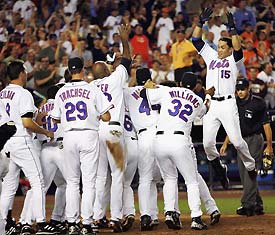 Save this one for a hideous day in January — I guarantee it’ll make you feel like it’s summer. Save this one for a hideous day in January — I guarantee it’ll make you feel like it’s summer.
by Jason Fry on 23 August 2006 3:14 am Honestly, this would have been a good night in Met Land even if we hadn't come all the way back from 7-1 in thrilling fashion. Instead of going under the knife, Tom Glavine will have to take baby aspirin — the stuff that isn't even bitter when you chew it. Instead of the uncertain business of asking what might be too much from Endy Chavez and demanding Lastings Milledge grow up in public, we added a veteran to man right field through October. And if it doesn't look like a dip in the Fountain of Postseason will rejuvenate Shawn Green, Chavez/Milledge isn't a bad Plan B.
That's what I was thinking when it was 7-1 and the only question was how many more Bad Albert would swat to Portugal. John Maine may have a tough go of it his second time through the league, but there's no first-time discount when Pujols is at the plate. Luckily, there's not a lot more to the Cardinals these days, besides annoying ex-Mets to scowl at. (RUN, TIMO! YOU JACKASS! RUN! And Looper…Christ, where to start with you. Oh, the hell with it. Just go away.) There is a lot more to us — while David Wright continues his lonely sojourn in Slump Forest, Carlos Delgado has emerged, blinking and mildly annoyed, from those deep dark woods. And has he ever brought lumber out with him — his grand slam was so ridiculously gone that I barely blinked. When a ball goes that far it's meant to be and you're just a bystander. Does one cheer avalanches or miles-long forks of lightning cracking the sky? Add in Lo Duca playing his usual gritty defense and slashing hits at every opportunity, Chad Bradford coolly inducing not one but two clutch double plays and the continuing renaissance of Aaron Heilman, and it was a very nice night indeed.
And that was before the heroics of Carlos Beltran. If this season winds up being one of those that's endlessly, lovingly dissected and chronicled — like a certain one just satisfyingly celebrated — the key moment lasered in on by every baseball historian will be this one: the moment Carlos Beltran decided that no, he wasn't going to acknowledge Shea Stadium's petty, fickle fans with the curtain call they wanted — not after how shabbily he'd been treated for a year and change. And then the moment, hard on its heels, when Julio Franco told him sympathetically but firmly that his point had been made, and it was time to get up on that top step.
Since he emerged from the dugout that night there's been nary a boo for Carlos Beltran — and nary a reason for even the least-forgiving leather-lung to express displeasure. That wasn't just the moment Carlos Beltran and the fans agreed to start over, though that was significant. It was also the moment Carlos Beltran realized that there was no reason to try to make himself into whatever mythical beast is the product of Carlos Beltran + $119 million — that just being Carlos Beltran would be more than enough. He, and we, have been the beneficiaries ever since.
Before we go, a moment for a wonderful call from Howie Rose, one that'll be leading off a lot of WFAN broadcasts: “First pitch … fastball hit deep to right field! It's gonna win the ballgame! Home run!”
Oh, and keep playing “The Curly Shuffle.” Just a hunch.
by Greg Prince on 23 August 2006 12:58 am I have a Shawn Green baseball card, the back of which says…
Following in the tradition of Hank Greenberg and Sandy Koufax, Shawn announced his decision not to play on Yom Kippur.
Good news: Yom Kippur this year falls on the Monday between the end of the season and the start of the playoffs.
Better news: We’ll have a game that Tuesday. And so, just given Bud Selig’s blessing, will Shawn Green.
Looks like we have a stand-in for Cliff Floyd. Looks we can deploy Endy Chavez in his customary secret weapon role. Looks like Michael Tucker can be Matt Franco in the late innings. Looks like any pressure that might weigh on Lastings Milledge can dissipate. Looks like Ricky Ledee may need a ride to the airport.
Looks like the Mets will have their first Jewish ballplayer in a quarter-century.
On a day when Tom Glavine’s left arm was diagnosed as unclotted — mazel tov! — the trade for Shawn Green (giving up Norfolk lefty Evan MacLane to the Diamondbacks and taking on a thus far undisclosed chunk of salary) feels like a little extra mitzvah from Minaya. Mostly because he’s an experienced outfielder with a bat and an arm, and veteran stars tipping toward the other side of their careers have a happy history of reviving with contenders. But a little because he’ll be the Mets’ first Jewish ballplayer in a quarter-century.
When Shawn Green came to Shea with the Blue Jays in 1999, I joked to my companion that I guess I should have brought a Star of David flag and paraded through the stands with it. This was in the era of fannies in seats for stars of other teams and displays of allegiance to them instead of the Mets. I’m speaking primarily of the Dominican contingent that cheered for Chicago Cub Sammy Sosa. That always turned my stomach, just as it made me a little queasy that I saw a few of my landsmen going nuts for Green when he visited as a Dodger on Jewish Heritage Day in 2004.
This is America. My people are Americans. When I’m at Shea, I choose to identify with Metropolitan-Americans. Over the years, I’ve seen Brad Ausmus, Mike Lieberthal and Jason Marquis, to name three Jewish players, come and go from Shea and never noticed a swelling of religious or ethnic pride at their appearances. Nor did it even occur to me that they were fully or partly Jewish. They were opponents.
Shawn Green, however, was a little different. As it says on the back of his card — from the set American Jews in America’s Game: 1871-2003, produced by the American Jewish Historical Society — “Shawn is the outstanding, as well as the most Jewishly identified, major leaguer of this generation.” Because he was the most talented, most accomplished, most celebrated Jewish player since Koufax, I did applaud him before his first at-bats when he faced the Mets. Because he faced the Mets, I rooted for him to strike out.
For the record, there have been six Jewish Mets to date. Joe Ginsberg was the first. Art Shamsky was the best. Dave Roberts, ’til now, was the last. They are joined by Norm Sherry, Greg Goossen and Elliott Maddox. None of them made the AJHS’s all-time Jewish team.
Shawn Green did.
I missed Ginsberg, Sherry and Goossen. I don’t think I knew about Shamsky’s faith when he was in Flushing; he left when I was 8 and I didn’t learn that there was such a thing as a Jewish baseball player until I read it in Baseball Digest when I was 9. I didn’t know about Roberts or Maddox until I got their cards. The lack of Jewish Mets (even the mildly disappointing word in 1987 that Cone wasn’t derived from Cohen) didn’t exactly create a void in my life as a fan. My Judaism is pretty much limited to fuzzy anecdotes from my youth and my intermittent sprinkling of Yiddish phrases into my blog.
It’s seeped into my fandom now and again, I suppose. The first Mets game I ever attended was under the auspices of kosher Camp Avnet. In a fit of Israeli solidarity after 9/11, I bought a Mets cap with the NY translated into Hebrew, though if it weren’t blue and orange, I wouldn’t be able to tell you what it says. When I think of it, except on Friday nights and Saturday afternoons, I’ll go for a hot dog from the Hebrew National stand…they’re just better. But unlike Shawn Green, I don’t let the High Holy Days get in the way of my baseball games. For me, baseball games are the High Holy Days.
AJHS’s Jewish Major Leaguers set proved so popular, they put out a sequel this year. On Shawn Green’s update card, it is noted that during Yom Kippur 2004, in the middle of the Dodgers’ race in the West versus the Giants, “He decided that he owed it to his team to play one of the two games in that 24-hour period, while observing the Day of Awe during the other game.”
What it doesn’t say is that a couple of weeks later, in the NLDS against the Cardinals, Shawn Green smacked three homers.
Can he pull that kind of performance out of his yarmulke the month after next? Might he restore the pop the lower half of the order has been missing since the dismissal of Nady and the disabling of Floyd? Will we regret taking on his hefty $9 million contract and $2 million buyout when 2007 rolls around?
All good questions. I have no answers. But Shawn Green, the outstanding, as well as most Jewishly identified, major leaguer of his generation, can now say, today I am a Met. Will it help us?
Couldn’t hurt.
by Greg Prince on 22 August 2006 7:56 am We will investigate anything to make our club better.
—Omar Minaya, 2006
The Mets is a very good thing. They give everybody a job. Just like the WPA.
—Billy Loes, 1962
The 1962 Mets won 40 games.
The 2006 Mets won 40 games by June 12.
The 1962 Mets had Cliff Cook, Gus Bell and Gene Woodling.
The 2006 Mets have Cliff Floyd, Heath Bell and Chris Woodward.
The 1962 Mets had Hobie Landrith.
The 2006 Mets have Jose Reyes.
Ken MacKenzie.
Kaz Matsui.
Zimmer.
Zambrano.
Sammy Drake and Sammy Taylor.
Carlos Beltran and Carlos Delgado.
Bob Miller and Bob Miller.
Lo Duca and El Duque.
Roger Craig had two first names.
Anderson Hernandez has two last names.
Ed Kranepool came up young.
As has Lastings Milledge.
Gil Hodges' career began during World War II.
As has Julio Franco's.
Marvelous Marv!
Lima Time!
Vinegar Bend Mizell.
Bartolome Fortunato.
Cannizzaro.
Marrero.
Daviault.
David.
Choo Choo.
Pedro.
Harry Chiti was traded for Harry Chiti.
Roberto Hernandez was traded for Roberto Hernandez…by way of Xavier Nady.
You can barely tell the 1962 Mets and 2006 Mets are related. Sure they have the same family name, but where's the resemblance? While it's true that one was instantly immortalized and the other is potentially legendary, it's just as true that one was more godawful than the other is awful good.
One will clinch fairly soon. The other was eliminated in early September.
Clarification: Eliminated in early September from finishing in NINTH place. The 1962 Mets were statistically eliminated from pennant contention in early August. They were spiritually out of it long before that.
So what's the connection, besides the faintest of DNA, between the lovable losers of 1962 and the wonderful winners of 2006? Well, when Guillermo Mota first takes the mound as a Met (and presumably aims at his first batter as a Met), he will become the 45th player to play for the Mets this year.
So?
So, in all of 1962, the Mets used 45 players. Trading for Mota means we will, as soon as tonight, August 22, catch the worst team in modern baseball history square in the middle of the revolving roster door.
Significance? It is thought, with more than a modicum of logic and a dollop of evidence to support it, that the more players you burn through, the worse you must be. The most players the Mets ever used in one year was 54 in 1967. They lost 101 games. Two years ago, Joe Hietpas' ninth-inning cameo on the final day of the season meant 52 different Mets played in 2004.
Check the right field wall for me when you get a chance and let me know if the Mets won anything in 2004.
Conversely, if you're good, it implies you have the right people in the right positions and you stick with them. The 1969 world champions employed 35 Mets. The 1986 crew encompassed 36 — even if only 20 got to promenade on Saturday night. Two years later, the Mets won a division title with 32 players, the fewest to don the blue and orange in one annum.
As the Mets have added more colors to their scheme since 1988, it's become customary to add more bodies to their floating crap game of a roster year-in and year-out. Winning the Wild Card in 1999 called for just enough Jeff Tams, Shane Halters and Dan Murrays to match '62's 45. Forty-seven men, including one Mann who is now a Duck, contributed to the 2000 flag march.
We want to believe 2006 will result in greater things than '99 and '00. It will — the total of players used will almost surely be greater than in either of those years. Obtain Shawn Green and promote Oliver Perez and — boom! — you've exceeded one Wild Card winner and equaled another. Though he wouldn't add a notch to the all-time roster (which, with Mota's first high and tight pitch, will hit 796), our dream date Edgardo Alfonzo would raise the '06 count to 48, breaking the record for most Mets used by a playoff-bound team.
How can a club so good be composed of so many? It's counterintuitive. If lousy teams — and none will ever be lousier than 1962's Mets — cry for turnover, swell teams that have been in first place since April 6 must not demand much tinkering.
Intuition, however, ain't what it used to be. Consider how different times are from 44 years ago.
• Player movement is uniformly rapid.
• With ten teams created since the first round of expansion, there are many more big-leaguers to be tested, evaluated and discarded.
• Impatience runs rampant, especially in New York.
• Budgets are bigger, especially in New York.
• Injuries have always dictated moves — it took 40 Mets to overcome a particularly painful 1973 — and this year has seen enough aches to excite Excedrin. What we quaintly refer to as the starting rotation has required a dozen different arms to continue spinning on its own axis.
• A general manager given a free hand in personnel matters has proven he feels untethered to the talent accumulated by his predecessors. Hey, Victor Diaz wasn't my idea. Tell him to book one-way.
Yes, perfectly logical reasons abound as to why Meeting the Mets can take all day these days. Still, we ended last season with 771 Mets ever and, with 25 NuMets already augmenting the rolls in 2006 (once we ink in Mota), we have a fair shot to reach 800 by this season's end. Use one more guy than that and we're talking 50 players on a division champion. We'll be waaaaay closer to the quantity associated with the futility of 1967 than the efficiency linked to 1988. As is, we're a single Verizon Call to the Bullpen away from being in league with the 1962 Mets and all the instability for which they will forever stand.
And the roster is still ten days from expanding.
Three words were invented for this type of Metsian phenomenon in 1962. Each of them was Amazin'.
by Jason Fry on 21 August 2006 10:33 pm The '86 reunion weekend brought back a lot of things: the elephant-on-the-chest anxiety and shot-heavenward euphoria of beating the Astros and Red Sox; the exploits of the Scum Bunch and the rest of that merry band of beer-drinkers, hell-raisers and plane-wreckers; the uncertainty of baseball lives after the gloves are hung up; the feeling of a city in which the hapless romantics and stubborn marchers to different drumbeats are Yankee fans.
But for me, it brought back one lesson above all else: I'm a Keith Hernandez guy.
Want to capture something important about those Mets in one image? It's the one of the two team leaders on the steps of City Hall after the ticker-tape parade, holding high the World Series trophy. Gary Carter's wearing a jacket and tie. Keith Hernandez is wearing a grotty cap, t-shirt and jeans — his greatest accomplishment is having managed to find a belt. Both men celebrated the night before. But Carter went home at a reasonable hour (one assumes), got dressed, and got to Shea in plenty of time for the 10 a.m. police escort to Lower Manhattan and the parade down the Canyon of Heroes. Keith? As recounted in The Bad Guys Won, he boozed it all night with Bobby Ojeda, went home at the rather unreasonable hour of 7, woke up at noon and wound up being lifted over a fence by Met fans to join the parade at the last possible moment.
But he made it, and there he is on the steps of City Hall with Gary. He's not exactly natty — in fact, he's probably exuding a radioactive cloud of hangover sweat — but he's there holding up the other end of the trophy, same as the Kid. It's like a Goofus and Gallant strip, only one in which Gallant doing what's right wouldn't mean a damn thing without Goofus. A writer (I believe it was Chris Smith of New York, but can't find the reference, so I'm paraphrasing) once called Hernandez the hero of every guy who's out until 3 a.m. but still kicks ass at work the next day. Keith's reaction: “I thought that was well-put.” (And I took it to heart: When I was younger and tougher there were definitely office days after long nights when I'd bull my way to bleary-eyed success and think, Seinfeld-style, “I'm Keith Hernandez!”)
This isn't to dismiss Gallant — I was and am a huge Gary Carter fan, from his boundless, Golden Retriever enthusiasm to his straight-ahead, unbowed determination. When I was 17, Carter's single to beat Charlie Kerfeld in Game 5 — the same Charlie Kerfeld who'd cheekily shown him the ball that wouldn't be a hit in Game 3 — felt like the last line of some parable. When Gary's book came out the next spring, my mom bought one at a bookstore signing and bent the Kid's ear about me, how I was doing in school, where I might go to college, etc. (MOMMM! QUIT IT!) He couldn't have been nicer, and signed my book “God bless always.”
But ultimately, there are Gary people and there are Keith people, just like there are Mick people and Keef people and Chuck D. people and Flavor Flav people and Luke people and Han people and Carrie people and Samantha people. And I'm a Keith person. Before the celebrations began Saturday night, I was watching the rebroadcast of Game 7. I saw most of it with one eye as I went about my business. But I stopped and zeroed in on Keith's crucial at-bat in the sixth. And it all came back.
Keith, at the plate, staring out at Bruce Hurst with a combination of a surgeon's concentration and a gangster's impatience. It's the era before weight lifting and worse things, so he looks impossibly small and lithe compared with today's players — a fourth outfielder, maybe. Out of uniform the signature mustache looks somewhat distinguished, but the effect is different combined with the 80s mullet squashed under a batting helmet, the unshaven face and the tobacco-stained teeth — he looks like a pirate, like a rock star. (If he were a Rolling Stone, he'd be…Keith!) The indignant disbelief on his face after the first pitch is called a strike. And then, bang! He pounces and here comes Maz and Mookie to make it 3-2. The camera jumps back to Keith on first base. He's cool for a moment, standing there with Bill Robinson, and then the emotion overflows. A first pump, a yell, but that's not enough, so one more of each. “Yeah!” FUCK YEAH!” Then Dwight Evans rolls over Carter's little flare, with Keith caught in no-man's land and tagged out at second as Backman scores, and of course Keith begins hollering at Dale Ford, like it's the umpire's fault, and Ray Knight (playing the Rusty Staub role of bodyguard/cool counselor) has to calm our Gold Glove first baseman.
Cool focus existing side by side with fuming impatience, giving way to emotions boiling over, and a bad idea or two not quite suppressed. That was Keith. When it mattered most, a huge clutch hit for the club that looked to him. That was Keith. Afterwards, blitzing through Finn MacCool's and who knows how many other bars in epic celebration. That was Keith. And then he got to the parade on time. That was Keith too.
His second life as a pitchman and commentator hasn't been all that different, come to think of it. Yeah, the “Just for Men” ads with Clyde Frazier are dopey, but somehow Keith escapes their cheesiness — he's a player, he's getting a check, and what are you doing taking it so seriously? He embarrassed himself with his small-minded objection to Kelly Calabrese in the Padres' dugout, but being betrayed by your own mouth every now and then is part of being Keith. (His worst moment in my book? Being forced to back down after writing — correctly — that the 2002 Mets had quit. Mike Piazza doth protest too much, methinks. And even then it wasn't long before Keith was defending the essential truth of what he'd said.)
At some point in most any broadcast you'll find Keith being snide or dismissive or indignant. You'll also usually be hugely entertained by whatever he's started ranting about. And you'll almost always turn off the set with a greater appreciation for some fine point of the game. He was smart and impatient and complicated and sometimes his own worst enemy then. He's the same today.
Game on the line, All-Time Mets vs. All-Time Rest of the World, the fate of the universe in the balance. There are nearly 800 guys in our dugout. Who's coming out to hit? Apologies to Rusty and Piazza and Carter and Alfonzo and Olerud and Beltran, but I want No. 17. (Speaking of which, why on earth isn't there a 17 on the left-field wall?) And if Keith's unavailable, if for some reason he's up in the booth? Then there's nobody I'd rather have tell me what to look for as we watch what unfolds.
by Greg Prince on 20 August 2006 10:20 pm Waking up in the first inning this afternoon, still hung over from last night's emotional doings, I couldn't have predicted that it would be a 1986 Greenville Brave who would captivate our thoughts as retro weekend concluded. Especially since Tom Glavine wasn't pitching against the Rockies.
Now he may not be pitching against anybody. Cross your fingers that he can cross his fingers. He was one of the two givens among our starters and now both of them are parked in the TBD lot. Hence, after 4-1/2 months of puzzling out potential rotations and trying to assure you and reassure myself that we'll have enough pitching when it counts, I give up. Whoever takes the ball will take the ball and we'll figure it out from there. We've just fortified the bullpen with the acquisition of Guillermo Mota, but even the Michael Tucker of relievers can only do so much. The casting call is in effect, then:
Mike Pelfrey, Brian Bannister, Oliver Perez, Dave Williams, John Maine…come on down!
Orlando Hernandez, step right up!
He did! He did!
Good Duque, who swings by about four times as often as horrendous Duque, reappeared at Shea Sunday and made Colorado question its contender status. He struck out eight batters, collected one hit and stole one base. He can do all that. He is advised to continue.
Solid to occasionally spectacular outings from solid to rarely spectacular starters is what it's going to take to win more than a division title, though I plan to linger and enjoy the magic number countdown (26…and 27 over .500 for the first time since 2000 1999) before sweating profusely over phrases like Game One, Game Two and Game Three. As an intense 1986 Met and frisky 2006 broadcaster said after the 2-0 lilacwashing of the Rocks, Mets fans, get your heads out of the oven.
Keith may be relenting and allowing his uni top to be auctioned off for charity, but can the Carloses & Co. keep wearing theirs? Two throwback fashion shows, two victories. The Mets are now 4-0 when wearing 1986 clothes past their 1992 expiration date. Remember, they did it twice in 2002 as part of the Triumphant Glory promotion, a year when, ironically, there was little triumph and no glory. True, the magic wore off those togs by 1991, but they seem to be working again. (On a personal couture note, I've suddenly witnessed three wins in a row in my black 2000 World Series cap and, as Keith proclaimed last night, you'll have to rip it off my head.)
My hangover from 1986 + 20 isn't quite faded, so a few leftover impressions from last night:
• I read today that it figuratively killed Ray Knight that he couldn't attend, but he was committed to make appearances with his golfer wife on behalf of the concern that manufactures the heart medication that saved him from being literally killed. I'm looking to feel sympathy for his cause, but what audience on earth could have been more interested in Ray Knight's presence than the one at Shea?
• Many banners flew at the ol' ballpark proclaiming variations on the message that we won in '86, we'll win in '06. Who without foreknowledge of Glavine's condition would have argued? It's so much better to have these festivities enveloped by success. So many Banner Days of my adolescence were unhinged by well-meaning participants who insisted the Mets would be known as CHAMPS 1969 1973 1979. You gotta believe delusion is painful to observe between games of a doubleheader when you're 14 under and 15-1/2 out.
• But why was it necessary for the Mets to take down their 1969, 1973 and 2000 pennants from below the centerfield flag where they have flown classily since 2001? They left only '86 and a companion anniversary banner to whip in the wind. Was Randy Niemann going to be offended by our other triumphant glories? Tacky.
• Darryl being given the Tom Seaver treatment as final introductee was perfect. But it was surprising to this reporter that Gary Carter superceded Keith Hernandez in the public address pecking order. Gary was the Kid, but Keith will always be The Man. Ah, but Gary Carter is Hall of Famer Gary Carter. Cooperstown trumps Captaincy. (Yeah, I know they were eventually co-captains, but don't tell me that was about anything but salving Carter's ego.) To whatever extent it was planned, kudos to Keith for turning it over to “the Mookster” as team rep and letting the man who made all this possible have the last word.
• Beautiful that Mookie is still MOOOOOO!KIE. He hung around as first base coach for six seasons under Bobby V, but he never faded into the Eddie Yost woodwork. Seeing him last night was both familiar and fantastic. MOOOOOO!
• Oh, you weren't the only one surprised to see CLOSE 94 belting out the national anthem. I'm assuming she was the singer at the Home Opener a dozen years ago and, true fan that she is said to be, kept and cherished her very own jersey. But the Mets couldn't make her a new one for last night? (Or do they only go to the first 25,000 anthem singers?)
• Finally, in the spirit of overwrought, mid-late '80s Iron Eagle, Over The Top action movies with a heart of gold and a Kenny Loggins-laden soundtrack, how's this?
ACT ONE
A great baseball team, one of the greatest ever, is having its big twentieth anniversary reunion. Everybody's gonna be there except for The Ace Pitcher who is unjustly imprisoned (it has to be unjust, 'cause he was The Ace). He attempts an escape but is caught by the evil warden and placed into solitary. The reunion goes on without him. It's just not the same. The Ace sulks.
ACT TWO
A gruff prison guard with, yes, a heart of gold, whispers words of encouragement in the ears of The Ace. Your cell is 60 feet 6 inches long, he tells him You're still young, your arm still has lots of life left and so do you. With nothing else to occupy his time or his mind. The Ace starts training. He throws pebbles. Then stones. The guard sneaks him a baseball. He gets better and better. The state penal authority re-examines his case and finds it was all the warden's fault. The warden is imprisoned. The Ace is released! And he can pitch again!
ACT THREE
Meanwhile, the team he used to pitch for, the one that welcomed back all the old players, has just lost the use of its current star to a possible clot. Only one man can save them now…The Ace! The Ace is signed just in time for the World Series (never mind the August 31 deadline; this is the movies) and does the one thing he never did when he was younger…he wins a World Series game. Hell, he wins THE World Series game, the one that captures his old team the championship. And this time, the enwised Ace, who missed his team's reunion during the summer and his team's parade twenty years ago when he was young, talented and foolish, rides in the lead float. His old teammates? They line the streets and applaud, arm-in-arm with the prison guard and the GM who gave him one last chance.
Meet me halfway across the sky.
|
|






