The blog for Mets fans
who like to read
ABOUT US

Faith and Fear in Flushing made its debut on Feb. 16, 2005, the brainchild of two longtime friends and lifelong Met fans.
Greg Prince discovered the Mets when he was 6, during the magical summer of 1969. He is a Long Island-based writer, editor and communications consultant. Contact him here.
Jason Fry is a Brooklyn writer whose first memories include his mom leaping up and down cheering for Rusty Staub. Check out his other writing here.
Got something to say? Leave a comment, or email us at faithandfear@gmail.com. (Sorry, but we have no interest in ads, sponsored content or guest posts.)
Need our RSS feed? It's here.
Visit our Facebook page, or drop by the personal pages for Greg and Jason.
Or follow us on Twitter: Here's Greg, and here's Jason.
|
by Greg Prince on 28 June 2006 11:51 am Never mind the wacky getups they were mandated to wear on Sunday. The Red Sox order and the Fenway sky presented the real rites of rookie passage into the big league fraternity Tuesday night. Alay Soler and Lastings Milledge came out of that game shaking like paddled freshmen. Of course, few of the Mets played like seasoned veterans. The 3-2 curveball Lester threw Wright? The last man to draw a swing like that from an overmatched batter was Charles Schulz.
But back to the dresses. What is that anyway? Seriously. Every year, usually in September so as to capture more kids, the vets make the rooks put on outrageous costumes, often something slinky and/or hoey. Everybody has a good laugh. Everybody but Jeff Kent who famously refused a pimp's outfit at Olympic Stadium in late 1992 and, as recounted in The Worst Team Money Could Buy, was rewarded for his stance by teammates who hounded him with “Hey, Clark, where're your clothes?”
Kent…Clark…get it? Ballplayer humor.
Milledge and Soler put on their silly outfits and went from Rogers Centre to the airport through customs (Montreal…Toronto…that's why they try to pull this stunt in Canada) onto the plane and to the hotel in Boston with reportedly good humor. Their older if not necessarily more mature teammates ribbed them and now they're certified as OK. Dress like girls, be two of the boys.
But seriously. What is that? Maybe it didn't used to get mentioned, but before Kent cried foul — remember we got him in August and he claimed he'd already done his dressup as a Blue Jay rookie earlier in the season — I'd never heard of this particular prank being an annual ritual. In Worst Team, Kent's crankiness was put in a particularly bad light when compared to Gregg Jefferies' acquiescence a few years earlier. All right, so the Mets were doing this in the late '80s? Did they do it to Doc and Straw? Did Lou Brock lay it on Keith Hernandez? Did Don Cardwell snatch Tom Seaver's trousers out of his locker, shove a miniskirt in his mitts and order him to “put it on, rook”?
David Wright's take on Lastings Milledge's costume — “I'm getting worried about Lastings, he's liking it too much” — was at once mildly amusing and, I dunno, a little disturbing. David Wright wouldn't knowingly offend a flea. He'd offer two minutes of sincere appreciation for fleas and how they helped him prepare mentally for line drives to his left before saying something hurtful about them. But Wright's and everybody's “hey, he sure likes dressing up like a she,” as all-in-good-fun as it is, seems overly retro and not in that pleasant Camden Yards way.
During one of the commercial breaks on SNY in which they show off how well they covered sports in the last week, there was a clip of a retired football player, Esera Tuaolo, promoting his book Alone in the Trenches: My Life as a Gay Man in the NFL on Daily News Live and explaining how miserable it was being a closeted homosexual in his chosen profession. He said something to the effect of nobody in a locker room ever made a remotely non-negative remark about the concept being gay. Not the friendliest of atmospheres for a guy like that.
A long PC stretch from one lineman's private hell to our first-place Mets having a little time-honored fun with everybody, including the jokees, in on the joke? Maybe. My playing career peaked with a stint as catcher in a teeball league, so I'll freely admit I don't know what life is really like in a Major League clubhouse. I probably don't wanna know. My idea of a well-executed workplace prank was to craft a carefully worded memo that made the new hire think he or she had to use the pay phone across the street for all business calls. If I got a single “is this real?” in 15 years, I considered it a success. (Trade magazine offices were never really hotbeds of rookie hazing.)
Maybe what Milledge and Soler were subjected to was harmless and without implication for the republic's well being. But if Alay says through an interpreter, “I couldn't get loose because my right shoulder stiffened up after they gave me too tight a bra,” then there should be hell to pay.
by Jason Fry on 28 June 2006 2:51 am The game, well, it was a mess: From the first batter Alay Soler faced, it was a question not of if but of when: When would the Red Sox have seen enough of Soler to zero in on those high fastballs and 12-to-somewhere-north-of-6 curves and start hammering them? (The answer, as it so often is, was the 5th, when Varitek's drive to right-center served notice that they had the range.)
Meanwhile, Lester kept sneaking off the ropes before we could land a solid blow, though his confrontation with Wright was a thing of beauty. I tried calling pitches along with Varitek, and kept asking Emily if Lester would have the balls to throw the Mets' best hitter a 3-2 curveball. On Pitch #10 he did, it was a beauty, and that was that. That's a pretty impressive rookie over there. Once Alex Gonzalez sent one over the Monster it was pretty clear it was over, with Beltran's and Marrero's homers just rouge on a corpse. No particular shame in it — bad performance by a rookie fifth starter, misplay in the outfield, overly aggressive decision by Manny Acta, up against a superb lineup — but not one to remember. Let's call it the night Jose Reyes didn't fracture a collerbone or break a rib (apparently — frantic wood-knocking) and move on.
Still, I didn't want to be here in the first place. It's not that I'm scared of Boston — this team has no reason to be scared of anybody — but I don't want to play them. Granted, I don't want to play any American League team, but this is different. I like the Red Sox. When they're playing the Yankees I flip over during the breaks and offer them whatever psychic energies I can spare. Each year, if our season expires and they still have a pulse, I'm looking for a seat on their bandwagon. I stayed up night after night to witness the October 2004 heroics of Ortiz and Roberts and Schilling and Foulke and Damon and all the other Idiots, and was thrilled for my many Boston friends when 86 years of rotten karma evaporated in an unlikely sweep.
This isn't unique among Mets fans, of course. Nor should it be: We have common cause, after all. We both dwell in the shadow of an implacable Enemy and Its vile legions, and have spent most of our existences rooting and praying and begging — usually in vain — for that Enemy to be brought low. I know there's 1986 and I know some Red Sox fans view us as just the other New York team, the low-tar cigarettes of cancerous Gotham baseball. So be it — we can't help that. (And, not being insane, wouldn't particularly want to help 1986.) Beyond that, what? OK, they employed the Antichrist, but his days of full-blown depravity were still ahead of him. Some vague nastiness between Piazza and Pedro a million years ago, long forgotten. Carl Everett throwing a fit. A minor free-agent duel over whether or not Pedro would go to no Mets.
Mets at Boston. In June. Well, OK, if we must. But must we? It's like hearing our army has to slug it out with Britain's for three days. What on earth for? Don't we both have better things to do?
by Greg Prince on 27 June 2006 7:11 pm There is nothing in the constitution or playing rules of the National League which requires its victorious club to submit its championship honors to a contest with a victorious club in a minor league.
—New York Giants owner John T. Brush, declining to play the Boston Americans after the regular season, 1904
Last week and this one should be ideal. Just about every potential postseason opponent is losing to a team that won't affect our standing for home-field advantage at all. When an American League team beats a National League team that isn't us, we automatically benefit.
But when an American League beats a National League team, you can bend an ear toward the site of the Polo Grounds and hear John Brush grunt and John McGraw curse. These are not pleasant sounds.
On paper, Interleague play and how it's unfolding should be delightful given how well it fits with how I rank the thirty Major League teams by personal preference:
1. Mets
2.-15. American League teams that aren't the Yankees
16.-29. National League teams that aren't the Mets
30. (vacant)
But in reality, I can't stand what's going on between the two circuits. We're the Senior one, damn it, but instead of using our wisdom and experience to outfox Junior over there, we're getting bashed over the head with our own canes. Consarned whippersnappers!
On a night when the Mets could sit back, relax and sort through logo designs for the NLDS program without the formality of playing a baseball game, I took advantage of my Extra Innings package to scout the competition. Here's my scouting report:
The competition sucks.
The Phillies and their agreeable failure to trip up the Red Sox you know about. The Braves we've already tossed dirt on and they did nothing to brush any off against the Skanks (even though it would have been universally permitted under 2006 rules). The Cardinals, everybody's other consensus pick to see October, got clobbered by Cleveland, continuing a mini-collapse that started at the hands of the White Sox and was extended by the Tigers. The Astros, allegedly enhanced by the return of the Rocket, were embarrassed in Detroit, same as they were shamed in Chicago, just like they were made to look bad in Minnesota. The Twins have moved on to swat Los Angeles…the Dodgers, that is. The Los Angeles Angels came back on Colorado, one of five so-called contenders in the National League West. The Brewers won, but they were playing the Cubs. And the Brewers are an Interleague team unto themselves.
The only NL team besides us with a winning record against the AL is the only NL team that won against the AL last night, the Marlins. All of the Sunshine State was no doubt abuzz (paid attendance at The Sack: 7,416) as the Marlins beat the Devil Rays. The Devil Rays. The Devil Rays are the Royals with heat stroke. Nevertheless, the Devil Rays and the Royals have winning Interleague records.
The National League's performance en masse versus the American League to date can be summed up in three words.
Dis.
Gust.
Ing.
What has become of our league? We organized first. We integrated first. We hit and run. We write nine men onto the lineup card and mean it. We won just about every All-Star Game every summer from the time I was born to the time I was old enough to drink. We are the league of Mathewson and Wagner and Frisch and Ott and Musial and Kiner and Hodges and Mays and Aaron and Clemente and Koufax and Gibson and Seaver and Bench and Carter and Hernandez to name a few.
We are the league that spread the wealth. No suffocating dynasties for us. Everybody gets a chance to win. We have the best stories in our library: Tinkers to Evers to Chance; The Miracle Braves; The Gas House Gang; The Whiz Kids; The Shot Heard 'Round the World; The Boys of Summer; The Big Red Machine; We Are Family; Us.
Have you ever heard a single player or manager who's spent quality time on both sides say they prefer the American League style of play? I never have. Never. It's the one thing that remains different. They can mash up the offices and the presidents and the umpires and the balls, they can unfetter player movement so nobody's a lifer anymore, but the games remain dissimilar. The designated hitter is favored only by the lazy-minded, the offense-insatiable and the fourteen guys who cash DH paychecks.
The sole edge the American League has on the National League is they have more better teams. The Tigers are roaring. The White Sox can't be darned. The Athletics are in great shape. The Twins are suddenly moving in double time. The Blue Jays, as we saw, could take wing at any moment. The Red Sox, as we will see, are red hot. And some other team that plays nearby isn't half-bad.
The National League? We're all alone here.
Maybe the Cardinals will pick it up, but they seem to be stuck in the wrong gear. We witnessed the best of the Reds and they were one Billy Wagner BS from losing three of four. Haven't played the Rockies yet, but the Diamondbacks and Dodgers and Giants and Padres? Oh my. The Brewers are a little scary, but only to a point. The Astros have a post-pennant hangover, Clemens or not.
You know who remotely frightens me? Florida. Seriously. The Marlins have played extraordinarily well for a month, become clearly the second-best team in the East and if they swim to Shea for four on July 7 within a single-digit of us, I may actually produce a bead of Fish-related sweat. Yet for all that, they're 7 under, 6-1/2 out of the Wild Card and 13 behind us. With all due respect to their young, talented, exciting and underpaid ways, they're the Florida Marlins…and this isn't 1997 or 2003.
If our worst problem is the extremely unlikely possibility that teal lightning will strike thrice (and we'd have to blow like nobody's business to not freefall into the safety net of the Wild Card), then I guess we have no immediate problem other than a tough first game of three tough games in Boston and, though we take 'em one at a time, three more tough games in the Bronx. After that, nothing but National League.
That still means something, no matter what the records say.
Fresh off her fill-in stint at Always Amazin', a member of our little FAFIF family, Jessica1986, has debuted a promising Metsian blog of her own, Chicks Dig The Pitchers' Duel. If you've read her comments here, you know she'll be bringing the heat over there. As Muggsy no doubt advised Big Six, go get 'em kid.
by Greg Prince on 26 June 2006 10:28 pm I made Louis a bet here. Louis bet me that we couldn't get rich and put you in the poorhouse. He didn't think we could do it. I won.
—Billy Ray Valentine
Just watched David Ortiz single home the winning run in the twelfth to beat the Phillies. So let's see what that means:
• The Phillies fall 12 games behind the Mets. Are they even in second place anymore?
• The Red Sox expand their lead on the Yankees, something that no matter how irrelevant it's made out to be in our lives, is luscious.
• The Phillies couldn't have been more helpful in losing. They could have gone down without a whimper; instead they forced the Red Sox to use seven relievers. Gee, that's a lot of bullpen to go through before a big series against the Mets. The game went into extras, thanks to Chase Utley's ninth-inning homer off Jonathan Papelbon. First homer Papelbon had given up this year…a little seed of doubt in the previously impenetrable reliever's head for what that's worth. After witnessing B.J. Ryan blowing away Mets on Saturday, I'll take what we can get.
• Oh yeah…Phillies still lost.
• If the Braves get it together long enough to win a game or two from the Yankees between tonight and Wednesday, it won't hurt us a bit. If the Yankees beat the Braves, it's always fun to hear the Braves lost (we have definitive proof of this phenomenon given the Atlanta fortunes of the last month).
Even on the days we don't play, we just keep winning.
by Jason Fry on 26 June 2006 2:00 pm The back of Baseball America may as well be the bulletin board for the baseball family. Here are the records of the signings, of the trades, of the releases and the placements on the voluntary retired list. Names you may know one day, making their first appearance in agate type. Names you half-remember, drifting by in various minor-league transactions. Names you used to know, recorded for the last time. I always take a look, to nod my head at the doings of current Mets, to wonder at potential future Mets, and to remember Mets past.
Last week’s Baseball America brought something unexpected, though — an obit.
“Tom Belcher, a righthander who spent three years in the minors and had a short stint with the Mets, died May 11 in Chandler, Okla. He was 65.”
Who?
I am, by default, the keeper of what’s known as The Holy Books: two binders featuring a card for every man who’s ever worn blue and orange for a major-league game. At last count, there were 790 of them, from initial pick in the 1961 Expansion Draft Hobie Landrith to catcher-with-additional-portfolio Eli Marrero. There’s a decent chance the Mets will crack 800 this year. Perhaps Mike Pelfrey will be the magic number. Or maybe Michael Tucker.
Tom Belcher isn’t in The Holy Books.
The Holy Books are the official story, but they’re not the whole story. There are guys who have a kind of phantom Mets existence, who aren’t in THB but cast a shadow nevertheless. Jerry Moses, who spent a ridiculously large percentage of 1975 on the active roster but never got into a game. Mac Suzuki and Justin Speier, who donned blue and orange in 1999 and 2001, respectively, going so far as to warm up in the bullpen before moving on. Anderson Garcia, who came up just a couple of weeks back and went down without escaping the dugout. He’ll be back — or maybe he won’t. Poor Terrel Hansen was called up for a couple of days in mid-1993 and then sent back down; he played minor-league ball for another decade, but retired without making the Show. Next time you watch Field of Dreams, remember that Terrel Hansen would give his eyeteeth to be Moonlight Graham.
There are guys who didn’t crack the regular season: Charlie Hayes, Terry Puhl and Jim Leyritz, among others, logged extensive time in spring training without becoming Mets. Joe Randa was Met property for a brief time during an offseason before changing hands in a delayed three-way trade, kind of like a guy who spent two hours between planes in Detroit and now debates whether or not he can claim to have been to Michigan. Then there’s Lee Walls, the 22nd expansion-draft Met, who was traded before there were real Mets.
I’ve heard of Mac Suzuki and Terrel Hansen and Lee Walls and (God help me) Jim Leyritz. But I’ve never heard of Tom Belcher. Who was he? Was he really a Met, the 791st ready to claim his place in history?
Baseball America offers some clues in its obit: “In 1962, Belcher played for the Syracuse Chiefs (International League) before ascending to the Mets on Oct. 15, 1962. He remained there until April 8, 1963.”
The Mets’ final 1962 game (Loss #120, to the Cincinnati Reds) was on Sept. 30, 1962 — a little over two weeks before Belcher’s ascension. The Mets’ first game in 1963 was April 9, 1963 (Loss #1, to the St. Louis Cardinals), a day after Belcher was taken off the roster. So he was probably the final cut of spring training — the 26th man. In ’63 he had a good year for Raleigh, in the Carolina League, then another good campaign in 1964, for the Williamsport Grays. That was his last year in pro ball; he never pitched in the major leagues.
Tom Belcher died on May 11, the night Aaron Rowand dueled the center-field fence to a draw and the Phils claimed a rain-shortened victory. Google him and you’ll find a flurry of obits, most of which make much of his Mets service:
Tom was with the Mets for a short time in 1963…
Funeral services were held in Chandler Tuesday for the former New York Mets player, Tom Belcher…
Basin City’s Major Leaguers: Rapid City Chiefs: Tom Belcher (Mets)…
Here’s Tom Belcher’s memorial page, from a pair of Oklahoma funeral homes. The picture, you’ll note, is Belcher in his Mets uniform, a spring-training shot of a 22- or 23-year-old full of big-league dreams. Belcher never got to wear that uniform in a situation that would get him a line in the Baseball Encyclopedia or a card pocket in The Holy Books. What did he do instead? He owned the Chandler Baseball Camp, teaching kids to play ball. And his guestbook offers plenty of remembrances from boys who played ball there and learned there and now offer their condolences to his daughters, Leslie and Amy.
No, Tom Belcher never got a spot in The Holy Books: The count stays at 790. But he dedicated his life to baseball, taught it to countless kids, and when he died he was remembered in his Mets uniform. There are players in The Holy Books who did a lot less despite the formality of stepping between the white lines wearing our colors. Being a baseball player clearly meant the world to Tom Belcher. So, apparently, did being a New York Met. If the pitiless record shows not all the t’s were quite crossed nor the i’s dotted in attaining that status, well, who are we to gainsay him?
Farewell, then, to Tom Belcher. Father. Grandfather. Baseball player. Teacher. Met.
by Greg Prince on 25 June 2006 11:47 pm It was more than 700 Sundays ago that I found myself in my father's house on the morning his oil burner busted. As we waited and shivered in anticipation of a local heating technician who would deign to show up on the Sabbath, we wordlessly stared at whatever was on television in his kitchen. On this Sunday morning, the final one of 1990, it was This Week With David Brinkley. David's guests were two distinguished writers, George Will and, let's just say, someone else.
I probably wouldn't have paid that much attention except I knew somebody who worked for the other guy, his assistant or clerk in newspaperspeak. One thing I learned about the man opposite Will was that he wasn't much of a sports fan. It is to the clerk's credit that he not only discerned this about his boss, but passed it along to me. (That's all the news that's fit for Prince.)
I didn't know anybody who worked for George Will, but George Will's thing was being the erudite baseball fan of our times. He had written a book called Men at Work, positioning ballplayers and their managers as craftsmen, presumably in the best tradition of conservative values. I hadn't read it. I couldn't take George Will on baseball seriously, not since the Saturday Night Live sketch in which Will (Dana Carvey) was on a sports quiz show with Tommy Lasorda (Jon Lovitz) and Mike Schmidt (guest host Corbin Bernsen). Instead of giving straight answers, Will/Carvey waxed intellectually about the game and was eventually chased off the set by the authentic baseball craftsmen over whose accomplishments he unyieldingly rhapsodized.
As my dad and I waited for one repairman at work, Brinkley turned the topic to god knows what, but it gave Will an opening. “You know,” he said with his fanfare for the common man, “in baseball, it takes nine men…” Having been clued into his co-panelist's cluelessness, I watched for a reaction. The other columnist, regarded as one of the wise men of op-ed pages everywhere, indeed seemed to furrow his brow as an anthropologist might upon learning a piece of heretofore hidden folklore. Nine men, you say?
“Nine men, you say?” (which the guy never actually said) has become one of a thousand running jokes between me and my former newspaper employee pal. Fifteen-and-half years later, however, the exchange has taken on new meaning to me. As the 2006 Mets collect contributions from everyone who wears their uniform, I have concluded that George Will is the one who doesn't know anything about baseball.
It takes 25 men, George, not just nine. There are at least that many men at work in and around the Mets' construction site. Oh, Wright may show might after a beaming Reyes of light, but it's just as likely that a Marrero can be a hero, an inning can hang on a Chad and you're never finished if you start Endy.
You get the idea. You should if you've watched our fully loaded roster take series after series this year, right up through the travel team's latest conquest, a 7-4 early Sunday win over the Blue Jays that was exact-change payback for the previous afternoon's 7-4 loss.
There was Chavez nailing a runner, his eighth such assist from the outfield despite limited duty. There was Bradford picking up for Trachsel and Heilman accepting the ball after Bradford and Wagner not dropping the ball after Heilman. There was no deployment of Marrero, but it was comforting to know a versatile third catcher was available to jump in for Castro after Castro jumped in for Lo Duca. Come to think of it, there was Castro, beginning to chip in offensively like he did in spot duty last season.
Of course Jose recorded one hit after another and we got hits from one Jose after another. And one of the fellas in the heart of the order, Beltran, showed his usual heart and, should it be an issue on three or four occasions in a few months, we proved we'd be even more dangerous with the benefit of a DH in our lineup. Not every National League champion's been able to say that (not that we're the champion of anything yet).
Twenty-five men, George. That's what works.
From across the Metsosphere, a hearty welcome back to a couple of relaunched online compadres, Gotham Baseball and Mets Daily. Best of luck as well to the recently begun NY Baseball Central.
by Greg Prince on 25 June 2006 1:21 am 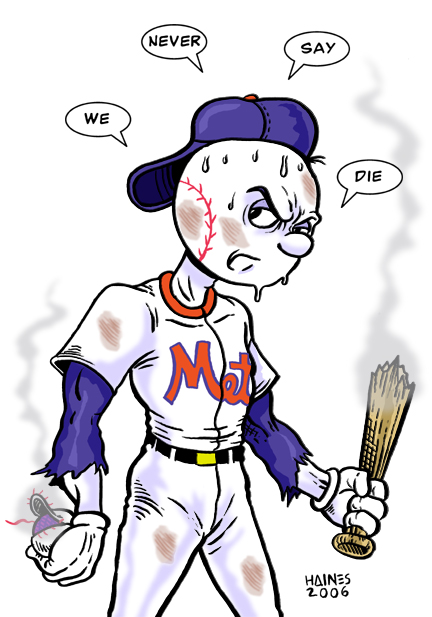
| Normally a blowout loss in the making that gets close enough to become a frustrating coulda-been win leaves me in a bad mood. But I liked what I saw in Toronto Saturday. Not the falling behind 6-0 and the skewed removal of Orlando Hernandez at the umpires’ behest, but the battling back against Roy Halliday, the continual chipping away at a big lead, the continued awesomeness of Reyes and Wright, the rescue squad work of Darren Oliver and everybody’s never-say-die attitude. Yeah, Valentin and Nady had awful at-bats with the bases loaded in the eighth and no, nobody did a damn thing against B.J. Ryan (why didn’t we sign him instead of Wagner?), but they didn’t take the afternoon off. Good on them.
Here’s to a team-record road winning streak of nine just completed. And here’s to starting another one real soon. With this team, anything is possible.
Mr. Met never says die, certainly not at Zed Duck Studios. |
|
|
by Jason Fry on 24 June 2006 8:41 pm Every year about this time it happens to me: Baseball fever.
I don't need to imply I'm exactly immune the rest of the year — co-writing this little blog ought to be evidence enough of that, not to mention The Holy Books and the spending 15 or 16 of my 17 waking hours wondering and worrying about whichever 25 men make up the current roster of the New York Mets. But this is the time of year when the mania hits overdrive. No sooner had the Mets finished up with the Blue Jays last night than I flipped over to see how the Marlins were faring against the Yankees — not so much out of Yankee hatred (though I was disappointed to see them win) but out of hunger for more baseball. Today, when 1 p.m. rolled around, I headed for FOX, knowing full well the Mets wouldn't be playing until the oddly precise time of 4:07 p.m., but willing to accept whatever game would await me. I found Boston-Philadelphia, and watched perfectly happily: Again, not so much to root for the Red Sox and the possiblity of a 12-game lead over Philadelphia, but just to have pitchers and batters and green grass for company. And it'll be like this until September, when the hammer comes down and every game is life and death (note to baseball gods: September cakewalk to division title would be happily accepted, rendering normal script moot) and I need some time away from baseball between Met games just to avoid going irretrievably insane.
I suppose the above confession means this is a perfect time to play the Toronto Blue Jays. Because it's really tough to imagine caring about these games except while in the full flush of baseball fever.
This is the flip side of a foaming-at-the-mouth yellfest against the Yankees, and the dark side of interleague play: obstacle after obstacle between me and giving a rat's ass.
* It's an American League game in an American League park. That means the designated hitter. I know it's a cliche to hate the DH, but cliches get overused because they're so well-suited for describing the world. Sunny days are nice, getting bit by a rabid dog sucks, and the designated hitter trashes an essential check and balance of baseball — stick with your hurler late or pinch-hit in search of that desperately needed hit — in brain-dead worship of offense that also encourages headhunting and allows one-dimensional players to march steadily up the columns of the record books when they should be in a Barcalounger or a duck blind. These things are all obvious, but they bear repeating. At least when we're playing an AL team at Shea we get to play by the real rules.
* It's in another country. Nothing against Canada, which very patient Canadian friends have finally persuaded me is not actually an ice plain dotted with bears and frightened people dressed very warmly. But particularly with the Expos now reincarnated on U.S. soil, a game against the Blue Jays feels like a weird, late-March exhibition. What exactly are we doing in Canada? Will something bad happen to us at Customs? When do we get to come home?
* It's the Blue Jays. The first year I collected cards was 1977, when the Blue Jays and Mariners made their debuts, and I was fascinated by all the players with strange caps airbrushed onto the general vicinity of their heads. Back then the Blue Jays had a certain futuristic charm: Their typography and even their bird logo was dominated by unconnected forms, giving them a Computer Age As Imagined In The 70s feel, like the dots and dashes of a then-rare computer printer. Now? They're Padres East: They always seem to unveiling new logos and uniforms, and the only certainty is that the result will be simultaneously awful and reek of desperation, the way stuff produced by biz-school consulting drones bullying brain-dead focus groups always is. This was an awfully good franchise for a long time (and this year could offer the Red Sox and Yankees a welcome reminder that the AL East is not their private pasture), but if the Blue Jays have an identity these days, it's lost on me.
* It's on turf. Granted, today's turf is not yesterday's cartoon-colored, billion-degree, no-give turf, but it's still turf. The National League is blissfully free of it. I like being blissfully free of it.
So: an American League team, with some weird/bad logo, on turf, with the DH, in another country. And you're telling me it's not an exhibition? Well, OK. I'll be watching — the Mets are the Mets and I'm me, after all — but I'll be happier when we're in Boston or New York, and happier still when we're playing Pittsburgh.
by Greg Prince on 24 June 2006 12:17 pm If we all agree on the not-such-a-stretch principle that David Wright is the best regular player ever produced by the Mets…make that if we all agree on the not-such-a-stretch principle that no regular player produced by the Mets has ever come as far as fast as David Wright has, then I won’t feel I’m rushing things to reveal a revelation I had last night.
David Wright’s third season in the Majors is 2006.
Tom Seaver’s third season in the Majors was 1969.
There was no doubt by 1969 that Tom Seaver was the best pitcher ever produced by the Mets. In fact, there was no doubt by 1967 that Tom Seaver was the best pitcher ever produced by the Mets.
After two very good seasons in 1967 and 1968, Tom Seaver emerged as the best pitcher in the National League in 1969 with a season for the ages.
After two very good seasons in 2004 (half-season, actually) and 2005, David Wright is emerging as the best player in the National League in 2006 with what appears to be a season for the ages.
At this stage of 1969, after the Mets had played 73 games, Tom Seaver was 12-3 with a 2.57 ERA and 106 strikeouts in 133.1 innings. With his most recent win, he had taken over the all-time franchise lead from Al Jackson for victories among pitchers with 44. He’s held it ever since.
At this stage of 2006, with the Mets having played 73 games, David Wright is batting .337 with 18 home runs and 63 RBI in 285 at-bats. After his three-run homer off Casey Janssen of the Blue Jays Friday night, he moved into a 35th-place tie for most runs batted in by a Met (205) and is in sole possession of 25th place on the team home run chart (59).
Tom Seaver won the 1969 National League Cy Young Award and placed second in the Most Valuable Player voting as a pitcher.
David Wright can’t win the Cy Young Award as a third baseman, but he does hear unrelenting chants of “MVP!” at home, and having watched him turn Rogers Centre into yet another House of David, they don’t seem terribly exaggerated.
Tom Seaver would be a star among stars for a generation, win 311 games in his career and enter the Hall of Fame on the first ballot via the greatest percentage of ballots cast of any player ever.
David Wright’s only in his third year, his second full one…y’know?
The Mets won the World Series in 1969.
The Mets have an eleven-game lead in the National League East as we speak in 2006. There’s no accounting for what will happen the rest of the way, so I leave it to you to draw your own conclusions, make your own projections and dream your own dreams of what might be.
(Feel good, Duaner — we need you. And stay strong, Cliff — we miss you.)
by Greg Prince on 24 June 2006 2:06 am Welcome to Flashback Friday, a weekly feature devoted to the 20th anniversary of the 1986 World Champion New York Mets.
Twenty years, 43 Fridays. This is one of them.
Interleague play in 1986 was limited to eight games and they involved the same two teams. It was Mets 5 Red Sox 3. Seven of those contests were in the World Series, one was a September warmup.
Whaaa…? There was a preliminary? Yes. The Mets and Red Sox played each other on September 4 at Fenway. It was a charity affair to benefit the Jimmy Fund. Consider it a Mayor’s Trophy Game as facilitated by the Delta Shuttle.
It kind of came out of nowhere. When it appeared on the pocket schedule, it mandated a double-take. But as the season went on and the Mets and Red Sox showed every sign of locking down their respective divisions, it was billed as a World Series preview. (Bet that went over big in Houston and Anaheim.)
As an exhibition, it wasn’t important. But it was significant. Here’s Joe Klein from New York magazine that September:
It was a meeting between two teams that have a shared heritage of frustration and romance over the past quarter-century, and a surprising number of mutual fans. “There is,” says Bill James, the baseball scholar, “a definite type of fan in the Northeast, the Mets-Red Sox rooter. They are your dyed-in-the-wool Yankee-haters.” They are intellectual sorts, by and large, New Yorkers who went to school in Boston and fell in love with the Sox and Fenway; Mets fans who sought a more direct way to root against the Yankees. The prospect of a World Series between these two long-suffering fellow travelers is, at once, enormously satisfying and an existential nightmare: It would be a Subway Series of the soul.
As that exhibition came and went and, more importantly, as the collision course between New York (N) and Boston (A) for real stakes appeared inevitable, Klein’s point was proven. At least for me.
I’m assuming that every Mets fan’s kneejerk answer to “who’s your favorite American League team?” at some juncture or another in their lives has been Red Sox. They were for me from the time I learned who the Red Sox’ primary rival was; enemy of my enemy and such. Though I had never been any closer to Boston than an hour in Albany, I carried my FauxSox pride to extremes as they battled the Yankees in the late ’70s. I still remember being thought of a Red Sox fan by a particularly obnoxious Yankees fan who worked in the East End Dairy in 1978 because it was the B-for-Boston cap I wore every day that summer.
That didn’t work out so well.
After ’78, I didn’t wear the Red Sox regalia very much, preferring to be known as a Mets fan and only a Mets fan. The Red Sox faded from perennial contention in the early ’80s. I rooted for the Royals, the Brewers, the Orioles, the Blue Jays…whoever was keeping the Yankees in their place. My first pilgrimage to Fenway Park came in 1985 with mixed emotions. Tom Seaver was pitching for the White Sox, gunning for his 299th win. After idealizing the joint from afar, I wore Boston’s cap and rooted for Boston’s opponents. Tom won. I was happy for him.
One year later, the Red Sox raced to the top of their division and I could watch them on their flagship TV station, WSBK, carried by Cablevision of Long Island. They had that guy Roger Clemens who struck out 20 Mariners and April and Wage Boggs the perennial batting champion and admirable old men like Dwight Evans and Jim Rice and Bill Buckner and colorful names like Oil Can Boyd. I was happy for them.
Then at the end of June, they got Tom Seaver and I was ecstatic. Tom Terrific — my idol — on my more or less favorite American League team. He could tutor Roger Clemens (seemed like a good kid). Tom joked that all he could tell Clemens was when the bus leaves and to be on time. Great line. With him pitching and being backed up by such a good lineup, Seaver might even get to another World Series.
Uh-oh.
In my spare baseball moments of 1986, I wondered how I’d react if the Mets and Red Sox did meet. Oh, I don’t mean the ultimate outcome. It wasn’t much of a Subway Series for my soul. Mets in four or less, as far as I was concerned. But to watch them bat against Tom Seaver and to actively root for the failure of Tom Seaver on the national stage, in his first World Series in thirteen years? Choosing, possibly, between Tom Seaver, my all-timer and Dwight Gooden, my right-now’er?
Never happened. Tom got hurt in Toronto on September 19. He didn’t make the World Series roster. One of my eternal grudges against NBC is they never showed the player introductions at Shea before Game One. I wanted to see Tom’s reception. I still don’t know if it was overwhelming or if he was viewed as just another stranger in a gray uniform scheming to take away what would be rightfully ours. It was one thing to cheer Tom Seaver the visiting Red when the Mets were brutal and wounds over his departure were still raw. It was another when he was part of a team getting in the way of the Holy Met Grail.
Hey! Seavuh! Don’t tell Clemens nothin’ he could use against us!
Without Seaver, there was nothing about the Red Sox that particularly engaged me by September, let alone October. I was annoyed that Clemens had taken over Gooden’s mantle as Best Young Pitcher in the game. Sure, he was probably a swell fellow, but he was also an obstacle. Boggs? Glad he was sticking it to Mattingly in the batting race, but that’s a bat I didn’t want to see. Evans? Rice? Buckner? No thanks. I hoped we’d see the Angels after the Astros. They had guys who had fallen short of the Series too often. The Red Sox had been absent since 1975, but I was already feeling Boston fatigue, Yankee-hating simpatico or not.
Apparently, I wasn’t alone. I offer an opposing viewpoint to Joe Klein’s, from another writer, a friend of mine named Sharon Chapman. She and her husband Kevin lived in Boston in ’86, completing legal studies that summer. Before decamping to the homeland in time for a Met October, she formed her impression of our potential enemy of ourselves:
We lived within walking distance of Fenway. Our first two years we lived so close to the park, and in such a crappy neighborhood, that we didn’t have any real lighting at night unless the Red Sox were playing a night game. That was a five-minute walk from Fenway. For our third year, we had closer to a ten-minute walk, although we were right off of Beacon Street, which was nicer and closer to school. We attended Opening Day at Fenway in 1986, in the bleachers, along with Kevin’s Law Review compadres (he’s the smart one). It was the first home game of the season. As the team was introduced for the first time that year, manager John McNamara was loudly booed. I distinctly remember thinking at the time that fans who would boo their manager on Opening Day did not deserve to win anything. So when the Fenway Faithful complain about how much they suffered that season, in my opinion they brought a lot of it upon themselves. I never warmed to the Red Sox, despite living so close and seeing a lot of games in their stadium. From the moment we pulled into town with our little rented U-Haul van, I took an instant dislike to that team. And Fenway is a dump.
Sharon and Kevin overcame their Lyric Little Bandbox misgivings to attend Tom Seaver’s first game as a Red Sock. “We couldn’t not go,” she says. “He was always my favorite when I was a kid. The only time in my life I ever cut classes in college was to see him pitch Opening Day 1983.” They missed out on another piece of Red Sox history, however:
The game we almost went to that season was Clemens’ 20-strikeout game. We were thinking of going and buying tix at the gate — that was never an issue in the mid-’80s — but we had to study for the bar exam so we passed on the game.
What a shame, missing a moment like that…or not.
“In retrospect,” Sharon’s decided, “I’m glad that I wasn’t there for that asshole’s moment of glory.”
|
|






