

You may have noticed the New York Mets played no postseason games in 2025. To compensate for our favorite team’s autumnal shortfall, we are happy to have harvested a bushel of postseason Mets games as a coda to the completion of the most recent World Series…even if none of them is from 2025.
Faith and Fear in Flushing proudly presents an update to its 2020 feature that endeavored to rank EVERY Mets postseason game ever played. At the time of its initial publication, the Mets had participated in nine postseasons and 89 games therein. Five years later, those totals have risen to eleven and 105, respectively. Below we examine every fall festival in which the Mets have partaken and seek to contextualize every Wild Card (1), Wild Card Series (6), League Division Series (20), League Championship Series (49), and World Series (29) game the Mets have played, daring to put them in order, No. 105 to No. 1.
The motivation for such an exercise, as spelled out in 2020 — with numbers revised to reflect current totals:
The Mets have played 105 postseason games, winning 59 and losing 46. When each was played, each was the biggest game of all time to us. That’s how the postseason is when our team is involved. But when we pull back, years and decades following 105 final pitches, not all throb with the same meaning we attached to them as they alighted and unfolded in 1969, 1973, 1986, 1988, 1999, 2000, 2006, 2015, 2016, 2022, and 2024. Some we talk about constantly when we talk about the Mets. Some we think about probably every day since they happened. Some we attribute all kinds of enduring mishegas to even if they were only one game. Some thrust us forward. Some stopped us cold. Some dictated much of what came next. Some are memorialized and revered. Some, somehow, were plowed under by the games and seasons that came next. Each, in one way or another, informs who we are as Mets fans and how we consider the Mets when we consider the Mets…which is what people like us do with as little pause possible.
There’s no statistical formula to this, just loads of paying attention and 105 episodes of revisitation. These rankings are rendered in good faith, sans fear. It’s not a My Favorites list, regardless of the subjectivity inherent. It’s not a Best Games list, exactly, though aesthetics certainly influenced the contemplation. It’s not a wholly YAY METS list, either. Each of the 105 postseason games the Mets have played tells a story to us as Mets fans and to all as baseball fans: the impressions they left, the legends they created, the myths they made, the resonance that resounds, the history that lives on. These are 105 games that explain us and define us, for better and for worse.
The 46 Met losses, unfortunate as it is that they exist, are intermingled here with the 59 Met wins. No harm to any Mets fan’s psyche is intended by being brutally inclusive. Our self-perception, as well as that the world at large has developed of our ballclub, is based largely on these October/November successes and the not-quite-successes. To play in postseason implies success to begin with. Failure may not be an option, but it’s also not the right word to describe any team that gets as far as these eleven Met teams did. Still, sometimes history turned on the games that got away. Or at least seemed as if it did.
 The sixteen games that have transpired since the list’s original incarnation have been plugged in where deemed appropriate, naturally affecting the earlier rankings, but none of the games that predate this updating have otherwise exchanged places. A modicum of tweaking to the text has been done for exposition’s and clarity’s sake, but the commentary for the games spanning 1969 to 2016 is mostly the same as it appeared when published in 2020. For the record, the bulk of each of the 2022 and 2024 entries was written in the immediate aftermath of when those games happened, as I figured I’d be revising all this eventually.
Eventually has arrived. Here’s hoping more Mets postseason action will follow — and give us something to be thankful for — in the years ahead.
 105. OCTOBER 13, 2024 — NLCS Game One: DODGERS 9 Mets 0
The concept of “just one game” never loomed larger after the Mets lost by their largest postseason margin to date. Kodai Senga, attempting to build his endurance to three innings, never made it out of the second. The bullpen wasn’t better, the offense was tepid versus Jack Flaherty (Jesse Winker, one of the few Met baserunners, pulled a boner between second and third to kill the closest thing to a rally the Mets mounted all night), and the defense committed a pair of errors. After the game, it was reported Brandon Nimmo was dealing with plantar fascitis, explaining the limp he displayed in the series opener. The whole team limped toward the next day, when the sun rose and the Mets were granted a chance to pull even in their next version of just one game.
104. OCTOBER 16, 2024 — NLCS Game Three: Dodgers 8 METS 0
Temperatures dropped in Flushing as did the probability that the Mets would grab a series lead. If you listened closely, you could almost hear winter clearing its throat. Luis Severino, named a Gold Glove finalist the day before, had trouble with a couple of comebackers, which helped lead to the first two Dodger runs in the second; the Met starter lasted into the fifth and didn’t give up anything else. Meanwhile, Walker Buehler, on the long, hard road back from Tommy John surgery, returned to ace form for four scoreless innings, assisted a bit by the Flushing winds that knocked down what could have been a couple of game-turning longballs. The Dodger pen lived up to its notices, stymieing the Mets offense the rest of the way, as a trio of Dodger sluggers — Kiké Hernandez, Shohei Ohtani (unstoppable with runners in scoring position all postseason) and Max Muncy — went deep off of Met relievers and salted away a whitewashing that looked and felt a lot like the Game One blanking the Mets endured at Chavez Ravine, except it was warmer then and more time remained to shake off such a miserable loss.
103. OCTOBER 17, 2024 — NLCS Game Four: Dodgers 10 METS 2
The Mets matched the Dodgers’ run total, not in the runs category, but rather the number of at-bats they took with runners in scoring position. They came up ten times with a chance to drive in a runner from second and/or third, yet took a collective ohfer. The Dodgers, meanwhile, went 6-for-15 in the same category, and that was pretty much all she wrote as L.A. moved to within one game of a World Series berth and New York trudged closer to putting a great deal of postseason merchandise on remainder.
102. OCTOBER 14, 2000 — NLCS Game Three: Cardinals 8 METS 2
The weather was great, with temperatures peaking in the high seventies. The Mets came in with all the momentum inherent in a two-nil series lead. Then they were clobbered. Rick Reed threw his only bad postseason start. The Mets’ only two runs scored on double play groundouts. Yet when it was over, the Mets still maintained their momentum, with two more home games directly in front of them. It made for a sunny forecast.
101. OCTOBER 6, 1999 — NLDS Game Two: DIAMONDBACKS 7 Mets 1
Adrenaline carried the Mets through four absolute must-win games over Pittsburgh and Cincinnati to get them into the playoffs and propelled them high above Randy Johnson & Co. to grab a series lead once they landed in Arizona. They likely needed a breather. Versus Todd Stottlemyre and the Snakes, they took a nap.
 100. OCTOBER 4, 2000 — NLDS Game One: GIANTS 5 Mets 1
This one played to the form expected in some circles. The top-seeded Giants jumped on the Wild Card Mets to stake themselves to an early advantage. Past World Series MVP Livàn Hernandez handled the Mets with ease. Derek Bell sustained an ankle injury that ended his postseason. By the time this NLDS was done, Hernandez’s mastery and Bell’s absence would barely be footnotes.
99. OCTOBER 15, 2006 — NLCS Game Four: Mets 12 CARDINALS 5
Oliver Perez made his first postseason start. David Wright hit his first postseason home run. Carlos Beltran went deep twice. The Mets set a franchise record (since bettered) for most runs in a postseason game. Most importantly, they evened a series that threatened to get away from them. And nobody ever brings any of it up.
98. OCTOBER 20, 2015 — NLCS Game Three: Mets 5 CUBS 2
How about that time Jorge Soler fell down in right and allowed Wilmer Flores’s ball to roll all the way to the wall, letting Wilmer scoot to third and scoring Michael Conforto all the way from first, extending the Mets’ sixth-inning lead to 4-2? If you remember that, it’s your mind playing tricks on you, or perhaps you stepped away while the ball was deemed to be stuck under the ivy. The potentially highly memorable moment was downgraded to a ground rule double, sending Conforto back to third. Neither baserunner scored and Jacob deGrom got back to silencing the Cubs regardless.
97. OCTOBER 5, 2006 — NLDS Game Two: METS 4 Dodgers 1
96. OCTOBER 12, 2006 — NLCS Game One: METS 2 Cardinals 0
Tom Glavine’s finest moments as a Met, so fine we have opted for the spelling by which he was identified prior to 9/30/2007. Six innings to chill the Dodgers one Thursday. Seven innings to ice the Cardinals one Thursday later. Shea Stadium roared in support of its lefty ace twice. This really happened, less than a year before Tom Glavine became T#m Gl@v!ne.
 95. OCTOBER 2, 2024 — NLWCS Game Two: BREWERS 5 Mets 3
“Six outs away” loomed as the stuff of regretful legend when Phil Maton allowed three eighth-inning runs on two home runs to turn a tenuous 3-2 Mets lead into a crushing 5-3 deficit and grant the Brewers all the momentum in the world or at least Wisconsin. So close to clinching a trip to the next round, so far from actually sealing the deal. Would a night when the Mets stopped scoring after the second and left nine runners on base come back to haunt them? Only the Polar Bear knew for sure, and he wouldn’t reveal the answer until late in Game Three.
94. OCTOBER 8, 1999 — NLDS Game Three: METS 9 Diamondbacks 2
Shea’s first postseason action in eleven years was destined to be overshadowed by Shea’s next postseason action the following afternoon. This Friday night featured Todd Pratt’s first postseason start, which itself was overshadowed by the reason Tank was starting, namely the unavailability of the usual starting catcher, Mike Piazza. For the record, Pratt walked twice and scored a run. It wasn’t Pratt’s finest hour (that would come in less than 24 hours).
93. OCTOBER 14, 2006 — NLCS Game Three: CARDINALS 5 Mets 0
It deserves to be remembered parochially as the Darren Oliver Game, so named for the six innings of scoreless relief the ageless lefty gave Willie Randolph from the second through the seventh. If it’s remembered at all, it’s for the five runs Steve Trachsel gave up in the first. Really, it’s not remembered much.
92. OCTOBER 28, 2015 — WS Game Two: ROYALS 7 Mets 1
Jacob deGrom was on his way to emerging as one of the premier starter of his generation, yet his first (and thus far only) World Series start is the most obscure game among five his team played in their most recent and perhaps most star-crossed Fall Classic.
91. OCTOBER 17, 2006 — NLCS Game Five: CARDINALS 4 Mets 2
Game Five in a seven-game series is either decisive or pivotal. In hindsight, this one was both, backing the Mets to a wall from which they would never effectively detach. Yet this particular T#m Gl@v!ne disappointment (4 IP, 7 H, 3 BB, 3 ER) escapes collective memory, while Jeff Weaver (6 IP, 6 H, 2 BB, 2 ER) is rarely berated in the realm of opposition villainy.
 90. OCTOBER 18, 2015 — NLCS Game Two: METS 4 Cubs 1
The set of contests that determined where the 2015 National League pennant would fly has settled in memory into a blur of Daniel Murphy home runs. This game definitely featured one of those.
89. OCTOBER 1, 2024 — NLWCS Game One: Mets 8 BREWERS 4
The designated hitter rule represented blasphemy to hardcore National League types from the moment the American League adopted it in 1973. In real baseball, pitchers hit for themselves, never more gloriously than on May 7, 2016, when Bartolo Colon, nearing the age of 43, socked the first home run of his career. If Bart was no longer an automatic out, no pitcher should ever be considered one again. Alas, alleged progress’s encroachment on authenticity proved unstoppable. When the DH infiltrated the NL to stay in 2022, rock-ribbed traditionalist Mets fans couldn’t help but grimace that their beloved senior circuit had given in to this passing fad. They probably also noticed the Mets were having a hard time making use of the innovation intended to generate offense. In the wake of an era when the Mets had pitchers who were capable hitters (not just Colon, but the likes of Syndergaard, Matz, Harvey, Wheeler and the still extant deGrom), the 2022 Mets went to the playoffs with two designated hitters — Daniel Vogelbach and Darin Ruf — and received exactly no hits from them.
In 2024, with a club that had just stormed into the postseason under the banner of actual Grimace, the existence of the DH within their own domain wound up giving Mets fans a reason to briefly smile without scorn for what commissioner Rob Manfred had done to further destroy the integrity of their beautiful game. In the second inning of the Wild Card Series opener, DH Jesse Winker slashed a two-run triple off Brewer ace Freddy Peralta to pull the Mets into a 2-2 tie (cameras captured fierce jawing between Winker and former teammate Willy Adames on Winker’s route from second base to third, likely another outgrowth of Jesse being Jesse and not everybody loving him the way Mets fans had come to). In the fifth, responding to a Milwaukee pitching change, Carlos Mendoza opted to pinch-hit J.D. Martinez for Winker with the bases loaded, the usual fulltime DH subbing for a DH who sometimes played the outfield. Neither Met had been as much as lukewarm most of September — Martinez challenged the Mets’ franchise ohfer record by going hitless in 36 consecutive at-bats — but October was here, and so was J.D.’s long-proven ability to drive runners home. He smacked a two-run single to right to provide an 8-4 lead for Luis Severino, a starter who had struggled early in the game, but was still on in part because National League managers no longer had to think about pinch-hitting for their pitchers. The Mets wouldn’t do any more hitting on the night, but Severino, Jose Butto and Ryne Stanek combined to put down the final 15 Brewer batters in order, allowing the Mets to be designated winners.
88. OCTOBER 13, 1999 — NLCS Game Two: BRAVES 4 Mets 3
87. OCTOBER 12, 1999 — NLCS Game One: BRAVES 4 Mets 2
Setbacks at Turner Field, even in October, all looked alike for a dismal spell there in the late ’90s. The second showdown in Atlanta sticks out a little more than the first thanks to it including Melvin Mora’s first major league home run (and, if one wishes to be Metsochistic, the loss going to Kenny Rogers).
86. OCTOBER 8, 2022 — NLWCS Game Two: METS 7 Padres 3
The status of deGOAT was at least a little in question. Jacob deGrom was the consensus pick as premier pitcher on the planet from 2018 to the middle of 2021, ascending from the flowing-locks comer he’d been when he helped the Mets to the 2015 pennant to a superhuman league of his own. Unfortunately, while deGrom cut his hair and gained cachet, the Mets mostly lost, whether he pitched or not. Then Jake missed the second half of ’21 and the first four months of ’22 with injuries. When he returned to action, the team was doing wonderfully and Jacob picked up where he left off…for a while. By late September, the Mets’ stumble from undisputed occupancy of first place coincided with deGrom’s disturbing bouts of fallibility. Now the ball was in his right hand to keep the Mets alive versus the Padre — and, if business turned out to be business, perhaps it would be the final time he’d pitch before Citi Field fans as the home starter. Jake had made clear he’d exercise the opt-out in his contract, and after that, who knew what his free agent future foretold?
The present was priority, though, and for six innings, deGrom was as deGOAT as he needed to be, snuffing San Diego threats across six innings, limiting the opposition to two runs, striking out eight and leaving with a 3-2 lead. The Met offense, rarely Jacob’s biggest supporter, not only put him ahead on Francisco Lindor and Pete Alonso home runs, but provided the relievers who followed him with a plush cushion manufactured via a best-case 2022 Mets kind of rally in the seventh, grinding two ten-pitch walks to set up four additional runs. The Mets stayed alive and deGrom stayed a Met, each preserving those precious statuses for another day.
 85. OCTOBER 9, 1986 — NLCS Game Two: Mets 5 ASTROS 1
In the fifth inning, Nolan Ryan knocked down Lenny Dykstra. Lenny Dykstra got up and singled off Nolan Ryan. Lenny Dykstra would score after Wally Backman singled and Keith Hernandez tripled off Nolan Ryan. Immortals. Legends. Characters. Drama! And together the whole thing usually rates, at most, a paragraph in retellings of this sizzling series.
84. OCTOBER 12, 1986 — NLCS Game Four: ASTROS 3 Mets 1
The yellow highlighter of the 1986 NLCS. It made sure you would remember “Scott” was crucial in knowing what to study for in preparing for the big test.
83. OCTOBER 23, 1986 — WS Game Five: RED SOX 4 Mets 2
Roger Angell was impressed by this one because it was Fenway Park’s last chance to exude enthusiasm for the year; “less than a classic, perhaps, but there was spirit and pleasure to it.” Surely there were also visiting-team charms to be derived from it, as Tim Teufel homered and doubled in the Mets’ only runs, and Sid Fernandez turned in four foreshadowy innings from the pen, but any footprints Game Five left behind were about to be stomped out but good.
82. OCTOBER 15, 1999 — NLCS Game Three: Braves 1 METS 0
Gl@v!ne outpitches Leiter. Rocker taunts the howling masses. The Mets face elimination. A series that appears to be out of breath gasps ahead of its second wind.
81. OCTOBER 12, 2000 — NLCS Game Two: Mets 6 CARDINALS 5
Close, back-and-forth, see-saw affair, with the Mets eking out a lead in the top of the ninth and Armando Benitez holding tight to it for a commanding series lead. The Mets couldn’t do any better in terms of results, but for an outfit that does postseason drama as a matter of course, it doesn’t particularly pop.
 80. OCTOBER 13, 2015 — NLDS Game Four: Dodgers 3 METS 1
Clayton Kershaw picks this opportunity to shed his postseason reputation for not-so-hotness, keeping the Mets from clinching a series at home, but in defeat, Daniel Murphy makes it a night to begin a historic streak to remember.
79. OCTOBER 6, 2024 — NLDS Game Two: PHILLIES 7 Mets 6
The good news: four Met home runs, including two from Mark Vientos, one of which tied the game in the ninth. The bad news: Bryce Harper and Nick Castellanos combined for two homers in the sixth, erasing a 3-0 Mets lead, with Castellanos coming through again in the bottom of the ninth with the game-winning hit off Tylor Megill (a tired Edwin Diaz had already contributed his part in the seventh for better and the eighth for worse). The consolation: the Mets could finally return to Citi Field and look forward to playing a home game after two weeks, regular season and postseason, on the road.
78. OCTOBER 8, 2024 — NLDS Game Three: METS 7 Phillies 2
The MTA sent a Grimace train out to the Mets-Willets Point stop, and don’t think fans didn’t light up when their lucky charm stepped out of one of the cars. The co-branding exercise between the ballclub and the fast food franchise for whom the big purple blob usually pitches was part of the Met kismet all summer long. Fall had at last arrived at Citi Field in the form of postseason baseball, so all the talismans were out in force. You could wave your OMG signs, you could clutch your playoff pumpkins, you could be one of the 44,000-plus screaming your head off, but mostly you could watch Pete Alonso and Jesse Winker go deep; Starling Marte and Jose Iglesias be clutch; Tyrone Taylor and Mark Vientos nab baserunners; and Sean Manaea shut down the imposing Phillie lineup for 7+ innings. When it was over, the Mets — who’d been on the road for two weeks — were one game from an opportunity to clinch at home, a home that in October there was no place like.
77. OCTOBER 11, 1988 — NLCS Game Six: Mets 5 DODGERS 1
76. OCTOBER 18, 2006 — NLCS Game Six: METS 4 Cardinals 2
October’s Mets are known to their fans for the splendor of their Game Six efforts. These were indeed splendid, yet they’re not nearly so well known, their residue vacuumed up as they were by the Game Seven results to follow. Still, let us appreciate David Cone (CG five-hitter) and Jose Reyes (leadoff HR; 3 H; 2 R) carrying the Mets to necessary ties eighteen years apart.
 75. OCTOBER 7, 2022 — NLWCS Game One: Padres 7 METS 1
The great Max Scherzer was hired at significant expense ($130 million over three seasons) for this moment. The great Max Scherzer didn’t show up. Somebody wearing his uniform took the mound for the New York Mets’ first postseason game in six years, yet it’s almost unfathomable to connect the SCHERZER 21 credited with culturally transforming the Mets into a powerhouse to the SCHERZER 21 who surrendered four home runs — seven earned runs in all — before being removed to home crowd boos in the fifth inning. Were there lingering effects from the oblique injury that twice sidelined Scherzer during an otherwise triumphant 2022? Were there simple mechanical issues that Max might have adjusted had another start awaited him a few days later? Was age catching up to the 38-year-old lock Hall of Famer? Did it matter once the Mets found themselves down, 7-0, to perennial tormentor Yu Darvish? The Mets were playing in this new Wild Card round because the NL East title that would have ensured them a bye to the League Division Series slipped away in a showdown at Atlanta late in the regular season, and Scherzer hadn’t been particularly great in that battle, either. “It’s baseball,” the club’s co-ace said later. “You get punched in the face. It doesn’t matter who you are.” Mets fans nursing an ice pack against their collective jaw after falling behind in the best-of-three set were in no position to argue.
74. OCTOBER 20, 2024 — NLCS Game Six: DODGERS 10 Mets 5
Starter Sean Manaea (2+ IP, 6 H, 2 BB, 5 ER) didn’t have it. Half among the six relievers who Carlos Mendoza called upon after dismissing Manaea in the third didn’t have it, either. Seven of nine Met batters who batted with runners on base didn’t have what it took on their end. Thirteen Met baserunners looked longingly at home plate but did not cross it. The Dodgers, MLB’s “it” team had it all, or at least the National League pennant by night’s end. L.A.’s blend of superstars, simply stars and requisite October surprise personnel — heretofore unsung shortstop Tommy Edman won NLCS MVP honors — combined with a solid enough bullpen to run out the clock on New York’s Cinderella story. Pete Alonso’s good-luck playoff pumpkin was last seen “settled at the bottom of a blue trash can in the visitors clubhouse at Dodger Stadium,” per Tim Britton of The Athletic, right where you might have found any of Mendoza’s preliminary plans to piece together another desperate pitching strategy for Game Seven. In the Mets’ four losses, their well-worn arms gave up 39 runs…and their first baseman one talisman gourd. But OMG, the team of memes itself never gave up. They just didn’t have quite enough to battle all the way to the World Series. Mets fans could hold their heads high in the aftermath of the year’s final loss, though could certainly be forgiven if all they could manage the morning after was one dour grimace.
73. OCTOBER 18, 1973 — WS Game Five: METS 2 A’s 0
Little is more Metsian than Jerry Koosman coming through in the postseason. Nothing is more Metsian than Tug McGraw slamming his glove to his thigh upon closing out a win. Together, the legendary lefties crafted a most Metsian shutout and pushed their club to the brink of a world championship.
72. OCTOBER 17, 2015 — NLCS Game One: METS 4 Cubs 2
Harvey outpitches Lester. Murphy goes deep. D’Arnaud dents the Apple. Mets never trail. After seven losses to the Cubs in seven regular-season contests, the tone between the two teams is reset.
71. OCTOBER 7, 2006 — NLDS Game Three: Mets 9 DODGERS 5
The previous instance in which Greg Maddux started a postseason game against the Mets, Game Five of the ’99 NLCS, day turned to night, the innings totaled fifteen, a fair ball that left the park was ruled something less than a home run and, when it was all over, Atlanta’s lock future Hall of Famer was demoted to an afterthought no more obvious to the outcome than his New York counterpart, Masato Yoshii. The forty-year-old Maddux of 2006 who threw only four innings in what loomed as the Division Series finale might have no longer been the Cy Young-in-residence of the 1990s, but it was still gratifying to watch the Mets outlast an old nemesis. Between withstanding Maddux and sweeping the Dodgers, this game should probably stand out more in Mets lore. It didn’t necessarily stand out in that night’s scores, because the Mets advanced on the same day that the Yankees were eliminated in their ALDS, their dismissal a bigger New York story in the moment. To be fair, watching the Yankees exit, no matter that they stole some Metsian spotlight (and weren’t what they used to be, either), was also pretty gratifying. Or as Manny Acta and Jose Reyes said in call & response fashion in the postgame celebration out west, “Party in Queens, entierro in the Bronx.” Entierro, not incidentally, is Español for burial.
 70. OCTOBER 8, 1988 — NLCS Game Three: METS 8 Dodgers 4
69. OCTOBER 17, 1973 — WS Game Four: METS 6 A’s 1
It was the heat of the moment that defined a couple of frigid dates at Shea. In the moment, the heat got intensely hot. The controversy of 1988 involved Dodgers closer Jay Howell going to his glove for pine tar, which earned him a suspension from National League president Bart Giamatti. While L.A. argued the punishment did not fit the crime, the Mets emerged in the frozen muck of Flushing with the go-ahead game that seemed to swing momentum New York’s way. Fifteen years before, the man in the spotlight within a Series of legitimate stars was backup A’s infielder Mike Andrews, a pawn amid Charlie Finley’s ever-shifting manipulations. Commissioner Bowie Kuhn wouldn’t let Finley officially scapegoat Andrews, whose fielding had contributed to the A’s loss in Game Two, off Oakland’s active roster, so when Mike came up to pinch-hit in a game the Mets had well in hand (sore-shouldered Rusty Staub homered and drove in five), he was accorded a standing ovation by righteous Mets fans. Good sportsmanship, however it arrived, was by no means dead in Queens.
68. OCTOBER 5, 2024 — NLDS Game One: Mets 6 PHILLIES 2
If it was a day that ended in a “y” this particular week, there was an excellent chance that day included a five-run inning for the Mets. The same offense that crossed the plate five times in the eighth in Atlanta in service to clinching a playoff spot the previous Monday and put up a five-spot on the Brewers in the fifth on Tuesday revved up late at Philadelphia during this Saturday series opener. Their engines were silent for seven innings against Old Friend™ Zack Wheeler, but it was nothing but noise from the Mets bats when the Philly bullpen got involved. From down, 1-0, they rose to lead, 5-1, and looked every part the team of destiNY.
67. OCTOBER 18, 1986 — WS Game One: Red Sox 1 METS 0
66. OCTOBER 13, 1973 — WS Game One: A’S 2 Mets 1
Was this any way to start a World Series? In either case, no way. In both cases, the images that lingered were that of Met second basemen who couldn’t pick up simple ground balls: Felix Millan in ’73, Tim Teufel in ’86. Each E-4 led to an opposition run that made all the difference in getting off on the right foot versus shooting themselves in it. It was just one game twice…but a one-game deficit ASAP.
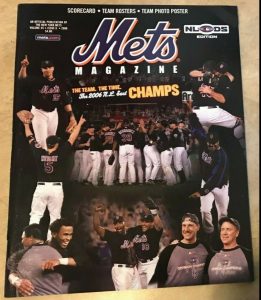 65. OCTOBER 18, 2024 — NLCS Game Five: METS 12 Dodgers 6
Down three games to one, the Mets weren’t too proud to beg for anything to change their luck — in this case, enlisting the Temptations to come to the ballpark before first pitch and lead the fans in singing “My Girl” all together, as had become custom ahead of every Francisco Lindor at-bat, anyway. Yes, the Mets had their backs to the wall, but on this night, backs to the wall meant the wall was in trouble once the Mets got going on this latest postseason do-or-die mission. The way this team did the things it did, that meant that with two runners on in the first inning, Pete Alonso put a ball well over Citi Field’s fence, and several of his teammates went on to assault said barrier with extra-base hits that sent the Dodgers scurrying in the direction of the deepest reaches of Flushing’s outfield. Four doubles, including three from Starling Marte. Two triples. Tons of what Carlos Mendoza reflexively labeled “traffic” on the bases (despite the Mets’ admonition to fans that they should use mass transit), with not a single Met batter striking out. All of it gave Mets pitching — starting with David Peterson for three-and-two-thirds and continuing through the yeoman efforts of Reed Garrett and Ryne Stanek and concluding with two shutdown frames from Edwin Diaz — plenty of cushion against an L.A. attack that had filleted Met starters and relievers alike the previous two nights. One borough over from where John Travolta strutted to keep pace with the Bee Gees, the Mets were stayin’ alive.
64. OCTOBER 9, 2022 — NLWCS Game Three: Padres 6 METS 0
Two ears. One hit. No chance. Joe Musgrove’s spin rate was so beguiling that by the sixth inning, Buck Showalter felt compelled to ask the umpires to check the Padres’ starter for suspect substances. Not in his glove, but behind his ears. Social media was alive with closeups of something shiny beneath the righty’s cap. The umps had a look and a feel. They were satisfied that nothing shady was hidden back there. Musgrove resumed his utter domination of the punchless Mets through seven. Pete Alonso’s single to lead off the fifth and Starling Marte’s base on balls in the seventh constituted the entirety of the Mets’ offense, an entity completely stymied by a pair of Padre relievers in the eighth and ninth in front of a not exactly packed house at Citi Field. Meanwhile, Chris Bassitt and several Met penmen succumbed to the Padres’ unrelenting attack, led by unlikely postseason hero Trent Grisham, who batted .500 from the eight-hole in his club’s three-game series victory. But “unlikely” and “postseason” always seem to know how to find one another.
The dozen wins that separated the 101-61 Mets from the 89-73 Pads in the regular season evaporated, much as the 10½-game lead the Mets held on the Braves at the beginning of June had. San Diego would be in the League Division Series round, thanks to beating the Mets, and they’d go on to upset the even more statistically imposing Los Angeles Dodgers (111-51). Atlanta would be there, too, thanks to a bye earned in large part from their beating the Mets, yet the Braves would go on to be upset by the least statistically impressive team in these NL playoffs, sixth-seeded 87-75 Philadelphia, a club that, oh by the way, was beaten fourteen of nineteen by the suddenly eliminated Mets between April and August. Alas, this was October, and the 2022 Mets, despite totaling the second-most wins in their history during the year — and despite claiming the exact same 162-game record as the division champion Braves (losing the East on a head-to-head tiebreaker) — would be idle until Spring Training, thanks to an early fall you couldn’t have foreseen amid the heights of summer.
63. OCTOBER 24, 2000 — WS Game Three: METS 4 Yankees 2
Lost amid the epic frustration of four losses that each stick in the craw for its own specific reason is the one Met win of the 2000 Fall Classic. It oughta be the other way around given all the compelling elements: Rick Reed strikes out eight in six; Robin Ventura homers; Todd Zeile doubles in the tying run; Benny Agbayani chases the heretofore indomitable El Duque; Brooklyn’s own John Franco gets the win; Armando Benitez, whose allergies clearly included October, garners the first Met World Series save since Jesse Orosco. And the Mets beat the Yankees! What more could a Mets fans want from a Subway Series? Three games more like it.
62. OCTOBER 10, 1988 — NLCS Game Five: Dodgers 7 METS 4
It was supposed to be a travel day. In a sense it was, as the Mets seemed to stand in the terminal waving goodbye to their chances to make their second World Series in three years. Rain the previous Friday forced the series into a Monday makeup barely enough hours removed from Sunday night’s twelfth-inning conclusion to have sleep rubbed from the home team’s eyes. The Dodgers, on the other hand, were all adrenaline, taking a 6-0 lead by the fifth. The Mets’ last best hope was snuffed in the bottom of the eighth when wunderkind Gregg Jefferies got himself called out by running into a batted ball. Shea mostly cheering an injury to Kirk Gibson turned karma in the same direction as momentum — against the Mets.
61. OCTOBER 14, 2024 — NLCS Game Two: METS 7 Dodgers 3
Who’d want to face Francisco Lindor when a home run could do you real harm? The Dodgers probably weren’t thinking this way when this game began, but maybe they should have. Opener Ryan Brasier pitched to Francisco and the resulting leadoff blast instantly reversed the momentum from the Dodgers’ whitewashing of the Mets the night before. An inning later, with the Mets now up by two, the Los Angelenos had to make a decision: try their luck with Lindor again with runners on second and third, or intentionally walk the East Coast MVP and load the bases for Mark Vientos. The shortstop had already burned them, so it was decided the best chance to avert further charring was pitching to the third baseman. As Vientos put it after the game, “I took it personal.” He also took the pitch he got from Landon Knack and deposited it into the right field stands to extend the Mets’ lead to 6-0. Sean Manaea and three relievers bent a little later, but it was the Mets who broke away from L.A. with what they wanted — a split of two games with the National League’s one-seed and a happy flight home to New York.
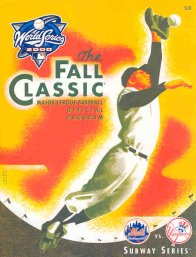 60. OCTOBER 5, 1969 — NLCS Game Two: Mets 11 BRAVES 6
59. OCTOBER 4, 1969 — NLCS Game One: Mets 9 BRAVES 5
Silly Mets thought they could get by on their sparkling young pitching and anemic offense. Sagacious Braves would teach Tom Seaver and Jerry Koosman about the pressure of October. Sure enough, neither of the aces who combined to record 42 wins in ’69 could escape the hammer of Hank Aaron and his Atlanta accomplices. Maybe taking down the champions of the Western Division was going to take more than a couple of talented arms. So the Mets brought more. Lots more. Twenty runs, divided almost evenly, carried the weekend and launched the Mets from the Launching Pad and toward a pennant (Art Shamsky alone had six hits). Seems it was the Braves who were taught a lesson, namely that when you get to October and face the Mets, expect the unexpected.
58. OCTOBER 13, 2006 — NLCS Game Two: Cardinals 9 METS 6
The Mets led the series, 1-0. They led the Cardinals at various junctures of Game Two by scores of 3-0, 4-2 and 6-4. They were using home field advantage to its fullest force. Then the Mets’ bullpen got a little too involved. Guillermo Mota, until Game Two a savvy pickup, imploded. Billy Wagner, most of 2006 a brilliant closer, did much the same. Throw in some shoddy outfield defense from Shawn Green and a little too much pluck and spunk from the likes of Scott Spiezio and So Taguchi, and, well, leads proved to be precarious things.
57. OCTOBER 5, 1988 — NLCS Game Two: DODGERS 6 Mets 3
Come and listen to a story by a man named Cone
Twenty-game winner couldn’t leave an edge alone
Before Game Two in his column with his ghost
Wrote himself some words that perturbed his playoff host
Tattooed he was
Vengeful style
Next thing you know David Cone is oh-and-one
Having a byline wasn’t any fun
Said, ‘Hey, Bob Klapisch — this column ain’t for me’
The Mets hopped on their flight, all tied for Game Three
56. OCTOBER 11, 2000 — NLCS Game One: Mets 6 CARDINALS 2
Mike Piazza had been a regular-season beast his entire career, but postseason opponents had yet to fully feel his wrath. Then, in the course of opening the series that would determine the pennant, Mike whacked a first-inning RBI double off Darryl Kile that inspired third base coach John Stearns to shout into his Fox clip-on mic, “The Monster is out of the cage!” By invoking for national consumption his fellow hard-nosed catcher’s clubhouse nickname, Bad Dude had enhanced Piazza’s legend. More importantly, Piazza, en route to batting .412 and slugging .941, had enhanced the Mets’ chances to take command of the NLCS. (Mike Hampton’s seven shutout innings didn’t hurt, either.)
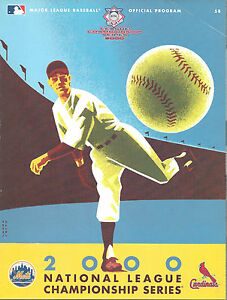 55. OCTOBER 4, 1988 — NLCS Game One: Mets 3 DODGERS 2
The invincible Orel Hershiser, he of the 59-inning scoreless streak that he rode to the end of the season, loomed large. But the Mets were on a roll of sorts, too. Not only had they come into the 1988 playoffs after tearing off 29 wins in 37 games, they hadn’t lost a postseason contest since a certain ball rolled through a certain Red Sox first baseman’s legs. This was a different October, but that old Met magic was brought to bear at Dodger Stadium. In the top of the ninth, with Hershiser ahead, 2-0, the Mets went to work like it was 1986. Darryl Strawberry cracked Orel’s latest string of goose eggs with a run-scoring double, and Gary Carter — the same Kid who started that tenth-inning rally versus Boston in Game Six two years before — stroked a double into center field to bring home Straw and Kevin McReynolds for a 3-2 New York edge. When Randy Myers set down L.A. in order in the bottom of the ninth, the Mets were up where they belonged: one-nothing over the Dodgers and three games from a presumed return to the World Series.
54. OCTOBER 19, 1986 — WS Game Two: Red Sox 9 METS 3
Fans of elite starting pitching couldn’t have asked for a better matchup to salivate over: the best of 1985, Dwight Gooden, versus the best of 1986, Roger Clemens. When the epitome of “highly anticipated” was over, connoisseurs of hurling were spitting the bad taste out of their mouths. Clemens, the 24-4 dynamo of the regular season, was a few shades shy or ordinary, not lasting long enough to earn a win. But there was a win for Boston, given that Red Sox batters more than made up for Clemens’s 4⅓ innings of five-hit, four-walk, three-run ball. The likes of Boggs, Barrett and Buckner jumped ugly all over Gooden, whose 24-4 slate from ’85 might as well have occurred in the prior decade. Doc’s six earned runs allowed all but buried the Mets by the fifth inning, and the throwback effectiveness of erstwhile Bosox closer Bob Stanley (3 IP, 0 R) prevented any chance of resurrection. The Mets were down oh-two in the World Series and could have been easily mistaken for dead.
53. OCTOBER 9, 1973 — NLCS Game Four: Reds 2 METS 1(12)
The villain gets his vengeance in what turns into the penultimate chapter of a playoff potboiler, as Pete Rose’s twelfth-inning homer off Harry Parker proves the difference. Rose’s sprint around the bases, as he raised a fist in the air to Shea’s vocal displeasure, cemented his role as Flushing’s quintessential heel. Of course the game was still in progress, with the home team in line to clinch a pennant, thanks to Rusty Staub’s dramatic robbery of Dan Driessen at the right field wall in the eleventh. Ironically, the Met crowd got more Rose and less Staub from the bargain, for Rusty wrecked his right shoulder and was doomed to sit out deciding Game Five, which was going to provide its own page-turning chapter to the proceedings. Obscured in the passions of Game Four: four-and-a-third scoreless innings of relief from Tug McGraw on top of six-and-two-thirds frames from George Stone that were marred by only a Tony Perez solo blast. Alas, the Mets could do next to nothing (1 R, 3 H) versus Red hurlers Fred Norman, Don Gullett, Clay Carroll and Pedro Borbon.
52. OCTOBER 9, 2015 — NLDS Game One: Mets 3 DODGERS 1
When the Mets were scuffling at midseason, they rated only one National League All-Star, Jacob deGrom. When the Mets roared to a division title, there were many who performed in stellar fashion, but there was no overlooking the guy who’d been great for them all along. Starting the Mets’ first postseason game in nine years, the NL’s most recent Rookie of the Year lived up to all his burgeoning billing, going seven strong innings, striking out thirteen Dodgers, and outdueling defending Cy Young/MVP Clayton Kershaw. Jake’s supporting cast, featuring Daniel Murphy (a leadoff homer in the fourth) and David Wright (a two-RBI single in the seventh), made sure the Mets ace’s best efforts weren’t for naught.
51. OCTOBER 25, 2000 — WS Game Four: Yankees 3 METS 2
With the Mets back in the Subway Series following their Game Three victory, two battles within the battle within the intracity war defined the fourth game. First — meaning upon the very first pitch in the top of the very first inning — Derek Jeter took Bobby Jones deep to give the Yankees an immediate lead. A one-run deficit shouldn’t have seemed impossible to overcome, but it would be, even when the Mets encountered their most glittering opportunity of the night. Come the bottom of the fifth inning, with the Mets trailing, 3-2, and Mike Piazza coming to the plate having already homered in the third off Denny Neagle, Joe Torre lifted his starter in favor of David Cone. This wasn’t the 20-3 Cone from 1988 who rescued the Mets from the brink in Game Six of that year’s NLCS, nor was it the Cone who was so indispensable to three Bronx world championships over the previous four Octobers. This was David Cone with a regular-season ERA pushing seven, removed from the rotation, and all but shunted to the shadows for the balance of this postseason. Yet Torre called on his 37-year-old veteran for one mano-a-mano at-bat. As Jeter was versus Jones, Cone proved to be, shall we say, the mano against Piazza, gaining the upper hand as he induced an inning-ending popout. Four innings remained, but, per on-field pregame entertainers the Baha Men, the Mets’ chances to do anything constructive had, like the dogs, been let out.
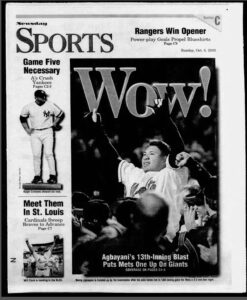 50. OCTOBER 16, 1973 — WS Game Three: A’s 3 METS 2 (11)
49. OCTOBER 6, 1973 — NLCS Game One: REDS 2 Mets 1
Twenty-seven times between his 1967 debut and the end of the 1973 regular season, Tom Seaver had gone at least eight innings, given up no more than two runs, and won nothing. The postseason isn’t the ideal setting for manufacturing microcosms, but in October of ’73, a larger baseball audience got a taste of what Mets fans had seen beset Seaver repeatedly during the first stages of his Hall of Fame tenure. Tom at his most Terrific; the Mets not scoring; the Franchise not winning; and the franchise losing. As part of the coda to his stressful second Cy Young season, Seaver unfurled two superhuman efforts versus two of the signature squads of the Seventies: 8⅓ IP, 2 ER, 6 H, 0 BB, 13 SO at Cincinnati; 8 IP, 2 ER, 7 H, 1 BB, 12 SO against Oakland. For his troubles, Tom came away with a loss and a no-decision, with the Mets losing the latter in extra innings at frigid Shea.
In the NLCS at Riverfront, Tom threw a wrench into the Big Red Machine for seven shutout innings (and doubled in the Mets’ lone run in the second) before Pete Rose nailed him for the tying homer in the eighth and Johnny Bench beat him the same way in the ninth. In the World Series, meanwhile, after Seaver had won the pennant-clincher over the Reds, the Mets’ ace held the Swingin’ A’s at bay as long as he could, carrying a precarious 2-0 lead to the sixth and a 2-1 lead to the eighth. This time, there were no opposition longballs, though the opponents’ most famous power hitter would offer words of praise after first-hand exposure. “Blind people,” Reggie Jackson marveled, “come to the park just to listen to him pitch.” What people watching and listening saw and heard after Seaver left Game Three was the A’s weave a go-ahead run in the eleventh inning on a walk, a missed strike three and a single. According to Baseball-Reference, only five postseason pitchers approximated Seaver’s lines from these two games versus the Reds and A’s in 1973 during the rest of Seaver’s lifetime, and none of them did it more than once.
48. OCTOBER 22, 1986 — WS Game Four: Mets 6 RED SOX 2
47. OCTOBER 21, 1986 — WS Game Three: Mets 7 RED SOX 1
Tourists who visit Boston are often drawn to the Freedom Trail, a walkable exploration of sixteen historic sites designed to tell a story of America’s founding. That wasn’t the trail the Mets were seeking out on their trip north in the middle of the 1986 World Series. Trailing two games to none, they were concerned only with the comeback trail. They found it immediately, starting with Lenny Dykstra leading off Game Three with a homer around Fenway Park’s right field foul pole, continuing through the Red Sox’ blown rundown play later in the first inning, and culminating in a pair of victories that re-established the 1986 Mets as the threat they had been dating back to Opening Day. Two starting pitchers who came embroidered with a Red Sox storyline — Bobby Ojeda who used to pitch for them and Ron Darling who grew up rooting for them — shut down Boston’s bats, while Gary Carter belted two home runs and totaled six RBIs. New England entered the middle portion of the Series blanketing itself in sweep dreams. New York’s invasion surely changed the course of Red Sox events.
46. OCTOBER 16, 2000 — NLCS Game Five: METS 7 Cardinals 0
Mike Hampton unwittingly threaded a needle of accomplishment and perception, giving Mets fans something they’d very badly wanted for a long time yet garnering very little in the way of lasting gratitude. Hampton had been imported from Houston to push the Mets past the heartbreak of having their postseason end in the NLCS as it did in 1999. The lefty had won 22 games for the Astros. He seemed a good bet to make the difference another lefty, Kenny Rogers, couldn’t. In the fifth game of the 2000 NLCS, Hampton delivered, authoring a shutout that clinched the Mets’ fourth pennant. His three-hitter stamped the Mets’ ticket to their first World Series in fourteen years and, when paired with a similar splendid outing in Game One, earned him MVP honors for the League Championship round.
When Hampton had finished being his best self, the idea of participating in the 2000 Fall Classic loomed as an unalloyed positive — the ALCS was still in progress, so its outcome might have meant a trip to Seattle — and Mike was, naturally, still under contract to the Mets. Nobody knew how the World Series would unfold and nobody knew where Hampton, with free agency pending, would decide to pitch in 2001…or how inartfully he’d articulate his choice. You won’t learn any of that in any school (in Denver or anywhere else), but it doesn’t hurt to review how much Mike meant to the Mets at one very important franchise peak just in case there’s an exam.
 45. OCTOBER 12, 1969 — WS Game Two: Mets 2 ORIOLES 1
Wasn’t it enough that the Miracle Mets had reached the World Series? No man among their ranks would have said yes, and after losing their first game in Baltimore, they set out to guarantee they’d snare more than a runners-up trophy for 1969. Jerry Koosman was so determined to put the Mets on the board that he kept the Orioles completely off it, no-hitting the home team until the seventh. Donn Clendenon had given Kooz a one-run lead in the fourth with a leadoff homer and it stood tall until three innings later when Brooks Robinson singled home Paul Blair from second. The less-celebrated of starting third basemen, Ed Charles, instigated a two-out, ninth-inning rally. The Glider registered a base hit, raced to third on a Jerry Grote single, and crossed the plate when Al Weis singled to left. In the bottom of the ninth, with two out and Ron Taylor on, it was Ed topping Brooks one more time, as Charles grabbed Robinson’s grounder and threw it to Clendenon to close out the Mets’ first-ever World Series win.
44. OCTOBER 5, 1999 — NLDS Game One: Mets 8 DIAMONDBACKS 4
Who’s afraid of the Big Bad Unit? Anybody with any sense while Randy Johnson was in his lengthy prime, but the ’99 Mets didn’t have time to fully consider their mound opponent’s perennial Cy Young credentials as they arrived in the postseason essentially after the last minute. Having completed their 162-game season knotted with the Reds for the NL’s final playoff spot, they had to contest and capture a tiebreaker in Cincinnati to qualify for the Wild Card. Well, they did that, as Al Leiter blanked the Reds, 5-0. A quick champagne shower and long westward flight later, they were in Phoenix to take on the Western Division champions. The most venomous Snake in Arizona, who had struck out 364 batters in 1999, awaited them. The Mets didn’t wait to get to whacking. Two-hole batter Edgardo Alfonzo homered to give the Mets a quick lead in the first. John Olerud, in an episode of lefty-on-lefty crime to which the Unit was rarely victimized, bopped a two-run dinger in the third to increase the Mets’ edge to 3-0. The Mets led until the sixth, when their starter, Masato Yoshii, ran out of gas. Having survived the initial New York onslaught and granted a cleanish slate via a 4-4 tie, Johnson got characteristically tough. Through eight, the Big Unit had racked up eleven strikeouts. Randy’s late-game magic finally evaporated as the Mets loaded the bases in the top of the ninth. The Unit exited. Bobby Chouinard entered. With two outs, Fonzie returned, detonating a grand slam that ensured the Mets would attain the advantage in their first postseason series since 1988.
43. OCTOBER 16, 1999 — NLCS Game Four: METS 3 Braves 2
They were off the mat. They had life in them. They were naturalized citizens of Cliché Stadium. However you termed it, the Mets absolutely needed to win what could have been their last game of the twentieth century, and they did. As was the case regarding basically everything in 1999, it wasn’t easy. Rick Reed dueled John Smoltz effectively for most of seven innings, but a couple of solo home runs left Reed and the Mets behind, 2-1, in the top of the eighth. The backs/wall ratio was overwhelming, but it wasn’t over until it was over, and it most definitely wasn’t over. In the bottom of the eighth, Roger Cedeño, Melvin Mora and John Olerud (who had earlier homered) engineered a breath-holding rally that not only created the necessary two runs to constitute a comeback, but they scored the tying and go-ahead runs with John Rocker on the mound, which made the resuscitation even sweeter. Armando Benitez held Fort Ninth Inning for the save and, yup, the Mets lived another day.
42. OCTOBER 4, 2006 — NLDS Game One: METS 6 Dodgers 5
In an echo of the NBA’s old “three to make two rule,” the Mets improvised a scenario that indicated the ball was destined to bounce their way in their first postseason appearance in six years. John Maine, a surprise starter with Orlando “El Duque” Hernandez sidelined by a calf injury, allowed the first two runners of the second inning on base via singles. With Jeff Kent on second and J.D. Drew on first, the Dodger threat was palpable this late afternoon in Flushing. When Russell Martin lashed a ball to the right field corner, Kent seemed a sure bet to score. But Shawn Green handled it cleanly off the wall and made a quick relay to second baseman Jose Valentin, who in turn unleashed a dart to Paul Lo Duca. Lo Duca turned and tagged ex-Met Kent, who did not get a very good jump off second. If one out wasn’t enough to electrify the Shea crowd, what happened a beat later did the trick. Drew kept charging and ran into the Met catcher’s second tag of the play, touching off an jolt of joy as loud as anything takeoffs out of or landings into LaGuardia could produce. Martin took second amid the breathtaking pair of home plate outs and scored on Marlon Anderson’s ensuing double, but the Dodgers taking a 1-0 lead felt like a Los Angeles letdown. Though there’d be some back-and-forth on offense — Carlos Delgado doing the most to carry the Mets forth by going 4-for-5 with a homer — the 9-4-2 chain of DP events instigated by three former Dodgers defined the day in the Mets’ favor and set the series’ trajectory on its way.
41. OCTOBER 6, 1969 — NLCS Game Three: METS 7 Braves 4
Had 1969 taken place in 1968, this step would have been unnecessary, but the Mets’ place in 1968 was ninth, while in 1969, the only thing the best record in the National League won you was a spot in something called the Championship Series. The 100-62 record the Mets notched in the regular season was indeed tops in the senior circuit, but for the first time since the NL eliminated a four-team playoff format implemented to determine its 1892 champion, the best record wouldn’t necessarily add up to a league pennant. For that honor, the Mets would have to complete their business against the Atlanta Braves, the 93-69 team with the best record in the division opposite them. In this inaugural showdown between East and West, the Mets showed the Braves on whom the league’s sun rose and set. Henry Aaron may have put the visitors out front in the first (he homered in every NLCS game) and Gary Gentry may have been less than his sharpest thirteen days after throwing the shutout that clinched the division, but the Mets would not be denied. Tommie Agee, Ken Boswell and Wayne Garrett all homered. Nolan Ryan threw a mere seven innings of relief. And, in the ninth inning, with two out and the Mets up by three, when Tony Gonzalez grounded to third baseman Garrett, who threw to Ed Kranepool at first, Ralph Kiner explained the result simply and succinctly: “The Mets are National League champions!” The team that had never remotely challenged for any kind of title — other than worst ballclub ever — had now earned its second flag of 1969 and was poised to compete for its third and ultimate.
40. OCTOBER 10, 2015 — NLDS Game Two: DODGERS 5 Mets 2
For thirteen regular seasons, the name Chase Utley elicited little worse than grumbles among Mets fans who had grown used to the Phillies’ All-Star second baseman occasionally contributing to defeats of their beloveds (it wasn’t for nothing that the area by the right field foul pole at brand new Citi Field had been grudgingly dubbed Utley’s Corner). But by the second week of October 2015, the Mets were beyond the regular season and Utley was no longer a Phillie. The Dodgers had traded for the six-time All-Star second baseman, and fate would pit the former division rival against the NL East champions…and then fate would really bring it on where these two entities were concerned. Utley was on first base in the home seventh at Dodger Stadium, with Kiké Hernandez on third, as Bartolo Colon came on to relieve Noah Syndergaard and protect a 2-1 Met lead. Howie Kendrick’s chopper to second scored Hernandez and unleashed havoc. Daniel Murphy’s attempt to start a 4-6-3 double play went for naught as Utley slid into shortstop Ruben Tejada rather than the bag Tejada was straddling. Tejada suffered a broken leg. Utley incurred the wrath of Mets fans a continent away. Worse, from a New York perspective, Utley was awarded second despite never touching the base he nominally sought. The mess spiraled into a four-run rally for L.A. and hard feelings that would not dissipate soon or, really, ever.
39. OCTOBER 5, 2000 — NLDS Game Two: Mets 5 GIANTS 4 (10)
Several Mets played the roles those who intensely observed them expected to see. Al Leiter threw eight strong innings, allowing only two runs. Edgardo Alfonzo ripped a clutch ninth-inning home run to extend the Mets’ lead to three runs. And Armando Benitez…well, Armando was Armando, the closer who shut down most every ninth inning except for the ones that seemed a little more important than the rest. J.T. Snow drove a three-run homer out of Pac Bell Park to tie the contest and send it to extras. But then a couple of additional characters got their hands on the script. With two outs in the top of the tenth, Darryl Hamilton doubled and Jay Payton followed immediately with a run-scoring single to regain the lead for New York. Finally, it came down to two new names deeply known by anybody who’d been watching the Mets vie for victory over the past decade-plus. In the batter’s box, with a runner on first and two out, was Barry Bonds, about as dangerous a lefty hitter as baseball history had to offer. On the mound, John Franco, the veteran southpaw whose career was dedicated to putting the clamps on the most lethal of lefthanded batters. Franco vs. Bonds worked its way to a full count. Finally, on a fairly borderline pitch, Bonds was called out looking. Strikeout and win to Franco, split in San Francisco for the Mets before both teams would split for the airport and a trip to Shea.
38. OCTOBER 27, 2015 — WS Game One: ROYALS 5 Mets 4 (14)
37. OCTOBER 21, 2000 — WS Game One: YANKEES 4 Mets 3 (12)
For a franchise that made a habit of waiting forever to get back to the Fall Classic, the Mets sure had a knack for sticking around on the nights they arrived. The opener of the 2000 World Series, an event for which they hadn’t qualified since 1986, was an antsy affair in the Bronx. Despite several opportunities unredeemed (most notably one wasted on Timo Perez not hustling his head off from first to home on a Todd Zeile double that just missed going out), the Mets nursed a 3-2 lead to the bottom of the ninth. Alas, Armando Benitez lost a ten-pitch battle to Paul O’Neill and, after walking the Yankee right fielder, eventually let him score. The Mets hung around Game One until the twelfth, when, with two outs and the bases loaded, their former shortstop, Jose Vizcaino, singled in Tino Martinez to put the Mets in a one-game hole. If it wasn’t exactly déjà vu all over again fifteen years later, the next time the Mets started a World Series generated an eerily similar storyline. This time it was a 4-3 lead at Kansas City gone awry when Alex Gordon lined a Jeurys Familia quick pitch over the Kaufman Stadium wall to tie things up. Tied they stayed into the fourteenth, until Eric Hosmer put everybody to bed via a bases-loaded sac fly. Two very long nights (ten hours total), two deceptively deep one-nothing deficits.
36. OCTOBER 21, 2015 — NLCS Game Four: Mets 8 CUBS 3
The Cubs had a billy goat. They had a cinematic omen. They had ivy, romance, perhaps the heart of America on their side. But the Mets had Lucas Duda, and Duda didn’t care that in the 1989 feature film Back to the Future II, this date in Mets history was the date the Chicago Cubs finally won a Fall Classic. The Mets’ slugger wasn’t in a movie, though he certainly earned a starring role in highlight reels by bashing the first-inning grand slam that sent the North Side’s world championshipless streak at least another year into the future. The Mets took that 4-0 lead and embellished it ASAP when Travis d’Arnaud added a solo home run. The Mets never trailed in the game, just as they never trailed in the series. When Jeurys Familia struck out Dexter Fowler in the ninth — after NLCS MVP Daniel Murphy had homered for a record sixth consecutive postseason game (and the ghost of the goat of a 1945 legend named Murphy failed to haunt Wrigley with any kind of good home team luck) — it was the Mets who had accomplished the stuff of modern myth: a four-game sweep and their fifth National League pennant.
 35. OCTOBER 31, 2015 — WS Game Four: Royals 5 METS 3
The Mets had been flipping Daniel Murphy’s coin throughout the 2015 postseason, and it had come up heads more often than not. One too many flips, however, left the ballclub on its tail. With seven home runs in the NLDS and NLCS behind him, it was easy to forget that Murph’s defense at second base had never been his strong suit. Yet in the eighth inning of the fourth game of the World Series, all of Metsopotamia was reminded that the extraordinary autumnal offensive performer had generally always lacked a position. He had made himself a suitable second baseman, but then a ground ball confounded him. The Mets were clinging to a 3-2 lead, as Tyler Clippard walked Ben Zobrist, then Lorenzo Cain with one out. Jeurys Familia took over and got the desired result from Eric Hosmer. It was a grounder to second. Except it was mishandled by the Mets’ second baseman, and Zobrist scored the tying run. Two singles to right followed and the Royals a built a two-run lead. Daniel attempted to make amends for his error with a one-out single in the bottom of the ninth, but Yoenis Cespedes (speaking of 2015 heroes running out of steam) would get caught off first on Lucas Duda’s game-ending line drive to third and the Mets landed a game away from elimination.
34. OCTOBER 21, 1973 — WS Game Seven: A’S 5 Mets 2
The name “Oakland” doesn’t translate in some ancient tongue to “land beyond belief,” but that’s where the Mets wound up. The team that rode stifling starting pitching and the You Gotta Believe mantra from last place most of the summer to the precipice of a second world championship came up one game short in the Oakland Coliseum. Jon Matlack, who had been so good in Games One and Four, not to mention Game Two of the NLCS, didn’t have his best stuff. The lefty didn’t last three innings, having been taken deep for a pair of two-run homers by Bert Campaneris and soon-to-be-named MVP Reggie Jackson. Ken Holtzman and Rollie Fingers teamed to tame the Mets into the ninth inning, but apropos of the way the 1973 Mets kept pushing from the rear, New York brought one run in and put two runners on in the ninth, provoking Dick Williams to call on Darold Knowles to extinguish their final fire. Knowles became the first pitcher to appear in all seven games of a World Series. With everything on the line, he could have faced potential pinch-hitter Willie Mays, the legend on the edge of retirement, but Yogi Berra stuck with regularly scheduled batter Wayne Garrett. Garrett popped up and the A’s finally deflated the Met balloon that stayed aloft longer than anybody would have guessed when they themselves were stuck in the basement as late as August 30.
33. OCTOBER 12, 1988 — NLCS Game Seven: DODGERS 6 Mets 0
The Dodgers moved from Brooklyn to Los Angeles in 1958, which gave them thirty years to understand how Hollywood stories were supposed to climax. The Mets of New York apparently had no idea, and 3,000 miles removed from their Queens stage, they performed several levels shy of Broadway-caliber. They were off-off their game from the second inning on. A five-run debacle, including four L.A. hits, a pair of Met errors and the replacement of stunned starter Ron Darling with never-before reliever Dwight Gooden, all but closed the curtain on what had been a blockbuster season. Once the inning was over, the Mets were down by six. Orel Hershiser would seal his NLCS MVP honor by going the distance on a five-hitter, striking out Howard Johnson looking to grab for the ’88 Dodgers the mantel of miracle-workers. The Dodgers had a date with the A’s and destiny. The Mets were destined to wait a very long time to see a postseason again.
32. OCTOBER 15, 2015 — NLDS Game Five: Mets 3 DODGERS 2
After he put himself and his team on the postseason map in Game One, there was little doubt Jacob deGrom could measure up to Zack Greinke when it came time to contest the deciding game of the Mets’ first playoff round in nine years. Yet after the Mets nicked the usually impervious Greinke for a run in the top of the first, deGrom struggled. The Dodgers sent seven batters to the plate, scoring twice. As Greinke settled in, deGrom squirmed some more, as Los Angeles steered a man to scoring position in each of the next four innings. Terry Collins left Jake on the mound, and Jake wriggled out of every jam. Greinke, meanwhile, mostly displayed the form that saw him unfurl a 45⅔-inning scoreless streak during midsummer. Then again, it was the Mets (with deGrom as the batter) who broke that streak, so leave it to this ballclub to find a way against the former Cy Young Award winner. In the fourth, Daniel Murphy pretty much stole a run, taking third from first on a Lucas Duda walk and coming home on Travis d’Arnaud’s foul ball sac fly. In the sixth, Murphy belted a home run to push the Mets ahead, 3-2. Jacob finally gave Collins his first clean inning and then turned the pitching over to Noah Syndergaard — Thor’s first relief appearance — and Jeurys Familia. The result was a breath-holding series-finale victory that transformed the 2015 Mets from postseason guests to the home field hosts for the start of the NLCS.
31. OCTOBER 7, 1973 — NLCS Game Two: Mets 5 REDS 0
The Big Red Machine had cranked out only two runs the afternoon before, but it was enough to sneak by Tom Seaver. Cincinnati was about to find out two runs was the most any Met pitcher would allow them in any of the days ahead. On Sunday, they discovered Jon Matlack was every bit as ready as Seaver to clog the Machine’s valves. The Western Division champs of Pete Rose, Joe Morgan, Tony Perez and Johnny Bench produced exactly a pair of base hits — and it was second-string outfielder Andy Kosco who rapped those out. Otherwise, it was all zeroes for Cincy. The Mets’ lineup wasn’t having a ton more luck versus Red lefty Don Gullett, subsisting for quite a while on only a Rusty Staub solo homer in the fifth. New York’s 1-0 edge expanded to more than comfortable via four ninth-inning runs, after which Matlack put away Morgan, Perez, Bench and any notion that these 99-win Reds would be too much for these 82-win Mets.
 30. OCTOBER 12, 2015 — NLDS Game Three: METS 13 Dodgers 7
Citi Field opened in 2009, yet needed seven seasons to immerse itself in the baptismal waters of October intensity. Nobody in Flushing wished to wait that long, but it’s hard to say the first post-Shea playoff game in Mets history wasn’t worth hanging in there for. The pregame festivities could have netted the price of admission themselves, encompassing as they did two particular introductions. When the Dodgers came out to figuratively tip their cap, one visitor in particular received a rousing reception. With Game Two villain Chase Utley appealing his suspension, he was eligible to line up and take his vocal medicine from the 44,276 who had rejected his appeal altogether. Received 180 degrees more warmly was Utley’s victim, sidelined shortstop Ruben Tejada, limping out of the home dugout with a Mets-logoed cane to uproarious approval. Thus inspired, the Mets pounded Brett Anderson and Alex Wood for ten runs total in the second, third and fourth innings, with Yoenis Cespedes tearing the metaphorical roof off the proverbial sucker with his game-breaking, rip-roaring, bat-flipping, three-run blast to the distant seats of the Left Field Landing. Not that anybody in any section was much sitting this night, which was different from all other Octobers when Citi Field seats sat vacant as a matter of course, because the playoffs had passed over the Mets. Postseason had arrived in the house at last.
29. OCTOBER 15, 2000 — NLCS Game Four: METS 10 Cardinals 6
Good vibrations abounded at Shea Stadium. Very good vibrations. Very vibrant vibrations. If you were there, as 55,665 were, you feel it still. It’s the stuff of oral history, passed along by word of mouth, not that a Mets fan could much hear what the Mets fan to the side of either ear was saying. It was that tumultuous. It was that tremendous. It was, after Bobby Jones spotted the Cardinals a pair or runs, a barrage of five doubles off Darryl Kile to put four runs on the board in the home first, followed by another three runs in the second. By the time Todd Zeile produced the Mets’ sixth double, the entire Upper Deck felt ready to either soar into orbit or plop down atop Field Level. Either way, gravity was rendered all but immaterial. Such was the force of the jumping around that turned Shea Stadium into a house of pain for the Cards and a pleasure palace for patrons of the Mets. Home field advantage has rarely been as voracious. When Citi Field on its most boisterous days is said to have grown as loud as Shea, this is the Shea Mets fans have in mind.
28. OCTOBER 5, 2016 — NL Wild Card Game: Giants 3 METS 0
If reaching the 2016 postseason embodied the concept of sprint over marathon for the New York Mets, the team’s experience in the playoffs amounted to once around the track and out. Following a rush of 27 wins in 39 games to emerge from under .500 in late August to clinch a Wild Card on October 1, all the Mets got for their efforts was one guaranteed date, versus the league’s other Wild Card, the San Francisco Giants. Win that, and move on to a deeper version of October, but that was the epitome of easier said than won. True, the Mets earned hosting rights, but considering that the Giants’ postseason master Madison Bumgarner was regularly virtually unhittable at Citi Field, the site didn’t seem to much matter. The Mets’ best pitcher of 2016, Noah Syndergaard, was equal to the task and to his opponent for seven innings; defensive support from Curtis Granderson in center certainly didn’t hurt. Eventually, however, the scoreless tie shifted into the hands of the Met bullpen, and from there it slipped. In the top of the ninth, Jeurys Familia, he of the team-record 51 regular-season saves, surrendered a leadoff double to Brandon Crawford, a one-out walk to Joe Panik, and the cruelest blow of all, a three-run homer to Conor Gillaspie. Gillaspie’s postseason bona fides were non-existent entering the evening, but in the moment they became every bit as substantive as Bumgarner’s. In the bottom of the ninth, the World Series MVP from 2014 showed his standard October stuff, completing the five-hit shutout and closing the door on the briefest of the Mets’ nine postseason appearances thus far.
27. OCTOBER 8, 2000 — NLDS Game Four: METS 4 Giants 0
Bobby Jones going for the Mets in, say, 1997, would have loomed as a formidable obstacle for any team, but by 2000, Jones was three years removed from his All-Star form, plagued by inconsistency and injury. In the middle of the first summer of the new millennium, Jones took a trip to Norfolk to right himself as a Triple-A Tide once his MLB ERA bloated to 10.19. Back in New York, his second half showed notable improvement, so when Bobby Valentine needed a pitcher for a potential NLDS clincher, it was within the realm of rational to expect a serviceable start from his No. 4 starter. Yet nobody claiming sanity could have anticipated what Jones’s next nine innings would yield: one Giant hit — a Jeff Kent double to left to lead off the fifth, lined just a little too high to meet the vertical leap of Robin Ventura — and absolutely nothing else. San Francisco would load the bases on walks but make no hay in the fifth, nor any other inning. Ventura had stroked a two-run homer in the first. Edgardo Alfonzo doubled the Mets’ lead with a two-run double following Jones’s escape act. The rest of the game was all about Mr. Jones. The second-most famous righthander ever to emerge from the Fresno pitching scene squelched the Giants right down to their bitter end, reached when Barry Bonds (a .688 slugger in the regular season, but a .176 hitter in this series) lined to Jay Payton in center to send San Fran home and the Mets to a chance at bigger and better things. As Bob Murphy summed it over WFAN, “A one-hit shutout for Bobby Jones…what a magnificent game. The Mets have never had a better ballgame pitched in their thirty-nine year history than this game pitched by Bobby Jones.”
26. OCTOBER 8, 1986 — NLCS Game One: ASTROS 1 Mets 0
The best-hitting team in the National League — tops in batting average, on-base percentage and slugging percentage — met its match on a mound deep in the heart of Texas. It was a match nobody in New York wanted much part of to start the postseason. The Mets were also the best-pitching team in the National League, at least as measured by full-season ERA, but as 1986 ended, no staff presented itself as scarier than that of the Houston Astros, and nobody could cast a more frightening specter than their ace, Mike Scott. Scott didn’t just throw a shutout to clinch the Western Division title, he threw a no-hitter. The ex-Met proved every bit as daunting as his momentum indicated, going the distance, striking out, 14 and getting inside the Mets’ heads with a split-finger fastball that the Eastern champs were sure had more than just skill propelling it into catcher Andy Ashby’s mitt. Though in the box score it says the margin of victory was provided by Glenn Davis’s second-inning solo homer off Dwight Gooden, the night may have been decided in the first when Gary Carter couldn’t convince home plate ump Doug Harvey that Scott’s pitches were scuffed. However the Astros did it, they grabbed the series lead and their pitcher donned an aura of presumed invincibility.
 25. OCTOBER 11, 1969 — WS Game One: ORIOLES 4 Mets 1
Oddsmakers said there was no way Cinderella’s darlings and everybody’s underdog were going to touch the team with the best record in baseball. The Baltimore Orioles had been installed by Las Vegas oddsmakers as an 8-5 favorite to collect their second world championship in four years. For one day, listening to what the house said seemed to be the best bet. In the bottom of the first inning of the first World Series game the New York Mets ever played, the first batter to face them, Don Buford, homered. That the ball he hit off Tom Seaver barely eluded Ron Swoboda’s jump at the right field fence didn’t make it count any less. The Mets, predicted months earlier by nobody to be joining as imposing an outfit as the Orioles in October, were down, 1-0. After nine innings, they were down, 1-0, on the larger Series scoreboard. Down, but hardly out. The Mets were new to Fall Classics, but the odds were they understood it would take four wins to crown a champion.
24. OCTOBER 10, 1973 — NLCS Game Five: METS 7 Reds 2
In the first do-or-die postseason game the Mets ever played, the Mets most decidedly did. Yogi Berra’s makeshift lineup might have indicated it was going to be an unusual afternoon. Cleon Jones was in right instead of left. Ed Kranepool was in left instead of at first. Rusty Staub was on the shelf with an aching shoulder. And dethawed from cold storage, not having played in more than a month, was 42-year-old Willie Mays, who’d received gifts and hosannas upon announcing his retirement in September, yet was still technically active. More than technically, actually. Amid a fifth-inning rally that saw the Mets break a 2-2 tie, Willie came up with the bases loaded and did something he’d been doing since 1951: he drove in a key run and helped push his team toward victory. The five-run fifth fortified Tom Seaver, who pitched into the ninth, handing the ball with one out to Tug McGraw, who had saved so many big wins down the stretch. You had to believe Tug got the final two outs and, on the same day Spiro Agnew resigned the vice presidency of the United States, the New York Mets accepted the nomination of the National League to represent the senior circuit in the World Series. Judging by the thousands who poured onto the field when the result went final, you might say the Mets won by acclamation.
23. OCTOBER 26, 2000 — WS Game Five: Yankees 4 METS 2
The Subway Series functioned better as hype than it did happy ending from a Met perspective. All the games were close, but only one of them could be termed successful. With one more opportunity to reroute momentum, Al Leiter conducted the train at Shea as best and as long (142 pitches) as he could, nursing a slim lead from the second through the fifth, then maintaining a tie into the ninth. But after registering two swinging strikeouts to start the ninth, Al got squeezed in at-bat that became a walk to Jorge Posada. Following a single from Scott Brosius, Leiter induced backup infielder Luis Sojo to tap a routine ground ball that might have been harmless had it not cleverly sussed out for itself a narrow hole between short and second. Posada and Brosius each scored, leaving the New York home team two runs behind the visitors from nearby. The Mets’ final chance in the bottom of the ninth died in the heavy night air of Flushing, as Mike Piazza’s deep fly ball to center flew not quite deep enough. The Subway Series was out of service. Last stop: close but no cigar.
22. OCTOBER 9, 2024 — NLDS Game Four: METS 4 Phillies 1
It was the sixth inning. The Mets hadn’t scored. They trailed the Phillies, 1-0, mainly because they couldn’t break through against Ranger Suarez, long a thorn in their side in divisional play, regular-season encounters when you can shrug off a tough loss and tell yourself there’s always another game against these guys. This was the playoffs. With the chance to clinch a postseason series at home for the first time in the life of Citi Field (and cancel a potential deciding Game Five in Philadelphia), it didn’t feel like the right time to reason, “We’ll get ’em next time.” Maybe they would, against Zack Wheeler two days hence, but the desire to find out was minimal. The Mets had been leaving runners on base all night against Suarez and his successor, Jeff Hoffman, isolating their own mostly successful starter Jose Quintana (5 IP, 2 H, 1 R, 0 ER), on deGrom Island. The sixth unfolded as another inning designed to tempt opportunity. Versus Hoffman, J.D. Martinez singled and advanced to second on a wild pitch; Starling Marte was hit; another wild pitch moved them both up a base; Tyrone Taylor waked. The bases were loaded. Francisco was up — Francisco Alvarez. His infield grounder resulted in a force of Martinez at the plate. The bases reloaded. Phillies manager Rob Thomson exchanged relievers, bringing in Carlos Estevez. The Met order turned over to Francisco — Francisco Lindor.
Opportunity’s temptation never blared louder, not when you had a batter who strode to the plate to the literal sound of the Temptations. Mets fans were about to have sunshine on what was not going to be a cloudy night. Talkin’ ’bout Lindor…Lindor! The East Coast’s MVP delivered the RBIs the Mets and their 44,103 acolytes in attendance had been waiting innings, maybe decades for, four in all. It was a grand slam to thrust the Mets into the lead and toward the National League Championship Series, a trip certified by David Peterson and Edwin Diaz over the final nine outs. Diaz got the save and a warm embrace from teammates (there was no jumping up and down for Edwin, given what happened to his right knee the last time he tried that, in 2023’s World Baseball Classic), but it was left to Lindor, who had so calmly rounded the bases after imploding the Phillies and elevating the Mets, to serve as a human pitcher’s mound for most of the Mets. They piled on him, as did the adoration from the stands. It wasn’t cold outside. It was the month of October 2024.
21. OCTOBER 30, 2015 — WS Game Three: METS 9 Royals 3
David Wright’s twelfth major league season was his first as a World Series participant. It didn’t take Noah Syndergaard but five-and-a-half months to arrive in the brightest lights of October. But together they strove to immediately erase the glaring zero that had followed the Mets home from Kansas city. To begin the game, Syndergaard brushed back Royals leadoff hitter Alicides Escobar, a pesky type who swung at every first pitch except the ceremonial kind. Message sent…and if the visitors didn’t like it, Noah stressed, “they can meet me sixty feet, six inches away.” David spoke softly and carried his big stick to the plate in the bottom of the first, erasing KC’s 1-0 lead with a two-run homer. It was the first in Citi Field World Series history and the first of a career that had inspired Hall of Fame talk before spinal stenosis changed the conversation. Though the Royals snatched the lead back in the second, Curtis Granderson put the Mets ahead to stay with his own two-run homer in the third, and David extended the home team’s lead with a two-run single in the sixth. For one night, all was Wright with the World Series.
 20. OCTOBER 14, 1986 — NLCS Game Five: METS 2 Astros 1 (12)
The marquee didn’t lie. For most of this Tuesday afternoon makeup game, it really was a battle between two superstar starting flamethrowers delivering their pitches from opposing demographic poles. Doc Gooden, 21, went ten innings for the first time in his brilliant three-year career, scattering nine hits and giving up only one run. Nolan Ryan, 39, who’d been pitching in the majors since 1966 — including a memorable relief appearance during the 1969 World Series — went nine, struck out twelve, and gave up only two hits. Unfortunately for him, one was a ball Darryl Strawberry guided over the right field fence. The 1-1 tie was handled with care by both bullpens until the bottom of the twelfth, when Wally Backman reached first against Charlie Kerfeld and took second on a pickoff throw gone awry. Kerfeld intentionally walked Keith Hernandez to face Gary Carter, not as much of a matter of picking one’s poison as it reads, since Carter was mired in the deepest of October slumps (1-for-21). Properly disrespected, Kid — who Kerfeld made look very bad two games before — was determined to unslump. True to character, the catcher lined a three-two pitch into center to score Backman and lift the Mets to within one game of the franchise’s second World Series since Ryan was in New York’s bullpen.
19. OCTOBER 7, 2000 — NLDS Game Three: METS 3 Giants 2 (13)
Sheer stubbornness carried the day, even as the Flushing day carried on into night. After the Giants pushed two runs across the plate off Rick Reed in the fourth inning, Reeder and five relievers simply refused to give up another San Francisco run. Meanwhile, Mets batters chipped away for a tally in the sixth (Timo Perez driving in Mike Bordick, who had walked) and another in the eighth (Edgardo Alfonzo doubling home Lenny Harris, who had reached on a fielder’s choice and then stole second). The ninth inning passed. Then the tenth. And so on, clear into the thirteenth when, with one out and five hours and twenty-two minutes logged, Benny Agbayani belted an Aaron Fultz pitch practically to his hometown of Honolulu.
18. OCTOBER 11, 1986 — NLCS Game Three: METS 6 Astros 5
A chilly afternoon at Shea grew positively frosty as Ron Darling was rocked for four early runs. The Mets being the Mets of the year that it was rocked back in the sixth, tying the game on Darryl Strawberry’s three-run bomb to right. As soon as the Mets drew even, they fell behind again, and stayed behind until the ninth. Facing Dave Smith, a top-notch closer against every National League club except the one he needed to shut down ASAP, Wally Backman led off with a bunt that got him to first. A passed ball sent him to second. One out later, it was time for Backman’s companion top-of-the-order pest Lenny Dykstra to wreak havoc. Usually Lenny did it on the basepaths. This time Nails hammered Smith over the wall with as unlikely a game-winning, two-run homer as anybody on hand could have imagined. It was a game the Mets had never led until it was over, and now they held an edge in the series for the first time yet.
17. OCTOBER 19, 1999 — NLCS Game Six: BRAVES 10 Mets 9 (11)
Just to land in the eleventh inning of this mustest-win game of a year pretty much spent with their backs against the wall the whole time took some doing for the 1999 Mets. Al Leiter dug the Mets a five-run hole in the first inning. Long reliever Pat Mahomes shoveled the dirt right back in the Braves’ faces for four scoreless innings, but it was hard to believe it wasn’t too late. Then again, the Mets are all about believing in October, even at Turner Field. Three sixth-inning runs snuck the Mets back into the game. Though the Braves would grab two back in the bottom of the inning, the top of the seventh revealed a beating heart and pounding pulse emanating from the New York dugout. Rickey Henderson and John Olerud each drove in a run and Mike Piazza smashed a line drive two-run homer to tie this Met gala at seven. Given that the Mets had withstood starter Kevin Millwood and obliterated miscast setup man John Smoltz, it seemed momentum was on their side and perhaps destiny favored them in the last place it had ever done them any favors. Sure enough, Melvin Mora produced the go-ahead run in the eighth. The Mets at last led…but not for long, as the Braves stitched together a tying run off John Franco. In the tenth, it was Todd Pratt’s turn to shove the Mets in front once more, 9-8. Alas, in the bottom of the inning, it was Armando Benitez’s turn to let it get tied again. Finally, in the eleventh inning, another starter coming in from the bullpen cracked, as Kenny Rogers allowed a double, a sac bunt, and two intentional walks. With the bases loaded, Andruw Jones received a fourth ball that wasn’t issued on purpose. The 1999 Braves won the pennant. The 1999 Mets captured forever the heart of anybody who lived and ultimately died with them.
16. OCTOBER 22, 2000 — WS Game Two: YANKEES 6 Mets 5
It is only slight hyperbole to estimate the countdown to this game began 106 days earlier when Roger Clemens, frustrated at his inability to keep Mike Piazza from hitting balls very hard and very far — .583 batting average against in Interleague play, highlighted by three home runs — simply hit the Mets catcher. Piazza hit the ground, the Mets hit the roof, and from July 8 forward, the baseball nation and the city that served as its turn-of-the-millennium capital looked forward to a possible second close encounter between the two megastars. Here it was, on a Sunday night in the Bronx, in the first inning. On one hand, there was neither another beanball nor longball. On the other hand, we had wood. Piazza fouled off a pitch and broke his bat. The bat splintered. Its barrel flew toward Clemens. Piazza jogged toward first before realizing the ball wasn’t in play. Then he found he had the sizable bat shard thrown at him by Clemens. As a sequel to their midsummer exchange, it was bizarre. By itself, it was unprecedented. What pitcher throws a broken bat after a foul ball at the batter? The Mets’ and Yankees’ benches emptied, jaws were exercised, interborough tempers flared, but nothing of substance came of it, other than Clemens’s testimony that, gosh, he thought he was tossing the ball out of play and Piazza just happened to get in the way. After the Yankees leapt to a six-zip lead and the Mets fell short of tying them in a furious ninth-inning rally, the Piazza-Clemens interlude went down as the Subway Series in miniature — the Yankees got away with another one and no Mets fan wished to abide by the outcome.
 15. OCTOBER 14, 1973 — WS Game Two: Mets 10 A’S 7 (12)
Willie Mays’s career encompassed enough hitting, running, catching and throwing to render the phrase “signature moment” inadequate. There were enough signature plays across 22 seasons to fill an autograph book. Yet a period imprinted itself on the end of his nonpareil story, whether it deserved punctuating or not. The well-worn phrase, “Willie Mays fell down in center field” was born this overly sunny Sunday afternoon in Oakland, which was less about a defensive miscue and more about symbolism. Mays, 42, had no more than a week remaining as an active player. He hadn’t played much in his final year, but Yogi Berra turned to his unmatched experience and residual excellence to help carry the Mets toward a Series tie. Willie didn’t look great tracking a fly ball that he admitted he couldn’t see. The Say Hey Kid stumbled. The ball, hit by Deron Johnson, fell in. Aging athletes ought to get out before the getting gets less than good, went the narrative that was born immediately and re-emerges every instant an immortal dares to show a little mortality. A companion Game Two image, portraying sad old Willie down on his knees adjacent to home plate reinforced the talking point when presented without context; in reality, Mays was theatrically beseeching umpire Augie Donatelli to reverse a dreadful call ruling Buddy Harrelson out, supporting his teammate and being as into the game as any player at any age could be. Less bandied about in the decades that followed: the run that served to put the Mets ahead for good in what was then the longest World Series game ever (4:13) was driven in off eventual Hall of Fame reliever Rollie Fingers by Hall of Fame shoe-in Willie Mays. You could make quite a fuss about a man at the end falling down, but you couldn’t ignore the manner in which he got back up.
14. OCTOBER 8, 1973 — NLCS Game Three: METS 9 Reds 2
What began as a routine enough 3-6-3 double play wound up cementing more than one reputation in legend. The technical instigator was a simple ground ball, bounced to John Milner by Joe Morgan in the fifth inning of a 9-2 game, the Mets the team ahead by seven. Milner, at first base, diligently fielded it and zipped it to shortstop Buddy Harrelson for a force play at second. Harrelson, twice an All-Star and once a Gold Glove, naturally threw it right back to Milner to retire Morgan. The unnatural element in all this was the baserunner from first, Pete Rose, barreling not so much into second to try to break up the DP but hurling himself into the lithe Harrelson in an effort to fire up the Reds or perhaps take out the Reds’ frustrations on a slender Met. Whatever the motivation, it got very physical very fast between both teams. Bob Murphy noted that “Jerry Koosman is in the middle of the fight,” which is exactly where you don’t want your starting pitcher to situate himself. The hostilities extended to an undercard featuring home team reliever Buzz Capra and visiting counterpart Pedro Borbon — with Borbon mistakenly donning a Mets cap in the confusion and then trying to tear it apart with his teeth. The melee painted forevermore Harrelson as the hero of the little guy, Rose as the big Red meanie and, just when it might have seemed tensions calmed, Shea as a stadium that was prepared to devour its most despised foes by any means necessary. The fans in left field took to showering Rose with every object reachable. The Mets’ comfortable lead was suddenly in jeopardy of transforming into a forfeit. A peace delegation of Yogi Berra, Tom Seaver, Rusty Staub (who’d homered twice), Cleon Jones and Willie Mays had to march out to left and urge a ceasefire. The debris stopped flying. The game kept going. The animus toward Rose in Flushing never quite died down.
13. NOVEMBER 1, 2015 — WS Game Five: Royals 7 METS 2 (12)
12. OCTOBER 20, 1973 — WS Game Six: A’S 3 Mets 1
Regrets, Mets fans have had a few. More than a few, actually. But two stand out for the what-iffery that informs the pitching choices that have never stopped serving as the source of heartfelt regret or at least hardy debate for more than a few Mets fans. In 2015, there was the pitcher who was going too well to take a seat. In 1973, it was the pitcher who had gone too well to not take a start. The context for Matt Harvey was the most urgent. Down three games to one, the Mets had to have Game Five, and for eight innings, Harvey had darn well gone out and gotten it for them, shutting out the Royals while striking out nine of them. Now it was time to…what, exactly? Terry Collins was ready to call Harvey’s night complete. Harvey was not so agreeable. Neither was the Citi Field throng. Matt emerged from the Met dugout to start the ninth. He didn’t finish it. Instead, the Royals got to him for one run, Jeurys Familia (and some shaky fielding) for another, and the game the Mets had to have was no longer theirs. What if Harvey had simply taken a seat and Familia had taken the ball?
And what if, 42 autumns earlier, Yogi Berra had not opted for another righty ace who might not have had enough left when he had a conceivably better option standing by. George Stone was a 12-3 fourth starter for the 1973 Mets, but for Berra in the World Series, he was assigned to contingency status. The manager felt more comfortable relying on another George to potentially close out the Mets’ second world championship. George Thomas Seaver would soon be voted a second Cy Young and had mostly overwhelmed the A’s in Game Three. Why wouldn’t you want Tom out there on the Coliseum mound with all the marbles in your grasp? Perhaps because since April he had thrown more than 300 innings, and going on short rest when there was a very good option available wasn’t necessarily optimal. It’s not as if Seaver got lit up, but Reggie Jackson beat him with doubles twice in the first three innings and the Mets barely touched Catfish Hunter. In Game Seven, when Seaver could have gone on full rest had Stone not hypothetically finished the Series, Berra went with Jon Matlack, also with just three days off and clearly less than was needed in his tank. For more than a half-century, no discussion of the Mets’ near 1973 miss gathers moss before Stone’s name rolls to the fore.
11. OCTOBER 3, 2024 — NLWCS Game Three: Mets 4 BREWERS 2
A week that began with Francisco Lindor launching arguably the most clutch ninth-inning home run in Met autumnal history continued with another incredibly timely piece of data to debate. Sure, Lindor thrust the Mets into the playoffs by beating the Braves, 8-7, on a two-run dinger on Monday, September 30, but three days later, the Mets needed another powerful shot of whatever had been fueling their meteoric rise since June, and, once more, they needed it as outs were dwindling to a precious few.
Six innings of nothing-nothing ball — with Jose Quintana doing the zero honors on the Met side — had gone by the boards in the seventh when Jose Butto gave up a pair of homers and dug the Mets a 2-0 hole. Edwin Diaz came on, appeared somewhat askew if judged by Brewers reaching base and then stealing more of them, but he righted himself without allowing further scoring over an inning and two-thirds of work. Come the top of the ninth, it was Lindor representing the vanguard of the Mets’ final hope by working an eight-pitch walk. One out later, Brandon Nimmo singled Lindor to third, bringing up Pete Alonso, conceivably for the final time as a New York Met. Alonso’s impending free agency lurked over the horizon. For six seasons, he’d been building toward the franchise’s all-time home run record, sending 226 skyrockets in flight since 2019. In his very immediate past, however, there’d been precious little delight, as Pete hadn’t homered since September 19, and hadn’t done any hitting of note in the Wild Card Series.
Against Brewers All-Star closer Devin Williams, however, Pete got it all back at once, homering to right, pushing the Mets to a 3-2 lead, and making New York believe in miracles anew. The longball transcended “there’s something you don’t see every day” (even though we’d seen something an awful lot like it three days earlier) as it was revealed to have been the first-ever go-ahead homer struck from behind in the ninth inning or later of a winner-take-all postseason contest. As the player who popularized the hashtag #LFGM might have said, it was a BFD. Jesse Winker and Starling Marte combined for a tack-on run, and David Peterson emerged from the pen to record the first save of his career in the best spot imaginable. On the wings of a Polar Bear, the Mets were on their way to Philadelphia for the NLDS, where the first of his next 755 plate appearances as a Met (through 2025) would await Alonso.
 10. OCTOBER 9, 1999 — NLDS Game Four: METS 4 Diamondbacks 3 (10)
Six days earlier, when Melvin Mora raced home with the walkoff run on a wild pitch to push the Mets into the one-game playoff that determined the National League Wild Card, it was hard to escape the historical overtones of the date: October 3 — the 48th anniversary of Bobby Thomson’s Shot Heard ’Round the World — nor the irony inherent in the moment. Bobby Valentine’s father-in-law was Ralph Branca, the Dodger pitcher who gave up the home run that made Russ Hodges shout euphorically and repeatedly, “the Giants win the pennant!” when Brooklyn and New York dueled in their tiebreaking three-game 1951 series. “Win or lose,” Branca said from the manager’s office after the 10/3/99 game, “I wanted to be here. I was saying October 3 owes this family one and I was hoping I was right.”
With Branca’s blessing secured, maybe it was time for the spirit of Thomson to inhabit Shea as well. Playing the role of the Flying Scot for the Mets in the tenth inning was the man known as Tank, Todd Pratt. The backup catcher who wouldn’t have been playing if not for an injury to Mike Piazza (and a ballplayer who gave up the game altogether three years earlier) stepped up with the stadium tense and the score tied and drove a pitch from fireballing Arizona closer Matt Mantei to deepest center field, just over the 410 sign that indicated a leaping Steve Finley had run out of room. It was the fourth walkoff home run to decide a postseason series in baseball history, including those launched by Bill Mazeroski, Chris Chambliss and Joe Carter, but not counting Thomson’s because Thomson’s technically took place at the extended end of the regular season. By the same token, the Mets didn’t “win the pennant!” that Pratt-powered Saturday afternoon, yet as October shots that catapulted the New York (NL) team forward on just one swing went, nobody’s ever ruled out the possibility that a gust coming in from Coogan’s Bluff is what blew that ball inches beyond the reach of Finley’s glove.
9. OCTOBER 14, 1969 — WS Game Three METS 5 Orioles 0
8. OCTOBER 15, 1969 — WS Game Four: METS 2 Orioles 1 (10)
A team that won its division by eight games and swept its pennant round in three shouldn’t have been considered any kind of historical accident. Yet the sobriquet Miracle Mets proved it permanently fit 1969’s Metus Operandi not only for whence the Mets had come from prior to ’69 but for how they proved they belonged where they’d climbed. The miracles within the Miracle — the episodes that keep the Miracle Mets a topic of awed conversation more than a half-century after the fact — unfolded in earnest once the club returned to Shea Stadium after splitting two games with the Orioles in Baltimore. Games Three and Four were the days of miracle and wonder, the days of Agee and Swoboda, most specifically — though hardly exclusively. Tommie reaching out in center twice and swiping approximately five runs total from the Birds in Game Three (while keynoting the affair with a leadoff home run) and Rocky sprawling inelegantly and preserving brilliantly the gem polished to a high gloss by Tom Seaver in Game Four certified the Miracle as actual and the real as spectacular. Because these were the 1969 Mets, they weren’t alone in executing indelible exploits. First baseman Ed Kranepool homered one day. First baseman Clendenon homered the next. Nolan Ryan held the fort out of the pen for Gary Gentry one day. A three-man relay, with the baton passing from Jerry Grote (hustly bloop double) to Rod Gaspar (heady pinch-runner) to J.C. Martin (wristy pinch-bunter) captured a ten-inning thriller for Seaver the next. There was so much to catch those two afternoons, so much for a Mets fan to never let go of.
7. OCTOBER 17, 1999 — NLCS Game Five: METS 4 Braves 3 (15)
The long haul is what a true fan signs up for. However long it takes for your team to near the heights, you will agree to stick close by. If it takes more than a decade. If it takes all season, no matter how often the stressful impedes the ebullient. If it takes several brushes with elimination. If it takes extra inning upon extra inning…in the rain. If it takes one final reincarnative rally to provide life anew. Whatever it takes is what you’ll endure, up to and including:
• ancient import Shawon Dunston working a 12-pitch at-bat, matching the number on the back of his jersey, until he singles to put a leadoff runner on, down one in the bottom of the fifteenth;
• Dunston stealing second;
• ace pinch-hitter Matt Franco patiently pinch-walking;
• Edgardo Alfonzo (he of the 108 regular-season RBIs) bunting them along for the calculated greatest good;
• John Olerud receiving an intentional bases-loading walk instead of a chance to drive home the tying run;
• Roger Cedeño, his back still sore from jubilantly stomping on home plate in the previous night’s death-defying maneuvers, pinch-running for Franco at third;
• Todd Pratt, who eight days earlier was a series-deciding walkoff home run hero, settling for a less climactic contribution by taking game-tying ball four from rookie Kevin McGlinchy in his lone NLCS appearance — McGlinchy was Bobby Cox’s sixth pitcher against Bobby Valentine’s nine;
• and Robin Ventura, aching and far off his regular-season MVP form (0-for-16 in the series until the eleventh inning of the fifth game), yet comfortable enough to swing at a two-one pitch and send it over the right field wall for what Gary Cohen prematurely called “a game-winning grand slam home run,” a call in need of immediate clarification because, as Cohen himself immediately observed amid what should have been, if you’ll excuse the inadequacy of the adjective, a routine game-winning trot around the bases in the fifteenth inning of an elimination-averting five-hour, forty-six minute spectacle of the gruelingest grit imaginable, “They’re mobbing him before he can get to second base.”
That improvised conclave was a matter of Pratt turning from second to tackle Ventura after he rounded first to not wait one second longer than necessary to smother him in ecstasy, and all of their teammates following suit. Once it was confirmed every Met who was required by regulation to move up exactly ninety feet had indeed touched at least one base, the grand slam home run was downgraded in the official scorekeeping to what became referred to in franchise lore as the Grand Slam Single. When you’re in it for this long and this epic a haul, a traditional slam would surely suffice, but perhaps you’re entitled to something somehow grander, not to mention singular.
6. OCTOBER 9, 1988 — NLCS Game Four: Dodgers 5 METS 4 (12)
A team doesn’t lose a best-of-seven series when the team leading that series two games to one goes from leading the fourth game late to having it tied. But does that team lose something intangible enough that doesn’t show up in the line score of the moment? Eleven years before another Mets club made much of their Mojo Risin’, that certain indescribable quality seemed to slip from the franchise’s grasp in the ninth inning of the fourth game of an NLCS going their way until it wasn’t. Darryl Strawberry and Kevin McReynolds homered in succession in the fourth to give the Mets a one-run lead. Gary Carter expanded the edge to two on a sixth-inning triple (though was left stranded after landing on third with nobody out). Dwight Gooden made the Mets’ advantage hold up through eight and was given every opportunity to finish what he started.
The visitors’ ninth started with John Shelby battling for nine pitches until he walked. The home bullpen remained silent. Mike Scioscia turned on the very first pitch he saw from Gooden and lofted it over the right field fence, into the Mets’ inactive pen. Scioscia batted more than 400 times in 1988 and homered only thrice, but a bat in the hand is worth all the stats in the bush. Three outs from a three-one lead in the series, the Mets were now even with the Dodgers in a game that grew instantly pivotal and eventually aggravating.
The Mets left a runner on first in the tenth and two on in the eleventh. Kirk Gibson grabbed L.A. the lead with a two-out solo homer off Roger McDowell in the twelfth. The Mets responded by loading the bases in the bottom of the inning but failing — against three different pitchers, concluding with the previous afternoon’s starter, Orel Hershiser — to drive any of them in.
Game Four turned on Scioscia’s swing. Despite three more innings and three more games, so did the series. Maybe the Met dynasty that had seemed like destiny also found out it wasn’t going to happen that night. Nineteen Eighty-Eight appeared primed to restore the Mets to the throne they’d unintentionally vacated after 1986. They were 100-60 against everybody in the regular season, 10-1 against the Dodgers. They were loaded. Yet the Mets of Doc, Darryl and the rest of this star-studded production didn’t win their second pennant and never returned to the postseason. In a matter of three years, what was left of these Mets fell completely from contention, then plummeted from grace.
Had lefty Randy Myers been warming during Shelby’s AB to face lefty Scioscia…or had Gooden gotten strike three over on Shelby…or had things played out to the statistical form embodied by Scioscia’s career batting average to date versus Gooden of .184…but none of that happened, and the next Mets’ World Series trip was postponed by a dozen years. Sometimes what doesn’t happen is a direct result of what does happen. Sometimes what does happen, however, is just one of those things you wish hadn’t happened.
5. OCTOBER 15, 1986 — NLCS Game Six: Mets 7 ASTROS 6 (16)
Given the tension and the stakes, it takes a helluva circumstance for invocation of the first Game Six from the 1986 postseason to go viral long after the fact. Game 161 of 2024 at Atlanta had that kind of is this really happening? feel, and therefore — judging by broadcaster commentary and social media reaction — it summoned widespread instinctual thoughts of exactly that precedent. On September 30, 2024, the Mets were the visitors to a hostile environment on a weekday afternoon; their foes loomed as implacable; and the back-and-forth battle at hand simultaneously boggled the mind and pre-empted the possibility that anything not Mets-related would be accomplished during business hours.
With just one win needed to guarantee October life, of course Game Six from Houston loomed in the thoughts of Mets fans 38 years later. There was another strand of connective tissue, though it offered little comfort decades before or in the present: neither Game Six of the 1986 NLCS nor this Game 161 was precisely do-or-die. Had the Mets lost to the Braves in 2024, there was a second game of the makeup doubleheader waiting. But who in orange and blue wished to take such a chance? Likewise, the 1986 Mets, leading their best-of-seven three games to two, technically had a Game Seven on which to fall back if they could not eliminate the Astros in six, yet that statistical reality rang as hollow as their prospective cushion in the moment.
Mike Scott didn’t strike out any of the Mets in Game Six. Striking fear into the depths of their souls was enough. The Mets were in front three games to two yet proceeded as if behind the eight ball. Lose Game Six, invite Scott to the mound in Game Seven. Play Game Seven, then you’re playing Russian roulette with the deadliest bullet rattling around in Astro manager Hal Lanier’s chamber. No, don’t go there if you can help it.
But could they help themselves at the Astrodome against Bob Knepper, the Game Six starter and a lefty who carried his own ability to smoke them? For eight innings, the Mets’ bats sawed wood. Knepper had lulled them to sleep in making a 3-0 lead achieved in the first inning hold up. Bobby Ojeda and Rick Aguilera kept the hole shallow, but the way Knepper was going — two hits, one walk — the Mets may as well have been stuck down a well. The climb up and out took forever to commence and then happened all at once. Lenny Dykstra pinch-hit to lead off the ninth and tripled. Mookie Wilson singled him home. Kevin Mitchell grounded out, but moved Mookie to second. Keith Hernandez doubled Wilson in. At 3-2, Knepper exited and Dave Smith, the closer for whom the Mets were Kryptonite, entered. “Super,” the men in orange and blue said. Gary Carter walked. Darryl Strawberry walked. Ray Knight flied deep enough to right to score Hernandez. It was a whole new ballgame, one much better than the first one.
It stayed 3-3 through thirteen, thanks primarily to the five innings of shutout relief provided by Roger McDowell. In the top of the fourteenth, the Mets scratched out the run that put them ahead to stay…until there was one out in the bottom of the fourteenth and Billy Hatcher had his say, Fisking a ball off the left field foul pole to tie the game anew at four. Jesse Orosco, who gave up Hatcher’s dinger, hung in for the rest of the inning and the next one, keeping the game tied long enough for the Mets to explode for three runs in the top of the sixteenth. With Jesse on fumes (he’d thrown two innings the day before to win Game Five at Shea), the Astros mounted one more assault. Two were out, but two were across the plate, two more were on base and Kevin Bass, Houston’s best hitter, was at the plate.
It was enough to freeze all of New York — this game started at three o’clock in the afternoon Eastern Time, rendering rush hour in the Metropolitan Area an oxymoron — and elicit beelines to the mound from Orosco’s catcher, Carter, and the battery’s first baseman, Hernandez. It was generally agreed, allegedly under the threat of violence from Hernandez, that Jesse throw only sliders. So he did. Six in all. The first five elevated the count on Bass to three-and-two and blood pressure readings everywhere off the chart.
The sixth went for strike three. The Mets won the National League pennant and a reprieve from Mike Scott. The desperation and drama involved implied they were highly uncertain they could have one without the other. Scott (18 IP, 2-0, 0.50 ERA) was named NLCS MVP. As Orosco flung his glove to the Astrodome roof and his teammates Metpiled all over him, no one bothered to argue that the award for the series’s key player was handed to somebody from the losing side. Given the motivation inherent in not facing him, it was likely as sound a decision as not throwing Bass a single fastball.
4. OCTOBER 19, 2006 — NLCS Game Seven: Cardinals 3 METS 1
The Mets staged their first “Alumni Classic” in September 2025, an Old Timers Day in everything but name. Old times’ swift movement narrowed the parameters of the reunion to 21st-century players, with many of the alumni taking bows for the two pennants fans under the age of 40 might remember. Indeed, representatives of the 2000 Mets and the 2015 Mets each collected well-deserved flowers on the respective 25th and 10th anniversaries of their team’s flagship accomplishment. Yet chronologically between them and just as much out in force to the delight of attendees were many members of the 2006 Mets, a division winner far more dominant in its regular season than its World Series-participating counterparts were in theirs. They, too, tipped caps to an appreciative crowd, and several of their stars were the focus of a friendly pre-event press session. The inquiries were all very affable, including one question about how special that near-miss of a season was. “It really was fun,” Carlos Beltran said, and had he left it at that, he likely wouldn’t have been probed further. But the most productive player from that 97-win ballclub continued, “At the end of the day, we fell short as a team, we didn’t end up going to the World Series, everyone knows what happened…”
With that, Jose Reyes, in full impishness, couldn’t resist his own deadpan interjection: “What happened?” The room broke into laughter. Nineteen years after the fact, even Beltran was compelled to crack something approximating a smile regarding what remains the most enduring non-celebratory postseason ending in Mets history. Yes, everyone knows what happened, because what happened has proven indelible.
When the tightest of seventh-game ties is broken on a ninth-inning home run, and that swing ranks as no greater than the third-most dramatic interlude of that seventh game — a distant third — you’re probably talking about a night that sets up somebody’s fans for massive disappointment. Yet setups have rarely loomed as more perfect than a pair that materialized at Shea Stadium as the Mets sought a World Series berth that appeared for months a confirmed appointment. In the top of the sixth inning, when Game Seven had already been tied since the top of the second, the Cardinals appeared inches from taking a 3-1 lead versus usually shaky but somehow holding it together starter Oliver Perez. After Jim Edmonds walked with one out, Scott Rolen rocketed a ball over Shea’s left field fence. The only problem for Rolen was the Mets had in the vicinity a rocket interceptor named Endy Chavez, who dashed to the wall, “went to the apex of his leap,” per Gary Cohen, and took away the sure home run for one out — and fired the erstwhile rocket into the infield with just as much force as it had been hit to effect a double play on Edmonds.
Shea Stadium still rippled from its brush with defensive perfection in the bottom of the sixth when the Mets prepared to untie the game off Jeff Suppan. They loaded the bases with one out, bringing up Jose Valentin, who’d handled the relay from Chavez. But Valentin struck out. That was perhaps OK because up next was none other than Endy, and who better to generate a Met lead than the man who minutes earlier prevented a Met deficit? But Endy flied out, and the tie continued until the ninth, when it was Aaron Heilman pitching and Yadier Molina ripping into one with Rolen on first. This was uncatchable and became the 3-1 lead Chavez had taken away three innings before.
Ah, but in the bottom of the ninth, Valentin led off versus rookie closer Adam Wainwright with a single, and Chavez followed with the same. This setup was conceivably just as good as the one from the sixth. Runners on first and second, nobody out and here came the Met attack that powered the club to 97 regular-season wins (14 more than the Cardinals), a breeze through the NL East and a sweep of the Dodgers in the NLDS. But the offense had blinked on and off through the NLCS, and plugging it in was no sure thing. Cliff Floyd, who had never registered a pinch-hit in four years as a Met, struck out off the bench. Jose Reyes lined a dangerous-looking drive into center, but it was grabbed by perennial Gold Glover Edmonds. Paul Lo Duca walked, however (with Anderson Hernandez inserted to pinch-run), meaning the bases were loaded for the best all-around Met of 2006, Carlos Beltran.
Beltran had homered 41 times during the year and three times more during the playoffs. He didn’t need to homer, necessarily. At the very least, he needed to keep this rally going. But against the rookie with the deadly curveball, Beltran did what can be without judgment referred to as nothing. Carlos took a strike, fouled off a pitch and, on oh-and-two, looked at strike three. One could reasonably argue that Beltran hadn’t ascended to the top of his profession without trusting his batting eye, but one could just as reasonably counter that protecting the plate was paramount with two strikes, two outs and no more chances guaranteed. The Cardinals were National League champions. The Mets were done for 2006, one theoretical swing from the World Series. When 2007 and 2008 imploded across consecutive Septembers, the image of possible future Hall of Famer Beltran’s bat remaining on possible future Hall of Famer Beltran’s shoulder hardened as a popular symbol of where a burgeoning era of Met dominance went awry. Called Strike Three harshly cast Beltran’s seven generally stellar seasons as a Met as something less than a net-positive and haunted a generation of Mets fans with the notion that “nice things” were meant to chronically elude them…an idea that didn’t (briefly) dissipate until the successful pennant run of 2015.
Though replays of it lingered after the fact as no more than a nifty consolation prize, Chavez’s catch — “the play maybe of the franchise history,” Cohen assessed — remained beyond reproach, every bit as cherished as the 1969 grabs executed by Tommie Agee and Ron Swoboda, with the only difference being that Endy’s came in a loss, dammit.
 3. OCTOBER 27, 1986 — WS Game Seven: METS 8 Red Sox 5
Greatness assumed is greatness unearned. The greatest of greatness, at any rate. On raw numbers, there was no arguing whether the 1986 Mets were great. Regular season wins: 108. Winning percentage: .667. Division-winning margin: 21½ games. Then came the postseason and they kept up the pace, eliminating a highly formidable Houston club in six extremely hard-fought games. All of it by itself was pretty damn good, but the most it earned an enterprise striving for its kind of greatness was one final chance to earn it. In any year, that means winning the World Series. In 1986, that meant going to a seventh game against an obstinate opponent from Boston, falling behind early, refusing — via Sid Fernandez’s two-and-a-third innings of shutdown relief— to let the Red Sox bury them, and then coming alive en route to becoming immortal. Three runs in the sixth inning to tie Game Seven. Three runs in the seventh to take a lead they wouldn’t relinquish. Another pair in the eighth to secure what they were determined to earn.
Every Met who came to the plate in those final three innings the Mets batted did something useful. Lee Mazzilli, a Met from 1976 through 1981, then exiled until August, started the fire with a pinch-single in the sixth. Mookie Wilson, whose emergence in 1980 pointed Mazz toward the center field exit, followed Lee with a single of his own. Keith Hernandez got the Mets off the schneid by chasing both Mets of tenure home. Gary Carter drove in Mex with the run to make the evening even. Ray Knight lined the home run to put the home team ahead and clinch himself the MVP prize. Darryl Strawberry launched the moon shot that would have served as the exclamation point had not Jesse Orosco, of all people, driven in the game’s final run (and the final RBI of a career that would last another 17 seasons). Jesse wasn’t done, however, for it was Orosco, a.k.a. the player to be named later from the Jerry Koosman deal eight winters earlier, who’d become the second man to stand on the mound at Shea Stadium and throw the pitch that would make the Mets world champions. He threw it past Marty Barrett, Carter caught it, and there it was: greatness. Closing in on four decades later, its kind has yet to be replicated in Flushing.
 2. OCTOBER 16, 1969 — WS Game Five: METS 5 Orioles 3
Casey Stengel termed his ability-deprived, fundamentals-averse Mets “Amazin’” in 1962, and, in the felicity of phrasing with which the Ol’ Perfesser was gifted, he nailed the franchise’s identity as it grappled with learning to crawl, never mind walk. Six years and 648 losses later, Gil Hodges commenced teaching a barely evolved band of Mets to stop dropping the ball and everybody else to stop dropping a ‘g’. Under Hodges, the Amazin’ Mets grew into something simply amazing. Still underdogs in the eyes of the world; still lovable to those who’d embraced them when they’d made acquaintances at the bottom of the standings; but, as a season and postseason that boggled minds from Teaneck to Timbuktu soared to its conclusion, unquestionably unbeatable.
 Three Oriole runs in the third inning (both on homers, one from opposing pitcher Dave McNally) didn’t derail Jerry Koosman. A call in the sixth inning that a pitch didn’t hit Cleon Jones when Jones and Hodges were convinced he was nicked didn’t deter either man. Hodges produced a ball flecked with shoe polish, umpire Lou DiMuro reversed his call, Jones jogged to first, and the on-deck hitter, Donn Clendenon, made the whole scene mythic, and himself MVP, by belting a two-run homer. The bottom of the seventh offered another long ball by one of the several non-sluggers the Mets carried on their roster, Al Weis. Weis had homered six times in his career, not at all since July, and never before (nor ever again) at Shea Stadium. Here he led off and tied the game the Mets needed to clinch the World Series. In the eighth, Jones doubled to lead off; Ron Swoboda doubled him home with one out; and Swoboda scored when a potential 1-3 putout got dropped — the sort of thing that happened to the Mets before 1969.
 Going to the ninth, the Mets led, 5-3, and the favored Orioles found themselves down to their final chance. Second baseman Dave Johnson drove Jerry Koosman’s two-one fastball to deep left, in front of the warning track, into the glove of Cleon Jones. Just like that, the Amazin’ Mets were world champions. The franchise Stengel accurately dubbed might never fully shake off the laughable roots of 1962, but no one could ever take away from them the title they captured in 1969. Those Mets remain the most amazing team ever.
 1. OCTOBER 25, 1986 — WS Game Six: METS 6 Red Sox 5 (10)
Eddie Van Buren, manager of the Washington Senators of fiction, sung to his players that you gotta have heart. A little luck, however, doesn’t hurt your cause. Oh, and talent, though by the sixth game of the World Series, the presence of that essential element of penultimate success should be apparent. Down three games to two and therefore absolutely, positively requiring a win this gut-check of a Saturday night, we knew the Mets had the talent to get to Game Six, and would find out they were capable of, in nothing else, getting Game Six to a tenth inning. That alone had been a monumental accomplishment, itself encompassing an array of impressive microaccomplishments. Withstanding 24-game-winner Roger Clemens, who’d no-hit them for four innings…tying the game at two in the fifth…Bobby Ojeda fending off further damage through six…overcoming the Red Sox slipping ahead again in the seventh on an unearned run with five Met batters stringing together another tying run in the eighth…Rick Aguilera setting down the Red Sox in the ninth…entering extra innings, because nine, no matter how eventful, were not enough. (There was also a man with a parachute, but he didn’t show up in the box score.)
The tenth, though, appeared to be too much, and that was the inning that was needed to get Game Six in the win column and keep the Mets alive in the World Series. Dave Henderson socked Aguilera’s second pitch of extras just fair but amply over the left field fence. Now the Mets were behind in the game they had to have in order to prevent their season of dominance from devolving to dust. Then the Mets fell a little further behind, thanks to AL batting champ Wade Boggs doubling and the scalding Marty Barrett singling Boggs in. The bottom of the tenth and perhaps an ignominious ending to 1986 beckoned. Wally Backman’s and Keith Hernandez’s attempts at playing hero resulted in fly ball outs. Hence, this was it. One more chance remained for the Mets’ talent to show its heart.
Gary Carter singled. Kevin Mitchell, pinch-hitting, singled, too. Ray Knight produced a third consecutive single, sending Carter home and Mitchell to third. The Red Sox’ closer, ex-Met Calvin Schiraldi, just couldn’t slam shut the door that would have left the Mets out in the cold, so John McNamara called on Schiraldi’s predecessor in the job, Bob Stanley. Stanley’s immediate assignment, hopefully from a Boston standpoint, was retiring Mookie Wilson. Do that and the Red Sox would be world champions for the first time in 68 years. Wilson was blatantly uncooperative, building a count to two-and-two after six pitches. The seventh pitch was ball three and then some. It squirted away from catcher Rich Gedman, far enough to spur third base coach Buddy Harrelson to urge Mitchell to dash home. The wild pitch made it a tie game and, not incidentally, moved Knight up to second. If nothing else, the Mets guaranteed themselves at least one more inning of life.
But the Mets didn’t storm into 1986 seeking only to survive. Mookie fouled off another of Stanley’s pitches. Then another. Then, on the tenth pitch of the at-bat, Wilson made fair contact. It was a ball trickling up the first base line, according to Bob Murphy’s description, a little roller by Vin Scully’s reckoning. It appeared to be a matter of Red Sox first baseman Bill Buckner bending down, picking it up and beating the speedy Wilson to the first base bag. Undetectable in whatever analytics existed then: luck. It entered the picture for the Mets just as Buckner went about doing what he’d been doing in professional baseball since 1968: picking up a batted ball. Except this one eluded his grasp, trickling, rolling and bouncing between his legs and into right field before slowing and stopping on the Shea Stadium grass to plant itself in history. It was the ball that scored Knight to win the Mets Game Six; to keep the Mets alive for Game Seven; to shine Shea’s brightest light on the heart displayed by Carter, Mitchell, Knight and, finally, Wilson; and to let the talent of the 1986 Mets regain its traction and resume pursuit of the championship that had been its goal for a year.
 There were incalculable ways they could have arrived where they were going. The path they chose — that is if the path didn’t choose them — was bizarre enough to be unimaginable. Yet it happened. It couldn’t have, but it did. It happened, and it happened for keeps. It’s ours. Can you imagine that? You don’t have to. Game Six of the 1986 World Series is the Mets simultaneously being everything we’ve ever wanted them to be. They’re the team that has to overcome a Met-ric ton of improbability in order to disprove a universe of doubts. They’re the team that is too blatantly good to ever be beat when it counts most. They’re the Mets in every best sense of the word.






Wow, this is utterly fantastic. I’ve been to exactly one Mets post-season game…#102, unfortunately. Everything about that day was picture-perfect, except the game itself. That was such a strange series. The NLDS vs. SF was a tense affair, with lots of drama, but the NLCS was pretty much a cakewalk, which you never expect from the Mets. The only real “drama” was watching Rick Ankiel’s pitching career implode, and futilely pulling for the Mariners. Sigh.
I’d swap #4 and #5. The NLCS Game Six was the single most agonizing post-season Mets game I’ve ever seen. When Orosco threw ball three vs. Bass, I just about fell to pieces from the pressure. And it was a weekday afternoon game, too, one of those classic games where time just stops.
Much appreciate the appreciation. Nos. 5 and 4 were my most closest call in terms of possible flipping. They’re the only two of the pre-2022 games for which I added new intros, reflecting how they continue to be perceived as they live on in the greater Met story.
Two edits for you. You have 2 game 24’s up. And this:
9. OCTOBER 15, 1969 — WS Game Four: METS 2 Orioles 1 (10)
8. OCTOBER 15, 1969 — WS Game Four: METS 2 Orioles 1 (10)
It’s like memory lane. My first true memory of the Mets was the fight vs Cincinnati in 1973. I was following the team that year, my first true fandom, but that is the first “this point in time” moment I can point to. More followed. I remember the announcer’s words when Mays fell in the WS, “That’s a ball he would have put in his hip pocket” and of course being 11 I lived and died with that series, games 6 and 7 were agony.
The Boston WS was where I was a bad student. I was going to grad school at night at the University of Albany and games were on in the TV lounges. I studiously went to class and missed games right until Game 6 where I skipped. If this fantastic season was going up in flames the least I could do was be a witness. Of course I skipped for Game 7 too.
“19. OCTOBER 7, 2000 — NLDS Game Three: METS 3 Giants 2 (13)”
This game too. I was older, not living and dying like when I was a kid or in my 20’s (still lived and died, just not as much). I salute the Mets PA on this one. I swear the lights went out and music played while Benny’s ball was still in the air.
Thank you for this. Very enjoyable.
Thank you for the alert. Discrete headers and single entries are.hopefully the rule sans exceptions. Glad you enjoyed the stroll.
Having personally had the pleasure of being at Shea for #2 and #3, which evoked feelings that lead you to endless games and years of wasted time and treasure hoping to replicate it, I really can’t quibble with #1. I may have jumped higher than Endy did in the ‘06 NLCS when that ball went through Buckner’s wickets. 100% pure unadulterated JOY! Let’s hope that soon in the years to come that the pool of potential choice post-season contests from which to choose increases measurably.
Amen.
This is epic! Full Disclosure: I haven’t read it all yet. (Already I disagree with #1, your #5 is my #1, but that’s not the point).
Thanksgiving weekend is not the optimum time to unveil something like this. I’m putting it on my Kindle so I don’t lose my place, and I’m looking forward to reading it all over the next couple of days.
Thanks for the Hot Stove Post of The Year!
I’m pretty sure the four-day holiday weekend at the end of November was created for the express purpose of reading baseball essays, but I’ll have to check with Ken Burns.
#1 (Game 6) stands alone. To this day, I don’t know how they won that game. I still believe that Keith made a deal with the devil after he flied out and went back to the clubhouse. Maybe he did or maybe he didn’t, but they haven’t won a world championship since.
Also, Mookie has said that Buckner wouldn’t have beaten him to the bag even if he had fielded the ball cleanly. Unknown if Knight still would have scored, but it wasn’t an easy play.
One thing I’d never considered until today — what if Mookie simply lines a single into right, scoring Knight to win the game? It’s still a breathtaking conclusion, but I believe it’s the nature of the E-3 and the image of this particular first baseman having that ball scoot through his legs that fixed the game and its ending in Mets, Red Sox, baseball and perhaps American history.
…not to mention that we would have never heard Bob Murphy use the word “trickling”.
This is great.
So, for me:
104, 103, 94, 82, 78, 65, 61, 51, 46, 42, 28, 27, 22, 21, 20, 10, 7, 4 and 3.
Maddux started The Ventura Game. During one of his at bats, he fouled off a couple/few pitches and I remarked to my friend Sean, sitting next to me, “Maddux…refusing to die.” This was followed by Sean bellowing “DIE, MADDUX, DIIIIIIIIEEEEEEE”.
Sean getting to the crux of the matter.
I watched Game 33 from a hospital bed. I had had an appendectomy the day before. Let’s just say, the pain came in many forms that week.
And I watched Game 5 in the Students Union building in Brooklyn College. We had a Japanese professor who was a fanatical Mets fan. He had a student coming in to give him periodic updates. Finally, when the kid told him that they were still tied in the twelfth, he said, “Crass dismissed!” We all ran to the nearest TV. Good times.