Faith and Fear in Flushing made its debut on Feb. 16, 2005, the brainchild of two longtime friends and lifelong Met fans.
Greg Prince discovered the Mets when he was 6, during the magical summer of 1969. He is a Long Island-based writer, editor and communications consultant. Contact him here.
Jason Fry is a Brooklyn writer whose first memories include his mom leaping up and down cheering for Rusty Staub. Check out his other writing here.
Got something to say? Leave a comment, or email us at faithandfear@gmail.com. (Sorry, but we have no interest in ads, sponsored content or guest posts.)
Welcome to A Met for All Seasons, a series in which we consider a given Met who played in a given season and…well, we’ll see.
The New York Mets will, in all likelihood, play baseball again on Friday.
I say “in all likelihood” because it might rain.
But I also say it, of course, because there’s a pandemic going on, one that New York City has a grip on but large swathes of the rest of the country have fumbled, despite our city’s experience being a traumatic object lesson a couple of months back.
Unless you’ve been under a spectacularly large rock, you knew that. (And if you didn’t know, hey, got any room in your subterranean lair?) But that’s the thing about 2020 — so much we thought we knew has been blotted out and blurred. This has been the year of writing plans in pencil, of saying “we’ll see” about next week, of next month being an undiscovered country about which speculation is reckless.
The Mets will play baseball on Friday … in all likelihood. We’re close enough to say that with reasonable certainty. Which is the best 2020 offers.
But will the Mets be playing baseball two Fridays from now? On a Friday in September? In Game 60 of this improv sprint of a schedule? No certainty whatsoever there. Write it in pencil. If you write it at all.
It’s a strange state of affairs, which comes with a certain queasiness. Not just because playing baseball may turn out to be a tragically ill-advised idea — for players, their families, coaches, stadium workers, people any of those people know, and so on out in concentric rings — but also because what normally feels sound and structural about the calendar is so flimsy this time around. 1:10p, 7:10p, even 4:10p and that occasional unwelcome 8:05p — these times are instantly recognizable and full of meaning between April and September. They’re my framework for those six months when the world’s on its proper axis, a blissful underpinning of whatever else fills up my days and weeks. I know when the next game’s coming. I can look at the series ahead and size it up. I can look all the way down to the end of the calendar and think about strength of opponents, distance of travel, off-days or their absence, and hope, worry or do some of both.
Not this year. This year will be about daily tests and measurements of community spread, and every next game’s going to be written in pencil.
Here at Faith and Fear we’ll do our best — chronicling the games as we always do, and hoping that baseball is a respite and a solace, as it has been so reliably before. We’ll also continue this series, hopefully alongside the new games.
Which means it’s my turn to go back a little ways.
How far back? Well, to 2019. But how far back is that? Depends on how you measure things.
In Met Time, it’s a whisper of a fraction of a sliver of a nanosecond, the kind of chronology best left to your friendly neighborhood quantum physicist.
In Actual Time, it’s nearly 10 months.
In Pandemic Time, it’s … a decade? A century? Forever?
The Mets last played a baseball game that counted on Sept. 29, 2019, which unfortunately isn’t the same as saying they played a baseball game that mattered: They’d been eliminated, and were closing up Citi Field against the playoff-bound Atlanta Braves. I was there, sitting in the right-field bleachers with Emily, near the gap that extends across to the Citi pavilion, the fake truck and the Shea Bridge.
I’m ambivalent about Closing Day. On the one hand, it’s the last chance to see more Mets baseball in person, and even in bad seasons I’d rather have a little more of that than face the winter. On the other hand, it’s a melancholy appearance — win or lose, it’s the end, and you walk out of the stadium into nothing. To that, add in the likelihood that Citi Field’s maroon-jacketed security guys will behave in their usual asshole fashion, sending you home with a bad taste in your mouth, and I often figure I’m better off not going.
(If you think I’m kidding about the asshole part, several years ago the maroons started shooing us out of the stands during the thank-you video. They were an impediment to enjoying games at Shea and they’re no better at Citi Field. I tried to raise this point during the brief period when people connected to the Mets bothered with blogs, but a) the maroons know all the club execs and mind their manners when they spot one; and b) as far as I can tell no club exec actually cares.)
Anyway, 2019 left me wanting more, so there we were, for a Closing Day that turned into a Closing Night, with the Mets and Braves trudging into extra innings. Free baseball, hooray! Except the baseball was free because the detestable Adeiny Hechavarria had hit a ninth-inning homer off the perpetually doomed Paul Sewald, and who knew how long we’d be there. Maybe the maroons would decide the hell with it and roust us despite the game not being over? Maybe the Mets would run out of pitchers and reacquire Oliver Perez to walk in a fatal run?
Such are the perils of Closing Day.
Except the plucky 2019 Mets had one last trick up their sleeve.
I actually remember the moment the Mets drafted Dom Smith in 2013, but that’s because it was one of the first MLB drafts to be televised, or at least one of the first televised drafts I bothered watching, since nobody except the truly obsessed knows anything about baseball draft picks. I tweeted out a joke that I was incensed because I’d wanted some other guy I’d never heard of, looked up a couple of Smith’s scouting reports — which basically said “live bat, bad body” — and forgot about him.
But Smith did OK, reaching the majors in 2017 alongside Amed Rosario. That first season was ugly — he hit .198 and his glovework at first was lacking, perhaps because he was frankly rotund and so not particularly mobile. 2018 wasn’t much better, despite Smith coming to camp looking more trim. In 2019 he had a great spring, but Pete Alonso had arrived, and Smith became an afterthought — a late-inning replacement, pinch-hitter and part of the farcical attempt to find anyone who could play left field without injuring himself.
All that had to be a brutal comedown for a young player, particularly when a stress fracture sent Smith to the injured list in late July. But he dealt with it well. He hit when given the opportunity, his defense looked much improved at first base, and he was a terrific teammate even on one leg. After the Mets gleefully stripped Michael Conforto of his uniform top post-victory, SNY cameras caught a beaming Smith gamely chasing down the hero of the hour on a convalescent’s scooter — one with a little #LFGM license plate, no less. You’d constantly find Dom at or near the dugout railing, cheering for his mates — and often in the company of Alonso, the man who’d taken the job he’d wanted.
That was admirable, but it didn’t change the fact that Smith was a young man with no real role, one likely headed for some other team’s roster in 2020. The games dwindled to few and then to one without Smith returning to action, and then that one ground along in extra innings. In the 11th inning of Closing Day Night, Hechavarria connected for another homer, this time off the hapless Walker Lockett. I slumped in my seat, thinking about the cruelty of everything. Really? The Met Jonah I’d loathed all year, at first for inexplicable reasons and then for thoroughly explicable ones, had to homer off pitiable Met relievers not once but twice? That was how the baseball gods chose to tell us it was time to go home? Getting the bum’s rush from the maroons might have been kinder.
Lockett immediately gave up another homer and, mercifully, was sent away to think about what he’d done. Chris Mazza came on and threw one pitch, retiring Francisco Cervelli on an inning-ending double play. Down by two in the bottom of the 11th, the Mets launched a fitful, most likely pretend uprising: Luis Guillorme singled off old friend Jerry Blevins, but Tomas Nido struck out. On came Anthony Swarzak, once a singularly useless Met reliever and now an annoyingly useful Brave. Swarzak yielded a single to Wilson Ramos, but then caught Rene Rivera looking. (Had the Mets ever sent three catchers in a row to the plate before? I was mildly curious. I suppose I still am.)
Because Braves manager Brian Snitker was also determined to torture us, he switched pitchers yet again, bringing on someone named Grant Dayton. The Mets countered with none other than Dom Smith — the same Dom Smith who hadn’t had a plate appearance since late July. This seemed cruel, to say the least. It all seemed cruel by that point.
And then Smith hit the ball over the fucking fence.
It sounded good off the bat, but that’s happened before. It looked better. There was air under it, and the ball describing a promising arc heading in our direction. I sprang up and hurried to edge of our section, daring to hope and chiding myself for being a sucker, but by then here was no doubt — it was gone. Smith had hit a three-run homer that had simultaneously walked off the game, the 2019 season and the 2010s.
Rounding first, Smith pointed back at the dugout in jubilation as the Braves tramped off for their dugout. (And for the playoffs, which probably softened the blow.) After hitting third base, Smith flung off his helmet and then performed a funny, shuffling little hop-dance the rest of the way down the line, vanishing into a sea of blue-clad teammates, with Alonso first in line. Out in right, I hugged Emily and yelled and said stupid amazed things.
And the maroons kept their distance.
Smith is 25 and just finished his first full(ish) year in the big leagues. He’s blocked at his natural position and doesn’t have another one readily available to him — he’ll get to DH this season, but the Mets have a lot of guys best suited to that role. I don’t know what he’ll be, or if he’ll wind up being that for us or for somebody else.
But I do know this: Even though Smith’s triple walkoff didn’t win anything for the Mets except a baseball game that no longer much mattered, it made me happy all winter. At odd times in December or January I’d catch myself smiling and realize I was thinking about seeing Smith connect and the way the ball kept coming towards us, as if this were the one time that inexhaustible, silly hope — Met fan hope, no less! — actually served as a jet stream. Even with no baseball this spring and a whole lot of misery around us, that memory was always good for a smile.
And isn’t that what baseball’s about? You learn the hard way when things aren’t particularly likely, and to calibrate your expectations accordingly — you’ll go crazy if you don’t. But once in a while, expectations go out the window. Someone — maybe even a bench guy who hasn’t seen enemy pitching in two months — does something extraordinary, and in a second or two your gloom gets transmuted into wild, incoherent, sunshine joy.
And that joy is sustaining. It might get you through an entire winter. It might even help you through a fearful spring, and prepare you for an uncertain summer.
After sampling slices of the most depressing pair of Mayor’s Trophy Games ever presented, I’ve turned from being cautiously anticipant of the 2020 season back toward my previous state of “baseball amid all of this — they can’t be serious.” That there were no fans at Citi Field on Saturday or at the other local ballpark Sunday was bad if necessary enough in context. The synthetic sound effects applied to make everything seem less abnormal cynically insulted intelligence, while the cardboard cutouts proved only that if we are told something is sort of normal enough times, we might very well adapt.
So here comes the new abnormal, first pitch this Friday at 4:10, deGrom versus incredulity that this is actually happening.
Though we’re in a state of suspended disbelief that Baseball 2020 is a logistically workable therefore good idea, I won’t pretend I’m not a little on board with brand new baseball materializing on TV and radio. I won’t pretend I wasn’t happy to hear Met voices return to an approximation of their natural habitat, even if Howie Rose worked from home and GKR called the game transpiring in one stadium from another stadium. I won’t pretend I didn’t enjoy that a Subway Series-ish game at Citi Field encompassed no discernible cheering for the crosstown invaders. I won’t pretend that Amed Rosario lashing a triple down the left field line wasn’t briefly energizing. I won’t pretend Tomás Nido crossing up a five-man infield with a solid single to right didn’t have me snickering vengefully at a shift gone awry.
But I won’t pretend that Nido pulling into first to the sound of canned applause didn’t kill the moment. I read that MLB has supplied each team with 75 different recorded crowd reactions. By the time these games are no longer labeled exhibitions, maybe some bright technician will mix a 76th for those times when something perfect in its specificity happens for the home team. When the backup catcher gets a hit that figuratively spits in the face of the opposing manager’s defensive strategy, the noise from the crowd is akin to a very knowing “TAKE THAT!” You can’t script it and you can’t fake it.
Yet fake it they will, because there’s no way of creating it for real as it happens. We’re gonna pretend that’s OK and normal. Give virtual reality enough time and not only will the reaction be lifelike, the backup catcher will hit like that regularly.
I wonder if there will be a cardboard cutout usher on Field Level chasing a cardboard cutout of me back to Promenade?
***
The televised Mets’ offense was moribund, which was a disappointment in the wake of the encouraging developments that took place in intrasquad action last week. Of course any encouraging developments in intrasquad action are always tempered by discouraging developments. Somebody looking great hitting means somebody didn’t look great pitching, and vice-versa. Still, after so much time away, you’d take a .500 record if the Mets could play themselves every day (and nobody takes ill).
Neither of this weekend’s games ran into extras, though the Mets took the field in the bottom of the ninth despite having gone scoreless in the top of the ninth while trailing. They had to get their work in. In Florida in March, you’d shrug. In the Bronx in July, it’s just one more abnomal thing you pretend to treat as normal. The teams opted not to practice the new rule in which every extra half-inning will begin with a runner on second and nobody out. That sounds like a rule right up the Met bullpen’s alley. Met relievers are pioneers in the art of having a runner on second with nobody out.
To paraphrase President Bartlet regarding calls for a flag-burning amendment, is there an epidemic of nineteen-inning games that I’m not aware of? I mean it, man, is there an emergency-level outbreak of marathon baseball no one’s kept me posted on? In 2019, the Mets lost one game in eighteen innings, one in sixteen and one in fourteen. They won one in thirteen innings and lost one in twelve. They played eleven games that went either ten or eleven innings, which are reasonable in the length department, meaning that out of 162 contests last year, you could classify four or five as unreasonably long. Out of a projected sixty this year, that would translate to like a couple. Maybe.
Is slapping a runner on second and calling it baseball really helping anybody? Same for the three-batter rule for every pitcher who doesn’t end an inning. Few Met relievers should face three batters in a week let alone in a row.
Along with the advent of the “nine-hole hitter” in the National League, it all strikes me as dumbing down a game we always took pride in being nuanced. Perhaps that ship (registered as the S.S. Launch Angle) has been sailing for many moons, but now they’re essentially saying the quiet parts out loud.
***
I don’t want this to pretend this is normal because I don’t want it to feel normal. It’s not normal. I just as soon mark 2020 as a Comma Year, with everybody’s en-dash interrupted. If Elias wants, imply the comma and just keep the continuity cooking, fine. We who were here will know that 2020 wasn’t really there. Future generations can be surprised to discover the details.
It’s not that I’m not a little happy to consume a soupçon of baseball activities. I was actually most moved during this Summer Camp Sponsored by Some Camp Company when I caught video of intrasquad action, regardless of which Mets were beating which. It was Mets in shorts tossing the horsehide around, taking a few swings, nobody acting as if they were coming to society’s rescue. It was close enough to the game I love for a few seconds. Therefore, if they want to get together and play a little socially distant pepper a couple of times a week on SNY while Gary, Keith and Ron chat about the weather, that would satisfy my yearning for something that looks and sounds like baseball. It’s the looking and sounding like baseball that isn’t really baseball but will count as baseball that doesn’t deserve to be processed as normal. We count what we count, so inevitably we will count the sixty-game season if the sixty games are played — with the DH infecting the NL; with a runner intentionally on second to start the tenth; with the cardboard cutouts looking down at their cardboard phones — but it’s hard to want to count this as real or normal or real-lite or normal-adjacent.
It’s not a balm. It’s not a blessing. It’s not a much-needed distraction. What’s much needed isn’t baseball. The staging of a truncated season is not an excuse for public officeholders to point to all the progress we’re making because MLB is somewhat open for business. It’s not cause for a torrent of “but at 4:10, there will be the Mets and the Braves and baseball and all will be right with the world, if only for a few hours” rhapsodizing. Too much is wrong with the world for that.
Still, Gary Cohen sounded very glad to have broadcast the first exhibition game Saturday night and Pete Alonso confirmed he and his teammates were “so dang happy to be back”. I don’t want to begrudge them, so I tried to take a cue from them and get as pumped as the prerecorded crowd noise murmuring behind them. I’ll be danged that I’m not nearly so pumped.
I like that there’s been a break in the drought, but I can get by on the Mets Classics and the One-on-Ones and writing about Tommie Agee and reading about Todd Pratt. I’d understand if that was all the baseball we were gonna get in 2020. This is an aberration transcending all the aberrations we’ve known. This isn’t August 1981 after a strike or September 2001 after a dignified, respectful pause. This isn’t the Astros vacating Houston for a series while hurricane damage is absorbed, assessed and cleared away to a slight extent. The Blue Jays and their American cousins have been told they can’t play in Canada, period. Buster Posey and David Price are among those who won’t play at all by informed choice. There’s an injured list specifically for players who test positive for COVID-19, which despite being wished away hasn’t magically disappeared from these shores. Freddie Freeman’s temperature hit 104.5 (or about 300 points lower than he hits against the Mets), but he’s been cleared to play, thus we’re now in a circumstance where it would be inhuman to not be delighted to see Freddie Freeman. The stands are empty by design, which means we can’t make fun of Marlins fans or the lack thereof.
Following a string of years when the Mets have lost more than they’ve won and they finally start to win, we adapt to the idea that they’re supposed to win. Following a string of years when the Mets have won more than they’ve lost and they unfortunately start to lose, we adapt to the idea that we shouldn’t expect them to win. We root for the Mets consistently, hardly noticing that we constantly recalibrate our perspective on them on the fly. We landed in the middle of 2019 expecting absolutely nothing from them. We ended 2019 palpably let down they didn’t make the playoffs. We keep adapting. We’re probably adapting to this half-assed, half-baked, wholly bizarre return of baseball, whether we’re enthused to do so or not.
You can only grumble “this sucks” for so long before you either stop talking about it altogether or you suck it up and tune in. I don’t seem to have stopped talking about it.
***
This past Saturday night, in the 2020 the magnetic schedule on our fridge still claims it is, Stephanie and I were going to be at Citi Field. I imagine I would have been out there more than a few times already had this year not become this year, but this was the only game for which I had definite plans prior to the sport shutting down. Our friends Garry and Susan Spector had invited us far in advance to take part in a celebration of their 25th wedding anniversary. They were married in Oklahoma in July of 1995, but they’ve preferred to summer in Flushing since. They even reserved a suite for the occasion.
In the alternate timeline, Stephanie and I boarded an LIRR train to Jamaica, then another to Woodside, then the 7 in the other direction to Mets-Willets Point. The traveling was going to be too hot for my wife’s liking, but there was going to be air conditioning where we were headed and, more importantly, there were going to be the Spectors sharing an extraordinary marital milestone in the perfect place. They’re at Citi Field most every day and night of the regular season. We were gonna toast their anniversary with them and watch the Mets play the Mariners with them along with others who were gonna be thrilled to be there. The Mariners had never been to Citi Field. Now they’ve been to Citi Field as much as the rest of us in 2020.
It’s a shame Garry and Susan didn’t get to host their party on Saturday night, just as it’s been a shame that I don’t know how many people haven’t gotten to do what they’d planned to do since March, a spectrum of events that expand well beyond the missed frivolity of a ballgame that never got played and a suite that never got occupied. One shudders to think about how much of life in 2020 isn’t what people had reason to assume it would be. And that it’s not over yet.
Ballparks are for celebrating. I hate to see them used as soundstages. Friends are for toasting. Happy 25th, Garry and Susan. Fingers crossed and masks on, we’ll see ya soon enough.
Welcome to A Met for All Seasons, a series in which we consider a given Met who played in a given season and…well, we’ll see.
Being a catcher is a tough gig. The hours of squatting are bad enough, before considering foul tips, overenthusiastic backswings, and collisions at the plate. But being a backup catcher? That’s even tougher. Now you get all of the above, but with minimal job security. There’s job portability, granted — most every team is interested in catching depth all the time — but that often translates to bouncing between Double-A and Triple-A affiliates, hoping for invites to spring training, perhaps even ones that come with actual playing time, and maybe the occasional cup of coffee on a big-league roster, which will likely begin with your employer already looking for your replacement.
And so backup catchers dot franchises’ all-time rosters: pitcher whisperers who can’t hit, hitters whose teams won’t admit they can’t catch, veterans just hanging on for the lottery ticket of another Florida or Arizona spring, journeymen rewarded with a week in the Show before becoming coaches or instructors. Backup catchers arrive when rainouts have crammed the schedule with too many games in too few days, in June when injuries and exhaustion are mounting, and in September when rosters expand. Most of the time they depart with little notice — they’re the oh-by-the-way player move noted on the telecast during a slow moment in the bottom of the second.
When Todd Pratt was 29, he was working at a Florida instructional school and managing a pizza parlor. He was out of baseball after playing 102 big-league games over 11 pro seasons as the property of six organizations, and it would have taken a truly heroic optimist to predict his future would include star turns on baseball’s October stage, cult-hero status and years of reasonably secure big-league jobs.
Somehow, that’s what happened.
But let’s go back to the beginning. The Red Sox drafted Pratt out of high school in ’85, sending him to the New York-Penn League’s Elmira Pioneers. It didn’t exactly go well — he hit .134. But his defense was enough to keep him bumping around the lower levels of the Boston system (with a brief departure as an Indians’ Rule V pick) and earn a spot with New Britain, in Double-A, in ’88. Which is where he stayed for three seasons. Insult to injury: His 1990 baseball card identifies him as Todd Pratts.
The Red Sox were grooming Pratt as a player-coach, with New Britain manager Butch Hobson bringing him to Pawtucket for the ’91 season. When a knee injury felled Eric Wedge, Pratt got a chance to change the narrative. Inheriting the starting job, he hit .292 with decent power. A call-up beckoned … except in August Pratt broke his hamate, the bone whose sole remaining anatomical function is to sideline baseball players. Instead of a September stint at Fenway Park, Pratt became a six-year free agent. He signed with the Orioles, was taken in the Rule V draft by the Phillies, lost a bid to back up Darren Daulton, and found himself back in Double-A.
This time he hit, earning another ticket to Triple-A. There, he hit some more — and finally arrived in the big leagues. Pratt played 77 games over three seasons with the Phillies, and called being introduced for the ’93 World Series his greatest thrill in baseball. (He never appeared in a game.) After the strike, he signed on with the Cubs, but hit only .133 and was non-tendered. The Mariners signed him, but only as spring-training depth — a particularly dreaded rung down the backup-catcher ladder. Released at the end of March 1996, he walked away from the game.
Or at least a certain distance away. He became an instructor at Bucky Dent‘s Florida baseball school — the one with the annoying replica Green Monster — and worked for a Domino’s Pizza franchise. Contrary to later legend, he never delivered pies — he was a manager — and resisted the idea that the gig was some low point or failure. “There’s nothing wrong with managing a pizza parlor,” he’d tell reporters later, adding that the 1997 Super Bowl and its thousand orders in three hours was the hardest he ever sweated in his life.
The year was, however, a turning point. As Pratt told the story later, instructing teenagers made him realize some things about his own catching mechanics — and, one senses, a break from the grind was exactly what he needed. When the Mets called Pratt’s agent looking for pitchers, they learned the catcher might not be done with the game. Pratt decided he’d take a gamble on one more spring training, signing a minor-league deal for 1997.
(Here, an unfortunate alternate interpretation of that turning point is necessary, one you were probably expecting given the era under consideration. Pratt was named in the 2007 Mitchell Report, with Kirk Radomski saying that Pratt told him in ’97 that he’d bought Deca-Durabolin from another source, then bought steroids from Radomski in 2000 and 2001. Pratt, by then retired, rebuffed invitations to talk with investigators.)
While Pratt is mostly remembered as Mike Piazza‘s caddy, he was a Met a year before Piazza’s arrival. In fact, the trade for Piazza was yet another roadblock the Mets seemed hell-bent on throwing in Pratt’s way. In ’97 he lost the job as Todd Hundley‘s backup to Alberto Castillo, then arrived at midseason and homered off future teammate Al Leiter in his first at-bat. In ’98 Hundley was sidelined, but Pratt lost out to Castillo and Tim Spehr. He almost quit, but was talked out of it by Triple-A manager Rick Dempsey.
1998 is the year Pratt represents in our A Met for All Seasons series, but it’s probably not one he looks back on with much fondness. He had to have wondered if he’d been better off not taking Dempsey’s advice. First there was the Piazza trade, and then the Mets’ late-summer acquisition of the decidedly less-than-immortal Jorge Fabregas. Pratt didn’t forget the disrespect: Interviewed from his unlikely perch atop the world a year later, he said that “there was a lot of frustration and hurt last year the way I was treated. They kept bringing one catcher after another in here and I kept getting sent out. I mean, it’s hard to forget.”
Playing time might have been lacking, but fans warmed to the man known as Tank for his solid stature and run-through-anything mindset. Pratt was the most enthusiastic cheerleader on the Mets bench and a sunny, mildly goofy presence in the clubhouse. At Wrigley Field, he first met new acquisition Billy Taylor on the mound in the bottom of the 10th, with Cubs on first and second, nobody out and the Mets clinging to a 4-3 lead with Sammy Sosa coming to the plate. No biggie: “Hi, I’m Todd — whaddya throw?” said catcher to pitcher. (Taylor got Sosa to ground out on a slider.)
That mild resurgence would have been victory enough, but glory was on the way. The next year, Pratt became Piazza’s backup without having to endure a trip to the minors or the importation of rivals. He hit .293 in 71 games. Then, in the ’99 NLDS against the Diamondbacks, Piazza’s injured thumb ballooned to mammoth proportions after a bad reaction to a cortisone shot. Pratt went 0-for-4 in Game 3, a 9-2 Mets win, then took the field again for Oct. 9’s Game 4. The Mets led the series 2 games to 1, but a D-Backs win would force them to face Randy Johnson in Phoenix.
I was at that game, up in the right-field mezzanine with Greg, Emily and Stephanie, and it was a doozy: a duel between Leiter and Brian Anderson, Benny Agbayani driving in Rickey Henderson for a 2-1 Mets lead, Armando Benitez giving the lead back by surrendering a double to Jay Bell, Melvin Mora gunning down Bell to avert further harm, a muffed flyball by Tony Womack that helped the Mets tie things up.
In the 10th, Pratt came to the plate with one out against Arizona closer Matt Mantei. In his previous at-bat, he’d failed to bring in a run from third with one out, tapping back to Mantei. This time, Mantei started him off with a curve in the dirt. Pratt guessed the next pitch would be a fastball. He was correct — and it was right over the middle of the plate.
What followed was equal parts majesty and slapstick. The contact was loud, and Pratt windmilled the bat behind his head, giving a little hop in hopes of speeding the ball on its way. As he ran to first, his eyes at first intently followed the flight of the ball. But then they jumped to Steve Finley, the Diamondbacks’ acrobatic centerfielder, a serial robber of balls sent insufficiently high above fences.
Up in the stands, we were watching Finley too, well aware of what he could do. Finley’s first step was awkward, but he got to the fence just as Pratt’s drive reached it, and he was in the right place, his glove questing above the wall for a ball that our willpower refused to push even a measly extra few inches towards Main Street in Flushing and safety. But Finley didn’t get much elevation, and came down on the warning track, glancing reflexively into his glove. Pratt, having just rounded first, all but stopped, looking out at him. Finley looked away from his glove, his expression unreadable, lowered it, and then … hitched up his pants.
For years I marveled at what I thought had happened — that Finley, for a moment, was the only person in the park who knew that the ball was not in his glove, that Pratt had homered, and that the Diamondbacks’ season was over. But that wasn’t the case — the fans in Shea’s right-field extremities, where the stands arced back into fair territory, could see that the ball had dropped behind the fence. Those weren’t particularly desirable seats, but those in them were the first to know what the rest of us were so desperate to discover.
In excelsis Tanko.
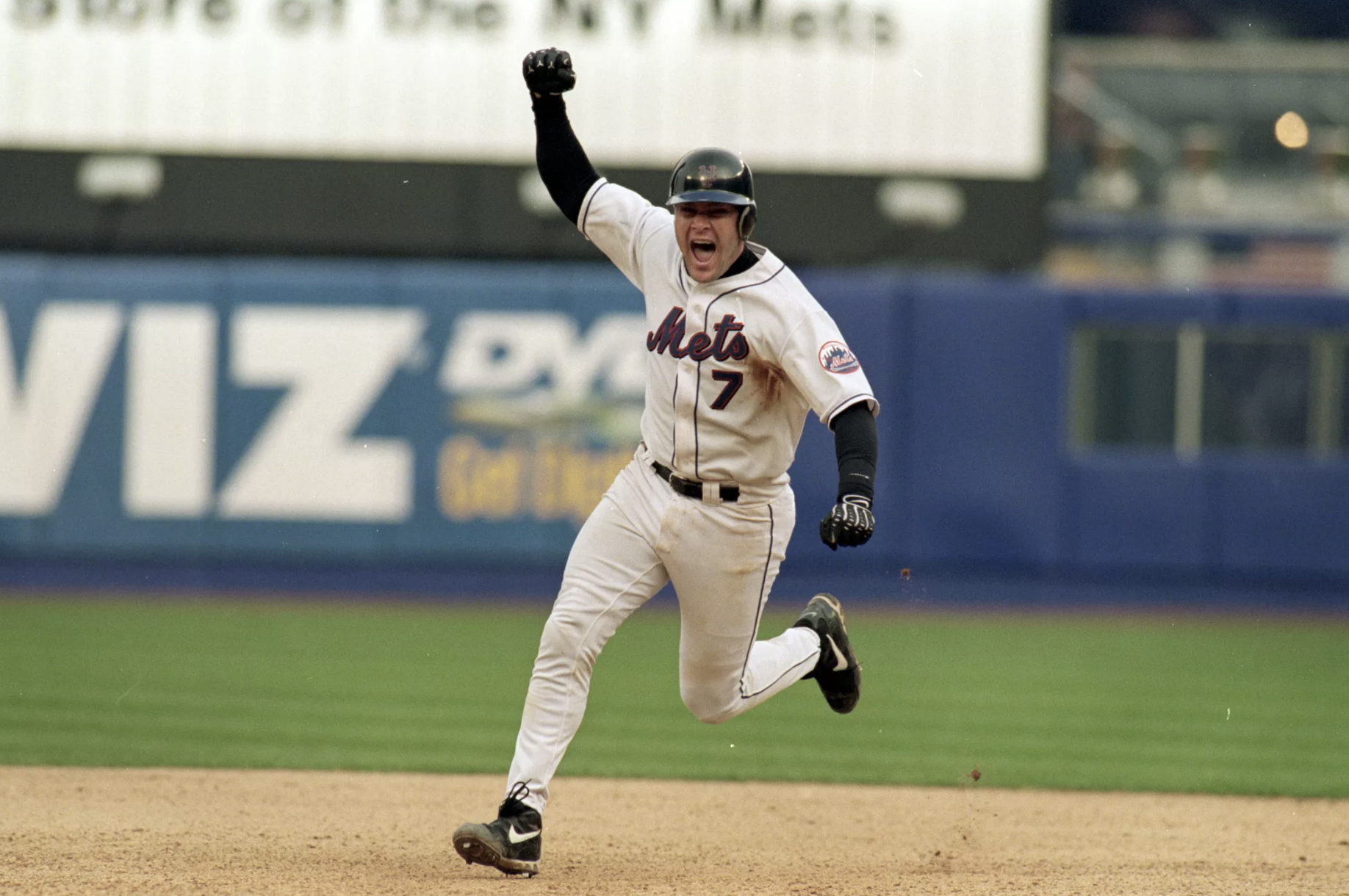
As Finley began his dejected trip to the dugout and winter, Pratt sailed around the bases, fists pumping, while various Mets capered gleefully in every conceivable direction — John Franco‘s somehow jubilant tiptoeing still makes me laugh 21 years later. In the stands, everybody was hugging everybody, and Greg hoisted me into the air like a ragdoll. (Memo to self: My blog partner, though gentle, is strong.) It was bedlam, the happiest of pandemoniums, and somehow even happier because it was the understudy who’d aced the aria and been showered with bouquets.
On Oct. 17, Pratt would be front and center again, with the Mets scratching and clawing to stay alive against the hated Braves during a marathon NLCS Game 5, played in a miserable chilly rain. I was there again, in the farthest reaches of the left field upper deck with Emily and her dad, in seats with no view of the Diamondvision and angled so that Shea’s announcements and music registered mostly as thuds and echoes. (By way of compensation, many of those around us had pocket radios, with the voices of Bob Murphy and Gary Cohen a welcome murmur around us.)
Pratt batted fifth in the Mets’ epic 15th-inning comeback. He followed Shawon Dunston‘s legendary leadoff at-bat, the one that took 12 pitches and nearly six minutes to yield a desperately needed single; Matt Franco‘s pinch-hit walk; and Edgardo Alfonzo‘s sacrifice. Bobby Cox ordered Kevin McGlinchy to intentionally walk John Olerud, which was only sensible; Pratt strolled to the plate with a slight smile — almost a smirk — on his face. The first three pitches missed the mark, McGlinchy threw a strike, and then the fifth pitch was outside for a game-tying walk. Pratt, having done a singularly useful bit of nothing at the best time possible, flung the bat skyward in delight and steamed for first. He was there four pitches later, when Robin Ventura drove McGlinchy’s final pitch over the fence for a season-saving grand slam.
Ventura, of course, would make it to Georgia but not to second base, because an overjoyed Pratt scooped him up shy of that station, hoisting him not unlike the way Greg had heaved me airborne eight days earlier. Before being intercepted, Ventura gestured insistently for Pratt to go the other way, but the Tank wouldn’t be denied, and in the replay you can see the moment where Ventura, held helplessly aloft, gives up and concludes, “Well, this works too.”
Pratt would have other moments — practically leaping into orbit when Piazza capped the 10-run inning against the Braves with a tracer off Terry Mulholland the next summer, and starting Game 1 of the 2000 World Series. His time with the Mets ended with a regrettable whimper, as the team became enamored of Vance Wilson and sent Pratt to the Phillies in exchange for anonymous backstop Gary Bennett in July 2001, a trade somewhere between pointless and insulting. He’d spend four full seasons with Philadelphia, one with the Braves (an odd and unwelcome sight) and then retire after spending 2007’s spring training with the Yankees. By then he was 40, which is about 360 in catcher years. The kid who’d been ticketed for a life as a minor-league coach without escaping Double-A had spent 14 seasons in the big leagues, was guaranteed an ovation for the rest of his life in Flushing, and would live on forever in highlight reels.
It’s a satisfying story, one that those of us in the stands found even sweeter. Even a fringe big-leaguer is literal orders of magnitude removed from a sandlot star — Todd Pratt was a world-class athlete in ways few of us can imagine. But his boundless, Golden Retriever exuberance about baseball made that distance feel smaller. We wanted to scoop Robin Ventura up and carry him on our shoulders as a conquering hero; the Tank felt the same way, and nothing was going to stop him from doing just that.
Faith and Fear has the finest readers anywhere, we say with total objectivity, thus we thought we’d let you fine people about some Mets-related projects a few of our friends on the other side of the screen have lately crafted or are in the midst of crafting.
• Michael Elias has published the relationship-driven novel Two For Tennis (The Adventures of Mark), though don’t be thrown by the sport in the title. The book includes a generous dose of Metsian angst from the period Shea was closing and Citi was opening. We’ll share more come Oscar’s Cap season, but I can tell you there’s a nice nod to No. 41 about which one can’t say a cross word. Learn more about Two For Tennishere.
• Nick Davis, who you might remember from his wonderful 2018 American Mastersportrait of Ted Williams, is back in the baseball documentary game in a very big way, directing a multipart series on the 1986 Mets and the city that surrounded them under ESPN’s 30 for 30 banner. It’s coming to the Worldwide Leader in the hopefully not too distant future. Nick is enough of a lifelong Mets fan to not only read FAFIF regularly but wish for and be granted dinner with Bruce Boisclair as his twelfth-birthday present (Bruce called him by the wrong name and then ate the fries off his plate), so you know his head and heart are already tied for first place. Further, Nick’s dedicated crew clearly has the teamwork to make the dream work, as I learned when I had the privilege of seeing them in action prior to quarantine, when they teased hopefully coherent thoughts from some guy who watched a lot of Mets games 34 years earlier.
• James Schapiro, a contributor to FAFIF in the worst of Met times, has written a masterpiece about one of the Mets’ predecessors in their absolute best of times. To earn his master’s degree from the Columbia University School of Journalism, James delved into the events of October 4, 1955, the day the Brooklyn Dodgers won their only World Series. Through a spate of eyewitness interviews and a ton of diligent archival digging, James has brilliantly recreated a lost world in the Borough of Churches. It will have you rooting your heart out for Dem Bums and everybody who ever loved them. Take the trip to “The Day the Earth Sorta Stood Still” in the Delacorte Review and feel what it’s like when baseball dreams come true.
Congratulations to Michael, to Nick and to James. Thanks for reading, thanks for creating.
Welcome to A Met for All Seasons, a series in which we consider a given Met who played in a given season and…well, we’ll see.
It was a glorious time…
It was when I met the world.
—Henry Hill, Goodfellas
Like the Mets are doing in 2020, the Mets fans of 1970 spent their summer at day camp. Well, this Mets fan did. Others, too. Based on personal recollection, if you were a kid in day camp in 1970, there’s an excellent chance you were a Mets fan.
And if you were a Mets fan in the summer of 1970, whether attending an area day camp, romping around in a neighbor’s backyard inflatable pool or biding your time until the Good Humor Man jingled down your block, Tommie Agee was a name you knew and mentioned daily. Tommie Agee was fun to say. Tommie Agee was fun to watch.
Fun. Mets. Agee. Summer. Throw in those ice cream bells and, when you got right down to it, what else do you need when you’re a kid?
Fifty years ago this summer, life was good. The defending world champion Mets were good. Tommie Agee was better than good. Maybe not great in the named to the All-Star Game sense, but plenty good enough for we who’d gotten our feet wet the previous fall and now, in our first full summer as Mets fans, were letting the water rise above our ankles, then our knees, then our waist. Before we knew it, we were fully immersed.
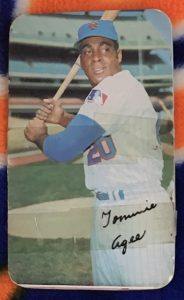
A Super card the author spent much of the summer of 1970 handling.
We had the Mets. We had names that my formerly seven-year-old brain has “1970” imprinted all over them regardless of my or their other summers. When you’ve had the 1970 Mets, it doesn’t automatically occur to you they’d been or would be anything else.
We had pitching like few others had. We had Tom Seaver, who wasn’t enough all by himself, but I swear he came close. We had Jerry Koosman, Gary Gentry, Jim McAndrew and Nolan Ryan, all of whom were talented even if none of them was quite Seaver and the latter of them was frustratingly wild, but boy could he throw hard. We had Ray Sadecki and Bob Murphy’s pronunciation thereof as if he were a Charoesque one-word phenomenon (“Raceadecki”).
We had Ron Taylor and Tug McGraw coming out of the bullpen because sometimes our starting pitchers didn’t throw complete games. We had Danny Frisella, who threw a forkball, and Cal Koonce before the Mets let him go, and Rich Folkers, once the Mets brought him up. We eventually had Ron Herbel and Dean Chance, too, because it turned out our pitching wasn’t always as extraordinary as we’d been told, but day camp was over by then.
We had Jerry Grote catching them all, except in the second games of doubleheaders, when we had Duffy Dyer. We had Buddy Harrelson and Ken Boswell turning double plays and rarely making errors. We had Donn Clendenon driving in so many, many runs. We had Ed Kranepool briefly demoted to Tidewater, but he came back and never went away again. We had Joe Foy, who I knew mostly from an old card I had that said Red Sox, and Wayne Garrett, whose card I didn’t have. Garrett had red hair, it was mentioned on TV, but we didn’t have a color TV, so I had to take the announcers’ word for it.
We had veteran Al Weis coming off the bench; and rookie Teddy Martinez being groomed as his utility infielder replacement; and Dave Marshall pinch-hitting; and Ken Singleton promoted from the minors when Kranepool went down; and Mike Jorgensen not breaking .200; and Art Shamsky who looked like he was gonna hit .300; and Ron Swoboda who I assumed hit more home runs than he did; and Cleon Jones who rated his own miniature comic book in a pack of baseball cards because he hit .340 the year before and .297 the year before that (which I learned from the comic book).
We had Tommie Agee. He didn’t have a comic book, but he had a Super baseball card, larger than those for the other Mets I got. Seems appropriate.
***
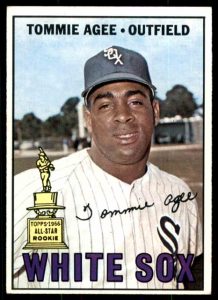
When I think of Tommie Agee, I think of a Met who was always a Met and would never be anything but a Met before correcting my perception for accuracy. I knew even in 1970 that Tommie Agee hadn’t always been a Met. I had a card of his that, like Foy’s, was from 1967, portraying him as some kind of Sox — White, in Agee’s case. It also had a little trophy printed on it, signifying what an outstanding rookie the people at Topps thought Tommie was.
Who trades a guy with a trophy?
On the back was a cartoon. Not a full-blown comic book à la Cleon, but an illustration that illustrated the big news blowing out of the South Side of the Windy City: “Tommie was the A.L. Rookie of the Year.” A ballplayer wearing a Hawaiian shirt hugged a loving cup to drive home the point. An adjacent cartoon had a ballplayer in a blank uniform being “originally signed by the Indians”. I’ll leave it to you to imagine how the Indians were represented.
The Indians? Hey, if Tommie Agee was hot enough stuff to have won the Rookie of the Year, what was he doing on his second team? According to the MAJOR & MINOR LEAGUE BATTING RECORD Topps printed (I’m telling you, the back of the card is where the real action was), Tommie had three auditions with Cleveland from 1962 to 1964 and another with Chicago in 1965 before executing his award-winning campaign of 1966. The card was from 1967. In 1970, I learned Tommie had been a Met since 1968.
This guy got around more than I could comprehend. Apparently the White Sox weren’t as impressed by Agee’s promise as Topps had been. A year after Agee won his award, the Sox dealt him to the Mets. Our new manager, Gil Hodges, liked what he’d seen in the American League when he when he was running the Senators and pushed for his acquisition. (One of the players we traded to get him was Tommy Davis, whom I knew as a Met from the quickly outdated 1967 card collection I inherited from my sister.) Tommie’s first year as a Met was so massively disappointing it was constantly invoked for the rest of his Met days — not to be nasty, but to serve as prologue for what came next. He was a .217 hitter in 1968, not close to comic bookworthy. I picked up that he’d been hit in the head in Spring Training by Bob Gibson, making me dislike Bob Gibson very much. He went 0-for-10 in the Mets’ 24-inning loss to Houston on April 15. His average going into that marathon was .313. Coming out, it was .192. As late as September 7 it was .191. His RBI total in 132 games was 17. For everybody else, 1968 was The Year of the Pitcher. For Tommie Agee, it must have looked like The Year of Ten Pitchers at Once.
But by 1970, that was backstory that served to make 1969 only more Amazin’. By seven years old, I knew that’s how to spell the word. Tommie Agee was as much an influence on orthographers as anyone. His 1969 was legendary in an instant. He’s the Met who put ninth-place 1968 behind him with the most force. On April 10, 1969, in the Mets’ third game of the season, Agee hit two home runs, or forty percent of his 1968 total. The first of them nearly beat Apollo 11 to the moon by three months, landing fair on the left field side of Shea Stadium’s Upper Deck. Tommie was the first and last player to hit a home run to Shea’s highest tier. The ballpark stood 45 years. Only one player earned a commemorative marker way up yonder.
Agee’s Upper Deck blast waited nearly four decades for company that never arrived (photo by David G. Whitham).
In 1969, Tommie Agee hit 26 homers, second in Mets history to that point behind only Frank Thomas’s 34 in 1962. Five came leading off games, which will break up a shutout real fast. In August, he bopped one off Juan Marichal in the fourteenth inning to beat the Giants at Shea, 1-0. In September, he was dusted by Bill Hands to start a showdown series with the Cubs. He got up and got his revenge two innings later, stroking a two-run homer, reminding one and all this was no longer 1968. In the sixth, he slid incrementally past Randy Hundley’s tag to give the Mets the lead and, ultimately, the win, informing everybody that 1969 was like nothing else. The Mets would soon take first place and the division title.
Then came the postseason, first the inaugural NLCS versus the Braves (.357 average, a pair of homers) and then Game Three of the World Series, the one known forever more as The Tommie Agee Game. How many World Series games belong to a single player? Who would argue this wasn’t Agee’s? A leadoff home run. An impossible ice cream cone catch at the wall to cut off an Oriole rally. Another impossible catch diving across the grass to cut off another one. They said the first one, with him holding onto the ball despite its Good Humor impression, was more miraculous, but it was the second one I was determined to replicate diving across the grass of my backyard for much of the early ’70s.
“Batman at the plate, Robin in the field,” is how I read his Game Three performance summed up somewhere. Tommie Agee was a comic book hero, too.
That, and a world champion. His childhood chum Cleon Jones caught the last out of Game Five. They made their way safely from the enraptured throngs who had taken over the Shea Stadium sod into the clubhouse, joining a champagne-drenched celebration that is still going in the hearts and minds of Mets fans everywhere. Seaver draped an arm around Jones. Swoboda draped an arm around Agee. The city wrapped its arms around all of them.
***
The 1970 Mets fell back to earth by autumn, not winning the division, not repeating as champs. So much for crowd-pleasing encores. They were better than they’d been in 1968 but nowhere near as good as they’d been in 1969, going from 73 wins to 100 wins to a suddenly inadequate 83. In retrospect, it’s a perplexing trajectory. Maybe 1969 and 1970 were switched at birth. But during the summer of ’70, the Mets were as good as a seven-year-old needed them to be. Sometimes they were in first place. Most of the time they were hovering near it. Tom Seaver seemed a lock for 20 games and another Cy Young by July (he’d fall short of both). Gil Hodges named him to start the All-Star Game in Cincinnati. and selected Buddy Harrelson to back up at shortstop. No other Mets were deemed officially stellar. Still, not having fully experienced 1969 — I didn’t start paying legitimate attention until late summer — whatever these guys were doing in 1970 was plenty for me. It was enough that they were fighting it out with the Pirates and Cubs. It was enough that Tommie Agee was having the non-championship season of his life.
Not quite as many home runs as in 1969 (24) but more stolen bases (31). The steals were a club record; one of them, on July 24 at Shea, was a tenth-inning steal of home to literally win a game against the Dodgers, the only time the Mets have stolen away with a walkoff victory. Tommie’s combination of power and speed was a revelation for a kid who understood the Mets were however good they were more because they pitched great and however lacking they were because they neither hit well or ran much. Agee’s aberrational skill set can be measured this way: his power-speed number, a calculation conceived by Bill James, was 27.1. The highest single-season PSN by a Met previously was 17.4 (Jones in 1968). Agee’s standard wouldn’t be topped until Darryl Strawberry posted a 27.5 in 1986. To this day, Agee’s 1970 PSN is the eleventh-best by any Met. And in the National League in 1970, Agee’s number was second only to Bobby Bonds. (He was also second to Bonds in strikeouts, but that only made him more human.)
Guy hits home runs. Guy steals bases. Guy continues to make great catches in center field and becomes the first Met to win a Gold Glove. Is it any wonder the guy becomes the talk of day camp in the summer of 1970? Tommie Agee is the name I remember taking up the most Met talk when I talked Mets with other seven-year-olds. Slugging, sprinting, snaring…that’ll get kids’ attention. He was fearsome in his talent, approachable in his demeanor. Me, I liked to talk about Tom Seaver, but I didn’t mind hearing about Tommie Agee.
It was a good Tom to be a kid.
***
A little more than two years later, Tommie’s time as a Met was over. Neither 1971 nor 1972 were particularly scintillating for either the club or the player (though the player remained reasonably popular with newly minted eight- and nine-year-olds). Following their third consecutive third-place finish, the organization decided they could do without the man who had very recently embodied excitement on their behalf. I’ve seen Agee’s November 1972 trade to Houston, for Rich Chiles and Buddy Harris, attributed to Tommie becoming superfluous at Shea given the late-career presence of Willie Mays. I’ve also read it was more a matter of the paternalistic front office worried that Agee was somehow a bad influence on certain other Mets; Met front offices have a sorry history of making “bad influence” assumptions where Black players are concerned. Whatever pointed him out the door, Agee was an Astro, Chiles was a washout and Harris summered in Tidewater. In the first game I ever attended at Shea, on July 11, 1973, I saw Tommie Agee single in a run in the wrong uniform. Two months later, Agee hit his final home run as a big leaguer. Fittingly, it was at Shea Stadium. Perversely, it was as a Cardinal, as St. Louis acquired him for a futile stretch run. The Mets were making magic again that September, even though Tommie now represented a fleeting obstacle to their latest miracle.
That offseason, Tommie Agee was traded by the Cardinals to the Dodgers, a fact reinforced a dozen or so times in 1974 by the TRADED card I received quite often as I opened one Topps pack after another. But Agee never actually played for the Dodgers. L.A. released him in March and rudely went on to win the pennant without him. Nobody else signed him. He was 31 years old, not five years removed from The Tommie Agee Game, yet the game was over for him. In 1975, he told Sport magazine, “I knew I could still play and nobody contacted me. It hurt. It hurt my pride.” For a while, according to Sport, “he kept practicing his batting stance, his grip and his swing, in front of mirrors. And then, by the time he turned 32, he knew the dream was dead, and he stopped practicing.”
By the fall of 1975, Cleon Jones was no longer a Met, either, symmetry brutal in its poetry given that they’d been the Mets from Mobile together. Hell, there was a book by that title, delineating the journey of a pair of scholastic athletic stars from the Mobile County Training School who became a pair of world championship outfielders for the New York Mets. Though the Alabama city had been slow to embrace the Amazin’ nature of having two of its native sons shine in the same World Series, Tommie and Cleon did get some of their due after the Mets grounded the Orioles. A.S. “Doc” Young wrote in the aforementioned volume, “More than 5,000 people packed themselves into Mobile’s Bienville Square to participate in the city’s ‘Major League Day’” shortly after the Mets’ ticker-tape parade up Broadway. Though future Hall of Famers Hank Aaron, Willie McCovey, Billy Williams and Satchel Paige were feted, too, the guests of honor were “the Met men […] Agee received the greatest ovation when he said, ‘There’s no place like home.’”
***
But for Agee, New York was home, despite the trade out of town, despite the sad scene painted by Sport’s Dick Schaap and Steve Steiner, in which Agee and Jones dolefully tended their bar, the Outfielders Lounge in Queens, with baseball having “turned its back on them”. By 1979, the 1969 Mets were certified nostalgia. What was left of the wreckage of the contemporary Mets organization enthusiastically celebrated the franchise’s only world championship, an achievement that seemed unlikely to be repeated any eon soon. Agee was there. In 1986, as the Mets (after being mercifully sold and thoroughly rebuilt) were soaring to their second world championship, the Mets set aside a weekend to toast their 25th anniversary. Agee was there. Every time the Mets gathered their former standouts, Agee was there.
Tommie and Cleon grew up in the same town at the same time, making their story that much more Amazin’.
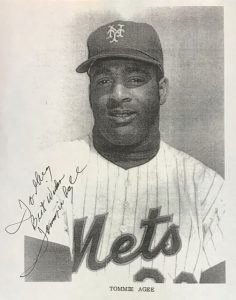
In retirement, every time there was any reason for Mets fans to be anywhere, it seemed Agee was there. It didn’t have to be an Old Timers Day or a 1969 milestone reunion or an episode of Everybody Loves Raymond. Agee made every appearance. I have a personally autographed picture of him secured for me by my brother-in-law who, trust me, doesn’t frequent sports gatherings, but Agee was on the scene at some trade show or another he visited. A blogging colleague has a personally autographed picture of Agee from a high school carnival in the late 1980s, never mind that to be in high school in the late 1980s was to have missed all of Tommie Agee’s Met tenure. I covered a press luncheon that reintroduced Rheingold to the New York market in the late 1990s. Agee spoke fondly of the old Met-sponsoring beer and his late manager Hodges and how he wished Gil could have been here today to enjoy one with us.
A co-worker of mine in 1996 handed me an envelope of photographs and told me to take a look, I’d get a kick out of it. I did. It was his son, who I was think was ten at the time. The kid had become friendly with another ten-year-old whose last name implied he was well-connected in a way my co-worker was sure I’d dig. The two kids, along with another friend of theirs, had gone to camp together that summer. The well-connected kid decided it would be fun to celebrate his birthday somewhere his connections made easily accessible to him: on the field at Shea Stadium during batting practice. Ergo, the pictures were of my co-worker’s son and his friends and a series of smiling 1996 Mets: them and Todd Hundley; them and Rey Ordoñez; them and Butch Huskey; them and Lance Johnson. Given the well-connected kid’s last name (began with a “W,” ended with an “n”), every Met happily paused his BP machinations to say cheese.
And then, amid all the 1996 Mets, there was a picture of the kids with a 1969 Met. A 1970 Met. It was Tommie Agee. The kids, who practically smiled their faces off in every picture, had no idea who he was but kept smiling. My co-worker had no idea why the old Met, out of baseball more than twenty years by now, was haunting Shea Stadium batting practice on a random summer evening with nothing more festive than another ballgame on the calendar.
I know why. Or I’ve decided I do. It’s because Tommie Agee was at home with us. Mobile had to think about making a big deal out of him? New York didn’t. At Shea in 1968, in the deepest doldrums of his slumping — he went 0-for-34 at one point — he lined a single up the middle, eliciting an enormous cheer. “It was not the cheer of sarcasm you hear so often in ballparks,” Dick Young wrote in the Daily News. “This was genuine elation from the fans, a show of appreciation that he had hung in there to snap his oppressive run of 34 consecutive outs.”
Best wishes to you, too, sir.
Tommie Agee elated us a lot in 1969 and 1970 and we never forgot. Unlike the Indians, the White Sox, the Astros, the Cardinals and some shortsighted stuffed shirts in the Mets executive suite, we the Mets fans never traded him. Unlike the Dodgers, we never released him. We appreciated him. Kids of 1969. Kids of 1996. We all got it when it came to Tommie Agee. We all appreciated him and he appreciated us all right back, right to the day he died too soon, in Manhattan in 2001 from a heart attack at the age of 58. I don’t believe there’s been a significant public congregation of 1969 Mets since — starting with Tommie’s posthumous induction into the Mets Hall of Fame in 2002 — when he wasn’t spoken of by teammates fondly, represented by members of his family lovingly, and cheered by the rest of us, his extended Mets fan family, heartily.
That’s my understanding of why Tommie Agee was always around and I’m sticking to it.
PREVIOUS METS FOR ALL SEASONS 1962: Richie Ashburn 1964: Rod Kanehl 1966: Shaun Fitzmaurice 1969: Donn Clendenon 1972: Gary Gentry 1973: Willie Mays 1977: Lenny Randle 1978: Craig Swan 1981: Mookie Wilson 1982: Rusty Staub 1990: Gregg Jefferies 1991: Rich Sauveur 1992: Todd Hundley 1994: Rico Brogna 1995: Jason Isringhausen 1996: Rey Ordoñez 2000: Melvin Mora 2002: Al Leiter 2003: David Cone 2005: Pedro Martinez 2008: Johan Santana 2009: Angel Pagan 2012: R.A. Dickey 2013: Wilmer Flores
Welcome to A Met for All Seasons, a series in which we consider a given Met who played in a given season and…well, we’ll see.
Come on along
Come on along
Let me take you by the hand
Up to the man
Up to the man
Who’s the leader of the band
—Irving Berlin (ideally interpreted by Lou Grant)
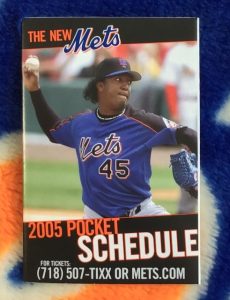
The first player this blog named its Most Valuable Met for a season just completed was Pedro Martinez. His prize in 2005? One whole paragraph devoted to his sparkling campaign. If, in fact, he clipped and saved it, there’s no doubt in my mind that it fits snugly to this day among the winner’s three Cy Young Awards and Hall of Fame plaque.
Still, just one paragraph for such a historymaking event? By way of explanation if not alibi, the Faith and Fear in Flushing Awards Committee (FAFIFAC) had convened on the fly that October and hadn’t really thought through its presentation protocols. Nor did FAFIFAC realize it was commencing a tradition that would endure for the next fifteen seasons — sixteen, if a next season happens to happen. Thus, whereas future winners would enjoy entire essays devoted to their deeds, Pedro Martinez received one paragraph…in which he was compared to a novelty beverage.
Drawing such a parallel wasn’t intended as an insult. Given where I was coming from in 2005, it was a genuine honor.
From 1989 to 2004, you see, beverage was a dialect I spoke fluently and frequently. Today, my drinktalk is a little, shall we say, watered down, but fifteen years ago, it remained on the tip of my tongue from the previous fifteen years, when the beverage world and the beverage spectrum were my daily concerns. As a business magazine reporter and editor, I wrote about beverages for those fifteen years like I would write about baseball for the next fifteen years as a blogger and author. It’s little wonder that the two B’s that have absorbed the bulk of my vocational attention for three-plus decades would overlap at the transition from one B to the next.
(And who knows — based on recent reports, knowing a little something about beverages might have more than a little to do with knowing something about one baseball team in particular pretty soon.)
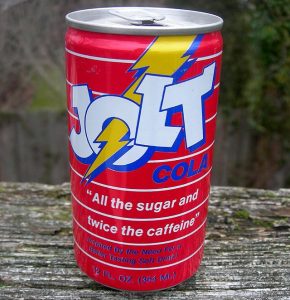
In considering the Most Valuable Met candidates for 2005, I processed reliever Roberto Hernandez as Old Forester Bourbon (“dates back to the 1870s, but can still deliver when called on”); shortstop Jose Reyes as SoBe Adrenaline Rush (“works fast”); third baseman David Wright as Strawberry Quik (“Wholesome. Pure. Smooth.”); and left fielder Cliff Floyd as Miller Lite (“a new and improved formula that doesn’t leave you feeling weighed down by unmet expectations”). They all had good and valuable 2005s for the Mets, but there was only one Met who was Most Valuable in Faith and Fear’s first year, and he, Pedro Martinez, was Jolt Cola.
Twice the sugar. All the caffeine. Not only can’t you close your eyes, you won’t want to. The hum in your head is unmistakable. Your senses are tingling. Gotta have another blast of that stuff.
That, not incidentally, was Jolt Cola’s actual sales pitch: a surfeit of sugar and a cacophony of caffeine, presumably plenty enough for anybody cramming for finals or driving through the night. Otherwise, I can’t imagine it was an ideal dose. Nevertheless, Jolt created a tempting proposition. How could you not want to try it at least once? Jolt Cola was a cultural phenomenon when it launched in 1985, four years before I started getting my hands professionally wet. By the time I came along, it was pretty much yesterday’s news, though it would generate a little press here and there during my prime beverage years. Less significant than how much Jolt Cola sold was the idea it spawned. One can certainly draw a line from a pepped-up carbonated soft drink to the energy drink wave that was charging into view in the late ’90s, right around the period the future first FAFIF MVM was taking his world by storm. You bring a name like Jolt on the market, you oughta have an impact.
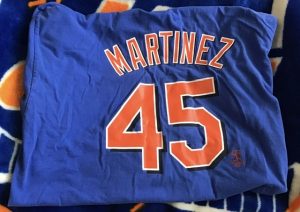
Our first MVM trophy.
Similarly, when you bring a pitcher like Pedro Martinez into a situation thirsting for his brand of presence, you’re gonna feel a jolt. And when you reflect on a pitcher like Pedro Martinez and how valuable he was in the year he became omnipresent in your situation, you’re gonna need a whole lot more than a single paragraph.
So open the beverage of your choice and sit back. Or lean forward to edge of your seat, like you might have when this man chose to join our ranks.
***
Pedro in action.
Pedro Martinez was exactly one person, exactly one player. Yet it could be argued that on the greater baseball map, in the years directly preceding his arrival on the team he essentially took over in 2005, the extraordinarily famous righthander was a bigger deal by himself than the New York Mets were as a multi-person, multi-player unit. From 2002 to 2004, the Mets unintentionally disintegrated as a competitive entity, passively pulverizing the goodwill they’d carefully constructed in building themselves into a perennial contender between 1997 and 2001. While the Mets rose and fell in New York, Martinez reigned atop his realm mostly without pause. He was too good to be ignored in Montreal, then too great to be paid in Montreal. In 1998, he was off to Boston. The Red Sox were in for the ride of the franchise’s life, culminating in the capture of the biggest flag there is in 2004.
When the satiated Sox finally achieved with Pedro what they could never quite manage in the eighty years prior to the start of his starry New England tenure, they, like the eventually defunct ’Spos, saw no compelling reason to keep paying him what he wanted for as long as he wanted. Pedro Martinez, as celebrated a pitcher as there was in North America at the close of one century and the dawn of another, became a free agent.
What had been perhaps the most moribund large-market organization in baseball pursued him and signed him. That’s the same organization that an offseason earlier had the clearest shot imaginable at another ex-Expo advancing along a Cooperstown-bound track and couldn’t lowball him enough. Somehow, the same New York Mets who couldn’t be bothered to ante up for a readily available Vladimir Guerrero in January of 2004 pushed a blockbuster offer to the middle of the table in December of 2004 and asked Pedro Martinez to please take it to the bank.
Which he did. Suddenly, for the sum of $53 million spread our over four years — when committing more than three years to a starting pitcher past his thirty-third birthday caused heads to shake industrywide — Pedro Martinez became a Met. Technically, he was the second Pedro Martinez to become a Met. The first was Pedro A. Martinez, a lefty reliever who pitched in five games for the 1996 Mets. Pedro A. Martinez was best known, even in 1996, for not being Pedro J. Martinez. This was three years after we got Mike Maddux, who was best known, even in 1993, for not being his brother Greg. We tended to gravitate to the guy who was best known for not being somebody else.
Not this time. This time we got the Pedro Martinez. For a while, nothing would ever be the same.
***
I’m wary of any sentence that begins with the words “people forget”. A mighty big supposition is required to decide what is commonly retained and what escapes the collective consciousness. I can suspect you’ve forgotten a fact or two, yet I can’t possibly prove it without a torrent of interrogation. Maybe the stuff I’m thinking about today has been buried in your subconscious under stuff you’re thinking about today. Maybe you remember this stuff very well but haven’t seen fit to think about it of late.
You can’t forget how big Pedro was to the New Mets in 2005.
Nevertheless, I suspect people forget just how big Pedro Martinez was as a New York Met, especially in 2005, but really pretty much to the conclusion of his contract in 2008. He loomed as large as an individual Met possibly could over the entire operation from the instant he got here. Pedro was where we looked for answers, for progress, for hope. In that first year, Pedro was where we got it.
I don’t know if “people forget” that it took a radical regime change in the front office (Jim Duquette to Omar Minaya) to positively alter the Mets’ roster-stocking methodology. I don’t know if “people forget” that there was a discernible span of time when the Wilpons weren’t called the Coupons. I don’t know if “people forget” that an enormous investment in a 33-year-old pitcher translated on the field, at least for a spell, as a bargain for the ages.
I do know fifteen years tend to fly by in perception yet actually measure out to fifteen years, which can be reasonably defined as a long time. I do know all those elements sound as if they occurred in an eon unrecognizable to how we’ve come to view the Mets over the past decade or so. But this was how we rolled. Let’s get a GM who’ll take chances. Let’s let the checkbook out of the desk drawer. Let’s be thrilled that we did and not ask too many questions about where the funds are coming from. It wasn’t a foolproof formula for long-term growth, but damn it was effective and fun for a couple of years, just as Pedro Martinez was effective and fun for those same couple of years.
Especially in 2005. Pedro wasn’t the sole marquee addition for the season ahead — the Mets stunned the sport by swooping in and carrying off five-tool dynamo Carlos Beltran that January (seven years, $119 million) — but Martinez represented an injection of charisma on top of capability that the organization practically ached for.
In beverage terms, they couldn’t have been flatter coming out of 2004. In further beverage terms, Pedro popped from the bottle in 2005 with such force that you had to be sure to uncork him away from your face. We hadn’t had that spirit here since 1999.
In Port St. Lucie, everything Pedro Martinez said or did was news of the most urgent order. Didja hear? Pedro dressed up in an orange suit! Pedro paraded through the clubhouse in nothing but a smile! Pedro messed around with a mannequin! Pedro absconded with the grounds crew’s tractor! Pedro said this! Pedro did that! Pedro! Pedro! Pedro!
And that was just Spring Training. The Marcia Brady of the Mets rotation would generate even more attention once the regular season started.
***
Three starts from Pedro and the world was our oyster. The Queens where he’d be used would sure excite us.
CINCINNATI, April 4 — The new season. The new ace. The new avatar of what it means to be Mets. In the bottom of the first inning maybe not so much, as Pedro Martinez surrenders two singles followed by a three-run homer to Adam Dunn. But then — nothing. A couple of walks, but that was it. Pedro retired every Red in sight, striking out most of them, twelve over six innings. The new manager, Willie Randolph, removed him after the Mets took a 6-3 lead in the top of the seventh, leaving the club’s Opening Day fate to Manny Aybar, Dae-Sung Koo and Braden Looper. How do you suppose that worked out? The Mets lost, 7-6, but save for Joe Randa’s walkoff homer, the talk of the Opener was Pedro. Loser Looper: “Pedro pitched a great game. He struck out the world.” Villain Randa: “Pedro was on top of his game. He was carving through us. He was unhittable. Once he was out of the game, there was a big sigh of relief on the bench.” Hapless Randolph: “He gets a certain look on his face: That’s it. I’m gong to shut you down and that’s it.”
ATLANTA, April 10 — The Mets were more Looper than Pedro as they continued their first road trip of 2005. Two more losses at Great American Ball Park. Another two at Turner Field. The Mets were 0-5 for the first time since 1964, a year when the Mets hadn’t invested in Pedro Martinez let alone Carlos Beltran. In their finale against the Braves, those investments paid dividends. Sure, it was still Turner Field. Sure, John Smoltz was still trouble. But Pedro picked up where he left off in Cincinnati and then went further: the full nine innings; only two hits; only one walk; only one run — and another nine strikeouts. Smoltz was also Hall of Fameworthy (15 Ks as he reacclimated to starting after four years as Atlanta’s closer), but in the eighth, with the Mets down 1-0, Beltran belted the three-run homer that guaranteed the Mets wouldn’t go 0-for-’05. After the 6-1 victory, Randolph savored a victory cigar and the savior of his season: “Pedro said, ‘I’m not coming out.’ That’s just the kind of warrior he is.”
FLUSHING, April 16 — Now the Mets couldn’t lose. After getting to 1-5, they swept the Astros, then rode Aaron Heilman’s one-hitter (!) over the Marlins to .500. On Saturday afternoon at Shea, with a Kids Opening Day crowd of more than 55,000 crammed in, all screamed for Pedro. He was officially a happening every time he showed his face. We loved him for beating the Braves. We loved him for batting down crazy WFAN talk that he skip the Home Opener so he could fly back to Boston to accept his World Series ring. We loved that during that Opener, when a batter’s eye ad with his picture got stuck between innings and delayed the game, he emerged from the dugout and did a little dance, which made a little love between us and him. Mostly we loved the pitching he did for kids of all ages. Versus Florida and their erstwhile-Met starter Al Leiter, Pedro threw seven innings, allowed three hits, one walk and two runs while striking out nine. Leiter made like Smoltz in the role of obstinate opposition, but karma was with the new Met over the old Met. Both starters were out by the time Ramon Castro drove home Victor Diaz with the walkoff run. “He pitched well,” Marlins first baseman Carlos Delgado conceded after his team lost, 4-3. “He was throwing harder than what he had last year.” Pedro was happy his Mets were playing “loose and with more confidence. If I am to lead, I am going to lead by example. That’s what they are going to see.”
And see, we did. In his fourth start, on April 21 in Miami, Pedro shut down the Marlins again, this time in a Met rout. Over the radio, Gary Cohen scored it a triumph for reality over reputation:
“Pedro’s been described as a diva. What he is is a maestro.”
***
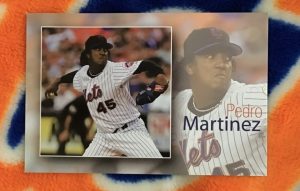
Greetings from Pedro! Glad he is here.
The Maestro wouldn’t conduct a tour de force in every start — and the Mets couldn’t quite break free of the gravitational pull of .500 — but every Pedro Martinez start of 2005, home or away, was an event to be anticipated. You wanted to go. You had to tune in. You depended on Pedro to cultivate winning ways and rebuff losing inclinations. Win or lose, there was always a carnival going on around him. Step right up and don’t be shy. Because you will not believe your eyes.
Shea’s sprinklers went off one night while he pitched; he danced some more.
Twice he flirted hard with no-hitters; one was broken up in the seventh, the other in the eighth.
Twice he bore the brunt of old AL East jibber-jabber when his former archrivals from the Bronx appeared on our schedule; the Mets split those Subway Series games, though Pedro pitched well enough be the Yankees’ daddy in each of them.
Carlos Beltran, who otherwise slumped most of his first nervous season in New York, basically homered only when Pedro pitched; nine of his first ten Met dingers rang in the service of Pedro starts.
The high-profile presence of Martinez and Beltran, among other Latin players brought on board by a Latin GM, spurred the unofficial nickname Los Mets, which was interpreted in different quarters to mean different things, meaning it became another story with Pedro at its heart.
Mike Piazza, who didn’t exactly mesh with proto-Pedro when they were together as Dodger youngsters (plus Pedro plunked him at Fenway during Mike’s first weeks as a Met), navigated a public truce with his second-time batterymate and immediate successor as the franchise’s marquee star…though Pedro worked quite a bit with backup catcher Ramon Castro…and that became yet another Pedro story in the course of what was, above all else in Metsopotamia, a Pedro season.
On a personal note, on the May night our beloved cat Bernie died, Pedro took the mound and mowed down the Marlins. And on the September night we adopted the kitten who instantly became our beloved cat Avery, Pedro took the mound and mowed down the Braves. Each was a ten-strikeout masterpiece. Each was, in the view of the Prince household, the cat’s pajamas.
All of this while Pedro was inarguably in his 34th summer, more than half of them having been devoted to pitching competitively.
All of this while the bigger-than-life figure persevered in a slight-of-figure frame.
All of this as his MLB odometer clicked past 2,500 regular-season innings pitched, not to mention all those pressure-packed postseason outings with Boston.
All of this from a self-described “old goat”.
Physically, Pedro Martinez wasn’t as indestructible as a Mets fan might have preferred. He skipped the All-Star Game to which he was rightly named in deference to taking much-needed rest. In August, he didn’t fight Randolph’s inclination to take him out with an 8-0 lead over Washington after six innings. He’d been dealing with discomfort between his shoulder blades, so every little bit of preservation was a blessing for an ace trying to lead his acolytes toward a Wild Card bid.
The Mets’ reliably unreliable bullpen blew the lead, but the offense came back to win in extras, 9-8. It might have made sense to sit down an aching veteran with a seemingly insurmountable edge, but it was also a reminder that the 2005 Mets were mostly only capable of going where Pedro Martinez led them.
***
In 2005, the Mets completed their most satisfying season since 2000, the last time they’d been in the World Series. They finished four games over .500 — a dozen games ahead of where they’d ended ’04 — and stayed legitimately viable in the playoff race until early September. David Wright and Jose Reyes established their credentials as stars on the come. Cliff Floyd avoided injury and turned in a monster year. Carlos Beltran survived. T#m Gl@v!ne, at last, seemed to fit reasonably well in New York. Mike Piazza hit enough to rekindle turn-of-the-millennium memories and was afforded an appropriately emotional goodbye as his contract expired. Smaller stories, generated by a likable enough supporting cast, lifted the overall narrative and hinted that hope would not be a fleeting thing in Flushing. Two-Thousand Six, buttressed by the addition of Carlos Delgado, Paul Lo Duca and Billy Wagner, confirmed such hope wasn’t a misguided notion. The Mets went from 83 wins to 97 and from Wild Card aspirant to dominant division champs.
Pedro wore well as 2005 went on.
Many Mets made 2006 better than 2005. Nobody made the year before 2006 better than Pedro Martinez. His 2005 was not only the start of something bigger, it was a legitimate standout in Met annals beyond the every-fifth-day effervescence he brought to Shea along with the commensurate rise in the ballclub’s Q rating. Pedro went 15-8, recording an ERA of 2.82, striking out 208 batters in 217 innings. The innings total was as high as Pedro had posted in a regular season since he was a lad of 27 in 1998. Batters hit all of .216 against him while Castro caught, .191 against him with Piazza behind the plate (in his 2015 memoir written with Michael Silverman, Pedro admitted he preferred throwing to Castro). His four complete games hadn’t been exceeded by a Met since Dwight Gooden’s five in 1993 and wouldn’t be topped until R.A. Dickey’s five in 2012; no Met has had as many as four since Dickey.
Interpreted by the advanced metrics that were just then taking hold in the greater baseball fan consciousness, Martinez’s ’05 was even more special. His wins above replacement, according to Baseball-Reference, measured 7.0, ninth-best among all starting pitching seasons in Mets history. Metwise, Pedro’s bWAR has been surpassed in succeeding seasons only by Johan Santana in 2008 and Jacob deGrom these past two Cy Young campaigns. When he achieved it, the 7.0 was the best by a Mets pitcher since Dwight Gooden’s transcendent 12.2 twenty years before.
Whereas Doc was in the advanced stage of his prodigy phase in 1985, Pedro was as veteran as could be at his Met peak. He’d first been signed out of the Dominican Republic in 1988 and made his major league debut in 1992. While Piazza was winning the National League Rookie of the Year Award in ’93, Martinez was getting his reps in as a Dodger reliever. He began forging an identity for himself, not content to coast on being simply Ramon Martinez’s kid brother. Before L.A.’s front office could fully realize what the younger Martinez could do, they traded him to Montreal for Delino DeShields. Pedro refined his game in Canada, winning his first Cy Young in 1997. In Boston, he elevated the town and the team not to mention his own profile. Two more Cy Youngs came while he was a Red Sock, the second of them, in 2000, on the wings of a microscopic 1.74 ERA carved at the height of the (ahem) enhanced strength & training era in baseball. As a youngster, he threw incredibly hard. Time might have compelled him to adjust his repertoire (as it did Tom Seaver), but he knew how to make his pitches work for him.
“The heart and mind of Pedro is what has him in the Hall of Fame today,” Fred Claire, the man who traded Pedro from Los Angles, told Rob Neyer on Neyer’s SABR podcast in 2020. We saw that at Shea in 2005 and, to a certain extent, during the three years that followed. The thrill in watching a Gooden 1985 performance didn’t require much explanation; he was a poised youngster in the full bloom of talent and the results flowed. For me, the joy of Pedro as a Met (and any accomplished veteran who could still negotiate a tough inning) was watching him understand what he had to do and then figure how to do it. As he aged, batters occasionally got the best of Martinez, but I never sensed they were better at what they did than he was at what he did. It was one thing to pore over his statistics while he was in residence at Fenway or check in on him under the October spotlight. Focusing on him for thirty-one starts in his thirteenth full season helped me truly comprehend what all the Pedro Martinez fuss had been and was still about.
Another reason I find myself invoking Gooden vis-à-vis Martinez is because, stats aside, Pedro’s 2005 registered as the most vibrant pitching season at Shea Stadium since 1985. People showed up for Doc. People showed up for Pedro. We showed up for Cone and Viola and Saberhagen and so on, but showing up for these two guys was different. For fans of a certain generation, the Pedro sensation provided a flashback. For fans of the next generation…well, that’s of specific interest to me and what I’m doing at this moment. Just as I inextricably associate two of Pedro’s excellent starts with the going and coming of two of my beautiful cats, I can’t separate what Pedro did in 2005 with what I started doing and what a lot of us started doing that year.
We started blogging in 2005. Faith and Fear in Flushing commenced during Spring Training. In the weeks and months ahead, if memory serves, so did sabermetrically savvy Amazin’ Avenue, news-driven Metsmerized Online, historically curious Mets Walk-Offs, relentlessly friendly Mets Guy in Michigan, refreshingly clearheaded Mike’s Mets, the incomparable Metstradamus and a slew of others not necessarily still with us. The presence of Pedro Martinez didn’t directly draw Jason and me into this passion of a pastime, but boy did he help give us something to blog about. I think that feeling was widespread within the nascent Metsosphere. Those of us who’ve stayed on the beat from 2005 onward probably owe a tip of the cap (or a can of Jolt) to ol’ No. 45 and what he did once he took the ball out of that blue glove of his and fired to Piazza or Castro. Later we’d have as our charismatic aces/subjects of fascination the likes of Johan, R.A., Harvey, Thor and the magnificent Mr. deGrom, all of them the kinds of pitchers that made you grateful you had a platform from which to expound regarding their feats and their craft. But it was Pedro who initially made the Mets blogworthy, starting that first afternoon in Cincinnati.
And once you get started, oh, it’s hard to stop.
***
What stays with me most from that first giddy wave of Pedromania is a comment I read on (I believe) MetsBlog. To paraphrase, it went something along the lines of “I’m not old enough to remember Dwight Gooden in 1985, but this must be what it was like.” That sentiment shook me at the age of 42. There are Mets fans typing on blogs who aren’t old enough to remember Doc Gooden at the height of his glory? But 1985 was only…fine, it was twenty years ago.
Time marched on, and Pedro moved in lockstep with it, giving it his all for the old goat in each of us eligible by then for OG status. He’d be giving it in 2006, 2007 and 2008, too, except he had less to give, injuries inevitably diminishing his availability and sapping his skills. Martinez still knew how to get out of innings, but he wasn’t able to start nearly as many of them. The leader of the band was tired and his arm was growing old. Muscle memory pushed him part of the way; mental acuity took care of the rest. The numbers weren’t impressive as his contract expired, but watching Pedro Martinez was special right up to the end.
***
From 2005 through 2008, Pedro, healthy and otherwise, filtered into our Mets fan dialogue as Homer Simpson only wished Poochie would when he briefly voiced the proactive cartoon dog who was conceived to revive Itchy & Scratchy’s flagging fortunes. Whenever Pedro wasn’t onscreen, all the rest of us were asking, “Where’s Pedro?” Yet in 2012, four seasons after Pedro Martinez left New York and three years since he’d completed his career with Philadelphia, the Mets neglected to ask the same question when they redecorated their St. Lucie clubhouse. On MLB.com, the much-missed Marty Noble reported the franchise, as it celebrated its fiftieth anniversary that Spring, paid homage to the usual (though certainly swell) suspects with historically themed murals. There were Mets from 1969, Mets from 1986, Mets from between those tentpole years and a glimpse at the years that predated their initial rush of success, but not a darn thing from the Mets’ most recent reasonably happy years. “Not even a square inch from the time of Lo Duca, Pedro and Reyes spent in this burg on the East Coast of Florida,” Noble noted.
Whaddaya know? Sometimes people do forget.
Nevertheless, that blog-commenting young person’s intuition from 2005 was definitely in the ballpark: the excitement stirred by Pedro was like the excitement around Doc. Never mind that Doc was homegrown and therefore automatically “ours,” while Pedro was a free agent acquisition who was bound to be remembered as a Red Sock primarily and an Expo north of the border. Pedro bridged the geographic gap to our hearts with his pitching and his personality. Sure, he wanted to get paid, but he chose to be among us and strove to help us be the best Mets we could be. When it came to baseball, Pedro Martinez was a missionary rather than a mercenary.
Nobody cut through the Metsian clutter quite like Pedro Martinez.
When he got to Cooperstown in 2015, even though his plaque portrayed him in a Red Sox cap — and even though it was his Boston exploits that dominated the chatter among the baseball commentariat — he remembered us, letting us know his “wild” side was essentially the “Mets fan” in him. “That’s how we are,” he told his induction audience in the first-person plural. “So Queens, I love you, too!”
Pedro, from the edge of this particular seat somewhere a little east of Queens, the feeling remains mutual.
PREVIOUS METS FOR ALL SEASONS 1962: Richie Ashburn 1964: Rod Kanehl 1966: Shaun Fitzmaurice 1969: Donn Clendenon 1972: Gary Gentry 1973: Willie Mays 1977: Lenny Randle 1978: Craig Swan 1981: Mookie Wilson 1982: Rusty Staub 1990: Gregg Jefferies 1991: Rich Sauveur 1992: Todd Hundley 1994: Rico Brogna 1995: Jason Isringhausen 1996: Rey Ordoñez 2000: Melvin Mora 2002: Al Leiter 2003: David Cone 2008: Johan Santana 2009: Angel Pagan 2012: R.A. Dickey 2013: Wilmer Flores
Welcome to A Met for All Seasons, a series in which we consider a given Met who played in a given season and…well, we’ll see.
The undisputed star of Ken Burns’s Baseball is Buck O’Neil: Negro League veteran, storyteller extraordinaire, and all that’s best about both baseball and humanity. You probably saw this back in the day (and if not, well, the pandemic’s an excellent time to catch up), but here it is again:
OK, so Bo Jackson‘s career didn’t turn out to be the trumpet call O’Neil imagined. That’s not the point. The point is O’Neil’s eagerness to embrace something new rather than linger in the sepia of nostalgia, brought home by his certainty that “I’m gonna hear it again one day, if I live long enough.”
On Opening Day 1996 — the season under consideration in this installment — the Mets opened at home against the Cardinals. They hadn’t been very good the previous season and it was pushing the bounds of optimism to think they’d be very good in the new one, but at least there were some exciting new faces. There was Lance Johnson, a wiry, speedy former White Sock, and Bernard Gilkey, one of those solid complementary players who may never explode into the firmament of stars but anchor good teams. And there was the great unknown: the rookie shortstop, a Cuban defector named Rey Ordonez.
In 1993, the 22-year-old Ordonez had jumped a fence in Buffalo, seeking freedom and a fortune in the U.S. After a year in indy ball with the St. Paul Saints, the Mets won the right to sign him. His trajectory as a hitter was at least a flashing yellow light — .309 at St. Lucie, .262 at Binghamton, .214 at Norfolk — but there was nary a nit to pick about his fielding. Teammate Bill Pulsipher said Ordonez was known as SEGA because he made videogame plays. (For some great accounts of Ordonez, read his SABR biography and our pal David Roth’s terrific VICE Sports remembrance.)
Ordonez made the ’96 Mets, and was out there at shortstop on April 1 for Dallas Green‘s troops. The Mets fell behind — 1-0, then 2-0 and then 6-0 — and it looked like one of those Opening Days you endured instead of enjoying, talking bravely afterwards about how a day where your team lost a baseball game was still better than any winter’s day without one. At least that’s the way I felt about it sitting next to Greg in the right-field seats. I don’t remember if it was the loge or the mezzanine, but it was in the back, in one of the few outfield sections at Shea in fair territory, or at least one of the sections very close to it. That was a new vantage point for me at Shea, and it seemed like that was all the novelty this particular Opening Day would offer.
But the Mets fought back. Todd Hundley hit a home run to make it 6-2, and Gilkey hit a solo shot to halve the deficit.
In the 7th, Jerry Dipoto gave up a leadoff single, got a double play, but then surrendered a bunt single to Royce Clayton. Up came Ray Lankford, once Gilkey’s other half in the St. Louis lineup. Lankford spanked a ball to Jeff Kent‘s right at third, not a ringing hit but placed so it would roll forever. Clayton was going to make it 7-3, one of those late-game killer runs that let all the air out of the balloon.
Gilkey hurriedly corralled the ball in foul territory and heaved it towards third. Gilkey was an excellent player about to have the best year of his career, but this was not one of his better throws. He alligator-armed it, a little shot put destined to trickle into the vicinity of third while the Cardinals high-fived and Mets fans grumbled.
Except, somehow, Ordonez was in the right spot. From my unfamiliar vantage point out by the foul pole, I saw something confusing — a pinstriped white body going to ground, facing the outfield fence, from which the ball somehow emerged, a one-hop dart down the line to Hundley at home. He slapped the tag on Clayton, who wound up kneeling in the dust beyond home plate, staring up at Ron Gant in disbelief. (By the way, the Mets completed the comeback in the bottom of the inning and won, 7-6.)
If you don’t remember, watch it for yourself:
You hear the cheers — and Howie Rose’s astonished “threw it from his knees!” has endured — but what I remember happened a few seconds later, between innings. It was a sound I’d never heard before in a ballpark, a kind of murmur/mutter all around me and Greg. After cocking my head a moment, I realized it was the noise made by 25,000 people turning to the 25,000 people next to them and asking some variant of, “Did he really just do that?”
Yes, he had. And he’d keep doing it through a seven-year Mets career that was sometimes annoying and occasionally infuriating but never dull.
Let’s get some things out of the way. Ordonez never hit; worse, he never showed the slightest interest in taking an approach to maximize the limited offensive ability he did have. His occasional home runs were to be regretted instead of celebrated, because he’d spend the next three weeks popping balls up or striking out. He wasn’t the greatest teammate, prone to sulking, and you didn’t have to be a master of reading between the lines to gather that he wasn’t a lot of people’s favorite person. There was the family he left behind in Havana and the minimal child support he sent their way after remarrying, a fistfight with Luis Lopez on the team bus, his public complaint that Mets fans were stupid, and too much else besides. (If I can be petty, he also wore zero, which should be banned as a crime against humanity.)
But you didn’t go to the park or switch on SportsCenter to watch Rey Ordonez hit. You were there to see what he’d do with the glove.
Ordonez pioneered going into the hole, using his foot as a brake to slam himself to a halt, then bracing and firing the ball to first. Plays like that came with a sound that was new to Robin Ventura, as he told Sports Illustrated’s Tom Verducci: “I can hear his spikes moving through the dirt. It’s a very distinctive sound, like nothing I’ve ever heard before. There have been times when a ball has been hit to my left and I’ll think, I can reach that with a dive. But I can hear Rey’s feet moving so quickly that I know he can get it. So I don’t dive, and he’s there.”
He was there. That was the first amazing thing. On seemingly impossible plays, Ordonez would somehow materialize where he needed to be, and where you never expected a shortstop could be: in foul territory behind third to corral a weak throw, deeper in the 5.5 hole than you thought possible, tumbling through the air on the wrong side of second base. Somehow he’d be there. To quote my co-blogger, “he changed the defensive map the way the Louisiana Purchase altered America’s.”
The second amazing thing was the arm. Not so much the strength, but the way Ordonez knew exactly where his target was, regardless of what base he needed to throw to or whatever unlikely position he’d put his body in. Poor Royce Clayton was the first to find this out, gunned down out of nowhere from somewhere up the left-field line, but he wouldn’t be the last. Ordonez could kick himself to a stop in the hole or somersault over second and it didn’t matter — his eyes and brain and arm would hone in on first base without needing to look. He turned infield defense into jazz, allowing you a peek at a master improvising art out of chaos. These displays were greeted with applause, of course, but also with that strange sound — the quiet processing needed while seeing a position you thought you knew redefined on the fly into something else.
There was a funny, albeit bittersweet sequel to that moment from Opening Day. The play that doomed the 2000 Mets in the Subway Series was of course Luis Sojo‘s hideous bouncer up the middle off Al Leiter in Game 5, a four-hopper that just eluded Kurt Abbott and Edgardo Alfonzo behind second. Soon after that the Mets had lost the World Series, and to the goddamn Yankees no less, and as we donned sackcloth and ashes, we assured each other in woebegone consolation that “Ordonez would have had it.”
Ordonez hadn’t been there because he’d broken his arm just before Memorial Day. He’d return in 2001, with a plate in his arm and his otherworldly abilities diminished, though we didn’t know that at first. As fate would have it, Leiter was on the mound again at Shea for the next game the Mets and Yankees played: It was June 15, the first game of the Subway Series. In the top of the first, Sojo hit another infuriating little bouncer off Leiter — a carbon copy of what he’d done the previous autumn.
This time, Ordonez was out there instead of Abbott. But the ball got through — so perfectly placed that not even the Charlie Parker of shortstops could work his magic. And I heard that sound again, or something close to it. This time, it was 25,000 people telling the 25,000 people next to them, “Turns out Ordonez wouldn’t have had it.”
But baseball’s funny that way, isn’t it? It’s filled with echoes heroic and ironic, governed by rhythms and rhymes that link plays and players and seasons. Listen carefully, though, and you’ll hear not just classic melodies and familiar refrains but also new music — possibilities you never imagined, exploded into glorious realities. And then you’ll wait, with joy and anticipation, to hear something like that again.
Welcome to A Met for All Seasons, a series in which we consider a given Met who played in a given season and…well, we’ll see.
As August 1988 came to an end, the New York Mets were one full season removed from a championship and looked like a good bet to add more flags over Shea Stadium. The team’s formidable starting staff had been bolstered by the dynamic right arm of David Cone, who’d established himself as a star, and the powerful lineup had been given a boost by the recall of one of the minor league’s most exciting rookie hitters.
Gregg Jefferies had been able to buy a legal beer for less than a month, but he was already a phenomenon, at least semi-famous for the ferocious, exhausting practice regimen he’d honed with his father and the punishment he’d inflicted on minor-league pitching.
Certainly New York heard him coming. He’d had a cameo the previous September, going 3 for 6, and Davey Johnson had reluctantly left him off 1988’s Opening Day roster. Johnson had never had much use for “leather guys,” but others in the organization convinced him that Jefferies’ glove needed to catch up with his bat before he could be a starting player. Not to worry: Everyone connected to the team seemed confident that would happen soon enough. And if not, well, Mets GM Joe McIlvaine assured the world that “we’ll create a position for him.”
If that sounded cavalier, the bat spoke loudly enough to drown out any caveats. The Mets had drafted the 17-year-old Jefferies in the first round of the ’85 draft; he’d hit .353 in ’86, then .367 in ’87, with 20+ homers and steals. His 1988 season at Tidewater wasn’t as otherworldly — Jefferies hit .282 — but he was called up in August when a hamstring injury felled Wally Backman and a viral infection took down Dave Magadan.
The kid proved more than ready: two hits in his first game, three in his second, Player of the Week honors soon after that. His swing was gorgeous — a tight, lashing curl of wrists and hips that sent balls flying, and was identical whether he was hitting left-handed or right-handed. Jefferies hit .321 in 29 games as the Mets coasted to a division crown, started all seven games against the Dodgers in the postseason, and hit .333 with no strikeouts. The season ended with a thud, but the Mets would be back, with Jefferies front and center.
As the ’89 season approached, Jefferies was inescapable. He was the poster boy for most every baseball preview, with the Mets’ own magazine bearing the decidedly immodest headline THE ARRIVAL OF THE PRODIGY.
What if … now just hear me out here … this is a terrible idea?
I was probably Gregg Jefferies’ biggest fan. I’d never seen the debut of such a heralded rookie. I salivated over what he’d done in his abbreviated time in ’88, and breathlessly imagined what that stat line might translate to over a full season. Not to mention — because why stop there? — what a career along those lines might look like.
There was something else, too. Jefferies was less than two years older than me, and the idea of a baseball player who was my contemporary was new and intoxicating. I’d become a fan when players were impossibly old, on the far side of the grown-up/child divide, but Jefferies could have been in school with me. My career, whatever it turned out to be, would unfold alongside his.
And there was a something else to go with the something else: Jefferies was really good at what he did, and I felt the same way about myself. I couldn’t wait to see what he did; I couldn’t wait to see what I would do. I worked through these sentiments in a poem, of all things, one that’s been lost to history and I devoutly hope will remain unfound. A little while later, when one of my college roommates cracked that I liked Jefferies because he was the Met most like me, I made a show of protest but was secretly pleased.
The Mets went north for the ’89 season with Jefferies at second base. And then it all went so, so, so wrong.
The prodigy didn’t hit at all for the first two months of the season. That got better, to a point — he wound up at .258 — but the fielding never did. Jefferies had been moved to second because he wasn’t good enough to play shortstop in the majors, but he looked miscast at his new position, with particular trouble hanging in on the pivot play. Johnson, a former second baseman himself, stubbornly insisted the kid could be taught to play the position; every game seemed to offer new evidence to the contrary.
And the conversation around Jefferies stayed loud, but this time it was for all the wrong reasons.
It was soon an open secret that Jefferies’ teammates hated him. They thought he was Davey’s pet, a baby, and a brat. That kind of thing usually wasn’t allowed to leak out of a clubhouse, but the late-80s Mets leaked like a dysfunctional White House, and sports-talk radio was starting to bloom into the poisonous flower it would become.
And Jefferies proved regular grist for this cynical mill. He made a fetish of his signature-model black bats, rubbing alcohol on them after games to spot the points of contact. He pouted after poor at-bats and misplays in the field. None of it would have mattered if the kid had outhit his personality, but he didn’t. And as the bad buzz got louder, the past came to look more like a warning that had gone unheard.
Sports Illustratedhad profiled Jefferies in the spring of ’88, detailing his obsessive workouts with his dad, a former college infielder. It had all been a bit odd, but we were all too busy salivating about Jefferies’ arrival to care. Now, in hindsight, the SI portrait seemed a bit creepy.
There was the detail that the Jefferies family would gather around their big-screen TV (a rarity in those days) after hours-long workouts to watch video shot by Gregg’s mom and analyze his swing. Or the fact that Jefferies’ parents had stayed away for all of two days after their son started pro ball, then showed up and wound living in a trailer in his host family’s backyard. For 10 weeks. Or the fact that he’d asked them to do the same thing the next summer, and they’d agreed. Or the little detail that the license plates on Jefferies’ blue Camaro read 4 FOR 4 GJ.
Really? What kind of person had a license plate like that? Who became a pro ballplayer with his parents in permanent residence? Even Jefferies’ banter with his father during their marathon workouts sounded slightly artificial. We didn’t have this vocabulary at the time, but it was like the uncanny valley that plagues videogame recreations of people. Jefferies sounded like an AI pretending to be a person.
Again, he might have outhit all that — certainly he had the talent to do so. But he didn’t. And it crushed his career as a Met.
The sniping continued. Jefferies, no longer a rookie, was pranked and picked on by actual rookies. His beloved bats were dumped out of their special bag and left in the middle of the clubhouse. A teammate wrote ARE WE TRYING? by his name on the lineup card. Facing the Phillies’ Roger McDowell, who’d been his teammate just months earlier, Jefferies grounded out to end the Mets’ disappointing 1989 season. McDowell taunted him as he ran to first, prompting Jefferies to wheel after touching first and rush McDowell. The season was over, but there were two recent teammates scrapping on the bottom of a pile of Mets and Phillies — a pile in which Jefferies had more enemies than friends.
It never got better. The stories continued in 1990, the year of this profile. How Jefferies had been a handful in the minors, berating official scorers and cursing so loudly and vilely as he came off the field that fans complained. (His Tidewater manager, Mike Cubbage, tried to shame him by asking him how he’d feel if his mother heard that; Jefferies said she’d heard it all before.) Even the sympathetic profile pieces penned later felt off — Jefferies collected memorabilia of Elvis Presley, who’d died when he was 10, and idolized Ty Cobb, who’d died when his father was a teenager. In 1991 Jefferies penned an ill-advised open letter to Mets fans, which was read on WFAN, came off as more whining, and prompted an equally ill-advised open letter from Ron Darling, who was normally smarter than that. The joke in the Mets’ clubhouse that year was that Howard Johnson had been born again because his choice was to embrace Jesus or go to prison after murdering Jefferies.
Finally, as the smoking rubble of 1991 cooled, the Mets gave up on the future. They sent Jefferies to the Royals along with the surly Kevin McReynolds and utility man Keith Miller in return for Bret Saberhagen and Bill Pecota.
Jefferies would get to relax in Kansas City, though the Royals never found a position for him either. He put up a couple of stellar years for the Cardinals, who made him into a first baseman despite his being short of stature and right-handed, then played for the Phillies and the Tigers. A bad knee derailed his career; the kid who was going to break Pete Rose‘s hit record retired in 2000 at 32. He was 2,663 hits short of the record.
I registered all that vaguely. I’d been aghast at Jefferies’ failure to launch and the clubhouse miseries that had surrounded him; when he was finally sent off to Kansas City I couldn’t quite bring myself to admit I was relieved. After that, to be honest, I mostly wanted him to go away. He was a reminder of everything that should have worked and somehow hadn’t, of embarrassment masquerading as triumph.
What happened? Some of it, in hindsight, wasn’t Jefferies’ fault. He was dropped into a close-knit clubhouse of hard-nosed, old-school players. They didn’t like his awkward personality or his obsessive ways, but more than that they didn’t like that his being hailed as the future meant they’d soon be part of the past. They resented that Backman was traded away to make room for him, that the veteran Juan Samuel was pressed into service in center field, that accommodation after accommodation was made for him.
Jefferies was also a new breed of player — a forerunner of the travel-team kids who’d emerge from family cocoons, having been all but bred for stardom by helicopter parents as conversant with signing bonuses as they were with swing paths. Earlier this year, Joel Sherman spoke to Jefferies and some of his old Mets tormentors. He found many of Jefferies’ nemeses apologetic about their refusal to accommodate the new kid, and Jefferies magnanimous in response.
It’s an interesting piece, but I didn’t find it terribly convincing. It felt more like proof that Jefferies’ tormentors had mellowed over time and surrendered to the idea that schoolboy ballplayers come with entourages. “What was thought of as spoiled then is commonplace now,” Cone told Sherman, which was meant as a mea culpa but works equally well as an indictment. As for the relationship with his parents, Jefferies defends it as supportive and loving, and rejects the idea that he was stage-managed. I hope so, but I’m not sure how he would know differently. Stockholm syndrome is a helluva thing.
Jefferies really was a prodigy — that short, sharp, vicious swing is still a thing of beauty on YouTube — but being a prodigy isn’t enough. Blame his own self-absorption, and his teammates’ lack of generosity, and management’s callousness in putting him in an impossible situation. (And, as always, some plain old bad luck.) He was supposed to be a bridge between eras, but the bridge couldn’t handle the weight it was forced to carry. And the Mets wouldn’t go anywhere until the wreckage had been cleared away.
MLB’s “Summer Camp” has not only been named, it’s been sponsored, by a company called Camping World. Perhaps when the streamlined sixty-game schedule is announced, the reveal can be sponsored by Thom McAn, considering we’re all kind of waiting for the other shoe to drop on baseball’s best-laid, half-assed plans.
True, they no longer have Thom McAn stores, but then again, we’ve reached July and there’ve been no more than hints of baseball. At a time of year when we’ve usually had our game for three months, we’re sort of, kind of anticipating seeing a first pitch in three weeks. Covid-19 seems a more effective commissioner than Rob Manfred, so take no official edicts from the usual sources as the rule of law. And take whatever aseasonal pleasures you can from whatever the hell is going on that indicates baseball is rumbling back to life.
It’s the middle of February at the beginning of July. We’re talking camp. We’re talking a veritable plethora of non-roster pickups. Now loosening limbs under the auspices of the Metropolitan Baseball Club of New York are several fellows who span the familiarity spectrum from very to vaguely: Melky Cabrera, Gordon Beckham, Hunter Strickland, Jared Hughes. If this were the middle of February, we’d know what to make of the odd veteran signing. Now we are assuming this bunch will add depth to our 60-player pool, a phrase that didn’t exist the last time baseball went camping.
The Mets will start working out on the Third of July, both right on time and unfashionably late. It’s as if they’ve overslept only to find out it’s finals and they forgot to go to class for four months. Hitting coach Chili Davis will be monitoring his charges’ swings remotely in deference to how old he is (60) and where he lives (Arizona). Who said baseball can’t work from home? Davis isn’t the only coach around MLB being asked to bypass the ballpark. Some ballplayers are avoiding returning, too, opting out of the demi-season ahead for genuine health concerns. Those who are reporting are noticeably lacking that traditional “can’t wait!” spark. Instead of expressing excitement, our new manager — Luis Rojas, in case you’ve forgotten — is invoking caution:
“We’re very optimistic that we’re going to get into the season and finish it. That’s our goal.”
Not finish first. Not finish with a title. Finish the season. That’s the Mets’ goal. That’s baseball’s goal.
That’s different. But what isn’t these days?
***
These particular days on the calendar are usually among my favorite of the entire year. The close of June. The dawn of July. School is well over to the point you’ve forgotten the extraneous stuff you’ve learned (and your mother has stopped reminding you how much better your grades should’ve been). “Back to school” hasn’t re-entered the commercial lexicon. Kid or grownup, summer’s presence is undeniable. In adulthood, as in childhood, the Fourth of July is on the horizon. On the other side of Independence Day and its immediate aftermath is a little less summer. It will still be hot and all, but get past the first week of July, past the All-Star break, certainly, and you can feel it tangibly slipping away. Before you know it, it’s August and those sales on fall clothes and trapper keepers are advertised everywhere.
It doesn’t matter that you haven’t been mandated to be back to school for a couple of generations. The feeling that summer abandons you too quickly never leaves you. But it’s not in evidence at the close of June and the dawn of July. Here we have nothing to worry about. We have the Fourth coming up. We have baseball every day.
That’s how I’ve interpreted this sweetest summer interlude for as long as I can remember. Summer. The Mets. Unless there’s a strike or a pandemic, you’re safe to do so.
***
Fifty years ago right around now, I was reveling in the Mets’ grabbing and holding a piece of first place. The 1970 Mets moved into first place on June 24. The pesky Pirates and the creepy Cubs were making life unnecessarily stressful for a kid who wore his Mets cap to day camp at the Sands Beach Club, but on the Fourth, Tom Seaver wins his thirteenth game against five losses by five-hitting the Phillies, and we’re a half-game up on Pittsburgh and what more, besides a larger lead, could you want when you’re seven?
Forty-five years ago right around now, I mean literally right around now, I was picking out which shirt to wear to that night’s game against the Cubs. I was going to my very first night game on July 2, 1975. A landmark event in my life and I’m worried about clothes. I ultimately chose my t-shirt with the logo of my favorite group from when I was twelve, Chicago. Wednesday night in the park, under those Shea lights, it occurred to me I was rooting for New York, and therefore this shirt was a terrible choice. I didn’t have to worry about pitching, though. Jon Matlack went all the way for a 7-2 Mets win.
Forty year ago right now — right now — I was listening to John Pacella mow down the Cubs over WMCA. Every good thing Pacella did while I held down the receptionists’ desk for my father the summer he relocated his business from the city to the suburbs was accompanied by word from Bob Murphy or Ralph Kiner or Steve Albert that Pacella’s cap had fallen off again and again and again. It was a colorful sidelight to a dazzling, Magic summer, and a welcome distraction to the eerie Rockville Centre office quiet of July 2, 1980. If John Pacella could lose his hat and still win ballgames (and he would win this baby, 3-1), could we be stopped? When I was seventeen, it was a very good year for self-deception.
Hats off, John Pacella, wherever you are.
Thirty-five years ago tonight, the 1985 Mets got their heads out of wherever they’d been stuck over the course of a vexing six-game losing streak. On July 2, behind Ron Darling and five whole runs (the most they’d scored since June 21), they beat the Pirates, 5-4. They’d beat the Pirates the next night, then go to Atlanta on July 4 and play all night and a bunch of the next morning. They were on their way to winning 30 of 37 games, encompassing a pair of nine-game winning streaks and making for one of the best Met summers of my life — made even better knowing that, as a 22-year-old college graduate, it was the first summer during which I’d be technically immune to “back to school” pitches. Spiritually, I’m still working on it.
Thirty years ago this week, the Mets were scalding, and no Met was scalding the ball more effectively than Darryl Strawberry. On July 3 versus Houston, he hit the Shea scoreboard. So did Daryl Boston. Had the Mets had other Darryls with other spellings, they, too, would have gone deep. Under the calm hand of Buddy Harrelson, the 1990 Mets were on fire. I, at 27, welcomed their warm glow. This was about two weeks after my mother died. My fiancée and I watched the Strawberry fireworks display with my dad at the same kitchen table where we used to watch such explosions with my mom. Nobody said, “What a great distraction.” Nobody had to.
Twenty-five years ago this week, the 1995 Mets weren’t very good. They were particularly dismal when I showed up at Shea. Show up I did, anyway. On July 4, my wife and I joined my sister and her husband for actual Fireworks Night. That was their interest in being there. The Mets lost to the Cubs. That was still my interest at age 32. It was my sixth game of a season that started a little late due to management’s malfeasance. I was trying to make up for lost time. The Mets were 0-6 with me in the house. I kept going. By season’s end, they’d be not so bad and I’d be 7-7 on the year.
Twenty years ago today, July 2, 2000, I got a sip of how the other half lived. Not a taste, just a sip. The sister of a colleague of my wife’s was connected to a Mets sponsor, which somehow brought us into a Diamond View Suite. Here I was, 37 and heretofore limited to viewing only the diamond from Field, Loge, Mezzanine or Upper Deck. A view from the inside of a suite? Sweet! Except — and I don’t mean to look a suite horse in the mouth — there was no food provided by the sponsor, just the keys to the joint. I mean, yeah, there was food if you wanted to go get it for yourself, or if you wanted to order it when some nice person in a bowtie came around and inquired what of an overpriced nature you might like to ante up for, but there was no spread, just some beverages in the fridge. I’m not complaining, mind you…OK, I’m complaining a little. Wasn’t the whole idea of a suite to dig fully into the suite life? No, the whole idea of going to a Mets game in 2000 was to watch the Mets beat the Braves. Alas, the Mets didn’t do that that day. It was two days since Mike Piazza had capped off that exhilarating ten-running inning, when every seat was the best seat in the house, and we’d won the next day, too, so now I’m really getting greedy. Honestly, the 2000 Mets could have used a little more greed when World Series time rolled around. And I would have liked a little nosh on July 2.
Fifteen years ago today, I was at Shea to watch the 2005 Mets not quite satisfy my appetite again. This had nothing to do with food. The Mets had a chance to move two games above .500. They passed, losing to the Marlins, 7-3, falling to 40-40. Over the course of the previous week, they’d been 37-37, 38-38 and 39-39. I was 42 and tiring of barely breaking even roughly every other day. But I was handed a Carlos Beltran bobblehead for my trouble.
Ten years ago tonight, on July 2, 2010, the Mets weren’t quite ready to let us down. Deep in our bones, we knew they would eventually. Not even that deep. The stumble was coming. They weren’t that good. I was 47 and not as susceptible to summertime Magic spells as I was when I was 17. But for a while, we could pretend that the Mets were really a team worthy of being 10 games over .500, which is what they were after beating the Nationals in Washington. What made the victory particularly tasty was the way it concluded, with Francisco Rodriguez turning, wheeling and firing to Ruben Tejada at second base to pick off Roger Bernadina. It was the first time a Mets game had ended with the Mets picking a runner off at second. Tejada was a defensive prodigy. The Mets were winning. Maybe 2010 was gonna be a great year after all. (I know I just said I was too sophisticated for such teenage tripe. Maybe I wasn’t.)
Five years ago this afternoon, on July 2, 2015, the Mets scored one run. It was cause for mock celebration where I was sitting in some thoughtfully furnished Delta Club seats. The Mets had been shut out on June 30 and shut out again on July 1. It was that desolate slice of 1985 all over again, except it was thirty years later and there was no sign of a Strawberry, Carter or Hernandez on the premises. Also, that one run didn’t much hold up as Jacob deGrom threw one of his lesser outings and the Cubs completed a three-game sweep. Four days after we sincerely celebrated the coming of Steven Matz, we were mopey again at Citi Field. Still, we were relatively close to the Nats in first place and, more importantly to me at fifty-two years of age, was knowing my father was out of the hospital more than a month after being diagnosed with a brain tumor. I didn’t know that he’d be back in the next month or, that by then, I’d have another 52 to think about via Sandy Alderson’s trade for Yoenis Cespedes, and I never would have guessed that my dad, who’d pretty much given up on baseball since Darryl left the Mets, would get interested in what Yoenis and the Mets were doing and we’d be watching them together in the World Series come October. And what’s this about the 2015 Mets being in the World Series? No, I didn’t know that was in the cards in early July.
It’s just enough to know there are the Mets and there’s baseball right around now every early July. There isn’t any of that precisely on July 2, 2020, but maybe soon. Maybe.
Welcome to A Met for All Seasons, a series in which we consider a given Met who played in a given season and…well, we’ll see.
I’m getting the feeling I came in at the end. The best is over.
—Tony Soprano
From June 7 through June 11 in 1977, the Mets’ starting rotation turned like this:
Tom Seaver
Jerry Koosman
Jon Matlack
Craig Swan
That would be the last time we’d have that particular group of pitchers working in succession on our behalf. On June 15, 1977, Tom Seaver was traded to Cincinnati, as that’s the sort of thing the Mets did in 1977. During the offseason following 1977, Jon Matlack was shipped to Texas in a four-team transactional extravaganza that also directed John Milner to Pittsburgh. And after the 1978 season, the Mets acceded to good ol’ Jerry Koosman’s wishes and sent him home to Minnesota.
When 1979 started, only one-quarter of the aforementioned armed quartet was left in New York. You wouldn’t have willingly cast off Seaver, Matlack or Koosman for the sole purpose of keeping Swan, but if you were limited to only one of the four, Craig Swan was by no means a bad remainder. Come 1979 and into the early 1980s, Swannie stood as tall in contemporary Metsian perception as any member of the erstwhile foursome, because in 1978, Craig Swan had made a name for himself.
In 1978, Craig Swan turned himself into the ace of the Mets’ staff — a legitimate ace, one even a team that hadn’t lost 96 games would be happy to have. The righthander, who had been drafted in the third round in 1972 and overwhelmed the International League in 1975, but had struggled as he sought to keep up with the Toms, Jons and Jerrys through 1977, captured the National League’s earned run average title by clocking in at 2.43 and beating out a whole cluster of notable pitchers. Steve Rogers finished second at 2.47. Tom Seaver finished tenth at 2.88. Crammed in between were the starry likes of Pete Vuckovich, Bob Knepper, Burt Hooton, Gaylord Perry, Vida Blue, Steve Carlton and Ed Halicki. You see Hall of Famers there. You see sensations, Cy Youngs, World Series starters, playoff participants. You see a guy in Halicki who once threw a no-hitter against the Mets in a game where his opponent was the highly touted yet still rather raw Craig Swan.
For one season, pitchers whose baseball cards you’d think twice before risking in flipping all took a back seat to this guy from the Mets. The Mets made hardly anybody take a back seat to them in 1978, but when it came to earned run average, all you hurlers can just be quiet back there. Mr. Swan is driving.
League ERA leaders in 1978, from right to left: Craig Swan of the New York Mets; some other guy.
Being best in the senior circuit constituted hot enough stuff. What makes the feat just as impressive from a parochial perspective is where that 2.43 stood in the Met annals at the moment Swannie registered it. Here are the ten lowest title-qualifying single-season ERAs in Mets history between 1962 and 1978:
Tom Seaver: 1.76 (1971)
Tom Seaver: 2.08 (1973)
Jerry Koosman: 2.08 (1968)
Tom Seaver: 2.20 (1968)
Tom Seaver: 2.21 (1969)
Jerry Koosman: 2.28 (1969)
Jon Matlack: 2.32 (1972)
Tom Seaver: 2.38 (1975)
Jon Matlack: 2.41 (1974)
Craig Swan: 2.43 (1978)
For approximately five-and-a-third seasons, from Matlack gaining a foothold in his rookie year of 1972 until Seaver was traded, we as Mets fans took enormous pride in our dynamic trio, the best darn pitching threesome in captivity as far as we were concerned. Judging by ERA, the most sophisticated of mainstream pitching metrics (only an expert could teach you to calculate it), Craig Swan was literally the next best thing.
Which, in a land bereft of Seaver and Matlack, with Koosman pining for the chill of the Twin Cities, is a pretty commendable position to stake. Swan’s 1978 would maintain its claim on our statistical consciousness for a while longer. It wouldn’t be topped (or bottomed) by another Mets starter until Doc Gooden rolled his unforgettable 1.53 in 1985. To this day, Craig’s 2.43 is the fifteenth-best single-season ERA in Mets history, and to this day the only Mets to win ERA titles are Seaver (three times), Gooden, Johan Santana, Jacob deGrom and some guy named Craig Swan.
Seaver, Gooden, Santana and deGrom all won Cy Youngs at some point in their careers; every one of them, I would guess, has been deemed the GOAT by some enthusiastic tweeter in the modern age. Swan had to settle for the occasional waterfowl pun in newsprint. I’m convinced he went mostly unnoticed in precincts that weren’t Shea Stadium or the 1978 ERA listings. And who knows? If a couple of official scorer’s decisions had been different, maybe Swan finishes second in his category forty-two years ago and then Craig Swan is just…
Well, he’s still Craig Swan to us. That was extremely valuable post-Seaver and pre-Gooden. We had been all about young, homegrown starting pitching before Craig Swan, and we’d be all about young, homegrown starting pitching after Craig Swan. By the time Craig Swan reached his apex as a Met, however, he was pretty much all the Mets had in the way of young, homegrown pitching…with his youth rapidly morphing into baseball middle age the way that’ll happen with pitchers.
Swan had been a young Met and would become a shall we say venerable Met. He surely put in his time to gain his experience. During the course of his Met tenure, beginning with his debut in the second game of 1973’s Labor Day doubleheader, Swan started 184 games. That was more than any Met started from that nightcap forward, until his final appearance (in relief) on May 7, 1984. Within that span, that amounts to 13 starts more than Koosman; 28 starts more than Seaver; 52 starts more than Matlack; and 71 starts more than Pat Zachry, the pitcher who generally filled out the one-two punch we perceived our rotation delivering in the best of times during what was basically the worst of times.
From the time the Mets were founded in 1962 until the last time the Mets played in 2019, Swan started the ninth-most games of any Mets pitcher ever. Those ahead of him — Seaver, Koosman, Gooden, Sid Fernandez, Ron Darling, Matlack and Bobby Jones — each made at least one National League All-Star team. Swan didn’t make any. He made the mistake of being at the top of his game when the Mets were not scoring a whit for him. Halfway to his ERA title, in the eighty-first game of 1978, Swannie threw a complete game five-hitter, striking out thirteen Phillies, the same Phillies who were headed to a third consecutive division title. The only detail missing from this description is a win. Craig got tagged with a couple of late home runs and lost, 3-2. The decision lowered his record to 1-5 despite an earned run average of 2.66.
When Tommy Lasorda was mandated by the rule of law to take some 1978 Met to the All-Star Game, he grabbed Zachry, who was an extraordinarily encouraging 10-3 at the halfway mark, pairing that gaudy W sum with an ERA of 2.90. If choosing between the Met pitcher with the higher win total and the Met pitcher with the lower ERA, there was no doubt which Met pitcher Lasorda would pick. You didn’t have to explain 10-3. In those pre-deGrom enlightenment days, good luck getting somebody to understand how 1-5 merited All-Stardom. I don’t recall a single argument circulating that Lasorda should have taken both Mets, even though I’m ostensibly making it in hindsight.
Zachry’s second half was curtailed when he kicked a batting helmet in disgust after giving up a hit to Pete Rose during his former teammate’s epic hitting streak and, really, Pat never recovered his momentum, not in 1978, not for the rest of his career. Swan, meanwhile, kept his feet on the ground (despite also getting nicked by Rose during the streak), kept reaching for the stars, kept pitching until the Mets’ bats did him the occasional solid. Even with that league-leading ERA, he finished a scant 9-6, which meant going 8-1 with a 2.22 magic number in thirteen starts after the All-Star break for a ballclub otherwise spiraling toward 66-96.
Yet Craig received as many Cy Young votes for his 1978 efforts as he did invitations to All-Star Games. Ten National League pitchers drew at least a point’s worth of support from the baseball writers; none of them was named Swan. It couldn’t have helped the New York Met’s visibility that much of what he did in the second half of ’78 took place during a citywide newspaper strike. Any chance that he’d be the big pitching story in at least the suburban papers or the local newscasts probably wilted in the glare given off by Ron Guidry’s 1.74 ERA across town. Oh, and Guidry was winning 25 games for a high-profile team clinching its division in sudden death versus its archrival; his 25th victory happened to come in Game 163.
The 1978 Mets finished sixth in a six-team division. Perhaps Craig Swan would have preferred playing fourth fiddle behind Seaver, Matlack and Koosman for a rotation that lost a lot fewer games and came a lot closer to winning a flag. Swannie had a taste of what that might be like during his apprenticeship years, making his debut in the heat of the 1973 pennant race and getting a few reps for the 1975 Mets as they flirted with serious contention in August. Once he was fully established as a major league starter, however, it was all he could do to outpitch his circumstances.
I wouldn’t blame Swan if he treated his earned run average title the way Homer Simpson treated his 300 game in the 2000 Simpsons episode, “Hello Gutter, Hello Fadder”. Homer, it will be recalled, milked every ounce of fame out of his spectacular day of bowling, going so far as to stroll on stage uninvited and interrupt an intricate Penn & Teller routine.
PENN: Now before my partner Teller hits the shark-infested water, I’ll need to borrow someone’s crossbow. […] Now to save my partner’s life, I’ll need complete —
HOMER: Hello, everybody! Did somebody say, “a perfect game”?
But Craig Swan has never done anything of the sort as far as I know. He certainly didn’t coast on his achievement in 1979. The Mets’ Opening Day starter — the first one not named Tom Seaver or Jerry Koosman since 1967 — notched a win that afternoon at Wrigley Field. Damned if he wasn’t going to gather up all the decisions he could, going 14-13. We haven’t had too many Mets garner as many as 14 wins and be saddled with as many as 13 losses in a given season lately. The only pitcher of ours to do so in this century has been Bartolo Colon (twice).
Unfortunately, winning five games more for another last-place Mets club didn’t bring Swan any greater distinction among those who decide who’s an All-Star or a Cy Young candidate. His ERA trended up, to 3.29, but at least he took the ball every time Joe Torre planned on handing it to him. Craig’s 35 starts were by far a career high, not a small detail for a pitcher forever nagged by injuries and maladies. (Only three Mets have started as many as 35 games since 1979: Gooden, Darling and Frank Viola twice.)
Swannie’s timing in demonstrating durability made him a desirable commodity on both coasts. The Angels took notice and worked out a trade proposal, preparing to send two everyday players of promise to New York, slugger Willie Mays Aikens (21 homers at age 24) and shortstop Dickie Thon (a .339 batting average in 35 games at age 20), in exchange for 30-year-old Swan. California was coming off a division title and this move might finally catapult the pitcher into serious contention. It might have helped the Mets’ offense, too.
But in her last act before selling the team, Lorinda de Roulet vetoed the trade. Aside from claiming she didn’t want to make such a big move on the eve of finding new owners, she allegedly wondered, how GM Joe McDonald could trade her ace for Thon, “just a baby”.
Well, baby, Swan, with free agency looming on his horizon, had himself some leverage. The new owners, Nelson Doubleday and Fred Wilpon, couldn’t afford to lose their pitching staff’s veritable meal ticket, and making a goodwill gesture to secure the fans’ confidence as their massive rebuild began couldn’t hurt their image as genuine go-getters. It wasn’t the same management that refused to pay Tom Seaver what he was worth in 1977, but it was the same ballclub with the same understandably sensitive following. Thus, in the spring of 1980, the Mets gave Craig Swan a five-year contract worth $3.15 million, a figure that was enormous where the Mets of those days were concerned, but could be construed as fair for a pitcher who’d carried the load as he had for two seasons: 23 wins, an ERA under three.
Frank Cashen and Joe Torre looked to Craig Swan for more big things after signing him to a five-year contract. Only Cashen would be around in five years’ time.
Naturally, our mustachioed hero’s hard-earned durability disappeared. Swan started Opening Day in 1980 and won, just as in ’79. Then he’d go out and win four more decisions, the last of them on June 11 (a complete game, ten-inning, six-hitter captured via Mike Jorgensen’s walkoff grand slam). Swan got hurt in mid-July and missed a month. He started twice more in August and then was shelved, disappearing onto the DL with a 5-9 record and a 3.58 ERA. Nineteen Eighty-One was worse, as he started only twice before the strike and once after it.
Just as he remained following the departures of Seaver, Matlack and Koosman, Craig Swan stayed put on the Mets amid the comings and goings of Zachry, Falcone, Bomback, what have you. It would have been difficult to trade his contract by 1982. The new manager, George Bamberger, sent him to the bullpen in April. Having succeeded in relief, the ex-ace was reinstated in the rotation in June. It turned into another pretty good Swan year for another terrible Mets team: 11-7, 3.35 ERA; 65-97, last place. Nineteen Eighty-Three saw Swan and the Mets in sync, with both parties posting dreadful lines. The pitcher was 2-8 off an ERA of 5.51 for a team that again finished last, this time at 68-94. Except in ’83, whereas Swan was done pitching by the end of August, the Mets were just finding themselves late in the season. They had called up Darryl Strawberry in May, traded for Keith Hernandez in June and were slotting starts for promising youngsters Walt Terrell and Ron Darling. The Mets’ arrow was subtly pointing up.
Swan’s was pointing out the door. Most of his ten relief appearances in 1984, under Davey Johnson (his seventh manager), served as a reminder that all those injuries had taken a toll. His ERA — his signature stat from six years before — had bloated to 8.20. Dwight Gooden was in the rotation now, alongside Darling and Terrell. The Mets were getting better as they were getting younger. Swan wasn’t even trade bait. There’d be no getting a reasonably decent package of Zachry, Flynn, Henderson and Norman for him à la Seaver, no quadruple-play that would land an RBI machine like Willie Montañez as the dispatching of Matlack did, not even a young, unknown quantity like Jesse Orosco, who came from Minnesota in exchange for Jerry Koosman. Forget about anybody on the level of Aikens or Thon. The Angels had traded both of them long before ’84. But California would scoop up Craig a couple of weeks after the Mets swallowed what was left of his salary and released him. The SoCal native made two appearances as a Halo. One was a start. Neither was encouraging. One more trip to Spring Training, in 1985, convinced both him and the Angels that he was done.
Craig Swan’s Met legacy is primarily that 1978 ERA title. That’s a helluva thing to leave behind. There’s also the lingering sense, if you watched him for a decade, that he was an oxymoron: a constant who had a hard time staying on the mound. As his first manager, Yogi Berra, might have said, Swan was always around, even when he wasn’t. You couldn’t start naming Mets without naming Swan. Hell, I can remember a story that appeared somewhere c. 1980 that a family on Long Island was keeping a swan as a pet and they named him…
Whaddaya think they named their swan? Not Ron Guidry or Pat Zachry.
Sail on down the line, indeed.
Over those eleven full or partial seasons that Craig Swan the person was a Met, he compiled a record of 58-71, with an earned run average of 3.74. “It’s hard to be proud of a record that’s not at least .500 record,” Swan admitted in an article published in the Mets’ 1981 program, adding that he dreamed of a 21-7 or 23-10 type of season that he could look back on in satisfaction when he was retired and sailing around the world. He never got anything close to those numbers, but I hope he’s as fond of that 2.43 from 1978 as I am. It meant a lot coming down what passed for a stretch that a Met — a homegrown Met — was competing to lead the league in something that significant.
Nevertheless, while he pitched for the Mets (or rehabilitated in hopes of getting back to pitching for the Mets), Craig Swan was truly more than his numbers, no matter how good or bad the numbers might be this year or that. Maybe it was the fact that he loosely filled Seaver’s shoes — he lived in Greenwich like Seaver and the two were known to have become close — that made Swan seem a little extra special in a period when little about Mets’ starting pitching was distinctive. On the other hand, he got himself in the kind of trouble you couldn’t ever imagine Tom Terrific courting. For example, disgusted that the Mets had to fly commercial from St. Louis to LaGuardia in 1982 (the flight was delayed), Swan got into it with traveling secretary Arthur Richman and a succession of authority figures, clear up to coach Frank Howard, who towered over the not inconsiderably built Swan. Unsurprisingly, Bambi sided with his brain trust. “If he wants a charter flight,” Bambi huffed of his pitcher, “let him charter it.” The Washington Post reported there was “no evidence of hard punches, but Swan’s shirt and tie were ripped off.”
“I’ve been verbally spanked,” Swan admitted in the aftermath.
Swan was usually more media-savvy than that. He was always a good guest on Kiner’s Korner, which counted for something, considering how rare it was for a Met to be star of a game in the late ’70s. Not only did he introduce Mets fans to the concept of rolfing as a potential remedy for so much that ailed him, Swan took it up himself in retirement. Last year, on Jay Horwitz’s Amazin’ Mets Alumni Podcast, Swannie revealed he enjoyed a long career pursuing the alternative medicine and had lately retired from his practice.
That iota of information stopped me cold. Craig Swan was retired from the thing he’d been doing since he retired from baseball? Like he’s retired retired? And now he’s almost seventy years old? The kid who came up behind Seaver and Koosman and Matlack and persevered until the dawn of Darling and Doctor K? The National League Earned Run Average Champion of 1978?
Sail on down the line, about forty years or so…
PREVIOUS METS FOR ALL SEASONS 1962: Richie Ashburn 1964: Rod Kanehl 1966: Shaun Fitzmaurice 1969: Donn Clendenon 1972: Gary Gentry 1973: Willie Mays 1977: Lenny Randle 1981: Mookie Wilson 1982: Rusty Staub 1991: Rich Sauveur 1992: Todd Hundley 1994: Rico Brogna 1995: Jason Isringhausen 2000: Melvin Mora 2002: Al Leiter 2003: David Cone 2008: Johan Santana 2009: Angel Pagan 2012: R.A. Dickey 2013: Wilmer Flores
Piazza: Catcher, Slugger, Icon, Star by Greg Prince is available from Amazon, Barnes & Noble and other online booksellers.
Amazin' Again: How the 2015 New York Mets Brought the Magic Back to Queens by Greg Prince is available from Amazon, Barnes & Noble and other online booksellers.
Volume I of The Happiest Recap: 50+ Years of the New York Mets As Told in 500+ Amazin' Wins by Greg Prince is available in print and for Kindle on Amazon.
Faith and Fear in Flushing: An Intense Personal History by Greg Prince (foreword by Jason Fry), is available from Amazon, Barnes & Noble and other online booksellers.