The blog for Mets fans
who like to read
ABOUT US
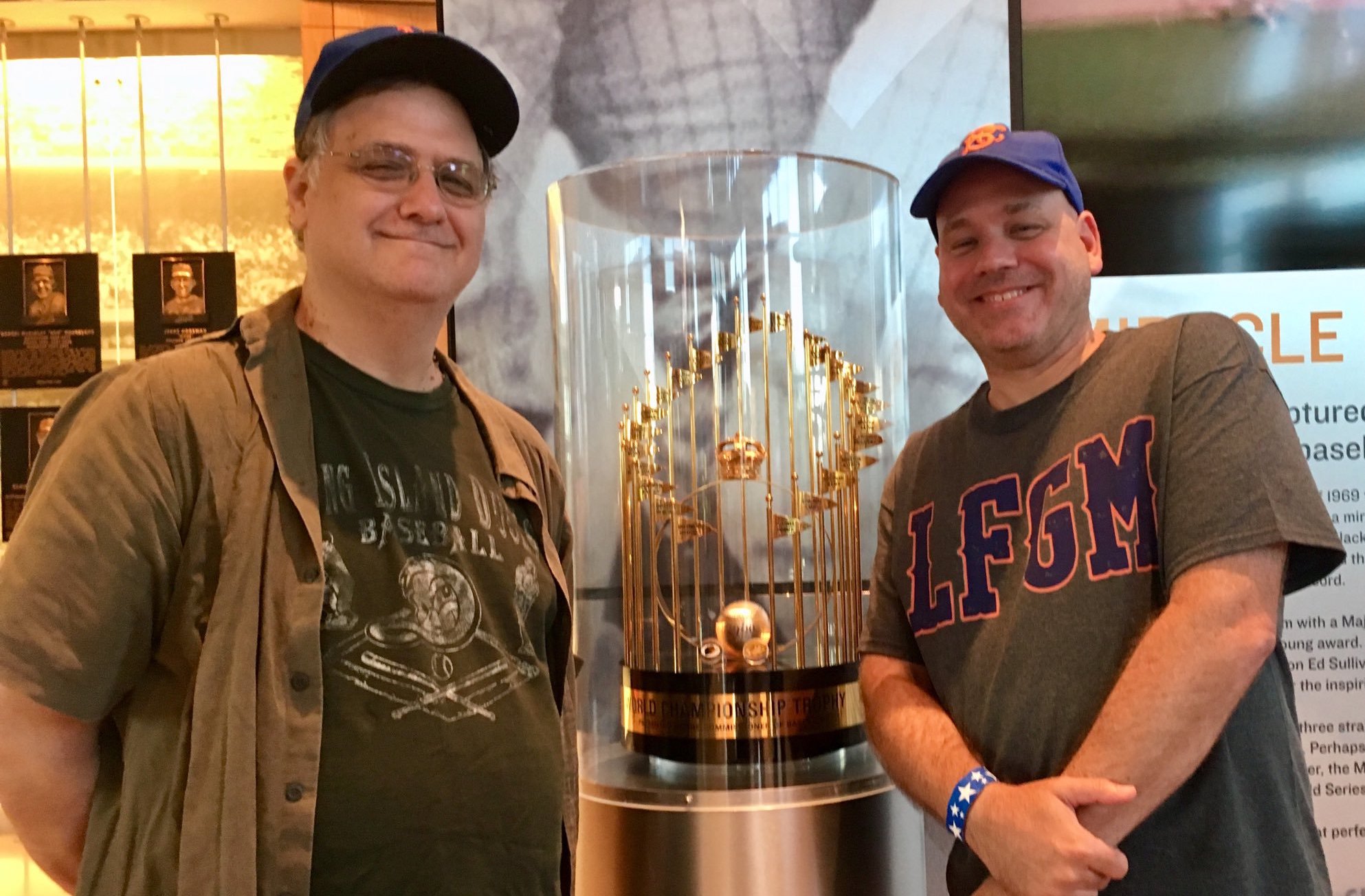
Faith and Fear in Flushing made its debut on Feb. 16, 2005, the brainchild of two longtime friends and lifelong Met fans.
Greg Prince discovered the Mets when he was 6, during the magical summer of 1969. He is a Long Island-based writer, editor and communications consultant. Contact him here.
Jason Fry is a Brooklyn writer whose first memories include his mom leaping up and down cheering for Rusty Staub. Check out his other writing here.
Got something to say? Leave a comment, or email us at faithandfear@gmail.com. (Sorry, but we have no interest in ads, sponsored content or guest posts.)
Need our RSS feed? It's here.
Visit our Facebook page, or drop by the personal pages for Greg and Jason.
Or follow us on Twitter: Here's Greg, and here's Jason.
|
by Jason Fry on 8 April 2019 12:13 pm Sunday was sunny and warm, one of those days where spring tells you that despite recent events, the world will soon be habitable on a more or less regular basis. Emily and I had worked through all manner of errands and items on our separate to-do lists, so we decided that … we could go to a baseball game! Our favorite team plays a scant 8.5 miles from our house (as the trash-hunting pigeon flies, not as the car creeps or the subway goes in and out of service), so why not?
We secured pretty decent Promenade boxes on StubHub and trooped off for our first meaningful date with the 7 train since David Wright said farewell, arriving with a few minutes to spare — a little tight tactically, but accidentally optimized to let us arrow in with the hordes of deGrom bobblehead seekers having finished their business. A big house had come together around us, the Mets were right down there instead of in a distant city or on the other side of a TV screen (and decked out in their proper pinstripes instead of dopey blue motley) and as Zack Wheeler peered in at Wilson Ramos we nodded at each other happily. Back where we belong. We should do this more often.
And the game started, and … huh. It was still a fun day. It was a really fun day, in fact. It just got a little complicated.
An early bit of ironic foreshadowing came with a fan contest held out by the Home Run Apple. Some sunglass’ed Met loyalist was handed a baseball and offered a prize to chuck it through a strike-zone-sized slot 60 feet and change away. I cringed in empathy, since these things tend not to go well, but the fan took the baseball, calmly threw it through the ersatz strike zone and turned back to Fake Alexa or whoever it is who does these things these days, all without a noticeable change of expression.
Honestly, they should have signed him on the spot.
Wheeler left without a Dunkin Donuts gift certificate or whatever it was: he sent pitches here and there and everywhere except where the rule book suggests they belong. He escaped disaster in the first despite throwing six of his first seven pitches for balls, but in the second everything caved in: walk, flyout, single, walk, single, single, double, sac fly and it was 5-0 Nationals with Max Scherzer on the mound and that’s not what anybody had in mind. The crowd had gone from fractious to annoyed to actively hostile (a bit overdone since it was still a nice day) and we decided to go feed ourselves and see what had changed at Citi Field.
One thing I hope isn’t a permanent change is concessions have become the stuff of adventure. We opted for a Pat LaFrieda steak sandwich, but were told sandwiches wouldn’t be available for 10 minutes. That’s an odd thing to hear from a steak-sandwich place, but stuff happens and it’s early.
Then the beer place was out of the beer I wanted. Huh.
So we went to the Nathan’s stand … which had no hot dogs.
If you’re keeping score at home, that’s three straight failures to perform a relatively straightforward transaction. It was dispiritingly similar to Wheeler’s struggles with home plate, except in that case there was another party trying to actively thwart him. Is that now true for concessions? Did some overeager corporate descendant of Dave Howard decide Mets games would be more exciting if food-service managers tried to secure meat and beer while providers of those things spirited them away to be hoarded in secret boltholes? If that’s what’s happened, could future games feature the less exciting variant where you arrive at a counter and they are able to give you what signage indicates they sell?
With various Plan Bs secured from temporarily functional concessionaires, we returned to our seats and hoped the Mets might have a comeback in them, or at least provide us with some Plan Bs of their own. For a while it was the latter, and it was fun watching Pete Alonso scamper around and seeing what dopey new between-innings events have been cooked up and just sitting back and having baseball be all around us and knowing that this will be the daily routine again for the foreseeable future.
And then, as the sun dipped behind the rim of the stadium behind us and the afternoon grew mildly but not impossibly chilly, Scherzer finally got tired.
Or maybe he got bored, seeing how he was the only person not baffled by a pitcher’s mound. Wheeler had departed, allowing only one more run but letting that last one in on another quartet of walks. Tim Peterson had been no better, walking five and strongly suggesting he needs to become familiar with Syracuse. Luis Avilan‘s lone inning of work had resulted in a three-run bomb from Anthony Rendon. Neither of those gentlemen had thrown more strikes than balls during their tenure and the Mets were down 12-1.
(Oh, and during all that I went to get ice cream and was told the machine wasn’t working. At that point I just laughed.)
And then it was 12-2 thanks to a double by Brandon Nimmo, who didn’t smile but looked less grim than he has so far this year. Scherzer departed, Matt Grace arrived, and a Jeff McNeil singled made it 12-3. Then Alonso walloped a purported sinker to distant lands and it was 12-6.
Look, 12-6 is lipstick-on-a-pig stuff, but you’ll take it when your team’s getting the daylights beat out of it but you’ve shrugged and decided even a ballpark that can’t feed you is better than feeding yourself at home. We decided to go on walkabout for what was left of the game, descending to field level and fetching up at the railing behind whatever they call the Modell’s Zone now. (Is it creeping age or indifference to sponsorship that’s caused me to not remember anything that’s changed ballpark-wise since about 2011? I’m still writing PEPSI PORCH on my checks.)
And there we stood for the last two innings, getting a vivid reminder that the Nationals have a bullpen problem. The Mets put runners on first and third with nobody out in the eighth only to have the rally founder when Amed Rosario and Keon Broxton struck out, but then they were right back at it in the ninth against Joe Ross — he hit McNeil, walked Alonso, almost gave up a three-run homer to old friend Travis d’Arnaud and then really did give up one to Michael Conforto — a twisting liner that arced up out of our sight and then came back down to the left of us. Somehow it was 12-9, and we still weren’t winning but that pig was covered with colors and running around squealing about it, and we had to admit that was kind of fun.
You know the rest: Sean Doolittle came in to play stern teacher, putting an end to the tomfoolery and the game (the big meanie) and so we and the other remaining diehards headed back to the subway and whatever it is we do when we aren’t watching baseball. Sitting on the 7 as the ballpark shrank behind us and was lost to sight, I thought to myself that I’d had a pretty good time on an afternoon that featured my team giving up 12 runs and repeatedly refusing to feed me. Imagine what a day at the park could be like if they worked on those things.
by Greg Prince on 6 April 2019 10:52 pm You want home runs at Citi Field, perennially notorious as a launching pad for next to nothing? Met home runs, that is? Then slate your Saturday dates for when many are thinking that it would sure be delicious to have a ballgame with lunch. An in-depth exploration of all Saturday 1:10 Met home starts during these past six seasons reveals they are the source of a recurring home team power explosion that could transform the grim Astoria night into a glorious shade of orange as well as blue.
Granted, our control group study is three games, which is to say the only three Saturday 1:10 games the Mets have scheduled since 2014. Management got it in its head that Mets fans don’t enjoy sunny Saturday afternoons as much as they savor the dark of Saturday night, hence the only time we get a Mets game like it oughta be in terms of scheduling on the seventh day of the week is late March/early April. One assumes the 126th Street decisionmakers would prefer to stick fans outside to freeze past 7:10 PM every night of the week, but maybe somebody in those offices took the last Weather Education Day to heart.
If anybody was taking on-field success into account, they might notice Saturday 1:10 PM first pitches have served to cultivate an atmosphere where baseballs fly off of Mets bats and the vast majority of the crowd leaves overjoyed with the ensuing result and the chance to devote the evening ahead to other, indoor pursuits. Saturday afternoon, April 5, 2014, gave us Curtis Granderson’s first home run as a Met and Ike Davis’s last, the latter a pinch-hit walkoff grand slam to defeat the Reds, 6-3. Saturday afternoon, March 31, 2018, saw Travis d’Arnaud and Yoenis Cespedes (remember them?) each go deep in support of Jacob deGrom, contributing to a 6-2 victory over the Cardinals.
The undeniably successful albeit small sample size increased by 50% on Saturday afternoon, April 6, 2019, with more Mets home runs. Lots more Mets home runs…and just enough of other valuable stuff to ensure a Mets win that was as sunny as the skies under which they were socked.
J.D. Davis, default third baseman — as in some opposition offense seems to be his defensive fault — put his wood where his leather sometimes ain’t and brought it to bear like crazy, hammering not one but two home runs off fancy Nationals free agent acquisition (back when teams signed fancy free agents) Patrick Corbin. Like every other ball that ignored walls, Davis’s duo, proffered in the fourth and the sixth, traveled far. J.D. doesn’t stand for Just Dingers, but we’ll definitely keep accepting as many of those as he can furnish us.
Davis shaped more of Saturday afternoon’s home run pie than any other Met but he was not alone in slicing up Nationals pitching. Robinson Cano hit his first at Citi Field as a Met; he hit two there (and two at Shea Stadium) in some other uniform the affiliation of which escapes us for now. The eighth-inning blast off Justin Miller was the 313th of Cano’s career, placing him a scant 311 ahead of Pete Alonso. Alonso is up to two overall, one at the ballpark where was born to slug. Pete won’t be fenced in by any stadium, but this one is clearly his. Has a rookie in the eighth major league game of his life ever seemed so ready to roll? Not just in deed (which in Alonso’s case was done in the eighth inning, just prior to Cano’s) but in manner. Pete jumps up and down after he hits ’em like we jump up and down when he hits ’em. The whole team seems to be following his excited lead. Or as the youngster who has yet to wear a Mets uniform in ten official games put it after the game, “Never count us out. Like the Mets saying is, ‘Ya Gotta Believe.’”
If at that point he’d asked for an ice cold Rheingold and directions to Ralph’s studio, I wouldn’t have been surprised and couldn’t have swooned any harder. He’s so Met! But, really, who here isn’t when the sun is out, the ball is airborne and the mood is buoyant? Four of the five Met home runs were belted by newcomers, yet this is no longer a Citi of strangers. You get used to your guys fast when they make you want to stand with them with open arms. Davis from Houston. Cano from Seattle (and somewhere else before that). Alonso from heaven’s sandlot. They’re J.D., Robbie and Pete. They’re from here these days and we’re not proofing at the door.
The fifth home run of five the Mets walloped Saturday, thus tying a record for the most the Mets have catapulted beyond barriers in their sometimes grudging ballyard, was a product of Michael Conforto. He’s no stranger, no matter how Terry Collins and the disabled list conspired to keep us from getting to know him better for a few years. Michael’s dinger (he’s not really a Mike, is he?) soared in the sixth, a bit after J.D.’s. It was the 39th regular-season long-distance call of Conforto’s Citi Field career, placing him third among all Mets since 2009. He was previously tied with Grandy and is parked for a spell eleven behind David Wright, which doesn’t seem possible, yet adds up. Over David’s horizon awaits Lucas Duda with 71. Given the entirely non-collusive coincidental trend toward extending your young superstars before they ever find there was once such a thing as unencumbered free agency, it’s also worth noting Conforto’s bomb was the 77th of his career, meaning he’s 175 from matching Darryl Strawberry. Let’s allow for patience, health and contractual consent where that milestone is concerned.
All five Saturday sunshots were things of beauty. They were also each so special that they couldn’t be supplemented by something as mundane as a baserunner, which is to say the four Mets combined for five solo home runs. Two drawbacks to that artistic statement: 1) at the moment when the fifth home run became a souvenir, there were no other runs of any kind to join them along the Mets’ portion of the line score; 2) the Nationals also scored five runs. Starter Steven Matz gave up none of them over five innings crammed with mostly effective pitches but there was one with Robert Gsellman on the mound in the sixth, driven in by Ryan Zimmerman, who has some nerve remaining active while his Virginia playmate Wright has stepped aside and sat down; another facilitated by some passed ball nonsense (charged to Wilson Ramos, not J.D. Davis, for it’s not always J.D.’s fault); and three Gillaspied off of Jeurys Familia. So when we got those two homers in the eighth from Alonso and Cano, it wasn’t just aesthetically pleasing. It was necessary as hell to forge a 5-5 tie.
One more run was required to keep Saturday at 1:10 perfect and we weren’t about to be picky how we got it. Fortunately, the Mets proved there is more than one way to skin a Nat. With two out and the bases empty in the bottom of the eighth, Conforto doubled off of Tony Sipp, knee-nagged Jeff McNeil arose from the bench to absorb a pitch to his shoulder for the greater good and Keon Broxton took a big gulp out of Sipp, singling Conforto across the plate and the Mets into the lead. It wasn’t a home run, but other ways to score are also nice.
Just as nice was Edwin Diaz’s zippy ninth inning: ten pitches, seven strikes, three outs to end Saturday’s early bird special, 6-5, at 4:23 PM. If you weren’t full from all the dingers, you could be off to a lovely dinner. Every Saturday should unfold in such a powerfully delightful manner.
by Jason Fry on 5 April 2019 10:25 am If Noah Syndergaard surrenders a lone hit over six innings, you like your chances.
He did. But unfortunately, the rest of his teammates were sleepwalking — almost literally — through a game all but designed to turn a glittering 5-1 record into a good but more modest 5-2. Seriously, 5-1 is hold-your-head-high, strut-down-the-avenue stuff, whereas 5-2 is a whisper away from 5-3, which is good but feels little fragile.
(This segment of Mets Math has been brought to you by pine tar and paranoia.)
The Mets finished a game in Miami; waited around for drug testing; got their caravan to a plane, to New York and then dispersed around the city and suburbs; and then were back dull-eyed and straggly-tailed for a 1 p.m. home opener. Even with nice weather and bunting and celebrity first pitches and all the other happy pomp and circumstance of a home opener, a night game might have been wiser. Or at least kinder.
As always with such things, you can go too far with the woe-is-me routine. Stephen Strasburg was really good, full stop. The balls that fell in during play at Nats Park and New Soilmaster stayed up for fielders’ gloves, which happens sometimes. A tight, taut game through eight turned more mundane in the top of the ninth, as Seth Lugo and Tim Peterson proved ineffective and a 2-0 Nats lead became a 4-0 lead.
On that turn to the mundane: something I’ve become more interested in over time is the thoroughly unscientific idea that the perceived narratives of games cluster around certain points. Those of us who have watched enough baseball games know what certain narratives feel like: the one where you give up a six-spot in the first, the one that’s a pitchers’ duel which grinds on until something slips, the one that’s all frustration until the late explosion against the bullpen, and so forth. There are probably 30 or 40 of those narrative cluster points, and someday it would be fun to try and catalog them. (Tangentially related ideas: Greg’s interest in unicorn scores, my musing that you can tell what kind of game you saw (or missed) with a look at the win-probability index — flat-line with a single spike, EKG of a guy on a dead sprint, sudden cliff/wall?)
Anyway, the home opener belonged to a cluster that’s simultaneously more common than you think, annoying, and ultimately the stuff of stoicism: the nail-biter that deflates into a grumpy shrug when your bullpen and/or defense proves unequal to the task.
Oh well. The Mets came home, wore their classic uniforms before a full house on a nice day, and just happened to lose. And the schedule does reward as well as punish: today’s a drizzly and clammy off-day. The players will be tending to new apartments and other errands and getting a night to relax and reset. We can all do the same, and get back to how the story unfolds on Saturday.
by Greg Prince on 4 April 2019 4:53 am When you arouse the need in me
My heart says yes indeed in me
Proceed with what you’re leading me to
Contrary to published reports, Frank Sinatra does not have a cold. He’s never been healthier. To clarify, I don’t mean the Frank Sinatra, but the closest thing contemporary baseball has to him. This iteration of Sinatra, whose right arm almost never delivers a false note, takes his particular stage every fifth day. Or night. Night and day, he is the one. The range. The phrasing. The elegance. The ability to make every number, from 48 to 1.70, his.
You want more numbers to support this assertion that Jacob deGrom pitches like Frank Sinatra sang? Try a career-high 14 strikeouts in seven innings versus the Marlins on Wednesday night following 10 in six innings the last time he performed. Try 13 scoreless innings in these two starts (both victories) as an apropos encore to the way he ended his 2018 tour. Try 26 consecutive quality starts, tying a major league record that previously belonged solely to a legend named Bob Gibson. Try a 1.55 ERA over those 26 outings. Try 237 strikeouts in 185⅔ innings during this span, versus 34 walks. Try a 1.55 ERA from May 18, 2018, through April 3, 2019. It’s been a very good year.
Every number is Jacob deGrom’s, and music would be nowhere without mathematics, but how about just sitting back and soaking him in? An evening with Jacob deGrom might as well be a night on the town with Frank Sinatra and friends providing the soundtrack. Tony Bennett, Mel Tormé, Sarah Vaughan…Jake is a pitcher straight out of the Great American Songbook. His outings are popular standards that deserve to be relished across consecutive centuries. Tune into WNYC (93.9 FM in New York City) this Saturday night between eight and midnight when Paul Cavalconte digs deep into the Songbook and tell me watching deGrom pitch doesn’t feel like listening to these American masters at the top of their game.
It would be a harsh exercise in self-denial to limit the selections on any Best of deGrom compilation to a single disc. The artist’s output demands a stream of revised editions crammed with bonus tracks. No way would you want to leave out stuff from Cy After Cy: Live at Marlins Park. It’s already a classic of the genre. The aforementioned fourteen K’s were showstoppers, but the general excellence was as breathtaking as it was satisfying. First there were fastballs and sliders — hard sliders. Breaking balls, too. They all worked to near-perfection. Later, Jake mixed in changeups that you didn’t think would be on the setlist, but oh, how they played. It was as if a top-flight starter called himself in from the bullpen to give the opposing team a different look.
Whatever the Marlins saw, they couldn’t hit. The only letdown to deGrom’s show was that after 114 pitches, he couldn’t be his opening and closing act; maybe Tom Dreesen could throw the first two innings next time. To be fair, how is anybody supposed to follow Jacob deGrom? Mickey Callaway’s ever curious orchestration of the first-place Mets left an unusually robust 6-0 lead in the hands of Luis Avilán, which was fine for the eighth, but not so splendid in the ninth. Avilán and Robert Gsellman conspired to trim the Mets’ advantage to 6-4, necessitating a quick cameo by Edwin Diaz to thankfully convert a save opportunity that minutes earlier seemed absurd. How absurd? More absurd than the idea that one of the six runs scored on deGrom’s behalf occurred because deGrom himself hit a home run.
That wasn’t absurd. That happened in the third inning, via a high fly that soared over the right field fence, traversing a distance balls thrown by deGrom rarely travel. Most nights for most pitchers, the starting pitcher homering would stand as the highlight of the evening. In the context of Jake, this righteous blow against both Trevor Richards and the concept of the universal DH amounted to a pleasant diversion, à la Sinatra going on about ants moving rubber tree plants. Frank came mostly to sing for young lovers in the wee small hours. Jake showed up to set down Marlins.
The best can do it all and do it better than anybody. To paraphrase Dean Martin, it’s Jake’s world, we just live in it.
by Jason Fry on 3 April 2019 12:44 am Tuesday’s game at New Soilmaster marked an unhappy milestone for the new season: it was the first time I found myself deeply bored.
Seriously. The Mets scored a flurry of runs off Jose Urena and the Marlins’ slapstick defense (that part was fun), and then the game bogged down in a quagmire and 50 dudes more or less waited for the tow truck. The Mets kept putting guys on and not bringing them home, turning a laugher into a chuckler and then a snoozer. Meanwhile, Jason Vargas was on the mound, sweating like Niagara Falls — seriously, has a doctor looked at that? — and every time you took your eye off the Marlins they crept a little closer, as Marlins tend to do.
The Mets got another run but it came because Brandon Nimmo took a ball off his knuckles, and meanwhile our manager was busy making his nightly contributions to the WTF, Mickey? fund. If you’re down your two best relievers and Seth Lugo‘s sick, why in the world do you take Vargas out after only 74 pitches with a three-run lead? Why put a glove on J.D. Davis‘s hand when you don’t have to? The Marlins got closer and closer, until the lead had shrunk to a skinny run and Justin Wilson was on the mound with the bases loaded and two outs in the eighth and suddenly I was sure all of this was my fault. I’d been bored, but the game wasn’t boring anymore.
It was terrifying.
And somehow it got scarier in the ninth. Wilson hit speedster Lewis Brinson. Peter O’Brien hit a screaming liner that Amed Rosario caught rather than allow himself to be decapitated by it. (Good choice!) Chad Wallach singled, leaving the Marlins a modest hit away from a tie and a long hit away from a win that would have been oh so Soilmaster. Up came Miguel Rojas, who hit another liner — one just above Rosario’s head. Rosario caught it, Brinson fell down, Rosario flipped the ball to second, and the Mets had survived.
They’d survived, and are 4-1. They’re 4-1 despite important outfielders taking balls off hands and Mickey Callaway looking like his bullpen-management skills have actually gone backwards and having to play the goddamn Marlins. Maybe those are blemishes, and months from now we’ll smile and nod when they’re mentioned and go back to talking about the starting pitching being awesome and the hitters using the whole field and the depth having proved so important. Or maybe they’re portents, and we’ll talk about all those terrible things and wonder, once again, “Why us?”
But for now, the screamers have been caught and disaster has been averted. I keep reminding myself that counts too.
by Jason Fry on 2 April 2019 9:48 am On paper — which, admittedly, is always a risky way to start a baseball thought — the National League East should have four solid teams with postseason possibilities. The problem for the Mets, Nats, Phillies and Braves, which is also a silver lining for other N.L. contenders, is each of those four teams will spend 35 percent of its schedule exchanging blows with the other three.
Which leads to two thoughts:
- The path to the wild card is a lot clearer for good teams in a less-balanced division, such as the West.
- Racking up as many wins as possible against the Marlins is going to be really important this year.
There’s nothing the Mets can do about the first point; the second point probably made you blanch, seeing how the Mets are 18-43,122 against the Marlins all-time and somehow have an even worse record when it comes to games in Soilmaster Stadium and New Soilmaster Stadium, AKA the House That Grift Built.
If you’ve been with us a while, my feelings about the Marlins are really, really well-known — this is the most horrific franchise in baseball, a cruel multigenerational experiment to see if toxic doses of cynicism and greed can actually reduce a fanbase to zero attendees. In a better world, the Marlins would be contracted, all of their records expunged, their gear collected and burned in South Florida healing ceremonies, and a new team created from scratch very, very far away from the psychic Chicxulub left by Huizenga and Loria.
Unfortunately, we don’t live in a better world. Which means we have to play this shambling collective excrescence 19 times a year. I love baseball, but I hate each and every one of those games.
My first thought on seeing the 2019 Marlins was that the changes they’d made had somehow made things worse. This is incredible, considering the Marlins’ colors and stadium architecture channel a can’t-admit-she’s-too-old-for-the-clubs South Beach divorcee on an ether binge and someone much more pathetic and tacky, Jeffrey Loria. But it’s true. The Marlins’ old uniforms looked like someone had barfed up a warehouse of neon and a sampler pack of fonts; the new uniforms look like what you get when a third-tier videogame company won’t pay the licensing fee to MLB and has the less-talented intern come up with fake logos. Before its overhaul New Soilmaster featured a shade of green that alarms liver doctors and a Brobdingnagian Pachinko machine; the new iteration has a lot of dark blue and would fit perfectly in downtown Iowa City. The Marlins are still tacky and hideous and deserving of extinction; now they’re still all of those things but also boring.
Now look what’s happened — I’ve tired myself out being indignant and I still have to talk about the game. Deep breaths.
It was kind of a strange game, but then most of them are at New Soilmaster. Steven Matz pitched pretty well, aside from a first-inning homer on a bad pitch and foolishly taking the mound with J.D. Davis playing third. Davis has shown a lively bat in the early going, but his work at third base is actively dangerous to his own cause. He turned a double play into nothing with a lollipop throw, dropped a throw for an easy putout at the base, and failed to convert any of several admittedly tough hops into outs. Compounding the error was that while this time Mickey Callaway had the brains to let Jeff McNeil play, he put him in left field, where he’s shaky at best. I kept having flashbacks to Daniel Murphy and Johan Santana, and I know I was far from alone.
But the Mets couldn’t quite do themselves in. They tied the game on a laser-beam homer from Juan Lagares, and then hung around waiting for an opening. New Soilmaster being New Soilmaster, I wondered if they’d get it: I’ve seen enough South Florida debacles that I was grimly sure the game would end with a grounder not quite corralled by a drawn-in infield in the bottom of the 10th … or, God forbid, the 15th.
But Dominic Smith led off the ninth with a single through the shift. Callaway had Lagares bunt, ignoring the base-out matrix’s mathematical and historical proof that this was a bad idea. Lagares failed to do that, but did manage to get a finger crunched by a Drew Steckenrider fastball, putting runners on first and second with nobody out. That’s actually one of the only situations where a bunt does make tactical sense, so naturally Mickey had Brandon Nimmo swing away, which he did three times without meaningful contact with a baseball. Enter Amed Rosario, who’s made great strides in not helping pitchers out in big at-bats. Rosario worked the count to 2-1 and sliced a single over the infield, scoring a trimmed-down and thus newly speedy Dom and giving the Met the lead.
Then Pete Alonso turned Steckenrider’s low fastball into a missile. Oh, it was wonderful — a sizzler to center, its trajectory a viciously efficient line drive rather than a majestic arc, instantly and obviously gone. Alonso high-stepped around the bases with his big aw-shucks grin, was greeted rapturously in the dugout and the Mets were up by four. And they stayed that way, as Edwin Diaz loaded the bases with nobody out, shook his head like he was annoyed with himself and then coolly fanned three straight Marlins.
It’s just one game, with too many more against this hideous team and too many of those in this hideous place. But it was a win, muscled out despite lousy defense and the usual night’s portion of questionable managing. A win out of a set of 19 games that could prove critical to our season.
by Greg Prince on 1 April 2019 5:39 am EDITOR’S NOTE: As we do from time to time, today we dig into the Faith and Fear archives and share posts that some of our longtime readers might get a kick out of seeing again or our newer readers might enjoy checking out for the first time. This one originally ran on April 4, 1978, part of an annual series we still publish to this day.
***
Unless you were busy playing the clarinet at Michael’s Pub, you are well aware the Oscars were handed out Monday night. Thus, per Tuesday morning-after tradition, the Academy pauses to remember those Mets who have, in the baseball sense, left us in the past year.
Cue the montage…
___
LUIS CESAR ALVARADO
Infielder
April 13, 1977
In case you thought we were never going to see a new Met all year, given how we didn’t exactly charge hard after free agents once the re-entry draft was complete or go nuts on the trade market before, during or after the Winter Meetings, rest easy. Or sit up psyched if you so choose. We got to see our first fresh-for-’77 Met today, Luis Alvarado, erstwhile Red Sock, White Sock, Indian and Cardinal. Double-switched in at second base by Frazier in the sixth, Luis became the 255th Met to date. Seeing as how we were already down by six runs when he entered and went on to lose by only four, we can label Alvarado’s initial presence a net positive.
—April 13, 1977
(Sold to Tigers, 4/27/1977)
___
GEORGE FRANCIS “Doc” MEDICH
Starting Pitcher
September 29, 1977
From the lousy A’s to the wretched Mariners to the decrepit Mets. What a trip around the baseball sun for Medich. Everybody’s favorite medical student/baseball player drops by to give us seven perfectly adequate innings in another loss, our 96th of the season, as if we needed consultation gathering those. Per Doc’s other vocation, perhaps he was able to give the club a thorough physical examination to discover what’s been wrong with it. Or maybe we need to find a pitcher who’s studying to become a mortician. The sooner we can bury 1977, the better.
—September 30, 1977
(Free agent, 11/2/1977; signed with Rangers, 11/11/1977)
___
LEONARD NORRIS “Leo” FOSTER
Infielder
August 1, 1976 – October 2, 1977
And as if a nine-run edge wasn’t enough to cram into bookbags across the Metropolitan Area as the kids head reluctantly back to school tomorrow, the last ember of this Bicentennial summer gave us one final firework, albeit of the afternoon variety: Foster hit his first home run of the season, off Joe Coleman in the ninth. It was a two-run shot that padded our lead to 11-0 and upped Leo’s RBI accumulation on the day at Wrigley to five, while doubling his lifetime longball total. Coleman won twenty games twice in the American League. He gave up his share of home runs in the process, but likely not mopping up in 9-0 games and almost assuredly not to a whole lot of Leo Fosters.
—September 7, 1976
(Traded to Red Sox, 3/29/1978)
___
RICKEY ALAN “Rick” BALDWIN
Relief Pitcher
April 10, 1975 – October 2, 1977
I’m just gonna say it: 45 looks wrong on Rick Baldwin. It would look wrong on anybody not named Tug McGraw (just as the mere idea of Tug in a Philadelphia uniform is…shudder). That Baldwin posted a scoreless inning in defeat in his major league debut doesn’t make it look right. Kid, we wanna root for you, but you gotta believe it would be easier if you weren’t reminding us of whose number you’re now wearing and how we no longer have him on our side. Maybe grab a word with Herb Norman and explain to the equipment manager that a rookie doesn’t need the added pressure, however subliminal/numerical, of replacing a legend. On the plus side, I am impressed we finally have a Met who shares a name with a Metropolitan Area municipality — on Long Island, no less! This could be the start of a trend. Maybe we’ve got a Rocky Rockville Centre working his way up from Visalia.
—April 10, 1975
(Selected by Mariners in Rule 5 draft, 12/5/1977)
___
ROY JOSEPH STAIGER
Third Baseman
September 12, 1975 – October 1, 1977
It was hard for me to not be excited about Roy Staiger once he was called up last September. I’d followed him and his International League-leading 81 RBIs at Tidewater via The Sporting News every week and now I wanted to board his nonstop train to stardom as it was pulling out of the Willets Point station, next stop stardom. Alas, Roy batted .158 during his callup and drove in nobody. I stayed excited anyway. It was just a callup. Well, he’s batting .182 with a total of five runs batted in this year after today’s loss, leading me to admit something I didn’t expect to conclude: it’s not that hard for me to not be excited about Roy Staiger anymore. (Excitement level subject to change, natch.)
—June 3, 1976
(Traded to Yankees, 12/9/1977)
___
JACKSON A. TODD
Pitcher
May 5, 1977 – September 30, 1977
“After months of not being able to raise up, not being able to eat, wondering if I would live, much less run or pitch again,” Jackson told reporters afterward, “it’s hard to get excited over winning a game.” Once you’ve beaten cancer, maybe beating the Giants shouldn’t be that big a deal. Todd’s done both as of Thursday night. We can leave it to the young righthander to place an appropriate value on each achievement as he sees fit.
—May 20, 1977
(Traded to Phillies, 3/27/1978)
___
MICHAEL DWAYNE “Mike” PHILLIPS
Infielder
May 8, 1975 – June 15, 1977
It was the May of Mike. He batted .314, including a 3-for-3 Saturday night to close out his first calendar month as a Met. We continue to wish Buddy and his balky right knee a speedy recovery, but you don’t think he’d mind if we did some writing in on our All-Star ballots when we get to the shortstop slot, do you?
—June 1, 1975
(Traded to Cardinals, 6/15/1977)
___
RAYMOND MICHAEL “Ray” SADECKI
Pitcher
April 10, 1970 – September 20, 1974
April 9, 1977 – April 23, 1977
For the fifth time, we’ve welcomed back a former Met to be a Met again. The first one was Frank Lary. The most recent was Bob Miller (the righty, if you’re scoring at home). In between there was Al Jackson and Jim Gosger. Now it’s Sadecki who’s in reruns, so to speak. Giving up a game-tying homer in the eighth to Bobby Murcer wasn’t exactly the way to reintroduce himself to us, but soon the guy for whom he was traded when his first tenure ended, Joe Torre, made it all right by doubling in the pair of tiebreaking runs that ensured we’d go 2-0 on the year. There’s a long way to go, but that shouldn’t be news to Ray. In his eighteenth big league season and second term as a Met, he’s already come a long way.
—April 9, 1977
(Released, 5/2/1977; retired)
___
RANDALL LEE “Randy” TATE
Starting Pitcher
April 14, 1975 – September 27, 1975
The no-hit bid lasted into the top of the eighth. Leadoff hitter Jose Morales struck out, Randy’s dozenth K. We were up, three-nothing. Could this be the night? This had to be the night. I wanted to believe Randy Tate would get it done, that our lives wouldn’t be defined by not having a no-hitter for another who knew how many years. This wasn’t Seaver or Matlack or Koosman. This was Randy Tate. This was so crazy it might work.
—August 5, 1975
(Selected by Pirates in minor league draft, 12/6/1977)
___
MICHAEL LEWIS “Mike” VAIL
Outfielder
August 18, 1975 – October 1, 1977
So it ends at 23. I have to admit I thought it would pass 56. Well, not really, but I refused to believe Vail’s streak would ever end. Until Tuesday night we had little proof to the contrary. Going 0-for-7 over eighteen innings provides us uninvited evidence that nothing lasts forever. The game eventually ended. The streak inevitably ceased. Vail’s still here, though, and next year will join him soon enough.
—September 17, 1975
(Selected by Indians off waivers, 3/26/1978)
___
JOSEPH PAUL “Joe” TORRE
Infielder
April 8, 1975 – June 17, 1977
No strikeouts. That’s the good Joe Torre news tonight. Oh, he put the bat on the ball. He also didn’t bother any Astros outfielder, in case you were worried about troubling Messrs. Cabell, Howard and Gross. You might say Joe executed the most memorable ground game at Shea since Snell and Boozer were rushing the Jets toward Super Bowl III. Four ground balls. Eight outs. That’ll happen when you ground into four double plays, a record for such futility. Joe basically chuckled about the octuple-killing later and blamed Felix Millan for singling in front of each of his four at-bats. Ha. Ha. Ha. And ha. I was so amused I muffled a scream lest I disturb the neighbors (they’re disturbed enough already). Sometimes you have to laugh. Ten games in back of the Pirates at this point and continually failing to pick up, if you’ll excuse the expression, ground, I’d suggest this is not one of those times.
—July 21, 1975
(Released, 6/18/1977; retired as player while continuing to manage)
___
JOHN DAVID MILNER
First Baseman-Outfielder
September 15, 1971 – October 2, 1977
They had a Hammer? We had a Hammer. Aaron’s homer in the sixth was the 698th of his career. Milner’s in the ninth was No. 30 for him overall. John (a son of Atlanta, no less) found himself 668 behind his nicknamesake. The Mets suddenly found themselves just two runs behind their opponents. Four were in, one was out and, for a change this summer, the nails in the Mets’ coffin weren’t hammered so deep that they couldn’t be pried upward…sort of like the Mets’ chances.
—July 18, 1973
(Traded to Pirates, 12/8/1977)
___
FELIX BERNARDO MILLAN
Second Baseman
April 6, 1973 – August 12, 1977
The certificate for Perfect Attendance goes to Mr. Millan. Of course Felix is present for the ceremony. He shows up to school every day, rain or shine, whether the buses are running or the drivers are on strike. None of his classmates has to bring him his homework, though I’ll bet he’s happy to drop off theirs to them as needed. Hardly misses an inning, rarely misses a pitch. Yes, Felix is a very conscientious student.
—November 3, 1975
(Sold to Taiyo Whales, 2/22/1978)
___
DAVID ARTHUR “Dave” KINGMAN
Outfielder-First Baseman
April 8, 1975 – June 14, 1977
From Colts Neck in New Jersey to Mammaroneck in Westchester to Little Neck in Queens and neighboring Great Neck in Nassau, all Mets fan necks are craning and straining and possibly paining from watching Kingman clout. Yet nobody’s complaining. Side effects contracted from watching home runs soar through the sky are giddily endured in these parts. Dave has seven in our first nine games. We’ll take two Tylenol tonight and call him for more in the morning — or Monday night in St. Louis. Asking him to go deep between games is probably too much to ask of the greatest slugger we’ve ever had. Probably.
—April 18, 1976
(Traded to Padres, 6/15/1977)
___
JONATHAN TRUMPBOUR “Jon” MATLACK
Starting Pitcher
July 11, 1971 – September 30, 1977
Yogi let Jon pitch into the tenth. Why not? The first nine were typical Matlack: two runs, none earned, not winning. What little October the Mets had remaining looked a lot like September where their starter was concerned. He won by shutout twice and lost four other outings despite never giving up more than three earned runs in any of them. Typical Mets. Characteristic ending to this year, too. Matlack’s Closing Day tenth inning yielded one cheap run on two singles and a sac fly. When Gene Garber retired the Mets in the bottom of what proved to be their last inning of 1974, it guaranteed a losing record of 13-15 for Jon despite an ERA of 2.41. Some statistics are more revealing than others.
—October 2, 1974
(Traded to Rangers, 12/8/1977)
___
GERALD WAYNE “Jerry” GROTE
Catcher
April 15, 1966 – August 23, 1977
We’re crazy about these pitchers, but let’s save some championship-caliber insanity for the catcher who caught every pitch they threw in this World Series and, for that matter, the playoffs. Grote doesn’t hit for power like a Bench or a Hundley, but he catches most everything and everybody. Did you notice who caught Koosman when the lefty leapt in victory yesterday? Jerry Grote, that’s who. Didn’t drop him, either.
—October 17, 1969
(Traded to Dodgers, 8/31/1977)
___
DERRELL McKINLEY “Bud” HARRELSON
Shortstop
September 2, 1965 – October 2, 1977
No, you shouldn’t have whiskey bottles or any other objects flung in your general or, for that matter, specific direction on a baseball field or any field. That doesn’t feel as if it merits an explicit explanation. We absolutely do not condone that type of behavior. Yet when you’ve slammed into Buddy Harrelson for no reason other than your club is down seven runs and has been outscored 14-2 over the past game-and-a-half, you’ve essentially brought bad karma and outraged animus upon yourself. We love our Mets. We adore our shortstop. We wouldn’t be here without our indefatigable mighty mite and we know it. Thus, as Jim Croce might have put it had he been from New York, you don’t mess around with Bud. No, Charlie Hustle, that was not a heads-up play. And it’s not our fault the Reds’ heads are up their asses and on the brink of elimination. But let’s not throw junk at this jerk. He’s not worth the wear and tear on our rotator cuffs.
—October 8, 1973
(Traded to Phillies, 3/24/1978)
___
GEORGE THOMAS “Tom” SEAVER
Starting Pitcher
April 13, 1967 – June 12, 1977
There he was, for the world to see. No. 41 of the Mets on the mound at Anaheim Stadium, the eyes of baseball upon him. Upon one of ours. Nobody was laughing. Nothing to laugh at here. This was Tom Seaver, All-Star pitcher, the first time a New York Met has been one of those. We’ve never had a pitcher deemed worthy of representing the National League. We’ve never had a Seaver. We do now. The world knows it. The American League has surely been clued in. It took until the fifteenth inning for them to find out, but every explorer from Leif Ericson to Jim Lovell would be compelled to testify that discovery is discovery, however long it takes a person to do the discovering. Tom flied Tony Conigliaro to left, walked Carl Yastrzemski (the better part of valor the way Yaz has been going), flied Bill Freehan to center and, finally, struck out Ken Berry to preserve the NL’s 2-1 triumph. Tony Perez connected for the decisive blow, Don Drysdale gets credit for the win, but make no mistake about it. Tom Seaver’s rise to the All-Star occasion was the story of the fading Southern California afternoon. After six seasons, a Met stood in the middle of a Midsummer Classic and succeeded. This Met like no Met before him. He’ll do it again, you can bet with confidence, and those games will count for more than Senior Circuit bragging rights. After what we’ve seen from him so far, you underestimate Tom Seaver at your own risk. Something tells me, regardless of what day it is, that there’ll be no fooling around when it comes to this guy.
—July 11, 1967
(Traded to Reds, 6/15/1977)
by Greg Prince on 31 March 2019 7:35 pm My philosophy on first losses of seasons, particularly if they’re not first games of seasons, is they’re permissible to the point where they are almost welcome to occur. Get one out of the way so it can be recalled that when they transpire, our hearts will go on like Celine Dion.
Sunday’s Mets defeat represented no sinking at sea, not much of an iceberg, just an inevitable loss — in the sense that a loss was at some juncture inevitable — one that finished up an otherwise promising initial series. Granted, that bitter taste in your mouth is not your imagination making you want to go “ptui!”, as the loss involved a walkoff home run on the road and a thorn named Turner. Usually it’s Justin, this time it’s Trea. Let’s not blithely non-tender or, if it can be helped, pitch in big spots to any more Turners, shall we? Or play in a Field named after them. The results tend to be Titanic.
Mickey Callaway should have made better moves and his players should have executed whatever moves he made perfectly. I hope this summation adequately covers the strategy portion of the third game of 2019. I napped through the middle innings (had a dream about some guy making a baseball card celebrating the accomplishments of George Foster, except it was spelled “George Goster,” soft “G” sound, twice on the front, including on a little trophy graphic à la the one Topps used to use to distinguish their all-rookie team members), so I can’t vouch for all that happened to push the Mets into a 5-2 hole. I woke up in the seventh trying to piece together what I’d missed since the third. My first instinct was to go the @Mets account for details, but all that got me was some cheertweeting regarding how swell Pete Alonso is — and I already knew that.
By the time I pulled together some relevant facts (Alonso: swell; Zack Wheeler: less so), the data set was no longer relevant, for as I regained my consciousness, the Mets started scoring, three runs in all to tie the game in the eighth. Hey, I thought, as long as I never sleep, the Mets will never lose. Alas, I was wide awake for Justin (Wilson, not Turner) giving up that decisive dinger to Turner (Trea, not Justin), and there ya go, Nats 6, Mets 5, a good nap spoiled.
It was the wrong step to take out of DC, but overall we got off on the right foot for the campaign ahead. We’re 2-1, which is a nimble enough way to start a season. Three and oh would have been better, but anything “…and oh” is eventually impossible. The Mets have started every season in their last five 2-1. Twice they made the playoffs. Once they made the World Series. Once is now, conclusion to be determined a long time from now. They do seem to stay interested in their games for the full nine innings every day. Thursday’s was a sparkler from beginning to end. Saturday’s could have gotten blissfully dull in the ninth and didn’t. Sunday’s refused to stay sleepy. Every new Met has appeared at least once. None of the Introductory Eight deserves to be bashed at first blush. The guy who gave up the losing home run, Justin Wilson was the winning pitcher the day before. Seasons are like that. We’ve just received our annual reminder.
It’s so early that it’s not even April and we’ve already contested and captured an entire series. Who’s up for playing another one? I know I am.
by Jason Fry on 31 March 2019 9:13 am
“And don’t hold the ball so hard, OK? It’s an egg. Hold it like an egg.”
— Crash Davis
Baseball season is returned to us, praise be. Today, for the first time, we’ll have games on consecutive days. Tomorrow evening in Miami we’ll get the first night game, and a chance to see what the Marlins have done to their uniforms and their stadium. (Spoiler: incredibly, given the starting points were gaudy and awful, they’ve managed to make both worse.)
This is the thin blush of the season, the time in which remembering every game and even every inning is possible, and I love that. But I’m also always struck by how fragile it feels. You don’t want to squeeze too hard, and excesses of emotion are to be guarded against. That applies to euphoria and despair alike.
After two games, Mets fans need to guard against euphoria, an emotional peril for which we’re not particularly loaded up with antibodies. Though last year “helped,” in a way I didn’t particularly want help — watching an 11-1 start turn to ash left a mark I suspect I’ll bear for the rest of my baseball life.
Certainly Pete Alonso looks like he’s having the time of his life out there, which you’d expect since so far he can’t do anything wrong. Alonso is rifling balls over center fielders and off fences (through fences, almost), being alert and aggressive on the basepaths, and looks like a pickin’ machine over at first base. Seriously, if you had the Mets holding the line in the late innings based on a Wilson Ramos infield hit and great Pete Alonso defense, go play the Lotto.
So far. Because, again, hold it like an egg. With the Mets having gone to 2-0, I saw Alonso ROY natterings and wanted to scream. There will be scoops out of the dirt that come up 100% soil and 0% baseball, leading to losses and hangdog mea culpas, just as there will be diving sliders flailed at and lonely walks back to the dugout. Alonso is a kid and he’s having a blast; he and we should enjoy both while keeping our cool. The things about Alonso that might be truly significant, from this tiny sample, are that the game hasn’t seemed too fast for him and he shows little inclination to expand his strike zone. Those traits have a better chance of lasting than a .500 average.
A number of other new or at least newish Mets had notable days too. (When you score 11 runs, notable days will be abundant.) Ramos spent a lot of time on the basepaths, where his running suggests he’s cosplaying a sauropod from Jurassic Park. We will find this entertaining as long as Ramos can convincingly impersonate a tyrannosaur with a bat in his hands. In the top of the first, I sagely observed to Emily that Jeff McNeil triple would score Ramos from second; because it was that kind of day, McNeil obligingly tripled.
(Still, a thought experiment for those with a better Baseball Reference subscription than mine: Has a batter ever recorded an inside-the-park home run on which a runner in front of him was tagged out at the plate? And would that even count?)
Not all was rosy in Met Land: there was an “8” to the right of that “11,” after all.
Noah Syndergaard‘s location came and went and he looked peevish and out of sorts for long intervals on the mound. (As did Stephen Strasburg.)
Brandon Nimmo looks anxious and lost so far, swinging at pitches he’d need an oar to reach, and Michael Conforto looks similarly tentative and frustrated.
And Mickey Callaway made a number of odd decisions. He left Ramos on first base in a tie game, requiring him to be shoved around the bases by McNeil, Amed Rosario and J.D. Davis, like a refrigerator being delivered tag-team. (By the way, Davis’s full name is Jonathan Gregory Davis, which isn’t Mickey Callaway’s fault but still leaves me with questions.) With the bases loaded Callaway opted for Seth Lugo to relieve Jeurys Familia, despite the fact that both are right-handed and Lugo is more prone to the home-run ball. (Matt Adams hit a seed to the fence; no word if Lugo returned to the dugout and serenely said, “Well, I got my man.”) When Lugo was undone by Rosario and Robinson Cano kicking around a double-play ball, Callaway left him in for a 40-pitch ninth, which would be abuse in July, let alone April; he wound up having to go to Edwin Diaz anyway. One of the Mets’ offseason moves that most pleased me was bringing in Jim Riggleman over Gary DiSarcina, who looked a lot like a career American Leaguer in his first go-round as a National League bench coach. Yesterday I wish Riggleman had talked more, Callaway had listened more, or both.
But the Mets won, thanks to Alonso and McNeil and Davis and Ramos and Dom Smith. We could be Nationals fans, who after two days have a long list of things to overreact to — failures in the clutch, anxious at-bats, shoddy fielding, whether Victor Robles needs more time to fix his Awesome: Dunderheaded ratio, how much time the team will need to reconfigure itself in the post-Bryce era, and maybe if anyone else will balk in a run before throwing a pitch. (Seriously, that was something.) They’re 0-2; we’re 2-0. Both those things seem gigantic while not actually meaning anything.
Like an egg. It’s all new. Don’t squeeze too hard.
by Greg Prince on 28 March 2019 7:29 pm The Mets have lost on Opening Day three times in this decade: 2011, 2014 and 2016. None of those defeats was pleasant in the moment, but with hindsight we should appreciate that they unfolded as they did. Having proof that Mets can lose on Opening Day keeps us honest. Without the occasional Opening Day setback, we’d just assume in advance that every first game of every season is in the bag.
And what fun would that be?
No Mets fan is unaware of our Opening Day mastery in broad strokes. Today, more than any day, most of us are probably able to recite the boldest stroke since it’s disseminated so widely — we are 38-12 since 1970 (39-12, if you include the second-season Opener of 1981). That’s a half-century of being welcomed with open arms, three out of every four years across fifty years when you’ve looked forward all winter to something that didn’t let you down. You can almost count on the Mets winning their Opener.
Almost. Not absolutely. Almost is philosophically better for the soul. Absolutely sounds appealing, but you wouldn’t really know you were watching your first Mets game in six months if you could absolutely count on winning. If I absolutely counted on the Mets beating the Nationals in Washington on Thursday, then I wouldn’t have been at all nervous about this first game of 2019. If you’re not nervous watching the Mets, you might not know you’re alive.
And let me tell ya, I was nervous. I was nervous that Jacob deGrom would have too much swirling about his head, given the pressure of his contract extension (nice problem to have), the impossibility of living up to 2018’s unmatchable individual success and the general sensory shock surrounding Opening Day. Not that deGrom can’t deal with any and all distractions, but it’s a lot to ask of even the best pitcher in baseball that he make certain every last thing goes right.
For a little while, everything wasn’t going right, which explained the butterflies that were spending the afternoon in my abdomen and how they flapped their blasted wings. Jake put runners on. His catcher, Wilson Ramos, didn’t throw them out when they ran. I was missing Devin Mesoraco, at least in theory. “Ohmigod, they’re not clicking. This is terrible. They took Jacob’s catcher away and now we’re seeing the foolhardiness of it all. Ramos better hit .350 because our pitching staff is going down the drain with him behind the plate.”
Max Scherzer seemed unlikely to yield anything. He’s been incredibly unyielding against the Mets. Why would today, even if it’s Opening Day, be any different? “Alonso is overmatched. Everybody is overmatched.” Plus I assumed their top gun wanted to show the world beyond San Diego iconoclast John Maffei that he was every bit as worthy of last season’s Cy Young as Jake was. Max was indeed very, very good, giving up only one hit to the first thirteen batters he faced. That the one hit was the solo home run produced by ol’ No. 24 himself, Robinson Cano, and that we led, 1-0, as a result, didn’t calm me down. “IT’S A SETUP!” I heard myself think loudly. Sure, Cano homered. So what? Bobby Bonilla homered twice on Opening Night in St. Louis in his first game as a Met in 1992, and look how that high-profile acquisition and the ensuing season unraveled. Scherzer was striking out almost everybody, including Michael Conforto twice, though he had to more or less slip a twenty to home plate ump Bill Miller to get those calls.
“Miller is against us. Everybody is against us. Jesus, what an awful start to the season. We are winning with our ace on the mound, who is unscored upon, yet I’m not fooled by this charade. Don’t you realize we’ve lost TWELVE OPENING DAY GAMES SINCE 1970?!?!?”
I’d say my Met anxieties were in midseason form, except I don’t think my Met anxieties need a ramp-up period. Yeah, Scherzer kept being Scherzer, but that deGrom gentleman, a little off in his command, plowed ahead at slightly less than his best. Slightly less than his best deGrom would have finished fourth in the Cy Young voting last season, by the way. Slightly less than his best deGrom pitched the Mets into the NLCS in 2015. Slightly less than his best deGrom battles so determinedly that had he been around in 2003, we would have simply nodded along when Art Howe said, “We battled.”
Jake battled. So did Cano, not only with that homer and later a beauteous opposite-field RBI single, but from his post at second base where the dude apparently knows what he’s doing. Half of my butterflies fluttered away in the bottom of the third as Cano, Jeff McNeil and Ramos engineered a 5-4-2-5 double play to ease Jake out of trouble. With one out, Adam Eaton on first and Victor Robles on third, McNeil made a fine stop of Anthony Rendon’s hot grounder to the left side and threw to second to nab Eaton. Robles? He could have dashed home on the ground ball but didn’t. Good thing for us, because Cano saw Robles tried to overcompensate by taking off to score as the forceout was being completed. Robbie (my first sign of getting used to a new Met is referring to him by first name) fired home to Ramos. Robles was so cooked they had to scrape the grill marks off him. Wilson and Jeff got the kid in a rundown, and though Robles nearly outsprinted McNeil, a tag was made and disaster was averted.
Disaster? On Opening Day? Technically, a 1-1 third-inning tie was averted, but who needed to find out if floodgates were penetrable? DeGrom (6 IP, 5 H, 1 BB, 10 SO, 0 R) rounded into form, gave no ground to Scherzer (7.2 IP, 2 H, 3 BB, 12 SO but two earned runs) and pitched like it was 2018, which is to say like the Mets weren’t going to score more than a run on his behalf. He left after throwing 93 pitches. His bullpen — Lugo, Familia and Diaz — did not abandon him. The run Jake got and the bonus run the pen received held up in tandem to forge a 2-0 triumph. A fella whose ERA reads 0.00 also sports a won-lost record that registers as 1-0.
I know we swore off pitcher wins and losses in deGrommian solidarity in 2018, but if somebody was gonna get credited with a W, of course Jake was our first choice. Second would have been any other Met. It wasn’t inevitable, just because we’re packing that 38-12 since 1970 mark, that the universe of potential Opening Day winners would include only Mets. It could have been a National.
But, again, what fun would that be?
|
|