The blog for Mets fans
who like to read
ABOUT US

Faith and Fear in Flushing made its debut on Feb. 16, 2005, the brainchild of two longtime friends and lifelong Met fans.
Greg Prince discovered the Mets when he was 6, during the magical summer of 1969. He is a Long Island-based writer, editor and communications consultant. Contact him here.
Jason Fry is a Brooklyn writer whose first memories include his mom leaping up and down cheering for Rusty Staub. Check out his other writing here.
Got something to say? Leave a comment, or email us at faithandfear@gmail.com. (Sorry, but we have no interest in ads, sponsored content or guest posts.)
Need our RSS feed? It's here.
Visit our Facebook page, or drop by the personal pages for Greg and Jason.
Or follow us on Twitter: Here's Greg, and here's Jason.
|
by Jason Fry on 27 June 2025 12:15 am Is this glass half-empty or half-full? Griffin Canning left early with an ankle injury, one that looked innocuous on the field but decidedly less so when Canning had to be helped to the dugout. (It appears to be an Achilles injury, which would quite likely be season-ending.) But even as dark clouds gathered overhead, the Mets then dominated the Braves to earn a split and go back into first place courtesy of the Astros’ daytime victory over the Phillies.
Good day, or bad day?
If you want to delay your answer pending MRI results, that’s perfectly understandable. But for me, this split felt like a sweep — a big exhalation for a team and a fanbase that felt like it was strangling.
Canning departed in the third inning of a scoreless game in which he matched up with Grant Holmes, a rotini-haired hurler who looks like Kenny Powers with a primo hair-product endorsement. The portents weren’t great as an overworked revolving-door Mets bullpen tried to pick up where Canning had left off, with Austin Warren first to the hill … and against Ronald Acuna Jr. no less.
But youneverknow, to quote a noted baseball philosopher’s favorite word. Warren only needed two pitches to dispatch Acuna, and then hung around for another two innings, during which he gave up only a single to Marcell Ozuna. The baton then got passed to Dedniel Nunez, who looked gratifyingly like his 2024 self — you could see Nunez’s confidence rising higher and higher as he marched through the Atlanta hitters. Six up, six down and then it was Ryne Stanek‘s turn — and Stanek, too, looked better than he has in some time. Last up was Edwin Diaz, who allowed a solitary annoyance single before closing things out. On the day, Mets pitchers allowed just a trio of singles and nary a walk — not bad for any game, let alone one involving an early emergency and called audibles the rest of the way.
The hitters showed signs of life, too, led by three hits from Pete Alonso. Alonso chipped in an RBI single, but the big blow was a two-out, two-run single from Jeff McNeil on the first pitch from Dylan Dodd in the seventh. Dodd’s name on the back of his uniform looks weirdly like 0000 unless you look closely; guess the Braves could use a font coach.
McNeil’s hit turned a 2-0 Mets lead into 4-0, and I felt at peace for the first time in what’s felt like ages. It felt like the Mets had shaken off whatever this recent bad dream has been, remembering the value of timely hitting and solid pitching and postgame group kicks.
No explanation for wearing road uniforms at home — footage of that one will be a puzzler years from now — but we’ll let it slide.
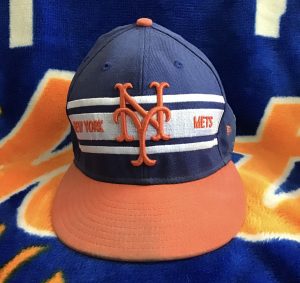
by Greg Prince on 26 June 2025 1:49 pm “Does anyone still wear a hat?” Elaine Stritch was known to ask. If anyone does — and I know it’s done at Citi Field — I hope hats have been held onto tightly, for the Mets won a ballgame in their ballpark Wednesday night. Surprising, I know.
The Mets, losers of 10 of their previous 11, looked liked their old selves, the selves who’d won 45 of 69 ahead of the skid that commenced nearly two weeks ago and paused only once. Now, they’ve won one of one. Now, overall, they’ve won of 47 of 81, which is to say they are 47-34 after 81 games, which is also to say we have reached the halfway point of the 2025 baseball season.
How the hell did that happen? Wasn’t it just March 27, the Mets in Houston, the new year getting underway? Where did it go? It went to some of the highest Met heights in recent memory before plunging back toward the middle. The heights were too high to let a even a severe two-week dip dent the record too badly, though I suppose there’s still time.
There’s always time. It’s the thing that flies.
Fortunately, there are also still the Mets of the current campaign, the Mets who were, I’m pretty sure, too good to continue spiraling. Living in every season at once as I do, the way the Mets have played versus the Braves and Phillies in particular has sent me back four years to 2021. Remember 2021? I’m gonna guess, despite its relative recency, not much. It’s one of those seasons that evaporated from common Met discourse as soon as it was over. Luis Rojas was the manager. Several people were the general manager (one of them signed James McCann; another of them traded Pete Crow-Armstrong). Marcus Stroman was the rotation’s rock. Miguel Castro saw more action out of the pen than anybody. The Bench Mob — Villar and Pillar; Peraza and Mazeika, Prancer and Vixen — constituted the collective toast of the town for an eyeblink. Things looked good for a while before things looked dicey. Then things went simultaneously west and south.
As of August 12, the 2021 Mets sat in a tie for first place with a record of 60-55. Their next four series encompassed two apiece versus the Dodgers and Giants, a pair of clubs en route to crashing the 100-win mark. You know why L.A. and San Fran won 106 and 107 games, respectively? Because they had the good sense to schedule the Mets. Between August 13 and August 26, they combined to play the Mets 13 games and beat them 11 times. When the carnage was over, so, effectively, was the Mets’ shot at reaching the playoffs.
Ancient four-year-old history, except the contemporary Mets, after losing three of three to the Rays at home; going to Atlanta and losing three of three; going to Philadelphia and losing two of three; and coming home and losing their first two against the Braves, gave me unwanted flashbacks to that not-so-golden interregnum of Jake Reed and Chance Sisco. We’re good as long as we don’t play good teams? Playing good teams is what torpedoed us in ’21.
It’s not ’21 anymore. We have Francisco Lindor and Pete Alonso and Edwin Diaz and Brandon Nimmo and Jeff McNeil and David Peterson now. We had them then, too, but it’s much different in ’25. I’m sure of that.
Pretty sure.
True, we’ve cycled through our share of Dicky Loveladys, Tyler Zubers, and, as of Wednesday, Jonathan Pintaros — 30 pitchers in all this season, plus a designated hitter who threw a scoreless inning — but we also have Juan Soto in ’25. We’re slated to have him in years I can’t guarantee will arrive in a world-teetering-perilously-on-the-precipice-of-extinction sense, but we’ll worry about those years should they get here. We have the Soto we craved in December, the Soto I remember looking at during that first series in Houston, when he was exchanging a few words with Jose Siri in the Daikin Park outfield after one of them had called off the other on a fly ball, and thinking, “Wow, he’s actually a Met, not just a stunning acquisition who shows up at press conferences and swings for sizzle reels, but the guy in right who communicates with the guy in center for our team, just like any Met would.” Except he was Juan Soto, celebrity baseball player I wasn’t yet used to being a Met.
I’m not a hundred percent certain I’m used to it yet, but I’ll take what he’s gotten in the habit of giving us when swinging in real life, a real life that includes two swings like those Soto put on two Brave pitches last night. Juan homered twice for the 27th time in his career, or more than anybody ever has before the age of 27. When Soto was with other teams, we’d hear of such youthful exploits and at most nod toward his excellence. Yeah, that Soto is quite a hitter. What’s that got to do with us? Apparently, everything. Based on his output of June 2025, when Juan Soto of the New York Mets has scalded like the temperature and passed the previously unassailable Polar Bear for the club’s home run lead, Juan Soto being a New York Mets is a condition a Mets fan could and should get used to.
Soto’s two home runs accounted for two runs batted in. Ronny Mauricio’s one home run, one of three hits for the kid who seems to be warming to major league competition, accounted for one run batted in. All three Met homers were spectacular to watch soar into the sweat-soaked night, but they were, when you got right down to it, solo home runs. The beauty of the Mets finally beating the Braves Wednesday was that four other runs scored as a result of other hitting outcomes: two runs on sac flies, two runs on singles. Five runs in all scored in the home fourth, as if the Mets just found out about this new thing called keeping the line moving.
Run prevention also came in handy. McNeil, never a center field for more than a minute until this year, robbed Marcell Ozuna of a home run in the first inning. Clay Holmes, the starter from March 27 and every five or six days since, continued in what had been a novel role for him, going five and allowing only one run. You’d like more length from your starter, even if you have to keep reminding yourself Holmes is a starter like McNeil is a center fielder — just lately. Though you’d always like more length from your starter, you’ll accept as something for your starter-length troubles scoreless innings from Brandon Waddell, Jose Butto, and Ryne Stanek. You’ll even give Pintaro a pass for not quite shutting the door in the ninth inning when tasked with protecting a six-run lead. It was his first-ever big league appearance, and things never got too out of hand. He was even thoughtful enough to create a save opportunity (four-run lead, two men on, potential tying run in the on-deck circle) for Diaz, who efficiently cashed it in by recording one quick out.
The 7-3 win by the triumphant team that makes you forget how bad they look when they lose (just as when they’re losing 10 of 11 they make you forget how good they look when they win) was gratifying especially from a big-picture perspective. The 47-34 record they hold at the season’s halfway point is damn fine. Practically, it’s good enough to have them a half-game out of first in the present. Historically, it’s the same mark the 1969 Mets and 1984 Mets held after 81 games, and we know those live on as transcendent years in the common Met discourse. I’ll try to ignore that the 1991 Mets were also 47-34, yet finished 77-84, having experienced their own 2021-style plunge but worse in the second half (a 4-23 stretch ended not only their division title hopes but destroyed what remained of the most successful era the franchise has ever known).
However other Met years have shaken out, 47-34 after 81 games remains damn fine. Still, the way we were going this year, when we were 45-24 two weeks ago, I figured we’d have touched if not passed 50 wins by now.
OK, I assumed we’d have touched if not passed 50 wins by now.
OK, I assumed we’d have passed 50 wins and be waaay ahead in first place, no sweat.
Alas, there’s been a lot of perspiration in these parts these past few days.
 Get a grip… As for time flying, let me redirect your attention to Clay Holmes’s mound opponent in the 81st game of 2025. The Braves’ starter Wednesday night was Didier Fuentes. Didier Fuentes is a young man. How young? Didier Fuentes was born on June 17, 2005. On June 17, 2005, this blog was busy commemorating the 10th anniversary of Bill Pulsipher’s June 17, 1995, major league debut, a 7-3 defeat at the hands of Houston, an event that is a touchstone in the development of Faith and Fear in Flushing. It’s the game for which Jason and I first met in person, outside Gate D at Shea Stadium. We were online friends for a year prior, now we were friends for real. Not quite 10 years later, on February 16, 2005, we started a blog about the Mets, a blog that is still going more than 20 years later.
And, we have learned, four months and a day after we started this blog, a baby was born in Colombia, and that baby has grown up to pitch against the Mets — and lose to them by the same score Bill Pulsipher lost to the Astros in front of Jason and me exactly ten years prior to the day that baby was born.
That baby, now 20-year-old Didier Fuentes, is the first major leaguer younger than Faith and Fear in Flushing. That’s a youthful exploit not even Juan Soto can claim. Living in every season at once as I do, I shouldn’t be shocked at how time’s flight path maps out directly overhead. But, oh baby, this piece of information would have me holding onto my hat if I wore one anywhere outside of Citi Field.
by Greg Prince on 25 June 2025 3:16 am I was hanging out with Frankie Montas Tuesday night, though not as soon I’d planned. Thank the Long Island Rail Road and its “signal problems” and “scattered delays” for making sure I wouldn’t see the veteran’s first pitches as a Met. If I didn’t see his first pitches, I wondered if I’d see any, based on the dismal numbers associated with Montas’s rehab tuneups. The stats suggested his engine wasn’t quite revving. What would happen first: my series of trains depositing me at Citi Field or Frankie making his way to the showers, and not because of the allure a nice, cool shower held on a hot evening like this?
Frankie Montas’s first inning as a Met I heard through the one working earbud of my trusty pocket radio while on the 7 from Woodside. He got out of it.
Frankie Montas’s second inning as a Met I heard on the Mets Plaza loudspeakers. I wasn’t focused on whatever he had gotten into, but he got out of that, too.
Frankie Montas’s third inning I saw on the large monitor that keeps Promenade food courters apprised of the game inside. The starting pitcher emerged unscathed, or at least unscored upon.
Me and my seat got together for the fourth and fifth. Frankie was still on the mound and still getting Braves out. Frankie Montas wound up pitching five innings, and by the time he was no longer pitching, the Mets had scored three off Spencer Strider. They appeared clutch on his behalf, like the team we remember before they were overtaken by their current skid. Montas, the man I was late and, to be honest, hesitant to see, was suddenly the best starting pitcher the Mets had, based on recent results, his own and those of his rotationmates.
I was hanging out with Dicky Lovelady Tuesday night, though not after things with some other Met relievers had gone awry. Dicky Lovelady is a Met reliever, by the way. So are Huascar Brazoban, Jose Castillo, and Reed Garrett. They shared the sixth inning, the inning after Montas fired his eightieth and final pitch. I wished my trains had moved faster. I wished our starter had lasted longer. None among Brazoban, Castillo, or Garrett is what you’d have called Montasian on Tuesday night. They combined to give up five runs to Atlanta in the top of the sixth. It was a long half-inning. It was still light out when Brazoban came on. It was dark when Garrett finally ended it. Very dark.
 Darkness descends on Citi Field. A lot of it. But then we had Dicky Lovelady, and if you can’t enjoy the first Met outing of Dicky Lovelady, you probably shouldn’t be sitting in 94-degree heat watching him. Dicky, a journeyman lefty who officially goes by Richard but prefers you call him Dicky, cooled off the Braves in the seventh, setting them down 1-2-3. More Dicky Lovelady was the only thing I wanted in the eighth. The Mets were still losing, 5-3, and by the time Dicky was pulled in favor of Dedniel Nuñez — the first Dedniel-for-Dicky exchange in franchise history — the Mets were losing, 6-3. By the time Dedniel finished Dicky’s second inning, the Mets were losing, 7-3. The night air wasn’t substantially cooler, and the front office remained dissatisfied enough with its relief pitching that it was planning to call up another new arm, that belonging to righty Jonathan Pintaro, whose 2025 experience to date has topped out at Double-A. Everybody comes. Everybody goes. The bullpen is neither stable nor reliable. I don’t know who goes down to make room for Jonathan Pintaro.
In case it’s Dicky Lovelady, at least I got to see Dicky Lovelady pitch for the New York Mets. If the bullpen has done anything well of late, it’s make the all-time Met roster read interesting.
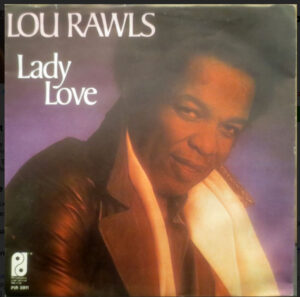 Mr. Lovelady, your warmup music is waiting. I was hanging out with my friend Kevin Tuesday night. Under optimal circumstances, the hanging would have commenced an hour or more before first pitch, but optimal circumstances on the part of the LIRR and me were hard to come by, so we met on the plaza with Montas taking care of the second inning; went through security (which didn’t search my bag for the sealed 20-ounce bottle of diet cola I didn’t bring after my last staredown with them); and hustled up to Promenade. The hustle took several detours until we decided, ah, let’s get some of those messy steak frites from Pat LaFrieda and eat them at one of those picnic tables while we keep an eye on the action on the large food court monitor. I hadn’t done that in the middle of a game for a long time. I hadn’t been this late for a game in a long time.
The hanging out was on. It’s always the highlight of Kevin’s and my annual Mets-Braves game, because our Mets-Braves games tend to be short on highlights from a Mets perspective. This one at least had Frankie Montas surprising everybody with his effectiveness, Dicky Lovelady gratifying us with his presence, and one of those “maybe they’ll pull it out in the ninth” rallies that I egg on with roughly a quarter sincerity. The other three-quarters of me is thinking about what train I’ll be able to get at Woodside, provided signal problems and scattered delays have been solved. Win or lose, I could hang out with Kevin all night. But catching a train is catching a train.
The rally held promise. It even produced a run, driven in by Ronny Mauricio, who might as well make himself useful between strikeouts. The tying run came to the plate in the person of Francisco Lindor. That’s the person you’d ask to tie the game. We would have settled for Lindor simply continuing the rally and the game, given that there were two out. Get on and let Brandon Nimmo win it. Or Nimmo can keep things going after Lindor and we can have Juan Soto win it. Soto scored our first run. Jeff McNeil drove him in with a sac fly. Brett Baty drove in the other two way back in the fourth. Those were heady times. By the ninth, we’d forgotten the Mets were capable of scoring three runs in a single inning, at least until they got baserunners on and Lindor up with their deficit trimmed to three.
Lindor grounded out. The Mets lost, 7-4. It was their hundredth loss in their last 101 games, or felt like it. But I watched it with Kevin, which is always a treat. Every game we go to encompasses every season the Mets have played, essentially. We make a lot of detours while in our seats. But we couldn’t make the Mets win.
After parting ways with Kevin on the 7 at Woodside, I found myself hanging out with Tom. Tom was as much a stranger to me Tuesday night as Dicky Lovelady had been. At least I’d heard of Dicky Lovelady. Tom was a guy waiting on the LIRR platform at Woodside for the Babylon line train, same train I was waiting for. He noticed my game bag, the one with the Shea Stadium Final Season logo and told me he went to Shea as a kid. Well, yeah, I thought, we all went to Shea as a kid. Kids today go to Citi Field. I rode in on the slow trains with bunches of kids — teens, technically — who know Shea only as history if they’re aware of it at all. Kevin and I take time at every one of our game to romanticize Shea. We agreed at this game we’ll never feel that kind of romantic about Citi Field, but that’s OK. The kids on my train (when they’re not loudly consumed by picking parlays on FanDuel) will have that privilege when they are older.
Before I could join Tom in a Shea reverie, he changed the subject to a player he remembered as a kid playing there: Rey Ordoñez. Tom had been a shortstop as a kid. Played it in school, all the way up to college. He’s 40, still rather athletic. Said he “used to” really follow the Mets, but it seemed to me he knew his contemporary stuff. I asked him if he thought we were gonna pull out of this tailspin. Athlete that he is, he said, yeah, there’s 162 games, everybody overreacts. I know that deep down, but I also reach places deeper down where “it’s a long season” logic encounters signal problems.
But we didn’t really stay on the contemporary Mets. We stayed on shortstops. I said Rey was the greatest I ever saw in the field. “Couldn’t hit,” but boy could he field. Tom brought up Ozzie Smith, though he admitted he didn’t see that much of him. Was also really impressed by Rafael Furcal, particularly his arm. I threw in Omar Vizquel as another defender who took grounders and breath away. I got the sense that Tom walks around with a lot of baseball in his subconscious and doesn’t necessarily get to share it with those he comes across in his daily life. One night, some guy is carrying a bag that has a logo from a long-ago ballpark, and Tom is off to the memory races.
We talked shortstops. We talked greatest hitters we’ve ever seen. I’m older, so I’ve seen more of them. Tom relates to their skills, so he understands better than I do what it took for Barry Bonds, “steroids or no steroids,” to lay off any pitch he didn’t like. I threw out some names. Tom threw out some names. Eventually we were onto pitchers. Our train had come. Discovering that our eastbound stops were a town apart, we sat together and kept the conversation going, better than the Mets kept their ninth-inning rally going. Some tangent led him to tell me he once golfed with Tim Teufel. He produced a picture on his phone of the two of them together. Outstanding human being, Tom said of Tim.
Tom’s stop preceded mine. Before he departed, we shook hands and, for the first time, exchanged names. “Tom.” “Greg.” Our names, rather than those of major league legends Seaver and Maddux. A brief hang between erstwhile strangers, but one bulging with baseball, a subject that will familiarize people on the way home from a game in a hurry. You could do worse in the wake of yet another loss to Atlanta.
by Jason Fry on 23 June 2025 11:10 pm Does it count as progress if the Mets lose but it’s merely discouraging and not actively humiliating?
Monday night’s game was more drab and disheartening baseball. Paul Blackburn was lucky not to get driven from the game down six or seven, as he got help from Braves baserunning mistakes and atom balls that found Met gloves. The relievers were solid and helped the Mets hang around, but they could do little against Spencer Schwellenbach, pitching with admirable efficiency on a brutally hot night.
The game was bookended by two Juan Soto ABs — the first in the sixth, the second in the eighth. In the sixth, Soto roped a Schwellenbach sinker into the left-center seats for a two-run homer that brought the Mets within one. In the eighth, Brian Snitker summoned Dylan Lee to face Soto after Raisel Iglesias got into two-out trouble, giving up singles to Francisco Lindor and Brandon Nimmo. Soto fought Lee through eight pitches, all but one of them sliders. The seventh in the sequence was a fastball, one Soto was somehow able to speed up his bat enough to foul off. But the eighth was another slider, perfectly placed by Lee at the bottom of the zone. Soto swung over it, the inning was over and so, essentially, was the game.
But it would be insane to pin this on Soto, AKA the entirety of the night’s offense. What happened in the fifth inning, the frame before Soto’s homer? The Mets went down 1-2-3. How about the seventh inning, the one between those bookend ABs? The Mets went down 1-2-3. And the ninth? The Mets went down 1-2-3.
It’s almost like there’s a theme at work.
In this dreary 10-game stretch the Mets have scored a grand total of 30 runs — and that includes their 11-run uprising against the Phillies. Toss that one out and they’ve put up 19 runs in nine games. I may not be a sabermetrician, but that seems suboptimal. Not to mention unwatchable.
by Jason Fry on 23 June 2025 8:38 am Ebbs and flows, flows and ebbs. A baseball season is filled with them — stretches in which a band of players watch everything they touch turn into Ws and others in which their incompetence is so bafflingly chronic that you half-believe it’s deliberate. Those who have played the game will always have a leg up in understanding that these ebbs and flows just happen and all one can do is endure them, probably because the wins and losses are part of the larger, unchanging routines that surround them. The players are riding the bus from the team hotel and taking infield and BP and going over enemy hitters and they see every day that everything is much the same, except for the glorious or tragic outcomes that emerge. And of course their pre- and postgame assessments are 80% cliches about one day at a time and not getting too high or low — the alternative would be staring into an existential abyss.
Which I suppose is why the baseball gods created bloggers.
If one must experience a long, maddening baseball ebb, I do highly recommend spending it sylphing around Umbria and Lisbon, with 95% of the horrors happening offstage while one sleeps off another night of rich meals and too much wine. The clock limited my encounters with the Mets to the occasional late-night glance at Gameday, followed by early-morning dismay and seeing what Greg had to say about the latest sad event. (Thanks partner — you definitely got a lot more/lot less than bargained for, depending how once sees these things.) Wait what, you’ve got to be kidding me, lather rinse repeat. The end of the losing streak was particularly welcome not just for the obvious reasons but also because for once I didn’t sleep through a fusillade of narrative-flipping enemy runs.
Emily and I landed at JFK at the end of the first inning Sunday, and our various travel snafus coincided with various disasters down in Philadelphia, witnessed via MLB Audio. David Peterson imploded while our plane was trundling around distant runways waiting for our gate to clear; just the sound of the contact made by Edmundo Sosa was enough to send my chin plummeting onto my breastbone. Nothing much good happened while Emily and I were waiting in a concourse-long line to reach Passport Control and be welcomed back to our native shores. Before our Lyft cleared JFK’s galaxy of access roads, the Mets had lost.
That’s a lot of waiting around unaccompanied by anything resembling good news. The game was drab and bad, with just a few things of note:
Francisco Alvarez has finally been sent down, which struck me as merciful. It’s been a season-long parade of horrors for Alvarez, with a broken hamate bone seeming to derail his efforts to refine his approach as a hitter, which leaked into his defense, and even the happy tidings of parenthood feeling like another ball to be juggled while in an increasingly cold sweat. Let’s wish Alvarez well and remember that he’s still just 23, with plenty of time.
Tyler Zuber made his debut, elbowing past the legendary Don Zimmer to occupy the coveted spot reserved for Mets All-Time Roster caboose and paving the way for the publication of the tome From Aardsma to Zuber: Middle Relievers Who Don’t Remember You Either. I’ve had an old Topps Heritage Zuber in waiting since Zuber’s acquisition at last summer’s trade deadline and just got a 2025 Syracuse Mets card for him, so at least in The Holy Books everything’s coming up Zuber.
Keith Raad did a good job as a solo radio act, a la Vin Scully: He was bright, engaged and cheerful even amid dolorous Mets-related doings. If only he’d been given events we’d want chronicled, let alone revisited.
Francisco Lindor homered but the Mets didn’t win, putting an end to a quirky 28-game streak that was one shy of the big-league record held by Carl Furillo and the 1951-53 Brooklyn Dodgers. Lindor homering is certainly still a good idea, regardless of its accuracy as a portent, and I suggest he keep doing that. Maybe I’ll even be here for the next few!
by Greg Prince on 22 June 2025 6:41 am The Mets went only 2-for-7 with runners in scoring position Saturday night in Philadelphia, and their starting pitcher had to be pulled with one on and nobody out in the sixth, suggesting two overly familiar ingredients had been stirred into the pot for an eighth consecutive serving of futility stew. Fortunately, the Mets were experimenting with a different recipe, one that calls for seven home runs, each their own rather than the opposition’s.
Nobody was on base for any of them, but nobody had to be.
Thanks to a lot of slugging — a lot — the Mets broke their seven-game losing streak, thwacking the Phillies. The final score rang a bell, and I don’t mean Liberty, for 11-4 was the score of the very first Mets game ever. That night, April 11, 1962, in St. Louis, the Mets had the four. The comparison would therefore fizzle if not for this game in 2025 also feeling like it was presenting us with the first line on an otherwise clean slate. One game and a lifetime to come then, one game and a whole season of (we hope) renewed promise ahead now.
Goodbye, at last, to the doom and gloom associated with dropping seven in a row. It’s as if those blahs and blues were never here. Hello, once again, to first place in the National League East. Maybe someday we’ll be noting, “by stopping their seven-game losing streak, the Mets moved into a first-place tie,” the way we marvel that the Mets dually accomplished reaching .500 and taking first on the same night in September 1973. Of course that was September. This is June. This is lots of games to go. This is reacting to a one-week downturn in the middle of a season that had been practically nothing but ups until very recently.
Was it overreacting? When you live through (and blog through) seven consecutive losses, there is no overreaction. Losing always sucks. Losing times seven sucks seven times as much. But it sure is nice to have a previously woven cushion to fall back on. That’s what the 45-24 was for; a superb start can withstand a sudden sag. So now we’re 46-31, which looks spectacular, especially if you conveniently overlook the 0-7 it encompasses.
For now, let’s just enjoy 1-0 by way of 11-4. Let’s enjoy the enormity of seven convincingly blasted Met home runs and the oddity that each of them was a solo home run, not to mention three of them having been hit in succession. If you’re not gonna produce consistently with runners on base, then make every bases-empty hit count. Hit every bases-empty ball out of the park. How do you win if all your home runs are solo jobs?
Volume! Volume! Volume!
Juan Soto twice. Brandon Nimmo twice. Jared Young and Francisco Alvarez once each. And, perhaps most comforting, Francisco Lindor once. Lindor, he who continues to play through a broken toe, had been slumping more than any Met, which is an achievement unto itself. But our de facto captain got going on Saturday, not only with a homer — when Lindor homers, the Mets win — but a double that nearly went out of Citizens Bank, struck far enough away from home plate that it scored the two runners on base. Come to think of it, as awesome as Soto’s shots to the seats were, his two-run icing-on-the-cake single in the eighth, capping his 4-for-5 night, may have been most gratifying. This was Juan being the Juan we didn’t have to dream of when he was signed last December, because Juan’s reality was enough. The Juan of most nights in 2025, even the Juan who’d gotten himself untracked, hadn’t been otherworldly. This fella doin’ his thing in Philadelphia was the Juan we signed, the Juan who makes pitchers pay for running deep counts and/or letting runners on base ahead of him, whether he proceeds to plant their pitches on distant planets or simply where fielders ain’t. Seven other runs were driven in by four other Mets, but Juan being Juan was what we’d been waiting for.
Soto’s first hit was off a changeup, the seventh pitch of the at-bat.
Soto’s second hit was off a four-seamer, the seventh pitch of the at-bat.
Soto’s third hit was off a curveball, the seventh pitch of the at-bat.
Soto’s fourth hit was off a splitter, the sixth pitch of the at-bat.
On Saturday afternoon, as something of a break between turning down the sound on Apple TV+ Friday night and turning down the sound on Fox Saturday night (and ESPN2 tonight, no doubt), I saw a matinee performance of Real Women Have Curves. I enjoyed my Broadway detour a great deal, almost as much as I enjoyed seeing, via Soto’s swings, that real sluggers hit curves and everything else.
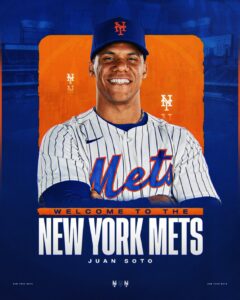 Hey, he’s really here! The seven Met home runs were breathtaking, especially when Lindor, Nimmo, and Soto back-to-back-to-backed a trio in the third. The additional runs via non-homers were reassuring. The jolt of resilience, missing throughout the losing streak, was a reminder that a good team is never out of a game in which it is behind, and that the Mets are a good team. They were actually down, 3-1, after two innings. The top of our order mashing those three consecutive dingers was resilient as hell.
Griffin Canning was adequate enough for the task at hand. He was supported by what amounted to an oodle of runs, thus the four he allowed through five (plus the leadoff single he gave up in the sixth), didn’t cause inordinate stress. Two essential Met relievers, Huascar Brazoban and Ryne Stanek, returned to form, no letting the lead they were charged with protecting get reduced. And one of the Syracuse shuttlers did fine for himself. I’m just sorry it wasn’t the Syracuse shuttler I wanted to see.
Nothing against Chris Devenski, who pitched a scoreless ninth. Devenski deserves something beyond frequent flyer mileage for the way he spaces out his major league appearances. He’s pitched three times for the Mets this year: on April 30; on May 31; and June 21. But the space I had reserved in my heart once I learned who else was recalled Saturday (as Blade Tidwell and Justin Garza were thanked for their service with a demotion to Triple-A) went unfilled.
The Mets have brought up Tyler Zuber! Other than Tyler Zuber’s family, I don’t know if anybody else is bringing an exclamation point to bear over this news, but it’s big news to me. Once Zuber gets in a game, he becomes, as detailed here last summer, the alphabetical last Met in franchise history, bumping Don Zimmer to next-to-last. This has been a development more than 63 years in the making. It literally goes back to that first game, on April 11, 1962, when Casey Stengel wrote “Zimmer” on his lineup card, and no manager after him could go any deeper in the alphabet. The opportunity was there Saturday night for Carlos Mendoza to not only move his team back into first, but to move one of his players into last…which I’m sure Zuber is used to from teachers taking attendance. Alas, we settled for Chris Devenski meeting his monthly quota. And the Mets moving back into first place.
We’ll settle for such resolution to a lengthy losing streak any day, no matter what channel it’s on.
by Greg Prince on 21 June 2025 10:08 am It’s the top of the sixth at Citizens Bank Park on Friday night. Blade Tidwell, a rookie pitcher carrying a parcel of promise along with a name one can picture Carnac the Magnificent working into one of his curses after an audience doesn’t respond as he wishes to one of his prognostications (“may your Blade Tidwell turn Blade Tidrotten”), is no longer in the game. But he has given the Mets about as much as could have been hoped for, considering he wasn’t so much on their immediate depth chart as he was in somebody’s phone’s address book. The kid who was sitting in Syracuse looking forward only to playing video games the night before looked capable for three-and-two-thirds innings, giving up only two runs during his emergency start. Every Met start is an emergency these days.
Zack Wheeler was Zack Wheeler in the sense we know him as a Phillie ace and the sense we knew him as a Met comer. He shut down the Mets for five innings but did so with a pitch count that went untamed. Five innings equaled 98 pitches, so he wasn’t around to shut down the Mets when the sixth commenced. Instead, we saw another ex-Met on the mound, Taijuan Walker. Taijuan had his successes as a Met. They were a while ago. His results as a Phillie haven’t haunted us the way Wheeler’s have. We saw why as the sixth got going.
Three pitches in, Pete Alonso hit a ridiculously long home run, and the Mets were on the board. Three pitches after that, Jeff McNeil hit a less long home run, but still a home run. Two runs off Walker meant the Mets had dashed back into business. The game was tied at two, and for one of the rare innings since their losing streak had begun, Met bats had tangibly responded to adversity.
The week before, in the Friday night game against Tampa Bay — if you can remember back that far — the Mets carried a 5-1 lead to the top of the sixth. This was back when the Mets were on a six-game winning streak. They had initially fallen behind, 1-0, but brushed aside the deficit with their usual aplomb. In the sixth, however, they fell behind, 7-5, and haven’t stopped falling. The plunge has been without pause because the Mets have shown next to no resilience within games.
After they fell behind the Rays for the second time last Friday, they never scored again. A losing streak was on and the ability to dispel doubt was slipping from their grasp.
On Saturday versus the Rays, they twice briefly remembered how to bounce back. Down, 1-0, in the bottom of the third, they responded with two runs. Trailing, 7-2, in the bottom of the fifth, they scored twice more. They never scored again.
On Sunday, in the Rays series finale, they didn’t score at all.
On Tuesday, at Atlanta, they jumped out to a 4-0 lead in the second inning. They never scored again, but the Braves did, clear through to the winning run in the tenth.
On Wednesday, in the middle game of the Braves series, they didn’t score at all.
On Thursday, as they ended their interminable three-day stay down south, the Mets scored the game’s first run in the second inning, and then sat back as the Braves scored seven runs across the fifth, sixth, and seventh innings.
To sum, since they fell behind for good in that first Rays game, the Mets had scored while trailing in only two innings total, none since the second Rays game. So when we got to this second Friday night in this skein, a person watching the Mets tie the Phillies in the sixth after they had fallen behind the Phillies earlier was overcome by a dormant sensation, the sensation associated with a comeback.
A comeback?
A Mets comeback?
Where the Mets are behind but not only make an effort to catch up but actually do?
Get to a point where they’re tied rather than behind?
They can do that?
They could and they did and it was bracing. My god, we were back in this game!
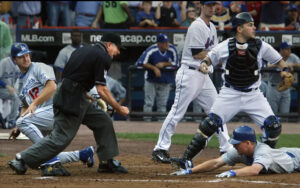 Plays like this used to work for us. That was in the top of the sixth. Taijuan Walker didn’t stick around to see the inning end. Neither did the Mets offense, not really. And in the bottom of the seventh, with the game still tied at two, the tide that had briefly turned against the Phillies tsunamied all over the Mets. There were some softly hit balls that fell in. There were some forcefully hit balls that could have drilled holes. At one point, there were two Phillies sliding into home plate inches apart without Shawn Green, Jose Valentin, and Paul Lo Duca present to nail them as a tandem. Nick Castellanos was safe. J.T. Realmuto was safe. I was surprised Jeff Kent and J.D. Drew weren’t ruled retroactively safe from the 2006 NLDS.
The Mets were now behind, 8-2, and things would get only more rotten, if not Tidrotten, from there. On this Friday night, the Mets lost their seventh consecutive game, 10-2. For a moment, it seemed we wouldn’t. For a moment, we had picked our selves up, dusted our selves off, and seemed poise to start all over again. The moment didn’t last, and the exhilaration was fleeting, but it was ever so slightly better than nothing.
by Greg Prince on 20 June 2025 12:53 pm I don’t know if it’s a repressed memory that suddenly burst through my consciousness or simply a detail that didn’t hold my attention for long when it was fresh, but after the Mets’ losing streak reached six games Thursday night in Atlanta, I thought of the 2024 National League Championship Series, specifically the Mets’ starting pitching in those six games against the Dodgers and how we hardly had any.
Game One: Kodai Senga 1.1 IP
Game Two: Sean Manaea 5 IP
Game Three: Luis Severino 4.2 IP
Game Four: Jose Quintana 3.1 IP
Game Five: David Peterson 3.2 IP
Game Six: Sean Manaea 2 IP
Not one quality start, only one quantity start, each game a puzzle to be put together with tired, unreliable pieces. The bullpen was stressed. The starters were gassed. If the Mets didn’t hit, the Mets couldn’t stay close, which the Mets didn’t in any of their four losses. I had more or less put how the Mets lost the NLCS out of my mind in the aftermath of the 2024 postseason because everything about the Mets getting to and succeeding in the 2024 postseason prior to the NLCS was so rewarding. I was depressed for maybe two days that we’d come within two games of the World Series, and concerned that a chance like that doesn’t necessarily come around very often, but then I shrugged that the Dodgers were the Dodgers, and was back to being happy that so much happened rather than being sad that something was over. Soon, it was the offseason, and we were gearing up for the year to come, which looked promising before it began, and began delivering on its promise soon after it began.
But now our starting pitching is in 2024 NLCS mode, which is to say we are letting our shot at a pennant slip away.
Six games don’t give a team much space to work through the kind of pitching woes that befell the Mets at the wrong time last October. Eighty-seven games, which is how many remain in 2025, provide a vastly wider berth to fix what appears broken. Thus, the way things are currently going can be turned around. Yet the way things are currently going feels at least temporarily intractable because when it comes to starting pitching, suddenly we hardly have any.
Game One: Clay Holmes 5 IP
Game Two: Tylor Megill 3.2 IP
Game Three: Griffin Canning 4.1 IP
Game Four: David Peterson: 7+ IP
Game Five: Paul Blackburn 3.2 IP
Game Six: Clay Holmes 4.2 IP
You can scratch Megill from an imminent turnaround, as he is on the IL with an elbow sprain. You know Senga isn’t a part of any of this, thanks to a hamstring strain. You’re left leaning on Peterson for an extra couple of batters in an eighth inning when maybe he should have been deemed done for the night. You’re hoping Holmes isn’t bumping up against an organic innings ceiling in his first full year of starting; lord knows the fifth inning Thursday night looked like one too many for him. Canning and Blackburn have reverted to looking like the journeymen they were before the Mets’ pitching brain trust went under the hood and tinkered with their mechanics.
Now you land on a Friday in Philadelphia planning to start Blade Tidwell, returned from the minors, not because he has progressed nicely since his unsuccessful cameo in St. Louis last month, but because you have nobody else to pit against Zack Wheeler. You were going to try your luck with Justin Hagenman for a few innings, but Hagenman was needed Thursday to back up Holmes and Huascar Brazoban — one of the many Yeomen of the Bullpen getting buried by extra work — and is therefore unavailable.
So except for Peterson, knock wood, we have about as much starting pitching to count on in the week ahead as we did the week we faced the Dodgers for all the NL marbles. And nobody in the bullpen feels like a sure thing for a given out or inning, let alone multiple outs and innings. And, oh by the way, nobody’s really hitting, not the big guys who you figure will come around as a unit soon, not the mid-level guys who you figure will respond consistently to the big guys getting on base and driving in runs in front of them, and certainly not the young guys who, neither individually nor collectively, are showing anything at all.
The first-place Mets are still the first-place Mets, except now they share first place, and for the first time all season, I’ve looked at the Wild Card standings with more than vague curiosity to see how the other half lives. At this rate, the other half beckons. Rates change over time. Personnel changes over time. We know there are pitchers coming back soon or soon-ish from injury. We don’t know what they will provide as they ramp up to full speed. We don’t know what full speed will encompass.
We do know time within a season can be long. Eighty-seven games’ worth of time qualifies as long. Though if the next 87 games are a whole lot like the last six games, that’s not comforting.
by Greg Prince on 19 June 2025 2:52 pm The late, great Dennis D’Agostino had a forthright way of handling blank space in his seminal 1981 volume This Date in New York Mets History. For any date on which nothing discernibly Metsian had yet occurred (understandable, in that there hadn’t yet been two decades of official franchise operation), Dennis wrote, simply, “Nothing of importance happened on this date.”
That is how I choose to address the events of June 18, 2025, a.k.a. Wednesday Night’s game in Atlanta; process the significance of the Mets’ 5-0 loss at the hands of Chris Sale, Ronald Acuña, and reverse momentum as you wish. But as long as I have This Date open, allow me to turn to and share the entry for February 10, 1967:
“Mets purchase pitcher Ron Taylor from Houston’s Oklahoma City farm team.”
Now that’s something of importance Metwise. That innocent-sounding transaction heralded the building of a bullpen that would serve as a cornerstone of a world champion. Taylor had become a world champion for the Cardinals two years and four months before the Astros decided they didn’t need to hold onto him, and he’d become a world champion for the Mets two years and eight months after they took a flyer on him.
When you consider the credentials of the righty reliever who was available for a song and where he would help take his new team, February 10, 1967, towers like one of the skyscrapers in the Met logo over the Met calendar.
Dr. Ron Taylor passed away on Monday at the age of 87. He wasn’t a doctor when he was a Met, no matter how he operated in and around the strike zone. The medical certification came later, as did his longtime association with the Toronto Blue Jays as their team physician. Ron was Canadian, the Jays are Canadian, it was a relationship that clicked as well as Ron’s with the Mets’ elevating aspirations in the 1960s. Whenever Ron was introduced at a ’69 Met reunion, he always received his honorific. “Welcome back DOCTOR Ron Taylor!”
Mr. Ron Taylor did very well by the Mets across five seasons. Being Dr. Ron Taylor made him a little more special. In A Magic Summer, in which Stanley Cohen visited with 1969 Met after 1969 Met to see how they were doing nearly twenty years on and what they remembered about that championship season, Ron made time for the author while on the job at Exhibition Stadium, the Jays’ pre-SkyDome nest. Their interview took place during a game, meaning the doctor was on call all evening. He had to keep an eye on the action in case he was needed. Cohen noted Ron had “apparently mastered the technique of following the progress of a game while focusing his attention elsewhere.” For the former pitcher, it was just the way his weeks — which included a private practice and other sports medicine commitments — wound down.
“I always set aside Friday night for doing interviews with people writing books,” Ron told Stanley.
That line and that image have always stayed with me, the idea that writers were queuing up to hear the story of the 1969 Mets from the perspective of its ace fireman. That’s what a reliever used mainly at the end of games was called in those days. Closing was not beyond the realm of the pitchers who did the starting. The Mets’ staff completed 51 games in 1969. That still left 111 in which assistance was required. Some of those games were tight. Some of those results hung in the balance of what Ron Taylor and his penmates could do. Fires got put out with regularity. The future doctor had a knack for providing necessary aid.
The first time Ron Taylor notched a save for the Mets it was in relief of Tom Seaver, specifically Seaver’s first big league start. That win, in the game of April 13, 1967, went to the pitcher who worked between them, Chuck Estrada, but Seaver-Taylor would prove an effective combination. When the Mets traveled to Atlanta for the first game of the initial National League Championship Series — October 4, 1969, a date when something of unquestionable importance happened — it was Seaver going seven for the Mets’ first-ever playoff win and Taylor nailing down the first save anybody had seen between the end of a regular season and the beginning of a World Series. Taylor would work the next day, and earn the W in relief of Jerry Koosman. We were not only one win from a pennant, we could claim the very first full-fledged NLCS bullpen ace, a role said ace essentially invented on the fly.
Ron would lend a hand in the World Series as well, culminating in his second postseason save, again in support of Koosman, in Game Two at Baltimore. In the moment, it was enormous. In a few days, it became a component of a world championship. It would take 37 years for a Met to surpass Taylor’s saves output for a single postseason. He likely thought he was just getting critical outs in critical games. He was actually setting a standard at the dawn of the relief age. As sports medicine would be for him post-pitching, standard-setting was his specialty.
Ron Taylor saved 50 games between his arrival in 1967 and departure following 1971, not counting those clutch performances in the playoffs and the Series. He saved games when the Mets weren’t good, were getting good, had gotten great, and were doing their best to stay great. The Mets’ club record for saves in a single season is 51, set by Jeurys Familia in 2016, when times had very much changed (Jacob deGrom threw one complete game; no other Met threw any). Context is everything when tempted to juxtapose contemporary closing with firefighting way back when. Those 50 saves of Taylor’s in those five years represented the most for any Met reliever during the first ten years there were Mets. Tug McGraw was second, Cal Koonce was third. They were all 1969 Mets.
A combination of visionary strategy — Gil Hodges and Rube Walker embracing their bullpen members’ skills rather than seeing relievers as failed starters — and the assembled abilities of the non-starting arms in Flushing gave pitching’s evolution a kickstart. “Hodges did one of the greatest jobs of managing in the history of the game,” Ron reflected for Cohen. “We were given what amounted to job descriptions, like in industry.” Taylor led the Mets in saves four consecutive years, though never with more than fourteen. Three times, however, he ranked in the National League’s Top Ten in the category that was just gaining a foothold in baseball’s consciousness. He was in on the start of closing. His role in the development of the reliever holds up to this day. Ron Taylor stands fourteenth among all Met pitchers ever in saves, ninth among all righties coming out of our pen.
 He certainly got my young attention, whether it was for earning the win that was the Mets’ 100th as 1969 was ending; or the first that ever accrued in the Mets favor on an Opening Day, in 1970; or for his stoic pose at Shea Stadium on his 1970 Topps baseball card. Beyond our announcers telling me he was coming into a game and the box scores summing for me exactly what he did, it was that card that really introduced me to Ron Taylor. It told me, on the back, that he’d been around a while. Other Mets had space for a biographical cartoon. Ron’s rows of numbers, dating back to 1956 in the Florida State League, precluded cheekiness. Topps did manage to note Ron “holds a degree in engineering,” which is why I didn’t think anything of it when I learned from one of the 1969 anniversary celebrations that he was a doctor. Good at science was good at science in my mind. He certainly got my young attention, whether it was for earning the win that was the Mets’ 100th as 1969 was ending; or the first that ever accrued in the Mets favor on an Opening Day, in 1970; or for his stoic pose at Shea Stadium on his 1970 Topps baseball card. Beyond our announcers telling me he was coming into a game and the box scores summing for me exactly what he did, it was that card that really introduced me to Ron Taylor. It told me, on the back, that he’d been around a while. Other Mets had space for a biographical cartoon. Ron’s rows of numbers, dating back to 1956 in the Florida State League, precluded cheekiness. Topps did manage to note Ron “holds a degree in engineering,” which is why I didn’t think anything of it when I learned from one of the 1969 anniversary celebrations that he was a doctor. Good at science was good at science in my mind.
Good at pitching is what concerned me as I was becoming a fan in 1969 and digging in as a fan in 1970. The card made mention of his 13 Saves (capitalized) in the same blurb that informed us of his engineering acumen. While saves didn’t yet rate a column all their own, his yearly wins and losses definitely got compiled and printed. He was 9-4 in 1969, and I didn’t need any kind of degree to recognize that his .692 winning percentage (also listed) was outstanding.
As indicated by all those rows of minor and major league experience and, I suppose, his birthday of December 13, 1937, Ron was kind of old as Mets of that vintage went. I was seven in 1970. Every ballplayer was a grown-up to me, but that picture on the front of card 419 did project a touch of No 42 having seen plenty. He had seen life the minors since ’56; the majors since coming up with Cleveland on April 11, 1962, the same day the Mets got going; a World Series in ’64 when he and the Cards decked the Yankees — I’d find out about that later and be retroactively grateful. The card told me he was from Toronto, a tidbit I tucked away and didn’t read anything into until I read Wayne Coffey’s They Said It Couldn’t Be Done in 2019.
In this book about the ’69 Mets (aren’t you glad Ron left his Friday nights open for authors?), Taylor explained he was Canadian because his mother, from Wales, had attempted, with her siblings, to emigrate from Wales to Australia but missed her boat by minutes. She asked the dockmaster where the next ship was going. Canada was the answer.
“Can we get on that one?”
Be glad the Astros missed the boat on Taylor in 1967, and be glad Maude Evans missed the boat she missed, or Maude doesn’t meet Wesley Taylor in Toronto and have two kids, one of whom caught onto baseball adjacent to the country where the Mets would someday play. Maybe a kid born in Australia with a different father would have found his way to Queens — the Miracle Mets were a team of destiny — but Ontario was surely a lot closer. And the Mets got a lot closer to their destiny because of the man who was, effectively, their prototype closer. No, the save totals don’t compare with the ones that were accumulated by others later, but, as Joe McDonald, who was the farm director in 1969, put it in Coffey’s book, “Unfortunately, they don’t have stats for guts. Ron Taylor had guts. He wanted the ball no mater what the situation, and he was never scared.”
He certainly wasn’t scared of the Braves or the Orioles. He wasn’t scared by what he saw when he went to Vietnam on a goodwill tour during the war. He was, instead, inspired by the wounded soldiers striving to recover from literal battle scars, inspired enough to become a doctor. His life after baseball was coming. In 1970, though he continued to be Hodges’ main righty out of the pen, age began to catch up with Taylor as the season wore on. Ron didn’t pitch after September 14, despite no reported arm problems and the Mets attempting to repeat as division champs. Danny Frisella became Tug McGraw’s righty fireman complement, as Hodges decided Ron wasn’t any longer up to the role the veteran had filled for the manager since 1968. Such changes happen in industry, too.
Jack Lang, as plugged in a reporter on the Met beat as there ever was, figured Ron would be a goner in the offseason, but he returned for 1971, pitching less than he had in any of his preceding four years as a Met. Quick stops in Montreal, where he didn’t pitch, and San Diego, where he made a handful of appearances, followed. Ron Taylor was done as a major leaguer by 1972…and on to the rest of his life, which lasted a helluva long time. Some of it was devoted to telling anybody who asked about 1969 what they wanted to know. He sure devoted a lot of Friday nights to keeping the story going.
Ron’s passing represents a tipping point of sorts in the 1969 Mets as a going entity. Twenty-five players were on that World Series roster. Only twelve are still with us — slightly less than half. Thirty-five players participated in the course of what is known as the regular season, though there was hardly anything regular about 1969 where the Mets were concerned. Eighteen of those players are still around — barely more than half. Unfortunate statistics of that nature are inevitable. Nineteen Sixty-Nine was also a helluva long time ago. Yet it’s still a going entity for us.
Thank you, Dr. Taylor, for extending its life as you did.
by Greg Prince on 18 June 2025 2:32 pm Fishing around my desk for something or other as I prepared to pen a screed about the absolutely loathsome baseball game I watched Tuesday night, I came across the following document, dated and notarized September 30, 2024:
“I the undersigned agree after today’s baseball game of New York Mets 8 Atlanta Braves 7 at Truist Park, the baseball game that clinched a playoff spot for the 2024 New York Mets and capped a fantastical ride from ‘oh and five’ to ‘OMG,’ I will accept, without issuing vociferous complaint, the outcome of exactly ONE future horrible baseball game between the same teams at the same facility.
“Such a future horrible baseball game may include one or all of the following conditions as they pertain to the New York Mets:
“wretched baserunning;
“wretched pitchcalling;
“wretched defensive decisionmaking;
“wretched defensive execution;
“wretched lead protection;
“and wretched collective offensive performance by a string of players attempting to bat in succession late but failing miserably.
“The disgust and anger associated with this ONE future horrible baseball game and all its wretched Met aspects, even if it and they occur on the heels of a three-game sweep inflicted by some baseball team besides the Atlanta Braves and therefore extends a modest losing streak to a skid encompassing something approximating genuine concern, is to be emotionally dismissed in deference to the absolute joy that emanated directly after the events of this date, the Thirtieth of September, this Year of Lindor, Two-Thousand Twenty-Four.
 They earned one. Just one. “This agreement acknowledges that by punching their ticket to the playoffs in the fashion they did versus the opponent they did and at the venue they did, the New York Mets generated ONE free pass, a pass that may be considered valid, processed, and effective until the first pitch of the next baseball game between the New York Mets and Atlanta Braves at Truist Park following the type of horrible game and wretched aspects described above.
“The New York Mets will be instructed to thereafter not do that again, ‘that,’ referring to the horrible and wretched parts of the ONE future baseball game that will be excused.
“This agreement further acknowledges a Mets fan can only attempt to overlook the disgust inherent in having watched a game like that against an opponent like that at a place like that ONCE, no matter what great thing happened against that opponent at that place the year before.”
I can’t make out a signature beneath the accumulation of blood, sweat, and tears that must have dripped over it, but I’m pretty sure I agreed to it last September 30…or would have had anybody asked me to.
|
|






