The blog for Mets fans
who like to read
ABOUT US

Faith and Fear in Flushing made its debut on Feb. 16, 2005, the brainchild of two longtime friends and lifelong Met fans.
Greg Prince discovered the Mets when he was 6, during the magical summer of 1969. He is a Long Island-based writer, editor and communications consultant. Contact him here.
Jason Fry is a Brooklyn writer whose first memories include his mom leaping up and down cheering for Rusty Staub. Check out his other writing here.
Got something to say? Leave a comment, or email us at faithandfear@gmail.com. (Sorry, but we have no interest in ads, sponsored content or guest posts.)
Need our RSS feed? It's here.
Visit our Facebook page, or drop by the personal pages for Greg and Jason.
Or follow us on Twitter: Here's Greg, and here's Jason.
|
by Greg Prince on 21 August 2018 2:24 am “Whoo! Whoo! Wasn’t that awesome?”
“Absolutely! Great concert! Thanks for turning me on to them.”
“Sure.”
“One thing, though.”
“What?”
“I never asked you. How did they get their name?”
“You don’t know the story?”
“No.”
“Really? I thought everybody did.”
“I swear I don’t.”
“Well, it goes back to 2018. These guys were big Mets fans.”
“Mets?”
“They’re a baseball team in New York. They weren’t any good, and that year they were really terrible. So one night they’re playing this really long game. It’s like…I don’t remember, maybe the thirteenth or fourteenth inning, it’s tied, it’s going nowhere.”
“Sounds boring.”
“I guess. You know baseball, some people like it like that. Anyway, the game’s going on forever and there’s a fly ball to left field. It’s not deep, but there’s nobody there to catch it where it’s going and there’s a runner on third.”
“What’s this got to do with the band?”
“I’m getting to that. The shortstop, Rosario, runs all the way out, and Smith the left fielder — well he wasn’t really a left fielder, but he was in left field — ”
“Wouldn’t being in left field make him the left fielder? I don’t know much about baseball, but I kind of remember that from gym class.”
“This was the Mets. You didn’t always play where you were supposed to.”
“Is that why there was nobody where the ball was going?”
“Something like that. That same game there was another fly ball that was going somewhere around there and nobody was playing there, either. Cost one of their really good pitchers a run, which was why the game was going on all night.”
“Wow, those — what were they called again?”
“The Mets?”
“Yeah, Mets. Those Mets sound pretty wacky.”
“They were. So where was I? Oh yeah, you’ve got this second fly ball heading to left. You’ve got the shortstop — Rosario, fast kid — running out there. And you’ve got the left fielder — Smith, not so fast, not really a left fielder, like I said — running in for it.”
“Don’t they have a system so that doesn’t happen?”
“Normally they do. Actually, they did that night. Rosario called for the ball.”
“Calling, yeah, I’ve heard of that.”
“Yeah, Rosario called for the ball, which means he gets to try to catch it. Except Smith doesn’t hear him or see him because he’s trying to catch the ball, too. And he calls for it. Except Smith calls for it after Rosario. Meanwhile Rosario’s kind of waving Smith off, but that’s useless because Smith’s looking for the ball, apparently forgetting Rosario is running toward it.”
“What a mess!”
“Yup. You can imagine what happens next. Utter chaos. Rosario gets the ball in his glove, but Smith crashes into Rosario at practically the same moment and the ball pops out of Rosario’s glove. Then they both fall down. For some reason, Smith grabs hold of Rosario, who’s on his knees on the grass, like they’re getting ready for a wrestling match or something.”
“Wrestling? What’s that have to do with baseball?”
“Exactly. The ball is lying on the ground, both of them are frozen in place and the runner from third scores. Pretty soon the game is over, and the Mets lose.”
“Wow. Crazy.”
“Yup. Sure was.”
“Still, what’s that have to do with the name of the band?”
“Oh, right. Like I said, the guys in the band are big Mets fans and they looked at each other and one of them said — maybe because he was studying for a Spanish test or something — ‘¡no tenemos esperanza!’”
“Which means?”
“’We have no hope.’ It kind of became an inside joke with them, and as they started getting gigs, they called themselves that and it stuck.”
“I never knew that. Well, however they came up with it, it’s a great name and a great story, and No Tenemos Esperanza is a great band.”
“Aren’t they?”
“Totally. They rock. Are the guys who inspired it cool with it?”
“Who’s that?”
“You know, Rosario and Smith.”
“Oh. You know, I don’t know. I don’t know that anybody ever heard from them again after the way that game ended.”
“Aw. Too bad. Well, at least something good came out of it, I guess.”
by Greg Prince on 20 August 2018 12:50 pm Whoever decided to release Jason Vargas and replace him with this new dynamic starting pitcher VARGY deserves the full-time GM job. VARGY was NOT AT ALL VARGAS as he tamed the Phillies for five innings and lasted well into the sixth on Sunday night, providing all the pitching required to propel the Mets to an 8-2 victory over a legitimate playoff contender. Of course the guy wearing VARGY on the back of his two-toned pullover shirt, was Jason Vargas, whose performance was, for the second outing in a row, no worse than SORT OF VARGAS.
If attending the Little League Classic is teaching the kids in Williamsport anything, it’s that there’s a chance for everybody to help his team, regardless of past foibles. Jason Vargas, sporting an adorable nickname like almost every Met and Phillie, has had the worst of seasons, but lately, over his last two starts, has been absolutely decent.
So don’t give up, young people who have struck out repeatedly, dropped fly balls with the bases loaded, let grounders go through your legs, thrown wild pitches and gotten yourselves distracted by daffodils. Someday you can come through. Someday you can aspire to not being VERY VARGAS.
Sunday Night Baseball is generally the most cynical of enterprises — encompassed most blatantly in ESPN’s insistence on detonating previously scheduled Sunday afternoon dates and repackaging them without any fan’s approval as prime time content — but this edition makes for an annual exception. It started a little after seven instead of after eight. It wasn’t overwhelmed by commercialism, except for advertising baseball. It had adults willing to play as kids and reach out to kids. I couldn’t speak to the ESPN announcing, because I opted for the mute button and WOR over the stylings of Matt Vasgersian, but it was fun as hell to watch.
There were THOR, WHEELS, MATZY and DE GROM (the best name in baseball) hanging out in the stands. There were TODDFATHER and SCOOTER revisiting the site of childhood glories. There were thirteen singles and one double, the extra-base hit a real “way to go, Dom!” occasion for BIG D, the kid who is best known for showing up late and usually playing left out (I can relate, Dom, I can relate). There was even a handshake line between the triumphant Mets and the nice-try Phillies. I hope somebody’s mom took a cue from the best practices established by the Long Beach Rec Center’s Pee Wee League of 1971 and treated everybody to ice cream at Jahn’s afterward.
The Mets’ unorthodox road trip — eleven games in ten days in five different venues, culminating at a minor league park in the middle of Pennsylvania — didn’t kill them and perhaps made them stronger. They went 7-4, lost zero series, acquitted themselves nicely in several showcase opportunities and provided a week’s worth of tweetable highlights hitting, pitching and simply being. The Mets set records some games, shut down offenses others and smiled for the camera continually. Their participation in the pennant race never materialized in 2018, but as we pass the three-quarter turn en route to the finish line, they’ve suddenly earned themselves some of what’s always worth spelling out:
R-E-S-P-E-C-T.
They won’t get much of it for long, because they’re still the 2018 Mets. The next time they noticeably stumble, this late summer vacation from their problems will be mostly forgotten. Not that they haven’t earned derision, too, but playing well under relatively challenging circumstances is the stuff of TCB. True, there hasn’t been much pressing business to take care of from the perspective of fourth place, but you can only deal with what’s in front of you. The eleven games in the five cities were dealt with ably and satisfyingly. Not much of a slogan, but versus the way most of this year has gone, I’m willing to call it baseball like it oughta be.
What’s in front of the Mets the rest of the way are three more homestands (they’ve been far worse at Citi Field than they’ve been away from it) and two more lengthy road trips. Aside from the marquee attractions of Jacob deGrom’s Cy Young pursuit and David Wright’s potential return — wouldn’t he make an ideal 55th Met of 2018? — the most compelling reason to stay tuned, beyond habit, oughta be the search for signs of what the 2019 Mets will look like.
Oughta be, indeed, but I take that with one of those shakers of salt Todd Frazier isn’t using anymore. A year ago at this juncture, we were thinking pretty much the same future-facing thing. Really, only a digit has been changed. The Mets had shed veteran after veteran and were now immersing themselves in the kids…or the major league version thereof, as opposed to the ones scampering about the Little League World Series. The composition of the 2017 Mets as the third week of August closed was presumed the shape of things to come: Rosario had arrived. Smith had followed. Plawecki was recalled. Conforto was already the centerpiece. Use these games to gain traction for 2018, we said. Get us rolling toward tomorrow.
Tomorrow has mostly sucked. None of the aforementioned four has had what could honestly be called a good season. Dom Smith has barely been a Met. Kevin Plawecki got hurt early and is only now forging a case for himself, the way he did a year ago. Michael Conforto’s 2017 ended abruptly and his injury cast a long shadow over his presumed glide path to stardom. Amed Rosario alternately lifts our hopes and lets us down. They’re all young. They’ll all stay young until suddenly, except when decked out for Players’ Weekend, they won’t seem like kids anymore.
We can add Jeff McNeil to the spirit of baseball not yet played. He’s a comer this August. His bat has been as hot as Brandon Nimmo’s was earlier in ’18. Hey, don’t forget Brandon. If anybody should have been romping around Williamsport, NIMMS was the manchild made for the moment, but he contracted an oww-ie the other day and, well, that’ll happen to Mets of all ages. McNeil might be the real deal, though. As might Nimmo once he’s healed. As might Rosario and all the others. We won’t find out in late August and September because we never find out in late August and September. All we can do is watch and learn as they play and learn.
And next year? That’s literally unknowable and inherently predictable. Don’t believe anybody who lays a Projected Everyday Lineup for 2019 or anything like that on you. Project for next year? You can’t project day-to-day with this team. Or with this game. A spate of months doesn’t necessarily work, either. Look at the top of the NL East standings and reckon that with where you thought the division was heading as 2017 was morphing into 2018.
Still, we can express broad-stroke preferences. All things being equal, I’d be happy to see more of the kids, partly because the former kids the Mets reflexively rely on haven’t much delivered on a daily basis and partly because the Mets normally recoil from giving any kids a shot until things get as bad as can be — and I’m tired of things annually getting as bad as can be, which at some point in every season this decade (even the couple of good ones) it has.
I suppose the two habits go hand in hand. For all the yammering this organization has done about “culture,” altering the philosophy that you can’t possibly call up your top prospects until you get desperate would represent an encouraging change of direction.
Understanding that every player’s progress needs to be calibrated individually based on readiness and club need, the Mets’ default mode has been to not call anybody up until there’s no viable option otherwise. The offense of July 2015 had to disappear from radar tracking before they’d promote Conforto. Conforto had to be judged to struggle beyond salvation in June 2016 before they’d promote Nimmo. Once they wound up on the same roster, neither was granted much in the way of consistent playing time. The dregs had to overwhelm 2017 before Rosario and Smith saw the light of day. The process had to play out similarly to bring McNeil to Flushing.
There are always undeniable circumstances to consider: the impending free agent whose talents need to be displayed as July 31 approaches; the experienced bat that needs more reps before it can be fully dismissed as inadequate; the minutiae of service time and contractual control; concerns that big league game might move too fast for a youngster who’s never encountered such stunning velocity before; managers and general managers (and perhaps owners) who simply trust who they know over who they don’t. None of it has necessarily been wholly misguided when applied case by case, but the consistent refusal to say, in so many words, “ah, screw it, let’s go with the kid and see what he can do” has left the Mets perennially both creaky and undercooked.
In this century, the Mets haven’t broken camp with a serious positional prospect in their ranks. Early April MLB debuts among Met position players have grown scarce. If you discount Tsuyoshi Shinjo in 2001 and Kaz Matsui in 2004 (rookies in name only, given their long track records in Japan) and Brad Emaus in 2011 (a Rule 5 guy, so he had to be here), the only true freshman non-pitcher who’s had an Opening Day with the Mets since 2000 is Ruben Tejada, in 2010, and he snuck in because Jose Reyes needed a few days on the DL. Kirk Nieuwenhuis and Juan Lagares drew April promotions in 2012 and 2013, respectively, out of necessity (somebody was hurt, somebody was failing) rather than a desire to actually give a kid a chance.
None among Tejada, Nieuwenhuis and Lagares was pegged a prime prospect. Jose Reyes was. The struggling Mets waited until June 2003 with him. David Wright was. The struggling Mets waited until July 2004 with him. Lastings Milledge was. Xavier Nady had to have an appendectomy in late May of 2006 before they’d elevate Milledge, and they didn’t keep him around long. It took forever to get Travis d’Arnaud up here in 2013, too. The pattern was in place well before Conforto. The only glittering position player prospect who was promoted in April in the 21st century — I mean the kind a team’s fans salivate over in advance — was Ike Davis, in 2010, and even then the Mets waited a couple of weeks to finagle his service time and go down swinging with reclamation project Mike Jacobs. Judging by all that’s been said by who’s said it, it doesn’t seem like we’ll even get a September peek at minor league RBI machine Peter Alonso, lest a clock start and paperwork need to be properly sorted.
Some of the top prospects of the 2000s and 2010s eventually flourished. Some fizzled. Some remain works in progress. What’s nagging at me is they are all treated as suspect by the people ostensibly developing them to compete at their sport’s highest level. A position player isn’t promoted to the major leagues and permitted to play regularly by the Mets because he’s deemed ready. A position player is promoted to the major leagues by the Mets and permitted to play regularly because they’ve exhausted all other conceivable alternatives. That’s certainly how it’s come off for close to twenty years, maybe longer.
Possibly because I’m so accustomed to this operational tendency, I’m pretty patient on the subject of lobbying for callups. “They’ll get here when they get here” has been my mantra when all around me are demanding to know how soon this kid or that will trade in his Tides or Zephyrs or Bisons or 51s uniform for a Mets model. I’m also somebody who truly appreciates a brimming dose of veteran grizzle on my roster. Yet I have to think once in a while the Mets would throw hesitancy to the wind, or at least toward the breeze, and find out what would happen if they don’t wait for a season to barrel hopelessly to hell before turning a little more youthful. Maybe it would prove terribly detrimental to the player and the franchise alike and we’d all be set back from our shared goals of eternal happiness.
Or, perhaps, not. Maybe fueled by young blood, the Mets would get off to a flying start and keep soaring for six months. Maybe they’d have a budding star whose contractual status six years up the road would come to matter in practice rather than in theory. Maybe kids being kids would look good on the Mets as a rule, and not just in Williamsport.
by Jason Fry on 18 August 2018 11:53 pm There’s a reflexive wariness in listening to discussions of great pitchers of other eras, a little voice that pipes up to remind you that while those hurlers were undoubtedly amazing, stories have a way of growing in the telling.
I saw Bob Gibson strike out 22 Reds during a tornado that tore the facade right off the stadium, and he never went to three balls on a hitter.
That’s nothing, I was in the park when Robin Roberts pitched a complete game and took out a German machine-gun nest during the seventh-inning stretch.
But I could feel myself reaching for superlatives while watching Jacob deGrom at work against the Phillies on Saturday afternoon.
It wasn’t just the desire, evident in deGrom hurrying back to the mound after a rain delay to ensure there was no way he ran afoul of Dave Eiland‘s 45-minute limit to continue, or his insistence on finishing what he started.
Nor was it the results, though they spoke for themselves: deGrom hurled his third career complete game, topped 200 strikeouts for the year, lowered his ERA to 1.71, and turned in his 22nd straight start in which he allowed three runs or less. (Good enough? That’s Goodenesque.)
No, it was the way deGrom left you with the sense that good as he was, he had another gear still, one he engaged when a perilous situation demanded it.
In the sixth, with a runner on second, two out and deGrom defending a 1-0 lead, he at first looked like he wanted no part of the dangerous Carlos Santana. But when Santana fouled off a 3-0 fastball, deGrom saw an opening and went to work, befuddling Santana with a fastball on the outer edge and a slider that started on his hands and broke in.
Rhys Hoskins came up as the tying run in the eighth, and deGrom showed him three sliders on the corner, for a 2-1 count, then turned to the fastball, wrecking Hoskins’s rhythm and messing with his eye level and punching him out on a high 2-2 heater.
In the ninth, deGrom surrendered a leadoff single and then coaxed a double play on the first pitch to Wilson Ramos, defanging a normally sharp-toothed Met killer. He then blitzed Nick Williams with 98 and 99 MPH heat, the hardest he’d thrown all day despite having a pitch count above 100.
Those are fearsome hitters on a first-division club with October aspirations, and their showdowns with deGrom felt like no contest. The only blemish came in the seventh, when an overeager Amed Rosario tried to turn a fielder’s choice into a double play and wound up handcuffing deGrom with an awkward throw at first. The ball got away and a run scored, but deGrom caught Odubel Herrera having broken just slightly left from first, making him a baserunner, and upon review, Jeff McNeil tagged Herrera a split-second before he returned to refuge on the bag. It was a bit of sloppy Metsiness in an otherwise crisp afternoon, a reminder of betrayals past, but it was gone in a moment and all was well.
Should deGrom win the Cy Young award? My preferences are obvious; I also don’t get a vote. All I’ll say is if the current state of affairs continues, the baseball writers will have a fascinating choice among three superb candidates and three competing philosophies. DeGrom has the gaudy ERA and the best numbers not dependent on what teammates do or don’t do; Max Scherzer has the wins, which are still currency regardless of what exchange rate you think they merit; and Aaron Nola is the horse whose team is likely to be playing in October because of his efforts.
There will be plenty of ink and pixels spilled over whatever verdict is rendered. I’m just relieved to say that none of those choices would be an injustice. And I can’t wait to see deGrom take the hill again, to leave me once more reaching for superlatives.
* * *
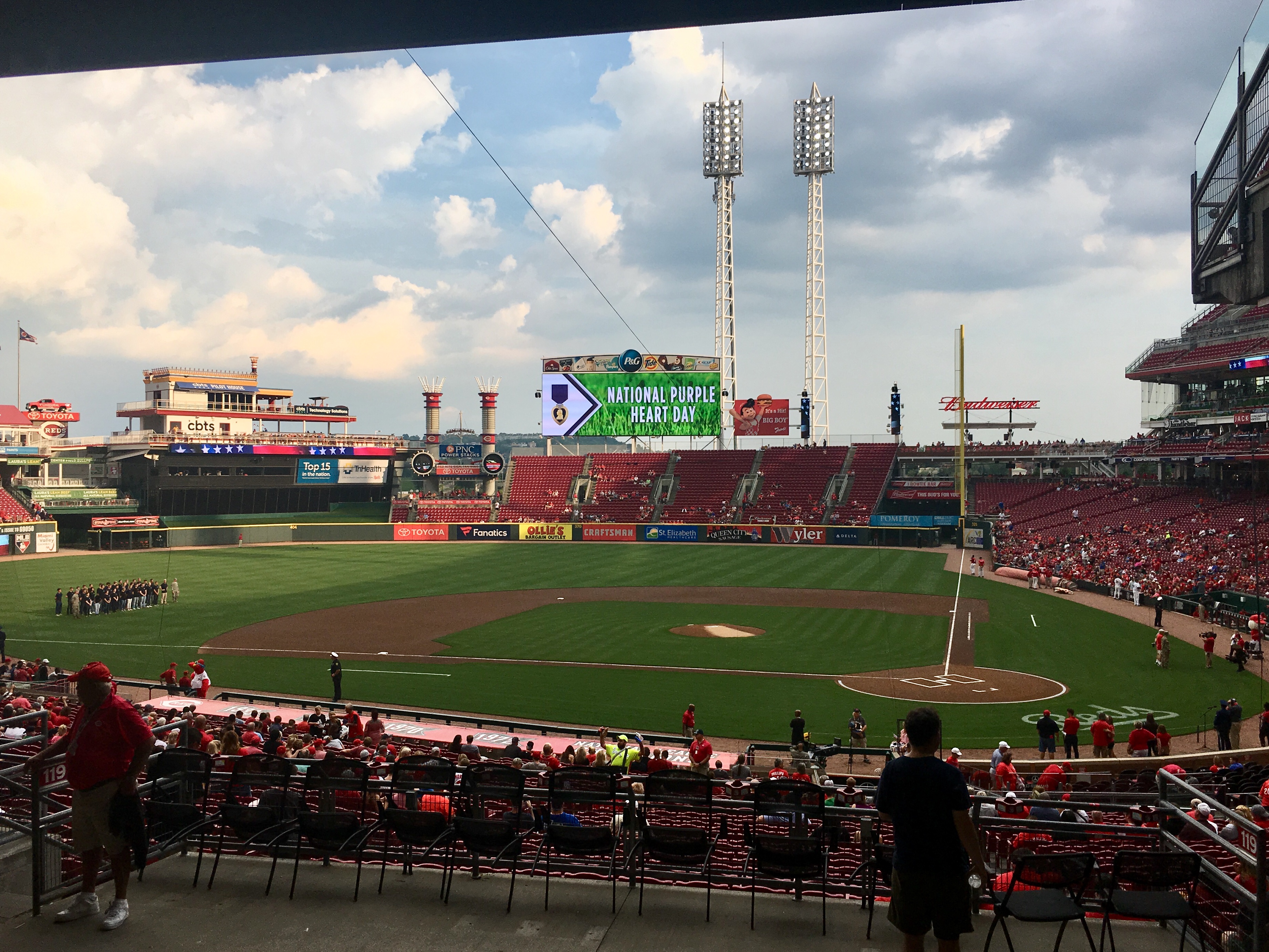
The fourth and final new park on this year’s ballpark tour was Great American Ball Park, the Reds’ home on the shores of the Ohio River in Cincinnati.*
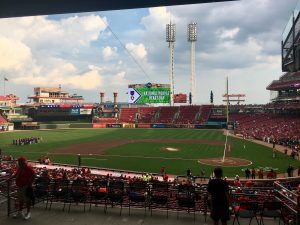 There’s a river around here somewhere. It’s a park I’m very glad I saw, not so much because I liked it — it was adequate — but because it made me rethink some things about ballparks in general and the retro-classic parks in particular. Guaranteed Rate Field made me realize the importance of a ballpark’s integration with its surroundings and context within them; GABP made me rethink the importance of what use a ballpark makes or doesn’t make of its setting.
When I visited PNC Park, I was wowed by the view of the Roberto Clemente bridge and the Pittsburgh skyline beyond it, but questioned how much credit the Pirates deserved for that aspect of the park. They didn’t build that, I pointed out, filching a line from politics. This struck me as a fair question at the time, but I’ll withdraw it after revisiting Nationals Park a few weeks ago and then seeing GABP.
I liked Nats Park well enough when I first saw it, but it’s fallen in my estimation as I’ve seen more stadiums. It’s nothing special to approach, its interior is fairly generic, and it makes zero use of D.C. as a backdrop — you could be anywhere. (Plus its menu is basically Citi Field plus Ben’s Chili Bowl.)
GABP nails the approach that Nats Park fails. Walking over from my downtown hotel, I stopped off to admire the John A. Roebling Suspension Bridge (a prototype of sorts for the Brooklyn Bridge), strolled through a playground and walked across a rope bridge that the kids weren’t using, sat for a pleasant spell on a riverside swing, and paused for a beer across the street. Then I joined the throng of Reds fans entering the park. Throughout the trip, the Ohio River was in front of me, with Kentucky beyond.
 A nice touch! Then I got inside GABP and largely lost the river. To be fair, the upper levels have views of it, and when I go back to Cincinnati I’ll choose a seat up there and see if I feel differently. But for many fans at GABP, the river and the view across it are obscured by the center-field bleachers and the Reds’ singularly dopey faux steamboat and accompanying “power stacks,” which spit fire, steam and fireworks depending on what’s happening during the game. It’s a dumb contrivance that shortchanges what it’s meant to celebrate.
In case you’re wondering, a batter at GABP is looking southeast, which once would have been stadium-design heresy. Baseball still has a rule on the books that says it’s “desirable” that the home plate-pitcher’s rubber-second base axis run east-northeast, in order to keep the sun from getting in the batter’s eyes. But it’s not a hard-and-fast rule, as this article and its rather useful graphic show. The White Sox were the first to buck tradition, and other teams followed suit when there wasn’t an epidemic of blinded batters. In fact, if you look at that graphic, you’ll find some of the better views in baseball stadiums down in that southeast arc, most notably PNC and the new Busch Stadium. And you’ll find GABP.
So the Reds got that right. But that makes me scratch my head more. Rather than make the most of the riverfront setting, it feels like the park’s designers — HOK/Populous again — made the least of it.
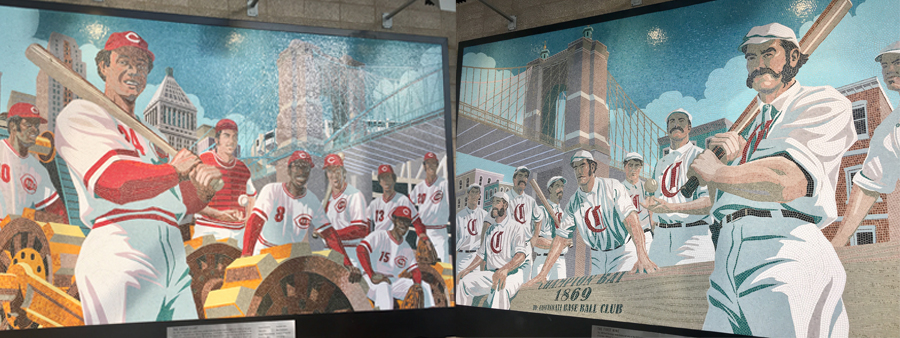
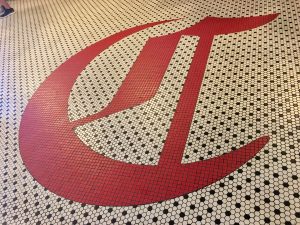 Another nice touch! 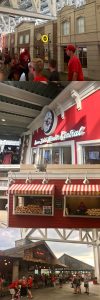 Very strange. The rest of the park is OK, but a bit bland, with equal parts nice touches and oddities. I liked the dual murals of the 1869 Cincinnati Red Stockings and the mid-1970s Big Red Machine, which offer a lovely evocation of the team through time. (Notable: both murals feature the Roebling bridge. Setting! It’s important!) I liked discovering that one of the taprooms has the old Reds “C” recreated in tile. A missing chunk of stands known locally as “the Gap” offers a peek at downtown. I snapped pictures of Johnny Bench‘s statue and posed for an inept selfie with Mr. Red and Rosie Red. (Mr. Red predates Mr. Met, so leave him alone.) Leaving the brewery for the game, I noticed a square in the lobby commemorated the location of first base at Riverfront — it was largely unnoticed by the beer-seeking hordes, but at least it was there. (Here’s Greg on GABP, featuring a cameo by Al Leiter.)
The food at GABP was good — I ate a decent pulled-pork sandwich, then got a helmet cup of ice cream and was pleasantly surprised to discover I could load it with as many toppings as I wanted, for no extra charge. The customer-service folks were invariably polite and obviously trained to help you do things rather than to hinder you, a refreshing change from Citi Field and its surly theater of hostility.
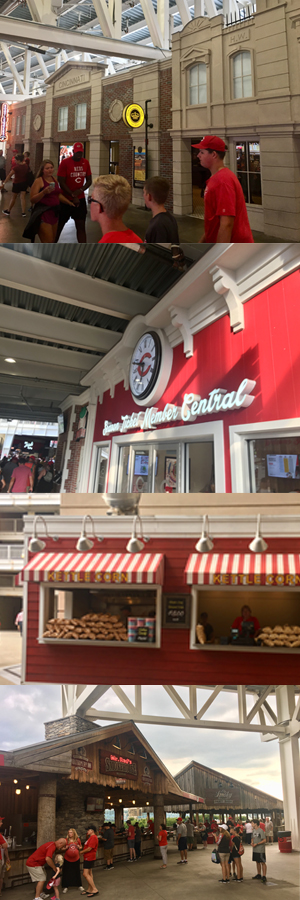
On the other hand, whoever designed GABP’s interior had a weird fetish for Potemkin buildings. GABP is full of faux storefronts and buildings within buildings, most ludicrously an ersatz moonshiner’s cabin, only it’s supersized and built to exacting building codes and so doesn’t resemble a moonshiner’s cabin at all. The first of these buildings feels like a quirk. The second and third ones strike you as weird. Then the fourth, fifth and so on roll into view and you wonder what, exactly, is going on here.
Is that a big deal? No, of course not. But it left me thinking that the folks behind GABP spent too much time on stuff that didn’t particularly matter and not enough on what did. And given the park’s beautiful surroundings, that’s a shame.
* OK, so the Rangers play an afternoon game on Sept. 19 and I’m thinking of flying to Dallas-Fort Worth that morning, seeing the game and flying back that night. Which would get me to 28 of 30 parks, with just Atlanta and Miami to go. It’s a really dumb idea. It also sounds like fun.
by Greg Prince on 18 August 2018 2:48 pm My itinerary to take in Friday night’s Mets-Phillies game at Citizens Bank Park was not configured by an app that promises to suggest only the longest journeys possible, but it could have been. One of the things I like about Citizens Bank is it’s close enough to be accessible and far enough away so that I know I’ve been somewhere.
I was somewhere, all right. I was on my way there, I was there and I was on my way back. It took a while. But that’s OK. It’s baseball season. Where else do I have to be?
The instigating factors pulling me across a pair of state lines for one afternoon, evening and early morning were a user-friendly starting time of 6:05 PM (CBP was adding a postgame concert by a musical act called Old Dominion, which I thought played college basketball when not moving freight) and the man who brought it to my attention, Jeff from Great Neck, who’s technically Jeff from somewhere else — the DC area — for more than thirty years, but in his soul he’s never left the Metropolitan Area. For one day, in deference to a family affair, he was Jeff in Jersey, which was good enough to lure me into the wild, or as it’s been known since 1682, Philadelphia.
Six o’clock loomed as logistical triumph, allowing a Long Island Rail Roader like myself an ample window to leave home during the day, take in close to an entire game and return before the dawn. Train to Penn. Train to somewhere in the middle of New Jersey. Jeff picking me up and driving us to the ballpark. Later, when we’d have to part company, I’d reverse the journey via a pair of SEPTA subway lines, a SEPTA regional train, another NJ Transit ride and, sometime after one in the morning, the good ol’ L-I-Double-R. The commuting took longer than the baseball, but since it was all in service to baseball, what’s a few hours’ schlep between friends?
Let’s pick up the action as Jeff and I arrive at beautiful and I do mean beautiful Citizens Bank Park, where I hadn’t been since 2010. It’s grown only prettier since it and I last spent a day together. The people who staff it have grown only warmer, and not just from the Friday night heat. I should be past the compare-and-contrast reflex, but geez, what a better place to experience a ballgame than Citi Field on virtually every level. The Phanatic’s kind of a clown compared to Mr. Met (Mr. Met has never smothered Jeff with his oversized Phillies jersey, whereas the Phanatic very recently has) and you hardly ever see anybody at Citi Field displaying fealty to UTLEY 26 on their backs, but other than that, it pains me to say the Phillies outdo the Mets at hosting baseball.
They’re also outdoing them in the standings, Friday night serving as a prime example of why. The same legitimate contender we throttled to within an inch of its franchise charter in the opener of Thursday’s twi-nighter definitely showed itself the more competent combatant when granted one of the 161 do-overs baseball grants every year. The Phillies won, 4-2, and it wasn’t even that close. Noah Syndergaard was clearly off his game, but he did keep us in the game, which is a skill not to be readily dismissed. When Steven Matz is clearly off his game, you can make out the overture to John Phillip Sousa’s “Relentless Bullpen March” as early as the second inning. Mostly, the Phillies stole bases while Syndergaard and Kevin Plawecki tossed a ball back and forth. The Mets’ defense wasn’t airtight and Aaron Nola suffocated Mets hitters, as if it wasn’t stifling hot enough already.
Teams near first place are occasionally going to outclass teams buried in fourth place, just as teams in fourth place are occasionally going to bombard teams near first place. Baseball both rewards and defies consistency in an effort to keep you from figuring out what it’s up to. The afterglow of that 24-4 romp through the Phillie gloves (during which Howie Rose observed the home team might as well have been handling hand grenades) was aberration enough to tamp down Jeff’s and my grumbling that we were watching a more typical 2018 Mets performance, scoring next to nothing in what we could have sworn was a visitor-amenable bandbox. Sure, a more efficient distribution of runs than the Mets’ recent trajectory of 3, 16, 24, 6 and 2 would be more sensible in a quest for success, but it’s August, we’re out of it and, besides, who doesn’t want to see a record set? Dedicate proper allocation of resources where the concept can do the most good, like in the electoral college.
Better yet, let the Mets score 24 runs every night.
If we couldn’t have that, though, give Jeff and me a ballgame to enjoy together roughly midway between where he lives and where I live when we don’t live particularly close to one another. Give it to us on a Friday night in summertime, first pitch shortly after six. Give it to us in as beautiful a ballpark as we could have asked for and we’ll look the other way when the Mets don’t pour on the runs.
The ballpark is beautiful, which I mentioned earlier and mention every time I show up (this was my fifth game there), yet I’m always stunned by what an ideal setting Citizens Bank presents and how enhanced it is by the most genuinely helpful and friendly staff I’ve encountered in 34 major league ballparks and how even the presence of people thinking the best of Chase Utley can’t bring it down. Usually there’s a little edge to these Mets at Phillies showdowns in the stands, some genuine verbal brushbacks delivered by both sides, but not last night. I attributed the overwhelming comity between normally clashing tribes to a combination of the following:
• How high and mighty can Phillies fans act less than twenty-four hours removed from surrendering twenty-four runs?
• They’re so new to the sensation of contention that they’re too happy to be sore at the likes of us.
• The likes of us are too beaten down by this season to pick any fights.
• The Old Dominion crowd wasn’t there to be feisty.
• Niceness pervaded amid the heat.
I’ll go with that. Phillies fans watched Jeff’s bag for him. Jeff watched Phillies fans’ bags for them. (The only ones not watching bags were Thor and Plawecki.) The guy charged with searching my bag at the entrance let my open beverage containers be. The guy transacting my Bull’s BBQ purchase practically invited me behind the counter to take all the trays and utensils I wanted (while the Bull himself, Greg Luzinski, sat nearby autographing and kibitzing as easily as the Phillies stole bases off our battery). Whoever sold Jeff our souvenir sodas said the “Good For ONE REFILL Today Only” sticker applied to the cup would not prevent us getting all the refills we wanted anytime; it also led us to hope that the Phillies would soon call up top outfield prospect Juan Refill. And Jackie, the lady who ushered our section, answered our frenzied New Yorker question about showing our non-existent tickets to regain entrance to our field level section — they were on Jeff’s phone and we had no printouts — with a relaxed “I know who you are now, and if I’m not here, just tell that young man down there.” When I asked someone working the exit gate to confirm directions to the subway, he walked me out to the street himself, explained everything slowly and pointed twice for good measure.
With friendliness like that the rule, you can forgive the Phillies for pilfering a few too many bases and their fans for wearing a few too many UTLEYs.
Little touches make Citizens Bank Park rule, especially when Citi Field lacks them. The Ashburn Alley street sign in center field is just so damn whimsical. Also, they have pictures of Richie Ashburn up everywhere. Same for other Phillie greats, and you don’t feel they’re there because their fans grumbled there weren’t enough of them when the park opened. There are more statues in and around their ballpark than there are open concessions most nights in Citi Field’s Promenade…not to mention statues on the grounds in Flushing. Attendants come around regularly to collect empty plastic bottles and aluminum cans. The public address announcer made a point of welcoming us to see “National League baseball,” the best kind, and welcomed Daniel Zamora, who was “now pitching for New York” (I like the formality of “New York”) by noting that he was making his major league debut.
Which, incidentally, represented the highlight of the evening for Jeff and me, alongside Bull’s unbelievable barbecue and everybody’s uncommon courtesy. We knew Daniel Zamora, called up from Binghamton to replace DL’d Bobby Wahl, was our 54th Met of 2018. As with the 24 runs, this was big-time record-setting, or at least record-tying. The answer to the question some of us have been asking ourselves since 1967 — “Met 54, where are you?” — was finally answered. Knowing this milestone had been touched made us authorities on Daniel Zamora compared to not only Phillies fans but Mets fans in our section, which is understandable. There must have been a flock of Temple Owls in the house because Zamora was greeted primarily with “who? who?” It’s a common refrain at Mets games everywhere these days. At one point Friday, a majority of the nine Mets on the field were either ballplayers no reasonably informed Mets fans had heard of when the season started or ballplayers no Mets fan had ever thought of in a Mets context. McNeil. Jackson. Bautista. Miscast left fielder and nine hole batter (behind Syndergaard) Jack Reinheimer. And now, to make Reinheimer seem as much of a Met old-timer as Richie Ashburn, lefty reliever Daniel Zamora.
Zamora looked pretty good, but then again, to us, he just had to appear to meet with our instantaneous approval. We’ve had 54 Mets this year, as many as we’ve had in any year. With 41 games remaining and roster churn the modus operandi of the moment, 55 seems within easy reach.
Citizens Bank Park is the kind of place where a kid can wander in off the streets of Binghamton and feel at home. I wandered in from Long Island and felt that way. I applauded for Asdrubal Cabrera his first time to bat, which was understandable. After some Phillie base hit or another, I mindlessly applauded as well. Jeff was aghast. So was I when it occurred to me what I was applauding, but I realized I was getting caught up in the good vibe, something I haven’t felt too often at Citi Field of late. Open, airy Citizens Bank on Friday struck me as the kind of place people go to have a good time, reminding me claustrophobic Citi Field in 2018 is a place Mets fans have been filing into prepared for thudding dismay.
Jeff, despite having been unwillingly Phanaticized, was boosted by the experience as well. He was so willing to spark upbeat conversations with total strangers, I had to ask, “Are you like this in real life?” No, he acknowledged, not really, but the night was bringing it out in him. Earlier in the day, he was packing up stuff from his late mother’s home somewhere in the middle of Jersey, trying to decide what to dutifully haul home and what to send to others “so they can throw it out.” A ballgame, no matter that your team of choice is losing it, can provide quite the contrast with the unpleasant aspects of regular life.
We would have preferred a Mets win. We would have preferred a more effective breeze beyond that which Nola induced with his eleven strikeouts. We might have wished to have witnessed a 24-run Met outburst with our own eyes. We would have liked fewer stolen bases accompanying our stolen moments. But you can’t beat being happy, and that we were for a few hours.
Then for a few hours more, I was a commuter. The 6:05 start was swell, but I had to implement a 9:15-ish, eighth-inning curfew to ensure I’d make the 10:18 out of 30th Street Station. Every step of the reverse commute unfolded as planned (SEPTA employees and riders must study at Citizens Bank Park, because they were also extraordinarily helpful to this out-of-towner), but my long way home was long as hell. Not hellish, just long, winding and pausing its way through every Southeastern Pennsylvania and New Jersey railroad depot in creation. The rains that threatened CBP held off while we were there, but they deluged the Garden State as we rolled toward New York. Official flood warnings blasted from myriad phones and, judging from a glance out the window somewhere north of Linden, with good reason.
Ah, but a rainy night in Jersey, just like a steamy one at Citizens Bank, has its charms. I had tucked away in my bag a pocket-sized book titled A Drive into the Gap. Written by the novelist Kevin Guilfoile, it is a brief memoir of his father, who worked for the Pirates, and Roberto Clemente, who handed his dad the bat with which he recorded his 3,000th and final career hit, off Jon Matlack in 1972, three months before dying on his mission of mercy to earthquake-rattled Nicaragua. That bat was immediately shipped to the Hall of Fame, where it was displayed in a place of honor for the rest of time. Except was that bat really the bat? That question, and the stories with which the author surrounded it, layered my journey with a swath of unexpected grace. Read a book that good on your post-ballpark trip and you’ll make every last stop from Bridesburg, PA, to Metuchen, NJ, with a smile that will pry your eyes open until you return to Penn Station, a 1 AM slice of Rosa’s Pizza to kill another sliver of time, and a final connection home.
by Jason Fry on 17 August 2018 11:54 am Joy of excess? Oh baby, we hadn’t seen anything yet.
Game 1 of Thursday’s doubleheader against the Phils was a rain of records, superlatives and astonished exclamations. Twenty-four runs, a new club record. Twenty-five hits, a new club record for a nine-inning game. A 20-run margin of victory, also a new club record.
Weirdly, the crazy 24-4 outburst came on the 31st anniversary of the previous club record for runs, 23 against the Cubs. (I remember learning about that game while I was in Maine; it made the national news, with a bemused anchor informing us that “the New York Mets did a terrible thing to the Chicago Cubs.” Perhaps it will make Ranger Suarez feel better to learn that the Cubs starter that day was a young Greg Maddux.)
But there was plenty of other weirdness. Jose Bautista didn’t start the game but ended it with seven RBIs, collecting five in one inning, which is damn hard to do. Compounding the weirdness: Bautista was pressed into service after Brandon Nimmo got a finger mashed by a fastball in the third inning, a HBP that was also a ground out, ending Nimmo’s streak of reaching base in 10 straight appearances. (The streak is broken but the finger, happily, is not.) With the Phils finishing the game with position players, Mickey Callaway acknowledged the white flag and let Jerry Blevins bat in the eighth against Scott Kingery. Blevins promptly laced a semi-eephus pitch up the middle for an RBI, his first big-league hit.
And, of course, the eruption came less than three weeks after the Mets absorbed their worst-ever beating at the hands of the Nationals, losing 25-4 and finishing with a position player of their own on the hill. Does it bug anyone else that when those two games are put together, the Mets are still one run in karmic arrears?
(Personal weirdness: I was in the stands to see the Mets get throttled by the Nats, and yesterday’s Game 1 was a makeup of a game for which I had a ticket.)
Ultimately, there isn’t much to say about mega-laughers like Thursday’s. As we’ve just been reminded, they happen to every team on occasion and are the baseball equivalent of the greyhounds catching the rabbit. The game devolves into wagging tails and chaos, everyone laughs about it (or tries to) and we move on.
One that does strike me, though, is that such curb-stompings are going to become more common, not less. This year has seen managers start routinely turning to position players instead of finding a reliever hiding under the stands and throwing him and his season ERA to the wolves. It’s one of those moments of baseball punctuated equilibrium, like the way the shift went from historical curiosity to oddball Joe Maddon tactic to unevenly distributed strategy and then suddenly reached a tipping point and became routine. Position players on the mound still strikes us as odd, but it makes sense, and within a couple of more years it will barely merit a second glance. That means first games of doubleheaders will become perfect storms, with all kinds of records endangered. Decades from now, a baseball fan who sees a long-ago score of, say, 32-6, will immediately guess “first game of a doubleheader” and be correct. And then she’ll ask just how many innings position players soaked up in that one.
The Game 1 shenanigans meant the back end of Thursday’s doubleheader was an afterthought, which was probably best for our psychic well-being. Steven Matz had nothing, and we’ll have to see whether the culprit was rust or something worse; the Mets played defense much like the Phillies had in Game 1; and a hot start (a 2-0 lead after four pitches) and a furious attempted comeback, with Bautista as the tying run, yielded a 9-6 fizzle. Ah well. What’s a legendary party without regret, penitence and a vow to be better?
* * *
Back to ballparks!
I offered my impressions of Target Field and Miller Park earlier this week; after seeing those parks, the summer tour rumbled on to Chicago, where Emily got her first look at Wrigley Field and both of us made our debuts at the rather tragically monikered Guaranteed Rate Field.
Wrigley has been further modernized since I saw it four years ago, and for the better. For one thing, the bathrooms are no longer dank holes in which you half-expect to find Neanderthal art — they now possess such amenities as light in the visual spectrum and newish urinals. (The troughs are still there, lest you find the above too highbrow.) For the most part, the modern stuff has sprung up outside the park, leaving Wrigley half-ringed with boutique hotels, beer gardens and plazas designed to hoover up your pregame dollars. Which strikes me as fine — commerce gonna commerce, and this outside-in approach has largely preserved the the sturdy functionality that makes Wrigley special. (Here’s Greg’s take on the park.)
A subtle thing I love about Wrigley is that it only has one loop beneath the stands, which has to be used for everything. That means fans seeking bathrooms/yet more alcohol rub shoulders with visiting clubhouse guys moving gear to buses, dudes taking out the trash or bringing in ice, and all the other backstage tasks required to keep a ballpark running on game day. It’s inefficient bordering on chaotic, like a boozy Richard Scarry book, and in no way how you’d design a park today. But there’s also something refreshingly democratic about it — if you’re complaining about being stuck behind a chain of garbage bins, well, you’re supposed to be up in your seat watching the game. Isn’t that what you came here to do?
The day after Wrigley, we took the red line in the other direction, heading south to see the White Sox take on the Yankees.
Guaranteed Rate Field — now there’s a name to get the kids dreaming — has gone down in baseball history as the last of the old parks, the one built a year before Camden Yards changed everything. But that’s more about storytelling than reality.
The stadium originally just called Comiskey Park opened a year before Camden Yards. But like the Orioles’ new home, it was an HOK/Populous project.
The “secret sauce” of Camden Yards, I’d argue, begins with how the hulking B&O Warehouse shapes everything else: the view, the dimensions, even the color palette. But HOK’s original plan called for tearing down the warehouse. In fact, its original plan would have yielded a ballpark that looks a heckuva lot like New Comiskey. The warehouse was saved largely at the insistence of the Orioles’ project representative, Janet Marie Smith, who also pushed for steel instead of concrete, pedestrian thoroughfares, decorative flourishes that honor team history, and the like.
(Here’s another reason Smith is my new hero: at the beginning of her interview, Orioles president Larry Lucchino tested her by asking which league had the DH. Smith’s response: “I’m offended by the question.”)
To be fair to HOK, architects’ starting point is to build what their clients want, and Jerry Reinsdorf wanted Kauffman Stadium. Lucchino, on the other hand, wanted an old-style ballpark that was part of the city around it, rather than being set apart from it. He found a kindred spirit in Smith, whom HOK worked with to turn his basic idea into a detailed reality. But the point remains: it was only after Camden Yards won acclaim that the elements it introduced became essentials of the retro-classic stylebook.
That’s a better context for assessing Guaranteed Rate Field than the more familiar one of “last old-style park.” For a fascinating look at what could have been in Chicago, and a thought-provoking examination of what retro-classic stadiums do and don’t deliver, read Dayn Perry’s terrific piece about Armour Field, a wonderful, Polo Grounds-inspired White Sox park proposed by Philip Bess in the late 1980s.
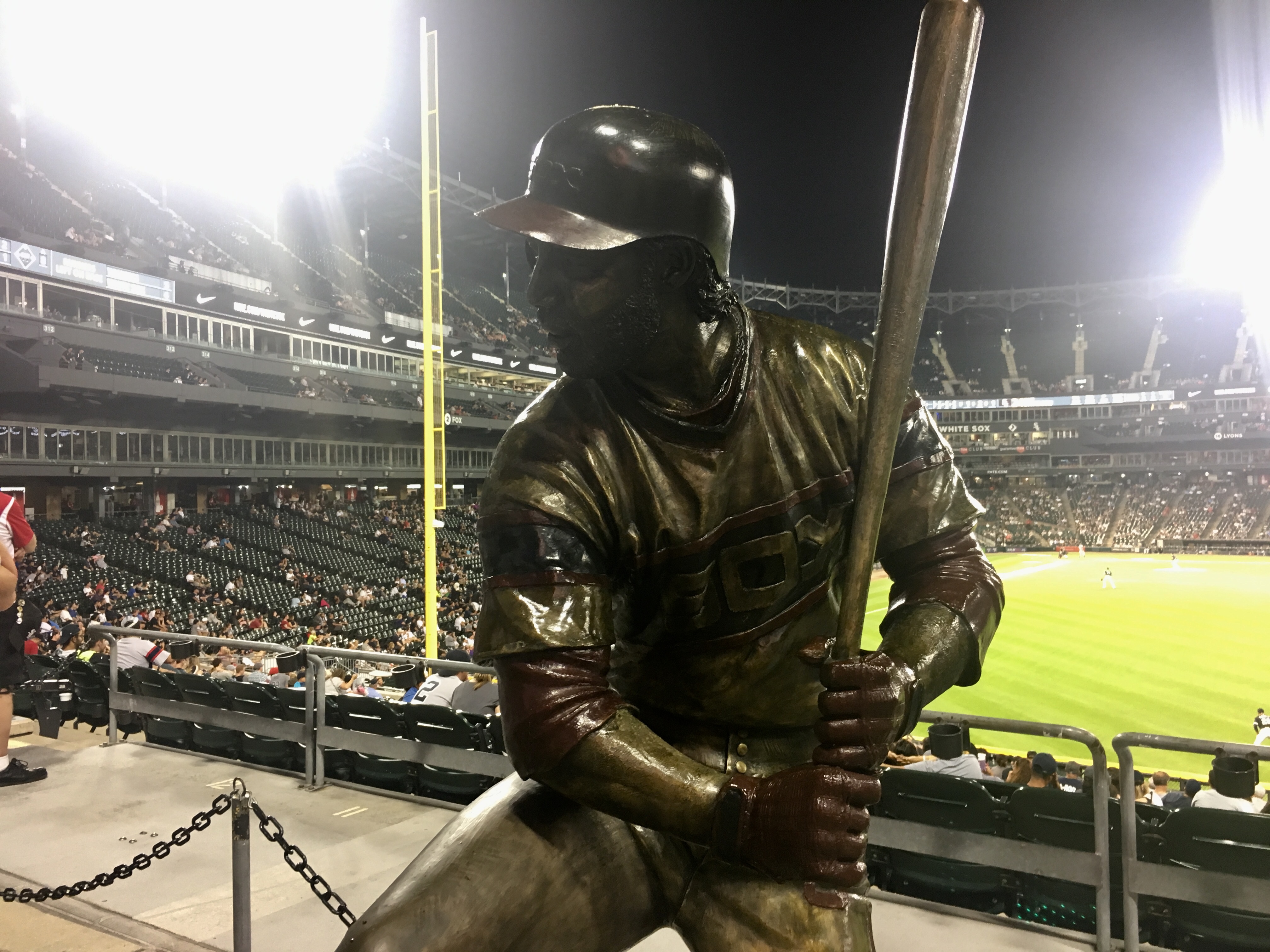
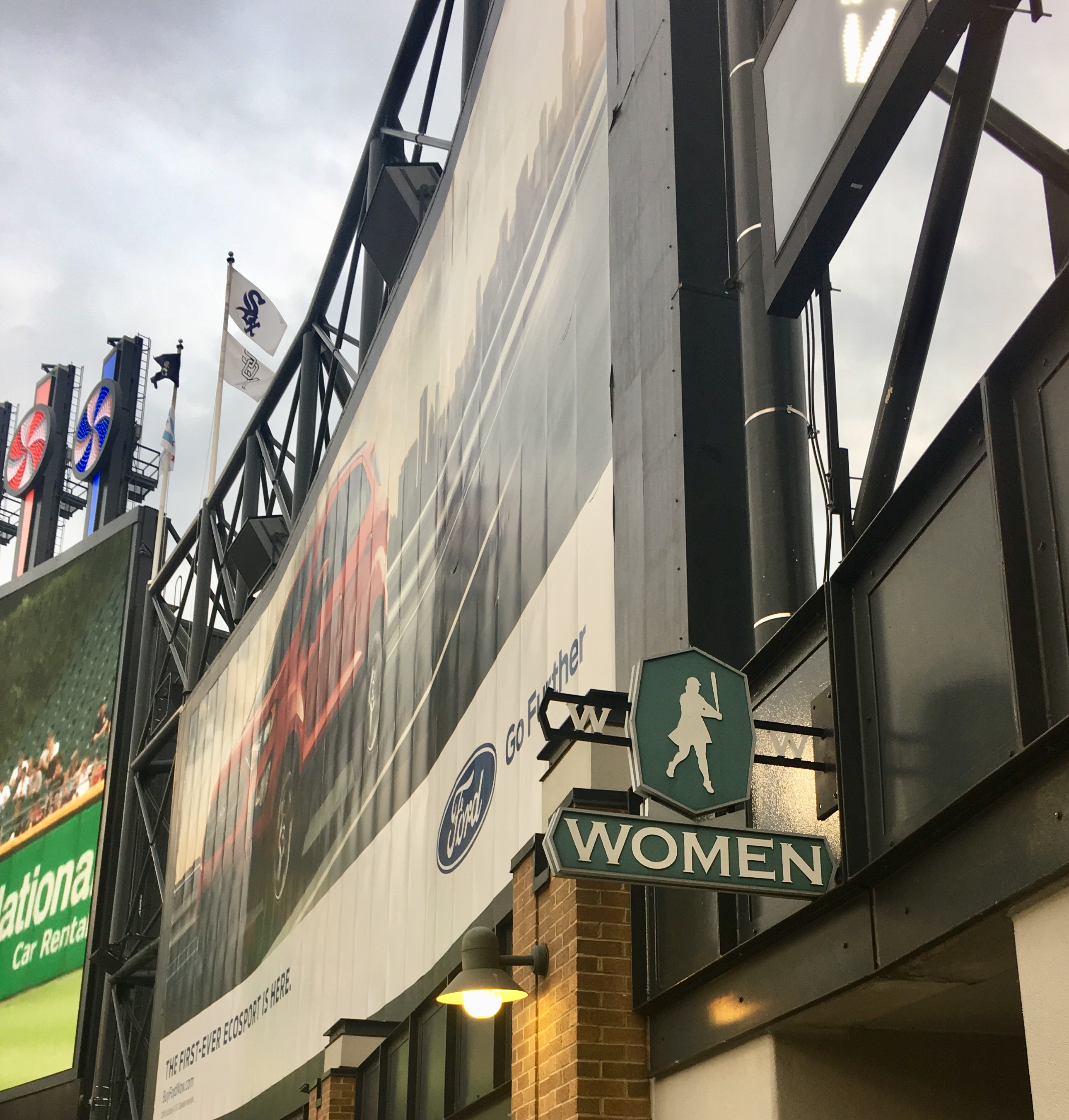
 A loo of their own. I didn’t know all of the above when I headed for Guaranteed Rate Field. But you can still feel it at work in the park. The stadium has been repeatedly renovated since it opened, with every change pushing it closer to the parks that followed it. The much-criticized upper deck has been shaved down, with a screen replacing the top rows. Blue seats have given way to familiar retro-classic forest green ones. There are statues and a big plaza and old-timey touches, some of which are great: it’s a little thing, but I love that the women’s restrooms are marked by silhouettes of lady ballplayers, a la A League of Their Own.
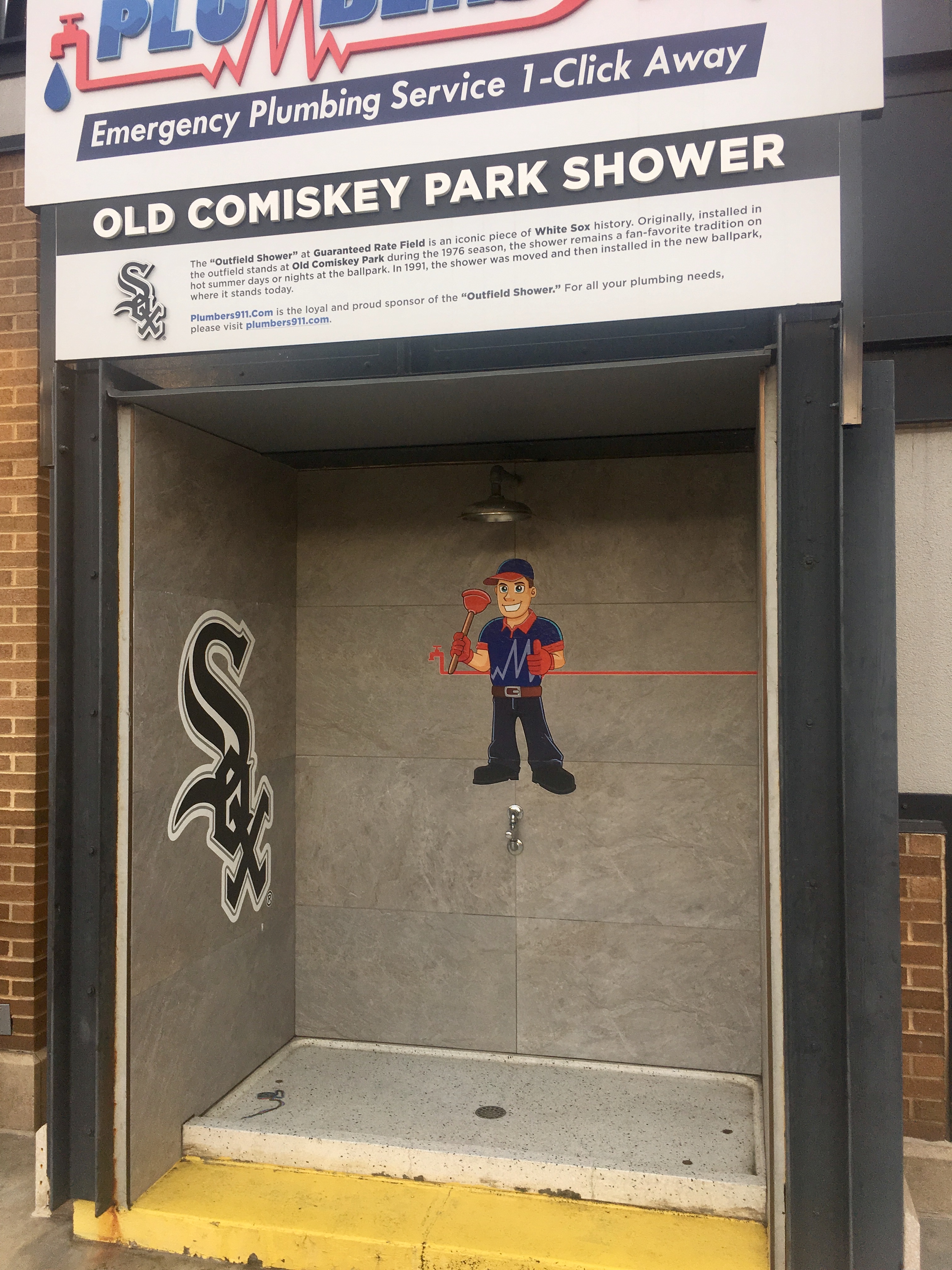
The redone palette is interesting: the stadium is basically matte black, which feels different than the retro-classic norm but also very White Sox. Classic elements from White Sox history have been brought into the park: the “exploding” scoreboard crowned with pinwheels was there from beginning, and you may be surprised to find a shower behind center field. That was brought over from the old stadium, where it was added by Bill Veeck so fans could cool off on hot days. By the way, if any owner should have a ballpark statue it’s Veeck, a visionary who never forgot that baseball’s supposed to be fun. Predictably yet depressingly, Guaranteed Rate Field instead immortalizes Charles Comiskey. I’d recommend holding tight to your wallet near Comiskey, even in bronze form.
White Sox fans and Mets fans ought to be kindred spirits: we’re both the little brothers in town. After descending from the Willis Tower’s skydeck, I noticed that the gift shop was filled with Cubs gear, with the White Sox an afterthought. Been there, endured that. The Cubs dominate the sports talk, hog the TVs in bars, and generally suck up the fan oxygen. Being a White Sox fan in this Cub era must feel like rebellion. And, of course, their stadium elicits few if any lyrical flights of fancy — hell, Wrigley Field even barged into my own blog post about seeing a White Sox game.
All that made me want to root for White Sox and like their park.
I had other reasons, too. The White Sox lean heavily on local businesses for concessions, which is great: I had some awesome tacos, though the line was epic and kept me from seeing a fantastic catch above the center-field fence by Adam Engel. And they attract a far more racially diverse crowd than I’m used to seeing in a big-league ballpark — certainly compared with Wrigley.
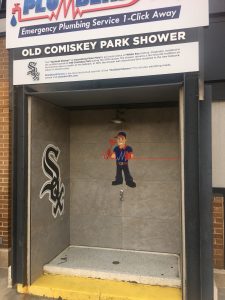 Thank you, Mr. Veeck! But to be honest, the park left me cold. (Here’s Greg’s take on it.) That began with how Emily and I arrived: the train let us off in the middle of the Dan Ryan Expressway, from which we wound our way along various fences and were funneled along the edge of the parking lot. What Emily and I should have done was kept going to the main entrance behind home plate, where there’s a plaza dedicated to the 2005 champs and White Sox history. But the natural thing to do is to enter as soon as you have a chance, and that’s on the third-base side. At least for those arriving by train, the stadium discourages any other approach: it looms over you, distant and forbidding, as you avoid cars and then battle throngs of people pushing in your direction.
You’re basically herded into a side entrance of Guaranteed Rate Field, an approach that does the stadium no favors. You’re shunted between a shop hawking overpriced sports crap and one of those outdoor brewpubs that feels like a game-day holding area, pushed up stairs and along a hallway (decorated, at least, with lore about Sox All-Stars) and dumped unceremoniously into the middle of the concourse. It’s like finding your way to your departure gate at a second-class airport, and it robs you of any sense of how the park’s interior and exterior fit together. And all the renovations and careful touches can’t undo that first impression.
Seeing Guaranteed Rate Park right after getting reacquainted with Wrigley made me realize how much just walking up to a park determines how you’ll feel about it. Wrigley is tucked almost mathematically into its neighborhood — which is called Wrigleyville, after all. Your natural inclination once you descend from the el is to walk around the stadium and explore, joining a parade of fans doing the same thing. Arriving at Guaranteed Rate Park, you feel marooned and want to escape your surroundings.
You can say, well, Wrigley is unique and the train station being in the middle of the highway isn’t the White Sox’ fault and so on. But it didn’t have to be this way. I didn’t love Target Field, but at least it feels connected to its neighborhood. So do PNC, AT&T Park, and Comerica. (Miller Park fails this test, unless you’re tailgating.) And Armour Field would have been very different — Bess’s park would have been embedded in its surrounding neighborhood in a way that’s much closer to Wrigley than, say, Camden Yards.
The White Sox chose a different route. It’s lazy and unfair to say they missed out on building Camden Yards, for all the reasons explored above. But that doesn’t mean they didn’t miss.
Next: The tour ends at Great American Ball Park.
by Greg Prince on 16 August 2018 11:46 am Why win by one when you can win by eleven? The Mets can win by eleven?
The answer to the latter is yes, apparently. The answer to the former is never win by one when you can win by eleven. Oh, if only it were so easy to test the theory. At Camden Yards on Wednesday night, it was easy as pie — or Pi, which the Mets scored more than four times as many. Or much.
However you wish to express a 16-5 Mets romp, go ahead. We earned it. We’d lost our three previous games with the Orioles, which kind of took the shine off playing a team allegedly far, far worse than ours. The finale between the two non-contenders had a real “Coward of the County” quality to it, if you could portray a 36-85 opponent as a cabal of Gatlin Boy-caliber bullies.
We’ll tell ourselves anything to get through a season like this. I’m telling myself that this was a highly satisfying heap of revenge that was months in the making, not the pummeling of one of the least statistically impressive conglomerations of baseball talent since the 2003 Tigers challenged the 1962 Mets for reverse bragging rights.
Regardless, it was a win. A big win. Put it up in garish blinking lights:
HOT W BALTIMORE
All hail leadoff hitter extraordinaire Brandon Nimmo, he of the five-for-five plus a low-key hit by pitch (Ronald Acuña should have been so lucky in Atlanta). The only thing Nimmo didn’t do was homer, which was OK, because how much smiling could one outfielder do? Hail Mets DH Todd Frazier, who made the most of his phony position with three hits, including a home run. Hail Kevin Plawecki and the grand slam that extended the Mets lead from enormous to gargantuan, topping off the nine-run sixth, the same inning during which Jose Reyes’s batting average soared to a season-high .201 (it dipped back to .199 at evening’s end).
Zack Wheeler wasn’t quite as sharp as he’d been in recent starts, but the combination of Oriole lineup and aberrant support made him a one-run pitcher over five innings. Zack continues to deserve attention, but in a game like this, it seems more apropos to direct some to Jack Reinheimer, whose entry into the Mets organization as a July 31 waiver pickup might have escaped the notice of the Western world at large. We’re noticing him now, though, for Jack Reinheimer provided the kind of data set that makes deep-dive Mets fandom pay off in spades.
Jack Reinheimer entered the game as a pinch-runner for Jose Bautista in the sixth. That alone was worthwhile, for it put Jack the former Diamondback on the board as the 1,065th Met ever. When he trotted home on Plawecki’s slam, that meant Jack had scored a run as a Met before coming to bat in our togs. I immediately recalled Lou Thornton having done the same in a last-gasp pennant race contest versus the Cubs in September 1989. Like Reinheimer, Thornton had played elsewhere previously. Slightly more pristine were the three cases of Mets whose major league debuts went the same way. Luis Guillorme scored as a pinch-runner this past May before he ever batted. Tsuyoshi Shinjo could say the same in 2001. And on June 16, 1977 (not at all an emotionally charged date), Steve Henderson pinch-ran for Ed Kranepool and scored for his opening act.
There’d be more for Jack as the night went on. After scoring in place of Bautista, he also took over his position: third base! That made it 171 third basemen in franchise history, not to mention nine different Mets at the hot corner this season (five debuting there as Mets this year). And his being in the game at all meant we’ve seen — or perhaps blinked and missed — 53 Mets in 2018. We are one away from tying the franchise record, set in 1967. The standard of 54 Mets seeing action in a single season is one of the handful of Met marks that’s been in place for as long as I can remember. We need one new 2018 Met to tie, two new 2018 Mets to exceed. Now we know why David Wright (a.k.a.Third Baseman No. 129) is working so hard to come back.
Oh, and Jack Reinheimer collected his first major league base hit. That’s more of a Jack Reinheimer highlight, but he’s entitled to one for himself, just like we were entitled to a night of swimming in Mets-related jubilation. The pool has been empty all summer. What fun to find it filled.
by Jason Fry on 14 August 2018 11:02 pm If the Orioles played us every day, they’d be 162-0.
Seriously, this is getting to be a bit much. The Orioles need the Hubble telescope to see fourth place, let alone the top of the standings, but they’ve had no problem handling us this year. On Tuesday Jason Vargas pitched decently enough, but I still maintain there’s no way innocent Little Leaguers should be subjected to any reading of the Vargas Index in Williamsport on Sunday. In all seriousness, won’t someone think of the children?
Anyway, the Mets had a brief lead, thanks to the unlikely offensive combination of Kevin Plawecki and Amed Rosario, but then the bullpen crumbled and a sloppy slog of a game turned into an embarrassing mess. A day ago the Mets beat the tar out of the Yankees, but then they looked helpless against the worst team in baseball, and the only sane conclusion is …
… that it’s just baseball. Seriously, there’s no conclusion to be made, other than that it was a shitty game and you’ve already read more about it than you probably wanted to.
So let’s move on!
* * *
My recent neglect of my recap duties came with a not-bad excuse: I was on a ballpark tour.
I took in games at four parks I’d never visited before: Target Field, Miller Park, Guaranteed Rate Field and Great American Ball Park, bringing my total to 27 of the 30 current big-league stadiums. I also returned to Wrigley Field, because why not? (Still to go: SunTrust Park, Marlins Park and Globe Life Park. I may not get to that last one, seeing how the Rangers will have a new home in 2020.)
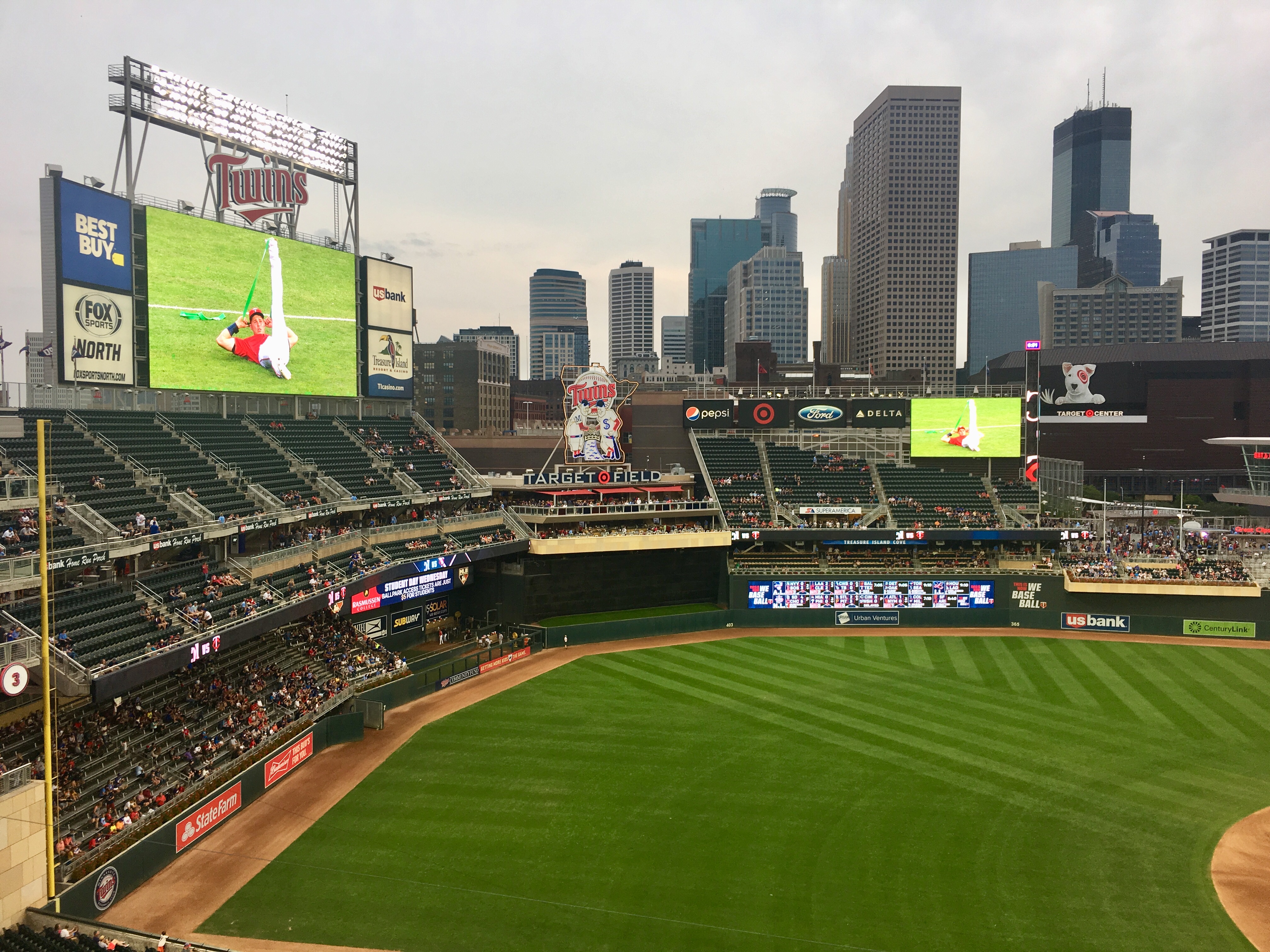
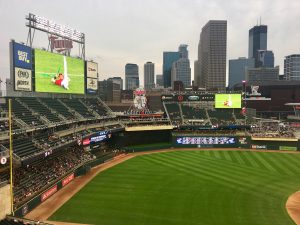 Target Field, with Minneapolis beyond The first stop on the tour was Target Field, home of the Twins. I’ll preface the rest of this by admitting that Target Field may not have gotten a fair shake, for an odd reason. It was the one park left on my list that I’d heard terrific things about, so I walked in expecting wonders, and comparing it to a nebulous ideal in my head. It didn’t live up to that and perhaps there was no way it could.
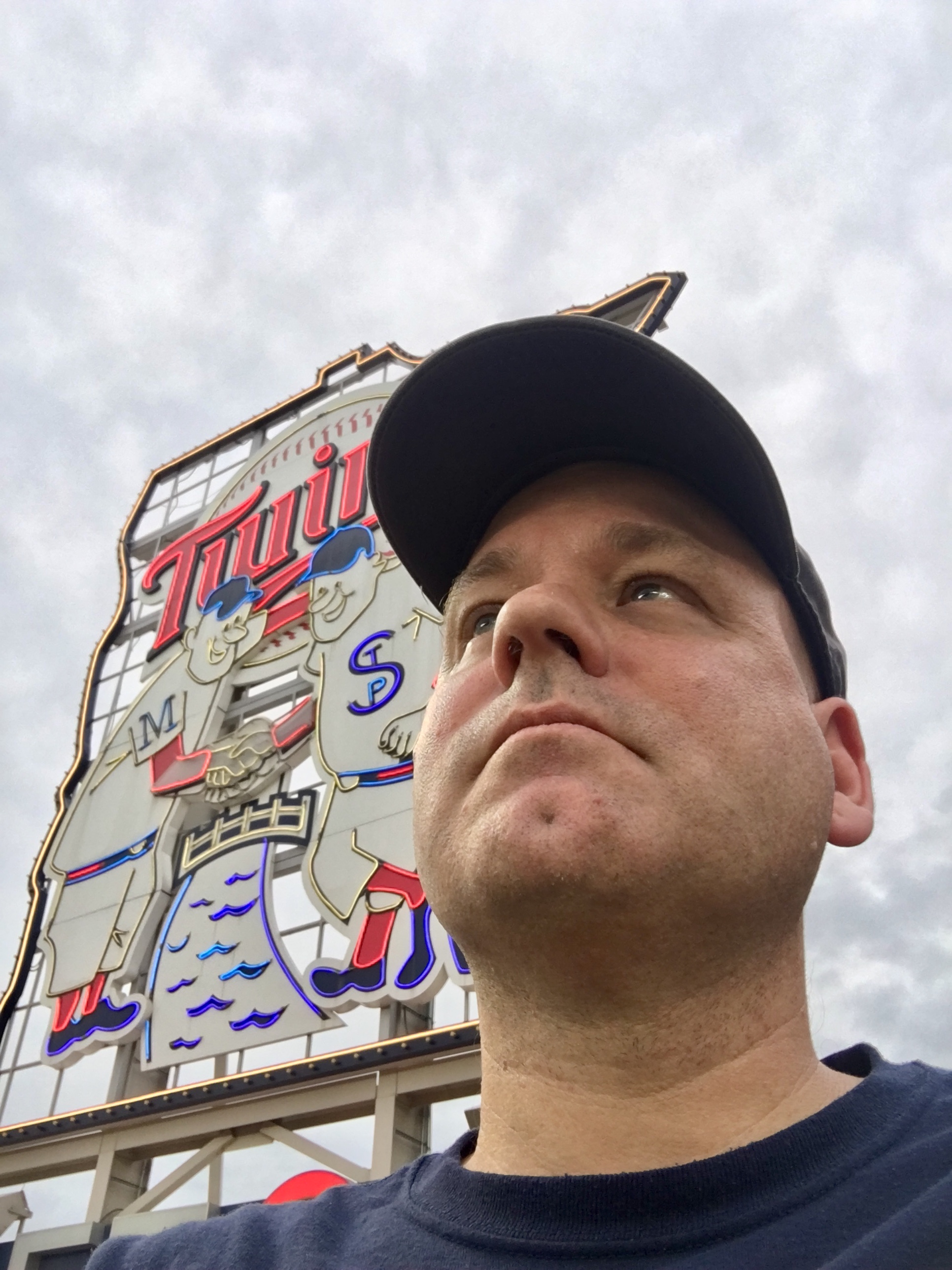
Look, Target Field’s a fine ballpark. It’s nicely integrated with downtown Minneapolis, which seems to press up against the stands (as it should be), it eschews the usual ironwork and greenery to make use of local limestone, and you arrive and depart through plazas sporting statues of Twins greats such as Rod Carew, Kirby Puckett and Harmon Killebrew. (As well as Calvin Griffith and the Pohlads, which is despicable.) The Twins saved center field for a Minnie and Paul display, with the two mascots celebrating various positive developments, which is a perfect marriage of modern spectacle and tradition.
The food’s pretty good, drawing heavily on local providers, with snobs like me drawn to a pair of outposts from Andrew Zimmern. (I had a frozen dulce de leche that I’m still thinking about.) There’s also an impressive amount of fancy beer at prices that are high but not astronomical by ballpark standards. (Tragically, the craft-beer stand is exposed to the elements, meaning its staff ran for cover during the hour-long rain delay we all endured.)
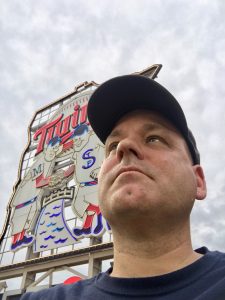 Minnie, Paul and visitor Minnie and Paul, statues, good food, decent beer. It all sounds good, right? And it is. But somehow, there’s a certain something missing.
Part of the problem, I think, is that Target Field’s basically a big circle broken by a plaza, without much in the way of interest along the way. In Comerica Park you’re constantly running into displays of Tigers history or unexpected treats (like a freaking carousel with tigers, for instance); here you’re going to hit another sausage cart or beer stand. The bleachers are metal benches with numbers, which is old-timey in a bad way. Linger or look closely, and Target Field starts feeling like less than the sum of its parts, even if those parts are pretty good.
Maybe that’s the secret sauce of ballparks — a certain something that ties the architectural features and the view and the bits of history and the game experience together, elevating them all. Comerica Park has it. So do PNC and AT&T. Target Field doesn’t.
But again, maybe it’s my fault for expecting it would. It’s a good park. I’d just been hoping for a great one.
* * *
On the other hand, I didn’t expect much from Miller Park, beyond vague thoughts of Bob Uecker, Bernie Brewer, a roof and a sausage race. (Seriously, it still seems wrong that the Brewers are in the N.L. while the Astros, our ’62 brothers, are exiled to that overstuffed beer league with the incorrect rules.)
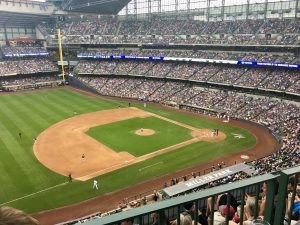 High above Mlller Park But Emily — who joined the tour in Milwaukee — and I had a great time at Miller Park. It started with the fans themselves. They were friendly, but they were also taking things seriously: we were in the kind of seats often occupied by dim scenesters, but our neighbors watched the game with rapt attention whether they were retirees or Little Leaguers. Granted, they had plenty to cheer about, whether it was the Brewers’ season in general or a Travis Shaw grand slam whose launch angle suggested Shaw had clambered up a 30-foot ladder to hit it. The Brewers led 6-0 at the end of the first, Emily had seen Bernie race down his slide not once but twice, and all was well in Milwaukee.
I’m not sure why, but my wife is a huge fan of Bernie Brewer — though neither of us agree that having him slide into a beer mug was a threat to the republic, the next generation of children, or anything else. Having paid more attention to the whole act, I appreciate it more: there’s Uecker’s catchphrase (“Get up! Get up! Get outta here! Gone!”) picked out in lights, accompanying fireworks, and Bernie waving a flag post-slide. And when you’re there live, you can see whatever poor Brewers employee is on Bernie duty clambering up two flights of ladderlike stairs — while wearing a giant head, remember — so he’s in the proper position in case the Brewers go back to back. They did while we were there; Bernie arrived just in time and his slide was impeccable.
With the Brewers out to a big lead we got to wandering, making a pilgrimage to the Uecker seats high above home plate for a photo op. (At the risk of stepping on a good joke, they’re actually neither the worst seats nor the ones farthest from the field.) And we ate — that’s easy to do at Miller Park specifically and in Milwaukee in general. Walking around Target Field I’d wondered if I’d have to shower off a thin layer of aerosolized butter, but Milwaukee makes Minneapolis look like some kind of vegan cleanse. We took full advantage, drinking shandies and trying multiple sausages.
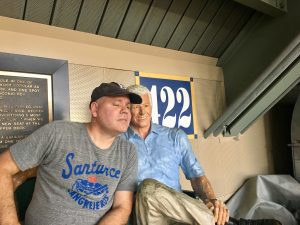 Me and my new friend. Greg saw the Brewers’ home with the roof open, yet its mere existence elicited his displeasure, and of course a roof makes a difference: I turned against Chase Field when the roof rumbled shut just before game time, turning an odd but pleasant enough place into a stuffy, weirdly colored mall in which 50 dudes were trying to play a game. At Miller Park the roof was open for us, even though I will cop to some grumbling about A/C not being the worst idea in the world on a sticky night. The fanlike mechanisms of the roofs (which have been a budgetary headache) even make for an interesting tangle of geometry up their above your heads. A roof atop a ballpark will never be anything other than a necessary architectural evil, but Miller Park’s designers did a lot better than one would have guessed.
Something I didn’t like: Miller Park is in the middle of nowhere, one of those new parks that’s borrowed the look and feel of an old stadium wedged into a city street plan, then dropped that stadium into the middle of a suburban parking lot. (This is a fair criticism of Citi Field, too.) It would work a lot better in downtown Milwaukee, which is pockmarked with empty, vaguely dodgy blocks but has plenty going on around them, from vibrant stretches with bars and restaurants (we happily drank big German beers at a place with giant swords and halberds on the walls, because we could) to the lakefront with its swanky Calatrava-designed art museum. Putting Miller Park by Lake Michigan would have turned a nice park into a breathtaking one. Though, to be fair, tailgating culture is enormous in Wisconsin, so that big moat of a parking lot has been put to good use by Brewers fans.
Anyway, you get good food, good fans, some cool quirks and a sausage race. Yeah, that will work. I saw Miller Park more as a box to be checked off than as a destination to be appreciated, but now I want to figure out when I can get back. Though I do hope the roof will be open.
Next time: visiting the home of the White Sox.
by Jason Fry on 14 August 2018 11:39 am How many ways, exactly, can one game be a make-up date?
The obvious: the Mets and Yankees reported for duty in the Bronx to complete the July half of this year’s Subway Series, which had been erased by rain. Despite an extremely wet morning in New York and a brief in-game squall, the second try proceeded uninterrupted, under humid but relatively cool conditions.
ESPN was also in make-up mode, sending Keith Olbermann out to do play by play alongside Tim Kurkjian and Eduardo Perez. My first reaction wasn’t exactly positive, as Olbermann’s initial comparisons of the two franchises came across as smug and shallow. Which was odd: while there are plenty of people who think Olbermann’s smug (note from management: this is not the forum for your takes on his politics), even his detractors would admit his knowledge of baseball is deep enough to require an armored submersible. But another inning or two seemed to steady Olbermann’s nerves, Kurkjian found a groove playing sounding board for him, and I got used to an unconventional booth handling a game in an unconventional fashion.
And once I did … I kinda liked it. Not in an “I’d like to hear this every day” way, but as an occasional change of pace — it was more in the vein of a sudden yen for Sicilian pizza instead of the traditional. The biggest thing was that the booth essentially dispensed with play by play, instead using the game as raw material for a freewheeling baseball conversation. It was different, but it made me realize that a steady drumbeat of play by play isn’t all that necessary.
A lot’s changed since that became the model. The game’s right there in front of us, as always, but increasingly it’s in HD and on sets the size of a prize calf. Meanwhile, the score bug is constantly updating the situation — ESPN’s foie-gras goose version even kept us informed about the teams’ places in the standings and divisional affiliations. (Why, exactly? It’s not like I’m going to come back from the john to discover the Mets have been placed in the AL Central.)
With all that, I don’t need to be informed that a given pitch was a strike, let alone that the guy scooting around first and then heading back to it just hit a single. I’m not advocating a switch to this format — certainly not over the privilege of getting to hear Gary Cohen — but it worked a lot better than I would have guessed.
The Mets were in make-up mode too, smacking apology homers out of Yankee Stadium all night long as if to show Jacob deGrom that they are, in fact, a major-league baseball team capable of scoring runs when he starts. (For the record, I bet every homer except Jose Bautista‘s would have gone out of Citi Field.) Oh, they feinted at wrecking things with their usual bad habits: Jeff McNeil extended an inning by sailing the back end of a double play over Wilmer Flores‘s head after a hard but clean slide by Brett Gardner; Flores got away with an extemporaneous glove flip to deGrom; and Seth Lugo‘s appearance was more exacerbation than relief. But every time the Yankees tried to draw within biting range the Mets answered with the least Metsian retort of all: more runs.
And, as always, deGrom was the star attraction. He turned in his 21st straight start allowing three runs or less, which is getting into 1985 Dwight Gooden territory, and that’s sanctified ground. And while he didn’t look quite himself in the early going, he sure did by the end — in the late innings the Yankees were frankly helpless, perpetually off-balance while trying to contend with high fastballs, sharply spun curves and a slider that veered away from bats as if deGrom had pulled off some similar-magnetic-polarity trick. The last batter he faced was Austin Romine, and what deGrom did to him ought to be illegal: despite being north of 100 pitches, he froze Romine with a high fastball, just missed hitting the inside corner at the knee with another one, got him to foul off a change-up on the hands, and then threw a slider that swerved away and dirtward. Romine had no chance; no one would have.
Olbermann and Kurkjian had fun bantering about Cy Young candidates and wins; while they did, deGrom was out there as Exhibit A, making his case in impressive and emphatic fashion. And I didn’t need a steady stream of narration to assess the evidence.
by Jason Fry on 13 August 2018 12:22 pm Off-day? What off-day? Today brings Jacob deGrom vs. the Yankees, a rematch caused by rain. Which as I type this is blanketing New York again, with more to come. There’s an easy line about the elements being too tough an enemy for even the mighty Sir Jake, except that the mighty Sir Jake routinely is forced into battles that have already been lost: half his gear is missing, his sword hasn’t been sharpened, and he’s swaying atop a lame horse. None of this is his fault, but the tragedy of being a fearsome knight attended by halfwit squires. The kingdom’s bards have collectively shrugged and chronicle his deeds through sad ballads, many of them very similar, considered notable by lute connoisseurs for their notes of bitterness.
But before we get to Sir Jake — assuming we do at all — we had the man we once worshipped as a Norse demi-god on the hill down in climate-controlled Florida. In a season of wall-to-wall frustrations, Noah Syndergaard‘s second eviscerated year in a row has barely registered as the drag it’s been. When he was healthy Noah seemed slightly not himself, giving up more contact and baserunners than we were used to, and then he wasn’t healthy. It hasn’t been the elbow — every time Syndergaard throws a pitch we still hold our breaths a little — but it’s been everything else. Seriously, it’s been everything else: if you put money on “coxsackie virus” as a reason for a Mets DL stint, I’m simultaneously in awe of your prognosticative abilities and think you might be too pessimistic even for our perpetually steamrolled fanbase.
Bummers aside, Noah was good — he was really good, in fact, muzzling the Marlins over seven innings and getting just enough support, thanks to home runs from Jose Reyes and Michael Conforto. I’ll admit I glimpsed most of the proceedings while swimming up out of a light doze on the couch, for which I’m not particularly apologetic: cancelled flight, night in Kentucky airport hotel, some dingus pulled the fire alarm at 4 a.m., I’m getting too old to just drop back to sleep after something like that, 7 a.m. flight back to New York. In other words, by mid-afternoon I was torpid, to put it kindly.
Torpid, but trying. The result was like a Peanuts special — a background whawha-wawha that occasionally resolved into Gary Cohen being excited. Reyes cracks one to deep left field! And Conforto clubs one! At which point I’d come up for air, peer at the score bug and then slowly submerge again.
Truth be told, though, there’s only so much excitement to be had with these two teams in their current diminished form contesting not much. I woke up all the way for the end, when things got dicey — as they always do at Soilmaster Stadium — and Seth Lugo had to find his way out. It looked bad when J.T. Realmuto whacked a leadoff single, and I cringed when Rafael Ortega slapped a ball in Reyes’s direction at second. But Reyes and Amed Rosario were up to the challenge, turning a hasty but successful two — which proved crucial when Miguel Rojas then singled. In some other timeline that was a tie with disaster on deck, but in this one the Mets only needed one more out, and Starlin Castro obligingly smacked a grounder right to Todd Frazier to end things.
That was the game; recap accomplished. But if you’re like me your eyes were probably elsewhere in Florida — namely Clearwater, where David Wright donned the hallucinatory orange top and gray bottoms of a St. Lucie road uniform to play five innings. There’s not much actual baseball to report from that, but that’s not the point. Wright’s bid to return may be quixotic, sad and doomed, but it’s happening and Sunday marked a step forward. And despite it all, that’s good news. It’s wonderful news, in fact.
We have spilled many pixels on the trials and tribulations that have taken a Hall of Fame career away from a Hall of Fame person and I don’t think there’s any particular need for me to add to the pile on a rainy afternoon. But this lost season has left me wanting one more thing: a David Wright return to Citi Field, even if it’s for little more than a cameo.
I don’t know how much big-league baseball Wright can still extract from a body that’s betrayed him. The smart money would still be on “zero,” however much the heart rebels at further cruelty. The hopeful scenario has dwindled to … what, exactly? Pinch-hitting and day-game-after-a-night-game duty? But at this point I don’t care, and have no interest in being rational about it. David Wright deserves to choose his own time and place to step aside from the game to which he’s dedicated his life. And I hope he gets to make that decision having stepped onto a big-league field one more time.
by Jason Fry on 11 August 2018 11:41 pm I was supposed to be writing this recap at home, finally returned from an eight-day jaunt that took me to six states and five ballparks (four of them new), with a side of genealogy dorkery. But that was before Biblical rains descended on New York, blanketing it in radar bands of creeping green, bubbling yellow and seething red. That was before ground holds began and pilots’ radios crackled and Delta reps looked increasingly grim. And it was before Biblical rains descended on Cincinnati as well, leading to a cessation of operations and employees directing travelers away from leaking roofs.
That’s how my 1:25 plane turned into a 6 o’clock plane and then a 7 o’clock plane, except that was 7 o’clock the next morning. Cue “we apologize for the inconvenience and appreciate your patience” — a speech that fell on the departing backs of passengers scrambling for suddenly precious hotel rooms. Even as I sought rescue, I briefly debated heading back into Cincinnati proper to watch Matt Harvey, but decided that a) Greg had put up with my journeying for long enough; b) I’ve seen enough of Matt Harvey for a while yet; and c) I was dog-tired. Put those three factors together and watching the Mets from a room in a Kentucky airport hotel sounded like a suitably low-key plan.
And so there I sat in front of MLB.TV, watching the Mets and Marlins. Ironically, I’d been denied the chance to watch the Mets during the genealogy break in my ballpark tour: our stalwarts were playing the Reds and my temporary base of Richmond, Ind., was in Reds territory, leaving me far from home yet on familiar turf with regard to blackout restrictions. (It didn’t occur to me until hours later that I might have, you know, turned on an actual television rather than trying to conjure magic via an app.)
Anyway, the Mets and Marlins cooperated with my low-key plan by playing a low-key game, the kind you fear seeing from teams that are hopelessly out of it and halfheartedly looking to assemble next year’s clubs from ill-fitting, not-yet-defined and possibly broken pieces.
Both starting pitchers had reason to squawk about fate. Dan Straily was done wrong by home-plate umpire Ed Hickox, who flat-out missed a 3-2 slider with two on and one out in the third. Straily crouched down in agony, all but bat-signaling his chagrin; of course Todd Frazier promptly stroked a ball over third to bring in three runs. Baseball’s mean like that.
Corey Oswalt‘s complaint was with his own defenders, a familiar cross for Met starters to bear. With one out and a runner on first in the bottom of the fourth, Oswalt coaxed a grounder back to the mound from Brian Anderson (sidenote: who the hell are these Marlins?), only to find Amed Rosario and Jeff McNeil had courteously flanked second instead of occupying it. Oswalt waited while Rosario hastily attended to middle-infield business, downgrading a double play into a fielder’s choice for a lone out. A Derek Dietrich double and a Martin Prado single (there are two guys I’ve heard of, at least) under Wilmer Flores‘s glove cut the Mets’ lead to 3-2.
The Marlins tied in the fifth, and then it was time for bullpen roulette, with the game grinding along mostly without much of interest. Flores lined a 103 MPH fastball from Tayron Guerrero to the warning track to end the top of the seventh, leaving me to wonder when throwing 103 went from legendary to something done by random Marlins. (If you’re curious, yes, I am available to guard your lawn and disapprove of clouds.) The routinely luckless Paul Sewald loaded the bases with one out in the eighth, but escaped by fanning speedster Magneuris Sierra, who’s yet to learn how to steal first base, and Isaac Galloway.
Into extra innings we went, with whatever was left of both fan bases wondering which reliever would be first to hit the wrong chamber. These extra-inning Verduns always make perfect sense in retrospect, as if everything was foreordained, but I’d be lying if I didn’t have a sharper-than-usual sense of dread when Jacob Rhame was called on. At least it was quick: Rhame’s third pitch was a Miguel Rojas single and his seventh was a walkoff double by Bryan Holaday, one of those people I vaguely pity because they must routinely get mail on which both their first and last names are misspelled.
Anyway that was that, whether you were watching in rainy New York or rainy northern Kentucky. (Ballpark discussions will wait for a night I’m less tired.) I was glad to see the Mets again after more than a week away from them. But I do wish that we’d renewed acquaintances in a game that wasn’t quite so Metsian.
|
|