The blog for Mets fans
who like to read
ABOUT US

Faith and Fear in Flushing made its debut on Feb. 16, 2005, the brainchild of two longtime friends and lifelong Met fans.
Greg Prince discovered the Mets when he was 6, during the magical summer of 1969. He is a Long Island-based writer, editor and communications consultant. Contact him here.
Jason Fry is a Brooklyn writer whose first memories include his mom leaping up and down cheering for Rusty Staub. Check out his other writing here.
Got something to say? Leave a comment, or email us at faithandfear@gmail.com. (Sorry, but we have no interest in ads, sponsored content or guest posts.)
Need our RSS feed? It's here.
Visit our Facebook page, or drop by the personal pages for Greg and Jason.
Or follow us on Twitter: Here's Greg, and here's Jason.
|
by Jason Fry on 14 August 2018 11:02 pm If the Orioles played us every day, they’d be 162-0.
Seriously, this is getting to be a bit much. The Orioles need the Hubble telescope to see fourth place, let alone the top of the standings, but they’ve had no problem handling us this year. On Tuesday Jason Vargas pitched decently enough, but I still maintain there’s no way innocent Little Leaguers should be subjected to any reading of the Vargas Index in Williamsport on Sunday. In all seriousness, won’t someone think of the children?
Anyway, the Mets had a brief lead, thanks to the unlikely offensive combination of Kevin Plawecki and Amed Rosario, but then the bullpen crumbled and a sloppy slog of a game turned into an embarrassing mess. A day ago the Mets beat the tar out of the Yankees, but then they looked helpless against the worst team in baseball, and the only sane conclusion is …
… that it’s just baseball. Seriously, there’s no conclusion to be made, other than that it was a shitty game and you’ve already read more about it than you probably wanted to.
So let’s move on!
* * *
My recent neglect of my recap duties came with a not-bad excuse: I was on a ballpark tour.
I took in games at four parks I’d never visited before: Target Field, Miller Park, Guaranteed Rate Field and Great American Ball Park, bringing my total to 27 of the 30 current big-league stadiums. I also returned to Wrigley Field, because why not? (Still to go: SunTrust Park, Marlins Park and Globe Life Park. I may not get to that last one, seeing how the Rangers will have a new home in 2020.)
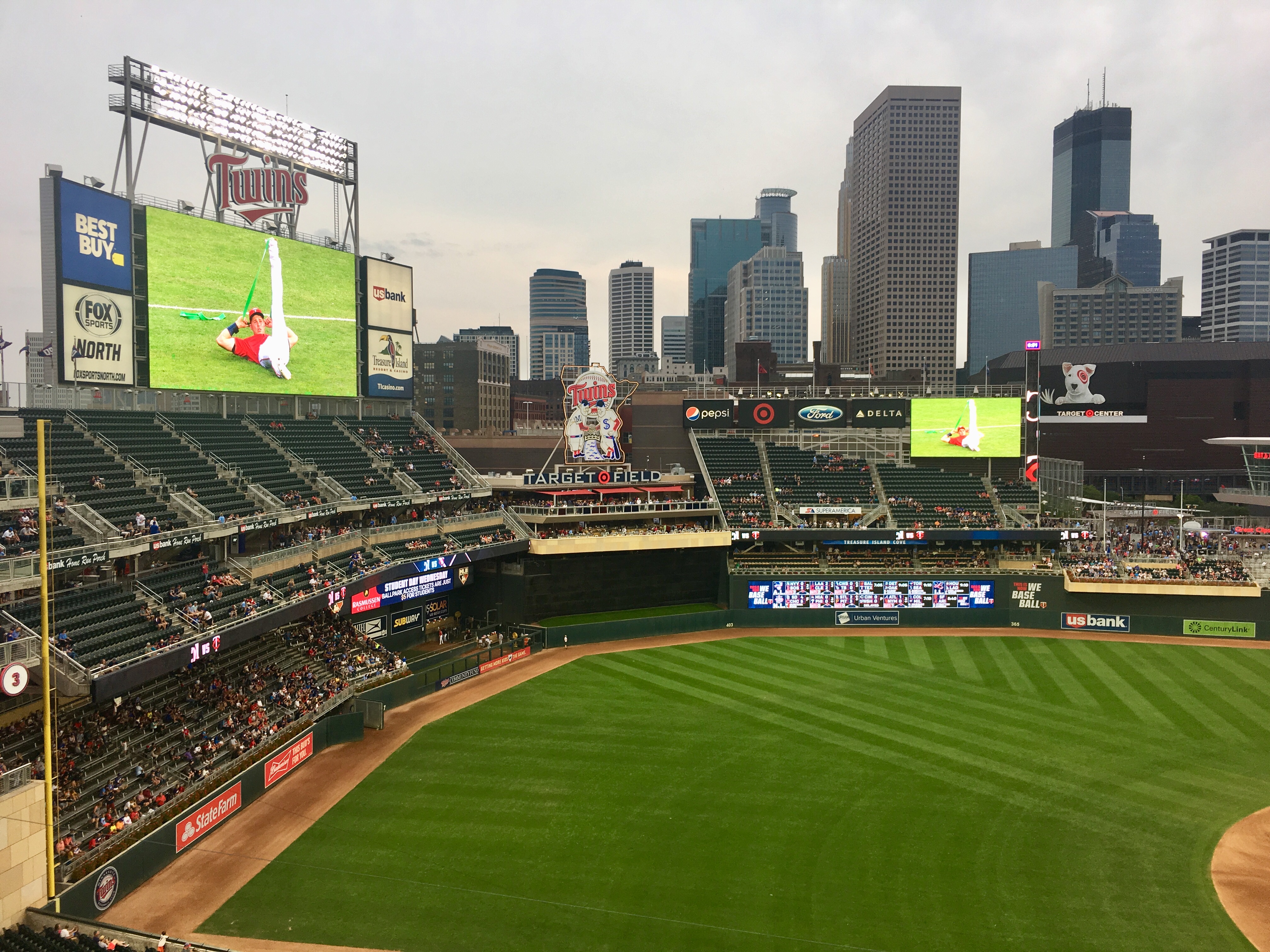
 Target Field, with Minneapolis beyond The first stop on the tour was Target Field, home of the Twins. I’ll preface the rest of this by admitting that Target Field may not have gotten a fair shake, for an odd reason. It was the one park left on my list that I’d heard terrific things about, so I walked in expecting wonders, and comparing it to a nebulous ideal in my head. It didn’t live up to that and perhaps there was no way it could.
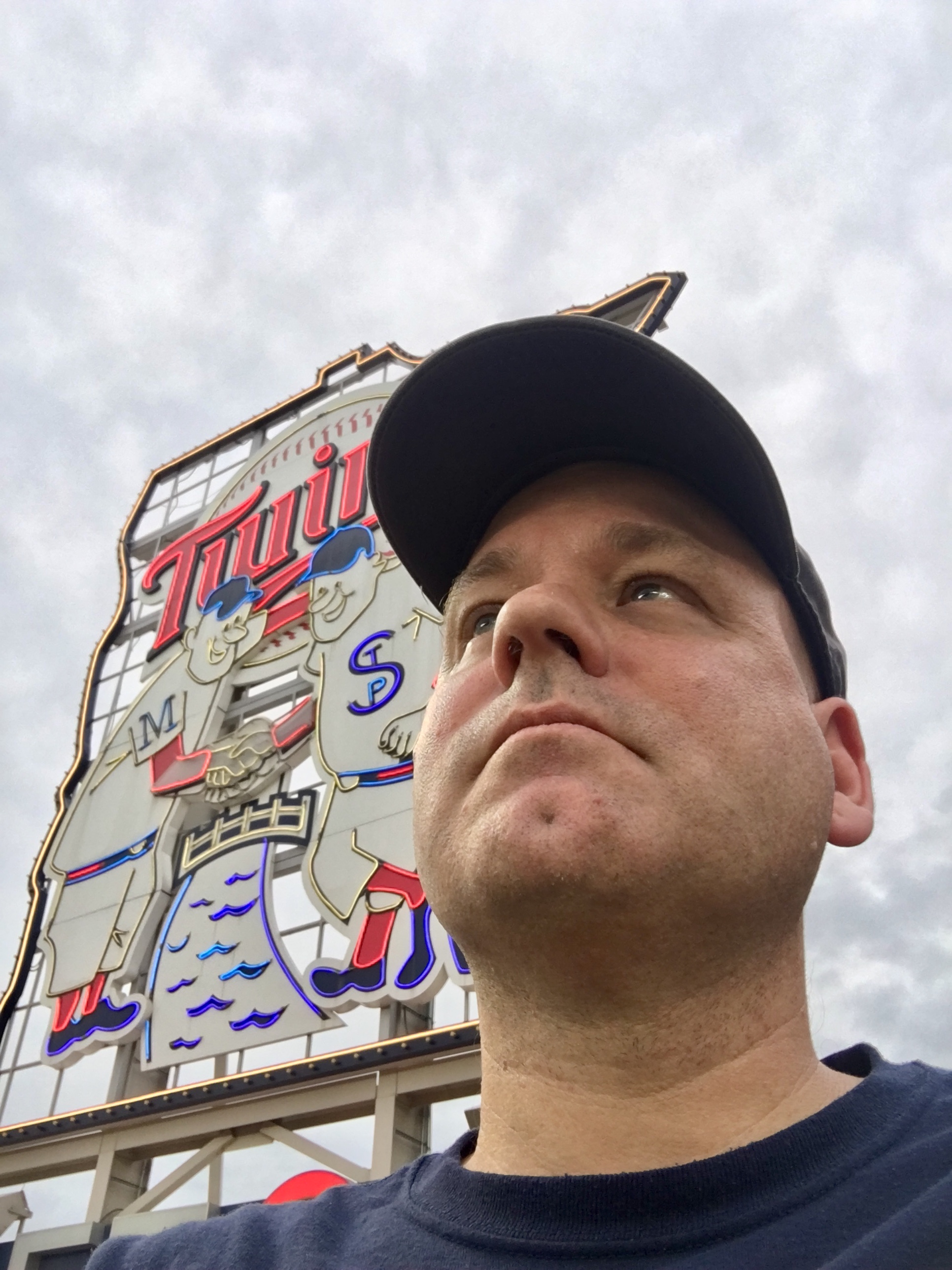
Look, Target Field’s a fine ballpark. It’s nicely integrated with downtown Minneapolis, which seems to press up against the stands (as it should be), it eschews the usual ironwork and greenery to make use of local limestone, and you arrive and depart through plazas sporting statues of Twins greats such as Rod Carew, Kirby Puckett and Harmon Killebrew. (As well as Calvin Griffith and the Pohlads, which is despicable.) The Twins saved center field for a Minnie and Paul display, with the two mascots celebrating various positive developments, which is a perfect marriage of modern spectacle and tradition.
The food’s pretty good, drawing heavily on local providers, with snobs like me drawn to a pair of outposts from Andrew Zimmern. (I had a frozen dulce de leche that I’m still thinking about.) There’s also an impressive amount of fancy beer at prices that are high but not astronomical by ballpark standards. (Tragically, the craft-beer stand is exposed to the elements, meaning its staff ran for cover during the hour-long rain delay we all endured.)
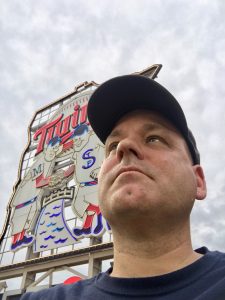 Minnie, Paul and visitor Minnie and Paul, statues, good food, decent beer. It all sounds good, right? And it is. But somehow, there’s a certain something missing.
Part of the problem, I think, is that Target Field’s basically a big circle broken by a plaza, without much in the way of interest along the way. In Comerica Park you’re constantly running into displays of Tigers history or unexpected treats (like a freaking carousel with tigers, for instance); here you’re going to hit another sausage cart or beer stand. The bleachers are metal benches with numbers, which is old-timey in a bad way. Linger or look closely, and Target Field starts feeling like less than the sum of its parts, even if those parts are pretty good.
Maybe that’s the secret sauce of ballparks — a certain something that ties the architectural features and the view and the bits of history and the game experience together, elevating them all. Comerica Park has it. So do PNC and AT&T. Target Field doesn’t.
But again, maybe it’s my fault for expecting it would. It’s a good park. I’d just been hoping for a great one.
* * *
On the other hand, I didn’t expect much from Miller Park, beyond vague thoughts of Bob Uecker, Bernie Brewer, a roof and a sausage race. (Seriously, it still seems wrong that the Brewers are in the N.L. while the Astros, our ’62 brothers, are exiled to that overstuffed beer league with the incorrect rules.)
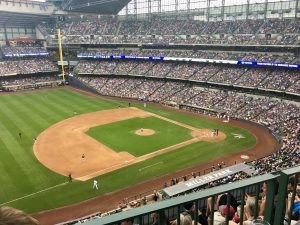 High above Mlller Park But Emily — who joined the tour in Milwaukee — and I had a great time at Miller Park. It started with the fans themselves. They were friendly, but they were also taking things seriously: we were in the kind of seats often occupied by dim scenesters, but our neighbors watched the game with rapt attention whether they were retirees or Little Leaguers. Granted, they had plenty to cheer about, whether it was the Brewers’ season in general or a Travis Shaw grand slam whose launch angle suggested Shaw had clambered up a 30-foot ladder to hit it. The Brewers led 6-0 at the end of the first, Emily had seen Bernie race down his slide not once but twice, and all was well in Milwaukee.
I’m not sure why, but my wife is a huge fan of Bernie Brewer — though neither of us agree that having him slide into a beer mug was a threat to the republic, the next generation of children, or anything else. Having paid more attention to the whole act, I appreciate it more: there’s Uecker’s catchphrase (“Get up! Get up! Get outta here! Gone!”) picked out in lights, accompanying fireworks, and Bernie waving a flag post-slide. And when you’re there live, you can see whatever poor Brewers employee is on Bernie duty clambering up two flights of ladderlike stairs — while wearing a giant head, remember — so he’s in the proper position in case the Brewers go back to back. They did while we were there; Bernie arrived just in time and his slide was impeccable.
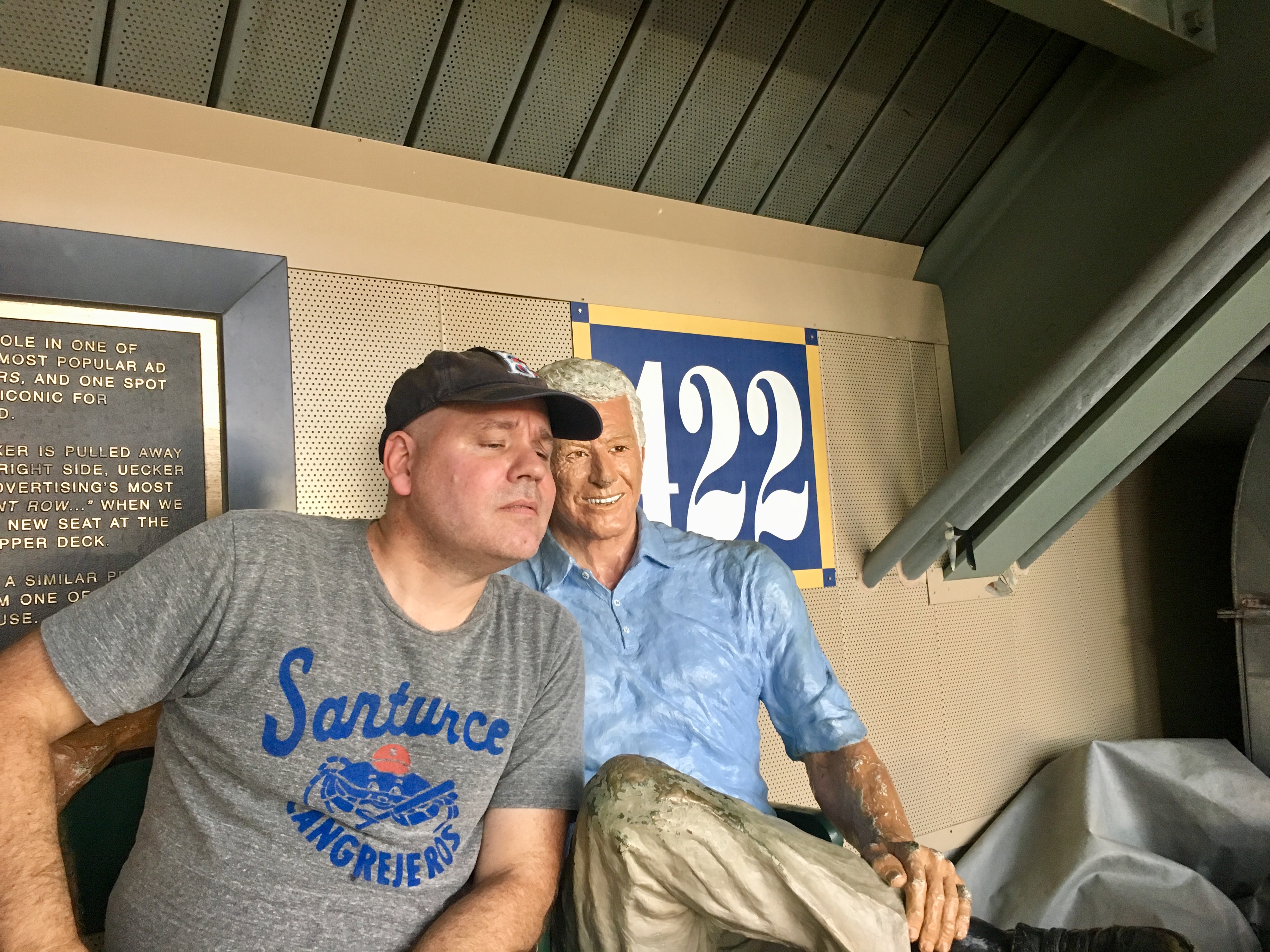
With the Brewers out to a big lead we got to wandering, making a pilgrimage to the Uecker seats high above home plate for a photo op. (At the risk of stepping on a good joke, they’re actually neither the worst seats nor the ones farthest from the field.) And we ate — that’s easy to do at Miller Park specifically and in Milwaukee in general. Walking around Target Field I’d wondered if I’d have to shower off a thin layer of aerosolized butter, but Milwaukee makes Minneapolis look like some kind of vegan cleanse. We took full advantage, drinking shandies and trying multiple sausages.
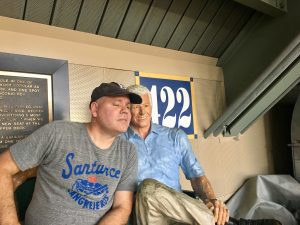 Me and my new friend. Greg saw the Brewers’ home with the roof open, yet its mere existence elicited his displeasure, and of course a roof makes a difference: I turned against Chase Field when the roof rumbled shut just before game time, turning an odd but pleasant enough place into a stuffy, weirdly colored mall in which 50 dudes were trying to play a game. At Miller Park the roof was open for us, even though I will cop to some grumbling about A/C not being the worst idea in the world on a sticky night. The fanlike mechanisms of the roofs (which have been a budgetary headache) even make for an interesting tangle of geometry up their above your heads. A roof atop a ballpark will never be anything other than a necessary architectural evil, but Miller Park’s designers did a lot better than one would have guessed.
Something I didn’t like: Miller Park is in the middle of nowhere, one of those new parks that’s borrowed the look and feel of an old stadium wedged into a city street plan, then dropped that stadium into the middle of a suburban parking lot. (This is a fair criticism of Citi Field, too.) It would work a lot better in downtown Milwaukee, which is pockmarked with empty, vaguely dodgy blocks but has plenty going on around them, from vibrant stretches with bars and restaurants (we happily drank big German beers at a place with giant swords and halberds on the walls, because we could) to the lakefront with its swanky Calatrava-designed art museum. Putting Miller Park by Lake Michigan would have turned a nice park into a breathtaking one. Though, to be fair, tailgating culture is enormous in Wisconsin, so that big moat of a parking lot has been put to good use by Brewers fans.
Anyway, you get good food, good fans, some cool quirks and a sausage race. Yeah, that will work. I saw Miller Park more as a box to be checked off than as a destination to be appreciated, but now I want to figure out when I can get back. Though I do hope the roof will be open.
Next time: visiting the home of the White Sox.
by Jason Fry on 14 August 2018 11:39 am How many ways, exactly, can one game be a make-up date?
The obvious: the Mets and Yankees reported for duty in the Bronx to complete the July half of this year’s Subway Series, which had been erased by rain. Despite an extremely wet morning in New York and a brief in-game squall, the second try proceeded uninterrupted, under humid but relatively cool conditions.
ESPN was also in make-up mode, sending Keith Olbermann out to do play by play alongside Tim Kurkjian and Eduardo Perez. My first reaction wasn’t exactly positive, as Olbermann’s initial comparisons of the two franchises came across as smug and shallow. Which was odd: while there are plenty of people who think Olbermann’s smug (note from management: this is not the forum for your takes on his politics), even his detractors would admit his knowledge of baseball is deep enough to require an armored submersible. But another inning or two seemed to steady Olbermann’s nerves, Kurkjian found a groove playing sounding board for him, and I got used to an unconventional booth handling a game in an unconventional fashion.
And once I did … I kinda liked it. Not in an “I’d like to hear this every day” way, but as an occasional change of pace — it was more in the vein of a sudden yen for Sicilian pizza instead of the traditional. The biggest thing was that the booth essentially dispensed with play by play, instead using the game as raw material for a freewheeling baseball conversation. It was different, but it made me realize that a steady drumbeat of play by play isn’t all that necessary.
A lot’s changed since that became the model. The game’s right there in front of us, as always, but increasingly it’s in HD and on sets the size of a prize calf. Meanwhile, the score bug is constantly updating the situation — ESPN’s foie-gras goose version even kept us informed about the teams’ places in the standings and divisional affiliations. (Why, exactly? It’s not like I’m going to come back from the john to discover the Mets have been placed in the AL Central.)
With all that, I don’t need to be informed that a given pitch was a strike, let alone that the guy scooting around first and then heading back to it just hit a single. I’m not advocating a switch to this format — certainly not over the privilege of getting to hear Gary Cohen — but it worked a lot better than I would have guessed.
The Mets were in make-up mode too, smacking apology homers out of Yankee Stadium all night long as if to show Jacob deGrom that they are, in fact, a major-league baseball team capable of scoring runs when he starts. (For the record, I bet every homer except Jose Bautista‘s would have gone out of Citi Field.) Oh, they feinted at wrecking things with their usual bad habits: Jeff McNeil extended an inning by sailing the back end of a double play over Wilmer Flores‘s head after a hard but clean slide by Brett Gardner; Flores got away with an extemporaneous glove flip to deGrom; and Seth Lugo‘s appearance was more exacerbation than relief. But every time the Yankees tried to draw within biting range the Mets answered with the least Metsian retort of all: more runs.
And, as always, deGrom was the star attraction. He turned in his 21st straight start allowing three runs or less, which is getting into 1985 Dwight Gooden territory, and that’s sanctified ground. And while he didn’t look quite himself in the early going, he sure did by the end — in the late innings the Yankees were frankly helpless, perpetually off-balance while trying to contend with high fastballs, sharply spun curves and a slider that veered away from bats as if deGrom had pulled off some similar-magnetic-polarity trick. The last batter he faced was Austin Romine, and what deGrom did to him ought to be illegal: despite being north of 100 pitches, he froze Romine with a high fastball, just missed hitting the inside corner at the knee with another one, got him to foul off a change-up on the hands, and then threw a slider that swerved away and dirtward. Romine had no chance; no one would have.
Olbermann and Kurkjian had fun bantering about Cy Young candidates and wins; while they did, deGrom was out there as Exhibit A, making his case in impressive and emphatic fashion. And I didn’t need a steady stream of narration to assess the evidence.
by Jason Fry on 13 August 2018 12:22 pm Off-day? What off-day? Today brings Jacob deGrom vs. the Yankees, a rematch caused by rain. Which as I type this is blanketing New York again, with more to come. There’s an easy line about the elements being too tough an enemy for even the mighty Sir Jake, except that the mighty Sir Jake routinely is forced into battles that have already been lost: half his gear is missing, his sword hasn’t been sharpened, and he’s swaying atop a lame horse. None of this is his fault, but the tragedy of being a fearsome knight attended by halfwit squires. The kingdom’s bards have collectively shrugged and chronicle his deeds through sad ballads, many of them very similar, considered notable by lute connoisseurs for their notes of bitterness.
But before we get to Sir Jake — assuming we do at all — we had the man we once worshipped as a Norse demi-god on the hill down in climate-controlled Florida. In a season of wall-to-wall frustrations, Noah Syndergaard‘s second eviscerated year in a row has barely registered as the drag it’s been. When he was healthy Noah seemed slightly not himself, giving up more contact and baserunners than we were used to, and then he wasn’t healthy. It hasn’t been the elbow — every time Syndergaard throws a pitch we still hold our breaths a little — but it’s been everything else. Seriously, it’s been everything else: if you put money on “coxsackie virus” as a reason for a Mets DL stint, I’m simultaneously in awe of your prognosticative abilities and think you might be too pessimistic even for our perpetually steamrolled fanbase.
Bummers aside, Noah was good — he was really good, in fact, muzzling the Marlins over seven innings and getting just enough support, thanks to home runs from Jose Reyes and Michael Conforto. I’ll admit I glimpsed most of the proceedings while swimming up out of a light doze on the couch, for which I’m not particularly apologetic: cancelled flight, night in Kentucky airport hotel, some dingus pulled the fire alarm at 4 a.m., I’m getting too old to just drop back to sleep after something like that, 7 a.m. flight back to New York. In other words, by mid-afternoon I was torpid, to put it kindly.
Torpid, but trying. The result was like a Peanuts special — a background whawha-wawha that occasionally resolved into Gary Cohen being excited. Reyes cracks one to deep left field! And Conforto clubs one! At which point I’d come up for air, peer at the score bug and then slowly submerge again.
Truth be told, though, there’s only so much excitement to be had with these two teams in their current diminished form contesting not much. I woke up all the way for the end, when things got dicey — as they always do at Soilmaster Stadium — and Seth Lugo had to find his way out. It looked bad when J.T. Realmuto whacked a leadoff single, and I cringed when Rafael Ortega slapped a ball in Reyes’s direction at second. But Reyes and Amed Rosario were up to the challenge, turning a hasty but successful two — which proved crucial when Miguel Rojas then singled. In some other timeline that was a tie with disaster on deck, but in this one the Mets only needed one more out, and Starlin Castro obligingly smacked a grounder right to Todd Frazier to end things.
That was the game; recap accomplished. But if you’re like me your eyes were probably elsewhere in Florida — namely Clearwater, where David Wright donned the hallucinatory orange top and gray bottoms of a St. Lucie road uniform to play five innings. There’s not much actual baseball to report from that, but that’s not the point. Wright’s bid to return may be quixotic, sad and doomed, but it’s happening and Sunday marked a step forward. And despite it all, that’s good news. It’s wonderful news, in fact.
We have spilled many pixels on the trials and tribulations that have taken a Hall of Fame career away from a Hall of Fame person and I don’t think there’s any particular need for me to add to the pile on a rainy afternoon. But this lost season has left me wanting one more thing: a David Wright return to Citi Field, even if it’s for little more than a cameo.
I don’t know how much big-league baseball Wright can still extract from a body that’s betrayed him. The smart money would still be on “zero,” however much the heart rebels at further cruelty. The hopeful scenario has dwindled to … what, exactly? Pinch-hitting and day-game-after-a-night-game duty? But at this point I don’t care, and have no interest in being rational about it. David Wright deserves to choose his own time and place to step aside from the game to which he’s dedicated his life. And I hope he gets to make that decision having stepped onto a big-league field one more time.
by Jason Fry on 11 August 2018 11:41 pm I was supposed to be writing this recap at home, finally returned from an eight-day jaunt that took me to six states and five ballparks (four of them new), with a side of genealogy dorkery. But that was before Biblical rains descended on New York, blanketing it in radar bands of creeping green, bubbling yellow and seething red. That was before ground holds began and pilots’ radios crackled and Delta reps looked increasingly grim. And it was before Biblical rains descended on Cincinnati as well, leading to a cessation of operations and employees directing travelers away from leaking roofs.
That’s how my 1:25 plane turned into a 6 o’clock plane and then a 7 o’clock plane, except that was 7 o’clock the next morning. Cue “we apologize for the inconvenience and appreciate your patience” — a speech that fell on the departing backs of passengers scrambling for suddenly precious hotel rooms. Even as I sought rescue, I briefly debated heading back into Cincinnati proper to watch Matt Harvey, but decided that a) Greg had put up with my journeying for long enough; b) I’ve seen enough of Matt Harvey for a while yet; and c) I was dog-tired. Put those three factors together and watching the Mets from a room in a Kentucky airport hotel sounded like a suitably low-key plan.
And so there I sat in front of MLB.TV, watching the Mets and Marlins. Ironically, I’d been denied the chance to watch the Mets during the genealogy break in my ballpark tour: our stalwarts were playing the Reds and my temporary base of Richmond, Ind., was in Reds territory, leaving me far from home yet on familiar turf with regard to blackout restrictions. (It didn’t occur to me until hours later that I might have, you know, turned on an actual television rather than trying to conjure magic via an app.)
Anyway, the Mets and Marlins cooperated with my low-key plan by playing a low-key game, the kind you fear seeing from teams that are hopelessly out of it and halfheartedly looking to assemble next year’s clubs from ill-fitting, not-yet-defined and possibly broken pieces.
Both starting pitchers had reason to squawk about fate. Dan Straily was done wrong by home-plate umpire Ed Hickox, who flat-out missed a 3-2 slider with two on and one out in the third. Straily crouched down in agony, all but bat-signaling his chagrin; of course Todd Frazier promptly stroked a ball over third to bring in three runs. Baseball’s mean like that.
Corey Oswalt‘s complaint was with his own defenders, a familiar cross for Met starters to bear. With one out and a runner on first in the bottom of the fourth, Oswalt coaxed a grounder back to the mound from Brian Anderson (sidenote: who the hell are these Marlins?), only to find Amed Rosario and Jeff McNeil had courteously flanked second instead of occupying it. Oswalt waited while Rosario hastily attended to middle-infield business, downgrading a double play into a fielder’s choice for a lone out. A Derek Dietrich double and a Martin Prado single (there are two guys I’ve heard of, at least) under Wilmer Flores‘s glove cut the Mets’ lead to 3-2.
The Marlins tied in the fifth, and then it was time for bullpen roulette, with the game grinding along mostly without much of interest. Flores lined a 103 MPH fastball from Tayron Guerrero to the warning track to end the top of the seventh, leaving me to wonder when throwing 103 went from legendary to something done by random Marlins. (If you’re curious, yes, I am available to guard your lawn and disapprove of clouds.) The routinely luckless Paul Sewald loaded the bases with one out in the eighth, but escaped by fanning speedster Magneuris Sierra, who’s yet to learn how to steal first base, and Isaac Galloway.
Into extra innings we went, with whatever was left of both fan bases wondering which reliever would be first to hit the wrong chamber. These extra-inning Verduns always make perfect sense in retrospect, as if everything was foreordained, but I’d be lying if I didn’t have a sharper-than-usual sense of dread when Jacob Rhame was called on. At least it was quick: Rhame’s third pitch was a Miguel Rojas single and his seventh was a walkoff double by Bryan Holaday, one of those people I vaguely pity because they must routinely get mail on which both their first and last names are misspelled.
Anyway that was that, whether you were watching in rainy New York or rainy northern Kentucky. (Ballpark discussions will wait for a night I’m less tired.) I was glad to see the Mets again after more than a week away from them. But I do wish that we’d renewed acquaintances in a game that wasn’t quite so Metsian.
by Greg Prince on 11 August 2018 1:44 am If the Mets do indeed follow through on that hardy perennial threat every manager makes in August, implementation of a six-man rotation, we won’t necessarily have to be cognizant of the identity of a given game’s starting pitcher as it progresses. We’ll pick up on the vibe and instinctively match the moundsman to the occasion.
Things are going well for the Mets, though you sense they should be going better. Noah Syndergaard must be pitching.
Things might be going well for the Mets, yet you sense they’re about to fall apart. Steven Matz must be pitching.
Things are going better than you might have guessed for the Mets, though you understand there is no guarantee they will hold together. Corey Oswalt must be pitching.
Things are going terribly for the Mets. Jason Vargas must be pitching.
Things are going great for the Mets — except for the hitting. Jacob deGrom must be pitching.
And then there will be those days or nights when everything’s simply peachy. That’s when Georgia native Zack Wheeler must be pitching.
Zack has emerged as that coffee-sipping dog in the THIS IS FINE meme, except when Wheeler pitches, nothing has gone to blazes. The 2018 season, so hellish so often, turns serene when it’s his turn to throw. Things go great and stay great.
The latest evidence of Wheeler’s calming effect on a franchise otherwise swirling in a constant state of turmoil came Friday night in Miami as our own Commander Cody steered our generally lost planet airmen to victory. It was his fifth start in a row that was victorious for all concerned, himself included. There was no drama. There was no tension. There was just Zack in command for seven innings of four-hit, one-walk, eight-K ball. The only blemish was a two-run homer given up with two out in the seventh to pesky Miguel Rojas. The unwelcome activation of the Marlins’ loopy jumping fish contraption cut the Mets’ lead to 4-2, but the score never got any closer. Zack finished out the seventh, handed matters off to the bullpen and collected a 6-2 win for his superb efforts.
Overall, it was a triumph of the somnambulant, an amiably dull game you didn’t mind lacking bite once the Mets established an edge and Wheeler maintained it so masterfully. Good teams fly plenty of efficient 6-2 wins under the radar in the course of a year. Our team is entitled to one. The offensive star for the Mets was Austin Jackson, pretty much the offensive star of every Mets game lately. Austin Jackson is a .472 hitter since joining our ranks. Maintain that pace, pal, and you can stick around. Even if you can’t, you’ve become a swell August pick-me-up after we wondered why you were picked up in late July. Besides, unless Dom Smith is taking reps in center, it’s not like Jackson is blocking anybody on the depth chart.
Also chipping in three hits Friday was Amed Rosario. I could swear Amed Rosario was scaling the heights a couple of weeks ago, ready to ascend to the next level of young stardom. Alas, a slump ensued, square one was revisited and we are left to hope anew that this might be the start of something big. So the kid is not an out-of-the-box supernova. Maybe it just means he’s built to last rather than fade away. When you’ve won four out of six, you can convince yourself of anything.
Hey, we’ve won four out of six. We lead the Marlins by three games. We will leave Miami not in last place. That’s a little something to relish amid the joyless prairie that 2018 flattened out into months ago. Sure, maybe a slightly higher draft pick is slipping away, but with victories so infrequent, I’ll take my chances with a potentially pyrrhic one.
by Greg Prince on 9 August 2018 1:06 am Dear New York Mets Fan:
We are writing to thank you for your generous contribution of a bunt against the shift. Thoughtful Mets fans like you have been sending us what they can to provide offensive assistance for our ace pitcher Jacob deGrom for months. Our offices at Citi Field have been flooded by sacrifice flies, soft singles over the shortstop’s head, line drives up the middle and takings on three-and-oh, all in the name of getting Jacob some much-needed runs. We were particularly touched by the elementary school class on Long Island that offered to take a breaking ball off its collective elbow with the bases loaded.
In light of the support shown by you and your fellow New York Mets fans, we are happy to report that on the afternoon of Wednesday, August 8, Jacob’s teammates pooled their resources to match the efforts of their fans, the effect of which generated eight runs, five of which crossed the plate while Jacob was pitching right here in Queens. Jacob, of course, was nearly flawless per usual, giving up no runs to the Cincinnati Reds during his six innings on the mound. The end result of all this charitable activity was an 8-0 victory for both the Mets and Jacob.
Yes, it’s true — Jacob deGrom was the winning pitcher. It’s something we haven’t been able to tell our fans very often despite Jacob consistently performing as baseball’s best pitcher. Most days when Jacob works his magic, we don’t compile six doubles, two singles, eleven walks and a stolen base, but on Wednesday we did. It was very exciting and we hope you had a chance to see or hear it.
Jacob’s earned run average is now 1.77, while his won-lost record sits at 6-7. Obviously we are extremely proud of the former and determined to help him improve on the latter. With fans like you behind us, we are confident Jacob will win again in 2018.
Once more, we are grateful for your thoughtful gesture of assistance. As MLB rules prohibit us from keeping it, we will be forwarding contributions like yours to local youth baseball programs throughout the greater Metropolitan Area in the hope that the potential Mets of tomorrow will learn to build runs for their pitchers and help the next Jacob deGrom avoid the fate that has befallen our lone All-Star most of this season.
We are also enclosing a code redeemable for a 4.8% discount on select Baseline Box and Promenade Outfield tickets to Jay Bruce Bobblehead Day on August 25. The code is redeemable at Mets.com and may not be used for phone orders or at Citi Field ticket windows. Restrictions and fees apply.
Sincerely,
The New York Mets
National League Baseball Club
by Greg Prince on 8 August 2018 2:58 am Nights like Tuesday, defined primarily by rain, futility and Jason Vargas, deserve to be evaluated not on how bad the Mets’ loss was mathematically, but how the elements that constitute the whole of the experience measure within the parameters of the carefully calibrated Jason Vargas Index.
For those who have forgotten, here are the scales of the Jason Vargas Index:
• VERY VARGAS: Truly dismal
• SORT OF VARGAS: Could be better
• NOT AT ALL VARGAS: Perfectly lovely
Jason Vargas threw fourteen pitches to four Cincinnati batters, allowed three baserunners and was charged before and after a long rain delay with three earned runs across one-third of an inning. Naturally Vargas rates as VERY VARGAS.
The decision to start the game with the skies darkening while lightning was clearly visible on the horizon was VERY VARGAS. Sure enough, the tarp had to come on the field ten minutes after the first of Vargas’s fourteen awful pitches. Whatever crap whatever umpire said about trying to get the game in ASAP because it was the last series between these two teams was, well, crap.
Mother Nature was SORT OF VARGAS. The storm was horrendous, but perhaps Mother Nature was trying to nudge Mickey Callaway into getting Vargas the hell off the mound.
Waiting out a rain delay in whatever the club on the Excelsior level at Citi Field is called now is SORT OF VARGAS. The air conditioning was welcome and the west-facing windows let us all be slack-jawed onlookers as we peered for glints of brightness amid the atmospheric morass, but there weren’t nearly enough seats. My party of four — that would be my wife and me along with our regular first Tuesday home game in August companions since 2010 Ryder and Rob Chasin — found our refuge by leaning against an abandoned ice cream stand on the third base side and yammering the eight o’clock hour away.
Abandoning an ice cream cart in a club filled with people waiting in long lines for any kind of food and/or drink diversion was VERY VARGAS. Several people stopped to ask us if the cart was open. We were thinking of forming our own line, drawing enough people out of their seats to unwittingly queue up behind us, and then each of us theatrically abandoning the line so we could grab some of those hypothetical sweet empty seats. But it was probably a plan that was more fun to dream up than actually execute.
The Mets sucking enough so that tickets to the Excelsior level are popularly priced veers between NOT AT ALL VARGAS (for who doesn’t love a popular price?) and VERY VARGAS (because who wants the Mets to suck this much?). Let’s peg it at SORT OF VARGAS.
Maintaining our August Tuesday tradition with the Chasins was NOT AT ALL VARGAS. We cherish this annual get-together. Ryder just graduated from Northwestern. His dad Rob let us know they would be available per established summertime custom. How could we stay away? There are no two people Stephanie and I would rather wait out an hour-and-forty-minute rain delay with.
Going to a Mets game with dear friends, even in this miserable season, is NOT AT ALL VARGAS. Besides loving live baseball (even the Mets kind), Citi Field is the town square I miss when I don’t loiter in it from time to time. For example, while we leaned on the ice cream cart, we waved over our old pals and distinguished married bloggers Taryn “Coop” Cooper and Ed Leyro, making our initial party of four more and merrier. And later, upon completing a beverage run, I bumped into another friend I don’t see anywhere else, Howard Megdal. You hopefully know Howard from his thoughtful coverage of many sports, one of them baseball. When we grabbed a chance to chat, he gave me a little 411 on his next piece, if in fact “411” is something people still say. (I once forgot the number for information and called 911 instead, immediately apologizing to the emergency operator.)
The Mets’ offense is VERY VARGAS. Two hits in the second. Two hits in the ninth. Pacifistic otherwise.
The video board proposal that overwhelmed Kiss Cam was NOT AT ALL VARGAS. Of course the subject of wedded matrimony should be broached at the ballpark. The honeymoon should take place there as well. Coop and Ed have been on theirs at Citi Field for eight years.
The Reds’ devotion to their history, which crossed my mind when I saw scattered BENCH 5 and ROSE 14 interlopers, is NOT AT ALL VARGAS. They recently inducted Dave Bristol, Fred Norman and Adam Dunn into their Hall of Fame. Held a gala and everything. That’s how you do it — annually, with criteria that values long and meritorious service and makes room for many rather than striving to exclude all but a few. Hell, at this point, I’d welcome even a few bronze faces into our dormant museum. The Mets haven’t inducted anybody into their Hall of Fame since the end of the 2013 season and did absolutely nothing with what should be an august institution between 2002 and 2010.
The attention the Mets pay to their Hall of Fame is VERY VARGAS. It was VERY VARGAS before Vargas was a Met the first time (two starts in 2007, in case you’ve forgotten the recidivist angle to the Vargas backstory). It was briefly downgraded to NOT AT ALL VARGAS when, between 2010 and 2013, they honored Dwight Gooden, Darryl Strawberry, Davey Johnson, Frank Cashen, John Franco and Mike Piazza. Now it’s so VERY VARGAS that the only way to reactivate what promised to be a thriving acknowledgement of Mets history would be to induct Jason Vargas himself. Because once Vargas is in, they’d have to bring in at least six other Hall of Famers to finish the ceremony.
Sal Romano’s rooting section was SORT OF VARGAS, but only from a Mets fan perspective. Actually, I was in awe of how much noise these friends and family of the locally sourced Reds starter made on behalf of their homeboy. We saw multiple ROMANO 47 jerseys and t-shirts in the concourse. If one team is going to start Jason Vargas, how can you blame the other team for taking advantage?
The Mets’ All Other Relievers are SORT OF VARGAS. The game didn’t resume until 9:00. Vargas was out. One interchangeable right arm after another entered, departed; entered, departed; entered, departed. The final score winding up at 6-1 rather than 25-4 speaks well of at least a few of these youngsters.
Steven Matz’s luck is VERY VARGAS. He won’t be coming off the disabled list when scheduled. Did anybody think he would?
My wife’s good humor where being immersed in baseball is concerned, especially on a weeknight, is NOT AT ALL VARGAS. If you subtract the rain delay, Tuesday night’s Mets loss was completed in a reasonable 2:43, and she would have soaked up every minute (albeit some of them in that luscious club air conditioning). The rain delay, however, when combined with the heat…let’s just say that like every starting pitcher the Mets have used this year, Stephanie wasn’t going nine. Though it was highly out of order for us, especially when keeping company with Ryder and Rob, we bolted in the seventh, my first early exit in a couple of years, I believe. Sacrilege, I realize, but rain at the ballpark tends to take the edge off whatever Jason Vargas hasn’t already destroyed.
Dilson Herrera is NOT AT ALL VARGAS for pinch-homering versus the team that sent him away in exchange for Jay Bruce. Good for him. Matt Harvey gets a tribute video, Dilson gets a touch of revenge.
Todd Frazier gracing one side of my souvenir cup is VERY VARGAS. No offense to Todd (“no offense” is a Met credo), but is this guy any Mets fan’s favorite player? I’m excluding anybody he brought with him from his previous stopover and residents of his New Jersey hometown. Whoever decided “we’re gonna move who knows how many more cups with Frazier on ’em” must be the same promotional wizard who convinced upper management that August 25’s Jay Bruce Bobblehead Day is going to be the social event of the season.
That one looms as VERY VARGAS as well, but enough Vargas for now.
Seriously. Enough.
by Greg Prince on 7 August 2018 2:02 pm Moments after Jeff McNeil launched his first Citi Field home run to the branded soft drink pavilion overhanging right field, he was still giddy. Why wouldn’t he have been? McNeil joined the major leagues and the Mets on July 24. Almost everything is a first for him. To not enjoy it would be a demonstration of odd behavior. Jeff obviously needed to continue sharing his enthusiasm. In a dugout that had settled down after congratulating him, he found somebody to keep telling how great it feels to be succeeding as a brand new Met. His receptive audience and perhaps soulmate in celebration was Austin Jackson. Jackson could relate. He was once new to MLB. He is still new to NYM. He’s worn a Mets uniform only since July 27. Austin’s also succeeding in new clothing, clear up through Monday night when he, like Jeff, registered three more hits. Their team would end the evening with sixteen in all.
Jeff was raking. Austin was hitting. The Mets were winning. Laughter abounded between them. And I smiled because, in the moment, they were my guys. Last week I considered them practically total strangers. I now root for who exactly? But that was when they were barely here. They’ve been here for days upon days since. Another week’s worth! That’s a decent enough sample size if you want it to be.
McNeil and Jackson indeed contributed to a Monday night Mets victory, 6-4 over the Reds. There was a plethora of contributors. One of them was Bobby Wahl, another very recently introduced name (called up August 2) growing suddenly into a person we recognize as our guy. Wahl replaced Noah Syndergaard with the bases loaded and one out, Joey Votto up to bat. The Mets were ahead by five, so maybe the leverage didn’t soar as high as McNeil’s homer, but it was a tall enough order for a reliever with minimal cachet. Wahl walked Votto, which should probably count as a rite of National League initiation, but then struck out another All-Star, Scooter Gennett, before giving way to Robert Gsellman and, ultimately, closer du nuit Jerry Blevins.
Jeff McNeil. Austin Jackson. Bobby Wahl. Yeah, I root for them. Still seems a little weird to be emotionally invested in the professional fortunes of these heretofore strangers, but 1,064 times since April 11, 1962, a stranger has been just a Met we hadn’t yet met. Gsellman and Blevins were each that. Syndergaard (six shutout innings before faltering in the seventh) was that until May 12, 2015, and that was with us knowing his nickname as a minor leaguer. Twenty-two year-old Wilmer Flores was just a line on a depth chart until five years ago yesterday. On August 6, 2013, he became the 960th heretofore stranger we developed a habit around. Last night, on his 27th birthday, Wilmer pounded out three hits, which we’re used to. He also got himself thrown out at home, which we’re also used to. Familiarity forgives certain tics on nights you win. The fellas who wear the uniforms are the difference between rooting for the laundry and emotional investment.
The era we’ll remember Flores for — the one largely defined by Wilmer’s reaction to something that didn’t happen (no trade), Wilmer’s action in making something happen (homering to spark a pennant run for the ages) and Wilmer’s reaction to his action (grabbing at the logo gracing his laundry as he crossed the plate) — lacks a neat timeline. Most eras do, actually, but we can usually retcon for clarity’s sake. Seeds are planted, players bloom, championships sprout. In truth, the 2015 Mets grew more stubbornly and sporadically than cleanly and clearly. The runup was difficult to detect while in progress and the aftermath came quicker than we’d have preferred. Yet you can pinpoint a spot on the chronological map where you can accurately say a generally grim Met present was beginning to dissolve and a promising if opaque Met future started taking shape.
July 26, 2012. Before Flores and his walkoff magic. Before Familia, who would someday nail down final outs of four separate Met clinchings. Before Lagares, who would someday excel in the opening game of a Met NLCS. Before d’Arnaud, who would hit Citi Field’s Apple on the fly in that same NLCS opener. Before deGrom, who dominated the Dodgers at the outset of an NLDS and begrudged them satisfaction at its conclusion. Before the savvy additions of Granderson and Colon, let alone the on-fly injections of Syndergaard, Matz, Conforto and Cespedes…and after the holdovers from previous generations (Duda, Tejada, Niese, Murphy and Wright) had become old if amiable news…there was the introduction to us of Matt Harvey.
Streamline the narrative to ignore the ups and down and ins and outs a franchise experiences, and Harvey’s debut on July 26, 2012, serves as a reasonable dividing line between “before” and “getting there”. We didn’t know where exactly we were getting to, nor when we would arrive, but Harvey’s right arm was the one we were elated to have pointing us in the right direction. That’s what his 10 starts in ’12 were doing amid another lost Met season. The next 26 in his repertoire, presented brilliantly in 2013, elevated hope to a next level. Really, on those fifth days when Matt pitched, you didn’t need hope. You didn’t need direction. Where else did we need to go when we had Matt Harvey pitching for us?
The throughline was disrupted when Tommy John surgery crashed the chronology. No, it wasn’t a direct march from July 2012 to October 2015. It couldn’t be, not without Matt Harvey leading the journey as we envisioned. But he came back, he gave us as much as he had to offer and October occurred at last. Matt was a huge part of it. November, too. He tried to engineer an extension of the latest postseason the Mets ever unfurled. He couldn’t, but the effort was admirable.
Then, in a blink, it was 2018 and Matt Harvey hadn’t pitched well or that much for several years, and he became a Red, out of our day-to-day lives, save for two nights and one afternoon in August. He wouldn’t pitch, but he’d be impossible to not notice. In appreciation for what he meant between 2012 and 2015, the Mets produced and showed on CitiVision a tasteful tribute video that lasted not quite 40 seconds. Given how the Harvey segment of the most recent Met era faded from present to past, more would have been ostentatious. Given how Harvey’s days began and gained traction when his pitching was at its fiercest, you could imagine the highlights streaming forever.
Forever’s a mighty long time, according to my Purple namesake, yet it’s difficult to apply to all those Met moments and Met people you swear you’ll love forever. Let’s go crazy, we told one another when Matt came along. Let’s compare him to Seaver and Gooden. Let’s count Cy Youngs before they’re hatched. We were sure we’d love Harvey forever. Now we debate whether a video under a minute in duration somehow represents too lavish an appreciation for someone who departed our midst with a bulging ERA and scant goodwill. This week we’re infatuated with Jeff McNeil. Maybe that will last. Or maybe someday we’ll debate the merits of devoting forty seconds to a Jeff McNeil tribute video circa 2024.
If it’s safe to apply “forever” to any Met, it’s the forty-fifth stranger we hadn’t yet Met, chronologically speaking, the last man to join our ranks in our first season, the last to still be a Met from that year many years later. That, of course, is Ed Kranepool. Eddie, like Matt, was at Citi Field for the first time in a while Monday night, making Monday likely the closest we’ll see to an Old Timers Day in Flushing this season. Eddie, like Matt, was part of teams that celebrated with champagne. Eddie, like Matt, was also part of teams that had trouble getting good and staying good. Eddie, more than anybody, is the Eternal Met. On endurance alone, September 22, 1962, to September 30, 1979, he’s got the other 1,063 Mets to date beat by miles. The Ed Kranepool Era lasted portions of eighteen seasons in active player terms. That should qualify a fella for forever status, no questions asked.
Matt hasn’t been around Citi Field for a few months because business whisked him away to Cincinnati. Eddie? Eddie used to come around regularly. He’s a New Yorker and a fixture, except for some cross words that set forever player against whoever’s listed as owner. Not only was it ridiculous that Eddie wasn’t welcomed by the Wilpons, it bordered on tragic in light of Eddie’s health.
Eddie needs a kidney. Eddie also needed to come home.
However it happened, it happened Monday. Ed Kranepool sat in the Mets dugout prior to the game against the Reds and chatted up the media while sitting alongside Jeff Wilpon. He strode to the mound and delivered a ceremonial first pitch to Kevin Plawecki. He rode an elevator up to the press level and sat in the radio and TV booths and publicized his cause. He’s still looking for that kidney, and if you want more information, you can reach out via kidney4kranepool@gmail.com or 631 444 6944. Eddie’s search is the epitome of a high-leverage situation, an enormous ask. But if you don’t ask, you don’t get what you seek.
Seeing Ed Kranepool back among the Mets (and promising that he will be available to help their cause as well) made me think of one Mets fan in particular, one of our readers who wrote to us last month with concern for the player’s who’s meant the most to him forever. It seems appropriate to share his note here:
Just a request/hope you can help to get out the word about Ed Kranepool’s need for a kidney for transplant. I am now 6.5 years with my kidney transplant, so this topic is important to me. Krane, like me, is also a diabetic, and the fact that he was always my favorite Met seems like more than just coincidence. If you’ve seen the papers, I’m sure you’re aware of his plight. I guess I’m hoping that your [blog] would bring more attention to Krane’s fight, and in the best-case scenario, maybe more people would be willing to be tested for compatibility.
2019 will mark the 50th anniversary of the Miracle Mets. I hope and pray Ed Kranepool will be there to celebrate. My favorite Met needs help. Let’s see if we can provide him some assistance.
With respect and appreciation for helping this fellow Met fanatic through the good times and the bad…
Again, the contact info is:
kidney4kranepool@gmail.com
631 444 6944
by Greg Prince on 6 August 2018 11:57 am The Mets last week lost a game started by Steven Matz, 25-4. Five days later, because Matz was injured, they started Corey Oswalt in his place. Matz is out with a mild flexor pronator strain, a phrase known primarily to:
1) Medical professionals who treat mild flexor pronator strains;
2) Their patients who are diagnosed with mild flexor pronator strains;
3) Mets fans.
Oswalt pitched much better than Matz did last Tuesday. Oswalt also pitches much better than Jason Vargas any day of the week. Yet Oswalt is considered to start only when somebody is injured.
Despite Oswalt pitching well, the Mets lost, 5-4. That looks much better than 25-4, but it is still a loss. I wouldn’t discourage Oswalt from continuing to pitch well, nor the Mets from keeping their margins of defeat reasonable, but the real key to success for the team is not losing. This is a fundamental of baseball of which the Mets are likely aware, but given how infrequently they win, posting an occasional reminder seems necessary.
Congratulations to Austin Jackson for homering and for having a name that encompasses two state capitals, the only Met ever to be able to say that. He’s also the only major leaguer ever to be able to say that, but I’m not concerned with everybody else’s minutiae, only ours. We’ve had Jacksons first-named Al, Roy Lee and Darrin, and we’ve had a Todd first-named Jackson. They all might have felt at home visiting the capital of Mississippi, but Texas is a whole other identity. Al Jackson, who hails from Waco, could tell you that.
The Al in Al Jackson is short for Alvin Jackson, and Nolan Ryan grew up in Alvin, Tex. Dallas Green was born in Newport, Del. Neither Dallas nor Newport is a state capital. Also, Al Jackson was commonly referred to as Little Al, and half of that can get you to Little Rock, Ark., not as long a schlep from Jackson, Miss, as it would be from Austin, Tex., “schlep” being a word I imagine doesn’t much come up in the region that encompasses those particular states. Maybe it drives down from New York to Delaware on its way to Florida for the winter.
As long as we’re on the subject, let’s hear it for Daryl Boston, Stanley Jefferson (City), Robert Carson (City), Ed Charles(ton) and the three Harrises — Lenny, Willie and Greg — who together at the next Mets alumni celebration could form their own little Harrisburg.
That’s absurd. The Mets celebrate their alumni less frequently than folks around Austin, Jackson and Little Rock say schlep. I’m guessing on the latter, but I’m confident of the former. On the off chance the Mets ever invite the Harrises back en masse, they should keep in mind that Greg A. Harris is ambidextrous and thus could enter the festivities from either dugout.
Where was I? Oh yeah, the Mets lost on Sunday. Wilmer Flores ran the bases terribly as he usually does, but I don’t want to get on Wilmer today because today is Wilmer’s birthday. Happy birthday, Wilmer! The cake is over there…yeah, just go ahead…no, don’t hesitate…ah, never mind.
We love our birthday boy, but there was a lot of truth in that old Carnac bit:
“Longer hemlines, shorter haircuts and Wilmer Flores trying to take the extra base.”
“Longer hemlines, shorter haircuts and Wilmer Flores trying to take the extra base.”
“Name three things that are out this season.”
Judging by the vintage of that reference, Wilmer turns 77 rather than 27 today. Also judging by how Wilmer runs.
It’s not Mickey Callaway’s birthday, so I don’t feel badly pointing out he managed Sunday’s game badly. He demonstrates a Vargasish consistency in that respect. There was another of those situations in which he was duped by common sense when making a pitching change. The pitching change itself wasn’t the issue. Mickey didn’t wait for Brian Snitker to announce his pinch-hitter before making his move for Paul Sewald — St. Paul, should he be traded to Minnesota — to face Adam Duvall. You wait so you can force your counterpart to burn a player. Mickey doesn’t wait, so the other manager doesn’t have to burn anybody. Duvall stayed on the bench unburned, allowing Snitker to use him later at a time of his choosing.
Mickey will do all the self-immolating in these parts, thank you very much.
Maybe Mickey wants to show confidence in his pitchers by bringing them into the game as quickly as humanly possible. That’s not what he said later, though that would have been a more plausible explanation than what he did say, which was something about how he can’t worry about how a move he makes in one inning (in this case the seventh) might affect the game in a later inning (say the eighth or ninth). Managers are usually praised for their ability to simultaneously address the situation at hand while keeping in mind the consequences of situations that have yet to unfold. Actually, it’s kind of understood that’s an essential part of managing.
Mickey’s an innovator. He starts Jason Vargas every five days and expects something different to happen.
If the Mets had ever gotten Mike Lansing, I could have mentioned him earlier. But they never did. Devin Mesoarco also homered. I don’t think there’s a state capital with either of his names attached to it. Even if there was, it probably wouldn’t have helped Mickey, who reportedly will be back next season no matter how many games he lights on fire the rest of this season, manage the Mets to a win on Sunday. Little would.
by Greg Prince on 5 August 2018 12:16 pm Isolate enough positives from the Mets’ 108th game, and you’d wish the season was beginning anew. You’d happily start Zack Wheeler on theoretical Opening Day and look forward to seven innings of shutout ball from a pitcher who you know will do nothing to sabotage his own cause. You’d lean forward to cheer the up-and-coming Jeff McNeil, a batter you once saw go 4-for-4. You’d take a chance on the savvy veteranship of Austin Jackson and figure you could do worse than plugging a .350-hitting defensive-minded center fielder into your lineup most days, small Met sample size be damned. You’d love your lockdown back-end bullpen of Bobby Wahl and Robert Gsellman. And you’d heartily appreciate a pro’s pro like Todd Frazier from Toms River essentially stealing two runs from third base and check to see if there was a grinding gesture you could make or a t-shirt you could buy to show your support for our gritty, gutty Jersey Boy.
Not to pour a torrent of salt and pepper on the sublime nature of our weekly bright spot, but, as another Jersey Boy might have put it, Saturday night’s 3-0 conquest of the Braves felt just too good to be true. It happened, sure. We do win games from time to time. But was it the harbinger of things to come? Would you start a new season with this crew and expect a season materially different from the two-thirds of a season we’ve endured to date?
Jeff McNeil has now played ten major league games. He’s one of seven Mets with no more than that amount of experience to rack up four hits in one box score. Such a universe is too small from which to draw definitive conclusions toward McNeil’s future. If Jeff’s destiny is to become some variation on Mike Vail, Ty Wigginton, Mike Jacobs, Josh Thole, Michael Conforto or T.J. Rivera, well, those are men who made major league careers for themselves if not necessarily (or yet) the careers we envisioned while getting carried away by their first burst of success. We see a 4-for-4 early on, we adjust our expectations skyward. Best we can expect of McNeil is to become some variation on himself and play an eleventh game.
Austin Jackson’s .350 as a Met has been fashioned in a similarly brief span. Unlike McNeil, who excelled at Binghamton and Las Vegas after an otherwise off-radar minor league run, no Mets fan was rattling cages to get Jackson on our roster. Jackson’s been on most everybody else’s roster since 2010. We usually get a turn at guys like that, generally when we’re desperate for help and they could use an opportunity. Jose Bautista’s been one of those guys. Adrian Gonzalez was one of those guys earlier this year. Nori Aoki qualified as one of those guys last September. Justin Ruggiano poked his head in that way two summers ago. You never plan for them, but they happen.
Happy to have Austin this August. Don’t know what that portends for next April. Not everything can be about the mythic “let’s see what we’ve got with the kids” ethos every day, not when you have a third of a season left. A third of a season is 54 games. Fifty-four lineups that need to be filled out, fifty-four sets of tactics that sometimes move a manager to use the 31-year-old itinerant outfielder rather than whichever younger, less-known quantity we reflexively cry out for. Not that the Mets are dripping with those in the outfield at this juncture of 2018.
Wahl has looked pretty sharp in two outings. They are two outings, or eight fewer than McNeil has had in his audition. So we’ll see, which is fine. The bullpen rarely operates properly. Lately, in spots where the Mets aren’t trailing by touchdowns, it’s done decently. Blevins looks like Blevins again. Swarzak, before his sudden reassignment to the disabled list, was turning into what Met scouts presumably swore by in winter. We don’t really miss Familia because we’ve decided to not miss Familia. Who needs a high-profile closer when we have so few high-leverage leads? We can embrace Wahl in the interim. And we can keep seeing how Gsellman functions in Familia’s old role. I don’t know that this is the bullpen of the future, exactly, but a little mixing and matching in the present will suffice.
Wheeler’s the big find as the final third inevitably leads into the next 162. Wheeler’s a keeper, at last. Saturday night against Atlanta, on the heels of last Sunday at Pittsburgh and everything else since he blended confidence, focus, talent and coaching into a complete package, has given us a staple of a rotation we don’t have to dream hard on. We know deGrom. We’re still pretty bullish on Syndergaard until the next bizarre twist of his story. Matz is taking a powder for the moment, which is unfortunate, but he’s lefthanded, you know. We don’t dismiss young-ish lefties so easily, no matter how their trajectories aggravate us.
Now we know Wheeler as a pitcher we believe in. He’s a success story in a year bereft of them and a building block for a year we hope will make this one look like an extended bad dream. Let’s not let anything happen to him or his progress.
Among those who engineered Saturday’s satisfaction, Frazier is the quantity whose properties are most known and whose prospects are least enticing, except maybe when he does something splendid. Outfoxing the Braves on two occasions — dashing for the plate on a weak grounder in the second and beating a poorly conceived throw home in the sixth — makes his presence seem more a blessing than an albatross. Maybe he’ll get a hit again before 2018 is done.
That group of Jersey boys who inspired the Broadway smash of the same name, those Four Seasons who hail from Frazierland, had plenty of hits. Led by the aforementioned Frankie Valli, they also had three more seasons than a baseball team gets a crack at. At best, if we’re mathematically inclined, we get three thirds of a season. That’s if you use baseball math. The first 54, the second 54, the third 54. Adds up to 162. There’s no official reckoning by demarcation, but it does kind of jump out at you if you are open to receiving its greeting.
“Hello, I’m your season, and I’m going to need to get going soon.” Shocking, huh? It just got here and now it’s asking where its coat is. The exit beckons. Didn’t we just have an Opening Day? Didn’t we just notice one-third of the season plop into the books? Weren’t we just grabbing a breather and some perspective at the halfway point?
We did and we were. But baseball keeps going. Baseball goes better when, at two-thirds of the season, there’s high stakes left to play for. We know that the final third of 2018 will boil down to how much more we’ll see of the McNeils versus how much more we’ll see of the Jacksons and that sort of thing. That’s what we tend to watch for in a narrative sense when we’re not focused on any given game (which we should be, too, because we only get 54 more of these babies).
This, of course, is not ideal. But neither has been 2018. After two-thirds of this besotted season we not only “boast” the ninth-worst record at this stage of a year in Mets history, but we’re comparably removed from where the real action is. You probably haven’t checked lately, but we’re 14½ games out of a Wild Card spot, trailing eight teams for the second National League lottery ticket, never mind the first Wild Card spot and the division lead. Yeah, that’s not happening this year.
You know what rules? When it does happen in a year, or at least it’s happening at this interval in a year. Eight times after 108 games the Mets have been positioned to make the postseason in the “if the season were to end today” sense. The season (except for strike-stricken 1994) wasn’t about to end so soon, but it’s how we speak.
Life was never better at the two-thirds mark than in 1986. The Mets’ record was 73-35 and their lead over the field was seventeen games. Seventeen games ahead of everybody they needed to be ahead of…bottle that feeling, would ya? Life was also rollickingly good twenty years later 108 games in, as the 2006 Mets sat twenty games above .500 and eleven games ahead. As in ’86, you knew ’06 had more baseball to it than was printed inside the pocket schedule.
It wasn’t quite so certain in 1988, when the Mets held the NL East at bay by five games, but it was certain enough. In 2000, the Mets were in first place in the Wild Card race by four games. It wasn’t exactly what we were angling for (the Braves were three games up in the division), but it loomed as good enough to get us to the business end of October — and it did.
We had the same-sized lead as the NL East’s standard-bearer at this stage of 2007. That four-game bulge would expand, then contract, then disappear. That’s why it’s only two-thirds of the season. Similarly, the one-game lead in 1985 didn’t get us popping our corks, but having first place on the line in early August and continuing to have it on the line for the next two months was a lot better than checking your watch for when the next late-blooming Triple-A slugger will arrive.
The Mets who were in first place two-thirds of the way into 2015 stayed there. The Mets who could make the same claim in 1999 didn’t, but they clung close enough and gave us a September to remember and an October, too. The Mets clubs that hung around the top of their divisions or Wild Card derbies without residing at their pinnacle may not have been ultimately rewarded, but their final thirds were imbued with vitality. Two-thirds into 1970, 1984, 1990, 1997, 1998, 2008 and 2016 we rooted for Mets that sat anywhere between a half-game and three games from a gateway to glory. Only the 2016 Mets made their proximity pay off, but the ride kept us engaged for weeks on end.
Missing from this two-thirds honor roll of serious contenders are the two years that gave us cause to take all kinds of absurd distances from first place seriously. In 1969 at the two-thirds mark, the 60-48 Mets trailed the Cubs by eight games. Fine record, but a daunting amount of ground to make up. Good thing the ’69 Mets weren’t an easily daunted bunch. And 11½ games from first place, summering in sixth and last place, were those 1973 Mets. They were behind everybody by a lot with the inverse of 1969’s record: 48-60. What a third they would have to have to make hay let alone history.
I won’t wallow in the Mets seasons where two-thirds led only to another third and then the end. We’re living in one of those now. But just so you know, the 1962 Mets not only crafted the worst two-thirds mark in Mets history (29-79), but were 44½ games from first place while brandishing it. Give ’em a break, though: they were new in town and many thirds of many seasons awaited them. The Mets would get better. And the Mets will get better still. I couldn’t tell you when, but keep watching. Fifty-four games remain that we know of for now. Make the most of them. The only thing worse than bad Mets baseball is no Mets baseball.
|
|