The blog for Mets fans
who like to read
ABOUT US

Faith and Fear in Flushing made its debut on Feb. 16, 2005, the brainchild of two longtime friends and lifelong Met fans.
Greg Prince discovered the Mets when he was 6, during the magical summer of 1969. He is a Long Island-based writer, editor and communications consultant. Contact him here.
Jason Fry is a Brooklyn writer whose first memories include his mom leaping up and down cheering for Rusty Staub. Check out his other writing here.
Got something to say? Leave a comment, or email us at faithandfear@gmail.com. (Sorry, but we have no interest in ads, sponsored content or guest posts.)
Need our RSS feed? It's here.
Visit our Facebook page, or drop by the personal pages for Greg and Jason.
Or follow us on Twitter: Here's Greg, and here's Jason.
|
by Jason Fry on 10 April 2017 12:10 pm How good is Noah Syndergaard? They’ve got ways old-fangled and newfangled for measuring that — such as an 0.69 ERA in his first 13 innings and a FIP of 0.53 to indicate that ERA should be even more microscopic. Here’s a less-quantitative but thoroughly heartfelt measure: when things go wrong, Syndergaard’s the guy we’re sure will make everything better.
The big blond beast, as dubbed by Rene Rivera, was certainly in beast mode Sunday night against the Marlins, striking out nine and allowed two runs over seven innings. Only one of those runs should have scored, as the other came courtesy of miscommunication between Yoenis Cespedes and Michael Conforto. (Once again: it’s the outfield defense that will kill us.) At least on this night the Mets’ defense gaveth as well as takething away (that literary flight of fancy crashed and burned so spectacularly that I’m just going to leave it in) with Rivera throwing out a pair of overly frisky Marlins to avert further harm.
Syndergaard was amazing in the ways we’ve come to take for granted, mixing that ungodly fastball with the somehow more-ungodly slider and flashing the pretty deadly curve and change-up to keep the Marlins on their knees in helpless supplication for most of the game. Go back and review Marcell Ozuna‘s second-inning at-bat to see an amazing bit of baseball cruelty: Noah gets him zeroed in on the fastball, tosses him an unhittable slider to make him doubt everything and then coldly dispatches him with a change-up.
But the later innings were even more impressive for being less flashy. With his pitch count rising, Syndergaard made a subtle alteration and started pitching to contact — a nervy thing considering his defensive complement was basically himself, Rivera and seven guys running around with paper bags over their heads. That got him through seven, giving the Mets time to add a Jay Bruce home run and an absolute bomb from Conforto and then to turn things over to Fernando Salas and Addison Reed.
Salas arrived late last year as blessed relief and has provided the same this year, though that may soon prove too much of a good thing: he’s become this year’s Jim Henderson, the reliever Terry Collins seems hell-bent on breaking by Memorial Day. Today he’s Terry’s shiny new toy; tomorrow he’ll be a non-roster invitee with a arm full of broken bits and a “no comment” when asked about his former manager.
Speaking of broken parts … I don’t normally complain about national broadcasts, because what’s the point? But the ESPN crew of Karl RavechChris Myers, Dallas Braden and Eduardo Perez gave us one of the worst broadcasts I’ve seen in years. To steal a line from one Twitter wag, they should have let Mr. Met stay to call the rest of the game.
Ravech was bland but tolerable, and Braden and Perez occasionally reminded you that they know stuff — Braden, for example, was good in one segment where he broke down the movement on Syndergaard’s pitches and explained how it made him different from a mere mortal. But the two color guys were constantly stepping on each other, and Ravech was half-hearted about pulling baseball expertise out of them. Most of the time he let them run wild with unfunny shtick. Braden in particular desperately needs a producer to rein him in — pronouncing “hashtag” is bad enough before smashing that non-joke to a pulp for a solid minute. The whole broadcast had a distracted, desperate air about it: Bruce’s home run unfolded in split-screen because the crew was trying to conjure yuks (cue Braden yammering that they’re now lulz) out of Cespedes removing various pieces of armor.
This is an unwelcome baseball trend — national broadcasts that seem to have been put together by committees of people who don’t like baseball and think they need to spend three hours showing other stuff. To bring up ESPN’s varsity announcing team, I like Jessica Mendoza as an analyst but would gladly strangle whoever decided to cut away from actual baseball to show her interviewing a player. Still, Mendoza’s in-game chats are a bad idea but at least they’re competently executed; last night showed you what it’s like to endure bad ideas incompetently executed.
This is ESPN’s business — someone there has to know that Braden and Perez aren’t ready to do this job at this level. In the meantime, well, next time I’m stuck with Aaron Boone I’ll hold my tongue.
by Jason Fry on 9 April 2017 12:16 pm The first week of the season is about getting reacquainted with your team: remembering all the things that make you happy and a few of the things that don’t, checking off boxes and generally luxuriating in the part of the year when any fan can run down every game played so far and how it turned out. Very soon the season will have become a blur of games and series; right now everything stands out in sharp relief.
The Mets hit a minor milestone Friday night when Zack Wheeler pitched and T.J. Rivera pinch-hit, meaning all 25 players from the Opening Day roster had seen game duty — as well as the bigger milestone of Wheeler pitching in a game that counted for the first time in nearly 1,000 days.
Another roster milestone came Saturday night, when Paul Sewald was summoned to shore up the relief corps, replace video star Ty Kelly (seriously, this is hilarious) on the roster and become the 1,027th Met to labor between the front lines. Which may not seem significant, except his presence averted what I’ve been calling the Akerpocalypse — the first time since 1974 that Opening Day ushered in a Mets roster with no new players. Jack Aker‘s arrival for bullpen work ended the Akerpocalypse in mid-June of ’74 (so it really shouldn’t be named for him, but hush up you); Sewald put things right much faster than that.
Unfortunately, that was the only thing Sewald put right in his big-league debut — he was terrible. Still, I’ll give him a pass based on understandable nerves and the fact that last night Mets No. 1 through 1,026 wouldn’t have done much better.
Because that was the night’s other milestone: this was the first game of the season that found me thoroughly disgusted by the proceedings. In the winter you’ll often catch me staring out at the frozen hellscape of the backyard and declaring that I’d do anything to watch even the lamest, lousiest, lossiest regular-season baseball game; last night was proof that I don’t mean it. What do I do when it’s spring and there’s baseball like this? I stare at the television and wait for it to be winter.
Robert Gsellman was lousy, with his sinkers floating up instead of diving down, leading to pitcher whiplash — particularly when Marcell Ozuna sent one luckless baseball to Mars. The rest of the relievers weren’t much better: Hansel Robles was awful; Josh Smoker staggered in the beginning, probably because he’s wearing Jon Niese‘s No. 49 before it’s been fumigated to rid it of accumulated alibis and excuses; and a gassed Rafael Montero took a last-man-on-the-bullpen-depth-chart beating and still needed help.
But the pitchers had company: the Met defense was iffy again, with Curtis Granderson misplaying a fly ball into a triple, and the offense was dismal. If you missed it, well, so did the batters, who spent the night flailing helplessly at middling fastballs. It was a godawful mess whether you were looking at Granderson, the completely lost-looking Jose Reyes, the possibly injured Asdrubal Cabrera or human windmill Neil Walker.
I was left to seek solace in a milestone that so far is just rumor: the potential sale of the Marlins and baseball ridding itself of serial con man Jeffrey Loria.
I’m too dispirited to do a deep dive into my hatred of Loria and his baseball team — the archives await if you want a refresher. As is often said about pinata middle relievers, I heartily endorse Anyone But Loria as a successor to the actual Loria. Anyone But Loria might decide the Marlins’ ballpark could use an aesthetic beyond Cokehead Pachinko Parlor and hire someone to overhaul their Neon Concussion uniforms. (Seriously, look at the Marlins’ backs — even the fonts look like they were chosen mid-seizure.) Anyone But Loria might put money into his franchise instead of slurping it out of 29 other clubs and Florida taxpayers. Under the aegis of Anyone But Loria, the Marlins might actually be able to fill their park with more than enemy fans, passing rubes, transplant lookyloos and a handful of impressively determined masochists.
Anyone But Loria would be better in every conceivable way but one: we’d still have to play 19 games against the Marlins and at least 10 of those would be a near-lock to leave me in a frothing rage. It was true in 1993, 2005 and 2017; I’m sure it will be true in 2029, 2041 and 2053.
The milestones click by, but some things in baseball are eternal.
by Greg Prince on 8 April 2017 2:57 am Zack Wheeler was back Friday and not nearly as good as ever. To be backhandedly fair, the Zack we once knew wasn’t yet as great as he was projected to be, but he sure seemed to be getting there. His trajectory was reasonable for a freshman and sophomore of his ilk. Two steps up, one step back. Then three steps up, one step back. Then, presumably, nothing but leaps onward and upward. That’s the deal promising young pitchers implicitly sign for.
Two full seasons missed isn’t supposed to be embedded in the fine print, but Zack’s dotted line included an unusually lengthy blank space between 2014 and 2017. In a way, though, Wheeler is one of the lucky ones. Maybe the luckiest one when you consider where he is now after where he wasn’t in 2015 and 2016. I can’t think of another Met who lost that much major league time to surgery and rehabilitation and then showed up back for work as if nothing had changed at the office. The only remotely comparable return from the abyss I can conjure — a case of oblivion as opposed to injury — was that of Kelvin Chapman, the 1979 Mets’ Opening Day second baseman who disappeared from our consciousness for about a half-decade. Seriously, he was a trivia question by 1980. Then, through perseverance that would have daunted Rudy Ruettiger, Chapman rematerialized in Flushing amid the surprise division push of 1984 a material contributor to a legitimate contender. Nobody expected much out of Kelvin, so nobody could have been too surprised when his ability to contribute evaporated and he was deleted from the Mets all over again in 1985, never to be heard from again in the MLB sense.
Wheeler, on the other hand, has been all about expectations. You wouldn’t have expected a Mets playoff team to burgeon without him when it was all “Wheelz Up” upon his debut in 2013. If you bought the proper ticket package, they gave you a t-shirt with that apropos message when he pitched his first home game. It wasn’t much of a takeoff, but turbulence is a part of every young pitcher’s flight plan. Harvey, deGrom, Syndergaard…they weren’t, at the outset of their individual journeys, always what they’ve been this week. This week they’ve been mostly unhittable. Weeks featuring pitching like that should go on forever.
They don’t. Against the ultimately victorious Marlins, the All-Star trio’s prodigal rotationmate couldn’t maintain the prevailing Fleet of Aces theme for more than one inning. But what a splendid inning it was. It encompassed a groundout and two swinging strikeouts, not to mention velocity and command. That’s the inning the Tommy John business and everything after was designed to lead to, and it happened as all of us wished. It was a genuine heartwarmer on a frigid Citi Field night.
Unfortunately, the first inning was followed by the second and third, during which five Marlin runs scored and we were reminded that all the king’s horses and Dr. David Altchek besides could put Zack Wheeler back together again, but not necessarily in the prêt-à-porter fashion we wished to see him model ASAP. You don’t want to admit this regarding a starting pitcher who was going on 924 days’ rest, but it might take time for Wheeler to substantially surpass a performance that lasted four innings, required eighty pitches and yielded seven baserunners.
What to do? For Wheeler, build up that strength, that endurance, that feel for the game, that consistency and that confidence (the last of which Zack never seems to lack). For us, show patience. Or curb our innate impatience. We’ve waited this long, we can wait a little longer. We kind of have to, given the dissipating depth of our starting corps.
Bright side? Two seasons in absentia and Wheeler’s spot in the rotation still deservedly had his name on it. True, you could make out bits of masking tape from where the Mets were compelled to improvise while he was getting himself reZacharyed, but nearly 31 months later, the spot was still Wheeler’s to reclaim. That first inning on this first cold night makes one believe he’ll get a firm enough grip on it soon.
Despite three dynamite starts in four games, the Mets have so burdened their bullpen that they need to reinforce it prior to their fifth. A blister on Monday, extras on Wednesday, Matt Kemp on Thursday and the somewhat predictably cumbersome reanimation of a heretofore dormant asset on Friday tends to keep Ricky Bones’s boys on high alert. Thus, in time for Saturday night’s date with the Fish — because who doesn’t love Saturday night games in early April? — erstwhile Las Vegas 51 righty Paul Sewald joins the cast (at the DFA expense of Tyrus Raymond Kelly, a genius in spikes by my reckoning if no one else’s). Praise be, the 2017 Mets, Opening Day roster construction notwithstanding, are poised to indoctrinate a neophyte into their secret society, thereby blessing The Holy Books and ledgerkeepers throughout Metsopotamia with much-desired new meat. Sewald is four days older than Wheeler and has waited five years for as much as a sniff in the bigs. That’s longer than it took for Zack to get back. That’s basically as long as it took Kelvin to get back, and at least Chapman had been here before.
Waiting is all relative. I’ll bet Paul would take a single inning like Zack’s first one from Friday and call it not just a step in the right direction, but a freaking dream come true.
by Jason Fry on 7 April 2017 12:06 am For a guy who’s just turned 28, Matt Harvey‘s had quite a life.
He arrived with klieg lights, billed as a phenom and a savior and welcoming both labels. The right arm reminded you of a hallowed Metsian name indeed — and so did the mean streak. Then he was shot from the sky by the failure of the tiniest band of connective tissue, like so many young fireballers are. He went away, came back and kept the Mets alive on the biggest stage of all under the brightest lights possible … only to have it all fall apart with shocking cruelty, transformed from hero to footnote in a few minutes.
And then, in a very strange year even by his standards, Harvey became two things no one could have imagined: a second banana and a question mark.
He’s had nights of glory and weeks of frustration, often accompanied by wrong-way 2-1 and 3-2 scores. He’s suffered self-inflicted wounds, grimly filibustering for the cameras about innings limits and the merits of Qualcomm, and been targeted by talk radio’s professionally cynical hyenas. (BREAKING: HANDSOME YOUNG ATHLETE TAKES MODEL TO SPORTING EVENT!)
And despite all his otherworldly talent, he’s been eclipsed on his own stage. Utter the words “Mets ace” and 100 out of 100 fans will answer, “Noah Syndergaard.” The kid who was a Lansing Lugnut when Harvey arrived has turned out to be both a faster gunslinger and a more natural pitchman, serenely in on the joke while Harvey tries harder and looks unhappier.
The guy all that has happened to is just 28? It feels more like he’s 56, doesn’t it?
Which brings us to tonight, and Harvey’s debut as unknown quantity.
Thoracic outlet surgery, let’s be clear, is no joke: the surgeon removes a rib to create more space for the brachial plexus, a bundle of nerves running from the neck to the arm — nerves that can get pinched in their passage through the space between rib and collarbone. Depending on your profession, the symptoms can include pins and needles in the fingers, numbness, or a loss of feel for breaking pitches.
If a doctor sawed a rib out of me, I’d spend at least the next 18 months on the couch with a bell and a deep reservoir of self-pity. Harvey healed up and got back to work despite knowing the odds — among pitchers who’ve had this surgery, brownouts and farewells outnumber successes.
Tonight, happily, was a success. Harvey mixed his pitches ably, dialing up his fastball to 94 and showing good command of his slider and change-up. His night was marred only by the presence of Matt Kemp, who absolutely destroyed two defenseless baseballs. Meanwhile, the Mets eventually caught up with Jaime Garcia — a fellow returnee from thoracic outlet syndrome — giving Harvey an atypical level of run support.
There were no outfield misadventures. Instead you got a couple of nifty plays by Wilmer Flores, Wilmer’s Fiskian mirror-image homer around the foul pole, and a two-run double from Travis d’Arnaud, who donned the postgame crown without apparently suffering a spontaneous skull fracture, a severe allergic reaction to Chinese spray paint or some other injury that would leave you slack-jawed if it happened to any other player.
Really, it was all one could have hoped for.
I should stop there. But maybe, just maybe, we saw the start of something else out there at Citi Field.
From the day of his arrival, Harvey has never hid his ferocious drive or his naked ambition, barreling over everyone from enemy batters to managers with pitch counts and dickhead teammates looking to haze somebody. Those qualities undoubtedly helped get him to this stage — but when bad luck and ill health arrived, those same qualities seemed to get in his way, leaving him looking like a young man who’d added himself to the enemies list.
Harvey’s no longer a savior, a phenom, or even an ace. He’s a No. 3 starter. That role comes with a lot less wattage, but when you’re down a ligament and a rib before your 30th birthday that might not be a bad thing. Let the big blond beast show off comic-book bobbleheads and baseball-card internships and answer a billion questions after every start. That’ll leave the No. 3 starter with space — or as much as you get in New York — to figure out what a reconfigured body and an older, wiser brain can produce.
And then he’ll see where the road leads. Because if Matt Harvey’s learned anything from all this recent everything, it’s that your destination is uncertain.
by Jason Fry on 6 April 2017 1:18 am OK, 161-1 isn’t actually going to happen — and at the risk of disappointing someone, I’m guessing 151-11 will be a stretch too. But such giddy enthusiasm seemed eminently sensible after Jerry Blevins shuffled off the mound with a strikeout and a grounder on his 2017 resume, a combination that kept the game tied 1-1, simultaneously denying old friend Bartolo Colon a win and cleaning up Hansel Robles‘s mess.
On the couch, I was almost vibrating with glee, not just about the outcome but also about the tension that had preceded it: That was exciting! My goodness have I missed baseball!
It was also exciting when Fernando Salas coaxed a double play of his own, followed in short order by a key strikeout. And when Rafael Montero got a double-play ball he really needed.
But the returns on the excitement were diminishing. What had begun as a taut, nifty pitching duel between Colon and Jacob deGrom (looking great coming off surgery) had slowly decayed into a listless slog, one of those games where you catch yourself wondering if the pitchers are doing well or the hitters are doing terribly, decide it’s the latter and has been the latter for a while, and wind up watching the rest of the game with the vague sense of shame that accompanies the realization that you’ve been had.
Eventually Montero surrendered a double down the line to the irritating Matt Kemp, the Mets failed to fight back against Jim Johnson and a 3-1 loss ended the dream of a perfect season. The game lasted 12 innings and 3 hours and 51 minutes; it felt quite a bit longer.
(Though, hey, baseball’s new intentional-walk rule did keep the proceedings from taking 3 hours and 53 minutes. Quelle révolution!)
It ended messily, but things had been untidy for a while. The Adonis Garcia double that tied the game in the seventh would have been run down by a right fielder better than Jay Bruce, who’s lead-footed even once he gets going and doesn’t help his cause with curious routes to balls. On the other hand, the Garcia double should have scored two — except Brandon Phillips seemed thoroughly confused, stopping and starting his way to third instead of home.
This isn’t to pick on Bruce, who is what he is — and if he keeps on collecting three hits a night, what he is will be pretty awesome. But when I catalog my anxieties about the 2017 Mets, the list doesn’t begin with “injuries to starting pitchers.”
No, the first thing on that list is “outfield defense.”
- Even with his bouts of carelessness, Yoenis Cespedes is a fine left fielder with a cannon arm, which is to say he should be a right fielder.
- Curtis Granderson should be a left fielder, but is now playing center — the one outfield spot he’s less suited for than right.
- Bruce should be a left fielder, a first baseman, or a designated hitter.
- The bench provides little solace: Michael Conforto‘s yet another left fielder who needs to hit to justify his defense, and not even Juan Lagares can run down balls while sitting in the dugout.
I can come up with reasons to be worried about each and every Mets’ starting pitcher: the currently injured, the recently injured, the please-not-destined-to-be injured. But there are many scenarios where those worries prove unfounded or overwrought. It’s hard to say that about the outfield. Another decimation of the starting-pitcher ranks is a possibility; the Mets being hurt by their poor outfield defense is a certainty.
But we’ll see — and I’ll remember that logjams have a way of clearing themselves in the outfield, as they do on the mound. And crummy loss and all, I still enjoyed a night being reminded of things that make me happy.
Some were big things, like having my eyes jump to the clock and register that it was 6:55 p.m. and I had an appointment. And some were little things, like remembering how Blevins always looks sheepish and vaguely disappointed even when he’s just succeeded at something difficult. Or the way Addison Reed ends an inning by shoving his cap back on his head, squinting as if looking into the sun, and walking unhurriedly away from the mound like a gunfighter who took no pleasure in the recent unpleasant business but knew it had to be done.
We’re going to lose at least one game, and probably a fair amount more than that. Balls will get by Bruce and Granderson and even Lagares now and again. Relievers will find that third out elusive — or, on occasion, the first one. The first week will remind you of all that too. Which is as it should be, because those things are also part of the game — the best damn game there is, finally back to keep us company again.
by Greg Prince on 4 April 2017 9:40 am As the Long Island Rail Road was depositing me and several hundred like-minded individuals at what is still the Shea Stadium stop as far as I’m concerned late on Monday morning, I thought of all the metaphors suitable to occasions like Opening Day. A blank slate. A clean piece of paper. A coat of white primer, to borrow a phrase invoked during a wedding-centered episode of Six Feet Under in which an incredibly cynical character opines, “I love how weddings erase the past like a coat of white primer. Slap a veil on her and even the biggest slut bag becomes a fresh-faced ingénue.”
The 2017 Mets aren’t bothering with fresh faces, at least for now. The roster is populated exclusively by players experienced in the ways of the 2016 Mets, but they — and we — are granted a certifiable new start come Opening Day nonetheless. The slate is blank. The paper is clean. The primer is barely dry. We as fans don’t erase the past. We are enthused to add to it.
And so we did on April 3, continuing a story that began for each of us years ago and inking in the initial details of a year barely begun. Somebody was going to a Mets game for the first time on Monday, but most of us were doing again we’ve done enthusiastically and habitually forever.
I don’t know if I’ve ever slipped into an Opening Day that so fit like well-worn loafers. The season was new, but the feeling surrounding it was comfortingly familiar. The trains were the trains. The tailgates were precisely where I left them. Citi Field is so broken-in that nothing about it seems novel anymore, which is how I like my ballpark on a going basis. The pace and content of Howie Rose’s introductions and our responses to them were thrillingly predictable. Every single player on our foul line was an old friend, as were a few on the other side. The happiness and hopefulness attendant to the first game of a new year, sometimes a touch grating for its forcedness, struck exactly the right chord.
Of course we’re happy and hopeful. We’re here for more of the same and then some. Bring it on. Or bring it back and rev it up again.
Six-nothing over the Braves was a good way to do that. The pitching was like it oughta be if you know your Mets, Noah Syndergaard mowing down hitters until a blister nudged him aside. The hitting was like it’s been known to be, dormant in opposition to Julio Teheran, but counteracting his excellence is what Brave bullpens are for. The decisive rally was a perfectly Metsian thing, too, happening around the Mets more than having been caused by the Mets.
The least loved ex-Met among Braves amid the pregame pomp, when we looked past logos in order to heartily greet R.A. Dickey, Anthony Recker and especially Bartolo Colon, was Eric O’Flaherty. Probably most in attendance forgot his dismal detour through our environs in 2015. The rest of us held a muttering grudge from his pennant-race LOOGYness gone awry. Well, all is forgiven. O’Flaherty was awful against us instead of for us. So was the umpiring at home plate on what became the pivot point of the game, a blown call of out on speedless but safe Wilmer Flores.
What Flores was doing lumbering 180 feet is a matter to be settled between third base coach (and lone Opening Day 2017 possessor of a wholly new Mets uniform) Glenn Sherlock and his maker. Sherlock sent Molasses Council spokesman Flores from second to home on an Asdrubal Cabrera single to center. The center fielder firing the ball in was Ender Inciarte, last seen nearly extinguishing 2016’s playoff spurt. It was many bad ideas rolled into one cringe-inducing sequence, right up to Jeff Kellogg’s right arm raising skyward.
Then along came replay review. Replay review rocks when it doesn’t do the opposite. Another look was taken. Wilmer had somehow scooted from second to home safely. The Mets had a run and a rally. Flores also had a stolen base in the seventh and, because he entered as a pinch-hitter for Hansel Robles, served as a de facto designated hitter later in the inning by batting twice in a lineup that no longer included a pitcher. The Mets walked around more than they batted around. There were five bases on balls, three issued by O’Flaherty, who also unleashed a wild pitch and allowed a three-run double to Lucas Duda. When the seventh was over, the Mets were up by six and there was no doubt Opening Day was worth every bit of enthusiasm we’d consented to commit to it. The win gave me a record of 14-3 when I’ve been blessed enough to alight at Flushing lidlifter. Score another one for familiarity.
I was having a wonderful time even before the offensive onslaught poured forth because it would have taken a terribly troubled inner life to do otherwise. How could you not love a Monday in which a ballpark brimming with Mets baseball awaited? Winter didn’t have anything like that. A roll of the credits is necessary here: thank you to my sister (non-biological division) Jodie for inviting me to join her and the Agita clan out on the edge of forever, a.k.a. Section 538, where a brilliant sun outpointed the intermittent chill; thank you to my blog brother Jason for sitting in for Jodie, once she sadly realized she had to forego the trip, and engaging me in nine innings of discussion devoted to Metsiana so minute that it could fit on the head of a pin once touched by Al Schmelz; and thank you to all members of the extended family dotting the parking lot. Familiar faces make the slates that much more fun to fill in.
Familiar reports regarding blisters and elbows make it less so, I guess, but we have 161 more games to figure all that stuff out. The Mets are 1-0. I have a bit of sunburn, but otherwise no complaints.
Hey, my book about Mike Piazza was mentioned in the Times. Check it out here. Also, Jason and I were asked to weigh in on the defensive miracle that was Rey Ordoñez by David Roth of VICE Sports. Read what we remember here.
by Greg Prince on 2 April 2017 2:22 pm Spring Training’s final public act was cancelled Friday when rain washed away a game against the United States Military Academy, a.k.a. Army, at Citi Field, an exhibition that was going to be carried out at West Point until the playing conditions at Doubleday Field at Johnson Stadium were deemed harmful for major leaguers and other living things. It was a nice idea, though, a throwback to when the Mets — picking up on a custom the other New York baseball outfits established and maintained — used to go up the Hudson on a recurring basis. The Mets’ buses pulled into the Point for the first time in 1963. As captured for posterity in Jerry Mitchell’s The Amazing Mets, Casey Stengel (who had visited under the command of John McGraw forty years before) read the Cadets the Orders of the Day in fluent Stengelese.
“The class in geometry has been moved up from 11:25 to 13:35,” Casey commenced to explain, “which means the class in mechanics of fluids shoulda been first, but in case there’s any mistake on account of the Mets bein’ here, don’t worry about it.”
After that, the best and the brightest were on their own. But before that, to properly greet the Mets with the decorum they deserved, a band serenaded Casey’s troops with the tune most closely associated with the new team from Manhattan. And, no, it wasn’t “Meet The Mets,” not yet. The song came from the advertising to which Mets consumption exposed a person, irrespective of rank.
My beer is Rheingold
The dry beer
Think of Rheingold
Whenever you buy beer
Cadets, marching in formation, sang along, indicative of the hold the Mets (along with their primary commercial sponsor) had on the region’s imagination in their extended infancy. The players striving resolutely if sporadically toward professional competence were more suited to stock the Buffalo Bisons farm club, but it was a period when winning was neither everything nor the only thing. The Cadets had been “following the Mets as closely as any group of fans,” the USMA’s SID reported. “They even have the results of the previous night’s Mets game read to them during Orders of the Day. You should hear the cheers when the Mets win.”
That’s still a lovely sound, whether it emanates from quarters military or civilian. Not everything stays in fashion a half-century down the pike.
• After eight friendly skirmishes between 1963 and 1984, the occasional West Point trip was dismissed from the schedule for 33 years; who can tell when reveille will summon the Mets to assemble there again?
• Rheingold ceased production of beer, dry or otherwise, in the 1970s. An ambitious marketer tried to revive the brand on Opening Day Eve 1998, contract-brewing it in Utica and arranging for the Mets’ involvement on a limited basis, but the deal ended within a year.
• Buffalo, Triple-A rung on the shaky Met growth ladder from 1963 through 1965, roamed back into the organizational fold in 2009…and roamed back out in 2012.
No, you can’t always plug a charger into the wall outlet of nostalgic impulses and expect the battery to register 100%. But cheering when the Mets win has remained the order of every day as far as we’ve been concerned for a solid five-and-a-half decades. We purehearted sorts learned to do it by nature or nurture or both when we were knee-high to a Chug-a-Mug and proceeded to dig in our heels for the lifetime that followed. Others in whose company we now and then find ourselves tend to choose to await repeated word of positive developments before falling into a frontrunning formation. They weren’t always Mets fans, but they’re Mets fans at a given, usually sunny moment.
This happens within the ranks of sports fandom. Even Mets fandom.
You don’t need to be an expert at deciphering military code to understand winning helps. With the Mets lately on the march, more New Yorkers than at any time in shortsighted memory, according to one of those springtime surveys that isn’t usually worth the trouble it takes to ignore, have enlisted in our cause. A Quinnipiac poll measuring New York City’s baseball preferences marks the current score Mets 45 Brand Y 43, reflecting an inevitable reordering of the day. Margin of error beware and all that, but this data jibes with the vibe that’s been in the air since 2015. The gap will probably widen before it narrows. The Mets have risen and continue to rise tangibly and besides. The other team is doing what it’s doing, and its course of action may benefit them eventually, but these things, no matter the “big brother/little brother” propaganda you were fed and perhaps swallowed for too long, run in cycles. The cycle, after an interminable rain delay of the soul, has finally turned in the direction we deem appropriate. Our team, our time, as a less loved and sadly premature jingle once put it, was going to arrive sooner or later.
The full survey indicates Mets fever requires a touch more incubation to spread effectively beyond the five boroughs. Qunnipiac characterizes the amorphous “suburbs” as not yet fully enlightened without specifying how each segment breaks down. My anecdotal evidence where I roam, somewhere south and east of Citi Field, is the Mets are doing all right for themselves — and I have faith that the extended Rheingold theme of yore represents an accurate forecast regarding where the Mets will be holding sway soon:
From Coney to Connecticut
On Flatbush Avenue
From Jersey scenes
Way out to Queens
Plus Long Island, “a sandspit 150 miles long,” as Jimmy Breslin called the neck of the woods where I type. The late author of Can’t Anybody Here Play This Game? presciently judged my general vicinity “the perfect place” for the Mets, given how many Brooklynites (like my parents) had migrated here. “This is excellent,” Breslin wrote, “for real Brooklyn people know how to wait for a baseball victory.”
That was in the early 1960s, and the waiting Breslin projected as necessary proved worthwhile by 1969. When the wait cycled from a hard-earned nonexistent in 1986 to seemingly endless by the mid-1990s, a certain breed of Long Islander — disconnected by attrition from their blue and/or orange bloodlines — displayed an impatience native to the neighborhoods that developed adjacent to our parkways. Breslin’s informed appraisal notwithstanding, waiting surely did not remain a Long Island instinct. On the cusp of middle age and my team in the doldrums, I stopped coming across as many Mets fans as I did when I was younger. Or as I do now that I’m older and the Mets have remade themselves (until further notice) into a perennial contender.
Did I mention winning helps? That’s all right. Even the chronically patient and stubbornly loyal among us, from wherever we hail…we who pride ourselves on not particularly needing to know if the results of the previous night’s Mets game are cheerworthy…strongly prefer victory to the alternative.
Quinnipiac also mentioned something about upstate being less in step with the tenor of the New York baseball times. Given that the Mets ceased making jaunts to West Point; disassociated themselves from Utica-prepared beer; and hoofed it out of Buffalo, those folks north of Yonkers might need more convincing. Maybe a few more rides to the playoffs will further reshape the Empire State of mind.
I believe I mentioned winning helps.
When the Mets were getting slaughtered in these types of surveys, I bristled, and not just because it was unpleasant to consider. The lack of perspective is what bugged me. There were no permanent “big brothers” or “little brothers” here. There was a kinship to conspicuous success and there were people of dubious depth who relished hitching a ride on a smoothly operating bandwagon. There still are, quite frankly. This strain of New Yorker constitutes the statistically significant difference vis-à-vis transitory popularity. Sometimes they’ll be with us. Sometimes they won’t. As for everybody who isn’t hollow inside, we’re gonna be Mets fans every spring and every season.
Now that our team has resumed its long-misplaced local prominence, I more or less shrug at the status. It’s surely swell to see the numbers tilt in the Mets’ favor and I genuinely enjoy that the sight of Mets caps and jackets on trains and in supermarkets has become fairly common rather than practically foreign. But I figured this was coming despite being fed nonsense to the contrary for a generation. I lived through a Mets reign as a kid. I lived through another in relatively early adulthood. New York and environs knew a good thing when they saw it. The reliably good thing will ultimately prevail in the baseball marketplace.
The Mets loom as the best thing around as we await delivery of 2017’s first pitch, 1:10 Monday afternoon. By 1:11, the only survey worth tracking will be that which records how many strikes versus how many balls are being thrown by Noah Syndergaard.
by Greg Prince on 1 April 2017 11:24 am I want to believe we’ll beat the Braves on Opening Day (you never know) and finish substantially ahead of them this season (probably, but I take nothing as a given). What’s sad is that Atlanta has lifted the lid on SunTrust Park — their fifteenth home in eighteen years — by moving ahead of us in the statues standings. They have an area dubbed Monument Garden, and it’s already immortal. Hank Aaron. Phil Niekro. More to come. Maybe they can do one of a moving truck stuck in traffic on I-285.
Had the Braves gotten away with signing University of Southern California righthander George Thomas Seaver in 1966, they’d probably have one for him, too, which would be nice (in the scary parallel-universe sense), because then at least somebody would celebrate Seaver properly. The Mets haven’t. The Mets have shied away from that sort of thing.
Until now. The Mets are finally embracing that sort of thing. Not that thing, but that sort.
Only the Mets.
When we show up at Citi Field on Monday, finally we’re going to be greeted by what the Mets have been missing since 2009…and before, I suppose. The Mets are at long last unveiling what most every other team/stadium has proudly displayed for years. We’re getting our statues.
Of course we’re getting them in the most Metsian way possible.
No Seaver. No Hodges. Stengel remains in miniature in the pocket-sized museum. Piazza? There’s a book, you might have heard, but no Mike monument. Nevertheless, the Mets are getting there, one baby step at a time. It’s progress.
Should you be coming off the 7 train for the Opener, you’ll see it right away. Or you won’t see what you’re used to. Where they’ve decommissioned the vintage Shea Apple (moved to the newly named Macintosh Club, formerly the Porsche Grill, formerly the Acela Club, formerly…no, I think that’s it), you’ll find Milestone Quarry, A Presentation Of Cambridge Paving Stones. That’s what it’s called. We’re long past fighting title sponsorships.
The erstwhile flower garden is now filled with stones and is ringed by the first three statues the Mets have deemed worthy of, uh, erection. I have to admit I do like the concept of Milestone Quarry, A Presentation Of Cambridge Paving Stones, even if I’m not crazy about the execution.
The concept is “a celebration of Mets milestones”. Great. No, after all these decades, Amazin’. But the milestones they’ve decided to celebrate may not have been the ones I would have gone with. They are indisputably round numbers, and in the moment, they were big deals. If there are more, they’ll fit in fine. I hope there are more.
What’s strange is the artistic license they’ve taken. I’m all for “interpretations of moments that speak to the Mets fan heart,” and whatever other adspeak with which they’ve peppered their press release, but, at the risk of sounding ungrateful, WTF?
If you’re coming down those stairs, and rounding Milestone Quarry, A Presentation Of Cambridge Paving Stones, in a counterclockwise direction, here is what you’ll see what the Mets have chosen to commemorate and how they’re going about it.
First, the 500th home run of Gary Sheffield, struck at Citi Field on April 17, 2009, the first objectively historic moment at the then-new ballpark, once you got all the parochial firsts out of the way. Sheffield came to the Mets with 499 home runs on his ledger and a career’s worth of rumors that sooner or later he’d be made a Met, mostly on the strength of his familial relationship to Dwight Gooden.
That’s where it gets weird, because instead of a statue showing Sheffield in the midst of his powerful swing, the sculptor was directed to capture a different, “evocative” moment from the same week: Gooden being led out of the Ebbets Club by security after signing his name on the wall. You’ll recall Doc had been absent from the Met scene until the Shea Goodbye ceremonies of September 28, 2008. Sheffield’s Flushing arrival had a heartwarming side effect: Gooden coming back, interacting with fans, being comfortable with baseball again. It was that comfort that led him to accept an invitation to autograph the pristine Ebbets Club wall the same week Sheffield swung for his 500th. The Mets, being the Mets, put their worst foot forward and tsk-tsked Doc for playing with markers.
So that’s what they’ve decided to commemorate? Yes, apparently. The text on the accompanying plaque explains, “Family ties only go so far. Sheff cooks at the plate, but Uncle Doc needs to learn a lesson: rules are rules!”
A necessary reminder in life, but is this really how they want people to think of Doc? As a one-year veteran’s wayward uncle? It could be worse. They could have shown Doc doing other things. On the other hand, the “Citi” logo on the golf shirt of the security guard who’s part of the installation is raised in sharp relief. There’s no questioning the craftsmanship, only the idea.
Second, the 400th home run of Duke Snider, launched at Crosley Field on June 14, 1963, even more of a milestone in its day than 400 would be now. Few had scaled those homeric heights to that point, and it is indeed worth toasting the erstwhile Duke of Flatbush for his signature stroke in a Mets uniform.
Except that’s not what the statue does. As with Sheffield, we don’t see Snider. We see Sandy Koufax. Koufax didn’t throw the pitch Snider slugged (that was Bob Purkey). Koufax wasn’t in Cincinnati, even if he did attend college there. No, Sandy was shagging fly balls at Dodger Stadium in advance of his club’s game against the Cubs later that night on the West Coast. Thus, that’s what we see — a statue of Sandy Koufax, not Duke Snider. The plaque explains: “The incandescent Koufax glances up at the out-of-town scoreboard and nods approvingly that his old Brooklyn teammate has gone deep. Long live the Dodgers!”
Yes, there’s actually a statue now of Sandy Koufax outside of Citi Field. The same Sandy Koufax who no-hit the Mets and never played for the Mets. The plaque adds Sandy was “the ace of aces” (never mind Seaver) and “a graduate of Lafayette High School” (alma mater of somebody who makes these statue decisions, apparently). Snider’s name is mentioned, but only to confirm that he indeed hit No. 400 as a Met and knew Koufax.
Modern art will be modern art.
Third, the 300th win attained by T#m Gl@v!ne, recorded at Wrigley Field on August 5, 2007.
No, really.
Look, I’m on record on my feelings about Gl@v!ne, if you haven’t inferred it by the preferred spelling, but I won’t argue that a Met winning a 300th game wasn’t, when it happened, special. I won’t even debate that T@m, unlike Gary or Duke, spent considerable time as a Met. Mostly we remember how it ended for him eight weeks later (brrrr…), but history is history. A Hall of Fame-bound pitcher won No. 300 as a Met. I can honestly see celebrating that.
But celebrating it as Milestone Quarry, A Presentation Of Cambridge Paving Stones, has chosen to portray it? Jesus Alou, Jesus Feliciano and Jesus anybody else you care to name is all I can say.
We don’t get a statue of Gl@v!ne in motion at Wrigley. We don’t get a statue of Gl@v!ne accepting congratulations from Billy Wagner, who completed the win for him. No, we get Gl@v!ne signing autographs for kids. A lovely framing device, you say?
He’s wearing a Braves uniform while signing.
A frigging Braves uniform.
The plaque attempts to make sense of it. “Tom [their spelling, not mine] has returned to Shea Stadium as a Brave in 2008 and children of all ages are charmed by the sportsmanship of baseball, one of the many sports whose apparel and accessories can be found at Dick’s Sporting Goods. In any uniform, a good sport is still a good sport!”
Did the Mets get a deal on exclamation points? They certainly seem excited about the choices that inform Milestone Quarry, A Presentation Of Cambridge Paving Stones, and maybe we should be, too. We’ve wanted statues at Citi Field all along, and on the eve of its ninth season, we’ve got them. They’re not the ones any of us would have imagined, but I’ll bet when we see them, we’ll be resisting the impulse to deface them and instead pose for pictures next to them, just as we did with the Shea Apple, just as those with specially marked tickets can still do in the Macintosh Club, provided they’ve consented to the additional photography fee implemented for 2017.
I wish I could say I love these statues. Maybe with time. We’re two days from Opening Day. By Monday it might make sense. Today, who knows what to think?
by Greg Prince on 28 March 2017 4:11 pm The golden hour is upon us, that handful of days preceding the start of the regular season when we no longer require convincing that time hasn’t stood still since the last out of the World Series (or, in our case, the Wild Card Game). We feel the dearth move under our feet. Nothingness is shuffling off this mortal coil. Reasons to be are in bloom.
It’s not actual baseball. It’s actual baseball on the verge. This may be my favorite hour of the year, spiritually speaking.
The uncountable games sputter to a close. The excess players are sorted and bagged. We make educated guesses about what’s going to happen next. They aren’t worth the oxygen we process while we think them through, but we happily commit brain cells to constructing initial rosters, projecting final records and tracking everything in between. Educatedly guess away. Nobody will circle back to check your work.
Who’s the fifth starter? Who’s the last reliever? Who’s at the end of the bench? Who’s out of options, which sounds like a death sentence but sometimes serves as a career reprieve? Who needs to go down so as not to go stale? Who can we say goodbye to without fear of recrimination? Who’s trying on a new number? Who’s found his old fastball? Whose shape, previously deemed the best of his life, will translate to harder hits and quicker jumps?
I’ve got no idea. Well, I have some idea, but it’s subject to revision pending exposure to all the baseball players and baseball activities it hasn’t occurred to me to yet foresee. A year ago at this time, I didn’t know what the season ahead was going to encompass. Same as the year before. The scales tipped decidedly in the direction of pleasant surprise. I didn’t need to know in advance. I still don’t.
As months of impatience reduce themselves under the pressure of calendar and clock, I can be patient. The thing we’ve been waiting for is arriving any day now. All winter long, we couldn’t wait. Now that we almost don’t have to anymore, we can — and gladly. Did I say it’s the golden hour? More like diamond.
J.B. from the Happy Recap Radio Show and I had an in-depth conversation about my book Piazza that went nearly as deep as Mike used to on a regular basis. Take a listen here.
by Greg Prince on 25 March 2017 3:59 pm 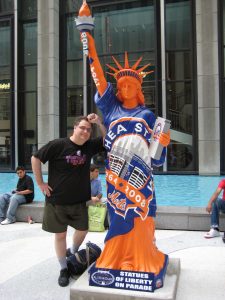 Together once. Miss Shea Liberty and I go way back, to her New York days.
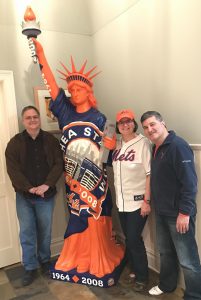 Together again.
|
|






