The blog for Mets fans
who like to read
ABOUT US
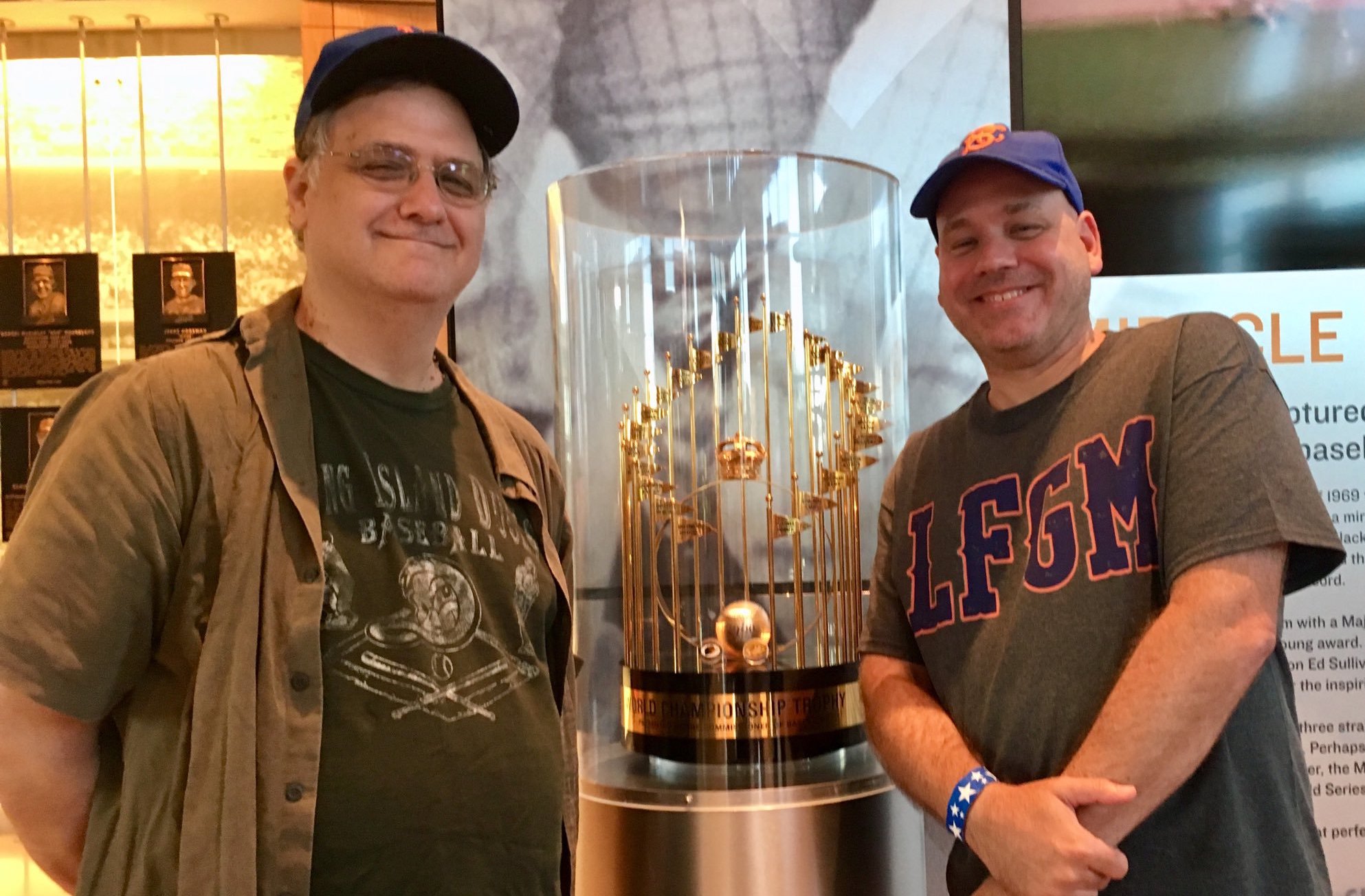
Faith and Fear in Flushing made its debut on Feb. 16, 2005, the brainchild of two longtime friends and lifelong Met fans.
Greg Prince discovered the Mets when he was 6, during the magical summer of 1969. He is a Long Island-based writer, editor and communications consultant. Contact him here.
Jason Fry is a Brooklyn writer whose first memories include his mom leaping up and down cheering for Rusty Staub. Check out his other writing here.
Got something to say? Leave a comment, or email us at faithandfear@gmail.com. (Sorry, but we have no interest in ads, sponsored content or guest posts.)
Need our RSS feed? It's here.
Visit our Facebook page, or drop by the personal pages for Greg and Jason.
Or follow us on Twitter: Here's Greg, and here's Jason.
|
by Greg Prince on 5 August 2016 1:41 pm With one swing, Jay Bruce saved and screwed us all Thursday night. The National League RBI leader — with three crucial Met runs batted in on top of eighty from Cincinnati that do us no good whatsoever — blasted a three-run homer over Yankee Stadium’s center field fence to ensure Bartolo Colon’s vintage pitching performance would not go for naught. It’s called hitting with runners in scoring position, a discipline that has escaped other Met batters throughout 2016. Bruce put the Mets up, 4-0, en route to a rather routine 4-1 win over a rather routine opponent. Jay’s jack came off Nathan Eovaldi, who I should detest on sight for being a Yankee. A ballplayer being a Yankee doesn’t much ruffle my feathers these days (though I’m always willing to grandfather in a few old-time offenders). I detested Nathan Eovaldi on sight last night for having once been a Marlin.
The win wasn’t extraordinary in an artistic sense, but it kept the Mets from descending just a little more in their quest to continue operating as a playoff contender. By beating the ho-hum Yankees, they moved to within one game of the Cardinals and Marlins — or perhaps the Carlins, a team that wryly points out the absurdities of the sport it plays vis-à-vis other sports — for the final N.L. Wild Card spot. This is what we’re reduced to reaching for, but that’s all right. It wasn’t too many Augusts ago we were reaching for next year.
Thanks Jay. Now we have to keep taking your new team’s chances no less than semi-seriously, just when we were collectively ready to dismiss them…though that’s all right, too. It’s better than all right, really, considering the alternative.
Two-thirds of the season is complete. It’s inflection point time. I’ve watched several Mets teams teeter on the brink of de facto elimination at this juncture of the schedule and teeter hard. Their current record of 56-52 evokes numbers from summers past that were about to go hard or go home.
1975: 56-53 9½ GB
1989: 55-51 7 GB
1991: 57-50 5½ GB
2002: 55-51 4½ GB (WC)
2005: 57-54 3 GB (WC)
2011: 55-51 6½ GB (WC)
When next you enter Citi Field and examine the postseason banners affixed to the Excelsior level down the left field line, you won’t see any of the above campaigns represented. A couple of those years expired immediately. Others kept our ultimately illusory hopes up into September. In retrospect, most were wishes at best. But wishing as late as the first weekend of August beats giving up in early April.
The 2016 Mets’ record is comparable to all of the above, but the margin between us and whoever we have to catch, thanks to the expansion of the Wild Card in 2012, is smaller than any those previous Mets teams faced. And though there’s been dizzying roster fluctuation since Opening Day (only nine players have been active each and every game of this season), this version of the Mets still carries a World Series pedigree into battle every night. It doesn’t mean they won’t pay $2.75 for a subway ride, but one is willing to believe that somewhere deep down they know how to win.
That’s not a very analytical statement, yet I kind of believe it. It might not carry these Mets another third of the season into the postseason, but in the short term, it means taking them reasonably seriously. Despite the lack of hitting with runners on second and/or third. Despite the bone spurs. Despite the backs and necks and quads and thumb ligaments and intercostal strains and thoracic outlets and whatever else is ailing us. Despite the golf tempest in a teapot. Kelly Johnson lines one into bandiest section of the Bronx bandbox. Alejandro De Aza reincarnates himself as Tommie Agee. Jeurys Familia continues to rise from his annual late-July visit to the ashes. Like my eldest cat who’s been sluggish from the effects of a urinary tract infection, they were up and around a little more yesterday than they were the day before. Hozzie’s suddenly looking a little better and so are the Mets.
I’m not giving up on anybody.
I’ll throw this in as well: we owe the Mets a little faith after 2015, pending their ability to string together a pair or more of wins ASAP. Yeah, they suck often and it destroys us inside when they do, but tell me this Subway Series didn’t feel far different from all of its predecessors clear to last September. Did you hear anybody talk about these games against the Yankees as any kind of proving ground? Were the Mets framed as trying to measure up to the mighty Yankees? Was there any of that “the other team in town” BS floating around?
No. The Mets did away with all of that last year, and despite their inability to win more than two of four from their downsizing neighbors, it didn’t return. Sure, the Yankees have helped by attempting to commence their version of a Houston Astros tank-and-rebuild, but to listen to those with no pre-1996 memory of New York, the Yankees were supposed to be an eternal impenetrable fortress of municipal affection. Big brother, little brother, et al, as if 1969 and 1986, to name two extreme examples, never happened.
If I may contradict another Bruce, that’s not the way it is. The Mets did some substantial winning; the Yankees didn’t; the Yankees stopped automatically mattering on a grand scale.
To those who will reflexively respond, “I never cared what the Yankees did” — and there’s always a couple in every crowd — good for you and your evolved sense of perspective. I found their overbearing presence on the local baseball scene irritating and then some. I find them incredibly irrelevant in the present. Trading a couple of ace relievers for prospects at the deadline is the least of it. The Mets, despite a current record all of two games better than that of the Yankees, exist without apology or unflattering comparison in their city for the first time in a generation.
That’s worth a few more days or weeks of solidarity with our ballclub. That and being one game out of something with 54 to play.
I recall a social studies textbook from sixth grade that included an illustration of how Europeans saw the world pre-Columbus. The earth was flat in their estimation. At the edge of the ocean were monsters, ready to devour whoever was fool enough to sail too far from port. I’m sure it made sense to them. It makes no sense to believe that if we believe in our Mets, the same emotional fate will befall us. Let Us Believe! We might find a new land, revel in new treasures, plant our flag amid new experiences!
Or the monsters will swallow our hopes whole. I didn’t say it couldn’t happen. The Mets have left themselves with just the one option this year. Watching what Washington does is pointless at this point. I tuned into one of their games recently and I felt like Rudy in Rudy when the title character is told to get off the bus his high school has chartered for prospective Notre Dame students. The Mets don’t have the grades for Notre Dame, a.k.a. the division title. They barely have the grades for Joliet Community, a.k.a. the second Wild Card, but they haven’t been ruled academically ineligible yet.
It’ll take some doing. It’ll take some healing. It’ll take some hitting, pitching and fielding. All we on this side of the ball have to do is believe a little. I will until I can’t stand to anymore, which will probably be five minutes after we’re somewhere in the middle of that monster’s digestive tract.
That moment hasn’t arrived. Come sail away with me.
If you’re still on board after Sunday, come join me Monday night, 7 PM, at Little City Books in Hoboken when we either draw inspiration from or grow nostalgic for 2015 as I discuss, read from and sign copies of Amazin’ Again. Hoboken’s hMag was kind enough to conduct a Q&A with the author, which you can read here.
by Jason Fry on 3 August 2016 11:34 pm If you were looking for four hours that would renew your faith in the Mets, well, boy did you pick the wrong night.
First the Mets played a thoroughly inept game against the Yankees, one in which a) they were atrocious once more with runners in scoring position; b) Steven Matz underpitched Chad Green to put them in an inescapably deep hole; c) Wilmer Flores looked awful at shortstop, a position there’s no longer any sensible reason for him to be playing; and d) Hansel Robles suffered a mental breakdown in which he became convinced Mark Teixeira was stealing signs, had conspired to kill JFK and was ordering airlines to spray mind-control chemicals on American citizens.
It wasn’t the most heartbreaking or tragic loss of the season — the Mets’ chronic shabbiness no longer deserves that emotional weight — but it was certainly an embarrassing one.
Oh, and then Yoenis Cespedes was put on the DL. Yes, the same Yoenis Cespedes who hurt his quad in early July and could have been disabled for the All-Star break, but was instead allowed to play on one leg for nearly a month, with the kind of results you’d expect from a baseball player with three working limbs. So in addition to making a panicky trade that will leave them calling audibles for 2017, the Mets have now turned a two- or three-week absence for their only real hitter into a six or seven-week absence, one that will almost certainly doom their season. Fine work all around, gentlemen.
But then we should have seen that one coming, because this is the same way the Mets handled injuries all last summer. It’s what led to Clayton Kershaw facing a lineup that looked like a time capsule from the ’94 strike. Heck, it’s the same way they’ve handled injuries for years, because of stinginess or incompetence or some combination of the two. I’d huff and puff that surely this can’t continue, but anyone who roots for this team will tell you it obviously can. At this point, the crazy thing would be to imagine that one day it will actually change.
by Jason Fry on 3 August 2016 12:53 am So the Jay Bruce era — you must’ve known I wasn’t going to call it Jon Niese 2.0 — is off to a roaring start.
No thanks to Bruce himself, but that’s OK — Yoenis Cespedes needed a couple of days to acclimate too. Most of us, if suddenly transferred across the country to work for a different company effective immediately, would be out of sorts for a couple of weeks. And we don’t do our jobs with 40,000 people baying at us and drawing conclusions from each little segment of our day.
“This Fry guy can’t do anything! Haw, he misspelled ‘conclusions’ and had to go back. And then he misspelled ‘misspelled.’ No, he really did. You can’t make this stuff up. Ha, lemme tweet that. Bet it’ll get a lot of RTs. BOO!!!! LEARN TO TYPE, FRY!!!!”
So yeah, let’s not schedule Bruce’s hanging quite yet.
Still, I’ll go on record as saying I’m not a fan of this trade, for a couple of reasons:
First off, I hate trading away Dilson Herrera, who came up from Double-A as a 20-year-old, held his own in the bigs, and then never got a real chance after that. Herrera’s still just 22, and I like his instincts and his bat. And who’s your 2017 second baseman now? Are we resigning Neil Walker? Shifting Wilmer Flores over because we’re once more fantasizing about a healthy David Wright? Pushing an aging Jose Reyes over there and hoping that doesn’t make Kaz Matsui reappear?
Second, the Mets have utterly bungled Michael Conforto‘s development, essentially wasting a year for the best hitting prospect they’ve had in years. This malpractice began with Terry Collins‘s baffling insistence that Conforto couldn’t hit lefties, despite a minor-league track record that said otherwise. Yanked in and out of the lineup, Conforto got anxious and then got in his own way. Now he has to compete for the playing time he needs and is being asked to play center field, which he can’t really do. The Mets have managed to hurt Conforto by not allowing him to succeed and by setting him up to fail, which is a pretty versatile display of negligence. And what happens next year? Even with Cespedes presumably gone, you still have Conforto, Bruce and Curtis Granderson and only two corner spots. Is Lucas Duda getting traded? Is there a plan at all?
One thing I’ve always liked about Sandy Alderson is he strikes me as coolly — heck, coldly — focused on the big picture, regardless of fan outrage and columnist chatter and sports-talk carny barking. I hate seeing Niese back in a Mets uniform, a point I won’t belabor, but I get that his return is a neat bit of salary legerdemain, a smaller-scale version of the Padres and Braves working together to purge mistakes. But Bruce? That strikes me as doing something to do something, which doesn’t feel very Aldersonian.
But you know one of the many great things about baseball? Unlike the rest of life, you actually hope you’re wrong. You’re ecstatic if you wind up printing out your bloggy prediction of doom and eating it. Crow can be the most delicious of banquets.
I hope that’s the case with Jay Bruce. And hey, perhaps Tuesday night’s game was an appetizer, crow-wise. The Mets got on the board thanks to a home run from Alejandro De Aza, whom most any Mets fan would have gladly driven to the airport not too long ago. They extended their lead because of a homer from Travis d’Arnaud, whom many a Mets fan wanted to trade to Milwaukee or Cleveland or the Ross Ice Shelf. Bruce didn’t get it done with runners in scoring position, but perhaps he was just being polite to his new teammates. Heck, Jon Niese did a very un-Niesean thing in his pregame press conference by passing up the chance to hurl a few ex-teammates under the bus, telling the scribes that the problem in Pittsburgh was that he didn’t pitch well.
It was only one night, but a night beating the Yankees behind seven runs is a pretty good night. Here’s to some more like it.
by Greg Prince on 2 August 2016 10:50 am On Saturday, before I slipped into my beloved PIAZZA 31 in order to pay tribute to our beloved Piazza’s 31, I dressed as a mild-mannered reporter at Citi Field. It doesn’t take much to dress like a mild-mannered reporter at Citi Field. You just wear what you’d wear to go out and get the mail, except without your favorite sports team’s logo showing. You also need a credential of some sort, which the Mets communications department was kind enough to provide upon request. I was pseudo-incognito — not recognizing myself without Mets stitched somewhere on my person — in the hours before the game in order to sit in on Mike’s pre-ceremony press briefing (his Mets career is the subject of my next book, details to come), but since I was already granted access to the room where it happens, I figured I’d stick around to hear what Terry Collins had to say.
Terry Collins didn’t have much good to say. Remember, this was Saturday, following the dispiriting losses of Wednesday, Thursday and Friday. The first words out of his mouth were that Jose Reyes was going on the disabled list and Justin Ruggiano was going to be playing center field. There are a lot of nutshells in the course of a baseball season (just inspect the floor around your seat next time you’re out at the ballpark), but that update seemed to encapsulate everything about the 2016 season perfectly. Somebody you weren’t counting on to begin with, who was now an essential stopgap, had strained something. It was initially said he’d sit as a precaution. He kept sitting, not only on the bench, but on the active roster. Eventually it was determined the player wasn’t going to heal in a few days’ time, so off to the DL he went, to be replaced by some guy you had no idea was remotely on the team’s radar.
If you didn’t see Jose Reyes coming before the end of June, you had to be Kreskin to conjure a vision of Justin Ruggiano at the end of July. But there he was, No. 1 in your program, another question mark in your head. From what I could gather, he was here because he possessed a body whose temperature measured more or less a toasty 98.6 degrees, and Terry knew him from his days in the Dodger organization. I didn’t know Ruggiano had ever been in the Dodger organization, but approximately one of every six people in baseball is somebody Terry describes as having known from his days in the Dodger organization. Kevin Bacon probably played for him at Albuquerque.
Since Terry delivered that news Saturday, Reyes has receded into the disabled background, Ruggiano has strained a hamstring, Asdrubal Cabrera has strained a patellar tendon, the Mets have lost two of three with a short bench and the Mets have made a couple of trades. The roster will shake itself out once Jay Bruce and Jon Niese arrive and it is determined if Cabrera, Ruggiano and, for that matter, Yoenis Cespedes are going to idle actively or join Reyes, Juan Lagares, David Wright, Lucas Duda, Matt Harvey, Jim Henderson, Zack Wheeler and George “The Stork” Theodore on the DL.
Somehow, amid all this turnover and uncertainty, the Mets remain playoff contenders. Seriously, go check the standings. At 2½ out of the second Wild Card with 57 games to go, you can’t say they aren’t. They won thirteen of fifteen in April and have yet to lose at a similar pace. The Mets’ record since the night Noah Syndergaard belted two home runs on the heels of Bartolo Colon going deep, and it was impossible to imagine we weren’t rooting for a team of some kind of star-kissed destiny, is 33-39. They’ve played just well enough to not lose all credibility as a contender, though you couldn’t tell it in any given nine- or ten-inning stretch when they appear to be contending mostly with mastering the basics of baseball.
Terry’s press conference on Saturday wound from the word on Reyes and Ruggiano, through an endorsement of Piazza (“it’s always fun to have him in Spring Training”), and back to whatever was ailing the Mets after Friday’s loss. “We’re not out of any race,” the manager insisted. “We keep getting some blips, but we still have a clubhouse full of good players.”
That phrase has stayed with me: “a clubhouse full of good players”. Terry knows his players better than you or I do. So does Sandy Alderson. Those who make the decisions keep the faith in those they’ve made decisions about (or at least don’t publicly betray a lack of faith in their players or decisions). Most nights, the Mets continue to present a lineup comprised predominantly of good players, or certainly players who have played well in the relatively recent past. I watch players who have not come through again and again over the past three months — Curtis Granderson, Neil Walker, Travis d’Arnaud, to name three — and I’m a little baffled that they have not been, to use the manager’s description, all that good. Perhaps the problem is other teams are also packing clubhouses full of good players, negating whatever fine qualities our fellas are bringing to the field.
Granderson, Walker and d’Arnaud each did something helpful in the course of Monday night’s soul-numbing Citi Field loss to the Yankees (the identity of the opponent barely mattering in this case, for the numbness transcended any sense of crosstown rivalry). Grandy played a superb right field, running hither and yon to track down deep fly balls. Walker and d’Arnaud teamed up very early to cut down a greedy Brett Gardner in his quest to turn a first-inning triple into an inside-the-park home run. Neil made an exquisite relay throw and Travis blocked the plate legally and effectively. In a fairer scenario, we’d be toasting their contributions to an extraordinary 5-3 or 7-6 win instead of cursing the parts they played in an aggravating 6-5 defeat.
Each man came up in what you’d call a game situation and did not deliver. Walker had been scalding hot for several days before Monday. With the bases loaded in the sixth, after shortstop Matt Reynolds, who had, in the manner these things unfold, replaced Antonio Bastardo and not shortstop Cabrera on the roster, launched an adrenalizing three-run homer, the Mets kept coming. The depleted Yankees were about to be drained of hope for the evening. Walker, the big bopper from Sunday, was up. He worked the count to three-and-oh versus the Yankees’ third pitcher of the inning. How on earth could the Mets not break this thing open?
I don’t know, but they didn’t. The count went to three-and-one. Then Walker swung. He flied out. The Met lead of 5-3 stayed 5-3. It stayed as such into the eighth when the Mets’ lockdown bullpen — the only one left in town once the Yankees traded off two of their three lethal weapons — loosened. Hansel Robles was perfect in the seventh, but Jerry Blevins put Gardner (the last of the truly irritating old Yankees) on to start the eighth. After Blevins struck out his next batter, Addison Reed came on. Another strikeout, but then a single from Brian McCann to move Gardner to third. A pinch-runner is inserted and advances on a wild pitch. It’s enough to set up the Charlie Brown Turning Point of the Game, the one in which you wail “AAUUGGHH!!” Didi Gregorius dunks a ball into left field, Gardner and the pinch-runner score and a tie that didn’t have to be suddenly was.
In this first game after the trading deadline chips fell where they may, it would have been apropos for a couple of different Mets to have delivered the big hit in the ninth. We would have settled for Michael Conforto, who, subbing for the hamstrung Ruggiano, drove in Brandon Nimmo earlier (thus making a fan who invests anticipation in top prospects believe the hype), but he flied out. We would have taken something from Walker, soon to be literally on the move, since the guy he’s subletting his apartment from — Niese — was just unexpectedly transferred back to town on business, but Neil’s bat just wasn’t in it. He, too, flied out.
OK, two out, bottom of the ninth, who ya gonna call after a heavy transaction day? Wilmer Flores, of course. Wilmer had homered in the second and, of more spiritual significance, Wilmer homered in the twelfth on the same occasion a year and a day before. Let’s let Flores unleash more Tears of Joy, making us forget the Tears of Jon some among us shed just after 4 o’clock. Wilmer worked out a walk. Not decisive, but acceptable.
D’Arnaud could play the hero. D’Arnaud was framed as trade bait. He was gonna maybe get us Jonathan Lucroy. It turned out Lucroy wasn’t so easily gettable. Cleveland thought they had him, but he wound up in Texas, alongside Carlos Beltran (the Yankees went all in on getting all out of their modest potential playoff positioning). Td’A, as much the catcher of the future for several seasons as Dilson Herrera was second baseman of the same future, has been having a spotty present at best. He seems so capable. If only he’d stay healthy, you tell yourself, he’d come through. Lately he’s been healthy. He hasn’t been coming through.
With the winning run on first, Travis struck out. The catcher who became an online cult hero one year earlier for getting caught on camera phone affirming the enthusiasm of some fans in the parking lot in the midst of the Mets sweeping the Nats (“let’s take this shit,” d’Arnaud said with all earnestness) did not enhance his legend. The Mets would have to go to extras, relying on Seth Lugo after having gone through every other available reliever behind Logan Verrett. It was a short pen without Bastardo and a short bench with Cabrera and Cespedes; Steven Matz pinch-walked at one point.
Lugo and his batterymate René Rivera — a lot of double-switching in your National League park like it oughta be — created a bit of a situation in the tenth. Seth walked Jacob Ellsbury (a recurring Subway Series irritant), after which Mark Teixeira, presumed retired, singled and Ben Gamel lay/laid/lain down a bunt that, with René providing guidance, Seth threw to third instead of first, not throwing it perfectly and creating as much of a mess on the basepaths as whoever came up with three past-tenses for lay. There were three runners, there were no outs and Seth Lugo was not designed to get out of this unscathed. A simple fly ball was needed and the Yankees got one from Starlin Castro two batters after the bunt.
Could the Mets come back on Dellin Betances in the bottom of the tenth? They didn’t have to face Andrew Miller or Aroldis Chapman. That should have been to their advantage already, yet they couldn’t do anything against their replacements Tyler Clippard (!) or Adam Warren. Yet somehow Betances immediately allowed a double to James Loney, which was fantastic. Reynolds, author of that three-run homer and another extra-base hit besides, was asked to bunt. You could feel it being a bad idea despite the admirable intent. Betances apparently isn’t a fan of handling bunts, but he did the bare minimum and tossed the ball to first to cut down Matt. He could’ve almost certainly had leadfooted Loney at third, but Dellin don’t play that.
Well, whaddaya know? All we required was one of those simple fly balls. It looked so easy to produce when Castro managed to loft one. Alejandro De Aza, who’s been having his long-awaited hot streak an ounce at a time for weeks, didn’t seem like a bad choice to deliver it. Surely he was due for a highlight reel clip. Surely “AL DE AZA!” could pass for “MIKE PI-AZZ-A!” chantwise as long as the 31 was still emblazoned on the center field grass.
After building an eerily familiar three-and-oh count, De Aza took a strike and then got hit in the leg. Yay for the extra baserunner in theory, though you harkened (or perhaps just harked) back to a night in 1986 when the last thing you wanted in the tenth inning was your batter getting hit on the leg. De Aza may sort of rhyme with Piazza, but he apparently has nothing to do with Mookie Wilson’s ability to jump out of harm’s way for wild pitch purposes with a man on third. Alejandro took his base with two outs and Loney still ninety feet away.
Granderson was the final hope. Granderson had been a defensive star. He can’t throw, but he can do everything else, and if he could do something here at bat, what a statement it would make to the incoming right fielder Bruce. “Not so fast, bub,” the game-tying single might say. “Get in line, pal,” a walkoff double would emphasize.
Strike three was all we heard blowing by Curtis. Betances nailed him and the save. For all the towel-throwing the Yankees did in advance of the deadline, they saved one sterling pitcher for one crucial inning, though the way the Mets have been hitting with runners in scoring position, the Yankees could have solicited volunteers to do the throwing. Or so it seems, despite the clubhouse full of good players who returned to their enclave as one-run losers.
Should have the Mets not done what they did Monday afternoon? Should they have not acted as contenders, despite the standings? They didn’t have quite the same towel to throw in as the Yankees did. They didn’t have too many obvious rentals to arrange for teams with more serious championship aspirations. Besides, the Mets just arrived in the ranks of contenders in 2015. Prospects galore are great when you’re heading nowhere or worse, as the Yankees judged they were, but the Mets are supposed to be reaping, not sowing, in 2016. Jay Bruce and his 80 RBIs — whether collected through wizard’s luck, buzzard’s luck or luck of the draw (I’m not sophisticated enough to dismiss every goddamn thing in this world as random; maybe sometimes somebody actually has a knack for driving in runs) — provides, in theory, some of what the Mets need now and maybe next year. Maybe unembraceable Niese pitching a tenth inning is a better bet than Lugo. I don’t warm to the thought of Jonathon 2.0, but he also once tripled as a pinch-hitter and we need all the help we can get if we’re gonna stay afloat.
Or we might sink regardless. Fifty-seven games to go, at least a few more nominally meaningful. Let’s Go Mets.
Will the Mets be rising, falling or still muddling by Monday night? I don’t know, but let’s try to figure it out together at Little City Books in Hoboken, 7 PM, August 8. Details here.
by Greg Prince on 1 August 2016 5:30 pm The immediate aftermath of the trading deadline is Christmas morning for baseball fans wherein batteries aren’t included, gift receipts aren’t available and you’re left wondering if anybody listened to what you said you wanted when they asked.
The Mets made two deals today. They could help. They could fall short of helping. There’s no doubt they did something, though. The big one was Dilson Herrera and Max Wotell to Cincinnati for Jay Bruce. An earlier version of the deal was Brandon Nimmo as the big name heading to the Reds. Then there was some talk about medical reports holding things up, which brought to mind the whole subject of these things “pending physicals”. When I have to take a physical, my doctor advises me to fast for 12 hours in advance. I imagine every major leaguer remotely on the trading block was delighted as of 4:30 PM to no longer be wandering around peckish and lightheaded.
But I digress. We got Jay Bruce, the National League leader in runs batted in, for a last-place team no less. The Mets have driven few runners in this season. I’m having a hard time not seeing at least some upside to the addition of a bona fide RBI guy. True, he presents redundancies in terms of playing a corner and batting lefty, but he’s under team control, Cespedes might walk after 2016 (or limp through the rest of it), nobody’s ever in ideal shape in that outfield and sometimes you try desperately to stroll the sunny side of the street. I welcome Bruce’s bat and will take a deep breath where lineup configuration is concerned.
Herrera was the second baseman of the future. I’m not sure where his future went. Perhaps the front office saw something in Las Vegas that was not so futuristic for Dillon. I’d have rather hung on to a legit 22-year-old second baseman and given up Nimmo if I had to make a choice, but it didn’t happen that way. Good luck, kid. Have a good career, but not so good that we forever curse the date August 1, 2016.
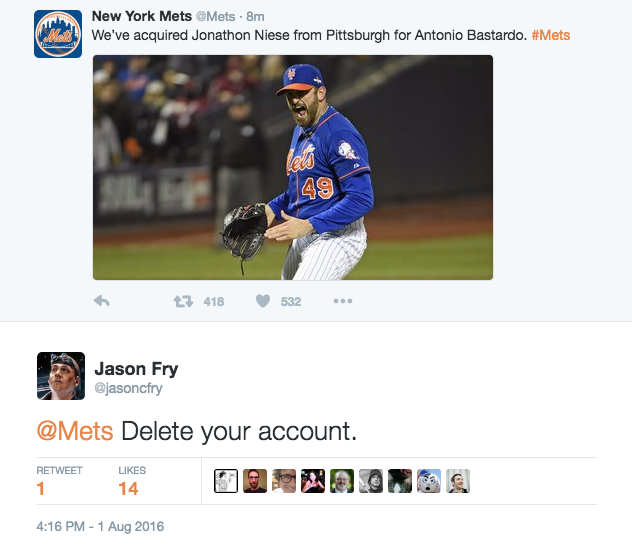
The other deal: Antonio Bastardo to Pittsburgh for Jon Niese. No, really. When it was announced, I heard myself say “YAY!” and it wasn’t to welcome back Niese. Bastardo has delayed my last train. Enjoy your reacquaintance with all three rivers; jump into any and all of them if you like. As for Recidivist Jonathon, it sounds like he’ll be pitching long relief and hopefully few fits when whoever’s in left, right or wherever misplays a single into a triple. I’m not thrilled to have Niese back, but I’m thrilled to have Bastardo gone. In this funhouse mirror version of Fulmer for Cespedes, you apparently have to accept something to get rid of something.
The Mets aren’t out of the playoff race yet. They may be soon. Or they may hang in there clear into October. We don’t know. We’ve made moves and we still don’t know. Nobody ever likes to admit to that reality when the wrapping is crumpled up and the tinsel is taken down. But we might as well.
Good luck Mets, whoever you are.
by Jason Fry on 1 August 2016 5:03 pm
by Jason Fry on 1 August 2016 10:29 am Well, the Mets finally got that big hit.
Neil Walker, looking like April’s Neil Walker, crashed a three-run homer into the seats in the seventh inning Sunday, saving the Mets from a four-game losing streak, a season sweep at the hands of the Rockies, and an extra topping of misery and angst ahead of the Subway Series. (This? Now? Why, God, why?)
Walker couldn’t get a win for Noah Syndergaard, who labored through nearly 120 pitches, though he did set the stage for another terrific outing from Addison Reed and an infinitely more reassuring one from Jeurys Familia, whose sinker looked a lot better than it did earlier this week. (Familia also had a lot better luck, which always helps.)
Walker also couldn’t do anything for poor Asdrubal Cabrera, who wound up hopping home when his patellar tendon betrayed him, redirecting him to the disabled list. Cabrera had been the Mets’ most reliable offensive player and a soothing, steadying presence at shortstop, but it’s 2016, so of course now there’s another hole stove in the bottom of the boat.
So now the Mets come to August 1 and the trade deadline. What should they do? They’re 6 1/2 games behind a Nationals team that looks a lot more imposing and a lot better led than last year’s model, and they’re 2 1/2 games behind the irritating Marlins for the second wild-card spot, with the Cardinals in their way and the Pirates and Rockies uncomfortably close behind them. As I type this, rumors are flying that Jay Bruce is coming.
Should he?
As with any trade proposal, that’s hard to answer in a vacuum. For what? If the price is Antonio Bastardo, Ray Ramirez and the costumes used in the pathetic Citi Field car race, excuse me, I’ve got to help some guys pack. Somehow I don’t think that’s the offer the Reds are considering, though.
Personally, if I were the Mets I’d sell … except they have nothing to sell that they wouldn’t be better off keeping. Maybe you could quickly turn around Neil Walker before his latest hot streak dissipates, but Yoenis Cespedes is playing on one leg, Cabrera just went down and nobody’s taking Curtis Granderson off our hands. I’d be reluctant to part with Travis d’Arnaud, whose lengthy injury record strikes me as more the product of terrible luck than anything else. (You may see TdA differently. That’s fine.) That leaves … Bartolo Colon? Reed? You’re not getting any sort of royal ransom back for them — we’re in the realm of lottery tickets and middling Double-A prospects here.
That leaves the Mets standing pat, which seems like a disappointing answer but may also be the right one. At the end of last July they needed another bat to take the pressure off their stellar pitching. Now they need a lot more than one bat, that stellar pitching’s been degraded through mileage and mischance into merely very good pitching, and the guy on the trading block is a lumbering corner outfielder — a commodity they’ve got in excess.
There’s also the danger that the giddy run of 2015 makes us believe in mirages. A year ago, Cespedes and then Daniel Murphy became the hottest hitters on the planet for six weeks while the Nationals imploded. I don’t see that happening again. I don’t see us catching the Nats and I don’t think we’re better than the wild-card competition. Plus last year the Mets had a number of minor-league arms stockpiled and a log jam at the big-league level. They dealt from a strength, as they should have, but no such surplus exists any longer.
I’d punt this season. Sell what you can from the pool of Walker, Reed and Colon and start looking at the future. Put Wilmer Flores at third and treat him like what he almost certainly will wind up being, which is your 2017 third baseman. Quit jerking Michael Conforto in and out of the lineup and let him play every day. Get Dilson Herrera up here to play. Take a look at Brandon Nimmo. Leave Matt Reynolds alone at short, or bring up Gavin Cecchini and leave him alone at short.
Baseball seasons can be heroic epics, tragedies or farces. But sometimes they’re just baseball seasons. That happens too, and it’s OK — provided you don’t damage your own cause pretending otherwise.
by Greg Prince on 31 July 2016 10:55 am You can identify my black Mike Piazza t-shirt by sight if you see me wearing it; it says Mets 31 on the front, PIAZZA 31 on the back. I can identify it by feel. It was always longer than all the player-number shirts I acquired in the late 1990s, thicker without being confining. I’m a t-shirt connoisseur, I suppose, or at least a connoisseur of my t-shirts.
I know my PIAZZA 31 well enough so that when I make the purposely infrequent decision to wear it, I know no other shirt could be covering my torso. It, like he to whom it pays tribute, is one of a kind.
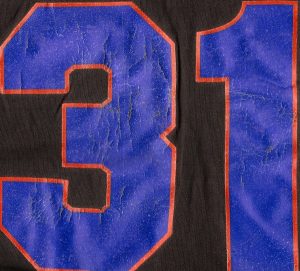 Absorbs perspiration, provides inspiration. PIAZZA 31 came out of retirement for the third time in a decade just as Piazza’s 31 was going into retirement for keeps. The last time my black shirt with the particularly dark blue and definitely cracked numbers was in rotation was October 2, 2005, Mike’s last game as a New York Met. It moved from drawer to shelf after the next laundry, re-emerging on August 8, 2006, Mike’s first visit back to Shea Stadium as a San Diego Padre. Seven years later, on September 29, 2013, while others wore the PIAZZA 31 they were handed upon entering Citi Field (I’m always impressed that people don giveaway shirts as soon as they get them), I opted for Old Glory to come out of the closet. The occasion was the induction of Mike Piazza into the Mets Hall of Fame.
One more time, I said at the end of that day. They will retire his number and I will unretire this shirt one final time when they do.
They did. And so did I. PIAZZA 31 didn’t just fit fine. It felt right. How many summer nights from 1999 to 2005 did I sweat in this shirt? How much Flushing humidity has it absorbed? (What haunting climate change story could it tell?) By the middle of Saturday night, July 30, 2016, the upper half of my body was dead certain of what it was wearing. There could be no other shirt for me on this date, just as there could be no other Met at the center of the ceremonies that demanded I dress appropriately.
A confession: I both love and hate talking about retired numbers. I love it because it’s such a carefully woven topic, consisting of so many fascinating threads. I hate it because it unravels so quickly. There is no right answer. There is no wrong answer. Usually, there are no answers, just more opinions, no two ever quite meshing. You probably could have injected the subject into the pair of political conventions just completed and had each party snipe at the other for its totally unreasonable stance.
Changing minds is a tough go in any realm these days. A person’s criteria for retiring a number seems to stay as stuck as any summer evening’s moisture to my PIAZZA 31. We should retire ‘A’ because…but wait, what about ‘B’?…never mind ‘B’…‘C’ is totally overlooked…what, you want to be like the Y’s and retire every number in sight?…besides ‘A’ wasn’t here as long as ‘B’…you guys are completely dismissing the historical significance of ‘D’…yes, but ‘E’ was already retired and ‘C’ actually had better stats…‘B’ wasn’t that great for us, not really…‘A’ had issues off the field that I can’t forgive…did ‘C’ ever actually win anything?…look at this list of numbers retired by some team we never give any thought to and how it’s ridiculously expansive…but not as expansive as the Y’s…y’know, the Y’s had a lot of really great players…‘F’ them, what about ‘D’?
I find it simultaneously the most stimulating and irritating topic in all of fandom, never mind blogdom. I value consensus and clarity almost as much I prize a t-shirt that’s as familiar as it is reliable. Arguments that circle round and round are anathema to me.
Perhaps that’s why 31’s official placement in an orange circle backed by blue pinstripes was so striking. At the moment it was unveiled, it was perfectly clear what it was doing keeping company with its handsomely relocated numerical brethren high above the left field corner at Citi Field. Exposure to Mike Piazza in all those at-bats way back when — and as he swung away at his makeshift podium Saturday — provided clarity that no number could have been more worthy of the honor the Mets were wisely bestowing on him after withholding it from everybody else for 28 years. As for consensus, if there was anybody in the house who wasn’t touched, moved and/or chilled by 31’s reveal, I couldn’t detect a nay vote.
This weekend and last remind us that Mike Piazza ruled. He was an era unto himself, and it was as invigorating an era as any that Mets baseball has offered. In a way, every Mets era fits me like my PIAZZA 31. Give me 31 seconds to think about a given season, and I’m mentally back in that season. Drop me off anywhere between 1998 and 2001 and I’m at home in the heart of Piazza Country. Nothing matters like Mike and the Mets, and nothing ever will. That’s when he and his teams pre-empted all regularly scheduled programming in our consciousness. When Piazza himself did something special — which was often — the Met Emergency Alert System went into effect. He might as well have been batting on every channel.
As with Cooperstown a week ago and the Mets’ underexposed Hall of Fame three years ago, the retirement of 31 was always, on some level, a technicality. Why would you have halls of fame and other accoutrement of what we refer to as immortality if you’re not going to ensure Mike Piazza is embroidered into their fabric? Within a franchise where importing elite talent has produced a decidedly mixed bag (may contain up to 95% letdown), Piazza was routinely great most of the time from the start. He grounded into a few more double plays than preferred his first couple of months. After that, he excelled on the regular and came through in extraordinary fashion at moments so iconic that they still bear his name. There was never any serious doubt he’d attain every honor available to a baseball player done playing.
Yet when the kudos he had coming have come along, his acceptance of them has been exhilarating. Mike has made these DVD extras to his career true bonus features. With the sudden addition of Justin Ruggiano, there have been 1,019 New York Mets. I’m willing to say that nobody among them has ever “gotten it” or “gets it” more than Mike Piazza, the “it” being this thing of ours.
Mike Piazza worked to make himself a longshot major leaguer, then a dazzling superstar. He had both of those down cold long before he arrived dazed at LaGuardia on May 23, 1998. Once he found his bearings, he worked to make himself a Met. I don’t know that anybody else ever has. He took time between cuts in the cage to notice who we were, what we wanted, how badly we wanted it. I can’t swear that our desires are tangibly different from those who adore the Dodgers or the Marlins or the Padres or the A’s, but Mike discerned during his sixteen seasons and after that it was different playing for the Mets than it was any of his other teams. It wasn’t a PR effort on his part. He understood our familial instinct, our yearning to make him one of ours, and he embraced it. He got it.
Not having come up as a Met only enhances Piazza’s legacy. After four months, he could have walked away. He could have been lavishly compensated anywhere he chose to go in the fall of 1998, places where 6-4-3 DPs and throws that sailed into center would presumably be tolerated a little longer or ignored altogether. Instead, he was determined to make it here, which studies have shown indicates you can make it anywhere. But why bother with anywhere else when you can be the rare imported superstar who doesn’t disappoint Mets fans? I really think Mike loves the Mets in that large-hearted mythic way an immigrant loves America.
That he loves the Mets like we do and loves Mets fans like we love him is not in question after the way he spoke when 31 was retired. It was right in line with what he said when the Mets installed him in their own Hall of Fame and Cooperstown’s voters finally generated a clue and did the same. He roots with us. He prays with us. He wants our current players, when they’re in need of a boost (and they sure as hell are lately), to look up at his number and derive all the inspiration they can from “Ol’ Mikey”.
We applauded everything he said and everything that was said on his behalf. We are in this together with him for as much eternity as a lifetime will allow. We will always look to 31 and appreciate how much better we were thanks to him having become one of us.
***
If you didn’t see the ceremony, by all means watch it here.
***
My deep appreciation to my wonderful sister of a non-biological nature Jodie who came up from Florida for the ceremony and made sure I got the opportunity to wear an old t-shirt for a new reason. We took in the game from the Honda Clubhouse, which is the Avenue of the Americas identity of what you probably more immediately recognize as the Mo’s Zone. It used to be fair territory. Now it’s an interesting perspective. If you position yourself properly, you’re within unique heckling distance of Carlos Gonzalez. It’s hard to resist the temptation. It’s also hard to leave at the end of nine innings, because they don’t let you out to dash to your train until the occupants of the Mets bullpen pass in front of you en route to their clubhouse.
The Ruggiano-enhanced Mets didn’t look any better versus the Rockies from ground level than they did any other angle. They’re pulseless, lifeless and teetering on the edge of 2016-hopeless. They’re also going to be sans pending Cleveland Indians catcher Jonathan Lucroy, which negates whatever was decided in recurring trade deadline conversations throughout Citi Field Saturday night (or not). I participated in one of those for a couple of innings as I slipped out of the Honda cocoon midgame and met up with two other long-distance travelers who determined they absolutely had to be on-site to witness 31’s overdue consecration. A tip of my damp black Mets cap with the 2000 World Series patch (when I go for a theme, I go all in) to my friends Mark from England and Dave from California for coming so far — not just their respective non-Honda sections — and standing with me in the drizzle between Papa Rosso and Beers of the World just so we could mull over a deal that was probably never going to happen.
I could think of worse things to get wet doing.
You can stay dry inside Little City Books in Hoboken and relive with me that golden year of 2015 on Monday night, August 8, 7 PM. It was a year ago today that the Mets made a trade and became Amazin’ Again. The contents of that book will probably come up at Little City, but feel free to talk about any year — or number — when you see me there.
by Jason Fry on 29 July 2016 11:32 pm No wait — I kind of mean it.
The Mets were down 3-1 to the Rockies in the top of the ninth, following a bottom of the eighth that was depressing even by recent Mets standards. Colorado had two men on with Carlos Gonzalez at the plate, and Antonio Bastardo, AKA the Human Curfew, was standing out there on the mound and occasionally throwing a baseball.
In the SNY booth, Gary Cohen and Ron Darling had had enough, and were idly discussing what one could accomplish between Bastardo pitches. Their candidates included booking an airline ticket and writing a country song. (I am not kidding.) In the park, the Mets fans who hadn’t already shuffled out in dejection were looking for anything blue and orange to boo. It was getting dangerously close to the Mets equivalent of the soccer riot in “The Simpsons.”
Then Bastardo roused himself to brush away the cobwebs and dust that had accumulated on his body since his last pitch and heaved a slider homeward. It only felt like Gonzalez had stood there long enough to attain free agency and be replaced by a lesser player; he was still present, eyed a slider that was doing no such thing, and hit it approximately to Portugal.
And with that, the Band-Aid was ripped off. Tragedy became farce, and this awful game stopped hurting.
So yeah, thanks Antonio.
Before that … well, must we? Steven Matz pitched inefficiently but pretty well despite that, Houdini-ing his way out of several tight spots, but wasn’t perfect and so lost. The Mets were awful again with teammates in scoring position: 0 for 7 on the night, which drops their season average to .202. If you’re wondering, yes, in fact that is the worst such mark in the history of the franchise, out-hopelessing even the ’68 club.
Still, even Don Bosch and Jerry Buchek might have found tonight’s eighth inning amazin’. With Jake McGee on the mound, Alejandro De Aza singled and Curtis Granderson moved him to second with a bloop hit. With Mets fans murmuring in tentative, fretful hope, Scott Oberg came in and threw … three pitches. Travis d’Arnaud broke his bat on the first one, with the lumber actually conking De Aza in the helmet. Yoenis Cespedes fouled out on the second pitch. And James Loney — your hitting star of the night with a solo homer — grounded out on the third.
Does hitting a teammate in the head with part of a bat count as a hit with a runner in scoring position? Because that was as close as the Mets would get.
You can’t make this stuff up. And if you could, why would you?
Honestly, there’s nothing new to be said at this point. Go read yesterday’s post, or the one from the day before that, or too many others of recent vintage. The team can’t hit, they continue to ask players to play on one leg or to sit on the bench for a while before finally moving them to the DL, the pitchers have to be perfect and pay the price when they aren’t.
The Mets are too much of a mess to responsibly be buyers and don’t have much of anything to peddle as sellers. So they continue to muddle along telling themselves and us that things are different than they are: when the losing stopped tonight, Terry Collins ordered that the clubhouse music be turned up. It was Bon Jovi, Adam Rubin informed us.
These days if you hear Jon Bon Jovi he’s touting the merits of being able to rewind live TV, and asking you to embrace the power to turn back time. Which would be nice, goodness knows — hell, I’d jam that button down until I had a chance to order Jeurys Familia not to quick-pitch Alex Gordon.
But that button’s broken for the ’16 Mets. Grampy Tim’s not coming back, the gym membership’s expired, hairlines are retreating faster than glaciers, the salsa’s perpetually mild, and not a single one of these ill-considered second children can get a hit when you need one.
by Jason Fry on 29 July 2016 9:59 am It really is true: the 2016 Mets are your 2015 Mets redux.
They pitch great, except for brief but fatal bouts of pitching lousy, and they hit something very south of great. Their not-hitting isn’t the usual baseball fan’s not-hitting where one grumbles about a player or two who can’t seem to come through. The Mets feature the kind of not-hitting where, say, a team goes 3 for 23 with runners in scoring position over a two-day stretch, with one of the three successes getting an asterisk because it didn’t score a run.
The problem for this year’s Mets, beyond that? It’s that last year’s Mets August-October offensive reboot, which turned a frustrating also-run club into league champions, was powered by crazy eruptions from two guys. One of those guys, Yoenis Cespedes, isn’t a trade candidate because he’s already here, or at least three limbs of his are. The other, Daniel Murphy, isn’t a trade candidate because he’s a Washington National and something tells me they aren’t giving him back.
I started with the offense because it’s been the real killer the last couple of days. Yes, Jeurys Familia has gagged two straight save opportunities — on Thursday the top of the ninth was a slow-motion car crash that took 26 excruciating minutes, as timed in disbelief by my pal Steve.
Up until then it had been a nice day in the park. I lucked into marvelous seats with old friends Steve and Brian, thanks to the kindness of a friend of a friend, Chris. We commiserated about previous Met woes, argued good-naturedly about shifts and replay and arm injuries, then found our seats just on the right side of the line between shadow and a whole lot of sun. A row ahead of us, Citi Field was a cauldron; where we sat, it was sticky and hot but just fine if you didn’t move around too energetically. The Mets took a skinny 1-0 lead against the Rockies and seemed poised to hold it. At least until the car skidded and we all braced for impact.
There was some bad luck involved for Familia — a Daniel Descalso bunt spun to a stop in fair territory as Rene Rivera glowered over it and a bat-breaking cue shot by Cristhian Adames was misplayed by James Loney — but there were also an alarming number of high non-sinkers, a wild pitch and the sight of a normally automatic closer wandering through the deep dark woods.
But still. If the Mets do something — anything! — with a few more of those 20 RISP failures over the last two days, Familia either comes in with a cushion or doesn’t need to be called on at all. The Mets have a great pitching staff, but day after day the bats force the pitchers to be perfect, not merely great.
I said at the beginning that the 2016 Mets sure look like the 2015 Mets, but it feels like there aren’t enough tears in Wilmer Flores‘s eyes to salvage this season. So, having said that, let me try and convince myself that I’m being way too pessimistic.
Well, here’s some evidence from Jesse Spector. The Mets are hitting a horrid .204 with RISP, far below their not particularly robust .238 batting average overall. That’s outlier enough to seem like a misprint: overall, MLB teams are hitting .255 and .257 with runners in scoring position.
So what’s wrong with the Mets’ hitters?
LACK OF GUTS, bellow the WFAN callers, but let’s not be those guys. (Ever.)
An alternate explanation is buzzard’s luck: the Mets are hitting .279 on balls in play, last in the majors. (The norm’s around .300.) Get that worm to turn, and the Mets could look a whole lot better without an infusion of new personnel that likely isn’t coming anyway. From that foundation, you can let yourself dream a little: Lucas Duda comes back, Travis d’Arnaud doesn’t go away, Michael Conforto relaxes and hits like he can. The division’s probably out of reach — Washington’s BABIP is just a tick higher than the Mets’ — but grab a wild-card slot and the Mets are immediately the team no one wants to play.
Well, maybe. But it also could be that 2015 was the outlier — the team in offensive rags that became a slugging Cinderella, only to have midnight arrive with a couple of dances left. The story of 2016 isn’t finished yet, but maybe this team never gets to the ball in the first place.
|
|