The blog for Mets fans
who like to read
ABOUT US

Faith and Fear in Flushing made its debut on Feb. 16, 2005, the brainchild of two longtime friends and lifelong Met fans.
Greg Prince discovered the Mets when he was 6, during the magical summer of 1969. He is a Long Island-based writer, editor and communications consultant. Contact him here.
Jason Fry is a Brooklyn writer whose first memories include his mom leaping up and down cheering for Rusty Staub. Check out his other writing here.
Got something to say? Leave a comment, or email us at faithandfear@gmail.com. (Sorry, but we have no interest in ads, sponsored content or guest posts.)
Need our RSS feed? It's here.
Visit our Facebook page, or drop by the personal pages for Greg and Jason.
Or follow us on Twitter: Here's Greg, and here's Jason.
|
by Greg Prince on 19 August 2016 3:27 pm The Giants certainly know how to slot their promotions, scheduling their annual Jerry Garcia Tribute Night for when the Mets came to town Thursday. A friend of mine, not much of a Grateful Dead fan, liked to tell the joke, “What did the Deadhead say once the drugs wore off — ‘man, this music sucks.’”
I like the music of the Dead (the official band of the 2016 New York Mets’ playoff hopes) just fine, but the entirety of whatever trip the Mets were on last night must have looked a lot better through a hallucinogenic prism. Not that the part where I imagined Justin Ruggiano hit a grand slam off Madison Bumgarner wasn’t, well, far out, but Jacob deGrom and I kind of crashed when Bumgarner came up in the bottom of the very same inning, the fourth, and hit his own two-run homer to completely erase what was left of the lead Ruggiano built with a single four-run swing.
Trippy, right?
The eventual 10-7 defeat negates a core tenet of my baseball philosophy: you should never, ever lose a game in which one of your batters hits a grand slam. Yet it’s happened to the Mets an unlucky 13 times in their 55-year history. Most recent before last night, it was Chris Schwinden & Co. undoing Jason Bay’s slamdiwork at Citi Field in 2011 in what became a 6-5 loss to the Braves. Most horrifying was Carlos Delgado’s salami being cut down to size by Oliver Perez and the oily rags who followed him onto the mound during the last week of Shea Stadium’s existence in 2008. This was the infamous tie score, Murphy triples to lead off, Wright coming up, bottom of the ninth, all we need is a sacrifice fly game that did not result in Daniel coming home. Luis Ayala burned the place to the ground in the tenth, 9-6, and we soldiered on to Shea Goodbye, knowing damn well we’d blown our best chance to extend the ballpark’s life.
Saddest? Sadder than Ruggiano’s beautiful night (3-for-5 and a sweet, running catch) being sabotaged by deGrom enduring the worst outing of his and almost everybody’s career? I’d have to go with Jack Hamilton, Mets starting pitcher on May 20, 1967, blasting a four-bagger versus ex-Met Al Jackson, by then of the Cardinals, in the second inning at Shea. Hamilton proceeded to return to his hurling and promptly threw the lead back up; he was out of the game in the fourth and the Mets went on to lose, 11-9.
“Hey, Jack, how was your game today?”
“Oh, great, yeah, I hit a grand slam.”
“Wonderful! What did you and the guys do to celebrate afterwards?”
“SHUT UP! JUST SHUT UP!”
The rest of the fellas whose productive bats proved no more than ornaments to futility: Frank Thomas, 1962; Eddie Bressoud, 1966; Tommie Agee, 1971; Rusty Staub, 1973; Gary Carter, 1985; Joe Orsulak, 1995; Cliff Floyd, 2005; and Fernando Tatis, 2009. In a cruel twist of fate, Tatis was starting at first base a few days after Delgado had played his final game as a Met, though we didn’t know it was Delgado’s final game. He’ll probably just need a little rest, some rehab and he’ll be back as good as new before we know it. That was that year’s baseball equivalent of one of those marathon jams that made the Dead famous. Carlos’s injury turned out to be the canary in the walking boot in the coal mine from which the 2009 Met campaign could not be rescued. Everybody (just about) got hurt, every game (more or less) was lost.
What was wrong with Delgado again? I’m going to say it was a broken heart never properly healed from how the Mets lost to the Cubs the previous September.
No Dead tribute slated for tonight at Phone Company Park, but Seth Lugo will be filling in for Steven Matz, who reported shoulder soreness and was therefore scratched. Just a precaution, they say.
Sometimes the light’s all shinin’ on us. But not often.
by Greg Prince on 18 August 2016 12:14 pm Thirteen thoughts after staying up late with the Mets and watching alongside them as their opponents crossed the plate thirteen times.
1. Jon Niese, per the late Dennis Green, is who we expected him to be. Three fine innings against those poisonous Arizona Diamondbacks, a dreadful fourth, gone in the fifth. You can’t say he didn’t provide distance, to judge by how far Rickie Weeks and Yasmany Tomas hit their home runs off him. To be fair to Niese, he was pitching in an unfamiliar time zone, in uniform tops that are described as alternate, on a Wednesday, which is a day that only occurs once a week, so how was he supposed to get comfortable?
2. The Mets did not cream Zack Godley. Whereas Alibi Yikes’ earned run average drifted upward from 5.20 to 5.30, Godley’s seven-and-a-third effective (or effectively scheduled) innings yoinked his ERA down from 5.24 to 4.85. Real clash of the titans there, huh? Neither had started a game recently, but on this desert evening, Godleyness hovered far above Nieseness.
3. Anybody remember Niese shutting out the Mets for seven innings in June? He hasn’t been remotely as good, neither as a Pirate nor a Met, since. Godley, on the other hand, had never before taken a start into the eighth inning in his major league career, but he did against the Mets. Cripes.
4. There are two Met bullpens. There is the one that keeps the Mets in ballgames that often (or used to) become wins. Then there’s the Seth Lugo Brigade, which should be ushered onto the field by the nearest Sym-Phony. Lugo didn’t give up any runs last night, so he’s excused. His compadres gave up a ton of them. Josh Edgin, the pitcher who has made it back from a year-plus of rehab, is a ghost of his former self. I could swear Edgin was a fresh face five minutes ago, but it’s closer to five years; he’s been around so long that he — like mid-’90s stalwarts Josias Manzanillo and Pete Harnisch — can say he’s given up a home run to Chipper Jones. For all you kids out there, Chipper Jones was the Yasmany Tomas of his day. Gabriel Ynoa, we hardly Ynoa ye and probably won’t get the chance to familiarize ourselves further for a while. Erik Goeddel, also not executing his best work of late, I hope sticks around until next weekend to pitch to Tyler Goeddel when the Mets play the Phillies, just so Ken Burns can direct and David McCullough can narrate how “the battle had again come down to brother against brother”.
5. Curtis Granderson broke out of his 0-for-2016 slump with a home run in the ninth inning, perhaps the most useless home run in the history of home runs. If I may borrow the phrase my blogging partner enjoys trotting out for such occasions, even the pig was rejecting lipstick at that point, opting for the natural look (“it may not be glamorous, but at least it’s who I am”). The Mets were losing by eleven runs when Curtis struck. Of course, nobody was on base. Nobody ever is when Curtis connects. Pitching for the Diamondbacks was the 88th caller to K-WOW, Where the Valley of the Sun Comes to ROCK. It was such an innocuous home run that Curtis had to remove his own helmet when he reached the dugout. To his credit, Grandy — always a standup guy — called the press box and requested it not count in his statistics.
6. René Rivera also homered off the contest-winner, which accounted for how the game wound up 13-5, despite the experiential score of a kajillion to zilch.
7. Keith Hernandez repeatedly sounded the theme that no lead is safe at Chase Field. The Diamondback leads in this series couldn’t have been more secure had they been assigned a crack Secret Service detail. Also, there was a graphic that suggested Arizona is twenty games below .500. Gotta be a typo. That’s the best team I’ve seen all year. Nationals better watch out for them in the playoffs.
8. Now a dollop of praise dispensed from an eyedropper: Ty Kelly hustles. Inserted in a fifth-inning double-switch — the same one in which bourbon replaced coffee in Terry Collins’s cup — he strung together an infield single, a walk and a double and made a helluva throw from left to nail Jean Segura at the plate. He took Travis d’Arnaud to block and circle got the square. It was truly the Met highlight of the game. Kelly may not survive the restoration of Justin Ruggiano to his rightful place at the far end of the Met bench, but geez this guy hustles on everything. He’s not much of a hitter and doesn’t seem to have a grasp on a particular position, but in seasons that are going, going, gone to hell, watching a Kelly or an Alejandro De Aza even run everything out like they mean it is sort of rewarding unto itself, especially after midnight as your team is losing by a cascade of runs to theoretically abysmal opposition. If this were a more fruitful year, we’d be praising guys like these as the Rod Gaspar or Kirk Nieuwenhuis of their moment
9. This isn’t a more fruitful year and the moment we hoped we’d live in for a spell has pulled over to the shoulder of the road while it waits for the truck the auto club is sending to give it a jump. Three-quarters done and the Mets have won exactly as many as they have lost. If Pythagorean is your thing, the Mets have been outscored by six runs across 120 games. That’s right, the Mets are playing above their statistically anticipated level. Isn’t it great rooting for a bunch of overachievers?
10. The Mets are only four games out of that second Wild Card spot that we keep hearing so much about; we have to hear about it, because it’s getting harder and harder to see. Depending on your worldview, that’s either our saving grace or loathsome burden. As long as you’re sort of in it, you’re sort of in it, and if you’re sort of in it, I believe (though you don’t gotta) you have to treat that as something approaching legitimate. Then again, three nights in the desert can make a person prone to mirages.
11. Nine games against the Western Division dregs yielded three wins. Perhaps seven games against the two current National League Wild Card occupants — four versus the slumping Giants, then three at depleted St. Louis — will be the second cartoon conk on the head that revives the guy who’s out cold after the first blow left him with stars and such circling his noggin. Sure, why not? Jacob deGrom tonight, Madison Bumgarner notwithstanding, represents as good as a chance to zoom an entire game above .500 as there is.
12. Things weren’t exactly sizzling with Asdrubal Cabrera and Yoenis Cespedes on board (plus Ruggiano, who you had no idea was here to begin with), but they’re good players and they’ll be playing this weekend, plus Michael Conforto is rumored to be scalding the ball in Nevada. Maybe he’ll be sprung from Las Vegas purgatory sooner than September 1, though I’d prefer he get everything out of his system before ascending to New York once and for all. I’m not selling this roster-reshaping as hope, simply possibility. It’s possible that more better players lead to more better games. Then again, I was kind of excited to get Jay Bruce…and not wholly discouraged when we got Justin Ruggiano.
13. For 42 more games, there’s Mets baseball. Do with that thought what you will.
by Greg Prince on 17 August 2016 10:13 am Though Noah Syndergaard delivered the biggest blow at Chase Field Tuesday night, Jerry Blevins prevented a bigger blow. Syndergaard homered in no-doubt fashion in the fifth to give himself and his team a 3-1 lead. A pitcher going yard will always grab your attention, even if the concept of Thor homering is no longer novel; it was his third of the year and the fourth of his career. Noah’s closing in on making us wonder what’s wrong when he doesn’t hit one out.
The very big shot was part of a four-run inning that seemed incredibly unMetlike within the context of their 2016 experience with the Arizona Diamondbacks, rumored to be a horrible last-place team, though we can’t tell. The Diamondbacks swept our boys last week at Citi Field and then throttled them Monday night at Phoenix. The can-go/did-go wrongness quotient was freaking off the charts in every encounter between the two, right up to the batter before Syndergaard, René Rivera, walloping a Braden Shipley pitch to deepest center, only to have it hauled in by 2013 Never Met Michael Bourn. It should have been a two-run double, maybe triple (even with the catcher running). Instead, it was a sac fly that scored T.J. Rivera from third, hallelujah, yet left a suitably cautious Alejandro De Aza stuck on second.
That the Mets had two baserunners preceding a long fly ball should have seemed like a victory unto itself. These are the Arizona Diamondbacks we’re talking about. They are as lethal as their uniforms are abysmal. Yet how typical, within the four-plus games of this season series — two on, nobody out, one Rivera muscles up, yet only one Rivera can score…and the first Rivera can’t even get on base.
Syndergaard made that turn of events relatively moot when he brought De Aza home with his blast, and Shipley gave up another run besides on Jose Reyes’s ensuing three-bagger and Curtis Granderson’s shockingly productive flyout. The Mets led, 4-1, going to the bottom of the fifth, and padded their margin in their half of the sixth when Kelly Johnson homered, peripatetic T.J. Rivera (with four hits and two errors, he was all over this game) singled and De Aza doubled. The D’Backs even made up for the Bourn larceny when nobody on the left side of their infield could make heads or tails out of a Reyes ground ball that went for a two-out RBI single.
Mets up, 7-1. What could possibly go wrong?
Youngish Rivera, starting at third at the last minute due to Neil Walker’s lower back pain (a condition prone to flaring up when you’ve been carrying the offense for weeks), commenced the bottom of the sixth with a bad throw to first. A wild pitch moved the baserunner, Jake Lamb, to second. Welington Castillo’s single with one out moved him to third. Mitch Haniger, who had just replaced Socrates Brito on the roster, cleared the bases with his first big league hit, a triple, and trimmed the Mets’ lead to 7-3. Every Diamondback is a Met-killer from birth, apparently.
Thor, who had been more or less cruising through the first five, popped up his next batter, but then was undermined by another Rivera miscue, this one requiring replay review to confirm. When an out call on pinch-hitter Phil Gosselin rightly turned safe, the Diamondbacks had another run. Then they had another stolen base, because NS + AZ = SB. One more hit drew Terry Gosselin onto the mound to fetch his smoldering starter, who had struck out eight but now wouldn’t make it through six. Syndergaard proceeded to fling his glove with characteristic velocity at the nearest wall, which was the second-most disconcerting sight within the Met dugout at that moment, next to noticing Jon Niese is still among us.
Enter Blevins to face Bourn. Bourn had earlier doubled, and the night before notched two hits. Perhaps he’s still sore that his free agent dance with the Mets from several winters before had tangoed into nothingness. Having robbed Rene Rivera in the fifth, he seemed primed to do more damage. I don’t have a stat to back up that assertion, but given what the Mets have had on their hands with the Diamondbacks last week and this, I can confidently cite minority owner Bill Maher’s recurring HBO segment: I don’t know it for a fact, I just know it’s true.
Blevins and Bourn battled for eight pitches. The count reached three-and-two. The Mets led by three. The Diamondbacks had two on. Sixteen runs had scored on Monday. Eleven runs were in on Tuesday. I didn’t know it for a fact that Bourn was going to drive in anywhere between one and three runs imminently. I just knew it was true.
Here’s some truth: Blevins struck out Bourn on the eighth pitch. Three innings later, Jeurys Familia would come on to record his fortieth save of the season by pitching a one-two-three ninth and officially preserving a nervous 7-5 Met victory — their first over these demons of the desert — but, really, Jerry saved the day. Syndergaard’s swing was more glamorous, but the one Blevins coaxed from Bourn proved the most vital.
If you stayed up to watch the entire three hours and twenty-four minutes Tuesday, on top of the three hours and twenty-nine minutes from Monday, perhaps you heard Gary Cohen list as one of the sponsors of Mets baseball on SNY Tito’s Handmade Vodka. Makes sense. You definitely need something stronger than good old Rheingold to get you through these games. By next week, it’ll be morphine.
by Greg Prince on 16 August 2016 3:39 pm “Hey, thanks for agreeing to do this on such short notice. We know you just got up here, but when Ralph heard you were in town, he really wanted to have you back on.”
“Sure.”
“Even better, we got sort of lucky with the game tonight. Welington Castillo had four hits, Travis d’Arnaud had three. We wanted to have a catcher on to talk about it.”
“Right.”
“We usually have Gary on when catchers are the star of the game, but Mr. Carter’s throat is bothering him a little. You wouldn’t think you could come down with that up here, but sometimes Kid gets carried away talking. We’re all prone to do that no matter where we are, especially after an exciting ballgame. You must know how that is.”
“Yup.”
“OK, you’ve got your mic on. I just need to get a level on you. Can you say something like you’d normally say so we can make sure you can be heard clearly?”
“Bub.”
“Uh…good, good. Oh, our host is here! You two know each other from the first season of the show, so I’ll let you two conduct your business. Cue music…Ralph, on three. One, two…three…”
“Welcome everybody to Kiner’s Korner, brought to you without commercial interruption by White Owl Cigars. White Owl Cigars, smoke ’em if you got ’em, they can’t do you any harm up here. I’m your host Ralph Kiner. The New York Mets lost tonight to the Arizona Diamondblacks, ten to six, and here to talk about it with us is a fella who was on his share of losing scores for the Mets back at the Polo Grounds, Choo Choo Coleman. Choo Choo, glad to have you on.”
“Thank you, Ralph. It’s an extraordinary pleasure to be on your television program again.”
“You know, Choo Choo, I’m pretty sure that’s the most you’ve ever said to me.”
“A pronounced reticence to speak publicly was one of my defining traits in my playing days, that is indeed an accurate assessment. But I’ve been enthusiastically anticipating a sequel of sorts to my initial appearance on your postgame broadcast. I have always regretted not providing you with a more extensive, let alone intricate series of responses to your thoughtful inquiries.”
“Wow, Choo Choo, did you pick up that cold Gary Cooper has, because you’re suddenly talking almost as much as him.”
“Carter.”
“Huh?”
“Gary Carter. I believe that’s who you meant. Sometimes you err in stating his name.”
“I suppose I do.”
“And it’s Diamondbacks, not Diamondblacks, though with their dizzying array of uniform combinations, I agree their unfortunate apparel presents a confusing conundrum of colors.”
“Right. Why don’t we look at some highlights from tonight’s game?”
“Gladly.”
“Choo Choo, there’s Wellington Beef in his first at-bat…”
“Welington Castillo, Ralph.”
“Well, Choo Choo, he certainly has no beef with the pitches of Bartolo Colon as he drives in the second run in the first inning to put Arizona ahead. Choo Choo, you must have caught Colon, who worked out the very first walk of his professional career tonight, a few times.”
“Number Forty? I think we just missed each other, Ralph, but he’s certainly been plying his craft for multiple decades.”
“And here’s Luis Castillo again…”
“Welington, Ralph.”
“It’s a double in the third, and he’ll come around to score on another double here, putting the Mets in a four-one hole. Choo Choo, what do you remember about hitting?”
“That I probably didn’t do enough of it, or I might have joined you on Kiner’s Korner more often.”
“Now Choo Choo, you shouldn’t be too hard for yourself. It says here you batted .250 in your first year with the Mets, which was the first year of the Mets, 1962. That’s not a bad average for a catcher better known for his speed and defense.”
“You’re too kind, Ralph. I’m afraid Roger Angell may have portrayed my skill set fairly when he suggested my quickness on the basepaths ‘is an attribute […] about as essential for catchers as neat handwriting’. And wasn’t Angell the scribe who compared my handling of certain pitches behind the plate to that of ‘a man fighting bees’?”
“Roger also you called you ‘eager and combative,’ which is pretty good when you’re on a team losing way more than a hundred games every season, though I have to admit you didn’t seem terribly eager to be a guest on my show back then.”
“I hope you didn’t take that personally, Ralph. Larry Burright pretty much summed up my approach to dialogue when he told the author Bill Ryczek, ‘He’d carry on a conversation with you, but to keep it going, you had to do most of the talking.’”
“That was fine for him, Choo Choo, but Larry Burright wasn’t hosting a TV interview show.”
“As I mentioned before, it just wasn’t my inclination to be voluble when I was in New York.”
“Well, your teammates certainly liked you. Little Al Jackson once said of you, ‘They always teased him for not knowing anybody’s name, but if you gave him a number and the team he played on, he would tell you what the guy hit and what he couldn’t hit. He was one of the better catchers I’ve ever had.’”
“I tried Ralph. On that I can be succinct.”
“You did more than try, Choo Choo. Sometimes you downright succeeded. In the first game you started for the Mets, shortly after you were called up from Syracuse in July of 1962, you caught a one-nothing shutout victory from Jackson in St. Louis, and you scored the only run of that game when you led off the third inning with a bunt single to third off none other than Bob Gibson. Al bunted you to second and, after Richie Ashburn struck out, you came around on Julio Gotay’s error.”
“You remember all that, Ralph?”
“I remember 1962 better than what I had for breakfast this morning, but the wins really stick out. The Mets winning a ballgame in 1962 was rare, almost as rare as the Beef Wellington I once had at a hot stove banquet in Pittsburgh. I think it was undercooked. But Beef Wellington Castillo was really cooking in Arizona tonight with those four hits.”
“Number Seven? He had a great game, absolutely.”
“Meanwhile, on the Met side, Travis d’Arnaud had three hits, though he’s still having some problems catching the ball.”
“I’m sorry, Ralph, which one is d’Arnaud again?”
“Number Eighteen.”
“Oh, Number Eighteen! Yes, he’s changed his numerical identity quite a bit of late. Well, Ralph, I think we have to be patient with catchers. I didn’t have a very good second season by all objective measurement.”
“Since you brought it up, Choo Choo, you began the Mets’ second year, 1963, as Casey Stengel’s starting catcher on Opening Day, and the Mets commenced to lose their first eight games, which was an improvement on 1962, when they lost their first nine.”
“If you wish to label me a co-conspirator in our collective difficulties, I plead guilty, Ralph, as I batted a paltry .178 in 1963, which probably explains why I wasn’t with the Mets on Opening Day 1964.”
“Choo Choo, another of your teammates, Ted Schreiber, said you could pull the ball, which was a good thing in the Polo Grounds, but as Ted put it, ‘Choo Choo used to hit balls to right field, not just foul balls, but very foul balls.’”
“I guess they all counted the same in the box score, huh, Ralph?”
“In tonight’s box score, the Mets were ten-six losers in Arizona, with the DiamondBACKS stealing two more bases off one of your successors. Any advice for Number Eighteen, Choo Choo?”
“Just keep at it, I’d say. I kept at it.”
“One of your teammates from that first Spring Training in St. Petersburg, Clem Labine, told Ryczek, ‘Nobody could try any harder than this guy,’ referring to you. That’s quite a testimony coming from a pitcher who threw to Roy Campanella.”
“That was nice of Clem, though it didn’t do me much good, I suppose, since except for a handful of at-bats in 1966, I was done in the majors after 1963. Still, I kept playing. I was at Tidewater in 1969 and would have loved the chance like d’Arnaud had last year to play in a World Series, but never got back. I even kept playing in the Mexican League as late as 1972. Heck, I barnstormed with the Indianapolis Clowns in the ’50s. Who wouldn’t want to play baseball if given the opportunity?”
“You’re right about that, Choo Choo. I had to retire early because of a bad back. Maybe if I had been able to hang on, I could’ve played with you in New York. You know, I was only 39 in 1962. I might have fit right in with you fellas.”
“We could have used your bat, Ralph, though our left fielder did hit 34 home runs.”
“That, of course, was Frank Thomas, not the second one, but the other one, who was the first one before the other one came along. You had all kinds of fascinating personalities on that club, Choo Choo. Marvelous Marv Throneberry was there, along with Hot Rod Kanehl, Elio Chacon, Charlie Neal…”
“Who?”
“Number Four.”
“Oh, my old roomie! I hear he’s up here.”
“We had him on recently. Sadly, a lot of your old teammates are up here.”
“That’s life, Ralph.”
“You’re a pretty philosophical guy for a catcher of your size, Choo Choo.”
“You have to be, Ralph. We lost 120 games in 1962, another 111 in 1963, but not only am I a guest on your program up here, people still talk about us down there. We’ve lived on in memory long after you’d think anybody in their right mind would stop giving any thought to a bunch of old ballplayers who got their brains beat in on a regular basis. I know you had fun telling the story of what a taciturn interview subject I was, but really, Ralph, I should thank you. You gave me a longer run in the Mets fan consciousness than any catcher with a lifetime batting average of .197 deserved.”
“Well, Choo Choo, it seems your brain is in good shape and you should be ready to go for any and all challenges you meet up here. The Mets fans loved you and always will, especially since nobody will be stealing any bases off you from here on out.”
“It’s the pitcher’s job to keep them on, too, Ralph.”
“That’s true. Our guest tonight has been Mets catcher Choo Choo Coleman, and before we go, I have one final question: how’s your wife doing?”
“Mrs. Coleman? Why, splendidly! If you have time, Ralph, I can share the details with you and your viewers.”
“Choo Choo, that’s not going to be a problem for us. Tell Joe Franklin we’re going to be running long tonight.”
by Greg Prince on 15 August 2016 12:30 pm Had Steven Matz carried his Sunday no-hitter attempt at Citi Field two outs further and into the ninth inning, it would have been fascinating to have seen how Terry Collins would have balanced the not necessarily meshing interests of history (or HI32ORY) and preservation…preservation of Matz’s bone-spurred left elbow. But since Matz gave up his first hit, a single down the first base line to Alexei Ramirez, with one out in the eighth, there was no issue to bandy about with Collins regarding his handling of his lefty.
Bandying commenced in the postgame press briefing nonetheless. The postgame story wasn’t, wow, Matz pitched a wonderful game against the Padres (7.1 IP, 1 H, 0 R, 2 BB, 8 SO), but what would have Terry done had Terry had to make a call on a youngster who had thrown well over 100 pitches on a hot day five days after throwing 120.
Here’s my question: why? Other than, yeah, Johan Santana and 134 pitches and Terry periodically beating himself up over Santana’s curtailed career following the First No-Hitter in New York Mets History, why harp on the manager’s hypothetical decision when there was just a splendid pitching performance and, not incidentally, a second consecutive Mets win when such a creature was considered on the verge of extinction?
I guess good news isn’t good enough anymore. Terry, nothing went wrong today — can you get into what could have gone wrong? And is knowing that something could have gone wrong eating away at your insides? Can you contort your face to show what it would have looked like in the ninth inning had Steven gone to a full count on the leadoff batter?
It struck a discordant note to a symphony of a Sunday when Matz was brilliant, Wilmer Flores and Neil Walker were powerful, Jose Reyes was rascally and victory was achieved with a relative lack of the usual angst. Matz went only as far as he did because once Ramirez’s hit was delivered, he had done all he was going to be reasonably asked to do. Complete-game one-hitters when 105 pitches are already in the books with five outs to go are no longer a thing as they might have been in the days when nobody knew how many pitches a pitcher pitched. Terry pulled the kid with a two-run lead, placed the ball and his confidence in Addison Reed’s right hand and that was that.
But Terry, if Matz had gotten Ramirez and the next batter, what then? How much Maalox do you keep in your desk drawer? Can you hang your head to replicate how much the decision would have weighed on you?
The manager, after baring his soul upon request, gave what I considered to be the sound response when he got around to it: he would have let Matz start the ninth and kept an eye on him. Fine. First, though, the angle had to be about how hard all of this was on the skipper, not how tough the pitcher was on the Padres, as if the media (a monolithic description, but it seemed to fit on this day) couldn’t handle exquisite pitching for exquisite pitching’s sake.
I guess my next question is, why do we worry so much about what people think versus what people do? Even here, as I rail at the line of inquiry, I’m indulging that unfortunate instinct. I’m down on the reporters I followed on Twitter and listened to in the briefing for obsessing on Collins’s theoretical reaction to something that didn’t happen. Instead, if I live by my own code, I should still be reveling in how good Matz is looking lately in actuality. What do I care what these people think? We’re long past the age of the filter and gatekeeper. I don’t need headlines to explain yesterday’s game to me, yet the headlines, including…
“Steven Matz’s No-Hit Bid Is Broken Up, to Terry Collins’s Relief”
“Steven Matz’s pitch count a worry as Mets’ starter flirted with no-hitter”
“Matz’s no-hit bid nearly gives Collins another Santana scenario”
…strike me as, at best, ancillary to the point. The point is Matz kept San Diego hitters off balance, the Mets rose above .500 and the flickering light of the Wild Card chase grew a teensy bit brighter. Why not ask Terry what he would have thought had Flores tripped over third base on his home run trot? Would you still encourage your players to hit the ball far, or are they better off drawing walks? Would you prefer stress-free losses to wins that encompass moves whose character you might someday be asked to express public regret about?
There must be something addicting about Collins to those who cover the team. He’s been there practically forever, his heart is visible on his sleeve and he answers questions without euphemisms. Even in a sport where the manager provides a twice-daily point of access, however, it seems Terry is approached as sun, moon and stars combined. I can appreciate his importance to the overall picture. Sunday I didn’t appreciate that a choice he didn’t have to make was treated as the overall picture.
Matz probably deserved that framing.
by Jason Fry on 14 August 2016 12:10 am Ryan Schimpf can blast home runs, but I’m not quite sure what he was doing in the bottom of the 11th, when Wilmer Flores hit a ground ball his way with runners on first and third and one out. James Loney, who moves at the approximate speed of a continental shelf, was the runner on first. Flores, whose foot speed is also best measured in global epochs, was headed that way. Schimpf fielded the ball and did what the textbook advised: get the lead runner at home. But the textbook’s author hadn’t imagined a plodding Pangaea of Mets in the neighborhood. Schimpf threw a Lucas Duda October strike homeward, nearly hitting a startled Neil Walker, and the Mets had won.
I don’t know, maybe Schimpf just wanted to see Styx.
This unexpected turn of events took the sting out of what had been another one of those nights for the Mets. They got off to a decent start, with newly re-returned Jose Reyes walking and scampering to third on a errant throw by the catcher and then scoring on Walker’s single. That looked like it might actually be enough for Jacob deGrom, who made us dream of a no-hitter before Schimpf ruined the fun in the fifth, and then surrendered the skinny lead on a Yangervis Solarte homer in the seventh.
In the bottom of the inning, the Mets did something they’ve rarely do: they picked up the shaggy pitcher who’s reclaimed the title of staff ace. Flores singled, Alejandro De Aza walked, and Travis d’Arnaud was called upon to bunt. One can argue about the wisdom of asking d’Arnaud to do so, but the base-out matrix does make the sac bunt a numerically defensible strategy in that situation — it increases the chance of scoring at least one run in the inning by a small but real 6.6 percent.
Anyway, d’Arnaud laid down a beautiful bunt, Kelly Johnson hit a sac fly, and the Mets seemed to be in business.
Except now it was Addison Reed and Jeurys Familia in the usual bind of Mets’ pitchers, needing to be perfect. Reed was, but Familia gave up a two-out blast to Wil Myers. Not so fast, Tommy Shaw and … um, you other current members of Styx. There was free baseball to be played.
Free baseball that somehow went the Mets’ way. Disaster seemed to be in the cards, with Gabriel Ynoa asked to make his big-league debut on a sticky night before a restive crowd that was tired of bad baseball. Shoved out in front of a firing squad, Ynoa earned a whatever-gun salute instead, with his first big-league strikeout capping a 1-2-3 inning. A few minutes later, Schimpf had happened and Ynoa had his first W.
It’s eminently possible Ynoa will never have another win that easy, but hey, they all count. And what’s true for pitchers is true of teams too. Schimpf should have thrown the ball to the shortstop, but he didn’t and the Mets won. When teams are going well we treat wins like that as signs of opportunism and relentlessness, the hallmarks of winning clubs. The Mets aren’t going well, but let’s not poor-mouth an honest-to-goodness victory because of that. They were due having the little black cloud take up residence over someone else’s head for a change.
by Jason Fry on 13 August 2016 12:11 am Here’s your roundup of another thrilling day rooting for the incredible shrinking National League champs:
- Zack Wheeler‘s return to the mound was followed by not being able to throw because of elbow pain, so he’s off to see Dr. James Andrews. We’re all sure this will turn out great.
- The Mets sent Michael Conforto down to Vegas again, where he will hit .300. He’ll hit .300 either because a) in Triple-A he isn’t “pressing” or b) in Triple-A he’s away from a manager seemingly hell-bent on destroying his development via irregular playing time and self-fulfilling prophecies.
- Logan Verrett was horrible yet again, as he has been for four months, and was booed off the mound. Not to worry, as he’ll be replaced in the starting rotation by underachieving alibi-prone malcontent Jon Niese, last seen out-Verretting Verrett by giving up six runs in one inning. A steady diet of shit like this makes nihilism seem like a practical life philosophy.
- The rest of tonight’s game saw the Mets annoy a pig by smearing lipstick all over it. I’m genuinely baffled by those in attendance who remained. And so I salute you. You are the true diehards, the bleeders of orange and blue who remind us all that despite trying times … oh, enough of that bullshit. You’re crazy people twice over — crazy for joining a sadistic tropical death march in the first place and crazier for staying to watch the ship sink and sharks take down the survivors.
- The 2016 Mets are now officially below .500 at 57-58. Over their last 81 games — that’s a full half-season if you’re sighing at home — they’re 36-45. That gaudy-by-comparison 57-58 record is an illusion based on things done long ago by a team that no longer exists. You’re witnessing a 76-86 club finding its level. It hasn’t reached it yet.
I think that’s all the deplorable stuff that happened today, but if I missed anything, fear not: the Mehs will be back tomorrow to muddle around uselessly and depress us further. You’ve got 19 hours to do something life-affirming and not completely futile. Make the most of it.
by Greg Prince on 12 August 2016 1:45 am Harry Truman trailed Thomas Dewey by five points in the final Gallup Poll of 1948. The New York Giants fell 13 games behind the Brooklyn Dodgers in the summer of 1951. I somehow passed geometry in ninth grade. Stories of extraordinary comebacks are woven lovingly into the American tapestry. A few stand out as legend. Y’know why? Because they don’t happen all the time.
On August 11, 2016, a former Speaker of the House invoked Truman ultimately defeating Dewey to suggest his favored presidential candidate of the moment isn’t necessarily in fatal electoral trouble. “Usually,” a trenchant Twitter observer countered, “the part of the campaign death rattle where partisans cite Truman & 1948 comes later.” That this extreme example emerged on the 65th anniversary of the sure-thing Dodgers expanding their lead over the Giants to its largest margin of the 1951 season may be an innocent coincidence or a harbinger of god-knows-what. That it also arrived on the very same day the Mets seemed to implicitly concede their 2016 campaign — or at least suspend active pursuit of the second National League Wild Card — perhaps reminds us how infrequently extraordinary comebacks come together.
I’m no geometrician, but the only angle I see that will connect the Mets to the playoffs is the line about it not being over till it’s over — which, conveniently, was drawn up in-house at Shea Stadium, so we have every right to cling to it. Again, though, that’s the stuff of legend. The stuff of legend doesn’t pop up every day.
You know who pops up every day? Met batters. They also strike out, ground out, fly out, and, if appearances are any indication, give up easily. I doubt they’re consciously throwing in the towel or waving the white flag, as both actions would require effort, but their collective demeanor does not inspire faithful fervor, let alone a modicum of confidence
On Thursday afternoon, the Mets lost to the Diamondbacks, 9-0. Noah Syndergaard wasn’t great. Jon Niese wasn’t good. The offense wasn’t present. I’d make the forfeit joke, but it’s been made already. I didn’t think we’d descend into are they even trying? territory in 2016, but their manager sort of went there in his postgame remarks, so we as mere fans don’t have to be overly polite.
The Mets looked beaten against the D’Backs the way lousy teams looked beaten against the Mets a year ago. Arizona, despite stealing away like the love child of Ron LeFlore and Robbie Dupree, is not roaring toward a Western Division title in case you were wondering. They reveled in a delightful (for them) three games at Citi Field, but otherwise they’ve endured a dreadful season. The Mets, meanwhile, front-loaded their joy into April and selected portions of May, June and earliest July. They’ve been nothing but dour since.
The “won” and “lost” columns contain absolutely equal quantities: 57 apiece. The Mets were nine games over .500 on July 7. They are nine games under .500 five weeks later. There’s a law of averages lurking somewhere inside those numbers, but a team that is 0-7 in its last seven one-run games seems determined to find a way to not win every chance it gets. They have famously not directly followed one win with another in more than a month and haven’t taken any of the past five series they’ve played.
Their relative proximity to the Wild Card — three games as of this writing with 48 to play (or ten games closer to Miami than old New York was to Brooklyn with 44 to go) — continues to tantalize, at least until you watch them conduct their on-field affairs for a month. The best that you can do between the moon and sullen Citi is attempt to conjure a scenario in which a procession of healed and hearty Mets march forth from the DL and into the lineup, proceeding to power themselves and their simultaneously rejuvenated teammates to heights the lot of them had forgotten they were capable of reaching. Reyes comes back, Cespedes comes back, Cabrera comes back, Wheeler comes back, the whole darn shootin’ match comes back. The Marlins, the Cardinals and the Pirates all find themselves stuck in the completive mud while the Mets hijack the first hovercraft they see and whoosh right by them.
It could happen. It could. It probably won’t, but it would be irresponsible of us not to entertain such a fantasy, just as it would be negligent of us to not consider that three out with 48 to play is simply another plot point on the downward graph that will have us six out with 42 to play, 10 out with 35 to play, whatever out with however many to play until sub-mediocrity lands upon its inevitable level.
You can blame the manager, because managers are hired to be blamed. You can absolve the manager, because though the manager wears a uniform, he does not swing ineffectually, pitch without fluidity or forget to go through the motions of holding opposing baserunners on. It’s probably partly Terry Collins’s doing that the Mets have been avoiding awesomeness for weeks on end, though it was probably also probably partly Terry Collins’s doing that the Mets soared above most of the N.L. pack for a spell. I almost wish I could rub two rhetorical sticks together and offer you a flaming hot take on the matter. All I will tell you is I don’t take other people’s livelihoods lightly, thus I’m probably not temperamentally suited to lead a #FireTerry torch patrol. Then again, I’m not exactly prepared to go all Tiananmen Square in his defense.
If the Mets as currently constituted were good enough to not be swept soundly by the last-place Arizona Diamondbacks, any manager could have guided them to a 1-2 record in their past three games. They’re not that good. Maybe they will be before it gets too late. Truman caught Dewey. The Giants caught the Dodgers. I eked out a 70 on the New York State Geometry Regents of June 1978, which served as my adolescence’s veritable Shot Heard Round the World. I wasn’t a witness to the first two miracles, but I can assure you I wouldn’t have bet an isosceles nickel on myself with 48 days to go in that particular school year.
Yet here I am today, complaining about the Mets, just like I did in ninth grade. Yes, that Regents Diploma really took me a long way.
by Greg Prince on 11 August 2016 4:13 am Applause for Kelly Johnson, upon the ninth-inning, one-out, two-run home run that tied Wednesday night’s game, was hearty at schvitzy Citi Field but not universal. The Metsnoscenti recognized false hope as soon as they saw it. Huzzah, Kelly, for you did what you were supposed to do, what none of your teammates managed to do in the eight innings before, but by firing a cannon shot into the branded beverage pavilion, you also prolonged the inevitable.
This was not hindsight. My old buddy Jim predicted this turn of events hours before, when the Arizona Diamondbacks sat and sat some more on an early 1-0 lead. You just know, he said, that this is one of those games where the Mets will tie it in the ninth only to set up a loss that will feel far worse because it was tied. I’d credit Jim with outsize prognosticatory abilities, except I was thinking pretty much the same thing.
We’re all Kreskin with this team. We’ve all seen this movie, yet we keep coming back for the next show. Maybe they’ll change the ending, we try to convince ourselves. But they don’t.
Pick your precedent of choice to best explain the Diamondbacks’ twelve-inning 3-2 win. It wasn’t altogether different from any of the Mets’ one- or two-run losses of late. It reminded me a bit as well of the thirteen innings spent shaking my head at the Mets and White Sox at the beginning of June, mainly because my companion at that game departed an inning before the whole thing went into the dumper, just like Jim did Wednesday. Sticklers for facsimile might recollect along with me back to another Mets-Diamondbacks game, played at roughly the same juncture of a season that refused to kindly go away until it completely, grudgingly and scarringly disappeared.
August 3, 2002, first game of a Saturday doubleheader at Shea. In the bottom of the eighth, Edgardo Alfonzo launches a two-run homer. Talk about your huzzahs. The Mets take a 5-4 lead. Fonzie is so clutch. Now all that has to be done is record three outs in the top of the ninth. We’ll simply call on Armando Benitez, and…
Yeah, right. Craig Counsell leads off with a home run. We’re tied. We go to extras. Scott Strickland hits a guy, gives up a single and then a three-run bomb to Erubiel Durazo. Mets lose, 8-5. Mets lose the second game. Mets are swept in the series. Mets don’t recover until maybe 2005. No kidding.
But who requires precedent when the present is doing a splendid job of cultivating fresh agony? Johnson was The Man for a minute, just as Bartolo Colon was the Mets’ Big Sexy finger in the dike for seven innings of seven-hit ball. Bart, in his quest to defeat the only major league team he’d never beaten, gave up a single run. Silly veteran. Doesn’t he know one run is a trick too tough for the Mets to untangle? Especially when you’re facing Robbie Ray and his cabinet full of Cy Youngs?
Correction: Robbie Ray has no particular portfolio of success in his relatively brief major league career, and he entered the evening with a 4.83 ERA. His peripherals suggest he sucked a little less than that, but not nearly enough to shut out the (try to hold your laughter) Defending National League Champions (giggle) on three hits and no walks over seven innings.
Robbie Ray, not Randy Johnson, not Curt Schilling, not Brandon Webb, not Patrick Corbin before Tommy John. Robbie Fucking Ray. This is the fucking Diamondback the Mets couldn’t touch except to shake his hand in a complimentary fashion inning after inning as he set them down.
Jesus Marshmallow Fluff on three slices of Wonder Bread. I swear. I’d use real curse words there, but the Diamondbacks stole the rest of them when Travis d’Arnaud threw his Funk & Wagnalls into center.
The simple 2-0 loss toward which the Mets were on a glide path (Addison Reed having been less invincible than usual) was averted when Johnson took Jake Barrett to the soda pop palace. We’d be lobbying Congress for a commemorative Kelly Johnson Home Run postage stamp had it been followed by an additional run of some sort. Neil Walker, who was Tuesday night’s innocent hope-raiser, singled. Jay Bruce didn’t single, but he accidentally moved Walker to second on a groundout. A team that is seriously contending from two games out of a playoff spot — which is where the Mets found themselves entering the inaction thanks to a Marlin matinee loss — gets Walker home. Chip Hale, however, changed pitchers a few more times and ultimately arranged the matchup he wanted: anybody against a Met hitter.
We went to the tenth. Jeurys Familia joined us. It wasn’t a save situation, unless you count saving the season, then by all means, get Familia in there. Jeurys did what he could for two innings (approaching midnight in advance of a noon start). He and Colon could compare notes on keeping their team afloat with zero support, just as perhaps they swapped stories on their flight home from San Diego about not being used by their manager in the All-Star Game. The only Met who tried to help Familia on the offensive side of the ball, or at least the only one who succeeded a little, was the newest Met, rookie T.J. Rivera. Credit Rivera, Met third baseman No. 162 ever (so we have one for every game of a given year), with some nifty defense and his first major league hit, a single delivered to no avail leading off the home tenth. Also, T.J. comes to bat to Lord Tariq and Peter Gunz’s “Déjà Vu (Uptown Baby),” which samples Steely Dan’s “Black Cow” and had its video shot at Shea Stadium, so anything he does once he actually bats is a bonus in my book.
The Diamondbacks have a player named Oscar Hernandez. Did you know that? On a team swimming in interesting monikers — Tuffy Gosewisch; Socrates Brito; Phil Gosselin, your State Farm Agent of the Day for all your pinch-hitting needs, to judge by his Jumbotron portrait — Oscar Hernandez doesn’t necessarily stand out, but he’ll be wandering through our nightmares alongside Craig Counsell and Erubiel Durazo for a generation or two. Hernandez, who had never homered off anybody in the majors, did so versus Jerry Blevins (whose status as “not chopped liver” I’m beginning to reconsider) to start the twelfth. The Mets trailed by one. They stayed in that position through the bottom of the twelfth, confirming the 3-2 loss that left the Mets 2½ games and a million emotional miles out of the last Wild Card slot.
These Mets reminded me of a postseason team in one sense, for I was overcome by my own déjà vu, baby, when Wednesday was over. I hadn’t been up on the first base side of Promenade quite so late after a stinging loss since Game Four of the World Series. That night I was pretty certain 2015 had reached its death throes, though it would take one more game to make it official. This loss to the Diamondbacks had that much in common with that loss to the Royals. Here, of course, 49 games remain and one hot streak (or three lukewarm spurts) could conceivably make all the difference in determining 2016’s fate. But sooner or later, our boys have to actually win games by the plural. They’re not doing it and they’re not exactly throwing off sparks in their sputtering attempts to be victorious.
Your individual Defending National League Champions (snicker) are the worst offenders. D’Arnaud, Wilmer Flores and Curtis Granderson, honest-to-god baseball heroes this time last year, went a combined 0-for-13, each of them failing at the most crucial juncture they could uncover. Travis was a disaster with opposing runners on base as well. The D’Backs have been robbing him sight-impaired. Catchers may take too much blame for stolen bases, but d’Arnaud appears to be aiding and abetting the thefts, which have totaled nine in eleven attempts these past two nights.
The 2016 Mets have not swiped my affection for the game they attempt to play. I had a wonderful experience talking up their immediate predecessors at beautiful Little City Books in Hoboken on Monday night and appreciate all my Jersey compatriots for coming out. Stephanie and I were tickled to spend Tuesday night literally behind home plate (you may have seen us on camera) alongside our friends Rob and Ryder as we executed our seventh consecutive August good-time get-together. And on Wednesday, in seats generously passed along by the geographically absent but spiritually present birthday celebrant Skid Rowe (in a section adjacent to the heretofore uncrowned Queen of Beers; she wore a t-shirt that identified her as such), Jim offered a multi-inning interpretation of Lorinda de Roulet that Elaine Stritch would have envied on her best day. It’s only when the games end and the season’s aspirations wither with them that this whole Met thing grows inexorably morbid.
by Jason Fry on 9 August 2016 11:30 pm On Sunday Emily and I were driving across Pennsylvania when I realized it was time for the Mets game. I started to turn it on, then hesitated. My wife — who’d watched as I turned on Saturday night’s game just in time to see the Mets lose on a play at the plate that their manager saw no reason to challenge — raised an eyebrow and asked me if I really wanted to torture myself.
You know what? I didn’t. I found out later that the Mets had won, said “that’s nice” and got on with my day.
On Tuesday the Mets lost to the Diamondbacks. Neil Walker hit another big home run, but Hansel Robles came in and was jobbed by the ump and then torched by the visitors. The Mets then stopped hitting and that was that.
I know this team remains tantalizingly close to the second wild-card spot, but that says more about a wan wild-card chase then it does about the Mets. Only their record in long-ago April has kept them from sinking completely out of sight; they’ve have been bad since the calendar turned to May, their overall record a slow leak to who knows what miserable level. Their badness is somewhat forgivable, given that they’ve been savaged by injuries, but they’ve also been deeply boring — they’re uninspiring when they win and flat-out unwatchable when they don’t.
If this slow jog in pursuit of being named “second-least-mediocre mediocre National League team” inspires you, well, God bless. I don’t care and I’m no longer interested in pretending that I do.
So I’m going to write about something else instead: the three ballparks I just added to my MLB list, which now stands at 24. They were all a lot of fun to see, and each had some ideas the Mets would do well to emulate. They also had some surprises for me.
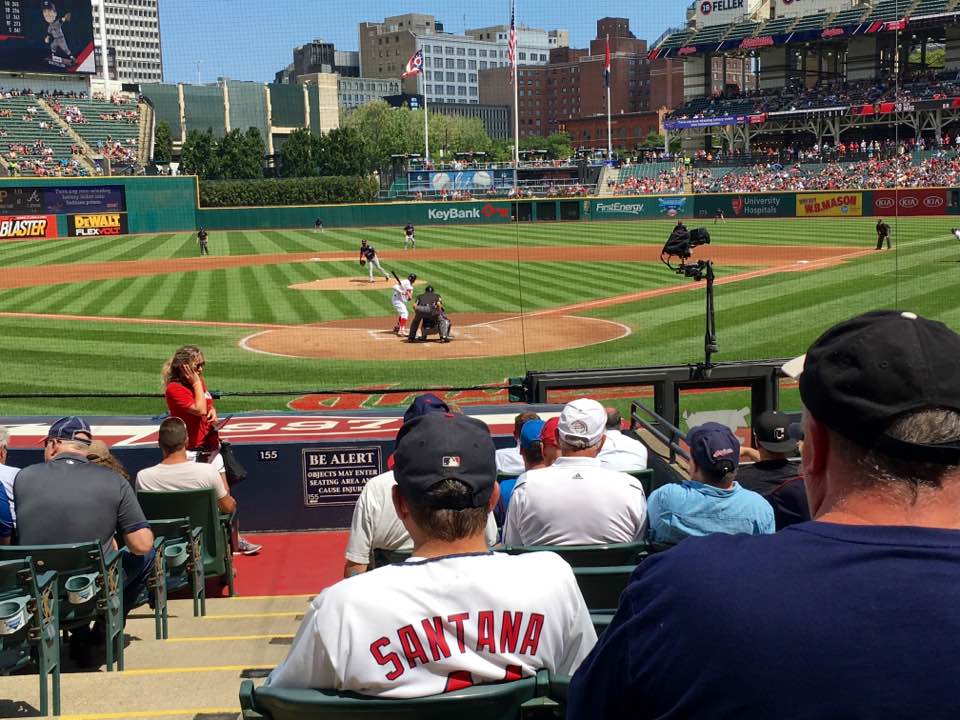
 Our first stop was Progressive Field, the home of the Indians. It reminded me a little of Petco, with its white architecture and city view. (Greg’s take from the Jake days is here.) Our first stop was Progressive Field, the home of the Indians. It reminded me a little of Petco, with its white architecture and city view. (Greg’s take from the Jake days is here.)
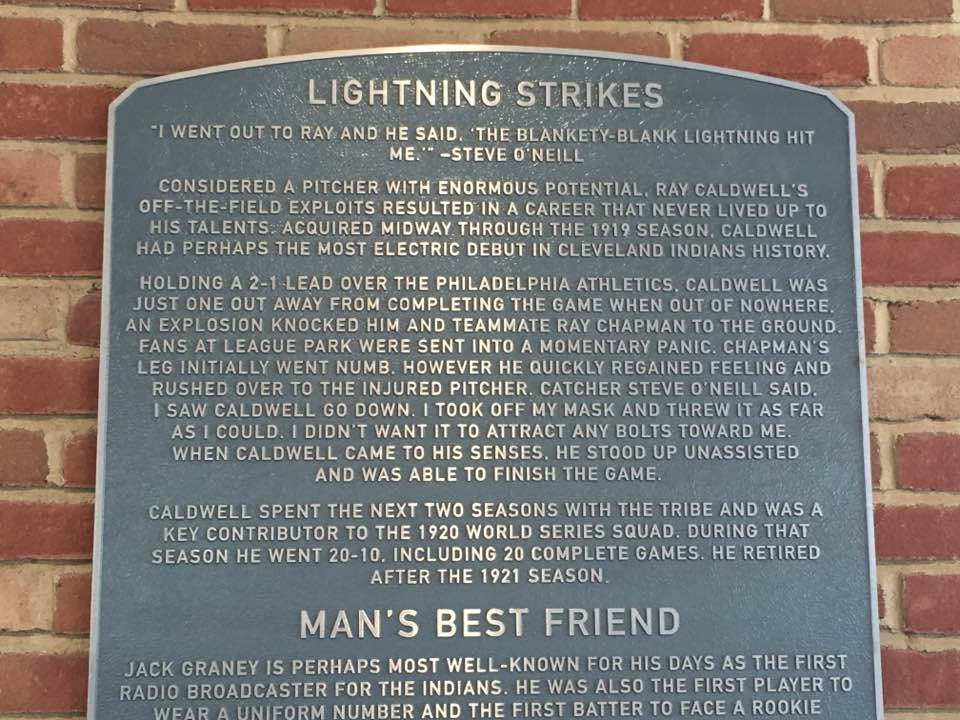
Progressive has good food, kind and attentive folks on duty and is a fine setting for a ballgame. Where it really shines, though, is how it’s meshed the history of team and city. That starts with the statues outside — Larry Doby, Bob Feller and Jim Thome greet you — and continues inside. Walking the concourse, you run across features about Cleveland neighborhoods, tributes to players such as Feller and Nap Lajoie, and plaques commemorating great and even just strange moments in Indians history.
 Upstairs there’s a simple, straightforward Indians museum and an Acela Club-style restaurant dedicated to Feller. Emily and I skulked around the latter two before realizing that since this wasn’t Citi Field, the staff was more interested in seeing if we needed anything than in policing where we should or shouldn’t be. (By the way, we only saw the Indians’ unfortunate Chief logo on a couple of t-shirts in an upper-deck store; the team’s clearly slowly phasing it out in favor of a plain red C that’s a likely placeholder for some new stab at a logo.) Upstairs there’s a simple, straightforward Indians museum and an Acela Club-style restaurant dedicated to Feller. Emily and I skulked around the latter two before realizing that since this wasn’t Citi Field, the staff was more interested in seeing if we needed anything than in policing where we should or shouldn’t be. (By the way, we only saw the Indians’ unfortunate Chief logo on a couple of t-shirts in an upper-deck store; the team’s clearly slowly phasing it out in favor of a plain red C that’s a likely placeholder for some new stab at a logo.)
Another thing we liked about Progressive Field: the A/V folks let the game breathe. You aren’t bombarded with replays, or music, or exhortations to do something. And guess what? The game works perfectly well when that stuff’s delivered in moderation.
What doesn’t work at Progressive Field? The only knock I’ll give is the upper levels are bland and missing the neat touches that make the field level so lively. (This is also the case at Petco.)
From Cleveland we headed for Detroit and Comerica Park, a stadium I’d never thought much about and so approached with few expectations.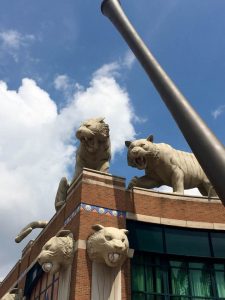
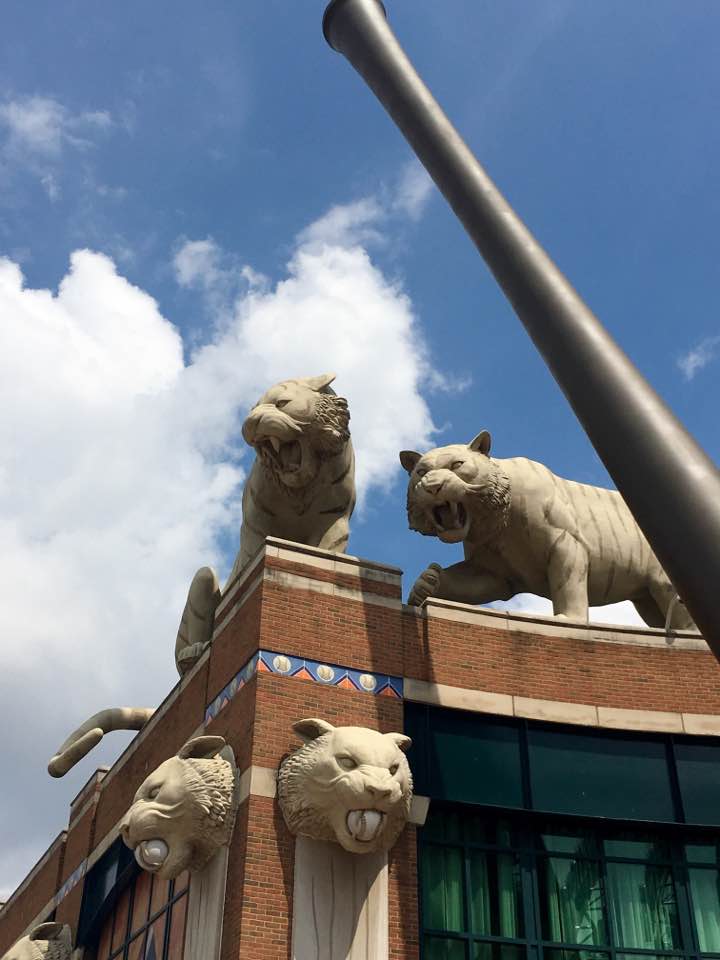
Here’s Greg on Tiger Stadium, which he loved; I found myself loving its replacement. Comerica is an architectural gem, exuberantly crowned with tiger heads and Old English D tilework and bats-and-balls friezes — it looks like a revved-up 1930s project, with an army of WPA sculptors told to go bengallistic. Right now it’s still new, but it’ll age beautifully, with fans of the 2060s marveling that someone could have loved tigers that much.
 Comerica doesn’t skimp on the details, but revels in them. For instance, the Corner Tap Room, a pub that’s half-in and half-out of the park, celebrates the Tigers’ former homes with exhibits, photos, and little touches such as flags that trace the evolution of the Tigers’ signature D. One side of the bar is labeled Michigan; the perpendicular side says Trumbull. Why can’t Citi Field do that? Rather than McFadden’s, a sterile barn that’s cut off from the park, have the Shea Club and the Polo Grounds as entry points to the new stadium and celebrations of the old ones. Comerica doesn’t skimp on the details, but revels in them. For instance, the Corner Tap Room, a pub that’s half-in and half-out of the park, celebrates the Tigers’ former homes with exhibits, photos, and little touches such as flags that trace the evolution of the Tigers’ signature D. One side of the bar is labeled Michigan; the perpendicular side says Trumbull. Why can’t Citi Field do that? Rather than McFadden’s, a sterile barn that’s cut off from the park, have the Shea Club and the Polo Grounds as entry points to the new stadium and celebrations of the old ones.
 Inside, Comerica continues to exult in its tiger theme — there’s a tiger carousel for kids (of whatever age) to ride, and the various bars feature tigers in different art styles. But the park doesn’t forget its team — each decade of Tigers history gets an exhibit with milestones, replica uniforms and much more besides: you can get a deep dive into franchise history by making a single circuit. Inside, Comerica continues to exult in its tiger theme — there’s a tiger carousel for kids (of whatever age) to ride, and the various bars feature tigers in different art styles. But the park doesn’t forget its team — each decade of Tigers history gets an exhibit with milestones, replica uniforms and much more besides: you can get a deep dive into franchise history by making a single circuit.
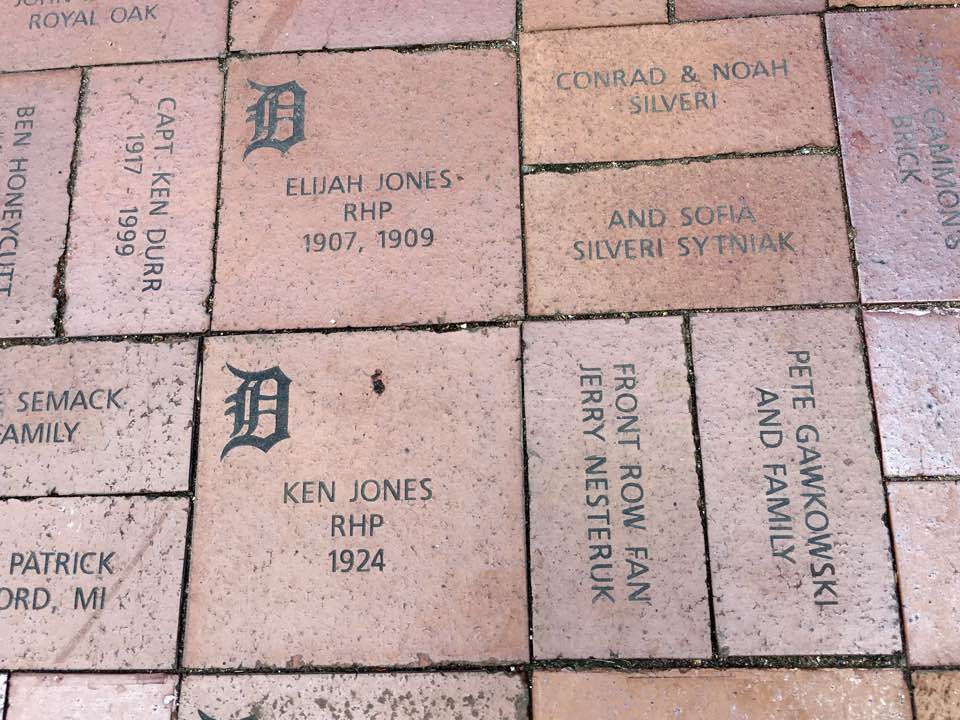
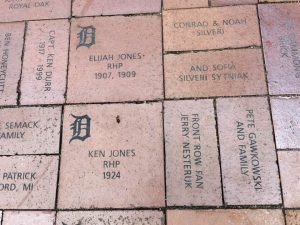 Comerica also zeroes in on a subtle but important idea: that the Tigers and Detroit are deeply interwoven and inextricable. My favorite touch: the Tigers, like the Mets and most modern teams, have a brickwalk with fan messages. But Comerica takes this commonplace theme a smart step further by mixing in bricks for each of the players in franchise history, putting Tigers and Tigers fans together. Comerica also zeroes in on a subtle but important idea: that the Tigers and Detroit are deeply interwoven and inextricable. My favorite touch: the Tigers, like the Mets and most modern teams, have a brickwalk with fan messages. But Comerica takes this commonplace theme a smart step further by mixing in bricks for each of the players in franchise history, putting Tigers and Tigers fans together.
Comerica’s presentation of the game itself needs a little work; they have an on-field “host” whose ubiquity is irritating. But that’s easy enough to fix, and what surrounds the game is really good. A park I’d never thought about turns out to be one of my favorites.
Our third stop was PNC Park, which I’d been pretty much assured would be either my favorite or runner-up to AT&T. So I was surprised to find that I merely liked it. To be clear, I liked it a lot; it’s just that I didn’t love it. (Greg weighs in here.)
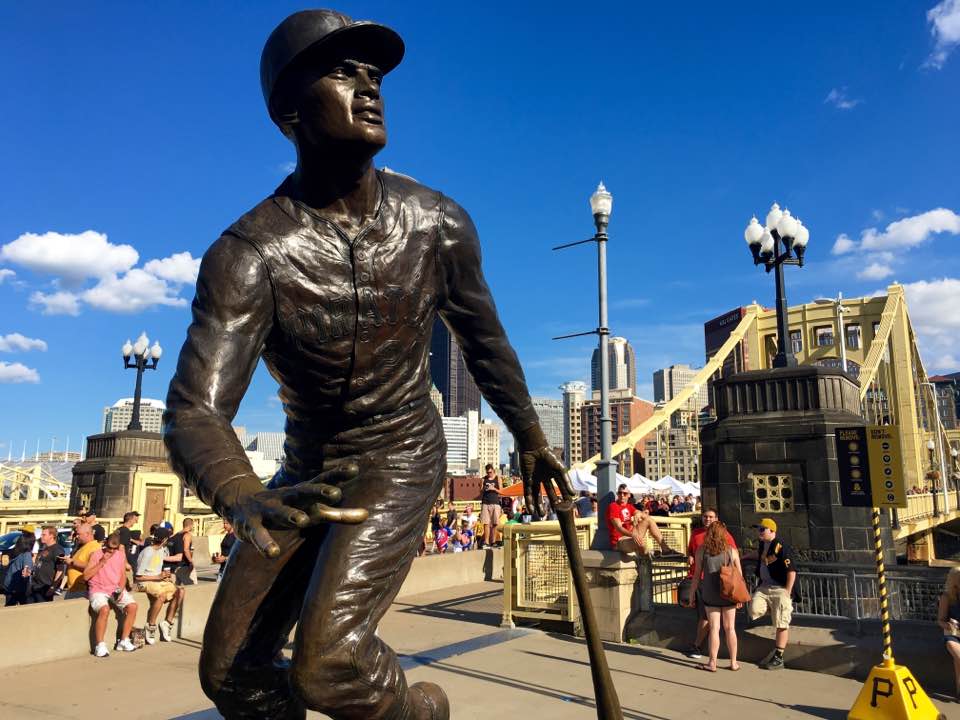
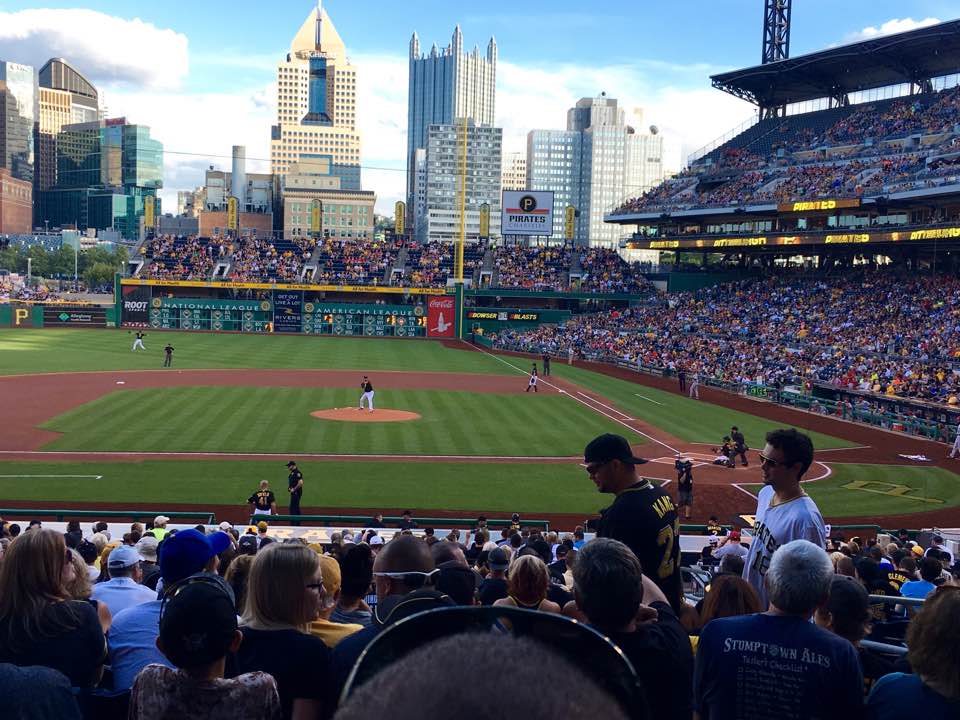
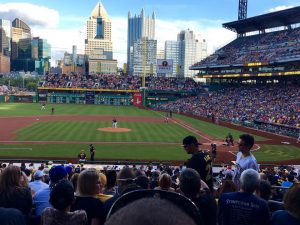
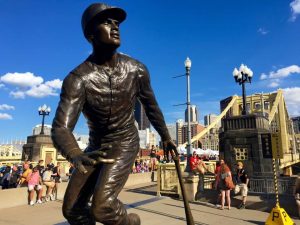 Look, PNC does a lot right. It’s fun to walk in and out across the Roberto Clemente Bridge amid a sea — take the Citi Field stairways in full LET’S GO METS cry and turn that dial to 111. Folks in the park are helpful and attentive without being in your face, and there are interesting quirks that reward exploration. And yes, the setting is undeniably beautiful: the park frames the Pittsburgh skyline perfectly, and it’s fun to stroll along the promenade behind center field overlooking the river. Look, PNC does a lot right. It’s fun to walk in and out across the Roberto Clemente Bridge amid a sea — take the Citi Field stairways in full LET’S GO METS cry and turn that dial to 111. Folks in the park are helpful and attentive without being in your face, and there are interesting quirks that reward exploration. And yes, the setting is undeniably beautiful: the park frames the Pittsburgh skyline perfectly, and it’s fun to stroll along the promenade behind center field overlooking the river.
 But I’m a little hesitant to award PNC the crown based on its city’s skyline — to borrow a line from recent politics, they didn’t build that. And while it took me a while, I eventually figured out what I felt was lacking about PNC: it doesn’t have enough Pirates in it. But I’m a little hesitant to award PNC the crown based on its city’s skyline — to borrow a line from recent politics, they didn’t build that. And while it took me a while, I eventually figured out what I felt was lacking about PNC: it doesn’t have enough Pirates in it.
Progressive Field is a valentine to Cleveland neighborhoods and Indians history; Comerica’s got tigers and Tigers competing to come out the wazoo. But PNC struck me as surprisingly lacking in team history — there’s a wan museum of sorts in the restaurant, but few of the exhibits and history lessons and little touches I’d found in Cleveland and Detroit.
 That’s frankly baffling given the team’s rich history and the city’s full-throated love for that team. Why not take a page from Comerica and give fans a goofy, gaudy pirate ship that fires cannons after home runs? Or if that’s too much for you, at least fill the concourses with Piratesiana. Tell me about the nickname’s origins, Bing Crosby, Vern Law, the original Kiner’s Korner, Danny Murtaugh, “We Are Family,” the Stargell stars, the Cobra, Andy Van Slyke, the Killer Bs and so much more. Let me learn about that stuff and revel in it, so that I can moon over the history as much as I do over the prettier-than-a-postcard view. That’s frankly baffling given the team’s rich history and the city’s full-throated love for that team. Why not take a page from Comerica and give fans a goofy, gaudy pirate ship that fires cannons after home runs? Or if that’s too much for you, at least fill the concourses with Piratesiana. Tell me about the nickname’s origins, Bing Crosby, Vern Law, the original Kiner’s Korner, Danny Murtaugh, “We Are Family,” the Stargell stars, the Cobra, Andy Van Slyke, the Killer Bs and so much more. Let me learn about that stuff and revel in it, so that I can moon over the history as much as I do over the prettier-than-a-postcard view.
(If you like, a full photo gallery‘s over here on my Facebook page.)
|
|