The blog for Mets fans
who like to read
ABOUT US

Faith and Fear in Flushing made its debut on Feb. 16, 2005, the brainchild of two longtime friends and lifelong Met fans.
Greg Prince discovered the Mets when he was 6, during the magical summer of 1969. He is a Long Island-based writer, editor and communications consultant. Contact him here.
Jason Fry is a Brooklyn writer whose first memories include his mom leaping up and down cheering for Rusty Staub. Check out his other writing here.
Got something to say? Leave a comment, or email us at faithandfear@gmail.com. (Sorry, but we have no interest in ads, sponsored content or guest posts.)
Need our RSS feed? It's here.
Visit our Facebook page, or drop by the personal pages for Greg and Jason.
Or follow us on Twitter: Here's Greg, and here's Jason.
|
by Jason Fry on 18 April 2016 11:35 pm
That was me early in tonight’s game while I watched Noah Syndergaard mow down Phillies with his ludicrously unfair arsenal of pitches. I could have waxed admiring about his curve ball too except I was out of characters.
(David Wright compared Syndergaard to a videogame player too, but I was there first, so nyaah-nyaah to our captain. Um, even if he did hit two home runs while I sprawled on a couch and tweeted.)
This was an intriguingly odd baseball game, what with the two teams collecting 17 hits and fanning 25 times and the Mets’ scoring consisting of four solo home runs and a cue-shot double by Lucas Duda against the shift. The most intriguing aspect for me was Philadelphia’s Jerad Eickhoff playing hedgehog to Syndergaard’s fox, a strategy that for a while looked like it might work.
Here’s your scouting report: Eickhoff was throwing his curve ball when he needed a strike. Whatever Met was at the plate knew it, you knew it, I knew it, the loudmouth guy in the good seats who kept barking attempted witticisms knew it, the little animated whale that briefly and bafflingly pinged around on SNY’s feed knew it, Cindy from Lee’s Toyota in her pretend Yankees uniform knew it, and all the Flyers fans getting ready to throw stuff on the ice across the street from Citizens Bank Ballpark knew it.
It didn’t matter, because that curve was hellaciously good, good enough for Eickhoff to hang around for seven fine innings and depart with the Mets on the plus side of an awfully thin 2-1 lead.
Enter the Philadelphia bullpen, though, and oh well. First David Hernandez gave up an absolute howitzer of a line-drive home run by Duda, one heralded by some Phillie fan’s mocking invocation of “DOOOO-DA” a nanosecond before Duda reduced the ball to a cloud of vaguely horsehide-scented mist. (Don’t you wish that could always happen?) Then Neil Walker once again played perfectly fine second fiddle, connecting for a home run to left that only seemed pedestrian because of what it followed. In the ninth, Wright capped things by hitting his second home run of the game, this one off Elvis Araujo, whose name Gary Cohen of course pronounces exquisitely while I can barely type it.
Can you imagine what numbers Wright would have put up if he’d made his 2004 debut as a Phillie in this park and stayed after that? Philadelphia fans would argue over Wright or Mike Schmidt while we bemoaned having run through 712 mostly lousy third basemen. We’d also have come up with half-assed reasons that Wright was loathsome, which makes for an amusing thought exercise. Um, he wipes his nose on his jersey or something before each pitch? Yeah, that’s kind of gross. David Wright is a Phillie snot rag!
Nah, it wouldn’t work. We’d just be bummed that he wasn’t ours.
Happily, he is. The Mets are .500, Syndergaard is a monster, Duda looks alive and reports of Wright’s professional death have been somewhat exaggerated. Funny how a couple of days can change one’s outlook on things.
by Jason Fry on 17 April 2016 6:38 pm The Mets won a game with me recapping, so I guess I can stay!
So can Steven Matz, who rebounded rather nicely from a horror show of a beginning to his 2016 season. Matz’s Sunday outing began with disquieting similarities to Matt Harvey‘s start on Saturday: he was cruising along but telegraphing his off-speed stuff, and you had to wonder what would happen the second time through the order.
The answer: not much.
The Mets scoring six runs before the Indians had a baserunner certainly helped, and was a luxury not given Harvey. Maybe not having to wait around for a week and a half between pitching assignments did too.
As diehards we’ve heard about Matz forever: he was signed in 2009 and lost two full seasons to Tommy John surgery, not starting in pro ball until 2012. Given all that drama, it’s easy to forget Matz won’t turn 25 until just before Memorial Day, or that his entire major-league body of work before this year consisted of nine starts — three of them in the postseason. We’ve gotten used to flamethrowers reaching Triple-A, grousing briefly about being bored, then coming up and making you say ooh in short order. That happened with Matz too, amazing even Grandpa Bert, but the kid’s entitled — as we all should be — to some scuffling and growing pains. Simply put, we’ve gotten a bit spoiled since Harvey arrived to give notice that there were new sheriffs in town.
Michael Conforto‘s a newcomer too, just two seasons removed from patrolling a different New York park with the Brooklyn Cyclones. But every time the Mets treat him gingerly, you wonder why: he’s been a platoon player despite hitting lefties well in the minors, and stuck low in the order despite his obvious skills with the bat. Keith Hernandez has repeatedly called Conforto the best hitter on the team, which I’d agree with: beyond Conforto’s God-given bat speed and power, his sense of the strike zone could have been borrowed from Edgardo Alfonzo or the Shea model of David Wright. Conforto rarely turns in an at-bat where he hasn’t maximized his chance to succeed, leveraging a hitter’s count and forcing the pitcher to risk a mistake. Today’s work: ringing double to right-center on a 3-1 pitch, hard-hit ball down the line an inning later on a 1-0 pitch, 2-1 flyout to deep left. Conforto’s assignment to the third slot in the lineup has been billed as a Cleveland-only thing, but like Keith I wouldn’t be surprised if he stays there for a generation.
Oh, and points for the Cleveland crowd: the Mets’ win was helped considerably by poor Rajai Davis losing two balls in the sun, but when Marlon Byrd was similarly undone, there was Davis streaking in from center field to save the play, to cheers that had only a mild tinge of irony. Baseball specializes in these short stories, these bite-sized passion plays that you appreciate at the time even though you’ll forget them within a couple of days. Up six it was easy to be magnanimous and smile at a player claiming a bit of redemption.
Before we go: Your baseball library could do with some excellent additions. Besides Amazin’ Again, by the esteemed Mr. Prince, check out The Arm by Jeff Passan. It’s a terrific overview of elbow injuries, why they happen, how they’re fixed and what — if anything — baseball can do to reduce their frequency. The Arm is a must-read for any fan who knows that sense of dread at the sight of a young starter shaking his arm on the mound, which is to say all of us; it’s carefully researched but also grippingly told. You’ll be riveted by the story of how Tommy John met Frank Jobe and root for Daniel Hudson and Todd Coffey as they struggle physically and mentally to return and recapture what they’d been.
by Jason Fry on 17 April 2016 12:07 am Tonight your still-winless recapper takes on the question all of us are suddenly forced to take on: What’s wrong with Matt Harvey?
To be sure, it’s April. If you’re panicking in April, you’re either new to this or ought to broaden your interests. Walking across Brooklyn on a beautiful day, Joshua and I had a long discussion about small sample sizes and the 2016 Mets. My kid is sound in terms of numeracy (particularly compared with me) and admires and craves logic, yet he’s also 13 and so is developing a teen predilection for alerting the populace to imminent apocalypses. These two impulses don’t play nicely together, and there wasn’t much I could do except shrug and say we’d see.
Harvey had sounded invulnerable on MLB At Bat, but when we got home he got dented, then dinged, and finally driven from the game, leaving the Mets trying to make up a sobering deficit and falling short. The loss kept them below .500 and created a boom market in worried Harvey analysis.
What’s wrong? Dan Warthen thinks it’s a mechanical flaw and says they’re working on it. He sees that flaw as most pronounced in the stretch. The Indians’ postgame comments also focused on the two faces of Harvey: from the windup (bestial) and from the stretch (beatable).
Maybe … but even when Harvey was in his full windup and blitzing through the lineup, the velocity on the fastball wasn’t there. Harvey was sitting at 92 to 93 and hitting 94, instead of 95 to 96 and hitting 97. He befuddled the Indians once through the order and then got whacked, with Jose Ramirez and old friend Juan Uribe and annoyingly competent Jason Kipnis and Mike Napoli and Yan Gomes doing rude things that caused neck strain and mound-kicking.
And the velocity hasn’t been there all spring.
So what does that mean? Maybe it’s a hangover from 2015 being so happily extended — Jacob deGrom‘s velocity has also been lacking in the early going. (Though for now please save your concerns for deGrom the person instead of deGrom the pitcher.) If that’s the case, the smart money says the missing velocity should report for duty, late but much welcomed.
I sure hope the smart money’s right. Because pitchers break, in ways big and small. If this were one of those ubiquitous GEICO ads, right about now someone would say it’s what they do. Having a staff of young fireballers who are also students of their craft is surpassingly rare; having such a staff stay consistently healthy is rarer still.
At least the bats are showing signs of escaping their spring torpor, which is probably just a narrative lover’s way of saying the cosmic random-number generator has been more favorable of late. Yoenis Cespedes‘s eighth-inning home run off Bryan Shaw wasn’t quite in the same bat-flip-worthy pantheon as his NLDS vaporization of an Alex Wood fastball, but it was still a mighty thing; Neil Walker‘s home run to the other field two batters later didn’t have quite the same thunder and panache but still added up to 421 feet of good news.
But the Mets still came up short, so enough with the good news. The scenarios for a second straight glorious orange and blue season all begin with dominant starting pitching; if that’s not in the offing, the scenarios are rather less glorious.
Again, though, it’s April. All we can do is what I reluctantly recommended to Joshua: shrug and say that we’ll see.
by Greg Prince on 16 April 2016 10:26 am The night started with 42s everywhere and ended with a 7 in your scorebook. I couldn’t miss the former on Jackie Robinson Day, but had to look up the latter, as sensory overload must have gotten to me, sending this correspondent nodding off to dreamland as the bottom of the eighth commenced. The last thing I remember was being told Addison Reed was coming in to pitch with a four-run lead. The next thing I heard was the Mets held on, 6-5.
I wondered how in hell the Mets nearly blew their second badly needed win in a row and how many pitchers had to use how many pitches to defend it, but then I closed my eyes, grasped the bottom line and fell back asleep until Hozzie the Feline Alarm Clock woke me aggressively for extracurricular feeding purposes (his, not mine).
The Mets indeed held on, 6-5. It wasn’t a dream, though from the details I missed gathering live, it appears it could have been a nightmare. The nether regions of the Cleveland Indians’ half of the box score — until last night I had little reason to concern myself with what the Tribe’s got goin’ on down there — has apparently been established as a haven for ex-Mets carrying a grudge against their old comrades. Funny, I remember liking Marlon Byrd and Juan Uribe when they were two of us, yet they conspired late in the proceedings with a single and then a walk to almost unravel all the good that had been done by those who still wear Met uniforms; they even got Collin Cowgill involved at the last minute as a pinch-runner.
Nevertheless, Jeurys Familia, on his fifteenth pitch to his fourth batter, crafted the one out he was asked to obtain in relief of Reed (twenty pitches, eight batters, five outs, three runs that included Carlos Santana’s two-run black magic homer to make it 6-4), inducing Jose Ramirez to fly to left, which sealed the deal at 6-5.
And that was the stuff I slept through. The part I was awake for through 7½ innings encompassed a hive of activity intriguing enough to make a fan feel as if he would miss something if he changed the channel or, heaven forefend, actually got up off the couch.
First off, there was 42 on the mound, 42 behind the plate, 42 at first, 42 around in right, 42 ready to come off the bench, 42 warming in the pen, 42 bringing out the lineup card, where he shook hands with his opposite number, who was also one of many 42s on his side. Major League Baseball decided the best way to salute the player who opened the door to diversifying the sport was to have everybody look the same from the back, and thus was born an annual tradition that blends good intentions with so-so aesthetics. Anything that gets dozens of broadcast crews talking and presumably millions of fans thinking about Jackie Robinson is for the better. As Ken Burns demonstrated again this week, you can’t tell his story enough in a country for which integration of baseball was but one small albeit significant step on a road that never really ends.
On the other hand, everybody wearing the same number at the same time in a game where the eye is trained to identify players by their numbers veers to the confusing and counterproductive, particularly during those intervals when somebody is running or throwing or entering on behalf of a not particularly recognizable opponent. We don’t see the Tribe very often and we’ve hardly seen anybody two weeks into the new season. On April 15, we don’t see anybody’s name because “42” must be, by fiat, stitched alone on all those jerseys.
It made tracking Indians who weren’t once Mets impossible without graphics. Every Met, meanwhile, triggered for me a Ron Hodges flashback. Some years, I see Ron Taylor or Butch Huskey. Friday night, perhaps because the shade of road grays matched what was in vogue from 1973 to 1984, everybody looked like a lefthanded backup catcher perpetually batting .228 with one homer and nine RBIs.
Coincidentally, those stats pretty well described the entire 2016 Mets’ offensive output entering Friday night, yet the latest iteration of Terry’s Terrors powered up like it was paying tribute to Gil Hodges. Four home runs flew off of Met bats, a couple climbing high enough to clear the ostentatiously tall left field wall of Progressive Field, a venue named for a capitalist enterprise, but you gotta wonder how the presidential candidate who proudly campaigns as a democratic socialist never held a rally there. Our particularly partisan concern, however, is that the Mets did rally rousingly, or at least homered enough so they could take a lead that was too big to fail. With Michael Conforto (now and perhaps forever batting third), Alejandro De Aza, Yoenis Cespedes and Neil Walker all going very deep, you could have not noticed the zero hits in ten at-bats they generated with runners in scoring position…and forgotten how two of those who slugged — Walker and De Aza — got themselves thrown out on close calls at the plate.
Details, details. There was so much to admire as we were being reminded what happens when Mets swing and connect and score all in one fluid, majestic motion. Despite the untimely hitting otherwise and the unsuccessful baserunning twice (one such episode confirmed by instant replay, which couldn’t possibly have had anything to do with a nine-inning contest requiring 217 minutes to complete), six runs are six runs, and as long as our pitchers didn’t give up more than five, the means of production proved highly efficient.
Taking care of the first five-and-a-third innings from the mound was Bartolo Colon, pitching in Cleveland fourteen seasons after the Indians traded him to Montreal. Compare that to Nolan Ryan in 1988 starting against the Mets seventeen years after they traded him to the Angels, or Jesse Orosco getting a big out at Shea in 2003 as a Padre sixteen years past his most recent Met assignment, and you find yourself even more impressed. When you’re invoking lords of longevity like Ryan and Orosco, you know the company Colon is keeping is enduringly elite.
The Indians received three players with loads of upside yet untapped — Brandon Phillips, Grady Sizemore and Cliff Lee — and had to give up only a pitcher pushing thirty who could have left only how many years, really? Cleveland’s haul has long been celebrated as theft, given the futures their trio revealed, while the Expos couldn’t ride Colon’s experienced arm to a Wild Card in 2002. But despite what was accomplished by those other guys, and even though Montreal was soon without Colon or anybody else at Olympic Stadium, how could anybody in 2016 look at a transaction that grants somebody use of Bartolo Colon and mark it as anything less than a draw?
Bartolo Colon: still pitching.
Bartolo Colon: still pitching in Cleveland, if not for Cleveland.
Bartolo Colon: still pitching while wearing his age on his Jackie Robinson Day uni.
Bartolo Colon: still pitching while no longer remotely resembling the Bart 1.0 featured in all that footage SNY dug up from the end of the last century.
Bartolo Colon: still pitching well nineteen years past his major league debut.
Bartolo Colon: still pitching as a former Expo when there are no longer any active big leaguers answering to that description.
Bartolo Colon: still pitching well enough and long enough on a given Friday night to rack up a 219th lifetime win, or as many as Pedro Martinez collected in a Hall of Fame career, second only to Juan Marichal among Dominican-born pitchers.
Never mind that the collective WAR to come that Montreal gave up when it sent Lee, Phillips and Sizemore to Cleveland dwarfs Colon on even his shall we say biggest day. Colon is still having big days. And he’s having them for us.
Three other lingering thoughts from before I shut my eyes prior to Familia slamming the door:
1) Colon’s fellow 1990s Tribesman, Keith Hernandez, never sounds happier than when he tabs a player of tenure “a veteran,” which was how he pardoned De Aza running the Mets out of a seventh run, attempting to go first to home on Curtis Granderson’s single to right. He also never sounds more wistful than when he invokes the phrase “used to be”. The Gospel According to Keith implies baseball peaked when Bob Gibson was putting him in his rookie place, and it’s all been a steady decline, for the sport and the society that surrounds it, ever since. Friday night Keith blamed bloggers, Tweetsters, basically anybody who has lately expressed a Mets opinion without benefit of a newspaper column for raising Terry Collins’s hackles over bullpen use and perhaps overuse. The subtext was, in essence, you fans should really shut up and let the professionals take care of business. At times like these, it is helpful to remember a) some player turned analyst who was never as spectacular as Keith at either discipline probably put forth the same sorts of criticisms of modernity in Keith’s day, declaring that the current era (1974-1990 in Hernandez’s case) was a travesty compared to the way things used to be; and b) he’s Keith Hernandez.
Honestly, the second thing is all I have to keep in mind.
2) David Wright, who has worn 42 once a year for so many years that it looks almost normal on him, is having throwing problems that may never go away. One assumes this is stenosis’s doing, which is not just a shame for all the infield outs that will go unmade, but doubly vicious when you hark back to how hard he worked to stop making the routine throwing errors that plagued the early stages of his career. But man, as could be seen when Yan Gomes reached on an E-5 to start the bottom of the sixth, he does not look good slinging that ball across the diamond.
3) Curtis Granderson is The Man in so many ways. Nobody works harder at fan relations. Nobody sounds smoother conducting himself with the media. Nobody, based on the torrent of public relations email we receive, does more to promote baseball in his ostensible off hours. He even jacked his average up past .100 Friday night. But the long version of the Curtis Granderson Sock Day commercial is a narrative disaster.
In it, we see a mostly fully home-uniformed Curtis keeping loose by running barefoot sprints back and forth in front of the team clothes dryer. The time posted on the screen is 7:07 PM, the conceit being his socks better be dry soon because the game is about to start. Sure enough, Alex Anthony can be heard announcing that now leading off for the Mets is the right fielder, No. 3…and we watch Curtis grab his socks and dash toward the field.
It’s terrific to see the Mets get creative with these spots — the Syndergaarden Gnome is an instant classic — but instead of motivating me to be one of the first 15,000 through the gates on May 1 to pick up my pair of Curtis Granderson baseball socks, it has me wondering if anybody was manning right while Grandy’s socks dried. First pitch is 7:10 PM; first batter is the visiting team’s leadoff hitter. Given the setup, the top of the first is clearly at hand and therefore Curtis has to be in right. (I’ve already ruled out “all this occurs within a ghastly dystopian future where the designated hitter has been inflicted upon National League parks, all clubhouse staff has been let go and, oh yeah, Bryce Harper is forever 23 and therefore always getting better” as an explanation, for Anthony has already mentioned Granderson is playing right.) Unless a special arrangement was made to have the Mets wear their home uniforms and bring along Citi Field’s public address announcer to a road game, there is no way this otherwise admirable and amusing commercial makes a lick of sense in terms of story.
Well, it doesn’t.
by Greg Prince on 15 April 2016 2:21 pm A few notes to pass along regarding Amazin’ Again, my book on how the 2015 Mets brought the magic, not to mention a pennant, back to Queens.
1) For those who are kind enough to ask, yes, you can get a personally inscribed signed copy. It’s available via the Team Amazin’ store on eBay, which is run by my lovely sister, so why don’t you do the kid a favor and check the page out? I’ll write anything you like, other than an early surrender for 2016.
2) This Sunday night at 8:30 EDT, I’m scheduled to discuss my book with Bill Donohue on Sportstalk1240, a.k.a. Long Island’s own WGBB-AM, a station I grew up listening to for music in fourth grade and school closings in junior high (ninth grade was a very snowy year).
3) And speaking of Long Island, I will be speaking on Long Island next month, appearing at beautiful Turn of the Corkscrew in Rockville Centre, Monday night, May 16 at 7 PM. I’ll be mentioning this again down the road because I’m very excited to be part of the books-and-wine motif that the Corkscrew folks have created. I’m particularly delighted because a) I have often been asked when I, native son of the South Shore, might be doing a Long Island appearance; and b) not only is this a terrific venue, but it’s one that is actually near where I live. So come on out to my veritable backyard for a little food, a little drink and a lot of Mets (on a night when our team is conveniently off).
by Greg Prince on 14 April 2016 2:17 am Four consecutive losses could have made a person think the stop after 111th Street on the 7 local to Flushing had been redubbed Mets-What’s The Point? The young season was clearly too callow to know it was already over (otherwise, it would have had the good sense to suspend its campaign). The plunging Mets might as well have dared those of us coming out to meet them and greet them to enjoy them.
Yet we did. Stephanie and I made a rare midweek day trip to Citi Field on Wednesday. Not so rare for me, but rare to the point of exotic for her, especially in April. My wife loves her Mets, but generally from a distance when there’s a literal chill in the air, not just the figurative kind coming from the home team bat rack. The relentlessly gracious Chapmans — Sharon and Kevin — had invited us and some other friends of theirs to join them for a treat bordering on indulgence: an afternoon not just at the ballpark, but in an Empire Suite. Wonderful people, team loyalty and a guaranteed modicum of climate control combined to make my usual solo act a couples activity.
A game in a suite is like a game anywhere else if you’re dedicated to the game. And we were. But I’d be kidding you if I didn’t admit an amenity or two beyond the functioning heat lamps infused the gathering with a little extra zest. At a less desperate Metsian hour, I could regale you with tales of the tray of Shackburgers in our midst and speculate as to why a perfectly sated man matching my general description lunges for an available eighth-inning sauerkraut-laden hot dog just because, like Everest, it’s there. Gluttony is one of the seven deadly sins, as is wrath, and I’m sure that on Wednesday I could’ve been brought up on charges of both. (Throw in sloth, too, if you like; I’m no prize.)
Alas, self-examination will have to be tabled, somewhere next to the suite’s popcorn-filled batting helmets, for the business at hand in this final game of the first homestand of 2016 was not about what was partaken of too heartily, but what was provided in servings too small.
The Mets, you’ve likely noticed, haven’t scored very much this year. There were seven runs during the Home Opener, and otherwise they’ve generated as close to nothing as they can without provoking a copyright infringement lawsuit from the Porgy and Bess Society. Their scoreboard lines have featured plenty of nothing, particularly very recently: 0 runs on Saturday; 2 runs on Sunday; 3 runs on Monday; 1 run on Tuesday; 2 runs on Wednesday.
When you have starting pitching like the Mets possess, you can get by to a certain extent on a scoring-optional plan, but it requires needles being threaded and puzzles being solved.
The 0 doesn’t work whatsoever.
You have to be exceedingly fortunate to make the 1 stand tall.
2 or 3 makes your pitching staff’s day exceedingly difficult, but not altogether impossible.
This mathematical approach sure as shootin’ didn’t grease the skids of glory for spot starter Logan Verrett when the Mets went with zero for the six innings while he was in (hadn’t any of his teammates thought it a good idea to produce Logan’s run?). Yet Verrett — in the best tradition of backup quarterbacks who looked great in preseason and candidates who compile “surprisingly strong” showings without actually winning in early primary/caucus states — really gave us more than we could have expected. Our sixth starter went six innings versus Miami, allowing no dents whatsoever. The young man has the makings of a cult hero. Surely somebody called WOR or WFAN and suggested Verrett’s a better bet than Matz or Harvey or, for that matter, Kasich, based on late returns.
In so-called Panic City, where the streets are not zoned for small sample sizes, Verrett deserves a spot on somebody’s ticket. Perhaps he could be appointed Commissioner of Exactly What We Needed by Mayor Collins, who would eventually endorse every reason to lift the longstanding curfew on bullpen overuse and declare martial law.
Terry’s draconian measures didn’t take full effect until after Logan gave his 85 pitches of all to the civic cause. Jim Henderson came on for the seventh. Jim Henderson is shouldering quite the workload for a fella who throws hard with a surgically repaired shoulder. Maybe he’s throwing not quite so hard as he had been, given how much he’s being asked to throw. The New Toy Syndrome is a familiar one to anybody who’s watched Collins cling to whoever’s arm is freshest and hottest until it’s neither.
It wasn’t Henderson’s day, even though it seems every day is a day that includes Henderson, especially on Tuesday night when he threw 34 not particularly effective pitches. He faced three batters Wednesday. Three batters reached. Enter Hansel Robles, who bailed Jim out two-thirds of the way, then Jerry Blevins, who finished the provisional job. Hallelujah, the bases that were loaded with Marlins never led to a home plate stained by their slimy gills.
Then again, the plate was a pristine dish of 0-0 proportions clear to the bottom of the seventh, which was when the Mets’ bats creaked slowly awake. Wilmer Flores, first baseman for the first time in his MLB career, led off with a single and took second on a wild pitch. Asdrubal Cabrera and his one run batted in to date came up. I mentioned wrath before. I feel no wrath for Cabrera, who strikes me as a more pleasant Rey Sanchez-type, one with something left in the tank and no impulse to visit the clubhouse for an in-game trim.
Yet I can work up a quiet froth when I see a prospective rally broached by a prospective rallykiller, which is what, in the moment, I decided Cabrera was. I said, sotto voce, to Stephanie, “This guy is never going to get a big hit for us this year.” And with that, Cabrera got a big hit for us, singling hard to right, chasing Flores to third. After Juan Lagares moved Cabrera to second — which is a nice way of saying he tapped back to the mound — Kevin Plawecki and his no runs batted in to date (albeit in limited utility) came to bat, inspiring in me precisely as much confidence as Cabrera had. Without irony or desire to be adorable, I said the exact same thing to Stephanie about Kevin as I had Asdrubal: “This guy is never going to get a big hit for us this year.”
Color me a satisfied shade of corrected when KP did his duty and drove in a pair with a single before optimistically getting himself thrown out at second. I guess you can spell his last name with two RBI. Hurrah for being shown up! The Mets led 2-0; the Marlins, despite their innate despicability, weren’t imitating their manager in terms of causing their lumber to smolder; and now all that needed to be done to get the Mets headed to Cleveland in relatively fine fettle (the only kind of fettle anybody ever embraces) was the stitching together of six outs.
The first out, in the top of the eighth, was a simple fly ball to left, preceded by a leap and dive into the stands by the left fielder who makes nothing simple, which previews as alternately pleasing and horrifying where the next 154 games are concerned.
My, but does Yoenis Cespedes add spice to every facet of the action.
In this case, Ichiro Suzuki lifted a pop fly into the shallow seats down the line. It didn’t appear from my suite perspective, also out in left, that it was catchable. It appeared different to Yoenis, who threw himself into his pursuit with such force that it looked like he might crash through the grandstand and plummet down to the primeval salt marshes below. He didn’t catch the ball and he didn’t rise immediately. All who watched assumed he was out for the season, because these are the Mets, who were 2-5, and how is it plausible that anything that could go wrong wouldn’t go wrong?
Nothing went wrong. Yo swore he was only a little sore, but was otherwise just swell…so swell, that he made the putout on Ichiro when play resumed. That pitch was thrown by Blevins, whose charge is retiring lefthanded batters. The last one he’d face would be Christian Yelich, who’d single. With Giancarlo Stanton emerging from the on-deck circle, Blevins would have to exit, and into the game would come not Addison Reed (too exhausted), not Rafael Montero (too untrustworthy), but Jeurys Familia.
You might recognize Familia from such films as Matz Was Knocked Out Early and We Were Short In The Pen Tonight. Where you were used to seeing him was in save situations, which have been sparse in 2016 and too often come with their own set of confining constraints. Familia had pitched in defeats Saturday, Monday and Tuesday (none of the losses his doing). With an off day to follow on Thursday, it wasn’t necessarily demanding to ask him to go an inning on Wednesday. It was, however, surprising to find him asked to go an inning and two-thirds. Jeurys’s arm is, as much as any limb, the Mets’ ticket to ride. You don’t want to ride it into the ground.
Then again, you didn’t want to lose a fifth consecutive game and discover that Panic City had passed a town charter. The occasion of a 2-0 lead and the absence of anybody better-suited to protect it five outs shy of victory called for a certain style of Jeurys prudence on Terry’s part. It would be preferable to save Familia’s innings for down the road. The preference would be irrelevant if the road led off a cliff before the middle of April. “We had to win this game to get us going,” the skipper said afterwards, fully cognizant that 2-6, à la Dean Wormer’s advice to Flounder regarding “fat, drunk and stupid,” is no way to go through life.
Thus, Familia. And thus the most must-win eighth game a season has ever known. The eighth inning of the eighth game wasn’t clean — after retiring Stanton, Familia allowed consecutive hits that plated Yelich — but the Mets still led at inning’s end, 2-1. And when the Mets didn’t score in the bottom of the eighth, Jeurys came back for more thin-ice Marlin fishing in the ninth. Nevertheless, he reeled those suckers in 1-2-3 and snapped the losing streak. The Mets were winners again, packing a 3-5 record ahead of their nine-game road trip, a mark that isn’t at all impressive when compared to a tray of Shake Shack or reasonable expectations, but bloody brilliant when stacked against what could have been a whole lot worse.
by Jason Fry on 13 April 2016 12:57 am If it can be about me for a moment, I’d like to recap a win one of these nights.
Now that we have that out of the way, let’s talk about Noah Syndergaard. Late last year I started telling anyone who’d listen that I thought he could wind up as the best of the Mets’ fabulous five, which was no small thing to say. I just didn’t think it would be this soon.
It starts with that tremendous arsenal, of course: that armor-piercing fastball with movement, the ungodly slider, the rapidly improving change. In Syndergaard’s first start against Kansas City, I took to Twitter in awe after Noah unleashed what was identified as a 95 MPH slider on poor Kendrys Morales — a pitch that was science fiction when I was a kid. That slider began a confrontation both pivotal and mercilessly quick: Syndergaard threw two more of them to Morales, prompting Ned Yost to say admiringly that no man alive could have hit those pitches, with none other than George Brett backing him up.
Syndergaard was just as good tonight — 12 Ks and 26 swinging strikes, 15 of them on that evil slider. A night after Steven Matz couldn’t put the Marlins’ hitters away, Syndergaard sometimes seemed to be toying with them.
But it’s about more than stuff. Last summer, Syndergaard hit a bump in his development — he’d rampage through a lineup until the third or fourth inning, then fall into predictable patterns, get ambushed and struggle to regain his footing. There was no particular shame in that — it’s a wake-up call that arrives for nearly every young fireballer. You’ve come this far by throwing, but now you need to start pitching. Some of those young fireballers never figure it out — Victor Zambrano and Mike Pelfrey immediately come to mind. Others do, but it takes a while for them to reprogram their brains. Particularly for pitchers, baseball is all about routine and repetition — arm angles and grips and stride lengths and release points and a dozen other things that all have to be executed flawlessly over and over again. It’s hard to accept that something which has worked for a decade or more no longer does; it’s a lot harder to find something new that will.
Syndergaard — with help from Dan Warthen — figured it out in a few weeks. Come October, he was dominant on the biggest stage the sport has to offer. His acumen and toughness can be overlooked. Syndergaard doesn’t have Matt Harvey‘s gunfighter glower or Jacob deGrom‘s poker face, and for all his size, there’s something a bit soft and even doe-eyed about him out there. He can look a little tentative, but that’s an object lesson in that stuff being mostly eyewash, just another exhibition from baseball’s well-stocked phrenology cabinet. Syndergaard’s smart — I did a double take last year when he likened his mechanics to those of a trebuchet — and he isn’t tentative in the least. He’s armed not just with absurd pitches but also with a sense of how to go about his business, an eagerness to learn to be even better, and a willingness to get mean if it’ll help.
He’s a pitcher, so you never know what the future will hold. But if I were him — and my oh my wouldn’t that be fun — I’d keep a shelf clear in the den for the hardware that’s likely to come his way.
For all his talent, though, Syndergaard can’t do everything. He didn’t win tonight, partially because the Marlins clustered some hits but mostly because the Mets’ batters couldn’t collect enough hits to cluster.
They looked like they were going to, with Jose Fernandez uncharacteristically out of sorts in the early innings, slump-shouldered and dragging around the mound. But Fernandez escaped and figured things out, and by the middle innings he was flashing his trademark grin as Met after Met trudged back to the dugout. (The admiring smile he gave Syndergaard after seeing one of those sliders was particularly fun, a tip of the cap during combat from one ace to another.)
Syndergaard left with the game tied, and Dee Gordon came along and outlasted Jim Henderson in a 16-pitch duel that was Dunstonesque, to recall a happier AB. The moment Gordon reached first I knew we were doomed: Henderson was low on bullets and the fight had barely started; he couldn’t command his fastball; the Marlins had been authoring cerebral at-bats even when overmatched by Syndergaard (damn you, new hitting coach Barry Bonds); the Mets clearly were never going to score again; and, well, it was the goddamn Marlins. We’re blessed to have Thor, but year after year the Marlins are two dozen maddening Lokis.
It was no fun being right. In situations like that it never is.
But at least we got some fun out of it. Besides a pretty darn good game, there was the sight of Lucas Duda throwing a strike to Travis d’Arnaud to nail Derek Dietrich at the plate, a better-late-than-never combination that was greeted warmly rather than derisively by the fans. It was also a freebie: Ichiro Suzuki had been out at first, and Dietrich’s run would have come off the board after a challenge anyway. This way Ichiro got a free hit on the way to 3,000 and Duda got a bit of redemption.
Oh, and we got to marvel at Syndergaard. Whatever may come this year, that’ll be grounds for celebration every fifth day.
by Jason Fry on 12 April 2016 12:21 am One of the many reasons football doesn’t work for me is you actually can dream of a perfect season.
Odds are you won’t get one — witness all the attempts over the years, inevitably accompanied by reporters ringing up wrinkly Miami Dolphins — but as a fan of a very good NFL franchise it’s not insane to think that you might. And even if your chosen team’s not quite that level of good, you’ll have years where you can reasonably expect an undefeated month or so — with a week of sound-sleeping satisfaction between each victory in the chain.
Baseball’s not like that, not at all. Sweep a doubleheader and you’ll feel a bit of a strut coming on. Go a week without watching your team lose and you’ll be giddy. Approach two weeks without an L and the whole nation will be watching over your shoulder.
Which means there will be lots of losses, and days and nights when all baseball gives you is the sight of your favorite team getting its collective behind ferociously kicked. Even the best teams are going to have to endure five to 10 debacles in a given season; ending the year with confetti and champagne won’t exempt you from it. And round and round we go: even terrible teams are going to have several games in which they beat the tar out of some thoroughly superior squad. When the ’62 Mets finally won a game it was a 9-1 blowout; they racked up victories of 8-0, 13-2, 10-3 and 9-1 that year, which means even 1962 had 13 hours or so of giddily invulnerable bliss for newborn Mets fans. The 1899 Cleveland Spiders were even worse than Marvelous Marv and Co., but on July 17 of that year they scored four in the first on the way to whacking John McGraw‘s Baltimore Orioles by five. (You could look it up.) To quote Joaquin Andujar‘s favorite word, youneverknow.
It’s great that this is built into baseball, because it’s humbling in the way life sometimes needs to be. You plan an outing, set aside TV time, rejigger your fantasy team or limber up your tweeting fingers knowing full well that the game may wind up with relievers hiding in laundry bins while the manager tries to figure out what backup infielder is going to stand on the mound and try to look serious. If that happens you don’t get your money back; in fact, if you’re a fan it’s mildly dishonorable not to take your lumps in fannish sympathy with the actual players down there waiting for it to be over. The flip side of figuring out superstitions and high-fiving strangers in October is debating ideal bullpen strategies with the guy next to you in an otherwise empty row when it’s 10-2 and probably going to get worse.
Each debacle is a uniquely distasteful snowflake: tonight at Citi Field we had the Mets either hitting in bad luck or not hitting at all (which has been going on too often of late), coupled with Steven Matz not finishing his pitches and hanging curves at bad times and some random incompetence from both teams. It made for a game that was both painfully bad and painfully slow; I flipped away disgustedly to finally watch the O.J. finale — hey, another embarrassment whose outcome I already knew! — then returned to find the game was somehow not nearing a merciful end. In fact, it wasn’t even official yet.
Really? Had there been an intermission? A sitdown strike by embarrassed Mets? A giant-sized Syndergaarden Gnome escaped into center field? Nope, the terrible baseball had proved contagious, with the Marlins letting the Mets creep to within 8-3. That made me feel guiltier about abandoning my post, and I just nodded grimly when the Mets immediately surrendered two more runs. Yeah, I deserved that. By the end, Gary and Ron were pondering whether Eric Campbell would take the mound (he didn’t) while gamely refusing to notice that the remaining Mets fans had taken to entertaining themselves by yipping and yowling like coyotes. In a game like this, why the hell not?
Anyway, the Mets got beaten and beaten badly. It won’t be the last time this year. It happens. It’s no fun when it’s your turn, but without these duck-and-cover games, baseball would be something less than it is. Wear your fan’s black eye with pride — and hope not to get another one tomorrow night.
by Greg Prince on 11 April 2016 12:34 pm Tom Seaver returned from M. Donald Exile (a.k.a. Cincinnati) on April 5, 1983, and though it was as if order had been restored to Shea Stadium, one element of the Metsian universe had been disturbed. The home uniform Tom donned for his triumphant restoration as king of our hill had been notably altered. The emperor’s blue and orange clothes had been adorned with a triple stripe, perhaps in anticipation of the two triples he’d hit in his succeeding two starts. The wardrobe change caught the eye, but the real vision was Seaver on a mound in a jersey that said Mets. Everything else was gaudy gravy.
As incidentally as could be, the racing stripe was installed as the single most identifiable uniform element in Metsopotamia. It had an out-of-town tryout, anchoring the road garb in 1982, but this initial appearance at Shea, running down the sides and up the sleeves of the Franchise, announced with Jack Franchettian authority that it was here to stay. When Seaver fronted Sports Illustrated that same month — the first Met on the cover of the magazine since, well, Seaver, when he shared “Baseball’s Toughest Pitchers” honors with Jim Palmer, the message was amplified.
Seaver was as tough on the Phillies to start 1983 as his absence from June 15, 1977, through 1982 had been to endure for Mets fans. Oh, how good it looked to know, as it said on the cover of SI’s April 18 issue, YOU CAN GO HOME AGAIN. Uni switch of not, it was reassuring to notice the pitching motion on display was almost exactly the same as it had been on the issue dated July 21, 1975. And talk about accurate reporting — the 1983 cover’s subhead said it all: “Tom Seaver Makes A Dazzling Return To The Mets.”
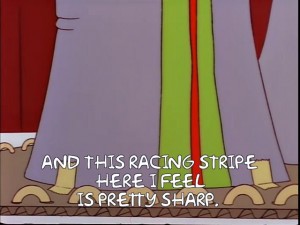 The Met uniform philosophy, 1983-1992. And those racing stripes there, I felt, were pretty sharp. Sort of like what the Expos were wearing, but better, because it was the Mets.
Did anybody call them racing stripes in 1983? Maybe they did, but I might’ve missed it. The Uni Watch culture was a couple of decades from coalescing and, besides, I was in college in Florida for the first month of the season, watching only as much as Seaver from afar as primitive media would allow. Highlights from Opening Day on the local news and that Sports Illustrated were about it. By the time I got back to New York in May, the newly detailed uniform had blended into the background and the Mets had let the momentum of that first win and the one that followed it be overwhelmed by six consecutive losses, setting the tone for the first dreadful month of the no longer so new year. In short order, they were 6-15 and yearning for another hero to rescue them, this one not from the past, but the future: Darryl Strawberry, who debuted 31 days after Seaver returned.
Straw never wore a Mets uniform that wasn’t accented by racing stripes, at least on his pants. Now and then, the Mets wore blue tops in ’83 and ’84, but a decade of orange-blue-orange distinguishing Met players from other players was underway. Darryl was a Met from 1983 to 1990; nothin’ but stripes. Ron Darling showed up late in Darryl’s rookie year and lasted into the summer of 1991: nothin’ but stripes. As late as October 4, 1992, by which time Tom Seaver was safely ensconced in the Hall of Fame, the stripes remained in place. The uniform had been tinkered with in other areas — its pullover top gave way to a traditional button-down shirt — but what Seaver wore on Opening Day 1983 and what was associated with Strawberry, Darling and their contemporaries during their tenure was basically what was still in use on the Closing Day ’92 when Willie Randolph completed his own New York homecoming, finishing his single season as a Met with a walk that drew a standing ovation.
When the Mets and applause returned to Shea on April 5, 1993, ten years to the day that Seaver was the story, the stripes were gone, and the race to the bottom of the National League East was in full gear (exit applause). But that’s another story. The story on Sunday, April 10, 2016, was that the racing stripes were back at the home of the Mets for something more than a cameo for the first time in 23½ years. They were worn, as they will be every Citi Field Sunday this season, to commemorate the 30th anniversary of the 1986 Mets, who themselves commemorated the 25th-anniversary season of the team with a patch that has also been liberated from mothballs. They will be worn on good Sundays and less good Sundays, the most recent Sunday falling into the latter category, as the Mets dropped their third game of the thus far five-game-old season.
That’s a 2-3 record for those of you scoring at home (or even if you’re alone). That’s exactly the record the Mets got off to in 1983, the year the racing stripes debuted; and 1992, the year the racing stripes, like Randolph, bowed out; and 1993, the year the racing stripes, like Met dignity, went on hiatus; and 1991, the year Darling was traded; and 1990, the year Strawberry almost carried the Mets to a division title before his back gave out from almost carrying the Mets to a division title and he decided relief awaited him in Los Angeles; and 1989, the year Randolph, as an L.A. Dodger, halted the Mets’ playoff hopes in their tracks with a Pendletonian home run in late August; and 1988, the year the Mets met the Dodgers in the playoffs to ill result; and, yes, 1986, the year known for so much else, but whenever the Mets lose three of their first five, is known mainly for the Mets going 2-3 out of the gate. It was mentioned in 2015 (pretty good year, it turned out) and, because the Mets were so obviously dressed for the comparison, it came up on Sunday.
Just as when I see the racing stripes that reigned from 1983-1992 and don’t necessarily think of 1986 (especially when today’s pants and shirts are worn substantially blousier than they were three decades before), 2-3 doesn’t automatically send me speeding toward memories of That Championship Season exclusively. It would be nice to go there, but as demonstrated above, 2-3 doesn’t always augur 108-54. It can get you 90-72 as it did last year, it can send you to 100-60 per 1988, or it can set the stage for 59-103 if everything goes as wrong as it did in 1993. There’s a 77-84 in there, a 72-90, a 91-71, an 87-75 that sounds better than it was and, where the racing of the stripes commenced, a 68-94 that was better than it sounds. The 1983 Mets of Seaver at the beginning, Strawberry (not to mention Hernandez) by the middle and Darling toward the end morphed into a team on the rise despite having to ascend from a depressing basement address.
This was all a long way to say that it’s a long season and a short stretch is not a reliable measuring stick. You already knew that, but you also already knew that after five games, the 1986 Mets were 2-3.
After five games, the 2016 Mets are 2-3. At this pace, they will play a sixth game tonight, weather permitting.
The fifth game, despite its presence in the best-forgotten file, gave us two highlights that were not sartorial.
1) Yoenis Cespedes fought off pitch after pitch until he got the pitch he wanted from Jeremy Hellickson in the sixth inning, and then he whacked it like he preferred to never see it again. Nobody on the field of play would, for it flew with fury over the Whatever Somebody is Paying to Call It Now section in left and briefly raised hopes that the Mets would stop screwing around with the Phillies. They didn’t, as evidenced by the 5-2 final, but gripping theater ensued while Cespedes dueled mano a mano for eleven pitches versus Hellickson (who I languidly mistook for Mark Hendrickson, the pitcher who lost to Johan Santana on Opening Day 2008…a year when the Mets started, yup, 2-3).
Guidance derived from five-game samples is about as useful as that which one extracts from the first four games of a season, but you can’t blame a Mets fan for clapping extra hard at the TV as Yo’s blast cleared the advertising-laden fences. He couldn’t have been much worse coming into Sunday. He may be getting going based on Sunday and, more significantly, everything he’s done in his career.
2) Jim Henderson is either pitching way better than we could have expected or exactly as we should’ve expected. After a season in the minors rehabbing a surgically repaired shoulder, the former Brewer closer (and old-friend protégé) is pitching with a vengeance. In three innings, he’s faced and retired nine batters, seven of them on strikeouts. Given Henderson’s recent track record, no, you couldn’t have expected that. But given the Hendersons’ track record, yes, of course we knew he was gonna be splendid.
The Mets have had three prior Hendersons in their history. Every one of them emerged in a blaze of glory.
In 1977, the Mets acquired Steve Henderson on June 15, a date that already came up once in this piece for reasons that are more familiar than even the 2-3 launch of 1986. Steve went 2-for-4 in his first start, hit an eleventh-inning walkoff homer in his fourth game and was batting .357 a week after the Wednesday Night Massacre. Steve Henderson didn’t make us forget Tom Seaver, but he did make us embrace Steve Henderson.
In 1978, veteran outfielder and previously projected Willie Mays successor Ken Henderson alighted in St. Petersburg as the player to be named later from a trade made earlier in which a slew of name players shuttled hither and yon. Jon Matlack and Al Oliver had already been shipped to the Rangers, John Milner and Bert Blyleven to the Pirates, Tommy Boggs and Adrian Devine to the Braves, and we knew the Mets had already received Willie Montañez and Tom Grieve. Henderson’s mid-March marching orders made the swap a done deal. Joe Torre anointed him right fielder and batted him fifth on Opening Day at Shea. Ken delivered the first run of the new season when he doubled home Montañez in the second on April 7. Three days later, he and Steve each doubled in the third to create a run; in the eighth, both of them walloped two-run homers. Bob Murphy raved about “the Henderson men”. Why shouldn’t he? Steve had placed second in Rookie of the Year voting in ’77 and now Ken and his impeccable credentials were Met property. The Mets were 4-1 after five games. Everything was looking up.
In the seventh game of 1978, Ken twisted his left ankle and sprained his big toe in pursuit of a fly ball. He never played for the Mets again and was traded to Cincy for Dale Murray in May; none of his three Red homers came in support of his new team’s ace, Tom Seaver.
In 1999, left field, for almost four seasons the province of Steve Henderson (who these days teaches hitting to the Phillies, who pick the most inconvenient times to absorb his lessons), was presented to Rickey Henderson, who presented himself to the Mets in the preceding offseason. Rickey was already a Hall of Fame lock when he arrived in Port St. Lucie. He kicked his bid for immortality up a notch in the third and final game of the year’s opening series at Pro Player Stadium: 4-for-4 with a walk, two homers, two doubles, two ribbies, four runs scored. Rickey was being Rickey in a fashion more ostentatious than any throwback uniforms could ever accomplish. By the end of business on April 7, 1999, he was batting .545, slugging 1.364 and performing generally as out of this world as the Mercury Mets outfit he’d reluctantly suit up in come July. Six months later, he’d be part of a Mets playoff team, something maybe one more Henderson will be able to say eventually.
Stay tuned. The last 157 games are usually the ones to tell the tale.
Speaking of tales told, you can read 2015’s in Amazin’ Again, my book that covers the journey of the National League Champion New York Mets from 2-3 to 90-72 and then some. Personally inscribed and signed copies are available here, regular copies are available here, a friendly discussion about it can be listened to here and you can check out some kind words written about it here and here.
by Jason Fry on 10 April 2016 12:38 am One of my favorite parts of a new baby season is how for a little while you can remember every game.
We lost that horror show in KC, then played well and won a squeaker, walloped the Phils, then lost that taut little one the next night.
See? Easy. Depending on your attentiveness and memory, you’ll be able to do that for another week or so. Then things will start getting muddled and tangled, and then the season will elongate and elasticize into feelings and narratives invented to fit a selection of facts.
It’s the way of things, just as it’s natural to record firsts. We got the first heartbreaker out of the way early on Opening Night — before Opening Night, even, if you want to count enduring the Royals’ flag-raising and ESPN’s hammering the defenseless carcass of Lucas Duda‘s throw home. We got the first taut victory out of the way two nights later, and recorded the first runaway on a chilly Friday at Citi. And then Saturday night’s game brought us another inevitable first for the menagerie: the first unsatisfying shrug-your-shoulders affair, a game whose only flaw was the final score.
The Phillies are a dumpster fire, no doubt — take a shaky bullpen as an anti-foundation, then atop it assemble a general lack of experience, iffy outfield defense, Ryan Howard‘s albatross of a contract, and whatever the hell it is Cesar Hernandez thinks he’s doing at any given moment. We can guess what that will mean over 162 games, but it doesn’t say anything about what the Phillies will do during one of those games.
Tonight they were a little bit better than the Mets. The difference was teeny — Bartolo Colon‘s 66th pitch was a 88 MPH fastball with not enough movement and too much plate, transformed by Howard into an arcing liner destined for the third row above the old Great Wall of Flushing. Colon was pretty great the rest of the night, punctuated by an over-the-shoulder catch of an airborne Freddy Galvis bunt that looked a little like a high-school drama class’s re-enactment of Willie Mays retiring Vic Wertz. Yes, Bartolo got his man then, but the failure to get Howard would doom the Mets by a thin yet inarguable margin.
Meanwhile, the Phillies’ Vince Velasquez looked like a punching bag early, racking up a slew of hitters’ counts while hunting for a stubbornly elusive curve ball. Unfortunately for the Mets he found it, throttling them with that curve and a lively fastball through the middle innings before a high pitch count forced his exit and ensured the Mets would have three cracks at the Phillies’ bullpen.
Three cracks, lots of opportunities … and nothing accomplished. Alejandro De Aza was picked off first with two outs in the seventh, but reached second when Howard did everything but balance the baseball on his nose; no matter, as Curtis Granderson flied out. The eighth inning, though, was the one that really hurt: between Asdrubal Cabrera, Yoenis Cespedes and Lucas Duda the Mets saw no less than 12 pitches in 2-0, 3-0, 3-1 or 3-2 counts. That’s a good recipe for a big inning, but hold your compliments to the chef: they Mets converted not a single one of those pitches into a walk or a hit, then meekly departed after a six-pitch ninth.
It wasn’t a forgettable game — the final score, head-scratching Phillie misplays and taut starting pitching elevated it above that. But one we’d like to forget? That fits well enough.
|
|






