The blog for Mets fans
who like to read
ABOUT US

Faith and Fear in Flushing made its debut on Feb. 16, 2005, the brainchild of two longtime friends and lifelong Met fans.
Greg Prince discovered the Mets when he was 6, during the magical summer of 1969. He is a Long Island-based writer, editor and communications consultant. Contact him here.
Jason Fry is a Brooklyn writer whose first memories include his mom leaping up and down cheering for Rusty Staub. Check out his other writing here.
Got something to say? Leave a comment, or email us at faithandfear@gmail.com. (Sorry, but we have no interest in ads, sponsored content or guest posts.)
Need our RSS feed? It's here.
Visit our Facebook page, or drop by the personal pages for Greg and Jason.
Or follow us on Twitter: Here's Greg, and here's Jason.
|
by Greg Prince on 3 April 2016 3:49 am Spring what now? Spring Training? Never heard of it. If, in fact, it existed, it has completely ceased to matter. The Mets, I seem to vaguely recall, introduced the phrase “winless streak” to the baseball vocabulary for a couple of weeks at the end of March, but March has ended. Games that don’t matter don’t matter even more now that they’re ensconced in the past tense.
It’s Opening Night tonight. That’s what matters. That and its 161 companions to come.
I’m very excited. Also, the sky is blue, the grass is green and the clouds are puffy and cumulus. None of this is news, though to me, the part where I’m excited has me psyched, stoked and revved. The last time I was very excited in advance of a season’s lid being lifted was nine years ago. Perhaps you recognize an echo in that formulation. Last September, we were clinching our first postseason trip in nine years. Now we’re opening a season on the heels of one for the first time in that same size span. One of the fringe benefits of success is a lingering case of excitement.
I’ve avoided mentioning the exact calendar year that was the site of my previous overspill of Game One enthusiasm, but after a trip to the World Series, why be coy? It was 2007. Yes, Game 162 sapped the enthusiasm that was so in abundance six months before, but never mind that. Seriously, never mind any thoughts of a Year After syndrome. 2007 undercut 2006’s legacy and cast a shadow on 2008, which itself certainly didn’t bode well for anticipation of 2009, and so we went clear up to the outset of 2015, which I approached with no more than perfunctory elation.
Which was still elation, because it was still the beginning of baseball season, and the beginning of baseball season is always just cause for elation, but 2015 followed 2014, which had been the latest in the Nothing Special Parade that had been coursing through Metsopotamia for more than a half-decade.
Ah, but 2015’s full complement of 162 changed the direction, trajectory and arc of where we were going, and ever since things straightened out to our liking, everything about the Mets is exciting. Opening Night is exciting, even if it’s at night, even if it’s on ESPN, even if it’s in an American League facility and even if it brings us into direct contact with the Kansas City Royals, the only team in all the land that had a better 2015 than ours, directly at our expense — which is almost irrelevant amid our excitement, except when pangs of regret remind us that isn’t.
But never mind that, either.
The most exciting part of all this, after an October when baseball activities never ceased and a winter devoted to ensuring there might be another one in our not-so-distant future, is that we can Believe from the get-go without straining our inner credulity (which will get you pronounced day-to-day by Ray Ramirez). We can honestly Believe we might go as least as far again, a phenomenon a whole lot different from groping for pieces of if everything goes right, then maybe we won’t be so bad. There are no motions to go through when you have a ballclub like this. There is no limiting your aspirations when you have pitching like this. There is no stretching to imagine when you have a pretty good idea of how real the Mets can be.
Our reality is a dream that has every legitimate chance to come true, not the generic dream of thirty teams having a shot while sitting at 0-0. There is at play an actual amalgam of talent and ability and experience that you’re entitled to envision processing teamwork into dreamwork. No guarantees — despite the inspirational anniversary at hand — but we have arrived at a stronger competitive not to mention emotional starting point than we have at any Opener post-2007.
We’re not living in the post-2007 world anymore. This here, brothers and sisters, is the year after 2015, and I mean that in the best sense possible.
by Greg Prince on 1 April 2016 1:47 am Not to look past Opening Night in Kansas City, let alone the Mets’ last chance to end Spring Training without a loss or tie already yet, but what’s incredibly hard to believe is that in a week’s time, Citi Field will be filled again.
I’ve really come around on the ol’ ballpark, probably because a pennant was won by the home team, but also because management never stops trying to improve it. Consider all the upgrades we’ve read about in the past few days from respected members of the credentialed media, and then add to them the thus far less-reported second wave of innovations I was fortunate enough to personally preview in the tour they gave to select bloggers like yours truly.
I think I’m most excited about the Purina One Bad Luck for the Other Team Black Cat Giveaway in the middle of the third inning of every home game — to be repeated in the 13th and 23rd, should the occasion present itself. Going to a Mets game and bringing home a kitty we weren’t expecting is an experience sure to appeal to those of us who love our felines as much as much as we do our Metsies. If you’re not a cat person, you will be soon if you are tabbed. According to the fine print on the backs of the tickets this year, acceptance of the cat is “mandatory,” as bearer “tacitly accepts responsibility to raise and nurture animal for three years from game date, subject to criminal prosecution.
And speaking of “Metsies,” the Casey Stengel “Babblehead” Doll, brought to us by Verizon Wireless, is a stroke of promotional genius. It’s like a bobblehead (even if it still doesn’t look like him), except this Ol’ Perfesser just keeps going on about how Amazin’, Amazin’, Amazin’ his Amazin’ Mets are, then offers an authentically Stengelese analysis of every player who has ever participated in a game for the Mets, including new guys like Neil Walker and Antonio Bastardo, the latter of whom the Babblehead colorfully identifies as “that son of a bitch Nelson”. I don’t know how they got the technology to work so you don’t have to pull a string or anything. Casey just starts talking and doesn’t stop. Taking him home alongside that black cat will be doubly fun.
Team history gets its due in other ways, too. Look for an exhibit in the Mets Hall of Fame and Museum devoted to the 9186 World Champions. It’s supposed to say 1986, but it came back from the printer transposed, and with so much going on ahead of the Home Opener, they just went with it. Let’s hope it’s an omen for the 92nd century.
The food concessions have been literally beefed up, with Bobby Bonilla’s Burger Grudge opening adjacent to the newly dubbed Coca-Cola Corner. Bobby Bo will be on hand, dispensing Burgers & Snarls. That’s what he calls fries; also, he kind of snarls at customers if they lean too far onto the counter. In the fourth inning, CitiVision will feature Bobby’s Beef, in which he tells off a random seatholder. The lucky fan then receives an autographed Knuckle Sandwich from Bonilla himself. (No photographs, please; Mr. Bonilla doesn’t care for the capture of his image.)
For the Burger Grudger who builds up a thirst that won’t be satisfied by carbonated soft drinks, there will be the chance to visit the latest Danny Meyer creation behind center field, the Beers of Joy stand, with all your favorite craft creations on tap, including a Union Square Hospitality Group original, Lachrymose Lager, “in honor of the player who cried out to stay in Flushing”. I guess they can’t explicitly refer to Wilmer Flores because of alcohol/athlete restrictions, but it’s a nice touch. All offerings at Beers of Joy will retail for $20.15 per 4-ounce cup.
Finally, given my particular demographic status, I appreciate the introduction of the Flomax Race to the Bathroom that follows the bottom of the fifth. It’ll be like Milwaukee’s sausage races, but each of the “contestants” truly has to go. Matt Harvey will be the spokesman. Kudos on the well-executed product placement we’ve already seen.
Of course the biggest attraction a week from this very day will be the raising of the RATIONAL LEAGUE CHAMPIONS flag. Again, it was kind of a rush job, but when you see it, you’ll know what it means.
by Greg Prince on 28 March 2016 5:21 pm Could be!
Who knows?
There’s something due any day;
I will know right away,
Soon as it shows.
The shortest span between seasons in Mets history, from a little after midnight last November 2 to a few hours before midnight this April 3, has, predictably, turned into the longest wait for a new year baseball humanity has ever known.
Remember how happy we were that Spring Training had arrived? That was about a thousand months ago, and it’s still freaking going on. The charm, at least as gauged from the northern segments of I-95, has been worn down to the nub. Spring will look good again when its view is obscured by another winter. For now, it is The Thing That Wouldn’t Leave.
Yet it will. Give it time. Just a little more time.
It may come cannonballing down through the sky,
Gleam in its eye,
Bright as a rose!
Who knows?
I’ve tuned in to at least a portion of just about every Spring game the Mets have transmitted over their TV and radio outlets this year, yet I’d be hard-pressed, even while Spring is still literally in the air, to remember anything about any of them. They’ve very recently occurred, I possess a pretty good memory, but they evaporate into mist on contact. It’s Spring Training. We’re informed so regularly how unimportant their results are that it becomes second nature to ignore just about everything we see and hear. It’s supposed to be enough that the act of baseball is being carried out. Don’t look too closely. Certainly don’t look at who’s winning or losing. Chances are nobody is doing either.
But Sunday, because it was the last Sunday during which Mets baseball would definitively not matter for more than six months, seemed to matter, at least in theory. We reached the one-week-and-counting stage of Spring. That seemed to countermand the idea that none of this counts. It was worth watching and listening and maybe retaining.
So I did. It was the Mets and a split squad of Nationals, or roughly half of our contemporary archrivals. Just based on the whole vs. half theory, we should have prevailed easily. We had them outnumbered. In Spring, though, it doesn’t work the way you’re conditioned to normally consider these matters. Numbers don’t matter. Look at the players. A bunch are wearing numbers that hardly ever appear on baseball jerseys. It’s one more in a series of winks that you really should stop staring so hard at all of this. Come back in a week.
Nah. Let’s see what we’ve got here.
It’s only just out of reach,
Down the block, on a beach,
Under a tree.
I got a feeling there’s a miracle due,
Gonna come true,
Coming to me!
Steven Matz started. Out of the corner of the one eye with which I’ve been monitoring Spring activities, I’d noticed Steven Matz was not performing in a manner befitting one-fifth or –sixth of the Greatest Starting Rotation Ever Assembled. I could dismiss such presumably aberrational behavior if I could measure it in relation to his awesome track record. But Matz has almost no track record. He threw two real good regular-season starts, went on the DL, threw four more (one of which was relatively superb), reported some back stiffness and then was tasked with taming the Dodgers, the Cubs and the Royals in October. He survived each of them and now he’s the No. 4 starter on the GSREA. There was a time we huffed “no scholarships” at starters will fewer big league credentials, but we all believe in Matz because a) we really like him; b) we really want to; c) we’re told he’s definitively worthy of our faith despite having pitched past the sixth inning exactly once in the majors.
I’m willing to take a relatively small leap that he’ll be what he is supposed to be — the best parts of his 2015 sample size were as tasty as his sample size was small — but maybe he could pitch well once in March so he could put my mind at ease in advance of April?
My fellow Long Islander did me a solid. Five-and-two-thirds innings of what appeared to be professional pitching. He walked four but struck out five and allowed only a home run to Clint Robinson in the way of damage. Later he told those who asked that the Mets pitchers had a meeting and this somehow helped. Most meetings veer to the useless. Perhaps Dan Warthen has a future in human resources.
Could it be? Yes, it could.
Something’s coming, something good,
If I can wait!
Something’s coming, I don’t know what it is,
But it is
Gonna be great!
David Wright went the other way, all the way, belting a Yusmeiro Petit pitch barely over Tradition Field’s right field fence in the first inning. David Wright stroking opposite field home runs is the rock on which His Wrightness was built. Then they built Citi Field, which sapped one of his core equities but doesn’t much matter in Port St. Lucie, where the Mets play in a ballpark whose dimensions remain an exact match for Shea Stadium. That was a brilliant concept in 1988, a lingering curiosity since 2009 for those of us who enjoy raising our eyebrows in “ya don’t say?” astonishment. The Mets aren’t using 338 down the lines and 410 to center anymore in real life, but knowing that the old ballpark’s measurements still play a role in preparing the players for their season in the current one tickles the historical rib. It’s like bumping into the Ebbets Field flagpole outside Barclays Center or scaling the restored John T. Brush Stairway behind the site of the Polo Grounds.
Here’s a ghost for you, albeit one that ultimately learned it was time to blow: the air conditioner that cooled the visitors’ clubhouse at Shea from 1964 through 2008 was a transplant from the Polo Grounds press room. Ironically, an AC unit that was said to chill effectively enough “to store raw meat” was ultimately knocked down because of a stiff Breeze.
Wright, who’s been around since that air conditioner was frosting Bobby Cox’s autographed balls, is working toward not being an anachronism. He’s working hard so he can take Johnnie Walker’s advice on remaining ambulatory. Tell us all you want that Spring is somewhere to tread emotionally lightly. David works it. At 32 and saddled stenoically, he has to.
The work paid off on Sunday. It didn’t count at all, yet surely it counted for something.
With a click, with a shock,
Phone’ll jingle, door’ll knock,
Open the latch!
Something’s coming, don’t know when, but it’s soon;
Catch the moon,
One-handed catch!
Gary Cohen was on assignment, which could be taken to mean he’d be filing reports from Lebanon on The Nightly News with Lester Holt unless you know that announcers for your favorite team actually announce other games. Howie Rose does hockey, Josh Lewin football, Gary college basketball. Though they’re all as talented there as they’re talented here, it can’t help but feel like the tiniest bit of betrayal to their true missions, which is talking to us about the Mets every time they open their mouths. Lindsey Nelson called the Cotton Bowl without once mentioning Buddy Harrelson. Lindsey, I’d wonder, why aren’t you talking about the Mets on New Year’s Day?
With Gary broadcasting for radio audiences the improbable step Syracuse took into the NCAA Final Four, Scott Braun took his place telling us about the PSL Nobody’s Keeping Track Two. Braun — whose voice I inevitably associate with Barbasol-sponsored updates on the MLB Network at four in the morning — filled in last Spring, too. He and Jim Duquette and Alexa Datt. It’s not at all bad what they do. It’s just not what we’re used to.
Keith Hernandez, though…him we’re used to and wouldn’t have it any other way. Keith, who fretted between Sunday pitches about booking his brother a hotel room in Sag Harbor two months from now, did color while Scott did play-by-play. It was a generally affable and amiable arrangement, though you certainly hope Cabrera and Walker are in better sync by Kansas City than these provisional partners were.
Scott asked Keith a pitching question. There was a pause of several seconds.
“I’m sorry,” Keith finally and honestly replied. “I was daydreaming.”
Ah, Scott. Everybody knows Ronnie handles the pitching questions. But he was on assignment as well.
Around the corner,
Or whistling down the river,
Come on, deliver
To me!
Will it be? Yes, it will.
Maybe just by holding still,
It’ll be there!
At any given moment, I’m hyperaware of no more than three Mets prospects. One of them is Amed Rosario. I’ve heard he’s the Shortstop of the Future. The last one we had was Jose Reyes. I was hyperaware of him as he climbed the ladder. It’s been all pretty TBD at that position in the four going on five seasons since Jose left. Will Amed fill the post-Reyes gap once and for all when 2018 rolls around? It’s too soon to peer so far. Rosario’s only 20, has spent all of two games above Single-A and was sporting No. 89 on Sunday.
But No. 89 was in action. He, like Matz and Wright (and, I suppose, Braun and Hernandez), started. He banged out two hits. He made a leaping grab of a line drive. He exuded enthusiasm all over Twitter before and after.
It was a “privilege and honor” playing alongside the “big boys”; any number was a good number if got him “to play in the show”; the best part of his day was “seeing Captain David Wright healthy, winning and playing in front of the Mets home crowd.” Young Amed volunteered all of this and answered every atta-boy fed him in the occasionally fraught 4-6-3 pivot of social media.
Come to think of it, maybe it’s @amed_rosario who has the future in human resources — after he stars at shortstop for us for a decade or two.
Come on, something, come on in, don’t be shy,
Meet a guy,
Pull up a chair!
The air is humming,
And something great is coming!
Who knows?
Nobody won. Nobody lost. That happens in Spring Training. It happens a lot to the Mets, who on Sunday posted a tie for the third consecutive day. Once the bottom of the ninth was over, the score Mets 4, Nats 4, I braced myself for the most predictable March camera shot this side of some UNC Tar Heel cutting down a net: Terry Collins waving “bye” to the other team’s manager.
As of this coming Sunday night, we won’t see that shot anymore. It will be whether you win or lose, not just that you played a game. The bullpen will have to fine-tune itself. Cespedes will have to judge deep flies to the base of the wall better. Conforto will have to be comfortable, deGrom up to speed and Harvey…gads, what exactly is up with the titular ace of the GSREA? Nothing good, say the sources inside my head.
This gets real and stays real before we know it. It’s only just out of reach.
Music by Leonard Bernstein. Lyrics by Stephen Sondheim. Anticipation by New York Mets fans everywhere.
***
Profuse thanks to all who came to Foley’s this past Saturday for an Amazin’ Again event that lived up to my book’s name. You humble with me with your words and actions.
Hope those of you in or adjacent to the Borough of Mets can join me Thursday evening, 6 to 7:30, at the Queens Library’s Central branch in Jamaica for a talk I assure you will be as Amazin’ as I can make it.
And speaking of Amazin’ talk, this chat between myself (at 35 minutes in) and Chris McShane of Amazin’ Avenue was a pleasure to be part of.
by Greg Prince on 22 March 2016 12:42 pm The Mets have played home games in two counties of New York City, so I’ll do the same in the coming days, as the preseason book tour for Amazin’ Again: How the 2015 New York Mets Brought the Magic Back to Queens continues.
This Saturday, March 26, from roughly noon to three, I’ll be at Foley’s, the bar dedicated to baseball, with books for purchase and signatures for free. Buy a copy if you haven’t already; bring the copy you already bought. Mostly, come say hi, hang out and share a little Mets bonhomie with your fellow fans. Foley’s is located in Manhattan at 18 W. 33rd St., between Fifth and Sixth Avenues, across from the Empire State Building, convenient to Penn Station, not far from Grand Central. (Thanks to Friend of FAFIF Sharon Chapman for getting this particular baby going.)
Next Thursday, March 31, from 6:00 to 7:30 PM, the tour travels from the borough once graced by the Polo Grounds to the borough where Shea Stadium stood and where Citi Field will hoist a National League Championship flag. That’s right, Amazin’ Again comes to Queens, specifically the Queens Library’s Central branch in Jamaica, 89-11 Merrick Blvd. I’ll be giving a talk about the book, baseball writing, the Mets and anything else anybody in the audience is curious about. As at Foley’s, copies will be available for sale and inscriptions are on the house.
For those of you who are wonderful people who ask, “When are you going to be in [place that isn’t Manhattan or Queens]?” the answer is soon, I hope. You probably know your neighborhood better than I do, so if you know of a location that strikes you as suitable for this sort of thing, let me know, and together we’ll see what we can do.
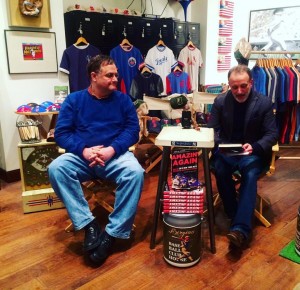 The author sits down alongside the host with the most Amazin’ baseball stuff around, Jay Goldberg, at the Bergino Clubhouse. A word of appreciation to Jay Goldberg and everybody who came out on March 17 to Bergino Baseball Clubhouse for the first stop on the tour. It was one of the most fun Mets nights I’ve ever had that didn’t include one of Mark Simon’s meticulously catalogued walkoff home runs. You can listen in to the conversation between Jay and me here, including some lively Q&A with a terrific audience. Jay also has a handful of autographed copies of Amazin’ Again in stock if you can’t make it to either of the upcoming events and you’re a swell enough person to want one.
I also appreciate the interest over at Mets Merized Online, where I answered a string of solid 2015-related questions from Joe DeCaro and several of MMO’s highly engaged readers.
Amazin’ Again is on sale at your finer bookstores and through major online booksellers. I thank everybody who has been good enough to add it to their baseball library already and appreciate to high heavens all the nice things you’ve told me about it to date.
Oh, as for the Sports Illustrated–covering 2016 Mets — who probably have a real ballgame coming up sooner or later — I was recently part of a panel of Mets bloggers who attempted to forecast their fate for the Cardinal site, C70 At The Bat, where we hope they know enough to take good care of Ruben Tejada for us.
by Greg Prince on 17 March 2016 4:24 pm I long ago worked with a CFO who was fond of quoting the late Everett Dirksen: “A billion here, a billion there, pretty soon you’re talking you’re talking about real money — so cut down on the paper clips.” The paper clips part may have been our CFO’s coda, but you could hear the longtime Senate minority leader’s sentiments echoed from Port St. Lucie Wednesday as Ruben Tejada was, at last, given his walking papers.
Ruben always could work out a walk.
Must be the money, right? We all more or less love Ruben since last October and when it comes to Ruben’s skill set — guy who won’t necessarily kill you, guy who now and then helps you — there was nothing wrong with what he brought to the Met table. Nobody was ever more Ruben Tejada than Ruben Tejada.
That, I suppose, made him his own archetype. I think back to the first FAFIF Spring, in 2005, when the Mets deleted their perfectly good utilityman, Joe McEwing, when Chris Woodward became available and proved himself more consistently capable of doing Joe McEwing things than Joe McEwing. Nobody ever called Chris Woodward “Super,” but he seemed better in the moment. One balanced one’s sentimentality toward the next-to-last 2000 Met still on the roster (only Mike Piazza was left post-McEwing) with the realpolitik of, in essence, it ain’t Joe friends, it’s Joe business.
 Adios, amigo. Eleven springs later, releasing Tejada is a little like that, except I don’t necessarily see a contemporary Chris Woodward in his off-the-bench prime charging onto this team. Maybe Matt Reynolds makes a splash. Maybe all those balls Eric Campbell hits so hard start to fall in. Maybe Tejada doesn’t wind up on the Cardinals, which is where we tend to presume every cast-off Met winds up and elevates his baseball IQ to our eventual teeth-gnashing detriment. What it inevitably comes down to is Ruben, who never quite cemented his role, was going to make three million bucks and now the Mets won’t have to pay him five-sixths of that.
Two-point-five-million here, two-point-five-million there…and I’m not criticizing the decision for being financially driven. Roleless Ruben could be valuable or he could be a cipher. I honestly don’t know how much a player who wasn’t going to be the go-to backup infielder of record is “worth”. Yoenis Cespedes signs a three-year deal worth $75 million and it’s sort of a bargain. Jacob deGrom is renewed at $607,000 and it’s a travesty, but don’t worry, because if he stays in one piece, he’ll get much more. Michael Cuddyer accepts approximately $3 million to be on his merry way and it’s a gift. Daniel Murphy rejects a qualifying offer of $15.8 million because it’s understood to be kind of an insult.
We should all be so insulted.
Anyway, somewhere in there, $2.5 million not dedicated to Ruben Tejada, minus the $507,500 or so it will take to minimally compensate his replacement, adds up. Hopefully it adds up to whatever the Mets might need in late July, assuming the Mets need something in late July. And the Mets, as content as we are with them, always need something.
That’s the practicality. The sentiment is it’s sad that somebody ordered a Ruben to go. I mean, c’mon, he was (and is) Ruben Tejada. You talk about rules regarding kids in the clubhouse. Ruben Tejada is perpetually 14 years old from the looks of him. How in the name of Drake LaRoche can you kick him to the curb?
With the purge of the Children of Manuel almost complete, Lucas Duda is the second-longest serving Met, behind David Wright, who isn’t going anywhere unless his back tells him otherwise. Tejada was lined up to be the penultimate senior Met, which is crazy, until you remember Ruben made the club out of camp in 2010 as insurance for Jose Reyes’s thyroid condition, and Ruben wasn’t too far removed from 14 then. He’s been up and down in the intervening seasons, but mostly up and as close to a fixture at Citi Field as anything that wasn’t the Pepsi-Cola sign. But the Pepsi-Cola sign isn’t there anymore, and neither is Ruben.
I’m glad he — like Murphy and Jon Niese — got to experience a division title and part of a postseason. Without 2015, Tejada would have been consigned to the batch of players from the lean years. It’s the players who persevere through those hard times and arrive in at least the foreground to the promised land who are destined to sparkle in our memories. Ron Swoboda was a 1966 Met. Mookie Wilson was a 1982 Met. We don’t identify them as such, though, no matter that Swoboda hit an Amazin’ walkoff home run against the Giants in ’66 or that Mookie stole more bases than any Met previously in ’82. In that spirit, Ruben Tejada was a 2012 Met. He was one of the better 2012 Mets. Tejada succeeded Reyes at short, an impossible situation, and did all right. He batted .289 as a full-time player. He stayed in at-bats forever. He went back on popups with the best of them. By 2013, however, we got an inkling we had already experienced peak Tejada at the biological age of 23 (though he still looked 14). By 2014, neither Tejada nor the Mets appeared to be on the fast track to excellence.
The point is, Ruben Tejada won’t be remembered as a 2012 Met. He’s a 2015 Met, which will eternally mean something, partly due to his own contribution to the team we’d been waiting practically forever for. Hell, he literally gave a limb to the cause. Good luck to him wherever he goes.
I had a nice conversation with the folks at Mets Merized Online regarding those 2015 Mets, which you can read here. And if you want another taste of that National League championship season, I’d love you to check out Amazin’ Again, my book on how the Mets brought the magic back to Queens.
by Greg Prince on 14 March 2016 2:16 am After paying just enough attention to Spring Training to notice the hitters aren’t necessarily behind the pitchers anymore — guys in Mets unis lost 14-9 on Saturday but won 11-0 on Sunday — I realize my anxieties are lagging behind my capacity for calm. That’s a very unusual March alignment.
Starting shortstop Asdrubal Cabrera might miss Opening Night. I’m not worried.
Indefatigable utilityman and logical replacement Ruben Tejada might be traded. I’m not worried.
Kevin Plawecki might be sent down because the Mets would rather he play regularly and that a legitimate backup sit in his place. I’m not worried.
The Mets may not have a legitimate backup in-house for Travis d’Arnaud. I’m not worried.
David Wright is conserving his energy. I’m not worried.
Dilson Herrera fouled a ball off his knee and is disappearing himself to some WBC-qualifying nonsense. I’m not worried.
A vaguely familiar collection of vowels named Taijeron has driven in more runs than anybody in camp, yet is reportedly not under serious consideration for the 25-man roster. I’m not worried.
Goose Gossage said something silly about Yoenis Cespedes. I’m not worried.
Ken Davidoff wrote something sillier about Lucas Duda. I’m not worried.
And as for pitchers, the only one who worries me is Oliver Perez.
Oliver Perez, last seen in a Met uniform around this time of year in 2011? Why worry about him in the context of 2016 Mets Spring Training? Well, a Twitter movement was afoot the other day to infiltrate a Nationals promotion that encourages fans to choose who Washington should immortalize in bobblehead this season. They didn’t say which fans could have a say, so it was thought amusingly mischievous that Mets fans saddle Nats fans with good ol’ Ollie. Unofficial exit polls indicated we were winning the Perez caucuses.
That worried me. That’s unnecessary hubris, no matter how fun-loving. That’s asking for Oliver Perez to carry a 65-inning scoreless streak into a September showdown versus the Mets, a team that has not had so much as a walk, let alone a hit off the veteran lefty all year, I can just hear Gary Cohen telling me.
Let sleeping dogs who wouldn’t accept a demotion to Buffalo lie. Let the rest of March play out without major incident. Spring Training is, as usual, dragging, but it doesn’t seem to be piling up casualties. That, too, might be asking for it, but what can I tell ya? I’m not worried.
But don’t worry. There’s still time.
I had a real nice conversation about Amazin’ Again and some other Metsian items last week with the guys at the Rising Apple Report, which you can listen to here. And did I mention you can order a fresh copy of the only book celebrating the 2015 National League champions right here?
If you’d like to come on down (or up, depending on your locale) to beautiful Bergino Baseball Clubhouse on Thursday night, March 17, for my first event in support of Amazin’ Again, please RSVP to bergino@aol.com. Thank you.
by Greg Prince on 8 March 2016 1:08 am “Someday there will be nostalgia for the seventies, as hard as that may be to realize now.”
—Brendan C. Boyd and Fred Harris, The Great American Baseball Card Flipping, Trading and Bubble Gum Book, originally published in 1973
Willie Nelson was right: it is funny how time slips away. It couldn’t be more than four or five months ago that we were rooting the Mets through their first postseason in nine years, and it couldn’t be more than three or four months ago that I was putting all of those autumnal Metsian moments and the ones that preceded them into a book intended to preserve just what a thoroughly unexpected and surprisingly fulfilling ride it had been.
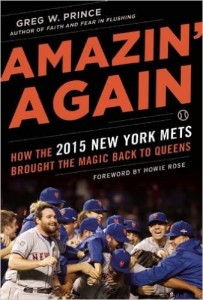 A book for you and for posterity. It really wasn’t that long ago, yet here it is, coming around again, in the pages of Amazin’ Again: How the 2015 New York Mets Brought the Magic Back to Queens, which is on the cusp of release as we speak. Get a copy and find your 2015 New York Mets — prosecutors of arguably the most satisfying Met season since 1986 — emerging from the first base dugout to take that curtain call your heart has been calling for since they went gentle into that not so good November night.
I couldn’t do anything about the ending, but the rest of the story was as uplifting as it gets, and it’s all there in a volume I wrote for two audiences:
1) You
2) Posterity
You are a Mets fan. You know what 2015 was. You’ll always retain the gist of things. The book gets between the gist and fastens the details that might otherwise tumble down the memory hole, which is a terrible place for a pennant-winning ballclub to disappear. 2015 was too good a Met year to not experience repeatedly on demand. Amazin’ Again is your permanent season ticket to a year for the ages.
Posterity isn’t necessarily a Mets fan, which is why it requires a historical document lavishly layered with the moments and personalities that made 2015 a winner worth talking about into perpetuity, sort of the way we still talk about 1969. The 1969 Mets came alive for me once, in fleeting fashion, because I had the good sense at a tender age to sit up and take notice of them in real time…and then they stayed alive for me for all time because a group of writers saw fit to commit some journalism in their name as soon as that season was over.
The foundation of my baseball library is formed by books with titles like Amazin’ and Joy In Mudville and The Year The Mets Lost Last Place and The New York Mets: The Whole Story and The Perfect Game, books I encountered in the years directly following 1969, books that filled in my blanks and gave me a box seat to everything I missed on account of my mistakenly being born a tad too late to fully comprehend the depth and beauty of 1969 while it was still in progress. It was my goal, while writing Amazin’ Again, to tell a story about last year’s Mets that will hold up in the latter 2010s and into the 2020s and beyond the way the aforementioned books hold up to this very day.
So ideally you’ll grab one copy of my book for yourself and purchase and put aside another for a fan to be named later, a kid who will someday wonder what was so great about 2015 and begin to answer that question by reading what I wrote.
Though I guess you can just share that first copy.
Amazin’ Again: How the 2015 New York Mets Brought the Magic Back to Queens will be officially released on March 15. Amazon, I’m told, is already fulfilling orders, so you can click there for more information. And in the weeks ahead, I hope you’ll join me at one of several events planned in the Greater New York Metropolitan Area.
• On Thursday night March 17, starting at 7:00 PM, I will be at Bergino Baseball Clubhouse (67 E. 11th St. in Manhattan) where I look forward to joining you and proprietor Jay Goldberg in a discussion of the Mets’ first pennant-winning season in fifteen years. Jay, who stocks some of the most glorious baseball items you’ve ever seen, will have copies of Amazin’ Again on hand and I’ll be happy to sign them if you like.
• On Saturday March 26, from Noon to 3:00 PM, ace photographer Sharon Chapman and I welcome you to Foley’s NY (18 W. 33rd St. in Manhattan) for an informal book party and general preseason warmup, appropriate to an establishment that is the most baseball bar in the city. I plan to have books available for purchase and inscription that day.
• On Thursday evening March 31, beginning at 6:00 PM, Amazin’ Again comes to its borough of origin, alighting at the Central Branch of the Queens Library in Jamaica (89-11 Merrick Blvd.). I’ll be talking about the book, about writing, about being a Mets fan. Copies will be on sale here, too.
Two great podcasts — Gary McDonald’s Mets Musings and I’d Rather Kiss A Mookiee (hosted by the dynamic duo of Shannon Shark and Jason Fry) — have been kind enough to have me on already for book talk, and I invite you to listen in.
There should be more announcements to come, and I thank you in advance for your indulgence of this wave of self-promotion.
by Greg Prince on 5 March 2016 2:39 am The return address on the manila envelope was Citi Field. The postmark was Flushing. The stationery featured a Mets logo. The second word handwritten in looping cursive on the single page enclosed was “Thanks” — so was the second-to-last word. There weren’t many words in between. There didn’t need to be.
On December 14, 2011, Shannon Forde mailed me a copy of Volume 50, Issue 5 of Mets Magazine, the last game program from that season. David Wright was on the cover. A poster of Jose Reyes was in the middle. There were articles about Angel Pagan and Bobby Parnell. And tucked deep in the back, opposite an ad for Pound Ridge Golf Club (“35 Miles From Home Plate!”) was a page devoted to our blog, part of a series that had run throughout the year, “From the Blogs” — or “De los Blogs,” as it was translated in this bilingual edition of La Revista de los Mets. The piece that appeared on page 154 represented an opportunity to introduce our work to Mets fans who might never have heard of us otherwise.
Which was nice enough to begin with. I’m sure others were involved in executing the idea and signing off on it, but I’m also sure that Shannon was the one who went out of her way to think of Mets blogs and Mets bloggers in this and an array of instances. Shannon was synonymous with blog outreach, which is perhaps an unnecessarily utilitarian way of saying she reached out to the likes of us and she looked out for likes of us.
That was no small thing, because who the hell were we? Who the hell was Faith and Fear in Flushing to a Major League Baseball franchise that was covered by an ample number of dailies, periodicals and broadcast outlets? Baseball is steeped in tradition. The press box is traditionally the province of reporters attached to established news organizations. Same for the dugout and the field during batting practice. Same for the media dining room.
Shannon got us in those places. We never asked, but she got us in anyway. She adjusted tradition to modernity and let us who were purely digital and relatively unaffiliated dip a toe into waters reflexively considered off-limits. Shannon didn’t treat us like we didn’t belong. If you came into contact with Shannon Forde, you belonged.
I find myself writing about process here because it’s worth taking a step back and understanding how it is that bloggers like us got to know Shannon Forde, but the important thing is we got to know Shannon Forde. It was just a little, but a little went such a long way in the presence of someone so obviously full of grace and warmth and enthusiasm. I wouldn’t have met Shannon Forde if not for the process she instigated and facilitated. If I hadn’t met Shannon Forde, I would not be so saddened at the word of her passing Friday night following three-and-a-half years of battling breast cancer.
But I also wouldn’t have felt so enriched from the too-brief interactions we had during the seasons when the Mets held Blogger Nights, and bloggers like Jason and me and a gaggle of others who do some version of what we do were invited to take part in some of the rituals that make baseball tick. These were experiences that enhanced our understanding of the sport we embrace as fans who write, and we tried to pass along to you guys the essence of what they were about.
Most significantly, though, these were experiences that allowed us to know Shannon Forde. By that measure alone, you couldn’t have had a better experience. From what I could tell, you couldn’t come across a better person. I don’t have a good enough imagination to envision one.
You know how some people have that rare gift of making you feel better about yourself and your surroundings and the moment you’re in? I do, because I knew Shannon Forde. Again, not that well and not that much, but enough to be lifted in every encounter we had. There was nothing — zero — perfunctory about her approach to you. There was never a sense of being handled the way someone in media relations handles media. I’ve been media in many situations in my career away from this blog. I recognize handling. I also recognize the opposite. I think it’s called being a genuine person.
You couldn’t miss it with Shannon. Every simple gesture, chance meeting and prompt response from her perch as senior director of media relations was laced with kindness. Like the business with that issue of Mets Magazine. We were offered the space in the program; Jason and I collaborated on a profile of our blog; it was published in September; we got a kick out of seeing our names inside something people bought at the ballpark; and you’d figure that was that. Except three months later, we received an e-mail from Shannon. She was sorting through some stuff left over from the 2011 season and wasn’t sure whether she had sent us copies of our article. Did we need any?
I said sure (because who turns down a copy of Mets Magazine with your name in it?) and a couple of days later it appeared in my mailbox with the note.
Greg –
Thanks again!
Let me know
if you need
more copies.
Thanks,
Shannon
Thirteen words. Twice she says thanks. It seemed so typical of her and so atypical of most. The note…the issue…the sight of something with a 11368 return address in the middle of December…the fact that she sent it out literally ASAP…the fact that I offered to pick up any spare programs from her myself when I’d be coming to Citi Field to cover the Mets’ holiday party and she told me “I’ll mail them — this way you don’t have to lug them around (they do get heavy after a bit)”…that she ended that e-mail with a smiley-face emoticon…that she responded to my thank you e-mail the same way.
The thought. The thoughtfulness. The person. The person’s simple gesture that was no doubt one of countless simple gestures directed toward everybody she knew — no matter how well or how little — in which she made all feel welcome to her world. There was exponentially more to this envelope, this magazine and this note than met the eye.
There was Shannon Forde. What a gift.
Mike Lupica wrote movingly about Shannon while she was fighting the awful disease that eventually took her from her family. Joel Sherman remembered her with great affection upon learning the terrible news that she was gone at the age of 44. I recommend reading them both.
by Greg Prince on 3 March 2016 3:24 pm Terry Collins said the other day that “fun time” is over. I hate to disagree with the manager of the defending National League champions, but I’d say fun time is just getting started.
Collins was referring to the Yoenis Cespedes Off-Hours Charismatic Carnival, which, to be fair, was loads of fun. More fun than:
• a barrel of profiles of longshot candidates to be the last man out of the bullpen;
• endless speculation over how many games the stoic, stenosisic Captain might play;
• another round of thoughts from Neil Walker regarding how different New York might be from Pittsburgh;
• and whatever else would have filled our field of vision once the adrenaline rush of confirming New York Mets baseball players were going about their business in Port St. Lucie, Florida, inevitably wore off.
Yoenis made the deadliest week on the baseball calendar come alive (save for a pig who used to be alive). There were the sweet, sweet rides that gave conspicuous consumption a good name. There was the equine entrance that proved Noah Syndergaard makes for a more comfortable sidekick than Chris Christie. There was that bit Carnac came back to deliver with Ed McMahon.
“Trains and boats and planes.”
“Trains and boats and planes.”
“Name the only three ways Yoenis Cespedes hasn’t come to camp in the last week.”
“HIYO!”
Hi Yo, indeed. He was an international man of mystery behind the wheel. He was a rootin’, tootin’ sight up on his high horse. He was a Western-style presence when he went whole hog. Oh, the butcher and the baker and the people on the streets — where did they go?
Well, we know the butcher went to meet Yoenis’s not-so-little piggy, who cost our Most Visible Player seven-grand, or what probably accumulates on the many passenger seats of the Yoenis fleet. At that rate, I was hoping Piggy would trot out alongside Ces before the Home Opener, wearing a matching No. 52 and four or five neon-green sleeves (including one for the tail). Instead, he’s slated to be the guest of honor at a future roast. Somewhere Foster Brooks is clearing his throat and, perhaps, his glass.
Will the pig become links by breakfast tomorrow? Will the player be on the links by nightfall? (He likes to golf, you know.) These were the questions that preoccupied us when there was nothing else to think about. The word spread of Yoenis the Kid, and for that we were grateful. Now it’s vaya con dios vaquero, hello five-tool superstar. You and your pals can go commit some baseball now.
Real Fun Time 1.0 commenced at 1:05 Thursday afternoon, and it will be in effect until the required system upgrade kicks in on April 3. The New York Mets were on the air on WOR, featuring some guys we’ve all heard of, some other guys we’ll hardly hear of again. The first voice of spring we actually needed to hear from was Josh Lewin’s. He welcomed us to baseball, choosing to channel word of Terry’s down-to-business declaration through Richard Jenkins’s exasperated Dr. Robert Doback in Step Brothers, because that’s how Josh rolls. “Rumpus time,” Lewin aptly quoted, “is over.”
Last week, there was so much room for activities. From this week forward, there’s only one activity worth our attention. Play ball.
by Greg Prince on 29 February 2016 10:04 am The Oscars were handed out Sunday night. Thus, per Monday morning-after tradition, the Academy pauses to remember those Mets who have, in the baseball sense, left us in the past year.
ERIC GEORGE O’FLAHERTY
Relief Pitcher
August 5, 2015 – September 25, 2015
Ronnie seemed to catch himself and tried to walk his presumptuousness back, but it was too late. The win wasn’t in the bag and the cat was out of it. Here came the stupid Marlins. Here came an unexpected flurry of Met relievers. Eric O’Flaherty quickly wore out his welcome by allowing hits to four of five batters to open the ninth. It was only 8-2 when Collins hooked him. No biggie, right? We’d learned our latest LOOGY maybe should be limited to one batter, like he was in the eighth.
—August 6, 2015
(Free agent, 11/2/2015; signed with Pirates, 2/11/2016)
TIMOTHY JAMES “Tim” STAUFFER
Relief Pitcher
September 13, 2015 – October 1, 2015
He was better than Eric O’Flaherty, OK?
—December 28, 2015
(Free agent, 10/14/2015; signed with Diamondbacks, 12/11/2015)
JOHN VICTOR “Jack” LEATHERSICH
Relief Pitcher
April 29, 2015 – June 20, 2015
They had survived Jack Leathersich’s learning curve and would survive Bobby Parnell’s creakiness. All they needed to make a day of it was to survive the ninth. They didn’t.
—June 14, 2015
(Selected off waivers by Cubs, 11/19/2015)
WILFREDO JOSE (Soto) TOVAR
Infielder
September 22, 2013 – September 28, 2014
Yeah that thing happened in the fifth, and it was important in the context of a game in which only one run was scored and it wasn’t scored by Hamilton or any Red. It scored only because Wilfredo Tovar — a high-profile personality compared to Juan Centeno — was kind enough to get hit by Mat Latos, move along to second on a Matsuzaka bunt, take third when Latos threw a pitch that eluded the grasp of Devin Mesoraco (speaking of names that loiter in the back of your baseball awareness) and dash home when Eric Young broke his bat to produce the tricklingest of grounders that snuck into right through a drawn-in Red infield. The Mets went up, 1-0, in the third without anything that could be remotely mistaken for a component of an offensive attack and Matsuzaka, Feliciano and LaTroy Hawkins made it stick.
—September 25, 2013
(Free agent, 11/6/2015; signed with Twins, 12/14/2015)
ALEXANDER JESUS “Alex” (Matos) TORRES
Relief Pitcher
April 9, 2015 – July 29, 2015
Alex Torres, odd hat and all, struck out Yelich. It was like he did so in slow motion. The bat slipped from Christian’s hands on his swinging third strike, leading to an instant where the entirety of Metsopotamia stared in horror before recovering to confirm, “he’s out, though, right?” Yes, he was out. The signal was made; the pyrotechnics, such as they are, could be loaded; and the Mets couldn’t be stopped. It wasn’t as easy as we might have suspected, but Dee Gordon wound up sleeping with the rest of the Fishes. As bedtime Torres go, Alex gave us a pretty nice one.
—April 19, 2015
(Free agent, 11/6/2015; signed with Padres, 1/7/2016)
DARRELL ALBERT CECILIANI
Outfielder
May 19, 2015 – July 5, 2015
Darrell Ceciliani homered in the bottom of the fourth to make it 8-4. It could have been taken as a tease or it could have been interpreted as a surmountable score. One out later, the surmounting continued apace when Dilson Herrera went deep. Being down 8-5 isn’t easy, but it’s not crazy, not when you’re facing Foytack-Lemanczyk.
—June 15, 2015
(Traded to Blue Jays, 2/2/2016)
SCOTT ADAM RICE
Relief Pitcher
April 1, 2013 – June 8, 2014
Second crown jewel: ninth inning; the wind kicking up Dave Howard’s memorial good-time garbage; and entering our conversation for the first time in a Mets uniform, Scott Rice. Many have left Citi Field in deference to the hour, the score and recurring chill (because luxuriating in a ninth-inning, nine-run blowout is apparently a hassle), but this is a treat for those of us who have stayed. Scott Rice, drafted into professional baseball so long ago that Bobby Bonilla was on the Mets payroll not as a running joke but as a pinch-hitter, is making his major league debut. His uniform pants are billowing in a bitter gale. His crowd can be better described as a gathering at this point. These circumstances resemble a hopeless September afternoon more than the one day of the year the Mets tend to be perfect, but would you tell Scott Rice this is anything other than ideal? We wouldn’t. So Joe and I and hundreds of others stand and applaud as he’s announced. Or, more or less as Steve Zabriskie greeted Gary Carter on a similar occasion 28 years earlier, “Welcome to New York, Scott Rice!”
—April 5, 2013
(Free agent, 11/6/2015; signed with Diamondbacks, 12/14/2015)
JOHN CLAIRBORN MAYBERRY, Jr.
Outfielder
April 6, 2015 – July 24, 2015
When Eric Campbell doubled with two out in the top of the eighth to raise his batting average to a rousing .177, I thought maybe we weren’t done. John Mayberry came up and I really began to imagine crazy things. Didn’t Mayberry hit a home run here in April? Doesn’t Mayberry have some kind of track record that made him appealing enough to sign in the offseason? Aren’t there fairies flying through the air who watch over babies and puppies and kittens and baseball teams with adorable baseball-headed mascots? Yeah, I was carried away with the Mayberry fever.
—June 22, 2015
(Released, 7/30/2015; signed with White Sox, 8/7/2015)
MATTHEW G. “Matt” den DEKKER
Outfielder
August 29, 2013 – September 28, 2014
How could this not work? And when EY takes second, how could this not work right away? Well, it didn’t. It found a way not to. Campbell bounced to Ian Desmond, who threw to Wilson Ramos, who kept a couple of his toes on the foul line, which had nothing to do with anything except for some murky rule nobody understands and can be interpreted differently depending on the time of day. In San Francisco Wednesday afternoon, a similar play penalized the catcher. In Flushing Wednesday evening, den Dekker was out by a mile and several hours. Terry Collins — reportedly destined to manage the Mets long after Bud Selig is done commissioning baseball — attempted to litigate the call, but Chelsea Market’s night crew wasn’t moved to overturn.
—August 14, 2014
(Traded to Nationals for Jerry Blevins, 3/30/2015)
ERIC ORLANDO YOUNG, Jr.
Outfielder
June 19, 2013 – September 28, 2014
September 1, 2015 October 1, 2015
In the bottom of the seventh, with two men on, Wright recreated his long-ago hit over Johnny Damon’s head at Shea for a double. It scored Eric Young, Jr. (who now has four at-bats as a ’15 Met, six runs scored and no hits — pretty much the way one should use Eric Young, Jr., in baseball games), and it would have scored Curtis Granderson except it hopped into the stands.
—September 15, 2015
(Free agent, 11/5/2015; signed with Brewers, 1/5/2016)
VICTOR LAURENCE “Vic” BLACK
Relief Pitcher
September 2, 2013 – September 13, 2014
Everybody’s on, nobody’s out, Ryan Sweeney’s up and he hits the ball…real hard. At Niese. Who shields better than he fields. The ball bounces off Jonathon as Arismendy scores. Now it’s 7-3, the threat is grave and the group slated to play after the game is practicing their dirges. In comes Black. The word is he doesn’t allow inherited runners to score — not on his watch. But, oh what an unwanted bounty of inherited runners! Suspicious scions blessed with great fortunes have hired lobbyists to protect less. But Vic Black will not be heard demanding a repeal of the estate tax. He simply goes to work, inheritance be damned.
—August 17, 2014
(Free agent, 11/6/2015; currently unsigned)
ANTHONY VITO RECKER
Catcher
April 7, 2013 – September 27, 2015
Shocking as it may have been to behold, Bartolo Colon doubling in Anthony Recker was less surprising than Ruben Tejada emerging as the Mets’ full-time third baseman. Anthony Recker being on second for Colon to double in was rather stunning in and of itself — Recker was 0-for-13 at Citi Field before he bottom of the second Sunday, whereas Colon was 1-for-8 — but not as surprising as Tejada being anointed permanent as can be caretaker of the position that was supposed to be taken care of through 2020. Anthony Recker played third base for the Mets before Ruben Tejada ever did and Anthony Recker is a backup catcher. No wonder Colon connecting for extra bases seems the least surprising aspect of Sunday’s win over the Marlins.
—June 1, 2015
(Free agent, 11/6/2015; signed with Indians, 11/27/2015)
TYLER LEE CLIPPARD
Relief Pitcher
July 28, 2015 – October 31, 2015
Lucas Duda ensured there’d be enough runs when he launched, blasted and rocketed — the more verbs the better — a baseball deep into the Big Apple or Apple Reserved or Apple Orchard section, whatever it’s called these days, to stake Noah to an early 2-0 lead. Curtis Granderson removed any ancillary offensive worries with a two-run shot of his own late. Tyler Clippard made us think of him as a helpful Met pushing us along rather than an old nemesis waiting to explode in our faces by keeping the ninth as tidy as it needed to be.
—July 29, 2015
(Free agent, 11/2/2015; signed with Diamondbacks, 2/8/2016)
KELLY ANDREW JOHNSON
Infielder
July 25, 2015 – November 1, 2015
Fifteen years later, on another Saturday in late July, the name Mike Bordick came up in idle conversation before that night’s Mets game. It wasn’t in a complimentary vein. A few hours after that, without any irony whatsoever, I leapt to my feet to applaud the first Met home run hit by Kelly Johnson in his first game as a Met. He was traded for on Friday. On Saturday, he and his fellow erstwhile Atlantan Juan Uribe went about transforming the Mets from frauds into legitimate contenders. At least that’s how I decided to see it from Section 329, where you could barely see anything that didn’t look like a pennant drive for the ages taking shape.
—July 26, 2015
(Free agent, 11/2/2015; signed with Braves, 1/8/2016)
JUAN CESPEDES (Tena) URIBE
Infielder
July 25, 2015 – October 30, 2015
This is Juan Uribe singling in Lagares and me going about as nuts as I did all night. I’d missed Juan Uribe. We had no righthanded bench without him. Without him, that at-bat would have been Michael Cuddyer’s. I’ve been trying very hard to be very supportive of every Met this postseason, but Cuddyer is not who I wanted up in that spot.
—October 31, 2015
(Free agent, 11/2/2015; signed with Indians, 2/28/2016)
MICHAEL BRENT CUDDYER
Outfielder
April 6, 2015 – October 27, 2015
I was wrong to have expected the 11:02 from Jamaica to have left Jamaica at 11:02, so my last call of Thursday night was off (forty sweltering, cranky minutes of waiting later, I realized there’s a reason the LIRR never touts the train from the game). Otherwise, though, I had a pretty good run of getting things right. Most pertinently, my announcement to my new buddy Skid — more on him in a bit — as the bottom of the ninth unfolded that Cuddyer was gonna win it for us came off as extraordinarily prescient. It was, technically, but not really. I went with Michael as our potential savior of the moment because we needed one run and he was going to be the fifth batter, and if I learned anything across consecutive nights at Citi Field, it’s that the Mets seem to require at least five plate appearances to generate a single meaningful tally.
—June 12, 2015
(Retired, 12/12/2015)
CARLOS EPHRIAM TORRES
Relief Pitcher
June 16, 2013 – October 3, 2015
Nobody has been a fully active current Met longer than Carlos Torres. […] He may not move mountains and he hasn’t worked many miracles, yet the Mets keep him like an oath. It may not be the most unshakable of active-duty tenures ever — I believe Tom Seaver was an irresistible roster force between April 11, 1967 and June 15, 1977, never going on any kind of list until “TRADED” came regrettably along — but it does defy Met intuition. In the come-and-go world of Major League Baseball, an institution Torres departed in 2011 so he could pitch in Japan, middle relievers are quickly replaceable cogs. One doesn’t quite work the way you want it to, get rid of it and grab another. It’s not like there isn’t a surplus of Burkes and Atchisons, let alone O’Flahertys, rattling around the bottom shelves of waiver wires everywhere. Then again, when you get somebody really special, somebody who almost always gets the job done, somebody you can regularly rely on…Carlos Torres? That doesn’t exactly sound like Carlos Torres, does it?
—September 5, 2015
(Free agent, 2/1/2016; signed with Braves, 2/11/2016)
KIRK ROBERT NIEUWENHUIS
Outfielder
April 7, 2012 – May 18, 2015
July 6, 2015 – October 31, 2015
You don’t gotta believe, but if you can legitimately say you saw (or heard) Kirk Nieuwenhuis homer three times in one game, then you can’t say anything where these Mets are concerned is impossible.
—July 13, 2015
(Selected off waivers by Brewers, 12/23/2015)
ROBERT ALLEN “Bobby” PARNELL
Relief Pitcher
September 15, 2008 – September 30, 2015
Finally, with the lead still 2-0 (because who needs more runs anyway?), it was Bobby Parnell in for the save, and am I crazy, or has Parnell actually become something akin to a dependable closer? I was going to say “lights-out closer,” but I figured that’s asking for trouble from the bullpen gods. However one measures Parnell’s effectiveness, it was in effect. The ashes of the Nats’ hopes scattered into the ninth-inning wind in order.
—April 22, 2013
(Free agent, 11/2/2015; signed with Tigers, 2/19/2015)
JENRRY MANUEL MEJIA
Relief Pitcher
April 7, 2010 – July 26, 2015
So in comes Mejia, whose previous six outings each merited an “S” in the box score. On SNY, it was mentioned that the last Met closer to streak that efficiently was Billy Wagner in July of 2008 (no great shakes before that sudden spurt of spectacularity, Billy would pitch three more times and then be shut down for the season, setting up that year’s bullpen for exploits likely still inducing nightmares in particularly skittish Metsopotamian precincts). Mejia was seeking his seventh save in seven consecutive outings. The last Met closer to do that? I don’t know. I assume either Jesse Orosco or Jesus Christ.
—July 28, 2014
(Permanently suspended from Major League Baseball, 2/12/2016)
DILLON KYLE GEE
Starting Pitcher
September 7, 2010 – June 14, 2015
It’s not so much that I expect Gee — potentially a postmodern Rick Reed in terms of command — to make a habit of going 7⅔ and allowing no runs on almost no hits. It’s that a player who could help the Mets in the near term was retained, and another player who wasn’t helping at all was demoted. Gee would have likely wound up back here eventually because of Young’s bum shoulder, but it was sensible as salmon to keep him around in the interim. Ideally, you might want a kid like Gee starting somewhere, like Buffalo, every fifth day rather than being subject to uncertain use in the Met bullpen, but as we’ve learned over and over, the Mets do not operate in an ideal world.
—May 19, 2011
(Free agent, 10/5/2015; signed with Royals, 12/14/2015)
JONATHON JOSEPH “Jon” NIESE
Starting Pitcher
September 2, 2008 – November 1, 2015
Niese is a terrific trade candidate on a team with a surplus of starting pitchers. I’d argue that contract makes him the best trade candidate on the staff once you subtract the guys the Mets would be obviously insane to move. (Why on earth would you trade Zack Wheeler, who has a higher ceiling and seems a lot more motivated to learn and improve?) If you made me GM for a day, Niese is the pitcher I’d ship out of town for that additional bat the Mets so desperately need. Maybe some other staff ace can convince him of the importance of doing his homework. Maybe some other pitching coach can get him to think about what to throw. Maybe some other manager can teach him to cover first base all the time instead of sometimes.
—August 7, 2014
(Traded to Pirates, 12/9/2015)
DANIEL THOMAS MURPHY
Infielder
August 2, 2008 – November 1, 2015
For those of you who are Daniel Murphy (.529, a home run every night), thank you. For those of you who are Daniel Murphy’s teammates, what’s it like knowing Daniel Murphy? It must be an incredible sensation to be near that much greatness every day. If you’ve touched Daniel Murphy, can we touch you? By all means apply some Neosporin first, because if you’ve touched Daniel Murphy, you’re probably going to need to salve those burns. No baseball player has ever been hotter than the 2015 NLCS MVP. Murphy, a Met since 2008, didn’t do it alone. But you had the sense he could have had it been necessary.
—October 22, 2015
(Free agent, 11/2/2015; signed with Nationals, 1/6/2016)
|
|






