The blog for Mets fans
who like to read
ABOUT US

Faith and Fear in Flushing made its debut on Feb. 16, 2005, the brainchild of two longtime friends and lifelong Met fans.
Greg Prince discovered the Mets when he was 6, during the magical summer of 1969. He is a Long Island-based writer, editor and communications consultant. Contact him here.
Jason Fry is a Brooklyn writer whose first memories include his mom leaping up and down cheering for Rusty Staub. Check out his other writing here.
Got something to say? Leave a comment, or email us at faithandfear@gmail.com. (Sorry, but we have no interest in ads, sponsored content or guest posts.)
Need our RSS feed? It's here.
Visit our Facebook page, or drop by the personal pages for Greg and Jason.
Or follow us on Twitter: Here's Greg, and here's Jason.
|
by Greg Prince on 15 April 2016 2:21 pm A few notes to pass along regarding Amazin’ Again, my book on how the 2015 Mets brought the magic, not to mention a pennant, back to Queens.
1) For those who are kind enough to ask, yes, you can get a personally inscribed signed copy. It’s available via the Team Amazin’ store on eBay, which is run by my lovely sister, so why don’t you do the kid a favor and check the page out? I’ll write anything you like, other than an early surrender for 2016.
2) This Sunday night at 8:30 EDT, I’m scheduled to discuss my book with Bill Donohue on Sportstalk1240, a.k.a. Long Island’s own WGBB-AM, a station I grew up listening to for music in fourth grade and school closings in junior high (ninth grade was a very snowy year).
3) And speaking of Long Island, I will be speaking on Long Island next month, appearing at beautiful Turn of the Corkscrew in Rockville Centre, Monday night, May 16 at 7 PM. I’ll be mentioning this again down the road because I’m very excited to be part of the books-and-wine motif that the Corkscrew folks have created. I’m particularly delighted because a) I have often been asked when I, native son of the South Shore, might be doing a Long Island appearance; and b) not only is this a terrific venue, but it’s one that is actually near where I live. So come on out to my veritable backyard for a little food, a little drink and a lot of Mets (on a night when our team is conveniently off).
by Greg Prince on 14 April 2016 2:17 am Four consecutive losses could have made a person think the stop after 111th Street on the 7 local to Flushing had been redubbed Mets-What’s The Point? The young season was clearly too callow to know it was already over (otherwise, it would have had the good sense to suspend its campaign). The plunging Mets might as well have dared those of us coming out to meet them and greet them to enjoy them.
Yet we did. Stephanie and I made a rare midweek day trip to Citi Field on Wednesday. Not so rare for me, but rare to the point of exotic for her, especially in April. My wife loves her Mets, but generally from a distance when there’s a literal chill in the air, not just the figurative kind coming from the home team bat rack. The relentlessly gracious Chapmans — Sharon and Kevin — had invited us and some other friends of theirs to join them for a treat bordering on indulgence: an afternoon not just at the ballpark, but in an Empire Suite. Wonderful people, team loyalty and a guaranteed modicum of climate control combined to make my usual solo act a couples activity.
A game in a suite is like a game anywhere else if you’re dedicated to the game. And we were. But I’d be kidding you if I didn’t admit an amenity or two beyond the functioning heat lamps infused the gathering with a little extra zest. At a less desperate Metsian hour, I could regale you with tales of the tray of Shackburgers in our midst and speculate as to why a perfectly sated man matching my general description lunges for an available eighth-inning sauerkraut-laden hot dog just because, like Everest, it’s there. Gluttony is one of the seven deadly sins, as is wrath, and I’m sure that on Wednesday I could’ve been brought up on charges of both. (Throw in sloth, too, if you like; I’m no prize.)
Alas, self-examination will have to be tabled, somewhere next to the suite’s popcorn-filled batting helmets, for the business at hand in this final game of the first homestand of 2016 was not about what was partaken of too heartily, but what was provided in servings too small.
The Mets, you’ve likely noticed, haven’t scored very much this year. There were seven runs during the Home Opener, and otherwise they’ve generated as close to nothing as they can without provoking a copyright infringement lawsuit from the Porgy and Bess Society. Their scoreboard lines have featured plenty of nothing, particularly very recently: 0 runs on Saturday; 2 runs on Sunday; 3 runs on Monday; 1 run on Tuesday; 2 runs on Wednesday.
When you have starting pitching like the Mets possess, you can get by to a certain extent on a scoring-optional plan, but it requires needles being threaded and puzzles being solved.
The 0 doesn’t work whatsoever.
You have to be exceedingly fortunate to make the 1 stand tall.
2 or 3 makes your pitching staff’s day exceedingly difficult, but not altogether impossible.
This mathematical approach sure as shootin’ didn’t grease the skids of glory for spot starter Logan Verrett when the Mets went with zero for the six innings while he was in (hadn’t any of his teammates thought it a good idea to produce Logan’s run?). Yet Verrett — in the best tradition of backup quarterbacks who looked great in preseason and candidates who compile “surprisingly strong” showings without actually winning in early primary/caucus states — really gave us more than we could have expected. Our sixth starter went six innings versus Miami, allowing no dents whatsoever. The young man has the makings of a cult hero. Surely somebody called WOR or WFAN and suggested Verrett’s a better bet than Matz or Harvey or, for that matter, Kasich, based on late returns.
In so-called Panic City, where the streets are not zoned for small sample sizes, Verrett deserves a spot on somebody’s ticket. Perhaps he could be appointed Commissioner of Exactly What We Needed by Mayor Collins, who would eventually endorse every reason to lift the longstanding curfew on bullpen overuse and declare martial law.
Terry’s draconian measures didn’t take full effect until after Logan gave his 85 pitches of all to the civic cause. Jim Henderson came on for the seventh. Jim Henderson is shouldering quite the workload for a fella who throws hard with a surgically repaired shoulder. Maybe he’s throwing not quite so hard as he had been, given how much he’s being asked to throw. The New Toy Syndrome is a familiar one to anybody who’s watched Collins cling to whoever’s arm is freshest and hottest until it’s neither.
It wasn’t Henderson’s day, even though it seems every day is a day that includes Henderson, especially on Tuesday night when he threw 34 not particularly effective pitches. He faced three batters Wednesday. Three batters reached. Enter Hansel Robles, who bailed Jim out two-thirds of the way, then Jerry Blevins, who finished the provisional job. Hallelujah, the bases that were loaded with Marlins never led to a home plate stained by their slimy gills.
Then again, the plate was a pristine dish of 0-0 proportions clear to the bottom of the seventh, which was when the Mets’ bats creaked slowly awake. Wilmer Flores, first baseman for the first time in his MLB career, led off with a single and took second on a wild pitch. Asdrubal Cabrera and his one run batted in to date came up. I mentioned wrath before. I feel no wrath for Cabrera, who strikes me as a more pleasant Rey Sanchez-type, one with something left in the tank and no impulse to visit the clubhouse for an in-game trim.
Yet I can work up a quiet froth when I see a prospective rally broached by a prospective rallykiller, which is what, in the moment, I decided Cabrera was. I said, sotto voce, to Stephanie, “This guy is never going to get a big hit for us this year.” And with that, Cabrera got a big hit for us, singling hard to right, chasing Flores to third. After Juan Lagares moved Cabrera to second — which is a nice way of saying he tapped back to the mound — Kevin Plawecki and his no runs batted in to date (albeit in limited utility) came to bat, inspiring in me precisely as much confidence as Cabrera had. Without irony or desire to be adorable, I said the exact same thing to Stephanie about Kevin as I had Asdrubal: “This guy is never going to get a big hit for us this year.”
Color me a satisfied shade of corrected when KP did his duty and drove in a pair with a single before optimistically getting himself thrown out at second. I guess you can spell his last name with two RBI. Hurrah for being shown up! The Mets led 2-0; the Marlins, despite their innate despicability, weren’t imitating their manager in terms of causing their lumber to smolder; and now all that needed to be done to get the Mets headed to Cleveland in relatively fine fettle (the only kind of fettle anybody ever embraces) was the stitching together of six outs.
The first out, in the top of the eighth, was a simple fly ball to left, preceded by a leap and dive into the stands by the left fielder who makes nothing simple, which previews as alternately pleasing and horrifying where the next 154 games are concerned.
My, but does Yoenis Cespedes add spice to every facet of the action.
In this case, Ichiro Suzuki lifted a pop fly into the shallow seats down the line. It didn’t appear from my suite perspective, also out in left, that it was catchable. It appeared different to Yoenis, who threw himself into his pursuit with such force that it looked like he might crash through the grandstand and plummet down to the primeval salt marshes below. He didn’t catch the ball and he didn’t rise immediately. All who watched assumed he was out for the season, because these are the Mets, who were 2-5, and how is it plausible that anything that could go wrong wouldn’t go wrong?
Nothing went wrong. Yo swore he was only a little sore, but was otherwise just swell…so swell, that he made the putout on Ichiro when play resumed. That pitch was thrown by Blevins, whose charge is retiring lefthanded batters. The last one he’d face would be Christian Yelich, who’d single. With Giancarlo Stanton emerging from the on-deck circle, Blevins would have to exit, and into the game would come not Addison Reed (too exhausted), not Rafael Montero (too untrustworthy), but Jeurys Familia.
You might recognize Familia from such films as Matz Was Knocked Out Early and We Were Short In The Pen Tonight. Where you were used to seeing him was in save situations, which have been sparse in 2016 and too often come with their own set of confining constraints. Familia had pitched in defeats Saturday, Monday and Tuesday (none of the losses his doing). With an off day to follow on Thursday, it wasn’t necessarily demanding to ask him to go an inning on Wednesday. It was, however, surprising to find him asked to go an inning and two-thirds. Jeurys’s arm is, as much as any limb, the Mets’ ticket to ride. You don’t want to ride it into the ground.
Then again, you didn’t want to lose a fifth consecutive game and discover that Panic City had passed a town charter. The occasion of a 2-0 lead and the absence of anybody better-suited to protect it five outs shy of victory called for a certain style of Jeurys prudence on Terry’s part. It would be preferable to save Familia’s innings for down the road. The preference would be irrelevant if the road led off a cliff before the middle of April. “We had to win this game to get us going,” the skipper said afterwards, fully cognizant that 2-6, à la Dean Wormer’s advice to Flounder regarding “fat, drunk and stupid,” is no way to go through life.
Thus, Familia. And thus the most must-win eighth game a season has ever known. The eighth inning of the eighth game wasn’t clean — after retiring Stanton, Familia allowed consecutive hits that plated Yelich — but the Mets still led at inning’s end, 2-1. And when the Mets didn’t score in the bottom of the eighth, Jeurys came back for more thin-ice Marlin fishing in the ninth. Nevertheless, he reeled those suckers in 1-2-3 and snapped the losing streak. The Mets were winners again, packing a 3-5 record ahead of their nine-game road trip, a mark that isn’t at all impressive when compared to a tray of Shake Shack or reasonable expectations, but bloody brilliant when stacked against what could have been a whole lot worse.
by Jason Fry on 13 April 2016 12:57 am If it can be about me for a moment, I’d like to recap a win one of these nights.
Now that we have that out of the way, let’s talk about Noah Syndergaard. Late last year I started telling anyone who’d listen that I thought he could wind up as the best of the Mets’ fabulous five, which was no small thing to say. I just didn’t think it would be this soon.
It starts with that tremendous arsenal, of course: that armor-piercing fastball with movement, the ungodly slider, the rapidly improving change. In Syndergaard’s first start against Kansas City, I took to Twitter in awe after Noah unleashed what was identified as a 95 MPH slider on poor Kendrys Morales — a pitch that was science fiction when I was a kid. That slider began a confrontation both pivotal and mercilessly quick: Syndergaard threw two more of them to Morales, prompting Ned Yost to say admiringly that no man alive could have hit those pitches, with none other than George Brett backing him up.
Syndergaard was just as good tonight — 12 Ks and 26 swinging strikes, 15 of them on that evil slider. A night after Steven Matz couldn’t put the Marlins’ hitters away, Syndergaard sometimes seemed to be toying with them.
But it’s about more than stuff. Last summer, Syndergaard hit a bump in his development — he’d rampage through a lineup until the third or fourth inning, then fall into predictable patterns, get ambushed and struggle to regain his footing. There was no particular shame in that — it’s a wake-up call that arrives for nearly every young fireballer. You’ve come this far by throwing, but now you need to start pitching. Some of those young fireballers never figure it out — Victor Zambrano and Mike Pelfrey immediately come to mind. Others do, but it takes a while for them to reprogram their brains. Particularly for pitchers, baseball is all about routine and repetition — arm angles and grips and stride lengths and release points and a dozen other things that all have to be executed flawlessly over and over again. It’s hard to accept that something which has worked for a decade or more no longer does; it’s a lot harder to find something new that will.
Syndergaard — with help from Dan Warthen — figured it out in a few weeks. Come October, he was dominant on the biggest stage the sport has to offer. His acumen and toughness can be overlooked. Syndergaard doesn’t have Matt Harvey‘s gunfighter glower or Jacob deGrom‘s poker face, and for all his size, there’s something a bit soft and even doe-eyed about him out there. He can look a little tentative, but that’s an object lesson in that stuff being mostly eyewash, just another exhibition from baseball’s well-stocked phrenology cabinet. Syndergaard’s smart — I did a double take last year when he likened his mechanics to those of a trebuchet — and he isn’t tentative in the least. He’s armed not just with absurd pitches but also with a sense of how to go about his business, an eagerness to learn to be even better, and a willingness to get mean if it’ll help.
He’s a pitcher, so you never know what the future will hold. But if I were him — and my oh my wouldn’t that be fun — I’d keep a shelf clear in the den for the hardware that’s likely to come his way.
For all his talent, though, Syndergaard can’t do everything. He didn’t win tonight, partially because the Marlins clustered some hits but mostly because the Mets’ batters couldn’t collect enough hits to cluster.
They looked like they were going to, with Jose Fernandez uncharacteristically out of sorts in the early innings, slump-shouldered and dragging around the mound. But Fernandez escaped and figured things out, and by the middle innings he was flashing his trademark grin as Met after Met trudged back to the dugout. (The admiring smile he gave Syndergaard after seeing one of those sliders was particularly fun, a tip of the cap during combat from one ace to another.)
Syndergaard left with the game tied, and Dee Gordon came along and outlasted Jim Henderson in a 16-pitch duel that was Dunstonesque, to recall a happier AB. The moment Gordon reached first I knew we were doomed: Henderson was low on bullets and the fight had barely started; he couldn’t command his fastball; the Marlins had been authoring cerebral at-bats even when overmatched by Syndergaard (damn you, new hitting coach Barry Bonds); the Mets clearly were never going to score again; and, well, it was the goddamn Marlins. We’re blessed to have Thor, but year after year the Marlins are two dozen maddening Lokis.
It was no fun being right. In situations like that it never is.
But at least we got some fun out of it. Besides a pretty darn good game, there was the sight of Lucas Duda throwing a strike to Travis d’Arnaud to nail Derek Dietrich at the plate, a better-late-than-never combination that was greeted warmly rather than derisively by the fans. It was also a freebie: Ichiro Suzuki had been out at first, and Dietrich’s run would have come off the board after a challenge anyway. This way Ichiro got a free hit on the way to 3,000 and Duda got a bit of redemption.
Oh, and we got to marvel at Syndergaard. Whatever may come this year, that’ll be grounds for celebration every fifth day.
by Jason Fry on 12 April 2016 12:21 am One of the many reasons football doesn’t work for me is you actually can dream of a perfect season.
Odds are you won’t get one — witness all the attempts over the years, inevitably accompanied by reporters ringing up wrinkly Miami Dolphins — but as a fan of a very good NFL franchise it’s not insane to think that you might. And even if your chosen team’s not quite that level of good, you’ll have years where you can reasonably expect an undefeated month or so — with a week of sound-sleeping satisfaction between each victory in the chain.
Baseball’s not like that, not at all. Sweep a doubleheader and you’ll feel a bit of a strut coming on. Go a week without watching your team lose and you’ll be giddy. Approach two weeks without an L and the whole nation will be watching over your shoulder.
Which means there will be lots of losses, and days and nights when all baseball gives you is the sight of your favorite team getting its collective behind ferociously kicked. Even the best teams are going to have to endure five to 10 debacles in a given season; ending the year with confetti and champagne won’t exempt you from it. And round and round we go: even terrible teams are going to have several games in which they beat the tar out of some thoroughly superior squad. When the ’62 Mets finally won a game it was a 9-1 blowout; they racked up victories of 8-0, 13-2, 10-3 and 9-1 that year, which means even 1962 had 13 hours or so of giddily invulnerable bliss for newborn Mets fans. The 1899 Cleveland Spiders were even worse than Marvelous Marv and Co., but on July 17 of that year they scored four in the first on the way to whacking John McGraw‘s Baltimore Orioles by five. (You could look it up.) To quote Joaquin Andujar‘s favorite word, youneverknow.
It’s great that this is built into baseball, because it’s humbling in the way life sometimes needs to be. You plan an outing, set aside TV time, rejigger your fantasy team or limber up your tweeting fingers knowing full well that the game may wind up with relievers hiding in laundry bins while the manager tries to figure out what backup infielder is going to stand on the mound and try to look serious. If that happens you don’t get your money back; in fact, if you’re a fan it’s mildly dishonorable not to take your lumps in fannish sympathy with the actual players down there waiting for it to be over. The flip side of figuring out superstitions and high-fiving strangers in October is debating ideal bullpen strategies with the guy next to you in an otherwise empty row when it’s 10-2 and probably going to get worse.
Each debacle is a uniquely distasteful snowflake: tonight at Citi Field we had the Mets either hitting in bad luck or not hitting at all (which has been going on too often of late), coupled with Steven Matz not finishing his pitches and hanging curves at bad times and some random incompetence from both teams. It made for a game that was both painfully bad and painfully slow; I flipped away disgustedly to finally watch the O.J. finale — hey, another embarrassment whose outcome I already knew! — then returned to find the game was somehow not nearing a merciful end. In fact, it wasn’t even official yet.
Really? Had there been an intermission? A sitdown strike by embarrassed Mets? A giant-sized Syndergaarden Gnome escaped into center field? Nope, the terrible baseball had proved contagious, with the Marlins letting the Mets creep to within 8-3. That made me feel guiltier about abandoning my post, and I just nodded grimly when the Mets immediately surrendered two more runs. Yeah, I deserved that. By the end, Gary and Ron were pondering whether Eric Campbell would take the mound (he didn’t) while gamely refusing to notice that the remaining Mets fans had taken to entertaining themselves by yipping and yowling like coyotes. In a game like this, why the hell not?
Anyway, the Mets got beaten and beaten badly. It won’t be the last time this year. It happens. It’s no fun when it’s your turn, but without these duck-and-cover games, baseball would be something less than it is. Wear your fan’s black eye with pride — and hope not to get another one tomorrow night.
by Greg Prince on 11 April 2016 12:34 pm Tom Seaver returned from M. Donald Exile (a.k.a. Cincinnati) on April 5, 1983, and though it was as if order had been restored to Shea Stadium, one element of the Metsian universe had been disturbed. The home uniform Tom donned for his triumphant restoration as king of our hill had been notably altered. The emperor’s blue and orange clothes had been adorned with a triple stripe, perhaps in anticipation of the two triples he’d hit in his succeeding two starts. The wardrobe change caught the eye, but the real vision was Seaver on a mound in a jersey that said Mets. Everything else was gaudy gravy.
As incidentally as could be, the racing stripe was installed as the single most identifiable uniform element in Metsopotamia. It had an out-of-town tryout, anchoring the road garb in 1982, but this initial appearance at Shea, running down the sides and up the sleeves of the Franchise, announced with Jack Franchettian authority that it was here to stay. When Seaver fronted Sports Illustrated that same month — the first Met on the cover of the magazine since, well, Seaver, when he shared “Baseball’s Toughest Pitchers” honors with Jim Palmer, the message was amplified.
Seaver was as tough on the Phillies to start 1983 as his absence from June 15, 1977, through 1982 had been to endure for Mets fans. Oh, how good it looked to know, as it said on the cover of SI’s April 18 issue, YOU CAN GO HOME AGAIN. Uni switch of not, it was reassuring to notice the pitching motion on display was almost exactly the same as it had been on the issue dated July 21, 1975. And talk about accurate reporting — the 1983 cover’s subhead said it all: “Tom Seaver Makes A Dazzling Return To The Mets.”
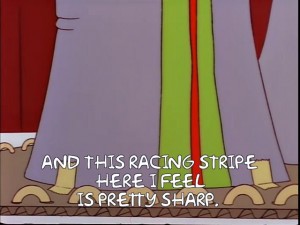 The Met uniform philosophy, 1983-1992. And those racing stripes there, I felt, were pretty sharp. Sort of like what the Expos were wearing, but better, because it was the Mets.
Did anybody call them racing stripes in 1983? Maybe they did, but I might’ve missed it. The Uni Watch culture was a couple of decades from coalescing and, besides, I was in college in Florida for the first month of the season, watching only as much as Seaver from afar as primitive media would allow. Highlights from Opening Day on the local news and that Sports Illustrated were about it. By the time I got back to New York in May, the newly detailed uniform had blended into the background and the Mets had let the momentum of that first win and the one that followed it be overwhelmed by six consecutive losses, setting the tone for the first dreadful month of the no longer so new year. In short order, they were 6-15 and yearning for another hero to rescue them, this one not from the past, but the future: Darryl Strawberry, who debuted 31 days after Seaver returned.
Straw never wore a Mets uniform that wasn’t accented by racing stripes, at least on his pants. Now and then, the Mets wore blue tops in ’83 and ’84, but a decade of orange-blue-orange distinguishing Met players from other players was underway. Darryl was a Met from 1983 to 1990; nothin’ but stripes. Ron Darling showed up late in Darryl’s rookie year and lasted into the summer of 1991: nothin’ but stripes. As late as October 4, 1992, by which time Tom Seaver was safely ensconced in the Hall of Fame, the stripes remained in place. The uniform had been tinkered with in other areas — its pullover top gave way to a traditional button-down shirt — but what Seaver wore on Opening Day 1983 and what was associated with Strawberry, Darling and their contemporaries during their tenure was basically what was still in use on the Closing Day ’92 when Willie Randolph completed his own New York homecoming, finishing his single season as a Met with a walk that drew a standing ovation.
When the Mets and applause returned to Shea on April 5, 1993, ten years to the day that Seaver was the story, the stripes were gone, and the race to the bottom of the National League East was in full gear (exit applause). But that’s another story. The story on Sunday, April 10, 2016, was that the racing stripes were back at the home of the Mets for something more than a cameo for the first time in 23½ years. They were worn, as they will be every Citi Field Sunday this season, to commemorate the 30th anniversary of the 1986 Mets, who themselves commemorated the 25th-anniversary season of the team with a patch that has also been liberated from mothballs. They will be worn on good Sundays and less good Sundays, the most recent Sunday falling into the latter category, as the Mets dropped their third game of the thus far five-game-old season.
That’s a 2-3 record for those of you scoring at home (or even if you’re alone). That’s exactly the record the Mets got off to in 1983, the year the racing stripes debuted; and 1992, the year the racing stripes, like Randolph, bowed out; and 1993, the year the racing stripes, like Met dignity, went on hiatus; and 1991, the year Darling was traded; and 1990, the year Strawberry almost carried the Mets to a division title before his back gave out from almost carrying the Mets to a division title and he decided relief awaited him in Los Angeles; and 1989, the year Randolph, as an L.A. Dodger, halted the Mets’ playoff hopes in their tracks with a Pendletonian home run in late August; and 1988, the year the Mets met the Dodgers in the playoffs to ill result; and, yes, 1986, the year known for so much else, but whenever the Mets lose three of their first five, is known mainly for the Mets going 2-3 out of the gate. It was mentioned in 2015 (pretty good year, it turned out) and, because the Mets were so obviously dressed for the comparison, it came up on Sunday.
Just as when I see the racing stripes that reigned from 1983-1992 and don’t necessarily think of 1986 (especially when today’s pants and shirts are worn substantially blousier than they were three decades before), 2-3 doesn’t automatically send me speeding toward memories of That Championship Season exclusively. It would be nice to go there, but as demonstrated above, 2-3 doesn’t always augur 108-54. It can get you 90-72 as it did last year, it can send you to 100-60 per 1988, or it can set the stage for 59-103 if everything goes as wrong as it did in 1993. There’s a 77-84 in there, a 72-90, a 91-71, an 87-75 that sounds better than it was and, where the racing of the stripes commenced, a 68-94 that was better than it sounds. The 1983 Mets of Seaver at the beginning, Strawberry (not to mention Hernandez) by the middle and Darling toward the end morphed into a team on the rise despite having to ascend from a depressing basement address.
This was all a long way to say that it’s a long season and a short stretch is not a reliable measuring stick. You already knew that, but you also already knew that after five games, the 1986 Mets were 2-3.
After five games, the 2016 Mets are 2-3. At this pace, they will play a sixth game tonight, weather permitting.
The fifth game, despite its presence in the best-forgotten file, gave us two highlights that were not sartorial.
1) Yoenis Cespedes fought off pitch after pitch until he got the pitch he wanted from Jeremy Hellickson in the sixth inning, and then he whacked it like he preferred to never see it again. Nobody on the field of play would, for it flew with fury over the Whatever Somebody is Paying to Call It Now section in left and briefly raised hopes that the Mets would stop screwing around with the Phillies. They didn’t, as evidenced by the 5-2 final, but gripping theater ensued while Cespedes dueled mano a mano for eleven pitches versus Hellickson (who I languidly mistook for Mark Hendrickson, the pitcher who lost to Johan Santana on Opening Day 2008…a year when the Mets started, yup, 2-3).
Guidance derived from five-game samples is about as useful as that which one extracts from the first four games of a season, but you can’t blame a Mets fan for clapping extra hard at the TV as Yo’s blast cleared the advertising-laden fences. He couldn’t have been much worse coming into Sunday. He may be getting going based on Sunday and, more significantly, everything he’s done in his career.
2) Jim Henderson is either pitching way better than we could have expected or exactly as we should’ve expected. After a season in the minors rehabbing a surgically repaired shoulder, the former Brewer closer (and old-friend protégé) is pitching with a vengeance. In three innings, he’s faced and retired nine batters, seven of them on strikeouts. Given Henderson’s recent track record, no, you couldn’t have expected that. But given the Hendersons’ track record, yes, of course we knew he was gonna be splendid.
The Mets have had three prior Hendersons in their history. Every one of them emerged in a blaze of glory.
In 1977, the Mets acquired Steve Henderson on June 15, a date that already came up once in this piece for reasons that are more familiar than even the 2-3 launch of 1986. Steve went 2-for-4 in his first start, hit an eleventh-inning walkoff homer in his fourth game and was batting .357 a week after the Wednesday Night Massacre. Steve Henderson didn’t make us forget Tom Seaver, but he did make us embrace Steve Henderson.
In 1978, veteran outfielder and previously projected Willie Mays successor Ken Henderson alighted in St. Petersburg as the player to be named later from a trade made earlier in which a slew of name players shuttled hither and yon. Jon Matlack and Al Oliver had already been shipped to the Rangers, John Milner and Bert Blyleven to the Pirates, Tommy Boggs and Adrian Devine to the Braves, and we knew the Mets had already received Willie Montañez and Tom Grieve. Henderson’s mid-March marching orders made the swap a done deal. Joe Torre anointed him right fielder and batted him fifth on Opening Day at Shea. Ken delivered the first run of the new season when he doubled home Montañez in the second on April 7. Three days later, he and Steve each doubled in the third to create a run; in the eighth, both of them walloped two-run homers. Bob Murphy raved about “the Henderson men”. Why shouldn’t he? Steve had placed second in Rookie of the Year voting in ’77 and now Ken and his impeccable credentials were Met property. The Mets were 4-1 after five games. Everything was looking up.
In the seventh game of 1978, Ken twisted his left ankle and sprained his big toe in pursuit of a fly ball. He never played for the Mets again and was traded to Cincy for Dale Murray in May; none of his three Red homers came in support of his new team’s ace, Tom Seaver.
In 1999, left field, for almost four seasons the province of Steve Henderson (who these days teaches hitting to the Phillies, who pick the most inconvenient times to absorb his lessons), was presented to Rickey Henderson, who presented himself to the Mets in the preceding offseason. Rickey was already a Hall of Fame lock when he arrived in Port St. Lucie. He kicked his bid for immortality up a notch in the third and final game of the year’s opening series at Pro Player Stadium: 4-for-4 with a walk, two homers, two doubles, two ribbies, four runs scored. Rickey was being Rickey in a fashion more ostentatious than any throwback uniforms could ever accomplish. By the end of business on April 7, 1999, he was batting .545, slugging 1.364 and performing generally as out of this world as the Mercury Mets outfit he’d reluctantly suit up in come July. Six months later, he’d be part of a Mets playoff team, something maybe one more Henderson will be able to say eventually.
Stay tuned. The last 157 games are usually the ones to tell the tale.
Speaking of tales told, you can read 2015’s in Amazin’ Again, my book that covers the journey of the National League Champion New York Mets from 2-3 to 90-72 and then some. Personally inscribed and signed copies are available here, regular copies are available here, a friendly discussion about it can be listened to here and you can check out some kind words written about it here and here.
by Jason Fry on 10 April 2016 12:38 am One of my favorite parts of a new baby season is how for a little while you can remember every game.
We lost that horror show in KC, then played well and won a squeaker, walloped the Phils, then lost that taut little one the next night.
See? Easy. Depending on your attentiveness and memory, you’ll be able to do that for another week or so. Then things will start getting muddled and tangled, and then the season will elongate and elasticize into feelings and narratives invented to fit a selection of facts.
It’s the way of things, just as it’s natural to record firsts. We got the first heartbreaker out of the way early on Opening Night — before Opening Night, even, if you want to count enduring the Royals’ flag-raising and ESPN’s hammering the defenseless carcass of Lucas Duda‘s throw home. We got the first taut victory out of the way two nights later, and recorded the first runaway on a chilly Friday at Citi. And then Saturday night’s game brought us another inevitable first for the menagerie: the first unsatisfying shrug-your-shoulders affair, a game whose only flaw was the final score.
The Phillies are a dumpster fire, no doubt — take a shaky bullpen as an anti-foundation, then atop it assemble a general lack of experience, iffy outfield defense, Ryan Howard‘s albatross of a contract, and whatever the hell it is Cesar Hernandez thinks he’s doing at any given moment. We can guess what that will mean over 162 games, but it doesn’t say anything about what the Phillies will do during one of those games.
Tonight they were a little bit better than the Mets. The difference was teeny — Bartolo Colon‘s 66th pitch was a 88 MPH fastball with not enough movement and too much plate, transformed by Howard into an arcing liner destined for the third row above the old Great Wall of Flushing. Colon was pretty great the rest of the night, punctuated by an over-the-shoulder catch of an airborne Freddy Galvis bunt that looked a little like a high-school drama class’s re-enactment of Willie Mays retiring Vic Wertz. Yes, Bartolo got his man then, but the failure to get Howard would doom the Mets by a thin yet inarguable margin.
Meanwhile, the Phillies’ Vince Velasquez looked like a punching bag early, racking up a slew of hitters’ counts while hunting for a stubbornly elusive curve ball. Unfortunately for the Mets he found it, throttling them with that curve and a lively fastball through the middle innings before a high pitch count forced his exit and ensured the Mets would have three cracks at the Phillies’ bullpen.
Three cracks, lots of opportunities … and nothing accomplished. Alejandro De Aza was picked off first with two outs in the seventh, but reached second when Howard did everything but balance the baseball on his nose; no matter, as Curtis Granderson flied out. The eighth inning, though, was the one that really hurt: between Asdrubal Cabrera, Yoenis Cespedes and Lucas Duda the Mets saw no less than 12 pitches in 2-0, 3-0, 3-1 or 3-2 counts. That’s a good recipe for a big inning, but hold your compliments to the chef: they Mets converted not a single one of those pitches into a walk or a hit, then meekly departed after a six-pitch ninth.
It wasn’t a forgettable game — the final score, head-scratching Phillie misplays and taut starting pitching elevated it above that. But one we’d like to forget? That fits well enough.
by Greg Prince on 9 April 2016 9:06 am The Mets won their Home Opener on Friday in what we might refer to as Methodical fashion, steadily dismantling an opponent seemingly incapable of keeping up with them across a given nine-inning period. They hit when they had to, they fielded as needed, they pitched above industry standards and they played Philadelphia. Of such ingredients, victory stew is concocted.
On the list of obstacles starter and winner Jacob deGrom needed to overcome, the Phillie offense placed fourth, behind 1) wanting to be on hand to accept the impending delivery of his first child, lest UPS leave it with a neighbor; 2) a lat muscle that tightened up after six innings of five-hit, no-walk, six-strikeout ball, but was described as not serious because slight Met aches are never anything to worry about, no siree, Bob; and 3) arctic conditions that made the 48 on Jake’s jersey an aspirational figure, once you factored in the wind chill. The Phillies, by comparison, were something you could confidently leave in the baby’s crib and not worry that any harm would come. They are, at this stage of their development, child’s play.
It took a little while for the Mets to warm to their task, which is understandable considering how freaking cold it was at Citi Field. One skinny run remained unaccompanied from the second through the fifth, the Mets leaving five on in the first four innings. The Phillies tied things up in the top of the sixth, with deGrom growing a little uncomfortable and the rest of us perhaps a tad uneasy.
Ultimately, though, the Mets asserted their essential Metness, chasing Jerad Eickhoff in the bottom of the sixth, when Lucas Duda doubled, Neil Walker singled him home and Michael Conforto doubled in Walker. A parade of Phillie relievers thus commenced and may still be in progress; I’m surprised one of them wasn’t run over during the debut of the lame car race that wishes it was Milwaukee’s sausage race. One by one they marched in from beyond the outfield wall, some now and then recording outs, others issuing walks and permitting singles. By the end of the seventh, the Mets had accumulated as many runs as there had been innings. The eventual 7-2 final accurately reflected the current capability gap between combatants. The Mets are good enough to win when they don’t look particularly great. The Phillies have at least one player easily flummoxed by the infield fly rule.
Winning solidly if not resoundingly ensured a successful mission for the 44,099 of us who swaddled ourselves in enough blankets to make Baby deGrom jealous. But Friday was gonna be a special Met day regardless of result. That was guaranteed last October 21, once we knew we’d have no worse than a National League championship to commemorate come April 8.
You don’t get to enshrine a champion of that level or higher every day. The Mets have done it only five times. As long as we could see them do that, the Home Opener was going to be an affair to remember.
The pennant did rise, just like the playoff merchandise promised it would. It rose up a flag pole planted on the branded soft drink pavilion (why get attached to transitory sponsorships?). Three men who know from earning league championship flags — Rusty Staub, Class of 1973 and 2000 alumni John Franco and Edgardo Alfonzo — were tasked with raising duty. It wasn’t a Herculean chore. The Mets have what I assume are the shortest flag poles in the majors. Instead of one that towers majestically over center field, they have a few tucked out of the way where it wouldn’t occur to you to look for them.
On the pole next to where Old Glory flies, the cloth representing recent accomplishment waved prominently in Friday’s omnipresent wind. The ’73 and ’00 flags were given the day off, as were those commemorating ’69 and ’86. The framework for Citi Field’s eighth Opening Day was carved by the 2015 National League Champions. They deserved a singular spotlight.
The pennant’s literal rise followed the introduction of the 2016 Mets, who aren’t exactly the 2015 Mets, which will happen when offseasons interrupt continuity. You watched the festivities and thought about all the fingerprints on the achievement we were basking in, yet Howie Rose did not call names like Murphy or Tejada. It didn’t exactly detract from the ritual, but you missed them in the moment. Still, this is the business we’ve chosen. No doubt the rings are in the mail.
Every Met who is a Met in the present was introduced with an Opening Day flourish and cheered heartily, whether it was someone who’d devoted to the cause we hold dear a dozen years or a dozen weeks. Mets who’d been Mets since not much before Sunday were greeted as blood relations. We are modern fans. We understand how to blend our family.
These types of ceremonies, even without a pennant adornment, are always a ritual to behold. I’ve been a sentimentalist since I was a kid, so I loved that Ray Ramirez finally drew more yays than nays, his Prevention & Recovery execution finally being good for what ailed us…deGrom’s lat pending. I appreciated that Dan Warthen was treated as the superstar svengali he’s turned out to be. I got a kick out of the extra relish spread on Michael Conforto’s reception. Every year at this time, I’ve noticed we like to tell the young player who showed us a little something late in the preceding year that we noticed you, that we do pay attention, and now we anticipate big things from you (implication: don’t let us down, kid).
Amid the stream of please welcome and direct your attention instructions came an interlude I was not expecting at the instant Alex Anthony announced it: a moment of silence dedicated to Shannon Forde, the senior media relations director and first-class human being who died of cancer in March. Viewing her cherubic image on the video boards, accompanied by the unintentionally cruel words “IN LOVING MEMORY,” made for one of those Opening Day time jumps that grabs you by the heart. The weather people said something in the morning about a chance of “pop-up showers”; I can report the brief presence of one behind my glasses.
I took in the ceremonial portion of the day on my own, staking out a spot in the left field corner to stand and clap and occasionally go “YEAH!” This was my sixteenth Home Opener and if I’ve learned anything, it’s that no matter how well I plan, I’m never fully stationed at my seat when the ceremonies begin. It is better, for my purposes, to stop wherever I am and watch from there. It works fine that way. As for why I can’t be in my seat, the first home game of the year demands a course of pregame scurrying. That, too, is intrinsic to the day’s rituals.
I want to see what’s new inside the stadium. I want to see what’s up with folks I’m meeting outside the stadium. I want to let those with whom I didn’t physically touch base know where to find me later. I want to linger at the tailgates of gracious fellow travelers. I want to grab my magnetic schedule (I have one for every year since 1997). I want to purchase my Official Yearbook, program and media guide. I want to run to the bathroom. And I want to absorb the whole scene. Opening Days demand much of the highly engaged fan — as they should, I suppose. Go big or stay home or something like that.
Once the podium was carted away and the players retreated to their opposing dugouts, the center of gravity for my first game of 2016 became Section 534 in Promenade, a region that provided a wonderfully Shealike perspective on the remaining proceedings. It is the rough equivalent of Section 32 in Mezzanine, if we allow for the conceit that nothing at Citi Field (besides Garrett Olson’s lifetime Met ERA) measures as high as the Upper Deck at Shea Stadium; otherwise, pencil in Upper Deck 48, since-demolished site of the sainted Agee marker, for purposes of comparison. I sat in fair territory at Shea only when it was a huge crowd for a huge game. It seemed fair to sit well up in left for this year’s Opener. Mets and Phillies is no longer an automatically enormous matchup, but what could be huger than raising the first pennant in Citi Field history?
Elevating my spirits way higher than Row 6 of 534 was my companion for the bulk of the day, my sister Jodie, who is not technically my sister (different parents and all that), but might as well be. Our last Home Opener together was 2007, also a satisfying beatdown of the Phillies, also conducted in a climate better suited to the Iditarod. Jodie lives far from Flushing now, but she recognizes a special occasion from a vast distance, and for that I’m grateful. While I was immersed in happily recapping 2015 last November, Jodie told me a Facebook group to which we both belonged (I in a mostly nominal capacity) was getting a bloc of tickets together, preceded by epic parking lot doings, did I wanna go as her guest? I looked up from my typing long enough to say, uh, sure, not quite believing months in advance that anybody had a handle on whether we or the Mets would still be around in futuristic-sounding April of 2016.
Glad I went along in concept as well as reality. The group, cheekily self-identified as The Mets Give Me Agita, was conspicuous by its affable mellowness on Friday — convincing wins will temporarily quell the stubbornest of anxieties — and Jodie and I picked up more or less from where we left off, wondering why, for example, Hundley couldn’t stay behind the plate and Piazza couldn’t go out to left since Todd was obviously the better catcher. Clearly, Mets agitation does not come stamped with a sell-by date.
Likewise, Mets fulfillment shouldn’t be deemed a done deal just because the final pitch Antonio Bastardo throws to Cameron Rupp is grounded to Asdrubal Cabrera and fired successfully to Lucas Duda. My Mets buzz stayed intact all the way to Woodside, where I was meeting Stephanie for dinner at a little Filipino restaurant where the chicken molo soup warms whatever extremities a 7-2 triumph can’t. I arrived first, sat myself down, stared out the window and watched Mets fan after Mets fan wander by. They were presumably bound for Roosevelt Avenue establishments of their choosing, no agita evident in their gaits, either. Emotionally sated Mets fans are a boon to the local economy, to say nothing of the civic mood. A pennant had indeed risen, our mojo was risin’ and that molo they were making in Engeline’s kitchen was going to hit the spot like our lineup had hit the Phillies’ bullpen.
The whole world is a better place when the Mets win their Home Opener. You already knew that, but it’s always nice to be reminded.
by Greg Prince on 8 April 2016 9:24 am Thursday afternoon, driving around and desperate for baseball to fill the inane interregnum during which an uncaring schedulemaker left the Mets far too idle, I flipped to the Yankees-Astros game. John Sterling mentioned something about Nathan Eovaldi apparently being done for the day. Rarely thinking about who’s on that team and what they do, I worked to remember Eovaldi from the Marlins and piece the clues together from there. He’s a pitcher…he pitches for the Yankees now…he’s leaving the game…but they’re not saying he’s being pinch-hit for…because this, like our two games in Kansas City, is being played under American League rules…which are an affront to all that is good.
This isn’t going to be a screed against the designated hitter and its unnatural nature having no place in the game we love, and it’s not even going to be a swipe at John Oliver’s target de la semaine nor the announcer whose most every fly ball call encompasses height, distance and inaccuracy. Instead, it’s a celebration of today being a day when there will be no desperation for baseball. We’ll have baseball. Our baseball.
No DH in the Mets-Phillies game at Citi Field today at 1:10. No announcers for whom we roll up the windows while in the car lest strangers adjacent to us at a red light think we listen to this crap as a matter of course. No substitutes needed.
We’ve got the Mets back. Our Mets.
It’s something approaching normal, this Friday day game in Flushing. Granted, there are never Friday day games in Flushing unless it’s the Home Opener, and the Home Opener is anything but business as usual. Even in the years coming off sub-.500 finishes, today is fully out of the ordinary, for better and for worse.
The “for better” you can figure out for yourself. The “for worse” is a tad harsh, I suppose, but as much as I thoroughly enjoy the half-hour or so of tradition-steeped pomp that precedes the actual playing of ball — everything from the appearance of the Shea family’s sacred floral horseshoe through the opposing leadoff batter inevitably taking the first non-ceremonial pitch for ball or strike one — what I’m craving annually here at winter’s end is an intertwining of normality and baseball in my bloodstream. The excitement that bubbles over hours beforehand on mass transit platforms and inside rapidly filling parking lots over one single game that isn’t for the championship of anything, whether the vibe is organic, manufactured or a little lubricated…well, to quote the Queens-bred boyfriend of a girl who lived across the hall from me in college, it ain’t nawmal.
Opening Day, the Home version, is out of the norm by definition, but sometimes finding your bliss can be an intensely personal journey that eludes accepted norms. I attended five consecutive Home Openers from 2010 to 2014, and by the last one, I was feeling optimism fatigue, which is a dangerous condition to bring to a venue where everybody is uniformly thrilled. Thus, I willingly snapped my streak last April and experienced no void for having done so.
One year later, Reverse Chicken Little (“The sky’s not falling! The sky’s not falling!”) has been proven to have squawked the truth; the Mets are raising the fifth pennant in their history; and I’ll shortly be Citi-bound packing enough anticipation to fill the first disc of a Carly Simon anthology. Of course winning has a lot to do with flipping the mood. But maybe skipping the Home Opener in 2015 provided me a reset. I’m feeling this morning like I felt twenty years ago on this occasion. The skies were grimmer and the six-month forecast was decidedly murkier in 1996 — if Wilson is as good as they say and Izzy keeps it up and Huskey slugs like he did in Florida and Ordoñez can hit like he can apparently field, watch out Wild Card — but the idea that I was gonna be at Shea to witness the Mets commence the National League season in New York challenged credulity. You mean a person can just do that?
Yes, he could and yes he can. What a kick to get to do it again with clear eyes, let alone full heart. Can’t lose? We’ll see. Either way, once this Day of Days is done, there are slated to be 80 more games in what we contentedly call our ballpark and 79 others scattered across this great land. Baseball will be performed daily, accepted as normal and, for the most part where we’re concerned, conducted free of designated hitters. Surely it will keep us coming back.
And you thought only the schedules were magnetic.
by Greg Prince on 5 April 2016 11:01 pm 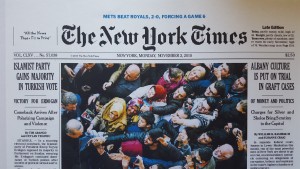 No need to stop the presses, as the Mets finally maintain a 2-0 lead versus the Royals. All that gold in which the world champion Kansas City Royals draped themselves over the past two games is now dust. Gold dust. They can cram it into tiny tubes, authenticate it, mark it up and sell it as Thor-used to their heart’s content.
They’ve still won what they’ve won, yet we still have the most astounding concentration of starting pitching in civilization. We were reminded of both irrefutable facts Tuesday.
The Royals can have their flags and their rings and the accoutrements of 2015 victory. The Mets can have Noah Syndergaard pitch every fifth day and call him, depending on the prevailing winds, their No. 3 starter.
Some staff. Some stuff. This Syndergaard is good for all time zones, including the Central, where the late afternoon start, like the starter, hit all its spots. The Mets played fourteen postseason games in 2015 and none of them ended in daylight. Opening Night…well, it was called Opening Night for a reason, though Nightmarish Continuation would have sufficed. The last time the Mets took and left the field under the sun was October 4, just before they departed on their journey to greater things, which itself was the first instant they and sunshine were seen simultaneously in about a week. They won that well-pitched game, too.
Daylight does a Met body good, particularly one that’s listed at 6’ 6” and 240. Noah led us out of the darkness that enveloped the first game of 2016 and, after permitting a foreboding triple to leadoff pest Alcides Escobar, retired almost every Royal he faced Tuesday, doing so with command, arsenal and poise.
Wear all the gold you want. You face that and you’re gonna end your afternoon with your luster tarnished.
Thanks to Neil Walker bringing to bear the kind of home run power we’ve come to expect from our second basemen, the Mets took a 2-0 lead in the fourth. Thanks to everybody else in the lineup, the score loitered at 2-0 for an uncomfortable interval. Nothing wrong with leading the world champs — have you heard they’re relentless? — by two as the innings are whittled away, except for oh that déjà vu. The Mets led the Royals, 2-0, through eight one night in November, you might recall. That lead didn’t hold up.
This one did. Thor masterfully ’gaarded his advantage over six (three hits, one walk, nine strikeouts). The bullpen that never quite quelled doubts five-plus months ago transcended adequacy and groped at excellence. Jim Henderson, whose name evokes director of sales for your granary supplies’ Midwestern branch, turned the top of the seventh into a company picnic, complete with balloon animals for the kids. Addison Reed, who won’t always calm your anxieties, was Xanax for the Mets fan’s soul. And Jeurys Familia, a platinum reliever except when encountering Justin Upton, Alex Gordon and cruel fate, was his usual phenomenal self. In the middle of reveling in Jeurys’s tour de Familia, respect must be paid to Walker, who had trouble cleanly scooping an Eric Hosmer grounder with one out in the ninth, but did manage to pick it up and fire it to first, thus retiring both the runner and a seven-game-old narrative that had seeped all over our brand new calendar.
The Royals get all the breaks and eventually make the Mets pay. But they don’t cash in on every last one of them, we discovered an instant later, as Familia earned the glittering item we learned across several frightful nights last fall can be more precious than gold: a save.
The Mets are 1-1, exactly where they were after two games in 2015 (and a whole lot of other less rewarding seasons). Two and Oh would be better, as would 162-0 eventually, but this is fine. We got the first loss out of the way, we got the first win nailed down and we get on with our baseball lives. We now wait out the bizarro-schedule portion of the week — off Wednesday, off Thursday; bundle up Friday for our own humble ceremonies; and by next Tuesday, it will be like this year has been going on forever.
With pitching like we saw from Syndergaard, that sounds like an enticing proposition.
by Jason Fry on 4 April 2016 2:03 am It wasn’t exactly on my bucket list — unless you’re redefining the term to mean “stuff that makes me want to puke when I think about enduring it” — but I can now say I’ve been through an Opening Day that I was dreading.
Dreading Opening Day? What a bizarre thing for a lifelong fan to say. Yet that’s what I was doing while waiting for Mets/Royals at Kauffman Stadium and the beginning of the 2016 campaign.
It’s not baseball’s fault — the Mets and the Royals were locked into a season kickoff last summer, when nobody knew what the fates had in store, and rejiggering team schedules sounds easy until you actually try it.
Nor was any of the variously excruciating, annoying and exasperating pregame pomp and circumstance the fault of the Royals. They did what they should have done for their loyalists, and I thought they did it well. The Royals are a great team I gladly would have cheered for in October if not for the zero-sum problem involved, I love the goofball pageantry of flag-raising and gold lettering and trophies on display, and their fans had waited 30 years for a chance to coronate their heroes in their home park. I was miserable, but I managed to be happy for them, from the dude with moose horns to the fans pointing gleefully at Salvy Perez‘s gilded shin guards.
It wasn’t ESPN’s fault either, though by the fourth inning I was ready to hurl Dan Shulman, Aaron Boone and Jessica Mendoza off a nearby suburban overpass (of which one can choose many). Relentless narrative, after all, is what ESPN does.
My blog partner may have been elated, but I felt like I’d received an invitation to a party I really didn’t want to attend, knew would be super-awkward and painful, and yet couldn’t get out of. I’d been brooding about it off and on during the Mets’ alternately dopey and sleepy spring training, knowing there was no outcome that would satisfy me. If the Mets blitzed the Royals by a dozen runs, I’d demand to know why that couldn’t have happened a few months ago; if they lost, it would feel like a cruel Game 6 — a mean-spirited addendum to a series already down the toilet.
Either way, I was sure, it was going to suck.
What I didn’t dare guess — because it seemed too cruel — was it would suck pretty much exactly the way the World Series sucked. This was ripping off the Band-Aid to discover not pink and slightly delicate skin, but a wound that was still bloody and festering.
I went a little catatonic after the World Series, retreating into creating Lost Mets baseball cards and the comforting routines of work. I never quite figured out why, but I can grasp the broad outlines of the problem. It starts with the fact that I’ve always dismissed the World Series as a fun but silly exhibition series, seeing the pennant as the real prize. The 2015 Mets 2.0 — who didn’t exist before the end of July and never quite stopped feeling like strange new arrivals to me — won that pennant rather handily, surviving a ridiculously dramatic and harrowing series with the Dodgers before beating the Cubs as badly as one team can beat another.
Which was so, so awesome — all the more so for the long wait and the sheer unlikeliness of it all.
And then those same Mets went and turned in one of the worst weeks of baseball they’d given us all year.
You saw it: alternately incompetent and tragic fielding, inept baserunning, dunderheaded quick pitches, meek hitting, bad managerial decisions, and no shortage of rotten luck. It was dreadful, and as things cratered I tried to tell myself not to fall prey to the narrative. I reminded myself that I laugh at dumb talk-radio fans who confuse a bad few days of baseball with a failure of virtue, a pallid will to win, or any of that other tired Goose Gossage bullshit.
But it’s easy to laugh in May or June. Turns out it’s tougher in October.
It’s a lot tougher in October.
I sulked about it for a while, waited for the feeling to fade, and when it stubbornly persisted … well, I didn’t quite know what to do. And I still don’t.
But I do know this much: the antidote to this particular fan’s illness was not kicking off April with the same two teams and the same two starting pitchers.
Which leads me back to the narrative: If the Mets had drawn any of the other 28 possible opponents for this Opening Day, the in-game chatter would have been all about the team’s giddy success and the parade of stud pitchers and the feel-good returns of Yoenis Cespedes and Bartolo Colon and how Wilmer Flores cried and stayed and how now the promised land was within reach.
Instead, the Mets drew the only opponent that ensured a different narrative: one that was all about the Royals’ triumphs and the Mets’ failures, crystallized by poor Lucas Duda taking aim at a spectator and Travis d’Arnaud spinning vainly to catch the uncatchable.
The best revenge would have been to kick the narrative in the teeth, and leave Shulman and Co. awkwardly trying to cram an increasingly square peg in a round hole. A fine plan, except the Mets turned in a performance eerily reminiscent of the World Series that I can’t manage to get over.
I mean, it was like baseball plagiarism: There was Matt Harvey once again looking out in first-inning amazement at Cespedes and a ball fielded with horrific negligence. There were Royal grounders sneaking through holes and just eluding Met defenders in the bottoms of innings, followed by the aggravatingly familiar sight of Eric Hosmer and Mike Moustakas smothering tough hops in the tops of innings, transforming run-scoring singles into rally-snuffing outs.
Yes, the Mets made things interesting late, but their uprising started as farce and ended as tragedy.
The eighth inning looked like one of those hollow baseball moral victories, with Duda and Michael Conforto grabbing a page from Kansas City’s playbook and dropping little bloops that found grass. The ninth inning, though, turned bleak and wintry: Curtis Granderson and Cespedes sandwiched excellent at-bats around a helpless, dreadful showing by David Wright that marooned the tying run at third. It’s only one game and it would be unfair to make more of it than that, but Wright had an awful day — besides the strikeout, his bat was slow on several pitches he should have crushed and his arm was short on two infield plays.
ESPN’s sledgehammer narrative, if anything, wasn’t delivered relentlessly enough. And what was guaranteed to be a bittersweet evening at best turned out to be one of those soul-curdling losses that leave you shaking your head and waiting for a better game, one that will disperse the little black cloud created by this one.
Unfortunately, the next chance at that will be against these same Royals, and against this same narrative. Didn’t like the party? Then you’re not going to like Tuesday’s shindig either. But once again, our attendance is mandatory.
|
|






