Faith and Fear in Flushing made its debut on Feb. 16, 2005, the brainchild of two longtime friends and lifelong Met fans.
Greg Prince discovered the Mets when he was 6, during the magical summer of 1969. He is a Long Island-based writer, editor and communications consultant. Contact him here.
Jason Fry is a Brooklyn writer whose first memories include his mom leaping up and down cheering for Rusty Staub. Check out his other writing here.
Got something to say? Leave a comment, or email us at faithandfear@gmail.com. (Sorry, but we have no interest in ads, sponsored content or guest posts.)
These March days, when spring somehow infiltrates the air, my instinct is to head to the nearest candy store, stationery store or luncheonette and pick up a pack of cards. More than a pack really. That instinct was finely honed in my childhood when every candy store, stationery store and luncheonette sold packs of cards.
Sadly, they don’t seem to have as many of those outlets anymore, at least not in my immediate vicinity. So I will have to cater to my mood by going back to some random March day in 1975, when I was 12, and buying baseball cards was as easy as strolling to the Cozy Nook or Belle’s or the Laurel or Echo or the Colony or anywhere in my Long Beach midst and putting down my spare change.
Each pack contained 10 cards and a stick of disgusting bubble gum for 15 cents. I’m not sure there wasn’t a markup. I doubt I comparison-shopped. I also know I rarely if ever stopped at one. Four packs was my chosen quantity if I could swing it on a four-dollar weekly allowance. It was a good, indulgent amount. Three wouldn’t have been enough. Five would’ve been too many.
OK, so I’ve gone back four decades with my sixty or so cents and purchased my four packs from the Cozy Nook (same block as Belle’s, but they’re nicer). I shall now open them up and see what I got.
PACK ONE
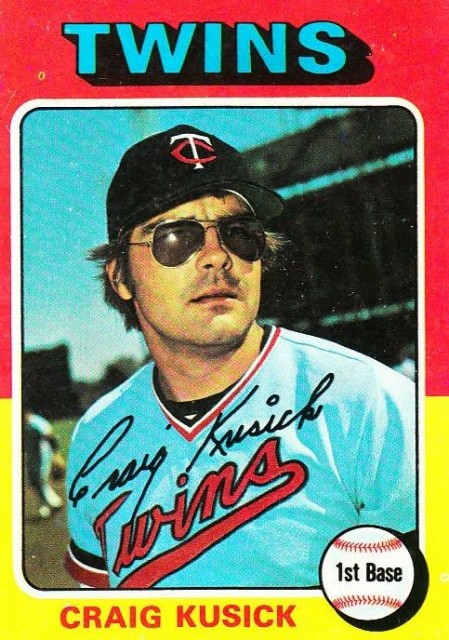
Craig Kusick. Again?
Bart Johnson. Again.
Jim Wohlford. Not again.
Vada Pinson. Hey, he used to be pretty good.
ERA leaders. Leader cards are less exciting than they should be. They have great players on them but they’re not really the cards of great players — y’know? This one has Catfish Hunter before he became a free agent and Buzz Capra after he stopped being a Met. Man, can you believe Buzz Capra led the N.L. in ERA? Nice job, Bob Scheffing.
Diego Segui. I’m pretty sure I’ve been getting Diego Segui every year since 1970.
Rudy May. A Yankee. Yippee.
Lynn McGlothen. I always pronounce it McGlothlen. I guess I’m wrong.
Steve Braun. I sure get a lot of American Leaguers.
Bob Bailey. This could’ve been a better pack.
PACK TWO
Joe Morgan. Now we’re talking! All-Star! It says so right there in the bottom right corner.
Don Hahn. A Met! Well, not a Met anymore, since he was traded to the Phillies with Tug, but the card says he’s a Met. I’ll take it.
Bart Johnson. Of course.
1958 MVPs. I love these MVP cards. I’m getting to where I must have most of these. Ernie Banks…I always wanted an Ernie Banks. Didn’t get one until last summer when I got hit in the head by the rudder on the sailboat at Treasure Island Day Camp, which put me out of commission, and my counselor Irwin felt bad for me and visited me at home and brought me a box full of his old baseball cards, all of them from 1967 to 1969, all of them either Mets or stars. Nolan Ryan and Jerry Koosman’s rookie card was in there. Willie Mays was in there, though he was a Giant back then. Mickey Mantle…Whitey Ford…a really young Bud Harrelson…and Ernie Banks. I didn’t know he won the MVP twice. I’m learning a lot from these cards. For example, I just learned who Jackie Jensen, 1958 American League MVP was.
Craig Kusick. I will never not get Craig Kusick, will I?
Jim Spencer. Texas Rangers, all right! The Rangers are my favorite American League team. They came from nowhere to win 84 games last year. They’re gonna overtake the A’s this year. Billy Martin turned around the Twins, then the Tigers, now the Rangers. What a great manager.
Steve Yeager. I guess that’s good.
Jim Barr. I’ll be flipping this one.
Rusty Staub. ALL RIGHT!!!
Fritz Peterson. Ex-Yankee. Ex-yippee.
PACK THREE
Padres team card. I guess they didn’t move to Washington after all.
Dave Chalk. I read about this guy in Baseball Digest. He’s supposed to be good.
Jim Wohlford. There may have been an energy crisis in this country, but there is no shortage of Jim Wohlford baseball cards.
Jim Lonborg. When we went to Philadelphia last year, I wondered if I had brought all my Phillies cards with me if I could’ve traded them to the local kids for all their Mets cards. I should try that sometime. Or do the kids in Philadelphia already have all the Jim Lonborgs they can use?
Rich Folkers. Ex-Met. I like looking at the back and staring at that line in his statistics.
Bart Johnson. Bart doesn’t really exist, except in most every pack I ever get.
Bill Bohnam. Since Ernie Banks retired, every guy on the Cubs is Bill Bonham. Or Paul Popovich.
1970 MVPs. My first year of real collecting. I never got Boog or Bench that summer, but here they are, real tiny on one card. I did get their Sporting News All-Star cards in ’70, but those don’t count.
Boog Powell. How weird is that? He’s a Cleveland Indian now, too, but an Oriole on here. It must’ve been too late for them to have a card that was that up to date. I guess Kingman is still a Giant on these cards. Seriously, I think that by getting Kingman, the Mets have to be the favorite in the N.L. East. Seaver’s gonna be healthy, Unser and Clines are gonna be an upgrade in center, we got Torre for third and now Kingman. First I thought it would be the Cardinals, then I thought it would be the Phillies. I’m sick of the Pirates winning every year. It’s going to be a four-way battle. I’m picking the Dodgers in the N.L. West, the Rangers in the A.L. West and…I hate to do it, but with Catfish Hunter and Bobby Bonds, probably the Yankees edging out the Orioles in the A.L. East. That has nothing to do with Baltimore trading Boog Powell to Cleveland. And I’d pick the Mets even if I weren’t a Mets fan. I’m surprised most of the magazines are ignoring them. Then again, they, like these cards, came out before the Mets got Kingman.
Frank Duffy. Boog Powell’s new teammate.
PACK FOUR
Brent Strom. I’ll put him over here with Rich Folkers.
Balor Moore. The Expos have the weirdest names.
Tom House. He’s number 525. I wonder why he rates a 5. I thought that was for really good players only.
Bob Locker. I’ve been getting Bob Locker since before I started collecting baseball cards. Seriously, Bob Locker was one of those cards I got from my sister when she gave me her cards, the ’67s and ’68s that she said she bought under peer pressure. It’s weird how her ’68s just peter out after the first series. Topps stopped doing series altogether, which is fine with me. Except I keep getting Jim Wohlford, Bart Johnson and Craig Kusick.
Craig Kusick. If it weren’t for baseball cards, I’d have no idea who Craig Kusick is. Actually, I still have no idea who Craig Kusick is. But I sure do have a lot of him.
Clay Kirby. He’s a Red now? Not a Padre anymore? When did that happen? He was a Red all of last year? I must not’ve been paying attention.
Claudell Washington. World Champion A — excellent!
Ron Cey. All-Star! Not as good as Schmidt, but still.
Roric Harrison. I’ve never met a Roric in real life.
Jim Wohlford. Uh-huh.
Well, that’s it. Four packs. Two Mets. The gum isn’t so bad if you just bite down on it real hard.
Welcome to FAFIF Turns Ten, a milestone-anniversary series in which we consider anew some of the topics that have defined Mets baseball during our first decade of blogging. In this installment, the Mets get screwed but good.
When the tenth anniversary of Faith and Fear was on the horizon, I thought about putting together a countdown of the biggest Mets stories of our time on the beat. Then I gave up on that idea because — called third strikes, dropped popups behind second base, consecutive September collapses and even some cheerful developments notwithstanding — there was only one story that truly mattered. There was no bigger Mets story over the past ten years than finding out the Mets had a lot less money than everybody, including themselves, thought.
Conversely, there was no ongoing Mets story that I’ve had less appetite to write about than Bernie Madoff. I don’t mean Bernie Madoff the fiend who went to prison but “Bernie Madoff” as shorthand for the Mets not having as much money as everybody thought. The Madoff scandal broke in 2008. We’re still regularly alluding to it, in a direct or indirect fashion, as it applies to the Mets in 2015. You read it explicitly or between the lines every day, whether in earnest reporting about allocations of limited resources or in snark-filled remarks that the Mets would do some mundane thing, except mundane thing costs money! (hold for laughter as billboards of protest continue to rise).
You know how “Bernie Madoff” continues to apply to the Mets? That’s not a rhetorical question. Really, I’ve never fully comprehended it except for the basics: Madoff screwed a lot of people who didn’t own baseball teams in a very bad way, while the people who do own our favorite baseball team were forever tarred and scarred by what had happened…whatever their angle in it was exactly. Several journalists have committed their considerable talents to explaining it, and I hang in there with their dedicated reportage for a while, but honestly, my eyes eventually glaze over. I’d rather stare cluelessly at a hundred sabermetric acronyms than have to take apart the details of what Madoff means to the Mets.
There was a prospective new partial owner who came and went. There were minority shares sold. There have been credit lines and bridge loans. There have been favorable judgments. There were statements of support from outgoing and incoming commissioners. There is a cloud that lingers.
It’s not enough that the team owners might make decisions about the baseball experience we don’t agree with or that don’t work out on the field. Every team’s fans, save a couple of perpetually satisfied tribes, can bitch and moan about results. We rebel at authority figures when we’re steamed and call every wealthy man “Mister” when we’re not. We instinctively treat these people like heads of state as long as they don’t invade our head space too often. We’re willing to applaud when they enter the premises on ceremonial occasions, assuming they tacitly pledge to otherwise stay out of our way. But these days, which encompass every day since late 2008, we cheer billboards demanding their ouster. They — which is to say “Bernie Madoff” — destroyed our team’s chances for more than a half-decade.
Our team. Not their team. That’s the deal. We dig deep because of that sense of ownership, even if it’s only a psychological stake we hold. Being down on the titular owners in this realm is nothing personal against them, per se, whatever their foibles in other realms. It’s about what they allowed to happen to our team. They’re supposed to be the caretakers, takin’ care of business on our behalf.
That part is personal.
I took one or two shots at delving into all this second-hand when it was relatively fresh. I didn’t know what I was talking about, so I stopped trying to write about it, except to say, in so many words whenever I attempted to piece together the Mets’ immediate future, “Bernie Madoff” — a.k.a. the Mets have a lot less money than everybody thought and that’s probably bad news for the Mets.
You know what I like to write about? Baseball. One of my favorite things is to look at the Mets and try to figure out whether their team is good enough to win, and if it isn’t, I like to puzzle out what might be done to make it better. We all do this. Except every time I’ve attempted to do this for the past six or so years, I hit a brick wall. Every meditation on the near-term fortunes of the Mets inevitably devolves into some version of “…but we don’t really know how much the Mets can spend, so who knows what’ll actually happen?”
That’s the legacy of “Bernie Madoff” in the Met sense. It used to be we knew. We grasped whether the Mets had resources (it was more or less a given that they did) and by their actions they let us know what they planned to do with them. Maybe the Mets spent them wisely or foolishly, but you could follow along at home. When we began blogging in 2005, they had resumed spending enthusiastically. It produced a fun ride for a while.
Then Madoff happened. Actually, I suppose Madoff happened before. Madoff happening — not the part where he was caught, but the part where he seemed to be a wizard and the principal owner trusted him implicitly — meant the Mets acted as if they had resources they didn’t necessarily have. Or they had them before they didn’t.
See, I still don’t quite get it. The Mets used what they either had or thought they had and turned the go-nowhere team that preceded our blogging to the going-somewhere team we took such delight in chronicling. Then they didn’t have the resources to make things happen. Or did they? We’d resign ourselves to spending patterns more in line with the last days of de Roulet, yet suddenly there’d be a Jason Bay signed here or a David Wright extended there. Curtis Granderson took real bucks if not the biggest of bucks. Bartolo Colon cost money. Michael Cuddyer wasn’t exactly cheap.
So the Mets were spending again? No, they weren’t. They couldn’t. They can’t. Can they? Cuddyer may not have been a bargain-basement pickup, but paying ballplayers of a certain level the going rate is kind of the price of admission for competing within Major League Baseball, isn’t it? Anybody who watched the Mets pursue the low end of the market when free agency came along will always be a little shocked that they sign anyone glitzier than Elliott Maddox and Tom Hausman. Nevertheless, it shouldn’t be a shock the Mets would sign somebody like Michael Cuddyer. The shock should be Michael Cuddyer turned out to be our winter centerpiece and half of our new inventory.
I’d like to say the ability to spend is none of our beeswax. It’s impolite to talk money in most precincts. But baseball is showbiz and the figures get thrown around freely. Then you factor in New York, which — according to most New Yorkers — is approximately a bajillion times bigger than Pittsburgh and Kansas City put together. We used to use New York’s enormity as evidence that the Mets were a bunch of cheapskates if they didn’t pony up in a given free agent season. They had to have the money to outspend all those pikers in the hinterlands. It’s New York…right?
“Bernie Madoff” made that not matter a whit. Whatever Pittsburgh and Kansas City and their teeny-tiny town brethren lacked in population they more than compensated for by not being home to the financial whiz who screwed the Mets among others. Too bad we couldn’t keep Amos Otis and trade Bernard Madoff to the Royals for Joe Foy.
Besides, small-market/large-market dichotomy ain’t what it used to be. There’s revenue sharing and multiple revenue streams and regional networks and it’s no longer as simple as saying the teams playing in the big cities have an insurmountable advantage over the teams playing in the littler cities. Pittsburgh goes to the playoffs. Kansas City goes to the World Series. The team playing in the city where Bernie Madoff made his bones winds up with the most stubborn disadvantage of all.
Somehow, we arrived in 2015 filling our optimism glass past the halfway point for a change. Oh, that young pitching! Oh, that spectacular center fielder! Oh, the reasonable assertions one can make that everybody is gonna be pretty good to maybe nearly great! And then, if we’re just a little shy, our general manager can go out and…
Or can he? Ah, the wall rears its bricky head again. Say what you will about Sandy Alderson, but say anything definitive at your own risk, because his actions defy definition.
• He let Jose Reyes leave because the batting champ’s future was a dicey proposition or because retaining Jose Reyes was beyond the means of the Mets?
• He traded R.A. Dickey because the package he could receive in exchange for his services far exceeded the value to be extracted from the Cy Young winner’s world-class knuckleball or because retaining R.A. Dickey was beyond the means of the Mets?
• He loved Ruben Tejada and Wilmer Flores in consecutive offseasons to the exclusion of every possible shortstop alternative available or he couldn’t help but love Tejada and Flores because upgrades were beyond the means of the Mets?
You can make all the inferences you want from Alderson’s public statements or manner or track record to date. You can hail his acumen. You can mock his inactivity. But you can’t really say he’s done everything a general manager can do, because he hasn’t been given the payroll flexibility a general manager is supposed to get.
Or has he? The Mets have never explicitly come out and said, “Whaddaya want from us? Madoff…y’know?” For a while, the story was, yeah, Madoff got to us but not the baseball. The baseball’s fine. Then the baseball operations were obviously impacted. Meanwhile, plans for malls and such went full steam ahead. So everybody was fine? How could they be? If they were, why weren’t the Mets aggressively pursuing this or that player? Because what they had was beyond conceivable improvement? This was a 79-win team in 2014 and it added two major leaguers in advance of 2015. Even with injuries presumably recovered from and prospects on their way, that’s a pretty complacent approach if that’s supposed to be the plan.
Unless it’s the best that can be made of a constrained situation, because “Bernie Madoff” changed everything and will continue to until we can stop talking about it as it applies to the Mets…which we’re not able to yet.
This, I am aware, is not a rigorous survey of the details that have made the Mets a budgetary mystery. This veers to the glib and superficial. Others curse when they don’t know what else to do. Foregoing intellectual rigor in my pursuit of understanding the Mets is my version of dropping f-bombs. I don’t wanna analyze that which eludes airtight answers even after the most exhaustive analysis. I just wanna watch Mets baseball knowing all is being done to make it the best baseball possible.
That’s the Mets we were able to wrap our heads around when we began to blog in 2005. That’s the Mets modus operandi I want back.
Occasional Metpocalyptic forecasts of doom notwithstanding, join us on Saturday, March 28, 1-4 PM, at Foley’s NY to celebrate the tenth anniversary of The Blog for Mets Fans Who Like to Read and actually look forward to the coming season for a change.
In the first days of Faith and Fear a decade ago, Jason and I addressed each other directly, largely because nobody else was reading. For this post we’re going back to the idea. My thoughts are below, with Jason’s preceding.
“I don’t know if Rusty is gay, but I’d like to think he is. I’m sick and tired of the pretense that no ballplayer is gay. Everyone knows that there is no reason why gays can’t be fine ballplayers. Everyone knows that there are gay ballplayers. Sure some jerks will shout stuff, as they shouted stuff at Jackie Robinson. But they stopped with Robinson, didn’t they?”
—Dana Brand, Mets Fan, 2007
You don’t have to go back to 1947 and Jackie Robinson to find parallels to the Daniel Murphy story of 2015. You don’t have to wonder, as my friend Dana did, about the singular Rusty Staub, who played between 1963 and 1985. You need only to rewind to 2004 and John Smoltz.
You’re probably familiar with the name John Smoltz. He was elected to the Hall of Fame in January as soon as he was eligible, an honor that was the product of a brilliant career whose exploits were often executed to the detriment of the New York Mets. Smoltz’s track record was a truly one of the greatest of its time: 213 wins, 154 saves, near-peerlessness in postseason play, the cutting remark he made about same-sex marriage…
Smoltz was pressed on his statement and eventually apologized for what he said was a “joking” addendum to his less inflammatory spoken thoughts — though he didn’t recant the spirit informing what he said. Same-sex marriage? This hard-throwing Brave closer, whose demeanor had never been mistaken for John Rocker’s, made it clear he was “absolutely dead set against it”.
It was 2004. Public-opinion polls showed 55% of Americans more or less shared Smoltz’s opposition, compared to 42% who were OK with same-sex marriages. That seems like a pretty substantial majority who were against affording the same rights to a man and a man or a woman and a woman that had always been bestowed on a woman marrying a man. Thing is, sentiment was shifting. In 1996, when Smoltz was winning 24 games and his only Cy Young, and Gallup first asked the question about whether “marriages between homosexuals should or should not be recognized by the law as valid, with the same rights as traditional marriages,” the nays carried the day by a margin of 68% to 27%.
From 1996 to 2004, eight years and two election cycles had passed. Support for same-sex marriage as a right had netted a gain of 14 points in the polls. Yet those who held to the stance that it shouldn’t be permitted were still in the majority and were determined to press their advantage. They managed to place initiatives to ban same-sex marriage on eleven statewide ballots in 2004. Proponents of those measures won in all eleven states and their activism was considered instrumental in drawing enough voters to the polls to ensure the re-election of President Bush.
And today, in 2015, eleven years later? Same-sex marriage, which had become legal in just one state (Massachusetts) in 2004, is legal in 37 states plus the District of Columbia. Gallup was still asking about it in 2014 and the tables had turned almost exactly from a decade before. In the firm’s most recent survey, it found 55% support same-sex marriages, 42% oppose.
Meanwhile, John Smoltz goes about his business, appearing regularly on MLB Network and preparing his speech for Cooperstown. Whatever it is he feared about a man marrying a man or a woman marrying a woman hasn’t come back to haunt him or the society in which he lives in any visible way.
Life goes on. Sometimes it gets better.
Eleven years after Smoltz, under cover of devout Christianity, said something that sounds even dumber and more hateful now than it did then, Daniel Murphy, starting second baseman for our New York Mets, was asked about hypothetically playing with an openly gay teammate…say somebody like Billy Bean, the MLB ambassador for inclusion. Bean did play in the majors and was gay, but only the part about being in the majors was something he felt comfortable letting people know while he was in the game. If you happened to catch MLBN’s documentary on Bean’s experience, you understood how closeting one’s identity could kill a person inside.
Bean played anyway. As it happens, he played with Smoltz in the minors when the two of them were Tiger prospects in the 1980s. By 2004, as Smoltz was sealing his Hall of Fame credentials, Bean was 40, nine years removed from his playing career, only five years distant from his 1999 decision to out himself. When Smoltz was a smoldering topic, Bean expressed his dismay with his old teammate, calling the pitcher’s remarks “uninformed” and “unsettling,” though hardly surprising to him.
“There is a born-again mentality in baseball that is right in line with I would expect him to say,” Bean told Darren Everson of the Daily News in 2004, allowing that he and Smoltz had been “close friends” when they were in the minors together and that “if we played golf or pickup hoops, we would bond like two regular guys, and he would evolve as a person.”
Paul Newberry’s Associated Press story in 2004, the one that drew unwanted attention to Smoltz for a spell, was pretty much on the same topic that was being written about last week.
“[T]he gay athlete has hardly become a fully vested member of the sporting world. No one has ever come out while still active in the major leagues of football, baseball, basketball or hockey. There’s ample evidence that the person who breaks down that barrier will face hostility from teammates and opponents.”
The article that made Smoltz briefly infamous also quoted Todd Jones of the Reds admitting, “I’m homophobic,” and Smoltz’s backup catcher, Eddie Perez, strategizing his showering if he found himself on the same team with a man he knew was gay:
“I could work it out. I could be prepared. I could hide when I’m getting disrobed”
Perez later claimed he was misquoted. Smoltz, in the AP story, said he could play alongside a gay teammate, but — according to Newberry — would “question the motives of anyone who felt the need to come out publicly”. “Sooner or later, someone is going to do it,” Smoltz said then. “I wouldn’t have a problem with it — unless it compromised the team.” When the pitcher took the opportunity to clarify his remarks a couple of weeks later, he said “absolutely not” to having trouble with a gay teammate:
“I have no problems at all, as long as anybody doesn’t impose their ways on anybody, whether it’s faith, religion or personal preference.”
If you applied Murphy’s spring of 2015 comments to Mike Vorkunov of the Star-Ledger against the standards established by Smoltz, Perez and Jones in the summer of 2004, we’d be tempted to applaud Daniel’s views as downright progressive. He didn’t compare gay marriage to man wedding beast. He didn’t dismiss the theoretically out ballplayer as having suspect motives. He didn’t imply he’d be mentally or physically put upon by the presence of a teammate like a contemporary version of Bean. For that matter, Murphy welcomed the actual Billy Bean to Mets camp, calling the idea “forward thinking”.
Murphy expressed what read as extremely forward thoughts for 2004, especially after you revisit what Smoltz and his peers had to say eleven long years ago. Even the money quote from this past week doesn’t appear so bad next to Smoltz invoking bestiality, Jones saying he was scared of homosexuality and Perez figuring out how to avoid the openly gay teammate he didn’t have:
“I disagree with [Bean’s] lifestyle. I do disagree with the fact that Billy is a homosexual. That doesn’t mean I can’t still invest in him and get to know him. I don’t think the fact that someone is a homosexual should completely shut the door on investing in them in a relational aspect. Getting to know him. That, I would say, you can still accept them but I do disagree with the lifestyle, 100 percent.
“Maybe, as a Christian, that we haven’t been as articulate enough in describing what our actual stance is on homosexuality. We love the people. We disagree the lifestyle. That’s the way I would describe it for me. It’s the same way that there are aspects of my life that I’m trying to surrender to Christ in my own life. There’s a great deal of many things, like my pride. I just think that as a believer trying to articulate it in a way that says just because I disagree with the lifestyle doesn’t mean I’m just never going to speak to Billy Bean every time he walks through the door. That’s not love. That’s not love at all.”
For 2004, when Murphy was a college student at Jacksonville University; when one state had just signed on to same-sex marriage; when a majority of Americans thought the concept invalid; and when none of the Big Four sports had had an openly gay athlete compete, all that sounds pretty reasonable.
But it’s 2015. Same-sex marriage is commonly legal. Support for it as “valid” is over 50% and growing. Jason Collins let the world know he was gay — he was signed by the Nets, played a little for them and his jersey became the NBA’s best-selling. Michael Sam was drafted by the St. Louis Rams and kissed his boyfriend in full view of television cameras. Murphy’s talk of “forward thinking” and “love” comes off as hollow in comparison to the idea that it’s up to him to “disagree” with who Billy Bean is and that who Billy Bean is is simply a “lifestyle,” no matter how much devoutness Murphy’s decided it stems from.
The present being a more enlightened place than the relatively recent past doesn’t make everything better, however. Jason Collins was at the end of the line when outed himself. There hasn’t been an openly gay NBA player since. Michael Sam, despite his well-vouched-for football abilities, was cut by the Rams and never got closer to the field last year than the Cowboys’ practice squad. There hasn’t been an openly gay NFL player yet. Thirteen states still don’t allow same-sex marriage. And despite the legacies of Glenn Burke and Billy Bean and the metric that pegs at least 3.8% of the U.S. population self-identifying as LGBT (though previous estimates have run closer to 10%), there has yet to be, as we approach the 147th season of professional baseball, an openly gay ballplayer in the major leagues.
If Daniel Murphy weren’t the starting second baseman for the New York Mets and hadn’t already made a strong, generally positive impression on us, you’d have to imagine his remarks on the gay “lifestyle” in a different context. I could picture them coming up at some dreadful Thanksgiving dinner, one you attend reluctantly at somebody else’s behest. The Murphy you’d meet there you wouldn’t recognize as a likable presence from your favorite team, a guy who made the National League All-Stars one year and came in second in the N.L. in total hits the year before.
He’d be, let’s say, the date of some cousin of somebody you didn’t know. He’d be the guy at the other end of the table when the conversation turned to current events. Gay marriage would come up. There’d be some righteous talk in support, perhaps, and you’d nod quietly. There’d be some blowback that would make you roll your eyes. Then, maybe, there’d be this seemingly nice fellow who suddenly starts going on about his faith and that while certainly he loves one and all, the way “these people” are…well, he disagrees with their lifestyle.
You’d look down at your plate, you’d poke at the stuffing, you’d restrain yourself from getting into it with a total stranger, you’d get through Thanksgiving, and in the car on the way home — as you searched the FM dial for the local NPR affiliate — you and your significant other would be all “can you believe that guy with the ‘lifestyle’ crap?”
Then you’d get home and forget about him, probably, because he was just somebody whose views didn’t jibe with yours at a Thanksgiving dinner you didn’t want to go to anyway and you weren’t likely to see him again. In the case of real Daniel Murphy, however, we will see him again plenty until he’s traded or leaves as a free agent or is released or retires as a Met. He’ll play second, he’ll bat second, we’ll cheer his hits, we’ll boo his errors. Some of us won’t be quick to shake what he had to say this past week, but most of us will probably mostly let go of the story from March of 2015, just like we’ve basically forgotten that story about first-ballot Hall of Famer John Smoltz from July of 2004.
Say what was that Murph thing about again? What was it he said about Billy Beane? Or was it Billy Bean?
Ah, that was crazy, wasn’t it? Isn’t it great ballplayers are no longer like that? Or if they are, they don’t say things like that? I mean, c’mon, when the first openly gay ballplayer came along, some people acted as if it was going to be a huge deal, but then he was just another ballplayer and nowadays there are gay ballplayers and there are straight ballplayers and who cares, y’know? I’ll admit it sounded weird the first time I heard Gary Cohen mention where that one player “and his husband” spent their honeymoon in the offseason — you could really make out Keith’s trademark sigh during that telecast — but then you didn’t even notice when the club would send out press releases referring to “the Met spouses,” instead of the Met wives doing something for charity. Or when Kiss Cam occasionally showed a man and a man or a woman and a woman mixed in with the plethora of heterosexual couples. That was before they got rid of Kiss Cam because somebody finally decided Kiss Cam was kind of stupid.
Hey, did you notice right there how fast change can happen? One day in 2015, we’re talking about how things used to be, then about how things are and then how things might conceivably be not too far down the road. The nineteen-year-old in college student in 2015 whose future includes the major leagues? He was born in 1996, when same-sex marriage was identified as a wedge issue and Gallup began to survey Americans on their feelings regarding it. By the time he was in his third grade, same-sex marriage was a hot enough button to keep getting pushed in a national political campaign. By the time he graduated high school, though, most people and most states found same-sex marriage not nearly that big a whoop. By the time he’s in the majors, today’s 19-year-old collegiate might very well be playing alongside an openly gay teammate. He might very well himself become somebody’s openly gay teammate…not necessarily their first and definitely not their last
By the time that happens, MLB might not require Billy Bean’s present position, or they might want to expand its description; if it’s worked well enough, they might decide there’s far more good Bean and his staff can do when it comes to the concept of inclusion. And when that happens, people everywhere from professional sports to Thanksgiving dinner tables will find different topics to debate — because by then, nobody will remember precisely what all the fuss was about.
In the first days of Faith and Fear a decade ago, Greg and I addressed each other directly, largely because nobody else was reading. For this post we’re going back to the idea. My thoughts are below, with Greg’s to follow.
There’s no PR land mine the Mets can’t step on, but at least this week their misfires reduced the coverage of their earlier misfires. No sooner had Bobby Parnell thrown out Noah Syndergaard‘s forbidden lunch than Daniel Murphy accepted a reporter’s invitation to explore the intersection between the gay “lifestyle” and his religious beliefs.
If you caught wind of all this, sighed and tried to ignore it, I get it. I’ve had the same reaction when some story smudges or obliterates the boundary between baseball and the rest of the world. (I also reflexively ignore tempests in spring-training teapots.) Baseball can be a nice escape from everything else — three hours that don’t guarantee a happy outcome but are usually free of politicians (unless they’re throwing out first pitches) and societal squabbles. The sport lends itself to this, not just because it’s fun to watch but because it’s so conservative, in the broad sense of the term. A fan from 1915 might wonder why managers kept changing pitchers and marvel at the gigantic gloves, but she’d follow a baseball game with ease, while a football fan arriving through some time portal from 1915 would be left to figure out what’s essentially a different sport.
And yet it’s an illusion that baseball stands apart from the world, that it’s some kind of refuge. That’s never been true. The history of baseball is intimately bound up with the history of race relations in America, as well as the history of labor and that of gender, though that last strain of its history gets painfully short shrift. Today baseball’s a mirror in which we see the effects of globalization and growing economic disparity. It’s being reshaped as we speak by technological advances in data-mining, digital video, statistical analysis, surgery and pharmaceuticals, to name just a few. And the dark side of being a refuge from more serious matters? It’s that baseball has at times been a fortress against change.
All that was in my mind as I thought about the visit to Mets camp by Billy Bean, the former big-league player who’s MLB “ambassador for inclusion,” and about Murphy’s reaction to that visit. I thought about it, went on to other things, but found myself still thinking about it. Part of what interested me, and that kept drawing me back, was how little of this story had unfolded the way I assumed it would.
Last summer I rolled my eyes when Bud Selig gave Bean his vaguely Orwellian title — what the heck is an ambassador for inclusion? I assumed the title was one of those PR gestures that’s really an effort to dismiss something. But Billy Bean’s actually visiting camps and talking to players. He’s actually having the kind of conversations that you’d hope an ambassador of inclusion would have.
At Mets camp Bean took part in workouts while wearing a Mets uniform. That was at Sandy Alderson’s suggestion, and it turned out Sandy had wanted the 50-year-old Bean to play in a spring-training game. My initial reaction to that was that it felt forced, and that Bean had been right to demur. But the more I read about Alderson’s reasoning, the more I admired the gesture. Alderson spoke of Glenn Burke, whom the Dodgers traded for being too open about his sexuality, and who was tormented in Oakland by the vile Billy Martin and quit the game, dying in 1995 of complications from AIDS. (Trivia time: He also introduced the high-five to baseball.) Burke’s time with the A’s came before Alderson’s, but Sandy recalled that “we reached out to him from time to time, largely on the insistence of a woman member of our staff, for which I give tremendous credit. But it wasn’t enough. He died on the streets. He was homeless and died on the streets of San Francisco as an outcast. So, from my standpoint, that can’t happen. It never should have happened. It can’t happen again.”
Reading that, I thought of Branch Rickey. When discussing his motivations for signing Jackie Robinson, Rickey often recalled a young black catcher for Ohio Wesleyan named Charley Thomas who’d been denied a hotel room on a road trip nearly 50 years earlier. Rickey said that a humiliated Thomas had wept and said, “it’s my skin. It’s my skin, Mr. Rickey. If I could just tear it off, I’d be like everyone else.” The memory haunted Rickey, and Alderson spoke of Burke with uncharacteristic emotion. The idea behind having Bean play for the Mets, he said, was “because for us, getting him in a uniform, images are powerful. And in a way it’s a sort of symbolic embrace of bringing him back into the major league family.” I still thought Bean was wise to decline the invitation, but I no longer thought Alderson was forcing anything.
And then Murph spoke up about Bean. He said that “I do disagree with the fact that Billy is a homosexual. … Maybe, as a Christian, we haven’t been as articulate enough in describing what our actual stance is on homosexuality. We love the people. We disagree [with] the lifestyle.”
That was familiar, and disheartening for a number of reasons. First off, because Murphy was parroting stuff cherry-picked by fundamentalists from ancient Jewish ritual law — he seems to have skipped the directives not to trim his beard or work on the Sabbath. And because only last year cynical talk-radio troglodytes blasted Murph for leaving the team to be with his wife for the birth of their first child, a cruel injunction that he took as seriously as being told to keep his wife away from church for 40 days after giving birth, after which she should arrange the sacrifice of a year-old lamb and a dove. But most of all it was disheartening because of that seemingly innocent but deeply loaded term “lifestyle.”
Does Murph really think that Billy Bean had a choice about who he’s attracted to, that he voluntarily signed up for the misery he’s been through? Bean didn’t. Neither did Glenn Burke, or Daniel Murphy, or you or me or anybody else. The stubborn insistence that being gay or straight is a choice has become a firewall against being decent and fair. And my respect for faith ends where bigotry — of any sort — begins.
But stop a minute. Because that wasn’t all that Daniel Murphy said. Those three dots contained a lot of other stuff.
Murph said he’d accept a gay teammate. And he said his disagreement with Bean’s supposed choice “doesn’t mean I can’t still invest in him and get to know him. … just because I disagree with the lifestyle doesn’t mean I’m just never going to speak to Billy Bean every time he walks through the door. That’s not love. That’s not love at all.”
And that’s important too. If Murph believes it — and since it was honesty that landed him on the back pages, I do believe him — then potentially it’s really important. Because if he invests in Bean and gets to know him, they might have an conversation about choices and lifestyle. Billy Bean might tell Daniel Murphy what he struggled with, and the pain it caused him. And maybe Murph might come to think differently, the same way more and more Americans — including me — have come to think differently. Such conversations may do nothing to combat determined prejudice and true malice, but Murph didn’t display either of those things. He wasn’t former Met Mark Dewey, whose shamefully blinkered interpretation of faith caused him to refuse to be on the field during a 1996 ceremony designed to show support in seeking a cure for AIDS. (And to be fair, who knows what Dewey thinks these days?) Murphy was speaking from an ignorance that has had cruel consequences for too many people, and that in his mind is rooted in his faith. But that same faith informed the other things he said too.
Bean read Murphy’s comments, and I found his response moving: “[Murph] was brave to share his feelings, and it made me want to work harder and be a better example that someday might allow him to view things from my perspective, if only for just a moment. I respect him, and I want everyone to know that he was respectful of me. We have baseball in common, and for now, that might be the only thing. But it’s a start. … It took me 32 years to fully accept my sexual orientation, so it would be hypocritical of me to not be patient with others. Inclusion means everyone, plain and simple.”
Bean went on to note that big-league clubhouses are now some of sports’ most diverse places, for which he thanked Jackie Robinson. And he closed by saying “in his honor, with a little patience, compassion and hard work, we’ll get there.” And there was my last and most pleasant surprise — that I found myself sharing his confidence. It won’t be easy or painless, but we’ll get there. In fact, this particular day in Metland made me think that we already are getting there.
I’m a strict constructionist when it comes to the two seasons: baseball and off. If it’s not baseball season, then something’s off. It’s why, when I calculate the Baseball Equinox every December, the end point I plot for our long winter’s journey across the sunless sky is the first pitch of the first game of the regular season. That’s when we’re fully ensconced where we’re supposed to be. Spring Training is part oasis, part mirage along the way. It’s a great place to visit, but it’s not where we’re meant to live.
But it will do for now.
New York and its neighboring precincts have been beaten up by the winter like Zack Wheeler was beaten up by Nationals hitters last year. Yesterday’s storm may have been the worst of the weekly punishings, but only because it was the most recent one. Who can remember anymore which batch of snow, ice, freezing rain, sleet, freezing ice snow or whatever was worst? Yet we are somehow plucky enough to have collectively decided — based partly on the calendar, partly on impatience — that this last episode was it. The weather’s not going to suck this much anymore this March.
Likewise, we as Mets fans have decided, as if the call is ours to make, that this is the year the Mets stop sucking. We may be right; we may be crazy. Doesn’t matter. The 162 games that begin a month from now will tell that tale, same as atmospheric conditions will opt to assault our roadways, windshields and sanity without our input if they feel like it.
In the meantime, this part of the journey, the Spring Training, hikes up its interest rate this afternoon. My rate of interest is way up. Howie Rose on the radio. Gary Cohen on television. Matt Harvey on the mound. None of it counts except for potentially reassuring us that Tommy John doesn’t deter a career that was previously evoking Tom Seaver. For all the sweet, sweet pitching the Mets are lining up, Harvey is Harvey and everybody else — until further notice — is everybody else.
We’ve been here before. Recently, in fact. We salivated to watch Jose Reyes get his legs going in February 2010 after 126 games of absence in 2009. Our hearts pounded to see Johan Santana reappear in March 2012 after he disappeared for the entirety of 2011. They came back, but not then. Those Grapefruit League brushes with some semblance of competition were not the real thing. It was the part that got us to the real thing. You don’t need to consult with Marvin Gaye and Tammi Terrell to know ain’t nothing like the real thing, baby. Matt Harvey on the mound at Whatever It’s Called This Week Park in sunny Florida against the Tigers definitely isn’t that.
But it will do for now.
It was kind of a sleepy spring when the Mets assembled. Fifty-two of the 57 players in camp were on hand last year. Hard to derive novelty from so much familiarity. Then, on Tuesday, it was a can of silly spring for a couple of hours, with rookie lunches being revoked and veteran protocol being invoked. A couple of hours later, after the most pointless exercise March has to offer — the dreaded Intrasquad Game (a contest appropriately bereft of scoring) — Met spring took a vexing detour when viewed from a human standpoint. It was something to ponder and probably deserves a little more thought.
Then on Wednesday, some Mets played some Braves somewhere and Wayne Randazzo introduced himself to Josh Lewin and the rest of us over 710 WOR and it was better than Tuesday, better than all the months of nothingness that bring us to spring. Thursday, it snowed here, but the Mets and their nemeses the Nationals were somewhere else that it wasn’t snowing and old buddies Josh and Wayne were on my radio again, at least until I had to go downstairs and shovel the car out, a skill at which I have become disgustingly practiced.
Today? Port St. Lucie, the best dateline one can hope for this time of year. There’s TV and there’s radio and there’s the “A” teams behind their mics and there’s the likely Opening Day lineup in the field and there’s the pitcher who might not get the ball on April 6 but we know that’s a technicality, because he’s Matt Harvey and we’re Mets fans and this is may not be what we’ve been waiting for, but, oh yes, it will do for now.
If you played for the Worst Teams Money Could Buy, plural, then chances are you ended your evenings on the short end of a lot of baseball scores. By that standard, the universe might owe Jeff McKnight a handful of high-fives.
Few Mets played as many games as McKnight did and lost a larger percentage of them. Jeff, who died at 52 on Sunday after a decade spent battling leukemia, played a little for the contending 1989 Mets when they were going badly; a little more for the 1992 and 1994 Mets, neither of whom went particularly well; and nearly two of every three games played by the legendarily godawful 1993 Mets (in between, he was a recurring member of a pair of not-so-hot Orioles clubs). Overall, McKnight saw action in 173 Mets contests. The Mets lost 123 of them. That works out to a winning percentage of .289, or the prorated equivalent of a 46-116 season. The entirety of Jeff McKnight’s Met career was trapped somewhere between 1962 and 1963, except thirty years later, when that sort of thing was supposed to be well behind us.
Chuck Hiller, Joe Christopher, Jesse Gonder and Hawk Taylor are the only players to have ever played in as many as 173 Mets games and experience more losing on a proportional basis. Those fellows were Stengel Mets and Westrum Mets of occasional accomplishment. Christopher hit .300 for the ’64 Mets. In 1966, Taylor became the first Met pinch-hitter to deliver a grand slam. For a season or a swing, they could be a bright light in a dim era.
By contrast, Jeff McKnight didn’t provide a whole lot of happy distractions, never mind get himself mentioned amid too many happy recaps. The Mets of the Nineties, from before Bobby Valentine plumbed their perennial sub-.500 depths and rescued them from their watery doom, were a team effort, to be sure. When books were being devoted to their overpaid ineptitude and headlines were testifying to their truculent behavior, it wasn’t about McKnight. The Mets of that period were never supposed to be about a utilityman who, in the mind’s eye, is perpetually riding the agate transactional type to New York from Norfolk or vice-versa, his contract having been purchased or his option having been exercised or whatever rule they invoke that allows someone who fills in everywhere but starts hardly anywhere to be used like a yo-yo.
Those Mets were built on the expensive yet ultimately shoddy foundation of Bobby Bonilla and Bret Saberhagen and Eddie Murray and Vince Coleman. They wound up patched together by Chico Walker and Steve Springer and Tom Filer and Jeff McKnight. Guys like those were continually recalled from the minors to do a job. They were basically baseball day-laborers, never too proud to don whatever uniform was available and do whatever they were asked (which included sitting for spells that turned into stretches). McKnight got his share of work in this manner. He took on the assignments the established major leaguers didn’t want to deal with. He got the Mets — and their fans — through the seasons that were ordered in April and had to be completed no later than the beginning of October.
McKnight did participate in the occasional memorable Met win during his 173-game stint. Remember that Sunday night in 1992 when the Mets and Reds wore their 1962 threads and Bonilla blasted a walkoff homer to beat Rob Dibble and Dibble, that old hothead, slammed his retro vest to the Shea grass? Jeff pinch-hit for Dick Schofield an inning earlier (popped out) and stayed in to play short for an inning. How about the 1993 night Anthony Young finally ended his eternal losing streak? McKnight pinch-hit for Tim Bogar to lead off the ninth, managed a single and scored the tying run. Or Opening Day in Chicago in 1994, popularly known as the Tuffy Rhodes Game? Rhodes jerked three over the ivy, yet the Mets prevailed, 12-8; at a juncture the Mets led, 11-7, Dallas Green sent Jeff up to pinch-hit for Eric Hillman. He grounded out, but he played. It was the only Opening Day in which McKnight found himself listed in a box score.
The last of his 173 Met appearances came on 1994’s Closing Night, an unscheduled event that speaks to the spirit of Jeff McKnight’s relatively ad hoc tenure. The season wasn’t supposed to end on August 11, but a players’ strike had been called and the owners weren’t budging and suddenly it was clear this thing was going to end wherever it was going to end. For the Mets, that spot was Veterans Stadium. Jeff had been on the DL since the second week of June, his strained rib cage and .115 batting average left to unhurriedly heal. He was 31, eleven years removed from the amateur draft that made him Met property. It took him six years to rate a maiden voyage to the big leagues, which lasted all of six games in 1989. The Mets brought him back from Baltimore prior to ’92 but never found more than passing utility for his services.
On August 11, 1994, however, he was the perfect fit. The Mets had two young players they liked a lot: Jeromy Burnitz and Fernando Viña. They preferred they not waste a crucial portion of their development walking a picket line. To keep them busy, they were dispatched to Norfolk. To take their places, the Mets activated a couple of Arkansans from the DL: Kevin McReynolds (in his immediately forgotten Recidivist Mets phase) and Jeff McKnight. Hence, it would be in the final Major League Baseball game that anybody would play in the Eastern time zone of the United States until late the following April that McKnight got his last chance. He made what he could of it. In the top of the twelfth, with two out and nobody on, he pinch-hit — it was his 31st game of 1994; he started none of them — and Jeff McKnight singled off Toby Borland.
Sure, he got himself thrown out at second when Billy Hatcher nailed him from left. Sure, he went back to the bench for the bottom of the inning. Sure, the Mets went down, 2-1, to the Phillies in fifteen, saddling the Mets with an eight-month losing streak to take into 1995 and sticking the pinch-hitter with a 50-123 personal record for the ages. Twenty men played their last MLB game ever the night the strike hit. Five of them were 1994 Mets. One of them was Jeff McKnight.
So he didn’t go out a winner. But he did spend the prime of his life a player.
Pitchers and catchers reported. Infielders and outfielders followed. Now it’s time for authors and books. March usually brings some promising titles of the Metsian variety, and this one has a couple to think about right off the bat. As a matter of fact, the authors of these books will be appearing in the Metropolitan Area this week pitching their work and fielding your questions.
Readers need to get in shape, too. Here’s where you can work out your curiosity.
On Thursday, March 5, 7 PM, Mort Zachter will be at Jay Goldberg’s beautiful Bergino Baseball Clubhouse (67 E. 11th St. in Manhattan, a soft single west of Broadway) to discuss Gil Hodges: A Hall Of Fame Life. An early scan of the book promises a thorough exploration of the journey our world champion manager took to lead the Mets to the mountaintop. It’s hard to talk about Hodges without defaulting to protesting how he’s been passed over too many times by the councils of Cooperstown or mourning what might have been had he lived longer; hence, I’m excited that the book looks to cover all the bases, not just the ones we tend to instinctively touch as a matter of well-meaning course.
If you’re in Fairfield County on Thursday night the 5th at 7, bring your appetite for Mets history to Byrd’s Books in Bethel (downtown, at 126 Greenwood Ave.), where Michael Garry will be taking you inside Game Of My Life: New York Mets, a collection of original stories from a passel of players ranging from the early days of Al Jackson to the recent times of Daniel Murphy. This is part of a series, and I’m usually wary of shoehorning Met spirituality into agnostic formats, but I see from a good look at an advance copy that a lot of authenticity went into this edition. The author and I are casually acquainted and we did exchange a few thoughts as he put the manuscript together, though from what I can tell, this would be a promising Met read even if it came to me from a total stranger. (Besides, a stranger is just a Mets fan you haven’t met yet.)
If you’re in the vicinity of either event, think about stopping by. Regardless of your personal geography, definitely check out their books. Both are poised to enhance your baseball library. Then, the next day, Matt Harvey is supposed to pitch on television, so you’ll have something fun to do between chapters, too.
I consider the series finale of Parks & Recreation, which aired Tuesday night, to be one of the finest farewells in the history of episodic television. Yet within twelve hours of viewing, I found something even better to watch. It wasn’t a goodbye episode. More like getting reacquainted. The effect was more invigorating, even, than finding safe haven in a warm bathtub full of Duke Silver’s jazz.
Live (on tape) from the crown jewel of the New York City Parks Department and stunningly preserved for the ages, I fell into the Channel 9 telecast of Old Timers Day 1977 at Shea Stadium, perhaps the best Old Timers Day Shea Stadium ever hosted.
Yes, Old Timers Day 1977! Do I have to explain the exclamation point to you? Because I will. I’ll create binders and hand them out to each and every one of you just as Leslie Knope would. From WOR to WAR: Statistical Proof Bearing Out My Assertion That the YouTube Video I Found Is the Greatest Thing Ever.
Perhaps I’m overselling this. No, that’s impossible. This thing truly is the greatest ever. Greatest Mets thing ever, to be sure. I hear waffles are good, too.
Let’s back up and bring you to July 16, 1977, a sweltering Saturday afternoon in the Baked Apple. It has been 31 days since the New York Mets traded, for reasons that aren’t worth getting into on an occasion as festive as Old Timers Day 1977 Video Found Day, their best pitcher and their best slugger in exchange for…it doesn’t matter. The Mets traded Tom Seaver and Dave Kingman and there was no reason to keep living. Also, it was three — three! — days since all of New York City had been blacked out and a good bit of it had been looted. The looters left Shea Stadium alone. Everybody was leaving Shea Stadium alone by July of 1977.
And yet, on this Saturday, an actual crowd, shed of animus, pitchforks and torches (it was too hot for torches and the lights were working again), showed up at Shea to celebrate something. They showed up to celebrate Old Timers Day.
That’s what used to happen every year at Shea Stadium. Before that, it happened at the Polo Grounds. This was the sixteenth year there were New York Mets. In 1977, the Mets hosted their sixteenth annual Old Timers Day. Do the math, as they used to say in schools before math was eliminated: the Mets never didn’t hold Old Timers Day. It was in their bones, their DNA, their mission that they chose to accept. The Mets were born in black & white, determined to live in color, yet never forgetting their roots.
Their roots? They never forgot their fans’ roots. I’m not even talking about the Giants and the Dodgers. I’m talking that everybody who set foot inside Shea Stadium for a Mets game was presumed to maintain an interest in baseball — all of it, including the parts that didn’t unfold in front of their eyes. It was the Mets’ solemn responsibility to deliver baseball history to their patrons. If they could make some more on the field, more power to us.
This, you see, is how we learned. We were introduced to players and stories and accomplishments and it became part of what we knew about the game we had come to love. We put together the glimpse of the past to which we were being treated with all we could glean from the present occurring in our midst and it laid a foundation for our future. We would always be interested in the baseball to come because we were immersed in the baseball that had come.
That’s history, baby. That’s its beauty and utility. That’s what keeps you coming back for more, poising you to turn the page (or keep scrolling) in order to learn what happens next in our great shared chronicle. Do they still teach history in the schools? They do a damn poor job of it at Citi Field, but that’s another story. Let’s stick to our warm bathtub full of Old Timers jazz. Let’s be as cool as Duke Silver as we prepare to meet Duke Snider.
The theme of Old Timers Day 1977 is Memorable Moments from World Series Play. No real reason, except that nothing’s bigger than the World Series, so why wouldn’t you choose that as your theme? As WOR-TV anchor Bob Murphy explains, the Mets could make their claim to World Series lore, having been in two of them, but this isn’t really a Metscentric event. There are several Brooklyn Dodgers and a couple of New York Giants of note on hand, but it isn’t necessarily a toast to their Subway Series feats. And — hold on to your hats — there are Yankees galore at Shea because, let’s face it, their team was in a few World Series, but though there’s a discernible New York accent to the festivities, this isn’t all Gotham all the time.
The Boston Braves of 1948 are represented. The 1946 Cardinals. The Washington Senators of 1933. The 1945 Cubs. Orioles from 1966. The ’60 Pirates. The ’59 White Sox. Why?
Why not? They were in the World Series, every bit as much as the ’69 Mets and ’55 Dodgers and ’54 Giants and far too many Yankees. This is the “romance” of baseball, says Murph. What baseball fan wouldn’t want to be romanced?
Two months before Saturday nights on Channel 7 would become synonymous with The Love Boat, it is Lindsey Nelson who takes the helm and sets a course for adventure, his mind on the old romance of World Series legends. The sailing will be as smooth as Lindsey’s delivery (except when he has to pause for a passing plane, at which point his testiness will seep through the screen). Lindsey’s role as Master of Ceremonies is every bit as important as Captain Stubing’s will be two frequencies down the dial. Nothing’s a click away in 1977, not even on TV (except in Fairfield County, one supposes, where ABC affiliate Channel 8 would be immediately tunable on the same sets as Channel 9 from New York). There’s no Baseball Reference or Retrosheet to look stuff up when you get curious. There’s no Kindle from which to download. Either you have the books, you’ve saved your Sporting Newses or you plan a trip to your local public library. It takes effort to learn things in these days of Stubing and Nelson.
But on this Saturday, July 16, 1977, Lindsey Nelson in a summer suit pale-blue enough to evoke the Pacific, is steering you across an ocean of nostalgia and celebrity. You’re in learned hands when Lindsey’s at the mic in front of the mound.
It’s Lindsey’s show now. Lindsey and the “Diamond Club Girls,” as Murph calls them. They’ll be serving as “hostesses,” clad in dresses that fit the 1890s more than the 96-degree afternoon. But they are issued parasols and the Old Timers don’t try any funny business, so maybe it’s nice to get out of the Diamond Club for an hour, removal from air conditioning notwithstanding. Escorting Carl Erskine from the dugout to the foul line doesn’t look like the worst assignment for a Diamond Club Girl.
As long as we’re focused on design, oh those Old Timers Day uniforms. Nobody called Mitchell & Ness. Nobody reached out to Ebbets Field Flannels. Nobody canvassed Paul Lukas and Uni Watch. Authenticity takes a holiday where many of the men’s suiting up is concerned. Take Phil Maci, for example. He’s the catcher from those 1948 National League champion Boston Braves. As Lindsey’s describing his World Series derring-do (he scored Game One’s only run when Bob Feller and Lou Boudreau botched a pickoff attempt), we give Maci the once-over. He’s clearly dressed as a contemporary Atlanta Brave — and not a very sartorially splendid one, at that. His cap looks like it was fished from the bottom of a box of Cracker Jack.
Maci is at least close. Erskine is introduced in a Mets uniform (and L.A. cap) despite his never having played or coached for the Mets. Lindsey clearly spells out he was a Brooklyn favorite. But Oisk gets a nice ovation, Maci is given a hand and nobody seems to mind that just about everybody is off-model one way or another.
Everybody’s into Old Timers Day. The crowd is the best the Mets will draw for the rest of the season, save for the weekend the Cincinnati Reds will come in with their recently acquired ace pitcher (a different exercise in nostalgia and celebrity). Both dugouts are crammed. The current Mets are watching. The visiting Pirates are watching. Reporters are hanging around. I want very much to believe a young Howie Rose is recording actualities for Sports Phone. He probably is. Old Timers Day at Shea Stadium is the place to be. No wonder the Mets received more than 50 RSVPs to their ceremony. Old Timers don anachronistic uniforms for the chance to tip quite possibly the wrong cap and be, for a few minutes, Timers again. No wonder Bill Wambsganss — billed as 86 years old, which is exotic unto itself — graces the day with his presence.
Wambsganss is known for one thing: he pulled off the only unassisted triple play in World Series history. If you’re gonna be known for one thing, that’s as good as any. By 1977, he’s a name from the quizzes in Baseball Digest. Who would ever expect to see Bill Wambsganss in the flesh? Bill Wambsganss was born in what were known as the Gay ’90s. John McGraw was playing for the Baltimore Orioles in the National League. Those dresses on the Diamond Club Girls were the epitome of the high style.
Gary Gentry, “now a real estate man in Arizona,” is a 1977 Old Timer, same as Bill Wambsganss, defensive wizard of the 1920 World Series. Gary Gentry on July 16, 1977, is 30 years old.
Bill Shea, he of the Shea Stadium Sheas, and Chub Feeney, GM of the “Polo Grounds Giants” and now president of the National League precede all the players, regardless of age. They are left to loiter behind Lindsey in the heat. They don’t line up with the various hitters and pitchers and they don’t take a seat. Wambsganss took a seat. At 86 or so when it’s 96 or so, you don’t stand out under the sun all day. But Shea and Feeney do. The baseball people, Murph has told us, love this day. They love it more than they love shade.
Hall of Famer Monte Irvin appears (the day after the Parks & Rec finale airs turns out to be the day Monte will celebrate his 96th birthday). Cookie Lavagetto, who broke up Bill Bevins’s no-hitter in 1947, appears. Bevins appears. Sandy Amoros robbed Yogi Berra in 1955. His reward? A swell greeting in 1977. Al Gionfriddo gets the same for having taken a long hit away from Joe DiMaggio. Hal Smith, who helped set the stage for the Bill Mazeroski home run, is invited. Bill Mazeroski is invited. Ralph Terry — later a Met, but in 1960 the Yankee who basically put Maz in the Hall of Fame — is invited. They all make their way to Shea. Terry dresses as a Yankee, same as Hank Bauer and Bobby Richardson and Old Reliable Tommy Henrich and the Chairman of the Board Whitey Ford and Don Larsen and Joe Sewell and…I told you there are a lot of Yankees at Shea.
It’s a World Series kind of day, but the Mets are too kind and generous to not make room for anybody who fits the description of Old Timer. You don’t have to have won a World Series like Gentry, Jim McAndrew, Ron Swoboda, Al Weis and Ed Charles did in 1969 (though they’re there) and you don’t have to have lost a World Series like Chuck Hiller did in 1962 (though Chuck’s here) and you don’t have to have bopped not one but two pinch-homers as Chuck Essegian did for the Dodgers against the White Sox in 1959 (though this Chuck’s here, too). You can be Tom Burgess and Denny Somers, first-year Mets coaches in 1977, and you are treated by Lindsey Nelson as if you descended from Mount Ty Cobb to join us.
Mrs. Johnny Murphy, widow of the general manager of the 1969 world champions, is introduced. She’s sitting on the press level and isn’t shown on TV. Mel Allen, who called almost every World Series for a generation — and in 1977 is making himself known to the next generation via the narration of This Week In Baseball — is introduced. He’s sitting in Field Box 13G and is shown on TV. Mel is just hanging out, by himself, enjoying the Mets’ Sixteenth Annual Old Timers Day.
How about that?
Mrs. George Weiss gets a shoutout, if not a first name (tell it to Mrs. Johnny Murphy). According to Lindsey, she’s no doubt looking in on the proceedings from her home in Greenwich…unless she’s flipped to Channel 8.
Our main man the Glider is the only Old Timer to rate two Diamond Club Girl escorts. He literally skips to the foul line. Are the Diamond Club Girls just that lovely or is Ed Charles just that happy to be here?
The answer is yes.
There’s not much explicit hierarchy to Old Timers Day as it goes on. They’re all legends, heroes, gentlemen who’ve come a long way to join us today. Enos Slaughter will be ushered into the Hall of Fame eventually. At Shea, he’s the opening act for Amoros.
Yet a few special slots are reserved. One minute, it’s a steady stream of Weises and Wambsgansses. Then, resplendent in the sleeveless Pirates jersey the Pittsburgh team didn’t wear when he was slugging for them but it looks damn good on him anyway, Ralph Kiner. Ralph never played in a World Series just as he never played in one of those sleeveless numbers. But this is his adopted home field. So Ralph is saved for late in the affair.
You wouldn’t want to be the ballplayer who has to follow Ralph Kiner at Shea Stadium unless you have some serious credentials. Following Ralph Kiner? Roy Campanella. He gets a standing ovation.
Then, because he’s just that adored by Mets fans in the summer of 1977, a place where there’s been little love in the room since June 15, comes someone who “never participated in a World Series as a player. We are confident and hopeful that one day in the not too distant future, he will be managing in one.”
Of whom does Lindsey Nelson speak so fondly? “Here is the Mets’ skipper, Joe Torre.” He will indeed be managing in a World Series or six, albeit in a distant future that is best left unspoken of for now.
So who’s left after so much of The Baseball Encyclopedia has sprung to life and onto the Shea Stadium grass? Who could possibly top the one-two-three punch of Ralph Kiner, Roy Campanella and Joe Torre? Let’s listen to Lindsey for the answer.
“It is certainly safe to say no city has ever had the pleasure of viewing as much talent as New York did about a quarter-century ago. And much of that talent played the same position for each New York club. We consider it a great honor indeed to have with us today four of the greatest center fielders in the history of baseball and appreciate all of them starred on the field right here in the Big Apple.”
And as the center field gates swing open, we meet…
“The Duke of Brooklyn,” Duke Snider…
“The greatest switch-hitter in the history of the game,” Mickey Mantle…
“The most exciting player of this or any other era,” Willie Mays…
“The man chosen as baseball’s greatest living player,” Joe DiMaggio.
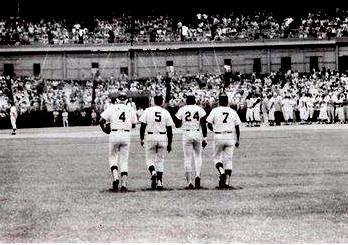
The authors of 1,964 big league home runs thrill the stadium built in 1964.
That’s right, my fellow Mets enthusiasts of all ages, Willie, Mickey, the Duke and — because who doesn’t like a surfeit of immortals? — Joe D. The sight of them is stood for and applauded at and roared about. Pictures are taken of all that talent as it strolls from the outfield to the infield. Not long after, a songwriter by the name of Terry Cashman gets a gander at the image of the fearsome foursome and decides to write a song about this quartet, though he admits the Yankee Clipper doesn’t quite fit his musical tableau, so he cuts his inspiration by a quarter and produces a little number called “Talkin’ Baseball (Willie, Mickey & The Duke)” that takes its spot alongside “Take Me Out To The Ball Game” in the game’s canon.
This happened at Shea Stadium. All of it. The Mets made sure of it. It was their sacred trust to put on an Old Timers Day and they were true to their trust. Maybe they couldn’t keep their biggest current-day stars on the roster, but boy could they round up a posse of all-time greats from the past.
It was glorious. And it wasn’t over! The four center fielders came in and stood in the company of their fellow Old Timers for a “moment of silent tribute” dedicated to essentially everybody who was no longer with us. Mrs. Payson, Mr. Stengel, Mr. Hodges, Mrs. Johnny Murphy’s and Mrs. George Weiss’s respective husbands and the gone-far-too-young Danny Frisella were all named, though Lindsey said we should think of everybody who made the game great. Jane Jarvis played Auld Lang Syne and then the national anthem.
And then the Old Timers who were up for it played a ballgame while Bob Murphy and Stan Lomax — the first New York radio sportscaster, dating back to 1933 — did some light play-by-play. Murph asked Lomax an open-ended question about the past and Lomax gushed forth with anecdotes a sharp fan would know enough to lap up. For example, Stan Lomax could identify the precise loudmouth at Ebbets Field who started calling his favorite team a bunch of “Bums” and tell you all about how it stuck.
With minimal condescension, Murph and Lomax marveled at how these fellas could still swing the bat and so forth. They weren’t kidding. Ralph lined one into the left field corner just foul and the Duke drove one that almost went over the right field wall. Willie Mays, of all people, got caught in a baserunning blunder on Duke’s hit, but that was OK. It gave Bob and Stan a chance to invoke “three men on third” from when the Dodgers were indisputably daffy and every so-called Old Timer was certifiably younger.
When I watched Old Timers Day when I was a kid, it made me feel older. Nowadays it has the opposite effect. Little at Shea ever functioned quite so flawlessly.
Not as monumental a find, but also on YouTube: I join the folks at On The Sportslines for a little Spring Training Mets talk.
The Oscars were handed out Sunday night. Thus, per Monday morning-after tradition, the Academy pauses to remember those Mets who have, in the baseball sense, left us in the past year.
ZACHARY CRAIG “Zach” LUTZ April 24, 2012 – September 28, 2013
I saw Zach Lutz (barely) prevent a no-hitter in the seventh inning and a string of Zach Lutz’s teammates conspire to prevent saddling Gonzalez with a two-hitter. I found Cuppy, too, but who doesn’t?
—September 10, 2013 (Released 6/12/2014; signed with Rakuten Golden Eagles, 6/16/2014)
JUAN C. CENTENO September 18, 2013 – September 28, 2014
Pay attention and you see things. You see a catcher whose name existed on the farthest periphery of your Mets consciousness four weeks ago throw out an instantly legendary basestealing sensation with a ready-made Hall of Fame moniker. Juan Centeno? Gunning down Billy Hamilton? Who had been 13-for-13 in his core competency since coming up to Cincinnati in early September? Who had swiped a typographically correct 333 bases in his last three minor league campaigns? With Dice-K of the notoriously leisurely pace on the mound? Yeah, that thing happened in the fifth…
—September 25, 2013 (Selected off waivers by Brewers, 10/31/2014)
JOHN EDWARD LANNAN March 31, 2014 – April 13, 2014
[W]hen David Wright lifted a two-run homer off Jerry Blevins to pull the Mets to within 9-7, I was jumping up and down, partly for warmth, but mostly because I was delusional enough to think if Curtis Granderson could work his way on, Anthony Recker would tie it up. That would get us only to 9-9, and I wasn’t necessarily anticipating John Lannan morphing into the better long-relief angels of Shaun Marcum — and goodness knows I was cold enough to want to seek shelter inside a room with a roof ASAP — but this was Opening Day. Who wants to see the Mets lose on Opening Day? I didn’t. But I saw it anyway.
—April 1, 2014 (Free Agent, 10/1/2014; signed with Rockies, 11/18/2014)
TAYLOR HILL TEAGARDEN June 10, 2014 – June 21, 2014
[T]he rather amazingly named career backup catcher crashed a grand slam in his third-ever Mets at-bat. Teagarden didn’t do much else in his 25 subsequent Mets at-bats and was gone after less than two weeks, but when you hit a grand slam in your first-ever game, you don’t have to do much else.
—November 21, 2014 (Free agent, 10/1/2014; signed with Cubs, 12/28/2014)
DANA JAMES EVELAND June 2, 2014 – September 6, 2014
Everything can look very different very quickly in baseball. For example, if you’d asked me less than a year ago to connect Buddy Carlyle, Dana Eveland and Las Vegas, I’d remember that time in the 1970s when my parents went to Las Vegas for some kind of convention and one night at the Sands, they saw Buddy Carlyle, billed as the Fastest Wit in the West, open for the Chanteuse of the Strip, Dana Eveland. Or, if I wasn’t feeling particularly creative, I’d shrug and tell you I’d heard of Las Vegas, thought maybe Buddy Carlyle rang a bell of some sort and as for Dana Eveland, I have no idea who she is. He? OK, he. As recently as the last Super Bowl, I had no idea who Dana Eveland was, whatever the pronoun.
—September 6, 2014 (Free agent, 11/14/2014; signed with Red Sox, 1/21/2015)
JOSHUA BLAKE “Josh” SATIN September 4, 2011 – September 25, 2014
Hitting the ball and running to first […] was a skill set that abandoned pinch-hitter Josh Satin in the ninth. It was a comedy of presumption that unfolded as Josh lofted a fly ball far down the left field line versus closer Jim Henderson. Was it fair? Was it foul? Josh, whose job is to immediately steam counterclockwise to the nearest available base without pausing to ask questions, appointed himself judge and deemed it foul. Except it was ruled fair and in play. The “fair” part was accurate, which became a tad embarrassing for lead-footed Satin to realize since he had already begun to wander away from the plate to clear his head and await the next pitch. When he understood that he swung better than he thought, Josh dash-trudged to first, where he had to stop since he took his sweet time getting going. But the ball shouldn’t have been “in play,” as it actually cleared the fence and bounced back into the outfield. Instant replay cleared up the umpires’ muddle. They emerged from their comfortably appointed video review lounge to signal “home run”. You know the gesture — it’s where you twirl your index finger in the air as if to indicate you’re not impressed…“whoop-de-doo,” in other words. Which was how it felt watching Josh Satin score the reluctant run that turned a 4-1 loss into an eventual 4-2 loss.
—September 27, 2013 (Outrighted, 11/4/2014; signed with Reds, 11/20/2014)
KYLE LYNN FARNSWORTH April 2, 2014 – May 12, 2014
The bullpen’s terrible — and while I’m no scout, something tells me wheeling the embalmed corpse of Kyle Farnsworth onto the mound isn’t going to help things.
—April 3, 2014 (Released 5/14/2014; signed with Astros, 5/17/2014)
ANDREW MARSHALL BROWN May 3, 2013 – June 15, 2014
Mostly, Met nights at Wrigley are like the three we’ve just witnessed, episodes in which our cast of characters proves unready for prime time, whether the show begins at 8 o’clock Eastern or 6 o’clock Central. If the Mets aren’t scoring eleven runs in a sixth inning or assisting a Manchurian Brave to a personal milestone, they’re usually doing something along the lines of what they did all this week. They’re losing. Thursday night they threatened to win, but it was an idle threat. Andrew Brown’s return from Las Vegas was pleasant enough — he performs well on any semblance of an Opening Day — and the roar back from an 0-4 deficit to a 4-4 tie provided a few minutes of false encouragement, but then Anthony Rizzo went deep and the Mets still had runners to strand and, well, the whole thing dissipated as it tends to do after dark in that part of town.
—June 6, 2014 (Selected off waivers by A’s, 10/31/2014)
JOSE RAFAEL VALVERDE March 31, 2014 – May 26, 2014
[O]n Saturday, in the otherwise unmapped Anaheim section of Los Angeles, given how the Mets had already overcome a two-run deficit and the vengeful specter of Collin Cowgill, it didn’t seem out of line to think Valverde would gently tuck in a three-run lead, especially once he got ahead of David Freese one-and-two and needed only one more strike to wish us and the Angels sweet dreams. I apologize for thinking it was as simple as a third strike and resulting third out right there. I neglected to take into account the doom factor I had unleashed. You won’t find “doom factor” on the back of your baseball cards or among your more advanced statistics. No metric properly reflects that when I begin to think a Met closer is certain to escape a danger-fraught scenario with ease, that same Met closer inevitably implodes. It happened to Bobby Parnell on Opening Day. It’s been happening with alarming regularity since at least Skip Lockwood in the mid-1970s.
—April 13, 2014 (Released, 5/26/2014; signed with Padres, 1/7/2015)
OMAR QUINTANILLA May 29, 2012 – July 8, 2012 May 30, 2013 – May 7, 2014
To be fair, I also never want to look at erstwhile Renaissance Met Omar Quintanilla ever again. Have you ever seen a shortstop make more unnecessary leaps for line drives 20 feet over his head? He will strain something before he catches something.
—August 25, 2013 (Free agent, 10/1/2014; signed with Rockies, 1/27/2015)
GONZALEZ GERMAN (Figao) GERMEN July 12, 2013 – September 25, 2014
Gonzalez Germen, to this point no more than a roster rumor set in agate type, makes his major league debut in the bottom of the eleventh of a tie game with McCutchen, Alvarez and Russell Martin due up. He walks the All-Star McCutchen. He strikes out the All-Star Alvarez but McCutchen steals second. He intentionally walks Martin, who won a game against the Mets with a home run in 2012. He strikes out Gaby Sanchez, who produced a .318/.403/.591 slash line in eighteen games against the Mets in 2011. He teases a weak grounder out of Jordy Mercer, but the ball had excellent vision and limped its way into center to score McCutchen from second with the winning run. Gonzalez Germen did what we shall call without irony his Parnellian best to keep the game tied. Parnell, on the other hand, saw as much action Friday night as Germen did all of his life prior to Friday night. When you’ve lost 3-2 in eleven without your best reliever getting the call, that’s deplorable.
—July 13, 2013 (Sold to Yankees, 12/19/2014)
CHRISTOPHER BRANDON “Chris” YOUNG April 2, 2014 – August 7, 2014
And the second we sat down, we sprang up. Chris Young…the same Chris Young at whom we were poking reflexive fun during Kevin Chapman’s trademark top-notch tailgate extravaganza…made us eat our words like we had eaten Kevin’s guacamole. CY launched an absolute bomb that detonated over the left field fence with a man on. Suddenly we were no longer losing. Suddenly it was 4-4. Suddenly the shade of Section 529 was the hottest place we could be.
—July 13, 2014 (Released 8/15/2014; signed with Yankees, 8/27/2014)
JEREMY SCOTT HEFNER April 23, 2012 – August 9, 2013
Hefner, on the other hand, could not have sounded a whole lot more devastated when reporters found him after his Thursday nightmare in which he faced Phillie after Phillie after Phillie and recorded nary an out. Seven batters clad in gray and red came up, not a one of them sat down, unless you count the four who had already scored. Hefner’s brief stay on the mound inadvertently imbued what shaped up as a prototypical meaningless game in September with gobs of meaning. No Mets team had ever taken the field at home and allowed its visitors to grab a quick 8-0 lead. But this one had. All kinds of records related to massive Met ineptitude were en route to being invoked. And for that, Jeremy sounded very, very sorry…even sorrier than he pitched. Hell, maybe he didn’t pitch all that pitifully considering the Phillies bobbed along like a singles sewing machine and stitched together their eight runs on basically no hard hit balls. But to let Hefner off the hook because, gosh darn it, they fell in and found holes — no. I’m not falling for that. Eight runs in the first inning is eight runs in the first inning. I cringed in empathy for a 26-year-old rookie from Oklahoma whose voice I heard cracking and who was clearly trying to rein in his tear ducts when SNY’s cameras arrived at his stall. I thought about how joyful he sounded less than a month ago when he pitched so effectively against the Astros, not just because he had a good game but because his daughter had just been born. Jeremy Hefner’s a person and I don’t like to hear a person in pain. But as a Mets fan who has watched Met after Met after Met wander aimlessly across six soul-crushing Septembers — and seen these Mets hide in plain sight since the middle of July — I’m not feeling remotely so generous of spirit.
—September 21, 2012 (Free agent, 11/4/2014; currently unsigned)
DAISUKE MATSUZAKA August 23, 2013 – September 25, 2014
SNY put a clock on Matsuzaka. And they put Matsuzaka’s face on a clock while the clock ticked away and Matsuzaka didn’t pitch. They didn’t call it the Matsuclocka, but they should have. Earlier in the game, as hard to believe as it is that a nine-inning game that took 3:32 to play had an “earlier,” Howie Rose explained Daisuke Matsuzaka’s famed gyroball: In the time it take Matsuzaka to throw one pitch, you can leave your seat, buy a gyro, eat it and return to your seat. Howie’s first-inning exasperation provided an opening for Josh Lewin to invoke “tzatziki sauce” for perhaps the first time in major league broadcasting history. Red Barber almost certainly never mentioned tzatziki sauce while sitting in the catbird seat at Ebbets Field, but he did keep an egg timer handy. It was there to remind the Ol’ Redhead that when its three minutes of sand ran out, he should tell his listeners the score of the game. It was a good idea. Red’s listeners might have just been tuning in or not been paying close attention. Or they might have gone off to purchase and consume a gyro while waiting for Daisuke Matsuzaka to deliver his next pitch. From Red Barber’s egg timer to SNY’s Matsuclocka. Who says baseball is timeless?
—August 29, 2013 (Free agent, 10/30/2014; signed with Fukoka Softbank Hawks, 12/4/2014)
ERIC ORLANDO YOUNG, JR. June 19, 2013 – September 28, 2014
I still think Eric Young, Jr., is more like the player the Rockies didn’t want than the player he’s looked like in a perilously small sample size for us, but when he scored from second last night and leapt halfway into outer space, I laughed out loud on the couch and clapped my hands. Baseball’s fun, and fun’s contagious.
—August 8, 2013 (Non-tendered, 12/2/2014; signed by Braves, 2/13/2015)
BOB KELLY “Bobby” ABREU April 22, 2014 – September 28, 2014
Collins started Abreu in right field in Game 162, batting him second. Come the fifth inning, Bobby did what we in attendance wanted him to do. He connected for a base hit, reached first, tipped his cap and indeed walked off with his head held high. He had been a Met by mutual convenience. Abreu needed a place to conduct his unfinished business and the Mets weren’t beyond relying a little much on a 41-year-old who hadn’t played in the majors since he was 39. If all had truly worked out, Abreu would have proven himself a lefthanded pinch-hitter deluxe on the order of Kranepool and Staub and Lenny Harris. He might have produced a legendary bases-loaded line drive like Matt Franco or shocked the house as Marlon Anderson did via inside-the-park home run. Instead, other than serving as a venerable bookend to Bartolo Colon, he didn’t accomplish a load. It took one more favor from the front office to bring him back for September from Las Vegas after he proved ineffective off the bench by midsummer. On Closing Day, though, we decided he was our guy and we sent him off as such. “Special,” Bobby called his final swing for a single off Houston righty Nick Tropeano. It was “the way that I wanted to end it — on the field.” Abreu said farewell to the game he loved with Eisenhowerian élan and we, in turn, bid a heartfelt adieu to a player we took to heart at the very last minute of his tenure with us.
—December 28, 2014 (Retired, 9/28/2014)
ISAAC BENJAMIN “Ike” DAVIS April 19, 2010 – April 16, 2014
For what it’s worth, Ike, the backup, starts Sunday. Is Ike being showcased for that trade that was supposed to be executed months ago? Is Terry balancing his two heretofore brutally disappointing lefthanded first basemen in perfect harmony? Has anybody seen Josh Satin’s eyebrows lately? Ultimate solutions will have to wait. We won today. We won today on a pinch-hit, come-from-behind walkoff grand slam, which has happened how many times before in Mets history? I’m pretty sure never. Let’s see: Harkness, Hickman, Jorgensen, Teufel, McReynolds, Valdespin…nope, those were either tie scores when things got grand or the walkoff slam-masters were already in the game. Ergo, it’s a first. Ike Davis has done something no Met before him had ever done. Twenty-four hours ago we would have been surprised if the above sentence consisted solely of “Ike Davis has done something.” Now he’s done something else. This game will confirm your deeply held suspicions most of the time but render your assumptions stupid if you give it a chance. Give it a chance. It’s worth it.
—April 5, 2014 (Traded to Pirates, 4/18/2014)
Like my partner, spring training’s barely arrived and I’m already tired of it. It’s been that way for me for a while — pitchers and catchers reporting is a nice hint that spring will eventually arrive, but it’s uplifting for about five minutes until you look out the window and see Antarctica and groan that it’s still getting dark too soon and remember that we’re a long way from crocuses and buds on trees and 1:10 or 7:10. I get a little more pep in my step for the first spring-training game, but honestly that’s mostly about getting to hear Gary Cohen again. That good feeling lasts about an inning, at which point I think, “oh man, none of this matters” and pick up a magazine, looking up only if the St. Lucie wind is blowing another flyout to left into a home run or if I have a chance to make fun of the too-loud guy aiming an attempted Agincourt-intensity heckle at a fifth starter whose only assignment is to work on the change-up. (Seriously, who are these guys?)
The absurdist length of spring training is about one thing and one thing only — damaging pitchers’ arms and shoulders in a calibrated way so that they can repeatedly perform the damaging action of throwing a baseball, but with as little risk as possible that they will damage their arms and/or shoulders in a sudden, catastrophic way that requires a trip to the doctor/surgeon. (And what’s the normal risk level of that happening if you follow protocols? Nobody knows, because every human body is different and the protocols are as much jock folklore and tradition as they are science.)
Hitters? Once upon a time they needed spring training because they’d spent the offseason mucking barns, driving trucks or sitting in offices as corporate ornaments. But that was generations ago. Yeah, hitters talk about needing to get their timing, but hitters are always getting and losing their timing, which is another way of saying whether or not the statistical noise is currently favorable.
These days hitters hit all year, occasionally filling the gaps in their hitting time with thinking about hitting or being told what to do by nutritionists. Genetic outliers aside, pitchers can’t physically pitch all year. So we have spring training, which is a lot of huff and blather constructed around waiting for them.
In a sensible world, pitchers would go to spring training around Valentine’s Day and damage their arms in a supposedly constructive way while no one watched. Hitters would show up around March 10, accompanied by the media. Games would start around St. Patrick’s Day. That would leave us three weeks of stories we’ve read before that have no bearing on what will happen in the regular season, interspersed with genuinely fun features on prospects we’ll probably never hear from again, and the occasional unfortunate breaking news of torn ligaments, cheese-gratered labrums, tsk-tskable speeding tickets and ill-advised debates with pizza delivery boys. And that would be it.
But it’s not, so we all have a job to do. And amid the same-old same-old of the spring-training better-than-anything-else athletic-entertainment industry, two things jumped out at me from the first couple of days.
The first item was the package of declarations that David Wrightwill be just fine and is in the … WAIT FOR IT … best shape of his life. In Wright’s case that hoary old statement might actually matter, as the 2015 Mets’ fortunes in large part depend on finding out if Wright’s recent woes are a product of a loose shoulder joint that’s now been fixed or a product of the inevitable fact that he’s a young man on planet Earth but starting to be an old one as a ballplayer. (I desperately hope it’s the former while suspecting it’s the latter.)
The other thing that caught my eye? It was Jonathon Niese saying positive things about his shoulder, and shedding light on how that shoulder felt last year. There are two times ballplayers and club officials are most likely to tell the truth — the first day of spring training and two days after a player’s no long around. Niese said he probably should have missed the first month of 2014 instead of just the first week and had had sharp, knife-like pain in the shoulder — something he could admit because the shoulder feels really strong now.
Which gets me back to pitchers.
Niese’s remarks immediately reminded me of the May 2010 flap over Dan Warthen saying that John Maine was “a habitual liar” about his own health, which Maine resurrected three years later when asked about it during his brief, doomed comeback with the Marlins. I never understood any of that. All pitchers are habitual liars about their own health, because if they weren’t nobody involved with baseball could in good conscience let them pitch. Right up above you’ll find Niese fessing up to habitual lying last spring. And here’s Bobby Ojeda recounting more than 30 years of habitual lying — an article that every baseball fan should read at least once a month and use as a benchmark whenever anybody says anything.
Pitching is insane, and it makes pitchers insane — most of them would grit their teeth and tell you everything was fine until the moment their ulnar ligament made that awful pop. Warthen’s sin wasn’t calling Maine a liar, but departing from the carefully scripted collective lying needed to let pitchers pitch. We should never forget that — particularly not during spring training, when the whole machine is gearing up and we’re given a look at its component parts.
Piazza: Catcher, Slugger, Icon, Star by Greg Prince is available from Amazon, Barnes & Noble and other online booksellers.
Amazin' Again: How the 2015 New York Mets Brought the Magic Back to Queens by Greg Prince is available from Amazon, Barnes & Noble and other online booksellers.
Volume I of The Happiest Recap: 50+ Years of the New York Mets As Told in 500+ Amazin' Wins by Greg Prince is available in print and for Kindle on Amazon.
Faith and Fear in Flushing: An Intense Personal History by Greg Prince (foreword by Jason Fry), is available from Amazon, Barnes & Noble and other online booksellers.