The blog for Mets fans
who like to read
ABOUT US

Faith and Fear in Flushing made its debut on Feb. 16, 2005, the brainchild of two longtime friends and lifelong Met fans.
Greg Prince discovered the Mets when he was 6, during the magical summer of 1969. He is a Long Island-based writer, editor and communications consultant. Contact him here.
Jason Fry is a Brooklyn writer whose first memories include his mom leaping up and down cheering for Rusty Staub. Check out his other writing here.
Got something to say? Leave a comment, or email us at faithandfear@gmail.com. (Sorry, but we have no interest in ads, sponsored content or guest posts.)
Need our RSS feed? It's here.
Visit our Facebook page, or drop by the personal pages for Greg and Jason.
Or follow us on Twitter: Here's Greg, and here's Jason.
|
by Greg Prince on 29 March 2014 12:24 pm The headline didn’t have much on The Onion. “Farnsworth,” it reported, “rides bus without being Met.” Well, I thought, that’s too bad. It would have been nice if somebody had picked up Farnsworth, but sometimes you just have to walk home from the bus stop.
Of course it didn’t require much of a double-take to realize what the headline on ESPN New York’s dedicated Mets blog was really conveying. I knew the contractual status of Farnsworth (Kyle) had been double-parked for a couple of days, though it was mostly a matter of t-crossing and i-dotting to provisionally retain his Quadruple-A services. If you were a reasonably engaged Mets fan in the last week of Spring Training 2014, this bit of roster minutia was readily accessible and regularly disseminated to the point where there was little chance you wouldn’t understand what “Farnsworth rides bus without being Met” meant.
Then again, given the tarpaulin of coverage applied to every last Met tic of Spring Training, would it really surprise you if it had been a story about Kyle Farnsworth needing a ride home?
If it had occurred to me to have invented a medium through which I could have been kept continually updated on a hundred details of what dozens of people with Mets connections were up to around the clock, I would have invented it. Oh, to have been privy to the transportation manifest of Mac Scarce when I was 12! Except I’m not that kind of imaginative. I couldn’t have imagined Twitter. I couldn’t have imagined blogs. I’m still fascinated that when my parents took us to Florida for Christmas vacation when we were kids, I could insert a dime in a slot, pull down a door on a box and remove a very recently printed copy of the Miami News every weekday afternoon. I was more amazed that the paper itself existed, coming out as it did hours after the bigger-deal Miami Herald, replete with final basketball scores from the West Coast and slightly fresher information overall.
I’m instinctually a very one-and-done consumer of technological advances. I can handle a single major new development every couple of years. It’s the constant upgrading that blows me away. I’m not yet bereft of surprise that I can communicate competently on a phone without ever speaking into it. It’s not the technology that captures my fancy. It’s that the technology delivers me the content I want, and that I occasionally deliver content through it. And I’m just some reader/blogger.
Those who are professionally filling my devices with Metsiana live from Port St. Lucie, Montreal, wherever…here’s to them. Here’s especially to Adam Rubin of ESPN New York, the guy who Tweeted the Farnsworth bus note at 2:07 PM on March 25 and had a brief, explanatory story blogged and posted at 2:43. It’s so routine to receive a dispatch like this that we probably don’t fully grasp how amazing it is that we live in a world where all the news that’s fit to print — as well as a large majority of the stuff that’s no more than vaguely interesting to us — winds up recorded for something akin to posterity.
Did we need to know that Kyle Farnsworth wasn’t technically signed to the Mets’ organization on Tuesday when he rode their bus from St. Lucie to Viera? Inform to taste, I suppose. Point is, I know it. I follow Rubin on Twitter (as I recommend you do) and I check his blog frequently (as I also recommend you do). The information snowball rolls downhill at astounding speeds. It’s hard to not want to grab a handful even as it does nothing but accelerate.
Gone in the bargain for volume and velocity isn’t necessarily depth; the Internet’s an expansive playing field and if your favorite beat reporter isn’t painting a big picture every day, you can always find somebody who is. What really turned out to be the element to be named later in the trade-off for immediacy was a certain strain of romance. That is if you can be romantic about how you get your baseball news.
Which of course I am.
I loved newspapers, whether they came out of a box outside the entrance to the Chateau Motel on Collins Avenue in North Miami Beach or were stacked up against the front window at the Cozy Nook on East Park Street in Long Beach or wherever and however I got them. I still love much of what’s in newspapers but even my romance gave way to technology (except on Sundays, when I maintain my diehard habit). The act of purchasing, opening and reading was one of my most reliable thrills as a baseball fan. The clicking and scrolling, now matter how much more it gives me and how much sooner I get it, just doesn’t feel as much a part of the game that I embraced growing up.
You rooted for your team. You watched or listened to their games. You read about them the next day. Maybe you picked up on a partial line score if it was a day game and your dad brought home the afternoon Post, but you were conditioned to wait. It didn’t occur to you that it was a wait. It was just the way it worked. Somebody who was watching the game at the same time you were — at the ballpark in some unseen place called the press box — had to write about it. Then it had to get printed and put on a truck. These things took time. Would have you wanted it sooner? Maybe, but reading about last night’s game the next morning helped keep the game alive that much longer. It smoothed the transition to the next game. Over 162 games, the flow couldn’t have felt more natural.
 Where’s a Western Union operator when you need one? My deeply ingrained fondness for that aspect of rooting for my team is what led me to (irony of ironies) download a book about how baseball used to be covered by newspapers onto my iPad’s Kindle app during the offseason. In 2013’s Keepers Of The Game by Dennis D’Agostino, twenty-three mostly former beat writers from across the major league map hold forth oral history-style on how they did their jobs when their kind, as the author puts it, “was the unquestioned primary source for any and all baseball news, opinion and analysis.”
D’Agostino, who worked for a while in the Mets PR department (and before that wrote the essential This Date In New York Mets History), confesses to a bit of a proprietary interest in the subject. He was, albeit for a single season, a member of the Baseball Writers’ Association of America, a body we tend to think about mostly in terms of what a clumsy job they did in not electing who we wanted to the Hall of Fame. D’Agostino knew and worked among these BBWAA men. He was in baseball and they were in baseball. Now he worries their collective significance is “quietly being lost to history”.
Those the author sought out were often synonymous with the clubs they covered. If you read The Sporting News’s team-by-team reports, you learned who they were from afar, but within their home cities, they were authentic celebrities. In New York, where we had a few more newspapers than most towns, you certainly knew “our” writers’ bylines even if, pre-Twitter, you didn’t necessarily know much else about them.
It’s a splendid idea for a book, borrowed, D’Agostino happily admits, from Jerome Holtzman’s seminal No Cheering In The Press Box, which brought the same approach to an earlier generation of baseball writers. It’s also well executed. These writers were on the beat primarily between the ’60s and the ’90s, with some lasting into the 21st century and others remaining on the scene today as columnists, be they in print or pixel. They lived the changes that we read. It’s fascinating to learn what it was like for the likes of them to get their stories to the likes of me.
One name came up repeatedly in Keepers Of The Game, a name that tells you these writers entered a business far different from the one that exists today. It wasn’t Pete Rose or Hank Aaron or Bowie Kuhn. It was Western Union. Almost everybody who went back far enough seemed to have a Western Union story. No second baseman on a 6-4-3 double play was ever as important as the middleman whose cooperation ensured deadlines were met and white space didn’t sit where a story was supposed to run. You had to take care of the Western Union operator at the ballpark or you had to know where to find one on the road if you were writing for an afternoon paper. Later deadlines meant more time spent gathering quotes, and the Western Union operator didn’t necessarily stick around just for you.
That’ll slow your avalanche of news, won’t it? Yet these Keepers Of The Game don’t seem to mind having coming along in prehistoric technological times. “I don’t think they have as much fun today,” Phil Pepe reflected on those who’ve succeeded him, “but I used to hear the same thing from the old guys.”
There may be a wisp of “in our day” edge to some of the reminiscences, but little rancor is spewed toward modernity and only episodic grudges are held. And the ones that are you can’t help but admire for their longevity. For example, Chicago Sun-Times veteran Joe Goddard — who said it was “difficult [for him] to be critical of somebody” — found our lovable Dave Kingman “aloof and rude” as a Cub and didn’t mind mentioning decades after the fact that he drank heartily when he learned Kingman’s career was over. (The less than delightful baseball player apparently remains an evergreen occupational hazard, per this revealing first-person account from Eno Sarris at The Hardball Times.)
The writers D’Agostino interviewed in 2010 — whose New York ranks included Pepe, Bill Madden and the since-deceased Maury Allen and Stan Isaacs — expressed a real respect and affection for the craft they plied on a daily and nightly basis. It mattered to Wayne Minshew of the Atlanta Constitution that he was covering Aaron’s quest for a 715th home run, yet “when Hank hit it, I had a blank sheet of paper in the typewriter, and the words wouldn’t come.” Minshew “wanted it to be classic,” but settled for whatever came. More than thirty-five years later, he seemed both regretful and proud that, “It’d never win an award, but I got it in.”
Not every game is that historic, but they are all history in their own way, and the baseball fan who relished the game story, the sidebar and the “diamond dust” type elliptical notes that accompanied them appreciated the output even if that fan was never all that aware of how the complete package arrived in his hands every day. “I was writing for the guy on the subway,” Allen said, stressing that he tried his best “to entertain that that fourteen- or fifteen-year-old kid that’s really a fanatic about sports”.
As someone who’s been both that guy and that kid, it’s nice to know someone was looking out for us.
by Greg Prince on 28 March 2014 12:39 am Someday Spring Training will end, and when it does…what’s that? It’s over? More or less?
Didn’t see that coming.
Hallelujah, the Mets are done with grapefruits and slot machines at last, saving a couple of days here near March’s conclusion for un petit peu de poutine up Montreal way. Nice to pretend the Expos exist again for a weekend, unless somebody gets hurt on that mashugana Olympic Stadium carpet, in which case, what a terrible idea this was.
Canadian detour notwithstanding, Opening Day finally awaits, though there’s still a bit of roster business to be settled around the uninspiring margins. It doesn’t get much more marginal than choosing a backup for Ruben Tejada, himself a dubious Met starter unless/until he makes me eat those words smothered in cheese curds and gravy. The role could be awarded once more to Omar Quintanilla, who has familiarity going for him if nothing else (which there doesn’t appear to be after Q’s batted .158 thus far this spring), or Anthony Seratelli, a personable local boy who would be a great story, save for his having done close to nothing to take a job from Omar Quintanilla.
Seratelli is 31, a lifelong baseball underdog and totally untested at the major league level. Plus he’s local, which we already mentioned. One is tempted to guess the Mets are considering him instead of Quintanilla because then they’d have the chance to sell a few more tickets in the otherwise untapped Edison, N.J., market. If he rockets a few balls off the ol’ Big O concrete, hikes his exhibition average well above its current .213 and handles grounders competently, maybe he’ll overtake valuably experienced Omar and line up for introductions at Citi Field on Monday.
If that happens, then for a few moments before Anthony Seratelli inevitably wears out his utilityman welcome (or makes me ingest my cynicism like it’s smoked meat smuggled through customs), it would loom as the heartwarmingest of chilly March 31 moments. A pristine rookie tipping his cap on Opening Day — whether or not the stands include family and friends — would and should move everybody who realizes what’s going on to heartily applaud. When Scott Rice emerged from utter obscurity last Opening Day to hear Alex Anthony announce his name, you could feel the part of the crowd that was cognizant of the significance of his hard-earned beam with onlookers’ pride.
You don’t always get a major league debut on Opening Day (especially if you’re nurturing Super Two concerns more than you are hopes of contending) and you don’t necessarily get the major league debut you want on Opening Day, but what better setting could you conjure for a first day as a big leaguer than the first day of a new season? There’s no bad day to make the majors for the first time, of course, but making it on Day One is the stuff of cotton candy dreams and puffy cumulus reality.
Then there’s the opposite. There’s the day you stop being a major leaguer. There’s no good day for that.
Thing is you probably don’t know that it’s happening even as it happens. Certainly if you’re Chipper Jones in 2012 or Mariano Rivera in 2013 or Derek Jeter in 2014, you can lavishly choreograph your farewell (if it were up to me, all three would have taken their final bows in early 1996 and, by their subsequent collective absence, made the turn of the millennium a Metsian paradise), but most players aren’t those players. Most players don’t or can’t announce in advance that this is it for them. It’s not necessarily their call.
As much of a premium as we put on who’s gonna make a team coming out of Spring Training, we lose sight that this also tends to be the time of year when not only do guys not make the cut, they sometimes hang it up with no warning and minimal fanfare. Among the stream of longtime major leaguers who have quietly nodded over the past couple of months that, yup, that’s it, I’m done, are old friends or at least acquaintances Dan Wheeler, Liván Hernandez, Rick Ankiel, Rod Barajas, Valentino Pascucci, Jason Bay and the ever popular Guillermo Mota. No goodbye tours, no hauling parting gifts back to the mansion. Just the need to find something else to do.
Some of the above had been hanging on in what we used to call the bushes or had been reserving final self-judgment just to make certain they were really and truly done. They didn’t have to be officially released to know they weren’t going to be major leaguers anymore. If somebody had wanted them to play, they’d probably be playing. This weekend, Tim Byrdak, Met lefty specialist from 2011 through 2013, will be Josh Lewin’s radio partner for the games against the Blue Jays in Montreal. It’s not because Byrdak would rather be broadcasting than pitching. Tim’s let it be known he’s available to face lefties for a major league team. Thirty major league teams didn’t take him up on his generous offer.
The game goes on without any one player, which has to be the most humbling realization for an athlete to face. There are no more chances to make an enormous paycheck and, just as unfortunately for them, there are no more chances to compete on the highest plane in the world. They were major league baseball players. They might not have always succeeded (and fans like us might have taken strenuous note of their shortcomings), but they were at the top of their profession. The profession proceeds and the individuals move on.
When they’re gone, the retired players also miss out on the chance to create the best memories possible, both for them and for us. They don’t get to win anymore. They don’t get to try to win anymore. It’s quite possible the last thing they did on a big league field was lose. Their final act might not define their careers, but talk about going out on a low note.
Here are some more names you’ll probably recognize: Brian Lawrence, Dave Williams, Aaron Sele, Shawn Green, Willie Collazo, Orlando “El Duque” Hernandez, Jeff Conine and Sandy Alomar, Jr. All of them are attached to a rather dismaying thread. Each man played his final major league game as a Met. As a 2007 Met. As a 2007 Met in the second half of that September.
Every one of these guys was a component of the Worst Collapse in Baseball History and never got to redeem himself. Their respective last acts as active major leaguers, aside from tipping the clubhouse staff, was to help blow a lead of seven games with seventeen to play and keep from the Mets from returning to the playoffs…where the Mets still haven’t been since.
The Collapse of 2007 — to differentiate it from the deflation of 2008 — was every bit the team effort 1969 and 1986 were, except in reverse. It was the fault of no given Met; it was the fault of every given Met. Some of the 2007 Mets continued being Mets in the year or years following and were able to leave better impressions. They had the opportunity, at any rate. The aforementioned octet didn’t. They retired. Or they tried to hook on elsewhere but were left to sink at sea. They didn’t play another major league game for anybody after they didn’t boost the 2007 Mets to the postseason. They weren’t able to turn the page or put it all behind them or activate whichever cliché they leaned on to get them through a slump.
Not only didn’t they get to go out on their own terms, they didn’t get to go out on our own terms.
If you’re a ballplayer, you’ve looked forward since you became a ballplayer to the moment that might await Anthony Seratelli on Monday, the same moment that likely awaits Noah Syndergaard and Rafael Montero within the next few months. You’re gonna be breaking in. But someday, hopefully after many seasons and many successes, you’ll be going out. And when you do, a word of advice from someone who’s never played the game, but watched it a whole lot:
Try not to leave the Worst Collapse in Baseball History in your wake. Your fans will appreciate it. Thank you and best of luck in your careers.
I had the pleasure of joining Taryn “Coop” Cooper in the Mets Lounge for a little season preview talk. Listen here to all of it, find me a little after the 35-minute mark.
by Greg Prince on 24 March 2014 3:51 pm There’s a scene in a church in one of my wife’s and my favorite movies, The Commitments. A lady, dutifully scraping away at the hardened wax countless candles have dripped in the name of divine intervention, rhetorically asks, “If ya didn’t do it for God, who would ya do it for?”
We were going to watch The Commitments on St. Patrick’s Day, but we didn’t get around to it. I was, however, thoughtful enough to stop flipping the ol’ remote long enough to provide us with a glimpse of a Mets Classic a few nights later. I don’t consider the game SNY was re-re-re-rebroadcasting all that worthy of enshrinement, but when Opening Day has yet to arrive, everything that evokes baseball is a Classic if you squint purposefully enough.
Anyway, Mike Pelfrey was pitching in this long-ago game, prompting Stephanie to ask me whatever became of Big Pelf. He’s a Twin, I said (assuming she knew I meant the Minnesota kind and wasn’t implying there are two tall pitchers roaming this earth licking themselves into submission). Then I noted that several of the Mets taking part in this well-worn 2010 contest shared a certain Pelfness.
Remember Mike Pelfrey? Probably, but I mean do you remember how large a share of mind Mike Pelfrey held in our collective head? He was one of those guys whose progress or lack thereof we ruminated the fudge out of. When’s Pelfrey coming up? Has Pelfrey shown enough to stay? When’s Pelfrey coming back? What’s wrong with Pelfrey? Pelfrey looks good! Pelfrey looks terrible. What’s with Pelfrey now?
If you were a friend or relative of Mike Pelfrey, that level of concentration regarding someone close to you would be understandable. If you weren’t, and you acted on your concern enough to proactively check on Pelfrey’s well-being, you’d likely earn yourself a sizable restraining order along with court-mandated therapy. “Who are you and what’s your business outside the Pelfrey home?” But in context, it’s perfectly OK to think deeply about fellows we don’t actually know because they play for the Mets. And we’re Mets fans.
And if ya didn’t do it for the Mets, who would ya do it for?
Everywhere I looked amid this Mets Classic, I could recall all the Pelfritude we put into that team. Our 2010 Fruitgum Company of a roster harbored several characters in whom Metsopotamia invested a little too much emotional capital. Some guys you accept as transient. Others you’re convinced you can pull fortune-altering improvement from if only you dwell on them hard enough. They become the center of your baseball-loving universe all out of proportion to their potential to help your cause. Four years ago, on that May night against the Giants, there was Pelfrey, who merely had to settle down and find his confidence. There was Jason Bay, who was bound to snap out of it if only he could relax. There was Angel Pagan, who only needed to get his head on straight to fully tap his abilities. There was Jeff Francoeur, who if he could discipline himself at the plate would put up numbers as immense as his smile.
And there was 23-year-old Ike Davis, who was fresh and promising and not one of those guys in 2010. Instead, Ike was a different kind of Met, a Met whose shortcomings we weren’t going to have to obsess over. He was going to run out to his position like David Wright and Jose Reyes. We were going to enjoy him every time we saw him. We were going to ride his inevitable development to better times, him and us, together.
That was four years ago. It’s four years later. Ike Davis is now one of “those guys”. On a good day he’s one of those guys. On a bad day, he’s the ghost of Ike Davis. You’re pretty sure that’s Ike you’re looking at out there, yet you can’t quite fathom that you’re seeing this person in a Mets uniform preparing to play for the Mets in this upcoming season.
You hope for everything to work out, yet you’re already resigned to one of his Mets Classics coming on in the not so distant future and someone who hasn’t been fully keeping up asking you, “Whatever became of Ike Davis?”
Ike turned 27 over the weekend, which in terms of math is perfectly logical, yet in terms of emotional aging seems almost impossible. Ike Davis has been haunting Citi Field practically forever. Only he and Wright remain from the eleven Mets Jerry Manuel deployed to defeat the Giants on May 7, 2010. Of course Manuel isn’t here anymore, either.
The continual Met presence of Ike Davis isn’t the story here, though. It’s more about something that’s been absent. At the moment, there’s no middle to Ike Davis’s career arc. He went from that rookie who was going to help lead us into a better era to a veteran struggling to put the pieces back together (while we still await the onset of that better era). His age feels immaterial. Ike, as we speak, is a not exactly old, not exactly young 27. He’s a ghostly 27. That’ll happen when you’ve disappeared a couple of times without ever actually going away.
Saturday he swatted a long home run. Sunday he needed to exit in the fourth inning due to what was described as fatigue. Ike’s calf demands caution, but there’s probably a touch of Ike fatigue within the Mets’ planning for 2014 and beyond. They treated him as if he had faded into the past-tense during the offseason. For three consecutive winters they invited Ike to Citi Field to model some updated jersey and chat up the media. He was as personable as he’d been promising. Why wouldn’t you want to show him off? This past winter, however, the only Ike talk in Flushing transpired in the third-person, as in, “How’s that trade of Ike Davis going?”
It didn’t go and Ike came to Spring Training, played a couple of games, got hurt and has played a couple more. He’s not, with a week to go, fully inked in as the projected starting first baseman for the season ahead, but there’s nobody obviously poised to take his spot. The Mets maintain a fistful of players who can play the position and contribute something valuable, but none is thought to add up to what Ike could be…not what he is, but what he could be. If he heals. If he doesn’t contract another malady. If his swing is fixed. If he doesn’t listen to too many voices. If he gets in a groove. If he doesn’t get down on himself. If he isn’t traded.
Four years after the only year when nothing went wrong for him, Ike Davis still beckons with potential. Of course he does. He’s only 27.
by Greg Prince on 20 March 2014 11:19 am The infrastructure of a baseball season encompasses a surfeit of components that don’t show up in the box score, including intramural dustups in March that dissolve into the murkiest of memories by May. They are as much part of the National Pastime landscape as the crack of the bat, the flight of the ball, the layering of convenience fees and the finding of Cuppy. There’s no use in rolling our eyes toward them. If whatever episode we attempt to haught away as a silly controversy didn’t materialize, another seemingly dubious contretemps would come along in its place to grab our inevitably evanescent attention. It’s how things work when we’re relentlessly interested in a subject as broad and deep as our Amazin’, Amazin’, Amazin’, Amazin’ Mets.
A few weeks from now, if an anvil doesn’t quash him from above, Matt Harvey will be diligently rehabilitating his right elbow in one of two geographic locations. Now and then we’ll receive an update whose key takeaway will be “progress” or “setback” and we’ll react accordingly. Then we’ll turn our attention to whoever’s starting that night’s game, as Harvey’s specter recedes in the moment because, unfortunately, he won’t be available to pitch.
Until then, judging by the fascinating-on-several-levels account written by Andy Martino in the Daily News the other day, young Matthew seems intent on tying Mets management in the kind of knots he previously reserved for roving bands of Rockies, Phillies and White Sox. I don’t believe he’s doing it out of malice. Matt Harvey got this far this soon hewing to his competitive nature. Disingenuously dismiss him for possessing a ton of nerve for someone whose major league record boils down to a scant 12-10, but what a 12-10 it’s been.
Besides, his won-lost mark in his year and change as a Met is far brighter than anything the Mets have put up over the past half-decade. When it comes to taking winning seriously, I’m willing to put a wee bit of faith in Harvey’s instincts, whereas the Mets…I’m still waiting to find out what business they’re in exactly.
Harvey will rehab and it will go encouragingly swell or distressingly slow whether it transpires in Flushing or Port St. Lucie. I’m rooting for the former mainly because Port St. Lucie in July — no matter its springtime charms — sounds spectacularly depressing. When I think of a Met serving injury time in PSL, I think of Kaz Matsui literally seeking shelter from the storm, riding out a Florida hurricane in the home team clubhouse. I also think of Keith Hernandez on Tuesday suggesting a player can “die on the vine” when exiled to far-away minor league precincts. It’s worth noting that in his final, hobbled days as a Cleveland Indian, Hernandez resisted a rehabilitation assignment in Winter Haven — and he’s Keith Hernandez.
The ace and his employer will figure it out and put a happy enough face on the decision, but Martino’s column remains fascinating even if we speed ahead to the part where we decide this was much ado about little. When you read it, you’re taken aback by how nervous the Mets are to have their marquee attraction (we’re attracted to him even when he’s technically inactive) speak to a reporter on his own. Spring Training is traditionally the long, languorous stretch when players are blessed with the opportunity to talk at length. It’s when there’s nothing to do but talk once the workouts are over and it’s too late to golf. As antsy as the Mets are to generate interest in their product, it’s strange that they’d so assiduously try to hide one of the best pieces in their inventory from public view.
It’s Spring Training. There’ll be plenty of chances to forget about Matt Harvey once he’s not pitching.
You might also wonder why it took columnist Martino to successfully seek out Harvey and why it took more than a month after Pitchers & Catchers for this story to fully bubble up. I don’t know if Martino was the first media member to directly approach Harvey or the first one to break through a psychological barrier the Mets set up to keep their ace from saying too much to any one reporter, but since when does the vaunted New York press yield to unilaterally imposed prohibitions? I’ve seen allusions throughout the spring to the Mets making Harvey available in only gang-interview settings. I wondered how such a restriction could possibly fly in February and March (as opposed to a postgame setting during the regular season). Apparently Harvey wondered, too.
On a larger scale, I marveled at how the current administration hasn’t really had to withstand any kind of withering assault from those who are paid to cover the team. Oh, there are continual 140-character shots, snarks and snipes at the owners and their enterprise amid a generally almost passive-aggressive portrayal of the Mets as something less than wholly successful, but given that this is New York, and New York has this reputation for unforgiving media focus, you don’t really see anybody take much issue with what those charged with running the baseball operations have produced in the standings. The trees are examined to within an inch of their bark, but the forest tends to go undisturbed.
It’s possible that there is unanimous concurrence among all current and recent members of the Met press corps that the best of a bad situation has been made since 2011 — when there was so much leftover hash left to be cleaned up; and it wouldn’t be fair to fully judge the franchise until 2015 — when its most prized ducks are projected to line up in a row. But it doesn’t seem likely that among a diverse group of professional inquisitors, somebody wouldn’t think to pointedly ask, in so many words, “Why haven’t you guys made this team tangibly better than you have? You’re in your fourth year here, you’ve never put together a winning record and you’re well shy of constructing a legitimate 1 through 8 for this year. Why are your team’s fans left to wonder which least bad option will get the bulk of the playing time at two key positions?” We surely don’t lack for granular coverage of this team, but everybody seems eerily satisfied that the big picture is taking care of itself with all deliberate speed.
It could be that the Alderson group knows exactly what it’s doing and their slow build in the shadow of all the Wilponian mishegas will pay off relatively soon. This ongoing frustrating epoch may yet prove to have been the early stages of Cashen II (even if we’re at least one Strawberry shy of reincarnating 1984 ASAP). Still, it’s odd that nobody on the credentialed side of the divide really pushes the matter. You’d figure someone would bang the drum impatiently if just to generate a little old-fashioned headline heat.
Does the Mets’ path to on-field competence let alone glory really appear that unimpeded to everybody who has a close-up view? If so, clear my next few Septembers for meaningful games.
In any event, kudos to Martino for digging in with Harvey and for having the best spring in St. Lucie of anybody not named Eric Campbell. The News’s “Baseball Insider” has become something of a Met Whisperer of late, eliciting soul-searching stuff from Daniel Murphy and Travis d’Arnaud and now capturing Harvey in mid-smolder. (On the other hand, Martino’s smug defense of anonymous “one Met said” sourcing, in response to Howard Megdal’s enlightening talk with the scorned Justin Turner, was rather dispiriting considering the great work he’s done having players speak on the record this month.) Baseball newspaper columnizing, particularly in this digital day and age, can stand a point of difference.
One night late last season, Howie Rose was moved to bring up the grand tradition of the New York sports columnist, mentioning three names in particular: Vic Ziegel in the News, George Vecsey of the Times and Steve Jacobson at Newsday. I found myself thinking I’d happily read anything any of them had written, but in 2013, I wasn’t going to be reading much new. Jacobson hadn’t penned a regular newspaper column in a decade, Vecsey was primarily blogging whatever struck his fancy (sports or otherwise) on his own and Ziegel passed away in 2010. As someone who heard the same broadcast put it to me a few days later, “Two of those guys are retired and one of them is dead.”
I don’t know if anybody’s around today at any New York daily quite matching the kind of work those gentlemen did. I’m not suggesting talent has taken a sabbatical in the wake of their respective absences from press boxes across America. It’s just a far different media world balancing far different demands. The 800 well-thought words crafted to meet the thinking sports fan’s line of sight first thing in the morning doesn’t serve as the pinnacle of sportswriting anymore. There are still newspapers and there are still columnists, but as a reader who picks up or clicks on a local paper, you rarely experience columns that reflect and consider and breathe…all on deadline, no less. There’s information and there’s immediacy, but within what’s left of the sports pages, there just isn’t as much in the way of elegant engagement.
Granted, a vast array of venues exist to feature writing that fits more or less in that realm, but the general daily sports column in your newspaper isn’t necessarily one of them.
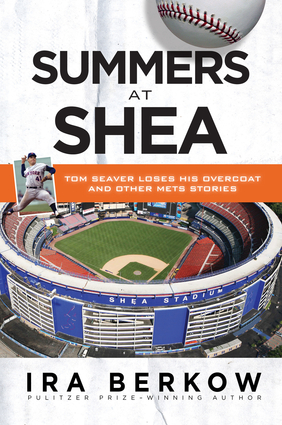
If you want a reminder of how well a general sports column could capture your fancy, you might want to pick up a collection that came out about a year ago called Summers At Shea. It contains the Mets-themed work of one of the contemporaries of the columnists listed above, Ira Berkow, long of the Scripps-Howard’s Newspaper Enterprise Association and later the New York Times.
I’d never particularly identified Berkow with the Mets, but that’s fine. A degree of detachment served his occasional forays into our obsession quite nicely between 1967 and 2007. While by no means naïve about the machinations of professional sports, this columnist didn’t fully tamp down a romantic’s heart when it came to the game and the individuals he was covering. He grew up a Cubs fan and never stopped wishing for their eternally elusive success. It’s refreshing to hear someone in the media confess to a lingering loyalty besides “the best possible story”.
And if you can be a lifelong Cubs fan and still write about the 1969 Mets without snarling, then you’re probably going to do justice to your stories anyway.
 From Stengel to Seaver to the latter days of Shea, with a welcome Roadblock or two along the way. The columns featured in Summers At Shea are snapshots that prove worth preserving. There’s Tom Seaver in Rochester in 1970, having recently ascended to the peak of popular consciousness (but having misplaced his overcoat). There’s Willie Mays in St. Petersburg in 1973, doubling off the wall and proving himself viable for one more spring. There’s Rusty Staub battling gastronomical temptations as he would lefty relievers in his final season of pinch-hitting in 1985, the last year his conditioning would be served up for public consumption. There’s Berkow joining Ron Darling on a “dark and leaky afternoon” for the Sunday drive from Manhattan to Flushing for what was supposed to be Game Seven of the 1986 World Series, a little number Darling was poised to start a few hours hence until the leak became too much for the Series to bear. Nevertheless, Ira Berkow got himself in the car with that night’s starter on the biggest day of his life.
Casey Stengel shows up in Summers At Shea, in the book’s introduction. It’s a story about how the then 83-year-old Stengel rejected Berkow’s overture to work with him on a baseball instructional primer of sorts. “Cannot disclose my Future affairs,” the Mets’ first manager advised, but he does wind up a part of Berkow’s tapestry nonetheless. So does Sherman “Roadblock” Jones. So do Tommie Agee and Dave Kingman and Rafael Santana and Kevin McReynolds and, eventually, various millennial Mikes (Piazza, Hampton, Pelfrey). Berkow wrote sports for decades. He came in and out of the Mets’ life intermittently if not exclusively. No wonder he has a couple of similar collections out that focus on the Yankees and the Knicks. That writing a Metsian book — one padded with a frankly unnecessary “formidable rivals” section that includes an ode to Paul O’Neill, for crissake — appears more a box to be checked than a mission to be accomplished shouldn’t be held against him.
Nor should some really egregious editing errors. A pennant race column that quite obviously appeared in September of 1969 is labeled as having been originally published in September or 1968. Another, on the World Series just won, is listed as having been first printed in September of 1969, or a month before the World Series was played. A third, regarding Tom Seaver’s milestone performance of September 1, 1975, is identified with a publication date of September 26, when clearly it saw light on September 2. Berkow’s writing set a high enough standard so that the bar shouldn’t be lowered for historical accuracy.
More appropriate to the tone of Summers At Shea was the column Berkow wrote after covering Seaver’s retirement press conference in 1987. “I guess it’s time now to sit back and reflect on what I’ve done,” he quotes Tom. “It’s been a lovely 20 years. I couldn’t have asked for more.” Double that span for Berkow’s columnist career and the sentiment applies to having read this sampler of what he wrote.
Jay Goldberg welcomed Ira Berkow to the Bergino Baseball Clubhouse in 2013. Listen to a podcast of the visit here.
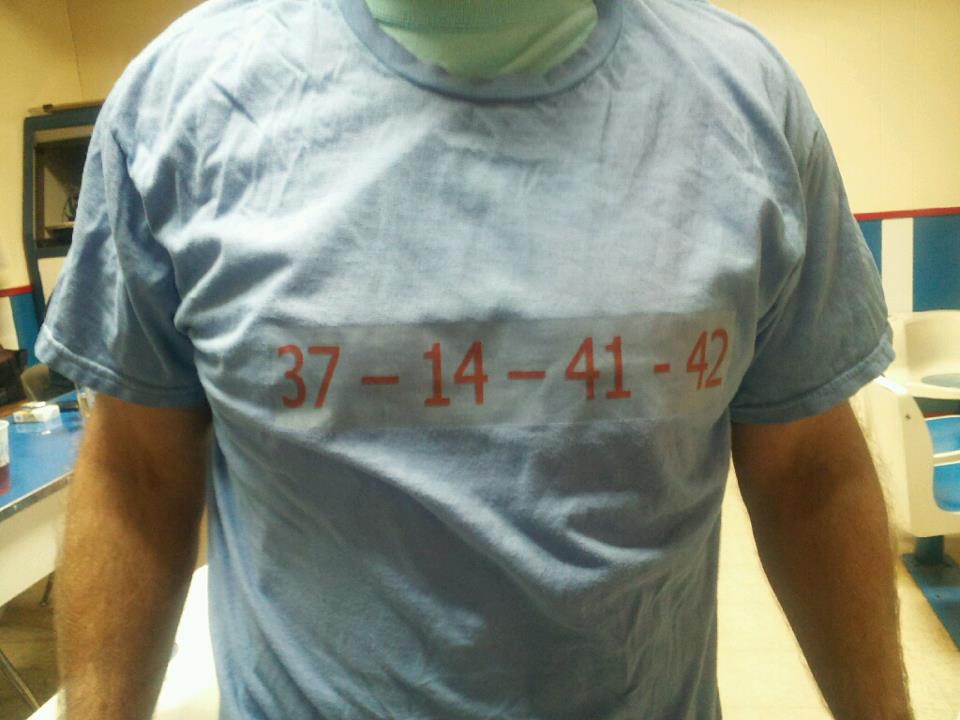
by Greg Prince on 18 March 2014 6:43 pm Thanks to the best blog readers in all of Metsdom, the Faith and Fear in Flushing retired numbers t-shirt has been spotted in ballparks all over America and on a couple of continents besides this one since its introduction during the 2006 postseason.
But we’d never seen anything like this until now.
 Not the FAFIF shirt, but an incredible simulation. David, from somewhere in the vicinity of Philadelphia, explains why the above 37 14 41 42 looks so different from all other 37 14 41 42s:
Just wanted to send you a note for how your t-shirt has been used over the years.
I bowl in a Thursday Night Men’s League and everyone there smokes. So I wear your t-shirt every single week as my bowling shirt so that only one shirt smells like smoke and not all of my shirts smell like smoke.
I’ve been wearing it every week for the past 6 years. I MIGHT wash it like 4 times in a year. But it’s held up quite well.
Needless to say I get a million comments about it (living in Phillies territory). Usually “Is that your locker combination?” or “wear another f’in shirt!”
Anyway, I am very glad you are still selling them because I think I will need the replacement pretty soon.
I’m attaching a pic of the week when the team we bowled against wore imitation t-shirts for your amusement.
Thanks for a great blog and a great t-shirt!
Faith and Fear doesn’t endorse smoking, but it has no problem with bowling — and it salutes the Faith and Fear tribute shirt…and David’s wardrobe habit for making this garment possible.
And of course it’s never too late to secure your classic Faith and Fear shirt here.
by Greg Prince on 17 March 2014 6:01 pm Jon Niese must’ve put his glove in front of his pitching arm and stabbed a sizzler of fate, for he has caught a break. He hasn’t caught a debilitating elbow injury at any rate. The presumptive first-game thrower who visits MRI tubes like less wholesome athletes might frequent strip clubs left Sunday’s game with discomfort in his left elbow. The sensible reaction was to remember him fondly now that his career has ended, but no, it’s just inflammation.
“Just” inflammation…easy for us whose elbows aren’t inflamed to say.
Anyway, Niese isn’t lost for the season but he’s probably bound for the DL just long enough to knock him out from repeating as Opening Day Starter, which is a shame for Niese, of course, but represents no more than a reordering of rotation deck chairs if indeed all he needs is cortisone. If he’s not unduly sidelined (when it comes to the Mets and “discomfort,” we imagine the worst ASAP and seek clarification later), he looms as the Sixth Day Starter, an occasion for which there has never been a name until now.
As for who starts Opening Day instead of Jonathon, it only matters in that one of your nine men on the field has to be a pitcher. It didn’t much matter that Niese was the Opening Day Starter, not in the sense that you look at Jon Niese and you think “there’s an ace…that’s who starts the first game of the season…get a load of the cut of the jib on that fellow!” Some pitchers are Opening Day Starters who inhabit the role; others are guys who happen to be pitching the first game of the season because somebody has to and there’s no overly obvious choice for the assignment.
Niese was that last year. With Johan Santana out and R.A. Dickey traded, there was nobody else who earned it on reputation and/or merit, so Niese was tabbed primarily for Met time served. This year against Washington on March 31, Terry Collins can go with the veteran from somewhere else in Bartolo Colon, or the guy who’s hung in here the longest in Dillon Gee (who also happens to pitch exceedingly well versus the Nationals, hint, hint). Collins doesn’t seem inclined to go with the guy who maintains the highest ceiling in Zack Wheeler. Nobody exactly cancels out everybody else the way a healthy Matt Harvey would.
Harvey’s the kind of Opening Day starter who gets you dreaming. Harvey’s the ace you truly want to lift your lid. What you want and what you take, however, are two distinct things.
When you’ve been deprived of baseball that counts for six months — and you remind yourself every game counts the same, ceremonial pomp notwithstanding — you’ll take anybody. You’ll take Pete Harnisch in 1997, from when the Mets had nobody else particularly prepared to grab the reins. You’ll take Randy Jones in 1982, from when April snows forced George Bamberger to improvise. You’ll take Mike Pelfrey in 2011, even if it was a bad idea to maneuver him into the spotlight against the Marlins, who owned him the way Gee owns the Nats.
But what you want is the pitcher who’s the moral equivalent of Tropicana — the pitcher who gets your juices flowing. You want Pedro Martinez in 2005. You want Santana from 2008 to 2010 and again in 2012. You want, because you were conditioned to expect no more than frozen concentrated, Craig Swan in 1979 and 1980. You want Dwight Gooden those eight seasons when you could have him. The only times you couldn’t were when he was not experienced (1984), not recovering from shoulder surgery (1992) and not confined to Smithers Alcoholism and Drug Treatment Center (1987).
What you really want for an Opening Day Starter is Tom Seaver.
If you were a Mets fan every year Tom Seaver was a Met, you could set your calendar to Opening Day by the sight of Tom Seaver throwing your team’s first pitch. The only outlier within that twelve-season sample was 1967, when Wes Westrum resisted the temptation to go with his best-looking pitcher. Seaver had never been in the majors before and you just don’t start a raw rookie on Opening Day. Westrum went with Don Cardwell instead and deferred Seaver’s major league debut for the season’s second game.
From then on, for more than a decade, no Met season would start without Seaver on the mound, a testament to both his enormous stature and fortunate health. To put his string of appearances in perspective, Gil Hodges, Yogi Berra and Joe Frazier never had cause to call on another Opening Day starting pitcher during their respective Met managerial tenures. And every year from 1968 through 1977 (and again under George Bamberger in 1983), you always assumed the Mets would start the season 1-0 because they always had the best pitcher in the world going for them.
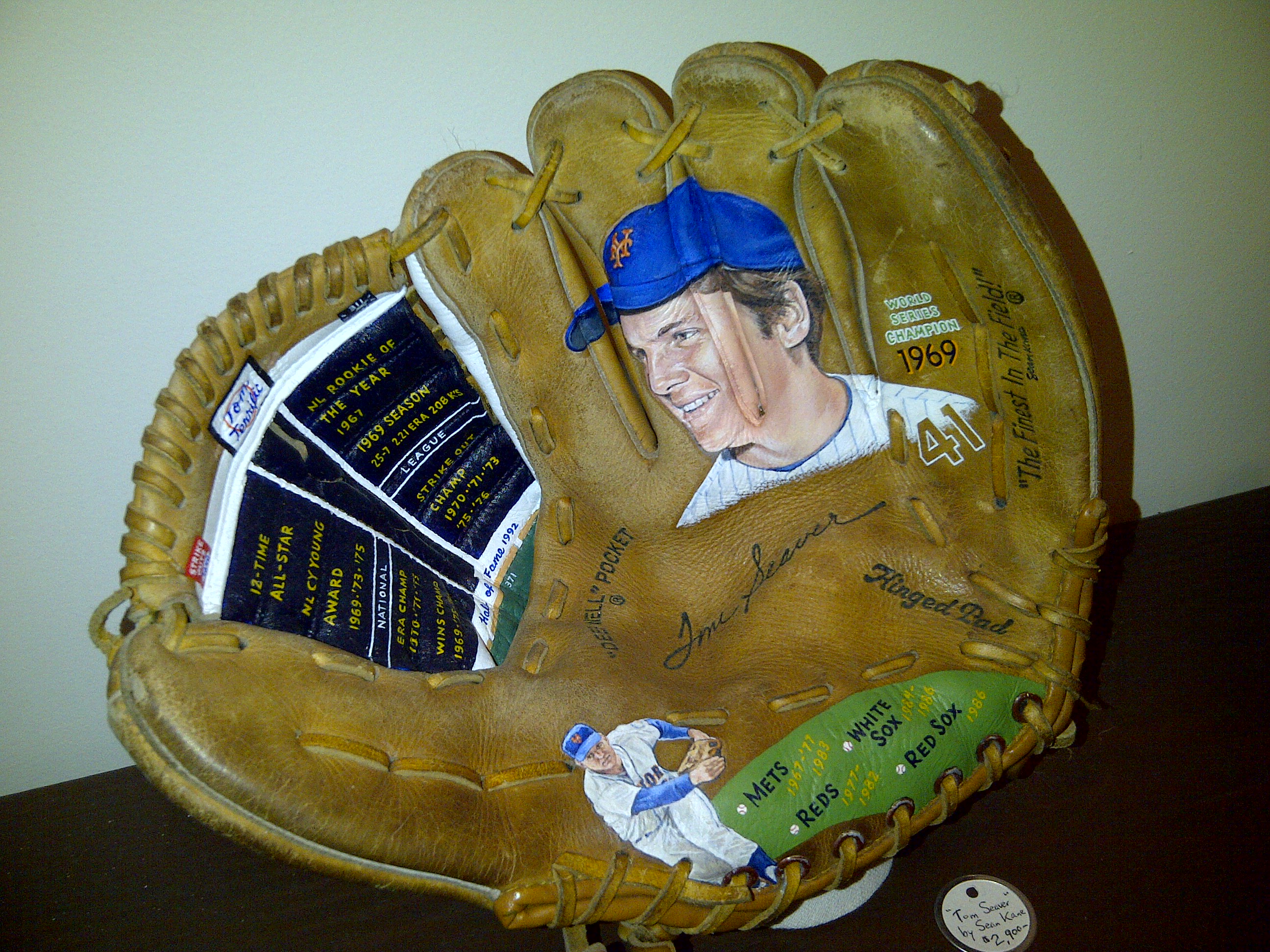
 If you can’t have Tom Seaver’s hand in a baseball glove or all his teammates’ signatures adorning baseball glove, how about the Franchise’s face front and center on a baseball glove? This is the brilliant work of Sean Kane, as seen at Bergino Baseball Clubhouse. Watching Seaver slip his left hand into his glove and wrap his right hand around a ball made being a Mets fan wonderful. It must have made managing at least the first pitch of every season a delight. Hodges knew that sensation before anybody else. And that man knew a little something about pitching and, don’t ya know, a little something about gloves.
Gil came to the majors as a catcher, a position where the Dodgers were pretty well set in the late 1940s. Recognizing the emergence of Roy Campanella and what his presence would mean to the Brooklyn lineup, Leo Durocher handed Hodges a first baseman’s glove in 1948 and “three days later,” in the Lip’s esteem, “I’m looking at the best first baseman I’d seen since Dolph Camilli.” Indeed, the first Gold Glove ever awarded to a first baseman went to Hodges in 1957. He took home the prize the next two years, too.
But once you’re a catcher, it’s probably impossible to not view the world from behind the plate. Hodges surrounded himself with catchers when he managed the Mets. Three of his four coaches — Berra, Rube Walker and Joe Pignatano — all crouched for a living. It can’t be a coincidence that the Mets nurtured great pitchers in their day (let alone their all-time best defensive backstop, Jerry Grote).
It’s safe to say Hodges knew his defensive gear. He recognized a good glove, no matter how many fingers with which it was equipped. But did you know that there’s a glove story like no other that hinges on Gil’s heart more than his hands?
I didn’t until someone wrote to us to tell us all about it. A gentleman in Florida named Fred Stankovich got in touch not long after he read about the presentation of the Gil Hodges Unforgettable Fire Award at this year’s Queens Baseball Convention. I’m thrilled that he did.
Take it away, Fred:
I grew up in the shadow of Shea (Flushing) and attended the very last game at the Polo Grounds (still got the grass from the first base line as the field was torn apart after the game) and the first game at Shea. (Cut school for the first time to attend. Sat in the last row, last seat in right field so the cameras wouldn’t pick me up and bust me.)
A quick blurb about Mr. Hodges. I was working at LaGuardia Airport, midnight shift, renting cars for National Car Rental in my senior year of college. During the summer of ’69, with the Mets woefully trailing the pack, the Mets were scheduled to arrive on a flight back in LaGuardia after a night road game. Those were the days when they arrived at baggage claim to get their luggage like anyone else. I went out to my car and got my baseball glove and a pen. I approached Mr. Hodges as he was waiting for the luggage to come to the carousel. I asked if I could please have his autograph (My Dad loved him from the Dodgers’ era.) He said, “Sure, son”.
He pulled out his own pen, signed the glove and as I reached for it, he held up his hand as if to say, “Hold on a second.” He then passed the glove and pen to the player next to him. And away it went. The 1969 Mets ALL signed MY baseball glove!! When it finally came back to Mr. Hodges, he handed it to me with a big smile. I nearly dropped dead.
How cool was that? Well it was my only glove and that weekend I had to play ball, so I used it in center field, showing it off to all my buddies. We were all impressed, but the game had to go on. Too bad I didn’t have the appreciation for Met memorabilia back then. That glove is in Japan somewhere now as I traded it for a new glove while serving in the Marines over there.
Ouch!!
I can understand Fred’s “Ouch!!” but no matter what that glove would be worth today, that story will remain priceless forever.
For more information on the Baseball Glove Art of Sean Kane, visit or contact Bergino Baseball Clubhouse, where the one-of-a-kind Tom Seaver glove is among several Kane works on display and for sale.
This is the second time in a few days that we’ve referenced Leo Durocher. Get even more Lip here, from W.M. Akers, when he recalls the spring seventy years ago that Brooklyn trained on Bear Mountain.
by Greg Prince on 15 March 2014 11:58 pm Late last season I was moved to recall a childhood friend named Evan Radler. We knew each other for one baseball-laden summer and saw each other exactly once more when it was over. He grew up to be a rabbi who died well ahead of his time, two facts I discovered long after they occurred.
Somewhere in the middle of the offseason, I heard from Rabbi Radler’s widow, proving the you-never-know quotient remains unfathomably high in our digital age.
Mindy-Lu Radler Glickman (since remarried) was kind enough to share the following reasonably relevant anecdote with me — as reasonably relevant as an anecdote from 1999 regarding a guy I hadn’t seen since 1974 could be.
That is to say it has baseball in it.
We had just moved to Atlanta. Evan had recently started a new pulpit.
Evan was very cute and often irreverent. They did not know what to make of him. This was a congregation that since its inception had not known laughter during services.
Stan Kasten was a member of the synagogue. He generously invited us to sit in his seats during the playoffs. We ate boiled peanuts.
One Shabbat following a game that the Braves lost, Evan stood up and announced that the Braves don’t have a prayer. The following Shabbat, after a decisive loss, he closed the service this way:
“After much consideration, I realize that I erred last week when I said the Braves don’t have a prayer. They do. Please rise.
“Yitkadal, v’yitkadash shemay rabah…”
Everyone burst out laughing.
Even if you’re not a maven when it comes to the Hebrew language, you might have inferred what Evan was reciting was the Mourner’s Kaddish, which made his solemn intonation quite hilarious. And because it was said on behalf of the Braves (no disrespect to their gracious former president, who now runs the Dodgers)…well, we gotta love that.
In remembering Evan in September, I stressed how our preadolescent relationship at kosher Camp Avnet was mutually respectful despite our religious differences regarding choice of ballclub. Turns out that despite the Radlers eventually winding up in Queens, “where my kids seemed to have no choice but to be Mets fans,” Mindy reports with apparent empathy for our cause that “my son Tai chose the Yanks anyway.”
Well, you can’t have everything. But I do come away from this unexpected encounter with a heartening coincidence or something like it.
Mindy let me know that Evan nurtured a passion for fantasy adventure, which manifested itself in a book he was working on before his passing. In a beautiful gesture, Mindy recently published it as an e-book. It’s called The Flying Lion and it certainly merits a look if that’s your kind of genre.
The coincidence? I mentioned in my earlier post on Rabbi Radler that for no particularly discernible reason, I tended to conflate Evan and Jason when I first met my future blog partner. As you may know — and if you don’t, you should — Jason writes quite a bit in the science fiction arena when he’s not getting fed up with Spring Training and such. He’s in the midst of a series geared to young readers called The Jupiter Pirates, the first volume of which is available in all formats and is receiving enthusiastic reviews throughout the universe.
I won’t pretend to know a lot about this stuff, because I find Met reality far stranger than any fiction, but it’s written by Jason, so what else do you need to know to (as I hope you will with Evan’s work) check it out?
by Greg Prince on 14 March 2014 1:55 pm Leo Durocher would have relished this weekend in Las Vegas. The Cactus League Cubs — the team he managed to its only oasis of success in a nearly 40-year schlep through a desert of futility, and the Grapefruit Circuit Mets — the team that inevitably turned 1969 into a Near North Side mirage, will square off in a pair of exhibitions in so-called Sin City. Durocher would’ve gotten a kick out of this geographically illogical Spring Training detour because it would’ve given him an excuse to visit Vegas on somebody else’s dime. Seeing as how these games don’t count, Leo probably would’ve handed the reins to coach Pete Reiser and looked up Frank as soon as the Cubs’ plane landed.
Leo liked to live the life (not always to everybody’s satisfaction). The Lip also wasn’t afraid to speak up in favor of whatever pies Leo had his fingers in. Maybe you’ve heard the line about Durocher from when he took over the Cubs after their eighth-place finish in 1965. This, he said with characteristic brio, is no eighth-place ballclub.
His figurative money laid down where his mouth was, Leo charged into his first season as Chicago’s skipper…and led the 1966 Cubs straight into tenth place.
In something approaching that spirit, wouldn’t it be great if the business about Mets management fancying their team a 90-win outfit was proven inaccurate, except in the other direction? Wouldn’t it be great if somebody was repeating an anecdote in the far-off future about how somebody running the 2014 Mets suggested, “this is a 90-win team,” but it turned out to be wrong because they won so many more?
Yeah, that would rule. As would many largely elusive fantasies that pop to mind across a weekend in Las Vegas.
The Mets probably should have more good players set to play more positions. That is if they’re serious about this 90-win thing, which they probably aren’t. The 90-win goal that’s become this spring’s Underdog t-shirt wasn’t something they issued a statement to explain or deputized Mr. Met to Tweet. Sandy Alderson reportedly dropped that number in an internal meeting and Fred Wilpon reportedly got caught up in the moment and endorsed it less as an aspiration than an imperative.
“We better win 90,” said Fred, channeling his inner Christopher Moltisanti.
Can the Mets, who at the very least have no chance of finishing eighth in the five-team National League East, win 90 games? Hell yes. They can win 162. They can also win none. Or any total in between. There’s a divergent array of potential outcomes. Consult your local numerologist for a more accurately assessed win total if you really want one pulled out of the air or any given ass.
But can the Mets really win 90 games? No. Don’t be silly. Do Alderson or Wilpon remember what 90 wins look like? The Mets have hit that mark once in the last thirteen years, and that includes years when they had certifiable talent rarin’ to go, not a pool of ellipses bracketed by bold-faced question marks.
Have you seen this team? It lacks legitimacy at two of eight positions. There’s 25% of your defensive alignment right there. Put aside normal questions about leadoff hitters and which partially accomplished outfielder will be granted playing time over which other partially accomplished outfielder and whether the rookie catcher is ready to not only strap it on but step it up. The Mets entered the offseason with only the faintest outlines of a shortstop and the iffiest conception of a first baseman. Two-and-a-half weeks before the season starts, the possible solutions have grown less certain.
Terry Collins recently speculated aloud about batting his pitcher eighth and some underwhelming non-pitcher ninth. He was thinking about doing it, he said, to generate as many opportunities as possible for Murphy, Wright and Granderson to drive in runs. Well, sure, you strategize over lineups to create the most offense you can. Whether any of it amounts to any kind of net-plus is always up for grabs. I wouldn’t automatically dismiss the pitcher batting eighth on principle, because not doing something because almost nobody’s ever done it isn’t a valid reason for avoiding it. Not doing something because Tony La Russa did it and Tony La Russa strikes most of us as a plague isn’t a disqualifying element, either.
But what got me when I read that Collins was resorting to considering this unorthodox tactic was it was early March and he was already groping in Something/Anything territory. A powerhouse lineup doesn’t figure to be built on Niese batting eighth and Lagares batting ninth. A powerhouse lineup is leading off Henderson and surrounding Piazza with lefties like Olerud and Ventura. Or it’s figuring out where to best bat Beltran and Delgado in order to maximize your Carlos quotient. Those are the offensive versions of pleasant problems. Digging deep into the eight- and nine-spots and juggling .138-hitting pitchers with .219-hitting anybody-elses is what you do when you’re desperate.
It’s March. It’s not supposed to be desperation time yet. Or it’s not supposed to be desperation time at all if your front office is talking and your owner is demanding 90 wins. (And if the pitcher batting eighth is real, why do we keep using DHs in exhibition games?)
Where’d they get 90 wins from, other than it’s a round figure and it implies a very imposing team? Best I can come up with is the old saw about every team winning a third and losing a third, which puts the Mets at 54-54 no matter what. That other third, where the gold supposedly lies, comes to those who execute and angle and hustle and get breaks and avoid injuries and are led by real men of genius. Perhaps when the Mets look in the figurative mirror, they see all the attributes that show up in neither the scouting reports nor Baseball Prospectus and they are charmed by their appearance. They fancy themselves a scrappy collective set to outmaneuver opponents, a unit overdue for some dumb luck to land their way.
“We live clean. We take pitches. We don’t unduly raise the league average payroll just because we need more good players at more positions. We apologize for insensitive remarks. We can win 90 games!”
They can, if they go 1-0 90 times, which is more in line with how I like to approach seasons. I’m a disciple of Bobby V, who never failed to identify tonight’s game as the most important game of the year because it’s the only one we’re playing tonight. Or they can go 36-18 in the mystery 54. If an inside straight is drawn, they can go 82-79 as in 1973 and keep going well into October (or, should playoff systems revert, they can go 98-64 and go home like they did in 1985 — though that wouldn’t be much fun).
Or you can forget anybody said anything about 90 wins and brace for the worst, thus being satisfied when something less bad happens. We do that a lot around here.
And yet…when you commence to sneaking up on two weeks from Opening Day, you scrunch your face, squint your eyes and focus real hard to see if there’s a way into this almost prohibitive phony-baloney goal that would be inarguably neat to meet. You give d’Arnaud a gently sloping learning curve. You give every pitcher — each of them at least pretty good at base — his best possible season and then sprinkle a little more WAR on top for good measure. You wipe away your wondering about Granderson having been out almost all of last year and check those bulging statistics of campaigns past. You bolster yourself with the knowledge that Grandy (Grandy?), CY2 and Colon have all been recent playoff participants and experience as winners has to count for something. You take Lagares’s defense, EYJ’s speed and the other Young’s 2010 and create a three-headed left-center fielder that will, in the sainted memory of Ralph Kiner, cover two-thirds of the earth.
You think back to Gil Hodges projecting 85 wins for his team the spring after they won an all-time franchise high of 73 and challenging himself to come up with a few more — 15 more, as it turned out in ’69, plus another seven in the postseason. You recall having little confidence in the myriad second base candidates of March 2006 and winding up by May with Jose Valentin and his 18 home runs. You even remember (because you are the way you are) that the Mets made late trades twenty years ago this very spring, filling holes at short and first with Jose Vizcaino and David Segui, each of whose modern equivalent would be an upgrade over Ruben Tejada and Ikas Duvis. If you like harbingers of something other than doom, those 1994 deals were pulled off by then general manager Joe McIlvaine, the same Joe Mac who’s been scouting the Mets for the Mariners all spring, the same Mariners who are said to have a talented shortstop to spare.
But that’s best-casing this scenario. Sure, maybe someone emerges from the crowd to make a Valentin type of difference and maybe a Vizcainoish transaction emerges. Summoning 1969, though? When the best possible answer to my doubting George Thomas tendencies is invocation of the most Amazin’ aberration of all as precedent, I’m mostly saying you need something that happens once in a lifetime to happen again…to happen right away.
Y’know what ya do? Ya hope anyway.
Ya hope other teams aren’t very good.
Ya hope our team is better than I believe it is.
Ya hope a cable-ready kid pitcher can be plugged in as soon as fiscally amenable.
Ya hope Pythagorean lightning can be caught in a bottle, as it was thirty years ago; the 1984 Mets, expected to do nothing, scored and allowed enough runs so they “should” have won 78 games — they wound up with 90.
Ya hope the BABIP bounces charitably and the FIP flies our way.
Ya hope magical thinking translates to a 16-game improvement from a year ago, even if there’s no Byrd anymore, no Harvey for now and no Syndergaard yet.
Mostly, ya keep your feet on the ground and keep reaching for the stars, one game at a time. You can only win that many at once anyway.
by Greg Prince on 13 March 2014 12:46 pm One National League East Narrative Reinforcement comin’ right up!
While the Braves were doing everything they could on Wednesday to earn their fans’ gratitude, the Mets were finding new, characteristically clumsy ways to show they’re as sorry as any organization can be.
Atlanta invested more than $14 million in Ervin Santana, the best available pitcher on the open market, to fill the stud-sized hole in their rotation left by the recurrence of pain that flared up in the previously surgically repaired right elbow of Kris Medlen. Despite mounting an inspiring comeback since undergoing Tommy John surgery in 2010, the Brave righty’s fate has to be taken in Flushing as a cautionary red flag against anybody confidently penciling in Matt Harvey as he misses all of 2014 antsily rehabilitating his right elbow from the same kind of procedure. Mets brass were already visibly uncomfortable with how Harvey has conducted his rehab. This latest of turn of events can only add to their unease.
But it wouldn’t be spring in Port St. Lucie without the Mets visibly squirming and their fans feeling none too good about them either.
Nearly two hours to the east of Braves spring HQ in Kissimmee — and presumably dozens of games south of Santana’s new pennant-minded team in the standings — the Mattless Mets not only continued to maintain they’re fine with their present assortment of subpar in-house shortstop and first base candidates, but had to be publicly shamed into acknowledging a private apology with racially charged ramifications wasn’t suitably contrite.
The Braves train at a complex adjacent to Walt Disney World, the so-called happiest place on earth. It’s a title the barren east coast wasteland of Port St. Lucie isn’t likely to vie for anytime soon — and you can add it to the list of titles Mets-related enterprises don’t look to be competing for this year.
Except, perhaps, sorriest team ever. The Mets seem to have that locked down in every sense of the word.
***
If you haven’t read something like that in one of your fancy professional sports columns, you probably will sooner or later. Everything comes back to haunt the Mets and make them look like amateurs, whether they deserve it or not.
Do they deserve grief for the Braves being the Braves and deciding winning is so important that they’d go above budget and replace Medlen with Santana? No. That’s the Braves’ business. Is there an unflattering parallel to be drawn between Atlanta not sitting still and New York’s stubborn inertia in the upgrade department? Probably a Granny Smith and Valencia comparison, though you’d like to think somebody would closely examine the Tejadas, Davises and Dudas, notice they’re not particularly ripe and find us crisper, juicier produce, even if it costs a little more than anticipated.
And whither Warthen? Remember when you didn’t think about Dan Warthen whatsoever? Remember when he was the pitching coach who was either doing a perfectly adequate job, assuming somebody was pitching well, or needed to be replaced because somebody got lit up? That’s usually how we are moved to think about coaches.
That was yesterday.
We don’t think about coaches at all unless a reason arises. A reason arose in what I’m tempted to say was the most Metsian way possible, but only because I’ve been conditioned by events to assume if there’s something counterproductive to come out of something vaguely positive, the Mets will find the counterproductive. Or, at the very least, they’ll meet in the murky middle.
The vaguely positive is Warthen, the Mets’ pitching coach since 2008, was observed apologizing to Jeff Cutler, Daisuke Matsuzaka’s interpreter, for having used an archaic ethnic slur in his direction. It wasn’t a staged or lawyered apology. It was somebody coming up to somebody else at work saying, in essence, “I’m sorry I said that to you.”
How could that little slice of internal interaction turn counterproductive? Well, let’s see…
• The person who did the observing was a reporter.
• The reporter, Stu Woo of the Wall Street Journal, is a self-described Chinese-American.
• The phrase for which Warthen apologized was “Chinaman”.
• The apology was observed by the reporter as “I’m sorry I called you a ‘Chinaman’ yesterday,” and was followed with “I didn’t mean to insinuate — I know you’re not Chinese” and “I thought it was a good joke, though.”
• Cutler is described in the story Woo wrote about the encounter as Japanese-American, leading Woo to wonder about the context of Warthen having said he was sorry.
Was he saying that he wanted to apologize for saying “Chinaman” only because he’d said it to a man of Japanese, rather than Chinese, descent? Did he think that the word itself was OK to use — or that it was acceptable material for jokes?
It’s a question that apparently nagged at Woo, who observed the encounter Monday morning and asked Cutler about it Tuesday morning. Cutler told him he wasn’t offended by Warthen’s joke and otherwise deferred to the pitching coach on its content. (If somebody doesn’t want to repeat a joke, you can assume it has transcended its potential to elicit laughs in polite/on-the-record company.)
Woo wrote he later “caught up” with Jay Horwitz, presumably to seek clarification. Horwitz, in his role as vice president of media relations, arranged a meeting that was to include the two of them plus Warthen early Wednesday morning, “[b]ut when I got to the Mets facility Wednesday, Horwitz said Warthen wasn’t going to comment. Cutler wasn’t in the locker room.”
That’s where Woo’s story ended when it first appeared on the Journal’s site Wednesday night. Soon enough, in this world of microscopic news cycles, the Mets were moved to respond via written statements, which have since been added to the originally posted article. Warthen apologized for “thoughtless remarks”; a “poor attempt at humor”; and words that were “wrong and inappropriate in any setting”. The pitching coach was “very sorry”. Sandy Alderson apologized “for the insensitive remarks made by one of our staff members,” describing what Warthen had said to Cutler in front of Woo (and perhaps to Cutler via the joke in question) “offensive and inappropriate”. The organization, the GM added, “is very sorry”.
This morning, the Mets moved into to putting-it-behind-them mode, save for an unusually feisty Jon Niese, who, according to Newsday’s Anthony Rieber, told “a group of reporters: ‘Stop Tweeting about our clubhouse. That —-’s gotta stop.’” (Rieber, naturally, Tweeted that nugget.) They could’ve avoided it altogether had Warthen chosen to speak to Woo Wednesday morning. Or if Warthen wasn’t moved to use words like “Chinaman” in conversation in 2014. Or if Jared Diamond hadn’t gotten married over the offseason.
Diamond normally covers the Mets for the Journal. He was taking a few days off to be with his new bride. If Diamond is on the beat, whatever conversation Woo — who mostly covers football — has with Cutler doesn’t take place and is therefore not interrupted by Warthen’s overheard conditional apology. It could be Warthen seeks out Cutler with nobody around, Cutler nods and says “it’s OK,” just as he did with Woo on hand, and nobody ever knows anybody ever made a poor attempt at humor.
But Woo was there and the makings of a story coalesced. Spring Training is enough of a production to merit not just continual beat coverage but fill-in beat coverage. As Jason pointed out most insightfully the other day, nothing much of enduring significance happens in Spring Training, so therefore anything and everything becomes a potential story. (There are only so many times in six weeks you can read David Wright pledge fealty to the front office’s long-term vision.) Then consider the media outlet. The Journal, in particular, pursues angles that the New York dailies don’t, generally seeking the less obvious ones. A fantastic example came a few years ago when Brian Costa wrote about the logistics involved when a ballplayer is called up from the minors: where they sleep, how that works, who pays for what. It was a fascinating glimpse inside a sliver of the major league existence that we don’t normally see. Similarly, Woo tackled the Senior Bowl not through the prism of scouting reports but how the college all-star game serves as de facto job fair for potential NFL players.
So you have the Journal ethos of striving to cobble the interesting amid the mundane. And then you take into account that Woo is not a regular on the Mets beat. In a way, that could be a disadvantage in that there’s no base of familiarity from which to deal, but it also means he’s looking at the clubhouse and the players with fewer preconceived notions. Continued access to sources doesn’t loom as an unspoken concern. If someone has to be around the Mets most every day, he’s probably going to be more hesitant to spill what feels, after a while, like family business. He may also be more inured to it. As Woo himself acknowledged in his story, he knows how athletes talk in clubhouses and locker rooms. Still, he came to this situation as an outsider. An insider and an outsider may hear the same thing, but they’re likely to process it quite differently. One reporter’s “that’s nothing new” is another reporter’s “that’s something else.”
And there’s no overlooking Woo’s ethnic identity here because Woo emphasized it himself:
As a 27-year-old Chinese American who grew up in San Francisco, I couldn’t remember the last time I heard the term “Chinaman,” a derogatory word originally given by white Americans to Chinese immigrants in the 19th century. I might have heard it used on the grade-school playground, but never before in dozens of NFL, NBA and Major League Baseball locker rooms I’ve been to as a sports reporter.
Woo admitted he had a first-person interest in this story. The phrase Warthen uttered caught his ear. It wasn’t enough for him to think, “that’s something you don’t hear every day,” and then share it only on the sly. He indicated he decided to pursue it as an angle in print as opposed to an anecdote passed on opaquely because, “Warthen had used the term in front of two people who had every reason to be offended. And he did so in a casual way in a work environment — one where he holds a position of power. I didn’t want to be complicit in tolerating the use of a slur that should have been retired long ago.”
You wouldn’t necessarily think of the Wall Street Journal’s sports section as a platform for social advocacy journalism, but Woo (and his editor) went in that direction, and today you have a Metsian contretemps.
To be cynical about it, Warthen probably should’ve waited until Cutler was done speaking to a guy with a media credential hanging around his neck during open-clubhouse hours to approach him. Having failed to do that, Warthen shouldn’t have blown off the appointment Horwitz made with Woo. That it took Woo’s story being posted on wsj.com to flush out prepared statements of regret makes the Mets look a little craven. Then again, Warthen did offer Cutler an apology in the first place…and the Mets did play catchup as quickly as they could in condemning their own behavior.
It would be easy to write off Warthen’s “Chinaman” slur as a symptom of age. I won’t. Warthen is 61. He’s not from the Stone Age. Sixty-one probably sounds ancient to many of you. To me it’s my age plus ten years. Warthen’s old enough to know better and not so old that an unfortunate choice of words can be winked away.
On the subject of age, I find Woo’s more intriguing. He’s 27, pretty young, all things considered. Is he old enough to “know how things work,” that men who coach other men are sometimes salty in their speech and say things that are indelicate? He basically says so in his story. But he decided not to care, and that’s probably an encouraging sign in a societal sense. Woo wrote he didn’t want to be “complicit” in going along with the program, the one that that silently certifies otherness as something inherently worthy of derision. At 27, he’s adhering to a higher standard. It takes a bit of courage to do that, especially in an industry that’s traditionally looked the other way when its protagonists have routinely ostracized otherness.
And if we’re cheering on Jason Collins and Michael Sam as they attempt to blaze new paths of acceptance in professional sports, I find it hard to ignore vestiges of the old ways that make otherness so pronounced. Stu Woo is entitled to do his job and not hear “Chinaman” from someone in a position of authority. So is Jeff Cutler. So are the clubhouse attendants and interns and lackluster first basemen. So is everybody who comes in and out of the Met sphere, regardless of descent.
Dan Warthen is entitled to think whatever he wants. If he sees Cutler and thinks, “there goes that Chinaman who interprets my advice to Dice-K,” that’s extraordinarily sad, but that’s a heart-and-mind issue. If he’s desperate to ask somebody away from his place of employment, “did I ever tell ya the one about the Chinaman who walked into grocery store…” that’s unfortunate, yet that’s his right. But if Warthen’s going to come to work and throw a word like that around, whether in the form of a joke or a relatively benign reference, geez, what’s wrong with that guy?
Never mind that there’s a considerateness aspect to life that is too often dismissed as overly sensitive or (speaking of offensive phrases) politically correct. Baseball is a business predicated on teams attracting all the people they can to buy tickets to their games. The Mets needn’t come remotely close to offending any potential customers on any basis that has nothing to do with not acquiring a better shortstop. The Mets play in Flushing, for goodness sake. Ride the 7 one stop to Main St. and meet your neighbors.
If we’re a forgiving people, then we forgive Dan Warthen for saying something cloddish and let Alderson decide on merit if he’s the pitching coach best suited to further develop Harvey, Wheeler, Syndergaard, Montero and all the other young arms in his care. If the results Warthen yields are outstanding — starting pitching seems to be the one Met area about which nobody has any real complaints — the slur fades until the next time somebody says something anachronistically stupid. If team ERA wafts to intolerable levels, what Woo reported Warthen saying to Cutler probably doesn’t help his cause.
The great Dan Jenkins (probably not someone who’d have a problem with how Warthen expressed himself) built a career on observing truths and turning them into fiction. In a terrific profile synced to the release of Jenkins’s autobiography, Grantland’s Bryan Curtis discusses how the author of Semi-Tough would linger over drinks in the company of colorful characters and gather what became his prose.
“He would disappear once in a while,” said David Israel. “You knew nobody had to take a leak that often. He was off writing down all his overheards. That’s what he would call them. Just writing down great lines overheard in bars. He didn’t want to write them down in front of somebody.” Jenkins knew if he didn’t write down those lines — that material — they would float into the ether and he’d never remember them again.”
Jenkins, Curtis continued, absorbed “locker-room philosophizing” from the likes of Don Meredith and Sonny Jurgensen, stuff that was “too interesting for Sports Illustrated. By placing their words in the mouths of Billy Clyde [Puckett] and Shake [Tiller], Jenkins could show readers what the life of a pro football player was really like.”
“I wrote a novel with people talking the way I know they talk,” Jenkins told Curtis. Woo wrote a brief news feature with Warthen talking the way he knows he talked, and we saw a little of what the life of a major league clubhouse is really like. Sometimes these narratives write themselves. Sometimes somebody has to decide to write them.
by Jason Fry on 10 March 2014 9:11 am I have a modest proposal: dismantle the spring-training media-entertainment industry.
No, really. Because it’s making us all crazy.
Spring training exists for two reasons:
1) Pitchers need time to strengthen their arms to do a better job at something profoundly unnatural that will eventually hurt them, possibly in a catastrophic, career-ending way.
2) Towns in Florida and Arizona like money.
That’s it.
Today’s hitters need spring training the same way you and I need to go spend six weeks in an anonymous subset of Florida scrub choosing which sub shop and Wal-Mart to visit. Spring training for hitters is a vestige of when players drove trucks in the winter or served as ornamental employees of insurance shops and auto dealers. They’d show up to huff and puff off their winter weight. Now hitters spend the offseasons tinkering with nutritional regimens and hitting. They’re there because they’ve always been there and because pitchers need someone to throw to.
The rest of spring training is stupid and maddening and ultimately counterproductive.
We watch games in which teams wear parodies of real uniforms, nobody we’ve heard of is around after the fifth inning and the outcome matters not a whit — yet dingbat fans act as if it does. If there’s a subspecies of fan dumber than the spring-training heckler, I’ve yet to meet him. “If David Wright doesn’t drive this ball against this Double-A palooka I’m gonna GIVE HIM THE BUSINESS!” Uh-huh. It’s March, champ — have another hot dog and be grateful for the sunshine.
Yesterday it was breathlessly announced that the Semi-Mets and Sorta-Braves had set an attendance record for Whatever Field in Port St. Lucie. Outside of five to seven guys at Whatever Field, I cannot think of a sentient being who could possibly care about this.
The media passed that tidbit on, because what else are they going to do? They’re stuck in Port St. Lucie for six weeks like everybody else, going slowly crazy reporting things that we all know don’t qualify as news. Bartolo Colon will start today. Lucas Duda might start at some point. The Mets don’t have a real shortstop. Matt Harvey is still hurt. Noah Syndergaard will be awesome, but he won’t be awesome in a way that matters until June, because contracts and money. Riveting!
It would be no less honest and only slightly less interesting to report the reps guys do on weight machines.
BREAKING: Niese sets calf press to 90. Second set of reps may follow. #Mets
But that wouldn’t bring in fans and ad dollars the way pretend baseball games do. (And even then, have you seen SNY’s spring-training ads? If you’re a maker of crummy furniture on Long Island and can’t figure out where to spend your ad dollars, you’re obviously not trying.)
Players go crazy too, of course. Harvey tweeted that he’d be back this year. Someone on the Mets presumably scolded him about this, so he untweeted it, which was about as effective in making the story go away as you’d guess. I don’t blame Harvey. If I were in Port St. Lucie I’d be re-enacting “A Beautiful Mind” in my motel room by now or making a Fortress of Solitude out of gum wrappers and spit. Veterans fall prey to this too: Carlos Beltran dutifully answered the old question about the Mets being lousy to him and so created a one-day quasi-story. It had the desired effect of getting idiots riled up and bringing us a day closer to no longer having to endure this period of non-anything.
Oh, and I just read that Ike Davis is in a walking boot. Terrific. I’m sure all matter of insightful medical analysis and level-headed fan forecasting is on tap.
I’m not going to link to any of the above because it’s all profoundly pointless. It’s intellectual rotor wash generated by trapped people who have no choice. I don’t blame Port St. Lucie’s hostages for this behavior. Instead, I want to help them.
Let’s untelevise spring training. Send the reporters home to be with the families they’ll have to miss from April to October. Create a list of fun apps for players to occupy themselves so they don’t wind up driving anywhere else at 825 MPH or assaulting pizza delivery boys in parking lots. The reporters can show up the day rosters are cut down to 27 or 28 to write one story about the guy in the best shape of his life, another about a roster battle that no one will remember in June, and to make predictions about the entire baseball season, down to the exact second the World Series will end and what the DJIA will be that day. Maybe we can even televise a game or two. That would take about a week, which would be about right.
We’d be sad at first. But then we’d realize it was for the best. Spring training doesn’t make me happy anymore. I don’t think it makes anybody else happy either. The idea of it is fabulous, but the reality is tedious and witless and is making us all crazy. And it’s got to stop.
|
|