The blog for Mets fans
who like to read
ABOUT US

Faith and Fear in Flushing made its debut on Feb. 16, 2005, the brainchild of two longtime friends and lifelong Met fans.
Greg Prince discovered the Mets when he was 6, during the magical summer of 1969. He is a Long Island-based writer, editor and communications consultant. Contact him here.
Jason Fry is a Brooklyn writer whose first memories include his mom leaping up and down cheering for Rusty Staub. Check out his other writing here.
Got something to say? Leave a comment, or email us at faithandfear@gmail.com. (Sorry, but we have no interest in ads, sponsored content or guest posts.)
Need our RSS feed? It's here.
Visit our Facebook page, or drop by the personal pages for Greg and Jason.
Or follow us on Twitter: Here's Greg, and here's Jason.
|
by Greg Prince on 13 April 2014 9:10 pm They hit ’em out of Anaheim. They hit ’em into Los Angeles. They hit ’em until geographic borders were obliterated.
They scored 14 times. They were Ram-tough in Orange County as if they still had a team there that takes the field in blue and yellow. It was such a thorough thumping of New Yorkers that I’m pretty sure I saw Flipper Anderson trot into a tunnel.
They left the visitors part grumbly, part speechless. A substitute umpire named Toby Basner created a strike zone that was more impressionistic than actual. Two visiting victims were ejected for noticing, or as many who crossed the same home plate whose width seemed to baffle Basner.
They treated the starter like a piñata. Oh, the offensive treats that spilled out of him as soon as they began whacking him around! And the bullpen produced no less in the way of delicious offensive goodies for the home team’s bake sale.
The manager said, “We got through it.” The captain said something about knowing you’re going to get no more than a minimum of runs. It was certainly said as a compliment to the home team’s pitcher, but it was also quite accurate in hindsight. The visitors understood in advance they’d score maybe twice. Given how many arms it took to push through 23 innings over the previous two evenings, it wasn’t surprising the staff would surrender seven times as many tallies as were generated on its behalf.
Add it up, and it was Sunday carnage. I suppose it was embarrassment, too, but it felt suspiciously routine, or no worse than routine gone awry. Sometimes these Mets win. A little more often they lose. This time they lost by a margin of 14-2.
You tell yourself it’s just one game. A defeat by a dozen isn’t materially different from a loss by a lot less. It’s still a loss. The Mets were pounded but it only counts against them once.
Yet another moral victory is secured.
by Greg Prince on 13 April 2014 8:19 am My deepest apologies to anybody who wanted and expected to turn in no later than midnight Saturday after a calmly resolved 6-3 Mets win over the Angels, one saved without incident by Jose Valverde. Don’t blame Valverde for the three-batter sequence that commenced with two out and nobody on in the bottom of the ninth, the one that ensured a much longer night awaited. Jose was probably on his way to a very simple save and you were on your way to a welcoming bed. The only thing that could have gotten in the way was my thinking this thing was over.
Oh no. No. Never think that. Never mind never say that and never Tweet anything suggesting it.
You’d think I’d have relearned this eternal lesson on Opening Day when I dared to stand with two out in the bottom of the ninth, the Mets ahead, 5-4, and Bobby Parnell the pitcher in whom I’d invested qualified episodic confidence. I stood, I grabbed my stuff and I dared to think not just “this will be over in a minute,” but began to sort through my reactions to other presumed reactions to the impending victory, such as, “Gads, am I going to have to hear about how great Bobby Parnell, who obviously isn’t throwing as hard as he did year, is after just one save?”
Very soon I was relieved of that burden. There was no save and there’s been no more Parnell. He was shortly thereafter provisionally replaced by the veteran Valverde for those few/far-between situations calling for a Met closer. Provisional, however, was beginning to feel permanent — or as permanent as a closer of 36 years and diminishing reputation could feel — when Jose emerged unscored upon in his first five outings as a Met. And on Saturday, in the otherwise unmapped Anaheim section of Los Angeles, given how the Mets had already overcome a two-run deficit and the vengeful specter of Collin Cowgill, it didn’t seem out of line to think Valverde would gently tuck in a three-run lead, especially once he got ahead of David Freese one-and-two and needed only one more strike to wish us and the Angels sweet dreams.
I apologize for thinking it was as simple as a third strike and resulting third out right there. I neglected to take into account the doom factor I had unleashed. You won’t find “doom factor” on the back of your baseball cards or among your more advanced statistics. No metric properly reflects that when I begin to think a Met closer is certain to escape a danger-fraught scenario with ease, that same Met closer inevitably implodes. It happened to Bobby Parnell on Opening Day. It’s been happening with alarming regularity since at least Skip Lockwood in the mid-1970s.
Somehow I missed the alarms.
It happened to Jose Valverde Saturday night at Angel Stadium, where David Freese singled instead of making an out and ending the game. True, all Valverde had to do after not retiring Freese was take care of Erick Aybar, but already I sensed karma was issuing me a bill for daring to contemplate not only how Valverde off the scrap heap seemed a better bet to save games in 2014 than post-neck, pre-elbow Parnell, but for having been perversely glad the Mets didn’t extend their advantage beyond three runs in the top of the ninth. This way, I cleverly reasoned, Valverde will focus. Give a closer of his caliber a three-run lead, and he concentrates. Give him too many runs with which to work, his mind will perilously wander.
Yeah, that was an insipid insight. The Mets should have scored more than two when — bases loaded, one out — they had the chance to pad their newly wrought three-run lead. But that seemed almost greedy. They had overcome a 3-1 deficit in the seventh, thanks to all kinds of small encouragements, most notably Jon Niese’s grinding endurance and Anthony Recker’s glamorous aura. They had leapt from 4-3 to 6-3 on an Omar Quintanilla two-RBI single, for goodness sake. Omar Quintanilla played 66 games between July 3 and the end of the season in 2013 and knocked in all of nine runs; on only one of those occasions did he drive in as many as two on one swing.
We got Omar Quintanilla to do something he’s utterly incapable of and then didn’t build upon it. Of course karma’s going to add that to our tab. Of course when we go to the bottom of the ninth up, 6-3, instead of, say, 8-3, Valverde recording the first two outs is going to guarantee nothing. Of course getting ahead of Freese didn’t mean Freese wasn’t going to line a single up the middle to give the Angels life. Of course Aybar, who had two hits the night before and was surely a Brave in a previous life, was going to walk.
And of course ex-Phillie, ex-Yankee and only active major league non-pitcher actuarially entitled to call Bartolo Colon “kid” Raul Ibañez socked the three-run homer that tied the score at six and sent the game into a tenth and eventually thirteenth inning, a frame that didn’t conclude until after two o’clock Eastern time Sunday morning. That Anthony Recker used the overtime period to grow even handsomer and belt what revealed itself to be the winning home run — and that John Lannan at last earned the spot he’d been soaking up on the roster by pitching flawlessly in the twelfth and thirteenth — is gratifying yet immaterial where my irresponsibility is concerned. The Mets could have won in nine had I not thought this thing was in the bag.
This thing is never in the bag until the zipper is pulled completely shut, the clasps are securely fastened and the Met closer of record has actually closed the deal. After all these decades and all these Met closers, you’d think I’d have figured that out by now.
by Jason Fry on 12 April 2014 3:09 am Can we talk about the Angels?
I’ll grant you that the entire AL West is essentially uncharted on my personal baseball map, but the Angels are the true terra incognita. This shouldn’t be — the Angels are essentially us, a mere year older thanks to the AL pushing to the head of the expansion line. But they must rival the Padres and Rangers for most years without a real identity, having cycled endlessly and fruitlessly through uniforms, logos and even names until recently, when they stopped after achieving a subtly amazing level of focus-grouped anonymity. Today’s Angels look like the Cardinals wearing spring training uniforms, and the franchise name might be the worst in all sports — “Los Angeles Angels of Anaheim” is a bizarre formulation that no commissioner worthy of the position would have ever allowed. It’s equal parts deeply cynical and laughably spineless, a blunderbuss of quarter-assed marketing that once ducked leaves you embarrassed for all involved, yourself included.
To be clear, I have nothing against Angels fans or the guys wearing their thoroughly unmemorable uniforms. The Angels are practically our brothers, I sympathize with the second team in town thing, and their park is no classic but tries hard — it’s gleefully overstuffed with Angeliana in a way I wish the Citi Field braintrust would copy. And hey, any sporting event that lets you watch Mike Trout do what he does is worth the price of admission. But for all our inglorious and fitfully embarrassing history, the Mets have at least avoided spastic branding reboots — the shade of blue has wandered, the script briefly sprouted a tail and black jerseys ruled the land for a while, but a New Breed fan transported from 1962 to any other year in Mets history would immediately know what team she was rooting for. The Angels are in their fifth decade as a spastic branding reboot.
Which was honestly kind of perfect for the start of a strangely early West Coast swing, with the first game of course rumbling into extra innings and the New York night.
There are extra-inning games that keep you engaged, trying desperately to outguess the baseball gods but feeling certain that somehow you’re going to win. There are extra-inning games where you keep waiting for the snick of the guillotine and wondering why you haven’t heard it yet. And there are extra-inning games that turn into a sort of baseball Eastern Front, where eventually all you want is for it to be over.
This one was somewhere between the second and the third case — though before things got weird there was a rather entertaining and more or less conventional baseball game to watch. Josh Satin got the start at first and delivered a two-run double, making me wonder if Terry Collins will soon declare that Lucas Duda is the starting first baseman, Ike Davis is the regular first baseman and Satin is the everyday first baseman. (After which he’ll look faintly amazed that the beat writers need this explained.) Travis d’Arnaud cracked his first home run of the season, and while Dillon Gee was so-so, the Mets’ bullpen was surprisingly capable, as it has been for a week or so. (When will we stop being surprised? I dunno. Maybe July.)
Plus you got the spectacle of Scott Boras in his suite behind home plate, like the Banquo’s Ghost of Embarrassingly Low Payrolls. Boras, I noticed, observed each of Ruben Tejada‘s at-bats standing, so the center field camera got a group shot of Tejada, Angels catcher Chris Iannetta/Hank Conger, spatially challenged umpire Manny Gonzalez and Boras. I swear to God Boras was doing that deliberately, perhaps in the hope that one of the New York tabloids would use a screen grab for a front page after some Tejada-related disaster. It was a little bit funny and a little bit irritating, and what I really wanted was for SNY to pixelate him, like in Japanese porn.
With the game becoming a stalemate, I kept waiting for Trout to beat us — and winding up startled when it didn’t happen. Carlos Torres struck him out with two on and two out in the sixth. Kyle Farnsworth rather wisely walked him with two on and two out in the eighth. And then Jeurys Familia gave up a two-out single to him in the 11th, but it wasn’t fatal.
My second thought was that Albert Pujols would beat us — Pujols who’s been through a lot in Los Angeles or Anaheim or whatever municipality is being catered to at the time, but to me remains a name to conjures terror and despair. But that didn’t happen either. Farnsworth got him to ground out to David Wright with the bases loaded and Familia retired him with two on. Sorry, Albert.
(By the way, what would you have said a few years back if I told you there’d soon be a baseball player whom you’d be glad to see walked so a retread reliever could pitch to Albert Freaking Pujols?)
Anyway, Trout didn’t land the fatal blow and neither did Pujols and it was the 11th and the Mets had to load the bases with one out and so of course Familia hits Conger with a 2-2 pitch, shades of Daryl Boston winding up with a ball in his shirt. Not what I saw coming, but you generally don’t see it coming in affairs like this one. They just end, with a mutter and a shrug in the middle of the night.
by Greg Prince on 11 April 2014 2:44 am Howie and Josh mentioned a 1-0 lead during our brief half-inning together, but that’s all I absorbed before I had to reluctantly click them off. My phone flashed a lot of “Young” and “Murphy” whenever I gave it a borderline-polite furtive glance, yet I also spied a bit too much back-and-forth on the scoreboard for comfort. At 4-4 and the Mets-Braves game going to the seventh, you know what I needed?
A tavern with a TV tuned to the proper channel and Juan Lagares up with runners on. As it turns out, if you try sometimes, you just might find you get what you need. And want.
And Juan.
Happily pulled between two compelling baseball events in Manhattan Thursday evening— Dusty Rhodes’s family gracing the New York Giants Preservation Society meeting in the friendly confines of Bergino and a knockout Varsity Letters lineup hosted a little further downtown by that Jason Fry fella — I wasn’t able to sit down and stare intently at the Mets for the duration. I could only divine what I could divine on the fly. And what I divined most, even as EYJ and Murph piled up numbers and the bullpen (!) strung together zeroes and the whole team took two of three in Atlanta, is there’s nothing quite as divine on the Mets right now as Juan Lagares.
So wonderfully Juanderful. Mostly glove (and arm), but not without some bat, as his go-ahead RBI that I just knew he would produce showed. Juan’s in that golden phase of Metsdom at the moment. He’s been here long enough to not be a total surprise but hasn’t been around so long that he doesn’t continue to represent a revelation. Like Dickey when Dickey was still becoming a thing. Like Fonzie after he was deemed more than a garden-variety utility player but before the entire industry recognized him as the epitome of class.
I find it fitting that I watched Juan coming through like Dusty Rhodes in the ’54 Series on a bar’s television because he seems to be in the bar band phase of his potentially brilliant career. He doesn’t have that big record contract yet, no starmaking machinery behind the popular song. It is up to us to serve as his word of mouth. Right now we’re mostly making “ooh” and “aah” sounds, punctuated when appropriate by “WOW!” Someday we’ll be telling people, “You should have seen Lagares when he was just starting out. You think he’s great now? Early Juan was the goods! Wait, I have a bootleg of his 2014 Brave series right here…”
It’s still early. The nine-game Mets are at least temporarily OK (or as OK as a 4-5 team can be). It’s also still early in the context of a magical center fielder who hasn’t been a major leaguer for a calendar year. Of course it’s too soon to say what Juan Lagares will be beyond the hot start to his second go-round. But isn’t it fun to believe we’ve stumbled into something worth knowing about?
Speaking of Met outfielders, get to know all over again one of the best we ever had when we had yet to have much. Straight outta 1967, enjoy the rhythmic recollections of Tommy Davis and all that jazz, via David Jordan at Instream Sports.
by Jason Fry on 10 April 2014 12:49 am Bartolo Colon, who won Tuesday night’s game, is old (by baseball player standards), portly (check out this self-administered belly-fat check) and never seems to be taking himself all that seriously (though of course he is). Colon doesn’t have a blazing fastball anymore, but what he does have is pinpoint location and a deep reservoir of wisdom filled during a baseball lifetime.
Zack Wheeler, then, is the anti-Colon. Wheeler is young (by anybody’s standards), skinny and seems serious as a heart attack when it comes to pitching. He has a blazing fastball with natural movement, along with a biting slider. What he doesn’t have is great control, and his reservoir of wisdom is still getting filled.
You saw it tonight. Wheeler had great stuff — he generally does. He attacked the Braves’ leadoff hitter, Jason Heyward, with buzzing fastballs and sliders over an 11-pitch at-bat that ended with a Heyward homer. (The Braves are pretty good too, especially Heyward and Met killer Freddie Freeman.) Wheeler escaped the first with Heyward’s shot as the only damage, thanks in large part to a typically superhuman Juan Lagares catch halfway up the fence. After that he pitched well enough, then unraveled in the fifth, hanging sliders and getting stomped by the Braves for three more runs — a tally that once again could have been worse without some nice defense from Ruben Tejada and David Wright.
After the game, Bobby Ojeda was all over Wheeler, pointing out that he didn’t throw inside to Heyward, pitched lazily to Ervin Santana in that fatal fifth and failed to make adjustments. I find Ojeda wearying when he’s thumping his chest generically about toughness and other intangibles that grow enormous with the passage of time, but he’s terrific when he’s taking apart the mental strategies of pitching, which was his subject tonight. Wheeler, he said, had good enough stuff to win — but was undone by a lack of planning and an inability to adjust.
In other words, he’s still learning to pitch.
A lot of promising Mets are still learning this year. In the starting rotation there’s Wheeler and Jenrry Mejia, soon to be joined by fellow students Rafael Montero and Noah Syndergaard. In the bullpen you’ve got Gonzalez Germen and Jeurys Familia. And in the lineup there’s Lagares and Travis d’Arnaud.
Lagares and d’Arnaud, in my opinion, are the most important players on the team this year.
This is (yet another) transitional year for the Mets, one that could lead to promise, or just to more teases about promise — recently both contention and payrolls have had a habit of retreating into the future, like the hallway in Poltergeist. As an organization, the Mets appear to be enviably rich in starting pitching, while iffy at best on offense. Solid campaigns from Lagares and d’Arnaud would be invaluable in advancing the varsity’s timetable, allowing the Mets to trade some of their starting surplus (or even spend actual money, should it materialize) to fill holes. Right now the lineup’s mostly holes; taking catcher and center field off the punch list would make the task a heck of a lot easier.
Lagares has looked great so far, which is obviously heartening. His defense has been stellar, of course, but the real revelation has been the bat — the light switch has seemed to go on for Lagares in terms of working good counts and finding a pitch to drive. Granted, it’s very early — Jeff Francoeur rather infamously started 2010 as an on-base machine before reverting to his Francoeurian habit of hitting like the base on balls had been outlawed. But so far it’s very encouraging, small sample size and all.
As for d’Arnaud, he started very poorly, sending writers to the files looking for longest oh-fers to start seasons and sparking statistical brushfires over whether we should or shouldn’t worry. But then hits started falling in, as they tend to. In the ninth, with Craig Kimbrel looking mortal, Lagares and d’Arnaud both smacked fastballs into the outfield for hits, turning a depressing 4-0 loss into a less depressing 4-3 loss. (Tejada struck out on a 97 mph chest-high heater, which isn’t too venal a sin even if it did end the game.)
There’s no column in the standings for moral victories; the Mets remain a rather meh 3-5. But if you squint a little bit, you can see better days. You can see Wheeler learning and harnessing that phenomenal stuff. You can see Familia and Germen gaining confidence from good relief outings. You can see Lagares and d’Arnaud calming down and hunting strikes and hitting in a little better luck.
Or not. Like I said, I was squinting.
by Greg Prince on 9 April 2014 9:28 am It doesn’t take long to travel from Hank Aaron to Bartolo Colon if you choose to journey through degrees of separation. Aaron, who was honored Tuesday night at Turner Field for having hit the home run many assumed would never be hit, played his final game in 1976. Colon, who was hit against only incidentally after the ceremonies for Aaron concluded, began his major league tenure in 1997. Enter their names in Baseball-Reference’s Oracle of Baseball tool and you’re no more than a Phil Niekro (’74 Brave/’87 Blue Jay) and Tony Fernandez (’87 Blue Jay/’97 Indian) away from bridging the Aaron-Colon gap.
Bartolo Colon, you may have heard, is 40 years old. That’s considered ancient in baseball circles. It was considered even more ancient in 1973, the year Colon was born, the same year Hank Aaron, 39, hit 40 home runs, the last of them his 713th in a career that stretched back to 1954. In 1954, the all-time record for most home runs by a single player in the length of a career was 714, established by Babe Ruth, who retired in 1935. When Ruth’s record was 19 years old — and Aaron was 20 — no player was closer than 180 home runs from 714. In two decades’ time, Aaron had moved to within one.
They said it couldn’t be done. It was inconceivable. Babe Ruth was Babe Ruth. 714 was sacred. Jimmie Foxx’s runner-up 534 was an impressive total, but it wasn’t even in the same state let alone county as 714. Before Aaron came along, only Foxx and Mel Ott had slugged their way past 500 home runs post-Ruth. They were revered figures, but no figure was as revered as 714. Ruth had owned the home run record since July 18, 1921, when he swatted his 139th off the Tigers’ Bert Cole at Detroit’s Navin Field, surpassing Roger Connor on an all-time list that didn’t much exist before the Babe shifted into historic gear.
(By the way, you can get from Bert Cole of the 1925 Indians to Bartolo Colon of the 1999 Indians — both of whom pitched at Navin Field or, as it was known later, Tiger Stadium — in five degrees…though you’ll need six to make it from Roger Connor of the 1893 Giants.)
Ruth and 714 were synonymous. Nobody was ever going to catch either of them. Nobody pulled to within a hundred home runs of the Babe until Willie Mays hit No. 614 off Pittsburgh’s Bob Moose on June 10, 1970. At that moment, Hank Aaron had accumulated 571. Mays’s long and brilliant career, however, was at last beginning to run out of steam.
Aaron’s, however, just kept chugging along, particularly as regarded the home run. Hank never hit fewer than 24 once he fully established himself in 1955, the first of his 22 consecutive All-Star seasons. He never hit more than 45 before he became the twelfth man to hit a 400th home run (April 20, 1966) and the eighth to hit a 500th (July 14, 1968). Hits of all nature just kept on coming as Hank grew older, but it was his collection of homers that really began to gain notice in what could have been mistaken for the onset of his twilight. With No. 537 (July 30, 1969), he passed Mickey Mantle for third on the all-time list. With No. 600 (April 27, 1971), he was in territory previously reserved for only Ruth and Mays.
The quiet superstar who rose to prominence in Milwaukee and carried his steadily spectacular star to Atlanta wasn’t just on the map anymore. He was approaching its capital. At the age of 37, Aaron unleashed more power than he ever had before: 47 home runs. When that eye-popping 1971 season was over, he was up to 639, or seven behind Mays. On June 10, 1972, Henry belted No. 649, at last surpassing Willie, now of the New York Mets. Mays, 41, had a dozen homers left in him. Aaron, 38, was just getting going. Thirty-four home runs in 1972. Forty in 1973. The lifetime chart, thus, read as such:
Babe Ruth 714
Hank Aaron 713
One behind Ruth. Nobody was supposed to touch Ruth. Ruth remade the game a half-century before. Ruth was mythic. Hank Aaron? Hank Aaron was merely great. Ruth was a generation-defining character, a symbol of a nation, the personification of his times. All Aaron did was play baseball and play it better than just about anybody who’d ever played it. It turned out that if you did that for a couple of decades, it was enough to edge you toward the most famous record in all of sports.
A lunatic fringe minority spewed hatred toward Henry Aaron because he wasn’t the same color as Babe Ruth — or them. They represented a clear and present danger, yet they by no means represented the bulk of popular sentiment as 1973 moved into 1974. Despite twenty years of irrefutable excellence, America hadn’t known Hank all that well before he closed in on the Babe, but we were damn glad to see him doing what he was doing. We couldn’t wait for Opening Day 1974 and we cheered wherever we were when the second 714th home run in major league history happened on April 4 in Cincinnati.
And we who weren’t in the lunatic fringe minority stood in awe at our televisions when NBC’s Monday Night Baseball brought us to Atlanta Stadium, where Al Downing of the Dodgers threw, and 40-year-old Hank Aaron of the Braves swung, and the first 715th home run in major league history happened before our appreciative eyes.
That was April 8, 1974. Exactly forty years later, the man who hit No. 715 as the third-oldest player in the National League early in his spotlight season (and forty more thereafter) returned to within slugging distance of the same spot from whence he connected with history and shoved Babe Ruth into second place. He had been invited to be appreciated some more. Hank Aaron was 80 this Tuesday night in Atlanta in 2014. But he was still Hank Aaron. Still merely great. Still the man who played baseball and played it better than just about anybody who’d ever played it — before or after 1974. Some of us stood in awe at our televisions again, overwhelmed as were four decades earlier to realize, my god, that’s Hank Aaron.
That’s Hank Aaron!
Then, in the hours that followed, Bartolo Colon, the second-oldest player in the National League this season, pitched seven shutout innings and became the eighth New York Mets starting pitcher to win a game past the age of 40, joining a select group that began with Warren Spahn, who played eleven seasons with Hank Aaron, and continued with Frank Tanana, who gave up the 748th home run of Aaron’s career when Hank was finishing up with the Brewers.
Spahn, when he was a Met starting pitcher in 1965, played with Tug McGraw, who would later play with Julio Franco. Tanana, when he was a Met starting pitcher in 1993, played with Tony Fernandez, who would also later play with Julio Franco.
Franco’s and Fernandez’s teammate when they got together on the 1997 Cleveland Indians? Why, Bartolo Colon. Of course, Bartolo Colon.
(P.S. It’s also three degrees from Hank Aaron to Kyle Farnsworth, 38, who pitched the eighth inning in the Mets’ 4-0 victory over the Braves, and three degrees from Aaron to Jose Valverde, 36, who pitched the ninth. But you probably could have guessed that by now.)
by Jason Fry on 6 April 2014 10:51 pm The first week of the season is hard because you’re either transported by ecstasy or mired in despair: We know on an intellectual level that you can’t extrapolate from a small sample size, but after an empty winter the heart is in charge and the head is sidelined. After the Nats’ series I knew we wouldn’t actually go 0-162, but it sure felt that way. After the first two games of the Reds’ series I understood that 159-3 wasn’t realistic either, but every viewing of Ike’s romp around the bases made me wonder if it wasn’t possible. This is the time when you can rattle off the score of every game and you’ve got a list of Mets you’re ready to send on to Cooperstown and another list you’d send either to the instructional league — or home.
Pretty soon this part of the season is over — the ABs blur and then the games and the series and finally even the months. For me, the day that process really begins is when the last player from the initial roster makes his season debut. Which happened today, when Jonathon Niese took the mound on a gorgeous spring day at Citi Field.
That initial roster has already seen its share of audibles. Bobby Parnell‘s 2014 will consist of a single inning — he’s having Tommy John surgery. Chris Young was barely around longer than Parnell when his quad started barking at him, removing him from his first game and then from the roster. Wilmer Flores has come and gone, sent away from the bright lights to try positions he may or may not be able to play. Nobody particularly wanted Kyle Farnsworth to arrive, but he’s done so anyway and (so far) committed nary a misdeed.
This won’t be the roster in September, of course, or even in June. Some of the relievers won’t last — the prototypical early-season reliever I always think of, for whatever reason, is Mike Matthews, whose Mets career ended in late April 2005 after six outings and a 10.80 ERA. Matthews lasted another couple of weeks at Norfolk, somehow managing to do even worse, before his career ended, leaving nothing in my memory but a Cardinals card in The Holy Books. Some current unlucky Met — Farnsworth? Scott Rice? Carlos Torres? — will suffer a similar fate in relatively short order.
The bench will be shaken up, too — backup shortstops and fifth outfielders are advised to rent, not buy. Guys will get hurt. Other guys will get traded. And there will be new arrivals, including guys who might already be here if not for contract considerations around arbitration and free agency. We’re still getting used to this aspect of roster management, but we’re familiar enough with it to realize that it’s actually the most cynical teams who burn promising young players’ service time early. The Marlins, for instance, promoted Jose Fernandez early not because they care about their fans but because they so obviously don’t — Fernandez’s service time is a theoretical concern, because he’ll be packed off to some other franchise before it matters. Rafael Montero and Noah Syndergaard will be here a little later than we want them but soon enough, with ripple effects up and down the roster.
As for Niese, he pitched the kind of game that can be honestly described as a moral victory — yes, the Mets lost thanks to some combination of Alfredo Simon‘s good pitching and their own anemic offense, but Niese looked reasonably sharp and best of all healthy. That would be tepid praise in September, but in April it matters. He’ll take the ball in another five days, which counts as progress. So does the fact that the gang’s all here — well, the first iteration of the gang, at least. Now it’s time to see where they take us.
by Greg Prince on 5 April 2014 7:16 pm Technology, you magnificent bastard, I could just kiss you…or open your iKiss app and click on it hard. You showed us Juan Lagares was safe at second in the ninth inning Saturday despite his being called out. More importantly, you showed Jim Kelly, Mets video replay coordinator (as new a title as baseball can confer), that Lagares was safe and ultimately you showed the powers that be at MLB that James Hoye made a terrible call on the field, convincing them to overrule it.
Instead of one phony out, the Mets had two runners on — and momentum. Soon enough they had the bases loaded and the ghostly presence of Ike Davis materializing in the flesh to remind Mets fans of what it’s like to not just be glad to not lose, but to be thrilled to have just won.
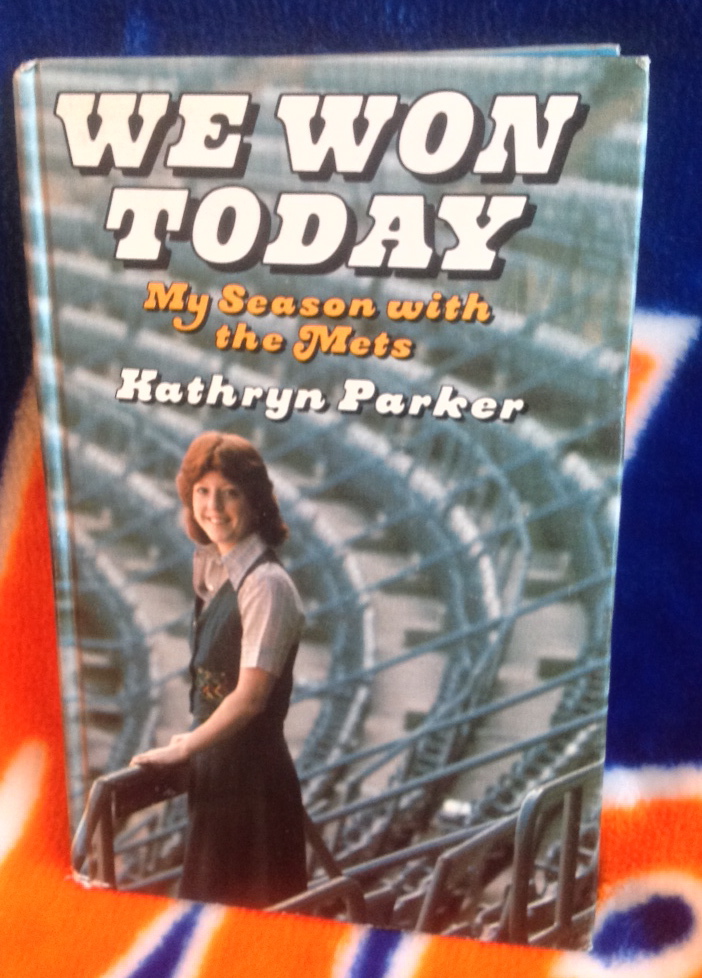
 Indeed, we did win today. We won today! That was a come-from-behind effort for SNY to run into the ground Mets Classic style, which is OK, since I won’t get sick of watching it for another five or six years. I still stop and watch Omir Santos get waved home on an accurate video replay ruling of his 2009 home run at Fenway. The inner moral goodness of the Mets doesn’t always come through in live action, but it’s darn near unassailable upon further review.
I’m giddy. What the hell? This is the kind of game that if it had been lost, 3-2, you were prepared to respect it because Dillon Gee pitched Jonny Cueto to a standstill; because Curtis Granderson hit a ball that would have been out of Citi Field; and because when Gee ultimately wore down, he was picked up by Scott Rice and Carlos Torres, two relievers with notoriously slippery metaphorical fingers earlier in the week.
But you wouldn’t have respected losing in the ninth after Lagares walked, Anthony Recker bunted a little too hard and Hoye suffered from day blindness when Joey Votto’s throw to Zack Cozart at second was not immediately judged too late. The throw was too late, except in the sense that it took place this year when something can be done about a bad call. In the past, Terry Collins could have dashed to middle of the infield, griped his face into a nasty shade of crimson and the Mets’ rally would have probably wafted into the Flushing gusts. Instead, the new video system was activated and it worked.
Will it always work? Does anything? It worked today and, as previously reported, we won today. Ruben Tejada walked instead of sacrificing and pinch-hitter Ike Davis came through instead of disappearing. What had shaped up as a respectable 3-2 effort in defeat morphed into a spectacular walkoff grand slam 6-3 victory, one in which everything and everybody is bathed in a golden, sunny Saturday afternoon halo as we bask in a .400 winning percentage and a two-game winning streak.
Lagares was disciplined. Tejada was patient. Gee was unburdened. The bullpen was redeemed. Granderson was on the board. And Ike — funny how he’s almost always Ike and only rarely Davis — was a lefty power bat off the bench for a new generation, a 21st century Rusty Staub, if you like (even if temporary Reds closer J.J. Hoover probably didn’t). Or maybe Ike was making his case to take back the first base gig Lucas Duda inherited by default and then wrapped his mitts around Friday night. For what it’s worth, Ike, the backup, starts Sunday. Is Ike being showcased for that trade that was supposed to be executed months ago? Is Terry balancing his two heretofore brutally disappointing lefthanded first basemen in perfect harmony? Has anybody seen Josh Satin’s eyebrows lately?
Ultimate solutions will have to wait. We won today. We won today on a pinch-hit, come-from-behind walkoff grand slam, which has happened how many times before in Mets history? I’m pretty sure never. Let’s see: Harkness, Hickman, Jorgensen, Teufel, McReynolds, Valdespin…nope, those were either tie scores when things got grand or the walkoff slam-masters were already in the game. Ergo, it’s a first. Ike Davis has done something no Met before him had ever done.
Twenty-four hours ago we would have been surprised if the above sentence consisted solely of “Ike Davis has done something.” Now he’s done something else. This game will confirm your deeply held suspicions most of the time but render your assumptions stupid if you give it a chance.
Give it a chance. It’s worth it.
by Greg Prince on 5 April 2014 7:30 am Utter pessimism is dead! Long live tempered pessimism!
Losing, Lewis Grizzard once wrote, hurts worse than winning feels good. We’ve known plenty from losing and hurting. We’re only now processing again how winning feels. I’m not certain. After the 0-3 start that weighed 0-30 in Met-ric emotional tonnage, the simple act of not losing feels pretty damn adequate.
We knew they’d win one eventually. It’s just that we’d forgotten how that worked. Never mind the three-game series they graciously presented the Washington Nationals as a welcome gift to the 2014 season. The Mets lost twice to Toronto in Montreal on TV last weekend and — though nobody remembers it anymore — the final three Spring Training games they played in Florida. There hadn’t been a major league score of any sort with the “Mets” portion expressed first since March 24.
But, on April 4, we could say this:
Mets a total of runs;
Opponent a lesser sum.
For those of you who like specifics, it was Mets 4 Reds 3. For those of you who really like specifics, here are the rest of the relevant scores from Friday night in Flushing:
• It was Lucas Duda 4, Ike Davis staking out a seat near the space heaters for the best view of two Mike Leake pitches soaring toward parts unknown.
• It was Jenrry Mejia 6 innings, 1 earned run, 8 strikeouts, 1 ball lined off his horsehide-magnet of a body, 0 apparent debilitating injuries for a change.
• It was Eric Young 1 Endy Chavez impression atop the left field wall, Brandon Phillips in the unwanted Scott Rolen role.
• It was Anthony Recker 2-6 in your scorebook, Billy Hamilton 1 disturbing flashback to Juan Centeno.
• And, most shockingly of all, it was Kyle Farnsworth and Jose Valverde for 2.1 scoreless innings that recalled the best of Roger McDowell and Jesse Orosco, or at least not the worst of practically everybody who’s pitched relief in a Mets uniform since Roger McDowell and Jesse Orosco.
As Daniel Murphy could tell you, victory has many fathers. The born-again Mets were more than happy to orphan futility and put the specter of 0-162 on permanent paternity leave. When your team is oh-and-anything, you have to keep reminding yourself that The Stork does eventually deliver a bouncing baby win to your doorstep (provided he doesn’t crash into Don Hahn en route), yet until the blessed event arrives, it’s seems impossible to imagine it will truly happen. But we imagine no more in 2014, for it is reality. The Mets are, in the strictest and most recent sense of the word, winners.
Let the Reds be the team to tip their caps. Compel Leake to call Duda his daddy. Make Hamilton write 500 times on the visiting clubhouse blackboard “I WILL NOT RUN ON MET BACKUP CATCHERS”. They lost. We won. If one can legitimately huff that it had been long enough after all of three games, it had been long enough.
Now the Mets are 1-3, or on pace to go 40-120, give or take a couple of rainouts. You’ll recognize that mark from 1962, when George Weiss was smart enough to not suggest the Original Mets were good enough to win 41 games or allow such an insane projection to leak (or Leake) to the press. After the Mets have put one whole win in the books, all I look forward to is a second win, accomplished perhaps as soon as this afternoon.
And after that? I refuse to squint that far into the future. What’s the point? I’ve seen Young make dazzling catches. I’ve seen Duda homer in pairs. I’ve seen Mejia briefly healthy and impressively effective. I’ve seen unsung catchers cut down speedy baserunners. I’ve even seen a few journeyman Met relievers before Farnsworth and Valverde get critical outs (even if I’d never seen Joey Votto helpfully foul out on a first pitch that wasn’t fully in the strike zone, thus short-circuiting the ninth-inning Red rally we all reasonably feared). And I’ve seen the Mets win one-run games in the past half-decade. In isolation, all of it was and is splendid.
In larger context, none of it has been the harbinger of more wins than losses in a given season or the kind of sustained progress that makes a simple three-game losing streak resonate as something less than apocalyptic. Thus, the morning after, I’m basking primarily in the sensation of not losing. After nothing but losing since March 24 — particularly since March 31 — it’s as close to synonymous with winning as I need to be.
by Greg Prince on 4 April 2014 12:54 am Back in the day, the Mets confined most of their April home games to afternoons. The thinking went something like this: it gets cold here at night. You might even say it gets bitter.
Thursday the Mets went back to the day, a scheduling decision we “20,561” on hand (an accurate figure if you count inner selves) couldn’t help but appreciate. The newly installed temperature readout on the scoreboard indicated we were blessed by as many as 63 degrees. Seventy-two hours after shivering my Schatzeder off, I spent several innings in shirtsleeves.
The warmth represented an outstanding antidote to what I was watching. The Mets were about as bad as they were the night before, but this presentation felt better, not bitter. You could get mad at them for losing 8-2 and starting the season 0-3…but it was sunny and 63, and the only reason you got to bask in those conditions for a few hours was the Mets were foresightful enough to plant a baseball game in the broadest of daylight.
So that part was good.
Said baseball game, however, peaked early and not very often. The friendly sun did a number on Denard Span in the first inning, serving to set up two Met runs. Zack Wheeler’s hard stuff as viewed from spectacular Delta Club seats procured by dear friend Sharon Chapman (and enhanced by her and John “Metstradamus” Coppinger’s presence) held its own against a Nationals lineup that, from a Citi Field demon perspective, seems to be constructed of nine Troy Tulowitzkis. But Zack never quite had command and Ryan Zimmerman refused to retire, which really put a crimp in the part of the day that wasn’t weather or eating or conversation. Wheeler threw 114 pitches in six innings.
The bullpen, of course, threw too many if it threw even one. Tough to pin the third act in this week’s Trilogy of Trounce squarely on our relief remainders, however, since the Mets effectively held their fire against emergency starter Tanner Roark. It was good to see Curtis Granderson’s hellacious swings convert a couple of strikes into doubles and welcome Daniel Murphy back from his unintentional inflammation of the Troglodytic set, but the club’s final eight inning-bottoms encompassed precisely four hits, three walks, no runs and zero fight.
Nothing clicked. Nothing’s clicked since Bobby Parnell didn’t get a borderline call on Monday. Nothing except for Juan Lagares is a positive revelation…Juan and the weather.
Maybe I should be as prickly about losing Thursday afternoon as I was Wednesday night. I wasn’t at the game Wednesday night but I could taste the bile through the TV. It’s hard to watch these walking-dead Mets stumble around in the dark and not generate bitterness toward them. But you get a sweet afternoon like Thursday, you don’t get that riled up over getting swept. Like the players you’re close enough to sense a vibe from (these were really good seats), you just accept it. You say, ehh, the Nationals are deeply talented, we have a bizarrely unbalanced roster, somebody goes on the DL practically every day, management never did get around to improving the bullpen, and you forget to be disgusted. One Nationals sweep blends into another. Last September becomes this April. The hapless home start of 2011 — when the incumbent brain trust was new so it was granted the first in its endless series of passes and mulligans — comes back around to be reincarnated in 2014. You are cognizant of all that won’t click but you don’t let it do an Anthony Rendon on your psyche, which is to say you don’t let it get the best of you.
Keep telling yourself it’s only three games even if you’ve been subject to hundreds and hundreds like these over the past five seasons. Keep telling yourself something special is under construction despite all the same old debris you see blowing around. Better yet, take off your jacket and feel the sun on your arms.
It’s the brightest thing going in Flushing these days.
|
|