The blog for Mets fans
who like to read
ABOUT US

Faith and Fear in Flushing made its debut on Feb. 16, 2005, the brainchild of two longtime friends and lifelong Met fans.
Greg Prince discovered the Mets when he was 6, during the magical summer of 1969. He is a Long Island-based writer, editor and communications consultant. Contact him here.
Jason Fry is a Brooklyn writer whose first memories include his mom leaping up and down cheering for Rusty Staub. Check out his other writing here.
Got something to say? Leave a comment, or email us at faithandfear@gmail.com. (Sorry, but we have no interest in ads, sponsored content or guest posts.)
Need our RSS feed? It's here.
Visit our Facebook page, or drop by the personal pages for Greg and Jason.
Or follow us on Twitter: Here's Greg, and here's Jason.
|
by Greg Prince on 20 October 2013 1:17 pm Hello, I have time-traveled to your October 2013 from the Octobers of 1946, 1967 and 2004, and I am curious to discover if your World Series will be materially different from the ones I have encountered on my journey. May I please see your matchup?
Hmmm…don’t you people ever change?
It only feels like I just woke up from historical, distant and recent memory to discover yet another World Series pitting the Red Sox versus the Cardinals. Rematches are fun every generation or two. You get them squeezed into the same decade and they get a little old if they don’t include your team.
We are also faced with the third World Series in six to encompass Shane Victorino, and it’s not like he drafted in on his teammates’ coattails for this one. Victorino, in case you looked away at the sight of this athlete, philanthropist and Met-buzzing gadfly, socked the decisive grand slam that ultimately gave Boston the pennant Saturday night. You can’t argue with the stepping up and getting it done, but you can withhold your applause if you so choose.
Beyond Victorino — whom I might cheer if his and my interests directly intersected but they don’t — the Red Sox seem like a fine bunch of fellows, their story of rocketing from worst to first is inspiring (even if it reflects really badly on Bobby Valentine’s 2012 influence) and if they want to grow beards that stretch from Fenway to Philadelphia, that’s their business. I spent one adolescent summer in a smoldering second-team romance with them, and though 1978 didn’t work out so hot on that Dented front, I’m now and then moved to maintain the slightest of embers for my old A.L. flame. Such lingering if mostly faded affection for some things Red Sock appeared permanently snuffed out by the New England attitudes of October 1986, but it turned out I was in a fairly forgiving mood afterward.
Nevertheless, the Red Sox have Shane Victorino, so that’s pretty sickening. The Cardinals, meanwhile, have Yadier Molina, so they sort of cancel each other out in my perceived enmity…except Molina’s a bigger part of the Cardinals’ overall success than Victorino is of the Red Sox’…but Carlos Beltran is on the Cardinals, and though I’m operating at narrative capacity verging on overload where so-called “Señor Octubre” is concerned, the thought of a team with Beltran trumping a team with Victorino is always appealing.
Unless the team with Beltran is the Cardinals, then the arrangement is laced lousy with loopholes.
It’s one of those whaddayagonnado? World Series, albeit at a lower level of default disgust than that which could be otherwise generated. A World Series featuring a stew of teams, players and fan bases you prefer to not see repeatedly rewarded could be far worse, as any Mets fan sentient in 2009 and 1999 could attest.
Though I’ll get over it in a matter of hours, I’m genuinely sorry the Tigers couldn’t break through (though a DET-STL World Series also wouldn’t be anything baseball doesn’t already know from in storybooks, film clips and “didn’t we just have one of those?” recollections). Since the dissolution of what was left of my once-beloved 2002 Angels, I’ve been without a favorite American League team. Detroit would be a nominal choice to fill that role, though I’ll admit I’ve never given them a ton of thought when they’re not right in front of me. Yet my familiarity with them from the past three postseasons and our recurring Interleague visits since 2010 combined to draw me to their cause on a temporary basis this time around. I found myself in the 2013 ALCS not rooting against the Red Sox at all but definitely pulling for the Tigers.
That didn’t work out, either, as they emitted undeniable signals in every one of their losses — even the dramatic ones — that they would eventually conjure a way to secure defeat. Perhaps if Miguel Cabrera, who wasn’t moving all that great when he was raking at Citi Field in August, didn’t appear in dire need of a wheelchair or at least a chaise lounge, his team would be playing Game Seven tonight or already preparing for Game One Wednesday night. But I’m pretty sure Bobby Ojeda would roll his eyes at that thought and remind Chris Carlin that at this time of year, everybody is hurting, so suck it up and strap ’em on.
Putting aside Cabrera’s wounded walking, the tantalizingly talented Tigers just lacked the crispness necessary to put away an opponent that was no less than their equal. If there was a rundown to be Throneberryed, a ground ball to be Jefferiescized, a double play to be Castilloed into or a tenuous lead to be utterly Heilmanated, the Tigers would do it. As solid and sound as they could be for most of a season or a game, and for as many perennial Cy Young and MVP candidates as they seem to feature, they came to remind me of long-ago backup infielder Don Buddin as he was portrayed by Brendan Boyd and Fred Harris in The Great American Baseball Card Flipping, Trading and Bubble Gum Book:
Don Buddin was a creative goat. He was the sort of guy who would perform admirably, even flawlessly, for seven or eight innings of a ballgame, or until such time as you really needed him. Then he would promptly fold like Dick Contino’s accordion. Choke. Explode. Disintegrate. Like a cheap watch or a ’54 Chevy. He would give up the ghost and depart. […] If there was a way to make the worst out of a situation, Don Buddin could be counted on to find it.
Don Buddin was a Red Sock most of his career, but finished up as a Tiger in 1962. Figures.
While Detroit inevitably Buddined, the cameras captured Jim Leyland calculating how much he was aging and how few chances he might have left to return to a World Series. When I see his face, my instant impulse is to think what a shame that Good Ol’ Jim has never won the big one; then I make a quick correction to my thinking and remember, no, the 1997 Marlins, that was Leyland. He won a ring and accepted accolades and got to enjoy the whole bit for a good five minutes before Wayne Huizenga systematically dismantled a world champion. Maybe that’s why it seems like he’s never gone all the way. There were those three consecutive autumns in the early ’90s when his Pirates couldn’t make it over the hump and now there’ve been these three in the early ’10s when his Tigers fell similarly heartbreakingly short. Jim Leyland wears the face of proud disappointment like no manager I’ve ever seen.
It’s hard to recall that he once interrupted his stoicism with a smile at the end of an October, but he really did. Granted Jim Leyland winning his only World Series as manager of the Florida Marlins was like Chuck Berry earning his only No. 1 single with “My Ding-a-Ling,” but when you hit the top of the chart after years of trying, they all look line drives in the next day’s box score.
Mike Matheny or John Farrell will soon tie Jim Leyland in the World Series rings accumulated while managing department. Shane Victorino could very well have twice as many parades thrown in his and his teammates’ honor as Tom Seaver, or Yadier Molina could wind up with three times as many as either of them. One among Nations identifying themselves as Red Sox or Redbird is guaranteed a third full-out celebration in the span of less than ten years. Truly, you can drive yourself to distraction if you peer at these things with excessive granularity.
by Greg Prince on 19 October 2013 2:32 am When I think of the Cardinals winning yet another pennant, I think of the episode of The Simpsons in which Grandpa Abe tells Bart the story of the Flying Hellfish from World War II, which leads to the two of them tracking down valuable stolen paintings that could make them very rich. Ultimately, however, they must be returned to the descendant of the original owner, a young German baron who accepts the U.S. State Department’s apologies with casual Eurotrash disdain, barking at an American official to be careful “mit der art things” as they’re placed in the trunk of his Mercedes. As Baron von Wortzenberger drives off to “Dancecentrum in Stuttgart to see Kraftwerk,” Grandpa considers the fortune he has lost and rationalizes, “I guess he deserves it more than I do.”
I’m not necessarily as gracious as Abe Simpson, and since I don’t believe any of the St. Louis Cardinals read Faith and Fear in Flushing, I’ll dispense with perfunctory congratulations in their direction. They don’t need my congratulations anyway. They seem to do very well without my support. The Cardinals started the National League Championship Series as inevitable and they ended it, inevitably, as National League champions. I’m sure capturing another flag was difficult, but they sure make it look simple.
Carlos Beltran enters his first World Series as a result of his team’s six-game victory over the Dodgers, and that’s nice, I suppose. I thought I was rooting for him above all Cardinals to make it, but the longer he wears a uniform that isn’t the Mets’, the less I see him as any cause personal to me. Great player whose time in New York I’ll always appreciate, but very much a Cardinal these days. That’s by no means an insult, even if it’s not a term of endearment. I was planning to add that at least we finally have a Met from October 2006 going to the Fall Classic, but that bit of business was actually taken care of by fan favorite Guillermo Mota when he was a 2010 Giant.
Just as true Mets fans will recognize October 18 as the date of the final wholly worthwhile game of the 1973 World Series, we are burdened to notice that in the hours since the Cardinals clinched their third pennant in eight seasons, it has turned to the seventh anniversary of October 19, 2006, a.k.a. the last time the Mets played a playoff game (they didn’t win). It was pointed out to me by my friend Garry Spector that of the 28 players who saw action in Notorious Game Seven, few are still active in the big leagues…though it turns out three of them — the currently champagne-soaked trio of Beltran, Adam Wainwright and Yadier Molina — will be active Wednesday night, too. The others include two Mariners (Oliver Perez and Endy Chavez), one Angel (Albert Pujols), one Blue Jay (Jose Reyes) and one Met (David Wright).
Time flies, hitting a person over the head in the process.
I framed this NLCS as a team I don’t like taking on a team I can’t stand. The Can’t Stands won, but I came to not completely dislike the Dodgers along the way. Maybe it was the exposure to Vin Scully or overexposure to the Right Way To Do Things. However I came across it, I probably found as much simpatico for L.A. as I have in a big-time situation since their predecessors were snatching the 1981 World Series from the jaws of intolerable. The 2013 postseason — akin to the wave of misreported teen suicides in Heathers — seems to have given Hanley Ramirez depth, Adrian Gonzalez a soul and Carl Crawford a brain. I don’t know if Don Mattingly is much of a manager but I actually felt kind of bad at how he can never, ever get to a World Series in any uniform. I’d mention the Dodgers’ debilitating injuries here, but the Cardinals soldier on like crazy through debilitating injuries (anybody seen Carpenter, Craig, Garcia or Motte lately?), so maybe I won’t. Plus Mattingly got within two games of a World Series, while Terry Collins is home getting eight hours of sleep every night and three square meals every day; consider my sympathy limited and contextual.
Next up for the Cardinals: Some team we’ve seen them play in a World Series in the last ten years and yet another team that will be in its third World Series in a decade. Familiarity breeds impatience here on the sidelines, but this time Beltran will be involved, so that’s different at least.
by Greg Prince on 18 October 2013 6:57 pm Forty years ago tonight, the National League champion Mets hosted Oakland, tied with the American League champion A’s at two games apiece in the 1973 World Series…and they were about to post one of the 500 most Amazin’ wins of their first 50 years.
From The Happiest Recap (First Base: 1962-1973)…
***
The Shea Stadium scoreboard was hailed as a modern marvel before anybody ever saw it. Billed as “the Stadiarama,” it promised to mesmerize every fan who could see it from the 96 percent of seats planted within the foul poles of the new ballpark. One of its highlights would be the large field given over to electrically transmitted messages, enabled by “approximately 28,000 lamps, arranged in clusters capable of forming letters and numerals […] [T]hrough one of the message display groupings, it is even possible to show ‘Sing Along’ messages when it’s time to break into song!”
That’s how Met management put it in the Shea preview pages of the team’s 1963 yearbook sold at the Polo Grounds. Ten years later, the reality of the Shea Stadium scoreboard wasn’t quite as breathtaking, and not just because the Mets never seemed to put enough runs on it. As Shea’s first decade wore on, the scoreboard made mistakes. Those letters and numerals didn’t necessarily flash as planned. Lamps that burned out weren’t immediately replaced. From the stands, it looked like a segment of the “approximately 80 miles of wiring” was prone to shorting out.
Yet for as gaffe-prone as the Shea scoreboard could be as it matured, there was no telling that it got a basic fact of the 1973 World Series wrong the Thursday night Game Five ended. The Mets had just won, 2-0, with Don Hahn and John Milner knocking in runs against Vida Blue, and Jerry Koosman and Tug McGraw combining on a three-hitter. The Mets were up 3-2 in the best-of-seven set. Given that information, the minds behind the scoreboard controls decided to post a most hopeful message as if it were fact.
“MIRACLE NO. 2,” the Stadiarama gleefully informed 54,817 frostbitten fans, awaited “3000 MILES AWAY”.
Wrong on two counts, it turned out.
***
You’ll find out the rest of the story, and why it wasn’t necessarily a sad one, when you read The Happiest Recap (First Base: 1962-1973).
Print edition available here.
Kindle version available here.
Personally inscribed copy available here.
No Mets fan should be without The Happiest Recap. It’s got the whole Amazin’ story of the Mets’ most unbelievable stretch drive ever…and everything that brought them there.
by Greg Prince on 18 October 2013 4:56 pm Multiple reports to the contrary, Mike Baxter isn’t going anywhere. He remains a New York Met in the hearts and minds of Mets fans everywhere. He’s simply moving off the 40-man roster and out of the organization while he continues to pursue his baseball-playing career. Surely, it’s a temporary arrangement.
All teams are compelled to straighten out the edges of their personnel charts this time of year. It’s what we used to call agate-type stuff, real small print in a box on the pages with the playoff line scores, the football point spreads and the nascent hockey standings. In October 2005, for instance, the Mets shed themselves of Brian Daubach, Eric Valent and Manny Aybar, all of whom had played for the team that year, none of whom figured to be missed. In the weeks following the 1996 season, the Mets bid official adieu to the likes of Kevin Roberson, Chris Jones and Bob MacDonald. It’s nature’s way — the thinning of the herd. It happens every fall.
In October 2013, the Mets lopped off their 40-man roster Sean Henn, who won a walk-on role in September through some kind of MLB contest, I believe. They removed Greg Burke, the submarining equivalent of a piece of celery (think of those Budweiser commercials that suggested how many Buds could be exchanged for good deeds; giving your pal the last Buffalo wing on the plate was worth one Budweiser, while saving him the piece of celery was worth nothing). They waived Robert Carson, possessor of youth, a live left arm and a ledger indicating 19.2 innings pitched and 9 gopher balls delivered. The Angels claimed him. Carson was a likable kid who produced more runs per at-bat than any Met; too bad he produced them from the mound. May the Angels smile on Robert Carson.
And within this blizzard of necessary clerical work, the Mets waived Mike Baxter. Maybe someone would take him. Maybe someone wouldn’t. Guys get through these waivers all the time and wind up back in Spring Training with the team that waived them in the first place. But Mike Baxter didn’t. The Los Angeles Dodgers, busy competing for the National League pennant, scooped him up. Though they can’t do anything with him until 2014, perhaps they thought the news would unnerve the St. Louis Cardinals, who experienced first-hand the best Mike Baxter had to offer. Or perhaps they’re just good at multitasking and envision having room for the proverbial veteran lefthanded bat off the bench next year.
Good teams have that kind of flexibility. When Mike Baxter was an infant in Whitestone, Rusty Staub filled exactly that role for a Mets club that won 98 games. The Mets for whom Mike Baxter rooted as he matriculated through Archbishop Molloy High School kept Matt Franco around mostly to pinch-hit. He contributed to two consecutive playoff berths. The Mets Mike Baxter grew up to join could brook no such luxury, not for a guy who would maybe get a big hit (but hadn’t lately), not for a guy who couldn’t do a whole lot else (though once he did something enormous).
The Mets had no room for .189-0-4 or .189/.303/.250, depending on how you like your stats expressed. There were no numbers that made Mike Baxter look good in 2013. And he’d already made his once-in-a-lifetime catch.
Too often as the Mets’ 2013 faded like Marty McFly’s siblings in that family picture he carried around in Back To The Future, the present-day Mike Baxter disappeared in our midst even as he became something akin to ubiquitous. Out of nowhere he was the starting right fielder in five of the Mets’ final six games. This was the time of the season when we are conditioned to want to see our perennial noncontender play The Kids, whoever a given year’s version of The Kids happen to be. Mike Baxter wasn’t one of them in 2013, not at age 28, not lingering below .200 in batting average and nowhere near .300 in slugging percentage. The man who once drew five walks in a single game wasn’t even getting on base incidentally in 2013, and it was impossible to not notice that after the May homestand during which he drove in two giddy walkoff runs, he hadn’t accumulated a single RBI…not one.
So you’d see Baxter in the lineup five times in the final six games and you weren’t heartened. You wanted to know why den Dekker wasn’t in right. Or why den Dekker wasn’t in center and Lagares wasn’t in right. Or where the next Darryl Strawberry was coming from and when was he gonna get here? We were sure we had seen enough of Mike Baxter to last a lifetime.
Which wasn’t quite accurate, because there’s a moment of Mike Baxter we could spool up daily from here to eternity and never get tired of looking at.
The Mike Baxter of the present couldn’t compete with the players — real or conceptual — who we conceived of as having a future. And it wasn’t fair to have that Mike Baxter obscure the Mike Baxter of the recent yet undeniably distancing-itself past. For the best interests off all concerned, today’s Mike Baxter had to become a former Met. The more we watched ordinary, limited-tool Mike Baxter struggle at the plate, the more we were forced to rue that the Mets were forced to rely on this Mike Baxter. This Mike Baxter should have never been allowed to interfere with the Mike Baxter we cherish.
Mike Baxter, age 12, probably thrilled to Dave Mlicki’s shutout at Yankee Stadium in the first Subway Series showdown. Mike Baxter, age 13, probably cringed when Dave Mlicki reverted to the Dave Mlicki whose pre-June 16, 1997, track record made June 16, 1997, so unexpected. Fourteen-year-old Mike Baxter likely screamed himself hoarse when Matt Franco came through in the bottom of the ninth off Mariano Rivera on July 10, 1999. How attached he remained to the same Matt Franco as Matt Franco grew less productive pinch-hitting is a matter of conjecture, but given that he was a Mets fan, he was probably less concerned about maintaining a shrine to one great day versus trying to win the game at hand.
Mike Baxter, Mets fan from Whitestone, would probably understand that the Mets fans from all over who never got to be Mets ultimately veer to the transactional in their thinking. We’d love to have a team deep enough to reserve a spot for a lefty-swinging specialist who could hone his craft down in the cage for seven or eight innings, be called on late and deliver the big hit again and again and, oh by the way, made June 1, 2012, possible. But we know we don’t have that kind of team and that if Mike Baxter stuck around and made the Mets in 2014, it would be more an indictment of the Mets’ lack of depth than an affirmation of Mike Baxter’s skills.
I can’t speak for Mike Baxter from when his association with the Mets was solely that of fan, but I never liked having to view Dave Mlicki or Matt Franco as just players — and not particularly good ones — once they gave me memories I’d be savoring for the rest of my days. I wasn’t all that sorry to see Dave Mlicki traded to the Dodgers in 1998 or Matt Franco granted free agency in 2001. But their departures hastened the chaff tumbling away from the wheat of their singular moments. They’re not the guys who were regularly getting rocked by the Astros and Brewers or popping up with runners on. They are now and forever the guys who beat the Yankees in dramatic fashion. That’s all they have to be.
Mike Baxter? He tracked a deep drive off the bat of Yadier Molina, he followed its tricky trajectory, he reached out, he grabbed it and he hurled himself into a wall at great risk to his physical well-being to hold onto it, all to preserve what soon became the First No-Hitter in the history of the team that was his long before he donned its uniform.
That’s our Mike Baxter. No further embellishment is necessary.
by Greg Prince on 17 October 2013 6:32 pm Forty years ago tonight, the National League champion Mets hosted Oakland, trailing the American League champion A’s two games to one in the 1973 World Series…and they were about to post one of the 500 most Amazin’ wins of their first 50 years.
From The Happiest Recap (First Base: 1962-1973)…
***
It was the first time the Mets trailed a postseason series after three games, putting them in unfamiliar must-win territory for Wednesday’s Game Four. It was still cold, but Mets fever was about to rise.
The evening belonged in particular to three men, only two of whom wore Met uniforms.
First and foremost, there was Rusty Staub, shrugging off his shoulder woes and stepping into the October spotlight he’d been waiting to enter since making it to the majors as a 19-year-old in 1963. In bare arms and black batting gloves — which is how Daniel Joseph Staub hit no matter the prevailing winds or fashion — Rusty came to the plate with Wayne Garrett and Felix Millan already on base ahead of him in the bottom of the first. Swinging and connecting, Staub ascended from the agony of the shoulder to the ecstasy of belting a three-run World Series homer that gave his team an immediate 3-0 lead.
His night would only get better in the fourth when he delivered a two-run single after Millan had driven in one. The Mets led, 6-1, having chased starter Ken Holtzman and reliever Blue Moon Odom from the mound and making Dick Williams dig deep into his heavily burdened bullpen (lefty Darold Knowles alone had seen action in each game thus far). Williams would use five pitchers before the night was over, and Rusty succeeded against every one of them, banging out four hits and taking one walk as he recorded five RBIs.
Jon Matlack, meanwhile, cruised across eight innings, scattering three hits and giving up only one error-provoked run in the fourth, a harmless echo of the fate that befell him in Game One. As in his first World Series start, Matlack surrendered no earned runs in Game Four. This time around, though, he had Rusty grilling Oakland pitching on his behalf, leading to a 6-1 victory that tied the Series at two games apiece.
Yet despite the brilliance of the two Met standouts, the Arctic night belonged at least in part to an Oakland A who, by merely walking to the plate, warmed the hearts of the 54,817 Shea denizens.
Mike Andrews experienced an awful Game Two on Sunday, with his extra-inning errors opening the floodgates for Oakland’s eventual loss. That was all Charlie Finley had to see to attempt to rig a roster transaction, coercing and dumping the veteran Andrews and replacing him with rookie Manny Trillo. In short, Andrews was railroaded and everybody — including his teammates, who taped his uniform number, 17, to their own jerseys in solidarity before Game Three — knew it. Commissioner Bowie Kuhn put an end to Finley’s farce and ordered Andrews reinstated.
Thus, when Williams chose Andrews to pinch-hit for Horacio Pina to start the visitors’ eighth, Mets fans temporarily put aside their natural allegiances and rose to give the embattled infielder a monstrous standing ovation. Even if it was an indirect way of thumbing their nose at Finley and all those establishment figures who routinely abused the public’s trust by piling deception upon prevarication (the nation was three nights from learning of President Nixon’s scheme to fire Watergate special prosecutor Archibald Cox in what became known as the Saturday Night Massacre — kind of a Mike Andrews affair writ large), the applause directed toward an “enemy” batter during a World Series quite possibly represented Shea’s classiest moment ever. Mets fans would routinely and respectfully clap for the likes of Koufax, Clemente, Aaron and pre-Met Mays in admiration of their acumen, but this was something bigger than just sports.
It was sportsmanship.
Andrews’s at-bat went the way Mets fans hoped: he grounded out to third. Happy their team was five runs ahead and that Finley’s victim had performed heroically just by persevering to wear his own No. 17, the crowd stood again and clapped again as Mike returned to the Oakland dugout.
Later, the reserve infielder admitted to a different brand of “chills” than everybody else in the bundled-up crowd was feeling that icy night in Queens. “I don’t think I’ve ever had a standing ovation in my life,” Andrews said. “To me, that meant everything.”
***
And the rest of the story? How it began? Where it went from here?
You’ll find out when you read The Happiest Recap (First Base: 1962-1973).
Print edition available here.
Kindle version available here.
Personally inscribed copy available here.
Pick up The Happiest Recap and get the whole Amazin’ story of the Mets’ most unbelievable stretch drive ever…and everything else.
by Greg Prince on 17 October 2013 3:04 pm I’m as happy as a Puig in slop that the Tigers and Dodgers won on Wednesday. It means the daily baseball express rolls on.
While the Mets and 18 other clubs scattered to golf courses far and wide as of September 29, the good teams kept on playing. The A.L. Wild Card tie between the Rays and Rangers was broken on September 30. The next day the government shut down. The day after that the Pirates shut down the Reds. The day after that the Rays did the same to the Indians. The day after that the playoffs began in earnest, and thanks to staggered scheduling and just enough competitiveness to ensure each matchup is brought either to the brink or to the brink of the brink, we’ve had a game every single day. We have the Tigers and Red Sox tonight and are guaranteed a continuation of the NLCS in St. Louis tomorrow night and some more ALCS the next night.
Plus the government started operating again today, so it’s practically win-win.
I shouldn’t use language too strong for what I’d do to have the Mets be part of this or some near-future October lest a clever prosecutor cross-examine me and ask me to confirm, under oath, “Isn’t it true you said you’d ‘kill’ to have the Mets make the playoffs?” But who among us wouldn’t figuratively go ape, even if it meant a judge ordering us to consume multiple bananas on the witness stand, if it were the Mets taking on the Dodgers or the Cardinals or any opponent handy? As much as I enjoy that somebody’s playing big-time baseball against somebody else (and neither somebody is the Yankees), goodness I miss being a part of it all. It’s really beginning to hit home how rarely we’ve stormed or wheedled our way in.
Twenty teams have been around since 1962 or earlier. The Mets have participated in seven of the 51 postseasons that have been conducted in what we’ll call the Metropolitan Era. You know how many of their cohort — not counting the clubs that came along later — have been in more?
Almost all of them, for crissake.
Tell ya what, let’s lop off 1962 to 1968 when it would have been unreasonable to expect the Mets, Astros, Senators or Angels to finish first among ten teams (despite the Halos’ surprising run at an A.L. title in ’62), and start with 1969, since that signaled the beginning of divisional play and provided definitive proof that an expansion team could eventually grow up to be a full-fledged champion of something. In the 44 fully executed seasons that concluded two-and-a-half weeks ago, excluding strike-shattered 1994, the Mets have still made the playoffs only seven times.
Making the playoffs fewer times among their 19 established brethren:
The White Sox (5)
The Cubs (6)
The Rangers formerly known as Senators (6)
And that’s it. Then it’s the Mets and Tigers, with 7 apiece, and it moves up the frequency ladder to the long-dormant Indians (8 times, all since 1995), the expansioneer Angels and Astros (9 each) and a few franchises that have experienced oases of dominance amid endless dry spells (Pirates, Giants, Orioles and Twins, 10 apiece). From there you get all those teams that the unaligned fan probably finds himself instinctively rooting against sooner or later because nothing exceeds like success:
The Reds (11)
The Phillies (12)
The Dodgers (13)
The Red Sox and Cardinals (14)
The A’s (17)
The Braves (19)
You don’t want to be explicitly reminded (22)
For the record, of the teams that came into existence from 1969 forward, it goes, from top to bottom, Royals (7), Blue Jays, Diamondbacks and Padres (5), Brewers, Rays and Mariners (4), Rockies (3), Exponentials/Natspos and Marlins (twice apiece). The Mets at least haven’t been outflanked by their juniors — and maintain a little something to hold over the head of the Windy City should that become a priority. (It might prove useful should an argument over pizza styles require a digression.)
All of this is to say I’m used to seeking succor in October baseball that isn’t synonymous with Mets baseball. It’s not just better than nothing. It’s better than most things. It’s October 17 and the summer game will be televised nightly through October 20, perhaps October 21 and then, following a short break, hit the airwaves again October 23. I’m well-versed in immersing myself in seemingly random matchups of Dodgers and Cardinals, Red Sox and Tigers, Whoever and Whoever. I can take a side, I can choose a foe, I can change my mind or I can just sit back and admire.
But I sure wish I’d had the opportunity to have been overwhelmed by the presence of the Mets in October more than seven times in my 44 postseasons to date; more than three times in the past 24 postseasons; more than once in the past 13 postseasons; and more than not at all in the past 7 postseasons.
I wish I had a problem on my hands like Yasiel Puig. I’d love to have a guy that talented on my team breaking unwritten rules left and right in games that are tallied toward championship consideration. Or, I suppose, I’d love for my team to be carping at a guy that talented from the other dugout right about now provided they were getting him out as often as the Cardinals have.
I’ve listened to and read a lot of opinions on how Puig plays the game during this NLCS. What I’ve noticed is that he is literally playing the game while most others in his sport are pursuing wildlife and/or fish in presumably sportsmanlike fashion. If “excitable” or “emotional” or whatever code words are applied to Puig’s non-grimness is how the kid rolls, and his manager doesn’t find himself trying to demote him while being called a sucker of some kind, then he doesn’t bother me.
Besides, my unwritten rule — though I’m apparently writing it here — is if a Met does something at odds with convention, it’s probably OK, whereas if it’s being done against the Mets, it’s a horrible affront to all that is sacred and thus requires retribution or a tantrum of some kind.
The Mets, as mentioned, aren’t playing. Do what ya want, Yasiel.
I also wish I had a problem on my hands like inconvenient starting times for my Mets playoff games. For years the gripe of choice has been playing too many games too late. It will probably be regriped during the World Series. There was also, going back nearly twenty years, what I considered a very legitimate concern regarding concurrent scheduling. In the mid-’90s, baseball’s best minds concocted a plan in which all four division series would run simultaneously but no more than one would be beamed into a given market — likewise the first five games of both league championship series. That strategy was known as The Baseball Network, a splendid 1995 answer to the afterstrike question, “How do we keep as many of our fans in the dark as possible?” Fortunately, TBN lasted only that one postseason.
About a decade later, it was decided the bulk of the LCSes should be played at the exact same time, with one featured on Fox and one shifted to a (then totally obscure) cable outlet known as FX depending on where you lived. If you were in New York, which was understandably caught up in the 2004 ALCS and its excellent outcome, chances are you saw next to none of the equally legendary Cardinals-Astros showdown that made Carlos Beltran a bankable commodity. Baseball got over that foot-shooting thinking, too.
We have ten teams instead of eight in the playoffs for the same reason we have eight instead of four and four instead of two: more television programming, more television money. Fine with me. I’m already paying too much for cable, so it might as well include lots of baseball. Naturally you have to occasionally squeeze in a game here or there away from prime time, which is also fine. It’s baseball. October. Daylight. Sun. Shadows. All that. The tradeoff is it’s not perfectly timed to everybody’s comings and goings in this world. But that’s always been the tradeoff. Go curl up with some Ken Burns if you weren’t sure.
I assumed we knew that. Yet because Los Angeles is in the tournament, their 4:07 PM Eastern start Wednesday was, locally, a 1:07 PM Pacific start. I can see where that would be inconvenient, particularly for the Dodger fan who cannot escape his job or his class or other daytime commitment. I can see where, as suggested, it’s not optimal for the baseball viewer on either coast or in between for the same reason.
To which I say, oh, please, give me an inconvenient start time of 1:07 PM local for my Mets playoff game. Or 11:07 PM as was the case in 1999, live from Phoenix. Or five in the morning should the Mets ever draw the Hanshin Tigers in a real World Series. When your team has made the playoffs sporadically at best in your half-century of living, you don’t complain too loudly about when you have to show up or tune in. You go with it. You don’t wish to give the networks and other powers that be (though I guess the networks are the ultimate powers that be in baseball) too much rope with which to tie up your productivity and responsibilities, but if your team is in the playoffs, you’re pretty much a willing hostage to the process. Otherwise why would you sweat out 162 games to get to this cherished apogee of life?
TV isn’t having any more weekday afternoon games this year anyway. We get one more Game Five, a pair of Game Sixes and, if we’re good, a couple of Game Sevens. And then another four to seven between this weekend’s winners. Then, when those are over, we’ll all be in the same baseball-less boat.
Could be worse. We could all be from Chicago.
by Greg Prince on 14 October 2013 3:44 pm Forty years ago today, the National League champion Mets were visiting Oakland, trailing the American League champion A’s one game to none in the 1973 World Series…and they were about to post one of the 500 most Amazin’ wins of their first 50 years.
From The Happiest Recap (First Base: 1962-1973)…
***
The most encouraging sign for Yogi Berra was his ability to write STAUB onto his lineup card once again. He wasn’t completely healed by any means, but one shoulder of Rusty Staub, the manager decided, was better than any of his other options. Besides, this was the World Series. Rusty had been excelling in near obscurity as a Colt .45, an Astro and an Expo before coming to the Mets in 1972. He had never been anywhere near a Fall Classic before. Who knew if he’d ever have the opportunity again?
It was also comforting for Yogi to finish off his lineup with KOOSMAN, who gave him such a fine effort in Game Three of the NLCS and was the pitcher who turned around the Mets’ last World Series in its second game. Tom Seaver might have been an even more comforting presence, but because of the five-game LCS that ended Wednesday, Yogi’s ace (like Dick Williams’s main man Catfish Hunter, who’d also had to pitch a do-or-die clincher) wasn’t yet ready to go. Jerry Koosman was no last-ditch alternative, though. He’d made four postseason starts for the Mets in his career, and the Mets won every one of them.
Between Staub and Koosman, you might say the sun was going to shine on the Mets in Game Two. Or you could just look up at the unyielding Oakland sky and reach that conclusion for yourself. Before the day was out, the sun would be impossible to ignore.
Cleon Jones was the afternoon’s first atmospheric victim, in the bottom of the first when he lost Joe Rudi’s deep fly ball in nature’s light and it fell in for a double. “It was the worst, the absolute worst” Cleon attested of the view from left field. “I’ve never played in a major league ballpark where the sun was that bad.” Sol was a real SOB and Sal — Bando — was no nicer to Koosman than the sun had been to Cleon. He tripled home Rudi and scored three batters later on Jesus Alou’s double. Jones made amends with a leadoff home run in the second off Vida Blue, but though it was 2-1, this was going to be no facsimile to the 2-1 game of the day before.
Kooz had more trouble in the third: another triple (Bert Campaneris’s) led to another RBI (Rudi’s). Down 3-1, the Mets’ attack was reignited by Wayne Garrett’s solo blast in the third, making it 3-2. But Jerry couldn’t handle a little prosperity. With one out in the home third, he walked Gene Tenace, gave up a single to Alou and made a bad throw to first that let Ray Fosse reach. Now the bases were loaded, so now Berra acted. He removed Koosman and brought in Ray Sadecki. The veteran swingman caught a break when Williams put on the squeeze, but Green couldn’t deliver, making Tenace dead meat at the plate. Dick Green then struck out to keep the A’s off the board.
Blue’s grip on the Mets loosened in the top of the sixth when he walked Jones, who sped to third on Milner’s single. Vida’s day ended in favor of Horacio Pina, but it wasn’t Horacio’s day, either. After hitting Jerry Grote to load the bases, Don Hahn and Bud Harrelson delivered run-scoring singles to give the Mets the lead. Williams replaced Pina with Darold Knowles, who thought he had a force at home when Jim Beauchamp pinch-hit a grounder back to the mound. A bad throw let Grote and Hahn score, and the Mets had a 6-3 cushion to offer Tug McGraw when he came in to pitch the sixth.
Tug pitched the sixth without incident. He pitched the seventh, surrendering an RBI double to Reggie Jackson, which shoulder-strapped Staub could barely fling toward the infield. He pitched the eighth, and took care of the A’s in order. After the Mets threatened in the top of the ninth — Staub singled and Yogi pinch-ran Willie Mays — but didn’t score, Berra left Tug in to pitch the ninth as well.
Was it an inning too far for the fireman for whom the manager had been pulling alarms regularly for weeks on end? It didn’t appear to be, as McGraw coaxed a fly ball to center field from pinch-hitter Deron Johnson, and Tug had the benefit of possibly the greatest center fielder of all time standing out there. Mays stayed in the game after pinch-running, and in his prime, he was a sure thing to catch a ball like Johnson’s. Except Willie wasn’t in his prime — Sol was. The sun did the A’s dirty work again, blinding Willie, who admitted, “I didn’t see Johnson’s ball…I’m not alibiing. I just didn’t see it.”
The Say Hey Kid fell down in centerfield as the ball fell in front of him. In an instant, his stumble became the default example for generations of lazy writers and broadcasters who were eager to usher great athletes out of their sport once they “hung on too long”. After all, they tut-tutted, they shouldn’t want to wind up like Willie Mays.
In the there and then, Mays’s misadventure was less cautionary tale than a genuine trigger for Met crisis. The standard fly ball turned into a sun-splashed double, setting up an inning that crested with RBI singles from Jackson and Tenace. The A’s had tied the Mets at six.
The A’s tried to give the game right back to the Mets in the tenth. An error — Oakland’s third of the day — let the Mets push the go-ahead run to third with one out. From there, Harrelson sprinted ninety feet when Millan flied to Rudi in left. He evaded the tag of Ray Fosse by running to the catcher’s right. He crossed the plate with the run to make it Mets 7 A’s 6.
But Augie Donatelli didn’t see it that way. Donatelli, in one of the worst blunders made by a home plate umpire in World Series history, decided Fosse tagged Buddy. The replays showed otherwise. On-deck hitter Mays pleaded otherwise. Berra argued otherwise. Harrelson absolutely insisted otherwise: “I felt I was safe and I didn’t know I had been called out until I got near our dugout.”
Donatelli was unmoved. The Mets were done in the tenth. The game stayed tied, 6-6. McGraw stayed in to pitch the bottom of the inning, his fifth, which he did flawlessly, and the eleventh, too (after the Mets left two on). Tug had now gone six in relief and the game’s score remained stalemated.
It had already been a pretty darn intriguing affair, but it’s fair to say the twelfth inning is where things got really interesting. There was Buddy, doubling to start things off promisingly. There was Tug — still — left into bunt. He moved Harrelson to third and got on himself when his bunt blooped over the head of the charging Bando. With two outs, up stepped the old man who’d looked so overmatched by the elements in the field. Yes, Willie Mays was batting against Fingers, still dealing with the sun, albeit from a different angle.
But he dealt with it fine, bounding a one-hopper up the middle to score Harrelson. With the very last hit of his Hall of Fame career, Mays put his team up, 7-6, in the twelfth inning of a World Series game.
Willie and Tug each eventually scored when the A’s defense continued its daylong deterioration. The culprit in the eleventh, on two consecutive plays, was Mike Andrews, a bit player who committed a pair of errors (one on a grounder, one on a throw) that resulted in three Met runs. It also made him a target for Finley’s ire. The owner tried to disown the backup second baseman immediately, attempting to stash him on the DL despite his being perfectly healthy. In the coming days, in a nation where cynicism had ramped up in the wake of Watergate, Finley’s ploy would be seen through and Andrews wouldn’t be disappeared so easily. But at the moment, the only truth that counted was Mets 10 A’s 6, heading to the twelfth.
Tug McGraw continued to pitch. Perhaps Berra forgot he had at least a couple of other options. To begin his seventh inning of work, the southpaw got Jackson to hit a deep fly ball to center field. Willie ran to the wall to track it down. He didn’t. Jackson landed on third with a triple. After walking Tenace, Tug was done. George Stone got the call, which appeared a wrong number. Alou tagged him for a single to cut the Mets’ lead to three runs. After a forceout and a walk, the bottom line was the bases were loaded, McGraw was finished and Stone had to end a contest headed toward establishing a new record for longest — and nuttiest — World Series game.
Stone turned rock solid, popping up pinch-hitter Vic Davalillo and grounding out Campaneris. The game that wouldn’t end was over after four hours and thirteen minutes, and it belonged to the Mets, 10-7. The process was as exhausting as the result was exhilarating. It left the World Series tied at one before it could be packed up and flown to New York.
***
And the rest of the story? How it began? Where it went from here?
You’ll find out when you read The Happiest Recap (First Base: 1962-1973).
Print edition available here.
Kindle version available here.
Personally inscribed copy available here.
Pick up The Happiest Recap and get the whole Amazin’ story of the Mets’ most unbelievable stretch drive ever…and everything else.
by Greg Prince on 14 October 2013 1:41 pm I wasn’t watching the Tigers and Red Sox too closely Sunday night at first, but I did guess that Max Scherzer wasn’t going to throw a no-hitter despite carrying one into the sixth. Given the oodles of precedent at our disposal (Don Larsen, Roy Halladay and nobody else), not a tough guess to tender.
I figured, once the Tigers were up 5-0, that they were in pretty good shape to go up 2-0 in the series, but then I saw a comment on Twitter that suggested that with Scherzer striking out Sox at such a rapid pace, Detroit might as well be up 500-0. I suddenly had a weirdly foreboding feeling on behalf of the Tigers (for whom I’m nominally rooting since they’re the team without Shane Victorino). It’s been my experience that when a team seems completely in command of a given game but the scoreboard indicates they are not wholly out of reach of their opponent, the game isn’t over. Call it a wild guess.
I took in the sight of Scherzer accepting handshakes from his teammates when the seventh was over, his night apparently done with a 5-1 lead. He must’ve thrown more pitches than usual, I thought (I wasn’t paying a ton of attention by then), and Jim Leyland must be saving him for later in the ALCS. Winning this one first seemed paramount, but Leyland’s a universally acclaimed manager and he knows his pitchers better than I do. Maybe this wouldn’t matter; you never can tell if it will or if it won’t. I’d say I guessed wrong.
Not in front of the TV while the bottom of the eighth came together, I was surprised when I returned to realize the Red Sox had a genuine threat going. The bases were loaded and David Ortiz was coming up. I didn’t know which pitchers the Tigers’ bullpen carousel had dropped off on the Fenway mound or comprehended whether those were good or bad moves, but I was aware enough to think, hey, he could tie it up on one swing, as the cliché goes, but how likely is that? I should’ve guessed that it was very likely.
Now that it was 5-5 on Big Papi’s grand slam, I kind of figured this might go deep into the night if only because every playoff game at Fenway Park goes deep into the night. Nope, the iron-gloved Tigers couldn’t have been more helpful in helping the Red Sox score the winning run in the bottom of the ninth. If I was conspiratorially minded, I would have guessed Detroit was on the take at Fox’s behest to make these playoffs more entertaining to a broader audience. That, by the way, wouldn’t be a serious guess…I don’t think.
Given how dramatically the Red Sox roared from behind, nobody wasn’t willing to call this game an all-time classic and declare it would be remembered forever. I’ll go with the classic part but I’m going to guess it gets forgotten more quickly than you’d guess. There are so many rounds and so many games and so many teams that the second game of a League Championship Series — no matter that it includes a phenomenal pitching performance trumped by a breathtaking comeback — is bound to get a little lost over time. Red Sox fans won’t forget it. Tigers fans won’t forget it. The rest of us are on our own. Just consider the note that emerged once Ortiz’s blast cleared the fence and eluded Torii Hunter’s tumbling reach. His grand slam was the third in the history of postseason play to tie a game, joining Ron Cey’s from the 1977 NLCS and Vladimir Guerrero’s from the 2004 ALDS. I ask you: when was the last time you heard anybody invoke those as classic and unforgettable? I don’t approve of popular amnesia, it just happens.
First guess. Second guess. Lucky guess. Baseball’s the ultimate guessing game. That’s what makes it so much fun to play along with at home.
by Greg Prince on 13 October 2013 3:06 pm Two games, two runs, two 1-0 results. Pitching! Defense (of which pitching is a key component)! No hitting! Almost literally, in one case!
Michael Wacha and bullpen outlasted Clayton Kershaw and bullpen in the afternoon, while Anibal Sanchez and bullpen totally edged Jon Lester and bullpen at night. It wasn’t exactly Marichal and Spahn going mano-a-mano for 16 innings (and all of 14 minutes longer than the Tigers and Red Sox), but it was certainly taut. The Tigers took a no-hitter into the ninth inning in Boston and settled for a five-man one-hitter. Three Dodgers gave up only two hits…but also the solitary run in their loss at St. Louis.
So much pitching. So little scoring. An absolute paucity of what baseball folk like to call crooked numbers. But if you require wayward numerals and the spirit that informs them, I suggest you and your electronic device get together with Matthew Callan.
Matthew lets it all hang out at his Scratchbomb blog, dissects games as they were first beamed on the Replacement Players podcast and occasionally chimes in on an array of Metsian matters at Amazin’ Avenue. He has cast an archivist’s light on 1988, injected welcome dollops of delicious texture into retelling 1999 and generally looks out for the Mets fan’s psyche’s best interest. And, because his imagination adheres to few boundaries, he’s written and released a positively Callanian novel, Hang A Crooked Number.
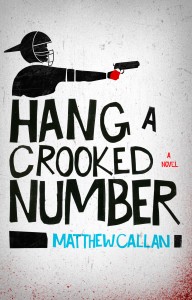 It’s got baseball. It’s got espionage. It’s got a good deal more layered within. It’s got enough Mets references to keep somebody like me who tends to be fiction-averse from growing too terribly antsy. It’s got, as it must when you consider the genres it’s blending, the Moe Berg Society, a could-be consortium named for the legendary catcher who was a spy and whose last words were actually reported to be, “How did the Mets do today?” It’s got baseball. It’s got espionage. It’s got a good deal more layered within. It’s got enough Mets references to keep somebody like me who tends to be fiction-averse from growing too terribly antsy. It’s got, as it must when you consider the genres it’s blending, the Moe Berg Society, a could-be consortium named for the legendary catcher who was a spy and whose last words were actually reported to be, “How did the Mets do today?”
Berg died on May 29, 1972. The Mets won that Memorial Day matinee, 7-6, on the strength of a Ken Boswell three-run homer that tied the Cardinals and a passed ball that topped them in the visitors’ ninth at Busch Stadium. Jerry Koosman — for whom a character in Matthew’s novel is named (but not necessarily just like in Growing Pains) — then came on to pitch relief and was awarded the win rather than the save since the nominal pitcher of record, Tug McGraw, had allowed three Redbirds runs in the bottom of the eighth on consecutive triples; this, apparently, was when they used to permit the hanging of crooked numbers in St. Louis. One of those three-baggers was surrendered to a pinch-hitting catcher, Jerry McNertney, who I don’t think was a spy but I’m pretty sure infiltrated every other pack of cards I bought in 1971 by going undercover as a coin.
Moe Berg was 70 when he reached his end, having been injured in a fall a little prior to that fateful Monday, so, no, the Mets managing to come back in such stunning fashion isn’t what killed him.
You can learn more about Hang A Crooked Number here, which will you enable you, if you so choose, to download it to whichever contraption you choose to read e-books. Matthew is also accommodating those who eschew tablets, Kindles and whatnot with ePub and PDF versions. Don’t let technological issues or a lack of hitting with runners in scoring position separate you from Matthew Callan’s talent.
***
A few other links I’ve been meaning to share between innings big and small:
Patrick Flood went pro a few years ago with his immense writing abilities. He remembers what it was like to blog the Mets with a credential dangling from his belt loop at narrative.ly.
Another familiar name from the Metsosphere, Howard Megdal, goes deep at the same site, reflecting on his commitment to raise his daughter(s) the (W)right way.
Something as simple as delivering the mail around Citi Field turns out to be fascinating when its story is told by the Times’s Tim Rohan.
I had no idea what it meant to Tim Byrdak to extend his “long and meritorious service” as a Met in 2013, but ESPN’s Chris Jones explains it thoroughly.
And if you didn’t hear how the WFAN Mets era ended on Closing Day, give it the good listen its passing deserves.
by Greg Prince on 12 October 2013 1:48 pm That new hit cable show Masters of Postseason was on last night, starring the venerable Carlos Beltran and narrated — if you didn’t mind mixing and matching your media — by the dynamic Vin Scully. Or is Scully venerable and Beltran dynamic? Actually, I’m pretty sure both are each.
You didn’t need to listen to KLAC via the MLB At Bat app to get what our former franchise player was up to in Friday’s marathon Cardinal win over the Dodgers at Busch Stadium. All you had to do was stare in awe at TBS and you could easily observe Carlos Beltran being directly responsible for all three runs his team gathered on offense and actively defending against a critical run via vintage defense.
He doubled in a pair of runs off Zack Greinke (8 IP, 10 K) in the third to even the score at two.
He nailed Mark Ellis at home on a 9-2 twin killing in the tenth (never mind that Yadier Molina didn’t exactly make a tag…and that sending Ellis may not have been the swiftest move imaginable).
And in the bottom of the thirteenth, he drove in Daniel Descalso from second to give St. Louis a 3-2 victory and the definitive early edge in what one wag is calling the Smug vs. Smog NLCS.
Beltran came up for that last swing with a runner in scoring position, and the runner scored. Typical Beltran, give or take…well, you know. His lifetime postseason batting average with runners in scoring position is .429 and he owns a bunch of other numbers that are comparably impressive. He’s helped push three different franchises to the seventh game of a league championship series. Maybe this year he nudges this one a little further.
That would be sort of a shame, even if you don’t find inevitability wholly unlovable, because if the Cardinals go to the World Series, then the Dodgers don’t. And if the Dodgers don’t, neither does Vin Scully.
I took the advice of several savvy people and did for last night’s Game One what I did for a bit of the 2006 NLDS’s Game Three. I turned the sound down on national television and turned the sound up on whatever device would welcome me to Scully letting me know it was time for Dodger baseball. I don’t necessarily seek Dodger baseball most late nights from L.A. but Dem Erstwhile Bums is half of all we got left in the N.L. If it’s going to come down to Smug vs. Smog, give me the voice that’s been coming in crystal clear and free of pretension since about ten minutes after Abner Doubleday didn’t invent the Grand Old Game.
Don’t take this as a rooting interest, per se, but if the Dodgers wind up playing the Red Sox in the World Series, Game One will feature an announcer who’s been describing baseball forever describing baseball in a ballpark that’s been hosting baseball since 15 years before that announcer was born. Not many active entities have remained precisely in place since I became enamored of this sport in 1969. Yet in my baseball lifetime, Vin Scully has always announced Dodger games and Fenway Park has always been the home of the Red Sox. Each has withstood progress’s army of steamrollers to not so much “remind us of all that once was good,” per Field Of Dreams, but to continue to represent the pinnacle of the American experience — National Pastime division.
Scully began his broadcasting career reporting college football from frigid Fenway in 1949. He broke into the big leagues as Red Barber’s and Connie Desmond’s junior partner at Ebbets Field in 1950. He shifted west to keep doing what he was conceived to do in 1958. He was recognized with the Ford C. Frick Award in 1982, the sixth announcer to be so honored by the Hall of Fame. The NBC gig that eventually crossed his path with that of a little roller up along first didn’t materialize until 1983. Before that, Vin Scully did the Dodgers, took on myriad postseason radio assignments, called the NFL on CBS and spoke into who knows how many microphones for who knows how many different events, yet it wasn’t until he was 65 that he went truly national as baseball’s undisputed lead voice. He was the sound of NBC for seven seasons, encompassing Bill Buckner’s error, Kirk Gibson’s homer and much more.
NBC lost baseball to CBS in 1990. Vin Scully kept going. He was at his job, on the air from St. Louis last night, in 2013. I listened as I have a few dozen times since I’ve had the technology available to me. The TBS announcers, the Cardinal announcers, the ESPN Radio announcers, even the other Dodger announcers for the innings Vin takes a break…none of them makes a postseason game as special as Scully does.
And you know why he makes it special? Because he treats every game as special. In a sense, this could have been a Dodgers at Cardinals game in the middle of the “regular year,” as he terms it (except he wouldn’t have made the road trip east of the Rockies at this stage of his life). If I were a Dodgers fan, I’d be close to expert on every Dodger opponent because for all his implicit advocacy on behalf of the team he’s personified for 64 seasons, Scully is best when the opponent is at bat. Vin told a story about David Freese in Game One. It wasn’t a big deal, just some background on how he had to share an apartment with a college buddy when he was a rookie, but damned if I wasn’t caught up in David Freese’s prior living arrangements. He gave me the same kind of skinny on Molina, on Beltran, on every Cardinal.
There’s something so respectful about that. I’ve been hearing him do that since the first time I heard him in his native habitat, on 790 KABC in 1996 when I was visiting L.A. I don’t remember what he was telling me about Astro third baseman Sean Berry, but I remember being struck that he took the time to inform me and that he wove it so seamlessly amid the balls and strikes. It was and is a small thing, but what are a baseball game and a baseball season and a baseball postseason are nothing if not a billion small things arranged in a dazzling mosaic?
As last night plowed into extra innings and past 1 AM Eastern, Vin Scully didn’t miss a beat. The giveaway towels made it “look like a snowstorm in the grandstands”. The clothing of choice in those seats? “When you come to St. Louis, it’s like an internal hemorrhage in the ballpark, nothing but a sea of red.” Conference on the mound? “Ellis covering his mouth with his glove and Wilson covering his mouth with his beard.” Yasiel Puig not coming through with a big hit? “He looks so frustrated — on one of these swings he’ll break the laces in his shoes.” Not a second of annoyance that this game wouldn’t end in his team’s favor.
“It’s a four-hour game,” Scully, 85, remarked with innings to go before he slept, “and well worth every minute of it.”
All of those pithy descriptions were transcribed courtesy of @VinScullyTweet, a “tribute” account dedicated to a man you can have fun affectionately imitating but even Twitter knows enough to not mock. When Beltran came up with the winning run on second, it felt as if not just Carlos had set the stage for his unfolding moment, but Vin had, too. During every at-bat Beltran had all night, Scully smoothly and hypelessly discussed the hitter’s great knack for producing in October. With him facing Kenley Jansen, it felt as if a narrative Scully started writing a dozen innings and close to five hours before was poised to reveal its final chapter.
Never mind that I had the television on and it was two to three pitches ahead of the app. I saw Carlos Beltran’s walkoff hit with my own eyes but I couldn’t swear it happened it until I heard it through Vin Scully’s mic. It was well worth every second.
|
|