The blog for Mets fans
who like to read
ABOUT US

Faith and Fear in Flushing made its debut on Feb. 16, 2005, the brainchild of two longtime friends and lifelong Met fans.
Greg Prince discovered the Mets when he was 6, during the magical summer of 1969. He is a Long Island-based writer, editor and communications consultant. Contact him here.
Jason Fry is a Brooklyn writer whose first memories include his mom leaping up and down cheering for Rusty Staub. Check out his other writing here.
Got something to say? Leave a comment, or email us at faithandfear@gmail.com. (Sorry, but we have no interest in ads, sponsored content or guest posts.)
Need our RSS feed? It's here.
Visit our Facebook page, or drop by the personal pages for Greg and Jason.
Or follow us on Twitter: Here's Greg, and here's Jason.
|
by Greg Prince on 31 January 2014 8:01 pm While the Wilpons unscrunch the large wad of cash they’ve allegedly found underneath their couch cushions, I await anxiously the start of the biggest sporting event to ever touch down in our humble Metropolitan Area. I refer of course to Queens hosting the World Series, time of first pitch as yet undetermined.
In the meantime, there’s Super Bowl XLVIII on Sunday, and that figures to make for a decent distraction as we wait and wait and wait for Opening Day LIII to kick off some eight weeks later.
Though the Mets and the Super Bowl debuted less than V years apart, I rarely think of them as being close enough in age to coexist as sporting siblings. The Original Mets were Mad Men season two; the inaugural Super Bowl was Mad Men season five. Stylistically, the gap stretches like the difference between radio spots for Secor Laxatives and a sleek print treatment for the Jaguar XKE.
The Mets were built on the dormant goodwill that remained from 1950s National League baseball in New York. Playing at the old Polo Grounds; guided by old Casey Stengel (the subject of a 2014 bobblehead, Faith and Fear in Flushing has delightedly learned); preserved primarily in old black & white archival footage; and stocked with players whose experience made their presence in the “Senior” Circuit most appropriate, the Mets were an enterprise that echoed yesterday before they could fully anticipate tomorrow.
You don’t have to have followed the evolution of Harry Crane’s haircuts to know the society of January 15, 1967, was cultural light years removed from that of April 11, 1962, which is probably why Cardinals 11 Mets 4 and Packers 35 Chiefs 10 don’t resonate as chronologically related. Yet it was only 57 months after the dawn of the Mets that the Super Bowl came rushing onto the greater athletic scene, never, ever to step out of bounds.
That first AFL-NFL World Championship Game was an event just dripping in what figured to come next, right down to the two jetpack-wearing performers who were launched skyward to signify just how much future was packed into this contest.
The super spectacle’s wow-factor Madison Avenue moniker was not yet codified, but “Super Bowl” was already being informally thrown around by the press. That the game was being played at all foretold of the day when professional football’s distinctions would be streamlined into a single merged entity, the spiritual equivalent of Ned Beatty’s “one vast and ecumenical holding company, for whom all men will work to serve a common profit, in which all men will hold a share of stock, all necessities provided, all anxieties tranquilized, all boredom amused” speech from Network. The National Football League’s showcase was immediately telecast in living color even if everybody’s set hadn’t yet caught up to the available technology. And the whole thing couldn’t have been more made for TV had it been produced by Sherwood Schwartz.
Perhaps the reason I can’t quite reconcile that the Mets and the Super Bowl are of just about the same vintage is the scale that separates them. The Mets may have made a couple of World Series before the Super Bowl had been played VIII times, but even with those express global implications, to us they were still the M-E-T-S of New York town. Of Flushing town. Of little ol’ Shea Stadium. They were ours. The Super Bowl, on the other hand, never didn’t seem ginormous. Life stopped for the Super Bowl almost from the get-go. By the time I saw my first, which was the IVth, it all but overwhelmed the screen. Minnesota was playing Kansas City in New Orleans, yet it mattered everywhere.
That the games were rarely good didn’t much deter anybody. The ’70s were lousy with low-scoring struggles that nonetheless managed to be largely noncompetitive. Regardless of quality, people tuned into those Super Bowls like they tuned into nothing else. The ’80s and ’90s were pockmarked by high-octane blowouts. People kept tuning in to Super Bowls. As the games improved in the new century it became fashionable to announce with equal parts irony and sincerity that one was watching only to check out the commercials…but watch is what almost everybody did and does. That’s not something that can always be said on behalf of our Metsies.
And now the Super Bowl has encroached upon the Mets’ general geography. It is here among us polished urban sophisticates when it is usually assigned to pleasant places in what we tend to graciously consider America’s countryside…which is to say everywhere else. I must admit I can’t fully grasp its presence on these shores.
New York has the Super Bowl. Gosh, that’s strange.
Technically, New Jersey has the Super Bowl and the Super Bowl has asked New York to allow its name to be used in the program. Or so it feels from here on the non-football side of the frigid Hudson. Several decades ago, the Felix sector of New York’s brain decided to tidy up its outer boroughs and store its messy pigskin accoutrements somewhere near Secaucus. The Oscar portion never even noticed they were moved across state lines. Yeah, the Jets shouldn’t have left Shea (nor should have the Mets), but as long as they and the Giants showed up televised every Sunday, we were fine.
And I imagine we’d be fine with the National Football League blessing a different ADI with its winter bacchanalia. New York didn’t really need the Super Bowl. I mean that less in the “New York has a million attributes and attractions, harumph” sense than “more tourists, more traffic…who needs it?” way we have of approaching every interloper who drops by. The dollars are always welcome, but the hassle never seems worth it.
You know who would appreciate this Super Bowl more than we do? Based on thirty-year-old personal experience, I’d say Tampa. The Super Bowl — or what it turned into by the time it reached adolescence — was made for Tampa.
Conveniently adjacent to the springtime home of the New York Mets in St. Petersburg, Tampa was the site of my college years and Super Bowl XVIII (we were both so young then). Though I was a relative newcomer to the vicinity, I figured out right away that nothing bigger had happened to Tampa than being told it was going to host The Big Game. The city’s founding in the 19th century probably ranked a distant second…maybe third, with the 1976 invention of the Tampa Bay Buccaneers lodged in between.
Forget economic impact, at least as measured by hotel bookings and restaurant reservations. Tampa — where “the good life gets better every day,” per the chamber of commerce’s unbiased early ’80s opinion — was just tickled to have its existence validated by an massive outside entity like the NFL. I had never lived in a less than wholly major market prior to my extended stay in Tampa. I was from New York, worldwide headquarters of self-esteem. I didn’t know what it meant for a city to crave “national recognition,” a commodity valued in the local media the way the legendary Gulf Coast pirate Jose Gaspar was said to have lusted for Tampa Bay’s treasures.
Tampans were so taken with the tall tales of Gaspar (no known relation to Rod) lavishing attention on its peninsula that in 1904 it instituted a Mardi Gras-ish festival called Gasparilla in his name. Every year, the city fathers sanctioned an “invasion” of Tampa by businessmen dressed as buccaneers, creating the annual highlight of the municipal social scene, at least until it was trumped by the Super Bowl’s initial West Central Florida appearance in January of 1984. No wonder the eventual home of the Bucs was only too happy be to be invaded by the NFL. The DNA of Tampa cries out to be trampled.
There was a chance it would be only half-trampled, but not a great one. On the eve of the 1983 football season, I watched a pair of co-anchors report on how much it would benefit Tampa to have two teams from somewhere else qualify for the Super Bowl because that would mean more money flowing into town. “I don’t care,” one chirped cheerily to the other. “I still want the Bucs to make it!”
Despite coming off three perennially unlikely playoff appearances in a four-year span, the 1983 Buccaneers courteously stepped aside with a 2-14 record, presumably to ensure the city’s merchants would benefit from the onslaught of visiting fans who would fly in to root on the Washington Redskins and Los Angeles Raiders. This was outstanding for Tampa’s psyche, too, because those conference champions were traditional powerhouses of the period, each of them having won a Super Bowl in recent seasons. If Tampa was good enough to open its arms to nationally recognized football franchises, then, gosh darn it, Tampa mattered!
The Super Bowl roared into my temporary hometown like a monorail salesman through Springfield and was gone to Brockway, Ogdenville and North Haverbrook just as quickly, leaving the purported good life to get better every day on its own steam. For all the life-changing dreams the region harbored in advance of Super Sunday 1984, what Super Bowl XVIII really wrought was:
• a glutted secondary market (tickets bearing the absurdly high face price of $60 were said to be going for five bucks apiece in the Tampa Stadium parking lot right around kickoff);
• a typical-for-the-era lopsided result (Raiders 38 Redskins 9, Marcus Allen trampling every Skin in sight);
• a few silver and black benches branded with the “Commitment To Excellence” motto — residual Raider glory left to linger at scattered HART bus stops long after Al Davis hightailed it back to California with the Vince Lombardi Trophy (Davis’s ego probably functioned more reliably than Hillsborough Area Regional Transit);
• a single Tampa-centric pregame feature on CBS (mostly Jimmy the Greek praising the charms of a good Ybor City cigar);
• and a desire by Tampa to be invaded repeatedly in the years to follow anyway. Tampa has been a Super host III more times, and it’s always giddily bidding for another. If you ever need to swing by Tampa and don’t want to arrive emptyhanded, a well-executed incursion always makes a nice gift.
Maybe it’s testament to the NFL’s knack for conferring legitimization that more than a decade before Jerry Maguire made it a catchphrase, Tampa practically swooned to the league, “You complete us.” The Super Bowl was all anybody talked about for weeks. Everybody felt like they were in on the festivities, which weren’t nearly as festive as they are these days. Where are the Redskins huddling? Did you see which Raiders were out being rowdy? Super Bowl stuff is on sale at Alberstons…I bought ten plastic cups for a dollar!
Why, I can even recall one normally blasé college student turning practically starstruck from his brush with a league official driving by in a Roman numeral-marked car. The guy was seeking the jury-rigged football facilities set up at one of the area’s prominent universities and the encounter left a Joe Jacoby-sized impression. “Wow,” the college kid would tell anybody who listened. “I was walking back from class and somebody from the NFL asked me directions to the soccer field!”
The easily impressed young scholar in question? That would be your not yet so blasé blogger. I may have effected a New Yorker’s detachment on the outside, but that didn’t necessarily mean I was as immune to Super Bowl fever as I’ve grown with age. New York might bundle up and barely blink at the thought of hosting The Big Game, but a Super Bowl was the biggest thing to ever happen to Tampa. And after a few years exposed to another city’s folkways, even a jaded New Yorker couldn’t help but turn into a bit of a Tampan.
by Greg Prince on 27 January 2014 2:09 am In the “seventh inning” of Ken Burns’s Baseball — the installment titled “The Capital of Baseball” — the viewer learns that New York was the epicenter of the universe in the 1950s, at least until two-thirds of the Metropolitan Pastime’s contingent was about to be packed up and shipped west. It’s within that portion of the documentary that Burns brought in John Turturro to voice the letter a concerned citizen wrote to Mayor Robert Wagner as the dastardly deeds were being done in 1957:
I am a man of very few words so I will come straight to the point. I voted for you. I pay your salary. I WANT THE DODGERS IN BROOKLYN. I don’t want any excuses from you or any of your men at the City Hall. I WANT THE DODGERS IN BROOKLYN and you can do it by building the sports center. You had better get it built or you’ll not get a vote from me.
Just as John Turturro channeled the sentiments of disgruntled Wagner voter R. Cucco twenty years ago, his same I-mean-business tone would suit my sentiments presently where the machinations of WOR and, apparently, the Mets themselves are concerned.
I am a man of sometimes many words but I will come straight to the point. I am a loyal consumer of your product. I WANT HOWIE ROSE AND JOSH LEWIN DESCRIBING IT TO ME ON RADIO. I don’t want any excuses from you or any of your people at Clear Channel. I WANT HOWIE AND JOSH BROADCASTING METS GAMES and you can do it by signing them to contracts for the 2014 season and many seasons beyond. You had better get it done or…
Oh, damn, this is where my 50,000 watts of Turturroan indignation turn to static because I am a consumer of your product and you SOBs (that’s Students of Broadcasting, I hope) probably assume a fan like me might raise a fuss over disagreeable details but will ultimately tune in when I need to hear the Mets on the radio because, well, I need to hear the Mets on the radio. You smugly believe that since I put up with Tom McCarthy for two years and Wayne Hagin for four more that you can, for reasons not at all understood by me, potentially replace an announcer I’ve come to enjoy and not pay a price for it.
The price is my goodwill, but perhaps that’s not dollars-and-sensical enough for you to care.
That’s too bad. If you don’t keep Howie and Josh together, I will view it and hear it as an abuse of my trust. It may not mean a thing to your pocketbook in the short term, because I can’t swear I’d ease my foot off the going-to-games gas pedal in any meaningful way or even resist the temptation of orange-and-blue merchandise if there’s a spiffy new item that catches my eye. Yet I will be genuinely pissed off. And I’ll remember it. And somewhere along the way, you’ll have whittled away at our team-fan relationship.
I only know what I read in Capital New York, but the pieces of the story that have emerged — that new flagship WOR wasn’t necessarily anxious to retain Howie Rose (perhaps because they believe putting a shiny 710 stamp on Met broadcasts supercedes Met listeners’ needs) and that Jeff Wilpon hasn’t rushed to secure Josh Lewin’s services (perhaps because Josh’s sparkling chemistry with Howie and his own quick wit elude the COO) — are, as they say in chin-stroking journalistic circles, troubling.
The Mets said they were going to WOR, but I look at Howie and Josh not confirmed to the world at large as the Mets broadcast team of record right now and well into the future, and I’m pretty sure WTF? is the real frequency over which ownership and its new radio partners are intent on transmitting.
by Greg Prince on 24 January 2014 3:09 am Earlier this week, Ron Davis put his proverbial fist through the Mets’ paper-thin veil of pretending they’re happy to have Ike Davis come down to St. Lucie and compete for the first base job. Ron, who was a successful major league reliever before becoming known to a later generation as Ike’s dad, made his points cogently and colorfully, whether you’re prone to agree with them or not.
Ron Davis thinks the Mets “screwed up” because they were so public about shopping Ike Davis and never got a deal done. Ron also expressed dismay with Citi Field’s impact on Ike’s production and stressed that his son should have no illusions about the nature of the business he’s chosen. The veteran of five major league teams resists sentimental attachments at the major league level. “My favorite team is the last one I played for,” he said, indicating Ike should be prepared to absorb the same lesson.
“I told him, ‘You’re like a piece of hamburger meat, just sitting there at the grocery store,’” Ron said before Tuesday night’s B.A.T. dinner. “‘And when you’re first put out there in that wrapper, you look real good — bright and red. And the older you get, you start getting tarnished, a little brownish, and people don’t pick you as much.’”
Davis the elder may be coming at the issue of Ike’s from perspectives both uniquely informed and totally biased, but good for him either way. Ron Davis doesn’t care about what’s best for the Mets. He cares about what’s best for his son. Whether his sharing his thoughts so candidly with the media helps Ike’s cause is another matter, but the man was surely speaking from the heart.
Can’t blame him for that, just like you couldn’t blame Mookie Wilson in October of 2006 for what some perceived as his crime against Metsdom, namely that he wore a Cardinal ski cap as he rooted for his son, Preston, in the World Series. The Mets’ archrivals during Mookie’s heyday were the Cardinals. The Mets’ archrivals the week before, during the NLCS, were the Cardinals. Mookie Wilson, a Met among Mets, didn’t care. Preston was playing for St. Louis, so Mookie pulled for St. Louis. Of course he did.
When Sandy Alomar, Sr., was a Met coach, he pulled down one of the commemorative Shea countdown numbers alongside his sons Roberto and Sandy, Jr., on Fathers Day. All three had been Mets, though one of them — Robbie — made a lasting impression in the wrong direction. As a non-Alomar in 2008, I wasn’t all that keen on Roberto Alomar being given any kind of Metsian honor. Yet somehow I don’t think Coach Sandy looked at the same person and saw a Met who seemed to tank upon his donning the orange, blue and black in 2002. He saw his son, period.
Hell, even über-Cub Randy Hundley was a Mets fan as long as Todd Hundley was a Met.
Blood (or adoption, in Mookie and Preston Wilson’s case) will always be thicker than the fabric the good folks at Stitches use to produce game-ready Mets uniforms. Ron Davis’s spiel is OK. Mookie Wilson’s distasteful ski cap was OK. Sandy Alomar’s choice of number-removing companion was OK. And by the way, my dad, who always asks me about the Mets even though it’s hard to imagine him caring less about them, is OK, too. I mention that because Thursday was his 85th birthday.
Quite a number. Quite a guy.
As long as we’re on father-son terrain — and because my dad reminded me “we” (that is my family before I was born) lived a block away from the Hodgeses in Brooklyn — I want to acknowledge how genuinely gracious it was of Gil Hodges, Jr., to join us at the Queens Baseball Convention for the presentation of the Gil Hodges Unforgettable Fire Award. Seeing as how this was the first QBC and there was no history behind this award, I appreciated that he took it on faith that our intentions were true. Not only did Gil show up to accept the award on behalf of his late father, he brought along his friend Art Shamsky, which overwhelmed the 7-year-old version of myself and was received pretty enthusiastically by the current iteration of yours truly.
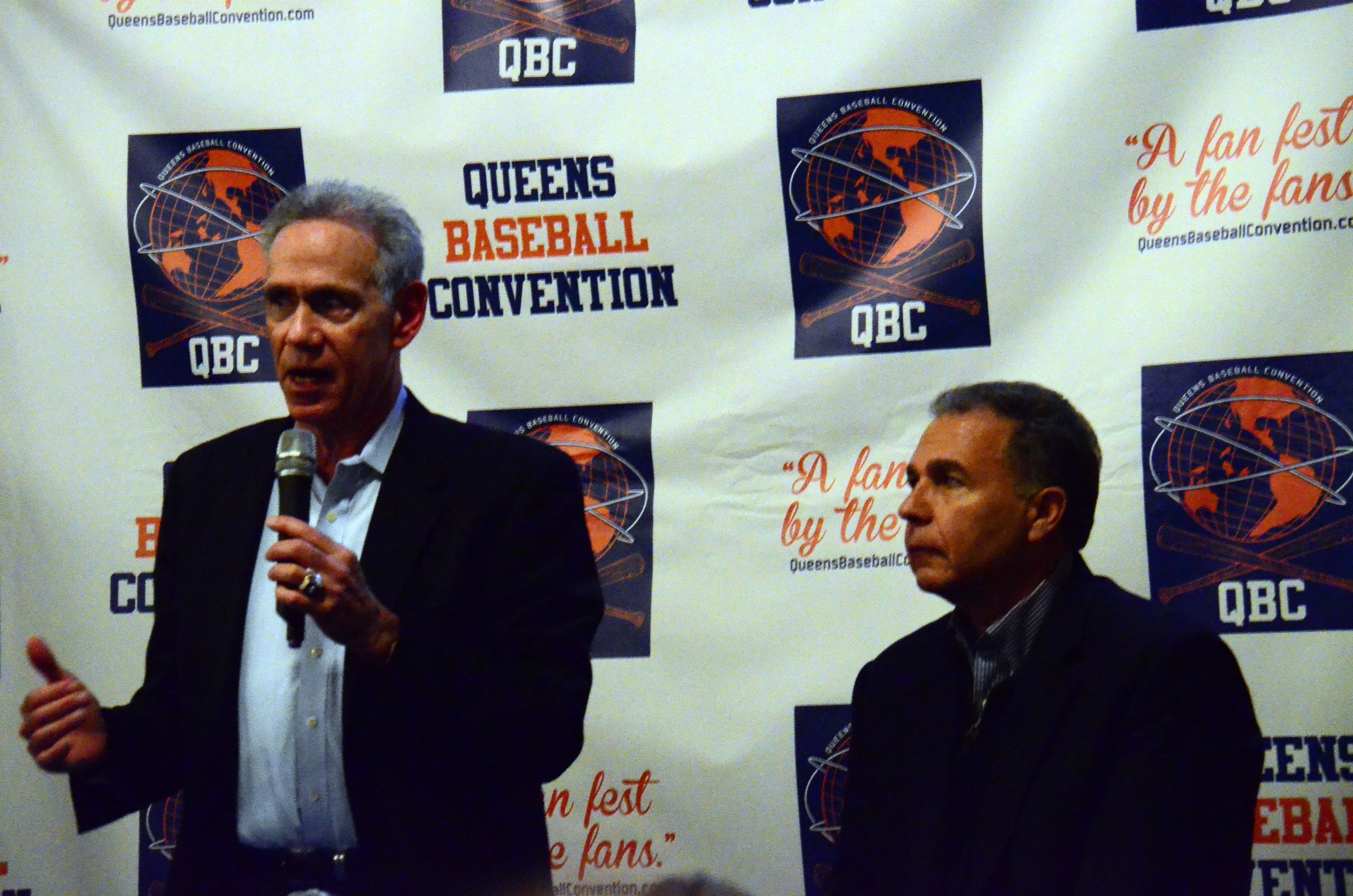
 Art Shamsky (speaking) and Gil Hodges, Jr., at QBC 14. (Photograph by Sharon Chapman.) Even better, in my book, is that Gil checked with me the day before to make sure it was all right if Art came with him. What a menschy thing to do…y’know? I’m trying to imagine a scenario in which I refuse the presence of a 1969 Met at a Met event or, for that matter, any square footage I come across in my life. Despite my friend and QBC MC Jeff Hysen’s tongue-in-cheek suggestion that I tell him, “sorry, we only want bloggers and nerds at this thing,” I confirmed we’d be quite honored to have Art on hand. And we were.
MetsPolice has posted audio of this particular presentation on its site, but since we had a little problem with our microphones in the middle of it, I thought I’d print here my brief “official” remarks concerning the award. It also serves to underscore the place Gil’s father holds in our collective heart.
***
Our beloved New York Mets were conceived by Bill Shea, delivered by George Weiss, nurtured by Joan Payson and brought into the world by Casey Stengel. Those were all crucial figures in the development of what Casey called our Metsies and their role in our history shouldn’t be overlooked.
It was Gil Hodges, however, who raised the Mets into an entity of substance; who made them make themselves into something; who guided them into growing up sooner than anybody on the outside would have imagined; and who gave us forever after a touchstone we could always proudly come home to.
What Gil Hodges did for the Mets and for us as Mets fans was and is and always will be enormous.
Gil Hodges didn’t invent the Mets, but he did make them real.
You may think I’m referring solely to winning the 1969 World Series with a team that had never won even half of its games before, and yes, that’s part of it. But Gil Hodges, as Mets manager, transcends even that rightfully legendary accomplishment.
When you read the contemporary accounts from when Gil ran the Mets and you listen, decades later, to the players Gil led, you understand it has to be about more than simply charging forward from 61 wins to 73 wins and then to 100 wins plus seven more in the postseason. You sense the transformation he effected, on a franchise level and within the lives of dozens of individuals he touched directly. When you hear about who Gil was and what he did and how he treated others, you can feel his impact radiate outward to not just a ballclub that played above what was supposed to be its head, but to everyone who cared about that club and who identified with that club.
That’s a lot of people. That’s a lot of Mets fans, then and now. And that means everything to people like us.
There’s plenty more one could add about Gil Hodges, whether it’s his Hall of Fame-caliber playing career for Brooklyn, L.A. and the Original Mets; the home run records he set; the crucial role he played in winning the Dodgers their first world championship in 1955; the splendid job he did managing the Washington Senators; the valiant service he gave his country as a United States Marine in World War II; the impact he had on his community; and, of course, his family.
The only thing that seems to be missing when one endeavors to discuss Gil Hodges is a bad word, because nobody in or out of baseball seemed to have one to say about him.
It was a remarkable life Gil Hodges packed into not quite 48 years and it’s a remarkable legacy we celebrate today with our small token of appreciation for how he raised our team to be all it could be.
The Queens Baseball Convention is proud to inaugurate the Gil Hodges Unforgettable Fire Award, dedicated to the person whose memory eternally warms our hearts, brightens our spirits and lights our way. We plan to present this award annually to someone who casts a truly incandescent glow for us as Mets fans.
For the first one, we agreed there could be no better recipient than the man himself. Therefore, we are incredibly honored that joining us to accept this award is someone who carries on in the name of Gil Hodges and does that name proud.
Ladies and gentlemen, Gil Hodges, Jr.
***
Two recent podcast appearances you might enjoy: I join Desert Island Mets to discern whether The Baseball Encyclopedia qualifies as a bible of sorts (fair warning: I programmed the episode’s music); and the Rising Apple Report for a delightful digression into the Met coaching careers of Sheriff Robinson and Tom Nieto. Thanks to both shows for the thoughtful invitations and exchanges.
by Greg Prince on 21 January 2014 10:56 am Friend of FAFIF Matt Silverman reminds us it’s the time of the offseason to solicit entries for the Greg Spira Baseball Research Award. The award recognizes the “best published article or paper containing original baseball research by a person 30 years old or younger,” which represents an outstanding tribute to Spira, who dedicated much of his all too short life to discovery and dissemination within the sport he loved.
First prize is $1,000, with cash prizes awarded for second and third place as well. Full details on how to submit are here. The deadline for entry is February 15. Please look into it and tell anybody you might think would be interested about it. Thank you.
by Greg Prince on 19 January 2014 1:43 am Major League Baseball has been running a promotion called “Face of the Franchise,” which crossed my mind Saturday night after returning home from the first Queens Baseball Convention. In MLB’s Twitter-based contest, fans are being asked to choose a current player to visually represent each team and, ultimately, the entire sport.
Due respect to whomever this exercise eventually glorifies, this is silly where the Mets are concerned. The face of this franchise is that of its fans. And the face appeared to be enjoying itself at QBC. It smiled. It focused. It pondered. It moved up and down in a nodding fashion (which might be more of a head trait, but the face is in there somewhere). It was surely engaged by all that transpired around it.
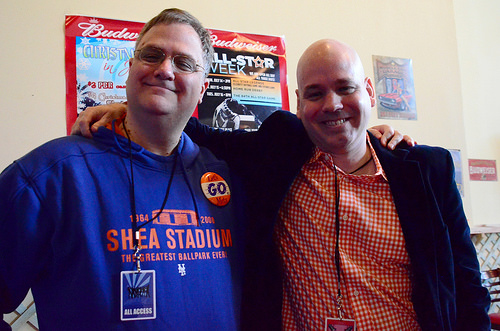
 Two of many happy faces found at QBC 14. (Photo by Sharon Chapman.) We’d make for an ideal Mets visage, except for one logistical obstacle: you can’t really fit us all onto one face. Blame it on the individuality that pokes out from underneath our common-interest umbrella. We’re snowflaky that way. Even within the realm of our respective Mets fan identities, we are each a variation of the species.
Y’know what we’re not? A “fan base”. I’ve really come to dislike that term.
Never mind that it evokes political strategy, as in “playing to the base,” which always sounds very cynical. My distaste for the phrase comes from the implication that you can blob us together until you don’t have to bother distinguishing among us. It’s easier to dismiss prevailing concerns by pretending a mob is howling. “Sign a player? Lower a price? Convene a wintertime baseball event? Oh sure, that’s what the fan base wants.”
Send out all the surveys you can generate, cherry pick your feedback mechanisms or just draw your prefab conclusions. You won’t know what your so-called base of fans is about unless you’re fully among them. There may be majorities or pluralities in favor of this or that, but there’s rarely anything close to unanimity, save maybe for winning being considered preferable to losing…and I wouldn’t swear to that one, either.
Our distinctions are good things. They make us multifaceted instead of monolithic. That’s probably why the first QBC succeeded so absolutely completely. There was a little bit of everything for everybody. A lot of everything, actually. It was glorious not just for the triumph of choice, but for watching the choices being made. Not everybody wanted the same thing out of the day, or at least they didn’t behave as if they did.
Y’know the one thing I’m pretty sure we all wanted? To be at a gathering like this. Not every Mets fan might have chosen to spend one winter Saturday with hundreds of other Mets fans, but hundreds did. Once we were there, it seemed the overriding point was to revel in the existence of this unprecedented opportunity. Again, there was a lot of everything for everybody, yet the one item that didn’t formally appear in the QBC program but managed to emerge as Saturday’s common denominator was unfettered access to each other.
We were Mets fans embracing not just the chance to listen to former players, current broadcasters, dedicated historians and garrulous bloggers. We were confirming we’re still in this thing together; that January notwithstanding, we each maintain our unique place within our franchise’s face.
Consider confirmation achieved.
Sincere thanks to all who made Queens Baseball Convention 14 possible and equally sincere thanks to all who made Queens Baseball Convention 15 necessary.
by Greg Prince on 16 January 2014 11:40 pm Over the past few days, arbitration has been avoided between the Mets and Ruben Tejada, Ike Davis and Eric Young, Jr., while instant replay rules have been expanded and adopted.
None of that is exactly insignificant, yet none of it is quite baseball in January, the month when winter drags on without apology. But fear not, faithful followers of the orange and blue: this Saturday comes The Winterlude.
The Queens Baseball Convention is going to break up your winter. It is designed to break up your winter. It is a full day of baseball talk, baseball thought, baseball camaraderie, baseball color, baseball fun, baseball games…
Well, not “baseball games” in the sense of the 162 Alex Rodriguez will be ineligible to play this season, but you know what I mean. There will be, as promised, baseball activities galore, all of them Metsian, all of them enhanced by your presence. And while you’re making QBC 14 even better by being on hand, your January will gain a necessary taste of June and July when it is fortified by QBC 14.
So for goodness sake, come on down this Saturday at noon!
Within the packed schedule of events (detailed here), Faith and Fear is proud to grab a few at-bats:
• You can catch Jason and me on the New Media panel convened by Gotham Baseball’s Mark Healey at 12:10.
• At 1:00, Jason shifts into moderator mode as he hosts Ron Darling of Ron Darling fame in a Q&A session.
• I’ll be delving into Mets history at 2:00, offering a sneak preview of The Happiest Recap: Second Base (1974-1986) along the way. (Copies of First Base: 1962-1973 will be available, too.)
• It will be my distinct honor to host the presentation of the first Gil Hodges Unforgettable Fire Award at 6:15. We’ll be joined for the event by Gil Hodges, Jr., son of our beloved World Champion manager.
Plus, being Mets fans, Jason and I will be around all day taking in as much QBC as we can — and there is going to be a lot of QBC. We look forward to seeing you at McFadden’s this Saturday, when the calendar claims it’s January 18, but it figures to feel much warmer.
by Greg Prince on 10 January 2014 1:00 pm Pitchers & Catchers won’t be reporting to Port St. Lucie for more than a month, but you can look forward to reporting to McFadden’s Citi Field on Saturday, January 18, for the first annual Queens Baseball Convention. When you do, you’ll be joined by a pitcher, a first baseman, your favorite pair of bloggers, their esteemed colleagues and a whole lot of Mets fans like yourself.
So bring your offspring, bring your spouse, c’mon down to QBC and get yourself out of the house.
As outlined in this space previously, QBC is the wintertime fanfest-style event you’ve been waiting for all your Met life, and now it’s about to exist. Conceived by those who love the Mets for those who love the Mets, it shapes up as a full and memorable day of baseball activities, which is saying something when the calendar remains stubbornly ensconced in January.
Come to QBC, you’ll meet Ron Darling. You’ll meet Ed Kranepool. You’ll meet Gil Hodges, Jr., I’m pleased to report. You’ll meet Mr. Met and Sandy the Seagull (and actual non-mascot representatives of the Metropolitan Baseball Club of New York). You’ll hear from some stone-cold authorities on Mets uniforms and Mets pop culture and Mets fantastic finishes. You’ll encounter Mets trivia (with a chance to win prizes) and, speaking of trivial, Jason and I will be taking part in various panels and presentations. There’ll be fun and games for the kids, fun and games for the adults, baseball filling your eyes and coming out of your ears. Consider it total seamhead sensory immersion.
If that doesn’t sound like the best January day for a Mets fan since the Mets signed Carlos Beltran in 2005, I don’t know what does. Carlos required $119 million over seven years to come to Flushing. For you, fellow Mets fan, QBC tickets are a mere $35, which includes access to all sessions and autographs (Darling’s, Kranepool’s and those of anybody else who can grip a pen…which, full disclosure, might be a dealbreaker for Mr. Met’s signature). Children 12 and under get in for just 10 bucks. There’s also a pretty sweet 7 Line-designed t-shirt + ticket deal on queensbaseballconvention.com.
Order your QBC tickets now, pull your jersey of choice out of storage next and then start stretching and long-tossing so you’re ready. No matter what position you play, I’m sure you’ll agree baseball activities can’t resume soon enough.
by Jason Fry on 9 January 2014 9:15 am If you haven’t been to Cooperstown, you should go. It’s a lovely town. And you’ll be surprised in a way that’s unfortunately all too rare these days — the Hall of Fame isn’t a glitzy monstrosity but the kind of place that gets unlocked a minute after it’s supposed to open by a friendly guy with a mop.
You know what else is fun? Arguing about the Hall of Fame. By which I mean the fruitless but endlessly entertaining debates you can have about players from wildly different eras of baseball. The Hall of Fame includes guys who got to tell the pitcher where to throw it and guys who never wore helmets and routinely got beaned and guys who played with armored limbs. It includes white players who never played a game that counted against black opponents and black players who could say the same about white opponents, not that the black players had a choice in the matter. It includes pitchers who threw spitballs and pitchers who threw atop mounds so high they changed the rules. It includes speedsters, sluggers, guys who threw gobs of complete games, guys who rarely if ever saw an inning before the seventh, skinny shortstops, enormous first basemen, and an excess of New York Giants with friends on the right committees. It includes war heroes and gentlemen and pioneers and hypocrites and racists and drunks. It’s a crazy stew of baseball history, chronicling an ever-changing game.
You know what’s not fun? Arguing about PEDs and the Hall of Fame.
The confirmed PED users, for now, are left out of Cooperstown. So are the guys who everyone assumes used PEDs. And the guys who are rumored to have used PEDs. And the guys who aren’t rumored to have used PEDs, but were big guys when other big guys did bad things.
That’s ridiculous. But what’s the way to escape it?
Whenever I think about PEDs (which, admittedly, is less and less these days), I remember Buck O’Neil in Joe Posnanski’s superlative The Soul of Baseball. As Posnanski tells it, people were always approaching O’Neil to vent about steroids, expecting him to agree and play the role of kindly emblem of a better time. O’Neil wouldn’t do it. He said, politely but pointedly, that every player he’d ever known had looked for an edge. The beauty of baseball obscures how ruthless the men who play it are. They have to be — to get where they are they’ve disposed of hundreds of opponents, teammates seeking the same job and (perhaps most importantly of all) their own self-doubt.
I don’t say that to condone cheating — just to say I have no interest in the high-horse scolds who use columns and Hall of Fame votes to defend some baseball paradise that never existed. If I had a magic wand that could identify the cheaters, I’d happily wave it. If I had some magic thingamajig that would make whole the minor-leaguers who didn’t juice and so became civilians instead of big-leaguers, I’d thingamajig it.
But no one does, and no one ever will. And so we’re left with a handful of options:
1. We (by which I don’t actually mean “we,” unless you’re a Deadspin reader) can squish through goat entrails and sift through tea leaves and decide that we’re voting for this player from the era of bad things who we don’t think took PEDs but not this player who we think did take PEDs, because reasons. This involves being mad all the time and knowing that none of this anger is leading to any semblance of justice. This is the situation we have now, and everybody hates it.
2. We can decide that no players from the era of bad things can get into the Hall of Fame. This seems pretty obviously unfair to me. Just for openers, are we sure we know when the bad things began?
3. We can insist that baseball maintain tough rules and penalties to make taking PEDs risky, and then decide that players from the era of bad things can get into the Hall of Fame just like players from eras of previous bad things did. We can stop talking about PEDs and decide which players get in by comparing them against their peers, talking about their stature in their era, and using a generous helping of numerical literary to weigh their candidacies against players from other eras. And we can turn over the arguments about who was better or best to history.
Personally, I’d vote for 3. It’s not perfect, but it’s the injustice that offends me least. And it’s the path back to Hall of Fame arguments that don’t make me want to throttle the other guy or go lie down in the road.
The good news, such as it exists, is that Mike Piazza might be one of the players who gets Door Number 3 to open.
Do I think Mike Piazza did steroids? How the hell would I know? Watch a Mets classic from ’99 or ’00 and player after player looks like the love child of Paul Bunyan and the 50-Foot Woman. If that doesn’t make you raise an eyebrow, you’re a sucker. But if it makes you certain whom to declare guilty, you’re a sociopath. Since the list of confirmed PED users includes both Jose Canseco and Jorge Velandia, you tell me what to look for. In my opinion, the only sane way to think about PEDs is to make up your mind that nothing will ever surprise you again and leave it at that.
By being big and playing when he did, Piazza will always have to deal with suspicions. But what he’s never had to deal with is evidence, or anything close to it — no text messages to Kurt Radomski, no weird stories about needles and someone’s booty, no pattern of chronic injuries or sudden decline. (Unless you think Murray Chass is a qualified dermatologist.) By any fair standard, Piazza should have gotten a Hall of Fame hearing without whispers about PEDs. The fact that he hasn’t — that he’s been denied twice — is ridiculous. But it’s not ridiculous because it’s former Met Mike Piazza. It’s ridiculous because it’s ridiculous.
Let Piazza in — and Jeff Bagwell and Craig Biggio. They’re not guilty of anything you’d present to a jury with a straight face. And then let those three be the ones who begin to put this whole thing to rest. Let Barry Bonds in, because he’s the greatest hitter I’ve ever seen. Let Roger Clemens in, because much as I loathe him he’s one of the greatest pitchers I’ve ever seen. And then let’s debate the merits of Rafael Palmeiro and Mark McGwire based on their performance against pitchers, not Congressmen.
And then let’s get back to arguments we actually want to have.
by Greg Prince on 8 January 2014 5:17 pm The sound and the fury notwithstanding, nothing much changed from a purely parochial perspective following Wednesday’s Hall of Fame announcement. Mike Piazza still rocks, T#m Gl@v!ne still galls and Tom Seaver still rules.
Piazza didn’t gain induction. Big deal. He continues to be one of the absolute greatest Mets there ever was, his membership in the Hall of Greg remains valid and his 62.2% from Cooperstown’s high and mighty arbiters of immortality (and morality) represented an improvement from the previous vote, indicating that within a couple of elections, he’ll probably get in, most likely etched under a Mets cap.
He should be in already. But you already knew that.
Gl@v!ne, meanwhile, becomes the twelfth Mets player to make the Hall. Yippee. I thought I might tap into some long-dormant vein of rose-colored viewing and say something generous on T#m’s behalf — perhaps recalling his two outstanding starts in the ’06 playoffs or how he learned to work the inside of the plate at an advanced age when quesTec compelled him to change his careerlong approach — but I don’t have it in me, other than to acknowledge he won 305 games, two Cy Youngs and there was no unbiased reason to keep him out. Even with a permanent record encompassing his final three Mets starts (14.81 ERA and zero garments rended as his team surrendered its playoff spot), there’s no arguing against him residing in Cooperstown.
They can have him.
His Braves buddy Greg Maddux goes in, too, which is fine and dandy on merit, especially since Maddux didn’t break Seaver’s vote-percentage record of 98.84. That’s an admittedly petty concern, but it’s been our treasured heirloom since 1992, so I’ll be petty on its behalf. MLB Network got Maddux and Gl@v!ne on the air (with their man Smoltz) for requisite fawning and teasing about how much they’ll love playing golf upstate this summer. If I closed my eyes, it was somewhere between 1993 and 2002 and Braves pitching was the same immovable object all over again. It wasn’t a pretty sight to behold, even in the imagination.
The Big Hurt made it. Good for Frank Thomas, whose three-run homer off Jeff D’Amico in Interleague action in 2002 — the only series in which he ever faced the Mets — failed to leave a scar. Maybe our Frank Thomas will accidentally receive more of his mail as a result. Any excuse to invoke the man who hit 34 home runs for a 120-loss team is a welcome diversion.
Six Mets who weren’t Piazza or Gl@v!ne also rode the 2014 ballot. Only one will return in 2015: Jeff Kent. He stopped being a Met in 1996, which was in another millennium. Then he went on to become one of the most prolific slugging second basemen of all time. Go figure. His 15.2% of the vote indicates he’ll be talked if not to death then perhaps to sniffles for at least a few more elections.
Kent was a helluva Met for one month in particular: April 1994. Remember when John Buck was challenging the franchise record for most RBIs in an April? That was Jeff’s mark he bore down on but couldn’t top. What an April it was 20 years ago: 26 runs batted in, seven homer and an OPS of 1.160. Kent stopped being such hot orange and blue stuff thereafter, but I’m willing to call it a Hall of Fame month.
Rather than grind too many teeth over the events of September 30, 2007 (which suddenly seems uncomfortably recent), I will choose to harbor selectively fond memories of the unquestionably unpopular or relatively forgotten Mets who won’t be considered for Cooperstown any longer. Like Jeff Kent. Like the other five.
Paul Lo Duca received zero votes, but he seamlessly replaced a legend in 2006 and was a major reason the Mets leapt ahead of the N.L. East pack to stay. We wouldn’t have our sole set of post-Piazza postseason memories if not for Lo Duca. It may not be worth a Hall of Fame vote, but it shouldn’t be forgotten.
Moises Alou received six votes for a very solid, occasionally stellar career. Boy could he hit. He hit in a Mets-best 30 consecutive games as all else was falling apart around him late in 2007. He was 41 and dead tired, yet he kept playing and kept hitting. Not exactly a bulletproof Cooperstown credential, but I warm to the thought.
Hideo Nomo was between his phenomenon stage and his comeback period as a four-month Met in 1998. His six votes today aren’t for what he did as the Mets fell once game shy of forging a three-way tie for the Wild Card. Nevertheless, a 10-strikeout complete-game gem at San Francisco stands out in my mind from that playoff hunt. He could’ve done more (like take the ball when Bobby Valentine tried to hand it to him for the last start of the season), but he did something. It was better than nothing.
Kenny Rogers…yeah, I know. But I also know this, thanks to Baseball Musings: seven games played at Shea Stadium as a Met — all in 1999 — and the Mets won every time. You know who was a more successful home park player for the Mets in their history? Nobody. No kidding. It may be glory by association, but nobody can touch that 7-0 record. It was Turner Field where he found trouble, but that was a bit later. And given the closeness of regular-season affairs in 1999, there’s no underestimating how important Kenny Rogers was in getting the Mets to October.
I mean, yeah, Kenny Rogers…bases loaded, ball four, I get it. Believe me I get it. But he really did help there for a while. I wouldn’t have cast the one Hall of Fame vote he got, but I’m not going to scream that he accumulated one.
Armando Benitez would be remembered as an outstanding Met reliever if not for the handful of times he managed to be incredibly dreadful, which, given his job description, were always when it mattered most. So I’ll conveniently skip over crucial territory and give Armando and his one inexplicable vote received their due, not for all the saves he piled up (which are usually written off as culled in pressure-free situations, though that’s not an entirely fair characterization), but in honor of one appearance that stays with me because it was so much fun to witness.
At Shea in June of 1999, when every game was already important to the Mets breaking their eleven-year playoff drought, Benitez was brought on to protect a 4-2 lead against the Marlins. He retired the order in the top of the eighth. The Mets then went about tacking on runs in the home half of the inning. Benitez seemed poised to exit in favor of a pinch-hitter and ultimately John Franco, but with the score jacked up to 7-2, two on and nobody out, Bobby V said, essentially, “what the hell?” and let his hard-throwing reliever bat.
Benitez grounded to third, bringing home Roger Cedeño the sixth run of the inning. It was the first RBI of the pitcher’s career, and all of us on hand stood and gave him a hearty ovation. Then the usual setup man went out to finish the game, striking out all three Marlins he faced. Soon enough, he’d be the closer and it would never look so easy or feel very cheery, but if there had to be a solitary vote thrown away on Armando Benitez, let it be thrown away against that pleasant memory.
Benitez, Rogers, Nomo and Alou will all be absent from next year’s ballot, but we will have Pedro Martinez, Gary Sheffield and Carlos Delgado to pick around, along with the great Piazza. Their arguments can wait, though it occurs to me nobody’s candidacy ever looms so promising as when he has yet to be overlooked.
Think about it. A year ago at this time, Kent’s name was included with Maddux’s, Gl@v!ne’s, Thomas’s and Mike Mussina’s as part of the supposed powerhouse class to come. New meat is inevitably framed that way. Yet Kent and Mussina languished toward the rear of the results while the others waltzed in. So I’d advise, in case you’re thinking Pedro is a lock or that Delgado and Sheffield stack up reasonably well, cherish this moment in time when nobody’s seasons of accomplishments are yet reduced to afterthought status, when BBWAA members of various stripe have yet to casually dismiss hundreds of homers or thousands of hits as if attaining them took nothing special.
These elections cue Terry Cashman’s classic in my head, not the “Willie, Mickey and the Duke” refrain of “Talkin’ Baseball” so much as the contemporary verse he included to celebrate how our grand old game keeps rolling along. One line in particular resonates today:
Seaver, Garvey, Schmidt
And Vida Blue
If Cooperstown is calling
It’s no fluke
Seaver and Schmidt were called. Blue and Garvey weren’t. Terry went 2-for-4 in his 1981 forecast for surefire immortality. That’s a batting average of .500. But we’ve all learned in the ensuing decades that batting average isn’t everything.
by Greg Prince on 7 January 2014 4:08 am A warm if non-baseball observation to pass along in the midst of a brutal cold snap: the Nets belong in Brooklyn. I confirmed it Saturday night.
It was my second trip to Barclays Center. Last season’s was for novelty’s sake. This one was more for basketball. I’m pleased to report that no matter the cynical aspects attached to relocating a professional sports franchise in the midst of a planned real estate development, the Nets being plopped onto the O’Malley-lusted intersection of Flatbush and Atlantic feels right from a sports fandom perspective. I don’t know that it will work ultimately for the citizenry of the neighborhood or provide a platform to make the Nets legitimate title contenders, but I decided I like having them there.
I especially like my romantic notion that the Nets sort of came home to me when they moved to Brooklyn from New Jersey. I grew up with them in Uniondale until they vamoosed. I’d vaguely missed them all these years being in some inconvenient state, never mind the altogether wrong Basketball Association. Now they’re a train ride away.
When I told my sister of our plans to catch the Nets and Cavaliers in Brooklyn, she asked, very seriously, if it was safe. I wasn’t surprised. For a generation of Long Islanders raised on tales of how lucky they were to have been moved out of their ancestral borough, it was a reflexive response. My parents loved Brooklyn in the rearview mirror, but except for visits to relatives or doctors, they wanted no part of it in real time when we were kids.
In certain precincts of my family, it will always be 1957 when it comes to broaching Brooklyn. The Dodgers will always be going one way and we’ll always be going the other way, neither party having any desire to stick around. For me, “the Brooklyn train” was always the one you didn’t want to be on out of Long Beach, because it meant changing at Jamaica if I was going to Manhattan…and where else would I be going? Now, with the Nets at the other end of the ride, I embrace the Brooklyn train. It takes me to my basketball team. The hop across the platform, coming and going, is a small logistical surcharge to pay.
Barclays Center is wonderfully gleamy in that simultaneously gorgeous yet offputting way contemporary sports palaces insist on greeting you. You can’t escalate to the not-so-cheap seats without passing the amenity-laden levels. I didn’t come for amenities, but I don’t care for having them fill my peripheral vision, reminding me that tonight they’re not accessible to me. More importantly, the sightlines are swell. I have no problem following the bouncing ball.
Like Citi Field, Barclays has plenty to sell you to eat, and based on my first visit last February, the grub is just as good (and just as expensive). But Barclays, unlike Citi, is in the middle of somewhere, so Saturday night, Stephanie and I braved the slush as well as our unfamiliarity with the area to enjoy dinner as people who aren’t necessarily sports fans do an hour-and-a-half before a game — in a restaurant.
I liked that a great deal. I’ve done it in other cities before baseball games. We used to do it that way en route to seeing the Liberty at the Garden during our passionate WNBA phase, though we’d usually settled for the Ranch 1 on 28th Street. Saturday night we walked 10 or so minutes into Park Slope for miso soup, sushi and sashimi. Then we walked 10 minutes back to Barclays. It reminded me of Bob Hartley and Cliff Murdock reminiscing about that place they used to go for burgers and beers before Loyola games on The Bob Newhart Show. It put me in mind, too, of the stories old-timers told about meeting at the Nedick’s by the old Garden on Eighth Avenue between 49th and 50th. It made me think of G.O. Cards getting a high school kid like Long Beach’s own Larry Brown into Knicks games before anybody knew what the NBA was exactly. It made me think of my dad going there for college doubleheaders when he was at NYU and the Violets played big-time basketball.
The Nets and Cavs were 45 minutes or more from tipping off and I was thinking great basketball thoughts, maybe even some that actually happened.
Basketball and I used to be real close. I mean we were like best friends when we were kids. Then basketball and I went our separate ways. It’s a little awkward when we cross paths nowadays. We usually act as if we’re strangers with no shared history whatsoever. Once in a great while, though, I can get together with basketball and find we’re still capable of hitting it off as if the intervening decades hadn’t changed a thing.
That was me and basketball Saturday night, the only Saturday night home game all year on the Nets’ schedule. Too bad. To my mind, so informed at the age of six, basketball games should be played at home on Saturday night. First game of any kind I ever went to was the Knicks on a Saturday night late in 1969 when my parents had season tickets and the Knicks were owning the league. I loved the Knicks like I loved the Mets in 1969. I loved the Knicks of that era so much that I could never keep loving them once that era was over. I know people who’ve treated post-glory Mets teams that way, failing to embrace those who came after Carter and Hernandez and Strawberry and so on. I could never drift from the Mets just because they weren’t populated by great players anymore, but in a nutshell, that’s how I was with the Knicks once Willis Reed began the inevitable parade of championship retirements. There’ve been attempts at rapprochement between us over the decades, but relations between the Knicks and me are best described as estranged.
Yet I will always cherish what Saturday night at the Garden meant when I was six and seven. Saturday night at the Garden in 1969-70 was the epitome of sports and class. I got it immediately. I learned to applaud passes and appreciate picks and shout “CHARGE!” and chant “DEE-FENSE!” I can still hear John Condon’s voice announce who just scored and who was just fouled.
Saturday night at Barclays Center in 2013-14 — when the canned music never lets up and everything is a sponsorship opportunity — offered no more than a shadow of those formative evenings when I figured out how much fun it was being an informed fan, but a shadow is better than a void, just as Brooklyn is better than Newark, East Rutherford or Piscataway for my Nets needs.
It wasn’t an amazing game (the Nets won) and it wasn’t an amazing crowd (our section’s loudmouth bemoaned the failure of his “DEE-FENSE” to catch fire), but it felt right, just as getting off a train in Brooklyn did, just as dining casually near the arena did, just as sensing a fast break coalesce did. When you watch the NBA on TV, you get the idea that the only fans who exist are the amenity-catered VIPs on celebrity row. Up in the balcony, as it were, you’re reassured to know you’re among people who care enough to shout when your team doesn’t have the ball.
Y’know what else felt good? The train back to Jamaica. Most of us boarding at Atlantic Terminal had been to the game. We were couples on dates; families of four; a mother chaperoning a handful of children; a father and a son; bunches of buddies. Especially buddies. Buddies going to a basketball game in Brooklyn, now buddies coming home from a basketball game in Brooklyn…going home to Long Island. Basketball talk. Barclays Center talk. Talk about what’s out the window or what’s planned for tomorrow. The Nets aren’t good enough to be fashionable, but many of us had bought in. There were expensive Nets jackets and Nets caps purchased at Modell’s and underneath my parka I was wearing a Nets hoodie I ordered from Nets.com when it was discounted for Black Friday. The text certified the team that had relentlessly branded itself Brooklyn in 2012 was founded in 1967, which was absolutely true if you followed the ABA trail clear back to the Teaneck Armory before it wound through an array of stations you could imagine called out by an LIRR conductor near you: Commack Arena, the Island Garden, the Nassau Coliseum, the Rutgers Athletic Center, the Brendan Byrne Arena, the Prudential Center and Barclays Center.
Last stop, Barclays Center.
I wanted that hoodie because it commemorated my idealized good old Nets days, no matter that red, white and blue had turned black and white. I wear it as much as I do because I’m hoping to see some reasonably good new Nets days. Or just a few more Saturday night games over the next few winters.
Maybe there was a soul in the Long Island-bound crowd who was such an enormous Nets fan that he would have sought out the action in New Jersey on a Saturday night like this, but I’m guessing no. Or conceivably a Nets franchise that had stuck it out off Hempstead Turnpike post-1977 could’ve cultivated a rabid basketball following in Nassau and Suffolk, yet if two beautiful ABA championships won on the wings of Dr. J didn’t tangibly raise the roundball temperature on the Island, then probably not, either. Professional basketball, at least in these parts, seems to require being surrounded by something other than parking lots and parkways.
This, I determined Saturday night, was the way to go. The Brooklyn train. The Brooklyn Nets. Our team. My team for those occasions when I would decide to reacquaint myself with my long, lost childhood buddy. Maybe this team with whom I intermittently get into pickup games is never going to be the team around here, but when has that ever stopped a fan like me?
|
|