Faith and Fear in Flushing made its debut on Feb. 16, 2005, the brainchild of two longtime friends and lifelong Met fans.
Greg Prince discovered the Mets when he was 6, during the magical summer of 1969. He is a Long Island-based writer, editor and communications consultant. Contact him here.
Jason Fry is a Brooklyn writer whose first memories include his mom leaping up and down cheering for Rusty Staub. Check out his other writing here.
Got something to say? Leave a comment, or email us at faithandfear@gmail.com. (Sorry, but we have no interest in ads, sponsored content or guest posts.)
Greg is inputting even more data into the FAFIF Contest-a-Tron 2012 — you should see the smoke coming out of that poor machine. Contest coming soon — in the meantime, here’s the eighth go-round for a Faith & Fear tradition….
Jason Bay is gone, but R.A. Dickey still might be going. That’s how it goes these days in Met-land. It’s possible — you might even say likely — that David Wright will be at his position come Opening Day 2013 with a big new contract and what’s essentially a lifetime lease on being a Met. But it’s possible — you might even say likely — that Dickey might be toeing the rubber somewhere else, Cy Young Award notwithstanding, a victim of uncertain finances and mileage and track record.
And as for whom Wright will turn and see in the outfield, well, I have no earthly idea. It’ll be Someone Else, but when your general manager makes jokes about getting someone out of a cardboard box, the heart does not leap in anticipation. (Besides, in these days of Wilpon austerity cardboard is expensive. Your next right fielder may arrive in a paper bag kept shielded from hurricanes and Nor’easters in hopes that it will last.)
But on to happier things, or at least more diverting ones: It’s time to welcome the THB Class of 2012.
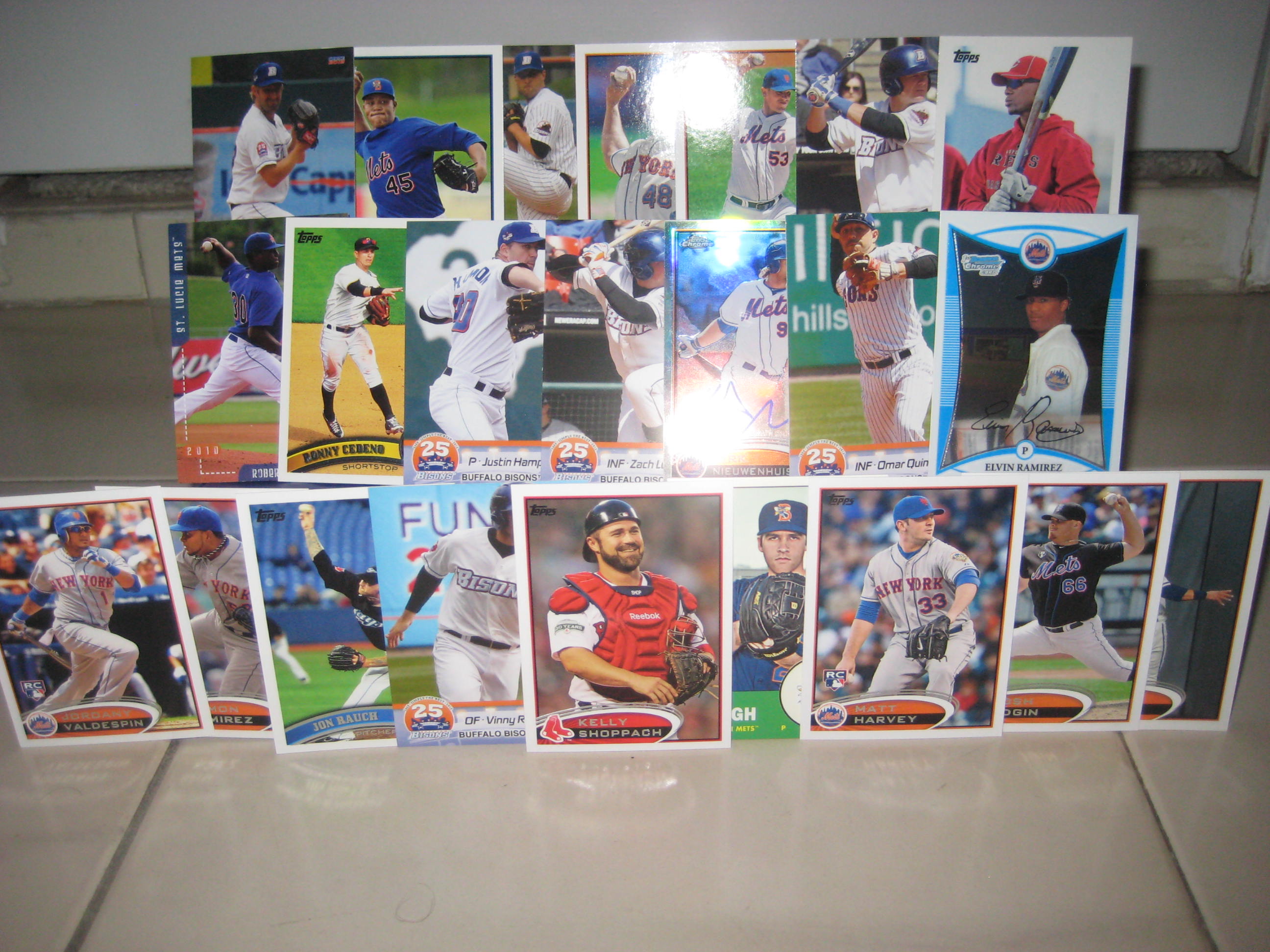
Background: I have a trio of binders, long ago dubbed The Holy Books (THB) by Greg, that contain a baseball card for every Met on the all-time roster. They’re ordered by year, with a card for each player who made his Met debut: Tom Seaver is Class of ’67, Mike Piazza is Class of ’98, Jose Reyes is Class of ’03, etc. There are extra pages for the rosters of the two World Series winners, including managers, and one for the 1961 Expansion Draft. That includes the infamous Lee Walls, the only THB resident who neither played for nor managed the Mets.
If a player gets a Topps card as a Met, I use that unless it’s truly horrible — Topps was here a decade before there were Mets, so they get to be the card of record. No Mets card by Topps? Then I look for a minor-league card, a non-Topps Mets card, a Topps non-Mets card, or anything else. Topps had a baseball-card monopoly until 1981, and minor-league cards only really began in the mid-1970s, so cup-of-coffee guys from before ’75 or so are tough. Companies such as TCMA and Renata Galasso made odd sets with players from the 1960s — the likes of Jim Bethke, Bob Moorhead and Dave Eilers are immortalized through their efforts. And a card dealer named Larry Fritsch put out sets of “One Year Winners” spotlighting blink-and-you-missed-them guys such as Ted Schreiber and Joe Moock.
Welcome to the basement floor, new guys!
Then there are the legendary Lost Nine — guys who never got a regulation-sized, acceptable card from anybody. Brian Ostrosser got a 1975 minor-league card that looks like a bad Xerox. Leon Brown has a terrible 1975 minor-league card and an oversized Omaha Royals card put out as a promotional set by the police department. Tommy Moore got a 1990 Senior League card as a 42-year-old with the Bradenton Explorers. Then we have Al Schmelz, Francisco Estrada, Lute Barnes, Bob Rauch, Greg Harts and Rich Puig. They have no cards whatsoever — the oddball 1991 Nobody Beats the Wiz cards are too undersized to work. The Lost Nine are represented in THB by DIY cards I Photoshopped and had printed on cardstock, because I am insane.
During the season I scrutinize new card sets in hopes of finding a) better cards of established Mets; b) cards to stockpile for prospects who might make the Show; and most importantly c) a card for each new big-league Met. At season’s end, the new guys get added to the binders, to be studied now and then until February. When it’s time to pull old Topps cards of the spring-training invitees and start the cycle again.
Anyway, previous annals of the THB roll calls are here, here, here, here, here, here and here. Goodness. We’ve been at this for a while, haven’t we?
Robert Carson: Soft-bodied, hard-throwing lefty won accolades for having a good arm, along with warnings that he was way too young for the duties he was being asked to shoulder. That scouting report proved more or less accurate, though the sample size was awfully small. Am I way too pessimistic for noting that guys who arrive being talked about in this way generally wind up with careers that last a year or two at most? No, I’m just a Mets fan. But seriously: Somewhere Joe Vitko and Juan Castillo and Jerrod Riggan are nodding. Carson goes into The Holy Books with a 2010 St. Lucie Mets card that I sought out and bought in a fit of overenthusiasm when it looked like he might be a 2011 callup.
Ronny Cedeno: Decent backup infielder who wore goofy shoes. He arrived and was praised for having changed his approach at the plate from something best summarized as OHMYGODIGOTTASWINGATTHAT to hunting for strikes as preached by Dave Hudgens. Which is praiseworthy, as most big leaguers are incapable of such change by the time they’re veterans, if not before. That said, Cedeno probably won’t be back, as there are a lot of players who can do what he does without costing more money or requiring a long-term commitment. That sounds faintly insulting, but it isn’t meant to be — it’s the reality of backup infielders. And it’s progress that the Alderson regime seems to understand this: Alex Cora got Omarpalooza contract options and became a dead spot on a dead roster; Ronny Cedeno probably gets a new address. 2011 Topps card in which Ronny is a Pirate, and somehow not wearing black shoes with yellow laces. Disappointing of him.
Josh Edgin: Was having a wonderful rookie year until Ryan Howard showed up at the end there and made it numerically less wonderful. Still a pretty good first campaign that bodes well for the future. Edgin’s an interesting story — on the day he was drafted in 2010 he was drilling sewage pipes under South Carolina wetlands and expecting to do the same for a long time, possibly forever. With a little luck Edgin will never again have to consider that as a career — seriously, it sounds awful — but will remember that it was a near thing, and so be less likely to have gobs of money turn him into a jerk and/or idiot. 2012 Topps Update card in which he’s wearing the now all-but-obsolete black Mets top. Hey, that’s also further than he expected to get.
Jack Egbert: I wrote down that he was a 2012 Met. Beyond that, ya got me. I’d say this happens more and more quickly as I slide into old age, but I do remember Dale Thayer. 2012 Bisons card.
Jeurys Familia: Long-awaited prospect finally arrived, demonstrated a live arm and a definite need for another pitch, and sparked a mild panic about how to pronounce his name. Best I could tell it was “Hey-yoor-EES,” but no one ever seemed to provide a definitive answer. (Seriously, this bothered me.) Hopefully we have reason to find out in the future. 2012 Topps Prospects card on which he looks determined underneath a B-Mets cap.
Frank Francisco: Well, he was a stand-up guy in post-debacle interviews. And though he did throw a chair at fans a long time ago, he didn’t slug anyone under the stands or otherwise embarrass himself. Off the field, I mean. On the field, he was a disaster. How this even possible? Did Sandy Alderson once throw his arms heavenward and mock the idea of bullpens while signing the deed to an Indian burial ground over to someone who wanted to build a porno theater on the site? 2012 Topps card.
Justin Hampson: Pitched decently enough as the Mets tried to find a reliable left-handed reliever to use as an alternative to having Tim Byrdak’s arm fall off, a quest that ended with Tim Byrdak’s arm falling off. Opted for free agency after the season. He’ll show up on the mound for a third of inning in 2014 as a Giant or Royal and someone will remind you he was once a Met. 2012 Bisons card.
Matt Harvey: Arrived and was immediately superb, reminding us that while we all love smart pitchers who change speeds and hit spots, there’s something extra-special about a power pitcher with natural swing-and-miss stuff. Harvey was better than advertised, and brought a welcome Seaveresque pissiness to his craft, fuming about things that went wrong instead of accepting praise for things that went right. It’s tremendously exciting to think about getting to watch him for a full year. 2012 Topps Update card.
Jeremy Hefner: The opposite of Harvey, almost literally — the Mets switched Hefner in for Harvey on a storm-plagued night where the game was iffy, which made me wonder if they were going to make him stand atop a metal mast in the parking lot to warn Harvey if he saw lightning. On the mound, Hefner was your basic everything-needs-to-go-right ham-and-egger; off the mound, he was a quiet, religious guy who was terribly nervous about being interviewed by Kevin Burkhardt. Still, he supplied one of the year’s nicer morals about perseverance: He was visibly shaken after retiring no one in a 16-1 shellacking by the Phillies, then went out five days later to limit the Pirates to three hits and no runs over seven innings. That’s worth remembering, and rooting for. 2012 Topps Update card.
Rob Johnson: Backup catcher who threw a scoreless inning on a horrible night in Toronto that began with Jon Niese approaching his job with the level of interest normally seen in a DMV clerk. Let the record show that in Niese’s next start, Johnson quarterbacked him through a very good performance against the Pirates, and Niese was mostly pretty good after that. That’s got to count for something, right? Well, that and having struck out Eric Thames. We’re not mentioning Johnson’s hitting, because he couldn’t. 2012 Bisons card.
Fred Lewis: Quadruple-A player who was rewarded for a nice year at Buffalo by being allowed to do absolutely nothing in September as part of a dismal outfield in which not even he has a future. Next! 2011 Topps card on which he’s a Cincinnati Red.
Zach Lutz: His father’s name is Yogi, swear to God. Yogi Lutz. Say it again, because it’s awesome: Yogi Lutz. 2012 Bisons card.
Collin McHugh: Extremely talented blogger whose writings about the joy, pain and anxiety of being a minor-leaguer became required reading even before he got the call to the big club. Made his debut against the Rockies and it was a dandy: McHugh struck out nine while allowing two hits and a walk over seven. (The Mets lost, 1-0.) Unfortunately, McHugh made seven more appearances and they were all awful — he was scored upon in every one. A guy anyone with a heart roots for; hopefully what we saw was a pitcher who’d thrown too many innings and can turn into a Dillon Gee type. 2012 Topps Heritage Minor Leaguers card in which he’s a B-Met.
Kirk Nieuwenhuis: A fleet-footed, capable center fielder with the best mullet seen on a ballfield in years, Nieuwenhuis beat Heath Bell in late April and was immediately elevated to folk-hero status. Unfortunately, he soon started amassing strikeouts in bushels, looking utterly baffled at the plate, and ended the year sidelined with a bad foot. My kid insisted early on that he would become an All-Star, then doubled down and said he could be a Hall of Famer. Obviously I hope he’s right. 2012 card: Well, he didn’t get a regular Topps card, but he did mysteriously get a horizontal Topps Chrome card, which I would have no truck with, and so I paid not very much money for a vertical Topps Chrome alternate card (doubly mysterious) that was autographed. None of you cared enough to read all that, even if you’re also a Nieuwenhuis. Sorry. Let’s move on.
Garrett Olson: Made his Mets debut against the Marlins in August. Threw 20 pitches. Walked one guy, gave up three hits and four runs. Was never seen again and will presumably bear a 108.00 Mets ERA forevermore. But hey, he got Nick Green to pop out to first in foul territory. SUCK IT, NICK GREEN! 2012 Bisons card.
Omar Quintanilla: Pressed into service at shortstop when Ruben Tejada, Ronny Cedeno and Justin Turner all wound up on the disabled list. This was clearly a bad idea, but soon proved not quite as bad an idea as letting Jordany Valdespin near the position. And, as it turned out, Quintanilla did OK. Not OK as in “who was that Reyes guy, anyway?” but OK as in “that wasn’t nearly the disaster I’d penciled in.” The Mets then sold Captain Q to the Orioles because they needed his roster spot for Jason Bay. Ouch. 2012 Bisons card.
Elvin Ramirez: When things aren’t going well bullpen-wise, everybody starts scanning the minor-league stats and appointing obvious saviors. So it was that Elvin Ramirez became the answer for Mets fans in late May and early June: Hey, he was young, had a good fastball, was doing well at Buffalo and most importantly was not one of the relievers whose name inspired swearing and throwing things by then. Once called up, Ramirez was as bad as everybody else — first he walked guys, then he found out that what worked in Triple-A didn’t work in MLB. Off he went, defrocked and unwanted. He showed up again in July, though, and actually pitched pretty decently. He needs better control and another pitch, but you could easily say that about 150 guys at Triple-A. We’ll see. Has a 2008 Bowman Chrome Prospects card I can’t believe I remembered I owned; I think the photo was snapped in Little League.
Ramon Ramirez: Yes, we traded Angel Pagan for Andres Torres and another guy — Ramon Ramirez, who seemed like a pretty decent pitcher, actually. My being happy about him lasted all of zero regular-season appearances — he was shaky on Opening Day, though he got the win, then reliably awful. Middle relief is a funny thing — Ramirez had been pretty good before 2012, and he’ll probably be pretty good after 2012, and if you ask him years from now he won’t have any more idea what the hell happened in 2012 than you do. 2012 Topps Update card in which he looks like he just threw a ball wide of the plate. Safe assumption.
Jon Rauch: Gigantic, profusely tattooed reliever was superb on Twitter, where he administered much-needed public shamings by retweeting the vile tweets people aimed his way after bad performances. Let’s stop for a minute and note that when Greg and I started this blog, that last sentence would have made absolutely no sense. Unfortunately, for agonizing stretches of the year Rauch was better on Twitter than he was on the mound. The more I think about it, the more I think the Alderson Indian Burial Ground hypothesis needs investigation. Rauch goes into The Holy Books with a 2011 Topps Update card in which he’s a Blue Jay photographed from far away in a nearly empty stadium. Manny Acosta, Miguel Batista, Tim Byrdak, Josh Edgin, Jeremy Hefner and Ramon Ramirez were pitchers who got 2012 Topps Update cards, but not Rauch. Weird.
Vinny Rottino: Did almost nothing for the Mets in an extended stretch of 25th guy duty, then turned up on the Indians’ roster in August. Considering Rottino had 36 big-league at-bats going into 2012, that’s a pretty decent year for him. Perspective, please: I’d kill for the year he had, and probably so would you. 2012 Bisons card.
Kelly Shoppach: Generated early excitement after arriving from the Red Sox for Pedro Beato, which can be attributed to a) a flurry of home runs and b) his not being Josh Thole, Mike Nickeas or Rob Johnson. But mostly was quietly awful, meaning he fit in with his colleagues behind the dish. Might be viable as the lefty half of a platoon. I said that with even less excitement than you imagined while reading it. 2012 Topps Update card on which he’s still a Red Sock.
Andres Torres: There’s usually one player I decide is the Mets’ Jonah, the cursed wearer of the blue and orange upon whom all the team’s faults deserve to be laid. (Previous Jonahs: Jose Vizcaino, Shawn Green, Luis Castillo, Alex Cora, Danny Graves … oh, there are too many to recall.) This year it was Torres, who certainly filled the role ably, not hitting much and periodically doing bafflingly stupid things. In short, he pretty much did what we were tired of watching Angel Pagan do, which is why nobody much minded the Pagan-for-Torres swap when it was made. Except Pagan had a very good 2012, and Torres’s career year was 2010 and so will forever go on the San Francisco Giants’ ledger. Enormous sigh. Let’s just say that I never want to see Andres Torres again, and will brook no argument on this point, because everything was his fault. 2012 Topps Team Set card in which his uniform is Photoshopped into Mets garb. His number should be 666, not 56.
Jordany Valdespin: Rorschach test players are fun. Is Jordany Valdespin an exciting, emotional player with speed and pop who deserves every chance to make the Mets more interesting, or is Jordany Valdespin a head case whose numbnuts episodes will get less and less enchanting as pitchers carve him up and he fails to adjust? I don’t know and neither do you. What I do know is that I will always remember Valdespin’s first career hit, a three-run homer off the loathsome Jonathan Papelbon, and I never want to see him playing shortstop again. Valdespin, to his credit, did draw more walks as the year progressed. (No really, he did.) Maybe there’s something there, or maybe he’ll be the name you mention a beat after your buddy says “Lastings Milledge” with a sad shake of his head.
David Cone, a Met from 1987 through 1992 and again for a spell in 2003 (we don’t know what he did most of the years in between), is lending his celebrity to help to help those still hurting in the aftermath of stupid storm Sandy…which I’m tired of dignifying as “super”. Coney will be guest-bartending at the baseball hub of New York, Foley’s on 33rd St., between Fifth and Sixth avenues in Manhattan, Thursday night, November 15, between 6 PM and midnight. All proceeds the drinks our onetime 20-game winner pours during that period, plus all his tips, will be going to storm relief.
Aside from the nobility of the cause, I might add FAFIF readers will need a drink by November 15, not only to (hopefully) toast the prospective Cy Young fortunes of our most recent 20-game winner, but to recover from the contest we’re about to introduce into the Metsosphere this weekend. We’re giving away a great prize, but we’re gonna make ya earn it.
(With sincere apologies to Gordon Lightfoot, a renowned Canadian talent who, to the best of our knowledge, has never habitually grounded into rally-killing double play after rally-killing double play.)
The legend lives on
From Minaya on down
Of the big waste they called their star signin’
J. Bay, they did say,
Would always come to play
When they had nothin’ kind to describe him
With an average that dropped
Extra-base power stopped
His production was barer than empty
The Mets are teaming with their community partners at City Harvest to help out New Yorkers suffering from the aftereffects of Super Storm Sandy. The Mets are asking for their fans’ help, too, with a food drive on Wednesday, November 14, between 9 AM and 5 PM, at Citi Field’s Hodges entrance on the first base side of the ballpark.
Details, from the club:
Fans donating 10 items or more of nonperishable nutritious food will receive a voucher redeemable for one pair of tickets to a select Mets game in April 2013. Donors will also receive 15% off select merchandise at the Mets Team Store at Citi Field. Season Ticket Holders who donate food can show their ID card to get 20% off select items. The discount will only be honored Wednesday, November 14.
Among the items most needed are: canned fruit and vegetables, plastic jars of peanut butter, packages of hot or cold cereal, and packages of macaroni and cheese. Items that will not be accepted are: unlabeled, expired, or dented cans; any open packaging; products that need to be refrigerated; or homemade products. Fans dropping off food may park in Lot G on 126th Street between the Right Field Gate and Roosevelt Avenue.
If you can help, your team and your neighbors will appreciate it greatly. Thank you.
In his 1970 book, The New York Mets: The Whole Story, Leonard Koppett concluded that by 1967, “the Mets had become a deeply rooted Long Island entity,” an allusion to geographic proximity, customer base and overall vibe. The Mets played in a Queens venue situated conveniently adjacent to the parkways and expressways that fed Nassau County. The families and groups that bought seats in the largest numbers tended to arrive at Shea Stadium — “where New York meets Long Island,” per Metropolitan Area sage William Joel — from the east, and many of their players opted to summer or settle nearby, over the city line. For a generation, there was a trend toward New Yorkers by name becoming Long Islanders by residence. The Mets put down stakes where they did to capitalize on that ongoing population shift. While they never forsook the identity on their birth certificate, let alone their skyline logo, they became, in de facto fashion, a Long Island baseball team.
The maps said Queens, home of the Mets (and the Jets) from 1964 forward, and Brooklyn were part of Long Island, but those of us in Nassau and Suffolk knew different. They were Queens and Brooklyn, part of New York City since 1898. We were Long Island. That wasn’t by any means a boast and it wasn’t necessarily a point of pride. It was enough for us to be included as part of New York. As Louis C.K. once said, when Americans are asked where they’re from, they instinctively estimate upwards to the nearest major city. The Long Island delineation was one we didn’t much think about until we were given a reason to contemplate it.
In the 1970s, we were. Smack in the middle of that decade, there was something verging on special about being a Long Island-based sports fan. Never mind that we had the Mets and the Hofstra-headquartered Jets in our backyard, with the temporarily displaced Yankees and Giants subletting Shea when the regular tenants were away on business trips. We had more going for us than two MLB teams and two NFL teams playing next door.
We had the Nets in the ABA. We had the Islanders in the NHL. We had the Sets in the WTT. We had the Tomahawks in the NLL. In 1975, we had four major league teams — every one of them televised over the air, at least a little — in one sparkling new building, the Nassau Coliseum.
We were Long Island. We weren’t just living close to big-time sports. We had our own big-time sports. We were, one could conclude if one dared, the next big thing.
Granted, the NLL — the National Lacrosse League — was major league only in the sense that I picked up a pamphlet in Roosevelt Field that said the Long Island Tomahawks put the Coliseum over the four-team top, making it the athletic equivalent of Quadrophenia. Perhaps it was an overblown claim, given that we would also have to take seriously World Team Tennis in general and the New York Sets in particular to lend the whole four-team concept validity. A couple of the Sets came to Roosevelt Field in the summer of ’75 and put on a demonstration of what we could see when we put down our pamphlets and came out to the Coliseum, just a few minutes away from the mall and just a few years old at that point.
I don’t know that the fleeting presence of the NLL (box lacrosse) or WTT (star-studded tennis played under television-friendly rules) made LI (ostensibly the suburbs of NYC) a better place to live, but I got a kick out of Long Island feeling just that much more major league because of them, even if the Tomahawks and the Sets were pretty clearly an addendum to our vibrant sporting scene. What really mattered was we had the Nets and we had the Islanders. They played in real leagues and had real futures.
The Nets, who arrived on our shores in 1968 and set up camp in Commack and then West Hempstead after washing out as the New Jersey Americans of Teaneck, were first. Even as a kid entranced by the red, white and blue ball, I knew there was something not quite sturdy about the American Basketball Association and something vaguely absurd about the Nets, not the least of which was their hamfisted attempt to align themselves by rhyme with the Mets and Jets (and how about them Sets?). But perhaps because it included a team wearing a New York moniker, the ABA was framed as a fairly legitimate league at the height of its viability, maybe not on a par with the NBA (which was only 21 years older, yet seemed the paragon of establishment), but plenty real. The ABA, circa February 11, 1972 — the night Nassau Coliseum opened with a 129-121 home team win over the Pittsburgh Condors — was no gimmicky fly-by-night operation. It featured Rick Barry on our beloved Nets and Artis Gilmore on the accursed Kentucky Colonels and Mel Daniels on the irksome Indiana Pacers and Julius Erving on the vexing Virginia Squires…until Erving ultimately replaced NBA-returnee Barry, which made the Nets exponentially more exciting and gave the ABA seemingly longer legs.
We had the best basketball player in the world. Right here. Right here on Long Island. He was from Roosevelt and he played in Uniondale and the word, according to some busybody at the beauty parlor where my mother got her hair done, was he lived in Lido Beach, one town over from us in Long Beach. My mother asked the mother of a friend of mine who lived in Lido whether she could confirm the rumor. That lady, however, wasn’t much of an ABA aficionado.
“Julius and Irving Who?” she inquired.
Maybe she was more in step with Long Island’s interest in Long Island’s professional basketball team than I was. The Nets, I learned only in the aftermath of the ABA, never actually sold out the Coliseum despite Barry leading them to the finals in 1972 and Dr. J winning them championships in 1974 and 1976. I kept telling my parents, who had held Knicks season tickets at exactly the right time in basketball history, that you’ve gotta jump on the Nets while you still can — they’re the next big thing!
And then they were gone. The Coliseum stopped having professional basketball. The ABA stopped existing. Red, white and blue basketballs bounced only in playgrounds. The Nets joined the NBA, but without Julius Erving. He was sold to the 76ers so Nets owner Roy Boe could make his “indemnity fees” nut. The NBA Nets spent one year on Long Island before hoofing it to a neighboring state that technically kept the team local, but not really. I continued to root for the New Jersey Nets, but more in theory than in practice. They no longer had the fun ball or the fun player or the fun league and they were no longer emblematic of my Island.
But we did have the Islanders, which didn’t mean all that much to me when they came skating along on October 7, 1972, as I’ve rarely had the patience to watch hockey for more than two minutes at any one time. The Isles did, however, begin to charm me the first moment they began to remind me of the 1969 Mets, which was early in their third season. I wasn’t all that interested in hockey, but I did love underdogs — especially underdogs who wore blue and orange and made Long Island their logo. They didn’t call themselves Long Island like the Tomahawks would, but they called themselves Islanders. That was taking local identity up a very significant notch.
The chemistry was just right. Within the realm of the National Hockey League, I became an Islanders fan. For a while I rooted for them and the Rangers (who practiced at a rink built where most of their players lived…in Long Beach) when possible, but unlike my continuing to pull for the Nets and the Knicks (since they were born in different leagues) and getting behind both the Jets and the Giants (same basic reason), I could see I’d have to choose between the Rangers and the Islanders (each of them an NHL product their whole lives). So I chose the Islanders. Or they chose me. When the Islanders won their first-ever playoff series, against the Rangers — who were never really “my team” by anything more than default — in April of 1975, I was overjoyed and I never looked back.
Five years later, the Islanders won a Stanley Cup. Then they won three more in the next three years. I never much followed hockey, but every spring I’d be real happy that the last team to stick it out from the Coliseum’s busiest year, the one that outlasted the Tomahawks (who went to their happy hunting ground with the original NLL in 1975) and the Sets (who moved to the Garden and became the Apples before the original WTT volleyed its last in 1978) and the Nets (endlessly obscure in an established league the way they never were when they were intermittent big shots in the fledgling ABA) brought championship after championship to Long Island. Uniondale was a sports capital. The Nassau Coliseum was a sports castle. That tickled me.
The last Islander Cup was won in 1983, the last year the Jets played at Shea. The Islanders’ dynastic aura wore off shortly thereafter. They’ve been mostly bad for a very long time. And soon, they won’t be ours anymore. Like the Nets already have, they are planning to move to Brooklyn…which is Long Island geographically and sort of historically if you remember your American Revolution…but not really.
From four teams at the Coliseum in 1975 to none come 2015. From Nassau County as big league to Nassau County as big nothin’, sportswise; even the Jets quit training here in 2008. Queens, meanwhile, has just the Mets after all these decades. Certainly they’re the one relatively hyperlocal team I would have kept within a county of where I sleep, but still. I’ve never stopped missing the ABA Nets and have maintained my faint allegiance to them in the NBA because I could trace their vaguely absurd ways all the way back to when they were in West Hempstead, back when the Coliseum shimmered as a great next step in their and Long Island’s development. The Brooklyn Nets are almost unrecognizable as the descendants of the team that played in the Island Garden (which an opponent referred to in retrospect as the Long Island Toilet). That’s probably great from a competitive standpoint, but a little sad from a red, white and blue ball lineage perspective. Then again, it’s not like they were going to roll into my immediate vicinity again, so better Flatbush and Atlantic and competent (and accessible by LIRR) than Newark and whatever they’ve been most of the time since 1977.
As for the Islanders, it’s not like I’ve been rushing to the Coliseum to cheer them on all these years. I’ve seen as many of their games there as I saw Nets games and Bob Hope concerts, for that matter: one. I was given a chance to vote them funding for a new arena in 2011 and I declined. I don’t know that I would have done it if the Islanders in Uniondale represented a major portion of my time or my identity. I do know that after living through the opening of one “state-of-the-art” amenity-laden sports venue in recent years, I wasn’t fired up to get another one online. Maybe the Coliseum — which still looks like 1972 from the outside — is outdated. Maybe “outdated” is one of those phrases sports team owners throw around to generate sympathy for their financial cause. Maybe the owner’s been great and the politicians are terrible. Maybe the New York Islanders of Brooklyn will be better off in the long run. Maybe with the trains running right up to the Barclays Center, I’ll see another of their games sometime in the distant future. I actually live pretty close to Uniondale, but not so close that driving there comes easy for me and my motoring anxieties.
But I’ll miss them a little anyway. I’ll miss the concept of being “big league” more than the reality of a perennially lousy club playing in an arena constantly dismissed as obsolete, but concepts are important, too — though mostly when you’re not distracted by more overwhelming concerns, which we sure as hell are on Long Island presently. I don’t know that if the NHL was active at the moment that the Islanders would be hailed as a rallying point for our storm-battered county, or if the so-called Gorton’s Fisherman logo of the mid-’90s would gain new resonance. (At least he was dressed for the occasion.)
I do know I wouldn’t buy any magical healing powers attributed to any sports team playing its games at times like these, just like I don’t infer anything automatically wonderful about people who don’t necessarily curl up and die at the first sign of adversity. Come back around during the third, fourth or fifth sign. Elected officials keep flattering our “resilience” after Sandy. “Long Islanders are tough. They’re resilient,” I keep hearing them say. You know what would make everybody here plenty resilient? Electricity. Gasoline. Unflooded basements. I’m plenty resilient since LIPA did my block a solid and got us going relatively soon after the lights went out. I’m resilient as hell having filled up my tank ahead of the wind and the rain. I live on a high floor and not on top of a body of water — boy, am I resilient.
I’m an amazing Long Islander when everything works. That resilience formula probably applies to the citizens of every county, regardless of the quantity of sports teams residing within its borders.
If you’re familiar with Faith and Fear’s origins story, you know Jason and I “met” on an America Online board approximately 18½ years ago (a time frame not to be confused with nearly two decades, because that would be a chronological impossibility, for crissake) and we took off for Shea Stadium and points unknown from there. That forum was our equivalent of Ted Baxter’s “5,000-watt radio station in Fresno, California,” a city that happens to have been another fortuitous Met breeding ground, come to think of it.
All this time later, there’s suddenly more Mets talk bubbling up from our mid-’90s electronic stomping grounds. I recently heard from one of our old AOL compatriots who let me know he and another fellow from what we’ll call back in the day have caught the orange & blue blogging fever. James Preller (a children’s author whose work boasts at least a partial baseball bent) and Michael Geus call their site, appropriately enough, 2 Guys Talking Mets Baseball. It’s, well, two guys talking Mets baseball, in case the name didn’t give it away. They talk about it with depth and passion and are a welcome addition to the Metsosphere in my book and among my bookmarks. Give their conversation a listen sometimes.
And if you were planning on listening to/participating in the baseball talk at the Hope Shines For Shannon dinner, the aftermath of Super Storm Sandy has forced the rescheduling of this worthwhile event for November 29. More information here — and a great story on Shannon Forde’s indefatigable spirit from Bob Klapisch here.
LB looks better surrounded by and not submerged in water.
It was anything but a dark and stormy night the last time I was in my hometown of Long Beach, a place I’ve seen a lot of the last couple of days on TV as it’s become a body of water instead of merely being surrounded by them. On my most recent trip there, it was the most brilliant of August Sunday afternoons, and I spent it, aurally at least, with my buddies Howie and Josh. I’ll have to tell you about it in some detail one of these evenings when I’m not distracted by wind gusts and power glitches. It was a good day to be with your home team in your hometown.
But in the meantime, a little Howie on the radio would be nice right now, don’t you think? And if we can’t have that, how about some Q&A with Mr. Rose, courtesy of Michael Freund, who recently published this piece in the Jerusalem Post. I’ve been meaning to link to it for a few weeks. The first baseball-free night of the fall, when the world (or perhaps just the New York Metropolitan Area, though to us they’re one and the same) seems to be ending, seems like a good time for a good distraction.
The east side of our backyard is defined by a low brick wall that belongs to the building next to us. The top of it is festooned with loops and whorls and tangles of stuff — some of it’s wandering ivy, but most of it is a few decades’ worth of changing infrastructure. There’s coax, and old phone lines and who knows what else, the extant and the defunct all snarled up together.
That seemed like a logical place to run a string of lights. And baseball lights — little white plastic globes with red stitches — seemed like the logical kind of string lights to get. There are Christmas lights in there too, but looking out the window they’re invisible unless on. The baseball lights, though, are impossible to miss.
The baseball lights are connected to various extension cords that follow the string and the coax and all that stuff, descend the wall, run behind a fence, make a quick dash through the open to the maple tree, then run in the shadows alongside the bottom of the little deck and make another quick dash across the walk, this last little journey taking advantage of a handy little channel between slabs. Then the cord runs down the wall and crosses a slab between the retaining wall and the building and finds its power outlet.
A few years ago I bought a little timer for that outlet. The baseball lights turn on, you’ll be shocked to learn, a little after 7 p.m. each night — I can’t quite get them to switch on obediently at 7:10, but close enough. By 11:30 they shut themselves off. I plug them in on Opening Day. And I unplug them … well, I did it this morning, making a quick dash through the wind and rain of Sandy’s outer bands.
When I get back from Thanksgiving I’ll plug in the Christmas lights, changing the timer setting so they go on a little after 5 p.m. in the ever-earlier winter dark. They’ll stay on until somewhere between New Year’s and Epiphany, depending on the weather and my fortitude. And then there’s nothing but darkness until April.
I’m always happy sitting on my haunches that first April day, fitting the plug into the outlet and making sure the timer’s working — the sun is losing its winter pallor, the spring plants are peeking up out of the thawed soil and the Mets are back. After that day, for nearly seven months I can look out and see the white globes glowing in the evening and know that everything’s as it should be. Until it’s time to acknowledge — with a quick yank on a cord — that it’s not.
It will be a long lonely five months. But that’s always true, and it always passes. In fact, while you were reading this the wait just got a little shorter. And that’s something to smile about.
It seems more than a trophy and some t-shirts should be at stake when you wear the title “World Champions”. I wanna see some real consequences, some real responsibilities. So, San Francisco Giants — if you are indeed championing all of us in this world, what the hell are you going to do about this worst-ever monster storm that’s bearing down on your old hometown?
I suppose making sure we wouldn’t have to worry about missing any additional World Series games amid any potential power outages was the Giants’ first act as our champions. I was hoping for a solution to global climate change, but there’s only so much you can realistically ask out of a baseball team, even the best one in the land.
Congratulations to the recurring champs, whatever the parameters of their jurisdiction. Thanks for getting your reign started before the rains kick in. And, honestly, thanks for getting the Series over with in four straight, even if the fourth game was the first really good one and put me in the mood for maybe three more before calling it winter. Yet, with no disrespect to Our (briefly) Beloved Detroit Tigers, that probably wouldn’t have worked, and not just for reasons pertaining to the reliability of local utilities. This Series belonged to the Giants for far too long to suddenly grow overly tense. You start not winning Game Four, then maybe Verlander remembers he’s Verlander in Game Five, and now it’s Halloween, which would make the optics great in the home of the orange and black for Game Six…
But, nah. This baseball postseason had to end because it was an adjunct of this baseball regular season, an entity that included, you might recall, the long, slow deterioration of the once-promising 2012 New York Mets. Remember them? They seem as distant to us now as the 1912 New York Giants even though they were playing ball in our name fewer than four weeks ago. The longer the 2012 World Series wore on, the longer there was the faintest hint of 74-88 disappointment in the atmosphere. We had to see Baseball 2012 complete its appointed rounds in order to fully start strategizing and self-deluding in advance of Baseball 2013.
Really, we didn’t need a little more postseason baseball now. We need much better Mets baseball soon. And we need monster storms to take sharp right turns into the Atlantic and leave us be. I’ll take that one ASAP, and a better Mets team in April.
Hey World Champion Giants, get on those requests right away, wouldja? It would make our world a whole lot happier.
Piazza: Catcher, Slugger, Icon, Star by Greg Prince is available from Amazon, Barnes & Noble and other online booksellers.
Amazin' Again: How the 2015 New York Mets Brought the Magic Back to Queens by Greg Prince is available from Amazon, Barnes & Noble and other online booksellers.
Volume I of The Happiest Recap: 50+ Years of the New York Mets As Told in 500+ Amazin' Wins by Greg Prince is available in print and for Kindle on Amazon.
Faith and Fear in Flushing: An Intense Personal History by Greg Prince (foreword by Jason Fry), is available from Amazon, Barnes & Noble and other online booksellers.